EP1253751A2 - Adaptives verteiltes Verfahren zur Berechnung systemoptimaler Routen in Kommunikationsnetzen - Google Patents
Adaptives verteiltes Verfahren zur Berechnung systemoptimaler Routen in Kommunikationsnetzen Download PDFInfo
- Publication number
- EP1253751A2 EP1253751A2 EP01120057A EP01120057A EP1253751A2 EP 1253751 A2 EP1253751 A2 EP 1253751A2 EP 01120057 A EP01120057 A EP 01120057A EP 01120057 A EP01120057 A EP 01120057A EP 1253751 A2 EP1253751 A2 EP 1253751A2
- Authority
- EP
- European Patent Office
- Prior art keywords
- network
- router
- routing
- weights
- data
- Prior art date
- Legal status (The legal status is an assumption and is not a legal conclusion. Google has not performed a legal analysis and makes no representation as to the accuracy of the status listed.)
- Withdrawn
Links
- 238000000034 method Methods 0.000 title claims abstract description 45
- 238000004891 communication Methods 0.000 title claims abstract description 37
- 230000003044 adaptive effect Effects 0.000 title abstract description 4
- 238000013528 artificial neural network Methods 0.000 claims abstract description 16
- 230000000306 recurrent effect Effects 0.000 claims abstract description 14
- 230000015654 memory Effects 0.000 claims description 31
- 230000006870 function Effects 0.000 claims description 29
- 238000004364 calculation method Methods 0.000 claims description 17
- 210000002569 neuron Anatomy 0.000 claims description 15
- 230000008878 coupling Effects 0.000 claims description 12
- 238000010168 coupling process Methods 0.000 claims description 12
- 238000005859 coupling reaction Methods 0.000 claims description 12
- 238000012937 correction Methods 0.000 claims description 11
- 230000008569 process Effects 0.000 claims description 7
- 230000000694 effects Effects 0.000 claims description 6
- 101150099612 Esrrb gene Proteins 0.000 claims description 3
- 230000001537 neural effect Effects 0.000 claims description 2
- 238000012913 prioritisation Methods 0.000 claims description 2
- 238000012545 processing Methods 0.000 claims description 2
- 238000013479 data entry Methods 0.000 claims 1
- 230000001419 dependent effect Effects 0.000 claims 1
- 230000002123 temporal effect Effects 0.000 claims 1
- 238000004422 calculation algorithm Methods 0.000 description 6
- 239000011159 matrix material Substances 0.000 description 5
- 230000005540 biological transmission Effects 0.000 description 3
- 238000005457 optimization Methods 0.000 description 3
- 230000000644 propagated effect Effects 0.000 description 3
- 241001136792 Alle Species 0.000 description 2
- 238000006243 chemical reaction Methods 0.000 description 2
- 238000011161 development Methods 0.000 description 2
- 238000011478 gradient descent method Methods 0.000 description 2
- 238000013507 mapping Methods 0.000 description 2
- 230000010355 oscillation Effects 0.000 description 2
- 230000008859 change Effects 0.000 description 1
- 238000010276 construction Methods 0.000 description 1
- 238000013500 data storage Methods 0.000 description 1
- 238000009795 derivation Methods 0.000 description 1
- 238000011156 evaluation Methods 0.000 description 1
- 230000003993 interaction Effects 0.000 description 1
- 230000014759 maintenance of location Effects 0.000 description 1
- 230000009467 reduction Effects 0.000 description 1
- 238000004088 simulation Methods 0.000 description 1
- 230000003595 spectral effect Effects 0.000 description 1
- 238000006467 substitution reaction Methods 0.000 description 1
- 230000036962 time dependent Effects 0.000 description 1
- 238000012546 transfer Methods 0.000 description 1
Images




Classifications
-
- H—ELECTRICITY
- H04—ELECTRIC COMMUNICATION TECHNIQUE
- H04L—TRANSMISSION OF DIGITAL INFORMATION, e.g. TELEGRAPHIC COMMUNICATION
- H04L45/00—Routing or path finding of packets in data switching networks
- H04L45/02—Topology update or discovery
- H04L45/08—Learning-based routing, e.g. using neural networks or artificial intelligence
Definitions
- Routing algorithms are required that allow the routes to be dynamically adapted to the current load pattern on the net. Such routing algorithms should have different routing metrics or target functions for application-related evaluation of routes in your calculation include.
- the object is achieved solved by a method with the features of claim 1.
- the invention described here implements an adaptive and distributed method for system-optimal route selection in packet-switching communication networks with any predefinable optimization criterion (target function).
- target function any predefinable optimization criterion
- the actual communication network and the associated routing method are mapped onto special, mutually cooperating neural networks, which are called the identification and error propagation network.
- the task can be interpreted as a control problem by the actual communication network is understood as the system to be controlled (identification network) and the optimal routing to control the first subsystem.
- Structures and states of the Identification network are determined by the topology of the communication network and its specific Attributes (queue memory sizes, service rates, etc.) defined.
- the free parameters to be set of the identification network are the entries in the routing tables of the individual router computers.
- the Control (the error propagation network) sets these parameters according to a given Objective function. Both subsystems are constantly cooperating with each other: the identification network cyclically transmits its current system status, while the error propagation network cyclically returns the new corrections to the routing tables.
- the optimal routes are determined with the aid of the error propagation network, which as a linear recurrent neural network implements a modified version of the particularly efficient learning method recurrent back propagation .
- the calculations of the error propagation network are all local , which means that each router computer only has to carry out a small part of the overall calculation.
- the model is capable of routing any subsets of data traffic (eg the traffic of a destination) separately in so-called layers , taking into account the interdependencies of the layers.
- connectionless intermediary layers i.e. datagram subnets like TCP / IP
- connection-oriented services subnets with virtual connections such as ATM
- mixed forms of the two It is simple, robust and stable. Further Criteria such as fairness and optimality can be introduced via suitably defined target functions.
- a first recurrent neural network ( RANN ) is constructed, which realistically reproduces the topology and dynamics of traffic in the communication network.
- this network should be called the identification network or the identification RANN .
- the topologies of communication network and neural network are mapped to each other by the router connections of the communication network with the neurons of the RANN .
- the connections of router outputs realized by the communication network and its router computers thus correspond to the couplings of the neurons.
- the network defined in this way is a recurrent neural network, since in principle every neuron can be connected to every other. In this case, however, the neurons are sparsely coupled, since a router is usually only connected to a few other routers. Note that there can be no two-way connections between two neurons because the graph G lines are directed.
- FIG. 2 shows a simple communication network with router computers ( R 1 to R 4 ), data sources (Q 1 , Q 2 ), data destinations ( Z 1 , Z 2 ), and connecting lines with the associated queue memories ( L 1 to L 12 ).
- the router R 3 has the option of forwarding the data packets arriving via line L 5 via lines L 6 , L 10 or L 11 .
- the figure shows the mapping of the communication network from FIG. 2 to a recurrent neural network.
- the individual neurons ( N 1 to N 12 ) correspond to the connecting lines with the associated queue memories of the communication network.
- the entries in the routing tables of the router computers which define the multipath routing of the communication network are the coupling weights w i, k of the neural network.
- the activity state x i ( t ) of the i th neuron at time t corresponds to the number of data packets that are in the queue at the router output i ⁇ at this time are located.
- the data packets in the communication network are propagated in the neural network with the aid of special activity functions s i , r i and coupling weights w ik , i, k ⁇ , realized. These functions, which depend on the state of the neuron (or the number of data packets), are interpreted as service ( s i ) or as memory restrictions ( r i ) of the communication system.
- the coupling weights w ik determine how the data packets arriving at the router inputs i are distributed to the router outputs k .
- You use it to define a routing table. For example, means a weight w ik 0.5, that of the router, which includes the router output k, exactly half passes at its router input from the router output i of another router computer incoming data packets to the router output k.
- the RANN weights are used required.
- the identification RANN constructed in this way is, however, too unspecific as a partial model for a routing method, since it cannot yet take into account the source-target relationships of the data packets.
- the matrix entries u ik ( t ) indicate how many data packets per unit of time from the source i ⁇ to the goal k ⁇ have to be transported.
- the identification RANN is made up of Z individual layers , each of which is a copy of the original network topology. Each layer is supposed to simulate the partial flows of the overall scenario, which, starting from any data source, lead to exactly one goal.
- the number of layers of an identification RANN expanded in this way is identical to the number Z of the destinations of the communication network. In this way, a specific subset of the total data traffic is modeled in each layer. In order to avoid dead ends, all neurons and connections that are not on any route leading to the destination d (from where the destination in question cannot be reached) are still removed in each layer d .
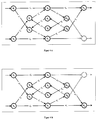
- FIG. 4 (a and b) illustrates how an identical copy of the original neural network is constructed for the sub-data streams of each target. These copies are called layers. With the introduction of the layers, all state variables of the original network are also multiplied. The new sizes are distinguished by a top index (e.g. w 2 / 3.7 is a coupling weight of layer 2). The figure shows the two layers for the example from FIGS. 2 and 3. In layer i , exactly the data streams of the overall system that have the target i are then modeled. However, it should be noted that the layers are not completely independent of one another, since the dynamic equations (0.2) of the neural network also include sums of layer-specific state variables across all layers. In each layer, the dead ends to the other targets are removed (ie the coupling weights of these connections are constantly set to the value 0).
- the RANN defined by equations (0.2) is a so-called ⁇ - ⁇ network because it is weighted Contains sums of products of (sigmoid) functions.
- the top index d always denotes the number of the shift.
- the q d / k are the source data flows of layer d, and ⁇ x is the discrete time interval of the development.
- the total service s i ( x i ) ⁇ [0; c i ] describes the total transmission power of the router computer via the connection i as a function of the data volume x i of the associated output memory, c i being the maximum service rate for the output memory i .
- FIG. 6 The form of such a function is shown in FIG. 6.
- the rough functional form of the total services s i ( x i ) is plotted against the number of packets x i of the queue memory.
- the transmission power s i is limited by the service rate c i .
- s i The exact definition of s i is determined in the specific application by a number of other (fixed) parameters, such as the performance of the computer hardware and the channel capacity of the line.
- the method described here can use any service functions s i as long as they are monotonously increasing and continuously differentiable.
- the monotonically falling r k ⁇ [0; 1] are the memory restrictions. They express the inability of a full output memory to accept further data packets.
- the exact definitions of the r k are insignificant for the method as long as they meet the above requirements.
- the error propagation network is the routing model part of the process. In it, error signals are propagated in the opposite direction to the data packets of the identification network .
- the states of this linear recurrent neural network are used to calculate corrections ⁇ w d / ik of the weights w d / ik of the identification network in accordance with predetermined optimization criteria (the w d / ik determine the routes of the data packets through the communication network).
- the error propagation network realizes a modified version of the learning method recurrent back propagation via a gradient descent along a predetermined target function.
- the development of the required formulas is shown here in a shortened form - without intermediate steps - since the complete statements would go beyond the scope of this description of the invention. In principle, however, the explanations follow the known derivation of the recurrent back-propagation learning method, as is explained, for example, in [4].
- the main difference is that the identification network is a so-called ⁇ - ⁇ network.
- target functions can be defined almost arbitrarily (they must be differentiable in x i ).
- the linear system defined in (0.12) is not contracting because the matrix ⁇ le / ik has a spectral radius greater than 1.
- the left side of the equation defines the 1st error propagation network with a weight matrix ⁇ ee / ik . Its task is to solve the linear system of equations (0.14) iteratively with the right side fixed.
- the second error propagation network with the weight matrix ⁇ le / ik solves the system of equations (0.14) with the left side fixed. So the dynamic equation of the 1st linear network is while the 2nd network realizes the following linear operation
- the working principle of the overall model consists of developing the identification network and the two error propagation networks alternately or in parallel in accordance with their dynamic equations, and after an adjustable number of time cycles t Id t or t Error the current network states are transferred to the other RANN for the calculation of its weight corrections.
- the integer timing parameters t Ident and t Error determine how often corrections are made to the weights and how accurate these corrections are. They can be interpreted as a kind of inertia of the system (larger values correspond to greater inertia).
- Figure 7 shows an overview of the overall model. It can be seen that the overall model is essentially divided into two: the layered identification network with the functions s i ( total services) and r i ( memory restrictions ), both of which depend on sums of state values of the individual layers , and the two-part error propagation network , which realizes the system-optimal routing.
- the error propagation subnets receive weights ⁇ dd / ik or ⁇ de / ik calculated cyclically from state variables of the identification network and return weight corrections for the coupling weights of the identification network.
- the routing tables of the communication network are dynamically adapted to the changing conditions (network load and traffic demand) through a permanent interplay of the subsystems according to predefinable cycles.
- Each router computer routes the incoming data packets according to its routing table, which is formed from the weights w d / ik .
- the weights with the index d are responsible for the packets with the destination router d (or for a correspondingly defined partial stream d ).
- the multipath routing defined by the w d / ik (usually exist for fixed i indices j 1 , j 2 with w d / i, J 1 , w d / i, J 2 ,> 0) is realized by the Data packets are distributed in a corresponding ratio to the outputs j 1 and j 2 . This division should largely be done so that the data packets of a source IP address are assigned to exactly one output.
- each router maintains k statistics (time averages) about all its partial data streams s d / k , s k , their changes over time S '/ k and the lengths of its output queues x d / k , x k .
- the statistical values of the router are sent cyclically to all directly connected neighboring router computers after defined time intervals ⁇ status . After receiving this data, each router is able to calculate its error propagation weights ⁇ de / ik , ⁇ de / ki according to the formula (0.13).
- each router calculates its error signals y d / k and z d / k according to the dynamic laws (0.15) and (0.16).
- the new error signals are sent to all directly connected neighboring router computers.
- each router k calculates the corrections ⁇ w d / ki , ⁇ w d / ik of its routing weights w d / ki , w d / ik using the current values y d / k according to the formula ( 0.17), and normalizes the new weights.
- the new weights are sent to all directly connected neighboring router computers.
Landscapes
- Engineering & Computer Science (AREA)
- Artificial Intelligence (AREA)
- Evolutionary Computation (AREA)
- Medical Informatics (AREA)
- Computer Networks & Wireless Communication (AREA)
- Signal Processing (AREA)
- Data Exchanges In Wide-Area Networks (AREA)
Abstract
Description













Claims (11)
- Verfahren zur Berechnung von, bezüglich vorgegebener netzweiter Zielfunktionen, optimaler Routen für die von einer Quelle zu einem Ziel zu transportierenden Dateneinheiten in Kommunikationsnetzen, mittels einer datenverarbeitenden Anlage,
gekennzeichnet durch folgende Schritte:Topologie und Dynamik des Kommunikationsnetzes werden auf ein spezielles rekurrentes neuronales Sigma-Pi-Netz (Identifikationsnetz) abgebildet, indem Ausgangsspeicher von im Netz angeordneten Routern zusammen mit nachfolgenden Verbindungsleitungen den Neuronen des neuronalen Netzes zugeordnet werden, wodurch Aktivitätszustände (x d / k) der Neuronen die Anzahl der Dateneinheiten eines Ziels (d), die in den entsprechenden Ausgangsspeichern auf ihre Weiterleitung warten, entsprechen, und Kopplungsgewichte (w d / ik) der Neuronen die Anteile der ankommenden Dateneinheiten mit Ziel (d), die zu den möglichen Ausgängen weitergeroutet werden (Routing-Tabelle), wobei das Sigma-Pi-Netz aus einzelnen Schichten aufgebaut ist, in denen Teildatenströme abgebildet werden,die Router-Rechner ermitteln Datendurchsätze (s d / k,sk ), Speicherrestriktionen (rk ) und Warteschlangen in den Ausgangsspeichern (x d / k, xk) sowie zeitliche Veränderungen (x'k,s'k,r'k ) davon und übermitteln diese Größen in zeitlichen Abständen (τ Status ) an direkt verbundene Nachbar-Router-Rechner,die Router-Rechner berechnen zum zielfunktion-abhängigen Routing ein Fehlerpropagierungsnetz auf der Basis einer dem Sigma-Pi-Netz angepassten Version des Lernverfahrens "Rekurrentes Backpropagation", wobei jeder Rechner nur den Teil der Gesamtberechnung ausführt, der seine lokalen Statusgrößen betrifft, dabeiberechnet jeder Router in Zeitabständen (τ Status ) die für die Berechnungen des Fehlerpropagierungsnetzes notwendigen Gewichte (ν de / ik,ν de / ki),berechnet jeder Router in weiteren Zeitabständen (τ Err1 und τ Err2 ) seine Fehlersignale (y d / k) und (z d / k), wonach die neuen Fehlersignale (y d / k) an direkt verbundene Nachbar-Router-Rechner geschickt werden,berechnet jeder Router nach einem zusätzlichen Zeitabstand (τ Kor ) Korrekturen seiner Routing-Gewichte (Δw d / ki, Δw d / ik) mit Hilfe der aktuellen Werte der Fehlersignale (y d / k) und normalisiert die neuen Gewichte, wonach die neuen Gewichte an die direkt verbundene Nachbar-Router-Rechner geschickt werden, die diese neuen Gewichte als neue Routing-Tabelle benutzen. - Verfahren nach Anspruch 1,
dadurch gekennzeichnet, dass die Kommunikationsnetze paketvermittelnd ausgebildet sind. - Verfahren nach einem der Ansprüche 1 oder 2,
dadurch gekennzeichnet, dass die vorkommenden Zeitabstände (τ Status ,τ Err1 ,τ Err2 ,τ Kor )alternativ, etwa in Abhängigkeit von speziellen Ereignissen oder der Last des Kommunikationsnetzes, im Betrieb so nachgeführt werden, dass zum Beispiel der zusätzliche Kommunikationsaufwand minimiert wird. - Verfahren nach einem der Ansprüche 1 bis 3,
dadurch gekennzeichnet, dass durch zusätzliche Gewichtsfaktoren in den verwendeten Zielfunktionen bestimmte Verbindungen oder Routen des Netzes attraktiver sind als andere und daher für die Routenauswahl bevorzugt werden. - Verfahren nach einem der Ansprüche 1 bis 4,
dadurch gekennzeichnet, dass jeder Schicht die Teildatenströme eines jeweils unterschiedlichen Zieles zugeordnet werden. - Verfahren nach einem der Ansprüche 1 bis 5,
dadurch gekennzeichnet, dass zur Einbeziehung von heterogenen Priorisierungsdiensten für verbindungsorientierte Dienste den einzelnen Schichten frei definierbare Teildatenströme (z.B. einer einzelnen Quelle-Ziel-Beziehung) zugeordnet werden, die gesondert behandelt und geroutet werden sollen. - Verfahren nach einem der Ansprüche 1 bis 6,
dadurch gekennzeichnet, dass speziell gekennzeichnete Dateneinlieiten einer Quelle zur Beanspruchung einer besonders priorisierten Route für verbindungsorientierte Dienste auf der kürzesten Route durch das Kommunikationsnetz geleitet werden und für sich und die nachfolgenden Dateneinheiten diesen Weg durch Neubildung einer hochpriorisierten Schicht reservieren. - Verfahren nach einem der Ansprüche 1 bis 7,
dadurch gekennzeichnet, dass eine gewisse Teilmenge der Routen im Kommunikationsnetz fix eingestellt wird, indem Schichten konstruiert werden, deren Gewichte fix sind, also nicht vom Fehlerpropagierungsnetz geändert werden. - Verfahren nach einem der Ansprüche 1 bis 8,
dadurch gekennzeichnet, dass die Router-Rechner die Datendurchsätze (s d / k, sk), Warteschlangen (x d / k, xk ), Speicherrestriktionen (rk ) und die zeitlichen Veränderungen davon (x'k ,s'k ,r'k ) über zeitliche Mittelwerte ermitteln und den weiteren Berechnungen des Verfahrens zur Verfügung stellen. - Verfahren nach einem der Ansprüche 1 bis 9,
dadurch gekennzeichnet, dass die Router-Rechner die Datendurchsätze (s d / k, sk ), Speicherrestriktionen (rk ) und die zeitlichen Veränderungen davon (s'k ,r'k ) über vordefinierte Funktionen ermitteln und den weiteren Berechnungen des Verfahrens zur Verfügung stellen. - Verfahren nach einem der Ansprüche 1 bis 10,
dadurch gekennzeichnet, dass die Router-Rechner bei den Berechnungen des Fehlerpropagierungsnetzes vereinfachend alle Kopplungsgewichte, die verschiedene Schichten betreffen, auf 0 setzen (ν el / ki=0,e≠l),also vernachlässigen.
Priority Applications (1)
| Application Number | Priority Date | Filing Date | Title |
|---|---|---|---|
| EP01120057A EP1253751A3 (de) | 2001-04-25 | 2001-08-21 | Adaptives verteiltes Verfahren zur Berechnung systemoptimaler Routen in Kommunikationsnetzen |
Applications Claiming Priority (3)
| Application Number | Priority Date | Filing Date | Title |
|---|---|---|---|
| EP01110000 | 2001-04-25 | ||
| EP01110000 | 2001-04-25 | ||
| EP01120057A EP1253751A3 (de) | 2001-04-25 | 2001-08-21 | Adaptives verteiltes Verfahren zur Berechnung systemoptimaler Routen in Kommunikationsnetzen |
Publications (2)
| Publication Number | Publication Date |
|---|---|
| EP1253751A2 true EP1253751A2 (de) | 2002-10-30 |
| EP1253751A3 EP1253751A3 (de) | 2002-12-11 |
Family
ID=26076557
Family Applications (1)
| Application Number | Title | Priority Date | Filing Date |
|---|---|---|---|
| EP01120057A Withdrawn EP1253751A3 (de) | 2001-04-25 | 2001-08-21 | Adaptives verteiltes Verfahren zur Berechnung systemoptimaler Routen in Kommunikationsnetzen |
Country Status (1)
| Country | Link |
|---|---|
| EP (1) | EP1253751A3 (de) |
Cited By (2)
| Publication number | Priority date | Publication date | Assignee | Title |
|---|---|---|---|---|
| CN111985684A (zh) * | 2020-07-14 | 2020-11-24 | 西安理工大学 | 一种应用于远距离的长波地波传播时延时变特性预测方法 |
| CN114124823A (zh) * | 2021-10-18 | 2022-03-01 | 西安电子科技大学 | 面向高动态网络拓扑下的自适应路由方法、系统、设备 |
Family Cites Families (3)
| Publication number | Priority date | Publication date | Assignee | Title |
|---|---|---|---|---|
| FR2702859A1 (fr) * | 1993-03-17 | 1994-09-23 | Philips Electronique Lab | Dispositif de recherche d'un plus court chemin dans un réseau. |
| US6078946A (en) * | 1996-09-10 | 2000-06-20 | First World Communications, Inc. | System and method for management of connection oriented networks |
| DE19858477B4 (de) * | 1998-12-17 | 2004-12-02 | Siemens Ag | Verfahren zum Ermitteln von Verkehrsinformationen |
-
2001
- 2001-08-21 EP EP01120057A patent/EP1253751A3/de not_active Withdrawn
Cited By (4)
| Publication number | Priority date | Publication date | Assignee | Title |
|---|---|---|---|---|
| CN111985684A (zh) * | 2020-07-14 | 2020-11-24 | 西安理工大学 | 一种应用于远距离的长波地波传播时延时变特性预测方法 |
| CN111985684B (zh) * | 2020-07-14 | 2023-09-22 | 西安理工大学 | 一种应用于远距离的长波地波传播时延时变特性预测方法 |
| CN114124823A (zh) * | 2021-10-18 | 2022-03-01 | 西安电子科技大学 | 面向高动态网络拓扑下的自适应路由方法、系统、设备 |
| CN114124823B (zh) * | 2021-10-18 | 2023-08-11 | 西安电子科技大学 | 面向高动态网络拓扑下的自适应路由方法、系统、设备 |
Also Published As
| Publication number | Publication date |
|---|---|
| EP1253751A3 (de) | 2002-12-11 |
Similar Documents
| Publication | Publication Date | Title |
|---|---|---|
| EP0872090B1 (de) | Verfahren zum bilden von leitweginformation | |
| DE60000172T2 (de) | Verfahren und Vorrichtung für Lastverteilung in einem Weitbereichsnetz | |
| DE602005002158T2 (de) | Lastausgleichtechnik für Verkehrstechnik zwischen Domänen | |
| DE69118974T2 (de) | Überlastungsregelung für verbindungslosen Verkehr in Datennetzen durch Umweglenkung | |
| DE60026238T2 (de) | Auf vorspezifizierter Dienstgüte basierender Verbindungsaufbau durch ein Kommunikationsnetz | |
| DE68925678T2 (de) | Kommunikationsnetz mit anpassbare wegbestimmung | |
| DE69126640T2 (de) | Flusssteuerung für Hochgeschwindigkeitsnetzwerk | |
| DE602005005471T2 (de) | Peer-to-peer-netze | |
| DE3888818T2 (de) | Aufgeteilte Lastverteilung. | |
| US20050038909A1 (en) | Static dense multicast path and bandwidth management | |
| DE69331013T2 (de) | System und verfahren für ruf-zu-ruf leitweglenkung mit auf regeln basierter rücklenkung | |
| DE60222656T2 (de) | Vorrichtung und verfahren für effizientes multicasting von datenpaketen | |
| DE60112319T2 (de) | Kommunikationsnetze | |
| DE60130844T2 (de) | Autonomes OSPF-System mit einem in zwei Teilbereiche getrennten Hauptnetz | |
| CN101610433A (zh) | 一种支持策略解析的多约束条件路由选择方法 | |
| DE102013104304A1 (de) | Netzwerksystem und Routingverfahren | |
| EP2638672A1 (de) | Verfahren zum erhöhen der qualität der datenübertragung in einem paketbasierten kommunikationsnetz | |
| DE60314821T2 (de) | Steuersystem für Leitweglenkung, Steuervorrichtung für Leitweglenkung und Steuerverfahren für Leitweglenkung | |
| DE60204581T2 (de) | Verfahren zur Optimierung der Verteilung eines Dienstes von einer Quelle zu mehreren Dienstempfängern in einem Netzwerk | |
| DE19858477B4 (de) | Verfahren zum Ermitteln von Verkehrsinformationen | |
| DE60312610T2 (de) | Vorrichtung und Verfahren zur Bestimmung der Weglenkung in einem Kommunikationsnetzwerk, mit Auswahl von Attributen | |
| WO2005013564A1 (de) | Verfahren für ein inter-domain mehrwege-routing | |
| DE102004004793B3 (de) | Verfahren zur Anpassung der Link-Gewichte im Hinblick auf eine optimierte Verkehrsverteilung | |
| DE102018202902B4 (de) | Dynamische TCP Proxy Auswahl zur Beschleunigung von kurzen Netzwerkflüssen | |
| DE10262074B4 (de) | Adaptives verteiltes Verfahren zur Berechnung systemoptimaler Routen in paketvermittelnden Kommunikationsnetzen |
Legal Events
| Date | Code | Title | Description |
|---|---|---|---|
| PUAI | Public reference made under article 153(3) epc to a published international application that has entered the european phase |
Free format text: ORIGINAL CODE: 0009012 |
|
| PUAL | Search report despatched |
Free format text: ORIGINAL CODE: 0009013 |
|
| AK | Designated contracting states |
Kind code of ref document: A2 Designated state(s): AT BE CH CY DE DK ES FI FR GB GR IE IT LI LU MC NL PT SE TR |
|
| AX | Request for extension of the european patent |
Free format text: AL;LT;LV;MK;RO;SI |
|
| AK | Designated contracting states |
Kind code of ref document: A3 Designated state(s): AT BE CH CY DE DK ES FI FR GB GR IE IT LI LU MC NL PT SE TR |
|
| AX | Request for extension of the european patent |
Free format text: AL;LT;LV;MK;RO;SI |
|
| 17P | Request for examination filed |
Effective date: 20030606 |
|
| AKX | Designation fees paid |
Designated state(s): AT BE CH CY DE DK ES FI FR GB GR IE IT LI LU MC NL PT SE TR |
|
| STAA | Information on the status of an ep patent application or granted ep patent |
Free format text: STATUS: THE APPLICATION IS DEEMED TO BE WITHDRAWN |
|
| 18D | Application deemed to be withdrawn |
Effective date: 20040302 |