EP1247509A2 - Absorbent article, absorbent core for absorbent article, and manufacturing process therefor - Google Patents
Absorbent article, absorbent core for absorbent article, and manufacturing process therefor Download PDFInfo
- Publication number
- EP1247509A2 EP1247509A2 EP02252437A EP02252437A EP1247509A2 EP 1247509 A2 EP1247509 A2 EP 1247509A2 EP 02252437 A EP02252437 A EP 02252437A EP 02252437 A EP02252437 A EP 02252437A EP 1247509 A2 EP1247509 A2 EP 1247509A2
- Authority
- EP
- European Patent Office
- Prior art keywords
- nonwoven fabric
- fragments
- fibers
- absorbent body
- absorbent
- Prior art date
- Legal status (The legal status is an assumption and is not a legal conclusion. Google has not performed a legal analysis and makes no representation as to the accuracy of the status listed.)
- Granted
Links
Images
Classifications
-
- A—HUMAN NECESSITIES
- A61—MEDICAL OR VETERINARY SCIENCE; HYGIENE
- A61F—FILTERS IMPLANTABLE INTO BLOOD VESSELS; PROSTHESES; DEVICES PROVIDING PATENCY TO, OR PREVENTING COLLAPSING OF, TUBULAR STRUCTURES OF THE BODY, e.g. STENTS; ORTHOPAEDIC, NURSING OR CONTRACEPTIVE DEVICES; FOMENTATION; TREATMENT OR PROTECTION OF EYES OR EARS; BANDAGES, DRESSINGS OR ABSORBENT PADS; FIRST-AID KITS
- A61F13/00—Bandages or dressings; Absorbent pads
- A61F13/15—Absorbent pads, e.g. sanitary towels, swabs or tampons for external or internal application to the body; Supporting or fastening means therefor; Tampon applicators
- A61F13/53—Absorbent pads, e.g. sanitary towels, swabs or tampons for external or internal application to the body; Supporting or fastening means therefor; Tampon applicators characterised by the absorbing medium
- A61F13/531—Absorbent pads, e.g. sanitary towels, swabs or tampons for external or internal application to the body; Supporting or fastening means therefor; Tampon applicators characterised by the absorbing medium having a homogeneous composition through the thickness of the pad
-
- A—HUMAN NECESSITIES
- A61—MEDICAL OR VETERINARY SCIENCE; HYGIENE
- A61F—FILTERS IMPLANTABLE INTO BLOOD VESSELS; PROSTHESES; DEVICES PROVIDING PATENCY TO, OR PREVENTING COLLAPSING OF, TUBULAR STRUCTURES OF THE BODY, e.g. STENTS; ORTHOPAEDIC, NURSING OR CONTRACEPTIVE DEVICES; FOMENTATION; TREATMENT OR PROTECTION OF EYES OR EARS; BANDAGES, DRESSINGS OR ABSORBENT PADS; FIRST-AID KITS
- A61F13/00—Bandages or dressings; Absorbent pads
- A61F13/15—Absorbent pads, e.g. sanitary towels, swabs or tampons for external or internal application to the body; Supporting or fastening means therefor; Tampon applicators
- A61F13/53—Absorbent pads, e.g. sanitary towels, swabs or tampons for external or internal application to the body; Supporting or fastening means therefor; Tampon applicators characterised by the absorbing medium
- A61F13/538—Absorbent pads, e.g. sanitary towels, swabs or tampons for external or internal application to the body; Supporting or fastening means therefor; Tampon applicators characterised by the absorbing medium characterised by specific fibre orientation or weave
-
- A—HUMAN NECESSITIES
- A61—MEDICAL OR VETERINARY SCIENCE; HYGIENE
- A61F—FILTERS IMPLANTABLE INTO BLOOD VESSELS; PROSTHESES; DEVICES PROVIDING PATENCY TO, OR PREVENTING COLLAPSING OF, TUBULAR STRUCTURES OF THE BODY, e.g. STENTS; ORTHOPAEDIC, NURSING OR CONTRACEPTIVE DEVICES; FOMENTATION; TREATMENT OR PROTECTION OF EYES OR EARS; BANDAGES, DRESSINGS OR ABSORBENT PADS; FIRST-AID KITS
- A61F13/00—Bandages or dressings; Absorbent pads
- A61F13/15—Absorbent pads, e.g. sanitary towels, swabs or tampons for external or internal application to the body; Supporting or fastening means therefor; Tampon applicators
- A61F13/15577—Apparatus or processes for manufacturing
- A61F13/15617—Making absorbent pads from fibres or pulverulent material with or without treatment of the fibres
- A61F13/15626—Making fibrous pads without outer layers
-
- A—HUMAN NECESSITIES
- A61—MEDICAL OR VETERINARY SCIENCE; HYGIENE
- A61F—FILTERS IMPLANTABLE INTO BLOOD VESSELS; PROSTHESES; DEVICES PROVIDING PATENCY TO, OR PREVENTING COLLAPSING OF, TUBULAR STRUCTURES OF THE BODY, e.g. STENTS; ORTHOPAEDIC, NURSING OR CONTRACEPTIVE DEVICES; FOMENTATION; TREATMENT OR PROTECTION OF EYES OR EARS; BANDAGES, DRESSINGS OR ABSORBENT PADS; FIRST-AID KITS
- A61F13/00—Bandages or dressings; Absorbent pads
- A61F13/15—Absorbent pads, e.g. sanitary towels, swabs or tampons for external or internal application to the body; Supporting or fastening means therefor; Tampon applicators
- A61F13/53—Absorbent pads, e.g. sanitary towels, swabs or tampons for external or internal application to the body; Supporting or fastening means therefor; Tampon applicators characterised by the absorbing medium
- A61F2013/530131—Absorbent pads, e.g. sanitary towels, swabs or tampons for external or internal application to the body; Supporting or fastening means therefor; Tampon applicators characterised by the absorbing medium being made in fibre but being not pulp
- A61F2013/530182—Absorbent pads, e.g. sanitary towels, swabs or tampons for external or internal application to the body; Supporting or fastening means therefor; Tampon applicators characterised by the absorbing medium being made in fibre but being not pulp characterized by the connection between the fibres
-
- Y—GENERAL TAGGING OF NEW TECHNOLOGICAL DEVELOPMENTS; GENERAL TAGGING OF CROSS-SECTIONAL TECHNOLOGIES SPANNING OVER SEVERAL SECTIONS OF THE IPC; TECHNICAL SUBJECTS COVERED BY FORMER USPC CROSS-REFERENCE ART COLLECTIONS [XRACs] AND DIGESTS
- Y10—TECHNICAL SUBJECTS COVERED BY FORMER USPC
- Y10T—TECHNICAL SUBJECTS COVERED BY FORMER US CLASSIFICATION
- Y10T156/00—Adhesive bonding and miscellaneous chemical manufacture
- Y10T156/10—Methods of surface bonding and/or assembly therefor
- Y10T156/1052—Methods of surface bonding and/or assembly therefor with cutting, punching, tearing or severing
- Y10T156/1062—Prior to assembly
Definitions
- the present invention relates to an absorbent article such as disposable diaper, pad for diaper, sanitary napkin, pet sheet and the like. More particularly, the present invention relates to an absorbent body to be used in the absorbent article and a manufacturing process therefor.
- absorbent articles are constructed to include: a liquid-permeable topsheet; a liquid-impermeable backsheet; and an absorbent body (absorbent core) interposed between the two sheets.
- the absorbent body is composed of absorbent fibers such as pulp and particulates of absorbent polymer.
- the improvement of compressive recovery (absorbency) and the improvement of shape stability are important challenge.
- Japanese Unexamined Patent Publication (Kokai) No. 2-74254 (74254/1990) discloses an absorbent body which contains 10 to 70% by weight of heat-fusible crimped fibers, 10 to 70% by weight of fluff pulp, and 5 to 50% by weight of particulates of absorbent polymer.
- the heat-fusible crimped fibers are fusion-bonded to each other to have three-dimensional network structure, thereby improving the recovery (absorbency) and shape stability of the absorbent body.
- the density of the three-dimensional framework composed of the heat-fusible fibers, the fluff pulp and the particulate absorbent polymer is high, which becomes a factor of interfering with one of basic functions in absorbent body i.e., swelling of the particulate absorbent polymer when body fluid is absorbed by the particulate polymer.
- the heat-fusible crimped fibers are thermally fusion-bonded to each other after the heat-fusible crimped fibers, the fluff pulp and the particulate absorbent polymer are mixed, the fluff pulp (not heat-fusible fibers) and the particulate absorbent polymer become an interfering factor. More specifically, fusion-bonding of the heat-fusible crimped fibers to each other in a condition where the fluff pulp (not heat-fusible fibers) and the particulate absorbent polymer are mixed therewith, requires large calorie.
- the processing temperature is simply set at a high level in order to increase the processing speed, the fusion-bonding can be done only in the surface of the absorbent body but not inside the absorbent body. As a result, sufficient shape stability can not be provided, so that the absorbent article may lose its shape after absorption of liquid. On the other hand, even if the heating rate is lowered, there is a problem of remarkable decrease in productivity, as well as it is still difficult to sufficiently heat inside of the absorbent body.
- the present invention has been worked out in view of the shortcoming in the prior art set forth above. It is therefore an object of the present invention to provide an absorbent body for use in an absorbent article, which has superior absorbency due to improved compressive recovery and superior shape stability.
- an absorbent body for use in an absorbent article, the absorbent body comprising: fragments of nonwoven fabric including heat-fusible fibers, the heat-fusible fibers being bonded to each other to have three-dimensional structure in advance of formation of the fragments; and hydrophilic fibers, the nonwoven fabric fragments and the hydrophilic fibers being blended.
- this absorbent body since the heat-fusible fibers are bonded to each other to have three-dimensional structure in advance of formation of the nonwoven fabric fragments, vacant spaces are formed inside of the absorbent body to improve the recovery after absorption of liquid. As a result, the absorbency is also improved.
- the nonwoven fabric fragments are thermally bonded to each other after blending of the nonwoven fabric fragments and the hydrophilic fibers.
- the heat-fusible fibers are bonded to each other to have three-dimensional structure in advance of formation of the nonwoven fabric fragments, the nonwoven fabric fragments can be certainly bonded to each other with relatively small calorie, thereby improving the productivity and the shape stability of the absorbent body. That is, the internal structure of the absorbent body is so stable as to maintain its original shape even after absorption of liquid.
- the nonwoven fabric fragments consist of the heat-fusible fibers. With this, bonding of the nonwoven fabric fragments can be further facilitated.
- the hydrophilic fibers are absorbent fibers having high water-absorbency. With this, the absorbency of the absorbent body can increase further.
- the absorbent body may further contain 5 to 95% by weight of particulates of superabsorbent polymer, and the blending weight ratio of the nonwoven fabric fragments to the hydrophilic fibers may be from 2:8 to 8:2 With the superabsorbent polymer thus contained, the absorbency of the absorbent body can increase further. With the blending weight ratio of the nonwoven fabric fragments to the hydrophilic fibers in the range from 2:8 to 8:2, on the other hand, well-balanced absorbency can be obtained. In detail, if the blending ratio of the nonwoven fabric fragments to the hydrophilic fibers is smaller than 2:8, compressive recovery may possibly decrease to lower absorbency. If the blending ratio is greater than 8:2, on the other hand, absorbency may possibly decrease since the hydrophilic fibers are not sufficiently present.
- average dimensions of the nonwoven fabric fragments are set within a range of 3 to 25 mm. More preferably, the average dimensions are set within a range of 5 to 15 mm. With this, it becomes possible to maintain surface smoothness of product and to prevent clogging in production line.
- an absorbent article comprising a liquid-permeable topsheet, a liquid-impermeable backsheet and an absorbent body disposed between the topsheet and the backsheet.
- the absorbent body comprises: fragments of nonwoven fabric including heat-fusible fibers, the heat-fusible fibers being bonded to each other to have three-dimensional structure in advance of formation of the fragments; and hydrophilic fibers, the nonwoven fabric fragments and the hydrophilic fibers being blended.
- the nonwoven fabric fragments are thermally bonded to each other after blending of the nonwoven fabric fragments and the hydrophilic fibers.
- the heat-fusible fibers are bonded to each other to have three-dimensional structure in advance of formation of the nonwoven fabric fragments, the nonwoven fabric fragments can be certainly bonded to each other with relatively small calorie, thereby improving the productivity and the shape stability of the absorbent article housing the absorbent body. That is, the internal structure of the absorbent article is so stable as to maintain its original shape even after absorption of liquid.
- the nonwoven fabric fragments consist of the heat-fusible fibers. With this, bonding of the nonwoven fabric fragments can be further facilitated.
- the hydrophilic fibers are absorbent fibers having high water-absorbency. With this, the absorbency of the absorbent article can increase further.
- the absorbent body may further contain 5 to 95% by weight of particulates of superabsorbent polymer, and the blending weight ratio of the nonwoven fabric fragments to the hydrophilic fibers may be from 2:8 to 8:2. With the superabsorbent polymer thus contained, the absorbency of the absorbent body can increase further. With the blending weight ratio of the nonwoven fabric fragments to the hydrophilic fibers in the range from 2:8 to 8:2, on the other hand, well-balanced absorbency can be obtained. In detail, if the blending ratio of the nonwoven fabric fragments to the hydrophilic fibers is smaller than 2:8, compressive recovery may possibly decrease to lower absorbency. If the blending ratio is greater than 8:2, on the other hand, absorbency may possibly decrease since the hydrophilic fibers are not sufficiently present.
- average dimensions of the nonwoven fabric fragments are set within a range of 3 to 25 mm. More preferably, the average dimensions are set within a range of 5 to 15 mm. with this, it becomes possible to maintain surface smoothness of product and to prevent clogging in production line.
- a process for manufacturing an absorbent body for use in an absorbent article comprising: forming nonwoven fabric in which constituent fibers are bonded to each other to have three-dimensional structure; breaking the nonwoven fabric into fragments; blending the nonwoven fabric fragments with hydrophilic fibers; and thermally fusion-bonding the nonwoven fabric fragments to each other.
- the nonwoven fabric fragments, in which the constituent fibers have been bonded to each other to have three-dimensional structure in advance of formation of the fragments are first prepared, mixed with the hydrophilic fibers, and then thermally bonded to each other. Therefore, the nonwoven fabric fragments can be bonded to each other with relatively small calorie, thereby improving the productivity.
- the nonwoven fabric fragments since the constituent fibers of the nonwoven fabric fragments have been bonded to each other to have three-dimensional structure in advance of fusion-bonding of the nonwoven fabric fragments to each other, the nonwoven fabric fragments can be certainly fusion-bonded to each other, thereby improving the shape stability of the absorbent body.
- the absorbent body may further contain 5 to 95% by weight of particulates of superabsorbent polymer, and the blending weight ratio of the nonwoven fabric fragments to the hydrophilic fibers may be from 2:8 to 8:2.
- the absorbency of the absorbent body can increase further.
- the blending weight ratio of the nonwoven fabric fragments to the hydrophilic fibers in the range from 2:8 to 8:2, on the other hand, well-balanced absorbency can be obtained.
- the blending ratio of the nonwoven fabric fragments to the hydrophilic fibers is smaller than 2:8, compressive recovery may possibly decrease to lower absorbency. If the blending ratio is greater than 8:2, on the other hand, absorbency may possibly decrease since the hydrophilic fibers are not sufficiently present.
- average dimensions of the nonwoven fabric fragments are set within a range of 3 to 25 mm. More preferably, the average dimensions are set within a range of 5 to 15 mm. With this, it becomes possible to maintain surface smoothness of product and to prevent clogging in production liner
- the absorbent body according to the present invention can be used for various kinds of absorbent article such as disposable diaper, pad for diaper, sanitary napkin, pet sheet, and the like.
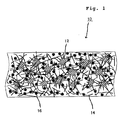
- Fig. 1 shows a structure of an absorbent body 10 according to one embodiment of the present invention.
- the absorbent body 10 is to be used for an absorbent article.
- the absorbent body 10 is in sheet form and comprises: fragments 12 formed from nonwoven fabric of which constituent fibers are bonded to each other to have three-dimensional structure in advance of formation of the fragments; hydrophilic fibers 14; and SAP (superabsorbent polymer) 16.
- the nonwoven fabric fragments 12 mainly contribute to improvement of shape stability of the absorbent body 10.
- the hydrophilic fibers 14 and the SAP 16 mainly contribute to improvement of liquid absorbency.
- the nonwoven fabric fragments 12 of three-dimensional structure can be obtained by breaking the nonwoven fabric into small fragments.
- nonwoven fabric fragments 12 preferably used is thermally bonded nonwoven fabric, such as spunbonded nonwoven fabric, point bonded nonwoven fabric, meltblown nonwoven fabric, through-air bonded nonwoven fabric, or the like.
- thermally bonded nonwoven fabric such as spunbonded nonwoven fabric, point bonded nonwoven fabric, meltblown nonwoven fabric, through-air bonded nonwoven fabric, or the like.
- through-air bonded nonwoven fabric is so bulky, and therefore, it is most preferred in view of compressive recovery.
- the constituent fibers forming the nonwoven fabric fragments 12 use can be made of polyolefine fibers, polyester fibers, polyamide fibers, or thick-and-thin type or side-by-side type bicomponent fibers of polyethylene/polypropylene or polyester.
- Average dimensions of the nonwoven fabric fragments 12 are preferably set within a range of 3 to 25 mm, more preferably within a range of 3 to 15 mm, for example, to 5 mm. If the average dimensions of the nonwoven fabric fragments 12 are smaller than 3 mm, the compressive recovery is decreased; if greater than 25 mm, the fragments 12 may cause clogging in production line or impair surface smoothness of products.
- the term "average dimension" as used herein refers to the average of the maximum dimension and the minimum dimension of each fibrous nonwoven fabric fragment.
- at least 80% of the fibrous nonwoven fabric fragments are preferably set within the foregoing range. That is, it is not necessary to set the average dimensions of all the fragments within the range of 3 to 25 mm.
- cutter mill method or the like can be employed.
- hydrophilic fibers 14 preferably used are absorbent fibers, such as pulp, cotton, rayon, acetate, or the like.
- SAP superabsorbent polymer
- use can be made of any materials known in the art, for example, such as: sodium polyacrylate; acrylic acid-vinyl alcohol copolymer; sodium polyacrylate crosslinked polymer; (starch-acrylic acid) graft copolymer; (isobutylene-maleic anhydride) copolymer and saponified matter thereof; and polyasparagine acid.
- the SAP 16 may be blended into the absorbent body 10, for example, in an amount of 5 to 95% by weight, although it is not necessarily needed for the SAP 16 to be added thereto.
- the blending ratio of the nonwoven fabric fragments 12 to the hydrophilic fibers 14 based on weight is preferably from 2:8 to 8:2. If the blending ratio is smaller than 2:8, the compressive recovery may possibly decrease to lower the absorbency. If the blending ratio is greater than 8:2, on the other hand, the absorbency may possibly decrease since the hydrophilic fibers are not sufficiently present.
- the nonwoven fabric fragments 12 are preferably blended in an amount of 20 to 80% by weight.
- the amount of the nonwoven fabric fragments 12 is set at 60 to 80%, for example.
- the amount of the nonwoven fabric fragments 12 is preferably set at 20 to 40%.
- the nonwoven fabric fragments 12 are thermally bonded to each other.
- nonwoven fabric in which constituent fibers are bonded to each other to have three-dimensional structure is first prepared. Then, the nonwoven fabric is broken into the nonwoven fabric fragments 12. The nonwoven fabric fragments 12 are blended with the hydrophilic fibers 14 and the SAP 16. Thereafter, the nonwoven fabric fragments 12 are thermally fusion-bonded to each other.
- fusion-bonding of the nonwoven fabric fragments 12 to each other can be performed with relatively small calorie, thereby improving the productivity.
- constituent fibers of each nonwoven fabric fragment 12 have been already bonded to each other to have three-dimensional structure in advance of fusion-bonding of the nonwoven fabric fragments 12 to each other, fusion-bonding of the nonwoven fabric fragments 12 to each other can be certainly performed, thereby improving the shape stability of the absorbent body 10.
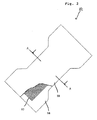
- Fig. 2 shows an absorbent article 20 using the foregoing absorbent body 10, which is embodied in an open-type disposable diaper.
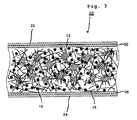
- the absorbent article 20 is provided with a liquid-permeable topsheet 22 and a liquid-impermeable backsheet 24. More specifically, as shown in Fig. 3, water-permeable tissue papers 26 are disposed between the topsheet 22 and the absorbent body 10 and between the backsheet 24 and the absorbent body 10.
- the topsheet 22 and the water-permeable tissue paper 26 opposed to the topsheet 22, and the backsheet 24 and the tissue paper 26 opposed to the backsheet 24 are bonded to each other with a hot-melt adhesive or the like, respectively.
- the upper and lower tissue papers 26 opposed to the absorbent body may also be bonded to the absorbent body with a hot-melt adhesive or the like.
- the hot-melt adhesive may be applied in an open pattern selected from patterns of an array of lines, dots, spirals, an array of waves, a lattice and the like.
- bonding may be directly performed by heat seal, sonic seal or the like.
- hydrophilic fibers use can be made of nonwoven fabric formed from hydrophilic fibers, apertured film, or the like.
- hydrophilic fibers use can be made of thermoplastic fibers (e.g., polyolefine fibers, polyester fibers, polyamide fibers, or thick-and-thin type or side-by-side type bicomponent fibers of polyethylene/polypropylene or polyester) treated to be hydrophilic, or absorbent fibers (e.g., pulp, rayon, acetate or cotton).
- absorbent fibers e.g., pulp, rayon, acetate or cotton.
- apertured film preferably used is polyolefine film of polyethylene, polypropylene or the like.
- the backsheet 24 use can be made of polyethylene film, polypropylene film, polyester film, polyurethane film or the like.
- the backsheet is preferred to be moisture-permeable.
- the absorbent article 20 thus constructed can restore to its original shape after removal of the effect of the external force.
- the absorbent article 20 readily conforms to the body shape of the wearer and also exhibits superior followability to the body movement.
- the absorbent body 10 exhibits superior absorbency due to the hydrophilic fibers 14 and the SAP 16 blended therein.
- the absorbent article and the absorbent body used therefor since the hydrophilic fibers are bonded to each other to have three-dimensional structure in advance of formation of the nonwoven fragments, vacant spaces are formed inside of the absorbent body to improve the recovery after absorption of liquid. As a result, the absorbency is also improved.
- the nonwoven fabric fragments in which the constituent fibers have been bonded to each other to have three-dimensional structure in advance of formation of the fragments, are first prepared, mixed with the hydrophilic fibers, and then thermally bonded to each other. Therefore, the nonwoven fabric fragments can be bonded to each other with relatively small calorie, thereby improving the productivity.
- the constituent fibers of the nonwoven fabric fragments have been bonded to each other to have three-dimensional structure in advance of fusion-bonding of the nonwoven fabric fragments to each other, the nonwoven fabric fragments can be certainly fusion-bonded to each other, thereby improving the shape stability of the absorbent body.
Landscapes
- Health & Medical Sciences (AREA)
- Engineering & Computer Science (AREA)
- General Health & Medical Sciences (AREA)
- Public Health (AREA)
- Heart & Thoracic Surgery (AREA)
- Vascular Medicine (AREA)
- Life Sciences & Earth Sciences (AREA)
- Animal Behavior & Ethology (AREA)
- Epidemiology (AREA)
- Biomedical Technology (AREA)
- Veterinary Medicine (AREA)
- Manufacturing & Machinery (AREA)
- Absorbent Articles And Supports Therefor (AREA)
- Nonwoven Fabrics (AREA)
- Orthopedics, Nursing, And Contraception (AREA)
- Solid-Sorbent Or Filter-Aiding Compositions (AREA)
- Materials For Medical Uses (AREA)
Abstract
Description
Claims (18)
- An absorbent body for use in an absorbent article, the absorbent body comprising: fragments of nonwoven fabric including heat-fusible fibers, the heat-fusible fibers being bonded to each other to have three-dimensional structure in advance of formation of the fragments; and hydrophilic fibers, the nonwoven fabric fragments and the hydrophilic fibers being blended.
- An absorbent body as set forth in claim 1, wherein the nonwoven fabric fragments are thermally bonded to each other after blending of the nonwoven fabric fragments and the hydrophilic fibers.
- An absorbent body as set forth in claim 1, wherein the nonwoven fabric fragments consist of the heat-fusible fibers.
- An absorbent body as set forth in claim 1, wherein the hydrophilic fibers are absorbent fibers having high water-absorbency.
- An absorbent body as set forth in claim 1, which further contains 5 to 95% by weight of particulates of superabsorbent polymer, wherein the blending weight ratio of the nonwoven fabric fragments to the hydrophilic fibers is from 2:8 to 8:2.
- An absorbent body as set forth in claim 1, wherein average dimensions of the nonwoven fabric fragments are set within a range of 3 to 25 mm.
- An absorbent body as set forth in claim 6, wherein the average dimensions are set within a range of 5 to 15 mm.
- An absorbent article comprising a liquid-permeable topsheet, a liquid-impermeable backsheet and an absorbent body disposed between the topsheet and the backsheet,
the absorbent body comprising: fragments of nonwoven fabric including heat-fusible fibers, the heat-fusible fibers being bonded to each other to have three-dimensional structure in advance of formation of the fragments; and hydrophilic fibers, the nonwoven fabric fragments and the hydrophilic fibers being blended. - An absorbent article as set forth in claim 8, wherein the nonwoven fabric fragments are thermally bonded to each other after blending of the nonwoven fabric fragments and the hydrophilic fibers.
- An absorbent article as set forth in claim 8, wherein the nonwoven fabric fragments consist of the heat-fusible fibers.
- An absorbent article as set forth in claim 8, wherein the hydrophilic fibers are absorbent fibers having high water-absorbency.
- An absorbent article as set forth in claim 8, wherein the absorbent body further contains 5 to 95% by weight of particulates of superabsorbent polymer, and the blending weight ratio of the nonwoven fabric fragments to the hydrophilic fibers is from 2:8 to 8:2.
- An absorbent article as set forth in claim 8, wherein average dimensions of the nonwoven fabric fragments are set within a range of 3 to 25 mm.
- An absorbent article as set forth in claim 13, wherein the average dimensions are set within a range of 5 to 15 mm.
- A process for manufacturing an absorbent body for use in an absorbent article, the manufacturing process comprising:forming nonwoven fabric in which constituent fibers are bonded to each other to have three-dimensional structure;breaking the nonwoven fabric into fragments;blending the nonwoven fabric fragments with hydrophilic fibers; andthermally fusion-bonding the nonwoven fabric fragments to each other.
- A manufacturing process as set forth in claim 15, wherein the absorbent body further contains 5 to 95% by weight of particulates of superabsorbent polymer, and the blending weight ratio of the nonwoven fabric fragments to the hydrophilic fibers is from 2:8 to 8:2.
- A manufacturing process as set forth in claim 15, wherein average dimensions of the nonwoven fabric fragments are set within a range of 3 to 25 mm.
- A manufacturing process as set forth in claim 17, wherein the average dimensions are set within a range of 5 to 15 mm.
Applications Claiming Priority (2)
| Application Number | Priority Date | Filing Date | Title |
|---|---|---|---|
| JP2001108263 | 2001-04-06 | ||
| JP2001108263A JP3916205B2 (en) | 2001-04-06 | 2001-04-06 | Absorbent article, absorbent body for absorbent article, and method for producing the same |
Publications (3)
| Publication Number | Publication Date |
|---|---|
| EP1247509A2 true EP1247509A2 (en) | 2002-10-09 |
| EP1247509A3 EP1247509A3 (en) | 2005-10-12 |
| EP1247509B1 EP1247509B1 (en) | 2008-08-27 |
Family
ID=18960435
Family Applications (1)
| Application Number | Title | Priority Date | Filing Date |
|---|---|---|---|
| EP02252437A Expired - Lifetime EP1247509B1 (en) | 2001-04-06 | 2002-04-03 | Absorbent article, absorbent core for absorbent article, and manufacturing process therefor |
Country Status (8)
| Country | Link |
|---|---|
| US (2) | US20020147434A1 (en) |
| EP (1) | EP1247509B1 (en) |
| JP (1) | JP3916205B2 (en) |
| KR (1) | KR20020079471A (en) |
| AT (1) | ATE406149T1 (en) |
| DE (1) | DE60228518D1 (en) |
| SG (1) | SG105542A1 (en) |
| TW (1) | TW546134B (en) |
Cited By (5)
| Publication number | Priority date | Publication date | Assignee | Title |
|---|---|---|---|---|
| EP1417946A1 (en) * | 2002-11-11 | 2004-05-12 | Kao Corporation | Absorbent article |
| WO2006071423A1 (en) * | 2004-12-23 | 2006-07-06 | Kimberly-Clark Worldwide, Inc. | Absorbent structure with aggregate clusters |
| CN110621273A (en) * | 2017-10-03 | 2019-12-27 | 花王株式会社 | Method for producing absorbent |
| CN112135593A (en) * | 2018-12-13 | 2020-12-25 | 花王株式会社 | Absorbent article |
| CN116473759A (en) * | 2023-04-24 | 2023-07-25 | 湖北丝宝护理用品有限公司 | Absorbent core, hygienic article, and manufacturing device and method for absorbent core |
Families Citing this family (37)
| Publication number | Priority date | Publication date | Assignee | Title |
|---|---|---|---|---|
| JP3964685B2 (en) | 2002-01-24 | 2007-08-22 | ユニ・チャーム株式会社 | Absorbent articles that reduce urine odor |
| JP4822864B2 (en) * | 2006-02-09 | 2011-11-24 | 花王株式会社 | Water-absorbing composite and absorbent article using the same |
| CN107242938B (en) * | 2017-07-07 | 2021-02-09 | 陈建辉 | Water-absorbing core body and preparation method and application thereof |
| JP2019063373A (en) * | 2017-10-03 | 2019-04-25 | 花王株式会社 | Absorbent article |
| JP7027102B2 (en) * | 2017-10-03 | 2022-03-01 | 花王株式会社 | Absorber manufacturing method and absorber manufacturing equipment |
| JP6965082B2 (en) * | 2017-10-03 | 2021-11-10 | 花王株式会社 | Absorbent manufacturing method |
| US11191675B2 (en) | 2017-10-03 | 2021-12-07 | Kao Corporation | Method for manufacturing absorbent body and device for manufacturing absorbent body |
| JP6952560B2 (en) * | 2017-10-03 | 2021-10-20 | 花王株式会社 | Absorbent manufacturing method |
| WO2019069882A1 (en) * | 2017-10-03 | 2019-04-11 | 花王株式会社 | Absorbent and absorbent article |
| WO2019069385A1 (en) * | 2017-10-03 | 2019-04-11 | 花王株式会社 | Method for manufacturing absorbent body and absorbent article and device for manufacturing absorbent body and absorbent article |
| JP7014577B2 (en) * | 2017-10-03 | 2022-02-01 | 花王株式会社 | Absorber and absorbent article |
| JP6952561B2 (en) * | 2017-10-03 | 2021-10-20 | 花王株式会社 | Absorbent article manufacturing method and absorbent article manufacturing equipment |
| JP6663893B2 (en) * | 2017-10-03 | 2020-03-13 | 花王株式会社 | Manufacturing method of absorber |
| JP6951181B2 (en) * | 2017-10-03 | 2021-10-20 | 花王株式会社 | Absorber manufacturing method and absorber manufacturing equipment |
| CN111031987B (en) * | 2017-10-03 | 2022-05-03 | 花王株式会社 | Absorbent body and absorbent article |
| JP7058112B2 (en) * | 2017-10-03 | 2022-04-21 | 花王株式会社 | Absorber and absorbent article |
| JP6524189B2 (en) * | 2017-10-03 | 2019-06-05 | 花王株式会社 | Absorbent body and absorbent article |
| JP7027103B2 (en) * | 2017-10-03 | 2022-03-01 | 花王株式会社 | Absorber manufacturing method and absorber manufacturing equipment |
| JP6538948B2 (en) * | 2017-11-28 | 2019-07-03 | 花王株式会社 | Absorbent body and absorbent article |
| JP2019097614A (en) * | 2017-11-28 | 2019-06-24 | 花王株式会社 | Method and apparatus for manufacturing sheet pieces, and manufacturing method of absorber |
| WO2019107238A1 (en) * | 2017-11-28 | 2019-06-06 | 花王株式会社 | Absorbent body and absorbent article |
| JP6990095B2 (en) * | 2017-11-28 | 2022-01-12 | 花王株式会社 | Absorber and absorbent article |
| JP6994368B2 (en) * | 2017-11-28 | 2022-01-14 | 花王株式会社 | Absorbent article |
| JP7045836B2 (en) * | 2017-11-28 | 2022-04-01 | 花王株式会社 | Absorbent article |
| JP6620138B2 (en) * | 2017-11-28 | 2019-12-11 | 花王株式会社 | Absorbent article package and manufacturing method of absorbent article package |
| JP6523412B1 (en) * | 2017-11-28 | 2019-05-29 | 花王株式会社 | Absorbent body and absorbent article |
| JP6554524B2 (en) * | 2017-11-28 | 2019-07-31 | 花王株式会社 | Absorbent articles |
| GB2575216B (en) | 2017-11-28 | 2022-08-24 | Kao Corp | Method for producing absorber and method for producing absorbent article |
| JP7029997B2 (en) * | 2018-03-29 | 2022-03-04 | 花王株式会社 | Absorber manufacturing method and absorber manufacturing equipment |
| JP7118752B2 (en) * | 2018-06-05 | 2022-08-16 | 花王株式会社 | Absorbent manufacturing method |
| JP6683795B1 (en) * | 2018-11-14 | 2020-04-22 | 花王株式会社 | Absorber manufacturing method and manufacturing apparatus |
| JP6824948B2 (en) * | 2018-12-13 | 2021-02-03 | 花王株式会社 | Absorbents and absorbent articles |
| JP7257219B2 (en) * | 2019-03-29 | 2023-04-13 | 花王株式会社 | absorbent article |
| JP7257220B2 (en) * | 2019-03-29 | 2023-04-13 | 花王株式会社 | absorbent article |
| JP7175826B2 (en) * | 2019-03-29 | 2022-11-21 | 花王株式会社 | absorbent article |
| JP7253977B2 (en) * | 2019-05-21 | 2023-04-07 | 花王株式会社 | absorbent article |
| JP7253445B2 (en) * | 2019-05-21 | 2023-04-06 | 花王株式会社 | absorbent article |
Family Cites Families (10)
| Publication number | Priority date | Publication date | Assignee | Title |
|---|---|---|---|---|
| US2964041A (en) * | 1956-07-23 | 1960-12-13 | Personal Products Corp | Absorbent product |
| US4100324A (en) * | 1974-03-26 | 1978-07-11 | Kimberly-Clark Corporation | Nonwoven fabric and method of producing same |
| US4061823A (en) * | 1975-12-11 | 1977-12-06 | Westinghouse Electric Corporation | Highly machinable cotton-phenolic base for decorative assemblies |
| US4758466A (en) * | 1987-05-05 | 1988-07-19 | Personal Products Company | Foam-fiber composite and process |
| US4813948A (en) * | 1987-09-01 | 1989-03-21 | Minnesota Mining And Manufacturing Company | Microwebs and nonwoven materials containing microwebs |
| JPS6468565A (en) * | 1987-09-04 | 1989-03-14 | Kao Corp | Production of nonwoven fabric |
| JPH0638814B2 (en) | 1988-09-08 | 1994-05-25 | ユニ・チャーム株式会社 | Absorbent body for absorbent article and manufacturing method thereof |
| US5030229A (en) * | 1990-01-12 | 1991-07-09 | Chicopee | Disposable urinary pad |
| JP3846905B2 (en) * | 1993-06-25 | 2006-11-15 | 花王株式会社 | Absorbent articles |
| JP3010005B2 (en) * | 1995-02-27 | 2000-02-14 | 東洋電機製造株式会社 | Inverter device |
-
2001
- 2001-04-06 JP JP2001108263A patent/JP3916205B2/en not_active Expired - Fee Related
-
2002
- 2002-04-03 EP EP02252437A patent/EP1247509B1/en not_active Expired - Lifetime
- 2002-04-03 AT AT02252437T patent/ATE406149T1/en not_active IP Right Cessation
- 2002-04-03 DE DE60228518T patent/DE60228518D1/en not_active Expired - Lifetime
- 2002-04-04 SG SG200202016A patent/SG105542A1/en unknown
- 2002-04-04 KR KR1020020018454A patent/KR20020079471A/en not_active Withdrawn
- 2002-04-04 TW TW091106887A patent/TW546134B/en not_active IP Right Cessation
- 2002-04-05 US US10/116,836 patent/US20020147434A1/en not_active Abandoned
-
2010
- 2010-03-16 US US12/725,107 patent/US8182623B2/en not_active Expired - Fee Related
Cited By (7)
| Publication number | Priority date | Publication date | Assignee | Title |
|---|---|---|---|---|
| EP1417946A1 (en) * | 2002-11-11 | 2004-05-12 | Kao Corporation | Absorbent article |
| WO2006071423A1 (en) * | 2004-12-23 | 2006-07-06 | Kimberly-Clark Worldwide, Inc. | Absorbent structure with aggregate clusters |
| CN110621273A (en) * | 2017-10-03 | 2019-12-27 | 花王株式会社 | Method for producing absorbent |
| CN110621273B (en) * | 2017-10-03 | 2022-02-22 | 花王株式会社 | Method for producing absorbent |
| CN112135593A (en) * | 2018-12-13 | 2020-12-25 | 花王株式会社 | Absorbent article |
| CN112135593B (en) * | 2018-12-13 | 2022-04-15 | 花王株式会社 | Absorbent article |
| CN116473759A (en) * | 2023-04-24 | 2023-07-25 | 湖北丝宝护理用品有限公司 | Absorbent core, hygienic article, and manufacturing device and method for absorbent core |
Also Published As
| Publication number | Publication date |
|---|---|
| JP2002301105A (en) | 2002-10-15 |
| US20100174259A1 (en) | 2010-07-08 |
| EP1247509A3 (en) | 2005-10-12 |
| US20020147434A1 (en) | 2002-10-10 |
| TW546134B (en) | 2003-08-11 |
| JP3916205B2 (en) | 2007-05-16 |
| ATE406149T1 (en) | 2008-09-15 |
| EP1247509B1 (en) | 2008-08-27 |
| SG105542A1 (en) | 2004-08-27 |
| US8182623B2 (en) | 2012-05-22 |
| KR20020079471A (en) | 2002-10-19 |
| DE60228518D1 (en) | 2008-10-09 |
Similar Documents
| Publication | Publication Date | Title |
|---|---|---|
| US8182623B2 (en) | Absorbent article, absorbent body for absorbent article, and manufaturing process therefor | |
| EP3525742B1 (en) | Disposable absorbent article comprising a core with multiple laminates | |
| EP1199059B1 (en) | Body fluid absorbent panel | |
| EP1990033B1 (en) | Sanitary napkin including body- facing protrusions for preventing side leakage and obliquely arranged embossed channels | |
| AU703616B2 (en) | Absorbent article having a braided wicking structure | |
| AU688670B2 (en) | Fluid distribution member for absorbent articles exhibiting high suction and high capacity | |
| EP0997124B1 (en) | Disposable body fluids absorbent article | |
| KR100245352B1 (en) | Absorbent article having rapid distribution strip | |
| JP2004538024A (en) | Absorbent core layer for absorbent articles | |
| US6264776B1 (en) | Method for forming an absorbent structure having vertically orientated absorbent members | |
| JPH09512465A (en) | Elastic fluid-carrying networks used in absorbent products | |
| EP0942698B1 (en) | Absorbent structure for use in an absorbent article | |
| JP3744768B2 (en) | Disposable wearing items for excrement disposal | |
| US6689933B1 (en) | Absorbent article having vertically orientated absorbent members | |
| WO2001019307A2 (en) | Absorbent article having vertically orientated absorbent members and method for forming | |
| JPH11123207A (en) | Absorbent articles | |
| WO2003055428A1 (en) | Absorbent article leg cuff configuration | |
| JP2026020647A (en) | Absorbent article | |
| JP2020081536A (en) | Absorbent article | |
| JP2020103397A (en) | Absorbent article | |
| JPH11206810A (en) | Absorbent articles | |
| HK1004653B (en) | Fluid distribution member for absorbent articles exhibiting high suction and high capacity |
Legal Events
| Date | Code | Title | Description |
|---|---|---|---|
| PUAI | Public reference made under article 153(3) epc to a published international application that has entered the european phase |
Free format text: ORIGINAL CODE: 0009012 |
|
| AK | Designated contracting states |
Kind code of ref document: A2 Designated state(s): AT BE CH CY DE DK ES FI FR GB GR IE IT LI LU MC NL PT SE TR |
|
| AX | Request for extension of the european patent |
Free format text: AL;LT;LV;MK;RO;SI |
|
| RAP1 | Party data changed (applicant data changed or rights of an application transferred) |
Owner name: UNI-CHARM CORPORATION |
|
| PUAL | Search report despatched |
Free format text: ORIGINAL CODE: 0009013 |
|
| AK | Designated contracting states |
Kind code of ref document: A3 Designated state(s): AT BE CH CY DE DK ES FI FR GB GR IE IT LI LU MC NL PT SE TR |
|
| AX | Request for extension of the european patent |
Extension state: AL LT LV MK RO SI |
|
| RIC1 | Information provided on ipc code assigned before grant |
Ipc: 7A 61F 13/531 A Ipc: 7A 61F 13/15 B |
|
| 17P | Request for examination filed |
Effective date: 20060317 |
|
| AKX | Designation fees paid |
Designated state(s): AT BE CH CY DE DK ES FI FR GB GR IE IT LI LU MC NL PT SE TR |
|
| 17Q | First examination report despatched |
Effective date: 20061207 |
|
| GRAP | Despatch of communication of intention to grant a patent |
Free format text: ORIGINAL CODE: EPIDOSNIGR1 |
|
| GRAS | Grant fee paid |
Free format text: ORIGINAL CODE: EPIDOSNIGR3 |
|
| GRAA | (expected) grant |
Free format text: ORIGINAL CODE: 0009210 |
|
| AK | Designated contracting states |
Kind code of ref document: B1 Designated state(s): AT BE CH CY DE DK ES FI FR GB GR IE IT LI LU MC NL PT SE TR |
|
| REG | Reference to a national code |
Ref country code: GB Ref legal event code: FG4D |
|
| REG | Reference to a national code |
Ref country code: CH Ref legal event code: EP |
|
| REG | Reference to a national code |
Ref country code: IE Ref legal event code: FG4D |
|
| REF | Corresponds to: |
Ref document number: 60228518 Country of ref document: DE Date of ref document: 20081009 Kind code of ref document: P |
|
| REG | Reference to a national code |
Ref country code: SE Ref legal event code: TRGR |
|
| PG25 | Lapsed in a contracting state [announced via postgrant information from national office to epo] |
Ref country code: ES Free format text: LAPSE BECAUSE OF FAILURE TO SUBMIT A TRANSLATION OF THE DESCRIPTION OR TO PAY THE FEE WITHIN THE PRESCRIBED TIME-LIMIT Effective date: 20081208 |
|
| PG25 | Lapsed in a contracting state [announced via postgrant information from national office to epo] |
Ref country code: FI Free format text: LAPSE BECAUSE OF FAILURE TO SUBMIT A TRANSLATION OF THE DESCRIPTION OR TO PAY THE FEE WITHIN THE PRESCRIBED TIME-LIMIT Effective date: 20080827 Ref country code: AT Free format text: LAPSE BECAUSE OF FAILURE TO SUBMIT A TRANSLATION OF THE DESCRIPTION OR TO PAY THE FEE WITHIN THE PRESCRIBED TIME-LIMIT Effective date: 20080827 |
|
| PG25 | Lapsed in a contracting state [announced via postgrant information from national office to epo] |
Ref country code: BE Free format text: LAPSE BECAUSE OF FAILURE TO SUBMIT A TRANSLATION OF THE DESCRIPTION OR TO PAY THE FEE WITHIN THE PRESCRIBED TIME-LIMIT Effective date: 20080827 |
|
| PG25 | Lapsed in a contracting state [announced via postgrant information from national office to epo] |
Ref country code: DK Free format text: LAPSE BECAUSE OF FAILURE TO SUBMIT A TRANSLATION OF THE DESCRIPTION OR TO PAY THE FEE WITHIN THE PRESCRIBED TIME-LIMIT Effective date: 20080827 |
|
| PG25 | Lapsed in a contracting state [announced via postgrant information from national office to epo] |
Ref country code: PT Free format text: LAPSE BECAUSE OF FAILURE TO SUBMIT A TRANSLATION OF THE DESCRIPTION OR TO PAY THE FEE WITHIN THE PRESCRIBED TIME-LIMIT Effective date: 20090127 |
|
| PLBE | No opposition filed within time limit |
Free format text: ORIGINAL CODE: 0009261 |
|
| STAA | Information on the status of an ep patent application or granted ep patent |
Free format text: STATUS: NO OPPOSITION FILED WITHIN TIME LIMIT |
|
| 26N | No opposition filed |
Effective date: 20090528 |
|
| PG25 | Lapsed in a contracting state [announced via postgrant information from national office to epo] |
Ref country code: IT Free format text: LAPSE BECAUSE OF FAILURE TO SUBMIT A TRANSLATION OF THE DESCRIPTION OR TO PAY THE FEE WITHIN THE PRESCRIBED TIME-LIMIT Effective date: 20080827 |
|
| REG | Reference to a national code |
Ref country code: CH Ref legal event code: PL |
|
| PG25 | Lapsed in a contracting state [announced via postgrant information from national office to epo] |
Ref country code: CH Free format text: LAPSE BECAUSE OF NON-PAYMENT OF DUE FEES Effective date: 20090430 Ref country code: LI Free format text: LAPSE BECAUSE OF NON-PAYMENT OF DUE FEES Effective date: 20090430 |
|
| REG | Reference to a national code |
Ref country code: IE Ref legal event code: MM4A |
|
| PG25 | Lapsed in a contracting state [announced via postgrant information from national office to epo] |
Ref country code: IE Free format text: LAPSE BECAUSE OF NON-PAYMENT OF DUE FEES Effective date: 20090403 Ref country code: MC Free format text: LAPSE BECAUSE OF NON-PAYMENT OF DUE FEES Effective date: 20090430 |
|
| PG25 | Lapsed in a contracting state [announced via postgrant information from national office to epo] |
Ref country code: GR Free format text: LAPSE BECAUSE OF FAILURE TO SUBMIT A TRANSLATION OF THE DESCRIPTION OR TO PAY THE FEE WITHIN THE PRESCRIBED TIME-LIMIT Effective date: 20081128 |
|
| PG25 | Lapsed in a contracting state [announced via postgrant information from national office to epo] |
Ref country code: LU Free format text: LAPSE BECAUSE OF NON-PAYMENT OF DUE FEES Effective date: 20090403 |
|
| PG25 | Lapsed in a contracting state [announced via postgrant information from national office to epo] |
Ref country code: CY Free format text: LAPSE BECAUSE OF FAILURE TO SUBMIT A TRANSLATION OF THE DESCRIPTION OR TO PAY THE FEE WITHIN THE PRESCRIBED TIME-LIMIT Effective date: 20080827 |
|
| PGFP | Annual fee paid to national office [announced via postgrant information from national office to epo] |
Ref country code: TR Payment date: 20120309 Year of fee payment: 11 |
|
| PGFP | Annual fee paid to national office [announced via postgrant information from national office to epo] |
Ref country code: DE Payment date: 20130327 Year of fee payment: 12 Ref country code: SE Payment date: 20130412 Year of fee payment: 12 Ref country code: GB Payment date: 20130403 Year of fee payment: 12 |
|
| PGFP | Annual fee paid to national office [announced via postgrant information from national office to epo] |
Ref country code: FR Payment date: 20130625 Year of fee payment: 12 Ref country code: NL Payment date: 20130416 Year of fee payment: 12 |
|
| REG | Reference to a national code |
Ref country code: DE Ref legal event code: R119 Ref document number: 60228518 Country of ref document: DE |
|
| REG | Reference to a national code |
Ref country code: NL Ref legal event code: V1 Effective date: 20141101 |
|
| REG | Reference to a national code |
Ref country code: SE Ref legal event code: EUG |
|
| GBPC | Gb: european patent ceased through non-payment of renewal fee |
Effective date: 20140403 |
|
| REG | Reference to a national code |
Ref country code: FR Ref legal event code: ST Effective date: 20141231 |
|
| REG | Reference to a national code |
Ref country code: DE Ref legal event code: R119 Ref document number: 60228518 Country of ref document: DE Effective date: 20141101 |
|
| PG25 | Lapsed in a contracting state [announced via postgrant information from national office to epo] |
Ref country code: SE Free format text: LAPSE BECAUSE OF NON-PAYMENT OF DUE FEES Effective date: 20140404 Ref country code: DE Free format text: LAPSE BECAUSE OF NON-PAYMENT OF DUE FEES Effective date: 20141101 Ref country code: GB Free format text: LAPSE BECAUSE OF NON-PAYMENT OF DUE FEES Effective date: 20140403 |
|
| PG25 | Lapsed in a contracting state [announced via postgrant information from national office to epo] |
Ref country code: NL Free format text: LAPSE BECAUSE OF NON-PAYMENT OF DUE FEES Effective date: 20141101 Ref country code: FR Free format text: LAPSE BECAUSE OF NON-PAYMENT OF DUE FEES Effective date: 20140430 |
|
| PG25 | Lapsed in a contracting state [announced via postgrant information from national office to epo] |
Ref country code: TR Free format text: LAPSE BECAUSE OF NON-PAYMENT OF DUE FEES Effective date: 20140403 |