EP1244992B1 - Gesichertes fernspielverwaltungsverfahren - Google Patents
Gesichertes fernspielverwaltungsverfahren Download PDFInfo
- Publication number
- EP1244992B1 EP1244992B1 EP00985401A EP00985401A EP1244992B1 EP 1244992 B1 EP1244992 B1 EP 1244992B1 EP 00985401 A EP00985401 A EP 00985401A EP 00985401 A EP00985401 A EP 00985401A EP 1244992 B1 EP1244992 B1 EP 1244992B1
- Authority
- EP
- European Patent Office
- Prior art keywords
- game
- management center
- game management
- terminal
- message
- Prior art date
- Legal status (The legal status is an assumption and is not a legal conclusion. Google has not performed a legal analysis and makes no representation as to the accuracy of the status listed.)
- Expired - Lifetime
Links
- 238000000034 method Methods 0.000 title claims description 37
- 238000012795 verification Methods 0.000 claims description 10
- FGUUSXIOTUKUDN-IBGZPJMESA-N C1(=CC=CC=C1)N1C2=C(NC([C@H](C1)NC=1OC(=NN=1)C1=CC=CC=C1)=O)C=CC=C2 Chemical compound C1(=CC=CC=C1)N1C2=C(NC([C@H](C1)NC=1OC(=NN=1)C1=CC=CC=C1)=O)C=CC=C2 FGUUSXIOTUKUDN-IBGZPJMESA-N 0.000 claims 6
- YTAHJIFKAKIKAV-XNMGPUDCSA-N [(1R)-3-morpholin-4-yl-1-phenylpropyl] N-[(3S)-2-oxo-5-phenyl-1,3-dihydro-1,4-benzodiazepin-3-yl]carbamate Chemical compound O=C1[C@H](N=C(C2=C(N1)C=CC=C2)C1=CC=CC=C1)NC(O[C@H](CCN1CCOCC1)C1=CC=CC=C1)=O YTAHJIFKAKIKAV-XNMGPUDCSA-N 0.000 claims 1
- 238000007726 management method Methods 0.000 description 15
- 230000000873 masking effect Effects 0.000 description 10
- 230000002452 interceptive effect Effects 0.000 description 7
- 230000005540 biological transmission Effects 0.000 description 5
- 230000006854 communication Effects 0.000 description 5
- 230000007175 bidirectional communication Effects 0.000 description 2
- 238000004364 calculation method Methods 0.000 description 2
- 238000013478 data encryption standard Methods 0.000 description 2
- 230000001771 impaired effect Effects 0.000 description 2
- 238000009792 diffusion process Methods 0.000 description 1
- 238000007620 mathematical function Methods 0.000 description 1
Images
Classifications
-
- A—HUMAN NECESSITIES
- A63—SPORTS; GAMES; AMUSEMENTS
- A63F—CARD, BOARD, OR ROULETTE GAMES; INDOOR GAMES USING SMALL MOVING PLAYING BODIES; VIDEO GAMES; GAMES NOT OTHERWISE PROVIDED FOR
- A63F13/00—Video games, i.e. games using an electronically generated display having two or more dimensions
- A63F13/70—Game security or game management aspects
- A63F13/71—Game security or game management aspects using secure communication between game devices and game servers, e.g. by encrypting game data or authenticating players
-
- A63F13/12—
-
- A—HUMAN NECESSITIES
- A63—SPORTS; GAMES; AMUSEMENTS
- A63F—CARD, BOARD, OR ROULETTE GAMES; INDOOR GAMES USING SMALL MOVING PLAYING BODIES; VIDEO GAMES; GAMES NOT OTHERWISE PROVIDED FOR
- A63F13/00—Video games, i.e. games using an electronically generated display having two or more dimensions
- A63F13/30—Interconnection arrangements between game servers and game devices; Interconnection arrangements between game devices; Interconnection arrangements between game servers
-
- A—HUMAN NECESSITIES
- A63—SPORTS; GAMES; AMUSEMENTS
- A63F—CARD, BOARD, OR ROULETTE GAMES; INDOOR GAMES USING SMALL MOVING PLAYING BODIES; VIDEO GAMES; GAMES NOT OTHERWISE PROVIDED FOR
- A63F13/00—Video games, i.e. games using an electronically generated display having two or more dimensions
- A63F13/30—Interconnection arrangements between game servers and game devices; Interconnection arrangements between game devices; Interconnection arrangements between game servers
- A63F13/35—Details of game servers
-
- A—HUMAN NECESSITIES
- A63—SPORTS; GAMES; AMUSEMENTS
- A63F—CARD, BOARD, OR ROULETTE GAMES; INDOOR GAMES USING SMALL MOVING PLAYING BODIES; VIDEO GAMES; GAMES NOT OTHERWISE PROVIDED FOR
- A63F13/00—Video games, i.e. games using an electronically generated display having two or more dimensions
- A63F13/70—Game security or game management aspects
- A63F13/73—Authorising game programs or game devices, e.g. checking authenticity
-
- A—HUMAN NECESSITIES
- A63—SPORTS; GAMES; AMUSEMENTS
- A63F—CARD, BOARD, OR ROULETTE GAMES; INDOOR GAMES USING SMALL MOVING PLAYING BODIES; VIDEO GAMES; GAMES NOT OTHERWISE PROVIDED FOR
- A63F13/00—Video games, i.e. games using an electronically generated display having two or more dimensions
- A63F13/70—Game security or game management aspects
- A63F13/77—Game security or game management aspects involving data related to game devices or game servers, e.g. configuration data, software version or amount of memory
-
- A—HUMAN NECESSITIES
- A63—SPORTS; GAMES; AMUSEMENTS
- A63F—CARD, BOARD, OR ROULETTE GAMES; INDOOR GAMES USING SMALL MOVING PLAYING BODIES; VIDEO GAMES; GAMES NOT OTHERWISE PROVIDED FOR
- A63F13/00—Video games, i.e. games using an electronically generated display having two or more dimensions
- A63F13/80—Special adaptations for executing a specific game genre or game mode
-
- A—HUMAN NECESSITIES
- A63—SPORTS; GAMES; AMUSEMENTS
- A63F—CARD, BOARD, OR ROULETTE GAMES; INDOOR GAMES USING SMALL MOVING PLAYING BODIES; VIDEO GAMES; GAMES NOT OTHERWISE PROVIDED FOR
- A63F2300/00—Features of games using an electronically generated display having two or more dimensions, e.g. on a television screen, showing representations related to the game
- A63F2300/40—Features of games using an electronically generated display having two or more dimensions, e.g. on a television screen, showing representations related to the game characterised by details of platform network
- A63F2300/401—Secure communication, e.g. using encryption or authentication
-
- A—HUMAN NECESSITIES
- A63—SPORTS; GAMES; AMUSEMENTS
- A63F—CARD, BOARD, OR ROULETTE GAMES; INDOOR GAMES USING SMALL MOVING PLAYING BODIES; VIDEO GAMES; GAMES NOT OTHERWISE PROVIDED FOR
- A63F2300/00—Features of games using an electronically generated display having two or more dimensions, e.g. on a television screen, showing representations related to the game
- A63F2300/50—Features of games using an electronically generated display having two or more dimensions, e.g. on a television screen, showing representations related to the game characterized by details of game servers
-
- A—HUMAN NECESSITIES
- A63—SPORTS; GAMES; AMUSEMENTS
- A63F—CARD, BOARD, OR ROULETTE GAMES; INDOOR GAMES USING SMALL MOVING PLAYING BODIES; VIDEO GAMES; GAMES NOT OTHERWISE PROVIDED FOR
- A63F2300/00—Features of games using an electronically generated display having two or more dimensions, e.g. on a television screen, showing representations related to the game
- A63F2300/50—Features of games using an electronically generated display having two or more dimensions, e.g. on a television screen, showing representations related to the game characterized by details of game servers
- A63F2300/53—Features of games using an electronically generated display having two or more dimensions, e.g. on a television screen, showing representations related to the game characterized by details of game servers details of basic data processing
- A63F2300/532—Features of games using an electronically generated display having two or more dimensions, e.g. on a television screen, showing representations related to the game characterized by details of game servers details of basic data processing using secure communication, e.g. by encryption, authentication
Definitions
- the present invention relates to a game management method to secure distance between a game management center and gaming terminals apart.
- Game organizers are increasingly becoming part of the game open networks, such as the Internet, or the possibilities offered by television interactive to organize games remotely.
- An object of the present invention is to solve the problems mentioned above by proposing a new remote game management method allowing players to play impulsively, without phase prior registration, and anonymously, while ensuring the security of both the point of view of the organizer of the game than that of the player.
- the invention relates, according to a first aspect, to a method secure remote gaming management between a gaming management center and least a remote gaming terminal that includes the following steps implemented by the remote gaming terminal.
- the first step is to receive from the game management center a first message containing a game identifier and a question.
- the second step is to build a response message containing the game identifier and the response of a player using said terminal play to said question; the third step is to hide the message answer with a secret; and the fourth step is to transmit the hidden response message at the game management center.
- the fifth step is to receive from the management center of play an acknowledgment of receipt when the player's response sent during the fourth step was taken into account by the game management center.
- the player can play so impulsive since it does not need to be prerecorded at the
- the fact of sending his answer in a form masked guarantees its anonymity and at the same time the security of the transmission of his answer.
- the third step is to generate a secret random number; to apply to this secret number a one-way function to generate a number of public masking and to use the number of public masking to hide the reply message.
- the third step is to encrypt the response message using a secret key symmetric generated by said remote game terminal.
- the first message sent during the first stage also includes: a center identifier game management; a certificate issued by a certifying authority game management center, decipherable using a public key of the authority certification, providing the public key of the game management center corresponding to the identifier of said game management center; and a signature part or all of said message using the associated private key to the public key of the game management center.
- each remote gaming terminal contains the public key of the authority of certification and, in the second step, the remote gaming terminal proceeds, before building the response message, verifying the authenticity of the game management center using said public key of the authority of certification.
- the response message built in the second step by the game terminal Remote also contains auxiliary personalization data.
- This can include the player's name, address, phone number, etc. These data are of course transmitted in hidden form thanks to the public number of masking to guarantee the anonymity of the player and will not unveiled only in the event that the player wins and wishes to get his prize.
- the hidden response message is transmitted in the fourth step under an encrypted form using the public key of the game management center. This provides a second level of security, in addition to masking the reply.
- the accused of reception sent during the fifth step includes a signature, using the private key associated with the public key of the game management center, a message formed by the concatenation of the game identifier and the message of hidden response sent by the remote game terminal.
- the method comprises a next additional step of claiming the prize won by a player when the response of the player sent in the fourth stage is the correct answer to the question contained in the first message received during the first step.
- the sixth step is, for the remote game terminal used by the winning player, to send to the game management center a message of claiming the prize containing at least: the acknowledgment of receipt received from the game management center at the fifth stage; and information proving that said game terminal is in possession of the secret used to hide the response message at the third step.
- the information transmitted in the sixth step includes, in a first variant, the number of public masking and the secret random number generated at the third step.
- the information transmitted to the sixth step includes the number of public masking and a way to prove, via a zero-knowledge protocol, that the terminal is also in possession the secret random number used to generate said masking number public.
- the information transmitted in the sixth step includes the symmetric secret key.
- the invention also relates to a remote gaming terminal capable of implement at least one of steps one to six of the above method.
- the invention also relates, according to a second aspect, to a secure remote gaming management method between a management center of game and at least one remote game terminal that includes the following steps implemented by the game management center.
- the first step is to send to the remote gaming terminal a first message containing a game identifier and a question.
- the second step is to receive from said remote gaming terminal the response of a player in a hidden answer message with a secret known only from the remote gaming terminal.
- the third step is to verify that the response message masked is received at a time prior to the broadcast of the response to the question asked in the first step.
- the fourth step is, in case of positive verification during the third step, to send an acknowledgment to said game terminal remote.
- the fifth step is to disseminate the answer to the question posed in the first step to said remote game terminal.
- the game management center is connected to all remote gaming terminals by a first bi-directional communication route and by a second single-directional communication channel from the management center to the terminals.
- the first message is sent when of the first step, by said single-directional communication path.
- This may be, for example, a terrestrial, cable or satellite.
- the diffusion of the answer at the fifth stage is done by way of mono-directional communication.
- the method comprises additional steps, implemented by the gaming management center, awarding the prize to a winning player.
- the sixth step is to receive from a remote gaming terminal used by the winning player a claim message containing the prize containing minus: the acknowledgment sent to the fourth step; and an information proving that said remote gaming terminal is in possession of the secret used to hide the response message received at the second step.
- the seventh step is to check the validity of the answer received in said prize claim message.
- the eighth step is, in case of positive verification during the seventh step, to implement ways to return the prize to the winning player.
- the invention further relates to a game management center capable of to implement at least one of the steps one to eight of the above method.
- the remote game management method which will be detailed below can be implemented in different types of environments. he is particularly suitable for Internet gaming applications or as part of interactive television.
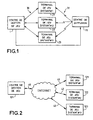
- FIG. 1 there is shown a first example environment adapted to the method of the invention.
- the management center of game located for example at a gaming organizer, is a server in which a game application is executed. It is connected to terminals of remote games 21, 22, 23 located in users through a first bi-directional network 30.
- Remote game terminals may be for example television receivers having a module with a microprocessor in which is executed a game application corresponding to that executed in the server 1. It may also be decoders of digital or analogue television signals transmitted by cable or satellite or even game consoles. Remote gaming terminals include a user interface including a screen display for viewing questions asked by the organizer of the game, a keyboard or any other means to capture an answer to the question asked (including a remote control).
- the game management center 1 is associated with a dissemination center 11 which communicates with the terminals of remote play through a second mono directional network 31.
- the broadcasting center 11 is the one which he already broadcasts his programs.
- the mono directional network 31 is for example a broadcasting network by radio, cable or satellite of digital or analogue television signals. It allows to transmit information simultaneously from the game management center 1 to all remote gaming terminals 21, 22, 23 to which it is connected.
- the first bi-directional network 30 is for example formed of telephone lines of the Switched Telephone Network or lines specialized digital devices at higher speeds. In the case where the game process is implemented as part of interactive television, the bi-directional network 30 forms the return path for interactive programs. This network 30 makes it possible to establish individual communications in both sense between each remote game terminal and the game management center.
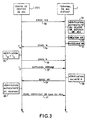
- the management center 101 is connected to the Internet network via a bi-directional link 40 and each of the remote gaming terminals 121, 122, 123 is also connected to the infernet network by a bi-directional link 41, 42, 43.
- the remote game terminals are for example consisting of personal computers located in users forming potential players.
- the game management method of the invention is particularly adapted to games in which a question is asked of players in their giving some time to answer. This may be a question with a meaning and demanding special knowledge to answer it. In the case of a lottery, the question may suggest players to bet on a random future draw. In this case, the expected answer will be the result of draw of the lottery.
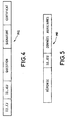
- FIG. 3 schematically illustrates the management method according to the invention between a game management center 1 or 101 and a remote gaming terminal given 2 among all those to which the center is connected
- the first part of the game management method that will be described the game itself, that is, asking a question and way to respond anonymously.
- a question is sent by the gaming management center at all remote gaming terminals to which it is connected.
- this question can be asked during a game television (for example in the form of a message appearing on the screen in overprinting) or on a website.
- the actual way in which the question is asked is not the subject of the present invention and will not be not described further.
- the question asked is transmitted from the management center game to each remote game terminal in the form of an MQ message which is sent preferentially by the one-way communication channel 31 (Fig. 1) if it exists and, if not, by the route of bi-directional communication 40 - 43 (Fig. 2).
- This message can particular be sent in the video signal stream if the game takes place in the part of an interactive television show.
- the message MQ whose content is schematically represented in Figure 4, contains an identification number of the game ID_JEU which is different for each game (ie for each new question asked) and which uniquely identifies the question asked. This number game identification is transmitted at the same time as the question itself ("QUESTION" - Fig. 4) in the MQ message.
- the game management center can also send in the message some authentication elements allowing remote gaming terminals to verify that the asked question comes from a gaming management center authorized by a certification authority and was not impaired during transmission.
- the MQ message preferentially contains an identification number of the game management center ID_CJ, this number being different for each game management center and being assigned by a certification authority uniquely to each game management center.
- the certification authority also assigns to each game management center a certificate that securely associates the identifier of the game management center ID_CJ with its public key K PUB_CJ .
- a well known means of securing the transmission of information is to use public key cryptographic systems in which each stakeholder has a private key that is known only to him and a public key that is known to other stakeholders .
- the certification authority itself has a private key with which it signs the certificates and a public key, which is contained in the remote game terminals as will be seen later to enable them to check the validity of the certificates.
- the certificate is transmitted in the message MQ ("CERTIFICATE” - Fig. 4) which also contains a signature of the message ("SIGNATURE") by means of the private key K PRI_CJ associated with the public key K PUB_CJ of the management center
- the signature is for example defined as follows: Sign K PRI_CJ (ID_CJ ⁇ QUESTION) where " ⁇ " represents the concatenation operator and "Sign” is a known mathematical function, such as a hash function, which is such that there is a corresponding function “Check” verifying: where M1, M2 are any messages.
- the next step 51 of the method consists, for the game terminal remote 2, to verify the authenticity of the game management center.
- each game terminal distributed to users contains the public key of the certification authority.
- the game terminal checks the contents of the CERTIFICATE and retrieves the public key K PUB_CJ game management center. He can thus ensure that the identification number of the game center ID_CJ contained in the message matches the one in the certificate.
- K PUB_CJ the game terminal can further verify that the SIGNATURE contained in the MQ message corresponds to the content of the message by using the Verification function described above.
- a player using the terminal remote game 2 proposed an answer to the question contained in the MQ message and entered it using the gaming terminal user interface.
- the game terminal then constructs a message MR, the content of which is illustrated in Figure 5, which contains the response entered by the player ("ANSWER"), the identification number of ID_JEU game as well as, preferentially, AUXILIARY DATA of personalization (for example: the name or the player's first name, address, phone number, etc.).
- this message is then masked to using a secret, during step 53 to guarantee the anonymity of the player when he sends his answer.
- the game terminal remote generates a random number x.
- This number can for example be of a pseudo-random generator as is known to the man of job. This number must remain secret and not be communicated outside of the game terminal. It will be used later to prove that the player had given the correct answer if he wins the game
- the game terminal 2 uses this secret random number x to create a public number of masking y, which will form the secret used to hide the MR response message.
- This public number of masking must be created from the secret number x in such a way that it is impossible to find x, knowing y and the function used to form y to from x.
- the message MR is masked by encryption using a symmetric secret key K y generated by the remote game terminal, preferably according to the DES (Data Encryption Standard) standard. ).
- the remote game terminal 2 sends the Hidden response message W at the game management center.
- the response of the player is secure and anonymous since it is impossible, without knowing y or K y , to find the player's response from the simple message W.
- the game management center receives the message W at a time T W. It checks in the next step 55 that this instant T W is well before that T D of the broadcast of the answer to the question asked in step 50. This ensures that the player did not cheat and did not send his answer after the correct answer was broadcast by the organizer of the game.
- the game management center then sends to the game terminal, in step 56, an acknowledgment R guaranteeing the player that his hidden response has been recorded by the game organizer.
- the first part of the game management process ends with the broadcast of the correct answer by the game management center, at time T D (step 57).
- the broadcast of the response is performed via the mono-directional network 31 (FIG 1) in the case where there is one, particularly in the case of an interactive game show. If it is a game on the Internet, the answer may be indicated on the website of the organizer of the game. The actual manner of broadcasting the answer is not the subject of the present invention and will not not described further.
- steps 51 to 56 can be performed for each remote gaming terminal to which the management center is connected.
- the second part of the game management process concerns the case where a player has given the correct answer to the question asked and claims his price. It is assumed that this second part starts when the player has verified that the response broadcast at step 57 corresponded to the response he had given in step 52 and that he started an instruction, thanks to the user interface of the game terminal 2, to claim its price from the organizer of the game
- the game terminal 2 must then prove to the game management center that the player had given the correct answer when he played 52-54). He must also prove that he knows the secret used to hide the answer. This ensures that only the winner authentic can receive a prize.
- the game terminal 2 will use the acknowledgment R that was sent by the game management center at step 56 as evidence recording the player's response to the game organizer.
- a first step 58 the remote game terminal 2 first checks the validity of the acknowledgment R using the public key K PUB_CJ of the game management center using for example the function Check exposed above.
- the game terminal sends (step 59) to the game management center a message MP proving that the player had given the right answer and that it was from him.
- the message MP contains the acknowledgment R and the number used to mask it the message MR to form the message W.
- the acknowledgment of receipt allows prove that the game terminal had sent the masked answer W to step 54.
- the message MP therefore contains besides the secret random number x.
- the MP message contains acknowledgment R, the number of masks public but it does not contain the secret number x.
- a zero-knowledge protocol is used to prove at the game management center that the remote gaming terminal 2 knew the secret number x without directly revealing this number x.
- steps 1 to 4. must be repeated several times with different numbers r j , z j , b j and u j to convince the game management center that the game terminal 2 knows x.
- the message MP sent to step 59 contains the acknowledgment R and the secret key K y .
- the acknowledgment can prove that the game terminal had indeed sent the masked response W in step 54 and the key K y can prove that the terminal knows the secret used to blind the response message.
- all messages exchanged between the game management center and the remote game terminal 2 are encrypted.
- the message MP sent in the first variant of the first embodiment (or in the second embodiment) is transmitted in encrypted form using the public key K PUB_CJ of the game management center.
- the messages sent from the game terminal 2 to the game management center (MP message, and sends the number u j ) are encrypted using the public key K PUB_CJ while the messages sent from the game management center to the remote terminal are encrypted using the private key K PRI_CJ of the game management center.
- step 60 the game management center verifies the authenticity of the game. winner, that is to say that he verifies, in view of the single message MP in the first variant of the first embodiment (or in the second embodiment embodiment), or in view of the messages exchanged according to the Schnorr authentication protocol in the second variant of the first embodiment, that the player's response was the right one and that she emanated from him.
- a certificate of price is sent to the remote game terminal 2 in step 61 to allow the player to receive his prize upon presentation of this certificate.
- Any appropriate means may be used to deliver the prize to the winner.
Landscapes
- Engineering & Computer Science (AREA)
- Multimedia (AREA)
- Computer Security & Cryptography (AREA)
- Business, Economics & Management (AREA)
- General Business, Economics & Management (AREA)
- Software Systems (AREA)
- Pinball Game Machines (AREA)
- Management, Administration, Business Operations System, And Electronic Commerce (AREA)
- Storage Device Security (AREA)
Claims (23)
- Gesichertes Fernspielverwaltungsverfahren zwischen einem Spielverwaltungszentrum (1, 101) und wenigstens einem Fernspielterminal (21-23; 121-123; 2),
gekennzeichnet durch folgende Schritte für das Fernspielterminal:a) Empfang einer Nachricht (MQ) mit einem Spielidentifizierer (ID_JEU) sowie einer Frage von dem Spielverwaltungszentrum (1, 101),b) Bildung einer Antwortnachricht (MR) mit dem Spielidentifizierer (ID_JEU) und der Antwort eines Spielers unter Anwendung des Spielterminals,c) Verdecken der Antwortnachricht (MR) mit einem Geheimcode (y, Ky), der nur dem Spielterminal bekannt ist,d) Übertragung der verdeckten Antwortnachricht (VV) zu dem Spielverwaltungszentrum unde) Empfang einer Empfangsbestätigung (R) von dem Spielverwaltungszentrum (1, 101), wenn die im Schritt d) gesendete Antwort des Spielers durch das Spielverwaltungszentrum berücksichtigt wurde. - Verfahren nach Anspruch 1, dadurch gekennzeichnet, dass der Schritt c) folgende Schritte enthält:Erzeugung einer geheimen Zufallszahl (x),Anwendung einer Einwegfunktion (f) auf diese Geheimcodezahl (x) zur Erzeugung einer öffentlichen Verdeckungszahl (y) undAnwendung der öffentlichen Verdeckungszahl (y) zur Verdeckung der Antwortnachricht (MR).
- Verfahren nach Anspruch 2, dadurch gekennzeichnet, dass die Einwegfunktion (f) eine Funktion aufgrund eines diskreten Logarithmus ist, der durch folgende Gleichung definiert ist:
- Verfahren nach Anspruch 1, dadurch gekennzeichnet, dass der Schritt c) in einer Verschlüsselung der Antwortnachricht (MR) mit Hilfe eines symmetrischen Geheimschlüssels (Ky) besteht, der durch das Fernspielterminal erzeugt wird.
- Verfahren nach einem der vorangehenden Ansprüche, dadurch gekennzeichnet, dass die während des Schritts a) empfangene erste Nachricht (MQ) außerdem folgendes enthält:einen Identifizierer des Fernspielverwaltungszentrums (ID_CJ),ein Zertifikat, das durch eine Zertifikationsbehörde zu dem Spielverwaltungszentrum geliefert wird, das mittels eines öffentlichen Schlüssels der Zertifikationsbehörde entschlüsselbar ist, und der öffentliche Schlüssel des Spielverwaltungszentrum entsprechend dem Identifizierer des Spielverwaltungszentrums (ID_CJ) geliefert wird, undeine Signatur eines Teils oder Gesamtheit der Nachricht mittels des privaten Schlüssels für das Spielverwaltungszentrum für die privaten Schlüssel.
- Verfahren nach Anspruch 5, in dem das Fernspielterminal den öffentlichen Schlüssel der Zertifikationsbehörde enthält, dadurch gekennzeichnet, dass während des Schritts b) das Fernspielterminal vor der Bildung der Antwortnachricht (MR) die Verifikation der Behörde des Spielverwaltungszentrums mittels des durch die Zertifikationsbehörde gelieferten Zertifikats durchführt.
- Verfahren nach einem der vorangehenden Ansprüche, dadurch gekennzeichnet, dass die im Schritt b) gebildete Antwortnachricht (MR) außerdem zusätzliche kundenspezifische Daten enthält.
- Verfahren nach einem der Ansprüche 5 bis 7, dadurch gekennzeichnet, dass die verdeckte Antwortnachricht (W) im Schritt d) in einer Form übertragen wird, die mittels des öffentlichen Schlüssels des Spielverwaltungszentrums verschlüsselt ist.
- Verfahren nach einem der Ansprüche 5 bis 8, dadurch gekennzeichnet, dass die während des Schritts e) empfangene Empfangsquittierung (R) eine Signatur enthält, mittels des privaten Schlüssels mit dem öffentlichen Schlüssel des Spielverwaltungszentrums, einer Nachricht, die aus der Verkettung des Spielidentifizierers (ID_JEU) und der verdeckten Antwortnachricht (W) gebildet wird.
- Verfahren nach einem der vorangehenden Ansprüche mit dem zusätzlichen Schritt der Beanspruchung des von einem Spieler gewonnenen Preises, wenn die während des Schritts d) gesendete Antwort des Spielers die richtige Antwort auf die Frage ist, die in der im Schritt a) empfangenen Nachricht (MQ) enthalten ist, dass der zusätzliche Schritt für das Fernspielterminal (2) durch den gewinnenden Spieler benutzt wird:f) Senden einer Beanspruchungsnachricht für den Preis (MP) zu dem Spielverwaltungszentrum, die wenigstens folgendes enthält:Quittierung des von dem Spielverwaltungszentrum im Schritt e) empfangenen Empfangs (R) undeine Information, die beweist, dass das Spielterminal sich im Besitz des Geheimcodes befindet, der zur Verdeckung der Antwortnachricht (MR) im Schritt c) benutzt wird.
- Verfahren nach Anspruch 10, in Abhängigkeit von den Ansprüchen 2, 3 und 5 bis 9, dadurch gekennzeichnet, dass die im Schritt f) zu dem Spielverwaltungszentrum übertragene Information durch das Fernspielterminal (2) zum Beweis, dass dieses Terminal im Besitz des Geheimcodes ist, folgendes enthält:die im Schritt c) erzeugt wurden.die öffentliche Verdeckungszahl y unddie Geheimzufallszahl (x),
- Verfahren nach Anspruch 10, in Abhängigkeit von den Ansprüchen 2, 3 und 5 bis 9, dadurch gekennzeichnet, dass die im Schritt f) durch das Fernspielterminal (2) zu dem Spielverwaltungszentrum übertragene Information, zum Beweis, dass das Terminal sich im Besitz des Geheimcodes befindet, folgendes enthält:die öffentliche Verdeckungszahl y undMittel zum Nachweis über ein Nullkenntnisprotokoll, dass sich das Terminal außerdem im Besitz der Geheimzufallszahl (x) befindet, die zur Erzeugung der öffentlichen Verdeckungszahl (y) benutzt wird.
- Verfahren nach Anspruch 12, abhängig von den Ansprüchen 3 und 5 bis 9,
dadurch gekennzeichnet, dass das benutzte Nullkenntnisprotokoll das Berechtigungsprotokoll von Schnorr ist. - Verfahren nach Anspruch 10, abhängig von den Ansprüchen 4 bis 9, dadurch gekennzeichnet, dass die im Schritt f) durch das Fernspielterminal (2) zu dem Spielverwaltungszentrum übertragene Information zum Nachweis, dass das Terminal sich im Besitz des Geheimcodes befindet, den symmetrischen Geheimschlüssel (Ky) enthält.
- Verfahren nach einem der Ansprüche 10 bis 14, dadurch gekennzeichnet, dass während des Schritts f) das Fernspielterminal (2) vor dem Senden der den Preis beanspruchenden Nachricht (MP) die Verifikation der Gültigkeit der Empfangsbestätigung (R) sendet, die während des Schritts e) von dem Spielverwaltungszentrum empfangen wird.
- Verfahren nach einem der Ansprüche 10 bis 15, abhängig vom Anspruch 5, dadurch gekennzeichnet, dass jede im Laufe des Schritts f) durch das Fernspielterminal zu dem Spielverwaltungszentrum gesendete Nachricht mittels des öffentlichen Schlüssels des Spielverwaltungszentrums verschlüsselt übertragen wird.
- Verfahren nach einem der Ansprüche 12 oder 13, dadurch gekennzeichnet, dass die Nachrichten, die von dem Spielverwaltungszentrum durch das Fernspielterminal im Rahmen des Nullkenntnisprotokolls empfangen werden, mittels des privaten Schlüssels für den öffentlichen Schlüssel des Spielverwaltungszentrums in verschlüsselter Form übertragen werden.
- Verfahren zur Verwaltung eines gesicherten Fernspiels zwischen einem Spielverwaltungszentrum (1, 101) und wenigstens einem Fernspielterminal (21-23; 121-123; 2), dadurch gekennzeichnet, dass es die folgenden Schritte für das Fernspielspielterminal enthält:i) Senden einer Nachricht (MQ) mit einem Spielidentifizierer (ID_JEU) sowie einer Frage zu dem Fernspielterminal (21-23; 121-123; 2),j) Empfangen der Antwort eines Spielers in einer Antwortnachricht (MR) von dem Fernspielterminal (21-23; 121-123; 2), die mit einem nur dem Fernspielterminal bekannten Geheimcode (y, Ky) verdeckt ist,k) Prüfung, ob die verdeckte Antwortnachricht (W) bei einem Zeitpunkt empfangen wird, der vor demjenigen (TD) der Sendung der Antwort zu der im Schritt i) gestellten Frage empfangen wird,l) im Falle einer positiven Prüfung im Schritt k) Senden einer Empfangsbestätigung (R) zu dem Fernspielterminal undm) Senden der Antwort auf die im Schritt i) gestellte Frage zu dem Fernspielterminal.
- Verfahren nach Anspruch 18 mit den zusätzlichen Schritten der Übermittlung des Preises zu einem gewinnenden Spieler, der zu dem Spielverwaltungszentrum gehört:n) Empfang einer Nachricht für die Beanspruchung des Preises (MP) von einem durch den gewinnenden Spieler benutzen Fernspielterminal, enthaltend wenigstens folgendes:die im Schritt I) gesendete Empfangsbestätigung (R) undeine Information, die nachweist, dass das Fernspielterminal im Besitz des Geheimschlüssels ist, der zur Verdeckung der in dem Schritt j) empfangenen Antwortnachricht dient,o) Prüfung der Gültigkeit der Nachricht, die in der den Preis beanspruchenden Nachricht empfangen wird, undp) im Falle einer positiven Prüfung im Schritt o) Durchführungsmittel für die Übertragung des Preises zu dem gewinnenden Spieler.
- Fernspielterminal zur Durchführung des Verfahrens gemäß einem der Ansprüche 1 bis 9, dadurch gekennzeichnet, dass es wenigstens einen der Schritte a) bis e) durchführen kann.
- Fernspielterminal nach Anspruch 20, dadurch gekennzeichnet, dass es außerdem den in den Ansprüchen 10 bis 17 angegebenen Schritt f) durchführen kann.
- Spielverwaltungszentrum für die Durchführung des Verfahrens nach Anspruch 18, dadurch gekennzeichnet, dass es die Schritte i) bis m) durchführen kann.
- Spielverwaltungszentrum nach Anspruch 22, dadurch gekennzeichnet, dass es außerdem die im Anspruch 19 angegebenen Schritte n) bis p) durchführen kann.
Applications Claiming Priority (3)
| Application Number | Priority Date | Filing Date | Title |
|---|---|---|---|
| FR9915950A FR2802677B1 (fr) | 1999-12-17 | 1999-12-17 | Procede de gestion de jeu a distance securise |
| FR9915950 | 1999-12-17 | ||
| PCT/FR2000/003382 WO2001045025A1 (fr) | 1999-12-17 | 2000-12-05 | Procede de gestion de jeu a distance securise |
Publications (2)
| Publication Number | Publication Date |
|---|---|
| EP1244992A1 EP1244992A1 (de) | 2002-10-02 |
| EP1244992B1 true EP1244992B1 (de) | 2003-07-23 |
Family
ID=9553389
Family Applications (1)
| Application Number | Title | Priority Date | Filing Date |
|---|---|---|---|
| EP00985401A Expired - Lifetime EP1244992B1 (de) | 1999-12-17 | 2000-12-05 | Gesichertes fernspielverwaltungsverfahren |
Country Status (8)
| Country | Link |
|---|---|
| US (1) | US7294057B2 (de) |
| EP (1) | EP1244992B1 (de) |
| JP (1) | JP4990457B2 (de) |
| CN (1) | CN1324513C (de) |
| DE (1) | DE60004104T2 (de) |
| ES (1) | ES2203547T3 (de) |
| FR (1) | FR2802677B1 (de) |
| WO (1) | WO2001045025A1 (de) |
Families Citing this family (13)
| Publication number | Priority date | Publication date | Assignee | Title |
|---|---|---|---|---|
| JP3458090B2 (ja) | 2000-03-15 | 2003-10-20 | コナミ株式会社 | メッセージ交換機能を備えたゲームシステム、そのゲームシステムで使用するゲーム装置、メッセージ交換システム、およびコンピュータ読取可能な記憶媒体 |
| US7516324B2 (en) * | 2001-07-05 | 2009-04-07 | Sony Corporation | Information processing system, information management apparatus, and information processing apparatus |
| FR2863439A1 (fr) * | 2003-12-09 | 2005-06-10 | New Screens | Procede permettant a un utilisateur abonne d'un service de television numerique d'obtenir rapidement un accuse de reception |
| GB2428500A (en) * | 2004-01-19 | 2007-01-31 | Tencent Technology | An instant communication method |
| US20070060387A1 (en) * | 2005-09-13 | 2007-03-15 | Enzminger Joseph R | Gaming floor control and configuration system |
| US9196116B2 (en) * | 2006-03-09 | 2015-11-24 | Szrek2Solutions Llc | Securing gaming transactions |
| US8468359B2 (en) * | 2006-06-30 | 2013-06-18 | Novell, Inc. | Credentials for blinded intended audiences |
| US7957510B2 (en) * | 2007-01-23 | 2011-06-07 | Microsoft Corporation | Notifying network contacts of inquiries |
| WO2013019957A1 (en) * | 2011-08-02 | 2013-02-07 | Velti Mobile Platforms Limited | Systems, methods, and devices for message based gameplay |
| US8662998B2 (en) | 2011-08-30 | 2014-03-04 | Multimedia Games, Inc. | Systems and methods for dynamically altering wagering game assets |
| US10616782B2 (en) | 2012-03-29 | 2020-04-07 | Mgage, Llc | Cross-channel user tracking systems, methods and devices |
| TW201709145A (zh) * | 2015-08-25 | 2017-03-01 | Xian-Li Peng | 網路博奕遊戲裝置 |
| FR3080693B1 (fr) * | 2018-04-30 | 2021-10-08 | Ledger | Authentification mutuelle d'un dispositif ou d'un systeme contenant des donnees sensibles ou confidentielles commandable par un utilisateur |
Family Cites Families (32)
| Publication number | Priority date | Publication date | Assignee | Title |
|---|---|---|---|---|
| US4218582A (en) * | 1977-10-06 | 1980-08-19 | The Board Of Trustees Of The Leland Stanford Junior University | Public key cryptographic apparatus and method |
| US4572509A (en) * | 1982-09-30 | 1986-02-25 | Sitrick David H | Video game network |
| US4900556A (en) * | 1985-04-26 | 1990-02-13 | Massachusetts Institute Of Technology | System for delayed and pulsed release of biologically active substances |
| US4885172A (en) * | 1985-06-26 | 1989-12-05 | The Liposome Company, Inc. | Composition for targeting, storing and loading of liposomes |
| US5007649A (en) * | 1986-01-16 | 1991-04-16 | Selectro-Vision, Ltd. | Gaming system with system base station and gaming boards |
| FR2630561B1 (fr) * | 1988-04-21 | 1992-11-27 | Audebert Yves | Dispositif portable electronique destine a etre utilise en liaison avec un ecran |
| US5179517A (en) * | 1988-09-22 | 1993-01-12 | Bally Manufacturing Corporation | Game machine data transfer system utilizing portable data units |
| US5283339A (en) * | 1988-11-23 | 1994-02-01 | California Institute Of Technology | Immobilized metal aqueous two-phase extraction and precipitation |
| ATE143511T1 (de) * | 1989-04-28 | 1996-10-15 | Softel Inc | Verfahren und vorrichtung zur fernsteuerung und - überwachung der anwendung von rechnerprogrammen |
| US5251909A (en) * | 1991-05-28 | 1993-10-12 | Reed Michael J | Secured high throughput data channel for public broadcast system |
| AU672770B2 (en) * | 1992-02-18 | 1996-10-17 | Ricos Co., Ltd. | Computer game device |
| FR2708768B1 (fr) * | 1993-08-05 | 1995-09-01 | Gemplus Card Int | Système sécurisé de participation à des jeux interactifs à distance avec vérification de la chronologie d'événements. |
| JPH07319810A (ja) * | 1994-04-01 | 1995-12-08 | Fujitsu Ltd | ネットワークサービスシステム及びネットワークサービスシステムを利用可能なゲーム機用通信装置並びにゲーム機 |
| US5470079A (en) * | 1994-06-16 | 1995-11-28 | Bally Gaming International, Inc. | Game machine accounting and monitoring system |
| US5599231A (en) * | 1994-10-31 | 1997-02-04 | Nintendo Co., Ltd. | Security systems and methods for a videographics and authentication game/program fabricating device |
| US5643086A (en) * | 1995-06-29 | 1997-07-01 | Silicon Gaming, Inc. | Electronic casino gaming apparatus with improved play capacity, authentication and security |
| DK0882339T3 (da) * | 1995-06-29 | 2011-04-18 | Igt Reno Nev | Elektronisk casino-spillesystem med forbedrede spillemuligheder, autentificering og sikkerhed |
| US5970143A (en) * | 1995-11-22 | 1999-10-19 | Walker Asset Management Lp | Remote-auditing of computer generated outcomes, authenticated billing and access control, and software metering system using cryptographic and other protocols |
| US5768382A (en) * | 1995-11-22 | 1998-06-16 | Walker Asset Management Limited Partnership | Remote-auditing of computer generated outcomes and authenticated biling and access control system using cryptographic and other protocols |
| WO1997019537A1 (en) * | 1995-11-22 | 1997-05-29 | Walker Asset Management L.P. | Remote-auditing of computer generated outcomes using cryptographic and other protocols |
| US5695400A (en) * | 1996-01-30 | 1997-12-09 | Boxer Jam Productions | Method of managing multi-player game playing over a network |
| US5907035A (en) * | 1996-05-23 | 1999-05-25 | Baxter Biotech Technology Sarl | Aqueous two-phase metal affinity partitioning protein purification system |
| US6001016A (en) * | 1996-12-31 | 1999-12-14 | Walker Asset Management Limited Partnership | Remote gaming device |
| US6099408A (en) * | 1996-12-31 | 2000-08-08 | Walker Digital, Llc | Method and apparatus for securing electronic games |
| JP3206474B2 (ja) * | 1997-01-27 | 2001-09-10 | 日本電気株式会社 | 電子抽選方法及び電子抽選システム |
| AUPO554397A0 (en) * | 1997-03-10 | 1997-04-10 | Aristocrat Leisure Industries Pty Ltd | Personal gaming system |
| JP3812043B2 (ja) * | 1997-03-31 | 2006-08-23 | カシオ計算機株式会社 | 通信装置及び通信方法 |
| US6030288A (en) * | 1997-09-02 | 2000-02-29 | Quixotic Solutions Inc. | Apparatus and process for verifying honest gaming transactions over a communications network |
| JP3402441B2 (ja) * | 1997-12-17 | 2003-05-06 | 日本電信電話株式会社 | 公開鍵暗号化装置、公開鍵暗号復号装置及び復号プログラム記録媒体 |
| US6805634B1 (en) * | 1998-10-14 | 2004-10-19 | Igt | Method for downloading data to gaming devices |
| US6280325B1 (en) * | 1999-05-13 | 2001-08-28 | Netgain Technologies, Llc | Computer network management of wide-area multi-player bingo game |
| US6368219B1 (en) * | 1999-10-15 | 2002-04-09 | Gtech Rhode Island Corporation | System and method for determining whether wagers have been altered after winning game numbers are drawn |
-
1999
- 1999-12-17 FR FR9915950A patent/FR2802677B1/fr not_active Expired - Fee Related
-
2000
- 2000-12-05 US US10/168,170 patent/US7294057B2/en not_active Expired - Fee Related
- 2000-12-05 CN CNB008171661A patent/CN1324513C/zh not_active Expired - Fee Related
- 2000-12-05 ES ES00985401T patent/ES2203547T3/es not_active Expired - Lifetime
- 2000-12-05 EP EP00985401A patent/EP1244992B1/de not_active Expired - Lifetime
- 2000-12-05 JP JP2001546045A patent/JP4990457B2/ja not_active Expired - Fee Related
- 2000-12-05 DE DE60004104T patent/DE60004104T2/de not_active Expired - Lifetime
- 2000-12-05 WO PCT/FR2000/003382 patent/WO2001045025A1/fr not_active Ceased
Also Published As
| Publication number | Publication date |
|---|---|
| DE60004104D1 (de) | 2003-08-28 |
| WO2001045025A1 (fr) | 2001-06-21 |
| FR2802677B1 (fr) | 2002-01-18 |
| US20030054886A1 (en) | 2003-03-20 |
| JP4990457B2 (ja) | 2012-08-01 |
| EP1244992A1 (de) | 2002-10-02 |
| JP2003534830A (ja) | 2003-11-25 |
| CN1324513C (zh) | 2007-07-04 |
| FR2802677A1 (fr) | 2001-06-22 |
| US7294057B2 (en) | 2007-11-13 |
| CN1409849A (zh) | 2003-04-09 |
| DE60004104T2 (de) | 2004-04-15 |
| ES2203547T3 (es) | 2004-04-16 |
Similar Documents
| Publication | Publication Date | Title |
|---|---|---|
| EP0638344B1 (de) | Sicheres Teilnahmesystem für interaktive Spiele mit Überprüfung der zeitlichen Ereignisfolge | |
| EP1244992B1 (de) | Gesichertes fernspielverwaltungsverfahren | |
| EP1305948B1 (de) | Verfahren zur gesicherten digitalen multimediadatenverteilung | |
| EP2656538B1 (de) | Anonymer zugriff auf einen dienst mittels aggregierter zertifikate | |
| EP2116000B1 (de) | Verfahren zur authentifizierung eines benutzers bei dienstanbietern | |
| FR2703552A1 (fr) | Procédé et dispositif pour l'embrouillage et le désembrouillage d'une émission déterminée de télévision. | |
| EP2052539A1 (de) | Verfahren für den widerruf von sicherheitsmodulen zur sicherung von rundfunknachrichten | |
| EP1495622B1 (de) | Verfahren zur anonymen Authentifizierung eines Datensenders | |
| EP1166496B1 (de) | Verfahren und vorrichtung zur authentifizierung und digitalen signaturerzeugung einer nachricht, mit der hilfe von kleineren challenge-daten | |
| EP3732849B1 (de) | Verfahren und system zur identifizierung eines benutzerendgeräts zum empfangen von streaming-geschützten multimedia-inhalten | |
| EP1400056A1 (de) | Verfahren zur kryptographischen authentifizierung | |
| EP0666664A1 (de) | Verfahren zur digitalen Unterschift und Authentifizierung von Nachrichten unter Verwendung eines diskreten Logarithmus mit verringerter Anzahl von modularen Multiplikationen | |
| EP3219077B1 (de) | Verfahren und system zur verwaltung von benutzeridentitäten, die während der kommunikation zwischen zwei webbrowsern implementiert werden sollen | |
| EP2347394A1 (de) | Verfahren und vorrichtung zum implementieren eines virtuellen rubbelkartenspiels | |
| EP3526946B1 (de) | Verschlüsselungsverfahren, entschlüsselungsverfahren, vorrichtung und entsprechendes computerprogramm | |
| EP1404427A1 (de) | Verfahren und system zur steuerung eines spiels zwischen einem verwaltungszentrum und wenigstens einem spielterminal, spielverwaltungszentrum und spielterminal | |
| EP1387719B1 (de) | Verfahren zum spielen eines wettspiels auf gewinnzahlen | |
| EP0743775B1 (de) | Verfahren zur digitalen Unterschrift mit Null-Kenntnis, zum Herstellen von kollisionsresistenten Unterschriften | |
| EP1794926A1 (de) | Kryptographische vorrichtung und verfahren mit öffentlichem schlüssel und zertifizierungs-server sowie an diese vorrichtung angepasste speicher | |
| EP1723791B1 (de) | Verfahren zum sichern eines von einem austrahler gesendeten verwürfelten inhalts | |
| EP0923829A2 (de) | Einrichtung zum gesicherten datenaustausch | |
| WO2007138229A2 (fr) | Procede d'acces securise a une ressource cryptee | |
| EP1992104B1 (de) | Authentifizierung einer computervorrichtung auf benutzerebene | |
| FR3141538A1 (fr) | Procede et dispositif de stockage en ligne reparti de fichiers dans un contexte zero confiance | |
| WO2008081151A2 (fr) | Procede de signature de liste anonyme et correlable |
Legal Events
| Date | Code | Title | Description |
|---|---|---|---|
| PUAI | Public reference made under article 153(3) epc to a published international application that has entered the european phase |
Free format text: ORIGINAL CODE: 0009012 |
|
| 17P | Request for examination filed |
Effective date: 20020603 |
|
| AK | Designated contracting states |
Kind code of ref document: A1 Designated state(s): AT BE CH CY DE DK ES FI FR GB GR IE IT LI LU MC NL PT SE TR |
|
| GRAH | Despatch of communication of intention to grant a patent |
Free format text: ORIGINAL CODE: EPIDOS IGRA |
|
| GRAH | Despatch of communication of intention to grant a patent |
Free format text: ORIGINAL CODE: EPIDOS IGRA |
|
| GRAA | (expected) grant |
Free format text: ORIGINAL CODE: 0009210 |
|
| AK | Designated contracting states |
Designated state(s): DE ES FR GB IT |
|
| REG | Reference to a national code |
Ref country code: GB Ref legal event code: FG4D Free format text: NOT ENGLISH |
|
| REG | Reference to a national code |
Ref country code: IE Ref legal event code: FG4D Free format text: FRENCH |
|
| REF | Corresponds to: |
Ref document number: 60004104 Country of ref document: DE Date of ref document: 20030828 Kind code of ref document: P |
|
| GBT | Gb: translation of ep patent filed (gb section 77(6)(a)/1977) |
Effective date: 20031022 |
|
| REG | Reference to a national code |
Ref country code: IE Ref legal event code: FD4D |
|
| REG | Reference to a national code |
Ref country code: ES Ref legal event code: FG2A Ref document number: 2203547 Country of ref document: ES Kind code of ref document: T3 |
|
| PLBE | No opposition filed within time limit |
Free format text: ORIGINAL CODE: 0009261 |
|
| STAA | Information on the status of an ep patent application or granted ep patent |
Free format text: STATUS: NO OPPOSITION FILED WITHIN TIME LIMIT |
|
| 26N | No opposition filed |
Effective date: 20040426 |
|
| REG | Reference to a national code |
Ref country code: DE Ref legal event code: R081 Ref document number: 60004104 Country of ref document: DE Owner name: THOMSON LICENSING, FR Free format text: FORMER OWNER: THOMSON LICENSING S.A., BOULOGNE, CEDEX, FR Effective date: 20120202 Ref country code: DE Ref legal event code: R082 Ref document number: 60004104 Country of ref document: DE Representative=s name: ROSSMANITH, MANFRED, DIPL.-PHYS. DR.RER.NAT., DE Effective date: 20120202 Ref country code: DE Ref legal event code: R081 Ref document number: 60004104 Country of ref document: DE Owner name: THOMSON LICENSING, FR Free format text: FORMER OWNER: THOMSON LICENSING S.A., BOULOGNE, FR Effective date: 20120202 Ref country code: DE Ref legal event code: R082 Ref document number: 60004104 Country of ref document: DE Representative=s name: HOFSTETTER, SCHURACK & PARTNER PATENT- UND REC, DE Effective date: 20120202 |
|
| REG | Reference to a national code |
Ref country code: FR Ref legal event code: PLFP Year of fee payment: 16 |
|
| REG | Reference to a national code |
Ref country code: FR Ref legal event code: PLFP Year of fee payment: 17 |
|
| REG | Reference to a national code |
Ref country code: DE Ref legal event code: R082 Ref document number: 60004104 Country of ref document: DE Representative=s name: HOFSTETTER, SCHURACK & PARTNER PATENT- UND REC, DE |
|
| REG | Reference to a national code |
Ref country code: FR Ref legal event code: PLFP Year of fee payment: 18 |
|
| PGFP | Annual fee paid to national office [announced via postgrant information from national office to epo] |
Ref country code: FR Payment date: 20171222 Year of fee payment: 18 |
|
| PGFP | Annual fee paid to national office [announced via postgrant information from national office to epo] |
Ref country code: GB Payment date: 20171220 Year of fee payment: 18 |
|
| PGFP | Annual fee paid to national office [announced via postgrant information from national office to epo] |
Ref country code: ES Payment date: 20180102 Year of fee payment: 18 Ref country code: DE Payment date: 20171218 Year of fee payment: 18 |
|
| PGFP | Annual fee paid to national office [announced via postgrant information from national office to epo] |
Ref country code: IT Payment date: 20171221 Year of fee payment: 18 |
|
| REG | Reference to a national code |
Ref country code: DE Ref legal event code: R079 Ref document number: 60004104 Country of ref document: DE Free format text: PREVIOUS MAIN CLASS: G06F0019000000 Ipc: G16Z0099000000 |
|
| REG | Reference to a national code |
Ref country code: DE Ref legal event code: R119 Ref document number: 60004104 Country of ref document: DE |
|
| GBPC | Gb: european patent ceased through non-payment of renewal fee |
Effective date: 20181205 |
|
| PG25 | Lapsed in a contracting state [announced via postgrant information from national office to epo] |
Ref country code: DE Free format text: LAPSE BECAUSE OF NON-PAYMENT OF DUE FEES Effective date: 20190702 Ref country code: FR Free format text: LAPSE BECAUSE OF NON-PAYMENT OF DUE FEES Effective date: 20181231 Ref country code: IT Free format text: LAPSE BECAUSE OF NON-PAYMENT OF DUE FEES Effective date: 20181205 |
|
| PG25 | Lapsed in a contracting state [announced via postgrant information from national office to epo] |
Ref country code: GB Free format text: LAPSE BECAUSE OF NON-PAYMENT OF DUE FEES Effective date: 20181205 |
|
| REG | Reference to a national code |
Ref country code: ES Ref legal event code: FD2A Effective date: 20200131 |
|
| PG25 | Lapsed in a contracting state [announced via postgrant information from national office to epo] |
Ref country code: ES Free format text: LAPSE BECAUSE OF NON-PAYMENT OF DUE FEES Effective date: 20181206 |
|
| P01 | Opt-out of the competence of the unified patent court (upc) registered |
Effective date: 20230527 |