EP1239322A2 - Mehrschichtanordnung für elektro-optische Vorrichtungen - Google Patents
Mehrschichtanordnung für elektro-optische Vorrichtungen Download PDFInfo
- Publication number
- EP1239322A2 EP1239322A2 EP02003272A EP02003272A EP1239322A2 EP 1239322 A2 EP1239322 A2 EP 1239322A2 EP 02003272 A EP02003272 A EP 02003272A EP 02003272 A EP02003272 A EP 02003272A EP 1239322 A2 EP1239322 A2 EP 1239322A2
- Authority
- EP
- European Patent Office
- Prior art keywords
- layer
- arrangement according
- layer arrangement
- substrates
- electro
- Prior art date
- Legal status (The legal status is an assumption and is not a legal conclusion. Google has not performed a legal analysis and makes no representation as to the accuracy of the status listed.)
- Granted
Links
- 239000000758 substrate Substances 0.000 claims abstract description 37
- 229920001940 conductive polymer Polymers 0.000 claims abstract description 11
- 239000004973 liquid crystal related substance Substances 0.000 claims abstract description 11
- -1 polypropylene Polymers 0.000 claims description 16
- 229920003023 plastic Polymers 0.000 claims description 10
- 239000004033 plastic Substances 0.000 claims description 10
- 125000006702 (C1-C18) alkyl group Chemical group 0.000 claims description 9
- 229920000728 polyester Polymers 0.000 claims description 9
- 229920000515 polycarbonate Polymers 0.000 claims description 7
- 239000004417 polycarbonate Substances 0.000 claims description 7
- 229920000123 polythiophene Polymers 0.000 claims description 7
- 239000011521 glass Substances 0.000 claims description 6
- 229920000447 polyanionic polymer Polymers 0.000 claims description 5
- 229920000089 Cyclic olefin copolymer Polymers 0.000 claims description 4
- 239000004713 Cyclic olefin copolymer Substances 0.000 claims description 4
- 239000004695 Polyether sulfone Substances 0.000 claims description 4
- 150000001450 anions Chemical class 0.000 claims description 4
- 229920001577 copolymer Polymers 0.000 claims description 4
- 229920006393 polyether sulfone Polymers 0.000 claims description 4
- 239000004698 Polyethylene Substances 0.000 claims description 3
- 239000004642 Polyimide Substances 0.000 claims description 3
- 229920002492 poly(sulfone) Polymers 0.000 claims description 3
- 229920000573 polyethylene Polymers 0.000 claims description 3
- 229920001721 polyimide Polymers 0.000 claims description 3
- 239000004743 Polypropylene Substances 0.000 claims description 2
- 125000002947 alkylene group Chemical group 0.000 claims description 2
- 229910052751 metal Inorganic materials 0.000 claims description 2
- 239000002184 metal Substances 0.000 claims description 2
- 229910044991 metal oxide Inorganic materials 0.000 claims description 2
- 150000004706 metal oxides Chemical class 0.000 claims description 2
- 229920000767 polyaniline Polymers 0.000 claims description 2
- 229920001155 polypropylene Polymers 0.000 claims description 2
- 229920000128 polypyrrole Polymers 0.000 claims description 2
- 230000003678 scratch resistant effect Effects 0.000 claims description 2
- 239000000126 substance Substances 0.000 claims description 2
- 125000003011 styrenyl group Chemical class [H]\C(*)=C(/[H])C1=C([H])C([H])=C([H])C([H])=C1[H] 0.000 claims 1
- 239000010410 layer Substances 0.000 description 24
- 125000001273 sulfonato group Chemical group [O-]S(*)(=O)=O 0.000 description 14
- 125000002887 hydroxy group Chemical group [H]O* 0.000 description 13
- 125000003178 carboxy group Chemical group [H]OC(*)=O 0.000 description 11
- 125000003545 alkoxy group Chemical group 0.000 description 8
- 125000004169 (C1-C6) alkyl group Chemical group 0.000 description 6
- 125000006710 (C2-C12) alkenyl group Chemical group 0.000 description 6
- 125000006272 (C3-C7) cycloalkyl group Chemical group 0.000 description 6
- 125000004648 C2-C8 alkenyl group Chemical group 0.000 description 6
- 125000000113 cyclohexyl group Chemical group [H]C1([H])C([H])([H])C([H])([H])C([H])(*)C([H])([H])C1([H])[H] 0.000 description 6
- 125000003253 isopropoxy group Chemical group [H]C([H])([H])C([H])(O*)C([H])([H])[H] 0.000 description 6
- 125000001624 naphthyl group Chemical group 0.000 description 6
- 125000001997 phenyl group Chemical group [H]C1=C([H])C([H])=C(*)C([H])=C1[H] 0.000 description 6
- 125000001511 cyclopentyl group Chemical group [H]C1([H])C([H])([H])C([H])([H])C([H])(*)C1([H])[H] 0.000 description 5
- 229920000172 poly(styrenesulfonic acid) Polymers 0.000 description 5
- 229920000642 polymer Polymers 0.000 description 5
- 125000004178 (C1-C4) alkyl group Chemical group 0.000 description 4
- 125000000041 C6-C10 aryl group Chemical group 0.000 description 4
- 238000000034 method Methods 0.000 description 4
- 125000003710 aryl alkyl group Chemical group 0.000 description 3
- 239000003795 chemical substances by application Substances 0.000 description 3
- 239000011159 matrix material Substances 0.000 description 3
- 229940005642 polystyrene sulfonic acid Drugs 0.000 description 3
- 239000000243 solution Substances 0.000 description 3
- 150000003460 sulfonic acids Chemical class 0.000 description 3
- UFHFLCQGNIYNRP-UHFFFAOYSA-N Hydrogen Chemical compound [H][H] UFHFLCQGNIYNRP-UHFFFAOYSA-N 0.000 description 2
- 229920002125 Sokalan® Polymers 0.000 description 2
- PPBRXRYQALVLMV-UHFFFAOYSA-N Styrene Chemical compound C=CC1=CC=CC=C1 PPBRXRYQALVLMV-UHFFFAOYSA-N 0.000 description 2
- 239000011149 active material Substances 0.000 description 2
- 150000001447 alkali salts Chemical class 0.000 description 2
- 238000004630 atomic force microscopy Methods 0.000 description 2
- 125000002091 cationic group Chemical group 0.000 description 2
- 238000010276 construction Methods 0.000 description 2
- 239000006185 dispersion Substances 0.000 description 2
- 150000002431 hydrogen Chemical class 0.000 description 2
- 229910052739 hydrogen Inorganic materials 0.000 description 2
- 239000001257 hydrogen Substances 0.000 description 2
- 238000004519 manufacturing process Methods 0.000 description 2
- 229920000139 polyethylene terephthalate Polymers 0.000 description 2
- 239000005020 polyethylene terephthalate Substances 0.000 description 2
- 150000003440 styrenes Chemical class 0.000 description 2
- 230000003746 surface roughness Effects 0.000 description 2
- 229920002554 vinyl polymer Polymers 0.000 description 2
- VPWNQTHUCYMVMZ-UHFFFAOYSA-N 4,4'-sulfonyldiphenol Chemical class C1=CC(O)=CC=C1S(=O)(=O)C1=CC=C(O)C=C1 VPWNQTHUCYMVMZ-UHFFFAOYSA-N 0.000 description 1
- 229930185605 Bisphenol Natural products 0.000 description 1
- DBCQEFSEZOUINS-UHFFFAOYSA-N COc(cc1)ccc1[N]1(CCCCC1)c(cc1)ccc1OC Chemical compound COc(cc1)ccc1[N]1(CCCCC1)c(cc1)ccc1OC DBCQEFSEZOUINS-UHFFFAOYSA-N 0.000 description 1
- 239000004971 Cross linker Substances 0.000 description 1
- 102000003668 Destrin Human genes 0.000 description 1
- 108090000082 Destrin Proteins 0.000 description 1
- 229920001609 Poly(3,4-ethylenedioxythiophene) Polymers 0.000 description 1
- 229920002845 Poly(methacrylic acid) Polymers 0.000 description 1
- 125000005396 acrylic acid ester group Chemical group 0.000 description 1
- 239000000654 additive Substances 0.000 description 1
- 238000003491 array Methods 0.000 description 1
- 239000002585 base Substances 0.000 description 1
- 238000005452 bending Methods 0.000 description 1
- 239000011230 binding agent Substances 0.000 description 1
- 230000015572 biosynthetic process Effects 0.000 description 1
- 229910052799 carbon Inorganic materials 0.000 description 1
- 150000001735 carboxylic acids Chemical class 0.000 description 1
- 238000005266 casting Methods 0.000 description 1
- 125000004122 cyclic group Chemical group 0.000 description 1
- 238000007598 dipping method Methods 0.000 description 1
- 230000000694 effects Effects 0.000 description 1
- 238000005516 engineering process Methods 0.000 description 1
- 230000007613 environmental effect Effects 0.000 description 1
- 238000009499 grossing Methods 0.000 description 1
- AMGQUBHHOARCQH-UHFFFAOYSA-N indium;oxotin Chemical compound [In].[Sn]=O AMGQUBHHOARCQH-UHFFFAOYSA-N 0.000 description 1
- 150000002500 ions Chemical class 0.000 description 1
- 229920002521 macromolecule Polymers 0.000 description 1
- 239000000463 material Substances 0.000 description 1
- 239000000203 mixture Substances 0.000 description 1
- 239000000178 monomer Substances 0.000 description 1
- 125000003506 n-propoxy group Chemical group [H]C([H])([H])C([H])([H])C([H])([H])O* 0.000 description 1
- 125000005609 naphthenate group Chemical group 0.000 description 1
- 230000007935 neutral effect Effects 0.000 description 1
- 239000012044 organic layer Substances 0.000 description 1
- 230000001590 oxidative effect Effects 0.000 description 1
- 239000003973 paint Substances 0.000 description 1
- 229920003208 poly(ethylene sulfide) Polymers 0.000 description 1
- 229920006289 polycarbonate film Polymers 0.000 description 1
- 229920006267 polyester film Polymers 0.000 description 1
- 229920001444 polymaleic acid Polymers 0.000 description 1
- 229920006254 polymer film Polymers 0.000 description 1
- 229920000307 polymer substrate Polymers 0.000 description 1
- 238000006116 polymerization reaction Methods 0.000 description 1
- 229920000098 polyolefin Polymers 0.000 description 1
- 238000002360 preparation method Methods 0.000 description 1
- 238000007639 printing Methods 0.000 description 1
- 238000005096 rolling process Methods 0.000 description 1
- 238000005507 spraying Methods 0.000 description 1
- 238000003860 storage Methods 0.000 description 1
- 239000010414 supernatant solution Substances 0.000 description 1
- NLVXSWCKKBEXTG-UHFFFAOYSA-N vinylsulfonic acid Chemical class OS(=O)(=O)C=C NLVXSWCKKBEXTG-UHFFFAOYSA-N 0.000 description 1
Classifications
-
- G—PHYSICS
- G02—OPTICS
- G02F—OPTICAL DEVICES OR ARRANGEMENTS FOR THE CONTROL OF LIGHT BY MODIFICATION OF THE OPTICAL PROPERTIES OF THE MEDIA OF THE ELEMENTS INVOLVED THEREIN; NON-LINEAR OPTICS; FREQUENCY-CHANGING OF LIGHT; OPTICAL LOGIC ELEMENTS; OPTICAL ANALOGUE/DIGITAL CONVERTERS
- G02F1/00—Devices or arrangements for the control of the intensity, colour, phase, polarisation or direction of light arriving from an independent light source, e.g. switching, gating or modulating; Non-linear optics
- G02F1/01—Devices or arrangements for the control of the intensity, colour, phase, polarisation or direction of light arriving from an independent light source, e.g. switching, gating or modulating; Non-linear optics for the control of the intensity, phase, polarisation or colour
- G02F1/13—Devices or arrangements for the control of the intensity, colour, phase, polarisation or direction of light arriving from an independent light source, e.g. switching, gating or modulating; Non-linear optics for the control of the intensity, phase, polarisation or colour based on liquid crystals, e.g. single liquid crystal display cells
- G02F1/133—Constructional arrangements; Operation of liquid crystal cells; Circuit arrangements
- G02F1/1333—Constructional arrangements; Manufacturing methods
-
- C—CHEMISTRY; METALLURGY
- C08—ORGANIC MACROMOLECULAR COMPOUNDS; THEIR PREPARATION OR CHEMICAL WORKING-UP; COMPOSITIONS BASED THEREON
- C08G—MACROMOLECULAR COMPOUNDS OBTAINED OTHERWISE THAN BY REACTIONS ONLY INVOLVING UNSATURATED CARBON-TO-CARBON BONDS
- C08G61/00—Macromolecular compounds obtained by reactions forming a carbon-to-carbon link in the main chain of the macromolecule
- C08G61/12—Macromolecular compounds containing atoms other than carbon in the main chain of the macromolecule
- C08G61/122—Macromolecular compounds containing atoms other than carbon in the main chain of the macromolecule derived from five- or six-membered heterocyclic compounds, other than imides
- C08G61/123—Macromolecular compounds containing atoms other than carbon in the main chain of the macromolecule derived from five- or six-membered heterocyclic compounds, other than imides derived from five-membered heterocyclic compounds
- C08G61/126—Macromolecular compounds containing atoms other than carbon in the main chain of the macromolecule derived from five- or six-membered heterocyclic compounds, other than imides derived from five-membered heterocyclic compounds with a five-membered ring containing one sulfur atom in the ring
-
- C—CHEMISTRY; METALLURGY
- C08—ORGANIC MACROMOLECULAR COMPOUNDS; THEIR PREPARATION OR CHEMICAL WORKING-UP; COMPOSITIONS BASED THEREON
- C08G—MACROMOLECULAR COMPOUNDS OBTAINED OTHERWISE THAN BY REACTIONS ONLY INVOLVING UNSATURATED CARBON-TO-CARBON BONDS
- C08G61/00—Macromolecular compounds obtained by reactions forming a carbon-to-carbon link in the main chain of the macromolecule
- C08G61/12—Macromolecular compounds containing atoms other than carbon in the main chain of the macromolecule
- C08G61/122—Macromolecular compounds containing atoms other than carbon in the main chain of the macromolecule derived from five- or six-membered heterocyclic compounds, other than imides
-
- G—PHYSICS
- G02—OPTICS
- G02F—OPTICAL DEVICES OR ARRANGEMENTS FOR THE CONTROL OF LIGHT BY MODIFICATION OF THE OPTICAL PROPERTIES OF THE MEDIA OF THE ELEMENTS INVOLVED THEREIN; NON-LINEAR OPTICS; FREQUENCY-CHANGING OF LIGHT; OPTICAL LOGIC ELEMENTS; OPTICAL ANALOGUE/DIGITAL CONVERTERS
- G02F1/00—Devices or arrangements for the control of the intensity, colour, phase, polarisation or direction of light arriving from an independent light source, e.g. switching, gating or modulating; Non-linear optics
- G02F1/01—Devices or arrangements for the control of the intensity, colour, phase, polarisation or direction of light arriving from an independent light source, e.g. switching, gating or modulating; Non-linear optics for the control of the intensity, phase, polarisation or colour
- G02F1/13—Devices or arrangements for the control of the intensity, colour, phase, polarisation or direction of light arriving from an independent light source, e.g. switching, gating or modulating; Non-linear optics for the control of the intensity, phase, polarisation or colour based on liquid crystals, e.g. single liquid crystal display cells
- G02F1/133—Constructional arrangements; Operation of liquid crystal cells; Circuit arrangements
- G02F1/1333—Constructional arrangements; Manufacturing methods
- G02F1/1337—Surface-induced orientation of the liquid crystal molecules, e.g. by alignment layers
- G02F1/133711—Surface-induced orientation of the liquid crystal molecules, e.g. by alignment layers by organic films, e.g. polymeric films
-
- G—PHYSICS
- G02—OPTICS
- G02F—OPTICAL DEVICES OR ARRANGEMENTS FOR THE CONTROL OF LIGHT BY MODIFICATION OF THE OPTICAL PROPERTIES OF THE MEDIA OF THE ELEMENTS INVOLVED THEREIN; NON-LINEAR OPTICS; FREQUENCY-CHANGING OF LIGHT; OPTICAL LOGIC ELEMENTS; OPTICAL ANALOGUE/DIGITAL CONVERTERS
- G02F1/00—Devices or arrangements for the control of the intensity, colour, phase, polarisation or direction of light arriving from an independent light source, e.g. switching, gating or modulating; Non-linear optics
- G02F1/01—Devices or arrangements for the control of the intensity, colour, phase, polarisation or direction of light arriving from an independent light source, e.g. switching, gating or modulating; Non-linear optics for the control of the intensity, phase, polarisation or colour
- G02F1/13—Devices or arrangements for the control of the intensity, colour, phase, polarisation or direction of light arriving from an independent light source, e.g. switching, gating or modulating; Non-linear optics for the control of the intensity, phase, polarisation or colour based on liquid crystals, e.g. single liquid crystal display cells
- G02F1/133—Constructional arrangements; Operation of liquid crystal cells; Circuit arrangements
- G02F1/1333—Constructional arrangements; Manufacturing methods
- G02F1/1343—Electrodes
- G02F1/13439—Electrodes characterised by their electrical, optical, physical properties; materials therefor; method of making
-
- H—ELECTRICITY
- H01—ELECTRIC ELEMENTS
- H01B—CABLES; CONDUCTORS; INSULATORS; SELECTION OF MATERIALS FOR THEIR CONDUCTIVE, INSULATING OR DIELECTRIC PROPERTIES
- H01B1/00—Conductors or conductive bodies characterised by the conductive materials; Selection of materials as conductors
- H01B1/06—Conductors or conductive bodies characterised by the conductive materials; Selection of materials as conductors mainly consisting of other non-metallic substances
- H01B1/12—Conductors or conductive bodies characterised by the conductive materials; Selection of materials as conductors mainly consisting of other non-metallic substances organic substances
- H01B1/122—Ionic conductors
-
- H—ELECTRICITY
- H01—ELECTRIC ELEMENTS
- H01B—CABLES; CONDUCTORS; INSULATORS; SELECTION OF MATERIALS FOR THEIR CONDUCTIVE, INSULATING OR DIELECTRIC PROPERTIES
- H01B1/00—Conductors or conductive bodies characterised by the conductive materials; Selection of materials as conductors
- H01B1/06—Conductors or conductive bodies characterised by the conductive materials; Selection of materials as conductors mainly consisting of other non-metallic substances
- H01B1/12—Conductors or conductive bodies characterised by the conductive materials; Selection of materials as conductors mainly consisting of other non-metallic substances organic substances
- H01B1/124—Intrinsically conductive polymers
- H01B1/128—Intrinsically conductive polymers comprising six-membered aromatic rings in the main chain, e.g. polyanilines, polyphenylenes
-
- G—PHYSICS
- G02—OPTICS
- G02F—OPTICAL DEVICES OR ARRANGEMENTS FOR THE CONTROL OF LIGHT BY MODIFICATION OF THE OPTICAL PROPERTIES OF THE MEDIA OF THE ELEMENTS INVOLVED THEREIN; NON-LINEAR OPTICS; FREQUENCY-CHANGING OF LIGHT; OPTICAL LOGIC ELEMENTS; OPTICAL ANALOGUE/DIGITAL CONVERTERS
- G02F1/00—Devices or arrangements for the control of the intensity, colour, phase, polarisation or direction of light arriving from an independent light source, e.g. switching, gating or modulating; Non-linear optics
- G02F1/01—Devices or arrangements for the control of the intensity, colour, phase, polarisation or direction of light arriving from an independent light source, e.g. switching, gating or modulating; Non-linear optics for the control of the intensity, phase, polarisation or colour
- G02F1/13—Devices or arrangements for the control of the intensity, colour, phase, polarisation or direction of light arriving from an independent light source, e.g. switching, gating or modulating; Non-linear optics for the control of the intensity, phase, polarisation or colour based on liquid crystals, e.g. single liquid crystal display cells
- G02F1/133—Constructional arrangements; Operation of liquid crystal cells; Circuit arrangements
- G02F1/1333—Constructional arrangements; Manufacturing methods
- G02F1/133305—Flexible substrates, e.g. plastics, organic film
-
- G—PHYSICS
- G02—OPTICS
- G02F—OPTICAL DEVICES OR ARRANGEMENTS FOR THE CONTROL OF LIGHT BY MODIFICATION OF THE OPTICAL PROPERTIES OF THE MEDIA OF THE ELEMENTS INVOLVED THEREIN; NON-LINEAR OPTICS; FREQUENCY-CHANGING OF LIGHT; OPTICAL LOGIC ELEMENTS; OPTICAL ANALOGUE/DIGITAL CONVERTERS
- G02F1/00—Devices or arrangements for the control of the intensity, colour, phase, polarisation or direction of light arriving from an independent light source, e.g. switching, gating or modulating; Non-linear optics
- G02F1/01—Devices or arrangements for the control of the intensity, colour, phase, polarisation or direction of light arriving from an independent light source, e.g. switching, gating or modulating; Non-linear optics for the control of the intensity, phase, polarisation or colour
- G02F1/15—Devices or arrangements for the control of the intensity, colour, phase, polarisation or direction of light arriving from an independent light source, e.g. switching, gating or modulating; Non-linear optics for the control of the intensity, phase, polarisation or colour based on an electrochromic effect
- G02F1/153—Constructional details
- G02F1/155—Electrodes
Definitions
- the present invention relates to a multilayer arrangement for electro-optical Devices, in particular with a conductive organic layer on a transparent electrode on a substrate, the substrate being preferred is a transparent polymer.
- Display devices usable for television or personal computer (PC), etc. with cathode ray tubes have large screens. Because with these display devices one with a luminous material coated screen at a predetermined distance from an electron gun must be arranged, however, there is a problem that the whole Volume of such display devices is large. Thus, such a CRT display device can not for electronic devices with small dimensions and low power consumption, such as for a wall-hung television, for portable televisions and notebook computers, etc. are used.
- flat panel display devices such as liquid crystal display devices (LCD, Liquid Crystal Display, e.g.
- LCD liquid crystal display
- PDP plasma Display Panel
- OLED Organic Electroluminescent Display
- VFD vacuum fluorescent display
- ECD electrochromic displays
- LCD electrochromic display
- liquid crystals are easily affected by an external influence such as an electrical one Field, a magnetic field, train, pressure, etc. affected. Because of these Properties become liquid crystals as a light screen or even as a display device used.
- liquid crystals To take advantage of these properties of liquid crystals, they can be used as needed be moved under the influence of the environment.
- orientation layer i.a. next to the actual orientation layer (grated Polyimide) a homogeneous and smooth base (substrate) essential.
- Grated Polyimide a homogeneous and smooth base (substrate) essential.
- Transparent substrates become polymer films such as polycarbonate or others transparent polymers used. These substrates are made with a conductive Layer, preferably indium tin oxide (ITO).
- ITO indium tin oxide
- Show due to manufacturing The usual inorganic conductive layers on plastic substrates are always larger Roughness than on glass.
- inorganic conductive layers such as ITO brittle, so on flexible documents due to the different expansion coefficients or ductility and toughness cracks occur which lead to a Interruption of electrical conductivity can result. This is especially true the storage and / or handling of wound substrates such as ITO-PET for roll to roll processes.
- the object of the invention was therefore to develop new layer arrangements do not show the disadvantages mentioned.
- a layer of an organic conductive polymer system is used directly on the existing conductive layer, e.g. ITO, the substrate applied.
- Applying the conductive polymer system eliminates surface roughness the conductive layer on the substrate, especially on plastic substrates, balanced.
- the polymer system also spans existing cracks. Due to its elasticity and toughness, it guarantees that even after handling of the layer system according to the invention possibly existing cracks with conductive paths stay spanned and the surface conductivity is not interrupted.
- the invention relates to a layer arrangement consisting of at least one transparent substrate containing an electrically conductive layer, an electro-optical active layer and another containing an electrically conductive layer Substrate, characterized in that at least one of the two is electrical conductive substrates additionally with an organic conductive polymer system is coated.
- the transparent conductive layer on the substrates a metal or metal oxide or mixed oxides, which can also be doped and the electro-optically active material is liquid crystals.
- the electro-optically active material around liquid crystals and at least one of the two substrates around a plastic substrate.
- the layer arrangement can be used for protection encapsulated against environmental influences such as mechanical damage, moisture, etc. his.
- the organic conductive polymer system can e.g. around a system Act on the basis of polyanilines, polypyrroles or polythiophenes.
- the conductive polymer system is understood to mean a system which, in addition to the actual organic conductive polymer may contain other components. These can include film formers, crosslinkers, thermosolvents, Act binders or additives that improve electrical conductivity. Examples are described in US-A 5 766 515 or EP-A 602 713.
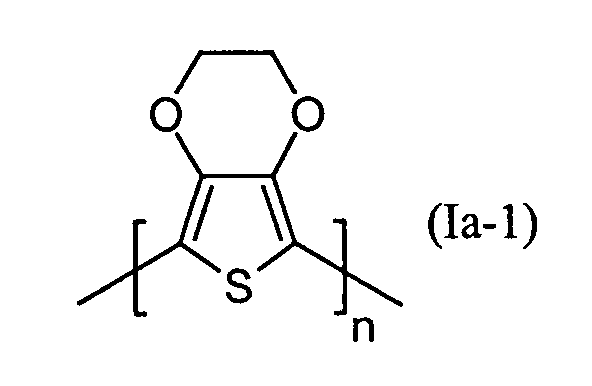
- n is in the named Formulas for an integer from 4 to 150, preferably 4 to 50.
- polymeric carboxylic acids such as polyacrylic acids
- polymethacrylic acids polymaleic acids and polymeric sulfonic acids
- Polystyrene sulfonic acids and polyvinyl sulfonic acids.
- These polycarbonate and sulfonic acids can also copolymers of vinyl carbon and vinyl sulfonic acids with other polymerizable monomers, such as acrylic acid esters and styrene.
- PSS polystyrene sulfonic acid
- the molecular weight of the polyacids providing the polyanions is preferably 1,000 to 2,000,000, particularly preferably 2,000 to 500,000.
- the polyacids or their alkali salts are commercially available, e.g. Polystyrene sulfonic acids and Polyacrylic acids, or can be produced by known processes (see e.g. Houben Weyl, Methods of Organic Chemistry, Vol. E 20 Macromolecular Substances, Part 2, (1987), p. 1141 and others).
- the polyalkylenedioxythiophenes carry positive and negative Charge in the structural unit.
- the polyalkylenedioxythiophenes are oxidative Polymerization produced. This gives them positive charges in the Formulas are not shown because their number and position cannot be determined correctly are.
- the polythiophene dispersion can be prepared using established processes such as casting, printing, Spraying, dipping, flooding or inkjet applied to the transparent conductive substrate become.
- a transparent substrate which is provided with a conductive layer
- glass Thin glass (flexible glass) or plastics are suitable.
- At least one of the substrates preferably consists of plastic.
- plastics are: polycarbonates, polyesters, copolycarbonates, Polysulfone, polyether sulfone, polyimide, polyethylene, polypropylene or cyclic Polyolefins or cyclic olefin copolymers (COC) or hydrogenated styrene (co) polymers.
- Preferred polymers are polysulfone, polyether sulfone, polyester, cyclic olefin copolymers, hydrogenated styrene (co) polymers and polycarbonates.
- Polyesters are PET and PEN (polyethylene terephthalate or polyethylene naphthenate) prefers.
- Suitable polymer substrates are, for example, polyester films, PES films Sumitomo or polycarbonate films from Bayer AG (Makrofol®).
- These substrates can be scratch-resistant and / or chemical-resistant due to an additional layer be equipped, e.g. Marnot® films (Bayer AG).
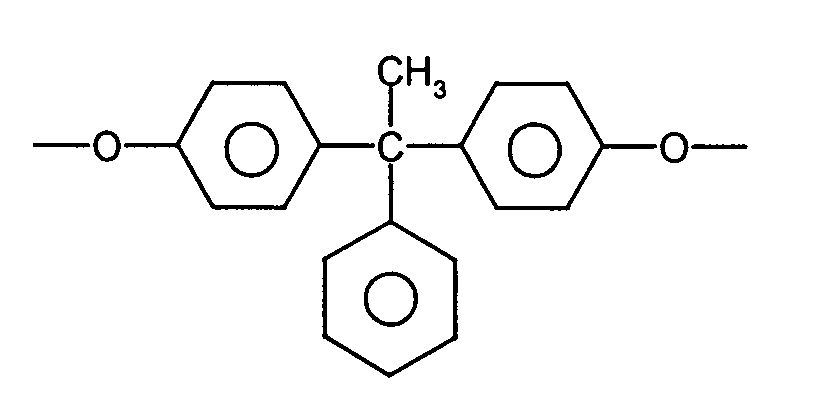
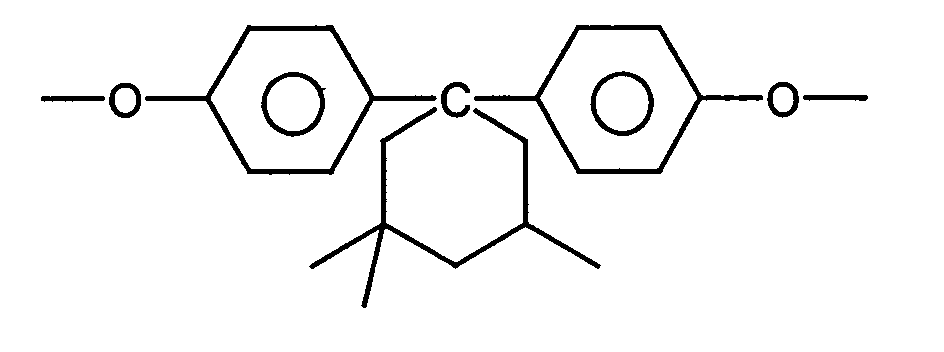
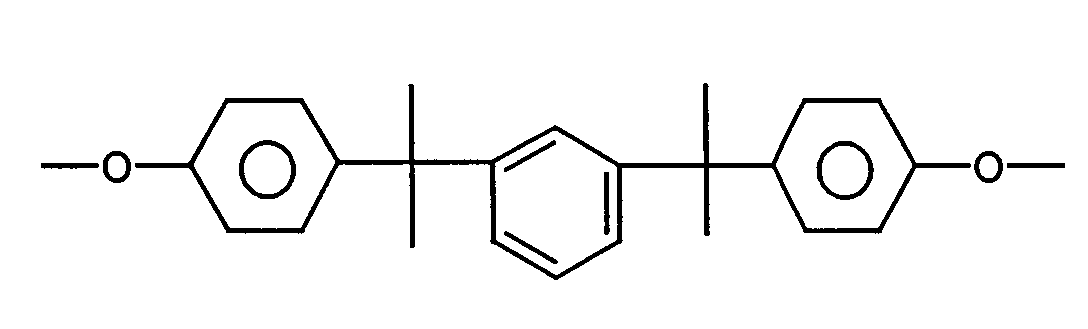
- polycarbonates From the group of polycarbonates, the poly- or copolycarbonates which contain one of the following segments are particularly suitable:
- Table 1 shows the influence of the Baytron®P solution on the surface roughness of the substrate. substratum Roughness r a (nm) a) Glass / ITO 2.5 b) GIaSRTO / Baytron®P 1.6 c) Polyester (PET) / ITO 3.9 d) Polyester (PET) / ITO / Baytron®P 2.5
- the roughness was determined using atomic force microscopy (AFM).
- the pattern d) also shows repeated mechanical Treatment - bending, rolling etc. - no visible surface cracks.
- the Baytron®P-coated substrates can be used to build common electro-optical active arrangements, e.g. Liquid crystal displays, electrochromic Displays etc. are used.
Landscapes
- Physics & Mathematics (AREA)
- Chemical & Material Sciences (AREA)
- Nonlinear Science (AREA)
- Spectroscopy & Molecular Physics (AREA)
- Mathematical Physics (AREA)
- Crystallography & Structural Chemistry (AREA)
- General Physics & Mathematics (AREA)
- Optics & Photonics (AREA)
- Health & Medical Sciences (AREA)
- Chemical Kinetics & Catalysis (AREA)
- Medicinal Chemistry (AREA)
- Polymers & Plastics (AREA)
- Organic Chemistry (AREA)
- Laminated Bodies (AREA)
- Liquid Crystal (AREA)
- Devices For Indicating Variable Information By Combining Individual Elements (AREA)
- Coating Of Shaped Articles Made Of Macromolecular Substances (AREA)
Abstract
Description

- A1 und A2
- unabhängig voneinander für gegebenenfalls substituiertes (C1-C18)-Alkyl stehen oder zusammen gegebenenfalls substituiertes (C1-C18)-Alkylen bilden, und
- n
- für eine ganze Zahl von 2 bis 10 000, vorzugsweise 3 bis 5 000 steht,


- R1 und R2
- unabhängig voneinander für Wasserstoff, gegebenenfalls substituiertes (C1-C18)-Alkyl, vorzugsweise (C1-C10)-, insbesondere (C1-C6)-Alkyl, gegebenenfalls substituiertes (C2-C12)-Alkenyl, vorzugsweise (C2-C8)-Alkenyl, gegebenenfalls substituiertes (C3-C7)-Cycloalkyl, vorzugsweise Cyclopentyl, Cyclohexyl, gegebenenfalls substituiertes (C7-C15)-Aralkyl, vorzugsweise Phenyl-(C1-C4)-alkyl, gegebenenfalls substituiertes (C6-C10)-Aryl, vorzugsweise Phenyl, Naphthyl, gegebenenfalls substituiertes (C1-C18)-Alkyloxy, vorzugsweise (C1-C10)-Alkyloxy, beispielsweise Methoxy, Ethoxy, n- oder iso-Propoxy, oder gegebenenfalls substituierten (C2-C18)-Alkyloxyester steht und
- R3, R4
- unabhängig voneinander für Wasserstoff, aber nicht beide gleichzeitig, mit mindestens einer Sulfonatgruppe, Hydroxylgruppe oder Carboxylgruppe substituiertes (C1-C18)-Alkyl, vorzugsweise (C1-C10)-, insbesondere (C1-C6)-Alkyl, mit mindestens einer Sulfonatgruppe, Hydroxylgruppe oder Carboxylgruppe substituiertes (C2-C12)-Alkenyl, vorzugsweise (C2-C8)-Alkenyl, mit mindestens einer Sulfonatgruppe, Hydroxylgruppe oder Carboxylgruppe substituiertes (C3-C7)-Cycloalkyl, vorzugsweise Cyclo-pentyl, Cyclohexyl, mit mindestens einer Sulfonatgruppe, Hydroxylgruppe oder Carboxylgruppe substituiertes (C7-C15)-Aralkyl, vorzugsweise Phenyl-(C1-C4)-alkyl, mit mindestens einer Sulfonatgruppe, Hydroxylgruppe oder Carboxylgruppe substituiertes (C6-C10)-Aryl, vorzugsweise Phenyl, Naphthyl, mit mindestens einer Sulfonatgruppe Hydroxylgruppe oder Carboxylgruppe substituiertes (C1-C18)-Alkyloxy, vorzugsweise (C1-C10)-Alkyloxy, beispielsweise Methoxy, Ethoxy, n- oder iso-Propoxy oder mit mindestens einer Sulfonatgruppe, Hydroxylgruppe oder Carboxylgruppe substituierten (C2-C18)-Alkyloxyester steht.
- n
- für eine Zahl von 2 bis 10 000, vorzugsweise 3 bis 5 000 steht.
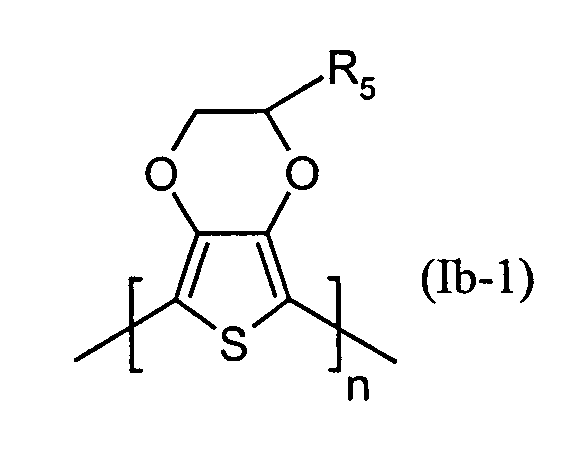
- R5
- für mit mindestens einer Sulfonatgruppe, Hydroxylgruppe oder Carboxyl-gruppe substituiertes (C1-C18)-Alkyl, vorzugsweise (C1-C10)-, insbesondere (C1-C6)-Alkyl, mit mindestens einer Sulfonatgruppe, Hydroxylgruppe oder Carboxylgruppe substituiertes (C2-C12)-Alkenyl, vorzugsweise (C2-C8)-Alkenyl, mit mindestens einer Sulfonatgruppe, Hydroxylgruppe oder Carboxylgruppe substituiertes (C3-C7)-Cycloalkyl, vorzugsweise Cyclopentyl, Cyclohexyl, mit mindestens einer Sulfonatgruppe, Hydroxylgruppe oder Carboxylgruppe substituiertes (C7-C15)-Aralkyl, vorzugsweise Phenyl-(C1-C4)-alkyl, mit mindestens einer Sulfonatgruppe, Hydroxylgruppe oder Carboxylgruppe substituiertes (C6-C10)-Aryl, vorzugsweise Phenyl, Naphthyl, mit mindestens einer Sulfonatgruppe, Hydroxylgruppe oder Carboxylgruppe substituiertes (C1-C18)-Alkyloxy, vorzugsweise (C1-C10)-Alkyloxy, beispielsweise Methoxy, Ethoxy, n- oder iso-Propoxy oder mit mindestens einer Sulfonatgruppe, Hydroxylgruppe oder Carboxylgruppe substituierten (C2-C18)-Alkyloxyester und
- n
- für eine ganze Zahl von 2 bis 10 000, vorzugsweise 3 bis 5 000 steht.



| Substrat | Rauhigkeit ra (nm) | |
| a) | Glas/ITO | 2,5 |
| b) | GIaSRTO/Baytron®P | 1,6 |
| c) | Polyester (PET)/ITO | 3,9 |
| d) | Polyester (PET)/ITO/Baytron®P | 2,5 |
Claims (10)
- Schichtanordnung, bestehend aus mindestens einem transparenten eine elektrisch leitfähige Schicht enthaltenden Substrat, einer elektro-optisch aktiven Schicht sowie einem weiteren eine elektrisch leitfähige Schicht enthaltenden Substrat, dadurch gekennzeichnet, dass mindestens eines der beiden elektrisch leitfähigen Substrate zusätzlich mit einem organischen leitfähigen Polymersystem beschichtet ist.
- Schichtanordnung gemäß Anspruch 1, dadurch gekennzeichnet, dass die transparente leitfähige Schicht auf den Substraten aus einem Metall oder Metalloxid oder Mischoxiden, die auch dotiert sein können, besteht.
- Schichtanordnung gemäß Anspruch 1, dadurch gekennzeichnet, dass es sich bei dem organischen leitfähigen Polymersystem um ein Polyanilin-, ein Polypyrrol- oder ein Polythiophensystem handelt.
- Schichtanordnung gemäß Anspruch 3, dadurch gekennzeichnet, dass es sich bei dem organischen leitfähigen Polymersystem um ein kationisch geladenes Polythiophen aus Struktureinheiten der Formel (I)in der

- A1 und A2
- unabhängig voneinander für gegebenenfalls substituiertes (C1-C18)-Alkyl stehen oder zusammen gegebenenfalls substituiertes (C1-C18)-Alkylen bilden, und
- n
- für eine ganze Zahl von 2 bis 10 000, vorzugsweise 3 bis 5 000 steht,
- Schichtanordnung gemäß Anspruch 1, dadurch gekennzeichnet, dass das transparente Substrat aus Glas oder einem Kunststoff besteht.
- Schichtanordnung gemäß Anspruch 1, dadurch gekennzeichnet, dass mindestens eines der beiden Substrate ein Kunststoffsubstrat ist.
- Schichtanordnung gemäß Anspruch 5 oder 6, dadurch gekennzeichnet, dass es sich bei dem Kunststoff um Polycarbonat oder Copolycarbonate, Polyester, Polysulfon, Polyethersulfon, Polyimid, Polypropylen, Polyethylen oder cyclische Olefincopolymere oder hydrierte Styrol(co)polymere handelt.
- Schichtanordnung gemäß Anspruch 7, dadurch gekennzeichnet, dass das Kunststoffsubstrat kratzfest und/oder chemikalienresistent ausgerüstet ist.
- Schichtanordnung gemäß Anspruch 1, dadurch gekennzeichnet, dass es sich bei der elektro-optisch aktiven Schicht um eine Flüssigkristallschicht handelt.
- Schichtanordnung gemäß Anspruch 1, dadurch gekennzeichnet, dass die Anordnung gekapselt ist.
Applications Claiming Priority (4)
| Application Number | Priority Date | Filing Date | Title |
|---|---|---|---|
| DE10110755 | 2001-03-07 | ||
| DE10110755 | 2001-03-07 | ||
| DE10127401A DE10127401A1 (de) | 2001-03-07 | 2001-06-06 | Mehrschichtanordnung für elektro-optische Vorrichtungen |
| DE10127401 | 2001-06-06 |
Publications (3)
| Publication Number | Publication Date |
|---|---|
| EP1239322A2 true EP1239322A2 (de) | 2002-09-11 |
| EP1239322A3 EP1239322A3 (de) | 2006-12-06 |
| EP1239322B1 EP1239322B1 (de) | 2014-05-21 |
Family
ID=26008696
Family Applications (1)
| Application Number | Title | Priority Date | Filing Date |
|---|---|---|---|
| EP02003272.8A Expired - Lifetime EP1239322B1 (de) | 2001-03-07 | 2002-02-22 | Mehrschichtanordnung für elektro-optische Vorrichtungen |
Country Status (6)
| Country | Link |
|---|---|
| US (1) | US6940626B2 (de) |
| EP (1) | EP1239322B1 (de) |
| JP (1) | JP2002311450A (de) |
| KR (1) | KR100925591B1 (de) |
| CA (1) | CA2374366A1 (de) |
| SG (1) | SG105534A1 (de) |
Families Citing this family (10)
| Publication number | Priority date | Publication date | Assignee | Title |
|---|---|---|---|---|
| DE10150477A1 (de) * | 2001-10-16 | 2003-04-17 | Bayer Ag | Elektrophosphoreszierende Anordnung mit leitfähigen Polymeren |
| US7427441B2 (en) * | 2004-09-17 | 2008-09-23 | Eastman Kodak Co | Transparent polymeric coated conductor |
| US20060134564A1 (en) * | 2004-12-20 | 2006-06-22 | Eastman Kodak Company | Reflective display based on liquid crystal materials |
| US7387856B2 (en) * | 2005-06-20 | 2008-06-17 | Industrial Technology Research Institute | Display comprising liquid crystal droplets in a hydrophobic binder |
| US20080007518A1 (en) * | 2006-06-23 | 2008-01-10 | Debasis Majumdar | Conductive polymer coating with improved aging stability |
| KR200453456Y1 (ko) * | 2008-11-18 | 2011-05-09 | 주식회사 동성진흥 | 작업용 안전발판 |
| JP2012023020A (ja) | 2010-06-17 | 2012-02-02 | Ricoh Co Ltd | 有機エレクトロルミネッセンス素子、その製造方法及び発光装置 |
| US8780432B1 (en) | 2011-03-22 | 2014-07-15 | Paul Phong Nguyen | Electrochromic devices and methods for forming such devices |
| US8709194B1 (en) * | 2013-02-25 | 2014-04-29 | Eastman Kodak Company | Assembling an electrode device |
| RU2704207C2 (ru) * | 2014-07-11 | 2019-10-24 | Клирист Инк. | Электрохромные устройства и способы создания таких устройств |
Family Cites Families (30)
| Publication number | Priority date | Publication date | Assignee | Title |
|---|---|---|---|---|
| NO170326C (no) | 1988-08-12 | 1992-10-07 | Bayer Ag | Dihydroksydifenylcykloalkaner |
| US5227458A (en) | 1988-08-12 | 1993-07-13 | Bayer Aktiengesellschaft | Polycarbonate from dihydroxydiphenyl cycloalkane |
| EP0440957B1 (de) | 1990-02-08 | 1996-03-27 | Bayer Ag | Neue Polythiophen-Dispersionen, ihre Herstellung und ihre Verwendung |
| US5111327A (en) * | 1991-03-04 | 1992-05-05 | General Electric Company | Substituted 3,4-polymethylenedioxythiophenes, and polymers and electro responsive devices made therefrom |
| US5465169A (en) * | 1992-08-25 | 1995-11-07 | Canon Kabushiki Kaisha | Ferroelectric liquid crystal device with electroconductive protective film and electroconductive alignment film |
| JPH06148648A (ja) * | 1992-10-30 | 1994-05-27 | Japan Radio Co Ltd | 強誘電性液晶表示素子 |
| EP0602713B1 (de) | 1992-12-17 | 1998-10-14 | Agfa-Gevaert N.V. | Antistatische, dauerhafte Grundierschicht |
| JP2884462B2 (ja) * | 1993-08-31 | 1999-04-19 | キヤノン株式会社 | 液晶素子 |
| EP0686662B2 (de) * | 1994-05-06 | 2006-05-24 | Bayer Ag | Leitfähige Beschichtungen |
| DE19507413A1 (de) * | 1994-05-06 | 1995-11-09 | Bayer Ag | Leitfähige Beschichtungen |
| IL110318A (en) * | 1994-05-23 | 1998-12-27 | Al Coat Ltd | Solutions containing polyaniline for making transparent electrodes for liquid crystal devices |
| EP0843195B1 (de) * | 1995-07-28 | 2004-04-07 | Sumitomo Chemical Company Limited | Reflektive platte, reflektiver polarisator und reflektive flüssigkristall-anzeigevorrichtung |
| WO1997018944A1 (en) * | 1995-11-22 | 1997-05-29 | The Government Of The United States Of America, Represented By The Secretary Of The Navy | Patterned conducting polymer surfaces and process for preparing the same and devices containing the same |
| JPH1068923A (ja) * | 1996-06-17 | 1998-03-10 | Canon Inc | 液晶素子及びそれを用いた液晶装置 |
| DE19627069A1 (de) * | 1996-07-05 | 1998-01-08 | Bayer Ag | Elektrolumineszierende Anordnungen unter Verwendung von lamellaren Elektroden |
| FR2752570B1 (fr) * | 1996-08-22 | 1998-10-02 | Saint Gobain Vitrage | Vitrage a proprietes optiques et/ou energetiques variables |
| DE19810932A1 (de) * | 1998-03-13 | 1999-09-16 | Bayer Ag | Elektrochrome Anordnung auf Basis von Poly-(3,4-ethylendioxy-thiophen)-Derivaten |
| WO1999047970A1 (en) * | 1998-03-18 | 1999-09-23 | E-Ink Corporation | Electrophoretic displays and systems for addressing such displays |
| US6704133B2 (en) * | 1998-03-18 | 2004-03-09 | E-Ink Corporation | Electro-optic display overlays and systems for addressing such displays |
| DE19824215A1 (de) * | 1998-05-29 | 1999-12-02 | Bayer Ag | Elektrochrome Anordnung auf Basis von Poly-(3,4-ethylendioxy-thiophen)-Derivaten in der elektrochromen und der ionenspeichernden Funktionsschicht |
| DE19834834A1 (de) * | 1998-08-01 | 2000-02-03 | Bayer Ag | Selbsthaftende elektrochrome Elektrode und diese enthaltende Anordnungen |
| TW522273B (en) * | 1998-08-07 | 2003-03-01 | Matsushita Electric Industrial Co Ltd | Reflection type liquid crystal display element |
| JP2000111935A (ja) * | 1998-10-05 | 2000-04-21 | Toshiba Corp | 液晶表示素子 |
| DE19845881A1 (de) * | 1998-10-06 | 2000-04-13 | Bayer Ag | Anordnung auf Basis von Poly-(3,4,-dioxythiophen)-Derivaten, die mit Protonen elektrochrom geschaltet werden |
| JP4233180B2 (ja) * | 1999-09-29 | 2009-03-04 | 帝人株式会社 | 透明導電性高分子基板 |
| US7357965B1 (en) * | 1999-10-15 | 2008-04-15 | Agfa-Gevaert, N.V. | Liquid crystal alignment layer |
| AU7917300A (en) * | 1999-10-15 | 2001-04-30 | Agfa-Gevaert Naamloze Vennootschap | Liquid crystal alignment layer |
| US20040043162A1 (en) * | 1999-10-15 | 2004-03-04 | Agfa-Gevaert | Use of a polythiophene for aligning liquid crystals |
| US6515787B1 (en) * | 2000-03-07 | 2003-02-04 | Eclipse Energy Systems, Inc. | Electrochromic layer |
| CN1273856C (zh) * | 2000-12-14 | 2006-09-06 | 皇家菲利浦电子有限公司 | 液晶显示叠层材料及其制造方法 |
-
2002
- 2002-02-04 SG SG200200662A patent/SG105534A1/en unknown
- 2002-02-22 EP EP02003272.8A patent/EP1239322B1/de not_active Expired - Lifetime
- 2002-02-28 JP JP2002053578A patent/JP2002311450A/ja active Pending
- 2002-03-04 CA CA002374366A patent/CA2374366A1/en not_active Abandoned
- 2002-03-04 US US10/090,321 patent/US6940626B2/en not_active Expired - Fee Related
- 2002-03-06 KR KR1020020011824A patent/KR100925591B1/ko not_active Expired - Fee Related
Non-Patent Citations (1)
| Title |
|---|
| None |
Also Published As
| Publication number | Publication date |
|---|---|
| KR20020071755A (ko) | 2002-09-13 |
| JP2002311450A (ja) | 2002-10-23 |
| EP1239322B1 (de) | 2014-05-21 |
| SG105534A1 (en) | 2004-08-27 |
| KR100925591B1 (ko) | 2009-11-06 |
| US20020159127A1 (en) | 2002-10-31 |
| EP1239322A3 (de) | 2006-12-06 |
| CA2374366A1 (en) | 2002-09-07 |
| US6940626B2 (en) | 2005-09-06 |
Similar Documents
| Publication | Publication Date | Title |
|---|---|---|
| DE69514048T2 (de) | Polyaniline-Lösung, damit beschichtete Gegenstände und Verfahren zur Herstellung derselben | |
| DE69232177T2 (de) | Ferroelektrische Flüssigkristallvorrichtung und Verfahren zu ihrer Herstellung | |
| DE69827649T2 (de) | Elektrisch leitfähiges Verbundglas | |
| DE60214833T2 (de) | Elektrochromische einrichtung | |
| DE69005346T2 (de) | Durchsichtiger elektrisch leitfähiger Film und elektrolumineszentes Paneel vom Wechselspannungstyp und dieses verwendende Flüssigkristallanzeige. | |
| Elschner et al. | Solution-deposited PEDOT for transparent conductive applications | |
| US8524438B2 (en) | Etch resist solution, method of fabricating thin film pattern using the same and method of fabricating an LCD device using the same | |
| EP0686662B1 (de) | Leitfähige Beschichtungen | |
| EP0910128B1 (de) | Herstellung von organischen elektrolumineszierenden Bauteilen | |
| DE69816601T2 (de) | Konjugierte polymer in einem oxidierten zustand | |
| DE60216257T2 (de) | Leitfähiger organischer Dünnfilm, Verfahren zu dessen Herstellung, sowie Elektrde und elektrisches Kabel, die davon Gebrauch machen | |
| EP1162238A2 (de) | Zusammensetzungen aus Polythiophen und Lösemittel | |
| EP0960926B1 (de) | UV-geschützte elektrochrome Anordnung auf Basis von Poly-(3,4-ethylendioxythiophen)-Derivaten | |
| DE19824185A1 (de) | Elektrochrome Anordnung auf Basis von Poly-(3,4-ethylendioxy-thiophen)-Derivaten in Kombination mit einer Lithiumniobat-Gegenelektrode | |
| WO2006047079A2 (en) | Polymeric conductor donor and transfer method | |
| DE69131261T2 (de) | Flüssigkristallvorrichtung, Anzeigeverfahren und Anzeigesystem, das dieses benutzt | |
| EP1239322B1 (de) | Mehrschichtanordnung für elektro-optische Vorrichtungen | |
| DE69231981T2 (de) | Optisches Modulationselement | |
| DE102007029915A1 (de) | Organisches Elektrolumineszenzbauteil und Verfahren zum Herstellen desselben | |
| DE102006023138B4 (de) | LCD und Verfahren zu dessen Herstellung | |
| DE102011013654A1 (de) | Leitende Polymerzusammensetzung und Herstellungsverfahren dafür | |
| US20040041969A1 (en) | Method of making a liquid crystal alignment layer | |
| DE60028802T2 (de) | Orientierungsschicht für flüssigkristall | |
| EP0961159B1 (de) | Elektrochrome Anordnung | |
| WO2007017472A1 (de) | Verfahren zur herstellung eines elektrochromen displays |
Legal Events
| Date | Code | Title | Description |
|---|---|---|---|
| PUAI | Public reference made under article 153(3) epc to a published international application that has entered the european phase |
Free format text: ORIGINAL CODE: 0009012 |
|
| AK | Designated contracting states |
Kind code of ref document: A2 Designated state(s): AT BE CH CY DE DK ES FI FR GB GR IE IT LI LU MC NL PT SE TR |
|
| AX | Request for extension of the european patent |
Free format text: AL;LT;LV;MK;RO;SI |
|
| RAP1 | Party data changed (applicant data changed or rights of an application transferred) |
Owner name: H.C. STARCK GMBH |
|
| PUAL | Search report despatched |
Free format text: ORIGINAL CODE: 0009013 |
|
| AK | Designated contracting states |
Kind code of ref document: A3 Designated state(s): AT BE CH CY DE DK ES FI FR GB GR IE IT LI LU MC NL PT SE TR |
|
| AX | Request for extension of the european patent |
Extension state: AL LT LV MK RO SI |
|
| RIC1 | Information provided on ipc code assigned before grant |
Ipc: G02F 1/1343 20060101AFI20020403BHEP Ipc: H01B 1/12 20060101ALI20061031BHEP Ipc: C09D 5/24 20060101ALI20061031BHEP Ipc: C08G 61/12 20060101ALI20061031BHEP Ipc: G02F 1/1333 20060101ALI20061031BHEP Ipc: G02F 1/1337 20060101ALI20061031BHEP |
|
| RAP1 | Party data changed (applicant data changed or rights of an application transferred) |
Owner name: H.C. STARCK GMBH & CO. KG |
|
| 17P | Request for examination filed |
Effective date: 20070606 |
|
| RAP1 | Party data changed (applicant data changed or rights of an application transferred) |
Owner name: H.C. STARCK GMBH |
|
| AKX | Designation fees paid |
Designated state(s): AT BE CH CY DE DK ES FI FR GB GR IE IT LI LU MC NL PT SE TR |
|
| 17Q | First examination report despatched |
Effective date: 20071115 |
|
| RAP1 | Party data changed (applicant data changed or rights of an application transferred) |
Owner name: H.C. STARCK CLEVIOS GMBH |
|
| RAP1 | Party data changed (applicant data changed or rights of an application transferred) |
Owner name: HERAEUS CLEVIOS GMBH |
|
| RAP1 | Party data changed (applicant data changed or rights of an application transferred) |
Owner name: HERAEUS PRECIOUS METALS GMBH & CO. KG |
|
| GRAP | Despatch of communication of intention to grant a patent |
Free format text: ORIGINAL CODE: EPIDOSNIGR1 |
|
| INTG | Intention to grant announced |
Effective date: 20131205 |
|
| GRAS | Grant fee paid |
Free format text: ORIGINAL CODE: EPIDOSNIGR3 |
|
| GRAA | (expected) grant |
Free format text: ORIGINAL CODE: 0009210 |
|
| AK | Designated contracting states |
Kind code of ref document: B1 Designated state(s): AT BE CH CY DE DK ES FI FR GB GR IE IT LI LU MC NL PT SE TR |
|
| REG | Reference to a national code |
Ref country code: GB Ref legal event code: FG4D Free format text: NOT ENGLISH Ref country code: DE Ref legal event code: R081 Ref document number: 50215928 Country of ref document: DE Owner name: HERAEUS DEUTSCHLAND GMBH & CO. KG, DE Free format text: FORMER OWNER: BAYER AG, 51373 LEVERKUSEN, DE |
|
| REG | Reference to a national code |
Ref country code: CH Ref legal event code: EP |
|
| REG | Reference to a national code |
Ref country code: AT Ref legal event code: REF Ref document number: 669883 Country of ref document: AT Kind code of ref document: T Effective date: 20140615 |
|
| REG | Reference to a national code |
Ref country code: IE Ref legal event code: FG4D Free format text: LANGUAGE OF EP DOCUMENT: GERMAN |
|
| REG | Reference to a national code |
Ref country code: DE Ref legal event code: R096 Ref document number: 50215928 Country of ref document: DE Effective date: 20140626 |
|
| REG | Reference to a national code |
Ref country code: NL Ref legal event code: VDEP Effective date: 20140521 |
|
| PG25 | Lapsed in a contracting state [announced via postgrant information from national office to epo] |
Ref country code: FI Free format text: LAPSE BECAUSE OF FAILURE TO SUBMIT A TRANSLATION OF THE DESCRIPTION OR TO PAY THE FEE WITHIN THE PRESCRIBED TIME-LIMIT Effective date: 20140521 Ref country code: GR Free format text: LAPSE BECAUSE OF FAILURE TO SUBMIT A TRANSLATION OF THE DESCRIPTION OR TO PAY THE FEE WITHIN THE PRESCRIBED TIME-LIMIT Effective date: 20140822 |
|
| PG25 | Lapsed in a contracting state [announced via postgrant information from national office to epo] |
Ref country code: ES Free format text: LAPSE BECAUSE OF FAILURE TO SUBMIT A TRANSLATION OF THE DESCRIPTION OR TO PAY THE FEE WITHIN THE PRESCRIBED TIME-LIMIT Effective date: 20140521 Ref country code: SE Free format text: LAPSE BECAUSE OF FAILURE TO SUBMIT A TRANSLATION OF THE DESCRIPTION OR TO PAY THE FEE WITHIN THE PRESCRIBED TIME-LIMIT Effective date: 20140521 |
|
| PG25 | Lapsed in a contracting state [announced via postgrant information from national office to epo] |
Ref country code: PT Free format text: LAPSE BECAUSE OF FAILURE TO SUBMIT A TRANSLATION OF THE DESCRIPTION OR TO PAY THE FEE WITHIN THE PRESCRIBED TIME-LIMIT Effective date: 20140922 |
|
| PG25 | Lapsed in a contracting state [announced via postgrant information from national office to epo] |
Ref country code: DK Free format text: LAPSE BECAUSE OF FAILURE TO SUBMIT A TRANSLATION OF THE DESCRIPTION OR TO PAY THE FEE WITHIN THE PRESCRIBED TIME-LIMIT Effective date: 20140521 |
|
| REG | Reference to a national code |
Ref country code: DE Ref legal event code: R097 Ref document number: 50215928 Country of ref document: DE |
|
| PG25 | Lapsed in a contracting state [announced via postgrant information from national office to epo] |
Ref country code: NL Free format text: LAPSE BECAUSE OF FAILURE TO SUBMIT A TRANSLATION OF THE DESCRIPTION OR TO PAY THE FEE WITHIN THE PRESCRIBED TIME-LIMIT Effective date: 20140521 |
|
| PLBE | No opposition filed within time limit |
Free format text: ORIGINAL CODE: 0009261 |
|
| STAA | Information on the status of an ep patent application or granted ep patent |
Free format text: STATUS: NO OPPOSITION FILED WITHIN TIME LIMIT |
|
| 26N | No opposition filed |
Effective date: 20150224 |
|
| PG25 | Lapsed in a contracting state [announced via postgrant information from national office to epo] |
Ref country code: IT Free format text: LAPSE BECAUSE OF FAILURE TO SUBMIT A TRANSLATION OF THE DESCRIPTION OR TO PAY THE FEE WITHIN THE PRESCRIBED TIME-LIMIT Effective date: 20140521 |
|
| REG | Reference to a national code |
Ref country code: DE Ref legal event code: R097 Ref document number: 50215928 Country of ref document: DE Effective date: 20150224 |
|
| REG | Reference to a national code |
Ref country code: DE Ref legal event code: R082 Ref document number: 50215928 Country of ref document: DE Representative=s name: HERZOG FIESSER & PARTNER PATENTANWAELTE PARTG , DE Ref country code: DE Ref legal event code: R081 Ref document number: 50215928 Country of ref document: DE Owner name: HERAEUS DEUTSCHLAND GMBH & CO. KG, DE Free format text: FORMER OWNER: HERAEUS PRECIOUS METALS GMBH & CO. KG, 63450 HANAU, DE |
|
| PG25 | Lapsed in a contracting state [announced via postgrant information from national office to epo] |
Ref country code: LU Free format text: LAPSE BECAUSE OF FAILURE TO SUBMIT A TRANSLATION OF THE DESCRIPTION OR TO PAY THE FEE WITHIN THE PRESCRIBED TIME-LIMIT Effective date: 20150222 |
|
| REG | Reference to a national code |
Ref country code: CH Ref legal event code: PL |
|
| PG25 | Lapsed in a contracting state [announced via postgrant information from national office to epo] |
Ref country code: MC Free format text: LAPSE BECAUSE OF FAILURE TO SUBMIT A TRANSLATION OF THE DESCRIPTION OR TO PAY THE FEE WITHIN THE PRESCRIBED TIME-LIMIT Effective date: 20140521 Ref country code: LI Free format text: LAPSE BECAUSE OF NON-PAYMENT OF DUE FEES Effective date: 20150228 Ref country code: CH Free format text: LAPSE BECAUSE OF NON-PAYMENT OF DUE FEES Effective date: 20150228 |
|
| REG | Reference to a national code |
Ref country code: IE Ref legal event code: MM4A |
|
| PG25 | Lapsed in a contracting state [announced via postgrant information from national office to epo] |
Ref country code: IE Free format text: LAPSE BECAUSE OF NON-PAYMENT OF DUE FEES Effective date: 20150222 |
|
| REG | Reference to a national code |
Ref country code: FR Ref legal event code: PLFP Year of fee payment: 15 |
|
| REG | Reference to a national code |
Ref country code: AT Ref legal event code: MM01 Ref document number: 669883 Country of ref document: AT Kind code of ref document: T Effective date: 20150222 |
|
| PGFP | Annual fee paid to national office [announced via postgrant information from national office to epo] |
Ref country code: DE Payment date: 20160218 Year of fee payment: 15 |
|
| PG25 | Lapsed in a contracting state [announced via postgrant information from national office to epo] |
Ref country code: AT Free format text: LAPSE BECAUSE OF NON-PAYMENT OF DUE FEES Effective date: 20150222 |
|
| PGFP | Annual fee paid to national office [announced via postgrant information from national office to epo] |
Ref country code: FR Payment date: 20160218 Year of fee payment: 15 Ref country code: BE Payment date: 20160217 Year of fee payment: 15 Ref country code: GB Payment date: 20160217 Year of fee payment: 15 |
|
| PG25 | Lapsed in a contracting state [announced via postgrant information from national office to epo] |
Ref country code: BE Free format text: LAPSE BECAUSE OF NON-PAYMENT OF DUE FEES Effective date: 20170228 |
|
| PG25 | Lapsed in a contracting state [announced via postgrant information from national office to epo] |
Ref country code: CY Free format text: LAPSE BECAUSE OF FAILURE TO SUBMIT A TRANSLATION OF THE DESCRIPTION OR TO PAY THE FEE WITHIN THE PRESCRIBED TIME-LIMIT Effective date: 20140521 |
|
| PG25 | Lapsed in a contracting state [announced via postgrant information from national office to epo] |
Ref country code: TR Free format text: LAPSE BECAUSE OF FAILURE TO SUBMIT A TRANSLATION OF THE DESCRIPTION OR TO PAY THE FEE WITHIN THE PRESCRIBED TIME-LIMIT Effective date: 20140521 |
|
| REG | Reference to a national code |
Ref country code: DE Ref legal event code: R119 Ref document number: 50215928 Country of ref document: DE |
|
| GBPC | Gb: european patent ceased through non-payment of renewal fee |
Effective date: 20170222 |
|
| REG | Reference to a national code |
Ref country code: FR Ref legal event code: ST Effective date: 20171031 |
|
| PG25 | Lapsed in a contracting state [announced via postgrant information from national office to epo] |
Ref country code: DE Free format text: LAPSE BECAUSE OF NON-PAYMENT OF DUE FEES Effective date: 20170901 Ref country code: FR Free format text: LAPSE BECAUSE OF NON-PAYMENT OF DUE FEES Effective date: 20170228 |
|
| REG | Reference to a national code |
Ref country code: BE Ref legal event code: MM Effective date: 20170228 |
|
| PG25 | Lapsed in a contracting state [announced via postgrant information from national office to epo] |
Ref country code: GB Free format text: LAPSE BECAUSE OF NON-PAYMENT OF DUE FEES Effective date: 20170222 |