EP1237364B1 - Appareil de télévision - Google Patents
Appareil de télévision Download PDFInfo
- Publication number
- EP1237364B1 EP1237364B1 EP02003629A EP02003629A EP1237364B1 EP 1237364 B1 EP1237364 B1 EP 1237364B1 EP 02003629 A EP02003629 A EP 02003629A EP 02003629 A EP02003629 A EP 02003629A EP 1237364 B1 EP1237364 B1 EP 1237364B1
- Authority
- EP
- European Patent Office
- Prior art keywords
- data
- entertainment device
- information
- electronic entertainment
- advertisement
- Prior art date
- Legal status (The legal status is an assumption and is not a legal conclusion. Google has not performed a legal analysis and makes no representation as to the accuracy of the status listed.)
- Expired - Lifetime
Links
- 230000015654 memory Effects 0.000 claims description 66
- 238000012545 processing Methods 0.000 claims description 10
- 230000005540 biological transmission Effects 0.000 claims description 6
- 238000012544 monitoring process Methods 0.000 claims description 5
- 238000011022 operating instruction Methods 0.000 claims 1
- 230000008901 benefit Effects 0.000 description 13
- 238000004891 communication Methods 0.000 description 8
- 206010038743 Restlessness Diseases 0.000 description 4
- 238000000034 method Methods 0.000 description 3
- 230000004913 activation Effects 0.000 description 2
- 230000008859 change Effects 0.000 description 2
- 238000010586 diagram Methods 0.000 description 2
- 238000003780 insertion Methods 0.000 description 2
- 230000037431 insertion Effects 0.000 description 2
- 238000004519 manufacturing process Methods 0.000 description 2
- 230000003287 optical effect Effects 0.000 description 2
- 230000008569 process Effects 0.000 description 2
- 230000001360 synchronised effect Effects 0.000 description 2
- 230000009471 action Effects 0.000 description 1
- 239000002131 composite material Substances 0.000 description 1
- 230000001419 dependent effect Effects 0.000 description 1
- 238000001514 detection method Methods 0.000 description 1
- 238000011161 development Methods 0.000 description 1
- 238000012986 modification Methods 0.000 description 1
- 230000004048 modification Effects 0.000 description 1
- 238000003825 pressing Methods 0.000 description 1
- 230000008439 repair process Effects 0.000 description 1
- 230000004044 response Effects 0.000 description 1
- 238000000926 separation method Methods 0.000 description 1
- 238000003860 storage Methods 0.000 description 1
- 230000003442 weekly effect Effects 0.000 description 1
Images

Classifications
-
- H—ELECTRICITY
- H04—ELECTRIC COMMUNICATION TECHNIQUE
- H04N—PICTORIAL COMMUNICATION, e.g. TELEVISION
- H04N5/00—Details of television systems
- H04N5/44—Receiver circuitry for the reception of television signals according to analogue transmission standards
-
- H—ELECTRICITY
- H04—ELECTRIC COMMUNICATION TECHNIQUE
- H04N—PICTORIAL COMMUNICATION, e.g. TELEVISION
- H04N5/00—Details of television systems
- H04N5/44—Receiver circuitry for the reception of television signals according to analogue transmission standards
- H04N5/445—Receiver circuitry for the reception of television signals according to analogue transmission standards for displaying additional information
-
- H—ELECTRICITY
- H04—ELECTRIC COMMUNICATION TECHNIQUE
- H04N—PICTORIAL COMMUNICATION, e.g. TELEVISION
- H04N5/00—Details of television systems
- H04N5/14—Picture signal circuitry for video frequency region
- H04N5/21—Circuitry for suppressing or minimising disturbance, e.g. moiré or halo
Definitions
- the invention relates to a television set which has a receiving part, a transmitter memory, an image signal processing stage, an image display unit, a control unit and an operating unit.
- US-A-5,233,423 there is disclosed a television receiving apparatus having a memory in which data containing advertising messages are stored. These messages are displayed on the TV depending on an internal circuit or internal clock.
- the US 6,317,780 B1 describes a system and method for distributing and displaying data, such as advertisements, from a host server to a browser device in a communication network.
- the browser device may be connected to the Internet by means of an ISDN modem.
- the data is transmitted in advance to the browser device via the communication network and stored there. During a detected idle time, this data is displayed using the browser device.
- television sets are already known, in which after a switch to a stable image display a blanking of the screen or the display of a suitably designed "curtain" takes place.
- the invention has for its object to provide a way how the uses of a device of consumer electronics, in particular a television, can be extended.
- a device provided with the claimed features of the consumer electronics, in particular a television, not only for receiving, storing and can be used for viewing transmitted over a radio link television signals, but also for playback of internally stored frames, image sequences or video clips.
- These individual images are preferably television-independent information that is useful to the end user and that has been stored by the device manufacturer or dealer.
- a consumer electronics device comprises time acquisition means provided for detecting the presentation time of the advertisements on the image display unit.
- a television viewer who accepts to consider advertisements over a given presentation time, possibly also in the sense of brief interruptions of a current television program, can be given as monetary benefits, for example, purchase discounts, warranty extensions, fee reimbursements or activation of a given TV channel
- the presentation of these individual images can take place in particular if no other television signals can currently be reproduced, for example in the event of signal failures, when a program slot not occupied by transmitter data is called or during the time the respective television is booted.
- the television station independent information can also be downloaded from the Internet. This can be done automatically after the establishment of an Internet connection or as a result of an operation of the keypad.
- the user also has the option of selecting one or more from a large number of information pages offered on the Internet. This can be done using a receiver-side generated menu page.
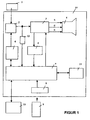
- FIG. 1 shows a block diagram of a device according to the invention of consumer electronics using a television TV. This is connected to an antenna 1 and is still connected to an ISDN telephone line 10 in connection. To operate the TV TV, a remote control transmitter 9 is provided. The emitted from this infrared control commands are received by a remote control receiver 8 and forwarded from there to the implemented as a microcomputer control unit 7.
- a television program is selected by means of the receiver unit 2 and made available in the form of an FBAS signal at the output of the receiver unit.
- This composite video signal is forwarded to an image signal processing unit 3 and to a sync signal separation stage 12.
- the synchronizing signals SY are separated from the FBAS signal and forwarded to the control unit 7.
- the provided at the output of the receiving unit CVBS signals are processed in the image signal processing unit 3 and converted into R, G, B signals. These are supplied to an image display unit 4 and displayed there.
- the apparatus shown has a transmitter memory 6, in which a plurality of television transmitters associated transmitter and receiver data are stored. These can be done by means of a Remote control unit in the sense of switching to a desired transmitter input command under control by the control unit 7 read from the transmitter memory 6 and used to vote the receiving unit 2 to the desired station.
- the transmitter memories usually installed today have such a large memory capacity that generally a large number of memory locations of the transmitter memory are not occupied by reception data from transmitters.
- a television according to the invention is provided with a signal failure detector. This can be formed by the control unit 7 itself, which recognizes whether a signal failure exists or not based on the presence or absence of sync pulses. Alternatively or additionally, a separate signal failure detector 5 may be provided which is in communication with the image signal processing unit 3 and detects the presence of a signal failure on the basis of the image signals present in the image signal processing unit.
- the control unit 7 is further in communication with a nonvolatile memory 11 of the television set TV.
- a nonvolatile memory 11 of the television set TV In this memory TV-independent images are stored corresponding data, d. H. Data that has not been received via the receiving part 2 and also not derived from an external video recorder or an external optical disc player.
- These television station independent data were preferably stored non-volatile in the memory 11 during the production of the television set in the factory.
- they contain, for example, the manufacturer's logo, a service dealer directory, contact addresses of the device manufacturer, information about the manufacturer and / or information about the product range of the device manufacturer.
- television-independent data can also be stored nonvolatilely in the memory 11 of the television set by the dealer of the device.
- This may be merchant-specific information, such as the merchant's contact address, the range of products offered by the merchant, and / or information about the merchant's services.
- information and / or advertising pages from other companies and authorities located at the point of sale of the television set can also be stored in the memory 11, for example information about local newspapers, local vehicle dealers and garages, local grocers, local hypermarkets, municipal information, etc.
- the memory 11 may be formed as a ROM. In this case, its content is fixed and unchangeable. Preferably, however, the memory 11 is a RAM, a flash memory or - especially for larger amounts of data - a hard disk space. With these memories, the stored data can be updated as needed, for example, every time the device is repaired by the service dealer. Thus, the dealer on the need for a software update of the device flash charging station his individual information and advertising content, eg. As a personal customer greeting, in the memory 11 of the device 11 deposit.
- the display of this information is carried out according to a first embodiment of the invention in response to an input by means of the remote control 9 operating command.
- the remote control 9 further comprises keys, for example +/- keys, by means of which it can be turned over between a plurality of stored information and advertising pages.
- a display of the stored information and advertising pages is then automatically when 5 signal failures are detected by means of the control unit 7 or the signal failure detector.
- the stored information and advertising pages are displayed automatically when the user knowingly or inadvertently dials a memory location of the transmitter memory 6 which is not occupied by program data. Also in this case it is avoided that on the screen of the TV, a rushing, restless picture can be seen.
- the stored information and advertising pages can also be displayed during the startup of the television after it has been switched on.
- Modern televisions take several seconds to achieve a stable image reproduction, since the screen needs a warm-up time and the TV must first be synchronized with a received signal.
- the time until this stable state is reached can advantageously be used to display a stored information page, for example a manufacturer-specific information page. This makes the switch-on process of the device optically more bearable and informative.
- An advantageous development of the invention consists in using the Internet connection 10 of the respective TV set TV to download information and / or advertising pages from the Internet and to store them non-volatile in the memory 11.
- the over the ISDN line of the control unit 7 supplied HTML pages are recoded by the control unit 7 and transferred to the memory 11. From there they can - as described above - be retrieved and displayed on the screen 4.
- the downloading of new information and advertising pages from the Internet can always take place automatically when an Internet connection is established.
- a selection of the respective Internet address containing the information and advertising pages and a likewise controlled by means of the remote control transmitter 9 selection of the data to be downloaded is preferably supported by a menu page displayed on the TV screen.
- FIGURE 2 shows a further block diagram of a device according to the invention of the consumer electronics with reference to a TV set TV, which is connected to an antenna 1 and further communicates with an ISDN telephone line 10.
- a remote control transmitter 9 is provided to operate the TV TV.
- the emitted from this infrared control commands are received by a remote control receiver 8 and forwarded from there to the implemented as a microcomputer control unit 7.
- a television program is selected by means of the receiver unit 2 and the corresponding signals in the form of an FBAS signal are provided at the output of the receiver unit.
- This CVBS signal is sent to a Image signal processing unit 3 and forwarded to a Synchronsignalabtrenncut 12.
- the synchronizing signals are separated from the FBAS signal and forwarded to the control unit 7.
- the provided at the output of the receiving unit CVBS signals are processed in the image signal processing unit 3 and converted into R, G, B signals. These are supplied to an image display unit 4 and displayed there.
- the apparatus shown has a transmitter memory 6, in which a plurality of television transmitters associated transmitter and receiver data are stored. These can be read out of the transmitter memory 6 by a command entered by means of the remote control unit in the sense of switching to a desired transmitter under the control of the control unit 7 and used to tune the receiver unit 2 to the desired transmitter.
- the transmitter memories usually installed today have such a large memory capacity that generally a large number of memory locations of the transmitter memory are not occupied by reception data from transmitters.
- the television shown is provided with a dropout detector. This can be formed by the control unit 7 itself, which recognizes whether a signal failure exists or not based on the presence or absence of sync pulses. Alternatively or additionally, a separate signal failure detector 5 may be provided which is in communication with the image signal processing unit 3 and detects the presence of a signal failure on the basis of the image signals present in the image signal processing unit.
- the control unit 7 is further in communication with non-volatile memories 11a-11e of the TV set TV.
- the memory 11a stores data corresponding to advertising contributions and in the form of individual images.
- These data were preferably stored in the memory 11a non-volatile already in the production of the television in the factory. They contain the manufacturer's logo, a service dealer directory, contact details of the equipment manufacturer, information about the manufacturer and / or information about the product range of the equipment manufacturer.
- data corresponding to the advertising items of the device of the device can also be stored nonvolatilely in the memory 11a of the television set.
- This may be merchant-specific information, such as the merchant's contact address, the range of products offered by the merchant, and / or information about the merchant's services.
- information and / or advertising pages from other companies and authorities located at the point of sale of the television set can also be stored in the memory 11a, for example information about local newspapers, local vehicle dealers and motor vehicle repair shops, local grocers, local hypermarkets , municipal information, etc.
- the memory 11a may be formed as a ROM. In this case, its content is fixed and unchangeable. However, the memory 11a is preferably a RAM, a flash memory or, in particular for larger amounts of data, a hard disk memory. With these memories, the stored data can be updated as needed, for example, every time the device is repaired by the service dealer. So the dealer can over the necessary for a software update of the equipment Flash charging station its individual information and advertising content, z. As a personal customer greeting, store in the memory 11 a of the device TV.
- the display of this information on the image display unit 4 takes place after input of an operating command entered by means of the remote control 9.
- the remote control 9 further comprises keys, for example +/- keys, by means of which it can be turned over between a plurality of stored information and advertising pages.
- An operating mode can also consist of an endless reproduction of the stored information and advertising pages. This mode is especially advantageous when the TV is placed in a shop window.
- a display of the stored advertising pages is then automatically when 5 signal failures are detected by means of the control unit 7 or the signal failure detector.
- displaying stored advertising pages is then achieved when signal failures, in an advantageous manner that no noisy, restless picture is seen during the signal downtime. This is particularly advantageous when the TV is set up in an exhibition room or a shop window when it is switched on.
- a display of the stored advertising pages is also automatically when the user knowingly or accidentally selects a not occupied with program data storage space of the transmitter memory 6. Also in this case it is avoided that on the screen of the TV, a rushing, restless picture can be seen.
- the stored advertising pages can also be displayed automatically during the startup of the television after it has been switched on.
- Modern televisions require several seconds until stable image reproduction is possible because the screen requires a warm-up time and the TV only with a received signal must be synchronized.
- the time until this stable state is reached can advantageously be used to display a stored advertisement page, for example a manufacturer-specific advertising page. This makes the switch-on process of the device optically more bearable and informative.
- the ISDN telephone line 10 of the television set TV shown is used to download advertising pages from the Internet and store them non-volatile in the memory 11a.
- the HTML pages supplied via the ISDN line to the control unit 7 are recoded by the control unit 7 and transmitted to the memory 11a. From there, as described above, they can be retrieved and displayed on the image display unit 4.
- To download new advertising pages from the Internet by means of the remote control transmitter 9 is a selection of the respective Internet address containing the advertising pages and also controlled by means of the remote control transmitter 9 selection of the data to be downloaded. This selection is preferably supported by a menu page displayed on the display unit of the television.
- television viewers are rewarded by monetary benefits for their willingness to view additional advertisements even during ongoing television broadcasts.
- monetary benefits include, for example, giving the viewer television discounts, granting a warranty extension, fees, For example, television fees, to reimburse or unlock a particular TV channel.
- This control data includes information about the times and the duration of advertising inserts, which in turn are stored in the non-volatile memory 11a.
- the duration of a commercial insertion can be, for example, 30 seconds.
- the time of the commercials or the intervals between successive commercials can be 30 minutes.
- the insertion of the advertisement takes place either in place of the television picture, so that for the television viewer the current television program is interrupted for a period of 30 seconds, or in the form of a fade into the current television picture.
- the device manufacturer or dealer in the memory 11b also stores information about a desired time interval, which corresponds to the desired overall presentation time of the advertising display on the image display unit 4.
- This setpoint time interval is compared during the device operation with an actual time interval which corresponds to an accumulated value of the previous actual presentation times of the commercials.
- Time detection means are provided for detecting the actual presentation times, which are formed by the control unit 7 in the exemplary embodiment shown.
- the summed value for the actual presentation times of the advertising overlays is stored in the nonvolatile memory 11c and is constantly updated during or after viewing an advertising overlay.
- the television viewer has his consideration for the monetary value granted to him Advantage brought and a display of advertisements takes place only when the device is booted, transmitter failures and a selection of unoccupied program slots and no longer in the sense of interrupting ongoing television broadcasts.
- monitoring of the accumulated value of the actual presentation times of the advertising overlays by the advertising provider is provided.
- This advertising provider is any company whose advertising pages are stored in the non-volatile memory 11a.
- the Internet address of the advertising service provider is stored in the non-volatile memory 11 b.
- the control unit 7 automatically initiates the establishment of an Internet connection via the ISDN telephone line 10 to the advertising provider using the stored Internet address. If the Internet connection is established, then a transmission takes place, in an advantageous embodiment of the invention, an encrypted transmission of the accumulated in the memory 11c accumulated value of the actual presentation times together with a device identification number stored in the nonvolatile memory 11d, the advertising provider.
- automatically updated advertising pages can be transmitted to the television set and stored there in the nonvolatile memory 11a.
- These updated advertising pages contain up-to-date information from the advertising service provider, such as references to valid special offers, current events, changes to addresses, or information about opening a new store.
- the advertisement contents are transmitted to the television viewers along with a television signal, but can only be shown on screen to registered customers.
- This transmission in the television signal may occur in the presence of an analog television signal similar to a teletext signal in reserved lines of the vertical blanking intervals. Only registered customers have access to these reserved lines of the vertical blanking gaps.
- the registration of the customers can take place via telephone or internet.
- the control and monitoring of advertising consumption via the software of each TV in conjunction with additional software that is provided by the respective advertiser to the end user either via the Internet or by means of a loadable into the TV disk, such as a CD-ROM or a DVD.
- the advertising content is transmitted to the end user in the form of digital data packets which are time multiplexed with the data packets of the television signal.
- a selection and deselection of advertisers on the part of the customer via the Internet via which the television viewers have access to a website, which contains an overview of the candidate advertising providers, their advertising duration and the advantages offered by these monetary benefits
- the registration of a customer is made by stating the respective device identification number, which serves to verify the automatic downloading of the advertising content.
- the TV receiving the downloaded data acknowledges receipt of the data with its identification number, so that the advertiser can be sure to reach the respective consumer with his advertisement.
- the respective TV set With the registration and the first download of advertising data, the respective TV set also receives the Internet address of the advertising provider, under which future updated advertising data will be collected.
- the Internet address mentioned, the advertising duration of the respective advertising provider and the advertising content are non-volatile stored in the TV set TV as in the above embodiments.
- a daily, weekly or monthly connection to the Internet with the advertising provider may also be provided.
Landscapes
- Engineering & Computer Science (AREA)
- Multimedia (AREA)
- Signal Processing (AREA)
- Two-Way Televisions, Distribution Of Moving Picture Or The Like (AREA)
- Information Transfer Between Computers (AREA)
- Management, Administration, Business Operations System, And Electronic Commerce (AREA)
Claims (14)
- Appareil d'électronique de divertissement, qui présente une partie de réception (2), une mémoire d'émetteur (6), un niveau de traitement de signal d'image (3), une unité de commande (7), une unité d'opération (9) et une mémoire (11, 11a, 11 b) non volatile, dans laquelle sont stockées des données indépendantes de l'émetteur de télévision,
qui sert au stockage d'informations sur des intervalles de temps de présentation de publicité et/ou lesquelles informations sur les intervalles de temps pour la représentation de publicité contiennent une information sur une durée, pour laquelle une présentation de publicité s'effectue sur une unité d'affichage d'image (4),
caractérisé en ce que la mémoire non volatile est prévue pour le stockage d'une information sur un intervalle de temps prévu, lequel est prévu pour une durée de présentation globale de consigne des articles publicitaires sur l'unité d'affichage d'image (4) et/ou qui est prévu pour le stockage d'une information d'adresses en ligne d'un prestataire de publicité,
et caractérisé en ce que la mémoire non volatile est prévue pour le stockage d'une valeur cumulée du temps de présentation réel, saisi à l'aide des moyens d'enregistrement de temps (7), des articles publicitaires, en ce que l'unité de commande (7) est prévue pour la comparaison de l'information correspondant à l'intervalle de temps prévu avec l'information correspondant à la valeur cumulée du temps de présentation réel et, lorsque la valeur cumulée du temps de présentation réel est supérieure ou égale à l'intervalle de temps prévu, supprime l'information sur les intervalles de temps de présentation de publicité. - Appareil d'électronique de divertissement selon la revendication 1,
caractérisé en ce
qu'il présente une unité d'affichage d'image ou peut être raccordé à une unité d'affichage d'image. - Appareil d'électronique de divertissement selon la revendication 1 ou 2,
caractérisé en ce
qu'il présente également des moyens d'enregistrement de temps (7), qui sont prévus pour l'enregistrement du temps de présentation des articles publicitaires sur l'unité d'affichage d'image (4). - Appareil d'électronique de divertissement selon l'une des revendications précédentes,
caractérisé en ce que
la mémoire (11, 11 a) non volatile est une ROM, une RAM, une mémoire flash ou une mémoire de disque dur. - Appareil d'électronique de divertissement selon l'une des revendications précédentes,
caractérisé en ce
qu'il présente un détecteur de défaillance de signal (5) et, en cas de défaillance de signal détectée, l'unité de commande (7) commande une extraction de données de la mémoire (11) non volatile et leur présentation sur l'unité d'affichage d'image (4) et/ou l'unité de commande (7) commande, en cas de reconnaissance d'un choix d'un emplacement de mémoire, non occupé avec des données d'émetteur, de la mémoire d'émetteur (6) une extraction de données de la mémoire (11, 11a) non volatile et leur présentation sur l'unité d'affichage d'image (4). - Appareil d'électronique de divertissement selon l'une des revendications précédentes,
caractérisé en ce que
l'unité de commande (7) commande, après l'identification d'une instruction d'enclenchement, une extraction de données de la mémoire (11, 11 a) non volatile et leur présentation sur l'unité d'affichage d'image (4). - Appareil d'électronique de divertissement selon l'une des revendications précédentes,
caractérisé en ce que
les données déduites d'Internet sont actualisées automatiquement après l'établissement d'une liaison Internet. - Appareil d'électronique de divertissement selon l'une des revendications précédentes,
caractérisé en ce que
les données déduites d'Internet ne sont mises à jour qu'après l'entrée d'une instruction de commande au moyen de l'unité d'opération (8, 9). - Appareil d'électronique de divertissement selon l'une des revendications précédentes,
caractérisé en ce que
l'unité d'opération (8, 9) présente des éléments d'opération, au moyen desquels on peut effectuer un défilement entre les données mémorisées et correspondant à des images individuelles. - Appareil d'électronique de divertissement selon l'une des revendications précédentes,
caractérisé en ce que
les informations sur les intervalles de temps de représentation de publicité contiennent une information sur des intervalles de temps entre des présentations de publicité consécutives sur l'unité d'affichage d'image (4). - Appareil d'électronique de divertissement selon l'une des revendications précédentes,
caractérisé en ce que
l'unité de commande (7) est prévue pour amorcer après la reconnaissance d'une instruction d'enclenchement ou à des intervalles réguliers automatiquement l'établissement d'une liaison Internet par la ligne de téléphone ISDN (10). - Appareil d'électronique de divertissement selon la revendication 11,
caractérisé en ce que
l'unité de commande (7) est prévue pour initier après l'établissement d'une liaison Internet une extraction de données sur la valeur cumulée des temps de présentation des articles publicitaires de la mémoire (11 c) et une transmission de ces données par la ligne de téléphone ISDN (10) au prestataire de publicité et/ou l'appareil présente une mémoire non volatile (11d) pour un numéro d'identification d'appareil et l'unité de commande (7) est prévue pour initier après l'établissement d'une liaison Internet une extraction de données sur la valeur cumulée du temps de présentation des articles publicitaires et du numéro d'identification d'appareil ainsi qu'une transmission de ces données par la ligne de téléphone ISDN (10) au prestataire de publicité. - Appareil d'électronique de divertissement selon l'une des revendications précédentes,
caractérisé en ce
qu'il présente une mémoire (11e) non volatile pour le stockage d'un programme de contrôle reçu d'Internet par la ligne de téléphone ISDN (10), programme avec l'utilisation duquel l'unité de commande (7) commande la présentation des articles publicitaires. - Appareil d'électronique de divertissement selon l'une des revendications précédentes,
caractérisé en ce
qu'il s'agit d'un appareil de télévision, d'un magnétoscope, d'un appareil de réception par satellite ou d'un lecteur de DVD.
Applications Claiming Priority (4)
| Application Number | Priority Date | Filing Date | Title |
|---|---|---|---|
| DE10109926 | 2001-03-01 | ||
| DE10109926A DE10109926A1 (de) | 2001-03-01 | 2001-03-01 | Fernsehgerät |
| DE10156514A DE10156514A1 (de) | 2001-11-16 | 2001-11-16 | Fernsehgerät |
| DE10156514 | 2001-11-16 |
Publications (3)
| Publication Number | Publication Date |
|---|---|
| EP1237364A2 EP1237364A2 (fr) | 2002-09-04 |
| EP1237364A3 EP1237364A3 (fr) | 2004-12-29 |
| EP1237364B1 true EP1237364B1 (fr) | 2012-08-29 |
Family
ID=26008655
Family Applications (1)
| Application Number | Title | Priority Date | Filing Date |
|---|---|---|---|
| EP02003629A Expired - Lifetime EP1237364B1 (fr) | 2001-03-01 | 2002-02-16 | Appareil de télévision |
Country Status (2)
| Country | Link |
|---|---|
| EP (1) | EP1237364B1 (fr) |
| ES (1) | ES2394369T3 (fr) |
Families Citing this family (1)
| Publication number | Priority date | Publication date | Assignee | Title |
|---|---|---|---|---|
| JP2008294555A (ja) * | 2007-05-22 | 2008-12-04 | Funai Electric Co Ltd | テレビ受信機 |
Citations (3)
| Publication number | Priority date | Publication date | Assignee | Title |
|---|---|---|---|---|
| US4315276A (en) * | 1978-10-21 | 1982-02-09 | Tsuyoshi Harada | Video signal defect compensation system |
| WO2000069175A1 (fr) * | 1999-05-05 | 2000-11-16 | General Instrument Corporation | Mecanisme de canal virtuel pour systeme de television |
| US6317780B1 (en) * | 1998-06-30 | 2001-11-13 | Webtv Networks, Inc. | System and method for distributing data over a communications network |
Family Cites Families (6)
| Publication number | Priority date | Publication date | Assignee | Title |
|---|---|---|---|---|
| JP2593844B2 (ja) * | 1985-06-12 | 1997-03-26 | ソニー株式会社 | 電子機器 |
| US5233423A (en) * | 1990-11-26 | 1993-08-03 | North American Philips Corporation | Embedded commericals within a television receiver using an integrated electronic billboard |
| KR930010174B1 (ko) * | 1991-06-11 | 1993-10-15 | 삼성전자 주식회사 | Tv의 파워오프시 메세지 디스플레이 방법 |
| US5907321A (en) * | 1996-03-27 | 1999-05-25 | Spot Com, Inc. | Method for transmitting and displaying an interchannel interval image in a cable system |
| WO1998036563A1 (fr) * | 1997-02-14 | 1998-08-20 | Koninklijke Philips Electronics N.V. | Recepteur de signal de television |
| JP2001054088A (ja) * | 1999-08-09 | 2001-02-23 | Minolta Co Ltd | 放送番組送受信システムおよび受信装置 |
-
2002
- 2002-02-16 EP EP02003629A patent/EP1237364B1/fr not_active Expired - Lifetime
- 2002-02-16 ES ES02003629T patent/ES2394369T3/es not_active Expired - Lifetime
Patent Citations (3)
| Publication number | Priority date | Publication date | Assignee | Title |
|---|---|---|---|---|
| US4315276A (en) * | 1978-10-21 | 1982-02-09 | Tsuyoshi Harada | Video signal defect compensation system |
| US6317780B1 (en) * | 1998-06-30 | 2001-11-13 | Webtv Networks, Inc. | System and method for distributing data over a communications network |
| WO2000069175A1 (fr) * | 1999-05-05 | 2000-11-16 | General Instrument Corporation | Mecanisme de canal virtuel pour systeme de television |
Also Published As
| Publication number | Publication date |
|---|---|
| EP1237364A3 (fr) | 2004-12-29 |
| ES2394369T3 (es) | 2013-01-31 |
| EP1237364A2 (fr) | 2002-09-04 |
Similar Documents
| Publication | Publication Date | Title |
|---|---|---|
| DE60019326T2 (de) | Interaktives fernsehprogrammführersystem mit gruppenlisten | |
| DE69723962T2 (de) | Zugriffsvorrichtung und -verfahren für online-mediendienste | |
| DE69933507T2 (de) | Verfahren und Vorrichtung zur Auswahl von Zuschauerprofilen in einem interaktiven Fernsehsystem | |
| DE69738374T2 (de) | Internetdatenzugriff über fernsehsystem | |
| DE69906954T2 (de) | Programmführungssystem mit gezielter werbung | |
| EP0667081B2 (fr) | Montage adressable | |
| DE69924865T2 (de) | System und verfahren zur bereitstellung von diensten im gebiet von nachrichten, sport und ortsfuehrung durch eine elektronische programmuebersicht | |
| DE69718162T2 (de) | Verfahren und system zur erzeugung einer elektronischen programmübersicht | |
| DE69936279T2 (de) | Konfigurierbares System für die Ermittlung der Zahl der Zuschauer und der Benutzung von interaktiven Applikationen | |
| DE602004010773T2 (de) | Verfahren zum Extrahieren von Programmen und Gerät zum Extrahieren von Programmen | |
| DE69635627T2 (de) | Verfahren und Einrichtung zur Planung einer elektronischen Programmanweisung mit Zugriff auf Dateneingabe | |
| DE69925881T2 (de) | Erinnerungsvorrichtung für Rundfunk- und Nicht-Rundfunkereignisse | |
| DE60210076T2 (de) | Fernbedienung mit eingebautem mobiltelefon für interaktives fernsehen | |
| DE69333713T2 (de) | Vorrichtung und Verfahren zur Bereitstellen von Rundfunkdatendiensten | |
| DE69928374T2 (de) | Benutzerprofil auf der basis von zugangszeiten | |
| DE69934030T2 (de) | Programmübersichtssystem mit Werbung | |
| DE69422659T2 (de) | System zur automatischen Abstimmung der Benutzerpräferenzen mit einer elektronischen Kaufinformation | |
| DE60118947T2 (de) | Verfahren und systeme zum aufbau von benutzermedialisten | |
| DE69724132T2 (de) | Fernsehprogrammsystem mit pop-up-aktionsmenü und icons | |
| DE69903438T2 (de) | Interaktive fernsehprogrammführung mit mehreren geräten an einem ort | |
| DE10190946B3 (de) | Informationsserviceverfahren, Datenendgeräteinheit, Datenübertragungs- und empfangsvorrichtung und Datenübertragungsvorrichtung | |
| DE69722910T2 (de) | Vorrichtung zur Anzeige von Bildern und Daten | |
| DE69808655T2 (de) | Verfahren und vorrichtung zur datenübertragung für interaktive fernsehanwendungen | |
| DE69903977T2 (de) | Anwendergruppen-identifizierungs-system | |
| DE69736431T2 (de) | Verfahren und vorrichtung zur lokalisierung einer sendung in einem elektronischen programmführer |
Legal Events
| Date | Code | Title | Description |
|---|---|---|---|
| PUAI | Public reference made under article 153(3) epc to a published international application that has entered the european phase |
Free format text: ORIGINAL CODE: 0009012 |
|
| AK | Designated contracting states |
Kind code of ref document: A2 Designated state(s): AT BE CH CY DE DK ES FI FR GB GR IE IT LI LU MC NL PT SE TR |
|
| AX | Request for extension of the european patent |
Free format text: AL;LT;LV;MK;RO;SI |
|
| RAP1 | Party data changed (applicant data changed or rights of an application transferred) |
Owner name: GRUNDIG MULTIMEDIA B.V. |
|
| PUAL | Search report despatched |
Free format text: ORIGINAL CODE: 0009013 |
|
| AK | Designated contracting states |
Kind code of ref document: A3 Designated state(s): AT BE CH CY DE DK ES FI FR GB GR IE IT LI LU MC NL PT SE TR |
|
| AX | Request for extension of the european patent |
Extension state: AL LT LV MK RO SI |
|
| 17P | Request for examination filed |
Effective date: 20050201 |
|
| AKX | Designation fees paid |
Designated state(s): AT BE CH CY DE DK ES FI FR GB GR IE IT LI LU MC NL PT SE TR |
|
| 17Q | First examination report despatched |
Effective date: 20070529 |
|
| GRAP | Despatch of communication of intention to grant a patent |
Free format text: ORIGINAL CODE: EPIDOSNIGR1 |
|
| GRAS | Grant fee paid |
Free format text: ORIGINAL CODE: EPIDOSNIGR3 |
|
| GRAA | (expected) grant |
Free format text: ORIGINAL CODE: 0009210 |
|
| RAP1 | Party data changed (applicant data changed or rights of an application transferred) |
Owner name: GRUNDIG MULTIMEDIA B.V. |
|
| AK | Designated contracting states |
Kind code of ref document: B1 Designated state(s): AT BE CH CY DE DK ES FI FR GB GR IE IT LI LU MC NL PT SE TR |
|
| REG | Reference to a national code |
Ref country code: GB Ref legal event code: FG4D Free format text: NOT ENGLISH |
|
| REG | Reference to a national code |
Ref country code: CH Ref legal event code: EP |
|
| REG | Reference to a national code |
Ref country code: AT Ref legal event code: REF Ref document number: 573593 Country of ref document: AT Kind code of ref document: T Effective date: 20120915 |
|
| REG | Reference to a national code |
Ref country code: IE Ref legal event code: FG4D Free format text: LANGUAGE OF EP DOCUMENT: GERMAN |
|
| REG | Reference to a national code |
Ref country code: DE Ref legal event code: R096 Ref document number: 50215586 Country of ref document: DE Effective date: 20121025 |
|
| REG | Reference to a national code |
Ref country code: NL Ref legal event code: VDEP Effective date: 20120829 |
|
| PG25 | Lapsed in a contracting state [announced via postgrant information from national office to epo] |
Ref country code: CY Free format text: LAPSE BECAUSE OF FAILURE TO SUBMIT A TRANSLATION OF THE DESCRIPTION OR TO PAY THE FEE WITHIN THE PRESCRIBED TIME-LIMIT Effective date: 20120829 Ref country code: FI Free format text: LAPSE BECAUSE OF FAILURE TO SUBMIT A TRANSLATION OF THE DESCRIPTION OR TO PAY THE FEE WITHIN THE PRESCRIBED TIME-LIMIT Effective date: 20120829 |
|
| REG | Reference to a national code |
Ref country code: ES Ref legal event code: FG2A Ref document number: 2394369 Country of ref document: ES Kind code of ref document: T3 Effective date: 20130131 |
|
| PG25 | Lapsed in a contracting state [announced via postgrant information from national office to epo] |
Ref country code: SE Free format text: LAPSE BECAUSE OF FAILURE TO SUBMIT A TRANSLATION OF THE DESCRIPTION OR TO PAY THE FEE WITHIN THE PRESCRIBED TIME-LIMIT Effective date: 20120829 Ref country code: GR Free format text: LAPSE BECAUSE OF FAILURE TO SUBMIT A TRANSLATION OF THE DESCRIPTION OR TO PAY THE FEE WITHIN THE PRESCRIBED TIME-LIMIT Effective date: 20121130 Ref country code: PT Free format text: LAPSE BECAUSE OF FAILURE TO SUBMIT A TRANSLATION OF THE DESCRIPTION OR TO PAY THE FEE WITHIN THE PRESCRIBED TIME-LIMIT Effective date: 20121231 |
|
| PG25 | Lapsed in a contracting state [announced via postgrant information from national office to epo] |
Ref country code: NL Free format text: LAPSE BECAUSE OF FAILURE TO SUBMIT A TRANSLATION OF THE DESCRIPTION OR TO PAY THE FEE WITHIN THE PRESCRIBED TIME-LIMIT Effective date: 20120829 Ref country code: DK Free format text: LAPSE BECAUSE OF FAILURE TO SUBMIT A TRANSLATION OF THE DESCRIPTION OR TO PAY THE FEE WITHIN THE PRESCRIBED TIME-LIMIT Effective date: 20120829 |
|
| PLBE | No opposition filed within time limit |
Free format text: ORIGINAL CODE: 0009261 |
|
| STAA | Information on the status of an ep patent application or granted ep patent |
Free format text: STATUS: NO OPPOSITION FILED WITHIN TIME LIMIT |
|
| 26N | No opposition filed |
Effective date: 20130530 |
|
| BERE | Be: lapsed |
Owner name: GRUNDIG MULTIMEDIA B.V. Effective date: 20130228 |
|
| REG | Reference to a national code |
Ref country code: DE Ref legal event code: R097 Ref document number: 50215586 Country of ref document: DE Effective date: 20130530 |
|
| PG25 | Lapsed in a contracting state [announced via postgrant information from national office to epo] |
Ref country code: MC Free format text: LAPSE BECAUSE OF NON-PAYMENT OF DUE FEES Effective date: 20130228 |
|
| REG | Reference to a national code |
Ref country code: CH Ref legal event code: PL |
|
| PG25 | Lapsed in a contracting state [announced via postgrant information from national office to epo] |
Ref country code: LI Free format text: LAPSE BECAUSE OF NON-PAYMENT OF DUE FEES Effective date: 20130228 Ref country code: CH Free format text: LAPSE BECAUSE OF NON-PAYMENT OF DUE FEES Effective date: 20130228 |
|
| REG | Reference to a national code |
Ref country code: IE Ref legal event code: MM4A |
|
| PG25 | Lapsed in a contracting state [announced via postgrant information from national office to epo] |
Ref country code: BE Free format text: LAPSE BECAUSE OF NON-PAYMENT OF DUE FEES Effective date: 20130228 Ref country code: IE Free format text: LAPSE BECAUSE OF NON-PAYMENT OF DUE FEES Effective date: 20130216 |
|
| REG | Reference to a national code |
Ref country code: AT Ref legal event code: MM01 Ref document number: 573593 Country of ref document: AT Kind code of ref document: T Effective date: 20130216 |
|
| PG25 | Lapsed in a contracting state [announced via postgrant information from national office to epo] |
Ref country code: AT Free format text: LAPSE BECAUSE OF NON-PAYMENT OF DUE FEES Effective date: 20130216 |
|
| PG25 | Lapsed in a contracting state [announced via postgrant information from national office to epo] |
Ref country code: LU Free format text: LAPSE BECAUSE OF NON-PAYMENT OF DUE FEES Effective date: 20130216 |
|
| REG | Reference to a national code |
Ref country code: FR Ref legal event code: PLFP Year of fee payment: 15 |
|
| REG | Reference to a national code |
Ref country code: FR Ref legal event code: PLFP Year of fee payment: 16 |
|
| REG | Reference to a national code |
Ref country code: FR Ref legal event code: PLFP Year of fee payment: 17 |
|
| PGFP | Annual fee paid to national office [announced via postgrant information from national office to epo] |
Ref country code: FR Payment date: 20210223 Year of fee payment: 20 Ref country code: IT Payment date: 20210226 Year of fee payment: 20 |
|
| PGFP | Annual fee paid to national office [announced via postgrant information from national office to epo] |
Ref country code: DE Payment date: 20210301 Year of fee payment: 20 Ref country code: TR Payment date: 20210202 Year of fee payment: 20 Ref country code: ES Payment date: 20210301 Year of fee payment: 20 Ref country code: GB Payment date: 20210219 Year of fee payment: 20 |
|
| REG | Reference to a national code |
Ref country code: DE Ref legal event code: R071 Ref document number: 50215586 Country of ref document: DE |
|
| REG | Reference to a national code |
Ref country code: GB Ref legal event code: PE20 Expiry date: 20220215 |
|
| PG25 | Lapsed in a contracting state [announced via postgrant information from national office to epo] |
Ref country code: GB Free format text: LAPSE BECAUSE OF EXPIRATION OF PROTECTION Effective date: 20220215 |
|
| REG | Reference to a national code |
Ref country code: ES Ref legal event code: FD2A Effective date: 20220526 |
|
| PG25 | Lapsed in a contracting state [announced via postgrant information from national office to epo] |
Ref country code: ES Free format text: LAPSE BECAUSE OF EXPIRATION OF PROTECTION Effective date: 20220217 |