EP1237355B1 - Procédé de détermination d'un profil de couleurs pour l'impression au moyen de plus que trois encres d'impression colorées - Google Patents
Procédé de détermination d'un profil de couleurs pour l'impression au moyen de plus que trois encres d'impression colorées Download PDFInfo
- Publication number
- EP1237355B1 EP1237355B1 EP01128957A EP01128957A EP1237355B1 EP 1237355 B1 EP1237355 B1 EP 1237355B1 EP 01128957 A EP01128957 A EP 01128957A EP 01128957 A EP01128957 A EP 01128957A EP 1237355 B1 EP1237355 B1 EP 1237355B1
- Authority
- EP
- European Patent Office
- Prior art keywords
- color
- printing
- colour
- inks
- ink
- Prior art date
- Legal status (The legal status is an assumption and is not a legal conclusion. Google has not performed a legal analysis and makes no representation as to the accuracy of the status listed.)
- Expired - Lifetime
Links
Images


Classifications
-
- H—ELECTRICITY
- H04—ELECTRIC COMMUNICATION TECHNIQUE
- H04N—PICTORIAL COMMUNICATION, e.g. TELEVISION
- H04N1/00—Scanning, transmission or reproduction of documents or the like, e.g. facsimile transmission; Details thereof
- H04N1/46—Colour picture communication systems
-
- H—ELECTRICITY
- H04—ELECTRIC COMMUNICATION TECHNIQUE
- H04N—PICTORIAL COMMUNICATION, e.g. TELEVISION
- H04N1/00—Scanning, transmission or reproduction of documents or the like, e.g. facsimile transmission; Details thereof
- H04N1/46—Colour picture communication systems
- H04N1/54—Conversion of colour picture signals to a plurality of signals some of which represent particular mixed colours, e.g. for textile printing
-
- H—ELECTRICITY
- H04—ELECTRIC COMMUNICATION TECHNIQUE
- H04N—PICTORIAL COMMUNICATION, e.g. TELEVISION
- H04N1/00—Scanning, transmission or reproduction of documents or the like, e.g. facsimile transmission; Details thereof
- H04N1/46—Colour picture communication systems
- H04N1/56—Processing of colour picture signals
- H04N1/60—Colour correction or control
- H04N1/603—Colour correction or control controlled by characteristics of the picture signal generator or the picture reproducer
- H04N1/6033—Colour correction or control controlled by characteristics of the picture signal generator or the picture reproducer using test pattern analysis
Definitions
- the invention relates to the field of electronic reproduction technology and relates to a method for determining a color profile for printing with more than three colored inks, generally for printing with N inks.
- print templates are created for printed pages containing all the elements to be printed, such as text, graphics and images.
- a separate print template is created for each ink, containing all the elements printed in each color.
- these are Cyan, Magenta, Yellow, and Black (CMYK) inks.
- CYK Cyan, Magenta, Yellow, and Black
- the printed originals separated by printing inks are also called color separations.
- the masters are usually rasterized and exposed to films, which are then further processed to produce printing forms for high-volume printing (printing plates, printing cylinders). Alternatively, the artwork can be exposed directly to printing plates in special recorders. There are also digital presses that directly process and convert the master data into the printed products without the intermediate step of making color separation films or plates.
- the masters of a print page to be reproduced describe the page in the form of print data indicating, in the case of four-color printing, the percentage of inks CMYK to be printed in each pixel by four ink colors.
- each print color value is described by one byte, ie it can be varied between 0% and 100% in 256 levels.
- the ink color value 0% means that the ink is not printed at the appropriate position on the print page, and the ink color value 100% means that the ink is printed with its full tone value, ie the maximum possible proportion.
- the image is scanned in a scanner line by line and pixel by pixel with light, whereby scanner color values for the primary colors red, green and blue (RGB) are first generated for each pixel.
- the scanner color values can be converted directly into the color values CMYK in a color calculator.
- the scanner color values are often first in an intermediate step in device independent color values, e.g. into the color values of the Lab color system.
- the Lab color system has been standardized by the CIE (Commission Internationale d'Éclairage) and describes the colors as a normal human observer sees them.
- the intermediate step is done to decouple the colors from the device-dependent color systems of scanners, color monitors, color printers, presses, etc. and to describe and process the colors to be printed in a device independent color system.
- the usually color-corrected and retouched Lab color values are then converted into the CMYK print color values.
- the relationship between the respective device color values and their corresponding Lab color values is preferably represented by a color profile.
- the scanner color profile describes which Lab color is associated with each possible combination of the scanner's RGB color values
- the ink profile indicates for each Lab color the associated CMYK color values that must be printed to match the Lab color in the print product receive.
- the color profiles are generally multi-dimensional conversion tables that contain the associated device-dependent color values for at least a subset of the possible Lab color values. Intermediate color values are then interpolated.
- the Data format of the Farbpronic has been standardized by the International Color Consortium (ICC).
- the decoupling via the Lab color system also makes it possible to combine any device such as different scanners or other image sources or different printing processes in one workflow and to change flexibly without losing the overview due to the many different device-dependent color systems, which color at the end of the process will come out.
- the control of color across different devices in a complex workflow is called color management.
- This case occurs in packaging printing when special strong product or logo colors need to be reproduced. Even if such a special color tone can be produced with the standard printing inks, a corresponding spot color brings increased stability to the fluctuation in the printing process of two standard overprinted inks. If you want to extend the color gamut of the printed colors in several hue areas, you can, for example, print with seven colors, with the standard colors CMYK and three other colorful printing colors red, green and blue.
- EP 0 563 498 A1 is a multi-color printing process for textile substrates known in particular by screen printing. Although printing inks should not be printed on top of each other if possible for printing on textile substrates, a method is described here in which several colors are printed on top of each other to achieve non-available colors. To determine the color impression, color fields are then produced on a textile substrate, for which in each case a maximum of three printing inks for all color fields of a color plate are printed one above the other. The three printing inks are selected so that the sub-color spaces formed by them do not overlap. Due to this limited selection of printing inks of a vacuum chamber, a clear assignment of desired colors to ink combinations can be produced.
- German Patent DE-4417449-C2 describes a simple method for generating the color separation for an additional ink, wherein the secondary color of the additional color in the standard printing inks is omitted by subtracting a corresponding amount from the involved standard inks.
- European Patent EP-0131145-B1 describes a method that works with seven or eight inks and in which the printing surface elements are printed side by side. Up to four inks are printed at each image location, surface elements of the printing inks white and black on the one hand, and surface elements of two brightly colored inks next to each other on the other hand.
- the ink values are obtained from the scanned RGB color values by gradually subtracting portions that are common to several RGB color values.
- EP-0735743-A2 A method is described which calculates the seven-color separations from the scanned RGB color values by simple operations such as addition, subtraction, minimum and maximum functions, and corrects the arithmetic values with simple one-dimensional table functions regarding the printing process characteristics.
- EP-0586139-A2 describes a method for determining the separations for seven printing inks, in which two three-dimensional conversion tables are calculated, a table which converts the scanned RGB color values into the four standard printing inks CMYK and another table which converts the scanned RGB color values into the additional printing inks red, green, blue.
- the method can be used both for ink systems containing the ink black, as well as for ink systems with only colorful inks.
- the method according to the invention enables the calculation of special ink profiles for the conversion of device-independent colors (Lab) into the ink values of an ink system with N printing inks, which are referred to as ICC (International Color Consortium) specification as link profiles.
- ICC International Color Consortium
- the calculation of the inverse conversion from the ink values to the device independent Lab color values is easily accomplished using well-known simple procedures, thereby complementing the ink profiles to the larger device profiles.
- the color profiles determined in accordance with the invention may be combined with a gamut mapping technique to account for certain, eg in a slide, colors can not be printed even with an advanced ink system of N inks. Such a method is for example in the patent DE 44 09 226 described.
- the perception of color is characterized by a three-dimensional color space. Therefore, standardized device-independent color systems such as the XYZ or the Lab color system are also three-dimensional. If more than three inks are used, the ink levels needed to create a particular color are not clearly defined. In general, there are several combinations of ink values that produce the same color. Nevertheless, in order to clearly define the assignment of device-independent predetermined lab colors to the corresponding print color values, additional limiting boundary conditions resulting from the technical features of the printing process must be taken into account.
- An essential feature of the method is a special decomposition of the entire color body of the printable colors in partial bodies, which can each be treated separately.
- the partial bodies correspond in each case to specific subspaces of the entire N-dimensional ink space.
- the basis for this decomposition is the determination of process properties in selected areas of the printing process. This is done first with a first set of test forms and then with a second set of test forms that are printed with the printing process to be determined and then measured colorimetrically.
- the method of decomposition and the resulting construction of test forms is first described for printing processes using the printing ink black.
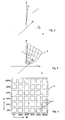
- inner reference curve 1 This curve is referred to below as inner reference curve 1. It is shown by way of example in FIG. 2.
- the inner reference curve 1 lies in the interior of the entire process color body in most printing processes, but in general it is not on the gray axis, i. on the L axis of the Lab color system. A particularly simple decomposition of the color body can be achieved if it is stipulated that no colored inks should be used on all points of the inner reference curve 1. This case will be explained first. The more general and, for many practical printing processes, more advantageous case that achromatic colors are formed by the overprinting of black and some brightly colored inks will be deduced later from this particular case.
- the various combinations of black and a single colored ink form a two-dimensional set of dots, which is imaged in the Lab color system as an interface in the process color body in the shape of a heavily distorted square.
- the corresponding interface 2 is shown by way of example for the printing ink magenta. It is bounded on one side by the inner reference curve 1.
- a test form is printed with combinations of some discrete values of the black and magenta inks and then measured colorimetrically.
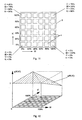
- Such a test form 3 is shown in FIG. 4. It consists of swatches 4 whose inking values for black and magenta are systematically varied. In the example of Fig. 4, in the color patches 4, the proportions of magenta increase from left to right, and the proportions of black increase from the bottom to the top. With the color measurement values of fields 4 of test form 3, the corresponding points in the Lab color system are obtained for the ink combinations. By two-dimensional interpolation between the printing color values of the color fields 4 or between the points measured in the Lab color system, it is then possible to describe the two-dimensional sub-process of black and the colorful printing ink with sufficient accuracy. For practical purposes has a step width 10% between 0 and 100% proved to be sufficiently accurate. A 0, 10, 20, 40, 70 and 100% grading is also suitable for this purpose.
- color fields are summarized, which contain all sorts of color combinations, each consisting of two bright spot colors. For N-1 colored inks, (N - 1) ⁇ (N - 2) / 2 fields result for this last test form.
- the entire set of N test forms is then preferably printed simultaneously on a print sheet, and all test fields are measured colorimetrically.
- the first N - 1 test forms give the descriptions for the two - dimensional subprocesses between one colored ink and one black.
- three boundary surfaces 2 for the colorful printing inks cyan, magenta and yellow are sketched in FIG.
- the printing process color body is divided by the three interfaces 2 into three color sectors 5.
- On the boundary surfaces 2 are colors that are created from a colorful printing ink and black.
- In the color sectors 5 between the surfaces are colors that are created from black and two colorful inks.
- a color sector 5 between two boundary surfaces 2 in the Lab color system corresponds to a three-dimensional subspace of the higher-dimensional printing process color space.
- the color components of the three participating inks vary between 0 and 100%.
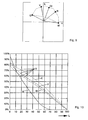
- Fig. 6 the example of Fig. 5 is shown again in a top view of the a, b plane.
- the maximum extent of the print process colorant in the a, b plane is determined by the solid colors CMY and the solid color mixing colors C + Y, M + Y and C + M.
- the Lab color values of the full-tone mixed colors are preserved one from the measured values of the test form whose fields contain the combination of two bright spot colors each.
- FIG. 7 schematically shows, as a further example, a seven-color system with the six colored printing inks cyan, magenta, yellow, red, green, blue in the top view of the a, b plane.
- the 12-cornered outline is created by the six colorful spot colors and the six full-tone mixed colors between adjacent printing inks.
- Fig. 7 it is indicated that the interfaces 2 between the color sectors 5 of the color body are generally irregular in shape and in the projection on the a, b plane usually curves or even narrow surfaces result.
- Generating, printing and measuring the first set of test forms serves to obtain an overview of the extent and shape of the print process colorant in the Lab color system. In addition, it determines the shape and position of the interfaces 2 between the color sectors 5.
- the user can, for example, judge the print process color body in various views on the basis of graphical representations, which are generated on a computer screen according to FIGS. 5, 6 or 7 with suitable software. Whether the corresponding spatial conditions in the Lab color system are acceptable depends heavily on the intentions of the user. For example, a printing process with a color body as in Fig.
- the colorful inks are arranged in a circumferential order using the previously calculated convex hull in the a, b plane. This determines which ink is adjacent to each other.
- a total decomposition of the printing process color body has been achieved in individual color sectors 5, and it has set at the same time to be used in each color sector 5 inks.
- Each color sector 5 of the printing process color body in the simplest case considered so far, where only the ink black is used for achromatic colors, can be produced from three printing colors, namely black and the brightly colored inks of the two interfaces 2, the color sector 5 on each Limit page.
- Each color sector 5 corresponds in each case to a three-dimensional subspace of the entire N-dimensional printing process color space. By varying the three ink proportions between 0 and 100%, all points of a color sector are reached.
- a second set of test forms is produced, wherein for each color sector 5 a test form is formed whose color fields contain combinations of the three printing inks involved in the color sector.
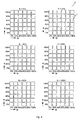
- Fig. 9 shows as an example a test form 6 for a color sector 5 with the three printing colors black, magenta and blue.
- the test form 6 contains several groups of color patches 7. In each group, the magenta and blue inks are varied in steps, and the black ink has a constant inking value. From group to group, the printing ink black is varied.
- the second set of test forms 6 is also printed with the printing process to be determined, and the color patches 7 are measured colorimetrically.
- the color profile is essentially a three-dimensional input-side table containing the associated ink values for all combinations of discrete, regularly graded Lab color values.
- all intermediate values can then be obtained by interpolation between the table interpolation points.
- Creating the table requires that for each table position, i. For each support point in the Lab color system, enter the corresponding N-tuple for the associated N print color values.
- the test forms 6 from the second set of test forms are the images of three-dimensional lattices in subspaces of the print process color space. For practical reasons, they usually have a resolution between 5 ⁇ 5 ⁇ 5 and 11 ⁇ 11 ⁇ 11 grid points.
- the grid position of a point determines its ink proportions in the respective subspace, and the coordinates of the point are the associated measured values in the Lab color system.
- grids are created with smaller distances between the points.
- a suitable grating has e.g. 32 ⁇ 32 ⁇ 32 points.
- the Euclidean distances to all grid points in all highly interpolated test pattern grids are then calculated.
- the grid point with the smallest distance is selected. Because of the limited resolution of the test form gratings, it is expedient to interpolate a local, finely resolved grid with a spacing of the grid points in the printing process subspace of, for example, 0.5% from its neighboring points in the vicinity of this grid point. In this finer local grid will be back calculates all Euclidean distances to the Lab color value of the table vertex and selects the point with the smallest distance.
- an N-tuple is formed, in which the three associated printing color values are entered in the corresponding color sector and the printing colors not belonging to the color sector are set to zero.
- the N-tuple is then entered in the currently edited table position of the ink profile. If the N-tuples are registered for all Lab bases of the ink profile, the process is complete.
- the simple case has been described that on all points of the inner reference curve 1 only the printing ink black is used.
- achromatic colors are formed by the overprinting of black and some brightly colored inks, as this, the achromatic colors are rendered darker and a smoother transition from achromatic colors to colorful is achieved.
- the method according to the invention is modified accordingly by not only defining the printing ink black for the colors on the inner reference curve 1 but also a combination of the standard printing inks CMYK.
- the relative proportions of these standard inks, with which they contribute to the construction of the achromatic colors, are expediently chosen as they are useful due to the experience with the classic four-color printing and lead to good results.
- FIG. 10 shows an example of the relative proportions of CMYK in achromatic colors, the components being plotted as functions 8 as a function of the brightness L.
- This composition is also referred to by the technical term "black structure".
- Typical of such blackening is also that light gray values contain no part of the ink black at all.
- FIG. 11 shows a test form 3 modified for such a black structure for determining the boundary surface 2 for the chromatic color magenta.
- a formal printing ink K ' is varied in the color fields 4 in the vertical direction as a combination of CMYK.
- the colorful printing ink magenta is varied, i.
- the portions from the corresponding color fields of the left column and the bottom row are not simply superimposed, since then an excessively high areal coverage would result for the upper right color field.
- the proportions are evaluated with a right and an upward sloping weight function g (M, K '). Such a weight function is qualitatively illustrated in FIG. 12. The exact course of the weight function g (M, K ') is not essential, it only has to drop to the upper right corner of the test form 3.
- the inner reference curve 1 can also be any other combination of some of the N printing inks are selected, for example, a black structure without the ink black and only with the Cyan, magenta and yellow inks. It is also not necessary for the method according to the invention that the inner reference curve 1 formed by the selected printing ink combination represents at all only achromatic colors and runs close to the L axis of the Lab color system.
- An inner reference curve 1 can also be defined, for example, with the printing inks red, green and magenta. It is only important that there is an inner reference curve 1, which is common to all color sectors 5. However, it is advantageous if the chosen ink combination results in an inner reference curve 1, which runs relatively far in the interior of the printing process color body and not too close to the edge.
- a second set of test forms 6 is produced, forming for each color sector 5 a test form 6 whose color fields 7 are combinations of the formal printing ink K 'and the two colored inks F1 and F2, which define the interfaces 2 of the color sector 5.
- the formal ink K ' is composed of combinations of the inks chosen for the inner reference line 1, e.g. six inks involved in the formation of a test form 6.
- each color sector 5 corresponds to a three-dimensional subspace of the entire N-dimensional ink space, and there is a clear correlation between the formal inks and the real.
- the modified test form 6 again contains a plurality of groups of color patches 7 (see Fig. 9).
- the colored inks F1 and F2 are varied in stages defining the boundaries 2 of the color sector 5, and the formal ink K 'has a constant inking value. From group to group the formal ink K 'is varied. Because of the involvement of more than three real printing inks on the formation of the color fields 7, but there is also again the danger that results in the upper right corners of the groups with a high K 'content for the color fields 7 too high area coverage sum , To the area coverage sum for all color fields 7 of the test form 6 to a reasonable To limit the value, for example 340%, the proportions are evaluated analogously to FIG.
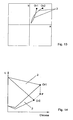
- FIG. 13 shows, in a view from above on the a, b plane, the boundary surfaces 2 of two different orange colors Or1 and Or2. That it may be useful to print with two almost identical inks, Fig. 14, in which the interfaces 2 of the two inks in the coordinates brightness (L) and chroma are shown (chroma is the distance to the L-axis).
- Fig. 14 in which the interfaces 2 of the two inks in the coordinates brightness (L) and chroma are shown (chroma is the distance to the L-axis).
- the inner reference curve was assumed to be lying on the L-axis. It becomes clear that the two boundary surfaces 2 overlap to a large extent, but that there are also noteworthy regions in each boundary surface 2 which are not contained in the other boundary surface 2. This means that the achievable color gamut is limited when printing with only one of the two orange colors.
- the values for the combination of both full-tone colors can be taken from the last test form from the first set of test forms.
- the corresponding point is designated P in FIG. If the two orange inks and black (or a corresponding color combination for the colors on the inner datum curve) are combined, the entire gamut of FIG. 14 be covered with a new common interface 2, which lies partly at the interface for the ink Or1, partly at the interface for the ink Or2 and partly between these two interfaces.
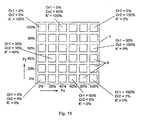
- FIG. 15 indicates for some color fields 4 which combinations of the three printing inks are produced according to these functions.
- the functions for generating the test form 3 for this special case can be varied within wide limits. It is only important that the generated color patches 4 cover the common color gamut of the printing inks Or1 and Or2 as shown in FIG. 14 completely and preferably in approximately equal increments.
- the determined Lab color values define a common interface 2 for the inks Or1 and Or2.
- the procedure initially proceeds as if the test form having the formal color Fx is constructed for one of the chromatic colors involved in the sector.
- Fx for example, according to the above functions, the corresponding values for Or1 and Or2 are used.
- the lab color system was used as the device-independent color system.
- the method is not limited to this color system but can be readily adapted to another device independent color system, such as e.g. the CIEXYZ color system or the Luv color system.
Landscapes
- Engineering & Computer Science (AREA)
- Multimedia (AREA)
- Signal Processing (AREA)
- Textile Engineering (AREA)
- Color Image Communication Systems (AREA)
- Facsimile Image Signal Circuits (AREA)
- Color, Gradation (AREA)
- Image Processing (AREA)
- Ink Jet (AREA)
- Spectrometry And Color Measurement (AREA)
Claims (8)
- Procédé de détermination d'un profil d'encre d'impression pour l'impression avec plus de trois encres d'impression multicolores, qui forment un corps d'encres de couleurs imprimables dans un système d'encres de couleur indépendant de l'appareil,
caractérisé en ce que■ une courbe de référence interne (1) est définie dans le système de couleur indépendant de l'appareil par une combinaison de plusieurs encres d'impression,■ des surfaces limites (2), qui divisent le corps de couleur en secteurs de couleur (5), sont définies entre la courbe de référence (1) et l'enveloppe extérieure du corps d'encres de couleurs par la production de premières formes-test (3), qui sont imprimées et mesu-rées par colorimétrie■ des secondes formes-test (6), qui ont été imprimées et mesurées par colorimétrie, sont produites pour les secteurs d'encres de couleur (5), et■ le profil d'encre d'impression est défini à partir des valeurs mesurées des secondes formes-test (6). - Procédé selon la revendication 1, caractérisé en ce que la combinaison d'encres d'impression de la courbe de référence interne (1) est sélectionnée de sorte que celle-ci s'étend à l'intérieur du corps d'encres de couleurs du processus d'impression et non tout près de son bord.
- Procédé selon la revendication 1, caractérisé en ce que les premières formes-test (3) contiennent des champs couleur (4), dans lesquels des parties des encres d'impression sélectionnées pour la courbe de référence interne (1) et d'une encre d'impression colorée sont variées.
- Procédé selon la revendication 1, caractérisé en ce que les formes-test (3) contiennent des champs couleur (4), dans lesquels des parties des encres d'impression sélectionnées pour la courbe de référence interne (1) et de deux encres d'impression colorées, dont le ton coloré est approximativement identique, sont variées.
- Procédé selon la revendication 1, caractérisé en ce que les secondes formes-test (6) contiennent des champs couleur (7), dans lesquels des parties des encres d'impression sélectionnées pour la courbe de référence interne (1) et de deux encres d'impression colorées sont variées.
- Procédé selon la revendication 1, caractérisé en ce que les deux formes-test (6) contiennent des champs couleur (7), dans lesquels des parties des encres d'impression sélectionnées pour la courbe de référence interne (1) et de deux encres d'impression colorées sont variées, parmi lesquelles deux présentent un ton coloré approximativement identique.
- Procédé selon la revendication 1, caractérisé en ce que le profil d'encre d'impression est décrit sous forme d'un tableau, dans lequel les valeurs d'encre d'impression des encres d'impression avec lesquelles les couleurs prédéfinies peuvent être imprimées, sont associées à des valeurs de couleur prédéfinies indépendantes de l'appareil.
- Procédé selon l'une quelconque des revendications 1 à 7, caractérisé en ce que le système d'encres de couleur indépendant de l'appareil est le système d'encres de couleur.
Applications Claiming Priority (2)
| Application Number | Priority Date | Filing Date | Title |
|---|---|---|---|
| DE10110125 | 2001-03-02 | ||
| DE10110125A DE10110125A1 (de) | 2001-03-02 | 2001-03-02 | Verfahren zur Bestimmung eines Farbprofils für das drucken mit N Druckfarben |
Publications (3)
| Publication Number | Publication Date |
|---|---|
| EP1237355A2 EP1237355A2 (fr) | 2002-09-04 |
| EP1237355A3 EP1237355A3 (fr) | 2004-09-08 |
| EP1237355B1 true EP1237355B1 (fr) | 2008-01-16 |
Family
ID=7676098
Family Applications (1)
| Application Number | Title | Priority Date | Filing Date |
|---|---|---|---|
| EP01128957A Expired - Lifetime EP1237355B1 (fr) | 2001-03-02 | 2001-12-06 | Procédé de détermination d'un profil de couleurs pour l'impression au moyen de plus que trois encres d'impression colorées |
Country Status (4)
| Country | Link |
|---|---|
| US (1) | US7233412B2 (fr) |
| EP (1) | EP1237355B1 (fr) |
| JP (1) | JP4154158B2 (fr) |
| DE (2) | DE10110125A1 (fr) |
Families Citing this family (19)
| Publication number | Priority date | Publication date | Assignee | Title |
|---|---|---|---|---|
| DE10110125A1 (de) * | 2001-03-02 | 2002-09-19 | Heidelberger Druckmasch Ag | Verfahren zur Bestimmung eines Farbprofils für das drucken mit N Druckfarben |
| DE10359322B4 (de) * | 2003-01-21 | 2020-11-26 | Heidelberger Druckmaschinen Ag | Verfahren und Vorrichtung zur Korrektur von nicht angepassten Druckdaten anhand eines farbmetrisch vermessenen Referenzbogens |
| JP2004291493A (ja) * | 2003-03-27 | 2004-10-21 | Brother Ind Ltd | 印刷装置、印刷システム及び印刷方法 |
| US7229166B2 (en) * | 2003-08-11 | 2007-06-12 | Canon Kabushiki Kaisha | Image-forming method, image-forming apparatus, ink set, and ink |
| US7652789B2 (en) * | 2003-11-03 | 2010-01-26 | Seiko Epson Corporation | Production of color conversion profile for printing |
| US7706604B2 (en) * | 2003-11-03 | 2010-04-27 | Seiko Epson Corporation | Production of color conversion profile for printing |
| DE102004003258A1 (de) * | 2004-01-21 | 2005-08-18 | GEKKO Gesellschaft für Printrealisierung und Farbstandardisierung mbH | Druckerzeugnis und Verfahren zu seiner Herstellung |
| ATE347231T1 (de) | 2004-03-03 | 2006-12-15 | Oce Tech Bv | Verfahren für die verarbeitung eines mehrfarbigen bildes |
| EP1571827B1 (fr) * | 2004-03-03 | 2006-11-29 | Océ-Technologies B.V. | Procédé pour le traitement d'une image en plusieurs couleurs |
| JP2005303572A (ja) * | 2004-04-09 | 2005-10-27 | Toyo Seikan Kaisha Ltd | 多色分解装置、多色分解製版システム、及び多色分解印刷方法 |
| JP4604623B2 (ja) * | 2004-09-22 | 2011-01-05 | 富士ゼロックス株式会社 | 画像処理装置 |
| US7557814B2 (en) * | 2005-10-19 | 2009-07-07 | Canon Kabushiki Kaisha | Construction and use of a multi-shelled gamut boundary descriptor |
| US8368955B2 (en) * | 2008-12-15 | 2013-02-05 | Xerox Corporation | Method for assessing synchronized print defects |
| CN102668533B (zh) * | 2009-10-19 | 2015-07-29 | Gmg有限两合公司 | 生成优化的打印机校正的方法 |
| US8953876B2 (en) * | 2012-08-22 | 2015-02-10 | Facebook, Inc. | Creation of a color profile of an image |
| JP6733426B2 (ja) * | 2016-08-30 | 2020-07-29 | セイコーエプソン株式会社 | 色変換テーブル生成装置、色変換テーブル生成方法、及び、色変換テーブル生成プログラム |
| EP3367659A1 (fr) * | 2017-02-28 | 2018-08-29 | Thomson Licensing | Mappage de gamme de couleurs de changement de teinte |
| DE102018202453A1 (de) * | 2017-03-22 | 2018-09-27 | Heidelberger Druckmaschinen Ag | Verfahren zur Durchführung eines Druckprozesses in einer Inkjet-Druckmaschine |
| CN113096072B (zh) * | 2021-03-18 | 2022-08-30 | 武汉纺织大学 | 一种色织纱线色彩体系构建方法 |
Family Cites Families (38)
| Publication number | Priority date | Publication date | Assignee | Title |
|---|---|---|---|---|
| ATE17407T1 (de) | 1982-06-04 | 1986-01-15 | Hell Rudolf Dr Ing Gmbh | Verfahren und einrichtung zur herstellung farbiger proofs beim mehrfarbendruck. |
| DE3320141C2 (de) * | 1983-06-03 | 1986-07-03 | Harald 6070 Langen Küppers | Reproduktionsverfahren zur Herstellung mehrfarbiger Drucke |
| DE3537008A1 (de) * | 1985-10-17 | 1987-04-23 | Harald Kueppers | Verfahren zur herstellung von systematischen farbtabellen bzw. farbtafeln fuer den siebenfarbendruck sowie nach diesem verfahren hergestellte tabellen bzw. tafeln |
| EP0446168B1 (fr) | 1990-03-02 | 1994-09-07 | Ciba-Geigy Ag | Procédé pour déterminer la formulation de peinture ou d'impression à partir d'un original en couleurs |
| DE4012905A1 (de) * | 1990-04-23 | 1991-10-24 | Linotype Ag | Verfahren und vorrichtung zur erzeugung einer digitalen drucktabelle fuer druckfarben bei bildreproduktionsgeraeten |
| US5245443A (en) * | 1990-10-02 | 1993-09-14 | Southwest Software, Inc. | Method and apparatus for calibrating image output from an image generating device |
| EP0486311B1 (fr) * | 1990-11-15 | 2001-10-10 | Canon Kabushiki Kaisha | Appareil et procédé de traitement d'images en couleurs |
| US5307182A (en) * | 1991-12-30 | 1994-04-26 | Xerox Corporation | Methods and apparatus for multigeneration color image processing |
| DE59206618D1 (de) * | 1992-03-30 | 1996-07-25 | Ciba Geigy Ag | Mehrfarbendruckverfahren, insbesondere Mehrfarbenrastersiebdruckverfahren für textile Substrate |
| IL102994A (en) * | 1992-08-30 | 1998-12-27 | Scitex Corp Ltd | Method and device for printing in seven colors |
| EP0664015B1 (fr) * | 1992-10-07 | 1999-03-24 | E.I. Du Pont De Nemours And Company | Procede et dispositif de conversion de valeurs de couleur d'image d'un premier a un deuxieme espace couleur |
| US5696839A (en) | 1993-04-08 | 1997-12-09 | Linotype-Hell Ag | Method and apparatus for reproducing an image employing a transformation of color solids |
| DE4409226C2 (de) * | 1993-04-08 | 1998-04-30 | Hell Ag Linotype | Verfahren und Einrichtung zur Transformation von Farbkörpern |
| US5909220A (en) * | 1993-05-10 | 1999-06-01 | Sandow; Robin | Interactive computerized image coloring systems and methods for processing combinations of color with automated subroutines and color standardization for diverse color systems |
| US5943143A (en) * | 1993-06-22 | 1999-08-24 | Canon Kabushiki Kaisha | Image processing system having color adjusting features |
| DE4335143A1 (de) * | 1993-10-15 | 1995-04-20 | Hell Ag Linotype | Verfahren und Einrichtung zur Umsetzung von Farbwerten |
| DE4431270C2 (de) * | 1993-10-21 | 1997-01-16 | Roland Man Druckmasch | Verfahren zur Steuerung der Farbführung einer autotypisch arbeitenden Druckmaschine |
| US5553199A (en) * | 1994-05-03 | 1996-09-03 | Eastman Kodak Company | Method and apparatus for calibrating a four color printer |
| US5574666A (en) * | 1994-05-13 | 1996-11-12 | Canon Information Systems, Inc. | Color printing method and apparatus using gamut mapping in Munsell space |
| DE4417449C2 (de) * | 1994-05-19 | 1996-09-05 | Eder Repros Offset Repro Gmbh | Verfahren zur Erstellung eines farbigen Druckbildes |
| US5563724A (en) * | 1994-10-21 | 1996-10-08 | Eastman Kodak Company | Color-to-ink transformation for extra-quarternary printing processes |
| US5687300A (en) | 1995-03-27 | 1997-11-11 | Linotype-Hell Ag | Process for creating five to seven color separations used on a multicolor press |
| US5781206A (en) * | 1995-05-01 | 1998-07-14 | Minnesota Mining And Manufacturing Company | Apparatus and method for recalibrating a multi-color imaging system |
| US5911003A (en) * | 1996-04-26 | 1999-06-08 | Pressco Technology Inc. | Color pattern evaluation system for randomly oriented articles |
| JP3209402B2 (ja) * | 1996-11-01 | 2001-09-17 | 富士ゼロックス株式会社 | 画像処理装置 |
| US6281984B1 (en) | 1997-03-25 | 2001-08-28 | International Business Machines Corporation | Enhanced system, method and program for converting an externally defined four dimensional colorant (CMYK) into an equivalent four dimensional colorant defined in terms of the four inks (C′M′Y′K′) that are associated with a given printer |
| JPH10282756A (ja) * | 1997-04-04 | 1998-10-23 | Ricoh Co Ltd | カラー画像形成装置 |
| US6480299B1 (en) * | 1997-11-25 | 2002-11-12 | University Technology Corporation | Color printer characterization using optimization theory and neural networks |
| US5978011A (en) * | 1998-02-25 | 1999-11-02 | Hewlett-Packard Company | Printer color gamut optimization method |
| US6062137A (en) * | 1998-05-17 | 2000-05-16 | Hewlett-Packard Company | Application of spectral modeling theory in device-independent color space halftoning |
| DE19835951C2 (de) * | 1998-08-08 | 2002-03-14 | Bernhard Hill | Multispektrales Farbreproduktionssystem mit nichtlinearer Kodierung |
| KR20010051599A (ko) * | 1999-11-11 | 2001-06-25 | 마츠시타 덴끼 산교 가부시키가이샤 | 색 정보 정규화 방법과 색 정보 교환 방법 및 그 장치 |
| DE10110125A1 (de) * | 2001-03-02 | 2002-09-19 | Heidelberger Druckmasch Ag | Verfahren zur Bestimmung eines Farbprofils für das drucken mit N Druckfarben |
| US6769759B2 (en) * | 2001-07-02 | 2004-08-03 | Seiko Epson Corporation | Printing with selection of sub-scanning |
| US7251058B2 (en) * | 2001-11-26 | 2007-07-31 | Ioan Pop | Method for generating customized ink/media transforms |
| US7203433B2 (en) * | 2003-06-25 | 2007-04-10 | Ricoh Company, Ltd. | Apparatus for detecting amount of toner deposit and controlling density of image, method of forming misalignment correction pattern, and apparatus for detecting and correcting misalignment of image |
| JP4220846B2 (ja) * | 2003-07-03 | 2009-02-04 | パナソニック株式会社 | カラーテストチャート及び画像記録制御装置 |
| DE102004001937B4 (de) * | 2004-01-14 | 2013-09-26 | Heidelberger Druckmaschinen Ag | Verfahren zur Reproduktion von Sonderfarben mit Primärdruckfarben und Sekundärdruckfarben |
-
2001
- 2001-03-02 DE DE10110125A patent/DE10110125A1/de not_active Withdrawn
- 2001-12-06 EP EP01128957A patent/EP1237355B1/fr not_active Expired - Lifetime
- 2001-12-06 DE DE50113502T patent/DE50113502D1/de not_active Expired - Lifetime
-
2002
- 2002-02-14 US US10/075,538 patent/US7233412B2/en not_active Expired - Lifetime
- 2002-03-04 JP JP2002056881A patent/JP4154158B2/ja not_active Expired - Fee Related
Also Published As
| Publication number | Publication date |
|---|---|
| DE50113502D1 (de) | 2008-03-06 |
| JP4154158B2 (ja) | 2008-09-24 |
| EP1237355A3 (fr) | 2004-09-08 |
| JP2002325183A (ja) | 2002-11-08 |
| DE10110125A1 (de) | 2002-09-19 |
| EP1237355A2 (fr) | 2002-09-04 |
| US20020122208A1 (en) | 2002-09-05 |
| US7233412B2 (en) | 2007-06-19 |
Similar Documents
| Publication | Publication Date | Title |
|---|---|---|
| DE102004001937B4 (de) | Verfahren zur Reproduktion von Sonderfarben mit Primärdruckfarben und Sekundärdruckfarben | |
| DE69510710T2 (de) | Farbdruck mit erweitertem Dichteumfang | |
| DE69806153T2 (de) | Anordnung und verfahren zur hochgenauen kolorimetrischen charakterisierung von anzeigevorrichtungen | |
| DE69526273T2 (de) | Farbdrucksystem und -verfahren | |
| DE69615728T2 (de) | Verfahren zur Erzeugung von mindestens fünf Farbauszügen für einen Mehrfarbendrucker | |
| EP2362633B1 (fr) | Procédé de détermination de données de caractérisation d'un processus d'impression | |
| EP2506559B1 (fr) | Procédé de correction de la balance des gris d'un processus d'impression | |
| EP0526510B1 (fr) | Procede et dispositif pour la production d'une table d'impression numerique pour les couleurs d'imprimerie dans les appareils de reproduction des images | |
| EP1237355A2 (fr) | Procédé de détermination d'un profil de couleurs pour l'impression au moyen de plusieurs couleurs d'impression | |
| DE19856574C2 (de) | Verfahren zum Optimieren von Druckerfarbpaletten | |
| DE69702800T2 (de) | Verfahren zum Erzeugen von Farbprobeabzugsdaten und Farbprobeabzügen | |
| EP0723728A1 (fr) | Procede et dispositif de conversion de valeurs de couleurs | |
| DE10252575A1 (de) | Bestimmung von Bezugspunkten für einen Aufbau einer Erster-Farbraum-Zu-Zweiter-Farbraum-Nachschlag- tabelle | |
| DE102004003300B4 (de) | Verfahren zur Herstellung eines Prüfdrucks für einen Druckprozess mit mehr als vier Druckfarben | |
| DE3447682A1 (de) | Verfahren zur farbkorrektur | |
| DE10359322A1 (de) | Verfahren zur Korrektur von nicht angepassten Druckdaten anhand eines farbmetrisch vermessenen Referenz-Bogens | |
| DE19632969C2 (de) | Verfahren zur Ermittlung von Vorgabewerten für die Herstellung von mehrfarbigen Druckexemplaren auf einer Druckmaschine | |
| DE4341871C2 (de) | System zur Generierung korrigierter Farbbilder | |
| DE102008031735B4 (de) | Graubalancekorrektur eines Druckverfahrens | |
| DE102011012806B4 (de) | Graubalancekorrektur eines Druckverfahrens | |
| DE69319857T2 (de) | Verfahren und Gerät zur Verbesserung von Vollfarbbildern mit Verwendung von Verfahrensschwärze und Druckerschwärze | |
| EP4325829B1 (fr) | Procédé pour effectuer des transformations de données de couleur | |
| EP2966850B1 (fr) | Procede de calcul de couleurs de remplacement pour couleurs speciales | |
| EP2491708B1 (fr) | Procédé d'optimisation de l'étalonnage d'une imprimante | |
| DE69120589T2 (de) | Farbtrennungsverfahren |
Legal Events
| Date | Code | Title | Description |
|---|---|---|---|
| PUAI | Public reference made under article 153(3) epc to a published international application that has entered the european phase |
Free format text: ORIGINAL CODE: 0009012 |
|
| AK | Designated contracting states |
Kind code of ref document: A2 Designated state(s): AT BE CH CY DE DK ES FI FR GB GR IE IT LI LU MC NL PT SE TR |
|
| AX | Request for extension of the european patent |
Free format text: AL;LT;LV;MK;RO;SI |
|
| PUAL | Search report despatched |
Free format text: ORIGINAL CODE: 0009013 |
|
| AK | Designated contracting states |
Kind code of ref document: A3 Designated state(s): AT BE CH CY DE DK ES FI FR GB GR IE IT LI LU MC NL PT SE TR |
|
| AX | Request for extension of the european patent |
Extension state: AL LT LV MK RO SI |
|
| 17P | Request for examination filed |
Effective date: 20050308 |
|
| AKX | Designation fees paid |
Designated state(s): CH DE FR GB LI |
|
| 17Q | First examination report despatched |
Effective date: 20060324 |
|
| 17Q | First examination report despatched |
Effective date: 20060324 |
|
| GRAP | Despatch of communication of intention to grant a patent |
Free format text: ORIGINAL CODE: EPIDOSNIGR1 |
|
| RTI1 | Title (correction) |
Free format text: METHOD OF DETERMINING A COLOUR PROFILE FOR PRINTING WITH MORE THAN THREE COLORED PRINTING INKS |
|
| GRAS | Grant fee paid |
Free format text: ORIGINAL CODE: EPIDOSNIGR3 |
|
| GRAA | (expected) grant |
Free format text: ORIGINAL CODE: 0009210 |
|
| AK | Designated contracting states |
Kind code of ref document: B1 Designated state(s): CH DE FR GB LI |
|
| REG | Reference to a national code |
Ref country code: GB Ref legal event code: FG4D Free format text: NOT ENGLISH |
|
| REG | Reference to a national code |
Ref country code: CH Ref legal event code: EP |
|
| GBT | Gb: translation of ep patent filed (gb section 77(6)(a)/1977) |
Effective date: 20080206 |
|
| REF | Corresponds to: |
Ref document number: 50113502 Country of ref document: DE Date of ref document: 20080306 Kind code of ref document: P |
|
| ET | Fr: translation filed | ||
| PLBE | No opposition filed within time limit |
Free format text: ORIGINAL CODE: 0009261 |
|
| STAA | Information on the status of an ep patent application or granted ep patent |
Free format text: STATUS: NO OPPOSITION FILED WITHIN TIME LIMIT |
|
| 26N | No opposition filed |
Effective date: 20081017 |
|
| REG | Reference to a national code |
Ref country code: FR Ref legal event code: PLFP Year of fee payment: 15 |
|
| PGFP | Annual fee paid to national office [announced via postgrant information from national office to epo] |
Ref country code: GB Payment date: 20151221 Year of fee payment: 15 |
|
| REG | Reference to a national code |
Ref country code: FR Ref legal event code: PLFP Year of fee payment: 16 |
|
| PGFP | Annual fee paid to national office [announced via postgrant information from national office to epo] |
Ref country code: CH Payment date: 20161222 Year of fee payment: 16 |
|
| GBPC | Gb: european patent ceased through non-payment of renewal fee |
Effective date: 20161206 |
|
| PG25 | Lapsed in a contracting state [announced via postgrant information from national office to epo] |
Ref country code: GB Free format text: LAPSE BECAUSE OF NON-PAYMENT OF DUE FEES Effective date: 20161206 |
|
| REG | Reference to a national code |
Ref country code: FR Ref legal event code: PLFP Year of fee payment: 17 |
|
| REG | Reference to a national code |
Ref country code: CH Ref legal event code: PL |
|
| PG25 | Lapsed in a contracting state [announced via postgrant information from national office to epo] |
Ref country code: LI Free format text: LAPSE BECAUSE OF NON-PAYMENT OF DUE FEES Effective date: 20171231 Ref country code: CH Free format text: LAPSE BECAUSE OF NON-PAYMENT OF DUE FEES Effective date: 20171231 |
|
| PGFP | Annual fee paid to national office [announced via postgrant information from national office to epo] |
Ref country code: DE Payment date: 20191231 Year of fee payment: 19 |
|
| PGFP | Annual fee paid to national office [announced via postgrant information from national office to epo] |
Ref country code: FR Payment date: 20191220 Year of fee payment: 19 |
|
| REG | Reference to a national code |
Ref country code: DE Ref legal event code: R119 Ref document number: 50113502 Country of ref document: DE |
|
| PG25 | Lapsed in a contracting state [announced via postgrant information from national office to epo] |
Ref country code: FR Free format text: LAPSE BECAUSE OF NON-PAYMENT OF DUE FEES Effective date: 20201231 |
|
| PG25 | Lapsed in a contracting state [announced via postgrant information from national office to epo] |
Ref country code: DE Free format text: LAPSE BECAUSE OF NON-PAYMENT OF DUE FEES Effective date: 20210701 |