EP1229096A1 - Mischungen aus Polyvinylalkylether und Polyacrylat - Google Patents
Mischungen aus Polyvinylalkylether und Polyacrylat Download PDFInfo
- Publication number
- EP1229096A1 EP1229096A1 EP02001394A EP02001394A EP1229096A1 EP 1229096 A1 EP1229096 A1 EP 1229096A1 EP 02001394 A EP02001394 A EP 02001394A EP 02001394 A EP02001394 A EP 02001394A EP 1229096 A1 EP1229096 A1 EP 1229096A1
- Authority
- EP
- European Patent Office
- Prior art keywords
- polyacrylate
- mixture
- adhesive
- mixture according
- weight
- Prior art date
- Legal status (The legal status is an assumption and is not a legal conclusion. Google has not performed a legal analysis and makes no representation as to the accuracy of the status listed.)
- Withdrawn
Links
- 239000000203 mixture Substances 0.000 title claims abstract description 51
- 229920000058 polyacrylate Polymers 0.000 title claims abstract description 43
- 239000000853 adhesive Substances 0.000 claims abstract description 28
- 239000002904 solvent Substances 0.000 claims abstract description 18
- 150000001252 acrylic acid derivatives Chemical class 0.000 claims abstract description 10
- 239000000758 substrate Substances 0.000 claims abstract description 10
- 125000000217 alkyl group Chemical group 0.000 claims abstract description 8
- 229920001577 copolymer Polymers 0.000 claims abstract description 7
- 238000010528 free radical solution polymerization reaction Methods 0.000 claims abstract description 7
- 229920002554 vinyl polymer Polymers 0.000 claims description 27
- 230000001070 adhesive effect Effects 0.000 claims description 19
- 150000005215 alkyl ethers Chemical class 0.000 claims description 19
- 239000004820 Pressure-sensitive adhesive Substances 0.000 claims description 12
- 229920000642 polymer Polymers 0.000 claims description 11
- WYURNTSHIVDZCO-UHFFFAOYSA-N Tetrahydrofuran Chemical compound C1CCOC1 WYURNTSHIVDZCO-UHFFFAOYSA-N 0.000 claims description 8
- 238000004519 manufacturing process Methods 0.000 claims description 8
- 239000012876 carrier material Substances 0.000 claims description 7
- 239000012943 hotmelt Substances 0.000 claims description 6
- 238000006116 polymerization reaction Methods 0.000 claims description 6
- 238000000034 method Methods 0.000 claims description 5
- XLYOFNOQVPJJNP-UHFFFAOYSA-N water Substances O XLYOFNOQVPJJNP-UHFFFAOYSA-N 0.000 claims description 5
- 239000000155 melt Substances 0.000 claims description 4
- YLQBMQCUIZJEEH-UHFFFAOYSA-N tetrahydrofuran Natural products C=1C=COC=1 YLQBMQCUIZJEEH-UHFFFAOYSA-N 0.000 claims description 4
- 125000004169 (C1-C6) alkyl group Chemical group 0.000 claims description 3
- 239000003960 organic solvent Substances 0.000 claims description 3
- 239000011888 foil Substances 0.000 claims description 2
- 238000002360 preparation method Methods 0.000 abstract description 5
- 230000005855 radiation Effects 0.000 abstract description 4
- 125000002947 alkylene group Chemical group 0.000 abstract description 3
- 238000001704 evaporation Methods 0.000 abstract 1
- 229920002959 polymer blend Polymers 0.000 abstract 1
- 229920000915 polyvinyl chloride Polymers 0.000 description 16
- 239000004800 polyvinyl chloride Substances 0.000 description 16
- KWOLFJPFCHCOCG-UHFFFAOYSA-N Acetophenone Chemical compound CC(=O)C1=CC=CC=C1 KWOLFJPFCHCOCG-UHFFFAOYSA-N 0.000 description 10
- 239000004014 plasticizer Substances 0.000 description 10
- 239000000178 monomer Substances 0.000 description 9
- 125000004432 carbon atom Chemical group C* 0.000 description 8
- 229920001289 polyvinyl ether Polymers 0.000 description 7
- -1 vinyl halides Chemical class 0.000 description 7
- NIXOWILDQLNWCW-UHFFFAOYSA-M Acrylate Chemical compound [O-]C(=O)C=C NIXOWILDQLNWCW-UHFFFAOYSA-M 0.000 description 6
- KFZMGEQAYNKOFK-UHFFFAOYSA-N Isopropanol Chemical compound CC(C)O KFZMGEQAYNKOFK-UHFFFAOYSA-N 0.000 description 6
- OKKJLVBELUTLKV-UHFFFAOYSA-N Methanol Chemical compound OC OKKJLVBELUTLKV-UHFFFAOYSA-N 0.000 description 6
- FJKIXWOMBXYWOQ-UHFFFAOYSA-N ethenoxyethane Chemical compound CCOC=C FJKIXWOMBXYWOQ-UHFFFAOYSA-N 0.000 description 6
- ZXEKIIBDNHEJCQ-UHFFFAOYSA-N isobutanol Chemical compound CC(C)CO ZXEKIIBDNHEJCQ-UHFFFAOYSA-N 0.000 description 6
- 229920005989 resin Polymers 0.000 description 6
- 239000011347 resin Substances 0.000 description 6
- 239000003999 initiator Substances 0.000 description 5
- KAKZBPTYRLMSJV-UHFFFAOYSA-N Butadiene Chemical compound C=CC=C KAKZBPTYRLMSJV-UHFFFAOYSA-N 0.000 description 4
- RTZKZFJDLAIYFH-UHFFFAOYSA-N Diethyl ether Chemical compound CCOCC RTZKZFJDLAIYFH-UHFFFAOYSA-N 0.000 description 4
- RRHGJUQNOFWUDK-UHFFFAOYSA-N Isoprene Chemical compound CC(=C)C=C RRHGJUQNOFWUDK-UHFFFAOYSA-N 0.000 description 4
- PPBRXRYQALVLMV-UHFFFAOYSA-N Styrene Chemical compound C=CC1=CC=CC=C1 PPBRXRYQALVLMV-UHFFFAOYSA-N 0.000 description 4
- 229920005700 acResin® Polymers 0.000 description 4
- NIXOWILDQLNWCW-UHFFFAOYSA-N acrylic acid group Chemical group C(C=C)(=O)O NIXOWILDQLNWCW-UHFFFAOYSA-N 0.000 description 4
- 239000012790 adhesive layer Substances 0.000 description 4
- 150000001298 alcohols Chemical class 0.000 description 4
- 150000008366 benzophenones Chemical class 0.000 description 4
- 238000000576 coating method Methods 0.000 description 4
- 229930195733 hydrocarbon Natural products 0.000 description 4
- 150000002430 hydrocarbons Chemical class 0.000 description 4
- 239000010410 layer Substances 0.000 description 4
- 125000002496 methyl group Chemical group [H]C([H])([H])* 0.000 description 4
- 238000013508 migration Methods 0.000 description 4
- 230000005012 migration Effects 0.000 description 4
- 125000001997 phenyl group Chemical group [H]C1=C([H])C([H])=C(*)C([H])=C1[H] 0.000 description 4
- ZWEHNKRNPOVVGH-UHFFFAOYSA-N 2-Butanone Chemical compound CCC(C)=O ZWEHNKRNPOVVGH-UHFFFAOYSA-N 0.000 description 3
- CSCPPACGZOOCGX-UHFFFAOYSA-N Acetone Chemical compound CC(C)=O CSCPPACGZOOCGX-UHFFFAOYSA-N 0.000 description 3
- LFQSCWFLJHTTHZ-UHFFFAOYSA-N Ethanol Chemical compound CCO LFQSCWFLJHTTHZ-UHFFFAOYSA-N 0.000 description 3
- XEKOWRVHYACXOJ-UHFFFAOYSA-N Ethyl acetate Chemical compound CCOC(C)=O XEKOWRVHYACXOJ-UHFFFAOYSA-N 0.000 description 3
- YXFVVABEGXRONW-UHFFFAOYSA-N Toluene Chemical compound CC1=CC=CC=C1 YXFVVABEGXRONW-UHFFFAOYSA-N 0.000 description 3
- QYKIQEUNHZKYBP-UHFFFAOYSA-N Vinyl ether Chemical class C=COC=C QYKIQEUNHZKYBP-UHFFFAOYSA-N 0.000 description 3
- 239000011248 coating agent Substances 0.000 description 3
- 238000004132 cross linking Methods 0.000 description 3
- MTHSVFCYNBDYFN-UHFFFAOYSA-N diethylene glycol Chemical compound OCCOCCO MTHSVFCYNBDYFN-UHFFFAOYSA-N 0.000 description 3
- 125000001495 ethyl group Chemical group [H]C([H])([H])C([H])([H])* 0.000 description 3
- 229960004592 isopropanol Drugs 0.000 description 3
- XJRBAMWJDBPFIM-UHFFFAOYSA-N methyl vinyl ether Chemical compound COC=C XJRBAMWJDBPFIM-UHFFFAOYSA-N 0.000 description 3
- 239000003505 polymerization initiator Substances 0.000 description 3
- 239000007787 solid Substances 0.000 description 3
- 125000006850 spacer group Chemical group 0.000 description 3
- PMJHHCWVYXUKFD-SNAWJCMRSA-N (E)-1,3-pentadiene Chemical group C\C=C\C=C PMJHHCWVYXUKFD-SNAWJCMRSA-N 0.000 description 2
- BTXXTMOWISPQSJ-UHFFFAOYSA-N 4,4,4-trifluorobutan-2-one Chemical compound CC(=O)CC(F)(F)F BTXXTMOWISPQSJ-UHFFFAOYSA-N 0.000 description 2
- RSWGJHLUYNHPMX-UHFFFAOYSA-N Abietic-Saeure Natural products C12CCC(C(C)C)=CC2=CCC2C1(C)CCCC2(C)C(O)=O RSWGJHLUYNHPMX-UHFFFAOYSA-N 0.000 description 2
- VZCYOOQTPOCHFL-OWOJBTEDSA-N Fumaric acid Chemical compound OC(=O)\C=C\C(O)=O VZCYOOQTPOCHFL-OWOJBTEDSA-N 0.000 description 2
- LRHPLDYGYMQRHN-UHFFFAOYSA-N N-Butanol Chemical compound CCCCO LRHPLDYGYMQRHN-UHFFFAOYSA-N 0.000 description 2
- 239000002313 adhesive film Substances 0.000 description 2
- 239000002390 adhesive tape Substances 0.000 description 2
- 238000013459 approach Methods 0.000 description 2
- 238000009835 boiling Methods 0.000 description 2
- 238000012662 bulk polymerization Methods 0.000 description 2
- 238000006243 chemical reaction Methods 0.000 description 2
- 150000001875 compounds Chemical class 0.000 description 2
- 238000007334 copolymerization reaction Methods 0.000 description 2
- MGNZXYYWBUKAII-UHFFFAOYSA-N cyclohexa-1,3-diene Chemical compound C1CC=CC=C1 MGNZXYYWBUKAII-UHFFFAOYSA-N 0.000 description 2
- ZSWFCLXCOIISFI-UHFFFAOYSA-N cyclopentadiene Chemical compound C1C=CC=C1 ZSWFCLXCOIISFI-UHFFFAOYSA-N 0.000 description 2
- LPIQUOYDBNQMRZ-UHFFFAOYSA-N cyclopentene Chemical compound C1CC=CC1 LPIQUOYDBNQMRZ-UHFFFAOYSA-N 0.000 description 2
- 125000005670 ethenylalkyl group Chemical group 0.000 description 2
- LYCAIKOWRPUZTN-UHFFFAOYSA-N ethylene glycol Natural products OCCO LYCAIKOWRPUZTN-UHFFFAOYSA-N 0.000 description 2
- 239000011521 glass Substances 0.000 description 2
- 239000000463 material Substances 0.000 description 2
- 150000002825 nitriles Chemical class 0.000 description 2
- 229920002432 poly(vinyl methyl ether) polymer Polymers 0.000 description 2
- HJWLCRVIBGQPNF-UHFFFAOYSA-N prop-2-enylbenzene Chemical compound C=CCC1=CC=CC=C1 HJWLCRVIBGQPNF-UHFFFAOYSA-N 0.000 description 2
- 230000001681 protective effect Effects 0.000 description 2
- 150000003254 radicals Chemical class 0.000 description 2
- 239000000126 substance Substances 0.000 description 2
- 238000005494 tarnishing Methods 0.000 description 2
- VZCYOOQTPOCHFL-UHFFFAOYSA-N trans-butenedioic acid Natural products OC(=O)C=CC(O)=O VZCYOOQTPOCHFL-UHFFFAOYSA-N 0.000 description 2
- 238000012546 transfer Methods 0.000 description 2
- 125000000391 vinyl group Chemical group [H]C([*])=C([H])[H] 0.000 description 2
- 125000006702 (C1-C18) alkyl group Chemical group 0.000 description 1
- 125000006273 (C1-C3) alkyl group Chemical group 0.000 description 1
- 125000004178 (C1-C4) alkyl group Chemical group 0.000 description 1
- KPAPHODVWOVUJL-UHFFFAOYSA-N 1-benzofuran;1h-indene Chemical compound C1=CC=C2CC=CC2=C1.C1=CC=C2OC=CC2=C1 KPAPHODVWOVUJL-UHFFFAOYSA-N 0.000 description 1
- QOVCUELHTLHMEN-UHFFFAOYSA-N 1-butyl-4-ethenylbenzene Chemical compound CCCCC1=CC=C(C=C)C=C1 QOVCUELHTLHMEN-UHFFFAOYSA-N 0.000 description 1
- DMADTXMQLFQQII-UHFFFAOYSA-N 1-decyl-4-ethenylbenzene Chemical compound CCCCCCCCCCC1=CC=C(C=C)C=C1 DMADTXMQLFQQII-UHFFFAOYSA-N 0.000 description 1
- OZCMOJQQLBXBKI-UHFFFAOYSA-N 1-ethenoxy-2-methylpropane Chemical compound CC(C)COC=C OZCMOJQQLBXBKI-UHFFFAOYSA-N 0.000 description 1
- OVGRCEFMXPHEBL-UHFFFAOYSA-N 1-ethenoxypropane Chemical compound CCCOC=C OVGRCEFMXPHEBL-UHFFFAOYSA-N 0.000 description 1
- SMZOUWXMTYCWNB-UHFFFAOYSA-N 2-(2-methoxy-5-methylphenyl)ethanamine Chemical compound COC1=CC=C(C)C=C1CCN SMZOUWXMTYCWNB-UHFFFAOYSA-N 0.000 description 1
- JAHNSTQSQJOJLO-UHFFFAOYSA-N 2-(3-fluorophenyl)-1h-imidazole Chemical compound FC1=CC=CC(C=2NC=CN=2)=C1 JAHNSTQSQJOJLO-UHFFFAOYSA-N 0.000 description 1
- OEPOKWHJYJXUGD-UHFFFAOYSA-N 2-(3-phenylmethoxyphenyl)-1,3-thiazole-4-carbaldehyde Chemical compound O=CC1=CSC(C=2C=C(OCC=3C=CC=CC=3)C=CC=2)=N1 OEPOKWHJYJXUGD-UHFFFAOYSA-N 0.000 description 1
- 125000000022 2-aminoethyl group Chemical group [H]C([*])([H])C([H])([H])N([H])[H] 0.000 description 1
- GNUGVECARVKIPH-UHFFFAOYSA-N 2-ethenoxypropane Chemical compound CC(C)OC=C GNUGVECARVKIPH-UHFFFAOYSA-N 0.000 description 1
- WDQMWEYDKDCEHT-UHFFFAOYSA-N 2-ethylhexyl 2-methylprop-2-enoate Chemical compound CCCCC(CC)COC(=O)C(C)=C WDQMWEYDKDCEHT-UHFFFAOYSA-N 0.000 description 1
- NLGDWWCZQDIASO-UHFFFAOYSA-N 2-hydroxy-1-(7-oxabicyclo[4.1.0]hepta-1,3,5-trien-2-yl)-2-phenylethanone Chemical compound OC(C(=O)c1cccc2Oc12)c1ccccc1 NLGDWWCZQDIASO-UHFFFAOYSA-N 0.000 description 1
- BKOOMYPCSUNDGP-UHFFFAOYSA-N 2-methylbut-2-ene Chemical compound CC=C(C)C BKOOMYPCSUNDGP-UHFFFAOYSA-N 0.000 description 1
- JLBJTVDPSNHSKJ-UHFFFAOYSA-N 4-Methylstyrene Chemical compound CC1=CC=C(C=C)C=C1 JLBJTVDPSNHSKJ-UHFFFAOYSA-N 0.000 description 1
- BQACOLQNOUYJCE-FYZZASKESA-N Abietic acid Natural products CC(C)C1=CC2=CC[C@]3(C)[C@](C)(CCC[C@@]3(C)C(=O)O)[C@H]2CC1 BQACOLQNOUYJCE-FYZZASKESA-N 0.000 description 1
- HRPVXLWXLXDGHG-UHFFFAOYSA-N Acrylamide Chemical compound NC(=O)C=C HRPVXLWXLXDGHG-UHFFFAOYSA-N 0.000 description 1
- NLHHRLWOUZZQLW-UHFFFAOYSA-N Acrylonitrile Chemical compound C=CC#N NLHHRLWOUZZQLW-UHFFFAOYSA-N 0.000 description 1
- LSNNMFCWUKXFEE-UHFFFAOYSA-M Bisulfite Chemical compound OS([O-])=O LSNNMFCWUKXFEE-UHFFFAOYSA-M 0.000 description 1
- WKBOTKDWSSQWDR-UHFFFAOYSA-N Bromine atom Chemical group [Br] WKBOTKDWSSQWDR-UHFFFAOYSA-N 0.000 description 1
- 239000004215 Carbon black (E152) Substances 0.000 description 1
- 239000004971 Cross linker Substances 0.000 description 1
- ZAFNJMIOTHYJRJ-UHFFFAOYSA-N Diisopropyl ether Chemical compound CC(C)OC(C)C ZAFNJMIOTHYJRJ-UHFFFAOYSA-N 0.000 description 1
- PXGOKWXKJXAPGV-UHFFFAOYSA-N Fluorine Chemical group FF PXGOKWXKJXAPGV-UHFFFAOYSA-N 0.000 description 1
- 239000004831 Hot glue Substances 0.000 description 1
- 239000013032 Hydrocarbon resin Substances 0.000 description 1
- CERQOIWHTDAKMF-UHFFFAOYSA-N Methacrylic acid Chemical compound CC(=C)C(O)=O CERQOIWHTDAKMF-UHFFFAOYSA-N 0.000 description 1
- NTIZESTWPVYFNL-UHFFFAOYSA-N Methyl isobutyl ketone Chemical compound CC(C)CC(C)=O NTIZESTWPVYFNL-UHFFFAOYSA-N 0.000 description 1
- UIHCLUNTQKBZGK-UHFFFAOYSA-N Methyl isobutyl ketone Natural products CCC(C)C(C)=O UIHCLUNTQKBZGK-UHFFFAOYSA-N 0.000 description 1
- GYCMBHHDWRMZGG-UHFFFAOYSA-N Methylacrylonitrile Chemical compound CC(=C)C#N GYCMBHHDWRMZGG-UHFFFAOYSA-N 0.000 description 1
- OFOBLEOULBTSOW-UHFFFAOYSA-N Propanedioic acid Natural products OC(=O)CC(O)=O OFOBLEOULBTSOW-UHFFFAOYSA-N 0.000 description 1
- KHPCPRHQVVSZAH-HUOMCSJISA-N Rosin Natural products O(C/C=C/c1ccccc1)[C@H]1[C@H](O)[C@@H](O)[C@@H](O)[C@@H](CO)O1 KHPCPRHQVVSZAH-HUOMCSJISA-N 0.000 description 1
- 229910000831 Steel Inorganic materials 0.000 description 1
- BZHJMEDXRYGGRV-UHFFFAOYSA-N Vinyl chloride Chemical compound ClC=C BZHJMEDXRYGGRV-UHFFFAOYSA-N 0.000 description 1
- 239000000654 additive Substances 0.000 description 1
- 150000001338 aliphatic hydrocarbons Chemical class 0.000 description 1
- XYLMUPLGERFSHI-UHFFFAOYSA-N alpha-Methylstyrene Chemical compound CC(=C)C1=CC=CC=C1 XYLMUPLGERFSHI-UHFFFAOYSA-N 0.000 description 1
- 230000004888 barrier function Effects 0.000 description 1
- RWCCWEUUXYIKHB-UHFFFAOYSA-N benzophenone Chemical compound C=1C=CC=CC=1C(=O)C1=CC=CC=C1 RWCCWEUUXYIKHB-UHFFFAOYSA-N 0.000 description 1
- 239000012965 benzophenone Substances 0.000 description 1
- 230000015572 biosynthetic process Effects 0.000 description 1
- GDTBXPJZTBHREO-UHFFFAOYSA-N bromine Chemical group BrBr GDTBXPJZTBHREO-UHFFFAOYSA-N 0.000 description 1
- 229910052794 bromium Chemical group 0.000 description 1
- 125000002915 carbonyl group Chemical group [*:2]C([*:1])=O 0.000 description 1
- 150000001732 carboxylic acid derivatives Chemical class 0.000 description 1
- 125000002843 carboxylic acid group Chemical group 0.000 description 1
- 150000001735 carboxylic acids Chemical class 0.000 description 1
- 238000010538 cationic polymerization reaction Methods 0.000 description 1
- 150000001768 cations Chemical class 0.000 description 1
- 239000003795 chemical substances by application Substances 0.000 description 1
- 229910052801 chlorine Inorganic materials 0.000 description 1
- 239000000460 chlorine Substances 0.000 description 1
- 125000001309 chloro group Chemical group Cl* 0.000 description 1
- YACLQRRMGMJLJV-UHFFFAOYSA-N chloroprene Chemical compound ClC(=C)C=C YACLQRRMGMJLJV-UHFFFAOYSA-N 0.000 description 1
- 238000000113 differential scanning calorimetry Methods 0.000 description 1
- 238000004455 differential thermal analysis Methods 0.000 description 1
- 238000006471 dimerization reaction Methods 0.000 description 1
- 238000007323 disproportionation reaction Methods 0.000 description 1
- 239000000975 dye Substances 0.000 description 1
- 239000000839 emulsion Substances 0.000 description 1
- 238000005516 engineering process Methods 0.000 description 1
- 230000032050 esterification Effects 0.000 description 1
- 238000005886 esterification reaction Methods 0.000 description 1
- 150000002148 esters Chemical class 0.000 description 1
- 239000000945 filler Substances 0.000 description 1
- 229910052731 fluorine Inorganic materials 0.000 description 1
- 239000011737 fluorine Chemical group 0.000 description 1
- 239000001530 fumaric acid Substances 0.000 description 1
- 230000009477 glass transition Effects 0.000 description 1
- 125000003055 glycidyl group Chemical group C(C1CO1)* 0.000 description 1
- VOZRXNHHFUQHIL-UHFFFAOYSA-N glycidyl methacrylate Chemical compound CC(=C)C(=O)OCC1CO1 VOZRXNHHFUQHIL-UHFFFAOYSA-N 0.000 description 1
- 229920001519 homopolymer Polymers 0.000 description 1
- 229920006270 hydrocarbon resin Polymers 0.000 description 1
- 125000004435 hydrogen atom Chemical group [H]* 0.000 description 1
- 238000005984 hydrogenation reaction Methods 0.000 description 1
- 125000002887 hydroxy group Chemical group [H]O* 0.000 description 1
- WGCNASOHLSPBMP-UHFFFAOYSA-N hydroxyacetaldehyde Natural products OCC=O WGCNASOHLSPBMP-UHFFFAOYSA-N 0.000 description 1
- 125000002768 hydroxyalkyl group Chemical group 0.000 description 1
- 239000012948 isocyanate Substances 0.000 description 1
- 150000002513 isocyanates Chemical class 0.000 description 1
- 238000006317 isomerization reaction Methods 0.000 description 1
- 125000001449 isopropyl group Chemical group [H]C([H])([H])C([H])(*)C([H])([H])[H] 0.000 description 1
- 150000002576 ketones Chemical class 0.000 description 1
- 239000007788 liquid Substances 0.000 description 1
- VZCYOOQTPOCHFL-UPHRSURJSA-N maleic acid Chemical compound OC(=O)\C=C/C(O)=O VZCYOOQTPOCHFL-UPHRSURJSA-N 0.000 description 1
- 239000011976 maleic acid Substances 0.000 description 1
- 125000005395 methacrylic acid group Chemical group 0.000 description 1
- LVHBHZANLOWSRM-UHFFFAOYSA-N methylenebutanedioic acid Natural products OC(=O)CC(=C)C(O)=O LVHBHZANLOWSRM-UHFFFAOYSA-N 0.000 description 1
- GASFVSRUEBGMDI-UHFFFAOYSA-N n-aminohydroxylamine Chemical compound NNO GASFVSRUEBGMDI-UHFFFAOYSA-N 0.000 description 1
- 125000004108 n-butyl group Chemical group [H]C([H])([H])C([H])([H])C([H])([H])C([H])([H])* 0.000 description 1
- 239000000025 natural resin Substances 0.000 description 1
- 150000002924 oxiranes Chemical class 0.000 description 1
- 238000007719 peel strength test Methods 0.000 description 1
- QYZLKGVUSQXAMU-UHFFFAOYSA-N penta-1,4-diene Chemical compound C=CCC=C QYZLKGVUSQXAMU-UHFFFAOYSA-N 0.000 description 1
- WXZMFSXDPGVJKK-UHFFFAOYSA-N pentaerythritol Chemical compound OCC(CO)(CO)CO WXZMFSXDPGVJKK-UHFFFAOYSA-N 0.000 description 1
- RGSFGYAAUTVSQA-UHFFFAOYSA-N pentamethylene Natural products C1CCCC1 RGSFGYAAUTVSQA-UHFFFAOYSA-N 0.000 description 1
- YWAKXRMUMFPDSH-UHFFFAOYSA-N pentene Chemical compound CCCC=C YWAKXRMUMFPDSH-UHFFFAOYSA-N 0.000 description 1
- ABLZXFCXXLZCGV-UHFFFAOYSA-N phosphonic acid group Chemical group P(O)(O)=O ABLZXFCXXLZCGV-UHFFFAOYSA-N 0.000 description 1
- 125000005498 phthalate group Chemical class 0.000 description 1
- XNGIFLGASWRNHJ-UHFFFAOYSA-L phthalate(2-) Chemical compound [O-]C(=O)C1=CC=CC=C1C([O-])=O XNGIFLGASWRNHJ-UHFFFAOYSA-L 0.000 description 1
- PMJHHCWVYXUKFD-UHFFFAOYSA-N piperylene Natural products CC=CC=C PMJHHCWVYXUKFD-UHFFFAOYSA-N 0.000 description 1
- 229920003023 plastic Polymers 0.000 description 1
- 239000004033 plastic Substances 0.000 description 1
- 239000002985 plastic film Substances 0.000 description 1
- 229920006255 plastic film Polymers 0.000 description 1
- 229920000098 polyolefin Polymers 0.000 description 1
- 150000003097 polyterpenes Chemical class 0.000 description 1
- 125000002924 primary amino group Chemical group [H]N([H])* 0.000 description 1
- 125000001436 propyl group Chemical group [H]C([*])([H])C([H])([H])C([H])([H])[H] 0.000 description 1
- 239000013557 residual solvent Substances 0.000 description 1
- 150000003839 salts Chemical group 0.000 description 1
- 239000010959 steel Substances 0.000 description 1
- 238000003860 storage Methods 0.000 description 1
- 238000012360 testing method Methods 0.000 description 1
- KHPCPRHQVVSZAH-UHFFFAOYSA-N trans-cinnamyl beta-D-glucopyranoside Natural products OC1C(O)C(O)C(CO)OC1OCC=CC1=CC=CC=C1 KHPCPRHQVVSZAH-UHFFFAOYSA-N 0.000 description 1
- ZIBGPFATKBEMQZ-UHFFFAOYSA-N triethylene glycol Chemical compound OCCOCCOCCO ZIBGPFATKBEMQZ-UHFFFAOYSA-N 0.000 description 1
- 229920001567 vinyl ester resin Polymers 0.000 description 1
Classifications
-
- C—CHEMISTRY; METALLURGY
- C09—DYES; PAINTS; POLISHES; NATURAL RESINS; ADHESIVES; COMPOSITIONS NOT OTHERWISE PROVIDED FOR; APPLICATIONS OF MATERIALS NOT OTHERWISE PROVIDED FOR
- C09J—ADHESIVES; NON-MECHANICAL ASPECTS OF ADHESIVE PROCESSES IN GENERAL; ADHESIVE PROCESSES NOT PROVIDED FOR ELSEWHERE; USE OF MATERIALS AS ADHESIVES
- C09J133/00—Adhesives based on homopolymers or copolymers of compounds having one or more unsaturated aliphatic radicals, each having only one carbon-to-carbon double bond, and at least one being terminated by only one carboxyl radical, or of salts, anhydrides, esters, amides, imides, or nitriles thereof; Adhesives based on derivatives of such polymers
- C09J133/04—Homopolymers or copolymers of esters
- C09J133/06—Homopolymers or copolymers of esters of esters containing only carbon, hydrogen and oxygen, the oxygen atom being present only as part of the carboxyl radical
- C09J133/08—Homopolymers or copolymers of acrylic acid esters
-
- C—CHEMISTRY; METALLURGY
- C08—ORGANIC MACROMOLECULAR COMPOUNDS; THEIR PREPARATION OR CHEMICAL WORKING-UP; COMPOSITIONS BASED THEREON
- C08L—COMPOSITIONS OF MACROMOLECULAR COMPOUNDS
- C08L2666/00—Composition of polymers characterized by a further compound in the blend, being organic macromolecular compounds, natural resins, waxes or and bituminous materials, non-macromolecular organic substances, inorganic substances or characterized by their function in the composition
- C08L2666/02—Organic macromolecular compounds, natural resins, waxes or and bituminous materials
- C08L2666/04—Macromolecular compounds according to groups C08L7/00 - C08L49/00, or C08L55/00 - C08L57/00; Derivatives thereof
-
- C—CHEMISTRY; METALLURGY
- C08—ORGANIC MACROMOLECULAR COMPOUNDS; THEIR PREPARATION OR CHEMICAL WORKING-UP; COMPOSITIONS BASED THEREON
- C08L—COMPOSITIONS OF MACROMOLECULAR COMPOUNDS
- C08L29/00—Compositions of homopolymers or copolymers of compounds having one or more unsaturated aliphatic radicals, each having only one carbon-to-carbon double bond, and at least one being terminated by an alcohol, ether, aldehydo, ketonic, acetal or ketal radical; Compositions of hydrolysed polymers of esters of unsaturated alcohols with saturated carboxylic acids; Compositions of derivatives of such polymers
- C08L29/10—Homopolymers or copolymers of unsaturated ethers
-
- Y—GENERAL TAGGING OF NEW TECHNOLOGICAL DEVELOPMENTS; GENERAL TAGGING OF CROSS-SECTIONAL TECHNOLOGIES SPANNING OVER SEVERAL SECTIONS OF THE IPC; TECHNICAL SUBJECTS COVERED BY FORMER USPC CROSS-REFERENCE ART COLLECTIONS [XRACs] AND DIGESTS
- Y10—TECHNICAL SUBJECTS COVERED BY FORMER USPC
- Y10S—TECHNICAL SUBJECTS COVERED BY FORMER USPC CROSS-REFERENCE ART COLLECTIONS [XRACs] AND DIGESTS
- Y10S522/00—Synthetic resins or natural rubbers -- part of the class 520 series
- Y10S522/904—Monomer or polymer contains initiating group
-
- Y—GENERAL TAGGING OF NEW TECHNOLOGICAL DEVELOPMENTS; GENERAL TAGGING OF CROSS-SECTIONAL TECHNOLOGIES SPANNING OVER SEVERAL SECTIONS OF THE IPC; TECHNICAL SUBJECTS COVERED BY FORMER USPC CROSS-REFERENCE ART COLLECTIONS [XRACs] AND DIGESTS
- Y10—TECHNICAL SUBJECTS COVERED BY FORMER USPC
- Y10T—TECHNICAL SUBJECTS COVERED BY FORMER US CLASSIFICATION
- Y10T428/00—Stock material or miscellaneous articles
- Y10T428/28—Web or sheet containing structurally defined element or component and having an adhesive outermost layer
- Y10T428/2852—Adhesive compositions
-
- Y—GENERAL TAGGING OF NEW TECHNOLOGICAL DEVELOPMENTS; GENERAL TAGGING OF CROSS-SECTIONAL TECHNOLOGIES SPANNING OVER SEVERAL SECTIONS OF THE IPC; TECHNICAL SUBJECTS COVERED BY FORMER USPC CROSS-REFERENCE ART COLLECTIONS [XRACs] AND DIGESTS
- Y10—TECHNICAL SUBJECTS COVERED BY FORMER USPC
- Y10T—TECHNICAL SUBJECTS COVERED BY FORMER US CLASSIFICATION
- Y10T428/00—Stock material or miscellaneous articles
- Y10T428/28—Web or sheet containing structurally defined element or component and having an adhesive outermost layer
- Y10T428/2852—Adhesive compositions
- Y10T428/2878—Adhesive compositions including addition polymer from unsaturated monomer
-
- Y—GENERAL TAGGING OF NEW TECHNOLOGICAL DEVELOPMENTS; GENERAL TAGGING OF CROSS-SECTIONAL TECHNOLOGIES SPANNING OVER SEVERAL SECTIONS OF THE IPC; TECHNICAL SUBJECTS COVERED BY FORMER USPC CROSS-REFERENCE ART COLLECTIONS [XRACs] AND DIGESTS
- Y10—TECHNICAL SUBJECTS COVERED BY FORMER USPC
- Y10T—TECHNICAL SUBJECTS COVERED BY FORMER US CLASSIFICATION
- Y10T428/00—Stock material or miscellaneous articles
- Y10T428/28—Web or sheet containing structurally defined element or component and having an adhesive outermost layer
- Y10T428/2852—Adhesive compositions
- Y10T428/2878—Adhesive compositions including addition polymer from unsaturated monomer
- Y10T428/2891—Adhesive compositions including addition polymer from unsaturated monomer including addition polymer from alpha-beta unsaturated carboxylic acid [e.g., acrylic acid, methacrylic acid, etc.] Or derivative thereof
Definitions
- the invention further relates to the use of the mixture as Adhesive or hotmelt pressure-sensitive adhesive, in particular for the production self-adhesive article with soft PVC as backing material.
- barrier layers for migration to prevent or reduce crosslinkers (EP 330272) or special comonomers (WO 96/26221).
- the object of the present invention was adhesives, which Also suitable for backing materials made of soft PVC and migration sufficiently prevent or reduce plasticizers or at least mitigate the consequences of migration.
- the mixture according to the invention necessarily contains a polyacrylate A) and a polyvinyl alkyl ether B).
- the polyacrylate consists of at least 40% by weight, preferably at least 60% by weight, particularly preferably at least 80% by weight, of C 1 -C 18 alkyl (meth) acrylates.
- C 1 -C 8 Alkyl (meth) acrylates for example methyl (meth) acrylate, ethyl (meth) acrylate, n-butyl (meth) acrylate, 2-ethylhexyl (methacrylate) may be mentioned in particular.
- the mixture preferably contains a photoinitiator, so that polyacrylate can be cross-linked with UV light.
- a photo initiator can be added for UV crosslinking.
- the photo initiator can also be bound to the polyacrylate his.
- the photoinitiator crosslinks the polyacrylate, preferably by a chemical graft reaction of the photoinitiator with a spatially adjacent polymer chain.
- crosslink by inserting a carbonyl group of the photoinitiator into an adjacent C-H bond with formation a -C-C-O-H grouping.
- the mixture according to the invention preferably contains 0.0001 to 1 mol, particularly preferably 0.0002 to 0.1, very particularly preferably 0.0003 to 0.01 mol of the photoinitiator or as a photoinitiator effective molecular group bound to the polyacrylate, per 100 g polyacrylate.
- the photo initiator is e.g. around acetophenone, benzoin ether, Benzyldialkylketole or their derivatives.
- the photoinitiator is preferably bound to the polyacrylate.
- the photoinitiator preferably contains one Acrylic or (meth) acrylic group.
- Suitable copolymerizable photoinitiators are acetophenone or Benzophenone derivatives, which at least one, preferably contain an ethylenically unsaturated group.
- the ethylenically unsaturated group is preferably an acrylic or methacrylic group.
- the ethylenically unsaturated group can be attached directly to the phenyl ring of the acetophenone or benzophenone derivative. in the general is between phenyl ring and ethylenic unsaturated group a spacer group (spacer).
- the spacer group can e.g. contain up to 100 carbon atoms.
- acetophenone or benzophenone derivatives are described, for example, in EP-A-346 734, EP-A-377199 (1st claim), DE-A-4 037 079 (1st claim) and DE-A-3 844 444 (1st claim ) and are also disclosed by this reference in the present application.
- Preferred acetophenone and benzophenone derivatives are those of the formula wherein R 1 is an organic radical having up to 30 C atoms, R 2 is an H atom or a methyl group and R 3 is an optionally substituted phenyl group or a C 1 -C 4 alkyl group.
- R 1 particularly preferably represents an alkylene group, in particular a C 2 -C 8 alkylene group.
- R 3 particularly preferably represents a methyl group or a phenyl group.
- Other monomers from which the polyacrylate can be built up are e.g. Vinyl esters of carboxylic acids containing up to 20 carbon atoms, Vinyl aromatics with up to 20 carbon atoms, ethylenic unsaturated nitriles, vinyl halides, vinyl ethers from 1 to 10 Alcohols containing C atoms, aliphatic hydrocarbons with 2 to 8 carbon atoms and 1 or 2 double bonds or mixtures of these monomers.
- vinyl aromatic compounds e.g. Vinyl toluene a and p-methylstyrene, a-butylstyrene, 4-n-butylstyrene, 4-n-decylstyrene and preferably styrene.
- nitriles are Acrylonitrile and methacrylonitrile.
- the vinyl halides are substituted with chlorine, fluorine or bromine ethylenically unsaturated compounds, preferably vinyl chloride and Vinylidene chloride.
- vinyl ethers examples include B. vinyl methyl ether, vinyl ethyl ether or vinyl isobutyl ether. Vinyl ether of 1 is preferred alcohols containing up to 4 carbon atoms.
- hydrocarbons with 2 to 8 carbon atoms and two olefinic Double bonds are butadiene, isoprene and chloroprene.
- Suitable monomers are in particular also Monomers with carboxylic acid, sulfonic acid or phosphonic acid groups.
- Carboxylic acid groups are preferred. May be mentioned for.
- hydroxyl-containing monomers in particular C 1 -C 10 hydroxyalkyl (meth) acrylates, (meth) acrylamide.
- Monomers that are functional other than the double bond Wear groups e.g. B. isocyanate, amino, hydroxy, amide or Glycidyl, e.g. B. improve the adhesion to substrates.
- the polyacrylate preferably has a K value of 30 to 80, especially preferably from 40 to 60, measured in tetrahydrofuran (1% solution, 21 ° C).
- the Fikentscher K value is a measure of the molecular weight and viscosity of the polymer.
- the glass transfer temperature (Tg) of the polyacrylate is preferably -60 to + 10 ° C, particularly preferably -55 to 0 ° C, whole particularly preferably -55 to -10 ° C.
- the glass transfer temperature of the polyacrylate can be reduced usual methods such as differential thermal analysis or differential Scanning calorimetry (see e.g. ASTM 3418/82, so-called “midpoint temperature ".
- the polyacrylates can be obtained by copolymerizing the monomeric components using the usual polymerization initiators as well as optionally produced by regulators, wherein one at the usual temperatures in bulk, in emulsion, e.g. in Water or liquid hydrocarbons, or in solution polymerized.
- the new copolymers are preferably carried out Polymerization of the monomers in solvents (solution polymerization), especially in solvents with a boiling range of 50 to 150 ° C, preferably from 60 to 120 ° C using the usual amounts of polymerization initiators, which in general at 0.01 to 10, in particular at 0.1 to 4 wt .-%, based on the total weight of the monomers is made.
- alcohols such as methanol, ethanol, and iso-propanol, n- and iso-butanol, preferably isopropanol and / or isobutanol and hydrocarbons such as toluene and in particular Gasoline with a boiling range of 60 to 120 ° C is possible.
- ketones such as acetone, methyl ethyl ketone, methyl isobutyl ketone and esters, in the case of ethyl acetate and mixtures of Solvents of the type mentioned are used, mixtures, the isopropanol and / or isobutanol in amounts of 5 to 95, in particular from 10 to 80, preferably from 25 to 60% by weight, based on the solution mixture used, included, preferred become.
- polymerization initiators come in solution polymerization for example azo compounds, ketone peroxides and Alkyl peroxides into consideration.
- the solvents can, if appropriate be separated off under reduced pressure, with one at elevated temperatures, for example in the range from 100 to 150 ° C works.
- the polymers can then in solvent-free Condition, i.e. used as melts.
- solvent-free Condition i.e. used as melts.
- the polyacrylates used in the mixture according to the invention are preferably solvent-free.
- a residual solvent content e.g. organic solvents and / or water, can however below 5 parts by weight, especially below 2 parts by weight, particularly preferably below 1 part by weight, very particularly preferably less than 0.5 part by weight of solvent, based on 100 parts by weight the sum of polyacrylate a) and polyvinyl alkyl ether B).
- the mixture according to the invention contains Polyvinyl alkyl ether homo- or copolymer, short polyvinyl alkyl ether B).
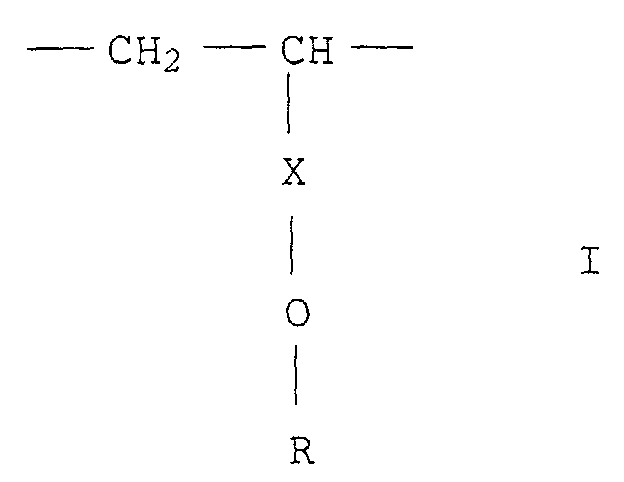
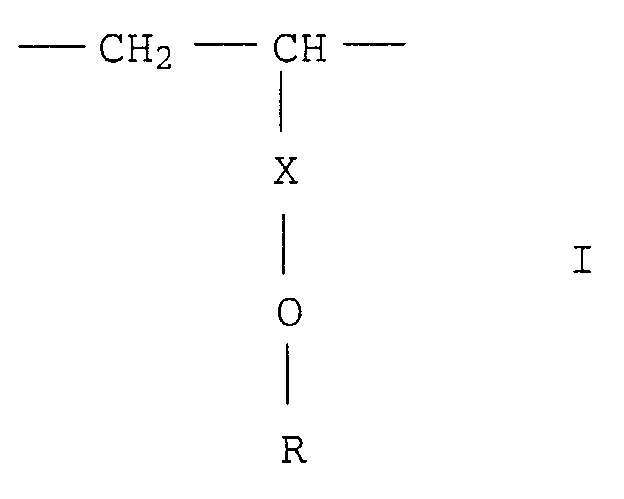
- the polyvinyl alkyl ether consists of at least 70% by weight, preferably at least 85% by weight, particularly preferably at least 95% by weight, of structural unit of the formula
- X stands for a single bond (ie X is omitted) or a C 1 -C 3 alkylene group.
- R represents a C 1 -C 6 alkyl group.
- Preferred structural units are those of the formula in which R has the above meaning.
- R preferably represents a C 1 -C 3 alkyl group, particularly preferably methyl, ethyl, propyl and isopropyl, very particularly preferably ethyl.
- Such polyvinyl alkyl ethers are known in e.g. cationic Polymerization of vinyl alkyl ethers (e.g. vinyl methyl ether, Vinyl ethyl ether, vinyl propyl ether or vinyl isopropyl ether, available.
- vinyl alkyl ethers e.g. vinyl methyl ether, Vinyl ethyl ether, vinyl propyl ether or vinyl isopropyl ether, available.
- Different vinyl alkyl ethers can also be copolymerized so that the polyvinyl alkyl ether is different Contains structural units of the formula I.
- Suitable comonomers are also (meth) acrylates.
- the polyvinyl alkyl ether preferably has a K value after Fikentscher from 10 to 90, particularly preferably 20 to 70 and whole particularly preferably 35 to 70 (1% solution, solvent tetrahydrofuran, 21 ° C).
- the preparation of the polyvinyl alkyl ethers can e.g. by solution polymerization in organic solvents or bulk polymerization (i.e. without solvent). Solvent-free are preferred manufactured polyvinyl alkyl ethers.
- Suitable polyvinyl ethers are e.g. under the label Lutonale® available from BASF.
- the polyacrylate can be used to produce the mixture according to the invention A) and the polyvinyl ether b) at any time be mixed together.
- the polyvinyl ether after the solution polymerization of the polyacrylate obtained solution of the polyacrylate be added. If desired, the solvent can then be used be removed (see above).
- the polyvinyl ether can also be used before or during production of the polyacrylate added to the polymerization mixture become.
- the production of the polyacrylate is preferred by solution polymerization, the addition of the polyvinyl ether before Removal of the solvent and subsequent removal of the above solvent (as described above).
- mixtures are particularly advantageous Get properties. This may be because that there is at least some chemical bonding the polyvinyl ether to the polyacrylate, e.g. through grafting reactions comes.
- the content of the polyvinyl ether in the mixture according to the invention is preferably 0.1 to 60 parts by weight, particularly preferably 5 up to 50 parts by weight, very particularly preferably 10 to 40 parts by weight, based on 100 parts by weight of A) + B) (solid, i.e. without solvent)
- the photoinitiator can be at any time be added.
- the mixture according to the invention can contain further components, e.g. Additives such as fillers, dyes, flow control agents and in particular contain tackifiers (tackifying resins).
- Additives such as fillers, dyes, flow control agents and in particular contain tackifiers (tackifying resins).
- Tackifiers are e.g. Natural resins such as rosins and their by disproportionation or isomerization, polymerization, Dimerization, hydrogenation resulting derivatives. These can be in their salt form (e.g. with mono- or polyvalent counterions (Cations) or preferably in their esterified form. Alcohols used for the esterification can be one or be multivalued. Examples are methanol, ethanediol, diethylene glycol, Triethylene glycol, 1,2,3-propanethiol, pentaerythritol.
- hydrocarbon resins e.g. Coumarone-indene resins, Polyterpene resins, hydrocarbon based resins unsaturated CH compounds, such as butadiene, pentene, methylbutene, Isoprene, piperylene, divinyl methane, pentadiene, cyclopentene, cyclopentadiene, Cyclohexadiene, styrene, ⁇ -methylstyrene, vinyl toluene Use.
- CH compounds such as butadiene, pentene, methylbutene, Isoprene, piperylene, divinyl methane, pentadiene, cyclopentene, cyclopentadiene, Cyclohexadiene, styrene, ⁇ -methylstyrene, vinyl toluene Use.
- Polyacrylates which have a low molecular weight are also increasingly being used as tackifiers. These polyacrylates preferably have a weight-average molecular weight M w of less than 30,000.
- the polyacrylates preferably consist of at least 60, in particular at least 80,% by weight of C 1 -C 8 alkyl (meth) acrylates.
- Preferred tackifiers are natural or chemically modified Rosins. Rosin resins are predominant Part from abietic acid or abietic acid derivatives.
- the amount by weight of the tackifier is preferably 5 to 100 parts by weight. particularly preferably 10 to 50 parts by weight. based on 100 parts by weight of polyacrylate (solid / solid).
- the mixture can be used as an adhesive, in particular as a pressure sensitive adhesive be used.
- the mixture can also be used as a hot melt pressure sensitive adhesive become, i.e. as a largely solvent-free mixture, which is applied from the melt to the desired substrates becomes.
- the mixture is particularly suitable as an adhesive for bonding of substrates, characterized in that at least one of the substrate surfaces made of soft PVC.
- the adhesive can be placed on a carrier e.g. made of paper or Plastic are applied and the carrier coated in this way (e.g. a label, tape or foil) on a substrate Soft PVC (e.g. window profiles etc.) can be glued.
- it is a crosslinkable with UV light Adhesive, pressure sensitive adhesive or hot melt pressure sensitive adhesive.
- the adhesives according to the invention or Hot melt adhesives for the production of self-adhesive articles, such as labels, adhesive tapes or adhesive films, e.g. Protective films.
- the self-adhesive articles generally consist of one Carrier and one or both sides, preferably one-sided applied layer of adhesive.
- the carrier material can e.g. in paper, plastic films act from polyolefins or PVC, PVC is preferred, particularly prefers soft PVC.
- the mixture according to the invention has particular advantages in the case of soft PVC as a carrier material.
- Soft PVC means polyvinyl chloride, which has a content of plasticizers and a low softening temperature having. Common plasticizers are e.g. Phthalates, epoxides, Adipic. The plasticizer content in the soft PVC is et al more than 10, in particular more than 20 wt .-%.
- plasticizers can migrate into the adhesive layer and significantly deteriorate the adhesive properties. With The migration of the plasticizers affects the mixture according to the invention little or no attention to the properties of the adhesive.
- the present invention therefore relates in particular self-adhesive articles with soft PVC as a carrier material and one adhesive layer of the above mixture coated thereon.
- the carrier material can be coated in the usual way.
- the above mixtures are preferably used as a hot melt pressure sensitive adhesive used, i.e. the coating takes place from the melt, preferably at a temperature of the mixture of 60 to 200, in particular 90 to 160 ° C.
- Preferred layer thicknesses are 2 to 200 ⁇ m, in particular 5 to 80 and particularly preferably 10 to 80 ⁇ m.
- UV light crosslinkable polyacrylates after coating, irradiation with high-energy light, especially UV light, so that crosslinking takes place.
- the coated substrates are coated on one Conveyor belt placed and the conveyor belt at a radiation source, e.g. passed by a UV lamp.
- the degree of crosslinking of the polymers depends on the duration and Radiation intensity.
- the radiation energy in the wavelength range from 250 to 260 nm is preferably 3 to 70 mJ / cm 2 of the irradiated area (measured with the UV Power Puck®).
- the coated substrates obtained are preferably as Self-adhesive articles, such as labels, adhesive tapes or protective films used.
- the adhesive coatings obtained, crosslinked with UV light have good application properties, e.g. a very good adhesion and high internal strength.
- Soft PVC films were coated with the mixtures given in the table, at 120 ° C. to 140 ° C. (layer thickness 25 g / m 2 ).
- the contact time was 20 minutes and the take-off speed 300 mm / min.
- the water resistance (tarnishing white) was also checked the adhesive film was stored under water and the time until intended for visually recognizable cloudiness.
Landscapes
- Chemical & Material Sciences (AREA)
- Organic Chemistry (AREA)
- Adhesives Or Adhesive Processes (AREA)
- Compositions Of Macromolecular Compounds (AREA)
- Adhesive Tapes (AREA)
Abstract
Description

R steht für eine C1-C6 Alkylgruppe. Bevorzugte Struktureinheiten sind solche der Formel

- Polyvinylalkylether:
- Lutonal® M40, ein Polyvinylmethylether
(K-Wert 40)
Lutonal® A 25, ein Polyvinylethylether (K-Wert 25)
Lutonal® I 60, ein Polyvinylisopropylether (K-Wert 60)
Lutonal® A 50, ein Polyvinylethylether (K-Wert 50)
| Gemische | UV-C-Dosis (250-260 mm) [mJ/cm2] | Schälfestigkeit | Weißanlaufen 24h | |
| sofort | 3 Tg, 70°C | |||
| 100 acResin A 203 UV + 30 Lutonal M 40 | 10 | 10,4 | 9,3 | 20 min |
| 100 acResin A 203 UV + 30 Lutonal A 25 | 10 | 21,3 | 11,3 | >24h |
| 100 acResin A 203 UV + 30 Lutonal A 50 | 10 | 15,8 | 9,5 | >24h |
| 100 acResin A 203 UV + 40 Lutonal I 60 | 5 | 21,7 | 19,4 | >24h |
| ac Resin A 203 UV | 10 | 6 | 1,5 | >24h |
| ac Resin A 203 UV | 5 | 8,5 | 3,9 | >24h |
Claims (16)
- Gemisch, enthaltendworin X für eine Einfachbindung oder eine C1 bis C3 Alkylengruppe und R für eine C1-C6 Alkylgruppe steht.A) ein Polymer, welches zu mindestens 40 Gew.-% aus C1-C18 Alkyl(meth)acrylaten (kurz Polyacrylat) besteht undB) ein Polyvinylalkyletherhomo- oder copolymer (kurz Polyvinylalkylether), welches zu mindestens 70 Gew-.% aus Struktureinheiten der folgenden Formel besteht,

- Gemisch gemäß Anspruch 1, dadurch gekennzeichnet, dass das Polyacrylat einen k-Wert nach Fikentscher von 30 bis 80 (in 1%iger Lösung, Lösungsmittel Tetrahydrofuran, 21°C) hat.
- Gemisch gemäß Anspruch 1 oder 2, dadurch gekennzeichnet, dass das Gemisch einen Photoinitiator enthält.
- Gemisch gemäß Anspruch 3 dadurch gekennzeichnet, dass der Photoinitiator an das Polyacrylat gebunden ist.
- Gemisch gemäß einem der Ansprüche 1 bis 4, dadurch gekennzeichnet, dass im Polyvinylalkylether der Formel I X für eine Einfachbindung und R für eine C1 bis C4 Alkylgruppe steht.
- Gemisch gemäß Anspruch 1, dadurch gekennzeichnet, dass der Polyvinylalkyether einen K-Wert nach Fikentscher von 10 bis 90 hat (in 1%iger Lösung, Lösungsmittel Tetrahydrofuran, 21°C) hat.
- Gemisch gemäß einem der Ansprüche 1 bis 6, dadurch gekennzeichnet, dass der Gehalt des Polyvinylalkylethers 0,1 bis 60 Gew.-Teile, bezogen auf 100 Gew.-Teile Polyacrylat A) beträgt.
- Gemische gemäß einem der Ansprüche 1 bis 7 erhältlich durch Herstellung des Polyacrylats durch Lösungspolymerisation und Zugabe des Polyvinylalkylethers vor Entfernung des bei der Polymerisation verwendeten Lösungsmittels.
- Gemäß einem der Ansprüche 1 bis 8, dadurch gekennzeichnet, dass das Gemisch einen Gehalt an Wasser oder organischen Lösungsmitteln von weniger als 5 Gew.-Teilen bezogen auf 100 Gew.-Teile der Summe aus Polyacrylat A) und Polyvinylalkylether B) aufweist.
- Verwendung eines Gemisches gemäß einem der Ansprüche 1 bis 9 als Klebstoff, insbesondere Haftklebstoff.
- Verwendung eines Gemisches gemäße einem der Ansprüche 1 bis 9 als Schmelzhaftklebstoff
- Verwendung eines Gemischs gemäß einem der Ansprüche 1 bis 9 als Klebstoff, dadurch gekennzeichnet, dass zumindest eine der durch den Klebstoff zu verbindenden Oberflächen aus Weich-PVC ist.
- Verwendung eines Gemisches gemäß einem der Ansprüche 1 bis 9 als Haftklebstoff, insbesondere Schmelzhaftklebstoff für die Herstellung selbstklebender Artikel mit Weich-PVC als Trägermaterial.
- Verfahren zur Herstellung von selbstklebenden Artikeln, dadurch gekennzeichnet, dass das Gemisch gemäß einem der Ansprüche 1 bis 9 auf Substrate, wie Etiketten, Bänder oder großflächigen Folien aufgetragen wird und anschließend eine Vernetzung durch UV-Licht erfolgt.
- Verfahren gemäß Anspruch 14, dadurch gekennzeichnet, das das Gemisch aus der Schmelze bei Temperaturen von 100 bis 160°C auf die Substrate aufgetragen wird und anschließend mit UV-Licht vernetzt wird.
- Selbstklebende Artikel erhältlich durch ein Verfahren gemäß einem der Ansprüche 14 oder 15 oder durch Verwendung gemäß einem der Ansprüche 10, 11 oder 13.
Applications Claiming Priority (2)
| Application Number | Priority Date | Filing Date | Title |
|---|---|---|---|
| DE10105278 | 2001-02-02 | ||
| DE10105278A DE10105278A1 (de) | 2001-02-02 | 2001-02-02 | Klebstoffe, enthaltend Polyvinylalkylether |
Publications (1)
| Publication Number | Publication Date |
|---|---|
| EP1229096A1 true EP1229096A1 (de) | 2002-08-07 |
Family
ID=7672993
Family Applications (1)
| Application Number | Title | Priority Date | Filing Date |
|---|---|---|---|
| EP02001394A Withdrawn EP1229096A1 (de) | 2001-02-02 | 2002-01-19 | Mischungen aus Polyvinylalkylether und Polyacrylat |
Country Status (4)
| Country | Link |
|---|---|
| US (1) | US6734222B2 (de) |
| EP (1) | EP1229096A1 (de) |
| JP (1) | JP2002317090A (de) |
| DE (1) | DE10105278A1 (de) |
Families Citing this family (5)
| Publication number | Priority date | Publication date | Assignee | Title |
|---|---|---|---|---|
| JP2005008830A (ja) * | 2003-06-20 | 2005-01-13 | Panac Co Ltd | 粘着剤組成物及び粘着シート |
| DE102005049681B4 (de) * | 2005-10-14 | 2011-03-10 | Henkel Ag & Co. Kgaa | Hülsenförmige Etiketten |
| WO2014112157A1 (ja) | 2013-01-16 | 2014-07-24 | 株式会社オートネットワーク技術研究所 | 硬化材料、ワイヤーハーネス及びその製造方法 |
| EP3114183B1 (de) | 2014-03-05 | 2026-05-06 | Henkel AG & Co. KGaA | Klebstoffbeschichtetes wärmeempfindliches polymersubstrat, verfahren zu dessen herstellung und verwendung davon |
| CN105694750A (zh) * | 2016-02-03 | 2016-06-22 | 河北华夏实业有限公司 | 一种新型耐高温聚氯乙烯胶带的制作方法 |
Citations (10)
| Publication number | Priority date | Publication date | Assignee | Title |
|---|---|---|---|---|
| GB1078942A (en) * | 1964-01-08 | 1967-08-09 | Beiersdorf & Co Ag | Production of self-sealing strips and foils |
| DE1569922A1 (de) * | 1962-04-09 | 1970-07-09 | Marechal S A Ets | Verfahren zur Herstellung von Klebefolien,insbesondere fuer Dekorationszwecke |
| DE2039079A1 (de) * | 1970-08-06 | 1972-02-10 | Basf Ag | Klebemittel beim Filmdruck |
| GB1280631A (en) * | 1968-07-09 | 1972-07-05 | Smith & Nephew | Adhesive materials |
| GB1322721A (en) * | 1969-05-21 | 1973-07-11 | Lo Sound Developments Ltd | Bonding of materials using adhesives |
| DE2236575A1 (de) * | 1972-07-26 | 1974-02-07 | Beiersdorf Ag | Wasserloesbare selbstklebemasse |
| AT320104B (de) * | 1972-03-24 | 1975-01-27 | Beiersdorf Ag | Wasserlösbare Selbstklebemasse |
| JPS5867776A (ja) * | 1981-10-19 | 1983-04-22 | Sekisui Chem Co Ltd | 治療用接着テ−プもしくはシ−ト |
| EP0155557A1 (de) * | 1984-02-28 | 1985-09-25 | Gebrüder Kömmerling Kunststoffwerke GmbH | Selbstklebende, redispergierbare Klebstoffmischung und sie enthaltende selbstklebende Folie zum Schutz empfindlicher Oberflächen |
| DE4432876C1 (de) * | 1994-09-15 | 1996-04-18 | Drescher Geschaeftsdrucke | Einlagiges Papiererzeugnis und dessen Verwendung |
Family Cites Families (14)
| Publication number | Priority date | Publication date | Assignee | Title |
|---|---|---|---|---|
| DE2439341A1 (de) * | 1974-08-16 | 1976-02-26 | Bayer Ag | Kontinuierliche substanzpolymerisation von vinylderivaten |
| DE3023201A1 (de) * | 1980-06-21 | 1982-01-07 | Hoechst Ag, 6000 Frankfurt | Positiv arbeitendes strahlungsempfindliches gemisch |
| DE3364187D1 (en) | 1982-08-19 | 1986-07-24 | Minnesota Mining & Mfg | Composite decorative article |
| US4469774A (en) * | 1983-03-28 | 1984-09-04 | E. I. Du Pont De Nemours And Company | Positive-working photosensitive benzoin esters |
| NL8800428A (nl) | 1988-02-19 | 1989-09-18 | Avery International Corp | Thermoplastische, voor weekmaker ongevoelige film, en zelfklevende film die de voor weekmaker ongevoelige film bevat. |
| DE3820464A1 (de) | 1988-06-16 | 1990-02-08 | Basf Ag | Neue benzophenonderivate und deren herstellung |
| US5264533A (en) * | 1988-06-16 | 1993-11-23 | Basf Aktiengesellschaft | Benzophenone derivatives and their preparation |
| DE3844444A1 (de) | 1988-12-31 | 1990-08-09 | Basf Ag | Strahlungsempfindliche, ethylenisch ungesaettigte, copolymerisierbare verbindungen und verfahren zu deren herstellung |
| US5248805A (en) * | 1988-12-31 | 1993-09-28 | Basf Aktiengesellschaft | Radiation-senstive, ethylenically unsaturated, copolymerizable compounds and their preparation |
| DE3844445A1 (de) | 1988-12-31 | 1990-07-19 | Basf Ag | Uv-vernetzbare massen auf basis von (meth)-acrylesterpolymerisaten |
| DE3914374A1 (de) * | 1989-04-29 | 1990-10-31 | Basf Ag | Durch ultraviolette strahlung unter luftsauerstoffatmosphaere vernetzbare copolymerisate |
| US5128286A (en) * | 1989-06-20 | 1992-07-07 | Tonen Corporation | Boron-containing, silicon nitride-based ceramic shaped body |
| DE4037079A1 (de) | 1990-11-22 | 1992-05-27 | Basf Ag | Ungesaettigte phenonderivate und ihre verwendung als haftklebstoffe |
| RU2154578C2 (ru) | 1995-02-16 | 2000-08-20 | Миннесота Майнинг Энд Мэнюфекчуринг Компани | Изделие, содержащее эффективный при кратковременном прижатии клей, имеющее улучшенную адгезию к пластифицированному поливинилхлориду, и способ соединения пластифицированного пвх с основой с помощью эффективного при кратковременном прижатии клея (его варианты) |
-
2001
- 2001-02-02 DE DE10105278A patent/DE10105278A1/de not_active Withdrawn
-
2002
- 2002-01-19 EP EP02001394A patent/EP1229096A1/de not_active Withdrawn
- 2002-01-28 US US10/056,116 patent/US6734222B2/en not_active Expired - Fee Related
- 2002-01-31 JP JP2002024160A patent/JP2002317090A/ja active Pending
Patent Citations (10)
| Publication number | Priority date | Publication date | Assignee | Title |
|---|---|---|---|---|
| DE1569922A1 (de) * | 1962-04-09 | 1970-07-09 | Marechal S A Ets | Verfahren zur Herstellung von Klebefolien,insbesondere fuer Dekorationszwecke |
| GB1078942A (en) * | 1964-01-08 | 1967-08-09 | Beiersdorf & Co Ag | Production of self-sealing strips and foils |
| GB1280631A (en) * | 1968-07-09 | 1972-07-05 | Smith & Nephew | Adhesive materials |
| GB1322721A (en) * | 1969-05-21 | 1973-07-11 | Lo Sound Developments Ltd | Bonding of materials using adhesives |
| DE2039079A1 (de) * | 1970-08-06 | 1972-02-10 | Basf Ag | Klebemittel beim Filmdruck |
| AT320104B (de) * | 1972-03-24 | 1975-01-27 | Beiersdorf Ag | Wasserlösbare Selbstklebemasse |
| DE2236575A1 (de) * | 1972-07-26 | 1974-02-07 | Beiersdorf Ag | Wasserloesbare selbstklebemasse |
| JPS5867776A (ja) * | 1981-10-19 | 1983-04-22 | Sekisui Chem Co Ltd | 治療用接着テ−プもしくはシ−ト |
| EP0155557A1 (de) * | 1984-02-28 | 1985-09-25 | Gebrüder Kömmerling Kunststoffwerke GmbH | Selbstklebende, redispergierbare Klebstoffmischung und sie enthaltende selbstklebende Folie zum Schutz empfindlicher Oberflächen |
| DE4432876C1 (de) * | 1994-09-15 | 1996-04-18 | Drescher Geschaeftsdrucke | Einlagiges Papiererzeugnis und dessen Verwendung |
Non-Patent Citations (1)
| Title |
|---|
| PATENT ABSTRACTS OF JAPAN vol. 007, no. 155 (C - 175) 7 July 1983 (1983-07-07) * |
Also Published As
| Publication number | Publication date |
|---|---|
| JP2002317090A (ja) | 2002-10-31 |
| DE10105278A1 (de) | 2002-08-08 |
| US20020137846A1 (en) | 2002-09-26 |
| US6734222B2 (en) | 2004-05-11 |
Similar Documents
| Publication | Publication Date | Title |
|---|---|---|
| EP2087021B1 (de) | Strahlungshärtbare mischung, enthaltend niedermolekulare, ethylenisch ungesättigte verbindungen mit nicht-aromatischen ringsystemen | |
| EP2718385B1 (de) | Schmelzklebstoff, enthaltend strahlungsvernetzbares poly(meth)acrylat und oligo(meth)acrylat mit nicht-acrylischen c-c-doppelbindungen | |
| EP0417564B1 (de) | UV-vernetzbare Copolymerisate | |
| EP0367054A2 (de) | UV-vernetzbare Massen auf Basis von Isoamyl(meth)acrylatcopolymerisaten | |
| DE102012218335A1 (de) | Haftklebstoff, enthaltend Poly(meth)acrylat aus hochverzweigten C13- bis C21-Alky(meth)acrylaten | |
| EP3322764B1 (de) | Schmelzklebstoff, enthaltend poly(meth)acrylat aus alky(meth)acrylaten und aus bestimmten heterocyclische gruppen enthaltenden (meth)acrylaten | |
| DE102015217131A1 (de) | Klebharz-modifizierte Haftklebemasse | |
| EP1213306B1 (de) | Lösungen von UV-vernetzbaren Polyacrylaten | |
| EP1329492B1 (de) | Haftklebstoff, enthaltend Vinylpyrrolidon | |
| EP1229096A1 (de) | Mischungen aus Polyvinylalkylether und Polyacrylat | |
| WO2008049805A1 (de) | Strahlungshärtbare mischung, enthaltend polyacrylat mit nicht-acrylischen doppelbindungen | |
| EP1603984B1 (de) | Haftklebstoff | |
| EP3694946B1 (de) | Gegen weichmachermigration resistenter, uv-härtbarer schmelzklebstoff für graphikfolien und etiketten aus weich-pvc | |
| WO2006058694A1 (de) | Strahlungshärtbare schmelzklebstoffe | |
| DE10103428A1 (de) | Stabilisatoren enthaltende UV-vernetzbare Schmelzhaftklebstoffe | |
| DE10134261A1 (de) | Stabilisatoren enthaltende UV-vernetzbare Schmelzhaftklebstoffe | |
| EP1228157B1 (de) | Verwendung von polymerisaten als klebstoffe für wiederabziehbare träger | |
| EP1242550B1 (de) | Klebstoffe für tiefgekühlte substrate | |
| DE10208843A1 (de) | UV-vernetzbare Schmelzhaftklebstoffe, enthaltend pyrogene Kieselsäuren | |
| DE102015209753A1 (de) | Verfahren zum Erwärmen eines Schmelzklebstoffs, enthaltend Poly(meth)acrylat | |
| DE202014101183U1 (de) | Mit Klebstoff beschichtetes thermisch empfindliches Polymersubstrat | |
| DE102004003764A1 (de) | Haftklebstoff, enthaltend Kondensationsharze | |
| DE10010767A1 (de) | Coextrusion von Schmelzhaftklebstoffen |
Legal Events
| Date | Code | Title | Description |
|---|---|---|---|
| PUAI | Public reference made under article 153(3) epc to a published international application that has entered the european phase |
Free format text: ORIGINAL CODE: 0009012 |
|
| AK | Designated contracting states |
Kind code of ref document: A1 Designated state(s): AT BE CH CY DE DK ES FI FR GB GR IE IT LI LU MC NL PT SE TR |
|
| AX | Request for extension of the european patent |
Free format text: AL;LT;LV;MK;RO;SI |
|
| 17P | Request for examination filed |
Effective date: 20020622 |
|
| AKX | Designation fees paid |
Designated state(s): DE ES FR GB IT |
|
| 17Q | First examination report despatched |
Effective date: 20040625 |
|
| GRAP | Despatch of communication of intention to grant a patent |
Free format text: ORIGINAL CODE: EPIDOSNIGR1 |
|
| RTI1 | Title (correction) |
Free format text: SELF-ADHESIVE ARTICLES AND METHOD FOR THEIR PREPARATION |
|
| GRAS | Grant fee paid |
Free format text: ORIGINAL CODE: EPIDOSNIGR3 |
|
| STAA | Information on the status of an ep patent application or granted ep patent |
Free format text: STATUS: THE APPLICATION IS DEEMED TO BE WITHDRAWN |
|
| 18D | Application deemed to be withdrawn |
Effective date: 20050524 |