EP1219038B1 - Short code detection method - Google Patents
Short code detection method Download PDFInfo
- Publication number
- EP1219038B1 EP1219038B1 EP00970464A EP00970464A EP1219038B1 EP 1219038 B1 EP1219038 B1 EP 1219038B1 EP 00970464 A EP00970464 A EP 00970464A EP 00970464 A EP00970464 A EP 00970464A EP 1219038 B1 EP1219038 B1 EP 1219038B1
- Authority
- EP
- European Patent Office
- Prior art keywords
- short code
- likelihood ratio
- code
- short
- detection method
- Prior art date
- Legal status (The legal status is an assumption and is not a legal conclusion. Google has not performed a legal analysis and makes no representation as to the accuracy of the status listed.)
- Expired - Lifetime
Links
- 238000001514 detection method Methods 0.000 title description 89
- 238000000034 method Methods 0.000 claims description 23
- 238000004891 communication Methods 0.000 claims description 21
- 230000007480 spreading Effects 0.000 claims description 8
- 238000005315 distribution function Methods 0.000 claims description 5
- 238000005070 sampling Methods 0.000 claims 1
- 238000001617 sequential probability ratio test Methods 0.000 description 14
- 230000005540 biological transmission Effects 0.000 description 6
- 238000010586 diagram Methods 0.000 description 4
- 238000001228 spectrum Methods 0.000 description 3
- 238000004364 calculation method Methods 0.000 description 2
- 230000007423 decrease Effects 0.000 description 1
- 230000003247 decreasing effect Effects 0.000 description 1
- 230000000694 effects Effects 0.000 description 1
- 230000006872 improvement Effects 0.000 description 1
- 230000000977 initiatory effect Effects 0.000 description 1
- 238000012986 modification Methods 0.000 description 1
- 230000004048 modification Effects 0.000 description 1
- 230000008569 process Effects 0.000 description 1
- 230000003252 repetitive effect Effects 0.000 description 1
- 230000000630 rising effect Effects 0.000 description 1
- 230000001360 synchronised effect Effects 0.000 description 1
Images



Classifications
-
- H—ELECTRICITY
- H04—ELECTRIC COMMUNICATION TECHNIQUE
- H04B—TRANSMISSION
- H04B1/00—Details of transmission systems, not covered by a single one of groups H04B3/00 - H04B13/00; Details of transmission systems not characterised by the medium used for transmission
- H04B1/69—Spread spectrum techniques
- H04B1/707—Spread spectrum techniques using direct sequence modulation
- H04B1/7097—Interference-related aspects
- H04B1/71—Interference-related aspects the interference being narrowband interference
-
- H—ELECTRICITY
- H04—ELECTRIC COMMUNICATION TECHNIQUE
- H04B—TRANSMISSION
- H04B1/00—Details of transmission systems, not covered by a single one of groups H04B3/00 - H04B13/00; Details of transmission systems not characterised by the medium used for transmission
- H04B1/69—Spread spectrum techniques
- H04B1/707—Spread spectrum techniques using direct sequence modulation
- H04B1/7073—Synchronisation aspects
- H04B1/70735—Code identification
-
- H—ELECTRICITY
- H04—ELECTRIC COMMUNICATION TECHNIQUE
- H04B—TRANSMISSION
- H04B1/00—Details of transmission systems, not covered by a single one of groups H04B3/00 - H04B13/00; Details of transmission systems not characterised by the medium used for transmission
- H04B1/69—Spread spectrum techniques
- H04B1/707—Spread spectrum techniques using direct sequence modulation
- H04B1/7097—Interference-related aspects
- H04B1/71—Interference-related aspects the interference being narrowband interference
- H04B1/7101—Interference-related aspects the interference being narrowband interference with estimation filters
-
- H—ELECTRICITY
- H04—ELECTRIC COMMUNICATION TECHNIQUE
- H04B—TRANSMISSION
- H04B1/00—Details of transmission systems, not covered by a single one of groups H04B3/00 - H04B13/00; Details of transmission systems not characterised by the medium used for transmission
- H04B1/69—Spread spectrum techniques
- H04B1/707—Spread spectrum techniques using direct sequence modulation
- H04B1/7097—Interference-related aspects
- H04B1/711—Interference-related aspects the interference being multi-path interference
- H04B1/7115—Constructive combining of multi-path signals, i.e. RAKE receivers
Definitions
- This invention relates to the field of code division multiple access (CDMA) communication systems. More particularly, the present invention relates to a system for accurately detecting short codes in a communication environment which includes continuous wave interference.
- CDMA code division multiple access
- Wireless communications systems employing CDMA techniques provide an efficient use of the available spectrum by accommodating more users than time division multiple access (TDMA) and frequency division multiple access (FDMA) systems.
- TDMA time division multiple access
- FDMA frequency division multiple access
- the same portion of the frequency spectrum is used for communication by all subscriber units.
- a single base station serves a plurality of subscriber units.
- the baseband data signal of each subscriber unit is multiplied by a pseudo-random code sequence, called the spreading code, which has a much higher transmission rate than the data.
- the spreading code which has a much higher transmission rate than the data.
- the subscriber signal is spread over the entire available bandwidth.
- Individual subscriber unit communications are discriminated by assigning a unique spreading code to each communication link. At times it is also useful in a CDMA system to transmit codes which are of shorter length than the usual spreading code.
- SPRT sequential probability ratio test
- a background noise estimation is required for the SPRT detection method.
- the background noise estimation is typically performed by applying a long pseudo-random spreading code to a RAKE despreader.
- the output of the RAKE despreader has a probability distribution function, (PDF).
- PDF probability distribution function
- curve 1 shows a typical PDF background for noise which is calculated using a long pseudo-random spreading code where there is no CW interference.
- Curve 3 shows a typical PDF in the presence of a valid detected signal.
- the background noise PDF is a curve like 2, which is shifted away from curve 1 and which appears similar to the PDF for a valid detected signal, curve 3.
- the noise estimate becomes skewed because the short code, which is not completely random is applied to the RAKE and it begins to correlate with the repetitive CW interference. Accordingly, as curve 2 shifts further toward curve 3 due to the presence of CW interference, the SPRT detection method will falsely detect invalid noise as a valid signal.
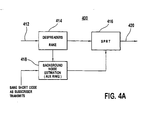
- the short code detector system 10 is typically located in a base station for detecting short codes received from a subscriber unit.
- a signal containing short codes, continuous wave interference and other forms of background noise is applied to the short code detector system 10 by way of the detector input line 12, and is received by a detector input block 14.
- the detector input block 14 includes a RAKE demodulator having M different phases.
- the RAKE demodulator operates on the input signal by combining it with the short pilot code.
- the pilot code is a pseudorandom code which is generated locally by the base station and transmitted by subscribers initiating a call setup.
- a first output signal of the detector input block 14 is applied to a detection block 16 of the detector system 10.
- the detection block 16 contains a SPRT detection method.
- the output signal of the detection block 16 appears on a decision line 20.
- the signal of the decision line 20 represents a decision by the SPRT detection method of detection block 16 whether a short code is present in the signal received by the input block 14.
- a second output signal of the input block 14 is applied to a noise estimator, which is comprised of a separate RAKE demodulator (AUX RAKE) which uses a long pseudorandom code in combination with the input signal to perform a background noise estimation.
- AUX RAKE RAKE demodulator
- the result of the background noise estimation performed in block 18 is a PDF which is applied to the SPRT detection method of detection block 16.
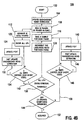
- the detection method 40 is used to detect the presence of short codes transmitted in a wireless communication system.
- the short code detection method 40 is suitable for operation within the detection block 16 of the short code detector system 10 to detect the presence of short codes in the input signal of the input line 12.
- Execution of the short code detection method 40 begins at the start terminal 42 and proceeds to step 44 where one of the M different phases of the RAKE 14 is selected.
- the short code detection method 40 proceeds to step 46 where a background noise estimate, performed by the AUX RAKE, (in the noise estimator 18 of Figure 1B), is updated.
- the signal is applied by the noise estimator 18 to the detection block 16.
- a sample of the signal from the selected phase of the input line 12 as received by the input block 14 is applied to the detection block 16 for computation according to the short code detection method 40.
- the likelihood ratio of the current phase is updated at step 54. It will be understood by those skilled in the art that such a likelihood ratio is calculated for each of the M different phases of the RAKE.
- the likelihood ratio of the current phase is calculated in view of the background estimate of step 46 and the input sample taken at step 50.
- step 56 If all of the likelihood ratios are below the rejection threshold 76 as determined by step 56, it is possible to be confident that no short code is present in any of the M phases of the received signal. Accordingly, the detection method 40 proceeds to step 52 where the likelihood ratios of all M phases are cleared.
- the phase of the local spreading code, the pilot code is advanced in step 48 for use with the RAKE and the next RAKE phase is selected in step 44.
- the detection method 40 proceeds by way of path 59 whereby a new sample of the signal phase is obtained, (step 50).
- the repeated branching of the detection method 40 by way of path 59 to obtain and process new samples in this manner causes the adjustment of the various likelihood ratios either toward or away from thresholds 74, 76.
- the short code detection method 40 repeatedly proceeds by way of path 59 until either: 1) one of the likelihood ratios crosses above the acceptance threshold 74; or 2) all of the likelihood ratios cross below the rejection threshold 76. Only when one of these two events occurs is there a sufficient confidence level to determine whether or not a short code is present. The number of samples required for one of these two events to occur is a measure of the efficiency of the short code detection method 40 .
- Repeated branching by way of path 59 can provide either an increasing likelihood or a decreasing likelihood that a short code is present.
- the repeated branching by way of path 59 causes adjustment of likelihood ratio 80 generally in the direction of the rejection threshold 76 .
- the likelihood ratio 80 to cross the rejection threshold 76
- Repeated branching by way of path 59 can also provide an increasing likelihood that a short code is present.
- successive samples cause adjustment of the likelihood ratio 84 generally in the direction of the acceptance threshold 74.
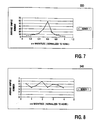
- FIGS. 7 and 8 two graphs are shown 220, 240 which set forth the average sample number required by the short code detection methods 40, 100 to determine whether a short code is present. It will be understood by those skilled in the art that the smaller the number of samples required to make this determination, the better the method performs. As continuous wave interference magnitude increases, the prior art short code detection method 40 requires substantially more samples in order to detect a short code. As shown in Figure 7 the average sample number can increase by an order of magnitude as the magnitude of the CW interference is increased. The drop in the number of samples shown in graph 220 for CW interference greater than 0.6 times the magnitude of the background noise does not indicate improved short code detection performance, but rather it reflects the fact that false detections begin occurring at this point.
Landscapes
- Engineering & Computer Science (AREA)
- Computer Networks & Wireless Communication (AREA)
- Signal Processing (AREA)
- Mobile Radio Communication Systems (AREA)
- Noise Elimination (AREA)
Priority Applications (1)
| Application Number | Priority Date | Filing Date | Title |
|---|---|---|---|
| EP05016461A EP1601114A3 (en) | 1999-10-08 | 2000-09-21 | Short code detection method |
Applications Claiming Priority (3)
| Application Number | Priority Date | Filing Date | Title |
|---|---|---|---|
| US09/415,321 US6414951B1 (en) | 1999-10-08 | 1999-10-08 | Method for detecting short codes in CDMA systems |
| US415321 | 1999-10-08 | ||
| PCT/US2000/025772 WO2001028122A1 (en) | 1999-10-08 | 2000-09-21 | Short code detection method |
Related Child Applications (1)
| Application Number | Title | Priority Date | Filing Date |
|---|---|---|---|
| EP05016461A Division EP1601114A3 (en) | 1999-10-08 | 2000-09-21 | Short code detection method |
Publications (2)
| Publication Number | Publication Date |
|---|---|
| EP1219038A1 EP1219038A1 (en) | 2002-07-03 |
| EP1219038B1 true EP1219038B1 (en) | 2005-08-03 |
Family
ID=23645234
Family Applications (2)
| Application Number | Title | Priority Date | Filing Date |
|---|---|---|---|
| EP00970464A Expired - Lifetime EP1219038B1 (en) | 1999-10-08 | 2000-09-21 | Short code detection method |
| EP05016461A Ceased EP1601114A3 (en) | 1999-10-08 | 2000-09-21 | Short code detection method |
Family Applications After (1)
| Application Number | Title | Priority Date | Filing Date |
|---|---|---|---|
| EP05016461A Ceased EP1601114A3 (en) | 1999-10-08 | 2000-09-21 | Short code detection method |
Country Status (12)
| Country | Link |
|---|---|
| US (7) | US6414951B1 (enExample) |
| EP (2) | EP1219038B1 (enExample) |
| JP (2) | JP3948554B2 (enExample) |
| AR (1) | AR025982A1 (enExample) |
| AT (1) | ATE301347T1 (enExample) |
| AU (1) | AU7984000A (enExample) |
| DE (1) | DE60021739T2 (enExample) |
| DK (1) | DK1219038T3 (enExample) |
| ES (1) | ES2246901T3 (enExample) |
| HK (1) | HK1048399B (enExample) |
| TW (1) | TW503634B (enExample) |
| WO (1) | WO2001028122A1 (enExample) |
Families Citing this family (13)
| Publication number | Priority date | Publication date | Assignee | Title |
|---|---|---|---|---|
| US6414951B1 (en) * | 1999-10-08 | 2002-07-02 | Interdigital Technology Corporation | Method for detecting short codes in CDMA systems |
| US6795423B1 (en) * | 2000-02-04 | 2004-09-21 | Interdigital Technology Corporation | System for continuous wave rejection |
| FI20000273A7 (fi) * | 2000-02-09 | 2001-08-10 | Nokia Corp | Menetelmä suorittaa koodisynkronointi ja vastaanotin |
| TW561747B (en) * | 2000-11-21 | 2003-11-11 | Ibm | Costs in data networks |
| US7868874B2 (en) | 2005-11-15 | 2011-01-11 | Synaptics Incorporated | Methods and systems for detecting a position-based attribute of an object using digital codes |
| US8847899B2 (en) | 2010-09-16 | 2014-09-30 | Synaptics Incorporated | Systems and methods for signaling and interference detection in sensor devices |
| US8743080B2 (en) | 2011-06-27 | 2014-06-03 | Synaptics Incorporated | System and method for signaling in sensor devices |
| US8766949B2 (en) | 2011-12-22 | 2014-07-01 | Synaptics Incorporated | Systems and methods for determining user input using simultaneous transmission from multiple electrodes |
| US9063608B2 (en) | 2012-06-14 | 2015-06-23 | Synaptics Incorporated | Systems and methods for sensor devices having a non-commensurate number of transmitter electrodes |
| US20150003500A1 (en) * | 2013-06-27 | 2015-01-01 | Dawson W. Kesling | Baseband Cancellation of Direct Sequence Spread Spectrum Platform Radio Interference |
| US9176633B2 (en) | 2014-03-31 | 2015-11-03 | Synaptics Incorporated | Sensor device and method for estimating noise in a capacitive sensing device |
| US10025428B2 (en) | 2015-11-19 | 2018-07-17 | Synaptics Incorporated | Method and apparatus for improving capacitive sensing detection |
| US10019122B2 (en) | 2016-03-31 | 2018-07-10 | Synaptics Incorporated | Capacitive sensing using non-integer excitation |
Family Cites Families (10)
| Publication number | Priority date | Publication date | Assignee | Title |
|---|---|---|---|---|
| US5103459B1 (en) | 1990-06-25 | 1999-07-06 | Qualcomm Inc | System and method for generating signal waveforms in a cdma cellular telephone system |
| CN1163009C (zh) | 1994-02-09 | 2004-08-18 | Ntt移动通信网株式会社 | 码分多址移动通信的方法和系统 |
| US5841768A (en) * | 1996-06-27 | 1998-11-24 | Interdigital Technology Corporation | Method of controlling initial power ramp-up in CDMA systems by using short codes |
| ZA965340B (en) | 1995-06-30 | 1997-01-27 | Interdigital Tech Corp | Code division multiple access (cdma) communication system |
| US5642377A (en) | 1995-07-25 | 1997-06-24 | Nokia Mobile Phones, Ltd. | Serial search acquisition system with adaptive threshold and optimal decision for spread spectrum systems |
| ATE218773T1 (de) | 1996-06-27 | 2002-06-15 | Interdigital Tech Corp | Ein verfahren und netzwerk zum kontrollieren des hochfahrens der anfangssendeleistung in einem cdma system unter verwendung kurzer kodes |
| US6263010B1 (en) * | 1997-08-04 | 2001-07-17 | Kabushiki Kaisha Toshiba | Spread spectrum communication apparatus |
| US5974079A (en) * | 1998-01-26 | 1999-10-26 | Motorola, Inc. | Method and apparatus for encoding rate determination in a communication system |
| US6205168B1 (en) * | 1998-11-12 | 2001-03-20 | Sharp Laboratories Of America, Inc. | Sequential detection system and method with adaptive bias |
| US6414951B1 (en) * | 1999-10-08 | 2002-07-02 | Interdigital Technology Corporation | Method for detecting short codes in CDMA systems |
-
1999
- 1999-10-08 US US09/415,321 patent/US6414951B1/en not_active Expired - Lifetime
-
2000
- 2000-09-21 ES ES00970464T patent/ES2246901T3/es not_active Expired - Lifetime
- 2000-09-21 AU AU79840/00A patent/AU7984000A/en not_active Abandoned
- 2000-09-21 AT AT00970464T patent/ATE301347T1/de not_active IP Right Cessation
- 2000-09-21 WO PCT/US2000/025772 patent/WO2001028122A1/en not_active Ceased
- 2000-09-21 HK HK03100009.6A patent/HK1048399B/en not_active IP Right Cessation
- 2000-09-21 DK DK00970464T patent/DK1219038T3/da active
- 2000-09-21 DE DE60021739T patent/DE60021739T2/de not_active Expired - Lifetime
- 2000-09-21 JP JP2001530228A patent/JP3948554B2/ja not_active Expired - Fee Related
- 2000-09-21 EP EP00970464A patent/EP1219038B1/en not_active Expired - Lifetime
- 2000-09-21 EP EP05016461A patent/EP1601114A3/en not_active Ceased
- 2000-10-06 AR ARP000105299A patent/AR025982A1/es active IP Right Grant
- 2000-10-06 TW TW089120889A patent/TW503634B/zh not_active IP Right Cessation
-
2002
- 2002-07-01 US US10/187,484 patent/US6741584B2/en not_active Expired - Lifetime
- 2002-07-01 US US10/188,279 patent/US6744756B2/en not_active Expired - Lifetime
- 2002-07-01 US US10/187,693 patent/US6744755B2/en not_active Expired - Lifetime
- 2002-07-01 US US10/187,687 patent/US6751208B2/en not_active Expired - Lifetime
-
2004
- 2004-06-04 US US10/860,848 patent/US7106720B2/en not_active Expired - Lifetime
-
2006
- 2006-09-12 US US11/519,540 patent/US7889664B2/en not_active Expired - Fee Related
-
2007
- 2007-02-07 JP JP2007027928A patent/JP4213189B2/ja not_active Expired - Fee Related
Also Published As
| Publication number | Publication date |
|---|---|
| EP1601114A2 (en) | 2005-11-30 |
| US6741584B2 (en) | 2004-05-25 |
| US6751208B2 (en) | 2004-06-15 |
| ATE301347T1 (de) | 2005-08-15 |
| US20070008874A1 (en) | 2007-01-11 |
| AR025982A1 (es) | 2002-12-26 |
| EP1601114A3 (en) | 2008-01-23 |
| US20020176395A1 (en) | 2002-11-28 |
| HK1048399B (en) | 2006-03-24 |
| US7106720B2 (en) | 2006-09-12 |
| AU7984000A (en) | 2001-04-23 |
| ES2246901T3 (es) | 2006-03-01 |
| JP4213189B2 (ja) | 2009-01-21 |
| US20020163927A1 (en) | 2002-11-07 |
| DE60021739D1 (de) | 2005-09-08 |
| TW503634B (en) | 2002-09-21 |
| US6744756B2 (en) | 2004-06-01 |
| WO2001028122A1 (en) | 2001-04-19 |
| DE60021739T2 (de) | 2006-04-20 |
| JP2003511960A (ja) | 2003-03-25 |
| US20040233864A1 (en) | 2004-11-25 |
| US7889664B2 (en) | 2011-02-15 |
| US6744755B2 (en) | 2004-06-01 |
| US20020163903A1 (en) | 2002-11-07 |
| JP3948554B2 (ja) | 2007-07-25 |
| JP2007129775A (ja) | 2007-05-24 |
| US20020181433A1 (en) | 2002-12-05 |
| HK1048399A1 (en) | 2003-03-28 |
| DK1219038T3 (da) | 2005-11-21 |
| US6414951B1 (en) | 2002-07-02 |
| EP1219038A1 (en) | 2002-07-03 |
Similar Documents
| Publication | Publication Date | Title |
|---|---|---|
| US5642377A (en) | Serial search acquisition system with adaptive threshold and optimal decision for spread spectrum systems | |
| JP4213189B2 (ja) | 短符号検出方法 | |
| KR100302502B1 (ko) | Cdma및직접확산스펙트럼시스템에서연속판단을수행하는이중드웰최대라이클리후드포착시스템 | |
| KR100629504B1 (ko) | 오경보 확률을 줄이기 위한 신호 획득 장치 및 방법 | |
| US7688878B2 (en) | Method and device of peak detection in preamble synchronization for direct sequence spread spectrum communication | |
| KR20010023157A (ko) | 포인트 투 멀티포인트 동기 씨디엠에이 시스템의다중사용자 포착방법 | |
| JP2005535176A (ja) | 相関後のソフトしきい値処理による受信cdma信号の電力測定 | |
| KR100197352B1 (ko) | 기준 정합여파기를 이용한 병렬포착시스템 | |
| JP2000152312A (ja) | 移動局の受信機が基地局を捕捉するための方法及び適応しきい値バイアシングを行う順次検索受信機 | |
| EP1069696B1 (en) | Receiver and method with enhanced performance for CDMA transmission | |
| EP1252721B1 (en) | System for continuous wave rejection | |
| HK1086397A (en) | Short code detection method | |
| US6795423B1 (en) | System for continuous wave rejection | |
| JP2006521760A (ja) | 受信インパルス無線信号を捕捉する方法、システム、および装置 | |
| Iinatti et al. | Matched filter acquisition in fixed multipath channel |
Legal Events
| Date | Code | Title | Description |
|---|---|---|---|
| PUAI | Public reference made under article 153(3) epc to a published international application that has entered the european phase |
Free format text: ORIGINAL CODE: 0009012 |
|
| 17P | Request for examination filed |
Effective date: 20020219 |
|
| AK | Designated contracting states |
Kind code of ref document: A1 Designated state(s): AT BE CH CY DE DK ES FI FR GB GR IE IT LI LU MC NL PT SE |
|
| AX | Request for extension of the european patent |
Free format text: AL;LT;LV;MK;RO;SI |
|
| 17Q | First examination report despatched |
Effective date: 20040524 |
|
| GRAP | Despatch of communication of intention to grant a patent |
Free format text: ORIGINAL CODE: EPIDOSNIGR1 |
|
| GRAS | Grant fee paid |
Free format text: ORIGINAL CODE: EPIDOSNIGR3 |
|
| GRAA | (expected) grant |
Free format text: ORIGINAL CODE: 0009210 |
|
| AK | Designated contracting states |
Kind code of ref document: B1 Designated state(s): AT BE CH CY DE DK ES FI FR GB GR IE IT LI LU MC NL PT SE |
|
| PG25 | Lapsed in a contracting state [announced via postgrant information from national office to epo] |
Ref country code: BE Free format text: LAPSE BECAUSE OF FAILURE TO SUBMIT A TRANSLATION OF THE DESCRIPTION OR TO PAY THE FEE WITHIN THE PRESCRIBED TIME-LIMIT Effective date: 20050803 Ref country code: AT Free format text: LAPSE BECAUSE OF FAILURE TO SUBMIT A TRANSLATION OF THE DESCRIPTION OR TO PAY THE FEE WITHIN THE PRESCRIBED TIME-LIMIT Effective date: 20050803 Ref country code: CH Free format text: LAPSE BECAUSE OF FAILURE TO SUBMIT A TRANSLATION OF THE DESCRIPTION OR TO PAY THE FEE WITHIN THE PRESCRIBED TIME-LIMIT Effective date: 20050803 Ref country code: NL Free format text: LAPSE BECAUSE OF FAILURE TO SUBMIT A TRANSLATION OF THE DESCRIPTION OR TO PAY THE FEE WITHIN THE PRESCRIBED TIME-LIMIT Effective date: 20050803 Ref country code: LI Free format text: LAPSE BECAUSE OF FAILURE TO SUBMIT A TRANSLATION OF THE DESCRIPTION OR TO PAY THE FEE WITHIN THE PRESCRIBED TIME-LIMIT Effective date: 20050803 |
|
| REG | Reference to a national code |
Ref country code: GB Ref legal event code: FG4D |
|
| REG | Reference to a national code |
Ref country code: CH Ref legal event code: EP |
|
| REG | Reference to a national code |
Ref country code: IE Ref legal event code: FG4D |
|
| REF | Corresponds to: |
Ref document number: 60021739 Country of ref document: DE Date of ref document: 20050908 Kind code of ref document: P |
|
| PG25 | Lapsed in a contracting state [announced via postgrant information from national office to epo] |
Ref country code: CY Free format text: LAPSE BECAUSE OF FAILURE TO SUBMIT A TRANSLATION OF THE DESCRIPTION OR TO PAY THE FEE WITHIN THE PRESCRIBED TIME-LIMIT Effective date: 20050921 Ref country code: IE Free format text: LAPSE BECAUSE OF NON-PAYMENT OF DUE FEES Effective date: 20050921 |
|
| PG25 | Lapsed in a contracting state [announced via postgrant information from national office to epo] |
Ref country code: MC Free format text: LAPSE BECAUSE OF NON-PAYMENT OF DUE FEES Effective date: 20050930 |
|
| PG25 | Lapsed in a contracting state [announced via postgrant information from national office to epo] |
Ref country code: LU Free format text: LAPSE BECAUSE OF NON-PAYMENT OF DUE FEES Effective date: 20051003 |
|
| PG25 | Lapsed in a contracting state [announced via postgrant information from national office to epo] |
Ref country code: SE Free format text: LAPSE BECAUSE OF FAILURE TO SUBMIT A TRANSLATION OF THE DESCRIPTION OR TO PAY THE FEE WITHIN THE PRESCRIBED TIME-LIMIT Effective date: 20051103 Ref country code: GR Free format text: LAPSE BECAUSE OF FAILURE TO SUBMIT A TRANSLATION OF THE DESCRIPTION OR TO PAY THE FEE WITHIN THE PRESCRIBED TIME-LIMIT Effective date: 20051103 |
|
| REG | Reference to a national code |
Ref country code: DK Ref legal event code: T3 |
|
| PG25 | Lapsed in a contracting state [announced via postgrant information from national office to epo] |
Ref country code: PT Free format text: LAPSE BECAUSE OF FAILURE TO SUBMIT A TRANSLATION OF THE DESCRIPTION OR TO PAY THE FEE WITHIN THE PRESCRIBED TIME-LIMIT Effective date: 20060103 |
|
| NLV1 | Nl: lapsed or annulled due to failure to fulfill the requirements of art. 29p and 29m of the patents act | ||
| REG | Reference to a national code |
Ref country code: CH Ref legal event code: PL |
|
| REG | Reference to a national code |
Ref country code: ES Ref legal event code: FG2A Ref document number: 2246901 Country of ref document: ES Kind code of ref document: T3 |
|
| REG | Reference to a national code |
Ref country code: HK Ref legal event code: GR Ref document number: 1048399 Country of ref document: HK |
|
| ET | Fr: translation filed | ||
| PLBE | No opposition filed within time limit |
Free format text: ORIGINAL CODE: 0009261 |
|
| STAA | Information on the status of an ep patent application or granted ep patent |
Free format text: STATUS: NO OPPOSITION FILED WITHIN TIME LIMIT |
|
| REG | Reference to a national code |
Ref country code: IE Ref legal event code: MM4A |
|
| 26N | No opposition filed |
Effective date: 20060504 |
|
| PGFP | Annual fee paid to national office [announced via postgrant information from national office to epo] |
Ref country code: FI Payment date: 20140910 Year of fee payment: 15 Ref country code: DE Payment date: 20140917 Year of fee payment: 15 Ref country code: DK Payment date: 20140910 Year of fee payment: 15 |
|
| PGFP | Annual fee paid to national office [announced via postgrant information from national office to epo] |
Ref country code: GB Payment date: 20140917 Year of fee payment: 15 Ref country code: ES Payment date: 20140911 Year of fee payment: 15 |
|
| PGFP | Annual fee paid to national office [announced via postgrant information from national office to epo] |
Ref country code: IT Payment date: 20140926 Year of fee payment: 15 |
|
| PGFP | Annual fee paid to national office [announced via postgrant information from national office to epo] |
Ref country code: FR Payment date: 20140906 Year of fee payment: 15 |
|
| REG | Reference to a national code |
Ref country code: DE Ref legal event code: R119 Ref document number: 60021739 Country of ref document: DE |
|
| REG | Reference to a national code |
Ref country code: DK Ref legal event code: EBP Effective date: 20150930 |
|
| PG25 | Lapsed in a contracting state [announced via postgrant information from national office to epo] |
Ref country code: IT Free format text: LAPSE BECAUSE OF NON-PAYMENT OF DUE FEES Effective date: 20150921 |
|
| GBPC | Gb: european patent ceased through non-payment of renewal fee |
Effective date: 20150921 |
|
| PG25 | Lapsed in a contracting state [announced via postgrant information from national office to epo] |
Ref country code: FI Free format text: LAPSE BECAUSE OF NON-PAYMENT OF DUE FEES Effective date: 20150921 |
|
| REG | Reference to a national code |
Ref country code: FR Ref legal event code: ST Effective date: 20160531 |
|
| PG25 | Lapsed in a contracting state [announced via postgrant information from national office to epo] |
Ref country code: DE Free format text: LAPSE BECAUSE OF NON-PAYMENT OF DUE FEES Effective date: 20160401 Ref country code: GB Free format text: LAPSE BECAUSE OF NON-PAYMENT OF DUE FEES Effective date: 20150921 |
|
| PG25 | Lapsed in a contracting state [announced via postgrant information from national office to epo] |
Ref country code: FR Free format text: LAPSE BECAUSE OF NON-PAYMENT OF DUE FEES Effective date: 20150930 |
|
| REG | Reference to a national code |
Ref country code: ES Ref legal event code: FD2A Effective date: 20161028 |
|
| PG25 | Lapsed in a contracting state [announced via postgrant information from national office to epo] |
Ref country code: DK Free format text: LAPSE BECAUSE OF NON-PAYMENT OF DUE FEES Effective date: 20150930 |
|
| PG25 | Lapsed in a contracting state [announced via postgrant information from national office to epo] |
Ref country code: ES Free format text: LAPSE BECAUSE OF NON-PAYMENT OF DUE FEES Effective date: 20150922 |