EP1215298A2 - A high-strength austenitic stainless steel strip excellent in flatness of shape and its manufacturing method - Google Patents
A high-strength austenitic stainless steel strip excellent in flatness of shape and its manufacturing method Download PDFInfo
- Publication number
- EP1215298A2 EP1215298A2 EP01121028A EP01121028A EP1215298A2 EP 1215298 A2 EP1215298 A2 EP 1215298A2 EP 01121028 A EP01121028 A EP 01121028A EP 01121028 A EP01121028 A EP 01121028A EP 1215298 A2 EP1215298 A2 EP 1215298A2
- Authority
- EP
- European Patent Office
- Prior art keywords
- mass
- steel strip
- stainless steel
- austenitic stainless
- reversion
- Prior art date
- Legal status (The legal status is an assumption and is not a legal conclusion. Google has not performed a legal analysis and makes no representation as to the accuracy of the status listed.)
- Withdrawn
Links
Classifications
-
- C—CHEMISTRY; METALLURGY
- C22—METALLURGY; FERROUS OR NON-FERROUS ALLOYS; TREATMENT OF ALLOYS OR NON-FERROUS METALS
- C22C—ALLOYS
- C22C38/00—Ferrous alloys, e.g. steel alloys
- C22C38/001—Ferrous alloys, e.g. steel alloys containing N
-
- C—CHEMISTRY; METALLURGY
- C21—METALLURGY OF IRON
- C21D—MODIFYING THE PHYSICAL STRUCTURE OF FERROUS METALS; GENERAL DEVICES FOR HEAT TREATMENT OF FERROUS OR NON-FERROUS METALS OR ALLOYS; MAKING METAL MALLEABLE, e.g. BY DECARBURISATION OR TEMPERING
- C21D6/00—Heat treatment of ferrous alloys
- C21D6/004—Heat treatment of ferrous alloys containing Cr and Ni
-
- C—CHEMISTRY; METALLURGY
- C21—METALLURGY OF IRON
- C21D—MODIFYING THE PHYSICAL STRUCTURE OF FERROUS METALS; GENERAL DEVICES FOR HEAT TREATMENT OF FERROUS OR NON-FERROUS METALS OR ALLOYS; MAKING METAL MALLEABLE, e.g. BY DECARBURISATION OR TEMPERING
- C21D8/00—Modifying the physical properties of ferrous metals or ferrous alloys by deformation combined with, or followed by, heat treatment
- C21D8/02—Modifying the physical properties of ferrous metals or ferrous alloys by deformation combined with, or followed by, heat treatment during manufacturing of plates or strips
-
- C—CHEMISTRY; METALLURGY
- C22—METALLURGY; FERROUS OR NON-FERROUS ALLOYS; TREATMENT OF ALLOYS OR NON-FERROUS METALS
- C22C—ALLOYS
- C22C38/00—Ferrous alloys, e.g. steel alloys
- C22C38/18—Ferrous alloys, e.g. steel alloys containing chromium
- C22C38/34—Ferrous alloys, e.g. steel alloys containing chromium with more than 1.5% by weight of silicon
-
- C—CHEMISTRY; METALLURGY
- C22—METALLURGY; FERROUS OR NON-FERROUS ALLOYS; TREATMENT OF ALLOYS OR NON-FERROUS METALS
- C22C—ALLOYS
- C22C38/00—Ferrous alloys, e.g. steel alloys
- C22C38/18—Ferrous alloys, e.g. steel alloys containing chromium
- C22C38/40—Ferrous alloys, e.g. steel alloys containing chromium with nickel
- C22C38/44—Ferrous alloys, e.g. steel alloys containing chromium with nickel with molybdenum or tungsten
-
- C—CHEMISTRY; METALLURGY
- C22—METALLURGY; FERROUS OR NON-FERROUS ALLOYS; TREATMENT OF ALLOYS OR NON-FERROUS METALS
- C22C—ALLOYS
- C22C38/00—Ferrous alloys, e.g. steel alloys
- C22C38/18—Ferrous alloys, e.g. steel alloys containing chromium
- C22C38/40—Ferrous alloys, e.g. steel alloys containing chromium with nickel
- C22C38/58—Ferrous alloys, e.g. steel alloys containing chromium with nickel with more than 1.5% by weight of manganese
-
- C—CHEMISTRY; METALLURGY
- C21—METALLURGY OF IRON
- C21D—MODIFYING THE PHYSICAL STRUCTURE OF FERROUS METALS; GENERAL DEVICES FOR HEAT TREATMENT OF FERROUS OR NON-FERROUS METALS OR ALLOYS; MAKING METAL MALLEABLE, e.g. BY DECARBURISATION OR TEMPERING
- C21D2211/00—Microstructure comprising significant phases
- C21D2211/001—Austenite
-
- C—CHEMISTRY; METALLURGY
- C21—METALLURGY OF IRON
- C21D—MODIFYING THE PHYSICAL STRUCTURE OF FERROUS METALS; GENERAL DEVICES FOR HEAT TREATMENT OF FERROUS OR NON-FERROUS METALS OR ALLOYS; MAKING METAL MALLEABLE, e.g. BY DECARBURISATION OR TEMPERING
- C21D2211/00—Microstructure comprising significant phases
- C21D2211/008—Martensite
-
- C—CHEMISTRY; METALLURGY
- C21—METALLURGY OF IRON
- C21D—MODIFYING THE PHYSICAL STRUCTURE OF FERROUS METALS; GENERAL DEVICES FOR HEAT TREATMENT OF FERROUS OR NON-FERROUS METALS OR ALLOYS; MAKING METAL MALLEABLE, e.g. BY DECARBURISATION OR TEMPERING
- C21D8/00—Modifying the physical properties of ferrous metals or ferrous alloys by deformation combined with, or followed by, heat treatment
- C21D8/02—Modifying the physical properties of ferrous metals or ferrous alloys by deformation combined with, or followed by, heat treatment during manufacturing of plates or strips
- C21D8/0221—Modifying the physical properties of ferrous metals or ferrous alloys by deformation combined with, or followed by, heat treatment during manufacturing of plates or strips characterised by the working steps
- C21D8/0236—Cold rolling
Definitions
- the present invention relates to a high-strength meta-stable austenitic stainless steel strip composed of a dual-phase structure of austenite and martensite excellent in flatness of shape with Vickers hardness of 400 or more, and also relates to a manufacturing method thereof.
- Martensitic, work-hardened or precipitation-hardened stainless steel has been used so far as high-strength material with Vickers hardness of 400 or more.
- Martensitic stainless steel such as SUS 410 or SUS420J2 is material hardened by quenching from a high-temperature austenitic phase to induce martensite transformation. Since the steel material is adjusted to Vickers hardness of 400 or more by heat-treatment such as quenching-tempering, its manufacturing process necessitates such a heat-treatment. The steel strip unfavorably reduces its toughness after quenching and changes its shape due to the martensite transformation. These disadvantages put considerable restrictions on manufacturing conditions.
- Work-hardened austenitic stainless steel such as SUS 301 or SUS 304 is often used instead, in the case where deviation of shape causes troubles on usage.
- the work-hardened austenitic stainless steel has an austenitic phase in a solution-treated state and generates a deformation-induced martensite phase effective for improvement of strength during cold-rolling thereafter.
- a degree of transformation from austenite to deformation-induced martensite depends on a rolling temperature, even if a stainless steel strip such as SUS 301 or SUS 304 is cold-rolled at the same reduction ratio.
- a stainless steel strip such as SUS 301 or SUS 304 is cold-rolled at the same reduction ratio.
- a lower rolling temperature accelerates transformation to deformation-induced martensite and raises hardness of the cold-rolled steel strip, on the contrary. Rising of hardness causes increase of deformation resistance, and so makes it difficult to flatten the shape of the steel strip.
- the present invention aims at provision of a high-strength austenitic stainless steel strip excellent in flatness of shape with Vickers hardness of 400 or more. Improvement of flatness is attained by volumetric change during reversion from deformation-induced martensite to austenite so as to suppress shape deterioration caused by martensitic transformation, instead of flattening a shape of the steel strip in a martensitic phase as such.
- the high-strength austenitic stainless steel strip proposed by the present invention has the composition consisting of C up to 0.20 mass %, Si up to 4.0 mass %, Mn up to 5.0 mass %, 4.0-12.0 mass % Ni, 12.0-20.0 mass % Cr, Mo up to 5.0 mass %, N up to 0.15 mass %, optionally at least one or more of Cu up to 3.0 mass %, Ti up to 0.5 mass %, Nb up to 0.50 mass %, Al up to 0.2mass %, B up to 0.015 mass %, REM (rare earth metals) up to 0.2 mass %, Y up to 0.2 mass %, Ca up to 0.1 mass % and Mg up to 0.10 mass %, and the balance being Fe except inevitable impurities with the provision that a value Md(N) defined by the formula (1) is in a range of 0-125.
- the steel strip has a dual-phase structure of austenite and martensite, which involves a reversed austenitic phase at a ratio more than 3 vol.%.
- Md(N) 580-520C-2Si-16Mn-16Cr-23Ni-26Cu-300N-10Mo
- the newly proposed austenitic stainless steel strip is manufactured as follows: A stainless steel strip having the properly controlled composition is solution-treated, cold-rolled to generate a deformation-induced martensite phase, and then re-heated at 500-700°C to induce reversion, whereby an austenitic phase is generated at a ratio of 3 vol.% or more in a matrix composed of the deformation-induced martensite.
- a stainless steel strip having the properly controlled composition is solution-treated, cold-rolled to generate a deformation-induced martensite phase, and then re-heated at 500-700°C to induce reversion, whereby an austenitic phase is generated at a ratio of 3 vol.% or more in a matrix composed of the deformation-induced martensite.
- the inventors have researched and examined, from various aspects, effects of conditions for manufacturing a meta-stable austenitic stainless steel strip, which generates deformation-induced martensite during cold-rolling, on hardness and flatness of the steel strip.
- heat-treatment to promote reversion from deformation-induced martensite to austenite causes volumetric change of the steel strip effective for improvement of flatness.
- High strength and excellent flatness are gained by properly controlling composition of steel as well as conditions for reversion.
- the wording "a steel strip" of course involves a steel sheet, and the same reversion to austenite is realized during heat-treatment of the steel sheet.
- C is an austenite former, which hardens a martensite phase and also lowers a reversion temperature. As the reversion temperature falls down, reversion to austenite is more easily controlled at a proper ratio suitable for improvement of flatness and hardness.
- precipitation of chromium carbides at grain boundaries is accelerated in a cooling step after solution-treatment or during aging as increase of C content. Precipitation of chromium carbides causes degradation of intergranular corrosion cracking resistance and fatigue strength. In this sense, an upper limit of C content is determined at 0.20 mass %, so as to inhibit precipitation of chromium carbides by conditions of heat-treatment and a cooling speed.
- Si is a ferrite former, which dissolves in a martensite matrix, hardens the martensitic phase and improves strength of a cold-rolled steel strip. Si is also effective for age-hardening, since it promotes strain aging during aging-treatment. However, excessive addition of Si causes high-temperature cracking and also various troubles on a manufacturing process, so that an upper limit of Si content is determined at 4.0 mass %.
- Mn is effective for suppressing generation of ⁇ -ferrite in a high-temperature zone.
- An initiating temperature for reversion falls as increase of Mn content, so that a ratio of reversed austenite can be controlled with ease.
- excessive addition of Mn above 5.0 mass % unfavorably accelerates generation of deformation-induced martensite during cold-rolling, and makes it impossible to use the reversion for improvement of flatness.
- Ni inhibits generation of ⁇ -ferrite in a high-temperature zone as the same as Mn, and lowers an initiating temperature for reversion as the same as C. Ni also effectively improves precipitation-hardenability of a steel strip. These effects are apparently noted at Ni content not less than 4.0 mass %. However, excessive addition of Ni above 12.0 mass % unfavorably accelerates generation of deformation-induced martensite during cold-rolling and so makes it difficult to induce the reversion necessary for flattening.
- Cr is an alloying element for improvement of corrosion resistance. Corrosion resistance is intentionally improved at Cr content of 12.0 mass % or more. However, excessive addition of Cr causes too much generation of ⁇ -ferrite in a high-temperature zone and requires increase of austenite formers such as C, N, Ni, Mn and Cu. Increase of the austenite formers stabilizes an austenitic phase at a room temperature and makes it hard to generate deformation-induced martensite during cold-rolling. As a result, a steel strip after being aged is poor of strength. In this sense, an upper limit of Cr content is determined at 20.0 mass %, in order to avoid increase of the austenite formers.
- Mo effectively improves corrosion resistance of the steel strip and promotes dispersion of carbides as fine particles during reversion.
- a re-heating temperature is determined at a level higher than a temperature for conventional aging treatment.
- elevation of the re-heating temperature accelerates release of strains, abrupt release of strains is suppressed by addition of Mo.
- Mo generates precipitates effective for improvement of strength during aging and inhibits decrease of strength at a reversion temperature higher than a conventional aging temperature.
- N is an austenite former, which lowers an initiating temperature for reversion, as the same as C does.
- Reversed austenite can be controlled at a ratio suitable for flatness of shape and strengthening with ease by addition of N at a proper ratio.
- an upper limit of N content is determined at 0.15 mass %.
- Cu is an optional alloying element acting as an austenite former, which lowers an initiating temperature for reversion and promotes age-hardening during reversion.
- excessive addition of Cu above 3.0 mass % causes poor hot-workability and occurrence of cracking.
- Ti is an optional alloying element, which promotes age-hardening and improves strength during reversion.
- excessive addition of Ti above 0.50 mass % causes occurrence of scratches on a surface of slab and troubles on a manufacturing process.
- Nb is an optional alloying element, which improves strength during reversion but degrades hot-workability of a steel strip. In this sense, Nb content shall be limited to 0.50 mass % or less.
- Al is an optional alloying element, which serves as a deoxidizing agent in a steel-making step and remarkably reduces type-A inclusions harmful for press-workability.
- the effects of Al are saturated at 0.2 mass %, and excessive addition of Al causes other troubles such as occurrence of surface flaws.
- B is an optional alloying element effective for inhibiting occurrence of edge cracks, which are derived from a difference of deformation resistance between ⁇ -ferrite and austenite at a hot-rolling temperature, in a hot-rolled steel strip.
- edge cracks which are derived from a difference of deformation resistance between ⁇ -ferrite and austenite at a hot-rolling temperature, in a hot-rolled steel strip.
- B above 0.015 mass % causes generation of low-melting boride and rather deteriorates hot-workability.
- Each of REM, Y, Ca and Mg is an optional alloying element, which improves hot-workability and oxidation resistance. Such effects are saturated at 0.2 mass % REM, 0.2 mass % Y, 0.1 mass % Ca and 0.1 mass % Mg, respectively, and excessive addition of these elements worsens cleanliness of steel material.
- the newly proposed steel strip further includes P, S and O other than the above-mentioned elements.
- P is an element effective for solution-hardening but harmful for toughness, so that an upper limit of P content is preferably determined at a conventionally allowable level of 0.04 mass %.
- S content shall be controlled to a lowest possible level, since S is a harmful element which causes occurrence of ear cracks during hot-rolling.
- the harmful influence of S can be inhibited by addition of B, so that allowable S content is preferably determined at 0.02 mass % or less.
- O generates nonmetallic oxide inclusions, which worsens cleanliness of steel and put harmful influences on press-workability and bendability, so that O content is preferably controlled at a ratio of 0.02 mass % or less.
- a shape of a stainless steel strip is flattened by volumetric change during re-heating to induce reversion from deformation-induced martensite, which is generated by cold-rolling, to austenite.
- a value Md(N) representing stability of an austenitic phase against working is controlled in a range of 0-125 so as to generate deformation-induced martensite by cold-rolling after solution-treatment.
- the value Md(N) shall be not less than 0; otherwise cold-rolling at an extremely lower temperature, which is not adaptable for an industrial manufacturing process, would be necessary for generation of a martensite phase effective for improvement of strength. If the value Md(N) exceeds 125 on the contrary, an austenitic phase, which is generated during reversion, is re-transformed to martensite during cooling to a room temperature, resulting in degradation of shape.
- a temperature for reversion 500-700°C
- a ratio of reversed austenite 3 vol.% or more
- volumetric change during reversion from martensite to austenite is shrinkage of 10% or so, and a steel strip is flattened by the shrinkage deformation.
- a shape of a steel strip collapses due to volumetric expansion caused by transformation from austenite to martensite during cold-rolling, such collapse of the shape is eliminated by the shrinkage deformation during the reversion from deformation-induced martensite to austenite, which is realized by re-heating the cold-rolled steel strip.
- a ratio of reversed austenite, which effects on flatness of a steel strip is at 3 vol.% at least.
- a steel strip is held in a state good of shape by application of a tension to a strip coil or by gravity of a steel strip itself during reversion.
- Flatness of the steel strip is further improved by reversion under the condition that a load is applied to the steel strip with a pressboard or the like, since the reversion progresses while restrained.
- a load is preferably of 785Pa or more for each unit area, accounting high-temperature strength at the reversion.
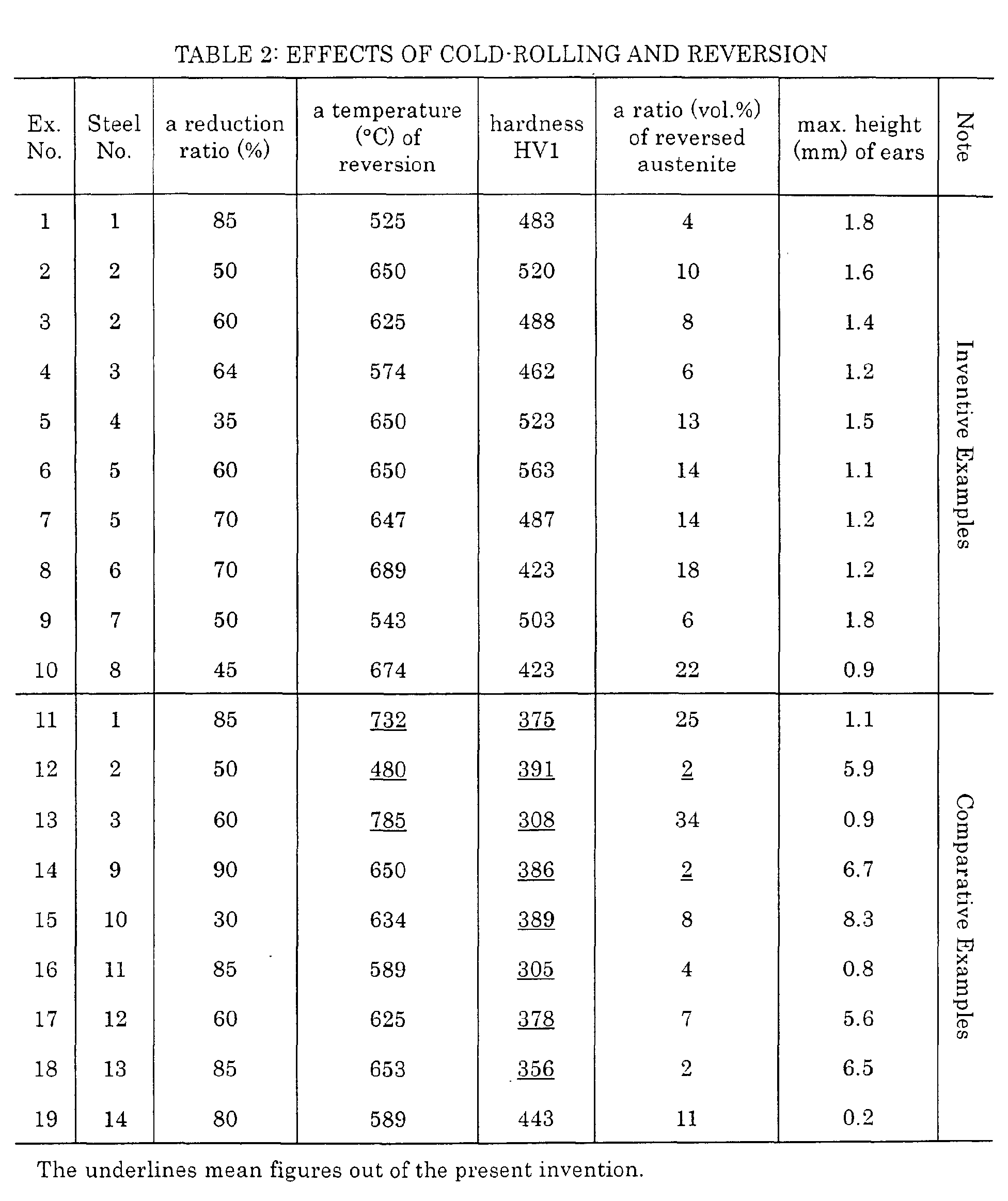
- Comparative Examples Nos. 11-13 are stainless steels having compositions in the range defined by the present invention. But, reversed austenite was not sufficiently generated in the steel of Example No. 12 , since a re-heating temperature was below 500°C. The steels of Example Nos. 11 and 13 had Vickers hardness below 400, since a re-heating temperature therefor was higher than 700°C.
- Comparative Examples Nos. 14-18 are stainless steel strips, which was poor of flatness at Vickers hardness of 400 or more due to compositions out of the range defined by the present invention. Especially, the steel of Example No. 15 was heavily deformed by re-transformation of reversed austenite to martensite during cooling due to a big Md(N) value above 125. The steel of Example No. 19 involved flaws, which originated in blowholes during steel making and casting steps, scattered on its surface due to excessive N content.
- Each steel strip was sized to a sheet of 200mm in width and 300mm in length by cutting off both edges with width of 10mm, and pressed with a press board at a pressure shown in Table 3 in order to further improve flatness of the steel sheet.
- the steel sheet was re-heated 600 seconds to induce reversion under the pressed condition. Effects of a load applied to the steel sheet were investigated in relation with flatness of the re-heated steel sheet. Results are shown in Table 3 , together with ratios of reversed austenite and averaged Vickers hardness (a load of 10kg).
- any steel of Example Nos. 1-6 had Vickers hardness of 400 or more in average and height of ears suppressed below 1.0mm due to application of the load during reversion.
- the relation of the applied load with the maximum height of ears proves that a shape of a steel sheet is effectively flattened by application of a load of 785Pa or more.
- an austenitic stainless steel strip excellent in flatness of shape with Vickers hardness of 400 or more is manufactured by properly controlling its composition and conditions for reversion so as to disperse reversed austenite in a matrix of deformation-induced martensite at a predetermined ratio.
- the proposed steel strip is also good of corrosion resistance. Due to such the excellent properties, the austenitic stainless steel is useful as various spring materials or high strength materials in a broad industrial field, e.g. press plates, stainless frames, plate springs, flapper valves, metal gaskets, wrapping carriers, carrier plates, stainless mirrors, damper springs, disk brakes, brake master keys, steel belts and metal masks.
Landscapes
- Chemical & Material Sciences (AREA)
- Engineering & Computer Science (AREA)
- Mechanical Engineering (AREA)
- Materials Engineering (AREA)
- Metallurgy (AREA)
- Organic Chemistry (AREA)
- Physics & Mathematics (AREA)
- Thermal Sciences (AREA)
- Crystallography & Structural Chemistry (AREA)
- Heat Treatment Of Sheet Steel (AREA)
- Heat Treatment Of Steel (AREA)
Abstract
Description
A value Md(N) defined by the formula of Md(N)=580-520C-2Si-16Mn-16Cr-23Ni-26Cu-300N-10Mo: 0-125


Claims (4)
- A high-strength austenitic stainless steel strip excellent in flatness of shape with Vickers hardness of 400 or more, which has the composition consisting of C up to 0.20 mass %, Si up to 4.0 mass %, Mn up to 5.0 mass %, 4.0-12.0 mass % Ni, 12.0-20.0 mass % Cr, Mo up to 5.0 mass %, N up to 0.15 mass % and the balance being Fe except inevitable impurities under the condition that a value Md(N) defined by the formula (1) is in a range of 0-125, and a dual-phase structure of austenite and martensite which involves reversion austenitic phase at a ratio more than 3 vol.%.
- The austenitic stainless steel strip defined in Claim 1, which further contains at least one or more of Cu up to 3.0 mass %, Ti up to 0.5 mass %, Nb up to 0.50 mass %, Al up to 0.2mass %, B up to 0.015 mass %, REM (rare earth metals) up to 0.2 mass %, Y up to 0.2 mass %, Ca up to 0.1 mass % and Mg up to 0.10 mass %.
- A method of manufacturing a high-strength austenitic stainless steel strip excellent in flatness of shape with Vickers hardness of 400 or more, which comprises the steps of:providing an austenitic stainless steel strip having compositions consisting of C up to 0.20 mass %, Si up to 4:0 mass %, Mn up to 5.0 mass %, 4.0-12.0 mass % Ni, 12.0-20.0 mass % Cr, Mo up to 5.0 mass %, N up to 0.15 mass %, optionally at least one or more of Cu up to 3.0 mass %, Ti up to 0.5 mass %, Nb up to 0.50 mass %, Al up to 0.2mass %, B up to 0.015 mass %, REM (rare earth metals) up to 0.2 mass %, Y up to 0.2 mass %, Ca up to 0.1 mass % and Mg up to 0.10 mass %, and the balance being Fe except inevitable impurities under the condition that a value Md(N) defined by the formula (1) is in a range of 0-125;solution-heating said austenitic stainless steel strip;cold-rolling said austenitic stainless steel strip to generate a deformation-induced martensite phase; andre-heating said cold-rolled austenitic stainless steel strip at 500-700°C to induce reversion, by which an austenitic phase is generated at a ratio of 3 vol.% or more in a matrix composed of said deformation-induced martensite phase.
- The method of manufacturing a high-strength austenitic stainless steel strip with Vickers hardness of 400 or more defined in Claim 3, wherein the austenitic stainless steel strip is re-heated in a state charged with a load of 785Pa or more.
Applications Claiming Priority (2)
| Application Number | Priority Date | Filing Date | Title |
|---|---|---|---|
| JP2000368534 | 2000-12-04 | ||
| JP2000368534A JP2002173742A (en) | 2000-12-04 | 2000-12-04 | High-strength austenitic stainless steel strip excellent in shape flatness and method for producing the same |
Publications (2)
| Publication Number | Publication Date |
|---|---|
| EP1215298A2 true EP1215298A2 (en) | 2002-06-19 |
| EP1215298A3 EP1215298A3 (en) | 2002-07-31 |
Family
ID=18838746
Family Applications (1)
| Application Number | Title | Priority Date | Filing Date |
|---|---|---|---|
| EP01121028A Withdrawn EP1215298A3 (en) | 2000-12-04 | 2001-08-31 | A high-strength austenitic stainless steel strip excellent in flatness of shape and its manufacturing method |
Country Status (6)
| Country | Link |
|---|---|
| US (1) | US6764555B2 (en) |
| EP (1) | EP1215298A3 (en) |
| JP (1) | JP2002173742A (en) |
| KR (1) | KR20020044047A (en) |
| CN (1) | CN1166805C (en) |
| TW (1) | TW555871B (en) |
Cited By (5)
| Publication number | Priority date | Publication date | Assignee | Title |
|---|---|---|---|---|
| WO2008087249A1 (en) * | 2007-01-17 | 2008-07-24 | Outokumpu Oyj | Method for manufacturing an austenitic steel object |
| EP1741799A4 (en) * | 2004-04-19 | 2009-04-01 | Hitachi Metals Ltd | AUSTENITIC CAST STEEL WITH HIGH HEAT-RESISTANT HEAT-RESISTANT CR-Ni CONTENT PRODUCED THEREFROM |
| US7767038B2 (en) * | 2007-07-18 | 2010-08-03 | Qingdao Samkyung Metals Co., Ltd. | Low-nickel austenitic stainless steel and method for producing same |
| DE102016109253A1 (en) * | 2016-05-19 | 2017-12-07 | Böhler Edelstahl GmbH & Co KG | Method for producing a steel material and steel material |
| WO2022108170A1 (en) * | 2020-11-23 | 2022-05-27 | 주식회사 포스코 | High-strength austenitic stainless steel having excellent hot workability |
Families Citing this family (68)
| Publication number | Priority date | Publication date | Assignee | Title |
|---|---|---|---|---|
| ES2250443T3 (en) * | 2000-08-01 | 2006-04-16 | Nisshin Steel Co., Ltd. | STAINLESS STEEL FUEL TANK FOR CAR. |
| DE10203711A1 (en) * | 2002-01-31 | 2003-08-14 | Sms Demag Ag | Process and plant for the production of hot strip from austenitic stainless steels |
| EP1621644B1 (en) * | 2003-04-28 | 2012-08-08 | JFE Steel Corporation | Martensitic stainless steel for disc brake |
| ES2395726T3 (en) * | 2003-10-20 | 2013-02-14 | Kubota Corporation | Heat-resistant cast steel for hydrogen production reaction tube is excellent in terms of ductility against aging and resistance to rupture due to plastic deformation |
| US8349086B2 (en) | 2004-07-30 | 2013-01-08 | United Technologies Corporation | Non-stick masking fixtures and methods of preparing same |
| US20060024140A1 (en) * | 2004-07-30 | 2006-02-02 | Wolff Edward C | Removable tap chasers and tap systems including the same |
| US7513320B2 (en) | 2004-12-16 | 2009-04-07 | Tdy Industries, Inc. | Cemented carbide inserts for earth-boring bits |
| US8637127B2 (en) | 2005-06-27 | 2014-01-28 | Kennametal Inc. | Composite article with coolant channels and tool fabrication method |
| US7687156B2 (en) | 2005-08-18 | 2010-03-30 | Tdy Industries, Inc. | Composite cutting inserts and methods of making the same |
| JP2009535536A (en) | 2006-04-27 | 2009-10-01 | ティーディーワイ・インダストリーズ・インコーポレーテッド | Modular fixed cutter boring bit, modular fixed cutter boring bit body and related method |
| WO2008013305A1 (en) * | 2006-07-28 | 2008-01-31 | Sumitomo Metal Industries, Ltd. | Stainless steel sheet for parts and process for manufacturing the same |
| WO2008051588A2 (en) | 2006-10-25 | 2008-05-02 | Tdy Industries, Inc. | Articles having improved resistance to thermal cracking |
| US8512882B2 (en) | 2007-02-19 | 2013-08-20 | TDY Industries, LLC | Carbide cutting insert |
| US7846551B2 (en) | 2007-03-16 | 2010-12-07 | Tdy Industries, Inc. | Composite articles |
| RU2414513C1 (en) * | 2007-04-05 | 2011-03-20 | Ниппон Стил Корпорейшн | Procedure for continuous annealing strip steel with curie peak and installation for continuous annealing such steel |
| US8865060B2 (en) | 2007-10-04 | 2014-10-21 | Nippon Steel & Sumitomo Metal Corporation | Austenitic stainless steel |
| CN102317489A (en) * | 2007-10-04 | 2012-01-11 | 住友金属工业株式会社 | Austenitic stainless steel |
| US20150010425A1 (en) | 2007-10-04 | 2015-01-08 | Nippon Steel & Sumitomo Metal Corporation | Austenitic stainless steel |
| AU2008330048B2 (en) * | 2007-11-29 | 2012-11-08 | Ati Properties Llc | Lean austenitic stainless steel |
| PL2229463T3 (en) | 2007-12-20 | 2018-01-31 | Ati Properties Llc | Corrosion resistant lean austenitic stainless steel |
| US8337749B2 (en) | 2007-12-20 | 2012-12-25 | Ati Properties, Inc. | Lean austenitic stainless steel |
| DK2245202T3 (en) * | 2007-12-20 | 2011-12-19 | Ati Properties Inc | Low nickel Austenitic stainless steel containing stabilizing elements |
| CN102112642B (en) | 2008-06-02 | 2013-11-06 | Tdy工业有限责任公司 | Cemented carbide-metallic alloy composites |
| US8790439B2 (en) | 2008-06-02 | 2014-07-29 | Kennametal Inc. | Composite sintered powder metal articles |
| US8322465B2 (en) | 2008-08-22 | 2012-12-04 | TDY Industries, LLC | Earth-boring bit parts including hybrid cemented carbides and methods of making the same |
| US8025112B2 (en) | 2008-08-22 | 2011-09-27 | Tdy Industries, Inc. | Earth-boring bits and other parts including cemented carbide |
| US8430075B2 (en) * | 2008-12-16 | 2013-04-30 | L.E. Jones Company | Superaustenitic stainless steel and method of making and use thereof |
| US8272816B2 (en) | 2009-05-12 | 2012-09-25 | TDY Industries, LLC | Composite cemented carbide rotary cutting tools and rotary cutting tool blanks |
| DE102009030489A1 (en) * | 2009-06-24 | 2010-12-30 | Thyssenkrupp Nirosta Gmbh | A method of producing a hot press hardened component, using a steel product for the manufacture of a hot press hardened component, and hot press hardened component |
| US8308096B2 (en) | 2009-07-14 | 2012-11-13 | TDY Industries, LLC | Reinforced roll and method of making same |
| US8440314B2 (en) | 2009-08-25 | 2013-05-14 | TDY Industries, LLC | Coated cutting tools having a platinum group metal concentration gradient and related processes |
| US9643236B2 (en) | 2009-11-11 | 2017-05-09 | Landis Solutions Llc | Thread rolling die and method of making same |
| US8479700B2 (en) * | 2010-01-05 | 2013-07-09 | L. E. Jones Company | Iron-chromium alloy with improved compressive yield strength and method of making and use thereof |
| CN102191441A (en) * | 2010-03-12 | 2011-09-21 | 泰州华泽金属工业有限公司 | Austenitic stainless steel for stainless steel wires of metal hose |
| CN102312171A (en) * | 2010-07-05 | 2012-01-11 | 内蒙古华业特钢股份有限公司 | Austenitic stainless steel containing rare-earth element |
| US8800848B2 (en) | 2011-08-31 | 2014-08-12 | Kennametal Inc. | Methods of forming wear resistant layers on metallic surfaces |
| US9016406B2 (en) | 2011-09-22 | 2015-04-28 | Kennametal Inc. | Cutting inserts for earth-boring bits |
| CN103667984A (en) * | 2013-11-08 | 2014-03-26 | 张超 | Chromium-nickel biphase stainless steel material for pump valves and preparation method thereof |
| CN104046922B (en) * | 2014-05-28 | 2016-05-04 | 无锡兴澄特种材料有限公司 | spring wire |
| JP6095619B2 (en) * | 2014-08-19 | 2017-03-15 | 日新製鋼株式会社 | Austenitic stainless steel sheet and metal gasket |
| JP6747639B2 (en) * | 2014-08-28 | 2020-09-02 | 国立大学法人豊橋技術科学大学 | Metal material and processing method |
| DE102014017274A1 (en) * | 2014-11-18 | 2016-05-19 | Salzgitter Flachstahl Gmbh | Highest strength air hardening multiphase steel with excellent processing properties and method of making a strip from this steel |
| KR101965524B1 (en) | 2015-03-06 | 2019-04-03 | 닛폰 스틸 앤드 스미킨 스테인레스 스틸 코포레이션 | High strength austenitic stainless steel excellent in hydrogen embrittlement resistance and manufacturing method thereof |
| US11149324B2 (en) | 2015-03-26 | 2021-10-19 | Nippon Steel Stainless Steel Corporation | High strength austenitic stainless steel having excellent resistance to hydrogen embrittlement, method for manufacturing the same, and hydrogen equipment used for high-pressure hydrogen gas and liquid hydrogen environment |
| CN105039868A (en) * | 2015-07-24 | 2015-11-11 | 苏州金业船用机械厂 | Stainless steel materials for ship propeller |
| CN106609336A (en) * | 2015-10-26 | 2017-05-03 | 威尔机械江苏有限公司 | Acid-resistant stainless steel and production method thereof |
| KR101783107B1 (en) * | 2015-11-19 | 2017-09-28 | 현대산업기계주식회사 | Steel and stainless steel with two phase structure of austenite and martensite |
| CN105483502A (en) * | 2015-12-03 | 2016-04-13 | 浙江腾龙精线有限公司 | Production method for spring wire |
| CN105598640A (en) * | 2015-12-28 | 2016-05-25 | 东台市江龙金属制造有限公司 | Method for processing high-hardness gasket |
| CN105414186A (en) * | 2015-12-28 | 2016-03-23 | 东台市江龙金属制造有限公司 | High-hardness steel plate machining method |
| JP6077693B1 (en) * | 2016-03-09 | 2017-02-08 | 日新製鋼株式会社 | Stainless steel for metal gasket |
| US20190127831A1 (en) * | 2016-03-15 | 2019-05-02 | Colorado State University Research Foundation | Corrosion-resistant alloy and applications |
| JP6222504B1 (en) | 2016-06-01 | 2017-11-01 | 株式会社特殊金属エクセル | Metastable austenitic stainless steel strip or steel plate and method for producing the same |
| CN106011635A (en) * | 2016-08-03 | 2016-10-12 | 苏州市虎丘区浒墅关弹簧厂 | Impact resistant compressive spring material |
| CN106222519A (en) * | 2016-08-15 | 2016-12-14 | 合肥万向钱潮汽车零部件有限公司 | The brake component of automotive brake |
| JP6748375B2 (en) | 2016-10-19 | 2020-09-02 | Jfeスチール株式会社 | Descaling method for Si-containing hot rolled steel sheet |
| CN107083519A (en) * | 2017-02-22 | 2017-08-22 | 广东鑫发精密金属科技有限公司 | A kind of stainless steel cold-rolled precision spring steel strip and its preparation method |
| KR20190066734A (en) | 2017-12-06 | 2019-06-14 | 주식회사 포스코 | High hardness austenitic stainless steel with excellent corrosion resistance |
| WO2019176073A1 (en) * | 2018-03-15 | 2019-09-19 | 日新製鋼株式会社 | Stainless steel material for use in diffusion bonding jigs |
| CN109457193A (en) * | 2018-11-16 | 2019-03-12 | 襄阳五二五泵业有限公司 | A kind of wear-resisting two phase stainless steel |
| JP6560427B1 (en) * | 2018-11-29 | 2019-08-14 | 株式会社特殊金属エクセル | Stainless steel strip or stainless steel foil and method for producing the same |
| CN111375875A (en) * | 2020-04-24 | 2020-07-07 | 河海大学常州校区 | Duplex stainless steel overlaying layer and preparation method thereof |
| CN111593277A (en) * | 2020-05-09 | 2020-08-28 | 张家港广大特材股份有限公司 | Austenitic stainless steel and preparation method thereof |
| CN111575464B (en) * | 2020-05-29 | 2022-04-08 | 青岛丰东热处理有限公司 | A method for improving the surface hardening layer of austenitic stainless steel |
| CN113088669B (en) * | 2021-04-01 | 2022-12-27 | 山西太钢不锈钢股份有限公司 | Method for improving surface hardness of semi-austenite precipitation hardening stainless steel precision strip steel |
| CN113667889A (en) * | 2021-07-16 | 2021-11-19 | 河钢股份有限公司承德分公司 | High-strength wear-resistant corrosion-resistant sink roller and production method thereof |
| CN114622144A (en) * | 2022-04-15 | 2022-06-14 | 威海多特瑞自动化设备有限公司 | Corrosion-resistant integrally-formed vortex shedding flowmeter shell material and processing technology thereof |
| CN115161454B (en) * | 2022-07-20 | 2023-07-21 | 山西太钢不锈钢精密带钢有限公司 | A kind of production method of hard austenitic stainless precision strip steel |
Family Cites Families (6)
| Publication number | Priority date | Publication date | Assignee | Title |
|---|---|---|---|---|
| JPS61295356A (en) * | 1985-06-24 | 1986-12-26 | Nisshin Steel Co Ltd | High strength stainless steel |
| JPH04154921A (en) * | 1990-10-16 | 1992-05-27 | Nisshin Steel Co Ltd | Manufacture of high strength stainless steel strip having excellent shape |
| US5269856A (en) * | 1990-10-16 | 1993-12-14 | Nisshin Steel Co., Ltd. | Process for producing high strength endless steel belt having a duplex structure of austenite and martesite |
| BR9200797A (en) * | 1992-02-27 | 1993-06-15 | Acos Villares Sa | ENROLLED STAINLESS STEEL FOR SPRINGS |
| US5494537A (en) * | 1994-02-21 | 1996-02-27 | Nisshin Steel Co. Ltd. | High strength and toughness stainless steel strip and process for the production of the same |
| JP2000239800A (en) * | 1999-02-23 | 2000-09-05 | Nisshin Steel Co Ltd | High strength metastable austenitic stainless steel sheet for blade having high elasticity and its production |
-
2000
- 2000-12-04 JP JP2000368534A patent/JP2002173742A/en not_active Withdrawn
-
2001
- 2001-08-31 EP EP01121028A patent/EP1215298A3/en not_active Withdrawn
- 2001-09-19 KR KR1020010057877A patent/KR20020044047A/en not_active Ceased
- 2001-10-09 CN CNB01136307XA patent/CN1166805C/en not_active Expired - Fee Related
- 2001-10-12 TW TW090125210A patent/TW555871B/en not_active IP Right Cessation
- 2001-12-03 US US10/004,919 patent/US6764555B2/en not_active Expired - Fee Related
Cited By (6)
| Publication number | Priority date | Publication date | Assignee | Title |
|---|---|---|---|---|
| EP1741799A4 (en) * | 2004-04-19 | 2009-04-01 | Hitachi Metals Ltd | AUSTENITIC CAST STEEL WITH HIGH HEAT-RESISTANT HEAT-RESISTANT CR-Ni CONTENT PRODUCED THEREFROM |
| US8241558B2 (en) | 2004-04-19 | 2012-08-14 | Hitachi Metals, Ltd. | High-Cr, high-Ni, heat-resistant, austenitic cast steel and exhaust equipment members formed thereby |
| WO2008087249A1 (en) * | 2007-01-17 | 2008-07-24 | Outokumpu Oyj | Method for manufacturing an austenitic steel object |
| US7767038B2 (en) * | 2007-07-18 | 2010-08-03 | Qingdao Samkyung Metals Co., Ltd. | Low-nickel austenitic stainless steel and method for producing same |
| DE102016109253A1 (en) * | 2016-05-19 | 2017-12-07 | Böhler Edelstahl GmbH & Co KG | Method for producing a steel material and steel material |
| WO2022108170A1 (en) * | 2020-11-23 | 2022-05-27 | 주식회사 포스코 | High-strength austenitic stainless steel having excellent hot workability |
Also Published As
| Publication number | Publication date |
|---|---|
| TW555871B (en) | 2003-10-01 |
| KR20020044047A (en) | 2002-06-14 |
| CN1357646A (en) | 2002-07-10 |
| US6764555B2 (en) | 2004-07-20 |
| JP2002173742A (en) | 2002-06-21 |
| US20020102178A1 (en) | 2002-08-01 |
| CN1166805C (en) | 2004-09-15 |
| EP1215298A3 (en) | 2002-07-31 |
Similar Documents
| Publication | Publication Date | Title |
|---|---|---|
| US6764555B2 (en) | High-strength austenitic stainless steel strip having excellent flatness and method of manufacturing same | |
| JP3857939B2 (en) | High strength and high ductility steel and steel plate excellent in local ductility and method for producing the steel plate | |
| CN109266955B (en) | High strength cold rolled steel sheet | |
| JP7150990B2 (en) | Austenitic stainless steel strip or austenitic stainless steel sheet and method for producing the same | |
| JP4252893B2 (en) | Duplex stainless steel strip for steel belt | |
| KR20150000892A (en) | High strength cold rolled steel sheet and method of producing such steel sheet | |
| KR20140041930A (en) | Hot-rolled steel sheet having excellent cold working properties and hardening properties, and method for producing same | |
| JP2022069229A (en) | Austenitic stainless steel and its manufacturing method | |
| JP2010215953A (en) | Austenitic stainless steel and method for producing austenitic stainless steel sheet | |
| JP2003193202A (en) | High elasticity metastable austenitic stainless steel sheet and production method therefor | |
| WO2011093516A1 (en) | Highly corrosion-resistant hot-rolled ferrite stainless steel sheet having excellent toughness | |
| JP4644075B2 (en) | High-strength steel sheet with excellent hole expansibility and manufacturing method thereof | |
| JPH08337843A (en) | High carbon hot rolled steel sheet excellent in punching workability and its production | |
| JP3470660B2 (en) | Chromium stainless steel material for spring and multi-layered structure for spring and method for producing the same | |
| JPH06316736A (en) | Ni-Fe based magnetic alloy excellent in magnetic properties and manufacturability and method for producing the same | |
| JP2003073783A (en) | Precipitation-hardening type martensitic stainless steel sheet for flapper valve, and manufacturing method therefor | |
| JPH0625379B2 (en) | Manufacturing method of high carbon cold rolled steel sheet with excellent toughness after heat treatment | |
| JP4852804B2 (en) | Non-oriented electrical steel sheet | |
| JP3230587B2 (en) | A high-strength stainless cold-rolled steel strip having excellent formability and fatigue properties and exhibiting high strength by aging treatment, and a method for producing the same. | |
| JP3670232B2 (en) | Austenitic stainless steel sheet with excellent precision punchability | |
| JP2000129400A (en) | Annealed martensitic stainless steel excellent in strength, toughness, and spring characteristic | |
| EP0676482A1 (en) | Low decarburization spring steel | |
| JPH0475305B2 (en) | ||
| JPH06271935A (en) | Manufacturing method of high carbon cold rolled steel sheet with small anisotropy | |
| JPH0874006A (en) | Precipitation hardening type stainless steel excellent in strength and twisting property |
Legal Events
| Date | Code | Title | Description |
|---|---|---|---|
| PUAI | Public reference made under article 153(3) epc to a published international application that has entered the european phase |
Free format text: ORIGINAL CODE: 0009012 |
|
| PUAL | Search report despatched |
Free format text: ORIGINAL CODE: 0009013 |
|
| AK | Designated contracting states |
Kind code of ref document: A2 Designated state(s): AT BE CH CY DE DK ES FI FR GB GR IE IT LI LU MC NL PT SE TR |
|
| AX | Request for extension of the european patent |
Free format text: AL;LT;LV;MK;RO;SI |
|
| AK | Designated contracting states |
Kind code of ref document: A3 Designated state(s): AT BE CH CY DE DK ES FI FR GB GR IE IT LI LU MC NL PT SE TR |
|
| AX | Request for extension of the european patent |
Free format text: AL;LT;LV;MK;RO;SI |
|
| 17P | Request for examination filed |
Effective date: 20020829 |
|
| AKX | Designation fees paid |
Designated state(s): AT DE ES GB SE |
|
| 17Q | First examination report despatched |
Effective date: 20031023 |
|
| STAA | Information on the status of an ep patent application or granted ep patent |
Free format text: STATUS: THE APPLICATION IS DEEMED TO BE WITHDRAWN |
|
| 18D | Application deemed to be withdrawn |
Effective date: 20040303 |