EP1215232B1 - Gummiprodukt, wie ein Reifen, der ein Eisensalz einer aromatischen Carbonsäure als Antioxydant enthält und dessen Herstellungverfahren - Google Patents
Gummiprodukt, wie ein Reifen, der ein Eisensalz einer aromatischen Carbonsäure als Antioxydant enthält und dessen Herstellungverfahren Download PDFInfo
- Publication number
- EP1215232B1 EP1215232B1 EP01127184A EP01127184A EP1215232B1 EP 1215232 B1 EP1215232 B1 EP 1215232B1 EP 01127184 A EP01127184 A EP 01127184A EP 01127184 A EP01127184 A EP 01127184A EP 1215232 B1 EP1215232 B1 EP 1215232B1
- Authority
- EP
- European Patent Office
- Prior art keywords
- acid
- rubber
- composition
- iron
- iii
- Prior art date
- Legal status (The legal status is an assumption and is not a legal conclusion. Google has not performed a legal analysis and makes no representation as to the accuracy of the status listed.)
- Expired - Lifetime
Links
- 229920001971 elastomer Polymers 0.000 title claims abstract description 56
- 239000005060 rubber Substances 0.000 title claims abstract description 35
- 125000003118 aryl group Chemical group 0.000 title claims abstract description 7
- 150000002505 iron Chemical class 0.000 title 1
- 238000004519 manufacturing process Methods 0.000 title 1
- 238000007254 oxidation reaction Methods 0.000 claims abstract description 26
- QVGXLLKOCUKJST-UHFFFAOYSA-N atomic oxygen Chemical compound [O] QVGXLLKOCUKJST-UHFFFAOYSA-N 0.000 claims abstract description 23
- 229910052760 oxygen Inorganic materials 0.000 claims abstract description 23
- 239000001301 oxygen Substances 0.000 claims abstract description 23
- 230000003647 oxidation Effects 0.000 claims abstract description 22
- 239000000806 elastomer Substances 0.000 claims abstract description 21
- 150000003839 salts Chemical class 0.000 claims abstract description 20
- -1 aromatic monocarboxylic acid Chemical class 0.000 claims abstract description 7
- 125000000217 alkyl group Chemical group 0.000 claims abstract description 5
- 125000003545 alkoxy group Chemical group 0.000 claims abstract description 3
- 239000000203 mixture Substances 0.000 claims description 120
- XEEYBQQBJWHFJM-UHFFFAOYSA-N Iron Chemical compound [Fe] XEEYBQQBJWHFJM-UHFFFAOYSA-N 0.000 claims description 34
- VTLYFUHAOXGGBS-UHFFFAOYSA-N Fe3+ Chemical class [Fe+3] VTLYFUHAOXGGBS-UHFFFAOYSA-N 0.000 claims description 28
- 239000002253 acid Substances 0.000 claims description 27
- 229910052742 iron Inorganic materials 0.000 claims description 16
- 238000000034 method Methods 0.000 claims description 12
- WPYMKLBDIGXBTP-UHFFFAOYSA-N benzoic acid Chemical compound OC(=O)C1=CC=CC=C1 WPYMKLBDIGXBTP-UHFFFAOYSA-N 0.000 claims description 10
- GPSDUZXPYCFOSQ-UHFFFAOYSA-N m-toluic acid Chemical compound CC1=CC=CC(C(O)=O)=C1 GPSDUZXPYCFOSQ-UHFFFAOYSA-N 0.000 claims description 10
- 230000008569 process Effects 0.000 claims description 8
- 239000011324 bead Substances 0.000 claims description 7
- JFKUBRAOUZEZSL-UHFFFAOYSA-N 4-butylbenzoic acid Chemical compound CCCCC1=CC=C(C(O)=O)C=C1 JFKUBRAOUZEZSL-UHFFFAOYSA-N 0.000 claims description 6
- ADCUEPOHPCPMCE-UHFFFAOYSA-N 4-cyanobenzoic acid Chemical compound OC(=O)C1=CC=C(C#N)C=C1 ADCUEPOHPCPMCE-UHFFFAOYSA-N 0.000 claims description 6
- 125000004432 carbon atom Chemical group C* 0.000 claims description 6
- LPNBBFKOUUSUDB-UHFFFAOYSA-N p-toluic acid Chemical compound CC1=CC=C(C(O)=O)C=C1 LPNBBFKOUUSUDB-UHFFFAOYSA-N 0.000 claims description 5
- 230000003014 reinforcing effect Effects 0.000 claims description 5
- 238000005096 rolling process Methods 0.000 claims description 5
- LNETULKMXZVUST-UHFFFAOYSA-N 1-naphthoic acid Chemical compound C1=CC=C2C(C(=O)O)=CC=CC2=C1 LNETULKMXZVUST-UHFFFAOYSA-N 0.000 claims description 4
- ZEYHEAKUIGZSGI-UHFFFAOYSA-N 4-methoxybenzoic acid Chemical compound COC1=CC=C(C(O)=O)C=C1 ZEYHEAKUIGZSGI-UHFFFAOYSA-N 0.000 claims description 4
- 239000000945 filler Substances 0.000 claims description 4
- ZWLPBLYKEWSWPD-UHFFFAOYSA-N o-toluic acid Chemical compound CC1=CC=CC=C1C(O)=O ZWLPBLYKEWSWPD-UHFFFAOYSA-N 0.000 claims description 4
- 125000004093 cyano group Chemical group *C#N 0.000 claims description 3
- DTNSDCJFTHMDAK-UHFFFAOYSA-N 2-cyanobenzoic acid Chemical compound OC(=O)C1=CC=CC=C1C#N DTNSDCJFTHMDAK-UHFFFAOYSA-N 0.000 claims description 2
- 239000005711 Benzoic acid Substances 0.000 claims description 2
- 235000010233 benzoic acid Nutrition 0.000 claims description 2
- 125000004435 hydrogen atom Chemical group [H]* 0.000 claims description 2
- PMVSDNDAUGGCCE-TYYBGVCCSA-L Ferrous fumarate Chemical compound [Fe+2].[O-]C(=O)\C=C\C([O-])=O PMVSDNDAUGGCCE-TYYBGVCCSA-L 0.000 claims 1
- 239000012763 reinforcing filler Substances 0.000 claims 1
- 239000012190 activator Substances 0.000 abstract description 6
- 125000003178 carboxy group Chemical group [H]OC(*)=O 0.000 abstract 1
- 125000001997 phenyl group Chemical group [H]C1=C([H])C([H])=C(*)C([H])=C1[H] 0.000 abstract 1
- 239000000047 product Substances 0.000 description 16
- KAKZBPTYRLMSJV-UHFFFAOYSA-N Butadiene Chemical compound C=CC=C KAKZBPTYRLMSJV-UHFFFAOYSA-N 0.000 description 11
- PPBRXRYQALVLMV-UHFFFAOYSA-N Styrene Chemical compound C=CC1=CC=CC=C1 PPBRXRYQALVLMV-UHFFFAOYSA-N 0.000 description 10
- 239000003795 chemical substances by application Substances 0.000 description 8
- 229910017052 cobalt Inorganic materials 0.000 description 7
- 239000010941 cobalt Substances 0.000 description 7
- GUTLYIVDDKVIGB-UHFFFAOYSA-N cobalt atom Chemical compound [Co] GUTLYIVDDKVIGB-UHFFFAOYSA-N 0.000 description 7
- XLOMVQKBTHCTTD-UHFFFAOYSA-N Zinc monoxide Chemical compound [Zn]=O XLOMVQKBTHCTTD-UHFFFAOYSA-N 0.000 description 6
- 229910052751 metal Inorganic materials 0.000 description 6
- 239000002184 metal Substances 0.000 description 6
- 229920001577 copolymer Polymers 0.000 description 5
- CMAUJSNXENPPOF-UHFFFAOYSA-N n-(1,3-benzothiazol-2-ylsulfanyl)-n-cyclohexylcyclohexanamine Chemical compound C1CCCCC1N(C1CCCCC1)SC1=NC2=CC=CC=C2S1 CMAUJSNXENPPOF-UHFFFAOYSA-N 0.000 description 5
- RRHGJUQNOFWUDK-UHFFFAOYSA-N Isoprene Chemical compound CC(=C)C=C RRHGJUQNOFWUDK-UHFFFAOYSA-N 0.000 description 4
- VYPSYNLAJGMNEJ-UHFFFAOYSA-N Silicium dioxide Chemical compound O=[Si]=O VYPSYNLAJGMNEJ-UHFFFAOYSA-N 0.000 description 4
- 230000032683 aging Effects 0.000 description 4
- 150000001993 dienes Chemical class 0.000 description 4
- QIQXTHQIDYTFRH-UHFFFAOYSA-N octadecanoic acid Chemical compound CCCCCCCCCCCCCCCCCC(O)=O QIQXTHQIDYTFRH-UHFFFAOYSA-N 0.000 description 4
- 229920003051 synthetic elastomer Polymers 0.000 description 4
- 239000005061 synthetic rubber Substances 0.000 description 4
- XLYOFNOQVPJJNP-UHFFFAOYSA-N water Substances O XLYOFNOQVPJJNP-UHFFFAOYSA-N 0.000 description 4
- 235000021355 Stearic acid Nutrition 0.000 description 3
- 229920005549 butyl rubber Polymers 0.000 description 3
- 150000001868 cobalt Chemical class 0.000 description 3
- FJDJVBXSSLDNJB-LNTINUHCSA-N cobalt;(z)-4-hydroxypent-3-en-2-one Chemical compound [Co].C\C(O)=C\C(C)=O.C\C(O)=C\C(C)=O.C\C(O)=C\C(C)=O FJDJVBXSSLDNJB-LNTINUHCSA-N 0.000 description 3
- OQCDKBAXFALNLD-UHFFFAOYSA-N octadecanoic acid Natural products CCCCCCCC(C)CCCCCCCCC(O)=O OQCDKBAXFALNLD-UHFFFAOYSA-N 0.000 description 3
- 239000008117 stearic acid Substances 0.000 description 3
- 229920002554 vinyl polymer Polymers 0.000 description 3
- 238000004073 vulcanization Methods 0.000 description 3
- 239000011787 zinc oxide Substances 0.000 description 3
- MYRTYDVEIRVNKP-UHFFFAOYSA-N 1,2-Divinylbenzene Chemical compound C=CC1=CC=CC=C1C=C MYRTYDVEIRVNKP-UHFFFAOYSA-N 0.000 description 2
- QTBSBXVTEAMEQO-UHFFFAOYSA-M Acetate Chemical compound CC([O-])=O QTBSBXVTEAMEQO-UHFFFAOYSA-M 0.000 description 2
- 244000043261 Hevea brasiliensis Species 0.000 description 2
- CDBYLPFSWZWCQE-UHFFFAOYSA-L Sodium Carbonate Chemical compound [Na+].[Na+].[O-]C([O-])=O CDBYLPFSWZWCQE-UHFFFAOYSA-L 0.000 description 2
- FAPWRFPIFSIZLT-UHFFFAOYSA-M Sodium chloride Chemical compound [Na+].[Cl-] FAPWRFPIFSIZLT-UHFFFAOYSA-M 0.000 description 2
- NINIDFKCEFEMDL-UHFFFAOYSA-N Sulfur Chemical compound [S] NINIDFKCEFEMDL-UHFFFAOYSA-N 0.000 description 2
- 230000003213 activating effect Effects 0.000 description 2
- 125000004429 atom Chemical group 0.000 description 2
- 230000015572 biosynthetic process Effects 0.000 description 2
- 239000006229 carbon black Substances 0.000 description 2
- 150000001869 cobalt compounds Chemical class 0.000 description 2
- 229920003244 diene elastomer Polymers 0.000 description 2
- 230000000694 effects Effects 0.000 description 2
- 230000009477 glass transition Effects 0.000 description 2
- 238000010438 heat treatment Methods 0.000 description 2
- 150000002506 iron compounds Chemical class 0.000 description 2
- AQBLLJNPHDIAPN-LNTINUHCSA-K iron(3+);(z)-4-oxopent-2-en-2-olate Chemical compound [Fe+3].C\C([O-])=C\C(C)=O.C\C([O-])=C\C(C)=O.C\C([O-])=C\C(C)=O AQBLLJNPHDIAPN-LNTINUHCSA-K 0.000 description 2
- 239000000463 material Substances 0.000 description 2
- 238000005259 measurement Methods 0.000 description 2
- 229920003052 natural elastomer Polymers 0.000 description 2
- 229920001194 natural rubber Polymers 0.000 description 2
- 230000001590 oxidative effect Effects 0.000 description 2
- 229920002857 polybutadiene Polymers 0.000 description 2
- 229920001195 polyisoprene Polymers 0.000 description 2
- 229920000642 polymer Polymers 0.000 description 2
- 238000006116 polymerization reaction Methods 0.000 description 2
- 230000003244 pro-oxidative effect Effects 0.000 description 2
- 230000002787 reinforcement Effects 0.000 description 2
- 239000011347 resin Substances 0.000 description 2
- 229920005989 resin Polymers 0.000 description 2
- 239000000377 silicon dioxide Substances 0.000 description 2
- 230000035882 stress Effects 0.000 description 2
- 229910052717 sulfur Inorganic materials 0.000 description 2
- 239000011593 sulfur Substances 0.000 description 2
- PMJHHCWVYXUKFD-SNAWJCMRSA-N (E)-1,3-pentadiene Chemical compound C\C=C\C=C PMJHHCWVYXUKFD-SNAWJCMRSA-N 0.000 description 1
- HYZQBNDRDQEWAN-LNTINUHCSA-N (z)-4-hydroxypent-3-en-2-one;manganese(3+) Chemical compound [Mn+3].C\C(O)=C\C(C)=O.C\C(O)=C\C(C)=O.C\C(O)=C\C(C)=O HYZQBNDRDQEWAN-LNTINUHCSA-N 0.000 description 1
- POILWHVDKZOXJZ-ARJAWSKDSA-M (z)-4-oxopent-2-en-2-olate Chemical compound C\C([O-])=C\C(C)=O POILWHVDKZOXJZ-ARJAWSKDSA-M 0.000 description 1
- IGGDKDTUCAWDAN-UHFFFAOYSA-N 1-vinylnaphthalene Chemical compound C1=CC=C2C(C=C)=CC=CC2=C1 IGGDKDTUCAWDAN-UHFFFAOYSA-N 0.000 description 1
- HMWCQCYUKQZPRA-UHFFFAOYSA-N 2,4-dimethyl-3-methylidenepent-1-ene Chemical compound CC(C)C(=C)C(C)=C HMWCQCYUKQZPRA-UHFFFAOYSA-N 0.000 description 1
- RYPKRALMXUUNKS-UHFFFAOYSA-N 2-Hexene Natural products CCCC=CC RYPKRALMXUUNKS-UHFFFAOYSA-N 0.000 description 1
- SBYMUDUGTIKLCR-UHFFFAOYSA-N 2-chloroethenylbenzene Chemical class ClC=CC1=CC=CC=C1 SBYMUDUGTIKLCR-UHFFFAOYSA-N 0.000 description 1
- PDELBHCVXBSVPJ-UHFFFAOYSA-N 2-ethenyl-1,3,5-trimethylbenzene Chemical group CC1=CC(C)=C(C=C)C(C)=C1 PDELBHCVXBSVPJ-UHFFFAOYSA-N 0.000 description 1
- CTHJQRHPNQEPAB-UHFFFAOYSA-N 2-methoxyethenylbenzene Chemical class COC=CC1=CC=CC=C1 CTHJQRHPNQEPAB-UHFFFAOYSA-N 0.000 description 1
- PJXJBPMWCKMWLS-UHFFFAOYSA-N 2-methyl-3-methylidenepent-1-ene Chemical compound CCC(=C)C(C)=C PJXJBPMWCKMWLS-UHFFFAOYSA-N 0.000 description 1
- UOBYKYZJUGYBDK-UHFFFAOYSA-N 2-naphthoic acid Chemical compound C1=CC=CC2=CC(C(=O)O)=CC=C21 UOBYKYZJUGYBDK-UHFFFAOYSA-N 0.000 description 1
- OAOZZYBUAWEDRA-UHFFFAOYSA-N 3,4-dimethylidenehexane Chemical compound CCC(=C)C(=C)CC OAOZZYBUAWEDRA-UHFFFAOYSA-N 0.000 description 1
- JLBJTVDPSNHSKJ-UHFFFAOYSA-N 4-Methylstyrene Chemical compound CC1=CC=C(C=C)C=C1 JLBJTVDPSNHSKJ-UHFFFAOYSA-N 0.000 description 1
- CNQBZQXTLOUSKU-UHFFFAOYSA-K 4-butylbenzoate;iron(3+) Chemical compound [Fe+3].CCCCC1=CC=C(C([O-])=O)C=C1.CCCCC1=CC=C(C([O-])=O)C=C1.CCCCC1=CC=C(C([O-])=O)C=C1 CNQBZQXTLOUSKU-UHFFFAOYSA-K 0.000 description 1
- IGFBFDKYZFAXQW-UHFFFAOYSA-K 4-cyanobenzoate;iron(3+) Chemical compound [Fe+3].[O-]C(=O)C1=CC=C(C#N)C=C1.[O-]C(=O)C1=CC=C(C#N)C=C1.[O-]C(=O)C1=CC=C(C#N)C=C1 IGFBFDKYZFAXQW-UHFFFAOYSA-K 0.000 description 1
- 206010001488 Aggression Diseases 0.000 description 1
- BVKZGUZCCUSVTD-UHFFFAOYSA-L Carbonate Chemical compound [O-]C([O-])=O BVKZGUZCCUSVTD-UHFFFAOYSA-L 0.000 description 1
- JPVYNHNXODAKFH-UHFFFAOYSA-N Cu2+ Chemical class [Cu+2] JPVYNHNXODAKFH-UHFFFAOYSA-N 0.000 description 1
- 229920002943 EPDM rubber Polymers 0.000 description 1
- PWHULOQIROXLJO-UHFFFAOYSA-N Manganese Chemical compound [Mn] PWHULOQIROXLJO-UHFFFAOYSA-N 0.000 description 1
- 239000005062 Polybutadiene Substances 0.000 description 1
- 229920002367 Polyisobutene Polymers 0.000 description 1
- 239000002174 Styrene-butadiene Substances 0.000 description 1
- UCKMPCXJQFINFW-UHFFFAOYSA-N Sulphide Chemical compound [S-2] UCKMPCXJQFINFW-UHFFFAOYSA-N 0.000 description 1
- 230000004308 accommodation Effects 0.000 description 1
- XECAHXYUAAWDEL-UHFFFAOYSA-N acrylonitrile butadiene styrene Chemical compound C=CC=C.C=CC#N.C=CC1=CC=CC=C1 XECAHXYUAAWDEL-UHFFFAOYSA-N 0.000 description 1
- 229920000122 acrylonitrile butadiene styrene Polymers 0.000 description 1
- 239000004676 acrylonitrile butadiene styrene Substances 0.000 description 1
- 239000000654 additive Substances 0.000 description 1
- 239000002318 adhesion promoter Substances 0.000 description 1
- 230000016571 aggressive behavior Effects 0.000 description 1
- 230000003712 anti-aging effect Effects 0.000 description 1
- 239000003963 antioxidant agent Substances 0.000 description 1
- 150000001491 aromatic compounds Chemical class 0.000 description 1
- 230000006399 behavior Effects 0.000 description 1
- 230000009286 beneficial effect Effects 0.000 description 1
- 239000011230 binding agent Substances 0.000 description 1
- MTAZNLWOLGHBHU-UHFFFAOYSA-N butadiene-styrene rubber Chemical compound C=CC=C.C=CC1=CC=CC=C1 MTAZNLWOLGHBHU-UHFFFAOYSA-N 0.000 description 1
- 150000001732 carboxylic acid derivatives Chemical class 0.000 description 1
- 150000001735 carboxylic acids Chemical class 0.000 description 1
- VZDYWEUILIUIDF-UHFFFAOYSA-J cerium(4+);disulfate Chemical compound [Ce+4].[O-]S([O-])(=O)=O.[O-]S([O-])(=O)=O VZDYWEUILIUIDF-UHFFFAOYSA-J 0.000 description 1
- 230000001055 chewing effect Effects 0.000 description 1
- 239000011651 chromium Substances 0.000 description 1
- BFGKITSFLPAWGI-UHFFFAOYSA-N chromium(3+) Chemical class [Cr+3] BFGKITSFLPAWGI-UHFFFAOYSA-N 0.000 description 1
- XEHUIDSUOAGHBW-UHFFFAOYSA-N chromium;pentane-2,4-dione Chemical compound [Cr].CC(=O)CC(C)=O.CC(=O)CC(C)=O.CC(=O)CC(C)=O XEHUIDSUOAGHBW-UHFFFAOYSA-N 0.000 description 1
- 238000007334 copolymerization reaction Methods 0.000 description 1
- ZKXWKVVCCTZOLD-FDGPNNRMSA-N copper;(z)-4-hydroxypent-3-en-2-one Chemical compound [Cu].C\C(O)=C\C(C)=O.C\C(O)=C\C(C)=O ZKXWKVVCCTZOLD-FDGPNNRMSA-N 0.000 description 1
- 230000008878 coupling Effects 0.000 description 1
- 238000010168 coupling process Methods 0.000 description 1
- 238000005859 coupling reaction Methods 0.000 description 1
- 238000000354 decomposition reaction Methods 0.000 description 1
- 125000002897 diene group Chemical group 0.000 description 1
- 238000009792 diffusion process Methods 0.000 description 1
- 239000006185 dispersion Substances 0.000 description 1
- 230000001747 exhibiting effect Effects 0.000 description 1
- 239000000446 fuel Substances 0.000 description 1
- DPUXQWOMYBMHRN-UHFFFAOYSA-N hexa-2,3-diene Chemical compound CCC=C=CC DPUXQWOMYBMHRN-UHFFFAOYSA-N 0.000 description 1
- 229920001519 homopolymer Polymers 0.000 description 1
- 150000002432 hydroperoxides Chemical group 0.000 description 1
- XLYOFNOQVPJJNP-UHFFFAOYSA-M hydroxide Chemical compound [OH-] XLYOFNOQVPJJNP-UHFFFAOYSA-M 0.000 description 1
- 230000006872 improvement Effects 0.000 description 1
- DTXSLEDEJQHEBE-UHFFFAOYSA-K iron(3+);4-methoxybenzoate Chemical compound [Fe+3].COC1=CC=C(C([O-])=O)C=C1.COC1=CC=C(C([O-])=O)C=C1.COC1=CC=C(C([O-])=O)C=C1 DTXSLEDEJQHEBE-UHFFFAOYSA-K 0.000 description 1
- BQBNGAZVJRNEAQ-UHFFFAOYSA-K iron(3+);naphthalene-1-carboxylate Chemical compound [Fe+3].C1=CC=C2C(C(=O)[O-])=CC=CC2=C1.C1=CC=C2C(C(=O)[O-])=CC=CC2=C1.C1=CC=C2C(C(=O)[O-])=CC=CC2=C1 BQBNGAZVJRNEAQ-UHFFFAOYSA-K 0.000 description 1
- HWXCZQWULOFPFN-UHFFFAOYSA-K iron(3+);naphthalene-2-carboxylate Chemical compound [Fe+3].C1=CC=CC2=CC(C(=O)[O-])=CC=C21.C1=CC=CC2=CC(C(=O)[O-])=CC=C21.C1=CC=CC2=CC(C(=O)[O-])=CC=C21 HWXCZQWULOFPFN-UHFFFAOYSA-K 0.000 description 1
- ITAUHKJMPRCVIH-UHFFFAOYSA-K iron(3+);tribenzoate Chemical compound [Fe+3].[O-]C(=O)C1=CC=CC=C1.[O-]C(=O)C1=CC=CC=C1.[O-]C(=O)C1=CC=CC=C1 ITAUHKJMPRCVIH-UHFFFAOYSA-K 0.000 description 1
- 150000002696 manganese Chemical class 0.000 description 1
- 229910052748 manganese Inorganic materials 0.000 description 1
- 239000011572 manganese Substances 0.000 description 1
- 235000006748 manganese carbonate Nutrition 0.000 description 1
- 239000011656 manganese carbonate Substances 0.000 description 1
- 229910000016 manganese(II) carbonate Inorganic materials 0.000 description 1
- XMWCXZJXESXBBY-UHFFFAOYSA-L manganese(ii) carbonate Chemical compound [Mn+2].[O-]C([O-])=O XMWCXZJXESXBBY-UHFFFAOYSA-L 0.000 description 1
- 150000002739 metals Chemical class 0.000 description 1
- 229910000476 molybdenum oxide Inorganic materials 0.000 description 1
- ZIKKVZAYJJZBGE-UHFFFAOYSA-N molybdenum(4+) Chemical class [Mo+4] ZIKKVZAYJJZBGE-UHFFFAOYSA-N 0.000 description 1
- 150000005673 monoalkenes Chemical class 0.000 description 1
- 239000000178 monomer Substances 0.000 description 1
- 239000003921 oil Substances 0.000 description 1
- 239000007800 oxidant agent Substances 0.000 description 1
- PQQKPALAQIIWST-UHFFFAOYSA-N oxomolybdenum Chemical compound [Mo]=O PQQKPALAQIIWST-UHFFFAOYSA-N 0.000 description 1
- 150000002978 peroxides Chemical class 0.000 description 1
- 239000000049 pigment Substances 0.000 description 1
- PMJHHCWVYXUKFD-UHFFFAOYSA-N piperylene Natural products CC=CC=C PMJHHCWVYXUKFD-UHFFFAOYSA-N 0.000 description 1
- 229920003192 poly(bis maleimide) Polymers 0.000 description 1
- 229920001084 poly(chloroprene) Polymers 0.000 description 1
- 239000000843 powder Substances 0.000 description 1
- 239000002244 precipitate Substances 0.000 description 1
- 238000004064 recycling Methods 0.000 description 1
- 230000009467 reduction Effects 0.000 description 1
- 230000002000 scavenging effect Effects 0.000 description 1
- 230000035939 shock Effects 0.000 description 1
- 239000011780 sodium chloride Substances 0.000 description 1
- 238000003756 stirring Methods 0.000 description 1
- 239000011115 styrene butadiene Substances 0.000 description 1
- 229920003048 styrene butadiene rubber Polymers 0.000 description 1
- 239000000725 suspension Substances 0.000 description 1
- 238000003786 synthesis reaction Methods 0.000 description 1
- 238000009864 tensile test Methods 0.000 description 1
- 239000004753 textile Substances 0.000 description 1
- YXFVVABEGXRONW-UHFFFAOYSA-N toluene Substances CC1=CC=CC=C1 YXFVVABEGXRONW-UHFFFAOYSA-N 0.000 description 1
- 229910052723 transition metal Inorganic materials 0.000 description 1
- 125000000391 vinyl group Chemical group [H]C([*])=C([H])[H] 0.000 description 1
- 239000001993 wax Substances 0.000 description 1
Classifications
-
- C—CHEMISTRY; METALLURGY
- C08—ORGANIC MACROMOLECULAR COMPOUNDS; THEIR PREPARATION OR CHEMICAL WORKING-UP; COMPOSITIONS BASED THEREON
- C08K—Use of inorganic or non-macromolecular organic substances as compounding ingredients
- C08K5/00—Use of organic ingredients
- C08K5/0008—Organic ingredients according to more than one of the "one dot" groups of C08K5/01 - C08K5/59
- C08K5/005—Stabilisers against oxidation, heat, light, ozone
-
- B—PERFORMING OPERATIONS; TRANSPORTING
- B60—VEHICLES IN GENERAL
- B60C—VEHICLE TYRES; TYRE INFLATION; TYRE CHANGING; CONNECTING VALVES TO INFLATABLE ELASTIC BODIES IN GENERAL; DEVICES OR ARRANGEMENTS RELATED TO TYRES
- B60C1/00—Tyres characterised by the chemical composition or the physical arrangement or mixture of the composition
-
- B—PERFORMING OPERATIONS; TRANSPORTING
- B60—VEHICLES IN GENERAL
- B60C—VEHICLE TYRES; TYRE INFLATION; TYRE CHANGING; CONNECTING VALVES TO INFLATABLE ELASTIC BODIES IN GENERAL; DEVICES OR ARRANGEMENTS RELATED TO TYRES
- B60C13/00—Tyre sidewalls; Protecting, decorating, marking, or the like, thereof
- B60C13/002—Protection against exterior elements
-
- C—CHEMISTRY; METALLURGY
- C08—ORGANIC MACROMOLECULAR COMPOUNDS; THEIR PREPARATION OR CHEMICAL WORKING-UP; COMPOSITIONS BASED THEREON
- C08K—Use of inorganic or non-macromolecular organic substances as compounding ingredients
- C08K5/00—Use of organic ingredients
- C08K5/04—Oxygen-containing compounds
- C08K5/09—Carboxylic acids; Metal salts thereof; Anhydrides thereof
- C08K5/098—Metal salts of carboxylic acids
-
- Y—GENERAL TAGGING OF NEW TECHNOLOGICAL DEVELOPMENTS; GENERAL TAGGING OF CROSS-SECTIONAL TECHNOLOGIES SPANNING OVER SEVERAL SECTIONS OF THE IPC; TECHNICAL SUBJECTS COVERED BY FORMER USPC CROSS-REFERENCE ART COLLECTIONS [XRACs] AND DIGESTS
- Y02—TECHNOLOGIES OR APPLICATIONS FOR MITIGATION OR ADAPTATION AGAINST CLIMATE CHANGE
- Y02T—CLIMATE CHANGE MITIGATION TECHNOLOGIES RELATED TO TRANSPORTATION
- Y02T10/00—Road transport of goods or passengers
- Y02T10/80—Technologies aiming to reduce greenhouse gasses emissions common to all road transportation technologies
- Y02T10/86—Optimisation of rolling resistance, e.g. weight reduction
Definitions
- the present invention relates to a rubber product, its process for obtaining and a process for reducing the rolling resistance of a tire made up of said product, such as a truck tire.
- a known method for reducing these oxidation phenomena consists in: limit the amount of oxygen arriving in an area of the envelope particularly sensitive to oxidation, coming from inflation air or outside air. This is how that we have used for a very long time an inner eraser formed of a layer of butyl rubber, impermeable to oxygen, forming the inner wall of the envelopes. Unfortunately, the impermeability of butyl rubber is not complete and the flow oxygen, even reduced, which passes through the mass of the envelope produces in the long run the oxidation phenomena that we wanted to avoid.
- Another method to avoid oxidation problems is to trap chemically oxygen by accelerated thermo-oxidation of a composition of rubber serving as a buffer, disposed between a main source of oxygen and the area that we want to protect against oxidation phenomena.
- a such buffer composition can be located between said inner rubber and the ply carcass to reduce the amount of oxygen that comes into contact with this sheet in source of inflation air, in particular in envelopes intended to be mounted on heavy vehicles.
- a metal salt which catalyzes oxidation in particular a salt of cobalt.
- This salt has the effect of activating the homolytic decomposition of hydroperoxides generated during aging caused by the above-mentioned oxidation phenomena.
- This salt is preferably introduced in an amount of 0.2 to 0.3 parts by weight in equivalent cobalt per 100 parts by weight of the elastomer in the buffer composition. We this increases the amount of oxygen that can be trapped by about 50 to 100% this buffer composition, compared to the same composition devoid of cobalt.
- European patent document EP-A-507 207 describes a method for scavenging oxygen using an elastomeric buffer composition, which is contained in a layer of a package.
- This buffer composition is in particular characterized by the presence of a transition metal salt intended to activate the fixation oxygen.
- the metal salts which are described under preferred are cobalt salts.
- other metals such as manganese or even iron are also envisaged, but not in relation to salts specified.
- said salt belongs to the group consisting of iron (III) acetylacetonate and by iron (III) salts of carboxylic acids corresponding to the formula Fe (C n H 2n O 2 ) 3 , where n can go from 6 to 23.
- said salt is an iron (III) salt of a carboxylic acid corresponding to the formula Fe (C n H 2n O 2 ) 3 , where n can range from 2 to 5.
- the Applicant has unexpectedly found that the beneficial effects aforementioned obtained by said iron (III) salts are substantially preserved using new specific iron (III) salts, also for obtaining a product based of rubber, of the type comprising at least one buffer zone intended to trap oxygen outside said product in order to protect at least one zone from oxidation sensitive of said product, said or each buffer zone containing a composition based on at least one elastomer which comprises at least one specific iron (III) salt according to the invention for activating oxidation in said composition.
- said acid is an acid cyanobenzoic acid, such as p-cyanobenzoic acid.
- said acid is the acid benzoic or an alkylbenzoic acid, such as p-butylbenzoic acid.
- said acid is an acid toluic, such as p-toluic, m-toluic or o-toluic acid.
- said acid is an acid alkoxybenzoic acid, such as p-methoxybenzoic acid.
- said acid is a naphthoic acid (generic formula D ), such as 1-naphthoic acid or 2-naphthoic acid.
- said acid corresponds to said generic formula A , it is preferably p-cyanobenzoic acid, benzoic acid, a p-alkylbenzoic acid, such as p-butylbenzoic acid, p-toluic acid, or a p-alkoxybenzoic acid, such as p-methoxybenzoic acid.
- said acid corresponds to generic formula B , it is preferably m-toluic acid.
- said acid corresponds to the generic formula C , it is preferably o-toluic acid.
- the amount of said iron (III) salt according to the invention in the composition can range from 0.01 to 0.03 phr of iron equivalent, the abbreviation "phr” meaning parts by weight per 100 parts by weight of the elastomer or all of the elastomers present in the composition. Even more preferably; this quantity iron (III) salt according to the invention varies from 0.01 to 0.02 phr of iron equivalent.
- the composition according to the invention is based on natural rubber or synthetic, or a cut of two or more of these rubbers.
- synthetic rubbers capable of being used in the composition according to the invention are diene rubbers such as polyisoprene, polybutadiene, mono-olefin rubbers such as polychloroprene, polyisobutylene, styrene-butadiene or styrene-butadiene-isoprene copolymers, acrylonitrile-butadiene-styrene copolymers and ethylene-propylenediene terpolymers.
- diene rubbers such as polyisoprene, polybutadiene, mono-olefin rubbers such as polychloroprene, polyisobutylene, styrene-butadiene or styrene-butadiene-isoprene copolymers, acrylonitrile-butadiene-sty
- diene rubbers are preferred, in particular particular any homopolymer obtained by polymerization of a diene monomer conjugate having from 4 to 12 carbon atoms, any copolymer obtained by copolymerization of one or more dienes conjugated together or with one or more vinyl aromatic compounds having 8 to 20 carbon atoms.
- 1,3-butadiene the 2-methyl-1,3-butadiene, 2,3-di (C1 to C5 alkyl) 1,3-butadiene such as by for example 2,3-dimethyl, 2,3-diethyl-1,3-butadiene, 2-methyl-3-ethyl-1,3-butadiene, 2-methyl-3-isopropyl-1,3-butadiene, 1,3-phenyl butadiene, 1,3-pentadiene, the 2.4-hexadiene.
- vinyl aromatic compounds in particular styrene is suitable, ortho, meta, para-methylstyrene, the commercial "vinyl-toluene" mixture, para-tertiobutyl styrene, methoxystyrenes, chlorostyrenes, vinyl mesitylene, divinyl benzene, vinylnaphthalene, etc.
- the copolymers can contain, for example, between 99% and 20% by weight diene units and from 1% to 80% by weight of aromatic vinyl units.
- Polymers can have any microstructure which is a function of polymerization conditions used, in particular the presence or absence of an agent modifying and / or randomizing agent and quantities of modifying or randomizing agent employed.
- the polymers can be block, statistical, sequenced, microsequenced, etc. and prepared in dispersion or in solution.
- diene synthetic rubbers are suitable polybutadienes and in particular those having a content of -1,2 units of between 4% and 80% and those having more than 90% of cis-1,4 bonds, polyisoprenes, butadiene-styrene copolymers and in particular those having a styrene content between 5% and 50% by weight and more particularly between 20% and 40% in weight, a content of -1,2 bonds in the butadiene part of between 4% and 65%, a content of trans-1,4 bonds of between 30% and 80%, those having a content overall in aromatic compound between 5% and 50% and a temperature of glass transition (Tg) between 0 ° C and - 80 ° C and particularly those with a styrene content of between 25% and 30% by weight, a content of bonds vinyl from the butadiene part between 55% and 65%, a bond content trans-1,4 between 20% and 25% and a glass transition temperature between - 20 ° C and - 30 ° C.
- butadiene-styrene-isoprene copolymers those suitable having a styrene content of between 5% and 50% and more particularly between 10% and 40%, an isoprene content between 15% and 60% in weight and more particularly between 20% and 50% by weight, a content of butadiene between 5% and 50% and more particularly between 20% and 40% by weight, a content of -1.2 units of the butadiene part of between 4% and 85%, a content in trans-1,4 units of the butadiene part of between 6% and 80%, a content of -1.2 units plus -3.4 of the isoprenic part of between 5% and 70% and a content in trans-1,4 units of the isoprenic part of between 10% and 50%.
- Synthetic rubbers can be coupled and / or starred or even functionalized with a coupling and / or staring or functionalizing agent.
- These rubbers can be vulcanized and / or crosslinked by all agents known such as sulfur, peroxides, bismaleimides, etc.
- composition according to the invention comprises fillers and additives usual such as carbon black, silica or any other filler reinforcing white, stearic acid, reinforcing resins, zinc oxide, activators, pigments, accelerators or retarders of vulcanization, anti aging agents such as antioxidants, anti-reversion agents, oils or various processing agents, tackifying resins, adhesion promoters on metal, anti-ozonizing waxes, binding agents and / or silica covering, etc.
- fillers and additives usual such as carbon black, silica or any other filler reinforcing white, stearic acid, reinforcing resins, zinc oxide, activators, pigments, accelerators or retarders of vulcanization, anti aging agents such as antioxidants, anti-reversion agents, oils or various processing agents, tackifying resins, adhesion promoters on metal, anti-ozonizing waxes, binding agents and / or silica covering, etc.
- compositions according to the invention can be used in very diverse applications, and for many rubber products in particular, by example in tire casings, as buffer compositions between a oxygen source, including inflation air or outside air, and an area to be protected in the envelope.
- these compositions can be used indoors of the inner rubber, between the inner rubber and the carcass ply, between the ply carcass and top plies, between top plies and tread, between the carcass ply and the flank, or even outside the flank.
- said tire casing is a heavyweight envelope in which said or each buffer zone containing the composition according to the invention is located in an elastomeric reinforcing layer provided between said inner rubber and said carcass ply.
- This reinforcing layer has in particular the effect of protecting the carcass ply aggressions such as the diffusion of oxygen, so that said sheet retains its original features as long as possible and, therefore, to increase the service life of the truck envelope and possibly the number of its retreads.
- an iron compound according to the invention is very different known uses of iron compounds in the rubber industry, such as example the known use of oxidizing salts to promote the chewing of rubbers (peptizing properties) or devulcanization for recycling, these applications being for example described in documents US-A-3 324 100, EP-A-157 079 and RU-A-2 014 339.
- the buffer composition comprises, for obtaining of the corresponding buffer zone.
- this process consists in incorporating into said or to said elastomers said iron (III) salt together with a filler intended for reinforce said composition.
- the method according to the present invention for reducing the resistance when rolling a tire consists of incorporating by work mechanical, to one or more elastomers constituting said envelope, an iron (III) salt such as defined above.
- the pro-oxidant efficacy of iron or cobalt compounds is evaluated in subjecting the compositions to a thermo-oxidative aging. We then measure the oxygen uptake by elementary analysis and the evolution of the properties is determined mechanical as the modulus, the hysteretic loss and the breaking properties.
- An oven ventilated at a temperature of 85 ° C. is used. This temperature is considered representative of thermal regimes during operation tire casings.
- the measure of hysteretic loss, or hysteresis, (Ph) is a loss of energy at 60 ° C by imposed energy rebound measured at the sixth shock.
- the value, expressed in %, is the difference between the energy supplied and the energy returned, referred to the energy provided.
- the deformation for the measured losses is 40%.
- Iron (III) salts which are respectively included in compositions II to I9 according to the invention (salts of p-cyanobenzoic, p-butylbenzoic, p-toluic acids, m-toluic, p-methoxybenzoic, 2-naphthoic, benzoic, o-toluic and 1-naphthoic) have all been synthesized in the manner described below concerning, for example, the synthesis of the salt of m-toluic acid (the amount of acid varying depending on the acid used).
- This table 1 shows that the iron (III) salts of p-cyanobenzoic acid, p-butylbenzoic acid, p-toluic, m-toluic, p-methoxybenzoic, 2-naphthoic, benzoic, o-toluic and 1-naphthoic in the respective compositions 1 to 19 in accordance with the invention, modify the characteristics of the basic composition less than it does cobalt acetylacetonate in the control composition T2, and that the hysteretic loss relating to these compositions I1 to I9 is notably smaller than that of said control composition T2.
- thermo-oxidation tests are shown in Table 2 below which gives the% by weight of fixed oxygen.
- Table 2 shows that the iron (III) salts of p-cyanobenzoic acid, p-butylbenzoic acid, p-toluic, m-toluic, p-methoxybenzoic, 2-naphthoic, benzoic, o-toluic and 1-naphthoic allow oxygen fixation by the compositions I1 to I9 which is substantially equal to or greater than that obtained with the control composition T2 comprising cobalt acetylacetonate, this fixation being notably higher than that of the control composition T1 devoid of iron or cobalt compound.
- Basic compositions comprising other described metal salts as pro-oxidants in the literature, introduced in an amount such that one is isomole of metal relative to the control composition T2, such as the manganese salts II or III and in particular the manganese (II) carbonate, acetate, acetylacetonate, manganese acetylacetonate (III), molybdenum (IV) salts and in particular sulfide and molybdenum oxide (IV), copper (II) salts and in particular hydroxide, carbonate, stearate, acetate, copper (II) acetyl acetonate, chromium (III) salts and in particular chromium acetylacetonate, cerium (IV) sulphate, lead to results similar to those obtained with the control composition T1 devoid of salt metallic.
- the manganese salts II or III and in particular the manganese (II) carbonate, acetate, acetylacetonate,
- this table 3 shows that the compositions I1 to I9 according to the invention have an ability to be fixed of oxygen which is improved compared to said known composition T2 while exhibiting, following the thermo-oxidant treatment, mechanical properties of elongation and rupture which have evolved to a practically analogous extent after heat-oxidizing treatment.
Landscapes
- Chemical & Material Sciences (AREA)
- Engineering & Computer Science (AREA)
- Mechanical Engineering (AREA)
- Health & Medical Sciences (AREA)
- Chemical Kinetics & Catalysis (AREA)
- Medicinal Chemistry (AREA)
- Polymers & Plastics (AREA)
- Organic Chemistry (AREA)
- Compositions Of Macromolecular Compounds (AREA)
- Tires In General (AREA)
- Tyre Moulding (AREA)
- Anti-Oxidant Or Stabilizer Compositions (AREA)
Claims (13)
- Produkt auf Kautschukbasis von dem Typ, der mindestens eine zum Abfangen von äußerem Sauerstoff vorgesehene Pufferzone aufweist, um mindestens eine empfindliche Zone des Produkts vor Oxidation zu schützen, wobei diese Pufferzone oder jede Pufferzone eine Zusammensetzung auf der Basis mindestens eines Elastomers enthält, die mindestens ein Eisen(III)-Salz enthält, das zur Aktivierung der Oxidation in dieser Zusammensetzung dient, dadurch gekennzeichnet, dass das Salz ein Eisen(III)-Salz einer aromatischen Monocarbonsäure ist, die einen oder mehrere gegebenenfalls substituierte aromatische Ringe aufweist und einer der folgenden Formeln entspricht:
 und
und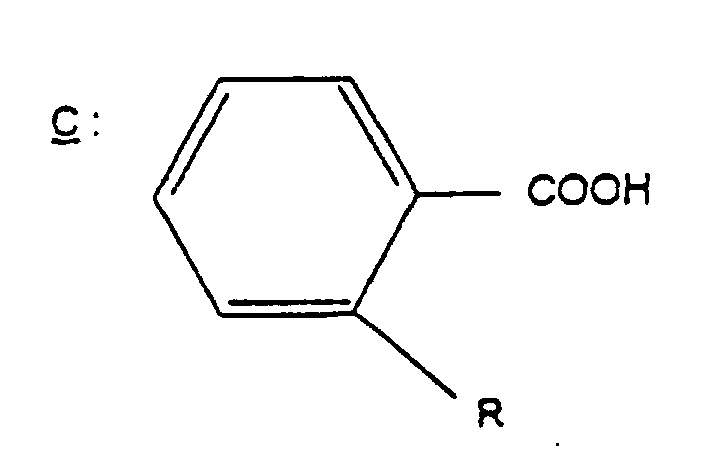 worin bedeuten:
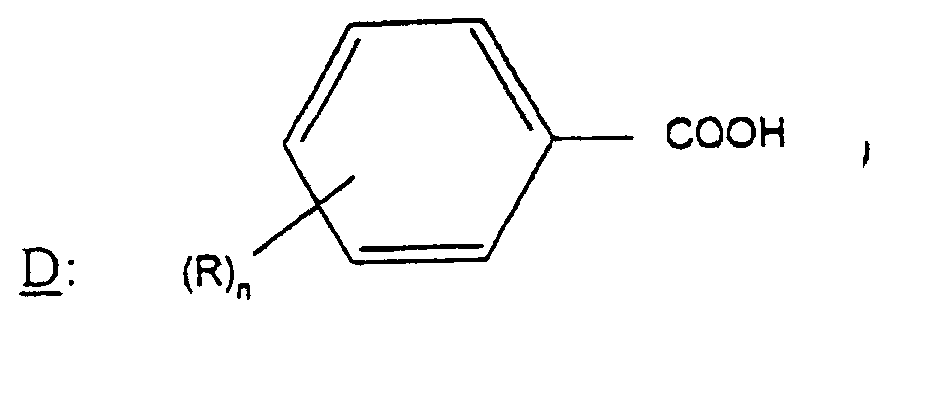 n eine ganze Zahl von 1 bis 5 undR in den Formeln A, B und C ein Wasserstoffatom, eine gegebenenfalls substituierte Alkylgruppe mit 1 bis 8 Kohlenstoffatomen, eine Alkoxygruppe oder eine Cyanogruppe undR in Formel D eine gegebenenfalls substituierte Arylgruppe mit 1 bis 6 Kohlenstoffatomen.
 - Produkt auf Kautschukbasis nach Anspruch 1, dadurch gekennzeichnet, dass die Säure eine Cyanobenzoesäure, wie p-Cyanobenzoesäure, ist.
- Produkt auf Kautschukbasis nach Anspruch 1, dadurch gekennzeichnet, dass die Säure Benzoesäure oder eine Alkylbenzoesäure, wie p-Butylbenzoesäure, ist.
- Produkt auf Kautschukbasis nach Anspruch 1, dadurch gekennzeichnet, dass die Säure eine Toluolcarbonsäure, wie p-Toluolcarbonsäure, m-Toluolcarbonsäure oder o-Toluolcarbonsäure, ist.
- Produkt auf Kautschukbasis nach Anspruch 1, dadurch gekennzeichnet, dass die Säure eine Alkoxybenzoesäure, wie p-Methoxybenzoesäure, ist.
- Produkt auf Kautschukbasis nach Anspruch 1, dadurch gekennzeichnet, dass die Säure eine Naphthoesäure ist.
- Produkt auf Kautschukbasis nach einem der vorhergehenden Ansprüche, dadurch gekennzeichnet, dass die Menge des Eisen(III)-Salzes in der Zusammensetzung 0,01 bis 0,03 pce, bezogen auf das Eisenäquivalent, beträgt.
- Luftreifenmantel, dadurch gekennzeichnet, dass er mit einem Produkt auf Kautschukbasis nach einem der vorhergehenden Ansprüche aufgebaut ist.
- Luftreifenmantel nach Anspruch 8, der von dem Typ ist, der einen Innengummi, eine Karkassenlage, die sich von Wulstkern zu Wulstkern erstreckt, Scheitellagen, Flanken, die in Wülsten enden, die mindestens einen Wulstkern aufweisen, sowie einen Laufstreifen aufweist, dadurch gekennzeichnet, dass die Pufferzone oder jede Pufferzone, welche die genannte Zusammensetzung enthält, mindestens eine der folgenden Positionen einnimmt:radial unterhalb des Innengummis, zwischen dem Innengummi und der Karkassenlage, zwischen der Karkassenlage und den Scheitellagen, zwischen den Scheitellagen und dem Laufstreifen, zwischen der Karkassenlage und den Flanken, innerhalb oder außerhalb der Flanken, innerhalb oder außerhalb des Laufstreifens.
- Luftreifenmantel für Lastwagen nach Anspruch 9, dadurch gekennzeichnet, dass sich die Pufferzone oder jede Pufferzone, welche die genannte Zusammensetzung enthält, in einer Verstärkungs-Elastomerschicht befindet, die zwischen dem Innengummi und der Karkassenlage vorgesehen ist.
- Verfahren zur Herstellung eines Produkts auf Kautschukbasis nach einem der Ansprüche 1 bis 7, dadurch gekennzeichnet, dass es darin besteht, das Eisen(III)-Salz durch mechanische Bearbeitung in das Elastomer oder die Elastomeren, welche die Zusammensetzung enthält, einzubringen, um die Pufferzone oder jede Pufferzone zu erzeugen.
- Verfahren zur Herstellung eines Produkts auf Kautschukbasis nach Anspruch 11, wobei das Produkt einen verstärkenden Füllstoff enthält, dadurch gekennzeichnet, dass es darin besteht, das Eisen(III)-Salz gleichzeitig mit einem zur Verstärkung der Zusammensetzung vorgesehenen Füllstoff in das Elastomer oder die Elastomeren einzubringen.
- Verfahren zur Verringerung des Abrollwiderstands eines Luftreifenmantels, dadurch gekennzeichnet, dass es darin besteht, ein Eisen(III)-Salz wie in einem der Ansprüche 1 bis 7 definiert durch mechanische Bearbeitung in ein oder mehrere Elastomere einzubringen, aus denen der Luftreifenmantel aufgebaut ist.
Applications Claiming Priority (2)
| Application Number | Priority Date | Filing Date | Title |
|---|---|---|---|
| FR0016273 | 2000-12-12 | ||
| FR0016273 | 2000-12-12 |
Publications (2)
| Publication Number | Publication Date |
|---|---|
| EP1215232A1 EP1215232A1 (de) | 2002-06-19 |
| EP1215232B1 true EP1215232B1 (de) | 2004-07-14 |
Family
ID=8857626
Family Applications (1)
| Application Number | Title | Priority Date | Filing Date |
|---|---|---|---|
| EP01127184A Expired - Lifetime EP1215232B1 (de) | 2000-12-12 | 2001-11-16 | Gummiprodukt, wie ein Reifen, der ein Eisensalz einer aromatischen Carbonsäure als Antioxydant enthält und dessen Herstellungverfahren |
Country Status (8)
| Country | Link |
|---|---|
| EP (1) | EP1215232B1 (de) |
| JP (1) | JP4082902B2 (de) |
| AT (1) | ATE271093T1 (de) |
| AU (1) | AU783712B2 (de) |
| BR (1) | BR0106003B1 (de) |
| CA (1) | CA2363211A1 (de) |
| DE (1) | DE60104269T2 (de) |
| ES (1) | ES2223711T3 (de) |
Families Citing this family (4)
| Publication number | Priority date | Publication date | Assignee | Title |
|---|---|---|---|---|
| JP4613508B2 (ja) * | 2004-04-06 | 2011-01-19 | 横浜ゴム株式会社 | 酸素吸収剤を含む空気入りタイヤ |
| FR2943680B1 (fr) * | 2009-03-31 | 2012-12-28 | Michelin Soc Tech | Composition de caoutchoux et pneumatique utilisant cette composition. |
| JP4858634B2 (ja) * | 2010-08-16 | 2012-01-18 | 横浜ゴム株式会社 | 酸素吸収剤を含む空気入りタイヤ |
| FR2966384A1 (fr) | 2010-10-22 | 2012-04-27 | Michelin Soc Tech | Pneumatique comportant une zone tampon entre l'armature de carcasse et l'armature de sommet |
Family Cites Families (3)
| Publication number | Priority date | Publication date | Assignee | Title |
|---|---|---|---|---|
| GB870007A (en) * | 1959-01-02 | 1961-06-07 | Midland Silicones Ltd | Organosilicon liquids |
| FR2770848A1 (fr) * | 1997-11-10 | 1999-05-14 | Michelin & Cie | Composition de caoutchouc comportant comme activateur d'oxydation un sel de fer |
| DE60012666T2 (de) * | 1999-05-07 | 2005-09-08 | Société de Technologie Michelin | Produkt auf basis von kautschuk, verfahren zu seiner herstellung, reifen und verfahren zur verringerung des rollwiderstandes von diesem reifen |
-
2001
- 2001-11-16 DE DE60104269T patent/DE60104269T2/de not_active Expired - Lifetime
- 2001-11-16 AT AT01127184T patent/ATE271093T1/de not_active IP Right Cessation
- 2001-11-16 EP EP01127184A patent/EP1215232B1/de not_active Expired - Lifetime
- 2001-11-16 ES ES01127184T patent/ES2223711T3/es not_active Expired - Lifetime
- 2001-11-23 CA CA002363211A patent/CA2363211A1/fr not_active Abandoned
- 2001-12-11 BR BRPI0106003-1A patent/BR0106003B1/pt not_active IP Right Cessation
- 2001-12-11 AU AU97186/01A patent/AU783712B2/en not_active Ceased
- 2001-12-12 JP JP2001402632A patent/JP4082902B2/ja not_active Expired - Fee Related
Also Published As
| Publication number | Publication date |
|---|---|
| ES2223711T3 (es) | 2005-03-01 |
| AU783712B2 (en) | 2005-12-01 |
| AU9718601A (en) | 2002-06-13 |
| JP4082902B2 (ja) | 2008-04-30 |
| JP2002356622A (ja) | 2002-12-13 |
| CA2363211A1 (fr) | 2002-06-12 |
| DE60104269D1 (de) | 2004-08-19 |
| DE60104269T2 (de) | 2005-08-04 |
| BR0106003B1 (pt) | 2010-12-28 |
| ATE271093T1 (de) | 2004-07-15 |
| EP1215232A1 (de) | 2002-06-19 |
| BR0106003A (pt) | 2002-10-15 |
Similar Documents
| Publication | Publication Date | Title |
|---|---|---|
| CA2310129C (fr) | Produit a base de caoutchouc, son procede d'obtention et procede pour reduire la resistance au roulement d'un pneumatique constitue dudit produit | |
| EP1115785A1 (de) | Haftvermittlerzusammensetzung (weisser füllstoff/dienrubber) die ein alkoxysilanpolysulfid, ein enamin und ein guanidinderivat enthält | |
| EP1102811B1 (de) | Produkt auf basis von kautschuk, verfahren zu seiner herstellung, reifen und verfahren zur verringerung des rollwiderstandes von diesem reifen | |
| WO2001055252A1 (fr) | Composition de caoutchouc pour pneumatique comportant une charge inorganique renforçante et un systeme de couplage (charge inorganique/elastomere) | |
| EP3727876B1 (de) | Schwefelfreie vernetzte zusammensetzung mit einer phenolischen verbindung | |
| FR3086296A1 (fr) | Composition de caoutchouc comprenant un elastomere epoxyde et un compose polyphenolique | |
| EP1215232B1 (de) | Gummiprodukt, wie ein Reifen, der ein Eisensalz einer aromatischen Carbonsäure als Antioxydant enthält und dessen Herstellungverfahren | |
| US6675851B1 (en) | Rubber based product, method for producing same and method for reducing rolling resistance of a tire made of said product | |
| JP3323279B2 (ja) | スチールコード接着用ゴム組成物 | |
| US20020156202A1 (en) | Product based on rubber, such as a tire, and process for reducing the rolling resistance of the said tire | |
| EP3463930B1 (de) | Reifen mit einem vernetzungssystem mit einem peroxid, einem metalloxid und einer ungesättigten organischen säure | |
| US20040084123A1 (en) | Product based on rubber, such as a tire, and process for reducing the rolling resistance of the said tire | |
| JPH0598074A (ja) | 重荷重用タイヤ | |
| FR3060012A1 (fr) | Pneumatique muni d'une composition comprenant un elastomere dienique, un acrylate de zinc, un peroxyde et un anti-oxydant specifique | |
| JP2002371156A (ja) | ゴム組成物 | |
| EP4210970B1 (de) | Kautschukzusammensetzung | |
| JPS5911342A (ja) | ゴム組成物 | |
| JPH01153783A (ja) | スチールコード接着促進剤 | |
| FR3033566A1 (fr) | Composition de caoutchouc a base de particules de polyethylene reticule | |
| MXPA00004483A (en) | Rubber based product, method for obtaining same and method for reducing rolling resistance of a tyre made of said product | |
| JPH01203473A (ja) | スチールコード被覆用ゴム組成物 | |
| JPH01158058A (ja) | 金属との接着が良好なゴム組成物 | |
| FR3058726A1 (fr) | Couche interne etanche de pneumatique comprenant une matrice elastomerique a base d'un copolymere a blocs comprenant un bloc elastomere avec des unites isobutylene et halogenoalkylstyrene | |
| FR3058725A1 (fr) | Couche interne etanche reticulee de pneumatique comprenant une matrice elastomerique a base d'un copolymere a blocs comprenant un bloc elastomere avec des unites isobutylene et halogenoalkylstyrene | |
| JPS60235853A (ja) | タイヤトレツド用ゴム組成物 |
Legal Events
| Date | Code | Title | Description |
|---|---|---|---|
| PUAI | Public reference made under article 153(3) epc to a published international application that has entered the european phase |
Free format text: ORIGINAL CODE: 0009012 |
|
| AK | Designated contracting states |
Kind code of ref document: A1 Designated state(s): AT BE CH CY DE DK ES FI FR GB GR IE IT LI LU MC NL PT SE TR |
|
| AX | Request for extension of the european patent |
Free format text: AL;LT;LV;MK;RO;SI |
|
| 17P | Request for examination filed |
Effective date: 20021219 |
|
| AKX | Designation fees paid |
Designated state(s): AT BE CH CY DE DK ES FI FR GB GR IE IT LI LU MC NL PT SE TR |
|
| 17Q | First examination report despatched |
Effective date: 20030911 |
|
| GRAP | Despatch of communication of intention to grant a patent |
Free format text: ORIGINAL CODE: EPIDOSNIGR1 |
|
| GRAS | Grant fee paid |
Free format text: ORIGINAL CODE: EPIDOSNIGR3 |
|
| GRAA | (expected) grant |
Free format text: ORIGINAL CODE: 0009210 |
|
| AK | Designated contracting states |
Kind code of ref document: B1 Designated state(s): AT BE CH CY DE DK ES FI FR GB GR IE IT LI LU MC NL PT SE TR |
|
| PG25 | Lapsed in a contracting state [announced via postgrant information from national office to epo] |
Ref country code: NL Free format text: LAPSE BECAUSE OF FAILURE TO SUBMIT A TRANSLATION OF THE DESCRIPTION OR TO PAY THE FEE WITHIN THE PRESCRIBED TIME-LIMIT Effective date: 20040714 Ref country code: IE Free format text: LAPSE BECAUSE OF FAILURE TO SUBMIT A TRANSLATION OF THE DESCRIPTION OR TO PAY THE FEE WITHIN THE PRESCRIBED TIME-LIMIT Effective date: 20040714 Ref country code: FI Free format text: LAPSE BECAUSE OF FAILURE TO SUBMIT A TRANSLATION OF THE DESCRIPTION OR TO PAY THE FEE WITHIN THE PRESCRIBED TIME-LIMIT Effective date: 20040714 Ref country code: CY Free format text: LAPSE BECAUSE OF FAILURE TO SUBMIT A TRANSLATION OF THE DESCRIPTION OR TO PAY THE FEE WITHIN THE PRESCRIBED TIME-LIMIT Effective date: 20040714 Ref country code: AT Free format text: LAPSE BECAUSE OF FAILURE TO SUBMIT A TRANSLATION OF THE DESCRIPTION OR TO PAY THE FEE WITHIN THE PRESCRIBED TIME-LIMIT Effective date: 20040714 Ref country code: TR Free format text: LAPSE BECAUSE OF FAILURE TO SUBMIT A TRANSLATION OF THE DESCRIPTION OR TO PAY THE FEE WITHIN THE PRESCRIBED TIME-LIMIT Effective date: 20040714 |
|
| REG | Reference to a national code |
Ref country code: GB Ref legal event code: FG4D Free format text: NOT ENGLISH |
|
| REG | Reference to a national code |
Ref country code: CH Ref legal event code: EP |
|
| REF | Corresponds to: |
Ref document number: 60104269 Country of ref document: DE Date of ref document: 20040819 Kind code of ref document: P |
|
| REG | Reference to a national code |
Ref country code: IE Ref legal event code: FG4D Free format text: FRENCH |
|
| PG25 | Lapsed in a contracting state [announced via postgrant information from national office to epo] |
Ref country code: DK Free format text: LAPSE BECAUSE OF FAILURE TO SUBMIT A TRANSLATION OF THE DESCRIPTION OR TO PAY THE FEE WITHIN THE PRESCRIBED TIME-LIMIT Effective date: 20041014 Ref country code: SE Free format text: LAPSE BECAUSE OF FAILURE TO SUBMIT A TRANSLATION OF THE DESCRIPTION OR TO PAY THE FEE WITHIN THE PRESCRIBED TIME-LIMIT Effective date: 20041014 Ref country code: GR Free format text: LAPSE BECAUSE OF FAILURE TO SUBMIT A TRANSLATION OF THE DESCRIPTION OR TO PAY THE FEE WITHIN THE PRESCRIBED TIME-LIMIT Effective date: 20041014 |
|
| GBT | Gb: translation of ep patent filed (gb section 77(6)(a)/1977) |
Effective date: 20041018 |
|
| PG25 | Lapsed in a contracting state [announced via postgrant information from national office to epo] |
Ref country code: BE Free format text: LAPSE BECAUSE OF NON-PAYMENT OF DUE FEES Effective date: 20041130 Ref country code: MC Free format text: LAPSE BECAUSE OF NON-PAYMENT OF DUE FEES Effective date: 20041130 |
|
| NLV1 | Nl: lapsed or annulled due to failure to fulfill the requirements of art. 29p and 29m of the patents act | ||
| REG | Reference to a national code |
Ref country code: ES Ref legal event code: FG2A Ref document number: 2223711 Country of ref document: ES Kind code of ref document: T3 |
|
| REG | Reference to a national code |
Ref country code: IE Ref legal event code: FD4D |
|
| PLBE | No opposition filed within time limit |
Free format text: ORIGINAL CODE: 0009261 |
|
| STAA | Information on the status of an ep patent application or granted ep patent |
Free format text: STATUS: NO OPPOSITION FILED WITHIN TIME LIMIT |
|
| BERE | Be: lapsed |
Owner name: SOC. DE TECHNOLOGIE MICHELIN Effective date: 20041130 Owner name: MICHELIN RECHERCHE ET TECHNIQUE S.A. Effective date: 20041130 |
|
| 26N | No opposition filed |
Effective date: 20050415 |
|
| PG25 | Lapsed in a contracting state [announced via postgrant information from national office to epo] |
Ref country code: LI Free format text: LAPSE BECAUSE OF NON-PAYMENT OF DUE FEES Effective date: 20051130 Ref country code: CH Free format text: LAPSE BECAUSE OF NON-PAYMENT OF DUE FEES Effective date: 20051130 |
|
| REG | Reference to a national code |
Ref country code: CH Ref legal event code: PL |
|
| BERE | Be: lapsed |
Owner name: S.A. *MICHELIN RECHERCHE ET TECHNIQUE Effective date: 20041130 Owner name: SOC. DE TECHNOLOGIE *MICHELIN Effective date: 20041130 |
|
| PG25 | Lapsed in a contracting state [announced via postgrant information from national office to epo] |
Ref country code: PT Free format text: LAPSE BECAUSE OF NON-PAYMENT OF DUE FEES Effective date: 20041214 |
|
| PGFP | Annual fee paid to national office [announced via postgrant information from national office to epo] |
Ref country code: LU Payment date: 20081127 Year of fee payment: 8 |
|
| PGFP | Annual fee paid to national office [announced via postgrant information from national office to epo] |
Ref country code: IT Payment date: 20101123 Year of fee payment: 10 Ref country code: GB Payment date: 20101118 Year of fee payment: 10 |
|
| PG25 | Lapsed in a contracting state [announced via postgrant information from national office to epo] |
Ref country code: LU Free format text: LAPSE BECAUSE OF NON-PAYMENT OF DUE FEES Effective date: 20091116 |
|
| GBPC | Gb: european patent ceased through non-payment of renewal fee |
Effective date: 20111116 |
|
| PG25 | Lapsed in a contracting state [announced via postgrant information from national office to epo] |
Ref country code: IT Free format text: LAPSE BECAUSE OF NON-PAYMENT OF DUE FEES Effective date: 20111116 |
|
| PG25 | Lapsed in a contracting state [announced via postgrant information from national office to epo] |
Ref country code: GB Free format text: LAPSE BECAUSE OF NON-PAYMENT OF DUE FEES Effective date: 20111116 |
|
| PGFP | Annual fee paid to national office [announced via postgrant information from national office to epo] |
Ref country code: DE Payment date: 20121121 Year of fee payment: 12 Ref country code: FR Payment date: 20121130 Year of fee payment: 12 |
|
| PGFP | Annual fee paid to national office [announced via postgrant information from national office to epo] |
Ref country code: ES Payment date: 20121127 Year of fee payment: 12 |
|
| REG | Reference to a national code |
Ref country code: FR Ref legal event code: ST Effective date: 20140731 |
|
| REG | Reference to a national code |
Ref country code: DE Ref legal event code: R119 Ref document number: 60104269 Country of ref document: DE Effective date: 20140603 |
|
| PG25 | Lapsed in a contracting state [announced via postgrant information from national office to epo] |
Ref country code: DE Free format text: LAPSE BECAUSE OF NON-PAYMENT OF DUE FEES Effective date: 20140603 |
|
| PG25 | Lapsed in a contracting state [announced via postgrant information from national office to epo] |
Ref country code: FR Free format text: LAPSE BECAUSE OF NON-PAYMENT OF DUE FEES Effective date: 20131202 |
|
| REG | Reference to a national code |
Ref country code: ES Ref legal event code: FD2A Effective date: 20150401 |
|
| PG25 | Lapsed in a contracting state [announced via postgrant information from national office to epo] |
Ref country code: ES Free format text: LAPSE BECAUSE OF NON-PAYMENT OF DUE FEES Effective date: 20131117 |