EP1186539B1 - Faltschachtel mit schachteleinwärts versetztem Boden - Google Patents
Faltschachtel mit schachteleinwärts versetztem Boden Download PDFInfo
- Publication number
- EP1186539B1 EP1186539B1 EP01120366A EP01120366A EP1186539B1 EP 1186539 B1 EP1186539 B1 EP 1186539B1 EP 01120366 A EP01120366 A EP 01120366A EP 01120366 A EP01120366 A EP 01120366A EP 1186539 B1 EP1186539 B1 EP 1186539B1
- Authority
- EP
- European Patent Office
- Prior art keywords
- flap
- side wall
- folding
- articulated
- folding line
- Prior art date
- Legal status (The legal status is an assumption and is not a legal conclusion. Google has not performed a legal analysis and makes no representation as to the accuracy of the status listed.)
- Expired - Lifetime
Links
- 239000011521 glass Substances 0.000 claims abstract description 6
- 239000002537 cosmetic Substances 0.000 claims abstract description 4
- 125000006850 spacer group Chemical group 0.000 claims description 48
- 239000000853 adhesive Substances 0.000 claims description 36
- 230000001070 adhesive effect Effects 0.000 claims description 36
- 239000000463 material Substances 0.000 claims description 7
- 238000003780 insertion Methods 0.000 claims description 3
- 230000037431 insertion Effects 0.000 claims description 3
- 239000011087 paperboard Substances 0.000 claims 1
- 238000012856 packing Methods 0.000 description 20
- 238000005520 cutting process Methods 0.000 description 8
- 238000013138 pruning Methods 0.000 description 6
- 238000000034 method Methods 0.000 description 5
- 239000000428 dust Substances 0.000 description 4
- 238000004806 packaging method and process Methods 0.000 description 4
- 238000004080 punching Methods 0.000 description 4
- 239000002689 soil Substances 0.000 description 3
- 239000000969 carrier Substances 0.000 description 2
- 239000003292 glue Substances 0.000 description 2
- 238000004519 manufacturing process Methods 0.000 description 2
- 238000004026 adhesive bonding Methods 0.000 description 1
- 238000005452 bending Methods 0.000 description 1
- 230000006835 compression Effects 0.000 description 1
- 238000007906 compression Methods 0.000 description 1
- 230000001419 dependent effect Effects 0.000 description 1
- 238000006073 displacement reaction Methods 0.000 description 1
- 239000011888 foil Substances 0.000 description 1
- 238000009434 installation Methods 0.000 description 1
- 230000001681 protective effect Effects 0.000 description 1
- 230000035939 shock Effects 0.000 description 1
- 239000000758 substrate Substances 0.000 description 1
- 230000003313 weakening effect Effects 0.000 description 1
- 238000004804 winding Methods 0.000 description 1
Images



Classifications
-
- B—PERFORMING OPERATIONS; TRANSPORTING
- B65—CONVEYING; PACKING; STORING; HANDLING THIN OR FILAMENTARY MATERIAL
- B65D—CONTAINERS FOR STORAGE OR TRANSPORT OF ARTICLES OR MATERIALS, e.g. BAGS, BARRELS, BOTTLES, BOXES, CANS, CARTONS, CRATES, DRUMS, JARS, TANKS, HOPPERS, FORWARDING CONTAINERS; ACCESSORIES, CLOSURES, OR FITTINGS THEREFOR; PACKAGING ELEMENTS; PACKAGES
- B65D5/00—Rigid or semi-rigid containers of polygonal cross-section, e.g. boxes, cartons or trays, formed by folding or erecting one or more blanks made of paper
- B65D5/42—Details of containers or of foldable or erectable container blanks
- B65D5/4204—Inspection openings or windows
-
- B—PERFORMING OPERATIONS; TRANSPORTING
- B65—CONVEYING; PACKING; STORING; HANDLING THIN OR FILAMENTARY MATERIAL
- B65D—CONTAINERS FOR STORAGE OR TRANSPORT OF ARTICLES OR MATERIALS, e.g. BAGS, BARRELS, BOTTLES, BOXES, CANS, CARTONS, CRATES, DRUMS, JARS, TANKS, HOPPERS, FORWARDING CONTAINERS; ACCESSORIES, CLOSURES, OR FITTINGS THEREFOR; PACKAGING ELEMENTS; PACKAGES
- B65D5/00—Rigid or semi-rigid containers of polygonal cross-section, e.g. boxes, cartons or trays, formed by folding or erecting one or more blanks made of paper
- B65D5/42—Details of containers or of foldable or erectable container blanks
- B65D5/44—Integral, inserted or attached portions forming internal or external fittings
- B65D5/50—Internal supporting or protecting elements for contents
- B65D5/5002—Integral elements for containers having tubular body walls
- B65D5/5011—Integral elements for containers having tubular body walls formed by folding inwardly of extensions hinged to the upper or lower edges of the body
- B65D5/5014—Integral elements for containers having tubular body walls formed by folding inwardly of extensions hinged to the upper or lower edges of the body and with an integral end closure
Definitions
- the invention relates to a carton for goods such as glasses, bottles, cans or like products, especially for cosmetic articles, with a rectangular Packungsmantel, one at the edge connected, with a in the Packungsmantel cross tabs provided cover part and with a box-inwardly offset floor.
- a folded package for goods such as glasses, bottles, cans or similar products
- which has a rectangular packing jacket, a lid connected thereto, provided with an engaging in the packing shell tucked lid part and also provided with a tuck bottom part having.
- a moldable tab is connected in each case having three parallel to the terminal edge on the packing jacket extending crease lines which divide the moldable tab into four individual sections, the outer of the sections is glued to the inside of the package sheath.
- the bottom of the folded package always ends flush with the surface on which the folded package stands.
- a displacement of the soil in the direction of the interior of the Faltpackung is not proposed, is also not possible due to the arrangement of the tabs.
- a disadvantage of the Faltpackung on the one hand that the goods located within the package is not sufficiently protected, and on the other hand, that the stability of the soil is not increased, just as it is customary in the packaging industry.
- a similar box which has at least one retaining and protective element for a glass.
- the box is formed by four consecutive main walls. Both in the lid and in the bottom area, there are two common closure walls which can close the box in the known manner. In the lid area further two dust flaps are hinged, which are folded before the insertion of the upper closure wall in the packaging body and thus complicate the ingress of dirt and dust.
- Essential to the invention are two tabs present in the bottom area, which are divided into a plurality of contiguous individual sections. When the tabs are unfolded, a two-ply two-part carrier, which is composed of the individual sections and which is helpful for fixing the product and for presenting it, is produced inside the box. In the two carrier halves are cutouts whose shape and size is based on the male product.
- the invention is based on the object, a resealable, cuboid To create folding carton, which provides a reinforced floor stackable on each other is and the sufficient protection located within the carton Offers goods that have a high stability with the lowest possible use of materials, which is inexpensive to produce using as little material as possible, the simply and quickly erected, filled and closed with the help of machines and whose folding blank consists of a single piece.
- the invention comprises a punched blank of the Folding box according to the invention.
- the invention describes a carton for goods such as glasses, bottles, cans or the like products, in particular for cosmetic articles, with a rectangular packing jacket, and a peripherally connected thereto, provided with an engaging in the packing shell tucked lid part.
- an intermediate tab is articulated to each of the four side walls, which together form the packing jacket, wherein the intermediate tabs all have the same height.
- a bottom flap is articulated in each case, wherein in each case two of the bottom flaps are glued together so that automatically closes when erecting the carton, the bottom, wherein one of the bottom flaps is as large as the cross section of the carton.
- a tab having three parallel to the terminal edge on the packing jacket extending fold lines, seen from the terminal edge of the tab in a first spacer bar, in Divide a support strip, in a second spacer bar and in an adhesive flap.
- the adhesive flap is glued to the inside of the package jacket so that the support strip and the second spacer bar are aligned substantially at right angles to each other.
- the two spacer webs are preferably of the same or at least approximately the same width.
- the support strip and the second spacer bar on a provided for receiving the product adapted to the shape of free cutting.
- the free-cutting in the region of the support strip can be rectangular and in the second spacer web subsequently arc-shaped or trapezoidal.
- the arcuate or trapezoidal region of the free-cutting can extend to the fold line of the adhesive flap.
- the surface is defined by a folding unit partially formed, integrally connected to the adhesive flap and the support strip is and has two fold lines whose distance is substantially equal to the width of Distance bridge corresponds.
- the Packing jacket revealed starting from the bottom area in the direction of Lid area taper slightly, with the tapered side walls should be arranged opposite each other.
- the reduction of the side wall width applies to all four side walls.
- the packing jacket is replaced in this way in the form of a pyramid with a preferably square base whose tip has been removed, a so-called truncated pyramid.
- the inclination of the side walls preferably does not exceed 10 °, but can certainly take higher values.
- the folding box there is a free cut in one, in particular the front side wall, which in particular extends into the adjacent side walls and which is covered in particular with a transparent foil.
- the goods located within the package is easily recognizable, so that visually appealing good can exert an increased buying stimulus.
- the film prevents the ingress of dust and at the same time increases the stability, because the punching of the window in the folding box reduces the rigidity of the folding box. By bonding the window film, the reduction in the rigidity of the carton is compensated.
- the carton according to the invention has a retracted inwardly bottom, in A preferred embodiment tabs in the lid area, which on the one hand the Prevent dust from entering the carton and the other hand Fixation surfaces (supports) for the within the carton to be stored Serve product.
- the fixation surfaces hold the product (in particular a crucible with screw cap Crucible) centered in the middle of the carton.
- the tabs may have stair-like additional recesses depending on Product are formed accordingly.
- the folding blank 10 which consists of a one-piece carton blank, is shown the carton 1 shown.
- the folding blank 10 may be made of cardboard, cardboard or a other suitable material.
- the body of the erected carton 1 is from the front side wall 13, the rear side wall 11, the front Side wall 13 and the rear side wall 11 connecting, right side wall 12th and the left side wall 14, wherein for the permanent closure of the body on the left side wall 14 laterally a tab 15 is articulated, with the back side wall 11 is glued.
- All side walls 11, 12, 13, 14 are rectangular in shape and preferably have the same dimensions, so that the carton 1 after installation a has square base.
- the tab 15 is slightly trapezoidal in shape Direction of their free end tapering and so wide that a secure bonding with the rear side wall 11 is possible.
- the tab 15 extends here - and this means the maximum size - over the entire length of the side wall 14th
- the individual side walls 11, 12, 13, 14 and the tab 15 are in a row over corresponding fold lines 101, 102, 103, 104 connected to each other.
- a cutout 131 exists, extending into the adjacent side walls 12, 14 extends and those with a transparent film may be covered, which is preferably glued according Faltschachtelinneren.
- an intermediate lug 21, 22, 23, 24 is articulated in each case via a folding line 105, 106, 107, 108, wherein the intermediate lugs 21, 22, 23, 24 all have the same height.
- the intermediate tabs 21, 22, 23, 24 preferably all have an identical shape, they are particularly preferably rectangular.
- the height of the intermediate flaps 21, 22, 23, 24 determines how far the bottom 30 of the folding box 1 is ultimately displaced into the interior of the folding box 1.
- the intermediate flaps 21, 22, 23, 24 are folded into the interior of the box 1 for packaging the folding box 1.
- a bottom flap 31, 32, 33, 34 hinged wherein each two of the bottom flaps 31, 32, 33, 34 glued together are that when erecting the carton 1, the bottom 30 closes automatically.
- the bottom flaps 31, 32, 33, 34 preferably form a bottom closure 30 as described in ECMA code A 6101 or A 6120 (see “THE ECMA CODE OF FOLDING CARTON STYLES", edited by ECMA (European Carton Makers Association), Reprint January 2000) as Faltêtverschluß with fully covering bottom flap known.
- This bottom closure 30 is directed due to the special shape of the bottom flaps 31, 32, 33, 34 in the bonding of the carton 1 automatically.
- the bottom closure 30 when the carton 1 is filled with content, not be opened.
- the bottom closure 30 closes in such a way that the tab 33 is a substrate for the good to be presented within the carton.
- the tab 33 is therefore preferably approximately as large as the cross section of the folding box. 1
- the lid part 41 in conjunction with the tuck 45 essentially form the closure 40 of the carton 1.
- the cover member 41 has therefore, preferably, a size which corresponds to the cross-sectional area of the packing jacket of the Folding box 1 corresponds, the tuck 45 is rectangular in shape, wherein the freestanding corners are rounded.
- each a moldable tab 42, 44 is connected via the fold lines 110 and 111 articulated. Since the formable tabs 42 and 44, as also shown here, are preferably identical, the description of the tabs 42 and 44 is limited to the tab 42.
- the formable flap 42 is substantially divided into five individual sections, starting from the fold line 110 in a first spacer bar 421, in a web 422, in a support bar 423, in a second spacer bar 424 and in an adhesive tab 425. Between the five Sections spacer web 421, web 422, support bar 423, spacer bar 424 and adhesive tab 425 are four total folding lines 120, 121, 122, 123 are provided, which are arranged parallel to the pack edge.
- the first spacer bar 421, the web 422, the support bar 423, the second spacer bar 424 and the adhesive tab 425 are substantially rectangular in shape. However, to accommodate the tuck tab 45, cutouts may be present on the respective sides of the spacer land 421, land 422, support strip 423, spacer land 424, and glue flap 425.
- the sum of the width of the web 422 and the second spacer web 424 is equal to the width of the first spacer web 421.
- the first spacer ring 421 and the web 422 may be glued together.
- the adhesive tab 425 is glued to the inside of the packing jacket of the carton 1 so that the support bar 423 and the second spacer bar 424 are aligned substantially at right angles to each other. Together with the after folding of the tab 44 parallel aligned support bar 443 results in a surface that fixes the contents of the carton 1 in its position, so that movement of the goods within the box 1 is excluded.
- folding box 1 In the preferred embodiment of the folding box 1 shown here have the both tabs 42 and 44 in addition to receiving the product provided Free cutting on, in the support bar 423 and in the second spacer bar 424 or in the support strip 443 and in the second spacer bar 444th
- the pruning is rectangular in the area of the support bar 423 while in the area Spacer bar 424 thereafter trapezoidal runs.
- the straight-lined part of Free cutting in the support bar 424 supports the product while the trapezoidal Area surrounds the product in the jacket area.
- the trapezoidal area ends here the pruning so that between the pruning and the side wall 12 at unfolded tab 42 remains a distance. In this way, a lid of a Product, which has a smaller diameter than the container of the Has good, and so the entire good be fixed in its position.
- the free cutting is preferably not executed over the entire surface, but it can still within the pruning a rectangular connecting web 426, over the Fold line 124 is connected to the support strip 423, and an adhesive extension 427, the on the fold line 125 with the rectangular connecting web 426 and on the Fold line 123 is associated with the adhesive tab 425 remain.
- the adhesive extension 427 which is in particular trapezoidal, with the trapezoid rectangular on its narrow side is extended to the adhesive flap 425, is glued onto the adhesive bag 425.
- the Connecting bar 426 supports and fixes again the goods within the box 1. Overall, the reduced stability of the overall stability of the unfolded flap 42 increased.
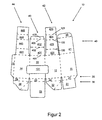
- FIG 2 is another flat lying, ungekanker from a one-piece Carton blank existing folding blank 10 a carton advantageous 1 shown.
- the body of the erected carton 1 is from the front side wall 13, the rear side wall 11, the front side wall 13 and the rear Side wall 11 connecting, right side wall 12 and the left side wall 14th formed, wherein for the permanent closure of the body on the left side wall 14th laterally a tab 15 is hinged, which glued to the rear side wall 11 becomes.
- a tab 15 is hinged, which glued to the rear side wall 11 becomes.
- the bottom closure 30 corresponds to that of the carton 1 according to FIG Figure 1 is known.
- At each of the four intermediate plates 21, 22, 23, 24 is thus one each Bottom flap 31, 32, 33, 34 articulated, wherein each two of the bottom flaps 31, 32, 33, 34 are glued together so that when erecting the carton 1 of the ground 30 automatically closes, so that the bottom closure 30 results, as in accordance with ECMA code A 6101 or A 6120 (see “THE ECMA CODE OF FOLDING CARTON STYLES ", published by ECMA (European Carton Makers Association), Reprint January 2000) is known as Faltêtverschluß with fully covering bottom flap.
- the cutout 131 is present.
- a rectangular-shaped cover part 41 is first hinged, which expires via the fold line 411 in an engaging in the packing jacket tuck 45.
- a moldable tab 42, 44 is connected via the fold lines 110 and 111 articulated.
- the moldable tab 42 is substantially divided into four individual sections, starting from the fold line 110 in a first spacer bar 421, in a support bar 423, in a second spacer bar 424 and in an adhesive tab 425.
- support bar 423, spacer bar 424 and adhesive tab 425 are a total of three fold lines 120, 122, 123 are provided, which are arranged parallel to the pack edge.
- the first spacer bar 421, the support bar 423, the second spacer bar 424 and the adhesive tab 425 are substantially rectangular in shape.
- the adhesive tab 425 is glued to the inside of the packing jacket of the carton 1 so that the support bar 423 and the second spacer bar 424 are aligned substantially at right angles to each other.
- the two spacer webs 421 and 424 preferably have the same width, but it is also possible to choose the width slightly different, whereby the support bar 423 slightly deviates from the parallel orientation to the wall of the package shell.
- the second surface 432 preferably has identical dimensions as the first surface 431, but should in no case be made smaller. Both preferably rectangular shaped surfaces 431 and 432 are glued together and thus serve as an additional surface that can provide information about the product involved or with an eye-catcher. "The crowner 43 extends vertically out of the folding box 1, thus attracting attention with respect to box 1.
- the fold line 403 may be designed as a weakening or breaking line to allow easy removal of the crowner 43 of the carton 1, without damaging them.
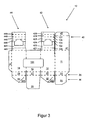
- FIG 3 is another flat lying, ungekanker from a one-piece Carton blank existing folding blank 10 a carton advantageous 1 shown without Crowner.
- the folding box 1 of FIG. 3 differs from that of FIG. 1 only in the embodiment of the tabs 42 and 44.
- the formable tab 42 is essentially divided into six individual sections, starting from the fold line 110 into a first spacer bar 421, into a support bar 423, into a second spacer bar 424, into an adhesive tab 425, into a third spacer bar 428 and into a second glue flap 429. Between the six sections there are a total of five fold lines 120, 122, 123, 126, 127 arranged parallel to the edge of the packet.
- the two tabs 42 and 44 have free cutouts provided in addition to the product reception, namely in the support strip 423 and in the second spacer bar 424 or in the support bar 443 and in the second spacer bar 444.
- the free-cutting is rectangular in the region of the support strip 423, while it is trapezoidal in the spacer bar 424 thereafter. The pruning is done here completely.
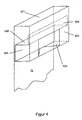
- the process is carried out so that the adhesive tab 425 can be glued to the side wall 11, further the second adhesive tab 429 on the support bar 423rd If the tab 42 is folded over at 90 ° to the body of the folding box 1, the support strip 423 is oriented parallel to the side wall 11. Due to the double bonding, the fixing support of the product and a stiffening of the tab 42 is considerably increased. The pruning is punched out according to the product contour.
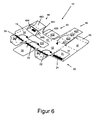
- FIGS. 5 and 6 show the first sections of the unfolding process Folded box 1 according to FIG. 2.
- the intermediate plates 21, 22, 23, 24, which all have the same height, are provided with an adhesive and folded in the direction of the box 1 such that the intermediate plates 21, 22, 23, 24 with the interior of the side walls 11, 12, 13, 14 stick together (see in particular intermediate tab 21 on side wall 11 in Figure 6).
- the bottom flaps 31, 32, 33, 34 are folded back by 90 °, for the manufacture of the bottom closure 30 then the two adhesive portions 321, 341, which are integrally formed on the tabs 32 and 34, provided with an adhesive and with the flap 33 and 31 respectively bonded.
- FIG 6 is indicated how to proceed with the tabs 42 and 44 and the Crowner 43.
- the tab 44 is unfolded so that the support strip 443 is arranged parallel to the side surface 14 and glued the adhesive flap 425 on the side surface 14. Accordingly, the tab 42 is unfolded.
- the Crowner 43 is formed by the second surface 432 folded back by 180 °, provided with an adhesive and pressed onto the first surface 431.
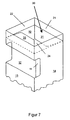
- Figure 7 shows the bottom closure 30 of an advantageously executed folding box 1, and indeed the box-inwardly offset floor 30 is shown.
- the height of the intermediate tabs 21, 22, 23, 24 determines how deep the floor is shifted in the direction of the box interior.
- FIG. 8 shows how two prefabricated folding boxes 1 and 2 according to the invention are stacked on one another. Due to the preferred embodiment of the tapered four side walls 11, 12, 13, 14 from the bottom portion 30 in the direction of the lid portion 40, the area cross section in the lid portion 40 is smaller than that in the bottom portion 10, the top carton 1 can be problematic - due to the staggered inwardly Bottom 30 - be stacked on the lower carton 2 and enter a relatively firm connection.
Landscapes
- Engineering & Computer Science (AREA)
- Mechanical Engineering (AREA)
- Cartons (AREA)
Description
An den beiden an das Bodenteil und/oder das Deckelteil angrenzenden Wänden des Packungsmantels ist jeweils eine formbare Lasche angeschlossen ist, die drei parallel zum Anschlußrand am Packungsmantel verlaufende Falzlinien aufweist, die die formbare Lasche in vier einzelne Abschnitte unterteilen, wobei der äußere der Abschnitte an der Innenseite des Packungsmantels angeklebt ist.
Es ergeben sich somit zwei Träger zur Aufnahme des in der Packung zu schützenden Gutes, dessen Lage weiter gefestigt wird, indem in den Trägem an die Form des Produkts angepaßte Freischneidungen vorhanden sind.
Der Boden der Faltpackung schließt bei der hier gewählten Ausführungsform stets bündig mit der Oberfläche ab, auf der die Faltpackung steht. Ein Versetzen des Bodens in Richtung des Inneren der Faltpackung ist nicht vorgeschlagen, ist darüber hinaus aufgrund der Anordnung der Laschen auch nicht möglich.
Nachteilig ist an der Faltpackung zum einen, daß das innerhalb der Verpackung befindliche Gut nicht ausreichend geschützt ist, und zum anderen, daß die Stabilität des Bodens nicht erhöht ist, eben wie es in der Verpackungsbranche üblich ist.
Im Deckelbereich sind des weiteren zwei Staublaschen angelenkt, die vor dem Einstecken der oberen Verschlußwand in den Verpackungskorpus eingeklappt werden und die somit das Eindringen von Schmutz und Staub erschweren.
Erfindungswesentlich sind zwei im Bodenbereich vorhandene Laschen, die in eine Vielzahl von zusammenhängenden Einzelabschnitten aufgeteilt sind. Beim Auffalten der besagten Laschen entsteht innerhalb der Schachtel ein doppellagiger zweiteiliger Träger, der aus sich aus den einzelnen Abschnitten zusammensetzt und der zur Fixierung des Produkts sowie zur Präsentation desselben hilfreich ist. In den beiden Trägerhälften sind Ausschnitte vorhanden, deren Form und Größe sich an dem aufzunehmenden Produkt orientiert.
Im Bodenbereich der erfindungsgemäßen Faltschachtel ist an jeder der vier Seitenwände, die zusammen den Packungsmantel ergeben, jeweils eine Zwischenlasche angelenkt ist, wobei die Zwischenlaschen alle die gleiche Höhe aufweisen. An jeder der vier Zwischenlaschen ist jeweils eine Bodenlasche angelenkt, wobei jeweils zwei der Bodenlaschen so miteinander verklebt sind, daß sich beim Aufrichten der Faltschachtel der Boden selbsttätig verschließt, wobei eine der Bodenlaschen so groß ist wie der Querschnitt der Faltschachtel.
Die beiden Distanzstege sind bevorzugt von gleicher oder zumindest annähernd gleicher Breite.
Beispielsweise kann die Freischneidung im Bereich der Stützleiste rechteckig und im zweiten Distanzsteg daran anschließend kreisbogenförmig oder trapezförmig verlaufen.
Weiter kann sich der kreisbogen- oder trapezförmige Bereich der Freischneidung bis zur Falzlinie der Klebelasche erstrecken.
Der Packungsmantel erhält auf diese Weise die Form einer Pyramide mit bevorzugt quadratischer Grundfläche, deren Spitze entfernt worden ist, ein sogenannter Pyramidenstumpf. Die Neigung der Seitenwände überschreitet vorzugsweise 10° nicht, kann aber durchaus höhere Werte annehmen.
Somit ist das innerhalb der Verpackung befindliche Gut problemlos zu erkennen, so daß optisch ansprechendes Gut einen verstärkten Kaufreiz ausüben kann.
Des weiteren verhindert die Folie das Eindringen von Staub und erhöht gleichzeitig die Stabilität, denn durch die Ausstanzung des Fensters in der Faltschachtel verringert sich die Steifigkeit der Faltschachtel. Durch die Verklebung der Fensterfolie wird die Verringerung der Steifigkeit der Faltschachtel kompensiert.
- die Faltschachtel aus einem Faltzuschnitt aus Pappe, Karton oder einem anderen geeigneten Werkstoff besteht,
- die vordere Seitenwand, die rückwärtige Seitenwand, die die vordere Seitenwand und die rückwärtige Seitenwand verbindende, rechte Seitenwand und die linke Seitenwand sowie die Lasche jeweils über Falzlinien miteinander verknüpft in einer Reihe geradlinig hintereinander angeordnet sind,
- an der rückwärtigen Seitenwand über die Falzlinie ein rechteckig geformtes Deckelteil angelenkt ist, das über die Falzlinie in einer in den Packungsmantel greifenden Einstecklasche ausläuft, und auf der gegenüberliegenden Seite über eine Falzlinie eine Zwischenlasche, wobei an der Zwischenlasche über die Falzlinie eine Bodenlasche angelenkt ist,
- an der rechten Seitenwand zum einen über eine Falzlinie eine Lasche und zum anderen auf der gegenüberliegenden Seite über eine Falzlinie eine Zwischenlasche angelenkt sind, wobei Lasche in fünf einzelne Abschnitte aufgeteilt ist, und zwar ausgehend von der Falzlinie in einen ersten Distanzsteg, in einen Steg, in eine Stützleiste, in einen zweiten Distanzsteg und in eine Klebelasche, zwischen denen insgesamt vier Falzlinien vorhanden sind, die parallel zum Packungsrand angeordnet sind, wobei an der Zwischenlasche über die Falzlinie eine Bodenlasche angelenkt ist,
- an der vorderen Seitenwand, in der gegebenenfalls eine Freischneidung vorhanden ist, die sich bis in die benachbarten Seitenwände erstreckt, über die Falzlinie eine Zwischenlasche angelenkt ist, wobei an der Zwischenlasche über die Falzlinie eine Bodenlasche angelenkt ist, so groß wie der Querschnilt der Faltschachtel,
- an der linken Seitenwand zum einen über eine Falzlinie eine Lasche und zum anderen auf der gegenüberliegenden Seite über eine Falzlinie eine Zwischenlasche angelenkt sind, wobei die Lasche in fünf einzelne Abschnitte aufgeteilt ist, und zwar ausgehend von der Falzlinie in einen ersten Distanzsteg, in einen Steg, in eine Stützleiste, in einen zweiten Distanzsteg und in eine Klebelasche, zwischen denen insgesamt vier Falzlinien vorhanden sind, die parallel zum Packungsrand angeordnet sind, wobei an der Zwischenlasche über die Falzlinie eine Bodenlasche angelenkt ist.
- Figur 1
- den flachliegenden, ungeklebten Stanzzuschnitt einer vorteilhaft ausgeführten Faltschachtel,
- Figur 2
- den flachliegenden, ungeklebten Stanzzuschnitt einer weiteren vorteilhaft ausgeführten Faltschachtel,
- Figur 3
- den flachliegenden, ungeklebten Stanzzuschnitt einer weiteren vorteilhaft ausgeführten Faltschachtel,
- Figur 4
- den Vorgang der Konfektionierung einer Lasche innerhalb der Faltschachtel nach Figur 3,
- Figur 5 und Figur 6
- die ersten Abschnitte des Vorgangs der Auffaltung der Faltschachtel nach Figur 2,
- Figur 7
- den Bodenverschluß einer vorteilhaft ausgeführten Faltschachtel und
- Figur 8
- zwei erfindungsgemäße, konfektionierte Faltschachteln, die aufeinander gestapelt werden.
Die Zwischenlaschen 21, 22, 23, 24 haben bevorzugt darüber hinaus alle eine identische Form, sie sind besonders bevorzugt rechteckig. Die Höhe der Zwischenlaschen 21, 22, 23, 24 gibt vor, wie weit der Boden 30 der Faltschachtel 1 letztendlich in das Innere der Faltschachtel 1 verschoben wird.
Die Zwischenlaschen 21, 22, 23 ,24 werden zur Konfektionierung der Faltschachtel 1 in das Innere der Schachtel 1 geklappt.
Die Bodenlaschen 31, 32, 33, 34 bilden bevorzugt einen Bodenverschluß 30, wie er gemäß ECMA-Code A 6101 oder A 6120 (siehe "THE ECMA CODE of FOLDING CARTON STYLES", herausgegeben von ECMA (European Carton Makers Association), Reprint January 2000) als Faltbodenverschluß mit volldeckender Bodenklappe bekannt. Dieser Bodenverschluß 30 richtet sich bedingt durch die besondere Formgebung der Bodenlaschen 31, 32, 33 ,34 bei der Verklebung der Faltschachtel 1 automatisch auf.
Zur Konfektionierung des Bodenverschlusses 30 werden die beiden Klebeabschnitte 321, 341, die an den Laschen 32 und 34 angeformt sind, mit der Lasche 33 beziehungsweise 31 verklebt, und zwar der Abschnitt 341 auf die Lasche 33 und der Abschnitt 321 auf die Lasche 31.
Beim Aufrichten der Faltschachtel 1 verschließt sich der Bodenverschluß 30 derartig, daß die Lasche 33 als Untergrund für das zu präsentierende Gut innerhalb der Faltschachtel wird. Die Lasche 33 ist daher vorzugsweise annähernd so groß wie der Querschnitt der Faltschachtel 1.
Da die formbaren Laschen 42 und 44, so wie auch hier gezeigt, bevorzugt identisch ausgeführt sind, beschränkt sich die Beschreibung der Laschen 42 und 44 auf die Lasche 42.
Der erste Distanzsteg 421, der Steg 422, die Stützleiste 423, der zweite Distanzsteg 424 und die Klebelasche 425 sind im wesentlichen von rechteckiger Form. Zur Aufnahme der Einstecklasche 45 können allerdings an den entsprechenden Seiten des Distanzstegs 421, des Stegs 422, der Stützleiste 423, des Distanzsteg 424 und der Klebelasche 425 Ausschneidungen vorhanden sein.
Zur Stabilisierung der Faltschachtel 1 können der erste Distanzring 421 und der Steg 422 miteinander verklebt sein.
Zusammen mit der nach Auffaltung der Lasche 44 parallel ausgerichteten Stützleiste 443 ergibt sich eine Fläche, die den Inhalt der Faltschachtel 1 in seiner Lage fixiert, so daß eine Bewegung des Gutes innerhalb der Schachtel 1 ausgeschlossen ist.
An den beiden an das Deckelteil 41 angrenzenden Seitenwänden 12 und 14 des Packungsmantels ist jeweils eine formbare Lasche 42, 44 über die Falzlinien 110 und 111 gelenkig angeschlossen.
Die formbare Lasche 42 ist im wesentlichen in vier einzelne Abschnitte aufgeteilt, und zwar ausgehend von der Falzlinie 110 in einen ersten Distanzsteg 421, in eine Stützleiste 423, in einen zweiten Distanzsteg 424 und in eine Klebelasche 425. Zwischen den vier Abschnitten Distanzsteg 421, Stützleiste 423, Distanzsteg 424 und Klebelasche 425 sind insgesamt drei Falzlinien 120, 122, 123 vorhanden, die parallel zum Packungsrand angeordnet sind.
Der erste Distanzsteg 421, die Stützleiste 423, der zweite Distanzsteg 424 und die Klebelasche 425 sind im wesentlichen von rechteckiger Form.
Die beiden Distanzstege 421 und 424 weisen vorzugsweise die gleiche Breite auf, jedoch besteht auch die Möglichkeit, die Breite geringfügig unterschiedlich zu wählen, wodurch die Stützleiste 423 geringfügig von der parallelen Ausrichtung zur Wand des Packungsmantels abweicht.
Die Falzlinie 403 kann als Schwächungs- oder Sollbruchlinie ausgeführt sein, um ein leichtes Abtrennen des Crowners 43 von der Faltschachtel 1 zu ermöglichen, ohne diese zu beschädigen.
Gemäß Figur 3 ist die formbare Lasche 42 im wesentlichen in sechs einzelne Abschnitte aufgeteilt, und zwar ausgehend von der Falzlinie 110 in einen ersten Distanzsteg 421, in eine Stützleiste 423, in einen zweiten Distanzsteg 424, in eine Klebelasche 425, in einen dritten Distanzsteg 428 und in eine zweite Klebelasche 429. Zwischen den sechs Abschnitten sind insgesamt fünf Falzlinien 120, 122, 123, 126, 127 vorhanden, die parallel zum Packungsrand angeordnet sind.
In der hier gezeigten bevorzugten Ausführungsform der Faltschachtel 1 weisen die beiden Laschen 42 und 44 zusätzlich zur Aufnahme des Produkts vorgesehene Freischneidungen auf, und zwar in der Stützleiste 423 und in dem zweiten Distanzsteg 424 beziehungsweise in der Stützleiste 443 und in dem zweiten Distanzsteg 444.
Die Freischneidung ist im Bereich der Stützleiste 423 rechteckig, während sie im Distanzsteg 424 daran anschließend trapezförmig verläuft.
Die Freischneidung ist hier komplett erfolgt.
Wird die Lasche 42 um 90° zum Korpus der Faltschachtel 1 umgelegt, richtet sich die Stützleiste 423 parallel zur Seitenwand 11 auf. Durch die zweifache Verklebung wird die fixierende Stützung des Produktes sowie eine Versteifung der Lasche 42 erheblich erhöht.
Die Freischneidung wird entsprechend der Produktkontur ausgestanzt entfernt.
Die Bodenlaschen 31, 32, 33, 34 werden um 90° zurückgefaltet, zur Konfektionierung des Bodenverschlusses 30 dann die beiden Klebeabschnitte 321, 341, die an den Laschen 32 und 34 angeformt sind, mit einem Klebstoffauftrag versehen und mit der Lasche 33 beziehungsweise 31 entsprechend verklebt.
Der Crowner 43 entsteht, indem die zweite Fläche 432 um 180° zurückgefaltet, mit einem Klebstoffauftrag versehen und auf die erste Fläche 431 angedrückt wird.
Bedingt durch die bevorzugte Ausführungsform der sich verjüngenden vier Seitenwände 11, 12, 13, 14 vom Bodenbereich 30 in Richtung des Deckelbereiches 40 ist der Flächenquerschnitt im Deckelbereich 40 kleiner als der im Bodenbereich 10, die obere Faltschachtel 1 kann problemlos - bedingt durch den schachteleinwärts versetzten Boden 30 - auf die untere Faltschachtel 2 gestapelt werden und dabei eine relativ feste Verbindung eingehen.
Claims (8)
- Faltschachtel 1 für Waren wie Gläser, Flaschen, Dosen oder dergleichen Produkte, insbesondere für kosmetische Artikel,
mit einem rechteckigen Packungsmantel, einem daran randseitig angeschlossenen, mit einer in den Packungsmantel greifenden Einstecklasche 45 versehenen Deckelteil 41,
einem Bodenbereich 30 in dem an jeder der vier Seitenwände 11, 12, 13, 14, die den Packungsmantel ergeben, jeweils eine Zwischenlasche 21, 22, 23, 24 angelenkt ist, wobei die Zwischenlaschen 21, 22, 23, 24 alle die gleiche Höhe aufweisen,
an jeder der vier Zwischenlaschen 21, 22, 23, 24 ist jeweils eine Bodenlasche 31, 32; 33, 34 angelenkt, wobei jeweils zwei der Bodenlaschen 31, 32, 33, 34 so miteinander verklebt sind, dass sich beim Aufrichten der Faltschachtel 1 der Boden 30 selbsttätig verschließt, dadurch gekennzeichnet, dass die Bodenlasche 33 so groß wie der Querschnitt der Faltschachtel 1 ist. - Faltschachtel nach Anspruch 1, dadurch gekennzeichnet, daß im Deckelbereich 40 an den beiden an das Deckelteil 41 angrenzenden Seitenwänden 12, 14 des Packungsmantels jeweils eine Lasche 42, 44 gelenkig angeschlossen ist, die drei parallel zum Anschlußrand am Packungsmantel verlaufende Falzlinien 120, 122, 123 aufweist, die die Lasche 42 vom Anschlußrand aus gesehen in einen ersten Distanzsteg 421, in eine Stützleiste 423, in einen zweiten Distanzsteg 424 und in eine Klebelasche 425 unterteilen, wobei die Klebelasche 425 an der Innenseite des Packungsmantels so angeklebt ist, daß die Stützleiste 423 und der zweite Distanzsteg 424 im wesentlichen rechtwinklig zueinander ausgerichtet sind.
- Faltschachtel nach den Ansprüchen 1 und 2, dadurch gekennzeichnet, daß die Stützleiste 423 und der zweite Distanzsteg 424 eine zur Aufnahme des Produkts vorgesehene, an dessen Form angepaßte Freischneidung aufweisen.
- Faltschachtel nach einem oder mehreren der vorstehenden Ansprüche, dadurch gekennzeichnet, daß bei den Laschen 42, 44 an die Klebelasche 425 jeweils über eine Falzlinie 126 ein dritter Distanzsteg 428 und über eine Falzlinie 127 eine zweite Klebelasche 429 anschließt.
- Faltschachtel nach einem oder mehreren der vorstehenden Ansprüche, dadurch gekennzeichnet, daß sich zumindest zwei der vier Seitenwände 11, 12, 13, 14, die den Packungsmantel ergeben, ausgehend vom Bodenbereich 30 in Richtung des Deckelbereiches 40 leicht verjüngen.
- Faltschachtel nach einem oder mehreren der vorstehenden Ansprüche, dadurch gekennzeichnet, daß in der vorderen Seitenwand 13 eine Freischneidung 131 vorhanden ist, die sich insbesondere in die benachbarten Seitenwände12, 14 erstreckt und die insbesondere mit einer transparenten Folie abgedeckt ist.
- Faltschachtel nach einem oder mehreren der vorstehenden Ansprüche, enthaltend einen Tiegel mit aufgesetztem Schraubverschluß.
- Stanzzuschnitt zur Herstellung einer wiederverschließbaren, quaderförmigen Faltschachtel 1 mit einer vorderen Seitenwand 13, einer rückwärtigen Seitenwand 11, einer die vordere Seitenwand 13 und die rückwärtige Seitenwand 11 verbindenden, rechten Seitenwand 12 und einer linken Seitenwand 14, einem von vier Bodenverschlußlappen 31, 32, 33, 34 gebildeten Bodenverschluß 30, einem von drei Verschlußlappen 41, 42, 44 gebildeten oberen Verschluß 40, wobei
die Faltschachtel 1 aus einem Faltzuschnitt 10 aus Pappe, Karton oder einem anderen geeigneten Werkstoff besteht,
wobei die vordere Seitenwand 13, die rückwärtige Seitenwand 11, die die vordere Seitenwand 13 und die rückwärtige Seitenwand 11 verbindende, rechte Seitenwand 12 und die linke Seitenwand 14 sowie die Lasche 15 jeweils über Falzlinien 101, 102, 103, 104 miteinander verknüpft in einer Reihe geradlinig hintereinander angeordnet sind, wobei an der rückwärtigen Seitenwand 11 über die Falzlinie 109 ein rechteckig geformtes Deckelteil 41 angelenkt ist, das über die Falzlinie 411 in einer in den Packungsmantel greifenden Einstecklasche 45 ausläuft, und auf der gegenüberliegenden Seite über eine Falzlinie 105 eine Zwischenlasche 21, wobei an der Zwischenlasche 21 über die Falzlinie 112 eine Bodenlasche 31 angelenkt ist,
wobei an der rechten Seitenwand 12 zum einen über eine Falzlinie 110 eine Lasche 42 und zum anderen auf der gegenüberliegenden Seite über eine Falzlinie 106 eine Zwischenlasche 22 angelenkt sind, wobei Lasche 42 in fünf einzelne Abschnitte aufgeteilt ist, und zwar ausgehend von der Falzlinie 110 in einen ersten Distanzsteg 421, in einen Steg 422, in eine Stützleiste 423, in einen zweiten Distanzsteg 424 und in eine Klebelasche 425, zwischen denen insgesamt vier Falzlinien 120, 121, 122, 123 vorhanden sind, die parallel zum Packungsrand angeordnet sind, wobei an der Zwischenlasche 22 über die Falzlinie 113 eine Bodenlasche 32 angelenkt ist,
wobei an der vorderen Seitenwand 13, in der gegebenenfalls eine Freischneidung 131 vorhanden ist, die sich bis in die benachbarten Seitenwände 12, 14 erstreckt, über die Falzlinie 107 eine Zwischenlasche 23 angelenkt ist, wobei an der Zwischenlasche 23 über die Falzlinie 114 eine Bodenlasche 33 angelenkt ist,
die so groß wie der Querschnitt der Faltschachtel ist wobei an der linken Seitenwand 14 zum einen über eine Falzlinie 111 eine Lasche 44 und zum anderen auf der gegenüberliegenden Seite über eine Falzlinie 108 eine Zwischenlasche 24 angelenkt sind, wobei die Lasche 44 in fünf einzelne Abschnitte aufgeteilt ist, und zwar ausgehend von der Falzlinie 111 in einen ersten Distanzsteg 441, in einen Steg 442, in eine Stützleiste 443, in einen zweiten Distanzsteg 444 und in eine Klebelasche 445, zwischen denen insgesamt vier Falzlinien vorhanden sind, die parallel zum Packungsrand angeordnet sind, wobei an der Zwischenlasche 24 über die Falzlinie 115 eine Bodenlasche 34 angelenkt ist.
Applications Claiming Priority (2)
| Application Number | Priority Date | Filing Date | Title |
|---|---|---|---|
| DE10043850A DE10043850A1 (de) | 2000-09-06 | 2000-09-06 | Faltschachtel mit schachteleinwärts versetztem Boden |
| DE10043850 | 2000-09-06 |
Publications (2)
| Publication Number | Publication Date |
|---|---|
| EP1186539A1 EP1186539A1 (de) | 2002-03-13 |
| EP1186539B1 true EP1186539B1 (de) | 2005-04-13 |
Family
ID=7655150
Family Applications (1)
| Application Number | Title | Priority Date | Filing Date |
|---|---|---|---|
| EP01120366A Expired - Lifetime EP1186539B1 (de) | 2000-09-06 | 2001-08-25 | Faltschachtel mit schachteleinwärts versetztem Boden |
Country Status (4)
| Country | Link |
|---|---|
| US (1) | US20020036156A1 (de) |
| EP (1) | EP1186539B1 (de) |
| AT (1) | ATE293068T1 (de) |
| DE (2) | DE10043850A1 (de) |
Families Citing this family (8)
| Publication number | Priority date | Publication date | Assignee | Title |
|---|---|---|---|---|
| DE102006031416A1 (de) | 2006-07-05 | 2008-01-10 | Tesa Ag | Originalitätsverschlossene Faltschachtel mit schachteleinwärts versetztem Deckel |
| US20090287562A1 (en) * | 2008-02-02 | 2009-11-19 | Peregrin Technologies, Inc. | Anonymous merchant-customer loyalty rewards program |
| USD657260S1 (en) | 2010-07-30 | 2012-04-10 | Johnson & Johnson Consumer Companies, Inc. | Container |
| ITSA20110011A1 (it) * | 2011-05-25 | 2012-11-26 | Nuceria Adesivi S R L | Sistema di appoggio e trattenimento di un flacone, vasetto e simili entro una scatola. |
| US10179671B2 (en) * | 2013-03-15 | 2019-01-15 | Tidi Products, Llc | Dispenser-packaging for protective eyewear |
| US11427378B2 (en) | 2013-03-15 | 2022-08-30 | Tidi Products, Llc | Eye shield dispenser |
| US10065762B2 (en) | 2013-04-30 | 2018-09-04 | Tidi Products, Llc | Dispenser having a tower portion and an insert portion |
| US9676543B2 (en) * | 2014-01-29 | 2017-06-13 | Liberty Hardware Mfg. Corp. | Shower door glass pane packaging assembly |
Family Cites Families (10)
| Publication number | Priority date | Publication date | Assignee | Title |
|---|---|---|---|---|
| GB853891A (en) * | 1958-03-28 | 1960-11-09 | Tillotsons Liverpool Ltd | Improvements in collapsible cartons |
| DE7635209U1 (de) * | 1976-11-06 | 1977-02-17 | Hammer Lit Gmbh | Faltbarer Behaelter aus Karton oder Kunststoff |
| FR2375100A1 (fr) * | 1976-12-24 | 1978-07-21 | Nicollet Hugues Sa | Emballage parallelepipedique, et flan et ebauche propres a la realisation d'un tel emballage |
| US4101022A (en) * | 1977-03-28 | 1978-07-18 | Inland Container Corporation | Recessed end container |
| US5540330A (en) * | 1993-09-10 | 1996-07-30 | Gi.Bi.Effe S.R.L. | Box with retention and protection element for a jar |
| DE9411039U1 (de) * | 1994-07-04 | 1994-09-15 | F.W. Oventrop Kg, 59939 Olsberg | Verpackung für eine Ventilbetätigungseinrichtung |
| DE9413673U1 (de) * | 1994-08-25 | 1994-10-13 | CD Cartondruck GmbH, 74182 Obersulm | Faltpackung für Waren |
| DE9419312U1 (de) * | 1994-12-02 | 1995-01-26 | Graphia Hans Gundlach GmbH & Co, 33649 Bielefeld | Aus Karton hergestellte Faltschachtel |
| FR2731682B1 (fr) * | 1995-03-14 | 1997-04-30 | Allardi | Flan en carton destine a la realisation d'une boite de presentation d'un contenu tel qu'un flacon de produit cosmetique |
| IT1277553B1 (it) * | 1995-09-07 | 1997-11-11 | Gi Bi Effe Srl | Scatola per alloggiare, trattenere e proteggere un flacone o simile e foglio fustellato e sagomato per la realizzazione di tale scatola |
-
2000
- 2000-09-06 DE DE10043850A patent/DE10043850A1/de not_active Ceased
-
2001
- 2001-08-25 DE DE50105893T patent/DE50105893D1/de not_active Expired - Fee Related
- 2001-08-25 AT AT01120366T patent/ATE293068T1/de not_active IP Right Cessation
- 2001-08-25 EP EP01120366A patent/EP1186539B1/de not_active Expired - Lifetime
- 2001-08-30 US US09/942,836 patent/US20020036156A1/en not_active Abandoned
Also Published As
| Publication number | Publication date |
|---|---|
| DE10043850A1 (de) | 2002-03-14 |
| DE50105893D1 (de) | 2005-05-19 |
| ATE293068T1 (de) | 2005-04-15 |
| US20020036156A1 (en) | 2002-03-28 |
| EP1186539A1 (de) | 2002-03-13 |
Similar Documents
| Publication | Publication Date | Title |
|---|---|---|
| EP3150503B1 (de) | Packung für zigaretten | |
| DE69401047T2 (de) | Schachtel mit Halte- und Schutzelement für ein Gefäss | |
| WO2004063031A1 (de) | Zuschnitt für ein prismenförmiges gebinde | |
| EP0983946A2 (de) | Behälterträger | |
| EP2569220B1 (de) | Faltschachteleinsatz und faltschachtel für einen faltschachteleinsatz | |
| EP1985544A1 (de) | Verpackung und Verfahren zum Herstellen einer als Faltschachtel ausgebildeten Verpackung | |
| EP1195329B1 (de) | Faltschachtel mit schachteleinwärts versetztem Innenboden und Zuschnitt dafür | |
| DE4311145A1 (de) | Schachtel | |
| EP0618151A1 (de) | Verpackung für stabförmige Gegenstände wie Zigaretten und Zuschnitt zum Herstellen der Verpackung | |
| EP1876103A1 (de) | Originalitätsverschlossene Faltschachtel mit schachteleinwärts versetztem Deckel | |
| DE4100784C2 (de) | Verpackung für in zwei Reihen angeordnete Behälter | |
| EP1186539A1 (de) | Faltschachtel mit schachteleinwärts versetztem Boden | |
| EP0399250B1 (de) | Materialbahn aus miteinander verbundenen (Verpackungs-) Zuschnitten | |
| EP0609784B1 (de) | Faltbarer Verpackungsbehälter und Zuschnitt dafür | |
| DE10006293A1 (de) | Wiederverschliessbare, quaderförmige Faltschachtel mit Aufhänger | |
| DE202008015318U1 (de) | Faltschachtel für Weinflaschen | |
| EP1801020B1 (de) | Faltschachtel mit verstärktem Staublaschenbereich | |
| DE4024112A1 (de) | Faltschachtel und zuschnitt fuer dieselbe | |
| EP2228310B1 (de) | Zuschnitt für Verpackung mit einrastbarem Klappdeckel | |
| DE4124452A1 (de) | Faltschachtel | |
| DE4140773C2 (de) | Faltzuschnitt für eine Verkaufsverpackung | |
| DE102005014864A1 (de) | Zigarettenpackung | |
| EP1259437B1 (de) | Einteiliger zuschnitt für aufklappbares verpackungsbehältnis | |
| EP0550730B1 (de) | Faltschachtel | |
| EP1712477A2 (de) | Faltschachtel aus Karton |
Legal Events
| Date | Code | Title | Description |
|---|---|---|---|
| PUAI | Public reference made under article 153(3) epc to a published international application that has entered the european phase |
Free format text: ORIGINAL CODE: 0009012 |
|
| AK | Designated contracting states |
Kind code of ref document: A1 Designated state(s): AT BE CH CY DE DK ES FI FR GB GR IE IT LI LU MC NL PT SE TR |
|
| AX | Request for extension of the european patent |
Free format text: AL;LT;LV;MK;RO;SI |
|
| 17P | Request for examination filed |
Effective date: 20020828 |
|
| AKX | Designation fees paid |
Free format text: AT BE CH CY DE DK ES FI FR GB GR IE IT LI LU MC NL PT SE TR |
|
| 17Q | First examination report despatched |
Effective date: 20030829 |
|
| GRAP | Despatch of communication of intention to grant a patent |
Free format text: ORIGINAL CODE: EPIDOSNIGR1 |
|
| GRAS | Grant fee paid |
Free format text: ORIGINAL CODE: EPIDOSNIGR3 |
|
| GRAA | (expected) grant |
Free format text: ORIGINAL CODE: 0009210 |
|
| AK | Designated contracting states |
Kind code of ref document: B1 Designated state(s): AT BE CH CY DE DK ES FI FR GB GR IE IT LI LU MC NL PT SE TR |
|
| PG25 | Lapsed in a contracting state [announced via postgrant information from national office to epo] |
Ref country code: NL Free format text: LAPSE BECAUSE OF FAILURE TO SUBMIT A TRANSLATION OF THE DESCRIPTION OR TO PAY THE FEE WITHIN THE PRESCRIBED TIME-LIMIT Effective date: 20050413 Ref country code: IE Free format text: LAPSE BECAUSE OF FAILURE TO SUBMIT A TRANSLATION OF THE DESCRIPTION OR TO PAY THE FEE WITHIN THE PRESCRIBED TIME-LIMIT Effective date: 20050413 Ref country code: GB Free format text: LAPSE BECAUSE OF FAILURE TO SUBMIT A TRANSLATION OF THE DESCRIPTION OR TO PAY THE FEE WITHIN THE PRESCRIBED TIME-LIMIT Effective date: 20050413 Ref country code: FI Free format text: LAPSE BECAUSE OF FAILURE TO SUBMIT A TRANSLATION OF THE DESCRIPTION OR TO PAY THE FEE WITHIN THE PRESCRIBED TIME-LIMIT Effective date: 20050413 Ref country code: TR Free format text: LAPSE BECAUSE OF FAILURE TO SUBMIT A TRANSLATION OF THE DESCRIPTION OR TO PAY THE FEE WITHIN THE PRESCRIBED TIME-LIMIT Effective date: 20050413 |
|
| REG | Reference to a national code |
Ref country code: GB Ref legal event code: FG4D Free format text: NOT ENGLISH |
|
| REG | Reference to a national code |
Ref country code: CH Ref legal event code: EP |
|
| REG | Reference to a national code |
Ref country code: IE Ref legal event code: FG4D Free format text: LANGUAGE OF EP DOCUMENT: GERMAN |
|
| REF | Corresponds to: |
Ref document number: 50105893 Country of ref document: DE Date of ref document: 20050519 Kind code of ref document: P |
|
| PG25 | Lapsed in a contracting state [announced via postgrant information from national office to epo] |
Ref country code: SE Free format text: LAPSE BECAUSE OF FAILURE TO SUBMIT A TRANSLATION OF THE DESCRIPTION OR TO PAY THE FEE WITHIN THE PRESCRIBED TIME-LIMIT Effective date: 20050713 Ref country code: GR Free format text: LAPSE BECAUSE OF FAILURE TO SUBMIT A TRANSLATION OF THE DESCRIPTION OR TO PAY THE FEE WITHIN THE PRESCRIBED TIME-LIMIT Effective date: 20050713 Ref country code: DK Free format text: LAPSE BECAUSE OF FAILURE TO SUBMIT A TRANSLATION OF THE DESCRIPTION OR TO PAY THE FEE WITHIN THE PRESCRIBED TIME-LIMIT Effective date: 20050713 |
|
| PG25 | Lapsed in a contracting state [announced via postgrant information from national office to epo] |
Ref country code: ES Free format text: LAPSE BECAUSE OF FAILURE TO SUBMIT A TRANSLATION OF THE DESCRIPTION OR TO PAY THE FEE WITHIN THE PRESCRIBED TIME-LIMIT Effective date: 20050724 |
|
| PG25 | Lapsed in a contracting state [announced via postgrant information from national office to epo] |
Ref country code: LU Free format text: LAPSE BECAUSE OF NON-PAYMENT OF DUE FEES Effective date: 20050825 Ref country code: CY Free format text: LAPSE BECAUSE OF FAILURE TO SUBMIT A TRANSLATION OF THE DESCRIPTION OR TO PAY THE FEE WITHIN THE PRESCRIBED TIME-LIMIT Effective date: 20050825 Ref country code: AT Free format text: LAPSE BECAUSE OF NON-PAYMENT OF DUE FEES Effective date: 20050825 |
|
| PG25 | Lapsed in a contracting state [announced via postgrant information from national office to epo] |
Ref country code: MC Free format text: LAPSE BECAUSE OF NON-PAYMENT OF DUE FEES Effective date: 20050831 Ref country code: CH Free format text: LAPSE BECAUSE OF NON-PAYMENT OF DUE FEES Effective date: 20050831 Ref country code: BE Free format text: LAPSE BECAUSE OF NON-PAYMENT OF DUE FEES Effective date: 20050831 Ref country code: LI Free format text: LAPSE BECAUSE OF NON-PAYMENT OF DUE FEES Effective date: 20050831 |
|
| PG25 | Lapsed in a contracting state [announced via postgrant information from national office to epo] |
Ref country code: PT Free format text: LAPSE BECAUSE OF FAILURE TO SUBMIT A TRANSLATION OF THE DESCRIPTION OR TO PAY THE FEE WITHIN THE PRESCRIBED TIME-LIMIT Effective date: 20050913 |
|
| NLV1 | Nl: lapsed or annulled due to failure to fulfill the requirements of art. 29p and 29m of the patents act | ||
| GBV | Gb: ep patent (uk) treated as always having been void in accordance with gb section 77(7)/1977 [no translation filed] |
Effective date: 20050413 |
|
| REG | Reference to a national code |
Ref country code: IE Ref legal event code: FD4D |
|
| PLBE | No opposition filed within time limit |
Free format text: ORIGINAL CODE: 0009261 |
|
| STAA | Information on the status of an ep patent application or granted ep patent |
Free format text: STATUS: NO OPPOSITION FILED WITHIN TIME LIMIT |
|
| ET | Fr: translation filed | ||
| 26N | No opposition filed |
Effective date: 20060116 |
|
| REG | Reference to a national code |
Ref country code: CH Ref legal event code: PL |
|
| BERE | Be: lapsed |
Owner name: BEIERSDORF A.G. Effective date: 20050831 |
|
| PGFP | Annual fee paid to national office [announced via postgrant information from national office to epo] |
Ref country code: DE Payment date: 20080831 Year of fee payment: 8 |
|
| PGFP | Annual fee paid to national office [announced via postgrant information from national office to epo] |
Ref country code: FR Payment date: 20080813 Year of fee payment: 8 Ref country code: IT Payment date: 20080823 Year of fee payment: 8 |
|
| REG | Reference to a national code |
Ref country code: FR Ref legal event code: ST Effective date: 20100430 |
|
| PG25 | Lapsed in a contracting state [announced via postgrant information from national office to epo] |
Ref country code: FR Free format text: LAPSE BECAUSE OF NON-PAYMENT OF DUE FEES Effective date: 20090831 Ref country code: DE Free format text: LAPSE BECAUSE OF NON-PAYMENT OF DUE FEES Effective date: 20100302 |
|
| PG25 | Lapsed in a contracting state [announced via postgrant information from national office to epo] |
Ref country code: IT Free format text: LAPSE BECAUSE OF NON-PAYMENT OF DUE FEES Effective date: 20090825 |