EP1180396A1 - Matériaux comportant des groupement organiques contenant du phosphore lié par l'intermédiaire d'atomes d'oxygenes à un oxyde minéral - Google Patents
Matériaux comportant des groupement organiques contenant du phosphore lié par l'intermédiaire d'atomes d'oxygenes à un oxyde minéral Download PDFInfo
- Publication number
- EP1180396A1 EP1180396A1 EP01402128A EP01402128A EP1180396A1 EP 1180396 A1 EP1180396 A1 EP 1180396A1 EP 01402128 A EP01402128 A EP 01402128A EP 01402128 A EP01402128 A EP 01402128A EP 1180396 A1 EP1180396 A1 EP 1180396A1
- Authority
- EP
- European Patent Office
- Prior art keywords
- group
- sulfur
- groups
- formula
- phosphorus
- Prior art date
- Legal status (The legal status is an assumption and is not a legal conclusion. Google has not performed a legal analysis and makes no representation as to the accuracy of the status listed.)
- Withdrawn
Links
- 229910052698 phosphorus Inorganic materials 0.000 title claims abstract description 39
- 239000000463 material Substances 0.000 title claims abstract description 33
- 239000011574 phosphorus Substances 0.000 title claims abstract description 24
- 125000004430 oxygen atom Chemical group O* 0.000 title claims abstract description 6
- 229910052809 inorganic oxide Inorganic materials 0.000 title claims abstract 3
- 229910052717 sulfur Inorganic materials 0.000 claims abstract description 34
- 239000011593 sulfur Substances 0.000 claims abstract description 31
- NINIDFKCEFEMDL-UHFFFAOYSA-N Sulfur Chemical compound [S] NINIDFKCEFEMDL-UHFFFAOYSA-N 0.000 claims abstract description 30
- 125000001183 hydrocarbyl group Chemical group 0.000 claims abstract description 20
- 238000000034 method Methods 0.000 claims abstract description 20
- -1 phosphorus compound Chemical class 0.000 claims abstract description 16
- 229910052500 inorganic mineral Inorganic materials 0.000 claims abstract description 14
- 239000011707 mineral Substances 0.000 claims abstract description 14
- UEZVMMHDMIWARA-UHFFFAOYSA-M phosphonate Chemical compound [O-]P(=O)=O UEZVMMHDMIWARA-UHFFFAOYSA-M 0.000 claims abstract description 11
- 125000004437 phosphorous atom Chemical group 0.000 claims abstract description 10
- 238000002360 preparation method Methods 0.000 claims abstract description 10
- 239000000725 suspension Substances 0.000 claims abstract description 10
- 125000000962 organic group Chemical group 0.000 claims abstract description 9
- 229910019142 PO4 Inorganic materials 0.000 claims abstract description 8
- NBIIXXVUZAFLBC-UHFFFAOYSA-K phosphate Chemical compound [O-]P([O-])([O-])=O NBIIXXVUZAFLBC-UHFFFAOYSA-K 0.000 claims abstract description 8
- 239000010452 phosphate Substances 0.000 claims abstract description 8
- ACVYVLVWPXVTIT-UHFFFAOYSA-M phosphinate Chemical compound [O-][PH2]=O ACVYVLVWPXVTIT-UHFFFAOYSA-M 0.000 claims abstract description 8
- 239000002904 solvent Substances 0.000 claims abstract description 8
- QAOWNCQODCNURD-UHFFFAOYSA-L Sulfate Chemical compound [O-]S([O-])(=O)=O QAOWNCQODCNURD-UHFFFAOYSA-L 0.000 claims abstract description 5
- 239000007788 liquid Substances 0.000 claims abstract description 5
- 125000004432 carbon atom Chemical group C* 0.000 claims description 27
- YMWUJEATGCHHMB-UHFFFAOYSA-N Dichloromethane Chemical compound ClCCl YMWUJEATGCHHMB-UHFFFAOYSA-N 0.000 claims description 24
- OAICVXFJPJFONN-UHFFFAOYSA-N Phosphorus Chemical compound [P] OAICVXFJPJFONN-UHFFFAOYSA-N 0.000 claims description 19
- XLYOFNOQVPJJNP-UHFFFAOYSA-N water Substances O XLYOFNOQVPJJNP-UHFFFAOYSA-N 0.000 claims description 17
- 150000001875 compounds Chemical class 0.000 claims description 10
- 125000003396 thiol group Chemical group [H]S* 0.000 claims description 10
- 125000000217 alkyl group Chemical group 0.000 claims description 9
- OKTJSMMVPCPJKN-UHFFFAOYSA-N Carbon Chemical compound [C] OKTJSMMVPCPJKN-UHFFFAOYSA-N 0.000 claims description 8
- 125000003118 aryl group Chemical group 0.000 claims description 8
- 239000010936 titanium Substances 0.000 claims description 8
- 125000002877 alkyl aryl group Chemical group 0.000 claims description 7
- 150000001768 cations Chemical class 0.000 claims description 6
- 125000000542 sulfonic acid group Chemical group 0.000 claims description 6
- 239000004215 Carbon black (E152) Substances 0.000 claims description 5
- 229930195733 hydrocarbon Natural products 0.000 claims description 5
- 150000002430 hydrocarbons Chemical class 0.000 claims description 5
- 125000001273 sulfonato group Chemical group [O-]S(*)(=O)=O 0.000 claims description 5
- IAZDPXIOMUYVGZ-UHFFFAOYSA-N Dimethylsulphoxide Chemical compound CS(C)=O IAZDPXIOMUYVGZ-UHFFFAOYSA-N 0.000 claims description 4
- XEEYBQQBJWHFJM-UHFFFAOYSA-N Iron Chemical compound [Fe] XEEYBQQBJWHFJM-UHFFFAOYSA-N 0.000 claims description 4
- WYURNTSHIVDZCO-UHFFFAOYSA-N Tetrahydrofuran Chemical compound C1CCOC1 WYURNTSHIVDZCO-UHFFFAOYSA-N 0.000 claims description 4
- RTAQQCXQSZGOHL-UHFFFAOYSA-N Titanium Chemical compound [Ti] RTAQQCXQSZGOHL-UHFFFAOYSA-N 0.000 claims description 4
- QCWXUUIWCKQGHC-UHFFFAOYSA-N Zirconium Chemical compound [Zr] QCWXUUIWCKQGHC-UHFFFAOYSA-N 0.000 claims description 4
- 229910052782 aluminium Inorganic materials 0.000 claims description 4
- XAGFODPZIPBFFR-UHFFFAOYSA-N aluminium Chemical compound [Al] XAGFODPZIPBFFR-UHFFFAOYSA-N 0.000 claims description 4
- 230000000737 periodic effect Effects 0.000 claims description 4
- 229910052719 titanium Inorganic materials 0.000 claims description 4
- 229910052726 zirconium Inorganic materials 0.000 claims description 4
- 125000001931 aliphatic group Chemical group 0.000 claims description 3
- 125000001741 organic sulfur group Chemical group 0.000 claims description 3
- 125000002743 phosphorus functional group Chemical group 0.000 claims description 3
- 150000008117 polysulfides Polymers 0.000 claims description 3
- 229920006395 saturated elastomer Polymers 0.000 claims description 3
- 229910052768 actinide Inorganic materials 0.000 claims description 2
- 150000001255 actinides Chemical class 0.000 claims description 2
- 229910052783 alkali metal Inorganic materials 0.000 claims description 2
- 150000001340 alkali metals Chemical class 0.000 claims description 2
- 125000003710 aryl alkyl group Chemical group 0.000 claims description 2
- 125000005842 heteroatom Chemical group 0.000 claims description 2
- 125000004435 hydrogen atom Chemical group [H]* 0.000 claims description 2
- 229910052742 iron Inorganic materials 0.000 claims description 2
- 229910052747 lanthanoid Inorganic materials 0.000 claims description 2
- 150000002602 lanthanoids Chemical class 0.000 claims description 2
- YLQBMQCUIZJEEH-UHFFFAOYSA-N tetrahydrofuran Natural products C=1C=COC=1 YLQBMQCUIZJEEH-UHFFFAOYSA-N 0.000 claims description 2
- 125000000101 thioether group Chemical group 0.000 claims description 2
- 125000004429 atom Chemical group 0.000 claims 2
- XUIMIQQOPSSXEZ-UHFFFAOYSA-N Silicon Chemical compound [Si] XUIMIQQOPSSXEZ-UHFFFAOYSA-N 0.000 claims 1
- ATJFFYVFTNAWJD-UHFFFAOYSA-N Tin Chemical compound [Sn] ATJFFYVFTNAWJD-UHFFFAOYSA-N 0.000 claims 1
- 229910052799 carbon Inorganic materials 0.000 claims 1
- GWYFCOCPABKNJV-UHFFFAOYSA-N isovaleric acid Chemical compound CC(C)CC(O)=O GWYFCOCPABKNJV-UHFFFAOYSA-N 0.000 claims 1
- 229910052710 silicon Inorganic materials 0.000 claims 1
- 239000010703 silicon Substances 0.000 claims 1
- 229910052718 tin Inorganic materials 0.000 claims 1
- OKKJLVBELUTLKV-UHFFFAOYSA-N Methanol Chemical compound OC OKKJLVBELUTLKV-UHFFFAOYSA-N 0.000 description 45
- 239000007787 solid Substances 0.000 description 32
- PNEYBMLMFCGWSK-UHFFFAOYSA-N aluminium oxide Inorganic materials [O-2].[O-2].[O-2].[Al+3].[Al+3] PNEYBMLMFCGWSK-UHFFFAOYSA-N 0.000 description 17
- 239000000243 solution Substances 0.000 description 11
- CSCPPACGZOOCGX-UHFFFAOYSA-N Acetone Chemical compound CC(C)=O CSCPPACGZOOCGX-UHFFFAOYSA-N 0.000 description 10
- RTZKZFJDLAIYFH-UHFFFAOYSA-N Diethyl ether Chemical compound CCOCC RTZKZFJDLAIYFH-UHFFFAOYSA-N 0.000 description 10
- QLZHNIAADXEJJP-UHFFFAOYSA-N Phenylphosphonic acid Chemical compound OP(O)(=O)C1=CC=CC=C1 QLZHNIAADXEJJP-UHFFFAOYSA-N 0.000 description 10
- 239000002245 particle Substances 0.000 description 10
- HEMHJVSKTPXQMS-UHFFFAOYSA-M Sodium hydroxide Chemical compound [OH-].[Na+] HEMHJVSKTPXQMS-UHFFFAOYSA-M 0.000 description 9
- 239000008367 deionised water Substances 0.000 description 8
- 229910021641 deionized water Inorganic materials 0.000 description 8
- 239000000126 substance Substances 0.000 description 8
- 238000000921 elemental analysis Methods 0.000 description 7
- 238000000655 nuclear magnetic resonance spectrum Methods 0.000 description 7
- LFQSCWFLJHTTHZ-UHFFFAOYSA-N Ethanol Chemical compound CCO LFQSCWFLJHTTHZ-UHFFFAOYSA-N 0.000 description 6
- 239000011541 reaction mixture Substances 0.000 description 6
- JHJLBTNAGRQEKS-UHFFFAOYSA-M sodium bromide Chemical compound [Na+].[Br-] JHJLBTNAGRQEKS-UHFFFAOYSA-M 0.000 description 6
- 238000006243 chemical reaction Methods 0.000 description 5
- XKRFYHLGVUSROY-UHFFFAOYSA-N Argon Chemical compound [Ar] XKRFYHLGVUSROY-UHFFFAOYSA-N 0.000 description 4
- OFBQJSOFQDEBGM-UHFFFAOYSA-N Pentane Chemical compound CCCCC OFBQJSOFQDEBGM-UHFFFAOYSA-N 0.000 description 4
- GWEVSGVZZGPLCZ-UHFFFAOYSA-N Titan oxide Chemical compound O=[Ti]=O GWEVSGVZZGPLCZ-UHFFFAOYSA-N 0.000 description 4
- 230000015572 biosynthetic process Effects 0.000 description 4
- 229910052751 metal Inorganic materials 0.000 description 4
- 239000002184 metal Substances 0.000 description 4
- 239000000203 mixture Substances 0.000 description 4
- DDGKNBVDPRIREH-UHFFFAOYSA-N CC[S+](CC)CCCP([O-])(O)=O Chemical compound CC[S+](CC)CCCP([O-])(O)=O DDGKNBVDPRIREH-UHFFFAOYSA-N 0.000 description 3
- PEIKTSJIUKYDPC-UHFFFAOYSA-N Diethyl 3-Bromopropylphosphonate Chemical compound CCOP(=O)(OCC)CCCBr PEIKTSJIUKYDPC-UHFFFAOYSA-N 0.000 description 3
- 241001274216 Naso Species 0.000 description 3
- 239000002253 acid Substances 0.000 description 3
- 230000000052 comparative effect Effects 0.000 description 3
- 125000000524 functional group Chemical group 0.000 description 3
- 238000010992 reflux Methods 0.000 description 3
- 238000003756 stirring Methods 0.000 description 3
- ABLZXFCXXLZCGV-UHFFFAOYSA-N Phosphorous acid Chemical compound OP(O)=O ABLZXFCXXLZCGV-UHFFFAOYSA-N 0.000 description 2
- VYPSYNLAJGMNEJ-UHFFFAOYSA-N Silicium dioxide Chemical compound O=[Si]=O VYPSYNLAJGMNEJ-UHFFFAOYSA-N 0.000 description 2
- 229910010413 TiO 2 Inorganic materials 0.000 description 2
- NCPIYHBOLXSJJR-UHFFFAOYSA-H [Al+3].[Al+3].[O-]P([O-])=O.[O-]P([O-])=O.[O-]P([O-])=O Chemical compound [Al+3].[Al+3].[O-]P([O-])=O.[O-]P([O-])=O.[O-]P([O-])=O NCPIYHBOLXSJJR-UHFFFAOYSA-H 0.000 description 2
- 150000007513 acids Chemical class 0.000 description 2
- 239000003463 adsorbent Substances 0.000 description 2
- 239000007864 aqueous solution Substances 0.000 description 2
- 229910052786 argon Inorganic materials 0.000 description 2
- 238000006555 catalytic reaction Methods 0.000 description 2
- 239000003153 chemical reaction reagent Substances 0.000 description 2
- VZEGPPPCKHRYGO-UHFFFAOYSA-N diethoxyphosphorylbenzene Chemical compound CCOP(=O)(OCC)C1=CC=CC=C1 VZEGPPPCKHRYGO-UHFFFAOYSA-N 0.000 description 2
- 238000004821 distillation Methods 0.000 description 2
- 238000001704 evaporation Methods 0.000 description 2
- 230000008020 evaporation Effects 0.000 description 2
- 239000011734 sodium Substances 0.000 description 2
- HIFJUMGIHIZEPX-UHFFFAOYSA-N sulfuric acid;sulfur trioxide Chemical compound O=S(=O)=O.OS(O)(=O)=O HIFJUMGIHIZEPX-UHFFFAOYSA-N 0.000 description 2
- OGIDPMRJRNCKJF-UHFFFAOYSA-N titanium oxide Inorganic materials [Ti]=O OGIDPMRJRNCKJF-UHFFFAOYSA-N 0.000 description 2
- BDZBKCUKTQZUTL-UHFFFAOYSA-N triethyl phosphite Chemical compound CCOP(OCC)OCC BDZBKCUKTQZUTL-UHFFFAOYSA-N 0.000 description 2
- VEFLKXRACNJHOV-UHFFFAOYSA-N 1,3-dibromopropane Chemical compound BrCCCBr VEFLKXRACNJHOV-UHFFFAOYSA-N 0.000 description 1
- WKBOTKDWSSQWDR-UHFFFAOYSA-N Bromine atom Chemical group [Br] WKBOTKDWSSQWDR-UHFFFAOYSA-N 0.000 description 1
- DGAQECJNVWCQMB-PUAWFVPOSA-M Ilexoside XXIX Chemical compound C[C@@H]1CC[C@@]2(CC[C@@]3(C(=CC[C@H]4[C@]3(CC[C@@H]5[C@@]4(CC[C@@H](C5(C)C)OS(=O)(=O)[O-])C)C)[C@@H]2[C@]1(C)O)C)C(=O)O[C@H]6[C@@H]([C@H]([C@@H]([C@H](O6)CO)O)O)O.[Na+] DGAQECJNVWCQMB-PUAWFVPOSA-M 0.000 description 1
- 238000005654 Michaelis-Arbuzov synthesis reaction Methods 0.000 description 1
- ZLMJMSJWJFRBEC-UHFFFAOYSA-N Potassium Chemical compound [K] ZLMJMSJWJFRBEC-UHFFFAOYSA-N 0.000 description 1
- 229910004856 P—O—P Inorganic materials 0.000 description 1
- UCKMPCXJQFINFW-UHFFFAOYSA-N Sulphide Chemical compound [S-2] UCKMPCXJQFINFW-UHFFFAOYSA-N 0.000 description 1
- MCMNRKCIXSYSNV-UHFFFAOYSA-N ZrO2 Inorganic materials O=[Zr]=O MCMNRKCIXSYSNV-UHFFFAOYSA-N 0.000 description 1
- 230000002378 acidificating effect Effects 0.000 description 1
- 150000001338 aliphatic hydrocarbons Chemical group 0.000 description 1
- AZDRQVAHHNSJOQ-UHFFFAOYSA-N alumane Chemical group [AlH3] AZDRQVAHHNSJOQ-UHFFFAOYSA-N 0.000 description 1
- 238000004458 analytical method Methods 0.000 description 1
- 125000002029 aromatic hydrocarbon group Chemical group 0.000 description 1
- 229910052801 chlorine Inorganic materials 0.000 description 1
- 125000001309 chloro group Chemical group Cl* 0.000 description 1
- 239000008139 complexing agent Substances 0.000 description 1
- DRNJFFYTADAYNB-UHFFFAOYSA-H dialuminum;dioxido-oxo-phenyl-$l^{5}-phosphane Chemical compound [Al+3].[Al+3].[O-]P([O-])(=O)C1=CC=CC=C1.[O-]P([O-])(=O)C1=CC=CC=C1.[O-]P([O-])(=O)C1=CC=CC=C1 DRNJFFYTADAYNB-UHFFFAOYSA-H 0.000 description 1
- 238000006073 displacement reaction Methods 0.000 description 1
- ZMMJGEGLRURXTF-UHFFFAOYSA-N ethidium bromide Chemical compound [Br-].C12=CC(N)=CC=C2C2=CC=C(N)C=C2[N+](CC)=C1C1=CC=CC=C1 ZMMJGEGLRURXTF-UHFFFAOYSA-N 0.000 description 1
- 125000005843 halogen group Chemical group 0.000 description 1
- VCOCWGTYSUNGHT-UHFFFAOYSA-N heptadecylphosphonic acid Chemical compound CCCCCCCCCCCCCCCCCP(O)(O)=O VCOCWGTYSUNGHT-UHFFFAOYSA-N 0.000 description 1
- 230000007062 hydrolysis Effects 0.000 description 1
- 238000006460 hydrolysis reaction Methods 0.000 description 1
- XLYOFNOQVPJJNP-UHFFFAOYSA-M hydroxide Chemical compound [OH-] XLYOFNOQVPJJNP-UHFFFAOYSA-M 0.000 description 1
- 150000004679 hydroxides Chemical class 0.000 description 1
- 239000012299 nitrogen atmosphere Substances 0.000 description 1
- 150000007524 organic acids Chemical group 0.000 description 1
- 150000002894 organic compounds Chemical class 0.000 description 1
- 229910052592 oxide mineral Inorganic materials 0.000 description 1
- TWNQGVIAIRXVLR-UHFFFAOYSA-N oxo(oxoalumanyloxy)alumane Chemical compound O=[Al]O[Al]=O TWNQGVIAIRXVLR-UHFFFAOYSA-N 0.000 description 1
- RVTZCBVAJQQJTK-UHFFFAOYSA-N oxygen(2-);zirconium(4+) Chemical compound [O-2].[O-2].[Zr+4] RVTZCBVAJQQJTK-UHFFFAOYSA-N 0.000 description 1
- ACVYVLVWPXVTIT-UHFFFAOYSA-N phosphinic acid Chemical compound O[PH2]=O ACVYVLVWPXVTIT-UHFFFAOYSA-N 0.000 description 1
- 229920001296 polysiloxane Polymers 0.000 description 1
- 229920001021 polysulfide Polymers 0.000 description 1
- 239000005077 polysulfide Substances 0.000 description 1
- 239000011591 potassium Substances 0.000 description 1
- 229910052700 potassium Inorganic materials 0.000 description 1
- 230000035945 sensitivity Effects 0.000 description 1
- 239000000377 silicon dioxide Substances 0.000 description 1
- 229910052708 sodium Inorganic materials 0.000 description 1
- HYHCSLBZRBJJCH-UHFFFAOYSA-M sodium hydrosulfide Chemical compound [Na+].[SH-] HYHCSLBZRBJJCH-UHFFFAOYSA-M 0.000 description 1
- 239000011343 solid material Substances 0.000 description 1
- 150000003463 sulfur Chemical class 0.000 description 1
- AKEJUJNQAAGONA-UHFFFAOYSA-N sulfur trioxide Inorganic materials O=S(=O)=O AKEJUJNQAAGONA-UHFFFAOYSA-N 0.000 description 1
- 239000004408 titanium dioxide Substances 0.000 description 1
- 125000004417 unsaturated alkyl group Chemical group 0.000 description 1
Images
Classifications
-
- C—CHEMISTRY; METALLURGY
- C01—INORGANIC CHEMISTRY
- C01G—COMPOUNDS CONTAINING METALS NOT COVERED BY SUBCLASSES C01D OR C01F
- C01G1/00—Methods of preparing compounds of metals not covered by subclasses C01B, C01C, C01D, or C01F, in general
- C01G1/02—Oxides
-
- B—PERFORMING OPERATIONS; TRANSPORTING
- B01—PHYSICAL OR CHEMICAL PROCESSES OR APPARATUS IN GENERAL
- B01J—CHEMICAL OR PHYSICAL PROCESSES, e.g. CATALYSIS OR COLLOID CHEMISTRY; THEIR RELEVANT APPARATUS
- B01J31/00—Catalysts comprising hydrides, coordination complexes or organic compounds
- B01J31/02—Catalysts comprising hydrides, coordination complexes or organic compounds containing organic compounds or metal hydrides
- B01J31/0215—Sulfur-containing compounds
- B01J31/0225—Sulfur-containing compounds comprising sulfonic acid groups or the corresponding salts
-
- B—PERFORMING OPERATIONS; TRANSPORTING
- B01—PHYSICAL OR CHEMICAL PROCESSES OR APPARATUS IN GENERAL
- B01J—CHEMICAL OR PHYSICAL PROCESSES, e.g. CATALYSIS OR COLLOID CHEMISTRY; THEIR RELEVANT APPARATUS
- B01J20/00—Solid sorbent compositions or filter aid compositions; Sorbents for chromatography; Processes for preparing, regenerating or reactivating thereof
- B01J20/30—Processes for preparing, regenerating, or reactivating
- B01J20/32—Impregnating or coating ; Solid sorbent compositions obtained from processes involving impregnating or coating
- B01J20/3202—Impregnating or coating ; Solid sorbent compositions obtained from processes involving impregnating or coating characterised by the carrier, support or substrate used for impregnation or coating
- B01J20/3204—Inorganic carriers, supports or substrates
-
- B—PERFORMING OPERATIONS; TRANSPORTING
- B01—PHYSICAL OR CHEMICAL PROCESSES OR APPARATUS IN GENERAL
- B01J—CHEMICAL OR PHYSICAL PROCESSES, e.g. CATALYSIS OR COLLOID CHEMISTRY; THEIR RELEVANT APPARATUS
- B01J20/00—Solid sorbent compositions or filter aid compositions; Sorbents for chromatography; Processes for preparing, regenerating or reactivating thereof
- B01J20/30—Processes for preparing, regenerating, or reactivating
- B01J20/32—Impregnating or coating ; Solid sorbent compositions obtained from processes involving impregnating or coating
- B01J20/3214—Impregnating or coating ; Solid sorbent compositions obtained from processes involving impregnating or coating characterised by the method for obtaining this coating or impregnating
- B01J20/3217—Resulting in a chemical bond between the coating or impregnating layer and the carrier, support or substrate, e.g. a covalent bond
- B01J20/3219—Resulting in a chemical bond between the coating or impregnating layer and the carrier, support or substrate, e.g. a covalent bond involving a particular spacer or linking group, e.g. for attaching an active group
-
- B—PERFORMING OPERATIONS; TRANSPORTING
- B01—PHYSICAL OR CHEMICAL PROCESSES OR APPARATUS IN GENERAL
- B01J—CHEMICAL OR PHYSICAL PROCESSES, e.g. CATALYSIS OR COLLOID CHEMISTRY; THEIR RELEVANT APPARATUS
- B01J20/00—Solid sorbent compositions or filter aid compositions; Sorbents for chromatography; Processes for preparing, regenerating or reactivating thereof
- B01J20/30—Processes for preparing, regenerating, or reactivating
- B01J20/32—Impregnating or coating ; Solid sorbent compositions obtained from processes involving impregnating or coating
- B01J20/3231—Impregnating or coating ; Solid sorbent compositions obtained from processes involving impregnating or coating characterised by the coating or impregnating layer
- B01J20/3242—Layers with a functional group, e.g. an affinity material, a ligand, a reactant or a complexing group
- B01J20/3244—Non-macromolecular compounds
- B01J20/3246—Non-macromolecular compounds having a well defined chemical structure
- B01J20/3248—Non-macromolecular compounds having a well defined chemical structure the functional group or the linking, spacer or anchoring group as a whole comprising at least one type of heteroatom selected from a nitrogen, oxygen or sulfur, these atoms not being part of the carrier as such
-
- B—PERFORMING OPERATIONS; TRANSPORTING
- B01—PHYSICAL OR CHEMICAL PROCESSES OR APPARATUS IN GENERAL
- B01J—CHEMICAL OR PHYSICAL PROCESSES, e.g. CATALYSIS OR COLLOID CHEMISTRY; THEIR RELEVANT APPARATUS
- B01J20/00—Solid sorbent compositions or filter aid compositions; Sorbents for chromatography; Processes for preparing, regenerating or reactivating thereof
- B01J20/30—Processes for preparing, regenerating, or reactivating
- B01J20/32—Impregnating or coating ; Solid sorbent compositions obtained from processes involving impregnating or coating
- B01J20/3231—Impregnating or coating ; Solid sorbent compositions obtained from processes involving impregnating or coating characterised by the coating or impregnating layer
- B01J20/3242—Layers with a functional group, e.g. an affinity material, a ligand, a reactant or a complexing group
- B01J20/3244—Non-macromolecular compounds
- B01J20/3246—Non-macromolecular compounds having a well defined chemical structure
- B01J20/3248—Non-macromolecular compounds having a well defined chemical structure the functional group or the linking, spacer or anchoring group as a whole comprising at least one type of heteroatom selected from a nitrogen, oxygen or sulfur, these atoms not being part of the carrier as such
- B01J20/3251—Non-macromolecular compounds having a well defined chemical structure the functional group or the linking, spacer or anchoring group as a whole comprising at least one type of heteroatom selected from a nitrogen, oxygen or sulfur, these atoms not being part of the carrier as such comprising at least two different types of heteroatoms selected from nitrogen, oxygen or sulphur
-
- B—PERFORMING OPERATIONS; TRANSPORTING
- B01—PHYSICAL OR CHEMICAL PROCESSES OR APPARATUS IN GENERAL
- B01J—CHEMICAL OR PHYSICAL PROCESSES, e.g. CATALYSIS OR COLLOID CHEMISTRY; THEIR RELEVANT APPARATUS
- B01J20/00—Solid sorbent compositions or filter aid compositions; Sorbents for chromatography; Processes for preparing, regenerating or reactivating thereof
- B01J20/30—Processes for preparing, regenerating, or reactivating
- B01J20/32—Impregnating or coating ; Solid sorbent compositions obtained from processes involving impregnating or coating
- B01J20/3231—Impregnating or coating ; Solid sorbent compositions obtained from processes involving impregnating or coating characterised by the coating or impregnating layer
- B01J20/3242—Layers with a functional group, e.g. an affinity material, a ligand, a reactant or a complexing group
- B01J20/3244—Non-macromolecular compounds
- B01J20/3246—Non-macromolecular compounds having a well defined chemical structure
- B01J20/3257—Non-macromolecular compounds having a well defined chemical structure the functional group or the linking, spacer or anchoring group as a whole comprising at least one of the heteroatoms nitrogen, oxygen or sulfur together with at least one silicon atom, these atoms not being part of the carrier as such
-
- B—PERFORMING OPERATIONS; TRANSPORTING
- B01—PHYSICAL OR CHEMICAL PROCESSES OR APPARATUS IN GENERAL
- B01J—CHEMICAL OR PHYSICAL PROCESSES, e.g. CATALYSIS OR COLLOID CHEMISTRY; THEIR RELEVANT APPARATUS
- B01J20/00—Solid sorbent compositions or filter aid compositions; Sorbents for chromatography; Processes for preparing, regenerating or reactivating thereof
- B01J20/30—Processes for preparing, regenerating, or reactivating
- B01J20/32—Impregnating or coating ; Solid sorbent compositions obtained from processes involving impregnating or coating
- B01J20/3231—Impregnating or coating ; Solid sorbent compositions obtained from processes involving impregnating or coating characterised by the coating or impregnating layer
- B01J20/3242—Layers with a functional group, e.g. an affinity material, a ligand, a reactant or a complexing group
- B01J20/3244—Non-macromolecular compounds
- B01J20/3246—Non-macromolecular compounds having a well defined chemical structure
- B01J20/3257—Non-macromolecular compounds having a well defined chemical structure the functional group or the linking, spacer or anchoring group as a whole comprising at least one of the heteroatoms nitrogen, oxygen or sulfur together with at least one silicon atom, these atoms not being part of the carrier as such
- B01J20/3259—Non-macromolecular compounds having a well defined chemical structure the functional group or the linking, spacer or anchoring group as a whole comprising at least one of the heteroatoms nitrogen, oxygen or sulfur together with at least one silicon atom, these atoms not being part of the carrier as such comprising at least two different types of heteroatoms selected from nitrogen, oxygen or sulfur with at least one silicon atom
-
- B—PERFORMING OPERATIONS; TRANSPORTING
- B01—PHYSICAL OR CHEMICAL PROCESSES OR APPARATUS IN GENERAL
- B01J—CHEMICAL OR PHYSICAL PROCESSES, e.g. CATALYSIS OR COLLOID CHEMISTRY; THEIR RELEVANT APPARATUS
- B01J20/00—Solid sorbent compositions or filter aid compositions; Sorbents for chromatography; Processes for preparing, regenerating or reactivating thereof
- B01J20/30—Processes for preparing, regenerating, or reactivating
- B01J20/32—Impregnating or coating ; Solid sorbent compositions obtained from processes involving impregnating or coating
- B01J20/3231—Impregnating or coating ; Solid sorbent compositions obtained from processes involving impregnating or coating characterised by the coating or impregnating layer
- B01J20/3242—Layers with a functional group, e.g. an affinity material, a ligand, a reactant or a complexing group
- B01J20/3244—Non-macromolecular compounds
- B01J20/3265—Non-macromolecular compounds with an organic functional group containing a metal, e.g. a metal affinity ligand
-
- B—PERFORMING OPERATIONS; TRANSPORTING
- B01—PHYSICAL OR CHEMICAL PROCESSES OR APPARATUS IN GENERAL
- B01J—CHEMICAL OR PHYSICAL PROCESSES, e.g. CATALYSIS OR COLLOID CHEMISTRY; THEIR RELEVANT APPARATUS
- B01J31/00—Catalysts comprising hydrides, coordination complexes or organic compounds
- B01J31/02—Catalysts comprising hydrides, coordination complexes or organic compounds containing organic compounds or metal hydrides
- B01J31/0234—Nitrogen-, phosphorus-, arsenic- or antimony-containing compounds
- B01J31/0255—Phosphorus containing compounds
- B01J31/0269—Phosphorus containing compounds on mineral substrates
-
- B—PERFORMING OPERATIONS; TRANSPORTING
- B82—NANOTECHNOLOGY
- B82Y—SPECIFIC USES OR APPLICATIONS OF NANOSTRUCTURES; MEASUREMENT OR ANALYSIS OF NANOSTRUCTURES; MANUFACTURE OR TREATMENT OF NANOSTRUCTURES
- B82Y30/00—Nanotechnology for materials or surface science, e.g. nanocomposites
-
- B—PERFORMING OPERATIONS; TRANSPORTING
- B82—NANOTECHNOLOGY
- B82Y—SPECIFIC USES OR APPLICATIONS OF NANOSTRUCTURES; MEASUREMENT OR ANALYSIS OF NANOSTRUCTURES; MANUFACTURE OR TREATMENT OF NANOSTRUCTURES
- B82Y40/00—Manufacture or treatment of nanostructures
-
- B—PERFORMING OPERATIONS; TRANSPORTING
- B01—PHYSICAL OR CHEMICAL PROCESSES OR APPARATUS IN GENERAL
- B01J—CHEMICAL OR PHYSICAL PROCESSES, e.g. CATALYSIS OR COLLOID CHEMISTRY; THEIR RELEVANT APPARATUS
- B01J21/00—Catalysts comprising the elements, oxides, or hydroxides of magnesium, boron, aluminium, carbon, silicon, titanium, zirconium, or hafnium
- B01J21/02—Boron or aluminium; Oxides or hydroxides thereof
- B01J21/04—Alumina
-
- B—PERFORMING OPERATIONS; TRANSPORTING
- B01—PHYSICAL OR CHEMICAL PROCESSES OR APPARATUS IN GENERAL
- B01J—CHEMICAL OR PHYSICAL PROCESSES, e.g. CATALYSIS OR COLLOID CHEMISTRY; THEIR RELEVANT APPARATUS
- B01J21/00—Catalysts comprising the elements, oxides, or hydroxides of magnesium, boron, aluminium, carbon, silicon, titanium, zirconium, or hafnium
- B01J21/06—Silicon, titanium, zirconium or hafnium; Oxides or hydroxides thereof
- B01J21/063—Titanium; Oxides or hydroxides thereof
-
- B—PERFORMING OPERATIONS; TRANSPORTING
- B01—PHYSICAL OR CHEMICAL PROCESSES OR APPARATUS IN GENERAL
- B01J—CHEMICAL OR PHYSICAL PROCESSES, e.g. CATALYSIS OR COLLOID CHEMISTRY; THEIR RELEVANT APPARATUS
- B01J21/00—Catalysts comprising the elements, oxides, or hydroxides of magnesium, boron, aluminium, carbon, silicon, titanium, zirconium, or hafnium
- B01J21/06—Silicon, titanium, zirconium or hafnium; Oxides or hydroxides thereof
- B01J21/066—Zirconium or hafnium; Oxides or hydroxides thereof
Definitions
- the present invention relates to materials comprising organic groups containing phosphorus bound via a covalent bond to a mineral oxide and the more often another functional group, most often terminal, such as for example a sulfur-containing functional group, as well as their preparation by grafting. It relates to also the various applications of these materials in particular in catalysis in particular when the organic group containing sulfur is a sulfonic end group or a sulfonic derivative, also as adsorbent or complexing agent in particular when the sulfur-containing organic group is a terminal thiol group or a derivative of the group thiol such as for example a sulfide or a polysulfide.
- adsorbent obtained by reaction between the sites reagents of oxide / hydroxide particles on a phosphorus compound containing one or several organic acid groups are for example described in US Patents 4,788,176, US 4,994,429. According to the teaching of these patents, these compounds are obtained by grafting oxides / hydroxides using acidic compounds such as acid derivatives phosphonic or phosphinic. Grafting begins at a very acidic pH, for example equal to 1.8 which results in the formation of an aluminum phosphonate phase in the event that the particles are alumina particles as will be shown in a comparative example given below by analysis of the nuclear magnetic resonance spectrum of phosphorus 31 and by comparison of the specific surface of the alumina before and after grafting.
- the functionalized solids which are the subject of the present invention can be defined as functionalized materials comprising groupings organic compounds containing phosphorus linked via oxygen atoms to an oxide mineral of at least one element M, said materials being characterized in that they are essentially amorphous, in that they essentially have a layer monomolecular of organic groups linked to said mineral oxide via of oxygen atom of said oxide to phosphorus atom and in that said materials are essentially free of the phosphate, phosphonate or phosphinate phase of the said element M.
- the terms essentially free of phosphate phase, phosphonate or phosphinate means that the number of phosphorus atoms present in such phase of the functionalized solid is less than about 10% and often less than about 3% of the total number of phosphorus atoms present in the solid
- Materials according to the present invention preferably include a sulfur-containing group or a group reagent convertible into a sulfur-containing group, said materials being essentially free of the sulfate phase of said M element. This sulfur-containing group is located at a distance of the phosphorus atom and is linked to the phosphorus by a hydrocarbon chain. most often phosphorus and sulfur are each located at one end of the chain hydrocarbon.
- the materials of the present invention have an element ratio M on phosphorus which is from about 0.5: 1 to about 350: 1 and often from about 10: 1 to about 250: 1 and most often around 15: 1 to around 200: 1.
- the sulfur to phosphorus ratio is usually from about 0.05: 1 to about 10: 1, often from about 0.1: 1 to about 5: 1 and most often from about 0.4: 1 to about 2: 1.
- the material of the present invention is usually a material in which M denotes an element from groups IB, IIB, IIIB, IVB, VB, VIB, VIIB, VIII, IIIA, lanthanides or actinides of the periodic table of elements (Handbook of Chemistry and Physics 45 th edition 1964-1965) and often M denotes an element chosen from the group comprising titanium, zirconium, iron, aluminum and preferably from elements of the group comprising titanium, zirconium and aluminum.
- the organic group containing sulfur is preferably chosen from thiol groups and their derivatives, sulfonic acid groups and their derivatives.
- the organic sulfur-containing group is usually chosen from the group formed by the thiol group of formula -SH, the sulfide group of formula -S-R1 in which R1 is a hydrocarbon residue and the polysulfide group of formula - (S) y - R1 in which y is a number greater than or equal to 2 and R1 is a hydrocarbon residue, or in the group formed by the sulfonic acid group of formula -SO 3 H, the organic sulfonate groups of formulas -SO 3 R1 in which R1 is a hydrocarbon residue and the mineral sulfonate groups of formulas -SO 3 (M ') 1 / t in which M' is an element of valence t of the periodic table of the elements and preferably an alkali metal.
- R1 denotes a hydrocarbon group most often having from 1
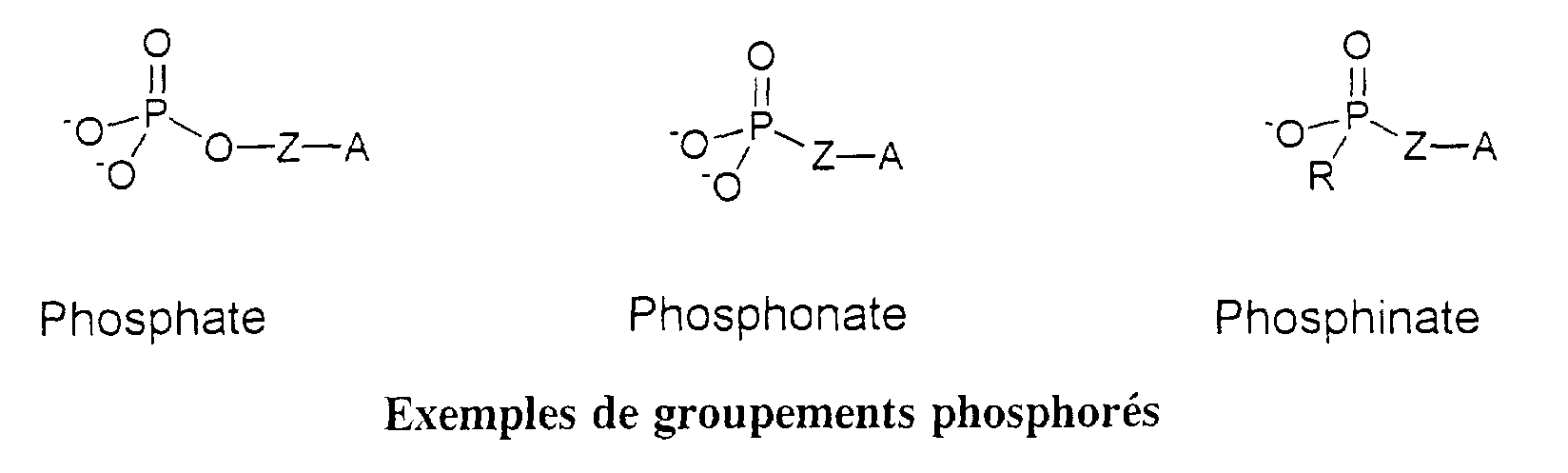
- the phosphorus groups are usually groups of the phosphate, phosphonate or phosphinate type represented below
- A designates the organic group preferably containing sulfur or a reactive group convertible into a group containing sulfur and Z is a group hydrocarbon defined below in conjunction with the process for the preparation of materials according to the present invention.
- Z is a hydrocarbon group containing from 1 to 24 carbon atoms, preferably from 2 to 12 carbon atoms and most often Z represents an aromatic hydrocarbon chain or an aliphatic hydrocarbon chain and in this preferably a hydroca chain saturated aliphatic bond connecting the group containing phosphorus to the group containing sulfur.
- the phosphorus compound used is a compound of formula I in which Cat + is a H + proton or preferably an alkaline cation, R is an alkyl group having from 1 to 18 carbon atoms or an aryl group having from 6 to 18 carbon atoms or an alkyl-aryl group having from 7 to 24 carbon atoms, X is chosen from the group formed by alkyl groups having from 1 to 18 carbon atoms, the aryl groups having from 6 to 18 carbon atoms , alkyl-aryl groups having from 7 to 24 carbon atoms and groups of formula SiR " 3 in which R" is a hydrocarbon group, Z is a bivalent saturated or unsaturated alkyl group having from 1 to 18 carbon atoms or a bivalent aryl group having 6 to 18 carbon atoms or a divalent alkyl-aryl or aryl-alkyl group having 7 to 24 carbon atoms and A is a sulfur-containing group selected from thiol groups and their derivatives, acid groups s
- This group A is preferably a thiol group of formula -SH or a sulfonic group of formula -SO 3 - Cat ' + in which Cat' + represents a proton H + or a monovalent cation such as for example a cation of a metal alkaline.
- Cat' + represents a proton H + or a monovalent cation such as for example a cation of a metal alkaline.
- Z is a divalent saturated alkyl group having from 1 to 6 carbon atoms and preferably a polymethylene group and often a polymethylene group having from 1 to 4 carbon atoms.
- Group A can also be a reactive group convertible into a sulfur-containing group, most often a halogenated group, such as for example a bromine atom or a chlorine atom.
- the solvent for the phosphorus compound of formula I is for example water or a solvent organic such as dimethylsulfoxide or tetrahydrofuran or dichloromethane.
- the liquid used to suspend the mineral oxide of element M in suspension is preferably the solvent used to dissolve the compound of formula I.
- a three-necked flask 1.049 g (6.64 * 10 -3 mole) of phenylphosphonic acid are dissolved in a methanol / water mixture (750/250 ml).
- the pH of the solution measured by a previously standardized pH meter is equal to 3.2.
- the pH is then adjusted to 6 by adding an aqueous solution of sodium hydroxide of normality 1N.
- a suspension of 2 g (1.96 * 10 -2 mole) of Degussa alumina C in 200 ml of deionized water is then added.
- a condenser is added to the assembly and the reaction mixture is stirred for 24 hours at room temperature.
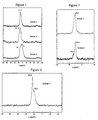
- the phosphor 31 NMR spectrum of solid 1 (see FIG. 1) produced on a Bruker Avance 300 MHz device shows a broad peak at 11.7 ppm with a shoulder at 10.5 ppm, corresponding to the chemical shift expected for phenylphosphonate groups bound to the surface of the alumina particles, the specific surface of the alumina used as a support remains unchanged at 90 m 2 / g.
- the NMR spectrum of phosphorus 31 of solid 2 (see FIG. 1) produced on a Bruker Avance 300 MHz device shows a broad peak at 11.3 ppm corresponding to the chemical shift observed for phenylphosphonate groups bound to the surface of the alumina particles.
- the specific surface of the alumina used as support remains unchanged at 90 m 2 / g.
- the phosphor 31 NMR spectrum of solid 3 (see FIG. 1) produced on a Bruker apparatus Advance 300 MHz shows a peak at +2 ppm corresponding to the expected chemical shift for phenylphosphonate groups bound to aluminum atoms in a phase aluminum phenylphosphonate and a shoulder at 12 ppm corresponding to displacement chemical expected for phenylphosphonate groups bound to the particle surface alumina.
- grafting under the conditions described above leads to a significant increase in the specific surface area of the alumina used as support, which goes from 90 m 2 / g before grafting to 140 m 2 / g after grafting.
- a functionalized solid containing a sulfonic acid group is prepared.
- a phosphonate of formula Br (CH 2 ) 3 PO was prepared according to the Arbuzov reaction (March, J Advanced Organic Chemistry, 3 rd edition, John Wiley & Sons, New-York, 1985 p. 848). 3 and 2 (I ').
- P (OEt) 3 + Br- (CH 2 ) 3 -Br ⁇ Br- (CH 2 ) 3 -PO 3 Et 2 + EtBr 1 equivalent of triethylphosphite and 1.5 equivalent of 1,3-dibromopropane are introduced into a reactor under a nitrogen atmosphere. The reactor is brought to 140 ° C.
- a condenser is added to the assembly and the reaction mixture is stirred for 24 hours at room temperature.
- the solid is then filtered and washed 5 times with 50 ml of methanol so as to remove the propane-1-phosphono-3-sulfonic acid physisorbed.
- the solid is then washed with deionized water, ethanol, acetone and ether and dried for 5 hours at 120 ° C under 5 * 10 -2 mbar. Elemental analysis of solid 4 gives the following results: A1: 36.6%, P: 0.9% and sulfur S: 0.7%, i.e. an A1 / P molar ratio of 47 and an S / P molar ratio 0.76.
- the NMR spectrum of phosphorus 31 of solid 4 (see FIG. 2) produced on a Bruker Avance 300 MHz device shows a broad peak at 23.9 ppm and a shoulder at 19.8 ppm corresponding to the chemical shift expected for O 3 groups.
- P (CH 2 ) 3 SO 3 H bound to the surface of the alumina particles.
- 4 g (39.2 mmol) of Degussa alumina C previously dried overnight at 120 ° C. under 5 * 10 -2 mbar
- 16 ml of a 0.1M solution of phenylphosphonic acid in water are added.
- the mixture is brought to reflux with stirring for one hour at 83 ° C.
- the product is dried in a vacuum oven at 110 ° C overnight.
- the product is placed in a 100 ml flask and 8 ml of fuming sulfuric acid are added. The flask is closed and stirred so as to coat all the particles, then it is stirred for two minutes. The contents of the flask are then placed in an erlennmeyer with 1.2 liters (66.7 moles) of deionized water and the whole is left to stand. The product is then rediluted 3 times with 1.2 liters of water (66.7 moles) each time. After allowing the product to settle, the water is drained off and the product is covered with methanol. It is left to stand overnight and then the methanol is removed. The methanol product is again covered and allowed to evaporate.
- a suspension of 2 g (2.5 * 10 -2 mole) of TiO 2 P25 Degussa (previously dried overnight at 120 ° C under 5 * 10 -2 mbar) in 200 ml of deionized water is then added.
- a condenser is added to the assembly and the reaction mixture is stirred for 72 hours at room temperature.
- the solid is then filtered and washed 5 times with 50 ml of methanol so as to remove the propane-1-phosphono-3-sulfonic acid physisorbed.
- the solid is then washed with deionized water, ethanol, acetone and ether and dried for 5 hours at 120 ° C under 5 * 10 -2 mbar.
- Elemental analysis of solid 6 gives the following results: Ti: 55.5%, P: 0.4%, S: 0.5%, ie a molar ratio_Ti / P of 90 and a molar ratio S / P of 0, 8.
- the NMR spectrum of phosphorus 31 of solid 6 (see FIG. 3) produced on a Bruker Avance 300 MHz device shows a broad peak at 24.9 ppm and a shoulder at 33.5 ppm corresponding to the chemical shift expected for O 3 groups.
- P (CH 2 ) 3 SO 3 H grafted on the surface of the titanium oxide particles.
- a functionalized solid containing a thiol group is prepared.
- the diethyl bromopropylphosphonate of formula Br (CH 2 ) 3 PO 3 Et 2 (I ') was prepared according to the procedure described above in Example 4.
- a second step according to the procedure described for example in patent DE 1,024,964 in a reactor containing 2 equivalents of sodium hydrogen sulfide in solution in methanol, a solution diluted in methanol containing 1 equivalent of diethyl bromopropylphosphonate is introduced dropwise.
- formula Br (CH 2 ) 3 PO 3 And 2 (I ') is brought to reflux and maintained at reflux with stirring for 4 hours.
- a suspension of 2 g (2.5 * 10 -2 mole) of TiO 2 P25 Degussa, (previously dried overnight at 120 ° C under 5 * 10 -2 mbar) in 40 ml of dry dichloromethane is then added.
- a condenser is added to the assembly which is placed under argon.
- the reaction mixture is stirred for 24 hours at 40 ° C.
- the solid is then filtered and washed 5 times with 50 ml of methanol so as to remove the physisorbed diethylmercaptopropylphosphonate.
- the solid is then washed with dry dichloromethane, acetone and ether and dried for 5 hours at 120 ° C under 5 * 10 -2 mbar.
- Elemental analysis of solid 7 gives the following results: Ti: 57.2%, P: 0.54%, S: 0.4%, ie a Ti / P molar ratio of 74 and an S / P molar ratio of 0 8.
- the phosphor 31 NMR spectrum of solid 7 (see FIG. 3) produced on a Bruker Avance 300 MHz device shows a broad peak at 26.6 ppm corresponding to the chemical shift expected for O 3 P (CH 2 ) 3 SH groups bound on the surface of the titanium oxide particles.
Landscapes
- Chemical & Material Sciences (AREA)
- Organic Chemistry (AREA)
- Chemical Kinetics & Catalysis (AREA)
- Engineering & Computer Science (AREA)
- Analytical Chemistry (AREA)
- Nanotechnology (AREA)
- Materials Engineering (AREA)
- Condensed Matter Physics & Semiconductors (AREA)
- Crystallography & Structural Chemistry (AREA)
- General Physics & Mathematics (AREA)
- Physics & Mathematics (AREA)
- Inorganic Chemistry (AREA)
- Composite Materials (AREA)
- Manufacturing & Machinery (AREA)
- Compounds Of Alkaline-Earth Elements, Aluminum Or Rare-Earth Metals (AREA)
- Oxygen, Ozone, And Oxides In General (AREA)
- Inorganic Compounds Of Heavy Metals (AREA)
Abstract
Description
Dans les formules ci-devant R1 désigne un groupe hydrocarboné ayant le plus souvent de 1 à 24 atomes de carbone et par exemple un reste alkyle, aryle ou alkyl-aryle,

L'analyse élémentaire du solide 1 donne les résultats suivant : A1 37,0%, P 2,1%. Soit un rapport molaire A1/P de20,2.
L'analyse élémentaire du solide 2 donne les résultats suivant : A1 50,5%, P 1,0% soit un rapport molaire A1/P de 58.
L'analyse élémentaire du solide 3 donne les résultats suivant : A1 : 28,8 %, P : 2,3 % soit un rapport molaire A1/P de 14,4.
Dans une première étape on a préparé selon la réaction d'Arbuzov (March, J Advanced Organic Chemistry, 3 ième édition, John Wiley & Sons, New-York, 1985 p. 848) un phosphonate de formule Br(CH2)3PO3Et2 (I').
L'analyse élémentaire du solide 5 donne les résultats suivant : A1 : 35,5 %, P : <0,2 %, S : 0,24 %. Il y a donc une perte très importante des groupements phophonates, soit un rapport molaire A1/P de 203,8 et un rapport molaire S/P de 1,16.
L'analyse élémentaire du solide 6 donne les résultats suivant : Ti : 55,5%, P : 0,4%, S : 0,5% soit un rapport molaire_Ti/P de 90 et un rapport molaire S/P de 0,8.
Le spectre de RMN du phosphore 31 du solide 6 (voir figure 3) réalisé sur un appareil Bruker Avance 300 MHz montre un pic large à 24,9 ppm et un épaulement à 33,5 ppm correspondant au déplacement chimique attendu pour des groupes O3P(CH2)3SO3H greffés à la surface des particules d'oxyde de titane.
Dans une première étape on a préparé selon la procédure décrite ci-devant dans l'exemple 4 le diéthyl bromopropylphosphonate de formule Br(CH2)3PO3Et2 (I'). Dans une deuxième étape, selon la procédure décrite par exemple dans le brevet DE 1,024,964 dans un réacteur contenant 2 équivalents d'hydrogénosulfure de sodium en solution dans du méthanol on introduit goutte à goutte une solution diluée dans du méthanol contenant 1 équivalent de diéthyl bromopropylphosphonate de formule Br(CH2)3PO3Et2 (I') on porte au reflux et on maintien au reflux sous agitation pendant 4 heures. Après évaporation du méthanol on reprend dans du pentane puis on filtre pour récupérer le bromure de sodium NaBr. Après évaporation du pentane et distillation sous vide on récupère le diéthylmercaptopropylphosphonate de formule HS(CH2)3PO3Et2. Dans un ballon tricol, on dissout 0,70 g (3,32*10-3 mole) de diéthylmercaptopropylphosphonate dans 40 ml de dichlorométhane sec. Une suspension de 2 g (2,5*10-2 mole) de TiO2 P25 Degussa, (préalablement séchés pendant une nuit à 120°C sous 5*10-2 mbar) dans 40 ml de dichlorométhane sec est alors ajoutée. Un réfrigérant est ajouté au montage qui est placé sous argon .Le mélange réactionnel est agité pendant 24 heures à 40°C. Le solide est ensuite filtré et lavé 5 fois avec 50 ml de méthanol de façon à ôter le diéthylmercaptopropylphosphonate physisorbé. Le solide est ensuite lavé avec du dichlorométhane sec, de l'acétone et de l'éther et séché pendant 5 heures à 120°C sous 5*10-2 mbar.
Claims (15)
- Matériaux fonctionnalisés comportant des groupements organiques du phosphore liés par l'intermédiaire d'atomes d'oxygènes à un oxyde minéral d'au moins un élément M, lesdits matériaux étant caractérisés en ce qu'ils sont essentiellement amorphes, en ce qu'ils comportent une couche essentiellement monomoléculaire de groupements organiques liés audit oxyde minéral par l'intermédiaire d'atome d'oxygènes dudit oxyde à l'atome de phosphore et en ce que lesdits matériaux sont essentiellement exempts de phase phosphate, phosphonate ou phosphinate dudit élément M.
- Matériaux fonctionnalisés selon la revendication 1 comprenant, à distance de l'atome de phosphore, un groupe contenant du soufre ou un groupe réactif transformable en un groupe contenant du soufre lesdits matériaux étant essentiellement exempts de phase sulfate dudit élément M.
- Matériaux fonctionnalisés selon la revendication 2 dans lesquels le groupement organique contenant du soufre est choisi dans le groupe formé par les groupes thiols et leur dérivés, les groupes acides sulfoniques et leur dérivés.
- Matériaux selon la revendication 2 ou 3 dans lesquels le groupement organique contenant du soufre est choisi dans le groupe formé par le groupement thiol de formule -SH, le groupement sulfure de formule -S-R1 dans laquelle R1 est un reste hydrocarboné et le groupement polysulfure de formule -(S)y-R1 dans laquelle y est un nombre supérieur ou égal à 2 et R1 est un reste hydrocarboné
- Matériaux selon la revendication 2 ou 3 dans lesquels le groupement organique contenant du soufre est choisi dans le groupe formé par le groupement acide sulfonique de formule - SO3H, les groupements sulfonates organiques de formules -SO3R1 dans laquelle R1 est un reste hydrocarboné et les goupements sulfonates minéraux de formules -SO3(M')1/t dans laquelle M' est un élément de valence t du tableau périodique des éléments et de préférence un métal alcalin.
- Matériaux selon l'une des revendications 2 à 5 dans lesquels la chaíne hydrocarbonée reliant le groupement contenant du phosphore au groupement contenant du soufre contient de 1 à 24 atomes de carbone, de préférence de 2 à 12 atomes de carbone.
- Matériaux selon l'une des revendications 2 à 6 dans lesquels la chaíne hydrocarbonée reliant le groupement contenant du phosphore au groupement contenant du soufre est une chaíne aromatique ou une chaíne aliphatique et de préférence une chaíne aliphatique saturée.
- Matériaux selon l'une des revendications 1 à 7 dans lesquels M désigne un éléments des groupes IB, IIB, IIIB, IVB, VB, VIB, VIIB, VIII, IIIA, IVA, des lanthanides ou des actinides de la classification périodique des éléments.
- Matériaux selon l'une des revendications 1 à 8 dans lesquels dans lequel M est choisi parmi les éléments du groupe comprenant le titane, le zirconium, le fer, l'aluminium, le silicium et l'étain et de préférence parmi les éléments du groupe comprenant le titane, le zirconium et l'aluminium.
- Procédé de préparation d'un matériau fonctionnalisé selon l'une des revendications 1 à 9 dans lequel on met en contact une suspension dans un liquide d'au moins un oxyde minéral d'un élément M avec une solution dans un solvant d'au moins un composé phosphoré de formule Idans laquelle la somme m+n+p+q est égale à 3, m =0, 1 ou 2, q =0, 1 ou 2, x=0 ou 1, p=0,1 ou 2, R est un groupe hydrocarboné, X est un atome d'hydrogène, un groupe hydrocarboné ou un groupe de formule SiR"3 dans lequel R" est un groupe hydrocarboné, Z est un groupe hydrocarboné comportant éventuellement des hétéroatomes, Cat+ est un cation monovalent et A est un groupe contenant du soufre ou un groupe réactif transformable en un groupe contenant du soufre, ladite mise en contact étant effectuée dans des conditions de pression, de température et d'acidité du milieu telles qu'il ne se forme pratiquement pas de phase phosphate, phosphonate, phosphinate et sulfate dudit élément M.

- Procédé selon la revendication 10 dans lequel on met en contact une suspension dans un liquide d'au moins un oxyde minéral de l'élément M avec une solution dans un solvant du composé phosphoré de formule I dans laquelle Cat+ est un proton H+, R est un groupe alcoyle ayant de 1 à 18 atomes de carbone ou un groupe aryle ayant de 6 à 18 atomes de carbone ou une groupe alkyl-aryle ayant de 7 à 24 atomes de carbone, X est choisi dans le groupe formé par les groupes alcoyles ayant de 1 à 18 atomes de carbone, les groupes aryles ayant de 6 à 18 atomes de carbone, les groupes alkyl-aryles ayant de 7 à 24 atomes de carbone et les groupes de formule SiR"3 dans lequel R" est un groupe hydrocarboné, Z est un groupe alkylique bivalent saturé ou non ayant de 1 à 18 atomes de carbone ou un groupe arylique bivalent ayant de 6 à 18 atomes de carbone ou une groupe bivalent alkyl-arylique ou aryl-alkylique ayant de 7 à 24 atomes de carbone et A est un groupe contenant du soufre choisi parmi les groupes thiols et leurs dérivés, les groupes acides sulfoniques et leurs dérivés.
- Procédé selon l'une des revendications 10 ou 11 dans laquelle le composé phosphoré de formule I est un composé dans lequel Z est un groupe alkylique bivalent saturé ayant de 1 à 6 atomes de carbone et de préférence un groupe polyméthylène.
- Procédé selon l'une des revendications 10 à 12 dans laquelle le solvant du composé phosphoré est choisi dans le groupe formé par le tétrahydrofurane, le dimethylsulfoxyde, le dichlorométhane et l'eau.
- Procédé selon l'une des revendications 10 à 13 dans lequel le composé phosphoré de formule I employé est un composé dans lequel m=2, q=1 et n=p=zéro.
- Procédé selon l'une des revendications 10 à 13 dans lequel le composé phosphoré de formule I employé est un composé dans lequel n=2, q=1 et m=p=zéro.
Applications Claiming Priority (2)
| Application Number | Priority Date | Filing Date | Title |
|---|---|---|---|
| FR0010695 | 2000-08-17 | ||
| FR0010695A FR2813025B1 (fr) | 2000-08-17 | 2000-08-17 | Materiaux comportant des groupements organiques contenant du phosphore lie par l'intermediaire d'atomes d'oxygenes a un oxyde mineral |
Publications (1)
| Publication Number | Publication Date |
|---|---|
| EP1180396A1 true EP1180396A1 (fr) | 2002-02-20 |
Family
ID=8853573
Family Applications (1)
| Application Number | Title | Priority Date | Filing Date |
|---|---|---|---|
| EP01402128A Withdrawn EP1180396A1 (fr) | 2000-08-17 | 2001-08-07 | Matériaux comportant des groupement organiques contenant du phosphore lié par l'intermédiaire d'atomes d'oxygenes à un oxyde minéral |
Country Status (5)
| Country | Link |
|---|---|
| US (1) | US6958307B2 (fr) |
| EP (1) | EP1180396A1 (fr) |
| JP (1) | JP2002160908A (fr) |
| KR (1) | KR100783443B1 (fr) |
| FR (1) | FR2813025B1 (fr) |
Cited By (2)
| Publication number | Priority date | Publication date | Assignee | Title |
|---|---|---|---|---|
| WO2007080291A1 (fr) * | 2006-01-13 | 2007-07-19 | Centre National De La Recherche Scientifique | Preparation d'un substrat inorganique presentant des proprietes anti-microbiennes. |
| FR2904241A1 (fr) * | 2006-07-31 | 2008-02-01 | Inst Francais Du Petrole | Procede de preparation de materiaux par greffage de groupements phosphores halogenes sur une surface inorganique |
Families Citing this family (4)
| Publication number | Priority date | Publication date | Assignee | Title |
|---|---|---|---|---|
| FR2809400B1 (fr) * | 2000-05-25 | 2004-04-09 | Inst Francais Du Petrole | Materiaux comportant des groupements organiques contenant du soufre et du phosphore lie par l'intermediaire d'atomes d'oxygenes a un oxyde mineral |
| US7993537B2 (en) * | 2007-02-23 | 2011-08-09 | GM Global Technology Operations LLC | Method for improving adhesion between a shape memory alloy and a polymer |
| EP2554367B1 (fr) | 2010-03-30 | 2016-06-29 | Kuraray Co., Ltd. | Structure composite, matériau d'emballage et article moulé produits chacun à partir de celle-ci, et procédé pour la production de la structure composite |
| ES2980666T3 (es) | 2014-02-24 | 2024-10-02 | Vito Nv | Utilización de membranas inorgánicas injertadas con fracciones orgánicas para incrementar la resistencia al ensuciamiento |
Citations (6)
| Publication number | Priority date | Publication date | Assignee | Title |
|---|---|---|---|---|
| EP0218506A1 (fr) * | 1985-09-17 | 1987-04-15 | Institut National De La Sante Et De La Recherche Medicale (Inserm) | Procédé d'insolubilisation d'enzymes par fixation sur des complexes alumine-phosphates organiques et enzymes insolubilisées obtenues par ce procédé, nouveaux supports d'enzymes et leur procédé de préparation et application desdits enzymes insolubilisées |
| US4786628A (en) * | 1987-03-09 | 1988-11-22 | Aluminum Company Of America | Chromatographic packings comprising metal oxide/hydroxide reacted with phosphonic acid |
| US4994429A (en) * | 1986-12-29 | 1991-02-19 | Aluminum Company Of America | Active material useful as adsorbent comprising metal oxide/hydroxide particles reacted with phosphorus-containing organic acid group of organic compound having unreacted acid group |
| EP0443734A1 (fr) * | 1990-02-20 | 1991-08-28 | Minnesota Mining And Manufacturing Company | Fibres enrobées d'oxyde de zirconium |
| US5059258A (en) * | 1989-08-23 | 1991-10-22 | Aluminum Company Of America | Phosphonic/phosphinic acid bonded to aluminum hydroxide layer |
| FR2773171A1 (fr) * | 1997-12-31 | 1999-07-02 | Ase & Bio Soc Civ | Enzymes immobilisees sur un support, leurs procedes de preparation et leurs applications |
Family Cites Families (16)
| Publication number | Priority date | Publication date | Assignee | Title |
|---|---|---|---|---|
| US3177233A (en) * | 1963-08-30 | 1965-04-06 | Shell Oil Co | Oil-soluble polyvalent metal salts of alkyl mercaptomethyl phosphonic acid |
| JPS60106861A (ja) * | 1983-11-12 | 1985-06-12 | Daihachi Kagaku Kogyosho:Kk | 有機リン酸エステル系化合物による改質無機粉体 |
| US4788176A (en) * | 1986-12-29 | 1988-11-29 | Aluminum Company Of America | Adsorbent comprising metal oxide/hydroxide particles reacted with one or more phosphorous-containing materials having selected organic radicals attached thereto |
| JPS63248437A (ja) * | 1986-12-29 | 1988-10-14 | アルミナム カンパニー オブ アメリカ | 吸着剤として有用な活性物質およびその製造方法 |
| US4962073A (en) * | 1986-12-29 | 1990-10-09 | Aluminum Company Of America | Surface treated porous ceramic membranes and method of making same |
| US4957890A (en) * | 1986-12-29 | 1990-09-18 | Aluminum Company Of America | Surface treated permeable inorganic membranes and method of making same |
| US5037795A (en) * | 1987-03-09 | 1991-08-06 | Aluminum Company Of America | Chromatographic packing material comprising extended area metal oxide/hydroxide particles with a layer of a phosphorus-containing material thereon |
| US5240602A (en) * | 1987-06-08 | 1993-08-31 | Chromatochem, Inc. | Chromatographic material |
| US5032237A (en) * | 1989-08-23 | 1991-07-16 | Aluminum Company Of America | Anodic phosphonic/phosphinic acid duplex coating on valve metal surface |
| JPH0629137B2 (ja) * | 1989-09-11 | 1994-04-20 | 工業技術院長 | 金超微粒子固定化酸化チタンの製造法 |
| GB9510222D0 (en) * | 1995-05-20 | 1995-07-19 | Zeneca Ltd | Compositions of matter |
| FR2753971A1 (fr) * | 1996-09-27 | 1998-04-03 | Rhone Poulenc Chimie | Nouveaux phosphonates d'elements tetravalents et leur procede de preparation |
| JPH1121469A (ja) * | 1997-07-03 | 1999-01-26 | Ishihara Sangyo Kaisha Ltd | 無機化合物の製造方法 |
| JP3985326B2 (ja) * | 1998-02-17 | 2007-10-03 | 東ソー株式会社 | イオン交換性複合体およびその製造方法 |
| JP3566122B2 (ja) * | 1999-02-24 | 2004-09-15 | シャープ株式会社 | 高密度有機分子薄膜の製造方法 |
| FR2809400B1 (fr) * | 2000-05-25 | 2004-04-09 | Inst Francais Du Petrole | Materiaux comportant des groupements organiques contenant du soufre et du phosphore lie par l'intermediaire d'atomes d'oxygenes a un oxyde mineral |
-
2000
- 2000-08-17 FR FR0010695A patent/FR2813025B1/fr not_active Expired - Lifetime
-
2001
- 2001-08-07 EP EP01402128A patent/EP1180396A1/fr not_active Withdrawn
- 2001-08-16 KR KR1020010049192A patent/KR100783443B1/ko not_active Expired - Lifetime
- 2001-08-16 US US09/930,153 patent/US6958307B2/en not_active Expired - Lifetime
- 2001-08-17 JP JP2001247509A patent/JP2002160908A/ja active Pending
Patent Citations (6)
| Publication number | Priority date | Publication date | Assignee | Title |
|---|---|---|---|---|
| EP0218506A1 (fr) * | 1985-09-17 | 1987-04-15 | Institut National De La Sante Et De La Recherche Medicale (Inserm) | Procédé d'insolubilisation d'enzymes par fixation sur des complexes alumine-phosphates organiques et enzymes insolubilisées obtenues par ce procédé, nouveaux supports d'enzymes et leur procédé de préparation et application desdits enzymes insolubilisées |
| US4994429A (en) * | 1986-12-29 | 1991-02-19 | Aluminum Company Of America | Active material useful as adsorbent comprising metal oxide/hydroxide particles reacted with phosphorus-containing organic acid group of organic compound having unreacted acid group |
| US4786628A (en) * | 1987-03-09 | 1988-11-22 | Aluminum Company Of America | Chromatographic packings comprising metal oxide/hydroxide reacted with phosphonic acid |
| US5059258A (en) * | 1989-08-23 | 1991-10-22 | Aluminum Company Of America | Phosphonic/phosphinic acid bonded to aluminum hydroxide layer |
| EP0443734A1 (fr) * | 1990-02-20 | 1991-08-28 | Minnesota Mining And Manufacturing Company | Fibres enrobées d'oxyde de zirconium |
| FR2773171A1 (fr) * | 1997-12-31 | 1999-07-02 | Ase & Bio Soc Civ | Enzymes immobilisees sur un support, leurs procedes de preparation et leurs applications |
Cited By (7)
| Publication number | Priority date | Publication date | Assignee | Title |
|---|---|---|---|---|
| WO2007080291A1 (fr) * | 2006-01-13 | 2007-07-19 | Centre National De La Recherche Scientifique | Preparation d'un substrat inorganique presentant des proprietes anti-microbiennes. |
| FR2896165A1 (fr) * | 2006-01-13 | 2007-07-20 | Centre Nat Rech Scient | Preparation d'un substrat inorganique presentant des proprietes anti-microbiennes |
| US20100249425A1 (en) * | 2006-01-13 | 2010-09-30 | Centre National De La Recherche Scientifique | Preparation of an inorganic substrate having antimicrobial properties |
| US8586758B2 (en) | 2006-01-13 | 2013-11-19 | Centre National De La Recherche Scientifique | Preparation of an inorganic substrate having antimicrobial properties |
| FR2904241A1 (fr) * | 2006-07-31 | 2008-02-01 | Inst Francais Du Petrole | Procede de preparation de materiaux par greffage de groupements phosphores halogenes sur une surface inorganique |
| WO2008015322A1 (fr) * | 2006-07-31 | 2008-02-07 | Ifp | Procédé de préparation de matériaux par greffage de groupements phosphores halogènes sur une surface inorganique |
| US8247539B2 (en) | 2006-07-31 | 2012-08-21 | IFP Energies Nouvelles | Process for preparing materials by grafting halogenated phosphorus-containing groups onto an inorganic surface |
Also Published As
| Publication number | Publication date |
|---|---|
| JP2002160908A (ja) | 2002-06-04 |
| KR100783443B1 (ko) | 2007-12-07 |
| KR20020014727A (ko) | 2002-02-25 |
| FR2813025A1 (fr) | 2002-02-22 |
| FR2813025B1 (fr) | 2002-11-29 |
| US20020023573A1 (en) | 2002-02-28 |
| US6958307B2 (en) | 2005-10-25 |
Similar Documents
| Publication | Publication Date | Title |
|---|---|---|
| EP1814891B1 (fr) | Bis-acylphosphanes et leur utilisation comme photo-initiateurs; procede de preparation d'acylphosphanes | |
| FR2813025A1 (fr) | Materiaux comportant des groupements organiques contenant du phosphore lie par l'intermediaire d'atomes d'oxygenes a un oxyde mineral | |
| EP1157994B1 (fr) | Matériaux comportant des groupements organiques contenant du soufre et du phosphoré liés par l'intermédiaire d'atomes d'oxygène à un oxyde minéral | |
| US20230095953A1 (en) | Method for producing cyclic polysiloxane | |
| EP2049257A1 (fr) | Procédé de préparation de matériaux par greffage de groupements phosphores halogènes sur une surface inorganique | |
| EP1080368B1 (fr) | Baton moleculaire et ses applications | |
| EP1140951B1 (fr) | Preparation de composes organophosphores sulfones hydrosolubles | |
| EP2665734B1 (fr) | PROCÉDÉ POUR LA FABRICATION DE COMPOSÉS CONTENANT UN GROUPE alpha -OXY-PHOSPHORÉ | |
| Dabkowski et al. | Anhydrides of phosphorus and sulfur acids, 2. Mixed anhydrides of phosphoric, phosphonic, and phosphinic acids with sulfonic acids and sulfuric Monoimidazolide. New methods of synthesis, novel structures, phosphorylating properties | |
| FR2804116A1 (fr) | Composes organosilicies, leur procede de preparation et leurs utilisations | |
| FR2986527A1 (fr) | Procede de preparation de phosphines tertiaires et de derives de celles-ci. | |
| KR101217010B1 (ko) | 포스포릴콜린기 함유 화합물 및 그 제조 방법 | |
| EP2870165B1 (fr) | Précurseurs organosilanes polysilylés fonctionnalisables | |
| FR2658515A1 (fr) | Nouveaux aminophosphine-phosphinites, leur procede de fabrication et leur application a des reactions enantioselectives. | |
| Chojnowski et al. | Optically active triorganosilyl esters of phosphorus synthesis and structure | |
| Zwierzak et al. | Organophosphorus esters—IV: Novel approach to monoalkyl hydrogen phosphites | |
| FR2834987A1 (fr) | Derives ureido ou carbamates d'ethers-couronnes et de silicum, utilisables pour preparer des supports destines a la separation par chromatographie de cations metalliques et de molecules organiques comportant des fonctions amines | |
| FR3069539B1 (fr) | Composes bifonctionnels a fonction thiophosphine, utiles comme extractants de l'uranium(vi), leurs procedes de synthese et leurs utilisations | |
| WO2008080833A1 (fr) | Procede de preparation d'une phosphine primaire | |
| WO2006003295A1 (fr) | Procede d'hydroxymethylation d'un acide phosphonique sous forme esterifiee | |
| FR2683222A1 (fr) | Procede de production d'acides, de sels et/ou esters aminoalcanephosphoniques. | |
| WO2025183219A1 (fr) | Dérivé de fullerène et procédé de production d'un dérivé de fullerène | |
| JP3658619B2 (ja) | 有機チオ基を単分子層吸着させた金とその製造方法 | |
| EP1888601A2 (fr) | Procede de preparation de composes organosiliciques en milieu biphasique | |
| FR2833264A1 (fr) | Procede d'obtention de monoorganoxysilanes polysulfures |
Legal Events
| Date | Code | Title | Description |
|---|---|---|---|
| PUAI | Public reference made under article 153(3) epc to a published international application that has entered the european phase |
Free format text: ORIGINAL CODE: 0009012 |
|
| AK | Designated contracting states |
Kind code of ref document: A1 Designated state(s): AT BE CH CY DE DK ES FI FR GB GR IE IT LI LU MC NL PT SE TR Kind code of ref document: A1 Designated state(s): DE ES GB IT NL |
|
| AX | Request for extension of the european patent |
Free format text: AL;LT;LV;MK;RO;SI |
|
| 17P | Request for examination filed |
Effective date: 20020820 |
|
| AKX | Designation fees paid |
Free format text: DE ES GB IT NL |
|
| 17Q | First examination report despatched |
Effective date: 20050805 |
|
| STAA | Information on the status of an ep patent application or granted ep patent |
Free format text: STATUS: THE APPLICATION IS DEEMED TO BE WITHDRAWN |
|
| 18D | Application deemed to be withdrawn |
Effective date: 20071023 |