EP1180246B1 - Verbundfolie - Google Patents
Verbundfolie Download PDFInfo
- Publication number
- EP1180246B1 EP1180246B1 EP00912823A EP00912823A EP1180246B1 EP 1180246 B1 EP1180246 B1 EP 1180246B1 EP 00912823 A EP00912823 A EP 00912823A EP 00912823 A EP00912823 A EP 00912823A EP 1180246 B1 EP1180246 B1 EP 1180246B1
- Authority
- EP
- European Patent Office
- Prior art keywords
- block copolymer
- film
- homopolymer
- copolymer
- composite
- Prior art date
- Legal status (The legal status is an assumption and is not a legal conclusion. Google has not performed a legal analysis and makes no representation as to the accuracy of the status listed.)
- Expired - Lifetime
Links
- 239000002131 composite material Substances 0.000 title claims abstract description 31
- 229920001400 block copolymer Polymers 0.000 claims abstract description 70
- 229920001519 homopolymer Polymers 0.000 claims abstract description 51
- 229920001577 copolymer Polymers 0.000 claims abstract description 33
- 239000000203 mixture Substances 0.000 claims abstract description 27
- 239000000758 substrate Substances 0.000 claims abstract description 27
- 239000004793 Polystyrene Substances 0.000 claims description 23
- 239000011248 coating agent Substances 0.000 claims description 15
- 238000000576 coating method Methods 0.000 claims description 15
- 229920002223 polystyrene Polymers 0.000 claims description 15
- 229920000359 diblock copolymer Polymers 0.000 claims description 14
- 229920000139 polyethylene terephthalate Polymers 0.000 claims description 14
- 239000005020 polyethylene terephthalate Substances 0.000 claims description 14
- 239000005062 Polybutadiene Substances 0.000 claims description 13
- 229920002857 polybutadiene Polymers 0.000 claims description 13
- 239000003085 diluting agent Substances 0.000 claims description 12
- 229920000642 polymer Polymers 0.000 claims description 11
- 238000000034 method Methods 0.000 claims description 9
- 239000000463 material Substances 0.000 claims description 8
- -1 polyethylene terephthalate Polymers 0.000 claims description 7
- 230000003287 optical effect Effects 0.000 claims description 5
- 239000002245 particle Substances 0.000 claims description 5
- 239000000654 additive Substances 0.000 claims description 4
- 238000004519 manufacturing process Methods 0.000 claims description 2
- 239000010408 film Substances 0.000 description 27
- 239000010410 layer Substances 0.000 description 21
- YXFVVABEGXRONW-UHFFFAOYSA-N Toluene Chemical compound CC1=CC=CC=C1 YXFVVABEGXRONW-UHFFFAOYSA-N 0.000 description 9
- 239000002904 solvent Substances 0.000 description 6
- 229920002799 BoPET Polymers 0.000 description 4
- KAKZBPTYRLMSJV-UHFFFAOYSA-N Butadiene Chemical compound C=CC=C KAKZBPTYRLMSJV-UHFFFAOYSA-N 0.000 description 4
- GWEVSGVZZGPLCZ-UHFFFAOYSA-N Titan oxide Chemical compound O=[Ti]=O GWEVSGVZZGPLCZ-UHFFFAOYSA-N 0.000 description 4
- 239000012790 adhesive layer Substances 0.000 description 3
- 230000001419 dependent effect Effects 0.000 description 3
- 229920000435 poly(dimethylsiloxane) Polymers 0.000 description 3
- 229920001195 polyisoprene Polymers 0.000 description 3
- 238000002310 reflectometry Methods 0.000 description 3
- 239000006120 scratch resistant coating Substances 0.000 description 3
- HEDRZPFGACZZDS-UHFFFAOYSA-N Chloroform Chemical compound ClC(Cl)Cl HEDRZPFGACZZDS-UHFFFAOYSA-N 0.000 description 2
- XEEYBQQBJWHFJM-UHFFFAOYSA-N Iron Chemical compound [Fe] XEEYBQQBJWHFJM-UHFFFAOYSA-N 0.000 description 2
- UQSXHKLRYXJYBZ-UHFFFAOYSA-N Iron oxide Chemical compound [Fe]=O UQSXHKLRYXJYBZ-UHFFFAOYSA-N 0.000 description 2
- VYPSYNLAJGMNEJ-UHFFFAOYSA-N Silicium dioxide Chemical compound O=[Si]=O VYPSYNLAJGMNEJ-UHFFFAOYSA-N 0.000 description 2
- PPBRXRYQALVLMV-UHFFFAOYSA-N Styrene Chemical compound C=CC1=CC=CC=C1 PPBRXRYQALVLMV-UHFFFAOYSA-N 0.000 description 2
- 239000006096 absorbing agent Substances 0.000 description 2
- 230000005540 biological transmission Effects 0.000 description 2
- RWGFKTVRMDUZSP-UHFFFAOYSA-N cumene Chemical compound CC(C)C1=CC=CC=C1 RWGFKTVRMDUZSP-UHFFFAOYSA-N 0.000 description 2
- 239000004205 dimethyl polysiloxane Substances 0.000 description 2
- 239000000975 dye Substances 0.000 description 2
- 238000007756 gravure coating Methods 0.000 description 2
- 238000007646 gravure printing Methods 0.000 description 2
- 239000012760 heat stabilizer Substances 0.000 description 2
- 239000004611 light stabiliser Substances 0.000 description 2
- 238000005191 phase separation Methods 0.000 description 2
- 239000004014 plasticizer Substances 0.000 description 2
- 229920003229 poly(methyl methacrylate) Polymers 0.000 description 2
- 239000004926 polymethyl methacrylate Substances 0.000 description 2
- 239000000126 substance Substances 0.000 description 2
- 230000008961 swelling Effects 0.000 description 2
- 239000004408 titanium dioxide Substances 0.000 description 2
- 229920000428 triblock copolymer Polymers 0.000 description 2
- ICMZFZGUTLNLAJ-UHFFFAOYSA-N 2,6-dimethyl-7-oxabicyclo[4.1.0]hepta-2,4-diene Chemical compound CC1=CC=CC2(C)OC12 ICMZFZGUTLNLAJ-UHFFFAOYSA-N 0.000 description 1
- 239000004215 Carbon black (E152) Substances 0.000 description 1
- IAYPIBMASNFSPL-UHFFFAOYSA-N Ethylene oxide Chemical compound C1CO1 IAYPIBMASNFSPL-UHFFFAOYSA-N 0.000 description 1
- 241000446313 Lamella Species 0.000 description 1
- 229920000134 Metallised film Polymers 0.000 description 1
- 229920003171 Poly (ethylene oxide) Polymers 0.000 description 1
- 239000004698 Polyethylene Substances 0.000 description 1
- 239000002174 Styrene-butadiene Substances 0.000 description 1
- 239000000853 adhesive Substances 0.000 description 1
- 230000001070 adhesive effect Effects 0.000 description 1
- 239000003963 antioxidant agent Substances 0.000 description 1
- MTAZNLWOLGHBHU-UHFFFAOYSA-N butadiene-styrene rubber Chemical compound C=CC=C.C=CC1=CC=CC=C1 MTAZNLWOLGHBHU-UHFFFAOYSA-N 0.000 description 1
- 238000001035 drying Methods 0.000 description 1
- 238000001704 evaporation Methods 0.000 description 1
- 230000008020 evaporation Effects 0.000 description 1
- 239000007888 film coating Substances 0.000 description 1
- 238000009501 film coating Methods 0.000 description 1
- 239000011521 glass Substances 0.000 description 1
- 229920002100 high-refractive-index polymer Polymers 0.000 description 1
- 229930195733 hydrocarbon Natural products 0.000 description 1
- 150000002430 hydrocarbons Chemical class 0.000 description 1
- AMGQUBHHOARCQH-UHFFFAOYSA-N indium;oxotin Chemical compound [In].[Sn]=O AMGQUBHHOARCQH-UHFFFAOYSA-N 0.000 description 1
- 229910052742 iron Inorganic materials 0.000 description 1
- 229920002521 macromolecule Polymers 0.000 description 1
- 239000000155 melt Substances 0.000 description 1
- 239000011104 metalized film Substances 0.000 description 1
- 239000003921 oil Substances 0.000 description 1
- 238000004806 packaging method and process Methods 0.000 description 1
- 229920000573 polyethylene Polymers 0.000 description 1
- 229920005553 polystyrene-acrylate Polymers 0.000 description 1
- 238000002360 preparation method Methods 0.000 description 1
- 238000007639 printing Methods 0.000 description 1
- 238000007761 roller coating Methods 0.000 description 1
- 238000000926 separation method Methods 0.000 description 1
- 239000000377 silicon dioxide Substances 0.000 description 1
- 238000007764 slot die coating Methods 0.000 description 1
- 238000002798 spectrophotometry method Methods 0.000 description 1
- 238000004528 spin coating Methods 0.000 description 1
- SKRWFPLZQAAQSU-UHFFFAOYSA-N stibanylidynetin;hydrate Chemical compound O.[Sn].[Sb] SKRWFPLZQAAQSU-UHFFFAOYSA-N 0.000 description 1
- 239000011115 styrene butadiene Substances 0.000 description 1
- 229920003048 styrene butadiene rubber Polymers 0.000 description 1
Images

Classifications
-
- C—CHEMISTRY; METALLURGY
- C03—GLASS; MINERAL OR SLAG WOOL
- C03C—CHEMICAL COMPOSITION OF GLASSES, GLAZES OR VITREOUS ENAMELS; SURFACE TREATMENT OF GLASS; SURFACE TREATMENT OF FIBRES OR FILAMENTS MADE FROM GLASS, MINERALS OR SLAGS; JOINING GLASS TO GLASS OR OTHER MATERIALS
- C03C17/00—Surface treatment of glass, not in the form of fibres or filaments, by coating
- C03C17/006—Surface treatment of glass, not in the form of fibres or filaments, by coating with materials of composite character
-
- B—PERFORMING OPERATIONS; TRANSPORTING
- B44—DECORATIVE ARTS
- B44C—PRODUCING DECORATIVE EFFECTS; MOSAICS; TARSIA WORK; PAPERHANGING
- B44C1/00—Processes, not specifically provided for elsewhere, for producing decorative surface effects
- B44C1/10—Applying flat materials, e.g. leaflets, pieces of fabrics
-
- B—PERFORMING OPERATIONS; TRANSPORTING
- B44—DECORATIVE ARTS
- B44F—SPECIAL DESIGNS OR PICTURES
- B44F1/00—Designs or pictures characterised by special or unusual light effects
- B44F1/02—Designs or pictures characterised by special or unusual light effects produced by reflected light, e.g. matt surfaces, lustrous surfaces
- B44F1/04—Designs or pictures characterised by special or unusual light effects produced by reflected light, e.g. matt surfaces, lustrous surfaces after passage through surface layers, e.g. pictures with mirrors on the back
-
- B—PERFORMING OPERATIONS; TRANSPORTING
- B44—DECORATIVE ARTS
- B44F—SPECIAL DESIGNS OR PICTURES
- B44F1/00—Designs or pictures characterised by special or unusual light effects
- B44F1/06—Designs or pictures characterised by special or unusual light effects produced by transmitted light, e.g. transparencies, imitations of glass paintings
-
- C—CHEMISTRY; METALLURGY
- C03—GLASS; MINERAL OR SLAG WOOL
- C03C—CHEMICAL COMPOSITION OF GLASSES, GLAZES OR VITREOUS ENAMELS; SURFACE TREATMENT OF GLASS; SURFACE TREATMENT OF FIBRES OR FILAMENTS MADE FROM GLASS, MINERALS OR SLAGS; JOINING GLASS TO GLASS OR OTHER MATERIALS
- C03C17/00—Surface treatment of glass, not in the form of fibres or filaments, by coating
- C03C17/28—Surface treatment of glass, not in the form of fibres or filaments, by coating with organic material
- C03C17/32—Surface treatment of glass, not in the form of fibres or filaments, by coating with organic material with synthetic or natural resins
-
- C—CHEMISTRY; METALLURGY
- C08—ORGANIC MACROMOLECULAR COMPOUNDS; THEIR PREPARATION OR CHEMICAL WORKING-UP; COMPOSITIONS BASED THEREON
- C08J—WORKING-UP; GENERAL PROCESSES OF COMPOUNDING; AFTER-TREATMENT NOT COVERED BY SUBCLASSES C08B, C08C, C08F, C08G or C08H
- C08J7/00—Chemical treatment or coating of shaped articles made of macromolecular substances
- C08J7/04—Coating
- C08J7/0427—Coating with only one layer of a composition containing a polymer binder
-
- C—CHEMISTRY; METALLURGY
- C08—ORGANIC MACROMOLECULAR COMPOUNDS; THEIR PREPARATION OR CHEMICAL WORKING-UP; COMPOSITIONS BASED THEREON
- C08J—WORKING-UP; GENERAL PROCESSES OF COMPOUNDING; AFTER-TREATMENT NOT COVERED BY SUBCLASSES C08B, C08C, C08F, C08G or C08H
- C08J7/00—Chemical treatment or coating of shaped articles made of macromolecular substances
- C08J7/04—Coating
- C08J7/043—Improving the adhesiveness of the coatings per se, e.g. forming primers
-
- C—CHEMISTRY; METALLURGY
- C08—ORGANIC MACROMOLECULAR COMPOUNDS; THEIR PREPARATION OR CHEMICAL WORKING-UP; COMPOSITIONS BASED THEREON
- C08J—WORKING-UP; GENERAL PROCESSES OF COMPOUNDING; AFTER-TREATMENT NOT COVERED BY SUBCLASSES C08B, C08C, C08F, C08G or C08H
- C08J7/00—Chemical treatment or coating of shaped articles made of macromolecular substances
- C08J7/04—Coating
- C08J7/046—Forming abrasion-resistant coatings; Forming surface-hardening coatings
-
- C—CHEMISTRY; METALLURGY
- C08—ORGANIC MACROMOLECULAR COMPOUNDS; THEIR PREPARATION OR CHEMICAL WORKING-UP; COMPOSITIONS BASED THEREON
- C08L—COMPOSITIONS OF MACROMOLECULAR COMPOUNDS
- C08L53/00—Compositions of block copolymers containing at least one sequence of a polymer obtained by reactions only involving carbon-to-carbon unsaturated bonds; Compositions of derivatives of such polymers
-
- C—CHEMISTRY; METALLURGY
- C08—ORGANIC MACROMOLECULAR COMPOUNDS; THEIR PREPARATION OR CHEMICAL WORKING-UP; COMPOSITIONS BASED THEREON
- C08L—COMPOSITIONS OF MACROMOLECULAR COMPOUNDS
- C08L53/00—Compositions of block copolymers containing at least one sequence of a polymer obtained by reactions only involving carbon-to-carbon unsaturated bonds; Compositions of derivatives of such polymers
- C08L53/02—Compositions of block copolymers containing at least one sequence of a polymer obtained by reactions only involving carbon-to-carbon unsaturated bonds; Compositions of derivatives of such polymers of vinyl-aromatic monomers and conjugated dienes
-
- C—CHEMISTRY; METALLURGY
- C08—ORGANIC MACROMOLECULAR COMPOUNDS; THEIR PREPARATION OR CHEMICAL WORKING-UP; COMPOSITIONS BASED THEREON
- C08L—COMPOSITIONS OF MACROMOLECULAR COMPOUNDS
- C08L53/00—Compositions of block copolymers containing at least one sequence of a polymer obtained by reactions only involving carbon-to-carbon unsaturated bonds; Compositions of derivatives of such polymers
- C08L53/02—Compositions of block copolymers containing at least one sequence of a polymer obtained by reactions only involving carbon-to-carbon unsaturated bonds; Compositions of derivatives of such polymers of vinyl-aromatic monomers and conjugated dienes
- C08L53/025—Compositions of block copolymers containing at least one sequence of a polymer obtained by reactions only involving carbon-to-carbon unsaturated bonds; Compositions of derivatives of such polymers of vinyl-aromatic monomers and conjugated dienes modified
-
- C—CHEMISTRY; METALLURGY
- C09—DYES; PAINTS; POLISHES; NATURAL RESINS; ADHESIVES; COMPOSITIONS NOT OTHERWISE PROVIDED FOR; APPLICATIONS OF MATERIALS NOT OTHERWISE PROVIDED FOR
- C09D—COATING COMPOSITIONS, e.g. PAINTS, VARNISHES OR LACQUERS; FILLING PASTES; CHEMICAL PAINT OR INK REMOVERS; INKS; CORRECTING FLUIDS; WOODSTAINS; PASTES OR SOLIDS FOR COLOURING OR PRINTING; USE OF MATERIALS THEREFOR
- C09D153/00—Coating compositions based on block copolymers containing at least one sequence of a polymer obtained by reactions only involving carbon-to-carbon unsaturated bonds; Coating compositions based on derivatives of such polymers
-
- C—CHEMISTRY; METALLURGY
- C09—DYES; PAINTS; POLISHES; NATURAL RESINS; ADHESIVES; COMPOSITIONS NOT OTHERWISE PROVIDED FOR; APPLICATIONS OF MATERIALS NOT OTHERWISE PROVIDED FOR
- C09D—COATING COMPOSITIONS, e.g. PAINTS, VARNISHES OR LACQUERS; FILLING PASTES; CHEMICAL PAINT OR INK REMOVERS; INKS; CORRECTING FLUIDS; WOODSTAINS; PASTES OR SOLIDS FOR COLOURING OR PRINTING; USE OF MATERIALS THEREFOR
- C09D153/00—Coating compositions based on block copolymers containing at least one sequence of a polymer obtained by reactions only involving carbon-to-carbon unsaturated bonds; Coating compositions based on derivatives of such polymers
- C09D153/02—Vinyl aromatic monomers and conjugated dienes
-
- C—CHEMISTRY; METALLURGY
- C09—DYES; PAINTS; POLISHES; NATURAL RESINS; ADHESIVES; COMPOSITIONS NOT OTHERWISE PROVIDED FOR; APPLICATIONS OF MATERIALS NOT OTHERWISE PROVIDED FOR
- C09D—COATING COMPOSITIONS, e.g. PAINTS, VARNISHES OR LACQUERS; FILLING PASTES; CHEMICAL PAINT OR INK REMOVERS; INKS; CORRECTING FLUIDS; WOODSTAINS; PASTES OR SOLIDS FOR COLOURING OR PRINTING; USE OF MATERIALS THEREFOR
- C09D153/00—Coating compositions based on block copolymers containing at least one sequence of a polymer obtained by reactions only involving carbon-to-carbon unsaturated bonds; Coating compositions based on derivatives of such polymers
- C09D153/02—Vinyl aromatic monomers and conjugated dienes
- C09D153/025—Vinyl aromatic monomers and conjugated dienes modified
-
- C—CHEMISTRY; METALLURGY
- C09—DYES; PAINTS; POLISHES; NATURAL RESINS; ADHESIVES; COMPOSITIONS NOT OTHERWISE PROVIDED FOR; APPLICATIONS OF MATERIALS NOT OTHERWISE PROVIDED FOR
- C09J—ADHESIVES; NON-MECHANICAL ASPECTS OF ADHESIVE PROCESSES IN GENERAL; ADHESIVE PROCESSES NOT PROVIDED FOR ELSEWHERE; USE OF MATERIALS AS ADHESIVES
- C09J153/00—Adhesives based on block copolymers containing at least one sequence of a polymer obtained by reactions only involving carbon-to-carbon unsaturated bonds; Adhesives based on derivatives of such polymers
-
- C—CHEMISTRY; METALLURGY
- C09—DYES; PAINTS; POLISHES; NATURAL RESINS; ADHESIVES; COMPOSITIONS NOT OTHERWISE PROVIDED FOR; APPLICATIONS OF MATERIALS NOT OTHERWISE PROVIDED FOR
- C09J—ADHESIVES; NON-MECHANICAL ASPECTS OF ADHESIVE PROCESSES IN GENERAL; ADHESIVE PROCESSES NOT PROVIDED FOR ELSEWHERE; USE OF MATERIALS AS ADHESIVES
- C09J153/00—Adhesives based on block copolymers containing at least one sequence of a polymer obtained by reactions only involving carbon-to-carbon unsaturated bonds; Adhesives based on derivatives of such polymers
- C09J153/02—Vinyl aromatic monomers and conjugated dienes
-
- C—CHEMISTRY; METALLURGY
- C09—DYES; PAINTS; POLISHES; NATURAL RESINS; ADHESIVES; COMPOSITIONS NOT OTHERWISE PROVIDED FOR; APPLICATIONS OF MATERIALS NOT OTHERWISE PROVIDED FOR
- C09J—ADHESIVES; NON-MECHANICAL ASPECTS OF ADHESIVE PROCESSES IN GENERAL; ADHESIVE PROCESSES NOT PROVIDED FOR ELSEWHERE; USE OF MATERIALS AS ADHESIVES
- C09J153/00—Adhesives based on block copolymers containing at least one sequence of a polymer obtained by reactions only involving carbon-to-carbon unsaturated bonds; Adhesives based on derivatives of such polymers
- C09J153/02—Vinyl aromatic monomers and conjugated dienes
- C09J153/025—Vinyl aromatic monomers and conjugated dienes modified
-
- G—PHYSICS
- G02—OPTICS
- G02B—OPTICAL ELEMENTS, SYSTEMS OR APPARATUS
- G02B1/00—Optical elements characterised by the material of which they are made; Optical coatings for optical elements
- G02B1/04—Optical elements characterised by the material of which they are made; Optical coatings for optical elements made of organic materials, e.g. plastics
-
- C—CHEMISTRY; METALLURGY
- C03—GLASS; MINERAL OR SLAG WOOL
- C03C—CHEMICAL COMPOSITION OF GLASSES, GLAZES OR VITREOUS ENAMELS; SURFACE TREATMENT OF GLASS; SURFACE TREATMENT OF FIBRES OR FILAMENTS MADE FROM GLASS, MINERALS OR SLAGS; JOINING GLASS TO GLASS OR OTHER MATERIALS
- C03C2217/00—Coatings on glass
- C03C2217/40—Coatings comprising at least one inhomogeneous layer
-
- C—CHEMISTRY; METALLURGY
- C03—GLASS; MINERAL OR SLAG WOOL
- C03C—CHEMICAL COMPOSITION OF GLASSES, GLAZES OR VITREOUS ENAMELS; SURFACE TREATMENT OF GLASS; SURFACE TREATMENT OF FIBRES OR FILAMENTS MADE FROM GLASS, MINERALS OR SLAGS; JOINING GLASS TO GLASS OR OTHER MATERIALS
- C03C2217/00—Coatings on glass
- C03C2217/40—Coatings comprising at least one inhomogeneous layer
- C03C2217/43—Coatings comprising at least one inhomogeneous layer consisting of a dispersed phase in a continuous phase
- C03C2217/46—Coatings comprising at least one inhomogeneous layer consisting of a dispersed phase in a continuous phase characterized by the dispersed phase
- C03C2217/47—Coatings comprising at least one inhomogeneous layer consisting of a dispersed phase in a continuous phase characterized by the dispersed phase consisting of a specific material
- C03C2217/475—Inorganic materials
-
- C—CHEMISTRY; METALLURGY
- C08—ORGANIC MACROMOLECULAR COMPOUNDS; THEIR PREPARATION OR CHEMICAL WORKING-UP; COMPOSITIONS BASED THEREON
- C08J—WORKING-UP; GENERAL PROCESSES OF COMPOUNDING; AFTER-TREATMENT NOT COVERED BY SUBCLASSES C08B, C08C, C08F, C08G or C08H
- C08J2453/00—Characterised by the use of block copolymers containing at least one sequence of a polymer obtained by reactions only involving carbon-to-carbon unsaturated bonds; Derivatives of such polymers
-
- Y—GENERAL TAGGING OF NEW TECHNOLOGICAL DEVELOPMENTS; GENERAL TAGGING OF CROSS-SECTIONAL TECHNOLOGIES SPANNING OVER SEVERAL SECTIONS OF THE IPC; TECHNICAL SUBJECTS COVERED BY FORMER USPC CROSS-REFERENCE ART COLLECTIONS [XRACs] AND DIGESTS
- Y10—TECHNICAL SUBJECTS COVERED BY FORMER USPC
- Y10T—TECHNICAL SUBJECTS COVERED BY FORMER US CLASSIFICATION
- Y10T428/00—Stock material or miscellaneous articles
- Y10T428/24—Structurally defined web or sheet [e.g., overall dimension, etc.]
- Y10T428/24479—Structurally defined web or sheet [e.g., overall dimension, etc.] including variation in thickness
-
- Y—GENERAL TAGGING OF NEW TECHNOLOGICAL DEVELOPMENTS; GENERAL TAGGING OF CROSS-SECTIONAL TECHNOLOGIES SPANNING OVER SEVERAL SECTIONS OF THE IPC; TECHNICAL SUBJECTS COVERED BY FORMER USPC CROSS-REFERENCE ART COLLECTIONS [XRACs] AND DIGESTS
- Y10—TECHNICAL SUBJECTS COVERED BY FORMER USPC
- Y10T—TECHNICAL SUBJECTS COVERED BY FORMER US CLASSIFICATION
- Y10T428/00—Stock material or miscellaneous articles
- Y10T428/24—Structurally defined web or sheet [e.g., overall dimension, etc.]
- Y10T428/24942—Structurally defined web or sheet [e.g., overall dimension, etc.] including components having same physical characteristic in differing degree
-
- Y—GENERAL TAGGING OF NEW TECHNOLOGICAL DEVELOPMENTS; GENERAL TAGGING OF CROSS-SECTIONAL TECHNOLOGIES SPANNING OVER SEVERAL SECTIONS OF THE IPC; TECHNICAL SUBJECTS COVERED BY FORMER USPC CROSS-REFERENCE ART COLLECTIONS [XRACs] AND DIGESTS
- Y10—TECHNICAL SUBJECTS COVERED BY FORMER USPC
- Y10T—TECHNICAL SUBJECTS COVERED BY FORMER US CLASSIFICATION
- Y10T428/00—Stock material or miscellaneous articles
- Y10T428/31504—Composite [nonstructural laminate]
- Y10T428/31786—Of polyester [e.g., alkyd, etc.]
- Y10T428/31797—Next to addition polymer from unsaturated monomers
Definitions
- This invention relates to optically active film composites, and in particular but not exclusively to window film of the type adhered to the surfaces of already existing windows of buildings and vehicles.
- block copolymer solutions are known to form distinctive morphologies and may spontaneously separate into microdomains when they are cooled from the melt or solvent is evaporated from solutions of the copolymers.
- the size, shape, spacing and number of the microdomains can be controlled through the selection of the relative amounts of the various comonomers, their molecular weight, and the thermodynamic incompatibility of the copolymer components. All this is disclosed in US Patent 5656205 and US Patent 5622668 .
- the percentage volumes of the two components of the copolymers are substantially 50:50 the block copolymer will segregate into lamellar microdomains of the component polymers.
- French Patent 2138 645 discloses a method for making high molecular weight block copolymers having lamellar layers of different refractive indices.
- the present invention uses the known properties of block copolymers to produce film composites which are particularly useful for window film.
- an optically active layered composite comprising a substrate having thereon at least one layer of block copolymer film comprising at least two polymeric components "a” and “b” separated into lamellar microdomains of each polymeric component, which components have different refractive indices, with said components of the block copolymer present as a blend of both copolymer and its respective copolymer component characterised in that the polymeric component "a", polymeric component "b", diluent homopolymer "a” and diluent homopolymer "b” are selected such that: ⁇ Na Nb Nab ⁇ 0.5 where Na is the number average degree of polymerisation of homopolymer component a, Nb is the number average degree of polymerisation of homopolymer component b, Nab is the number average degree of polymerisation of the diblock copolymer and the molecular weight of the homopolymer should not exceed 40% of the molecular weight of the block copolymer to which it is added.
- polystyrene or polybutadiene may be mixed with PS-PB block copolymer, to achieve a total volume ratio of polystyrene:polybutadiene of about 1:1.
- the homopolymer may comprise a different homopolymer, for example poly 2,6 dimethylphenylene oxide may be added to swell the polystyrene phase of a block copolymer.
- Homopolymer polystyrene may be added to a PS-PB copolymer consisting of a 30:70 ratio polystyrene:polybutadiene to raise the polystyrene ratio from 30:70 to 60:40 polystyrene:polybutadiene.
- ⁇ the flatter are the lamellar domains and the interfaces between adjacent lamellar domains.
- ⁇ ⁇ 0.2 Preferably ⁇ ⁇ 0.1, and for best light transmission and reflection properties ⁇ ⁇ 0.1.
- the volume fraction of homopolymer which can be added to the block copolymer to form a blend is also related to ⁇ such that the smaller is ⁇ then the more homopolymer can be added to the blend.
- the addition of homopolymer makes the blend less viscous and easier to process as well a producing a cheaper blend.
- Optical properties include reflectance properties and light transmission properties.
- the block copolymer comprises between 30:70 and 70:30 volume percent of each component of the copolymer, preferably between 40:60 to 60:40 volume percent of each component, and more preferably 50:50 by volume of each component.
- Polystyrene:polybutadiene (PS-PB) block copolymers can produce lamellar structures with a styrene butadiene volume ratio of 30:70, and polybutadiene-polyethylene oxide block copolymers will produce lamellar structures with a 30:70 volume ratio of butadiene:ethylene oxide.
- PS-PB polystyrene:polybutadiene
- the block copolymer film is optically clear, that is essentially haze free, and the difference between the refractive indices of the two components should be at least 0.08.
- the block copolymer layer preferably reflects at least 50% of incident light of selected wavelengths.
- the substrate may be covered in a plurality of layers of block copolymer film, and the repective block copolymer in one layer may be different than the respective copolymer in another layer so that different film layers selectively reflect different waveighths of incident light.
- the preferred substrate is a transparent substrate, preferably a polymeric film, typically polyethylene terephthalate (PET), and preferably the block copolymer layer is sandwiched between two film substrates.
- the substrate film may have a thickness of about 12-50 microns, as is typically used for window film.
- the block copolymer typically contains as one component a high refractive index polymer such as polystyrene and the other component may comprise a lower refractive index polymer such as at least one of the following: polyisoprene, polybutadiene, polymethyl methacrylate, polydimethylsiloxane, polyethylene-butylene (hydrogenated polybutadiene).
- a high refractive index polymer such as polystyrene
- the other component may comprise a lower refractive index polymer such as at least one of the following: polyisoprene, polybutadiene, polymethyl methacrylate, polydimethylsiloxane, polyethylene-butylene (hydrogenated polybutadiene).
- the copolymer may be in form of diblock copolymers A-B where A & B are different polymer components, or triblock copolymers A-B-A.
- the lamellar microdomains are formed with the two polymers forming alternating domains of components A & B formed from an AB or ABA block copolymer.
- the thickness of a pair of adjacent domains in lamellar morphology is referred to as the "d" spacing.
- the "d" spacing is determined by the molecular weight (MW) of the copolymer and will be the same (for a given MW) for AB or ABA copolymer.
- the number average molecular weight (Mn) of the block copolymer is in the range of 200,000 to 2000,000, preferably 250,000-1000000, and more preferably 300,000 - 600,000.
- the "d" spacing is not affected in theory by the thickness of the applied block copolymer layer. Thickness does affect the number of lamellar domain pairs. For example, a 1 micron coating of an AB block copolymer having a molecular weight such that it forms a lamellar morphology with a "d" spacing of 100nm, will segregate into 10 lamellar domain pairs of A & B, and hence 20 alternating lamellae of A & B. Reflection is best provided by lamellar domains having a thickness of about 1 ⁇ 4 wavelength.
- the film composite may be made to reflect particular wave bands of light by selection of the copolymer component to provide "tailored" average thickness lamellae.
- IR light ⁇ 800-1500 nm
- visible light ⁇ 400-800 nm
- lamellae having a thickness of between 70-140 nm the maximum thickness of lamellae that can produced will be about 170 nm.
- the "d" spacing may also be increased by the inclusion of a diluent either in the form of a compatible solvent, plasticizer, or homopolymer.
- Typical solvents are cumene, or chloroform with PS-PB block copolymer, or toluene with the block copolymers of polystyrene/polyisoprene; polystyrene/polybutadiene; polystyrene/polymethyl methacrylate; polystyrene/polydimethylsiloxane.
- Typical plasticizers may include hydrocarbon oils for use with polybutadiene.
- the maximum volume fraction of homopolymer in the blend should not exceed 0.8.
- the "d" spacing for the lamellar domains is also dependant upon the volume fraction of homopolymer ⁇ h in the blend such that there is correlation between the "d" spacing of the pure block copolymer Do and the "d" spacing of the blend Db, such that Db increases with increasing volume fraction of the homopolymer up to a maximum where Do:Db is between 1:4 and 1:5.
- either or both homopolymers may be used dependant upon which lamellar domains require swelling to achieve particular optical properties.
- the copolymer blend may include antioxidants, heat and light stabilizers, and UV absorbers as additives.
- Optically active additives may be added, for example dye, and/or particles of a high refractive index material which are preferably added to the higher refractive index component of the copolymer blend.
- High refractive index particles include antimony tin oxide, indium tin oxide, titanium dioxide, and iron oxide.
- One method for making block copolymer film coatings is by spin casting the block copolymer in a solvent, typically toluene, the solutions being coated onto a substrate with the evaporation of the solvent and microphase separation taking place gradually from the exposed surface adjacent the air interface and inwardly as the solution evaporates.
- a solvent typically toluene
- the thickness of the coating may be controlled by a draw bar. Thin coatings less than 250 ⁇ m encourage the lamellae to form substantially parallel to the substrate.
- Preferred methods of coating a block copolymer solution are by means of roller coating especially by the use of gravure coating and printing techniques and slot die coating.
- a method of making of an optically active composite film in which method a solution of block copolymer blend of a least two polymeric components and homopolymers of the two components is coated onto a film substrate, the coating is then caused to separate into lamellar microdomains of each polymeric component having different refractive indices, characterised in that the blend of both copolymer and its respective homopolymers is such that polymeric component "a", polymeric component "b”, diluent homopolymer "a” and diluent homopolymer “b”: ⁇ Na Nb Nab ⁇ 0.5 where Na is the number average degree of polymerisation of homopolymer "a”, Nb is the number average degree of polymerisation of homopolymer "b”, Nab is the number average degree of polymerisation of the block copolymer and the molecular weight of the homopolymer should not exceed 40% of the molecular weight of the block copolymer to which it is added.
- the optically active film can be made to reflect a desired percentage of light and/or a desired wave band of light by controlling the difference in refractive indices, the thickness of the lamellar microdomains, and/or their number.
- the thickness of the microdomains may be controlled by the addition of diluents for example homopolymers having a lower molecular weight than the polymer fractions to which they are added.
- Film composite according to the present invention may be applied to vehicle windows, the windows of building, in particular the windows of pre-existing buildings, PC monitor screens, video screens, and any other surface which may be required to be optically active for example packaging, show cases and display stands.
- Typical diblock copolymers are polystyrene-block-poly (ethylene-ran-butylene)-block-polystyrene (PS-PEB-PS) and polystyrene-block-polybutadiene(PS-PB), polystyrene-block-polyisoprene and polystyrene-block-poly(dimethylsiloxane) (PS-PDMS).
- Block copolymers are generally available from Polymer Sources Inc., Canada, Shell Chemicals.
- the reflectivity is dependent upon the difference between the refractive indices ( ⁇ R) of the adjacent lamellae, and the percentage reflection will be a function of the number of layers of lamellae formed during the phase separation into microdomains.
- ⁇ R refractive indices
- a reflectivity in excess of 80% is desired for removal of infrared or UV light and it is seen that a PB-PS diblock copolymer will require in order of 70-80 lamellae in order to be IR or UV reflective.
- the PB-PS diblock copolymer can reflect the desired percentage of light. The wavelength of the reflected light will be dependent upon the thickness of the respective lamella as is shown in Table 2.
- a film of block copolymer should be at least 30 lamellae with a "d" spacing of about 120 nm.
- reflecting visible light (taking a mid-range value of 500 nm) will again require PS-PDMS block copolymer having at least 30 lamellae with a d-spacing of 170 nm, and a PS-PB block copolymer coating will require about 60 lamellae having a "d" spacing of 170 nm.
- the "d" spacing can be tailored using molecular weight of the copolymer, and swelling the lamellae layers as previously described.
- PS-PB diblock copolymer and PS-PB diblock copolymer/homopolymer blends.
- the blockpolymers and homopolymers were sourced from Polymer Sources Inc., Canada and Shell Chemicals.
- Table 3 gives details of the various samples prepared. Table 3 Preparation of Samples sample Wt % copolymer Wt% PS Wt% PB Vol fractn PS ⁇ ps Vol fractn homo-polymer ⁇ h Conc sol. Wt% 1 40 30 30 0.4 0.56 22 2 100 00 00 0.46 00.00 10 3 69 20 11 0.50 0.26 10 4 26 42 34 0.48 0.73 10 5 13 51 36 0.52 0.84 10 6 8 53 39 0.51 0.90 10
- MW molecular weights
- the diblock copolymer used in sample 1 was a PS-PB copolymer having a MW of about 83,000, and in all other samples MW of about 300,000.
- the homopolymer PS had a MW of about 9300 and the homopolymer PB had a MW of about 12000.
- the volume fraction ⁇ ps is the total fraction of PS in both the PS-PB block copolymer and homopolymer diluent
- the volume fraction homopolymer ⁇ h is the total of homopolymer diluent, both PS & PB, added to any blend.
- Solutions of the samples were made up in toluene until the solutions were clear, if necessary using a bain-marie (waterbath) heated at 50°C.
- the solutions when clear, were coated onto a clean PET film (polyethylene terephthallate) and formed to an even thickness using a draw bar.
- the wet coating thickness was set at 250 ⁇ m.
- the coated PET film was then left to dry overnight at ambient temperature to allow the solvent to evaporate. Drying was then completed in a vacuum oven at 50°C for 24 hours.
- the samples were tested using a CamSpec M350 UV spectrophotometer measuring the reflection of the composite against wavelength.
- the block copolymer coating may be applied as a solution, or viscous copolymer/homopolymer blend, to film substrate using gravure printing and coating techniques.
- the printing rollers will help orient the copolymer molecules to favour phase separation into oriented lamellar microdomains.
- a window or decorative film composite laminate in which a diblock copolymer layer 11 is applied to a polyethyleneterephthalate (PET) sheet 12.
- a layer of adhesive 13 may be applied over the block copolymer 11 so that the film composite may be adhered to the surface of a window of a building or vehicle, or alternatively an interior surface to be decorated, with the PET substrate facing away from the surface.
- the copolymer layer 11 is devised in the manner as described above to reflect the desired band width of light.
- an optional hard scratch resistant coating may be applied between the PET substrate 12 and the block copolymer 11, or on the reverse side (exposed side) of the PET substrate.
- FIG 2 A second preferred embodiment of the invention is shown in Fig 2 in which a block copolymer layer 21 is sandwiched between two sheets of PET substrates 22, 23 with an adhesive layer 24, applied to the external face of one PET substrate sheet 22, and an optional scratch-resistant coating 25 applied to the other external face of the composite on the other PET substrate sheet 23, and which on use will face outwardly from any window on which the film composite is adhered.
- An optional adhesive layer may be required between the block copolymer layer 21 and the PET sheets 22, 23, and an alternative or optional further scratch resistant coating may be inserted between the substrate and the block copolymer layer 21.
- the percentage of light reflection is dependent upon the thickness of the copolymer coating, it is possible to achieve different optical effects by providing the block copolymer coating with areas of different thickness during the coating operation. The percentage of light reflected from these areas will be different.
- the diblock or triblock copolymer coating could be applied to glass or other transparent substrates as well as to the PET film described herein.
- copolymer blend may be added to provide other optical effects.
- dyes, and/or particles of a high refractive index material may be added to the blend.
- high refractive index materials include titanium dioxide, oxides of iron, silica, etc.
- the high refractive index particles are preferably added to the higher refractive index component of the block copolymer blend.
- the block copolymer layer may include other additives such as light and heat stabilizers, Uv absorbers, antioxidents etc. and may be laminated with other conventional layers such as metallised film or sputtered film layers.
Landscapes
- Chemical & Material Sciences (AREA)
- Organic Chemistry (AREA)
- Chemical Kinetics & Catalysis (AREA)
- Polymers & Plastics (AREA)
- Medicinal Chemistry (AREA)
- Health & Medical Sciences (AREA)
- Life Sciences & Earth Sciences (AREA)
- Engineering & Computer Science (AREA)
- Materials Engineering (AREA)
- Wood Science & Technology (AREA)
- General Chemical & Material Sciences (AREA)
- Geochemistry & Mineralogy (AREA)
- Physics & Mathematics (AREA)
- Composite Materials (AREA)
- Optics & Photonics (AREA)
- General Physics & Mathematics (AREA)
- Laminated Bodies (AREA)
Claims (14)
- Optisch aktive Schichtzusammensetzung, das ein Substrat umfasst, auf dem sich mindestens eine Schicht eines Blockcopolymerfilms befindet, der eine polymerische Komponente "a" und eine polymerische Komponente "b" umfasst, wobei die polymerischen Komponenten "a" und "b" in lamellenartige Mikrodomänen jeder polymerischen Komponente unterteilt sind, wobei die Komponenten unterschiedliche Brechungsindizes aufweisen, wobei die Komponenten des Blockcopolymers als Mischung des Copolymers und seines jeweiligen Homopolymers vorliegen, dadurch gekennzeichnet, dass die polymerische Komponente "a", die polymerische Komponente "b", das Verdünnungshomopolymer "a" und das Verdünnungshomopolymer "b" wie folgt ausgewählt werden:

wobei Na der numerische Durchschnittsgrad der Polymerisierung des Homopolymers "a", Nb der numerische Durchschnittsgrad der Polymerisierung des Homopolymers "b", Nab der numerische Durchschnittsgrad der Polymerisierung des Blockcopolymers ist und das Molekulargewicht jedes Homopolymers, das in der Copolymermischung vorliegt, 40% des Molekulargewichts des Copolymers nicht übersteigt. - Zusammensetzung nach Anspruch 1, wobei das Blockcopolymer ein Polystyren:Polybutadien-Diblockcopolymer ist und die Komponente "a" entweder Polystyren oder Polybutadien ist und die Polymerkomponente "b" entweder Polybutadien oder Polystyren ist und
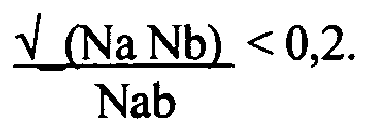
- Zusammensetzung nach Anspruch 1 oder Anspruch 2, wobei der Blockcopolymerfilm aus einer Mischung aus Blockcopolymer und Homopolymeren gebildet wird, wobei der Gesamtvolumenanteil der Homopolymere 0,8 nicht übersteigt.
- Zusammensetzung nach einem der Ansprüche 1 bis 3, wobei das Blockcopolymer im Wesentlichen 50:50 Volumenprozent jeder Komponente des Copolymers umfasst.
- Zusammensetzung nach einem der Ansprüche 1 bis 4, wobei das Molekulargewicht des Blockcopolymers zwischen 200.000 und 2.000.000 liegt.
- Zusammensetzung nach einem der Ansprüche 1 bis 5, wobei die Copolymermischung mindestens einen Farbstoff oder Partikel aus einem Material mit einem hohen Brechungsindex als Additiv umfasst.
- Filmzusammensetzung nach einem der Ansprüche 1 bis 6, wobei die Differenzen zwischen den Brechungsindizes der Mikrodomänen der unterschiedlichen Copolymerkomponenten zwischen 0,07 und 0,2 liegen.
- Zusammensetzung nach einem der Ansprüche 1 bis 7, wobei das Substrat einen transparenten Polymerfilm umfasst.
- Filmzusammensetzung nach Anspruch 8, wobei der Polymerfilm einen transparenten Polyethylenterephthalatfilm umfasst.
- Filmzusammensetzung nach Anspruch 9, wobei die Zusammensetzung eine Vielzahl von Schichten des Blockcopolymerfilms umfasst.
- Filmzusammensetzung nach einem der Ansprüche 1 bis 10, wobei die Zusammensetzung ein zweites Polymersubstrat umfasst, das so angeordnet ist, dass der Diblockcopolymerfilm zwischen den beiden Substraten angeordnet ist.
- Filmzusammensetzung nach einem der Ansprüche 1 bis 11, wobei der Blockcopolymerfilm Bereiche mit unterschiedlicher Dicke aufweist, die unterschiedliche optische Effekte bereitstellen.
- Verfahren zur Herstellung einer optisch aktiven Schichtzusammensetzung, wobei bei dem Verfahren eine Lösung, die eine Blockcopolymermischung aus mindestens zwei polymerischen Komponenten und Homopolymeren der beiden Komponenten umfasst, auf ein Filmsubstrat aufgetragen wird, wobei die Beschichtung daraufhin in lamellenartige Mikrodomänen jeder polymerischen Komponente unterteilt wird, wobei die Komponenten unterschiedliche Brechungsindizes aufweisen, dadurch gekennzeichnet, dass die Mischung sowohl des Copolymers als auch seiner jeweiligen Homopolymere derart beschaffen ist, dass die polymerische Komponente "a", die polymerische Komponente "b", das Verdünnungshomopolymer "a" und das Verdünnungshomopolymer "b":

wobei Na der numerische Durchschnittsgrad der Polymerisierung des Homopolymers "a", Nb der numerische Durchschnittsgrad der Polymerisierung des Homopolymers "b", Nab der numerische Durchschnittsgrad der Polymerisierung des Blockcopolymers ist und das Homopolymer, das der Mischung hinzugefügt wird, ein Molekulargewicht von weniger als 40% des Molekulargewichts des Copolymers aufweist. - Verfahren nach Anspruch 15, wobei der Volumenanteil des Homopolymers, das der Mischung hinzugefügt wird, 0,8 nicht übersteigt.
Applications Claiming Priority (3)
| Application Number | Priority Date | Filing Date | Title |
|---|---|---|---|
| GB9907483 | 1999-03-31 | ||
| GB9907483A GB9907483D0 (en) | 1999-03-31 | 1999-03-31 | Film composites |
| PCT/GB2000/001156 WO2000058760A1 (en) | 1999-03-31 | 2000-03-28 | Film composites |
Publications (2)
| Publication Number | Publication Date |
|---|---|
| EP1180246A1 EP1180246A1 (de) | 2002-02-20 |
| EP1180246B1 true EP1180246B1 (de) | 2012-07-04 |
Family
ID=10850765
Family Applications (1)
| Application Number | Title | Priority Date | Filing Date |
|---|---|---|---|
| EP00912823A Expired - Lifetime EP1180246B1 (de) | 1999-03-31 | 2000-03-28 | Verbundfolie |
Country Status (6)
| Country | Link |
|---|---|
| US (1) | US6720061B1 (de) |
| EP (1) | EP1180246B1 (de) |
| AU (1) | AU3446500A (de) |
| ES (1) | ES2390758T3 (de) |
| GB (1) | GB9907483D0 (de) |
| WO (1) | WO2000058760A1 (de) |
Families Citing this family (9)
| Publication number | Priority date | Publication date | Assignee | Title |
|---|---|---|---|---|
| US6440551B1 (en) * | 1999-06-14 | 2002-08-27 | Cpfilms, Inc. | Light-stable colored transparent composite films |
| WO2002018491A1 (en) * | 2000-08-30 | 2002-03-07 | The Dow Chemical Company | Compositions for flexible optical media discs |
| DE10164016B4 (de) | 2001-12-28 | 2020-01-23 | Osram Opto Semiconductors Gmbh | Organische Leuchtdiode (OLED) und Verfahren zu ihrer Herstellung |
| USD560070S1 (en) * | 2004-12-21 | 2008-01-22 | Matsushita Electric Industrial Co., Ltd. | Edge of a magnetic sheet |
| GB2424647B (en) * | 2005-03-30 | 2009-11-04 | Univ Sheffield | Self-assembling block copolymer film |
| JP5281637B2 (ja) * | 2007-04-13 | 2013-09-04 | エルジー・ケム・リミテッド | 光学フィルム、位相差フィルムおよびそれを含む液晶表示装置 |
| US20090086208A1 (en) * | 2007-09-27 | 2009-04-02 | Massachusetts Institute Of Technology | Broad wavelength range tunable photonic materials |
| US7828986B2 (en) * | 2007-10-29 | 2010-11-09 | International Business Machines Corporation | Forming surface features using self-assembling masks |
| KR102607190B1 (ko) * | 2017-03-30 | 2023-11-27 | 니폰 제온 가부시키가이샤 | 광학 필름, 그 제조 방법, 편광판, 및 액정 표시 장치 |
Citations (1)
| Publication number | Priority date | Publication date | Assignee | Title |
|---|---|---|---|---|
| FR2138465A1 (en) * | 1971-05-26 | 1973-01-05 | Anvar | Linear block copolymers - with blocks of different refractive indices as light filters on reflectors |
Family Cites Families (8)
| Publication number | Priority date | Publication date | Assignee | Title |
|---|---|---|---|---|
| US4014728A (en) * | 1974-11-27 | 1977-03-29 | Xerox Corporation | Method of making an imaging member |
| JPS5540705A (en) * | 1978-09-16 | 1980-03-22 | Asahi Chem Ind Co Ltd | Highly transparent and impact-resistant molded article having specific structure |
| JPS61146301A (ja) | 1984-12-19 | 1986-07-04 | Daicel Chem Ind Ltd | 膜およびその製造方法 |
| JP3031014B2 (ja) | 1991-12-12 | 2000-04-10 | 住友化学工業株式会社 | 位相差板および液晶表示装置 |
| US5622668A (en) * | 1992-02-07 | 1997-04-22 | The United States Of America As Represented By The Secretary Of The Air Force | Method for preparing oriented polymer structures and said structures |
| JP2887083B2 (ja) * | 1994-12-02 | 1999-04-26 | 富士ゼロックス株式会社 | 熱記録型光学素子 |
| US5656205A (en) * | 1994-12-29 | 1997-08-12 | International Business Machines Corporation | Optical components from phase separated block polymers |
| JP3233883B2 (ja) | 1997-08-29 | 2001-12-04 | 科学技術振興事業団 | 発色性高分子構造体とその製造方法 |
-
1999
- 1999-03-31 GB GB9907483A patent/GB9907483D0/en not_active Ceased
-
2000
- 2000-03-28 AU AU34465/00A patent/AU3446500A/en not_active Abandoned
- 2000-03-28 US US09/936,939 patent/US6720061B1/en not_active Expired - Fee Related
- 2000-03-28 ES ES00912823T patent/ES2390758T3/es not_active Expired - Lifetime
- 2000-03-28 WO PCT/GB2000/001156 patent/WO2000058760A1/en not_active Ceased
- 2000-03-28 EP EP00912823A patent/EP1180246B1/de not_active Expired - Lifetime
Patent Citations (1)
| Publication number | Priority date | Publication date | Assignee | Title |
|---|---|---|---|---|
| FR2138465A1 (en) * | 1971-05-26 | 1973-01-05 | Anvar | Linear block copolymers - with blocks of different refractive indices as light filters on reflectors |
Also Published As
| Publication number | Publication date |
|---|---|
| ES2390758T3 (es) | 2012-11-16 |
| EP1180246A1 (de) | 2002-02-20 |
| US6720061B1 (en) | 2004-04-13 |
| GB9907483D0 (en) | 1999-05-26 |
| AU3446500A (en) | 2000-10-16 |
| WO2000058760A1 (en) | 2000-10-05 |
Similar Documents
| Publication | Publication Date | Title |
|---|---|---|
| EP1180246B1 (de) | Verbundfolie | |
| Urbas et al. | One-dimensionally periodic dielectric reflectors from self-assembled block copolymer− homopolymer blends | |
| CA2889908C (fr) | Substrat muni d'un empilement a couche metallique partielle, vitrage et procede | |
| EP1519902B1 (de) | Transparentes substrat mit einer antireflexionsbeschichtung | |
| US7956966B2 (en) | Very thin achromatic quarter wave film laminate for transflective LCD and method for producing the same | |
| US7749577B2 (en) | High strength multilayer laminates comprising twisted nematic liquid crystals | |
| CN105189392B (zh) | 可热处理的涂覆玻璃板 | |
| US11485115B2 (en) | Laminated glazing comprising a stack of layers | |
| FR2827855A1 (fr) | Vitrage muni d'un empilement de couches minces reflechissant les infrarouges et/ou le rayonnement solaire | |
| EP1644297A2 (de) | Verglasung mit gestapelten dünnen schichten, die infrarotstrahlen und/oder sonnenstrahlung reflektieren | |
| JP2014214063A (ja) | シリカ系多孔質膜、シリカ系多孔質膜付き物品およびその製造方法 | |
| CN112334424A (zh) | 夹层玻璃用中间膜和夹层玻璃 | |
| AU2007297581B2 (en) | Separated functional layer stack and titanium nitride layer for achieving solar control | |
| TWI899130B (zh) | B級塗膜形成用塗料、b級塗膜、b級塗膜積層膜、成型體和b級塗膜的製造方法 | |
| EP2864268B2 (de) | Reflektierende tafel | |
| FR2924232A1 (fr) | Substrat muni d'un empilement a proprietes thermiques | |
| TR201906437T4 (tr) | Koruyucu bir polimer filmle donatılmış ısı kontrol cam paneli. | |
| EP1375015B1 (de) | Oberflächiges funktionales Element | |
| CA2908799A1 (fr) | Vitrage de controle solaire comprenant deux couches metalliques a base de nickel | |
| WO2009071809A2 (fr) | Substrat muni d'un empilement a proprietes thermiques | |
| US20080020201A1 (en) | Composite, Color Corrected Films Comprising an Aluminum Oxide Coating | |
| WO2022043627A1 (fr) | Element vitre antisolaire avec reflexion diffuse | |
| KR20220012701A (ko) | 눈부심 방지 필름, 편광판 및 디스플레이 장치 | |
| US12529925B2 (en) | Anti-glare film, polarizing plate and display apparatus | |
| EP4592336A1 (de) | Folie und verfahren zur herstellung davon, laminierte struktur, laminiertes glas und automobil |
Legal Events
| Date | Code | Title | Description |
|---|---|---|---|
| PUAI | Public reference made under article 153(3) epc to a published international application that has entered the european phase |
Free format text: ORIGINAL CODE: 0009012 |
|
| 17P | Request for examination filed |
Effective date: 20011023 |
|
| AK | Designated contracting states |
Kind code of ref document: A1 Designated state(s): AT BE CH CY DE DK ES FI FR GB GR IE IT LI LU MC NL PT SE |
|
| AX | Request for extension of the european patent |
Free format text: AL;LT;LV;MK;RO;SI |
|
| 17Q | First examination report despatched |
Effective date: 20061220 |
|
| RIC1 | Information provided on ipc code assigned before grant |
Ipc: C08J 7/04 20060101ALI20111117BHEP Ipc: C03C 17/00 20060101ALI20111117BHEP Ipc: G02B 1/04 20060101AFI20111117BHEP Ipc: C09J 153/00 20060101ALI20111117BHEP Ipc: C08L 53/00 20060101ALI20111117BHEP Ipc: C09D 153/00 20060101ALI20111117BHEP Ipc: C08L 53/02 20060101ALI20111117BHEP Ipc: C03C 17/32 20060101ALI20111117BHEP |
|
| GRAP | Despatch of communication of intention to grant a patent |
Free format text: ORIGINAL CODE: EPIDOSNIGR1 |
|
| RIN1 | Information on inventor provided before grant (corrected) |
Inventor name: FAIRCLOUGH, JOHN, PATRICK, ANTHONY Inventor name: SALOU, CORINNE, LUCIENNE, ODETTE Inventor name: PORT, ANTHONY, BRIAN Inventor name: RYAN, ANTHONY, JOHN |
|
| GRAS | Grant fee paid |
Free format text: ORIGINAL CODE: EPIDOSNIGR3 |
|
| GRAA | (expected) grant |
Free format text: ORIGINAL CODE: 0009210 |
|
| AK | Designated contracting states |
Kind code of ref document: B1 Designated state(s): AT BE CH CY DE DK ES FI FR GB GR IE IT LI LU MC NL PT SE |
|
| REG | Reference to a national code |
Ref country code: GB Ref legal event code: FG4D |
|
| REG | Reference to a national code |
Ref country code: CH Ref legal event code: EP |
|
| REG | Reference to a national code |
Ref country code: AT Ref legal event code: REF Ref document number: 565363 Country of ref document: AT Kind code of ref document: T Effective date: 20120715 |
|
| REG | Reference to a national code |
Ref country code: IE Ref legal event code: FG4D |
|
| REG | Reference to a national code |
Ref country code: DE Ref legal event code: R096 Ref document number: 60047312 Country of ref document: DE Effective date: 20120823 |
|
| REG | Reference to a national code |
Ref country code: AT Ref legal event code: MK05 Ref document number: 565363 Country of ref document: AT Kind code of ref document: T Effective date: 20120704 |
|
| REG | Reference to a national code |
Ref country code: ES Ref legal event code: FG2A Ref document number: 2390758 Country of ref document: ES Kind code of ref document: T3 Effective date: 20121116 |
|
| REG | Reference to a national code |
Ref country code: NL Ref legal event code: VDEP Effective date: 20120704 |
|
| PG25 | Lapsed in a contracting state [announced via postgrant information from national office to epo] |
Ref country code: CY Free format text: LAPSE BECAUSE OF FAILURE TO SUBMIT A TRANSLATION OF THE DESCRIPTION OR TO PAY THE FEE WITHIN THE PRESCRIBED TIME-LIMIT Effective date: 20120704 Ref country code: AT Free format text: LAPSE BECAUSE OF FAILURE TO SUBMIT A TRANSLATION OF THE DESCRIPTION OR TO PAY THE FEE WITHIN THE PRESCRIBED TIME-LIMIT Effective date: 20120704 Ref country code: FI Free format text: LAPSE BECAUSE OF FAILURE TO SUBMIT A TRANSLATION OF THE DESCRIPTION OR TO PAY THE FEE WITHIN THE PRESCRIBED TIME-LIMIT Effective date: 20120704 Ref country code: BE Free format text: LAPSE BECAUSE OF FAILURE TO SUBMIT A TRANSLATION OF THE DESCRIPTION OR TO PAY THE FEE WITHIN THE PRESCRIBED TIME-LIMIT Effective date: 20120704 |
|
| PG25 | Lapsed in a contracting state [announced via postgrant information from national office to epo] |
Ref country code: GR Free format text: LAPSE BECAUSE OF FAILURE TO SUBMIT A TRANSLATION OF THE DESCRIPTION OR TO PAY THE FEE WITHIN THE PRESCRIBED TIME-LIMIT Effective date: 20121005 Ref country code: PT Free format text: LAPSE BECAUSE OF FAILURE TO SUBMIT A TRANSLATION OF THE DESCRIPTION OR TO PAY THE FEE WITHIN THE PRESCRIBED TIME-LIMIT Effective date: 20121105 Ref country code: SE Free format text: LAPSE BECAUSE OF FAILURE TO SUBMIT A TRANSLATION OF THE DESCRIPTION OR TO PAY THE FEE WITHIN THE PRESCRIBED TIME-LIMIT Effective date: 20120704 |
|
| PG25 | Lapsed in a contracting state [announced via postgrant information from national office to epo] |
Ref country code: NL Free format text: LAPSE BECAUSE OF FAILURE TO SUBMIT A TRANSLATION OF THE DESCRIPTION OR TO PAY THE FEE WITHIN THE PRESCRIBED TIME-LIMIT Effective date: 20120704 |
|
| PG25 | Lapsed in a contracting state [announced via postgrant information from national office to epo] |
Ref country code: DK Free format text: LAPSE BECAUSE OF FAILURE TO SUBMIT A TRANSLATION OF THE DESCRIPTION OR TO PAY THE FEE WITHIN THE PRESCRIBED TIME-LIMIT Effective date: 20120704 |
|
| PLBE | No opposition filed within time limit |
Free format text: ORIGINAL CODE: 0009261 |
|
| STAA | Information on the status of an ep patent application or granted ep patent |
Free format text: STATUS: NO OPPOSITION FILED WITHIN TIME LIMIT |
|
| 26N | No opposition filed |
Effective date: 20130405 |
|
| REG | Reference to a national code |
Ref country code: DE Ref legal event code: R097 Ref document number: 60047312 Country of ref document: DE Effective date: 20130405 |
|
| PG25 | Lapsed in a contracting state [announced via postgrant information from national office to epo] |
Ref country code: MC Free format text: LAPSE BECAUSE OF NON-PAYMENT OF DUE FEES Effective date: 20130331 |
|
| REG | Reference to a national code |
Ref country code: CH Ref legal event code: PL |
|
| GBPC | Gb: european patent ceased through non-payment of renewal fee |
Effective date: 20130328 |
|
| REG | Reference to a national code |
Ref country code: FR Ref legal event code: ST Effective date: 20131129 |
|
| REG | Reference to a national code |
Ref country code: IE Ref legal event code: MM4A |
|
| REG | Reference to a national code |
Ref country code: DE Ref legal event code: R119 Ref document number: 60047312 Country of ref document: DE Effective date: 20131001 |
|
| PG25 | Lapsed in a contracting state [announced via postgrant information from national office to epo] |
Ref country code: CH Free format text: LAPSE BECAUSE OF NON-PAYMENT OF DUE FEES Effective date: 20130331 Ref country code: FR Free format text: LAPSE BECAUSE OF NON-PAYMENT OF DUE FEES Effective date: 20130402 Ref country code: IE Free format text: LAPSE BECAUSE OF NON-PAYMENT OF DUE FEES Effective date: 20130328 Ref country code: LI Free format text: LAPSE BECAUSE OF NON-PAYMENT OF DUE FEES Effective date: 20130331 Ref country code: DE Free format text: LAPSE BECAUSE OF NON-PAYMENT OF DUE FEES Effective date: 20131001 Ref country code: GB Free format text: LAPSE BECAUSE OF NON-PAYMENT OF DUE FEES Effective date: 20130328 |
|
| PG25 | Lapsed in a contracting state [announced via postgrant information from national office to epo] |
Ref country code: IT Free format text: LAPSE BECAUSE OF NON-PAYMENT OF DUE FEES Effective date: 20130328 |
|
| REG | Reference to a national code |
Ref country code: ES Ref legal event code: FD2A Effective date: 20150424 |
|
| PG25 | Lapsed in a contracting state [announced via postgrant information from national office to epo] |
Ref country code: LU Free format text: LAPSE BECAUSE OF NON-PAYMENT OF DUE FEES Effective date: 20130328 Ref country code: ES Free format text: LAPSE BECAUSE OF NON-PAYMENT OF DUE FEES Effective date: 20140329 |