EP1176133A2 - Verfahren zur Herstellung von substituierten Benzoylchloriden - Google Patents
Verfahren zur Herstellung von substituierten Benzoylchloriden Download PDFInfo
- Publication number
- EP1176133A2 EP1176133A2 EP01116470A EP01116470A EP1176133A2 EP 1176133 A2 EP1176133 A2 EP 1176133A2 EP 01116470 A EP01116470 A EP 01116470A EP 01116470 A EP01116470 A EP 01116470A EP 1176133 A2 EP1176133 A2 EP 1176133A2
- Authority
- EP
- European Patent Office
- Prior art keywords
- mixture
- halogen
- azobis
- radical
- benzaldehyde
- Prior art date
- Legal status (The legal status is an assumption and is not a legal conclusion. Google has not performed a legal analysis and makes no representation as to the accuracy of the status listed.)
- Granted
Links
- 238000000034 method Methods 0.000 title claims abstract description 29
- PASDCCFISLVPSO-UHFFFAOYSA-N benzoyl chloride Chemical class ClC(=O)C1=CC=CC=C1 PASDCCFISLVPSO-UHFFFAOYSA-N 0.000 title claims abstract description 17
- 238000002360 preparation method Methods 0.000 title claims abstract description 6
- HUMNYLRZRPPJDN-UHFFFAOYSA-N benzaldehyde Chemical compound O=CC1=CC=CC=C1 HUMNYLRZRPPJDN-UHFFFAOYSA-N 0.000 claims abstract description 33
- 229910052736 halogen Inorganic materials 0.000 claims abstract description 19
- 239000002904 solvent Substances 0.000 claims abstract description 18
- QNGNSVIICDLXHT-UHFFFAOYSA-N para-ethylbenzaldehyde Natural products CCC1=CC=C(C=O)C=C1 QNGNSVIICDLXHT-UHFFFAOYSA-N 0.000 claims abstract description 16
- CIUQDSCDWFSTQR-UHFFFAOYSA-N [C]1=CC=CC=C1 Chemical class [C]1=CC=CC=C1 CIUQDSCDWFSTQR-UHFFFAOYSA-N 0.000 claims abstract description 15
- 239000012320 chlorinating reagent Substances 0.000 claims abstract description 13
- 239000003999 initiator Substances 0.000 claims abstract description 8
- 125000004178 (C1-C4) alkyl group Chemical group 0.000 claims abstract description 6
- 238000006243 chemical reaction Methods 0.000 claims description 33
- MVPPADPHJFYWMZ-UHFFFAOYSA-N chlorobenzene Chemical compound ClC1=CC=CC=C1 MVPPADPHJFYWMZ-UHFFFAOYSA-N 0.000 claims description 24
- 239000000203 mixture Substances 0.000 claims description 23
- -1 (C 1 -C 4 ) alkyl hypochlorite Chemical compound 0.000 claims description 16
- WYGWHHGCAGTUCH-UHFFFAOYSA-N 2-[(2-cyano-4-methylpentan-2-yl)diazenyl]-2,4-dimethylpentanenitrile Chemical compound CC(C)CC(C)(C#N)N=NC(C)(C#N)CC(C)C WYGWHHGCAGTUCH-UHFFFAOYSA-N 0.000 claims description 12
- RFFLAFLAYFXFSW-UHFFFAOYSA-N 1,2-dichlorobenzene Chemical compound ClC1=CC=CC=C1Cl RFFLAFLAYFXFSW-UHFFFAOYSA-N 0.000 claims description 9
- OZAIFHULBGXAKX-UHFFFAOYSA-N 2-(2-cyanopropan-2-yldiazenyl)-2-methylpropanenitrile Chemical compound N#CC(C)(C)N=NC(C)(C)C#N OZAIFHULBGXAKX-UHFFFAOYSA-N 0.000 claims description 8
- 125000003172 aldehyde group Chemical group 0.000 claims description 8
- PBKONEOXTCPAFI-UHFFFAOYSA-N 1,2,4-trichlorobenzene Chemical compound ClC1=CC=C(Cl)C(Cl)=C1 PBKONEOXTCPAFI-UHFFFAOYSA-N 0.000 claims description 6
- PFHOSZAOXCYAGJ-UHFFFAOYSA-N 2-[(2-cyano-4-methoxy-4-methylpentan-2-yl)diazenyl]-4-methoxy-2,4-dimethylpentanenitrile Chemical compound COC(C)(C)CC(C)(C#N)N=NC(C)(C#N)CC(C)(C)OC PFHOSZAOXCYAGJ-UHFFFAOYSA-N 0.000 claims description 4
- NPDACUSDTOMAMK-UHFFFAOYSA-N 4-Chlorotoluene Chemical compound CC1=CC=C(Cl)C=C1 NPDACUSDTOMAMK-UHFFFAOYSA-N 0.000 claims description 4
- JRNVZBWKYDBUCA-UHFFFAOYSA-N N-chlorosuccinimide Chemical compound ClN1C(=O)CCC1=O JRNVZBWKYDBUCA-UHFFFAOYSA-N 0.000 claims description 4
- RELMFMZEBKVZJC-UHFFFAOYSA-N 1,2,3-trichlorobenzene Chemical compound ClC1=CC=CC(Cl)=C1Cl RELMFMZEBKVZJC-UHFFFAOYSA-N 0.000 claims description 3
- ZPQOPVIELGIULI-UHFFFAOYSA-N 1,3-dichlorobenzene Chemical compound ClC1=CC=CC(Cl)=C1 ZPQOPVIELGIULI-UHFFFAOYSA-N 0.000 claims description 3
- OCJBOOLMMGQPQU-UHFFFAOYSA-N 1,4-dichlorobenzene Chemical compound ClC1=CC=C(Cl)C=C1 OCJBOOLMMGQPQU-UHFFFAOYSA-N 0.000 claims description 3
- XKEFYDZQGKAQCN-UHFFFAOYSA-N 1,3,5-trichlorobenzene Chemical compound ClC1=CC(Cl)=CC(Cl)=C1 XKEFYDZQGKAQCN-UHFFFAOYSA-N 0.000 claims description 2
- OSOUNOBYRMOXQQ-UHFFFAOYSA-N 1-chloro-3-methylbenzene Chemical compound CC1=CC=CC(Cl)=C1 OSOUNOBYRMOXQQ-UHFFFAOYSA-N 0.000 claims description 2
- 150000001338 aliphatic hydrocarbons Chemical class 0.000 claims description 2
- 150000004945 aromatic hydrocarbons Chemical class 0.000 claims description 2
- WQYVRQLZKVEZGA-UHFFFAOYSA-N hypochlorite Inorganic materials Cl[O-] WQYVRQLZKVEZGA-UHFFFAOYSA-N 0.000 claims description 2
- 150000001451 organic peroxides Chemical class 0.000 claims description 2
- RLOWWWKZYUNIDI-UHFFFAOYSA-N phosphinic chloride Chemical compound ClP=O RLOWWWKZYUNIDI-UHFFFAOYSA-N 0.000 claims description 2
- IBSQPLPBRSHTTG-UHFFFAOYSA-N 1-chloro-2-methylbenzene Chemical compound CC1=CC=CC=C1Cl IBSQPLPBRSHTTG-UHFFFAOYSA-N 0.000 claims 1
- 125000005843 halogen group Chemical group 0.000 claims 1
- 239000000460 chlorine Substances 0.000 description 48
- ZAMOUSCENKQFHK-UHFFFAOYSA-N Chlorine atom Chemical compound [Cl] ZAMOUSCENKQFHK-UHFFFAOYSA-N 0.000 description 42
- 229910052801 chlorine Inorganic materials 0.000 description 42
- 239000007789 gas Substances 0.000 description 37
- 230000001681 protective effect Effects 0.000 description 23
- 150000003935 benzaldehydes Chemical class 0.000 description 16
- 238000005660 chlorination reaction Methods 0.000 description 14
- 238000004587 chromatography analysis Methods 0.000 description 13
- 230000000052 comparative effect Effects 0.000 description 13
- 150000003254 radicals Chemical class 0.000 description 12
- 239000011541 reaction mixture Substances 0.000 description 11
- 238000003756 stirring Methods 0.000 description 11
- 239000000047 product Substances 0.000 description 10
- 239000006227 byproduct Substances 0.000 description 7
- SOWRUJSGHKNOKN-UHFFFAOYSA-N 2,6-difluorobenzaldehyde Chemical compound FC1=CC=CC(F)=C1C=O SOWRUJSGHKNOKN-UHFFFAOYSA-N 0.000 description 6
- ZWDVQMVZZYIAHO-UHFFFAOYSA-N 2-fluorobenzaldehyde Chemical compound FC1=CC=CC=C1C=O ZWDVQMVZZYIAHO-UHFFFAOYSA-N 0.000 description 6
- UOQXIWFBQSVDPP-UHFFFAOYSA-N 4-fluorobenzaldehyde Chemical compound FC1=CC=C(C=O)C=C1 UOQXIWFBQSVDPP-UHFFFAOYSA-N 0.000 description 6
- 230000015572 biosynthetic process Effects 0.000 description 6
- 150000002367 halogens Chemical class 0.000 description 6
- CZKLEJHVLCMVQR-UHFFFAOYSA-N 4-fluorobenzoyl chloride Chemical compound FC1=CC=C(C(Cl)=O)C=C1 CZKLEJHVLCMVQR-UHFFFAOYSA-N 0.000 description 5
- 238000011049 filling Methods 0.000 description 4
- CIHOLLKRGTVIJN-UHFFFAOYSA-N tert‐butyl hydroperoxide Chemical compound CC(C)(C)OO CIHOLLKRGTVIJN-UHFFFAOYSA-N 0.000 description 4
- YMWUJEATGCHHMB-UHFFFAOYSA-N Dichloromethane Chemical compound ClCCl YMWUJEATGCHHMB-UHFFFAOYSA-N 0.000 description 3
- 230000002411 adverse Effects 0.000 description 3
- 238000005695 dehalogenation reaction Methods 0.000 description 3
- 238000004821 distillation Methods 0.000 description 3
- 238000004519 manufacturing process Methods 0.000 description 3
- QYZFTMMPKCOTAN-UHFFFAOYSA-N n-[2-(2-hydroxyethylamino)ethyl]-2-[[1-[2-(2-hydroxyethylamino)ethylamino]-2-methyl-1-oxopropan-2-yl]diazenyl]-2-methylpropanamide Chemical compound OCCNCCNC(=O)C(C)(C)N=NC(C)(C)C(=O)NCCNCCO QYZFTMMPKCOTAN-UHFFFAOYSA-N 0.000 description 3
- 150000002978 peroxides Chemical class 0.000 description 3
- 239000007858 starting material Substances 0.000 description 3
- 238000003786 synthesis reaction Methods 0.000 description 3
- XEMRAKSQROQPBR-UHFFFAOYSA-N (trichloromethyl)benzene Chemical class ClC(Cl)(Cl)C1=CC=CC=C1 XEMRAKSQROQPBR-UHFFFAOYSA-N 0.000 description 2
- BRKULQOUSCHDGS-UHFFFAOYSA-N 1,2-bis(4-fluorophenyl)ethane-1,2-dione Chemical compound C1=CC(F)=CC=C1C(=O)C(=O)C1=CC=C(F)C=C1 BRKULQOUSCHDGS-UHFFFAOYSA-N 0.000 description 2
- AZUYLZMQTIKGSC-UHFFFAOYSA-N 1-[6-[4-(5-chloro-6-methyl-1H-indazol-4-yl)-5-methyl-3-(1-methylindazol-5-yl)pyrazol-1-yl]-2-azaspiro[3.3]heptan-2-yl]prop-2-en-1-one Chemical compound ClC=1C(=C2C=NNC2=CC=1C)C=1C(=NN(C=1C)C1CC2(CN(C2)C(C=C)=O)C1)C=1C=C2C=NN(C2=CC=1)C AZUYLZMQTIKGSC-UHFFFAOYSA-N 0.000 description 2
- LGJCFVYMIJLQJO-UHFFFAOYSA-N 1-dodecylperoxydodecane Chemical compound CCCCCCCCCCCCOOCCCCCCCCCCCC LGJCFVYMIJLQJO-UHFFFAOYSA-N 0.000 description 2
- DMIYKWPEFRFTPY-UHFFFAOYSA-N 2,6-dichlorobenzaldehyde Chemical compound ClC1=CC=CC(Cl)=C1C=O DMIYKWPEFRFTPY-UHFFFAOYSA-N 0.000 description 2
- QRHUZEVERIHEPT-UHFFFAOYSA-N 2,6-difluorobenzoyl chloride Chemical compound FC1=CC=CC(F)=C1C(Cl)=O QRHUZEVERIHEPT-UHFFFAOYSA-N 0.000 description 2
- VFVHWCKUHAEDMY-UHFFFAOYSA-N 2-chloro-5-nitrobenzaldehyde Chemical compound [O-][N+](=O)C1=CC=C(Cl)C(C=O)=C1 VFVHWCKUHAEDMY-UHFFFAOYSA-N 0.000 description 2
- OACPOWYLLGHGCR-UHFFFAOYSA-N 2-chloro-6-fluorobenzaldehyde Chemical compound FC1=CC=CC(Cl)=C1C=O OACPOWYLLGHGCR-UHFFFAOYSA-N 0.000 description 2
- FPYUJUBAXZAQNL-UHFFFAOYSA-N 2-chlorobenzaldehyde Chemical compound ClC1=CC=CC=C1C=O FPYUJUBAXZAQNL-UHFFFAOYSA-N 0.000 description 2
- IJGRMHOSHXDMSA-UHFFFAOYSA-N Atomic nitrogen Chemical compound N#N IJGRMHOSHXDMSA-UHFFFAOYSA-N 0.000 description 2
- OMPJBNCRMGITSC-UHFFFAOYSA-N Benzoylperoxide Chemical compound C=1C=CC=CC=1C(=O)OOC(=O)C1=CC=CC=C1 OMPJBNCRMGITSC-UHFFFAOYSA-N 0.000 description 2
- CURLTUGMZLYLDI-UHFFFAOYSA-N Carbon dioxide Chemical compound O=C=O CURLTUGMZLYLDI-UHFFFAOYSA-N 0.000 description 2
- HEDRZPFGACZZDS-UHFFFAOYSA-N Chloroform Chemical compound ClC(Cl)Cl HEDRZPFGACZZDS-UHFFFAOYSA-N 0.000 description 2
- LXEKPEMOWBOYRF-UHFFFAOYSA-N [2-[(1-azaniumyl-1-imino-2-methylpropan-2-yl)diazenyl]-2-methylpropanimidoyl]azanium;dichloride Chemical compound Cl.Cl.NC(=N)C(C)(C)N=NC(C)(C)C(N)=N LXEKPEMOWBOYRF-UHFFFAOYSA-N 0.000 description 2
- 150000001299 aldehydes Chemical class 0.000 description 2
- 235000019400 benzoyl peroxide Nutrition 0.000 description 2
- KCXMKQUNVWSEMD-UHFFFAOYSA-N benzyl chloride Chemical class ClCC1=CC=CC=C1 KCXMKQUNVWSEMD-UHFFFAOYSA-N 0.000 description 2
- 238000009835 boiling Methods 0.000 description 2
- 150000001735 carboxylic acids Chemical class 0.000 description 2
- 239000007795 chemical reaction product Substances 0.000 description 2
- 238000005187 foaming Methods 0.000 description 2
- 239000003701 inert diluent Substances 0.000 description 2
- 239000011814 protection agent Substances 0.000 description 2
- 238000010992 reflux Methods 0.000 description 2
- 239000007787 solid Substances 0.000 description 2
- WYKYCHHWIJXDAO-UHFFFAOYSA-N tert-butyl 2-ethylhexaneperoxoate Chemical compound CCCCC(CC)C(=O)OOC(C)(C)C WYKYCHHWIJXDAO-UHFFFAOYSA-N 0.000 description 2
- VZGDMQKNWNREIO-UHFFFAOYSA-N tetrachloromethane Chemical compound ClC(Cl)(Cl)Cl VZGDMQKNWNREIO-UHFFFAOYSA-N 0.000 description 2
- 238000010626 work up procedure Methods 0.000 description 2
- WSLDOOZREJYCGB-UHFFFAOYSA-N 1,2-Dichloroethane Chemical compound ClCCCl WSLDOOZREJYCGB-UHFFFAOYSA-N 0.000 description 1
- JBLIDPPHFGWTKU-UHFFFAOYSA-N 2,6-dichlorobenzoyl chloride Chemical compound ClC(=O)C1=C(Cl)C=CC=C1Cl JBLIDPPHFGWTKU-UHFFFAOYSA-N 0.000 description 1
- AVTLBBWTUPQRAY-UHFFFAOYSA-N 2-(2-cyanobutan-2-yldiazenyl)-2-methylbutanenitrile Chemical compound CCC(C)(C#N)N=NC(C)(CC)C#N AVTLBBWTUPQRAY-UHFFFAOYSA-N 0.000 description 1
- OGLKKYALUKXVPQ-UHFFFAOYSA-N 2-chloro-5-nitrobenzoyl chloride Chemical compound [O-][N+](=O)C1=CC=C(Cl)C(C(Cl)=O)=C1 OGLKKYALUKXVPQ-UHFFFAOYSA-N 0.000 description 1
- GFNAJZAKJGKJCS-UHFFFAOYSA-N 2-chloro-6-fluorobenzoyl chloride Chemical compound FC1=CC=CC(Cl)=C1C(Cl)=O GFNAJZAKJGKJCS-UHFFFAOYSA-N 0.000 description 1
- ONIKNECPXCLUHT-UHFFFAOYSA-N 2-chlorobenzoyl chloride Chemical compound ClC(=O)C1=CC=CC=C1Cl ONIKNECPXCLUHT-UHFFFAOYSA-N 0.000 description 1
- CKSAKVMRQYOFBC-UHFFFAOYSA-N 2-cyanopropan-2-yliminourea Chemical compound N#CC(C)(C)N=NC(N)=O CKSAKVMRQYOFBC-UHFFFAOYSA-N 0.000 description 1
- WFUGQJXVXHBTEM-UHFFFAOYSA-N 2-hydroperoxy-2-(2-hydroperoxybutan-2-ylperoxy)butane Chemical compound CCC(C)(OO)OOC(C)(CC)OO WFUGQJXVXHBTEM-UHFFFAOYSA-N 0.000 description 1
- FRIBMENBGGCKPD-UHFFFAOYSA-N 3-(2,3-dimethoxyphenyl)prop-2-enal Chemical compound COC1=CC=CC(C=CC=O)=C1OC FRIBMENBGGCKPD-UHFFFAOYSA-N 0.000 description 1
- DLZUHSFUBZTBQZ-UHFFFAOYSA-N 3-chloro-4-fluorobenzoyl chloride Chemical compound FC1=CC=C(C(Cl)=O)C=C1Cl DLZUHSFUBZTBQZ-UHFFFAOYSA-N 0.000 description 1
- VFXXTYGQYWRHJP-UHFFFAOYSA-N 4,4'-azobis(4-cyanopentanoic acid) Chemical compound OC(=O)CCC(C)(C#N)N=NC(C)(CCC(O)=O)C#N VFXXTYGQYWRHJP-UHFFFAOYSA-N 0.000 description 1
- FKAJZOZTZXQGTJ-UHFFFAOYSA-N 5,5-dimethyl-1,3-diazabicyclo[2.2.0]hex-3-ene Chemical compound C1N2C(C1(C)C)=NC2 FKAJZOZTZXQGTJ-UHFFFAOYSA-N 0.000 description 1
- PGFZYOCLSPEKSN-UHFFFAOYSA-N 5,5-dimethyl-1,3-diazabicyclo[2.2.0]hex-3-ene dihydrochloride Chemical compound Cl.Cl.CC1(C)CN2CN=C12 PGFZYOCLSPEKSN-UHFFFAOYSA-N 0.000 description 1
- YIVJZNGAASQVEM-UHFFFAOYSA-N Lauroyl peroxide Chemical compound CCCCCCCCCCCC(=O)OOC(=O)CCCCCCCCCCC YIVJZNGAASQVEM-UHFFFAOYSA-N 0.000 description 1
- KYIKRXIYLAGAKQ-UHFFFAOYSA-N abcn Chemical compound C1CCCCC1(C#N)N=NC1(C#N)CCCCC1 KYIKRXIYLAGAKQ-UHFFFAOYSA-N 0.000 description 1
- 235000010233 benzoic acid Nutrition 0.000 description 1
- 150000001559 benzoic acids Chemical class 0.000 description 1
- WPKWPKDNOPEODE-UHFFFAOYSA-N bis(2,4,4-trimethylpentan-2-yl)diazene Chemical compound CC(C)(C)CC(C)(C)N=NC(C)(C)CC(C)(C)C WPKWPKDNOPEODE-UHFFFAOYSA-N 0.000 description 1
- 229910002092 carbon dioxide Inorganic materials 0.000 description 1
- 239000001569 carbon dioxide Substances 0.000 description 1
- 238000005119 centrifugation Methods 0.000 description 1
- 239000003795 chemical substances by application Substances 0.000 description 1
- 150000001805 chlorine compounds Chemical class 0.000 description 1
- NEHMKBQYUWJMIP-NJFSPNSNSA-N chloro(114C)methane Chemical compound [14CH3]Cl NEHMKBQYUWJMIP-NJFSPNSNSA-N 0.000 description 1
- 238000004140 cleaning Methods 0.000 description 1
- LSXWFXONGKSEMY-UHFFFAOYSA-N di-tert-butyl peroxide Chemical compound CC(C)(C)OOC(C)(C)C LSXWFXONGKSEMY-UHFFFAOYSA-N 0.000 description 1
- 150000004816 dichlorobenzenes Chemical class 0.000 description 1
- 229940079593 drug Drugs 0.000 description 1
- 239000003814 drug Substances 0.000 description 1
- 239000000975 dye Substances 0.000 description 1
- 230000002349 favourable effect Effects 0.000 description 1
- 238000001914 filtration Methods 0.000 description 1
- 230000026030 halogenation Effects 0.000 description 1
- 238000005658 halogenation reaction Methods 0.000 description 1
- 230000007062 hydrolysis Effects 0.000 description 1
- 238000006460 hydrolysis reaction Methods 0.000 description 1
- 230000001771 impaired effect Effects 0.000 description 1
- 239000011261 inert gas Substances 0.000 description 1
- 239000000543 intermediate Substances 0.000 description 1
- 238000002955 isolation Methods 0.000 description 1
- 238000002844 melting Methods 0.000 description 1
- 230000008018 melting Effects 0.000 description 1
- ZQMHJBXHRFJKOT-UHFFFAOYSA-N methyl 2-[(1-methoxy-2-methyl-1-oxopropan-2-yl)diazenyl]-2-methylpropanoate Chemical compound COC(=O)C(C)(C)N=NC(C)(C)C(=O)OC ZQMHJBXHRFJKOT-UHFFFAOYSA-N 0.000 description 1
- 125000002496 methyl group Chemical class [H]C([H])([H])* 0.000 description 1
- 229910052757 nitrogen Inorganic materials 0.000 description 1
- 229910052756 noble gas Inorganic materials 0.000 description 1
- 239000000825 pharmaceutical preparation Substances 0.000 description 1
- 229940127557 pharmaceutical product Drugs 0.000 description 1
- 238000005191 phase separation Methods 0.000 description 1
- 239000004033 plastic Substances 0.000 description 1
- 229920003023 plastic Polymers 0.000 description 1
- 239000002243 precursor Substances 0.000 description 1
- 239000000126 substance Substances 0.000 description 1
- GJBRNHKUVLOCEB-UHFFFAOYSA-N tert-butyl benzenecarboperoxoate Chemical compound CC(C)(C)OOC(=O)C1=CC=CC=C1 GJBRNHKUVLOCEB-UHFFFAOYSA-N 0.000 description 1
- XTXFUQOLBKQKJU-UHFFFAOYSA-N tert-butylperoxy(trimethyl)silane Chemical compound CC(C)(C)OO[Si](C)(C)C XTXFUQOLBKQKJU-UHFFFAOYSA-N 0.000 description 1
- 230000007306 turnover Effects 0.000 description 1
Classifications
-
- C—CHEMISTRY; METALLURGY
- C07—ORGANIC CHEMISTRY
- C07C—ACYCLIC OR CARBOCYCLIC COMPOUNDS
- C07C51/00—Preparation of carboxylic acids or their salts, halides or anhydrides
- C07C51/58—Preparation of carboxylic acid halides
Definitions
- the present invention relates to a process for the preparation of substituted benzoyl chlorides by chlorination of the corresponding benzaldehydes.
- Substituted benzoyl chlorides can be regarded as activated derivatives of the corresponding benzoic acids. For this reason, they are widely used as valuable synthesis building blocks, e.g. B. as intermediates for the synthesis of crop protection agents and drugs and for the production of dyes and plastics.
- Aromatic carboxylic acid chlorides are usually prepared by reacting carboxylic acids with a chlorinating agent or by partial hydrolysis of benzotrichlorides. An important advantage of these processes is that the corresponding starting materials are readily available on an industrial scale.
- EP 0 723 950 B1 describes a process for the production of Alkylbenzoyl chlorides described by chlorination of alkylbenzaldehydes. Although here in the presence of a solvent and another methyl or chloromethyl-substituted benzene derivative is used exceeds Selectivity in no case 86%. By using a complex Mixture of substances (at least 4 components) as well as the not very high ones Selectivities require a lot of effort to purify the reaction product and the product quality is adversely affected.
- aldehydes tend to dehalogenate (see in the experimental part, comparative example 1a), resulting in products which are often very difficult to separate and thus the quality of the end products, to which very high demands are made when used in syntheses for pharmaceutical products or crop protection agents will adversely affect.
- one or more undesired by-products (referred to in the experimental section as secondary components) are or are often formed during chlorination, which are presumably uncontrolled secondary products of the benzoyl chloride produced and the unreacted feed product (substituted benzaldehyde), possibly under the influence of chlorine represent ongoing reactions. In particular, a chlorine-containing by-product is formed.
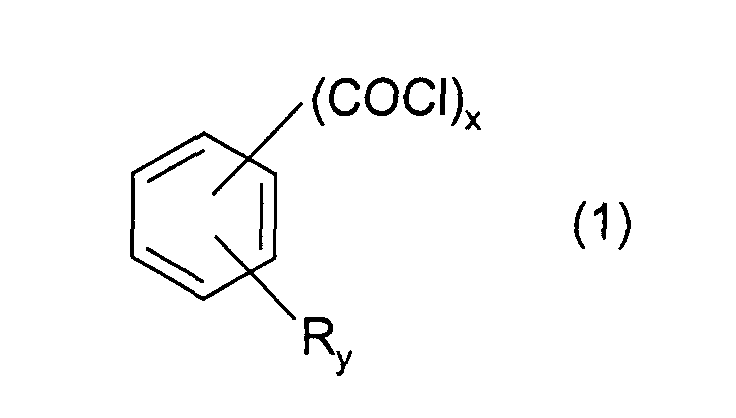
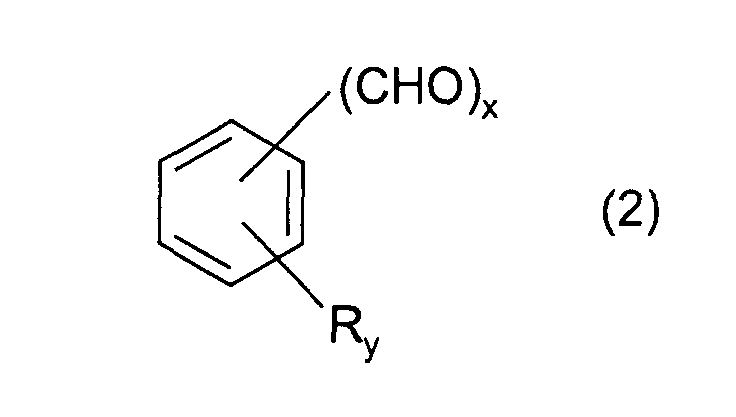
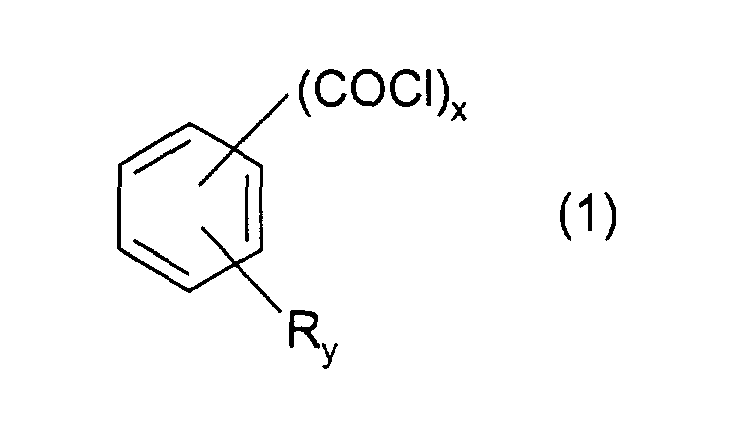
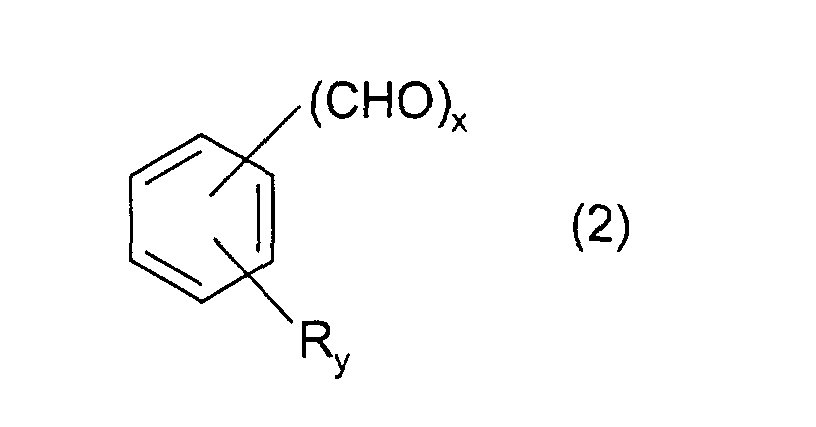
- R, x and y thus have the same meaning in formula (1) as in formula (2).
- the method according to the invention has several advantages. On the one hand, it can be applied to a larger number of substituted benzaldehydes and, on the other hand, it is surprisingly possible to carry out the reaction with good success even at comparatively low temperatures (see Examples 1 to 4).
- the low temperatures enable a particularly gentle reaction, which is particularly advantageous for sensitive benzaldehydes, for example for halogenated benzaldehydes prone to dehalogenation.
- By using low temperatures it is possible to effectively reduce the dehalogenation even in the absence of a solvent (see comparative examples 1b, 2a and 2b), but the formation of undesired by-products identified as by-components cannot be reduced to the desired extent.
- halogenated benzaldehydes which are ortho to the aldehyde group can also be reacted at higher temperatures, with no dehalogenation occurring and, at the same time, the formation of undesired by-products only taking place to a very small extent.
- a benzaldehyde of the formula (2) in which R is, independently of one another, the same or different and represents -Halogen, -NO 2 , -CN, -OR 'or -COR', where R 'is a straight-chain or branched C 1 - C 4 alkyl radical or an unsubstituted phenyl radical.
- R is, independently of one another, the same or different and represents -Halogen, -NO 2 , -CN, -OR 'or -COR', where R 'is a straight-chain or branched C 1 - C 4 alkyl radical or an unsubstituted phenyl radical.
- benzaldehydes (2) where x is 1.
- benzaldehydes (2) in which y is 1 or 2 or 2 or 3, in particular in which y is 1 or 2, preferably 2.
- a benzaldehyde (2) in which at least one of the radicals R is a halogen which is arranged in the ortho position to an aldehyde group, in particular -F, -Cl or -Br, preferably -F or -Cl, can be used with good success, in particular in which one of the radicals R represents a halogen arranged ortho to an aldehyde group and a second of the radicals R also represents halogen and is halogen -F, -Cl or -Br, in particular -F or -Cl.
- Highly suitable benzaldehyde (2) is where R is independently the same or different and represents -F, -Cl or -NO 2 , x is 1 and at least one of the radicals R is a -F arranged ortho to an aldehyde group or -Cl stands.
- the substituted benzaldehyde (2) and the chlorinating agent are usually used in a molar ratio of 1: (0.5 to 2.0), in particular 1: (0.7 to 1.5), preferably 1: (0.9 to 1.2 ) on.
- the chlorinating agent used can be chlorine or a chlorine-releasing agent, if appropriate in the presence of an inert diluent gas such as nitrogen, carbon dioxide or a noble gas.
- chlorinating agents are Cl 2 , SOCl 2 , SO 2 Cl 2 , PCl 3 , POCl 3 , PCl 5 , SbCl 5 , ICI, ICl 3 , SCl 2 , S 2 Cl 2 , MnCl 4 , (C 1 -C 4 ) alkyl hypochlorite, CCl 4 and N-chlorosuccinimide or a mixture thereof.
- Cl 2 , SOCl 2 , SO 2 Cl 2 , or a mixture thereof is used as the chlorinating agent.
- Suitable peroxides and organic azo compounds are ethyl methyl ketone peroxide, tert-butyl hydroperoxide, tert-butyl-trimethylsilyl peroxide, cumene hydroperoxide, lauroyl peroxide, dibenzoyl peroxide, di-tert-butyl peroxide, dilauryl peroxide, Perbenzoic acid tert-butyl ester, tert-butyl peroxy-2-ethylhexanoate, 2,2'-azobis (4-methoxy-2,4-dimethylvaleronitrile), 2,2'-azobis (2,4-dimethylvaleronitrile), 2, 2'-azobis (isobutyronitrile), dimethyl-2,2'-azobis (isobutyrate), 2,2'-azobis (2-methylbutyronitrile), 1,1'-azobis (1-cyclohexane carbonitrile), 2- (
- 2,2'-azobis (2,4-dimethylvaleronitrile), 2,2'-azobis (isobutyronitrile) and / or 2,2'-azobis (4-methoxy-2,4-dimethylvaleronitrile) are used as Radical starter.
- the radical initiator peroxide and / or azo compound
- the substituted benzaldehydes (2) are reacted with the chlorinating agent in the presence of a solvent which is inert under the reaction conditions.
- a single or multiple chlorinated aliphatic or aromatic hydrocarbon or a mixture thereof can be used as the solvent.
- suitable solvents are, without claiming to be complete, 1,2-dichloroethane, methyl chloride, methylene chloride, chloroform, carbon tetrachloride, chlorobenzene, dichlorobenzenes, trichlorobenzenes and chlorotoluenes.
- chlorobenzene, 1,2-dichlorobenzene, 1,3-dichlorobenzene, 1,4-dichlorobenzene, 1,2,3-trichlorobenzene, 1,2,4-trichlorobenzene, 1,3,5-trichlorobenzene, 2 are used as solvents Chlorotoluene, 3-chlorotoluene, 4-chlorotoluene or a mixture thereof, preferably chlorobenzene, 1,2-dichlorobenzene, 1,3-dichlorobenzene, 1,4-dichlorobenzene or a mixture thereof.
- chlorobenzene is used as the solvent.
- the solvent is usually used in a ratio of 50: 1 to 1:50, in particular 10: 1 to 1:10, preferably 4: 1 to 1: 4, based on the substituted benzaldehyde.
- substituted chloraldehydes (2) with the chlorinating agent at -10 to 130 ° C., especially at 0 to 120 ° C, preferably 20 to 90 ° C, particularly preferably 30 to 85 ° C to implement.
- a large number of substituted benzaldehydes can be successfully implemented at a temperature of 35 to 80 ° C.
- the isolation of the substituted benzoyl chlorides (1) obtained can be carried out by customary work-up methods which depend on the melting and boiling points of the products or, when working with solvents, on the solubility of the product in the solvent used and, in turn, on its fixed point / boiling point.
- the usual work-up methods are chromatography, filtration, phase separation, centrifugation or distillation at normal pressure or in vacuo.
- working up by distillation is the method of choice for substituted benzoyl chlorides.
- the process according to the invention can be carried out batchwise or continuously. All process steps can be carried out under normal pressure, negative pressure or positive pressure. The following examples illustrate the process without restricting it:
- the product is then distilled in vacuo through a packed column (Height 100 cm, Sulzer CY filling) with a reflux ratio of 1: 7, whereby 2,6-difluorobenzoyl chloride boils at 145 mbar at a constant 125 ° C.
- the fractionated 2,6-difluorobenzoyl chloride has a purity of> 99.5% (a / a).
- the product distillation then takes place i. Vak. over packed column (height 100 cm, filling Sulzer CY) with a reflux ratio of 1:15, whereby 4-fluorobenzoyl chloride boils at 40 mbar at a constant 94 ° C.
- the fractionated 4-fluorobenzoyl chloride has a purity of> 99.5% (a / a).
Landscapes
- Chemical & Material Sciences (AREA)
- Organic Chemistry (AREA)
- Engineering & Computer Science (AREA)
- Oil, Petroleum & Natural Gas (AREA)
- Organic Low-Molecular-Weight Compounds And Preparation Thereof (AREA)
Abstract
Description
Aromatische Carbonsäurechloride stellt man üblicherweise durch Umsetzung von Carbonsäuren mit einem Chlorierungsmittel oder durch teilweise Hydrolyse von Benzotrichloriden her. Ein wichtiger Vorteil dieser Verfahren beruht darauf, dass die entsprechenden Ausgangsmaterialien, weil einfach zugänglich, in technischem Maßstab verfügbar sind. Diese günstigen Voraussetzungen sind bei der Herstellung substituierter Benzoylchloride nicht gegeben, da die entsprechenden Ausgangsstoffe, nämlich entsprechend substituierte Carbonsäuren oder Benzotrichloride in der Regel nicht leicht zugänglich sind und auch im Normalfall nicht in technischen Mengen zur Verfügung stehen.
Es ist bekannt, dass man ausgehend von Aldehyden durch Halogenierung der Aldehydgruppe direkt zu Carbonsäurehalogeniden gelangen kann.
Ein Verfahren zur Herstellung von 3-Chlor-4-fluorbenzoylchlorid wird in
EP 0 922 693 A1 beschrieben. Hierbei wird die Vorstufe 4-Fluorbenzoylchlorid durch Chlorierung von 4-Fluorbenzaldehyd hergestellt. Es bilden sich jedoch noch 8,3 % einer Nebenkomponente (dort als 4,4'-Difluorbenzil ausgewiesen), die die Reinigung des Produkts erschwert. Bei Durchführung der Chlorierung von 4-Fluorbenzaldehyd in Abwesenheit eines Lösungsmittels bildet sich unter starker Schaumbildung ein gallertartiger Feststoff (siehe im experimentellen Teil Vergleichsbeispiel 3). Ein weiterer Nachteil ist die signifikant erhöhte Bildung eines chlorhaltigen Nebenproduktes (kein 4,4'-Difluorbenzil) und die damit verbundene deutlich verschlechterte Selektivität.
Die Verwendung von in ortho-Stellung durch Halogen substituierten Benzaldehyden, also 2-Halogenbenzaldehyden (worin ein Halogen in ortho-Stellung zur Aldehydgruppe angeordnet ist) ergibt ein zusätzliches Problem. Diese Aldehyde tendieren nämlich zum Teil zur Dehalogenierung (siehe im experimentellen Teil Vergleichsbeispiel 1a), wobei Produkte entstehen, die sich häufig sehr schwer abtrennen lassen und somit die Qualität der Endprodukte, an die bei Einsatz in Synthesen für pharmazeutische Produkte oder Pflanzenschutzmittel sehr hohe Anforderungen gestellt werden, ungünstig beeinflussen.
Darüber hinaus wird bzw. werden bei der Chlorierung häufig ein oder mehrere unerwünschte Nebenprodukte (im experimentellen Teil als Nebenkomponente bezeichnet) gebildet, die vermutlich Folgeprodukte von zwischen dem hergestellten Benzoylchlorid und noch nicht umgesetztem Einsatzprodukt (substituierter Benzaldehyd), möglicherweise unter Einwirkung von Chlor, unkontrolliert ablaufenden Reaktionen darstellen. Insbesondere wird ein chlorhaltiges Nebenprodukt gebildet. Wie die Vergleichsbeispiele 1a, 1b, 2a und 2b zeigen, wird dadurch die Selektivität der Reaktion ungünstig beeinflusst.
Im Hinblick auf die vorstehend geschilderten Nachteile und Probleme besteht der Bedarf, ein Verfahren bereitzustellen, das diese Nachteile und Probleme vermeidet, das sich zudem, ohne großen zusätzlichen Aufwand zu erfordern, auf einfache Weise realisieren lässt und die gewünschten Produkte mit hohem Umsatz und hoher Selektivität in hohen Ausbeuten zugänglich macht.
Diese Aufgabe wird überraschenderweise gelöst durch ein Verfahren zur Herstellung substituierter Benzoylchloride der Formel (1)
Wie die Beispiele 5, 6 und 7 beweisen, lassen sich in ortho-Stellung zur Aldehydgruppe halogenierte Benzaldehyde auch bei höheren Temperaturen umsetzen, wobei keine Dehalogenierung eintritt und zugleich die Bildung unerwünschter Nebenprodukte nur in geringem bis sehr geringem Ausmaß erfolgt.
Insbesondere kann man einen Benzaldehyd der Formel (2), worin R unabhängig voneinander gleich oder verschieden ist und für -Halogen, -NO2, -CN, -OR' oder -COR' steht, wobei R' ein geradkettiger oder verzweigter C1-C4-Alkylrest oder ein unsubstituierter Phenylrest ist, einsetzen.
Von besonderem Interesse sind Benzaldehyde (2), worin x für 1 steht.
Von Interesse sind ferner Benzaldehyde (2), worin y für 1 oder 2 oder für 2 oder 3 steht, insbesondere worin y für 1 oder 2, bevorzugt für 2 steht.
Ebenfalls kann man mit gutem Erfolg einen Benzaldehyd (2), worin wenigstens einer der Reste R für ein in ortho-Stellung zu einer Aldehydgruppe angeordnetes Halogen, insbesondere -F, -Cl oder -Br, bevorzugt -F oder -Cl ist, steht, insbesondere worin einer der Reste R für ein in ortho-Stellung zu einer Aldehydgruppe angeordnetes Halogen und ein zweiter der Reste R ebenfalls für Halogen steht und Halogen -F, -Cl oder -Br, insbesondere -F oder -Cl ist, einsetzen.
Gut geeigneter Benzaldehyd (2) ist, worin R unabhängig voneinander gleich oder verschieden ist und für -F, -Cl oder -NO2 steht, x für 1 und wenigstens einer der Reste R für ein in ortho-Stellung zu einer Aldehydgruppe angeordnetes -F oder -Cl steht.
Man setzt üblicherweise den substituierten Benzaldehyd (2) und das Chlorierungsmittel im Molverhältnis 1 : (0,5 bis 2,0), insbesondere 1 : (0,7 bis 1,5), bevorzugt 1 : (0,9 bis 1,2) ein.
Als Chlorierungsmittel kann man Chlor, oder ein chlorabgebendes Agens, gegebenenfalls in Gegenwart eines inerten Verdünnungsgases wie Stickstoff, Kohlendioxid oder eines Edelgases, einsetzen. Vorzugsweise wird in Abwesenheit eines inerten Verdünnungsgases gearbeitet. Geeignet als Chlorierungsmittel, ohne Anspruch auf Vollständigkeit zu erheben, sind Cl2, SOCl2, SO2Cl2, PCl3, POCl3, PCl5, SbCl5, ICI, ICl3, SCl2, S2Cl2, MnCl4, (C1-C4)Alkylhypochlorit, CCl4 und N-Chlorsuccinimid oder ein Gemisch derselben.
Man setzt insbesondere Cl2, SOCl2, SO2Cl2, oder ein Gemisch derselben als Chlorierungsmittel ein.
Es hat sich als besonders günstig erwiesen, den substituierten Benzaldehyd (2) mit Cl2 als Chlorierungsmittel umzusetzen.
Die Umsetzung von substituierten Benzaldehyden mit dem Chlorierungsmittel erfolgt nach Art einer radikalischen Chlorierung, wobei die Anwesenheit eines Radikalstarters vorteilhaft ist. Üblicherweise verwendet man ein Peroxid oder eine Azoverbindung einzeln oder in Kombination miteinander als Radikalstarter. Es ist bekannt, dass organische Peroxide und organische Azoverbindungen unter dem Einfluss von Wärme und/oder Licht in Radikale zerfallen, die die radikalische Chlorierung initiieren.
Beispiele für geeignete Peroxide und organische Azoverbindungen sind, ohne Anspruch auf Vollständigkeit zu erheben, Ethylmethylketonperoxid, tert.-Butylhydroperoxid, tert.-Butyl-trimethylsilylperoxid, Cumolhydroperoxid, Lauroylperoxid, Dibenzoylperoxid, Di-tert.-Butylperoxid, Dilaurylperoxid,
Perbenzoesäure-tert.-butylester, tert.-Butylperoxy-2-ethylhexanoat, 2,2'-Azobis(4-methoxy-2,4-dimethylvaleronitril), 2,2'-Azobis(2,4-dimethylvaleronitril), 2,2'-Azobis(isobutyronitril), Dimethyl-2,2'-azobis(isobutyrat), 2,2'-Azobis(2-methylbutyronitril), 1,1'-Azobis(1-cyclohexancarbonitril), 2-(Carbamoylazo)isobutyronitril, 2,2'-Azobis(2,4,4-trimethylpentan), 2,2'-Azobis(isobutyroamidin)Dihydrochlorid, 2,2'-Azobis(N,N'-dimethylenisobutyramidin)-Dihydrochlorid, 2,2'-Azobis(2-amidinopropan)-Dihydrochlorid, 2,2'-Azobis(N,N'-dimethylenisobutyramidin), 4,4'-Azobis(4-cyanpentansäure) und/oder 2,2'-Azobis[2-methyl-N-(2-hydroxyethyl)propionsäureamid], insbesondere tert.-Butylhydroperoxid, Dibenzoylperoxid, Dilaurylperoxid, tert.-Butylperoxy-2-ethylhexanoat, 2,2'-Azobis(4-methoxy-2,4-dimethylvaleronitril), 2,2'-Azobis(2,4-dimethylvaleronitril) und/oder 2,2'-Azobis(isobutyronitril).
Nach einer bevorzugten Variante setzt man 2,2'-Azobis(2,4-dimethylvaleronitril), 2,2'-Azobis(isobutyronitril) und/oder 2,2'-Azobis(4-methoxy-2,4-dimethylvaleronitril) als Radikalstarter ein.
Man setzt den Radikalstarter (Peroxid und/oder Azoverbindung) üblicherweise in einer Menge von 0,001 bis 10, insbesondere 0,005 bis 5, bevorzugt 0,02 bis 2 Molprozent, bezogen auf den substituierten Benzaldehyd (2) ein.
Die Umsetzung der substituierten Benzaldehyde (2) mit dem Chlorierungsmittel erfolgt in Anwesenheit eines Lösungsmittels, das sich unter Reaktionsbedingungen inert verhält. Man kann als Lösungsmittel einen einfach oder mehrfach chlorierten aliphatischen oder aromatischen Kohlenwasserstoff oder ein Gemisch derselben einsetzen. Beispiele für geeignete Lösungsmittel sind, ohne Anspruch auf Vollständigkeit zu erheben, 1,2-Dichlorethan, Methylchlorid, Methylenchlorid, Chloroform, Tetrachlorkohlenstoff, Chlorbenzol, Dichlorbenzole, Trichlorbenzole und Chlortoluole.
Man setzt als Lösungsmittel insbesondere Chlorbenzol, 1,2-Dichlorbenzol, 1,3-Dichlorbenzol, 1,4-Dichlorbenzol, 1,2,3-Trichlorbenzol, 1,2,4-Trichlorbenzol, 1,3,5-Trichlorbenzol, 2-Chlortoluol, 3-Chlortoluol, 4-Chlortoluol oder ein Gemisch derselben, bevorzugt Chlorbenzol, 1,2-Dichlorbenzol, 1,3-Dichlorbenzol, 1,4-Dichlorbenzol oder ein Gemisch derselben ein. Nach einer besonders bevorzugten Variante verwendet man Chlorbenzol als Lösungsmittel.
Man setzt das Lösungsmittel üblicherweise im Verhältnis 50:1 bis 1:50, insbesondere 10:1 bis 1:10, bevorzugt 4:1 bis 1:4 bezogen auf den substituierten Benzaldehyd ein.
In einer Vielzahl von Fällen hat es sich als ausreichend erwiesen, die substituierten Benzaldehyde (2) mit dem Chlorierungsmittel bei -10 bis 130°C, insbesondere bei
0 bis 120°C, bevorzugt 20 bis 90°C, besonders bevorzugt 30 bis 85 °C umzusetzen. Eine Vielzahl substituierter Benzaldehyde lässt sich bei einer Temperatur von 35 bis 80°C mit gutem Erfolg umsetzen.
Die Isolierung der erhaltenen substituierten Benzoylchloride (1) kann nach üblichen Aufarbeitungsverfahren erfolgen, die von den Schmelz- und Siedepunkten der Produkte bzw. bei Arbeiten unter Verwendung von Lösungsmitteln von der Löslichkeit des Produktes im verwendeten Lösungsmittel und wiederum dessen Festpunkt/Siedepunkt abhängen. Übliche Aufarbeitungsverfahren sind hierbei Chromatographie, Filtration, Phasentrennung, Zentrifugation oder Destillation bei Normaldruck oder im Vakuum. Insbesondere die destillative Aufarbeitung stellt für substituierte Benzoylchloride die Methode der Wahl dar.
Das erfindungsgemäße Verfahren lässt sich diskontinuierlich oder kontinuierlich durchführen. Alle Verfahrensschritte können unter Normaldruck, Unter- oder Überdruck durchgeführt werden.
Die folgenden Beispiele erläutern das Verfahren, ohne es zu beschränken:
| GC-Umsatzkontrolle | 2,4 % | (a/a) | 2,6-Difluorbenzaldehyd |
| 85,1 % | (a/a) | 2,6-Difluorbenzoylchlorid | |
| 1,1 % | (a/a) | 2-Fluorbenzoylchlorid | |
| 10,7 % | (a/a) | Nebenkomponente | |
| Umsatz | 97,6 % | ||
| Selektivität | 87,2 % |
Das Fortschreiten der Umsetzung wird mittels gaschromatographischer Analyse (GC) kontrolliert.
| GC-Umsatzkontrolle | 1,8 % | (a/a) | 2,6-Difluorbenzaldehyd |
| 92,1 % | (a/a) | 2,6-Difluorbenzoylchlorid | |
| 5,7 % | (a/a) | Nebenkomponente | |
| Umsatz | 98,2 % | ||
| Selektivität | 93,8 % |
| GC-Umsatzkontrolle | 0,2 % | (a/a) | 2,6-Difluorbenzaldehyd |
| 98,9 % | (a/a) | 2,6-Difluorbenzoylchlorid | |
| 0,8 % | (a/a) | Nebenkomponente | |
| Umsatz | 99,8 % | ||
| Selektivität | 99,1 % | ||
| Ausbeute | 96,7 % |
Das Fortschreiten der Umsetzung wird mittels gaschromatographischer Analyse (GC) kontrolliert.
| GC-Umsatzkontrolle | 1,5 % | (a/a) | 2-Fluorbenzaldehyd |
| 65,6 % | (a/a) | 2-Fluorbenzoylchlorid | |
| 31,0 % | (a/a) | Nebenkomponente | |
| Umsatz | 98,5 % | ||
| Selektivität | 66,6 % |
Das Fortschreiten der Umsetzung wird mittels gaschromatographischer Analyse (GC) kontrolliert.
| GC-Umsatzkontrolle | 1,7 % | (a/a) | 2-Fluorbenzaldehyd |
| 85,6 % | (a/a) | 2-Fluorbenzoylchlorid | |
| 12,6 % | (a/a) | Nebenkomponente | |
| Umsatz | 98,3 % | ||
| Selektivität | 87,1 % |
Das Fortschreiten der Umsetzung wird mittels gaschromatographischer Analyse (GC) kontrolliert.
| GC-Umsatzkontrolle | 1,0 % | (a/a) | 2-Fluorbenzaldehyd |
| 98,4 % | (a/a) | 2-Fluorbenzoylchlorid | |
| 0,6 % | (a/a) | Nebenkomponente | |
| Umsatz | 99,0 % | ||
| Selektivität | 99,4 % |
Das Fortschreiten der Umsetzung wird mittels gaschromatographischer Analyse (GC) kontrolliert.
| GC-Umsatzkontrolle | 10,7 % | (a/a) | 4-Fluorbenzaldehyd |
| 66,2 % | (a/a) | 4-Fluorbenzoylchlorid | |
| 22,2 % | (a/a) | Nebenkomponente | |
| Umsatz | 89,3 % | ||
| Selektivität | 74,1 % |
Das Fortschreiten der Umsetzung wird mittels gaschromatographischer Analyse (GC) kontrolliert.
| GC-Umsatzkontrolle | 0,5 % | (a/a) | 4-Fluorbenzaldehyd |
| 97,1 % | (a/a) | 4-Fluorbenzoylchlorid | |
| 2,4 % | (a/a) | Nebenkomponente | |
| Umsatz | 99,5 % | ||
| Selektivität | 97,6 % | ||
| Ausbeute | 95,3 % |
Das Fortschreiten der Umsetzung wird mittels gaschromatographischer Analyse (GC) kontrolliert.
| GC-Umsatzkontrolle | 5,0 % | (a/a) | 2-Chlorbenzaldehyd |
| 93,0 % | (a/a) | 2-Chlorbenzoylchlorid | |
| 1,1 % | (a/a) | Nebenkomponente | |
| Umsatz | 95,0 % | ||
| Selektivität | 97,9 % |
Das Fortschreiten der Umsetzung wird mittels gaschromatographischer Analyse (GC) kontrolliert.
| GC-Umsatzkontrolle | 0,1 % | (a/a) | 2,6-Dichlorbenzaldehyd |
| 99,0 % | (a/a) | 2,6-Dichlorbenzoylchlorid | |
| 0,9 % | (a/a) | Nebenkomponente | |
| Umsatz | 99,9 % | ||
| Selektivität | 99,1 % |
Das Fortschreiten der Umsetzung wird mittels gaschromatographischer Analyse (GC) kontrolliert.
| GC-Umsatzkontrolle | 0,2 % | (a/a) | 2-Chlor-6-fluorbenzaldehyd |
| 98,4 % | (a/a) | 2-Chlor-6-fluorbenzoylchlorid | |
| 1,2 % | (a/a) | Nebenkomponente | |
| Umsatz | 99,8 % | ||
| Selektivität | 98,6 % |
| GC-Umsatzkontrolle | 55,1 % | (a/a) | 2-Chlor-5-nitrobenzaldehyd |
| 42,3 % | (a/a) | 2-Chlor-5-nitrobenzoylchlorid | |
| 1,6 % | (a/a) | Nebenkomponente | |
| Umsatz | 44,9 % | ||
| Selektivität | 94,2 % |
Claims (13)
- Verfahren zur Herstellung substituierter Benzoylchloride der Formel (1)worin R, x und y die nachstehend angegebene Bedeutung haben, dadurch gekennzeichnet, dass man einen Benzaldehyd der Formel (2)
 worin R unabhängig voneinander gleich oder verschieden ist und für einen unsubstituierten Phenylrest oder einen durch -Halogen, -NO2, -CN, -(C1-C4)Alkyl oder -(C1-C4)Alkoxy substituierten Phenylrest, für -Halogen, -NO2, -CN, -NR'2, -OR', -SO2R', -SO2OR', -COR' oder -CO2R' steht, wobei R' ein geradkettiger oder verzweigter C1-C10-Alkylrest, ein unsubstituierter Phenylrest oder ein durch -Halogen, -NO2, -CN, -(C1-C4)Alkyl oder -(C1-C4)Alkoxy substituierter Phenylrest ist, x für 1 oder 2 und y für 1, 2 oder 3 steht, mit einem Chlorierungsmittel in Anwesenheit eines Radikalstarters und eines Lösungsmittels bei -20 bis +200°C umsetzt.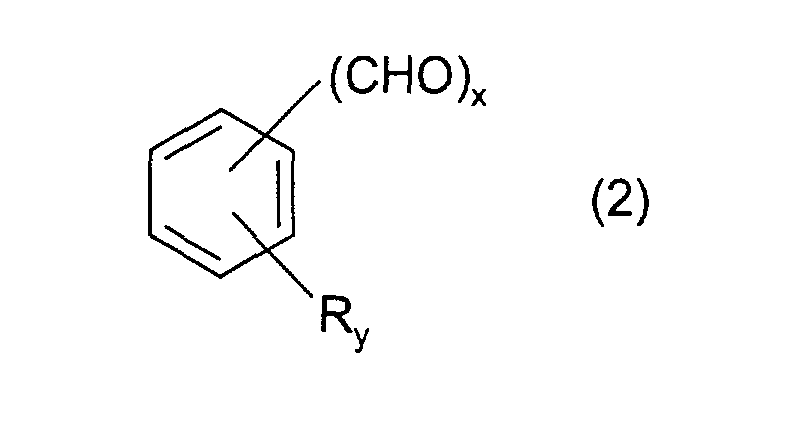
- Verfahren nach Anspruch 1, dadurch gekennzeichnet, dass man einen Benzaldehyd der Formel (2), worin R unabhängig voneinander gleich oder verschieden ist und für -Halogen, -NO2, -CN, -NR'2, -OR', -SO2R', -SO2OR', -COR' oder -CO2R' steht, wobei R' ein geradkettiger oder verzweigter C1-C4-Alkylrest oder ein unsubstituierter Phenylrest ist, einsetzt.
- Verfahren nach Anspruch 1 oder 2, dadurch gekennzeichnet, dass man einen Benzaldehyd (2), worin x für 1 steht, einsetzt.
- Verfahren nach einem oder mehreren der Ansprüche 1 bis 3, dadurch gekennzeichnet, dass man einen Benzaldehyd (2), worin wenigstens einer der Reste R für ein in ortho-Stellung zu einer Aldehydgruppe angeordnetes Halogen steht, einsetzt.
- Verfahren nach einem oder mehreren der Ansprüche 1 bis 4, dadurch gekennzeichnet, dass man einen Benzaldehyd (2), worin R unabhängig voneinander gleich oder verschieden ist und für -F, -Cl oder -NO2 steht, x für 1 und wenigstens einer der Reste R für ein in ortho-Stellung zu der Aldehydgruppe angeordnetes -F oder -Cl steht, einsetzt.
- Verfahren nach einem oder mehreren der Ansprüche 1 bis 5, dadurch gekennzeichnet, dass man als Chlorierungsmittel Cl2, SOCl2, SO2Cl2, PCl3, POCl3, PCl5, SbCl5, ICI, ICl3, SCl2, S2Cl2, MnCl4, (C1-C4)Alkylhypochlorit, CCl4, N-Chlorsuccinimid oder ein Gemisch derselben einsetzt.
- Verfahren nach einem oder mehreren der Ansprüche 1 bis 6, dadurch gekennzeichnet, dass man als Chlorierungsmittel Cl2, SOCl2, SO2Cl2 oder ein Gemisch derselben einsetzt.
- Verfahren nach einem oder mehreren der Ansprüche 1 bis 7, dadurch gekennzeichnet, dass man als Radikalstarter ein organisches Peroxid oder eine organische Azoverbindung oder ein Gemisch derselben einsetzt.
- Verfahren nach einem oder mehreren der Ansprüche 1 bis 8, dadurch gekennzeichnet, dass man 2,2'-Azobis(2,4-dimethylvaleronitril), 2,2'-Azobis(isobutyronitril), 2,2'-Azobis(4-methoxy-2,4-dimethylvaleronitril) oder ein Gemisch derselben als Radikalstarter einsetzt.
- Verfahren nach einem oder mehreren der Ansprüche 1 bis 9, dadurch gekennzeichnet, dass man als Lösungsmittel einen einfach oder mehrfach chlorierten aliphatischen oder aromatischen Kohlenwasserstoff oder ein Gemisch derselben einsetzt.
- Verfahren nach einem oder mehreren der Ansprüche 1 bis 10, dadurch gekennzeichnet, dass man als Lösungsmittel Chlorbenzol, 1,2-Dichlorbenzol, 1,3-Dichlorbenzol, 1,4-Dichlorbenzol, 1,2,3-Trichlorbenzol, 1,2,4-Trichlorbenzol, 1,3,5-Trichlorbenzol, 2-Chlortoluol, 3-Chlortoluol, 4-Chlortoluol oder ein Gemisch derselben einsetzt.
- Verfahren nach einem oder mehreren der Ansprüche 1 bis 11, dadurch gekennzeichnet, dass man die Umsetzung bei 0 bis 120°C durchführt.
- Verfahren nach einem oder mehreren der Ansprüche 1 bis 12, dadurch gekennzeichnet, dass man die Umsetzung bei 20 bis 90°C durchführt.
Applications Claiming Priority (2)
| Application Number | Priority Date | Filing Date | Title |
|---|---|---|---|
| DE10036653 | 2000-07-26 | ||
| DE10036653A DE10036653A1 (de) | 2000-07-26 | 2000-07-26 | Verfahren zur Herstellung von substituierten Benzoylchloriden |
Publications (3)
| Publication Number | Publication Date |
|---|---|
| EP1176133A2 true EP1176133A2 (de) | 2002-01-30 |
| EP1176133A3 EP1176133A3 (de) | 2003-02-05 |
| EP1176133B1 EP1176133B1 (de) | 2006-12-27 |
Family
ID=7650435
Family Applications (1)
| Application Number | Title | Priority Date | Filing Date |
|---|---|---|---|
| EP01116470A Expired - Lifetime EP1176133B1 (de) | 2000-07-26 | 2001-07-07 | Verfahren zur Herstellung von substituierten Benzoylchloriden |
Country Status (4)
| Country | Link |
|---|---|
| US (1) | US20020040158A1 (de) |
| EP (1) | EP1176133B1 (de) |
| JP (1) | JP5047427B2 (de) |
| DE (2) | DE10036653A1 (de) |
Cited By (1)
| Publication number | Priority date | Publication date | Assignee | Title |
|---|---|---|---|---|
| EP2537829A1 (de) | 2002-10-30 | 2012-12-26 | Basf Se | Aminobenzoylsulfonsäureamide und deren Herstellung |
Families Citing this family (4)
| Publication number | Priority date | Publication date | Assignee | Title |
|---|---|---|---|---|
| JP4940810B2 (ja) * | 2006-04-13 | 2012-05-30 | セントラル硝子株式会社 | 3,3,3−トリフルオロプロピオン酸クロリドの製造方法 |
| DE102007002674A1 (de) * | 2007-01-18 | 2008-07-24 | Bayer Cropscience Ag | Verfahren zum Herstellen von substituierten Pyrazolcarbonsäurechloriden |
| WO2020132792A1 (zh) * | 2018-12-24 | 2020-07-02 | 江苏联化科技有限公司 | 一种2-苯甲酰丙二酸酯类化合物、其制备方法及应用 |
| CN111348996B (zh) * | 2018-12-24 | 2023-09-08 | 江苏联化科技有限公司 | 一种2-苯甲酰丙二酸酯类化合物、其制备方法及应用 |
Family Cites Families (7)
| Publication number | Priority date | Publication date | Assignee | Title |
|---|---|---|---|---|
| US3274242A (en) * | 1962-05-24 | 1966-09-20 | Petro Tex Chem Corp | Preparation of aromatic acid chlorides by vapor phase chlorination of aromatic aldehydes |
| GB2061257B (en) * | 1979-10-18 | 1983-10-12 | Dow Chemical Co | Method for the preparations of 2-chlorobenzoyl chloride and its uses |
| JP3788482B2 (ja) * | 1995-01-26 | 2006-06-21 | 三菱瓦斯化学株式会社 | アルキルベンゾイルクロライドの製造方法 |
| JP3783733B2 (ja) * | 1995-01-26 | 2006-06-07 | 三菱瓦斯化学株式会社 | アルキルベンゾイルクロライドの製造法 |
| JP3918883B2 (ja) * | 1996-12-20 | 2007-05-23 | 三菱瓦斯化学株式会社 | ベンゾイルクロライド類の製造方法 |
| DE19755298A1 (de) * | 1997-12-12 | 1999-06-17 | Clariant Gmbh | Verfahren zur Herstellung von 3-Chlor-4-fluorbenzoylchlorid |
| JP2000281637A (ja) * | 1999-03-29 | 2000-10-10 | Showa Denko Kk | シアノ安息香酸ハライドの製造方法 |
-
2000
- 2000-07-26 DE DE10036653A patent/DE10036653A1/de not_active Withdrawn
-
2001
- 2001-06-11 JP JP2001175558A patent/JP5047427B2/ja not_active Expired - Fee Related
- 2001-07-07 DE DE50111717T patent/DE50111717D1/de not_active Expired - Lifetime
- 2001-07-07 EP EP01116470A patent/EP1176133B1/de not_active Expired - Lifetime
- 2001-07-26 US US09/915,830 patent/US20020040158A1/en not_active Abandoned
Cited By (1)
| Publication number | Priority date | Publication date | Assignee | Title |
|---|---|---|---|---|
| EP2537829A1 (de) | 2002-10-30 | 2012-12-26 | Basf Se | Aminobenzoylsulfonsäureamide und deren Herstellung |
Also Published As
| Publication number | Publication date |
|---|---|
| JP2002053521A (ja) | 2002-02-19 |
| EP1176133B1 (de) | 2006-12-27 |
| JP5047427B2 (ja) | 2012-10-10 |
| EP1176133A3 (de) | 2003-02-05 |
| DE50111717D1 (de) | 2007-02-08 |
| DE10036653A1 (de) | 2002-02-07 |
| US20020040158A1 (en) | 2002-04-04 |
Similar Documents
| Publication | Publication Date | Title |
|---|---|---|
| DE69932609T2 (de) | Verfahren zur herstellung von 1-chloro-1,1,3,3,3-pentafluorpropan | |
| EP1176133B1 (de) | Verfahren zur Herstellung von substituierten Benzoylchloriden | |
| EP0083442B1 (de) | Verfahren zur Herstellung von 2,4,6-Trichloranilin | |
| DE2546532C2 (de) | Verfahren zur Herstellung von Trichlormethyl-trifluormethylbenzolen | |
| EP0607824A2 (de) | Verfahren zur Herstellung mehrfach halogenierter Benzotrifluoride, Benzotrichloride und Benzoylchloride sowie neue Trihalogenbenzotrichloride und -benzoylchloride | |
| EP0628536B1 (de) | Verfahren zur Herstellung von aromatischen Aminen | |
| EP0676389B1 (de) | Verfahren zur Herstellung von 0-Chloromethylbenzoesäurechloriden | |
| EP0505874B1 (de) | Verfahren zur Herstellung von p-Dichlorbenzol | |
| EP0922693B1 (de) | Verfahren zur Herstellung von 3-Chlor-4-fluorbenzoylchlorid | |
| DE3104259A1 (de) | Verfahren zur herstellung von polychlorbenzoylchloriden | |
| US6844468B2 (en) | Process for preparing substituted benzoyl chlorides | |
| EP0718261A1 (de) | Verfahren zur Herstellung von 3-Fluor-4,6-dichlortoluol | |
| DE3809845A1 (de) | Verfahren zur herstellung von 4-halo-3-oxo-2-alkoxyiminobuttersaeureestern | |
| EP0165540B1 (de) | Verfahren zur Herstellung von 2-Chlorpropionsäure | |
| DE10101150A1 (de) | Verfahren zur Herstellung trifluormethyl-substituierter Biphenylcarbonsäuren und neue trichlormethyl-und trifluormethyl-substituierte Biphenylcarbonitrile | |
| EP0546418A1 (de) | Verfahren zur Herstellung von 5-substituierten 2-Chlorpyridinen | |
| EP0657407B1 (de) | Verfahren zur Herstellung von 3-Fluor-4,6-dichlortoluol | |
| DE19810036A1 (de) | Kontinuierliches Verfahren zur Herstellung von Propargylchlorid | |
| EP0608714B1 (de) | Verfahren zur Herstellung chlorierter 4,5-Difluorbenzoesäuren, -benzoesäurederivate und -benzaldehyde | |
| EP0537540B1 (de) | Verfahren zur radikalischen Chlorierung oder Bromierung von Methylaromaten | |
| DE4123322C2 (de) | 2-Chlor-3,4,5-trifluorbenzoesäure 2,2'-Dichlor-3,4,5-trifluoracetophenon, 2,2',2'-Trichlor-3,4,5-trifluoracetophenon, 5,2'-Dichlor-2,3,4-trifluoracetophenon und 5,2',2'-Trichlor-2,3,4-trifluoracetophenon und Verfahren zur Herstellung dieser Verbindungen und der isomeren 5-Chlor-2,3,4-trifluorbenzoesäure | |
| DE3506980A1 (de) | Amino-diaryl-sulfoxid-derivate, verfahren zu deren herstellung und diese enthaltende mittel | |
| DE3406909A1 (de) | Verfahren zur herstellung von 2,6-dichlorbenzoxazol | |
| DE19959066C1 (de) | Verfahren zur Herstellung von o-Chlormethylbenzoesäurechloriden | |
| EP0306804B1 (de) | Herstellung von substituierten Benzotrichloriden |
Legal Events
| Date | Code | Title | Description |
|---|---|---|---|
| PUAI | Public reference made under article 153(3) epc to a published international application that has entered the european phase |
Free format text: ORIGINAL CODE: 0009012 |
|
| AK | Designated contracting states |
Kind code of ref document: A2 Designated state(s): AT BE CH CY DE DK ES FI FR GB GR IE IT LI LU MC NL PT SE TR |
|
| AX | Request for extension of the european patent |
Free format text: AL;LT;LV;MK;RO;SI |
|
| PUAL | Search report despatched |
Free format text: ORIGINAL CODE: 0009013 |
|
| AK | Designated contracting states |
Designated state(s): AT BE CH CY DE DK ES FI FR GB GR IE IT LI LU MC NL PT SE TR |
|
| AX | Request for extension of the european patent |
Extension state: AL LT LV MK RO SI |
|
| RIC1 | Information provided on ipc code assigned before grant |
Ipc: 7C 07C 205/58 B Ipc: 7C 07C 63/70 B Ipc: 7C 07C 201/12 B Ipc: 7C 07C 205/57 B Ipc: 7C 07C 51/58 A |
|
| 17P | Request for examination filed |
Effective date: 20030805 |
|
| AKX | Designation fees paid |
Designated state(s): CH DE FR GB IT LI |
|
| 17Q | First examination report despatched |
Effective date: 20040608 |
|
| RAP1 | Party data changed (applicant data changed or rights of an application transferred) |
Owner name: CLARIANT PRODUKTE (DEUTSCHLAND) GMBH |
|
| GRAP | Despatch of communication of intention to grant a patent |
Free format text: ORIGINAL CODE: EPIDOSNIGR1 |
|
| GRAS | Grant fee paid |
Free format text: ORIGINAL CODE: EPIDOSNIGR3 |
|
| GRAA | (expected) grant |
Free format text: ORIGINAL CODE: 0009210 |
|
| AK | Designated contracting states |
Kind code of ref document: B1 Designated state(s): CH DE FR GB IT LI |
|
| REG | Reference to a national code |
Ref country code: GB Ref legal event code: FG4D Free format text: NOT ENGLISH |
|
| REF | Corresponds to: |
Ref document number: 50111717 Country of ref document: DE Date of ref document: 20070208 Kind code of ref document: P |
|
| ET | Fr: translation filed | ||
| PLBE | No opposition filed within time limit |
Free format text: ORIGINAL CODE: 0009261 |
|
| STAA | Information on the status of an ep patent application or granted ep patent |
Free format text: STATUS: NO OPPOSITION FILED WITHIN TIME LIMIT |
|
| 26N | No opposition filed |
Effective date: 20070928 |
|
| REG | Reference to a national code |
Ref country code: CH Ref legal event code: NV Representative=s name: SCHNEIDER FELDMANN AG PATENT- UND MARKENANWAELTE |
|
| REG | Reference to a national code |
Ref country code: DE Ref legal event code: R081 Ref document number: 50111717 Country of ref document: DE Owner name: WEYLCHEM FRANKFURT GMBH, DE Free format text: FORMER OWNER: CLARIANT PRODUKTE (DEUTSCHLAND) GMBH, 65929 FRANKFURT, DE Effective date: 20121129 Ref country code: DE Ref legal event code: R082 Ref document number: 50111717 Country of ref document: DE Representative=s name: ZELLENTIN & PARTNER GBR, DE Effective date: 20121129 |
|
| PGFP | Annual fee paid to national office [announced via postgrant information from national office to epo] |
Ref country code: DE Payment date: 20140724 Year of fee payment: 14 Ref country code: CH Payment date: 20140722 Year of fee payment: 14 |
|
| PGFP | Annual fee paid to national office [announced via postgrant information from national office to epo] |
Ref country code: FR Payment date: 20140724 Year of fee payment: 14 Ref country code: GB Payment date: 20140721 Year of fee payment: 14 |
|
| PGFP | Annual fee paid to national office [announced via postgrant information from national office to epo] |
Ref country code: IT Payment date: 20140725 Year of fee payment: 14 |
|
| REG | Reference to a national code |
Ref country code: DE Ref legal event code: R119 Ref document number: 50111717 Country of ref document: DE |
|
| REG | Reference to a national code |
Ref country code: CH Ref legal event code: PL |
|
| GBPC | Gb: european patent ceased through non-payment of renewal fee |
Effective date: 20150707 |
|
| PG25 | Lapsed in a contracting state [announced via postgrant information from national office to epo] |
Ref country code: GB Free format text: LAPSE BECAUSE OF NON-PAYMENT OF DUE FEES Effective date: 20150707 Ref country code: IT Free format text: LAPSE BECAUSE OF NON-PAYMENT OF DUE FEES Effective date: 20150707 Ref country code: LI Free format text: LAPSE BECAUSE OF NON-PAYMENT OF DUE FEES Effective date: 20150731 Ref country code: CH Free format text: LAPSE BECAUSE OF NON-PAYMENT OF DUE FEES Effective date: 20150731 Ref country code: DE Free format text: LAPSE BECAUSE OF NON-PAYMENT OF DUE FEES Effective date: 20160202 |
|
| REG | Reference to a national code |
Ref country code: FR Ref legal event code: ST Effective date: 20160331 |
|
| PG25 | Lapsed in a contracting state [announced via postgrant information from national office to epo] |
Ref country code: FR Free format text: LAPSE BECAUSE OF NON-PAYMENT OF DUE FEES Effective date: 20150731 |