EP1170277A2 - Verfahren zur Oxidation von Alkoholen mit homogen löslichen polymervergrösserten Stickstoffverbindungen als Katalysator - Google Patents
Verfahren zur Oxidation von Alkoholen mit homogen löslichen polymervergrösserten Stickstoffverbindungen als Katalysator Download PDFInfo
- Publication number
- EP1170277A2 EP1170277A2 EP01111819A EP01111819A EP1170277A2 EP 1170277 A2 EP1170277 A2 EP 1170277A2 EP 01111819 A EP01111819 A EP 01111819A EP 01111819 A EP01111819 A EP 01111819A EP 1170277 A2 EP1170277 A2 EP 1170277A2
- Authority
- EP
- European Patent Office
- Prior art keywords
- oxidation
- mol
- alcohols
- enlarged
- soluble polymer
- Prior art date
- Legal status (The legal status is an assumption and is not a legal conclusion. Google has not performed a legal analysis and makes no representation as to the accuracy of the status listed.)
- Withdrawn
Links
- 238000000034 method Methods 0.000 title claims abstract description 25
- 238000007254 oxidation reaction Methods 0.000 title claims abstract description 24
- 230000003647 oxidation Effects 0.000 title claims abstract description 23
- 230000008569 process Effects 0.000 title claims abstract description 11
- 150000001298 alcohols Chemical class 0.000 title claims abstract description 9
- 239000003054 catalyst Substances 0.000 title description 12
- 229920000642 polymer Polymers 0.000 title description 10
- 229910017464 nitrogen compound Inorganic materials 0.000 title description 3
- 150000002830 nitrogen compounds Chemical class 0.000 title description 3
- 150000001875 compounds Chemical class 0.000 claims abstract description 15
- 239000000203 mixture Substances 0.000 claims abstract description 12
- 239000007800 oxidant agent Substances 0.000 claims abstract description 7
- ODUCDPQEXGNKDN-UHFFFAOYSA-N nitroxyl Chemical class O=N ODUCDPQEXGNKDN-UHFFFAOYSA-N 0.000 claims abstract description 6
- 230000003197 catalytic effect Effects 0.000 claims abstract description 3
- 238000006243 chemical reaction Methods 0.000 claims description 18
- -1 HEMA or EGDMA Chemical class 0.000 claims description 13
- SUKJFIGYRHOWBL-UHFFFAOYSA-N sodium hypochlorite Chemical compound [Na+].Cl[O-] SUKJFIGYRHOWBL-UHFFFAOYSA-N 0.000 claims description 11
- 229910052760 oxygen Inorganic materials 0.000 claims description 8
- 125000004209 (C1-C8) alkyl group Chemical group 0.000 claims description 7
- 229910019093 NaOCl Inorganic materials 0.000 claims description 7
- 238000003786 synthesis reaction Methods 0.000 claims description 7
- 102100026735 Coagulation factor VIII Human genes 0.000 claims description 6
- 101000911390 Homo sapiens Coagulation factor VIII Proteins 0.000 claims description 6
- WOBHKFSMXKNTIM-UHFFFAOYSA-N Hydroxyethyl methacrylate Chemical compound CC(=C)C(=O)OCCO WOBHKFSMXKNTIM-UHFFFAOYSA-N 0.000 claims description 6
- STVZJERGLQHEKB-UHFFFAOYSA-N ethylene glycol dimethacrylate Chemical compound CC(=C)C(=O)OCCOC(=O)C(C)=C STVZJERGLQHEKB-UHFFFAOYSA-N 0.000 claims description 6
- 125000002496 methyl group Chemical group [H]C([H])([H])* 0.000 claims description 6
- 125000003545 alkoxy group Chemical group 0.000 claims description 5
- 125000006552 (C3-C8) cycloalkyl group Chemical group 0.000 claims description 4
- 229910052736 halogen Inorganic materials 0.000 claims description 4
- 150000002367 halogens Chemical class 0.000 claims description 4
- 229910052717 sulfur Inorganic materials 0.000 claims description 4
- 125000005842 heteroatom Chemical group 0.000 claims description 3
- NIXOWILDQLNWCW-UHFFFAOYSA-M Acrylate Chemical compound [O-]C(=O)C=C NIXOWILDQLNWCW-UHFFFAOYSA-M 0.000 claims description 2
- 125000003710 aryl alkyl group Chemical group 0.000 claims description 2
- 125000003118 aryl group Chemical group 0.000 claims description 2
- 239000000126 substance Substances 0.000 abstract description 7
- 230000000975 bioactive effect Effects 0.000 abstract description 3
- 238000007334 copolymerization reaction Methods 0.000 abstract description 3
- GDOPTJXRTPNYNR-UHFFFAOYSA-N methyl-cyclopentane Natural products CC1CCCC1 GDOPTJXRTPNYNR-UHFFFAOYSA-N 0.000 abstract 1
- YMWUJEATGCHHMB-UHFFFAOYSA-N Dichloromethane Chemical compound ClCCl YMWUJEATGCHHMB-UHFFFAOYSA-N 0.000 description 21
- RTZKZFJDLAIYFH-UHFFFAOYSA-N Diethyl ether Chemical compound CCOCC RTZKZFJDLAIYFH-UHFFFAOYSA-N 0.000 description 17
- 239000000047 product Substances 0.000 description 11
- UIIMBOGNXHQVGW-UHFFFAOYSA-M Sodium bicarbonate Chemical compound [Na+].OC([O-])=O UIIMBOGNXHQVGW-UHFFFAOYSA-M 0.000 description 10
- OKKJLVBELUTLKV-UHFFFAOYSA-N Methanol Chemical compound OC OKKJLVBELUTLKV-UHFFFAOYSA-N 0.000 description 9
- CSNNHWWHGAXBCP-UHFFFAOYSA-L Magnesium sulfate Chemical compound [Mg+2].[O-][S+2]([O-])([O-])[O-] CSNNHWWHGAXBCP-UHFFFAOYSA-L 0.000 description 8
- IOLCXVTUBQKXJR-UHFFFAOYSA-M potassium bromide Chemical compound [K+].[Br-] IOLCXVTUBQKXJR-UHFFFAOYSA-M 0.000 description 8
- LFQSCWFLJHTTHZ-UHFFFAOYSA-N Ethanol Chemical compound CCO LFQSCWFLJHTTHZ-UHFFFAOYSA-N 0.000 description 7
- 239000003208 petroleum Substances 0.000 description 7
- WEVYAHXRMPXWCK-UHFFFAOYSA-N Acetonitrile Chemical compound CC#N WEVYAHXRMPXWCK-UHFFFAOYSA-N 0.000 description 6
- XEKOWRVHYACXOJ-UHFFFAOYSA-N Ethyl acetate Chemical compound CCOC(C)=O XEKOWRVHYACXOJ-UHFFFAOYSA-N 0.000 description 6
- 238000001914 filtration Methods 0.000 description 6
- ZSIAUFGUXNUGDI-UHFFFAOYSA-N hexan-1-ol Chemical compound CCCCCCO ZSIAUFGUXNUGDI-UHFFFAOYSA-N 0.000 description 6
- QNVRIHYSUZMSGM-UHFFFAOYSA-N hexan-2-ol Chemical compound CCCCC(C)O QNVRIHYSUZMSGM-UHFFFAOYSA-N 0.000 description 6
- 239000012528 membrane Substances 0.000 description 6
- 239000012071 phase Substances 0.000 description 6
- NTIZESTWPVYFNL-UHFFFAOYSA-N Methyl isobutyl ketone Chemical compound CC(C)CC(C)=O NTIZESTWPVYFNL-UHFFFAOYSA-N 0.000 description 5
- UIHCLUNTQKBZGK-UHFFFAOYSA-N Methyl isobutyl ketone Natural products CCC(C)C(C)=O UIHCLUNTQKBZGK-UHFFFAOYSA-N 0.000 description 5
- QQZOPKMRPOGIEB-UHFFFAOYSA-N n-butyl methyl ketone Natural products CCCCC(C)=O QQZOPKMRPOGIEB-UHFFFAOYSA-N 0.000 description 5
- 239000002244 precipitate Substances 0.000 description 5
- 229910000030 sodium bicarbonate Inorganic materials 0.000 description 5
- 235000017557 sodium bicarbonate Nutrition 0.000 description 5
- UFLXKQBCEYNCDU-UHFFFAOYSA-N (2,2,6,6-tetramethylpiperidin-4-yl) 2-methylprop-2-enoate Chemical compound CC(=C)C(=O)OC1CC(C)(C)NC(C)(C)C1 UFLXKQBCEYNCDU-UHFFFAOYSA-N 0.000 description 4
- OZAIFHULBGXAKX-UHFFFAOYSA-N 2-(2-cyanopropan-2-yldiazenyl)-2-methylpropanenitrile Chemical compound N#CC(C)(C)N=NC(C)(C)C#N OZAIFHULBGXAKX-UHFFFAOYSA-N 0.000 description 4
- BTWSPOZXDCFMLX-UHFFFAOYSA-N 4-methacryloyloxy-TEMPO Chemical group CC(=C)C(=O)OC1CC(C)(C)N([O])C(C)(C)C1 BTWSPOZXDCFMLX-UHFFFAOYSA-N 0.000 description 4
- IJGRMHOSHXDMSA-UHFFFAOYSA-N Atomic nitrogen Chemical compound N#N IJGRMHOSHXDMSA-UHFFFAOYSA-N 0.000 description 4
- MHAJPDPJQMAIIY-UHFFFAOYSA-N Hydrogen peroxide Chemical compound OO MHAJPDPJQMAIIY-UHFFFAOYSA-N 0.000 description 4
- 239000005708 Sodium hypochlorite Substances 0.000 description 4
- WYURNTSHIVDZCO-UHFFFAOYSA-N Tetrahydrofuran Chemical compound C1CCOC1 WYURNTSHIVDZCO-UHFFFAOYSA-N 0.000 description 4
- 229910052943 magnesium sulfate Inorganic materials 0.000 description 4
- 235000019341 magnesium sulphate Nutrition 0.000 description 4
- AKHNMLFCWUSKQB-UHFFFAOYSA-L sodium thiosulfate Chemical compound [Na+].[Na+].[O-]S([O-])(=O)=S AKHNMLFCWUSKQB-UHFFFAOYSA-L 0.000 description 4
- 235000019345 sodium thiosulphate Nutrition 0.000 description 4
- 239000007787 solid Substances 0.000 description 4
- 125000006648 (C1-C8) haloalkyl group Chemical group 0.000 description 3
- QNVRIHYSUZMSGM-LURJTMIESA-N 2-Hexanol Natural products CCCC[C@H](C)O QNVRIHYSUZMSGM-LURJTMIESA-N 0.000 description 3
- OZAIFHULBGXAKX-VAWYXSNFSA-N AIBN Substances N#CC(C)(C)\N=N\C(C)(C)C#N OZAIFHULBGXAKX-VAWYXSNFSA-N 0.000 description 3
- VVQNEPGJFQJSBK-UHFFFAOYSA-N Methyl methacrylate Chemical compound COC(=O)C(C)=C VVQNEPGJFQJSBK-UHFFFAOYSA-N 0.000 description 3
- 238000005481 NMR spectroscopy Methods 0.000 description 3
- 239000002253 acid Substances 0.000 description 3
- 150000007513 acids Chemical class 0.000 description 3
- 150000001299 aldehydes Chemical class 0.000 description 3
- 239000008346 aqueous phase Substances 0.000 description 3
- JFDZBHWFFUWGJE-UHFFFAOYSA-N benzonitrile Chemical compound N#CC1=CC=CC=C1 JFDZBHWFFUWGJE-UHFFFAOYSA-N 0.000 description 3
- 230000015572 biosynthetic process Effects 0.000 description 3
- 239000000460 chlorine Substances 0.000 description 3
- 229910052801 chlorine Inorganic materials 0.000 description 3
- 150000002576 ketones Chemical class 0.000 description 3
- 239000000178 monomer Substances 0.000 description 3
- VLKZOEOYAKHREP-UHFFFAOYSA-N n-Hexane Chemical compound CCCCCC VLKZOEOYAKHREP-UHFFFAOYSA-N 0.000 description 3
- 239000012074 organic phase Substances 0.000 description 3
- 150000003138 primary alcohols Chemical class 0.000 description 3
- 150000003254 radicals Chemical class 0.000 description 3
- 239000002904 solvent Substances 0.000 description 3
- XLYOFNOQVPJJNP-UHFFFAOYSA-N water Substances O XLYOFNOQVPJJNP-UHFFFAOYSA-N 0.000 description 3
- QWMFKVNJIYNWII-UHFFFAOYSA-N 5-bromo-2-(2,5-dimethylpyrrol-1-yl)pyridine Chemical compound CC1=CC=C(C)N1C1=CC=C(Br)C=N1 QWMFKVNJIYNWII-UHFFFAOYSA-N 0.000 description 2
- ZAMOUSCENKQFHK-UHFFFAOYSA-N Chlorine atom Chemical compound [Cl] ZAMOUSCENKQFHK-UHFFFAOYSA-N 0.000 description 2
- KCXVZYZYPLLWCC-UHFFFAOYSA-N EDTA Chemical compound OC(=O)CN(CC(O)=O)CCN(CC(O)=O)CC(O)=O KCXVZYZYPLLWCC-UHFFFAOYSA-N 0.000 description 2
- PXGOKWXKJXAPGV-UHFFFAOYSA-N Fluorine Chemical compound FF PXGOKWXKJXAPGV-UHFFFAOYSA-N 0.000 description 2
- CERQOIWHTDAKMF-UHFFFAOYSA-N Methacrylic acid Chemical compound CC(=C)C(O)=O CERQOIWHTDAKMF-UHFFFAOYSA-N 0.000 description 2
- CDBYLPFSWZWCQE-UHFFFAOYSA-L Sodium Carbonate Chemical compound [Na+].[Na+].[O-]C([O-])=O CDBYLPFSWZWCQE-UHFFFAOYSA-L 0.000 description 2
- 150000005840 aryl radicals Chemical class 0.000 description 2
- 230000008901 benefit Effects 0.000 description 2
- DKSMCEUSSQTGBK-UHFFFAOYSA-M bromite Chemical compound [O-]Br=O DKSMCEUSSQTGBK-UHFFFAOYSA-M 0.000 description 2
- 125000004432 carbon atom Chemical group C* 0.000 description 2
- 238000001816 cooling Methods 0.000 description 2
- 239000012043 crude product Substances 0.000 description 2
- 239000012065 filter cake Substances 0.000 description 2
- 239000000706 filtrate Substances 0.000 description 2
- 239000011737 fluorine Substances 0.000 description 2
- 229910052731 fluorine Inorganic materials 0.000 description 2
- 125000005843 halogen group Chemical group 0.000 description 2
- JARKCYVAAOWBJS-UHFFFAOYSA-N hexanal Chemical compound CCCCCC=O JARKCYVAAOWBJS-UHFFFAOYSA-N 0.000 description 2
- WQYVRQLZKVEZGA-UHFFFAOYSA-N hypochlorite Chemical compound Cl[O-] WQYVRQLZKVEZGA-UHFFFAOYSA-N 0.000 description 2
- 238000004519 manufacturing process Methods 0.000 description 2
- 229910052757 nitrogen Inorganic materials 0.000 description 2
- 239000003960 organic solvent Substances 0.000 description 2
- BWHMMNNQKKPAPP-UHFFFAOYSA-L potassium carbonate Chemical compound [K+].[K+].[O-]C([O-])=O BWHMMNNQKKPAPP-UHFFFAOYSA-L 0.000 description 2
- 239000000843 powder Substances 0.000 description 2
- 239000011541 reaction mixture Substances 0.000 description 2
- 150000003333 secondary alcohols Chemical class 0.000 description 2
- 239000000725 suspension Substances 0.000 description 2
- YLQBMQCUIZJEEH-UHFFFAOYSA-N tetrahydrofuran Natural products C=1C=COC=1 YLQBMQCUIZJEEH-UHFFFAOYSA-N 0.000 description 2
- NHQDETIJWKXCTC-UHFFFAOYSA-N 3-chloroperbenzoic acid Chemical compound OOC(=O)C1=CC=CC(Cl)=C1 NHQDETIJWKXCTC-UHFFFAOYSA-N 0.000 description 1
- ZCYVEMRRCGMTRW-UHFFFAOYSA-N 7553-56-2 Chemical compound [I] ZCYVEMRRCGMTRW-UHFFFAOYSA-N 0.000 description 1
- WKBOTKDWSSQWDR-UHFFFAOYSA-N Bromine atom Chemical compound [Br] WKBOTKDWSSQWDR-UHFFFAOYSA-N 0.000 description 1
- XFXPMWWXUTWYJX-UHFFFAOYSA-N Cyanide Chemical compound N#[C-] XFXPMWWXUTWYJX-UHFFFAOYSA-N 0.000 description 1
- 240000003517 Elaeocarpus dentatus Species 0.000 description 1
- CERQOIWHTDAKMF-UHFFFAOYSA-M Methacrylate Chemical compound CC(=C)C([O-])=O CERQOIWHTDAKMF-UHFFFAOYSA-M 0.000 description 1
- 239000012963 UV stabilizer Substances 0.000 description 1
- 125000005428 anthryl group Chemical group [H]C1=C([H])C([H])=C2C([H])=C3C(*)=C([H])C([H])=C([H])C3=C([H])C2=C1[H] 0.000 description 1
- 239000003125 aqueous solvent Substances 0.000 description 1
- 238000010923 batch production Methods 0.000 description 1
- 235000010290 biphenyl Nutrition 0.000 description 1
- 239000004305 biphenyl Substances 0.000 description 1
- GDTBXPJZTBHREO-UHFFFAOYSA-N bromine Substances BrBr GDTBXPJZTBHREO-UHFFFAOYSA-N 0.000 description 1
- 229910052794 bromium Inorganic materials 0.000 description 1
- 230000008859 change Effects 0.000 description 1
- 238000003889 chemical engineering Methods 0.000 description 1
- 238000004132 cross linking Methods 0.000 description 1
- 125000001995 cyclobutyl group Chemical group [H]C1([H])C([H])([H])C([H])(*)C1([H])[H] 0.000 description 1
- 125000000582 cycloheptyl group Chemical group [H]C1([H])C([H])([H])C([H])([H])C([H])([H])C([H])(*)C([H])([H])C1([H])[H] 0.000 description 1
- 125000000113 cyclohexyl group Chemical group [H]C1([H])C([H])([H])C([H])([H])C([H])(*)C([H])([H])C1([H])[H] 0.000 description 1
- 125000001511 cyclopentyl group Chemical group [H]C1([H])C([H])([H])C([H])([H])C([H])(*)C1([H])[H] 0.000 description 1
- 125000001559 cyclopropyl group Chemical group [H]C1([H])C([H])([H])C1([H])* 0.000 description 1
- 239000008367 deionised water Substances 0.000 description 1
- 229910021641 deionized water Inorganic materials 0.000 description 1
- BNIILDVGGAEEIG-UHFFFAOYSA-L disodium hydrogen phosphate Chemical compound [Na+].[Na+].OP([O-])([O-])=O BNIILDVGGAEEIG-UHFFFAOYSA-L 0.000 description 1
- 229910000397 disodium phosphate Inorganic materials 0.000 description 1
- 235000019800 disodium phosphate Nutrition 0.000 description 1
- 230000000694 effects Effects 0.000 description 1
- 238000005516 engineering process Methods 0.000 description 1
- 125000001495 ethyl group Chemical group [H]C([H])([H])C([H])([H])* 0.000 description 1
- 238000002474 experimental method Methods 0.000 description 1
- 125000003187 heptyl group Chemical group [H]C([*])([H])C([H])([H])C([H])([H])C([H])([H])C([H])([H])C([H])([H])C([H])([H])[H] 0.000 description 1
- 125000004051 hexyl group Chemical group [H]C([H])([H])C([H])([H])C([H])([H])C([H])([H])C([H])([H])C([H])([H])* 0.000 description 1
- 238000007172 homogeneous catalysis Methods 0.000 description 1
- 229910052740 iodine Inorganic materials 0.000 description 1
- 239000011630 iodine Substances 0.000 description 1
- 125000000959 isobutyl group Chemical group [H]C([H])([H])C([H])(C([H])([H])[H])C([H])([H])* 0.000 description 1
- 125000001449 isopropyl group Chemical group [H]C([H])([H])C([H])(*)C([H])([H])[H] 0.000 description 1
- 238000010327 methods by industry Methods 0.000 description 1
- 238000001728 nano-filtration Methods 0.000 description 1
- 125000001624 naphthyl group Chemical group 0.000 description 1
- 238000000655 nuclear magnetic resonance spectrum Methods 0.000 description 1
- 238000005935 nucleophilic addition reaction Methods 0.000 description 1
- 125000002347 octyl group Chemical group [H]C([*])([H])C([H])([H])C([H])([H])C([H])([H])C([H])([H])C([H])([H])C([H])([H])C([H])([H])[H] 0.000 description 1
- 150000002902 organometallic compounds Chemical class 0.000 description 1
- 125000004430 oxygen atom Chemical group O* 0.000 description 1
- 125000001147 pentyl group Chemical group C(CCCC)* 0.000 description 1
- 125000005561 phenanthryl group Chemical group 0.000 description 1
- 125000001997 phenyl group Chemical group [H]C1=C([H])C([H])=C(*)C([H])=C1[H] 0.000 description 1
- ZUOUZKKEUPVFJK-UHFFFAOYSA-N phenylbenzene Natural products C1=CC=CC=C1C1=CC=CC=C1 ZUOUZKKEUPVFJK-UHFFFAOYSA-N 0.000 description 1
- 125000003386 piperidinyl group Chemical group 0.000 description 1
- 229920002959 polymer blend Polymers 0.000 description 1
- 238000006116 polymerization reaction Methods 0.000 description 1
- 229910000027 potassium carbonate Inorganic materials 0.000 description 1
- 235000011181 potassium carbonates Nutrition 0.000 description 1
- 238000001556 precipitation Methods 0.000 description 1
- 238000004321 preservation Methods 0.000 description 1
- 230000009257 reactivity Effects 0.000 description 1
- 230000004044 response Effects 0.000 description 1
- 239000012465 retentate Substances 0.000 description 1
- 125000002914 sec-butyl group Chemical group [H]C([H])([H])C([H])([H])C([H])(*)C([H])([H])[H] 0.000 description 1
- 229910000029 sodium carbonate Inorganic materials 0.000 description 1
- 241000894007 species Species 0.000 description 1
- 238000003756 stirring Methods 0.000 description 1
- 239000000758 substrate Substances 0.000 description 1
- 239000006228 supernatant Substances 0.000 description 1
- 125000000999 tert-butyl group Chemical group [H]C([H])([H])C(*)(C([H])([H])[H])C([H])([H])[H] 0.000 description 1
- 230000009466 transformation Effects 0.000 description 1
- 238000000108 ultra-filtration Methods 0.000 description 1
Classifications
-
- C—CHEMISTRY; METALLURGY
- C08—ORGANIC MACROMOLECULAR COMPOUNDS; THEIR PREPARATION OR CHEMICAL WORKING-UP; COMPOSITIONS BASED THEREON
- C08F—MACROMOLECULAR COMPOUNDS OBTAINED BY REACTIONS ONLY INVOLVING CARBON-TO-CARBON UNSATURATED BONDS
- C08F20/00—Homopolymers and copolymers of compounds having one or more unsaturated aliphatic radicals, each having only one carbon-to-carbon double bond, and only one being terminated by only one carboxyl radical or a salt, anhydride, ester, amide, imide or nitrile thereof
- C08F20/02—Monocarboxylic acids having less than ten carbon atoms, Derivatives thereof
- C08F20/10—Esters
- C08F20/34—Esters containing nitrogen, e.g. N,N-dimethylaminoethyl (meth)acrylate
- C08F20/36—Esters containing nitrogen, e.g. N,N-dimethylaminoethyl (meth)acrylate containing oxygen in addition to the carboxy oxygen, e.g. 2-N-morpholinoethyl (meth)acrylate or 2-isocyanatoethyl (meth)acrylate
-
- C—CHEMISTRY; METALLURGY
- C07—ORGANIC CHEMISTRY
- C07C—ACYCLIC OR CARBOCYCLIC COMPOUNDS
- C07C45/00—Preparation of compounds having >C = O groups bound only to carbon or hydrogen atoms; Preparation of chelates of such compounds
- C07C45/27—Preparation of compounds having >C = O groups bound only to carbon or hydrogen atoms; Preparation of chelates of such compounds by oxidation
- C07C45/29—Preparation of compounds having >C = O groups bound only to carbon or hydrogen atoms; Preparation of chelates of such compounds by oxidation of hydroxy groups
-
- C—CHEMISTRY; METALLURGY
- C07—ORGANIC CHEMISTRY
- C07C—ACYCLIC OR CARBOCYCLIC COMPOUNDS
- C07C45/00—Preparation of compounds having >C = O groups bound only to carbon or hydrogen atoms; Preparation of chelates of such compounds
- C07C45/27—Preparation of compounds having >C = O groups bound only to carbon or hydrogen atoms; Preparation of chelates of such compounds by oxidation
- C07C45/30—Preparation of compounds having >C = O groups bound only to carbon or hydrogen atoms; Preparation of chelates of such compounds by oxidation with halogen containing compounds, e.g. hypohalogenation
-
- C—CHEMISTRY; METALLURGY
- C08—ORGANIC MACROMOLECULAR COMPOUNDS; THEIR PREPARATION OR CHEMICAL WORKING-UP; COMPOSITIONS BASED THEREON
- C08F—MACROMOLECULAR COMPOUNDS OBTAINED BY REACTIONS ONLY INVOLVING CARBON-TO-CARBON UNSATURATED BONDS
- C08F8/00—Chemical modification by after-treatment
- C08F8/06—Oxidation
-
- C—CHEMISTRY; METALLURGY
- C08—ORGANIC MACROMOLECULAR COMPOUNDS; THEIR PREPARATION OR CHEMICAL WORKING-UP; COMPOSITIONS BASED THEREON
- C08F—MACROMOLECULAR COMPOUNDS OBTAINED BY REACTIONS ONLY INVOLVING CARBON-TO-CARBON UNSATURATED BONDS
- C08F220/00—Copolymers of compounds having one or more unsaturated aliphatic radicals, each having only one carbon-to-carbon double bond, and only one being terminated by only one carboxyl radical or a salt, anhydride ester, amide, imide or nitrile thereof
- C08F220/02—Monocarboxylic acids having less than ten carbon atoms; Derivatives thereof
- C08F220/10—Esters
- C08F220/12—Esters of monohydric alcohols or phenols
- C08F220/14—Methyl esters, e.g. methyl (meth)acrylate
-
- C—CHEMISTRY; METALLURGY
- C08—ORGANIC MACROMOLECULAR COMPOUNDS; THEIR PREPARATION OR CHEMICAL WORKING-UP; COMPOSITIONS BASED THEREON
- C08F—MACROMOLECULAR COMPOUNDS OBTAINED BY REACTIONS ONLY INVOLVING CARBON-TO-CARBON UNSATURATED BONDS
- C08F2810/00—Chemical modification of a polymer
- C08F2810/50—Chemical modification of a polymer wherein the polymer is a copolymer and the modification is taking place only on one or more of the monomers present in minority
Definitions
- the present invention is based on a method of oxidation of alcohols using homogeneously soluble polymer enlargers Directed nitrogen compounds as catalysts.
- the oxidation of alcohols represents organic synthesis an important transformation for the preservation of aldehydes, Ketones or acids. These in turn advantageously serve if not intended as a line molecule itself, for further conversion into follow-up products as they very easily accessible nucleophilic addition reactions are. This means that they also benefit from technical production of bioactive molecules often play a key role in the synthesis path to.
- polymer-enlarged TEMPO radicals have already been synthesized with the purpose of incorporating them as UV stabilizers in polymer mixtures (DE 2748362; L. Wenzhong, Polym. Degra. And Stab. 1991, 31, 353-364).
- endo et al. partially soluble polymer-enlarged TEMPO compounds have been used in alcohol oxidations (Journal of Polymer Science: Polymer Chemistry Edition, Vol. 23, 2487-94 (1985)).
- the object of the present invention was therefore to provide another process for the oxidation of alcohols in Presence of oxidation catalysts based on homogeneous specify soluble polymer-enlarged nitrogen compounds.
- this process should be technical This means that the scale can be used in terms of economic and ecological Points of view be advantageous.
- Claims 2 to 6 are further preferred Refinements of the method according to the invention.
- Claim 7 protects a preferred use of Compounds prepared according to the invention.
- a method is particularly preferred in which the polymer-enlarged nitroxyl derivative of the formula (II) with a ratio of n / m of 1-100, preferably 1-50, and an average molecular weight of 1-200 kDa, preferably 10-100 kDa, is used.
- ⁇ , ⁇ -unsaturated compounds of type C. serve in particular those monomers which help the To change the solubility properties of the polymer or ideally adapt to the solvent system to be used. These monomers can also have a crosslinking effect. Thereby it is achieved that individual polymer strands are connected to one another be what in turn the solubility properties and the secondary structure of the polymer backbone and thus indirectly significantly affect the reactivity of the catalyst can.
- the monomers of component A) and B) of the polymer iii) come into question in DE 19734360. Most notably the use of HEMA or EGDMA is preferred in this Respect.
- the substances suitable for the person skilled in the art for this reaction can be used as the oxidizing agent.
- These are preferably K 3 Fe (CN) 3 or aqueous NaOCl solution.
- Aqueous NaOCl solution is preferred because it is cheaper and does not cause any cyanide problems, especially on an industrial scale.
- the oxidation according to the invention is in principle corresponding who performed with monomeric TEMPO, preferably in Two-phase system made of organic and aqueous solvents.
- organic solvents ethyl acetate, Serve acetonitrile, dichloromethane or benzonitrile. All ethyl acetate, acetonitrile is particularly preferred.
- Oxidizing agent polymer-enlarged nitroxyl derivative of Formula (I), preferably that of formula (II), is in the selected two-phase system solved.
- the pH is adjusted so that the oxidation at a pH of 6-13, preferably 9-10.
- For setting of the pH is preferably sodium carbonate.
- bases suitable for this purpose can be used, such as e.g. Potassium carbonate, sodium hydrogen carbonate, sodium hydrogen phosphate.
- the alcohol can then be added to the mixture are given. The reaction is usually in a few minutes completed quantitatively.
- the reaction is preferably carried out at temperatures of -20 ° C-80 ° C, preferably 0-30 ° C, carried out. After completing the The reaction can be carried out by methods known to those skilled in the art be worked up.
- the organic one product-containing and possibly catalyst-containing phase of the aqueous separated.
- a particular advantage of the invention The process is that the polymer-enlarged catalyst after completion of the reaction slightly from the organic Phase can be recovered and so for another Oxidation cycle is available. This can be done by filtration by means of an ultra / nanofiltration membrane or by precipitation with the addition of suitable solvents, preferably alcohols such as methanol or ethanol, Petroleum ether, hexane or diethyl ether.
- the use of the method is very particularly preferred in a membrane reactor. This can usually Syntheses carried out in a batch process quasi-continuously or be done continuously, from a cost perspective particularly advantageous for a technical process appears.
- the application of the method according to the invention in the membrane reactor runs analogously to that described in the prior art Method (T. Müller, J. Mol. Cat. A: Chem. 1997, 116, 39-42; DE 199 10 691.6; Wandrey et al., Tetrahedron Asymmetry 1999, 10, 923-928).
- the membrane reactor can thereby as a cross-flow or dead-end filtration module act (DE 19947505.9 and DE 19910691.6 or engineering processes for bioseparations "Edited by: Laurence R. Weatherley Pages: 135-165; Butterworth-Heinemann, 1994; ISBN: 0 7506 1936 8).
- Another aspect of the invention is concerned with Use of the oxidation products produced according to the invention in organic synthesis, preferably for production of bioactive compounds.
- the objective method allows a simple, in Technical scale oxidation of alcohols that is easy to carry out to the correspondingly desired derivatives. Surrender compared to the known insoluble polymer-enlarged ones Species - surprisingly short response times. This and the fact that the catalyst is light can therefore be recycled and used again Cause that the claimed method is very good is suitable for technical use. Furthermore is excellent selectivity in favor of primary alcohols to be determined, if in the substrate or in the reaction mixture, both primary and secondary alcohols are present are.
- the (C 1 -C 8 ) alkyl is methyl, ethyl, n- propyl, isopropyl, n -butyl, isobutyl, sec-butyl, tert-butyl, pentyl, hexyl, heptyl or octyl together with all binding isomers.
- a (C 6 -C 18 ) aryl radical is understood to mean an aromatic radical having 6 to 18 C atoms.
- these include compounds such as phenyl, naphthyl, anthryl, phenanthryl, biphenyl radicals. These can be substituted one or more times with (C 1 -C 8 ) alkoxy, (C 1 -C 8 ) haloalkyl, OH, Cl, NH 2 , NO 2 .
- the rest can have one or more heteroatoms such as N, O, S.
- (C 1 -C 8 ) alkoxy is a (C 1 -C 8 ) alkyl radical bonded to the molecule under consideration via an oxygen atom.
- a (C 7 -C 19 ) aralkyl radical is a (C 6 -C 18 ) aryl radical bonded to the molecule via a (C 1 -C 8 ) alkyl radical.
- acrylate is also used in the context of the invention understood the term methacrylate.
- (C 1 -C 8 ) haloalkyl is a (C 1 -C 8 ) alkyl radical substituted by one or more halogen atoms. Chlorine and fluorine are particularly suitable as halogen atoms.
- (C 2 -C 8 ) -alkylene chain is to be understood as meaning a (C 2 -C 8 ) -alkyl radical which is bonded to the molecule in question via two different C atoms. This can be substituted one or more times with (C 1 -C 8 ) alkoxy, (C 1 -C 8 ) haloalkyl, OH, halogen, NH 2 , NO 2 , SH, S- (C 1 -C 8 ) alkyl his.
- Cycloalkyl means cyclopropyl, cyclobutyl, cyclopentyl, cyclohexyl or cycloheptyl or cyclooctyl radicals.
- Halogen is fluorine, chlorine, bromine, iodine.
- any under membrane reactor Understanding reaction vessel in which the catalyst in one Reactor is trapped while low molecular weight substances can be fed to the reactor or leave it.
- the membrane can be integrated directly into the reaction space be or outside in a separate filtration module be installed in which the reaction solution is continuous or intermittently through the filtration module flows and the retentate is returned to the reactor.
- Suitable embodiments include in WO98 / 22415 and in Wandrey et al. in 1998 yearbook, process engineering and Chemical engineering, VDI p. 151ff .; Wandrey et al. in Applied Homogeneous Catalysis with Organometallic Compounds, Vol. 2, VCH 1996, p.832 ff .; Kragl et al., Angew. Chem. 1996, 6, 684f. described.
- 0.62 g of polymeric 4-methacryloyloxy-2,2,6,6-tetramethylpiperidine-1-oxyl, 5.11g 1-hexanol, 20ml dichloromethane and 10 ml of 0.5M potassium bromide solution are mixed in 100ml Three-necked flask placed and cooled to -10 ° C. 54.61g sodium hypochlorite solution (7.49% NaOCl, with solid sodium bicarbonate adjusted to pH 9.5) within Dropped 20 minutes. The reaction is exothermic, and that The reaction temperature is determined by cooling between 0 ° C and 5 ° C held. The mixture is stirred at 0 ° C - 5 ° C for 10 minutes.
- the aqueous phase is separated in a separating funnel and 3 times shaken with 20ml dichloromethane each.
- the organic Phases are combined and 2 times with 25ml each and once washed with 75ml sodium thiosulfate solution (10%).
- the org. Phase is dried with magnesium sulfate.
- the magnesium sulfate is removed again by filtration.
- the filtrate is concentrated on a rotary evaporator at 35 ° C - 40 ° C / 400 mbar.
- the crude product obtained is analyzed directly.
- the aqueous phase is separated in a separating funnel and 3 times shaken with 20ml dichloromethane each.
- the organic Phases are combined and 2 times with 25ml each and once washed with 75ml sodium thiosulfate solution (10%).
- the org. Phase is dried with magnesium sulfate.
- the magnesium sulfate is removed again by filtration.
- the filtrate is concentrated on a rotary evaporator at 35 ° C - 40 ° C / 400 mbar.
- the crude product obtained is analyzed directly.
Landscapes
- Chemical & Material Sciences (AREA)
- Organic Chemistry (AREA)
- Health & Medical Sciences (AREA)
- Chemical Kinetics & Catalysis (AREA)
- Medicinal Chemistry (AREA)
- Polymers & Plastics (AREA)
- General Chemical & Material Sciences (AREA)
- Organic Low-Molecular-Weight Compounds And Preparation Thereof (AREA)
- Addition Polymer Or Copolymer, Post-Treatments, Or Chemical Modifications (AREA)
- Catalysts (AREA)
- Low-Molecular Organic Synthesis Reactions Using Catalysts (AREA)
Abstract
Description

Von Endo et al. wurden u.a. teilweise lösliche polymervergrößerte TEMPO-Verbindungen in Alkoholoxidationen eingesetzt (Journal of Polymer Science: Polymer Chemistry Edition, Vol. 23, 2487-94 (1985)). Es zeigte sich jedoch, daß die unlöslichen Oxidationskatalysatoren des dort vorgestellten Typs die besseren waren.

oder R1 und R2 und/oder R3 und R4 oder R1 und R3 und/oder R2 und R4 sind über eine (C2-C8)-Alkylenbrücke miteinander verbunden,

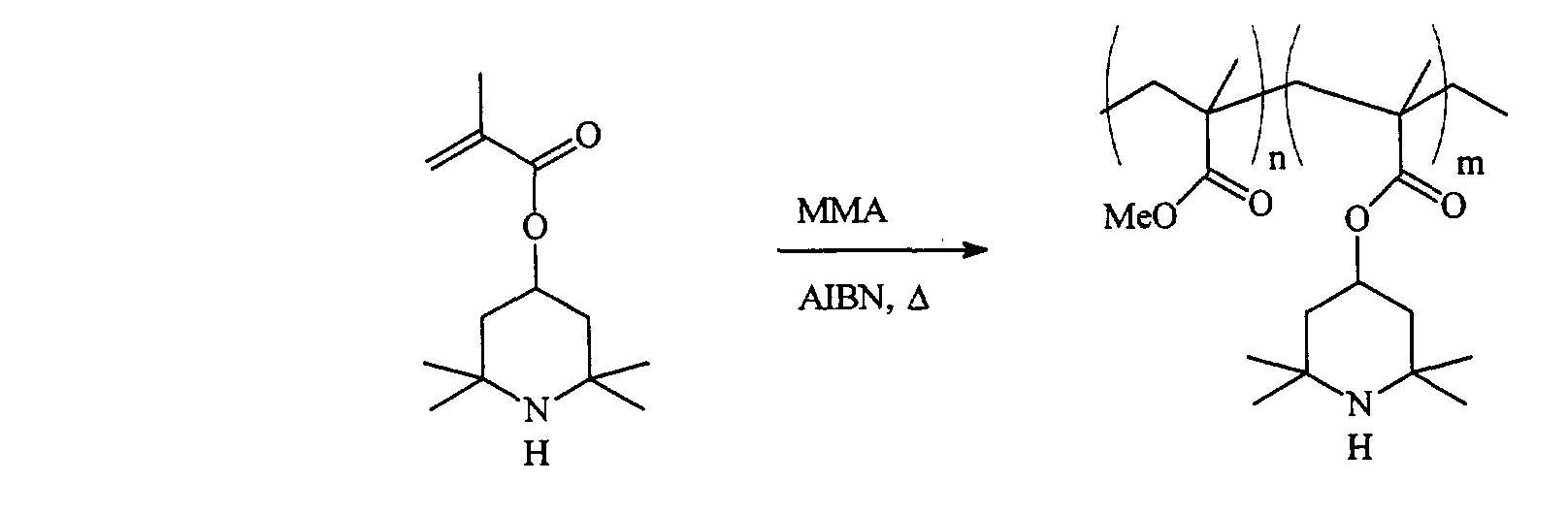


54,61 g (55 mmol) (mit festem Natriumhydrogencarbonat auf pH 9,5 einstellen)
Ausbeute: 4,64 g = 72,8 % d. Th.

(mit festem Natriumhydrogencarbonat auf pH 9,5 einstellen)
Ausbeute: 4,58 g = 81,8 % d. Th.
Claims (7)
- Verfahren zur Oxidation von Alkoholen unter Verwendung eines Oxidationsmittels und katalytischer Mengen von homogen löslichen polymervergrößerten Nitroxylderivaten erhältlich durch Copolymerisation einer Mischung aufweisendA: 0,1-100, vorzugsweise 1-20 Gew.-% einer Verbindung (I)worin Y = • oder H ist,
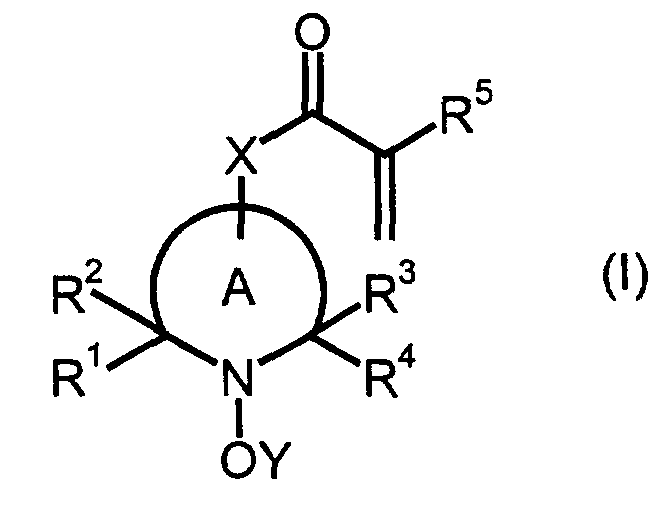 A ist ein 5 bis 8 gliedriger Ring, der 0-3 weitere Heteroatome, wie N, O, S, und 0-3 weitere Reste, wie (C1-C8)-Alkyl, (C1-C8)-Alkoxy, Halogene, aufweisen kann,R1, R2, R3, R4 sind unabhängig voneinander (C1-C8)-Alkyl, (C6-C18) -Aryl, (C7-C19)-Aralkyl, (C3-C8)-Cycloalkyl,
oder R1 und R2 und/oder R3 und R4 oder R1 und R3 und/oder R2 und R4 sind über eine (C2-C8)-Alkylenbrücke miteinander verbunden,R5 ist H oder Methyl,X ist O, NH, NR1,B: 0-99,9, vorzugsweise 80-99 Gew.-%
(Meth)acrylsäureesterC: 0-80, vorzugsweise 1-20 Gew.-% weiterer α,β-ungesättigter Verbindungen, wie HEMA oder EGDMA, gewonnen werden. - Verfahren nach Anspruch 1,
dadurch gekennzeichnet, daß
das polymervergrößerte Nitroxylderivat der Formel (II)mit einem Verhältnis von n/m von 1-100 und einem mittleren Molekulargewicht von 1-200 kDa, vorzugsweise 10-100 kDa, entspricht.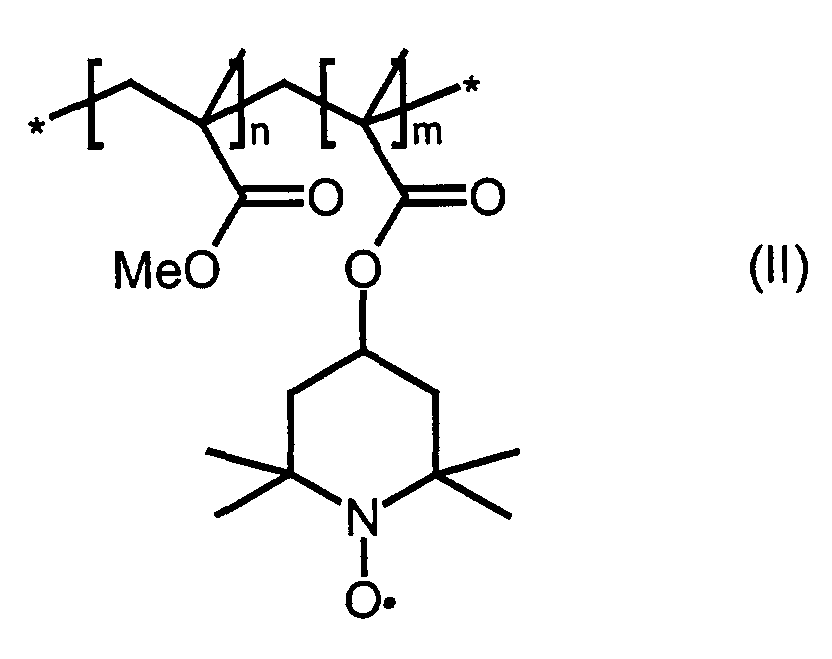
- Verfahren nach Anspruch 1 und/oder 2,
dadurch gekennzeichnet, daß
man als Oxidationsmittel NaOCl-Lösung verwendet. - Verfahren nach einem oder mehreren der Ansprüche 1 bis 3,
dadurch gekennzeichnet, daß
die Oxidation bei Temperaturen von -20 - 80°C, vorzugsweise 0 - 30°C, durchführt. - Verfahren nach einem oder mehreren der Ansprüche 1 bis 4,
dadurch gekennzeichnet, daß
man die Oxidation bei einem pH von 6-13, vorzugsweise 9-10, durchführt. - Verfahren nach einem oder mehreren der Ansprüche 1 bis 5,
dadurch gekennzeichnet, daß
man die Reaktion kontinuierlich in einem Menbranreaktor durchführt. - Verwendung der nach einem oder mehreren der Ansprüche 1 bis 10 hergestellten Verbindungen in der organischen Synthese.
Applications Claiming Priority (2)
| Application Number | Priority Date | Filing Date | Title |
|---|---|---|---|
| DE10029597A DE10029597A1 (de) | 2000-06-15 | 2000-06-15 | Verfahren zur Oxidation von Alkoholen mit homogen löslichen polymervergrößerten Stickstoffverbindungen als Katalysator |
| DE10029597 | 2000-06-15 |
Publications (2)
| Publication Number | Publication Date |
|---|---|
| EP1170277A2 true EP1170277A2 (de) | 2002-01-09 |
| EP1170277A3 EP1170277A3 (de) | 2002-01-16 |
Family
ID=7645895
Family Applications (1)
| Application Number | Title | Priority Date | Filing Date |
|---|---|---|---|
| EP01111819A Withdrawn EP1170277A3 (de) | 2000-06-15 | 2001-05-16 | Verfahren zur Oxidation von Alkoholen mit homogen löslichen polymervergrösserten Stickstoffverbindungen als Katalysator |
Country Status (4)
| Country | Link |
|---|---|
| US (1) | US6451943B1 (de) |
| EP (1) | EP1170277A3 (de) |
| JP (1) | JP2002020323A (de) |
| DE (1) | DE10029597A1 (de) |
Cited By (2)
| Publication number | Priority date | Publication date | Assignee | Title |
|---|---|---|---|---|
| WO2003080689A1 (de) * | 2002-03-22 | 2003-10-02 | Tesa Ag | Verfahren zur herstellung copolymerer polyacrylat-haftklebemassen, damit erhaltene nitroxid-modofizierte polyacrylate und kamm-blockpolymere |
| WO2005116092A1 (ja) | 2004-05-31 | 2005-12-08 | Sumitomo Seika Chemicals Co., Ltd. | 架橋ポリ(メタ)アクリル酸化合物の製造方法 |
Families Citing this family (10)
| Publication number | Priority date | Publication date | Assignee | Title |
|---|---|---|---|---|
| AR029677A1 (es) * | 2000-06-29 | 2003-07-10 | Bayer Ag | Combinaciones de compuestos activos con propiedades insecticidas y acaricidas |
| ATE257136T1 (de) | 2001-10-11 | 2004-01-15 | Consortium Elektrochem Ind | Verfahren zur oxidation von alkoholen unter katalyse von nitroxylverbindungen |
| DE10156138A1 (de) * | 2001-10-11 | 2003-04-30 | Consortium Elektrochem Ind | Verfahren zur Oxidation von Alkoholen zu Aldehyden und Ketonen unter Katalyse von Nitroxylverbindungen |
| WO2003080575A1 (en) * | 2002-03-26 | 2003-10-02 | Koei Chemical Co., Ltd. | Process for producing heterocyclic aldehyde |
| ATE505450T1 (de) * | 2003-01-30 | 2011-04-15 | Nutrasweet Property Holdings Inc | Bromfreies katalysatorsystem auftempo-basis zur oxidation primärer und sekundärer alkohole mit naoci alsoxidationsmittel |
| DE10354259A1 (de) | 2003-11-20 | 2005-06-09 | Wacker-Chemie Gmbh | Verfahren zur Herstellung von Carbonylreste-aufweisenden Organosiliciumverbindungen |
| US6825384B1 (en) * | 2004-01-29 | 2004-11-30 | The Nutrasweet Company | Bromine free TEMPO based catalyst system for oxidation of primary and secondary alcohols using NaOCl as an oxidant |
| JP4617437B2 (ja) * | 2005-09-02 | 2011-01-26 | 学校法人早稲田大学 | ノルボルネン系架橋共重合体及びその製造方法 |
| JP5178220B2 (ja) * | 2008-01-31 | 2013-04-10 | 東京応化工業株式会社 | レジスト組成物およびレジストパターン形成方法 |
| CN108102052B (zh) * | 2017-11-29 | 2020-05-26 | 浙江工业大学 | 一种附载tempo催化活性基团共混催化膜的制备方法 |
Family Cites Families (3)
| Publication number | Priority date | Publication date | Assignee | Title |
|---|---|---|---|---|
| DE2748362A1 (de) | 1977-10-28 | 1979-05-03 | Hoechst Ag | Polymere substituierter piperidine, ihre herstellung und verwendung |
| DE19647892A1 (de) | 1996-11-20 | 1998-06-04 | Forschungszentrum Juelich Gmbh | Verfahren zur katalytischen, enantioselektiven Reduktion von Ketonen |
| DE19947505A1 (de) | 1999-10-01 | 2001-04-05 | Degussa | Verfahren zur Herstellung organischer Verbindungen im Membranreaktor |
-
2000
- 2000-06-15 DE DE10029597A patent/DE10029597A1/de not_active Withdrawn
-
2001
- 2001-05-16 EP EP01111819A patent/EP1170277A3/de not_active Withdrawn
- 2001-06-12 JP JP2001177445A patent/JP2002020323A/ja active Pending
- 2001-06-14 US US09/879,985 patent/US6451943B1/en not_active Expired - Fee Related
Cited By (4)
| Publication number | Priority date | Publication date | Assignee | Title |
|---|---|---|---|---|
| WO2003080689A1 (de) * | 2002-03-22 | 2003-10-02 | Tesa Ag | Verfahren zur herstellung copolymerer polyacrylat-haftklebemassen, damit erhaltene nitroxid-modofizierte polyacrylate und kamm-blockpolymere |
| WO2005116092A1 (ja) | 2004-05-31 | 2005-12-08 | Sumitomo Seika Chemicals Co., Ltd. | 架橋ポリ(メタ)アクリル酸化合物の製造方法 |
| EP1752474A4 (de) * | 2004-05-31 | 2010-03-10 | Sumitomo Seika Chemicals | Verfahren zur herstellung einer vernetzten poly(meth)acrylatverbindung |
| US7816457B2 (en) | 2004-05-31 | 2010-10-19 | Sumitomo Seika Chemicals Co., Ltd. | Method for producing crosslinked poly(meth)acrylate compound |
Also Published As
| Publication number | Publication date |
|---|---|
| JP2002020323A (ja) | 2002-01-23 |
| US20020035223A1 (en) | 2002-03-21 |
| DE10029597A1 (de) | 2002-01-03 |
| EP1170277A3 (de) | 2002-01-16 |
| US6451943B1 (en) | 2002-09-17 |
Similar Documents
| Publication | Publication Date | Title |
|---|---|---|
| EP1170277A2 (de) | Verfahren zur Oxidation von Alkoholen mit homogen löslichen polymervergrösserten Stickstoffverbindungen als Katalysator | |
| EP0236994B1 (de) | Verfahren zur Herstellung von Acryl- und Methycrylsäureestern | |
| DE4204808A1 (de) | Verfahren zur herstellung von (omega)-formylalkancarbonsaeureestern | |
| CN112189004B (zh) | 制备酮基官能化的芳族(甲基)丙烯酸化产物的方法 | |
| EP0623575B1 (de) | Verfahren zur Herstellung von Ketonen | |
| EP0158875A2 (de) | Chirale Rhodium-diphosphinkomplexe für asymmetrische Hydrierungen | |
| DE1645183A1 (de) | Verfahren zur Herstellung von Polyvinylalkohol | |
| EP0945469B1 (de) | Verfahren zur Herstellung von Telechelen, so hergestellte Telechele und ihre Verwendung | |
| EP1323725B1 (de) | Verfahren zur Herstellung von 1-Methoxy-2-propanol | |
| EP0949256B1 (de) | Verfahren zur Herstellung von Isochroman-3-onen | |
| EP1120160B1 (de) | Polymere Diphosphinliganden für homogen lösliche Hydrierkatalysatoren, Verfahren zu deren Herstellung und Verwendung | |
| DE2041563C3 (de) | Verfahren zur Vinylierung aromatischer Verbindungen | |
| EP0343476B1 (de) | Ethylenisch ungesättigte Harnstoffderivate und Verfahren zu ihrer Herstellung | |
| EP2912012B1 (de) | Verfahren zur herstellung von zwitterionischen monomeren sowie die verwendung dieser monomere | |
| EP0168749A1 (de) | Ionisch aufgebaute,polymerisierbare Verbindungen | |
| DE2417615A1 (de) | Cyclische ketone und verfahren zu ihrer herstellung | |
| DE102010063082A1 (de) | Verfahren zur Herstellung von Funktionalisierten Silanen in Ionischer Flüssigkeit | |
| EP1120161A1 (de) | Molekulargewichtsgrösserte Liganden für asymetrische homogenlösliche Hydrierkatalysatoren, Verfahren zu deren Herstellung und Verwendung | |
| DE60125889T2 (de) | Chiraler bleikatalysator und verfahren zur asymmetrischen aldol-reaktion | |
| DE69612563T2 (de) | Hydroformylierungsverfahren | |
| DE102011110096A1 (de) | Verfahren zur Herstellung von Carbonylverbindungen | |
| EP1279657B1 (de) | Verfahren zur Herstellung von Carbonylverbindungen aus Alkoholen | |
| DE10036328B4 (de) | Polymervergrößerte Liganden, Verfahren zu deren Herstellung und deren Verwendung | |
| EP0681567B1 (de) | Diacylperoxidester | |
| DE102004009549B4 (de) | Verfahren zur Durchführung von basisch katalysierten Reaktionen |
Legal Events
| Date | Code | Title | Description |
|---|---|---|---|
| PUAI | Public reference made under article 153(3) epc to a published international application that has entered the european phase |
Free format text: ORIGINAL CODE: 0009012 |
|
| PUAL | Search report despatched |
Free format text: ORIGINAL CODE: 0009013 |
|
| 17P | Request for examination filed |
Effective date: 20010516 |
|
| AK | Designated contracting states |
Kind code of ref document: A2 Designated state(s): AT BE CH CY DE DK ES FI FR GB GR IE IT LI LU MC NL PT SE TR |
|
| AX | Request for extension of the european patent |
Free format text: AL;LT;LV;MK;RO;SI |
|
| AK | Designated contracting states |
Kind code of ref document: A3 Designated state(s): AT BE CH CY DE DK ES FI FR GB GR IE IT LI LU MC NL PT SE TR |
|
| AX | Request for extension of the european patent |
Free format text: AL;LT;LV;MK;RO;SI |
|
| 17Q | First examination report despatched |
Effective date: 20020808 |
|
| AKX | Designation fees paid |
Free format text: AT BE CH CY DE DK ES FI FR GB GR IE IT LI LU MC NL PT SE TR |
|
| GRAP | Despatch of communication of intention to grant a patent |
Free format text: ORIGINAL CODE: EPIDOSNIGR1 |
|
| GRAP | Despatch of communication of intention to grant a patent |
Free format text: ORIGINAL CODE: EPIDOSNIGR1 |
|
| GRAS | Grant fee paid |
Free format text: ORIGINAL CODE: EPIDOSNIGR3 |
|
| STAA | Information on the status of an ep patent application or granted ep patent |
Free format text: STATUS: THE APPLICATION IS DEEMED TO BE WITHDRAWN |
|
| 18D | Application deemed to be withdrawn |
Effective date: 20040727 |