EP1148070A1 - Verfahren zur Herstellung von superabsorbierenden Polymeren aus Polyacrylnitrilen - Google Patents
Verfahren zur Herstellung von superabsorbierenden Polymeren aus Polyacrylnitrilen Download PDFInfo
- Publication number
- EP1148070A1 EP1148070A1 EP01107845A EP01107845A EP1148070A1 EP 1148070 A1 EP1148070 A1 EP 1148070A1 EP 01107845 A EP01107845 A EP 01107845A EP 01107845 A EP01107845 A EP 01107845A EP 1148070 A1 EP1148070 A1 EP 1148070A1
- Authority
- EP
- European Patent Office
- Prior art keywords
- acid
- hydrolysis
- water
- pan
- emulsions
- Prior art date
- Legal status (The legal status is an assumption and is not a legal conclusion. Google has not performed a legal analysis and makes no representation as to the accuracy of the status listed.)
- Withdrawn
Links
Classifications
-
- H—ELECTRICITY
- H01—ELECTRIC ELEMENTS
- H01B—CABLES; CONDUCTORS; INSULATORS; SELECTION OF MATERIALS FOR THEIR CONDUCTIVE, INSULATING OR DIELECTRIC PROPERTIES
- H01B7/00—Insulated conductors or cables characterised by their form
- H01B7/17—Protection against damage caused by external factors, e.g. sheaths or armouring
- H01B7/28—Protection against damage caused by moisture, corrosion, chemical attack or weather
- H01B7/282—Preventing penetration of fluid, e.g. water or humidity, into conductor or cable
- H01B7/285—Preventing penetration of fluid, e.g. water or humidity, into conductor or cable by completely or partially filling interstices in the cable
- H01B7/288—Preventing penetration of fluid, e.g. water or humidity, into conductor or cable by completely or partially filling interstices in the cable using hygroscopic material or material swelling in the presence of liquid
-
- A—HUMAN NECESSITIES
- A61—MEDICAL OR VETERINARY SCIENCE; HYGIENE
- A61L—METHODS OR APPARATUS FOR STERILISING MATERIALS OR OBJECTS IN GENERAL; DISINFECTION, STERILISATION OR DEODORISATION OF AIR; CHEMICAL ASPECTS OF BANDAGES, DRESSINGS, ABSORBENT PADS OR SURGICAL ARTICLES; MATERIALS FOR BANDAGES, DRESSINGS, ABSORBENT PADS OR SURGICAL ARTICLES
- A61L15/00—Chemical aspects of, or use of materials for, bandages, dressings or absorbent pads
- A61L15/16—Bandages, dressings or absorbent pads for physiological fluids such as urine or blood, e.g. sanitary towels, tampons
- A61L15/42—Use of materials characterised by their function or physical properties
- A61L15/60—Liquid-swellable gel-forming materials, e.g. super-absorbents
-
- B—PERFORMING OPERATIONS; TRANSPORTING
- B01—PHYSICAL OR CHEMICAL PROCESSES OR APPARATUS IN GENERAL
- B01J—CHEMICAL OR PHYSICAL PROCESSES, e.g. CATALYSIS OR COLLOID CHEMISTRY; THEIR RELEVANT APPARATUS
- B01J20/00—Solid sorbent compositions or filter aid compositions; Sorbents for chromatography; Processes for preparing, regenerating or reactivating thereof
- B01J20/22—Solid sorbent compositions or filter aid compositions; Sorbents for chromatography; Processes for preparing, regenerating or reactivating thereof comprising organic material
- B01J20/26—Synthetic macromolecular compounds
- B01J20/265—Synthetic macromolecular compounds modified or post-treated polymers
-
- C—CHEMISTRY; METALLURGY
- C08—ORGANIC MACROMOLECULAR COMPOUNDS; THEIR PREPARATION OR CHEMICAL WORKING-UP; COMPOSITIONS BASED THEREON
- C08F—MACROMOLECULAR COMPOUNDS OBTAINED BY REACTIONS ONLY INVOLVING CARBON-TO-CARBON UNSATURATED BONDS
- C08F8/00—Chemical modification by after-treatment
- C08F8/44—Preparation of metal salts or ammonium salts
-
- B—PERFORMING OPERATIONS; TRANSPORTING
- B01—PHYSICAL OR CHEMICAL PROCESSES OR APPARATUS IN GENERAL
- B01J—CHEMICAL OR PHYSICAL PROCESSES, e.g. CATALYSIS OR COLLOID CHEMISTRY; THEIR RELEVANT APPARATUS
- B01J2220/00—Aspects relating to sorbent materials
- B01J2220/50—Aspects relating to the use of sorbent or filter aid materials
- B01J2220/68—Superabsorbents
Definitions
- the invention relates to a method for producing superabsorbent Polymers (SAP) by alkaline hydrolysis of polyacrylonitrile emulsions (PAN emulsion).
- SAP superabsorbent Polymers
- Superabsorbent polymers are known and are mainly used in Manufacture of diapers and incontinence articles, but also as water-storing Materials in agriculture and in the sheathing of electrical cables used. As a rule, these are superabsorbent polymers for wide-meshed, water-insoluble polymers or copolymers based on alkali salts of polyacrylic acid or copolymers of akali salts of acrylic acid and acrylamide, which are obtained by radical copolymerization of Acrylic acid and polyfunctional monomers, such as divinylbenzene, ethylene glycol dimethacrylate, Ethylene glycol diallyl ether, butanediol diacrylate, hexanediol dimethacrylate, Polyglycol diacrylate, trimethylolpropane diacrylate, allyl acrylate, diallylacrylamide, Trisallylamine, diallyl ether, methylene bisacrylamide and N-methylolacrylamide, be preserved. Due to their
- the reaction mixture can, according to DE-A 196 00 163 directly from the List reactor into one equipped with a high-speed stirrer Precipitation reactor containing a low boiling alcohol e.g. Methanol or Contains ethanol, be entered continuously.
- a low boiling alcohol e.g. Methanol or Contains ethanol
- the superabsorbent falls Polymer as a fine, easily filterable powder. After drying and The finished superabsorber is then available for grinding to the desired grain size.
- the invention was therefore based on the object of an SAP with a pH value less than or equal to 7.0 by alkaline hydrolysis of PAN emulsions or PAN precipitation polymers provide without alcohol or any other organic solvents must be used for insulation.
- the PAN emulsions after sub-step a) have an average particle size of 60 to 500 nm, preferably 80 to 200 nm, determined by laser correlation spectroscopy and a solids content of 10 to 55% by weight.
- the molecular weights (weight average) of the uncrosslinked PAN emulsions are between 5 * 10 5 to 1 * 10 7 g / mol.
- Preferred PAN emulsions are uncrosslinked or crosslinked homopolymers of acrylonitrile.
- Crosslinked PAN emulsions contain polymerized polyfunctional monomers, as described in DE-A 42 33 026, from 0.2 to 4.0% by weight, based on the total amount of monomers.
- the low-viscosity educts PAN emulsion and aqueous Alkali hydroxide solution
- HV reactor Highly viscous media suitable reactors
- Suitable HV reactors have a good mixing and kneading effect for the resulting highly viscous gel, good heat transfer and allow one Stirring off the ammonia formed during the hydrolysis.
- Particularly suitable HV reactors are those of List AG, CH-4422 Arisdorf, Switzerland, which and twin-shaft devices are built and mixing and stripping elements on both the Own shaft as well as in the reactor housing.
- the hydrolysis can be carried out in a batch, semi-continuous manner Process by metering in one or both educts or in continuous Process are made. Even with a continuous process it is possible to add the starting materials at the beginning of the process or partially later in the process dose. It is possible to have one or more HV reactors connected in series to use.
- the starting materials can be mixed in the HV reactor or upstream Apparatus such as Pipelines, static mixers, but also one upstream HV reactor, which mainly has mixed tasks, or in Screw kneading machines are carried out.
- Hydrolysis of PAN emulsions with aqueous alkali hydroxide solutions is the molar ratio of the nitrile groups of the polymer to the alkali hydroxide 1: 1 to 1: 0.05, preferably 1: 0.9 to 1: 0.1, particularly preferably 1: 0.7 to 1: 0.3.
- Alkali hydroxides are preferably NaOH or KOH or mixtures thereof.
- the Hydrolysis is carried out at 80 to 200 ° C, preferably above 100 to 160 ° C under positive pressure executed. The reaction times are 0.01 to 10 hours. That with hydrolysis The resulting gaseous ammonia is removed from the reactor and in water dissolved or condensed at low temperatures.
- Hydrolysis produces partially hydrolyzed polymers in which 30 to 80 mol% the nitrile groups of the PAN polymer in carboxylate groups and 20 to 70 mol% in Carbonamide groups are converted and 0 to 20 mol% of the nitrile groups unchanged stay.
- the pH of the hydrolysis products measured as 0.1% by weight Solution in 0.9% by weight NaCl solution is in the range of 8.0, preferably 7.5 to 7.1.
- an acid is added to the hydrolysis product after hydrolysis has ended (according to c1.)) or the hydrolysis product briefly in a water / acid mixture directed (according to c2.)).
- Suitable acids according to c1. are mineral acids, e.g. Hydrochloric acid, sulfuric acid, Phosphoric acid, nitric acid, carboxylic acids, including polyvalent acids and acids with other functional groups, e.g. Formic acid, acetic acid, propionic acid, Adipic acid, lactic acid, citric acid, polymeric acids, e.g. Polyacrylic acid, Polyacrylic acid copolymers, polystyrene sulfonic acid and mixtures of the aforementioned Acids. Polymeric acids can be used in crosslinked or uncrosslinked form become.
- mineral acids e.g. Hydrochloric acid, sulfuric acid, Phosphoric acid, nitric acid, carboxylic acids, including polyvalent acids and acids with other functional groups, e.g. Formic acid, acetic acid, propionic acid, Adipic acid, lactic acid, citric acid, polymeric acids, e.g. Polyacrylic acid, Polyacrylic acid copolymers, polyst
- the amount of acid added in substep c1.) depends on that for Use the desired pH on the one hand and the acidity of the acid on the other.
- the amount of acid added is therefore 0.1 to 20% by weight, preferably 0.1 to 10 wt .-% based on the dry weight of the hydrolysis product.
- the Alkali salts formed by the addition of the acid remain in the product.
- the Acid can be mixed with the highly viscous hydrolysis product in suitable mixers, such as e.g. Static mixers, screw kneaders, kneaders, continuous or discontinuous be mixed.
- Suitable acids according to c2. are mineral acids, e.g. Hydrochloric acid, sulfuric acid, Phosphoric acid, nitric acid, carboxylic acids, including polyvalent acids and acids with other functional groups, e.g. Formic acid, acetic acid, propionic acid, Adipic acid, lactic acid, citric acid, polymeric acids, e.g. Polyacrylic acid, Polyacrylic acid copolymers, polystyrene sulfonic acid and mixtures of the aforementioned Acids. Polymeric acids can be used in crosslinked or uncrosslinked form become.
- mineral acids e.g. Hydrochloric acid, sulfuric acid, Phosphoric acid, nitric acid, carboxylic acids, including polyvalent acids and acids with other functional groups, e.g. Formic acid, acetic acid, propionic acid, Adipic acid, lactic acid, citric acid, polymeric acids, e.g. Polyacrylic acid, Polyacrylic acid copolymers, polyst
- the amount of acid added in substep c2.) Depends on that for Use the desired pH on the one hand and the acidity of the acid on the other.
- the amount of acid added is therefore 0.1 to 20% by weight, preferably 0.1 to 10 wt .-% based on the dry weight of the hydrolysis product.
- the Acid is in the 1.0 to 100 times the amount of water, preferably 1.5 to 30 times Amount of water based on the weight of the SAP gel to be neutralized solved.
- the residence time of the hydrolyzate in the water / acid mixture is between 5s and 30min, preferably between 10s and 5min.
- the neutralization of the hydrolysis product after sub-step c2.) can be carried out batchwise or continuously be performed.
- the water-containing, gel-like product obtained after sub-step c) becomes after Sub-step d) dried.
- Suitable drying processes are according to the state of the Technology described in "Modern Superabsorbent Polymer Technology", ed. F.L. Buchholz, A.T. Graham, Wiley-VCH, New York, 1998, ISBN 0-471-19411-5, Chapter 3.2.4.2. Post-Reactor Gel Preparation, pp. 85-87 and 3.2.5. Drying, pp. 87-93 and the literature cited there.
- After drying in contrast to DE 196 00 163 A1 describes the addition of an acid after sub-step c1.) Salts in the product.
- step e the dried product is ground according to the prior art and classified; see: “Modern Superabsorbent Polymer Technology", ed. F.L. Buchholz, A.T. Graham, Wiley-VCH, New York, 1998, ISBN 0-471-19411-5, Chapter 3.2.6. Handling of the Dried Material: Particle Sizing, pp. 93-95.
- the Particle size distribution of the ground and classified SAP should be in the range of 100 to 1000 microns, preferably 150 to 850 microns.
- Preferred surface modifiers when using acid are di- and Polyols, e.g. Ethylene glycol, 1,2-propanediol, glycerin, trimethylolpropane.
- This Modifiers are common with the acid in solution, which is common consists of an alcohol-water mixture, sprayed onto the SAP particles and mixed and within 0.1 to 5, preferably 0.5 to 3 hours at 100 to 200 ° C, brought to reaction preferably 110 to 180 ° C.
- Ethylene carbonate, diglycidyl compounds such as e.g. Ethylene glycol diglycidyl ether or di- or polyisocyanates, optionally mixtures of the agents mentioned.
- SAPs obtainable by the process according to the invention are outstandingly suitable for use in the manufacture of hygiene articles, e.g. Baby diapers, Incontinence articles for adults and feminine hygiene, for wrapping of electrical cables, for use as water-storing materials in in agriculture and for the packaging of goods at risk of leakage.
- hygiene articles e.g. Baby diapers, Incontinence articles for adults and feminine hygiene, for wrapping of electrical cables, for use as water-storing materials in in agriculture and for the packaging of goods at risk of leakage.
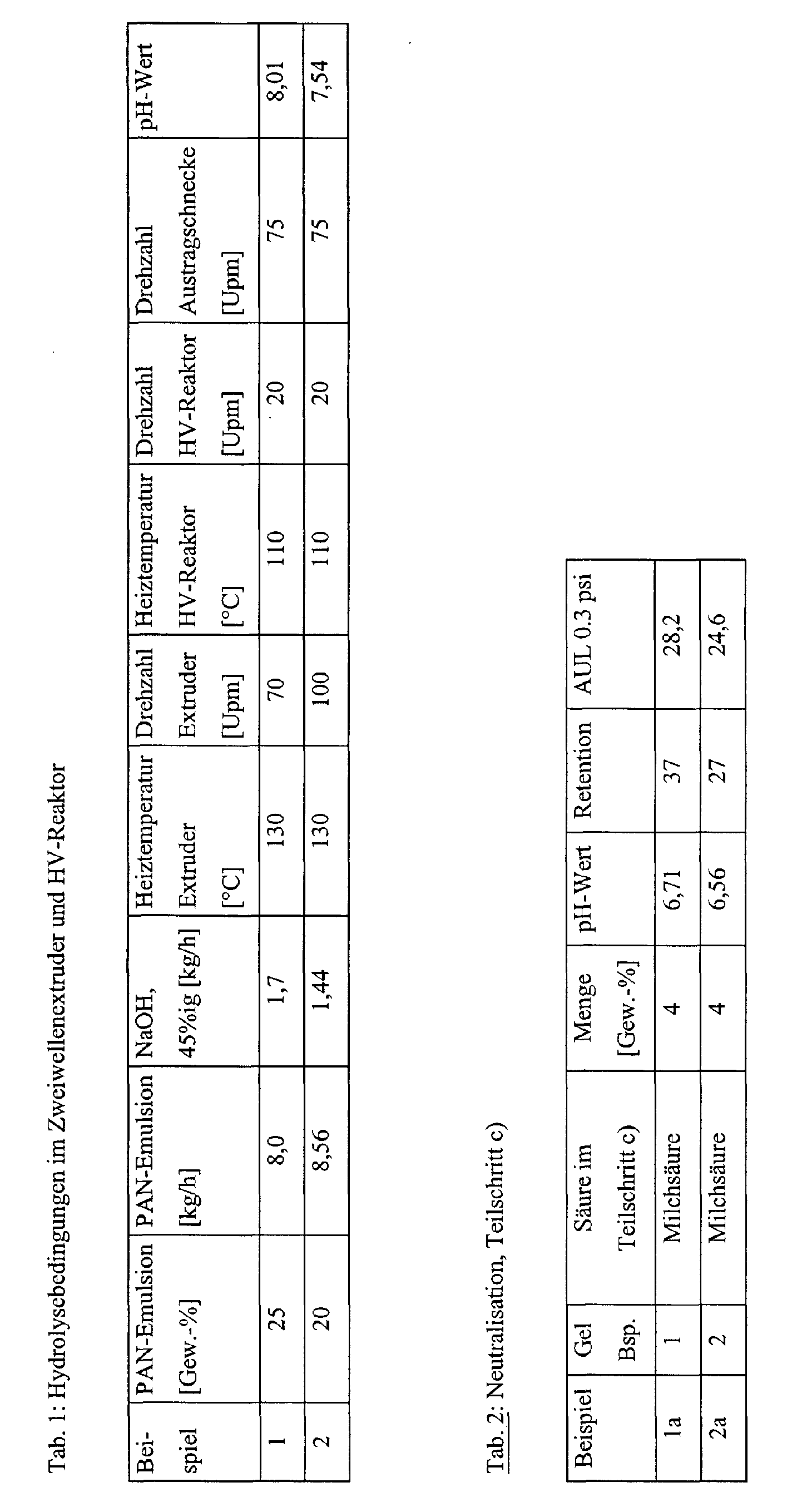
- the alkaline hydrolysis of the PAN emulsions was carried out in a continuous Process consisting of a twin-screw extruder (reaction volume: 0.5 L) and an HV reactor from List (List DTB 6 Conti, 17.5 L reaction volume).
- the PAN emulsion was prepared according to DE 42 33 026 A1, Example 8. It is about this is an uncrosslinked polyacrylonitrile homopolymer, the proportion of that used polymeric emulsifier was in contrast to DE 42 33 026 A1, Example 8 only 2.5% by weight based on polyacrylonitrile.
- the starting materials (PAN emulsion, sodium hydroxide solution, E-water) were pumped into the twin-screw extruder (metering flows, speed and heating temperature of the extruder: see Table 1 ).
- the viscous product leaving the extruder was metered into the HV reactor.
- the viscous, gel-like, slightly yellow to colorless product was discharged from the discharge screw via a multi-hole nozzle (heating temperature, speed of the main shaft of the HV reactor and the discharge screw: see Table 1 ).
- the resulting ammonia-water mixture is expanded from the HV reactor via pressure maintenance in an acid scrubber.
- Table 2 shows the acids that were used in step c1.) (Example 1a, 2a) to adjust the pH and the amounts in% by weight based on the solids of the gel-like SAP. After adding the acid and mixing in a kneader, the gel is dried in a laboratory drying cabinet at 110-115 ° C., ground in a laboratory mill and fractionated to a particle size of 100-800 ⁇ m.
- the surface modification was carried out with a solution of ethylene glycol diglycidyl ether, 1,2-propanediol and water in a ratio of 0.06: 3.152: 0.788.
- 100 parts of SAP powder were placed in a beaker, sprayed with 4 parts of the above solution and mixed and then reacted for 2 hours at 125 ° C in a drying cabinet (see Table 2 ).
- Tab. 3 shows the acids that were used in sub-step c1.) And in sub-step f) to adjust the pH and / or as a catalyst for the surface modification, and the amounts in% by weight based on the solids of the gel SAP specified. After adding and mixing the acid in sub-step c), the gel is dried in a laboratory drying cabinet at 110-115 ° C., ground in a laboratory mill and fractionated to a particle size of 100-800 ⁇ m.
- tab. 3 shows an example in which the neutralization was carried out in accordance with sub-step c2.) (Example 3b).
- the moist SAP gel was suspended in five times the amount of water, the amount given in Table 3 in% by weight, based on the solids of the gel-like SAP, of 85% formic acid was added and the mixture was isolated after 60 s.
- the gel obtained was worked up further as described above.
- the surface modification is carried out with a solution of acid, as indicated in Table 3 , glycerol, 2-propanol, water in a ratio of 1: 2: 2: 2.
- a solution of acid as indicated in Table 3 , glycerol, 2-propanol, water in a ratio of 1: 2: 2: 2.
- 100 parts of SAP powder are placed in a beaker, sprayed with 7 parts of the above solution and mixed and then reacted for 2 hours at 160 ° C. in a drying cabinet.
Landscapes
- Chemical & Material Sciences (AREA)
- Health & Medical Sciences (AREA)
- Organic Chemistry (AREA)
- Chemical Kinetics & Catalysis (AREA)
- Life Sciences & Earth Sciences (AREA)
- Public Health (AREA)
- Hematology (AREA)
- Engineering & Computer Science (AREA)
- Materials Engineering (AREA)
- Epidemiology (AREA)
- Analytical Chemistry (AREA)
- Animal Behavior & Ethology (AREA)
- General Health & Medical Sciences (AREA)
- Dispersion Chemistry (AREA)
- Veterinary Medicine (AREA)
- General Chemical & Material Sciences (AREA)
- Medicinal Chemistry (AREA)
- Polymers & Plastics (AREA)
- Absorbent Articles And Supports Therefor (AREA)
- Addition Polymer Or Copolymer, Post-Treatments, Or Chemical Modifications (AREA)
- Processes Of Treating Macromolecular Substances (AREA)
- Orthopedics, Nursing, And Contraception (AREA)
Abstract
Description

Claims (13)
- Verfahren zur Herstellung von Superabsorbern durch alkalische Hydrolyse von Polyacrylnitril-Emulsionen, dadurch gekennzeichnet, dass zur Isolierung keine Alkohole oder organische Lösungsmittel eingesetzt werden.
- Verfahren gemäß Anspruch 1, wobei die Teilschritte Herstellung einer PAN-Emulsion und alkalische Hydrolyse der Polyacrylnitril-Emulsionen in selbstreinigenden, für hochviskose Medien geeigneten Reaktoren und Neutralisation des Hydrolysats enthalten sind.
- Verfahren gemäß Anspruch 2, wobei zusätzlich die Verfahrensschritteenthalten sind.d) Trocknen des Produktes unde) Mahlen
- Verfahren gemäß einem oder mehreren der vorangegangenen Ansprüche, wobei zusätzlich ein Verfahrensschritt
f) Oberflächenmodifikation des Superabsorbers
enthalten ist. - Verfahren gemäß einem oder mehreren der vorangegangenen Ansprüche, wobei die Neutralisation des Hydrolysats (Verfahrensschritt c)) durchdurchgeführt wird.1. Zugabe von Säure zum Hydrolyseprodukt oder/und2. Zugabe des Hydrolyseproduktes zu einem Wasser/Säuregemisch zur Einstellung des pH-Wertes oder/und
- Verfahren gemäß einem oder mehreren der vorangegangenen Ansprüche, wobei als Polyacrylnitril-Emulsion unvernetzte oder vernetzte Homopolymerisate des Acylnitrils bei der alkalischen Hydrolyse eingesetzt werden.
- Verfahren gemäß einem oder mehreren der vorangegangenen Ansprüche, wobei die PAN-Emulsion (in Teilschritt a)) eine mittlere Teilchengröße von 60 bis 500 nm aufweist.
- Verfahren gemäß einem oder mehreren der vorangegangenen Ansprüche, wobei die Molekulargewichte der unvernetzten PAN-Emulsionen zwischen 5·105 und 1·107 g/mol liegen.
- Verfahren gemäß einem oder mehreren der vorangegangenen Ansprüche, wobei in Verfahrensschritt b) hochviskose Gele mit einem Feststoffgehalt von 10 bis 70 Gew.-% entstehen.
- Verfahren gemäß einem oder mehreren der vorangegangenen Ansprüche, wobei im Verfahrensschritt e) die Teilchengrößenverteilung der gemahlenen und klassierten Superabsorper im Bereich von 100 bis 1000 µm liegt.
- Superabsorber, hergestellt gemäß einem oder mehrerer der vorangegangenen Ansprüche.
- Verwendung der Superabsorber gemäß Anspruch 11 zur Herstellung von Windeln, Inkontinenzartikeln, wasserspeichernden Materialien und Elektrokabelummantelungen.
- Windeln, Inkontinenzartikeln, wasserspeichernden Materialien und Elektrokabelummantelungen, hergestellt gemäß einem oder mehreren der vorangegangenen Ansprüche.
Applications Claiming Priority (2)
| Application Number | Priority Date | Filing Date | Title |
|---|---|---|---|
| DE10019756 | 2000-04-20 | ||
| DE10019756A DE10019756A1 (de) | 2000-04-20 | 2000-04-20 | Verfahren zur Herstellung von superabsorbierenden Polymeren aus Polyacrylnitrilen |
Publications (1)
| Publication Number | Publication Date |
|---|---|
| EP1148070A1 true EP1148070A1 (de) | 2001-10-24 |
Family
ID=7639561
Family Applications (1)
| Application Number | Title | Priority Date | Filing Date |
|---|---|---|---|
| EP01107845A Withdrawn EP1148070A1 (de) | 2000-04-20 | 2001-04-09 | Verfahren zur Herstellung von superabsorbierenden Polymeren aus Polyacrylnitrilen |
Country Status (4)
| Country | Link |
|---|---|
| US (1) | US6639022B2 (de) |
| EP (1) | EP1148070A1 (de) |
| JP (1) | JP2002047312A (de) |
| DE (1) | DE10019756A1 (de) |
Families Citing this family (15)
| Publication number | Priority date | Publication date | Assignee | Title |
|---|---|---|---|---|
| CN1274754C (zh) * | 2003-09-09 | 2006-09-13 | 青岛科技大学高分子科学与工程学院 | 遇水崩解型环境友好高分子共混材料及其制取方法 |
| WO2005095498A1 (en) * | 2004-03-30 | 2005-10-13 | Basf Aktiengesellschaft | Improved method of manufacturing superabsorbent polymers |
| BRPI0923225A2 (pt) | 2008-12-02 | 2016-10-04 | Chiralgen Ltd | metodo para sintese de acidos nucleicos modificados no atomo de fosforo |
| EP2451461A4 (de) | 2009-07-06 | 2013-05-29 | Ontorii Inc | Neuartige nukleinsäure-prodrugs und verwendungsverfahren dafür |
| DK2620428T3 (da) | 2010-09-24 | 2019-07-01 | Wave Life Sciences Ltd | Asymmetrisk hjælpegruppe |
| CN107365339A (zh) | 2011-07-19 | 2017-11-21 | 波涛生命科学有限公司 | 合成官能化核酸的方法 |
| WO2014010250A1 (en) | 2012-07-13 | 2014-01-16 | Chiralgen, Ltd. | Asymmetric auxiliary group |
| DK2872147T3 (da) | 2012-07-13 | 2023-02-20 | Wave Life Sciences Ltd | Fremgangsmåde til fremstilling af kirale oligonukleotider |
| EP3095459A4 (de) | 2014-01-15 | 2017-08-23 | Shin Nippon Biomedical Laboratories, Ltd. | Chirales nukleinsäureadjuvans mit antitumorwirkung und antitumormittel |
| EP3095461A4 (de) | 2014-01-15 | 2017-08-23 | Shin Nippon Biomedical Laboratories, Ltd. | Chirales nukleinsäure-adjuvans mit immunitätsinduktionswirkung und immunitätsinduktionsaktivator |
| EP3094728B1 (de) | 2014-01-16 | 2022-03-09 | Wave Life Sciences Ltd. | Chirales design |
| CN117965536A (zh) | 2015-07-22 | 2024-05-03 | 波涛生命科学有限公司 | 寡核苷酸组合物及其方法 |
| EP3452596A4 (de) | 2016-05-04 | 2020-03-18 | Wave Life Sciences Ltd. | Oligonukleotidzusammensetzungen und verfahren dafür |
| CN111206440A (zh) * | 2020-03-12 | 2020-05-29 | 蚌埠学院 | 一种粒径均匀彩色纳米球的制备方法 |
| WO2021195736A1 (pt) * | 2020-04-01 | 2021-10-07 | Instituto Granado De Tecnologia Da Poliacrilonitrila Ltda | Método de obtenção de polimeros superabsorbentes pela hidrólise alcalina com vapor de água sob pressão, empregando poliacrilonitrila, fibras e tecidos acrílicos |
Citations (4)
| Publication number | Priority date | Publication date | Assignee | Title |
|---|---|---|---|---|
| EP0603677A2 (de) * | 1992-12-23 | 1994-06-29 | Wolff Walsrode Aktiengesellschaft | Verfahren zur Herstellung niedermolekularer Acrylnitrilpolymerisate sowie deren Verwendung |
| EP0783005A2 (de) * | 1996-01-04 | 1997-07-09 | Bayer Ag | Verfahren zur kontinuierlichen Herstellung von superabsorbierenden Polymerisaten aus PAN-Emulsionen |
| DE19646856A1 (de) * | 1996-11-13 | 1998-05-14 | Bayer Ag | Präformierte Superabsorber mit hohem Quellvermögen |
| DE19805447A1 (de) * | 1998-02-11 | 1999-08-12 | Bayer Ag | Modifizierte Superabsorber auf Basis von Polyacrylnitril-Emulsionen |
Family Cites Families (2)
| Publication number | Priority date | Publication date | Assignee | Title |
|---|---|---|---|---|
| JPS52107045A (en) * | 1976-03-05 | 1977-09-08 | Japan Exlan Co Ltd | Stable aqueous emulsions of acrylonitrile polymers, their preparation, and dyeability improvers therefrom |
| DE4233026A1 (de) | 1992-10-01 | 1994-04-07 | Bayer Ag | Hochkonzentrierte wäßrige Poly(acrylnitril)-Emulsion und Verfahren zu ihrer Herstellung |
-
2000
- 2000-04-20 DE DE10019756A patent/DE10019756A1/de not_active Withdrawn
-
2001
- 2001-04-09 EP EP01107845A patent/EP1148070A1/de not_active Withdrawn
- 2001-04-16 US US09/835,666 patent/US6639022B2/en not_active Expired - Fee Related
- 2001-04-18 JP JP2001119548A patent/JP2002047312A/ja active Pending
Patent Citations (4)
| Publication number | Priority date | Publication date | Assignee | Title |
|---|---|---|---|---|
| EP0603677A2 (de) * | 1992-12-23 | 1994-06-29 | Wolff Walsrode Aktiengesellschaft | Verfahren zur Herstellung niedermolekularer Acrylnitrilpolymerisate sowie deren Verwendung |
| EP0783005A2 (de) * | 1996-01-04 | 1997-07-09 | Bayer Ag | Verfahren zur kontinuierlichen Herstellung von superabsorbierenden Polymerisaten aus PAN-Emulsionen |
| DE19646856A1 (de) * | 1996-11-13 | 1998-05-14 | Bayer Ag | Präformierte Superabsorber mit hohem Quellvermögen |
| DE19805447A1 (de) * | 1998-02-11 | 1999-08-12 | Bayer Ag | Modifizierte Superabsorber auf Basis von Polyacrylnitril-Emulsionen |
Also Published As
| Publication number | Publication date |
|---|---|
| US6639022B2 (en) | 2003-10-28 |
| DE10019756A1 (de) | 2001-10-25 |
| US20010044501A1 (en) | 2001-11-22 |
| JP2002047312A (ja) | 2002-02-12 |
Similar Documents
| Publication | Publication Date | Title |
|---|---|---|
| DE19807992C1 (de) | Verfahren zur Vernetzung von Hydrogelen mit Bis- und Poly-2-oxazolidinonen | |
| DE3239476C3 (de) | Verfahren zur Herstellung eines festen, trockenen und wasserabsorbierenden harzes | |
| EP1682194B2 (de) | Blut und/oder körperflüssigkeiten absorbierende polymerpartikel | |
| DE10019756A1 (de) | Verfahren zur Herstellung von superabsorbierenden Polymeren aus Polyacrylnitrilen | |
| EP1123330B1 (de) | Verfahren zur herstellung von wasserquellbaren hydrophilen polymeren, die polymere sowie deren verwendung | |
| DE69333752T2 (de) | Verfahren zur Herstellung eines hydrophilen Harzes | |
| EP2411422B2 (de) | Verfahren zur herstellung oberflächennachvernetzter wasserabsorbierender polymerpartikel | |
| DE69508489T2 (de) | Verfahren zur Erhöhung der Grösse und/oder der Absorption unter Last der superabsorbierenden Polymere durch oberflächliches Vernetzen und anschliessende Agglomeration von Partikeln unter Normalgrösse | |
| DE4244548A1 (de) | Pulverförmige, unter Belastung wäßrige Flüssigkeiten sowie Blut absorbierende Polymere, Verfahren zu ihrer Herstellung und ihre Verwendung in textilen Konstruktionen für die Körperhygiene | |
| DE4406951A1 (de) | Superabsorbierende Polymerisate | |
| EP2773691B1 (de) | Superabsorbierende polymere für hochgefüllte oder faserfreie hygieneartikel | |
| DE69017846T2 (de) | Verfahren zur herstellung von harzen mit hoher wasserabsorption. | |
| DE102005010198A1 (de) | Hydrolysestabile, nachvernetzte Superabsorber | |
| DE69509012T2 (de) | Verfahren zur Erhöhung der Grösse und der Absorption unter Last der superabsorbierenden feinen Partikel durch Imprägnierung mit einer wässrigen Lösung von Acryl-Monomeren | |
| WO2018029045A1 (de) | Verfahren zur herstellung von superabsorbern | |
| EP1148069A1 (de) | Verfahren zur Herstellung von superabsorbierenden Polymeren aus Polyacrylnitril-Fällungspolymerisaten | |
| EP0697416A1 (de) | Superabsorbierende Polymere aus vernetzten Polyacrylnitril-Emulsionen | |
| EP2780044B1 (de) | Verfahren zur herstellung thermisch oberflächennachvernetzter wasserabsorbierender polymerpartikel | |
| EP3827031B1 (de) | Verfahren zur herstellung von superabsorbern | |
| EP0783005B1 (de) | Verfahren zur kontinuierlichen Herstellung von superabsorbierenden Polymerisaten aus PAN-Emulsionen | |
| DE19646856A1 (de) | Präformierte Superabsorber mit hohem Quellvermögen | |
| EP3619243B1 (de) | Verfahren zur diskontinuierlichen herstellung von superabsorberpartikeln durch polymerisation einer in einem hydrophoben lösungsmittel dispergierten wässrigen monomerlösung | |
| DE10059593A1 (de) | Verfahren zur Herstellung von Superabsorbern aus Polyacrylnitril-Emulsionen unter adiabatischen Reaktionsbedingungen | |
| EP1164147B1 (de) | Verfahren zur kontinuierlichen Herstellung von superabsorbierenden Polymerisaten aus PAN-Emulsionen | |
| EP3619244B1 (de) | Verfahren zur diskontinuierlichen herstellung von superabsorberpartikeln durch polymerisation einer in einem hydrophoben lösungsmittel dispergierten wässrigen monomerlösung |
Legal Events
| Date | Code | Title | Description |
|---|---|---|---|
| PUAI | Public reference made under article 153(3) epc to a published international application that has entered the european phase |
Free format text: ORIGINAL CODE: 0009012 |
|
| AK | Designated contracting states |
Kind code of ref document: A1 Designated state(s): AT BE CH CY DE DK ES FI FR GB GR IE IT LI LU MC NL PT SE TR Kind code of ref document: A1 Designated state(s): DE FR GB IT |
|
| AX | Request for extension of the european patent |
Free format text: AL;LT;LV;MK;RO;SI |
|
| 17P | Request for examination filed |
Effective date: 20020424 |
|
| AKX | Designation fees paid |
Free format text: DE FR GB IT |
|
| RAP1 | Party data changed (applicant data changed or rights of an application transferred) |
Owner name: BAYER MATERIALSCIENCE AG |
|
| STAA | Information on the status of an ep patent application or granted ep patent |
Free format text: STATUS: THE APPLICATION HAS BEEN WITHDRAWN |
|
| 18W | Application withdrawn |
Effective date: 20041124 |