EP1134820A1 - Verfahren zum Verbinden von Elektrodenfahnen mit einem Pol eines elektrochemischen Generators und Generator - Google Patents
Verfahren zum Verbinden von Elektrodenfahnen mit einem Pol eines elektrochemischen Generators und Generator Download PDFInfo
- Publication number
- EP1134820A1 EP1134820A1 EP01400537A EP01400537A EP1134820A1 EP 1134820 A1 EP1134820 A1 EP 1134820A1 EP 01400537 A EP01400537 A EP 01400537A EP 01400537 A EP01400537 A EP 01400537A EP 1134820 A1 EP1134820 A1 EP 1134820A1
- Authority
- EP
- European Patent Office
- Prior art keywords
- terminal
- holding element
- strips
- ring
- welding
- Prior art date
- Legal status (The legal status is an assumption and is not a legal conclusion. Google has not performed a legal analysis and makes no representation as to the accuracy of the status listed.)
- Granted
Links
- 238000000034 method Methods 0.000 title claims abstract description 19
- 238000003466 welding Methods 0.000 claims abstract description 71
- 239000000463 material Substances 0.000 claims description 23
- PXHVJJICTQNCMI-UHFFFAOYSA-N Nickel Chemical compound [Ni] PXHVJJICTQNCMI-UHFFFAOYSA-N 0.000 claims description 20
- RYGMFSIKBFXOCR-UHFFFAOYSA-N Copper Chemical compound [Cu] RYGMFSIKBFXOCR-UHFFFAOYSA-N 0.000 claims description 16
- 229910052802 copper Inorganic materials 0.000 claims description 16
- 239000010949 copper Substances 0.000 claims description 16
- 229910052759 nickel Inorganic materials 0.000 claims description 10
- 229910052782 aluminium Inorganic materials 0.000 claims description 7
- XAGFODPZIPBFFR-UHFFFAOYSA-N aluminium Chemical compound [Al] XAGFODPZIPBFFR-UHFFFAOYSA-N 0.000 claims description 7
- 229910000679 solder Inorganic materials 0.000 claims description 6
- 230000002093 peripheral effect Effects 0.000 claims description 4
- 238000005520 cutting process Methods 0.000 description 5
- 241000446313 Lamella Species 0.000 description 4
- 238000007747 plating Methods 0.000 description 4
- 229910052751 metal Inorganic materials 0.000 description 3
- 239000002184 metal Substances 0.000 description 3
- 239000007769 metal material Substances 0.000 description 3
- WHXSMMKQMYFTQS-UHFFFAOYSA-N Lithium Chemical compound [Li] WHXSMMKQMYFTQS-UHFFFAOYSA-N 0.000 description 2
- 238000006073 displacement reaction Methods 0.000 description 2
- 238000009434 installation Methods 0.000 description 2
- 229910052744 lithium Inorganic materials 0.000 description 2
- 230000014759 maintenance of location Effects 0.000 description 2
- 239000000155 melt Substances 0.000 description 2
- 238000003825 pressing Methods 0.000 description 2
- 239000011149 active material Substances 0.000 description 1
- 238000001816 cooling Methods 0.000 description 1
- 229940082150 encore Drugs 0.000 description 1
- 230000004927 fusion Effects 0.000 description 1
- 230000001939 inductive effect Effects 0.000 description 1
- 238000004519 manufacturing process Methods 0.000 description 1
- 238000004513 sizing Methods 0.000 description 1
- 239000007787 solid Substances 0.000 description 1
- 238000009827 uniform distribution Methods 0.000 description 1
Images



Classifications
-
- B—PERFORMING OPERATIONS; TRANSPORTING
- B23—MACHINE TOOLS; METAL-WORKING NOT OTHERWISE PROVIDED FOR
- B23K—SOLDERING OR UNSOLDERING; WELDING; CLADDING OR PLATING BY SOLDERING OR WELDING; CUTTING BY APPLYING HEAT LOCALLY, e.g. FLAME CUTTING; WORKING BY LASER BEAM
- B23K26/00—Working by laser beam, e.g. welding, cutting or boring
- B23K26/009—Working by laser beam, e.g. welding, cutting or boring using a non-absorbing, e.g. transparent, reflective or refractive, layer on the workpiece
-
- B—PERFORMING OPERATIONS; TRANSPORTING
- B23—MACHINE TOOLS; METAL-WORKING NOT OTHERWISE PROVIDED FOR
- B23K—SOLDERING OR UNSOLDERING; WELDING; CLADDING OR PLATING BY SOLDERING OR WELDING; CUTTING BY APPLYING HEAT LOCALLY, e.g. FLAME CUTTING; WORKING BY LASER BEAM
- B23K26/00—Working by laser beam, e.g. welding, cutting or boring
- B23K26/08—Devices involving relative movement between laser beam and workpiece
- B23K26/10—Devices involving relative movement between laser beam and workpiece using a fixed support, i.e. involving moving the laser beam
-
- H—ELECTRICITY
- H01—ELECTRIC ELEMENTS
- H01M—PROCESSES OR MEANS, e.g. BATTERIES, FOR THE DIRECT CONVERSION OF CHEMICAL ENERGY INTO ELECTRICAL ENERGY
- H01M50/00—Constructional details or processes of manufacture of the non-active parts of electrochemical cells other than fuel cells, e.g. hybrid cells
- H01M50/50—Current conducting connections for cells or batteries
- H01M50/528—Fixed electrical connections, i.e. not intended for disconnection
-
- H—ELECTRICITY
- H01—ELECTRIC ELEMENTS
- H01M—PROCESSES OR MEANS, e.g. BATTERIES, FOR THE DIRECT CONVERSION OF CHEMICAL ENERGY INTO ELECTRICAL ENERGY
- H01M50/00—Constructional details or processes of manufacture of the non-active parts of electrochemical cells other than fuel cells, e.g. hybrid cells
- H01M50/50—Current conducting connections for cells or batteries
- H01M50/531—Electrode connections inside a battery casing
- H01M50/533—Electrode connections inside a battery casing characterised by the shape of the leads or tabs
-
- H—ELECTRICITY
- H01—ELECTRIC ELEMENTS
- H01M—PROCESSES OR MEANS, e.g. BATTERIES, FOR THE DIRECT CONVERSION OF CHEMICAL ENERGY INTO ELECTRICAL ENERGY
- H01M50/00—Constructional details or processes of manufacture of the non-active parts of electrochemical cells other than fuel cells, e.g. hybrid cells
- H01M50/50—Current conducting connections for cells or batteries
- H01M50/531—Electrode connections inside a battery casing
- H01M50/534—Electrode connections inside a battery casing characterised by the material of the leads or tabs
-
- H—ELECTRICITY
- H01—ELECTRIC ELEMENTS
- H01M—PROCESSES OR MEANS, e.g. BATTERIES, FOR THE DIRECT CONVERSION OF CHEMICAL ENERGY INTO ELECTRICAL ENERGY
- H01M50/00—Constructional details or processes of manufacture of the non-active parts of electrochemical cells other than fuel cells, e.g. hybrid cells
- H01M50/50—Current conducting connections for cells or batteries
- H01M50/531—Electrode connections inside a battery casing
- H01M50/538—Connection of several leads or tabs of wound or folded electrode stacks
-
- Y—GENERAL TAGGING OF NEW TECHNOLOGICAL DEVELOPMENTS; GENERAL TAGGING OF CROSS-SECTIONAL TECHNOLOGIES SPANNING OVER SEVERAL SECTIONS OF THE IPC; TECHNICAL SUBJECTS COVERED BY FORMER USPC CROSS-REFERENCE ART COLLECTIONS [XRACs] AND DIGESTS
- Y02—TECHNOLOGIES OR APPLICATIONS FOR MITIGATION OR ADAPTATION AGAINST CLIMATE CHANGE
- Y02E—REDUCTION OF GREENHOUSE GAS [GHG] EMISSIONS, RELATED TO ENERGY GENERATION, TRANSMISSION OR DISTRIBUTION
- Y02E60/00—Enabling technologies; Technologies with a potential or indirect contribution to GHG emissions mitigation
- Y02E60/10—Energy storage using batteries
-
- Y—GENERAL TAGGING OF NEW TECHNOLOGICAL DEVELOPMENTS; GENERAL TAGGING OF CROSS-SECTIONAL TECHNOLOGIES SPANNING OVER SEVERAL SECTIONS OF THE IPC; TECHNICAL SUBJECTS COVERED BY FORMER USPC CROSS-REFERENCE ART COLLECTIONS [XRACs] AND DIGESTS
- Y02—TECHNOLOGIES OR APPLICATIONS FOR MITIGATION OR ADAPTATION AGAINST CLIMATE CHANGE
- Y02P—CLIMATE CHANGE MITIGATION TECHNOLOGIES IN THE PRODUCTION OR PROCESSING OF GOODS
- Y02P70/00—Climate change mitigation technologies in the production process for final industrial or consumer products
- Y02P70/50—Manufacturing or production processes characterised by the final manufactured product
-
- Y—GENERAL TAGGING OF NEW TECHNOLOGICAL DEVELOPMENTS; GENERAL TAGGING OF CROSS-SECTIONAL TECHNOLOGIES SPANNING OVER SEVERAL SECTIONS OF THE IPC; TECHNICAL SUBJECTS COVERED BY FORMER USPC CROSS-REFERENCE ART COLLECTIONS [XRACs] AND DIGESTS
- Y10—TECHNICAL SUBJECTS COVERED BY FORMER USPC
- Y10T—TECHNICAL SUBJECTS COVERED BY FORMER US CLASSIFICATION
- Y10T29/00—Metal working
- Y10T29/49—Method of mechanical manufacture
- Y10T29/49002—Electrical device making
- Y10T29/49108—Electric battery cell making
Definitions
- the present invention relates to a method of connecting the lamellae coming from an electrode to a terminal of an electrochemical generator, in particular, a rechargeable lithium electrochemical generator with electrodes spiral cylindrical.
- the invention also relates to an electrochemical generator likely to be obtained by this process.
- An electrochemical generator with spiral electrodes includes electrodes in the form of ribbons wound around a central mandrel or bobbin to form a cylinder.
- Each electrode includes a current collector metallic which supports on at least one of its faces the active material of the electrode. It is electrically connected to a current output terminal which ensures electrical continuity between the electrode and the application to which the generator is associated.
- the terminal crosses the generator container: the part located outside of the container receives the external connections, the part located inside is connected to the electrodes.
- This terminal can be integral or attached to the container. It exists Several ways to electrically connect an electrode to a current output. One of these ways is the use of one or more conductive or thin strips metal strips: one end of each of the strips is welded to the edge of the manifold and the other end is soldered to the internal part of the terminal located at inside the container.
- FR-A-2752089 describes a method for connecting the slats coming from of an electrode of such an electrochemical generator to a terminal attached to its container.
- the inner part of the terminal container includes a shoulder cylindrical.
- the method consists in gathering the lamellae around the periphery of the shoulder by a cylindrical part animated by a concentric movement towards the periphery. Then, the slats are fixed on the periphery using in particular a ring or by using electrical or ultrasonic welding.
- This process has the disadvantage of inducing a long manufacturing time.
- the electric welding or ultrasonic welding is not of good quality satisfactory when it comes to welding, for example, aluminum slats on aluminum bollards.
- Electric welding is difficult to implement in especially when several lamellae overlap as this results in a cumulation of contact resistances between the various lamellae and the terminal which is such that the electric welding becomes impossible or at least provides quality welding poor no longer reliably making the mechanical connection and slats at the terminal.
- the disadvantage of ultrasonic welding is do not allow to successively weld the slats to the terminal because vibrations generated during the welding of a given strip deteriorate or destroy the welding of the previous strip.
- the object of the present invention is to eliminate the drawbacks of the art prior.
- the lamellae each preferably have a thickness of between 50 ⁇ m and 80 ⁇ m.
- the holding element preferably has a thickness of between 0.5mm and 1mm.
- the terminal, the slats and the holding element are made of aluminum.
- the terminal and the slats are produced each in a material chosen from copper, nickel-plated copper and nickel, and the holding element is made of nickel or nickel-plated copper.
- the method preferably comprises the folding of the lamellae on the flat part from a peripheral edge of the flat part, before pinching and welding. It is therefore advantageous if the terminal has a cylindrical part on one face of which the flat part is arranged and that the holding element is a washer.
- the invention proposes an electrochemical generator, in which lamellae from an electrode are arranged between a terminal and a holding element, and comprising at least one weld passing through the element holding and the slats and entering the terminal.
- the slats each have preferably a thickness between 50 ⁇ m and 80 ⁇ m.
- the holding element has preferably a thickness between 0.5mm and 1mm.
- the terminal, the slats and the holding element are made of aluminum.
- the terminal and the slats are produced each in a material chosen from copper, nickel-plated copper and nickel and that the holding element is made of nickel or nickel-plated copper.
- the slats are preferably folded down on the flat part to from a peripheral edge of the flat part. It is therefore advantageous if the terminal has a cylindrical part on one face of which the flat part is arranged and that the holding element is a washer.
- the invention proposes to connect the lamellae coming from an electrode to an electrochemical generator terminal by pinching these strips between an element and the terminal for pressing and holding the slats against the terminal during the welding of the lamellae on the terminal using a welding with laser by transparency through the holding element.
- Laser welding by transparency consists in attacking a point on the surface with the laser beam outside of the holding element to gradually melt the thickness of material of the holding element at this point.
- the beam continues its attack on the or the underlying lamellae to melt the material thickness of these slats and then finally the underlying material of the terminal at least at one level superficial.
- the beam laser is moved gradually, preferably continuously, along a welding line on the outer surface of the holding element for welding the set of lamellae on the terminal along this weld line, the speed of displacement being chosen to obtain the effective welding of the holding element, lamellae and terminal along the weld line.
- This generator typically comprises an electrochemical beam including a positive electrode and a negative electrode as well as two separators.
- the two electrodes are wound or spiraled together with the separators interposed between them to form a cylinder.
- Each electrode is connected to an output corresponding current by means of metal strips.
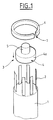
- FIG. 1 represents a spiral electrode 1 connected to a plurality of metal strips 2 before their connection to a current output terminal 3.
- the strips 2 are used to electrically connect the electrode 1 to the terminal 3.
- the slats 2 are generally all the same thickness. The number of slats 2 represented is not significant and depends in fact on the power of the electrochemical generator.
- Terminal 3 includes a connection pad 5 which will usually disposed on the outside of the generator housing, not shown, and a connection part 4 which will usually be located inside the housing of the generator.
- Connection pad 5 receives the connection from the external application to which the generator is associated by means, for example, of a thread not represented.
- the connection part 4 has the shape of a cylinder of revolution on one face of which the connection pad 5 is arranged.
- the connection pad 5 does not not protrude radially outside the circumference 4a of the connecting part 4.
- the connection of the slats 2 to the terminal 3 is carried out using a holding in the form of a split cylindrical ring 6,
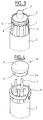
- connection part 4 is arranged between the lamellae 2 so that the lamellae 2 extend around the circumference 4a of the connection part 4, as illustrated in FIG. 2.
- the connection pad 5 is obviously located on the opposite side to the electrode 1. Terminal 3 could for example be held by a tool tightening the connection pad 5.
- the ring 6 is placed around the circumference 4a of the connection part 4 and of the strips 2.
- the strips 2 are therefore arranged between the circumference 4a of the connection part 4 and the ring 6.
- the ring 6 when it is not stressed, has a diameter interior greater than the diameter of the connection part 4 and sufficient for ability to surround conference 4a with connection part 4 with lamellae 2 arranged around it.
- the ring 6 is then tightened on the circumference 4a of the connection part 4 using for example a clamp concentric, not shown. Consequently, the slats 2 are pinched between the circumference 4a of the connecting part 4 and the ring 6 as illustrated in Figure 3.
- a person skilled in the art will choose the material and the dimensions of the ring 6 of so as to have sufficient elasticity to allow this tightening. Likewise, it choose the width of the slot 7 of the ring 6 to allow the reduction of sufficient diameter of the ring 6 when tightening it. Tightening is done only over part 8 of the width of the outer circumference of the ring 6 which is shown hatched in FIG. 3.
- the setting place of the ring 6 will then be done by increasing its diameter with a spreader tool adapted to allow the ring 6 to pass around the circumference 4a of the connection part 4 and lamellae 2. Then, the stress on the ring 6 ceases so that it encloses the circumference of the connecting part 4 so that pinch the slats together.
- the skilled person will choose the material and the dimensions at rest of the ring 6 to provide sufficient elasticity for allow the increase in diameter and to obtain a pinching force of the strips between the connecting part 4 and the ring 6 sufficient.
- the shape of the ring 6 can be arranged to facilitate its grip by the spreader tool for example at like a classic elastic tree ring.
- the plates 2 are welded to the circumference 4a of the connection part 4.
- the welding is carried out by laser by transparency at across the ring 6 along a weld line 9 going around the outer circumference of the ring 6 and which is shown in dotted lines on the figure 3.
- the tightening of the ring 6 on the connection part 4 is used to press and hold the strips 2 against the connection part 4 to allow reliable welding of the lamellae 2 on the connection part 4.
- the laser welding is done by transparency, that is to say that the laser beam attacks at a point on the welding line 9 on the outer circumference of ring 6 and gradually melts first the material thickness of the ring 6, then the material of the lamellae 2 and finally at minus the material on the surface of the connection part 4, for welding together these different elements.
- the laser beam progressively travels the line of welding 9 to perform the welding all along it.
- a person skilled in the art will choose the materials of the slats 2, of the terminal 3 and of the ring 6, as well as an adequate material thickness of the lamellae 2 and of the ring 6 in the area of the welding line 9 to allow laser welding by transparency. He will also choose the laser power to use which can be of the continuous or pulsed type, as well as its speed of movement.
- the width of the ring 6 will preferably be at least equal to the thickness of the part connection 4 so that the ring 6 can enclose the entire width of its circumference 4a.
- Welding could be limited to only portions of the welding line 9 which correspond to the slats 2 and therefore by not welding if necessary the ring 6 on the connection part 4 where there is no lamella 2 interposed. But in reality it is simpler to carry out the welding all along the weld line 9 around the outer circumference of the ring 6, which has in addition, the advantage of securing ring 6 more securely and reliably the connection part 4.
- the lamellae 2 may possibly overlap on the circumference of the connection part 4 when the tightening of the ring 6 ensures the plating of all the slats against the connection part 4 to allow laser welding by transparency. In this case, when welding laser transparency, the laser beam will attack as and when slats 2 superimposed until reaching terminal 3.
- a metallic material which is sufficiently malleable for the ring 6 to ability to effectively lay all the slats 2 on terminal 3 in the case where the number of overlapping slats 2 varies according to the position on the circumference 4a of the connecting part 4, that is to say that the thickness resulting from the lamellae 2 around the connection part 4 is not constant.
- the slats 2 preferably stop flush with the edge of the circumference of the connection part 4 on the side of the connection pad 5 as illustrated in figures 2 and 3, cutting them if necessary at any time before, during or after the implementation of connection operations previously described.
- Figures 4 and 5 illustrate a second embodiment of the invention which is a variant of the first embodiment.
- Terminal 10 includes a connection part 4 which will usually located inside the generator housing.
- the part of connection 4 is identical to that of terminal 3 in the first mode of realization and has the same function of connecting the slats 2 coming from the electrode 1.
- the terminal 10 comprises a connection cover 11 which will usually disposed on the outside of the generator housing, not shown, and which allows the electrical connection of the generator with the external application such as the connection pad 5 in the first embodiment.
- the cover 11 has a circular section and is integral with the connection part 4 with which it is coaxial.
- the cover 11 has a diameter greater than that of the part of connection 4 and therefore protrudes radially from the circumference of the part of connection 4.
- the lamellae 2 are gathered between the ring 6 and the circumference 4a of the part of connection 4 with the ring 6 enclosing the circumference 4a of the part of connection 4 to allow laser welding by transparency along a weld line around the outer circumference of the ring 6.
- modify the operating mode described for the first mode of realization as follows. First, place the ring 6 around the slats 2 as illustrated in Figure 4.
- the slats 2 preferably stop flush with the edge of the circumference 4a of the connection part 4 on the side of the cover 10 as illustrated in Figure 5, cutting them if necessary preferably before setting implementation of the connection operations previously described. Slats 2 can also stop flush along the edge of the outer circumference of the ring 6 on the side of the cover 10 by cutting them after fitting and tightening of the ring 6 around the connection part 4. As a variant, the strips 2 can also be cut flush along the edge of the circumference of the cover 10 on the side of ring 6 by cutting them after fitting and tightening the ring 6 around the connection part 4.
- Figures 6, 7 and 8 show a third embodiment of the invention which is a variant of the first embodiment.
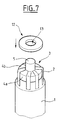
- the part of the slats 2 which projects by the connection part 4 on the face 4b of the connection part 4 on the side of the connection pad 5, as illustrated in FIG. 7.
- the strips 2 extend from preferably on the face 4b without going up along the connection pad 5, at need by cutting them at any time before, during or after setting connection operations being described.
- the drawdown of slats 2 on the face 4b can be done for example by means of a tool comprising three to six branches moving concentrically from the outside of terminal 3 towards the axis thereof.
- the washer 12 is placed on the face 4b of the connection part 4 so that the slats 2 are arranged between the face 4b and the washer 12, as illustrated in FIGS. 7 and 8.
- the washer 12 has an opening 13 corresponding to the cross section of the connection pad 5.
- the connection pad has a circular cross section and coaxial with the connection part 4. So as to correspond to terminal 3, the washer 12 is advantageously circular outer diameter corresponding to that of the connection part 4 and the opening 13 is also circular and coaxial with the outer circumference of the connection pad 5.
- the washer 12 is then pressed against the face 4b of the part of connection 4 using for example a hollow cylindrical tool 14 supported on the washer 12 around the connection pad 5.
- the support zone of the tool 14 on the face 4b is shown hatched and referenced 15.
- the face opposite the face 4b of the connection part 4 may for example press against the mandrel of electrode 1 or be supported by suitable tools such as a threaded rod screwed into a connection thread, not shown, arranged in the connection pad 5. Consequently, the strips 2 are pinched between the face 4b of the connection part 4 and the washer 12.
- the plates 2 are welded to the face 4b of the connection part 4 similarly to the first embodiment, but on the face of the washer 12.
- the welding is carried out by laser by transparency through the washer 12 along a welding line 16, around the stud connection 5, which is shown in dotted lines in FIG. 8.
- the welding line 16 is located on the face of the washer 12 outside the zone 15 on which the tool 14 rests. Laser welding is done by transparency, i.e.
- the laser beam travels gradually the welding line 16 for carrying out the welding all along the latter.
- Welding could be limited to only portions of the welding line welding 16 which corresponds to the lamellae 2 and therefore not welding the case if necessary the washer 12 on the connection part 4 at the places where there is no lamella 2 interposed. But in reality it is easier to carry out the welding while along the weld line 16 around the connection pad 5, which further for advantage of securely and securely securing the washer 12 with the part of connection 4.
- a person skilled in the art will choose the materials of the slats 2, of the terminal 3 and of the washer 12, as well as an adequate material thickness of the lamellae 2 and of the washer 12 in the area of the welding line 16 to allow welding to laser by transparency. He will also choose the laser power to use, which can be of the continuous or pulsed type.
- the diameter of the washer 12 will be preferably at least equal to the diameter of the connection part 4 so that the washer 12 can enclose the entire face 4b of the connection part 4.
- the lamellae 2 can also be overlap on the face 4b of the connection part 4 as soon as the effort of tightening applied to the washer 12 ensures the plating of all of the strips 2 against the face 4b of the connection part 4 to allow the laser welding by transparency.
- the slats 2 will be welded between they at the level of the overlapping parts.
- metal material sufficiently malleable for the washer 12 if the number of overlapping lamellae 2 varies according to the position on the face 4b of the connection part 4, i.e. the resulting thickness of the lamellae 2 around the connecting part 4 is not constant.
- the slats 2, the terminal 3 or 10 and the ring 6 or the washer 12 are of preferably made from metallic materials compatible from a point of view electrochemical.
- the material of the ring 6 or of the washer 12 is chosen. compatible with laser welding by transparency through it, counts given its thickness, i.e. a material which reflects little or no beam laser welding. So, if it is the terminal and the lamellae of an electrode positive, all three will advantageously be made of aluminum. If this is the terminal and strips of a negative electrode, the strips and the terminal will be preferably in nickel, copper or nickel-plated copper while ring 6 or washer 12 will preferably be made of nickel or nickel-plated copper which ensure better transparency to laser welding - i.e. lower beam reflection laser - than copper.
- the lamellae 2 preferably have a thickness of between 50 ⁇ m (50 micrometers) and 80 ⁇ m (80 micrometers), which makes it possible to obtain particularly good laser welding by transparency.
- the thickness of the ring 6 or the washer 12 in the region of the welding line 9 or 16 is preferably between 0.5mm and 1mm.
- the slats 2 generally have a width of between 2mm and 10mm.
- the diameter of the part of connection 4 is for example between 25mm and 50mm and its thickness is advantageously at least equal to 4mm.
- the diameter of the connection part 4 is for example between 30mm and 50mm and the diameter of the connection pad 5 is for example between 8mm and 15mm.
- the average pressing pressure of the ring 6 or of the washer 12 against the connection part 4 - the strips 2 being pinched together - during the laser welding by transparency is preferably between 30N / cm 2 and 60N / cm 2 .
- This indication is given assuming theoretically a uniform distribution of the forces of the ring 6 or of the washer 12 on the connection part 4.
- the clamping force applied to the washer 12 with the tool 14 could advantageously be between 150N and 200N for a washer 12 having an outside diameter of 30mm corresponding to that of the connection part 4 and the opening 13 of which has a diameter of 15mm.
- Welding can for example be carried out with a continuous YAG laser with a power of about 2000W for a thickness of ring 6 or washer 12 of 0.5mm and a superposition of five lamellas 2 on each other at the level of the connection part 4, by adopting a beam displacement speed laser of the order of 10m / min.
- Laser welding by transparency provides a connection solid and reliable mechanical slats 2 at terminal 3 - further reinforced by the welding of the ring 6 or the washer 12 on the slat / terminal assembly - thus than a high quality electrical connection.
- the third embodiment still has the advantage of simplifying the positioning and plating of the strips 2 on the connection part 4 of the terminal 3 using a tool simpler and allowing faster, and therefore more economical, of these operations.
- the plating part of the lamellae 2 against the part of connection 4 comes down to a simple, very inexpensive washer.
- the present invention is not limited to the examples and to the embodiments described and represented, but it is susceptible of numerous variants accessible to those skilled in the art.
- the invention can be applied to an electrochemical generator of a type other than rechargeable.
- the holding element no longer performs the lamella holding function against the terminal after welding with the lamellae on the terminal; this is where resulting solder which keeps the strips on the terminal. Nevertheless we continued to designate it by these same terms - that is to say by holding element - after the welding, both in the description and in the claims.
Landscapes
- Physics & Mathematics (AREA)
- Engineering & Computer Science (AREA)
- Optics & Photonics (AREA)
- Chemical & Material Sciences (AREA)
- Chemical Kinetics & Catalysis (AREA)
- Electrochemistry (AREA)
- General Chemical & Material Sciences (AREA)
- Plasma & Fusion (AREA)
- Mechanical Engineering (AREA)
- Connection Of Batteries Or Terminals (AREA)
- Secondary Cells (AREA)
Applications Claiming Priority (2)
| Application Number | Priority Date | Filing Date | Title |
|---|---|---|---|
| FR0003369 | 2000-03-16 | ||
| FR0003369A FR2806532B1 (fr) | 2000-03-16 | 2000-03-16 | Procede de raccordement des lamelles d'une electrode a une borne d'un generateur electrochimique et generateur en resultant |
Publications (2)
| Publication Number | Publication Date |
|---|---|
| EP1134820A1 true EP1134820A1 (de) | 2001-09-19 |
| EP1134820B1 EP1134820B1 (de) | 2015-11-11 |
Family
ID=8848156
Family Applications (1)
| Application Number | Title | Priority Date | Filing Date |
|---|---|---|---|
| EP01400537.5A Expired - Lifetime EP1134820B1 (de) | 2000-03-16 | 2001-03-01 | Verfahren zum Verbinden von Elektrodenfahnen mit einem Pol eines elektrochemischen Generators und Generator |
Country Status (4)
| Country | Link |
|---|---|
| US (1) | US6569565B2 (de) |
| EP (1) | EP1134820B1 (de) |
| JP (1) | JP2001297745A (de) |
| FR (1) | FR2806532B1 (de) |
Cited By (4)
| Publication number | Priority date | Publication date | Assignee | Title |
|---|---|---|---|---|
| FR2904475A1 (fr) * | 2006-07-28 | 2008-02-01 | Donald P H Wu | Structure conductrice pour un ensemble d'electrodes d'une batterie secondaire au lithium |
| EP2093820A1 (de) * | 2008-02-22 | 2009-08-26 | Saft Groupe S.A. | Elektrische Verbindung für Stromakkumulator |
| EP2736057A4 (de) * | 2011-07-20 | 2015-07-22 | Nichicon Corp | Elektrischer doppelschichtkondensator |
| EP3611781A4 (de) * | 2017-04-14 | 2020-02-19 | LG Chem, Ltd. | Sekundärbatterie und sekundärbatterieherstellungsverfahren |
Families Citing this family (36)
| Publication number | Priority date | Publication date | Assignee | Title |
|---|---|---|---|---|
| US7041413B2 (en) | 2000-02-02 | 2006-05-09 | Quallion Llc | Bipolar electronics package |
| US7166388B2 (en) | 2000-02-02 | 2007-01-23 | Quallion Llc | Brazed ceramic seal for batteries |
| EP1134819B1 (de) * | 2000-03-14 | 2007-04-25 | Sanyo Electric Co., Ltd. | Nichtwässrige elektrolytische Sekundärzellen |
| WO2001082397A1 (en) | 2000-04-26 | 2001-11-01 | Quallion, Llc | Lithium battery suitable for hybrid electric vehicles |
| FR2831996A1 (fr) * | 2001-11-08 | 2003-05-09 | Thomson Licensing Sa | Guide d'ondes, antenne, ensemble antenne-guide d'ondes, et leur procede de realisation |
| DE10326906B4 (de) * | 2003-06-14 | 2008-09-11 | Varta Automotive Systems Gmbh | Akkumulator und Verfahren zur Herstellung einer dichten Kontaktklemmendurchführung |
| FR2875056B1 (fr) * | 2004-09-07 | 2007-03-30 | Accumulateurs Fixes | Accumulateur presentant deux bornes de sortie de courant sur une paroi de son conteneur |
| US7672898B1 (en) * | 2006-07-07 | 2010-03-02 | Trading Technologies International Inc. | Regulating order entry in an electronic trading environment to maintain an actual cost for a trading strategy |
| US20080076013A1 (en) * | 2006-07-26 | 2008-03-27 | Wu Donald P H | Conductive Structure for an Electrode Assembly of a Lithium Secondary Battery |
| CN100541864C (zh) * | 2006-08-01 | 2009-09-16 | 伍必翔 | 二次锂电池的导电柄导电连接结构 |
| CN100590926C (zh) * | 2006-09-21 | 2010-02-17 | 伍必翔 | 方形二次锂电池的电芯结构 |
| CN100541865C (zh) * | 2006-09-21 | 2009-09-16 | 伍必翔 | 二次锂电池的电芯导电连结结构 |
| CN100590925C (zh) * | 2006-09-21 | 2010-02-17 | 伍必翔 | 圆形二次锂电池的电芯结构 |
| JP5117133B2 (ja) * | 2007-07-26 | 2013-01-09 | 日立ビークルエナジー株式会社 | 非水電解質二次電池およびその製造方法 |
| JP2009176452A (ja) * | 2008-01-22 | 2009-08-06 | Hitachi Vehicle Energy Ltd | 捲回型リチウムイオン二次電池 |
| JP5248210B2 (ja) * | 2008-06-02 | 2013-07-31 | 日立ビークルエナジー株式会社 | リチウムイオン二次電池 |
| KR101049282B1 (ko) * | 2009-03-03 | 2011-07-13 | 주식회사 네스캡 | 전기에너지 저장장치 |
| US8435073B2 (en) | 2010-10-08 | 2013-05-07 | John Mezzalingua Associates, LLC | Connector assembly for corrugated coaxial cable |
| US8430688B2 (en) * | 2010-10-08 | 2013-04-30 | John Mezzalingua Associates, LLC | Connector assembly having deformable clamping surface |
| US8439703B2 (en) | 2010-10-08 | 2013-05-14 | John Mezzalingua Associates, LLC | Connector assembly for corrugated coaxial cable |
| US9172156B2 (en) | 2010-10-08 | 2015-10-27 | John Mezzalingua Associates, LLC | Connector assembly having deformable surface |
| US8449325B2 (en) | 2010-10-08 | 2013-05-28 | John Mezzalingua Associates, LLC | Connector assembly for corrugated coaxial cable |
| US8458898B2 (en) | 2010-10-28 | 2013-06-11 | John Mezzalingua Associates, LLC | Method of preparing a terminal end of a corrugated coaxial cable for termination |
| JP2012160282A (ja) * | 2011-01-31 | 2012-08-23 | Hitachi Vehicle Energy Ltd | 円筒形二次電池 |
| KR20140031336A (ko) * | 2011-05-25 | 2014-03-12 | 신코베덴키 가부시키가이샤 | 이차 전지용 극판군 유닛 및 그 제조 방법 |
| US8628352B2 (en) | 2011-07-07 | 2014-01-14 | John Mezzalingua Associates, LLC | Coaxial cable connector assembly |
| US9083113B2 (en) | 2012-01-11 | 2015-07-14 | John Mezzalingua Associates, LLC | Compression connector for clamping/seizing a coaxial cable and an outer conductor |
| US9099825B2 (en) | 2012-01-12 | 2015-08-04 | John Mezzalingua Associates, LLC | Center conductor engagement mechanism |
| US9017102B2 (en) | 2012-02-06 | 2015-04-28 | John Mezzalingua Associates, LLC | Port assembly connector for engaging a coaxial cable and an outer conductor |
| JP6040603B2 (ja) * | 2012-07-18 | 2016-12-07 | 日立化成株式会社 | 電池用極板群の製造方法 |
| US9770790B2 (en) | 2015-07-30 | 2017-09-26 | Ford Global Technologies, Llc | Metal sheet laser welding clamp |
| CN106711397A (zh) * | 2017-01-06 | 2017-05-24 | 珠海格力智能装备有限公司 | 一种极耳压弯结构及具有其的电芯整形装置 |
| DE102018200543A1 (de) * | 2018-01-15 | 2019-07-18 | Bayerische Motoren Werke Aktiengesellschaft | Galvanisches Element, Batterie sowie Verfahren zur Herstellung eines galvanischen Elements |
| KR102712362B1 (ko) * | 2018-10-12 | 2024-10-04 | 삼성에스디아이 주식회사 | 이차전지 |
| EP4329083A1 (de) * | 2022-08-25 | 2024-02-28 | VARTA Microbattery GmbH | Elektrochemische energiespeicherzelle und verfahren zur herstellung |
| DE102022128837A1 (de) * | 2022-10-31 | 2024-05-02 | Bayerische Motoren Werke Aktiengesellschaft | Stromableiter für eine Batterie mit einem Elektrodenwickel |
Citations (7)
| Publication number | Priority date | Publication date | Assignee | Title |
|---|---|---|---|---|
| US4322484A (en) * | 1978-09-05 | 1982-03-30 | General Electric Company | Spiral wound electrochemical cell having high capacity |
| JPH01255164A (ja) * | 1988-04-01 | 1989-10-12 | Natl Space Dev Agency Japan<Nasda> | アルカリ蓄電池の製造方法 |
| JPH04162351A (ja) * | 1990-10-25 | 1992-06-05 | Toshiba Battery Co Ltd | 円筒形電池の製造方法 |
| US5227267A (en) * | 1990-11-01 | 1993-07-13 | Yardney Technical Products, Inc. | Disc electrode and busbar for an electrochemical battery |
| JPH08293299A (ja) * | 1995-04-24 | 1996-11-05 | Matsushita Electric Ind Co Ltd | 電池の製造法 |
| EP0771040A2 (de) * | 1995-09-27 | 1997-05-02 | Sony Corporation | Hochkapazität sekundäre Batterie dem "jelly roll" Typ mit gewickelten Elektroden |
| US5707758A (en) * | 1995-09-27 | 1998-01-13 | Nissan Motor Co., Ltd. | Secondary battery |
Family Cites Families (6)
| Publication number | Priority date | Publication date | Assignee | Title |
|---|---|---|---|---|
| JP3633056B2 (ja) * | 1995-09-27 | 2005-03-30 | ソニー株式会社 | 二次電池 |
| JPH1031996A (ja) * | 1996-07-16 | 1998-02-03 | Sony Corp | 電 池 |
| JPH11111259A (ja) * | 1997-09-30 | 1999-04-23 | Shin Kobe Electric Mach Co Ltd | 捲回式電池 |
| JPH11238500A (ja) * | 1998-02-23 | 1999-08-31 | Shin Kobe Electric Mach Co Ltd | 捲回式円筒形電池 |
| US6245457B1 (en) * | 1999-06-11 | 2001-06-12 | Alcatel | Bussing structure in an electrochemical cell |
| JP2001118561A (ja) * | 1999-10-19 | 2001-04-27 | Sony Corp | 集電構造及び二次電池 |
-
2000
- 2000-03-16 FR FR0003369A patent/FR2806532B1/fr not_active Expired - Lifetime
-
2001
- 2001-03-01 EP EP01400537.5A patent/EP1134820B1/de not_active Expired - Lifetime
- 2001-03-13 JP JP2001070430A patent/JP2001297745A/ja active Pending
- 2001-03-14 US US09/805,136 patent/US6569565B2/en not_active Expired - Lifetime
Patent Citations (7)
| Publication number | Priority date | Publication date | Assignee | Title |
|---|---|---|---|---|
| US4322484A (en) * | 1978-09-05 | 1982-03-30 | General Electric Company | Spiral wound electrochemical cell having high capacity |
| JPH01255164A (ja) * | 1988-04-01 | 1989-10-12 | Natl Space Dev Agency Japan<Nasda> | アルカリ蓄電池の製造方法 |
| JPH04162351A (ja) * | 1990-10-25 | 1992-06-05 | Toshiba Battery Co Ltd | 円筒形電池の製造方法 |
| US5227267A (en) * | 1990-11-01 | 1993-07-13 | Yardney Technical Products, Inc. | Disc electrode and busbar for an electrochemical battery |
| JPH08293299A (ja) * | 1995-04-24 | 1996-11-05 | Matsushita Electric Ind Co Ltd | 電池の製造法 |
| EP0771040A2 (de) * | 1995-09-27 | 1997-05-02 | Sony Corporation | Hochkapazität sekundäre Batterie dem "jelly roll" Typ mit gewickelten Elektroden |
| US5707758A (en) * | 1995-09-27 | 1998-01-13 | Nissan Motor Co., Ltd. | Secondary battery |
Non-Patent Citations (3)
| Title |
|---|
| PATENT ABSTRACTS OF JAPAN vol. 014, no. 009 (E - 870) 10 January 1990 (1990-01-10) * |
| PATENT ABSTRACTS OF JAPAN vol. 016, no. 459 (E - 1268) 24 September 1992 (1992-09-24) * |
| PATENT ABSTRACTS OF JAPAN vol. 1997, no. 03 31 March 1997 (1997-03-31) * |
Cited By (13)
| Publication number | Priority date | Publication date | Assignee | Title |
|---|---|---|---|---|
| FR2904475A1 (fr) * | 2006-07-28 | 2008-02-01 | Donald P H Wu | Structure conductrice pour un ensemble d'electrodes d'une batterie secondaire au lithium |
| EP2093820A1 (de) * | 2008-02-22 | 2009-08-26 | Saft Groupe S.A. | Elektrische Verbindung für Stromakkumulator |
| FR2928035A1 (fr) * | 2008-02-22 | 2009-08-28 | Saft Groupe Sa | Connexion electrique pour accumulateur de courant. |
| US8043746B2 (en) | 2008-02-22 | 2011-10-25 | Saft | Electrical connection for a storage cell |
| EP2736057A4 (de) * | 2011-07-20 | 2015-07-22 | Nichicon Corp | Elektrischer doppelschichtkondensator |
| US9443663B2 (en) | 2011-07-20 | 2016-09-13 | Nichicon Corporation | Electric double-layer capacitor |
| EP3611781A4 (de) * | 2017-04-14 | 2020-02-19 | LG Chem, Ltd. | Sekundärbatterie und sekundärbatterieherstellungsverfahren |
| US11652232B2 (en) | 2017-04-14 | 2023-05-16 | Lg Energy Solution, Ltd. | Secondary battery and method for manufacturing the same |
| US11973177B2 (en) | 2017-04-14 | 2024-04-30 | Lg Energy Solution, Ltd. | Secondary battery and method for manufacturing the same |
| EP4418337A3 (de) * | 2017-04-14 | 2024-11-13 | LG Energy Solution, Ltd. | Sekundärbatterie und verfahren zur herstellung einer sekundärbatterie |
| US12278326B2 (en) | 2017-04-14 | 2025-04-15 | Lg Energy Solution, Ltd. | Secondary battery and method for manufacturing the same |
| US12334493B2 (en) | 2017-04-14 | 2025-06-17 | Lg Energy Solution, Ltd. | Secondary battery and method for manufacturing the same |
| US12341147B2 (en) | 2017-04-14 | 2025-06-24 | Lg Energy Solution, Ltd. | Secondary battery and method for manufacturing the same |
Also Published As
| Publication number | Publication date |
|---|---|
| US20010023038A1 (en) | 2001-09-20 |
| FR2806532B1 (fr) | 2002-05-31 |
| JP2001297745A (ja) | 2001-10-26 |
| US6569565B2 (en) | 2003-05-27 |
| FR2806532A1 (fr) | 2001-09-21 |
| EP1134820B1 (de) | 2015-11-11 |
Similar Documents
| Publication | Publication Date | Title |
|---|---|---|
| EP1134820B1 (de) | Verfahren zum Verbinden von Elektrodenfahnen mit einem Pol eines elektrochemischen Generators und Generator | |
| EP0822605B1 (de) | Zylindrischer elektrochemischer Generator mit spiralförmig gewickelten Elektroden | |
| EP2842185B1 (de) | Buchse zur formung eines anschlusses für eine lithiumspeicherbatterie und zugehörige speicherbatterie | |
| EP0658946B1 (de) | Elektrodeplatte mit schaumförmigem Träger für elektrochemische Generatoren und Verfahren zur ihrer Herstellung | |
| EP1596449A2 (de) | Elektrische Verbindung zu einem Bündel von Elektroden-Anschlüssen | |
| EP2198438B1 (de) | Verfahren und einrichtung zum herstellen von elektrischen energiespeicherbaugruppen | |
| EP4014288B1 (de) | Verfahren und anlage zur herstellung von elektrischen anschlussbaugruppen | |
| EP1221729A1 (de) | Elektrisches Verbindungssystem für elektrochemische Generatoren | |
| FR3125172A1 (fr) | Pièce de connexion pour élément électrochimique de format prismatique | |
| CA1095587A (fr) | Generateur electrochimique de forme cylindrique | |
| FR3054745A1 (fr) | Machine electrique tournante munie d'un interconnecteur a crochets d'ecrouissage | |
| EP2812935B1 (de) | Verfahren zur herstellung einer anordnung für die speicherung elektrischer energie | |
| EP3316350B1 (de) | Elektrisches anschlussstück für akkumulator | |
| EP3280033A1 (de) | Elektrisch umflaufende maschine, die mit einem schneid-klemm-verbindungselement ausgestattet ist | |
| FR2936373A1 (fr) | Procede de fabrication d'un connecteur pour cable electrique et connecteur ainsi obtenu | |
| FR2504318A1 (fr) | Lame conductrice pour collecteurs de machines electriques tournantes et son procede de fabrication | |
| WO2010079295A2 (fr) | Dispositif de stockage d'energie, notamment pour equiper un vehicule automobile | |
| FR2656951A1 (fr) | Transformateur de type torique. | |
| EP1731267A2 (de) | Matrizensatz für ein Crimpwerkzeug | |
| FR3158583A1 (fr) | Condensateur pour bus continu d’un onduleur | |
| FR2700423A1 (fr) | Porte-balai en matière plastique et ensemble porte-balais monobloc correspondant, avec montage de balai facilité. | |
| WO2025003183A1 (fr) | Dispositif d'accueil de cellules électrochimiques pour former un module de batterie | |
| FR2674062A3 (fr) | Bobinage electrique et son procede de fabrication. | |
| WO2021122488A1 (fr) | Conducteur électrique pour une pièce bobinée de machine électrique tournante | |
| EP0186530A1 (de) | Verfahren zur Herstellung eines Statorgehäuses für eine elektrische Maschine und Statorgehäuse für eine elektrische Maschine |
Legal Events
| Date | Code | Title | Description |
|---|---|---|---|
| PUAI | Public reference made under article 153(3) epc to a published international application that has entered the european phase |
Free format text: ORIGINAL CODE: 0009012 |
|
| AK | Designated contracting states |
Kind code of ref document: A1 Designated state(s): AT BE CH CY DE DK ES FI FR GB GR IE IT LI LU MC NL PT SE TR Kind code of ref document: A1 Designated state(s): DE FR GB |
|
| AX | Request for extension of the european patent |
Free format text: AL;LT;LV;MK;RO;SI |
|
| 17P | Request for examination filed |
Effective date: 20020319 |
|
| AKX | Designation fees paid |
Free format text: DE FR GB |
|
| RAP1 | Party data changed (applicant data changed or rights of an application transferred) |
Owner name: SAFT FINANCE S.AE.R.L. |
|
| 17Q | First examination report despatched |
Effective date: 20070921 |
|
| GRAP | Despatch of communication of intention to grant a patent |
Free format text: ORIGINAL CODE: EPIDOSNIGR1 |
|
| INTG | Intention to grant announced |
Effective date: 20150603 |
|
| RAP1 | Party data changed (applicant data changed or rights of an application transferred) |
Owner name: SAFT |
|
| GRAS | Grant fee paid |
Free format text: ORIGINAL CODE: EPIDOSNIGR3 |
|
| GRAA | (expected) grant |
Free format text: ORIGINAL CODE: 0009210 |
|
| AK | Designated contracting states |
Kind code of ref document: B1 Designated state(s): DE FR GB |
|
| REG | Reference to a national code |
Ref country code: GB Ref legal event code: FG4D Free format text: NOT ENGLISH |
|
| REG | Reference to a national code |
Ref country code: DE Ref legal event code: R096 Ref document number: 60149659 Country of ref document: DE |
|
| REG | Reference to a national code |
Ref country code: FR Ref legal event code: PLFP Year of fee payment: 16 |
|
| REG | Reference to a national code |
Ref country code: DE Ref legal event code: R097 Ref document number: 60149659 Country of ref document: DE |
|
| PLBE | No opposition filed within time limit |
Free format text: ORIGINAL CODE: 0009261 |
|
| STAA | Information on the status of an ep patent application or granted ep patent |
Free format text: STATUS: NO OPPOSITION FILED WITHIN TIME LIMIT |
|
| 26N | No opposition filed |
Effective date: 20160812 |
|
| REG | Reference to a national code |
Ref country code: FR Ref legal event code: PLFP Year of fee payment: 17 |
|
| PGFP | Annual fee paid to national office [announced via postgrant information from national office to epo] |
Ref country code: DE Payment date: 20170221 Year of fee payment: 17 |
|
| PGFP | Annual fee paid to national office [announced via postgrant information from national office to epo] |
Ref country code: GB Payment date: 20170301 Year of fee payment: 17 |
|
| REG | Reference to a national code |
Ref country code: FR Ref legal event code: PLFP Year of fee payment: 18 |
|
| REG | Reference to a national code |
Ref country code: DE Ref legal event code: R119 Ref document number: 60149659 Country of ref document: DE |
|
| GBPC | Gb: european patent ceased through non-payment of renewal fee |
Effective date: 20180301 |
|
| PG25 | Lapsed in a contracting state [announced via postgrant information from national office to epo] |
Ref country code: DE Free format text: LAPSE BECAUSE OF NON-PAYMENT OF DUE FEES Effective date: 20181002 |
|
| PG25 | Lapsed in a contracting state [announced via postgrant information from national office to epo] |
Ref country code: GB Free format text: LAPSE BECAUSE OF NON-PAYMENT OF DUE FEES Effective date: 20180301 |
|
| PGFP | Annual fee paid to national office [announced via postgrant information from national office to epo] |
Ref country code: FR Payment date: 20200318 Year of fee payment: 20 |