EP1130936B1 - Dynamic logical coverage areas for wireless base stations - Google Patents
Dynamic logical coverage areas for wireless base stations Download PDFInfo
- Publication number
- EP1130936B1 EP1130936B1 EP00307827A EP00307827A EP1130936B1 EP 1130936 B1 EP1130936 B1 EP 1130936B1 EP 00307827 A EP00307827 A EP 00307827A EP 00307827 A EP00307827 A EP 00307827A EP 1130936 B1 EP1130936 B1 EP 1130936B1
- Authority
- EP
- European Patent Office
- Prior art keywords
- base stations
- logical coverage
- coverage areas
- base station
- coverage area
- Prior art date
- Legal status (The legal status is an assumption and is not a legal conclusion. Google has not performed a legal analysis and makes no representation as to the accuracy of the status listed.)
- Expired - Lifetime
Links
- 238000000034 method Methods 0.000 claims description 13
- 238000012546 transfer Methods 0.000 description 9
- 238000012545 processing Methods 0.000 description 3
- 230000006978 adaptation Effects 0.000 description 2
- 238000004891 communication Methods 0.000 description 2
- 230000005540 biological transmission Effects 0.000 description 1
- 238000010586 diagram Methods 0.000 description 1
- 238000009434 installation Methods 0.000 description 1
- 238000012544 monitoring process Methods 0.000 description 1
- 230000008707 rearrangement Effects 0.000 description 1
- 230000003068 static effect Effects 0.000 description 1
Images


Classifications
-
- H—ELECTRICITY
- H04—ELECTRIC COMMUNICATION TECHNIQUE
- H04W—WIRELESS COMMUNICATION NETWORKS
- H04W24/00—Supervisory, monitoring or testing arrangements
- H04W24/02—Arrangements for optimising operational condition
Definitions
- This invention relates to telecommunications switching and, in particular, to wireless switching systems.
- PCS personal communications systems
- Base stations are grouped into logical coverage areas, and the wireless system controller is only informed that a wireless handset is registered on a base station within a particular logical coverage area.
- the wireless system controller When an incoming call is received for the wireless handset, the wireless system controller only attempts to establish a connection to the wireless handset through the base stations that make up the logical coverage area of the wireless handset.
- the wireless handset Within a logical coverage area, if a wireless handset moves from one base station to another, the wireless handset does not re-register on the other base station since it is in the same logical coverage area. This greatly reduces the number of re-registrations and assists in the amount of work that must be done to route incoming calls to a wireless handset.
- Logical coverage areas are used in many wireless protocols such as PHS, DECT, or PWT.
- problems do exist with the utilization of logical coverage areas.
- the use of logical coverage areas complicates the provisioning and deploying of new PCS wireless networks since a great deal of time and effort must be spent in determining which base stations should be placed in which logical coverage areas.
- people do not move in constant and uniform patterns. Rather, people enter the wireless system in the morning and leave in the evening. People go to a cafeteria for lunch, or go to an auditorium for a large meeting. The result is that no matter how carefully the provisioning and deployment of the logical coverage areas is performed, a static deployed logical coverage areas are not efficient for all conditions in most installations.
- US Patent No. 5,754,959 discloses a method for detecting the need for a base station to join a different logical coverage area or to transfer mobile units to another base station.
- the adaptation is controlled by individual base stations, or in a second embodiment, the adaptation is controlled by a system wireless controller that controls the wireless switching system.
- a base station in a first logical coverage area determines when it should join a second logical coverage area by monitoring the frequency of registrations of wireless handsets from all other logical coverage areas. When registrations from the second logical coverage area exceed a predetermined threshold rate, the base station joins the second logical coverage area. To join the second logical coverage area, the base station requests permission from another base station within the second logical coverage area. If the number of base stations in the second logical coverage area does not exceed a predetermined threshold number, the other base station gives the base station permission to join the second logical coverage area.
- the system wireless controller maintains a frequency table for each base station.
- the frequency table records the rate of registrations from other logical coverage areas to the base station.
- the system wireless controller transfers the base station from the first logical coverage area to second logical coverage area if the number of base stations already in the second logical coverage area does not exceed a predetermined threshold.
- FIG. 1 illustrates a wireless switching system that has wireless handsets (WH) 113-133 which are capable of registering and placing and receiving calls on base stations (BS) 101-112.
- the base stations are interconnected by fixed links not illustrated in FIG. 1 to system wireless controller 100.
- System wireless controller 100 provides overall control of the wireless system and provides the necessary switching of audio information between the wireless handsets.
- FIG. 1 illustrates the initial state of the system before logical coverage areas are established.
- Cells 134-141 illustrate the radio coverage of individual base stations. For example, cell 134 is the radio coverage area of base station 108. Double-ended arrows attaching a wireless handset to a base station indicate that the wireless handset is registered on that base station.
- base stations initially interrogate each wireless handset registered on the base station to determine in which other cells, the wireless handset is registered. For example, base station 108 interrogates its registered wireless handset and determine that wireless handset 122 is within cell 136 of base station 107. Base station 108 then communicates with base station 107 via the fixed links through system wireless controller 100 to determine that base stations 107 and 108 should be in a logical coverage group. Base station 106 performs a similar operation with respect to wireless handset 114. The logical coverage area that results from the communication between base stations 106-108 is logical coverage area 201 as illustrated in FIG. 2. Similarly, base stations 109-112 establish coverage area 202 as illustrated in FIG. 2.
- logical coverage area 202 is established because wireless handsets 128 and 126 are within cell 141 of base station 112 but are registered on base stations 109 and 111, respectively.
- base stations 101 and 102 also have a common wireless handset, although not illustrated, and form coverage area 203.
- coverage area 204 is formed to include base stations 103 and 104. After a group of base stations such as base stations 106-108 have determined they should be in a logical coverage area, this fact must be communicated to system wireless controller 100 so that it can assign a logical coverage area number to the determined logical coverage area and know the identity of the base stations in the determined logical coverage area.
- the previously-described operations of forming the logical coverage areas are performed by system wireless controller 100 using information received from base stations 101-112.
- system wireless controller 100 When wireless handset 121 is in logical coverage area 201 and system wireless controller 100 receives a call for wireless handset 121, system wireless controller 100 sends call setup messages to base stations 106-108 since system wireless controller 100 sends setup messages to all of the base stations in logical coverage area 201. If logical coverage areas were not utilized, system wireless controller 100 would either have to send call setup messages to all of the base stations illustrated in FIG. 1, or each time, wireless handset 121 re-registered on a base station, this re-registration would have to be reported back to system wireless controller 100.
- wireless handset 121 uses logical coverage areas to determine whether wireless coverage has not left logical coverage area 201.
- Wireless handset 121 knows that it has not left logical coverage area 201 because base stations 106-108 each broadcast on the broadcast control channel (BCCH) the logical coverage area number.
- BCCH broadcast control channel
- wireless handset 121 moves into cell 137 it is aware from information contained in the BCCH broadcasted by base station 107 that it is still in logical coverage area 201.
- wireless handset 121 had entered cell 139 of base station 109, wireless handset 121 would re-register since it detects from information transmitted by base station 109 that it had changed its logical coverage area.
- This re-registration of wireless handset 121 on base station 109 involves operations by system wireless controller 100 and base station 109.
- wireless handset 121 expends a large amount of electrical energy from its battery in performing its portion of the re-registration operation.
- base station 108 determines that it should be part of logical coverage area 202 in anticipation of more wireless handsets from logical coverage area 202 registering on base station 108.
- base station negotiates its entry into logical coverage area 202 with base stations 109-112 by the transmission of messages to these base stations via system controller 100 and the wired links that the base stations maintain to system wireless controller 100.
- base station 108 communicates to base stations 106 and 107 of logical coverage area 201 that base station 108 is transferring out of coverage area 201.
- base station 108 via its BCCH transmits to wireless handsets 121, 122, 124, and 129 that they are no longer part of logical coverage area 201 and are part of logical coverage area 201. Base station 108 also specifies that the handsets do not have to re-register. Finally, base station 108 transmits to system wireless controller 100 a message for each of its presently registered wireless handsets that informs system wireless controller 100 that these wireless handsets are now part of logical coverage area 202.
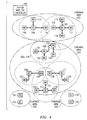
- FIG. 4 illustrates the configuration of the wireless switching system after base station 108 becomes part of logical coverage area 202.
- system wireless controller 100 performs the control operations performed by base station 108 in the first embodiment of the invention, and automatically adjusts the logical coverage areas as previously described.
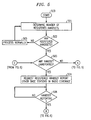
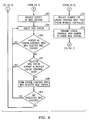
- FIGS. 5 and 6 illustrate the steps performed by a base station in initially establishing a logical coverage area.
- the base station first determines the number of registered handsets that are registered on the base station in block 501.
- decision block 502 determines if there are any registered handsets. If the answer is no, normal processing is performed in block 505 before control is transferred back to block 501. If the answer in decision block 502 is yes, decision block 503 determines if any of the registered handsets are unreported. If the answer in decision block 503 is yes, block 504 requests that a registered handset report other base stations in the radio coverage area of the registered handset before transferring control to decision block 506. The latter decision block waits until the requested handset reports and then transfers control to block 603 of FIG. 6.
- Block 603 requests the identification of the other base stations from the requested handset.
- Block 604 selects one of the base stations identified in block 603.
- Decision block 606 determines if the selected base station is already in a logical coverage area with the base station that is performing the steps of FIGS. 5 and 6. If the answer is yes, control is transferred back to block 604. If the answer is no, control is transferred by decision block 606 to decision block 607 that determines whether the selected base station is already in another logical coverage area. If the answer is yes in decision block 607, control is transferred back to block 604. If the answer is no in decision block 607, block 608 contacts the selected base station and forms it into a new logical coverage area before transferring control to decision block 609.
- the latter decision block determines if there are any more unselected base stations reported by the reporting handset that supplied a list of base stations in block 603. If the answer is yes, control is transferred back to block 604 so that a new base station can be selected. If the answer is no in decision block 609, control is transferred back to decision block 503 of FIG. 5.
- Block 601 requests a number for the new logical coverage area that is being formed from the system wireless controller, and block 602 transmits this logical coverage area number to the other base stations that are being formed into the new logical coverage area. These are the base stations that were determined and designated in block 608.
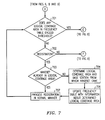
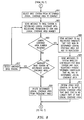
- FIGS. 7-9 illustrate, in flow chart form, the steps performed by a base station in automatically transferring to a different logical coverage area.
- control is transferred to decision block 701 that examines a frequency table that is maintained by each base station.
- the frequency table maintains the frequency of transfers of wireless handsets from other logical coverage area to the base station.
- Decision block 701 determines if the transfer rate from any logical coverage area listed in the frequency table exceeds the threshold for such transfers. If the answer is yes, the base station will join the logical coverage area exceeding the threshold. If the answer is no in decision block 701, control is transferred to decision block 702 which determines if a wireless handset is in the process of registering on the base station.
- decision block 703 determines if the wireless handset is already in the logical coverage area of the base station. If the answer is yes in decision block 703, control is transferred to block 707 which processes the registration operation with the wireless handset in a normal manner before returning control back to decision block 701. If the answer is no in decision block 703, control is transferred to block 704 which determines from the wireless handset the logical coverage area and base station from which the wireless handset came before transferring control to block 706. The latter block updates the frequency table with the information about the determined logical coverage area from block 704 and records the base station information before transferring control to block 707.
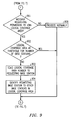
- Block 801 selects a base station associated with the determined logical coverage area to be contacted before transferring control to block 802.
- the latter block sends a message to the selected base station in the determined logical coverage area requesting permission to join the logical coverage area and to receive the logical coverage area number. If the selected base station returns the logical coverage area number, this means that permission has been granted to join the logical coverage area.
- the steps performed by a base station such as the selected base station in block 802 are illustrated in FIG. 9. After execution of block 802, block 803 determines if the logical coverage area number has been received from the selected base station of block 801.
- control is transferred to decision block 804 that determines if there is another base station that has been associated in the frequency table with the determined logical coverage area. If the answer is yes in decision block 804, block 807 selects another base station from the frequency table and returns control to block 802. If the answer in decision block 804 is no, block 806 deletes the determined logical coverage area with its associated base stations from the frequency table before transferring control back to decision block 701 of FIG. 7.
- Block 808 sends a message to all of the wireless handsets registered on the base station, performing the step of block 808, informing these wireless handsets that they are now in the determined logical coverage area as defined by the logical coverage area number received in block 803.
- the message transmitted in block 808 also informs the registered wireless handsets that the wireless handsets do not have to re-register.
- control is transferred to block 809 that sends messages to the system wireless controller for the base station and each of the registered handsets informing the system wireless controller that the base station and all of its registered handsets are now in the determined logical coverage area before transferring control to block 811.
- Block 811 informs the other base stations of the former or departed logical coverage area that the base station is no longer part of that logical coverage area before transferring control back to decision block 701 of FIG. 7.
- FIG. 9 illustrates, in flow chart form, the steps performed by a base station upon receiving a message from another base station requesting permission to join the logical coverage area of the base station executing the steps of FIG. 9.
- decision block 901 determines if a message is being received from another base station is requesting permission to join the logical coverage area of the base station executing decision block 901. If the answer is no, control is transferred to block 906 which processes the stimuli being received by the base station in a normal manner before transferring control back to decision block 701 of FIG. 7.
- decision block 901 determines if the logical coverage area is at the threshold for the number of base stations that are allowed to be in a logical coverage area. If the answer is yes, control is transferred back to decision block 701 of FIG. 7. If the answer in decision block 902 is no, block 903 transmits the logical coverage area number to the requesting base station, and identifies the requesting base station to the other base stations in the logical coverage area before transferring control back to decision block 701 of FIG. 7.
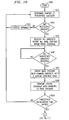
- FIG. 10 illustrates the steps performed by system wireless controller 100 in initially establishing logical coverage areas for the base stations.
- system wireless controller 100 determines the total number of registered handsets by execution of block 1001.
- Decision block 1002 determines if there are any registered handsets. If the answer is no, block 1003 performs normal processing before returning control back to block 1001. If the answer in decision block 1002 is yes, block 1004 requests that all handsets report all base stations within the radio coverage area of each wireless handset before transferring control to decision block 1006. The latter decision block waits until all wireless handsets have reported before transferring control to block 1007.
- the latter block groups the stations into logical coverage areas.
- a logical coverage area initially consists of those base stations that have common handsets.
- block 1008 After execution of block 1007, block 1008 transmits the logical coverage area numbers to the base stations. Finally, decision block 1009 determines when a predefined amount of time that is allowed for the initialization phase has elapsed. If the time has not elapsed yet, decision block 1009 transfers control back to block 1001. If the time has elapsed, decision block 1009 transfers control to block 1101 of FIG. 11.
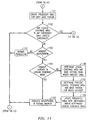
- Block 1101 creates a frequency table for each base station.
- the frequency table lists the frequency of registrations being received from particular logical coverage areas.
- Decision block 1102 examines the frequency tables to determine if a logical coverage area in a frequency table for a base station has exceeded the threshold. If the answer is no in decision block 1102, decision block 1103 determines if a wireless handset has just registered on the wireless switching system. If the answer is no, block 1111 performs normal processing before transferring control back to decision block 1102. If the answer in decision block 1103 is yes, decision block 1104 determines if the handset has merely re-registered on a base station within its present logical coverage area.
- control is transferred to block 1109 which processes the registration in a normal manner before transferring control back to decision block 1102. If the answer in decision block 1104 is no, block 1106 determines the logical coverage area and base station from which the wireless handset came, and block 1107 determines the present logical coverage area and base station on which the wireless handset is presently registered. Then, block 1108 updates the frequency table for the base station with information about the determined logical coverage area before transferring control to block 1109.
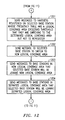
- Block 1201 sends messages to the handsets registered on the base station selected in decision block 1102. (The selected base station is the one whose frequency table had a logical coverage area that has exceeded the threshold as determined in block 1102.) The messages inform the wireless handsets that they are being switched to the determined logical coverage area but that they should not re-register. Then, block 1202 sends a message to the selected base station requesting that it switch to the new logical coverage area, and messages are sent to the base stations in the new logical coverage area informing them that the selected base station is joining that logical coverage area.
- block 1203 sends messages to the base stations in the new logical coverage area that the selected base station will be joining the new logical coverage area.
- block 1204 sends messages to the base stations in the departed logical coverage area informing these base stations that the selected base station is leaving the departed logical coverage area before transferring control back to 1102 of FIG. 11.
Landscapes
- Engineering & Computer Science (AREA)
- Computer Networks & Wireless Communication (AREA)
- Signal Processing (AREA)
- Mobile Radio Communication Systems (AREA)
Applications Claiming Priority (2)
| Application Number | Priority Date | Filing Date | Title |
|---|---|---|---|
| US515447 | 2000-02-29 | ||
| US09/515,447 US6650900B1 (en) | 2000-02-29 | 2000-02-29 | Dynamic logical coverage areas for wireless base stations |
Publications (2)
| Publication Number | Publication Date |
|---|---|
| EP1130936A1 EP1130936A1 (en) | 2001-09-05 |
| EP1130936B1 true EP1130936B1 (en) | 2003-01-22 |
Family
ID=24051381
Family Applications (1)
| Application Number | Title | Priority Date | Filing Date |
|---|---|---|---|
| EP00307827A Expired - Lifetime EP1130936B1 (en) | 2000-02-29 | 2000-09-11 | Dynamic logical coverage areas for wireless base stations |
Country Status (5)
| Country | Link |
|---|---|
| US (1) | US6650900B1 (enExample) |
| EP (1) | EP1130936B1 (enExample) |
| JP (1) | JP3693927B2 (enExample) |
| CA (1) | CA2328753C (enExample) |
| DE (1) | DE60001258T2 (enExample) |
Families Citing this family (16)
| Publication number | Priority date | Publication date | Assignee | Title |
|---|---|---|---|---|
| GB2361385A (en) * | 2000-04-12 | 2001-10-17 | Queen Mary & Westfield College | Intelligent control of radio resorces in a wireless network |
| JP3939142B2 (ja) | 2001-12-07 | 2007-07-04 | 株式会社エヌ・ティ・ティ・ドコモ | 位置登録エリア構成方法、移動通信システム及び無線基地局 |
| US7139578B2 (en) * | 2002-03-22 | 2006-11-21 | Lucent Technologies Inc. | Method for managing wireless assets in a coverage area |
| EP1610574A1 (en) * | 2004-06-25 | 2005-12-28 | Groundhog Technologies Inc. | Partitioning method for mobile communication network with overlapping location areas |
| KR100589249B1 (ko) | 2004-11-08 | 2006-06-19 | 엘지전자 주식회사 | 플라즈마 디스플레이 패널의 에너지 회수장치 및 회수방법 |
| US20090047966A1 (en) * | 2007-08-17 | 2009-02-19 | Qualcomm Incorporated | Method for a heterogeneous wireless ad hoc mobile internet access service |
| US9398453B2 (en) | 2007-08-17 | 2016-07-19 | Qualcomm Incorporated | Ad hoc service provider's ability to provide service for a wireless network |
| US9392445B2 (en) | 2007-08-17 | 2016-07-12 | Qualcomm Incorporated | Handoff at an ad-hoc mobile service provider |
| CN101631314B (zh) * | 2008-07-17 | 2012-09-05 | 上海寰创通信科技股份有限公司 | 一种无线覆盖区域动态通讯的方法 |
| US9521554B2 (en) | 2008-08-15 | 2016-12-13 | Qualcomm Incorporated | Adaptive clustering framework in frequency-time for network MIMO systems |
| US10028332B2 (en) | 2008-08-15 | 2018-07-17 | Qualcomm, Incorporated | Hierarchical clustering framework for inter-cell MIMO systems |
| US9179367B2 (en) | 2009-05-26 | 2015-11-03 | Qualcomm Incorporated | Maximizing service provider utility in a heterogeneous wireless ad-hoc network |
| CN102612842B (zh) * | 2009-10-28 | 2015-09-16 | Nec欧洲有限公司 | 用于操作无线网络中的能量管理系统的方法和网络 |
| US8639256B2 (en) | 2010-05-26 | 2014-01-28 | Qualcomm Incorporated | Adaptive cell clustering in a multi-cluster environment |
| US9288690B2 (en) | 2010-05-26 | 2016-03-15 | Qualcomm Incorporated | Apparatus for clustering cells using neighbor relations |
| US9320013B2 (en) * | 2011-12-02 | 2016-04-19 | Qualcomm Incorporation | Methods and apparatuses for improved paging area identifier selection in wireless networks containing low power base stations |
Family Cites Families (12)
| Publication number | Priority date | Publication date | Assignee | Title |
|---|---|---|---|---|
| FI98186C (fi) * | 1992-11-30 | 1997-04-25 | Nokia Telecommunications Oy | Solukkoradioverkko sekä menetelmä sijainninpäivityksen suorittamiseksisolukkoradiojärjestelmässä |
| EP0666700A1 (en) * | 1994-02-03 | 1995-08-09 | AT&T Corp. | Virtual mobile location area |
| JPH07298340A (ja) | 1994-03-02 | 1995-11-10 | Fujitsu Ltd | 移動通信システムおよび移動局 |
| FI105960B (fi) * | 1996-12-04 | 2000-10-31 | Nokia Networks Oy | Solukkoradiojärjestelmä |
| US5867789A (en) * | 1996-12-30 | 1999-02-02 | Motorola, Inc. | Method and system for real-time channel management in a radio telecommunications system |
| FI105638B (fi) | 1997-05-14 | 2000-09-15 | Nokia Networks Oy | Menetelmä solukkoradiojärjestelmän eri osien kapasiteettitarpeen arvioimiseksi |
| JPH114476A (ja) * | 1997-06-11 | 1999-01-06 | Nec Corp | 移動通信システム及びそのトラヒック収集制御方法並びにトラヒック収集制御プログラムを記録した記録媒体 |
| US6069871A (en) * | 1997-07-21 | 2000-05-30 | Nortel Networks Corporation | Traffic allocation and dynamic load balancing in a multiple carrier cellular wireless communication system |
| US6374124B1 (en) * | 1997-12-24 | 2002-04-16 | Transcept, Inc. | Dynamic reallocation of transceivers used to interconnect wireless telephones to a broadband network |
| US6078821A (en) * | 1998-02-25 | 2000-06-20 | Motorola, Inc. | Cordless radiotelephone system having an extendable geographic coverage area and method therefor |
| SE522834C2 (sv) * | 1998-11-11 | 2004-03-09 | Ericsson Telefon Ab L M | Anordning, system och förfarande relaterande till radiokommunikation |
| US6510320B1 (en) * | 2000-02-29 | 2003-01-21 | Avaya Technology Corp. | Initialization of dynamic logical coverage areas for wireless base stations |
-
2000
- 2000-02-29 US US09/515,447 patent/US6650900B1/en not_active Expired - Fee Related
- 2000-09-11 EP EP00307827A patent/EP1130936B1/en not_active Expired - Lifetime
- 2000-09-11 DE DE60001258T patent/DE60001258T2/de not_active Expired - Fee Related
- 2000-12-19 CA CA002328753A patent/CA2328753C/en not_active Expired - Fee Related
-
2001
- 2001-02-27 JP JP2001051334A patent/JP3693927B2/ja not_active Expired - Fee Related
Also Published As
| Publication number | Publication date |
|---|---|
| US6650900B1 (en) | 2003-11-18 |
| DE60001258T2 (de) | 2003-07-24 |
| CA2328753A1 (en) | 2001-08-29 |
| CA2328753C (en) | 2004-02-17 |
| JP2001275145A (ja) | 2001-10-05 |
| EP1130936A1 (en) | 2001-09-05 |
| JP3693927B2 (ja) | 2005-09-14 |
| DE60001258D1 (de) | 2003-02-27 |
Similar Documents
| Publication | Publication Date | Title |
|---|---|---|
| JP3506331B2 (ja) | システムネットワークおよびセルのハンドオーバ情報の転送のための方法 | |
| EP0300721B1 (en) | Colocated cellular radiotelephone systems | |
| CA2328753C (en) | Dynamic logical coverage areas for wireless base stations | |
| KR101833841B1 (ko) | 무선 근거리 통신망에 데이터를 분배하기 위한 방법, 단말 및 네트워크 장치 | |
| CN101297578B (zh) | 从无线局域网到蜂窝电话网络的硬越区切换 | |
| KR20190088536A (ko) | 세션 관리 방법, 단말, 및 시스템 | |
| WO1998038827A1 (en) | Handover and call setup in a mobile communication system | |
| EP1484935B1 (en) | Radio area network control system and wide radio area network control system | |
| US6148210A (en) | Personal communication system and technique with zone report feature | |
| JP2006523404A (ja) | Tdd・cdmaネットワークにおける距離に依存する直接方式のピアツーピア通信の確立 | |
| JP3754608B2 (ja) | 無線アクセスhoを提供するための移動スイッチング・センタ | |
| US20040002336A1 (en) | Signaling and routing protocools for an integrated cellular and relaying system | |
| JP2011035926A (ja) | 移動通信方法、移動交換局、無線基地局及び移動局 | |
| US11229072B2 (en) | User equipment capable of attaching to multiple communication networks | |
| EP1776781A1 (en) | Establishment of radio resource control connection in wireless communication system | |
| EP1993317B1 (en) | Controlling which cell a mobile station is associated with in idle mode | |
| EP3025552A1 (en) | Method for enhanced access selection by a user equipment in a cellular telecommunications network, telecommunications network, and system for enhanced access selection of a user equipment | |
| EP1130939B1 (en) | Initialization of dynamic logical coverage areas for wireless base stations | |
| US6519459B1 (en) | Use of immediate handover to achieve multi-head zones | |
| CA2328844C (en) | Modification of re-registration by a wireless handset in response to a change of logical coverage area | |
| KR100976935B1 (ko) | 비동기망과 동기망이 혼재된 이동통신망에서의 핸드오버방법 | |
| WO2026011448A1 (zh) | 通信方法、设备、芯片、存储介质及程序产品 | |
| RU2000130305A (ru) | Персональный радиовызов в области множества сотовых ячеек для сотовой системы связи |
Legal Events
| Date | Code | Title | Description |
|---|---|---|---|
| PUAI | Public reference made under article 153(3) epc to a published international application that has entered the european phase |
Free format text: ORIGINAL CODE: 0009012 |
|
| 17P | Request for examination filed |
Effective date: 20000925 |
|
| AK | Designated contracting states |
Kind code of ref document: A1 Designated state(s): AT BE CH CY DE DK ES FI FR GB GR IE IT LI LU MC NL PT SE |
|
| AX | Request for extension of the european patent |
Free format text: AL;LT;LV;MK;RO;SI |
|
| GRAG | Despatch of communication of intention to grant |
Free format text: ORIGINAL CODE: EPIDOS AGRA |
|
| GRAG | Despatch of communication of intention to grant |
Free format text: ORIGINAL CODE: EPIDOS AGRA |
|
| GRAH | Despatch of communication of intention to grant a patent |
Free format text: ORIGINAL CODE: EPIDOS IGRA |
|
| AKX | Designation fees paid |
Free format text: DE FI FR SE |
|
| GRAH | Despatch of communication of intention to grant a patent |
Free format text: ORIGINAL CODE: EPIDOS IGRA |
|
| GRAA | (expected) grant |
Free format text: ORIGINAL CODE: 0009210 |
|
| AK | Designated contracting states |
Kind code of ref document: B1 Designated state(s): DE FI FR SE |
|
| REF | Corresponds to: |
Ref document number: 60001258 Country of ref document: DE Date of ref document: 20030227 Kind code of ref document: P |
|
| REG | Reference to a national code |
Ref country code: SE Ref legal event code: TRGR |
|
| ET | Fr: translation filed | ||
| PLBE | No opposition filed within time limit |
Free format text: ORIGINAL CODE: 0009261 |
|
| STAA | Information on the status of an ep patent application or granted ep patent |
Free format text: STATUS: NO OPPOSITION FILED WITHIN TIME LIMIT |
|
| 26N | No opposition filed |
Effective date: 20031023 |
|
| PGFP | Annual fee paid to national office [announced via postgrant information from national office to epo] |
Ref country code: FI Payment date: 20080915 Year of fee payment: 9 Ref country code: FR Payment date: 20080915 Year of fee payment: 9 |
|
| PGFP | Annual fee paid to national office [announced via postgrant information from national office to epo] |
Ref country code: DE Payment date: 20080926 Year of fee payment: 9 |
|
| PGFP | Annual fee paid to national office [announced via postgrant information from national office to epo] |
Ref country code: SE Payment date: 20080908 Year of fee payment: 9 |
|
| PG25 | Lapsed in a contracting state [announced via postgrant information from national office to epo] |
Ref country code: FI Free format text: LAPSE BECAUSE OF NON-PAYMENT OF DUE FEES Effective date: 20090911 |
|
| EUG | Se: european patent has lapsed | ||
| REG | Reference to a national code |
Ref country code: FR Ref legal event code: ST Effective date: 20100531 |
|
| PG25 | Lapsed in a contracting state [announced via postgrant information from national office to epo] |
Ref country code: FR Free format text: LAPSE BECAUSE OF NON-PAYMENT OF DUE FEES Effective date: 20090930 Ref country code: DE Free format text: LAPSE BECAUSE OF NON-PAYMENT OF DUE FEES Effective date: 20100401 |
|
| PG25 | Lapsed in a contracting state [announced via postgrant information from national office to epo] |
Ref country code: SE Free format text: LAPSE BECAUSE OF NON-PAYMENT OF DUE FEES Effective date: 20090912 |