EP1130027A1 - Memno-Peptide, Verfahren zu ihrer Herstellung und Verwendung derselben - Google Patents
Memno-Peptide, Verfahren zu ihrer Herstellung und Verwendung derselben Download PDFInfo
- Publication number
- EP1130027A1 EP1130027A1 EP00104114A EP00104114A EP1130027A1 EP 1130027 A1 EP1130027 A1 EP 1130027A1 EP 00104114 A EP00104114 A EP 00104114A EP 00104114 A EP00104114 A EP 00104114A EP 1130027 A1 EP1130027 A1 EP 1130027A1
- Authority
- EP
- European Patent Office
- Prior art keywords
- formula
- compound
- acceptable salt
- physiologically acceptable
- memno
- Prior art date
- Legal status (The legal status is an assumption and is not a legal conclusion. Google has not performed a legal analysis and makes no representation as to the accuracy of the status listed.)
- Withdrawn
Links
- 238000002360 preparation method Methods 0.000 title claims abstract description 14
- 108090000765 processed proteins & peptides Proteins 0.000 title claims description 60
- 238000000034 method Methods 0.000 title claims description 13
- 230000008569 process Effects 0.000 title claims description 9
- 102000004196 processed proteins & peptides Human genes 0.000 title description 52
- 150000003839 salts Chemical class 0.000 claims abstract description 27
- 150000001413 amino acids Chemical class 0.000 claims abstract description 26
- IJGRMHOSHXDMSA-UHFFFAOYSA-N Atomic nitrogen Chemical compound N#N IJGRMHOSHXDMSA-UHFFFAOYSA-N 0.000 claims abstract description 20
- 229910052757 nitrogen Inorganic materials 0.000 claims abstract description 10
- 125000000904 isoindolyl group Chemical class C=1(NC=C2C=CC=CC12)* 0.000 claims abstract description 7
- 235000000346 sugar Nutrition 0.000 claims abstract description 7
- 150000001875 compounds Chemical class 0.000 claims description 46
- 241001598067 Memnoniella echinata Species 0.000 claims description 20
- 239000001963 growth medium Substances 0.000 claims description 16
- 206010019280 Heart failures Diseases 0.000 claims description 13
- 239000003814 drug Substances 0.000 claims description 13
- 239000000126 substance Substances 0.000 claims description 13
- 238000000855 fermentation Methods 0.000 claims description 11
- 230000004151 fermentation Effects 0.000 claims description 11
- 229910052799 carbon Inorganic materials 0.000 claims description 9
- 238000004519 manufacturing process Methods 0.000 claims description 8
- XEEYBQQBJWHFJM-UHFFFAOYSA-N Iron Chemical compound [Fe] XEEYBQQBJWHFJM-UHFFFAOYSA-N 0.000 claims description 6
- 238000011282 treatment Methods 0.000 claims description 6
- 125000004432 carbon atom Chemical group C* 0.000 claims description 5
- 238000002955 isolation Methods 0.000 claims description 5
- 229910052760 oxygen Inorganic materials 0.000 claims description 5
- 239000000825 pharmaceutical preparation Substances 0.000 claims description 5
- 150000001412 amines Chemical group 0.000 claims description 4
- 239000000969 carrier Substances 0.000 claims description 3
- 206010012601 diabetes mellitus Diseases 0.000 claims description 3
- 229940079593 drug Drugs 0.000 claims description 3
- GZCGUPFRVQAUEE-UHFFFAOYSA-N 2,3,4,5,6-pentahydroxyhexanal Chemical compound OCC(O)C(O)C(O)C(O)C=O GZCGUPFRVQAUEE-UHFFFAOYSA-N 0.000 claims description 2
- 125000000539 amino acid group Chemical group 0.000 claims description 2
- 208000037265 diseases, disorders, signs and symptoms Diseases 0.000 claims description 2
- 208000015181 infectious disease Diseases 0.000 claims description 2
- 230000000813 microbial effect Effects 0.000 claims description 2
- 238000011321 prophylaxis Methods 0.000 claims description 2
- 150000003462 sulfoxides Chemical class 0.000 claims description 2
- 238000002560 therapeutic procedure Methods 0.000 claims description 2
- 238000006243 chemical reaction Methods 0.000 claims 2
- 239000003085 diluting agent Substances 0.000 claims 1
- 201000010099 disease Diseases 0.000 claims 1
- 235000019988 mead Nutrition 0.000 claims 1
- 125000000217 alkyl group Chemical group 0.000 abstract description 2
- 125000003545 alkoxy group Chemical group 0.000 abstract 3
- 125000001429 N-terminal alpha-amino-acid group Chemical group 0.000 abstract 1
- 125000004433 nitrogen atom Chemical group N* 0.000 abstract 1
- 239000000243 solution Substances 0.000 description 29
- WEVYAHXRMPXWCK-UHFFFAOYSA-N Acetonitrile Chemical compound CC#N WEVYAHXRMPXWCK-UHFFFAOYSA-N 0.000 description 18
- 108010055874 memnopeptide A Proteins 0.000 description 18
- GRBLBISGALXJDT-LHTGWLQBSA-N memnopeptide a Chemical compound C1CCC(C(=O)N2C(CCC2)C(O)=O)N1C(=O)C(CC(C)C)NC(=O)C1CCCN1C(=O)C(CCC(N)=O)NC(=O)C(NC(=O)C1N(CCC1)C(=O)C(CCC(N)=O)NC(=O)C(CC=1NC=NC=1)NC(=O)C(CCS(C)=O)N1C(C2=CC(O)=C3C[C@]4(OC3=C2C1)[C@]1(CC[C@@H](O)C(C)(C)[C@@H]1CC[C@H]4C)C)=O)CC1=CNC=N1 GRBLBISGALXJDT-LHTGWLQBSA-N 0.000 description 18
- OKKJLVBELUTLKV-UHFFFAOYSA-N Methanol Chemical compound OC OKKJLVBELUTLKV-UHFFFAOYSA-N 0.000 description 15
- 235000015097 nutrients Nutrition 0.000 description 15
- 235000001014 amino acid Nutrition 0.000 description 14
- 239000011575 calcium Substances 0.000 description 12
- 239000003960 organic solvent Substances 0.000 description 12
- XLYOFNOQVPJJNP-UHFFFAOYSA-N water Substances O XLYOFNOQVPJJNP-UHFFFAOYSA-N 0.000 description 12
- PEDCQBHIVMGVHV-UHFFFAOYSA-N Glycerine Chemical compound OCC(O)CO PEDCQBHIVMGVHV-UHFFFAOYSA-N 0.000 description 11
- 239000000203 mixture Substances 0.000 description 11
- 235000007586 terpenes Nutrition 0.000 description 10
- ROHFNLRQFUQHCH-YFKPBYRVSA-N L-leucine Chemical compound CC(C)C[C@H](N)C(O)=O ROHFNLRQFUQHCH-YFKPBYRVSA-N 0.000 description 9
- 238000004587 chromatography analysis Methods 0.000 description 9
- 102000005681 phospholamban Human genes 0.000 description 9
- 108010059929 phospholamban Proteins 0.000 description 9
- DTQVDTLACAAQTR-UHFFFAOYSA-N Trifluoroacetic acid Chemical compound OC(=O)C(F)(F)F DTQVDTLACAAQTR-UHFFFAOYSA-N 0.000 description 8
- 150000003505 terpenes Chemical class 0.000 description 8
- 102100027732 Sarcoplasmic/endoplasmic reticulum calcium ATPase 2 Human genes 0.000 description 7
- 101710109123 Sarcoplasmic/endoplasmic reticulum calcium ATPase 2 Proteins 0.000 description 7
- 241000191967 Staphylococcus aureus Species 0.000 description 7
- 239000003242 anti bacterial agent Substances 0.000 description 7
- 229940088710 antibiotic agent Drugs 0.000 description 7
- 230000000694 effects Effects 0.000 description 7
- 239000000047 product Substances 0.000 description 7
- 239000000706 filtrate Substances 0.000 description 6
- 230000026731 phosphorylation Effects 0.000 description 6
- 238000006366 phosphorylation reaction Methods 0.000 description 6
- 239000002904 solvent Substances 0.000 description 6
- QTBSBXVTEAMEQO-UHFFFAOYSA-N Acetic acid Chemical compound CC(O)=O QTBSBXVTEAMEQO-UHFFFAOYSA-N 0.000 description 5
- WQZGKKKJIJFFOK-GASJEMHNSA-N Glucose Natural products OC[C@H]1OC(O)[C@H](O)[C@@H](O)[C@@H]1O WQZGKKKJIJFFOK-GASJEMHNSA-N 0.000 description 5
- RJQXTJLFIWVMTO-TYNCELHUSA-N Methicillin Chemical compound COC1=CC=CC(OC)=C1C(=O)N[C@@H]1C(=O)N2[C@@H](C(O)=O)C(C)(C)S[C@@H]21 RJQXTJLFIWVMTO-TYNCELHUSA-N 0.000 description 5
- 239000007864 aqueous solution Substances 0.000 description 5
- WQZGKKKJIJFFOK-VFUOTHLCSA-N beta-D-glucose Chemical compound OC[C@H]1O[C@@H](O)[C@H](O)[C@@H](O)[C@@H]1O WQZGKKKJIJFFOK-VFUOTHLCSA-N 0.000 description 5
- 239000012141 concentrate Substances 0.000 description 5
- 235000008504 concentrate Nutrition 0.000 description 5
- 239000008103 glucose Substances 0.000 description 5
- 238000004128 high performance liquid chromatography Methods 0.000 description 5
- 150000002500 ions Chemical class 0.000 description 5
- 239000007788 liquid Substances 0.000 description 5
- 229960003085 meticillin Drugs 0.000 description 5
- 244000005700 microbiome Species 0.000 description 5
- 239000012071 phase Substances 0.000 description 5
- WHUUTDBJXJRKMK-UHFFFAOYSA-N Glutamic acid Natural products OC(=O)C(N)CCC(O)=O WHUUTDBJXJRKMK-UHFFFAOYSA-N 0.000 description 4
- KFZMGEQAYNKOFK-UHFFFAOYSA-N Isopropanol Chemical compound CC(C)O KFZMGEQAYNKOFK-UHFFFAOYSA-N 0.000 description 4
- VYPSYNLAJGMNEJ-UHFFFAOYSA-N Silicium dioxide Chemical compound O=[Si]=O VYPSYNLAJGMNEJ-UHFFFAOYSA-N 0.000 description 4
- FAPWRFPIFSIZLT-UHFFFAOYSA-M Sodium chloride Chemical compound [Na+].[Cl-] FAPWRFPIFSIZLT-UHFFFAOYSA-M 0.000 description 4
- 239000004480 active ingredient Substances 0.000 description 4
- 238000001514 detection method Methods 0.000 description 4
- 239000003480 eluent Substances 0.000 description 4
- 235000011187 glycerol Nutrition 0.000 description 4
- QJGQUHMNIGDVPM-UHFFFAOYSA-N nitrogen group Chemical group [N] QJGQUHMNIGDVPM-UHFFFAOYSA-N 0.000 description 4
- -1 nitrogen-containing terpenes Chemical class 0.000 description 4
- 102000004169 proteins and genes Human genes 0.000 description 4
- 108090000623 proteins and genes Proteins 0.000 description 4
- 108010009004 proteose-peptone Proteins 0.000 description 4
- 210000001908 sarcoplasmic reticulum Anatomy 0.000 description 4
- 238000012360 testing method Methods 0.000 description 4
- GSDSWSVVBLHKDQ-UHFFFAOYSA-N 9-fluoro-3-methyl-10-(4-methylpiperazin-1-yl)-7-oxo-2,3-dihydro-7H-[1,4]oxazino[2,3,4-ij]quinoline-6-carboxylic acid Chemical compound FC1=CC(C(C(C(O)=O)=C2)=O)=C3N2C(C)COC3=C1N1CCN(C)CC1 GSDSWSVVBLHKDQ-UHFFFAOYSA-N 0.000 description 3
- OKTJSMMVPCPJKN-UHFFFAOYSA-N Carbon Chemical compound [C] OKTJSMMVPCPJKN-UHFFFAOYSA-N 0.000 description 3
- FBPFZTCFMRRESA-KVTDHHQDSA-N D-Mannitol Chemical compound OC[C@@H](O)[C@@H](O)[C@H](O)[C@H](O)CO FBPFZTCFMRRESA-KVTDHHQDSA-N 0.000 description 3
- RTZKZFJDLAIYFH-UHFFFAOYSA-N Diethyl ether Chemical group CCOCC RTZKZFJDLAIYFH-UHFFFAOYSA-N 0.000 description 3
- IAZDPXIOMUYVGZ-UHFFFAOYSA-N Dimethylsulphoxide Chemical compound CS(C)=O IAZDPXIOMUYVGZ-UHFFFAOYSA-N 0.000 description 3
- 241000194031 Enterococcus faecium Species 0.000 description 3
- 239000012541 Fractogel® Substances 0.000 description 3
- RRHGJUQNOFWUDK-UHFFFAOYSA-N Isoprene Chemical compound CC(=C)C=C RRHGJUQNOFWUDK-UHFFFAOYSA-N 0.000 description 3
- 241001279361 Stachybotrys Species 0.000 description 3
- 108010055297 Sterol Esterase Proteins 0.000 description 3
- 102000000019 Sterol Esterase Human genes 0.000 description 3
- 241000193996 Streptococcus pyogenes Species 0.000 description 3
- 108010059993 Vancomycin Proteins 0.000 description 3
- 230000015572 biosynthetic process Effects 0.000 description 3
- 150000001721 carbon Chemical group 0.000 description 3
- 239000012876 carrier material Substances 0.000 description 3
- 230000001419 dependent effect Effects 0.000 description 3
- 238000010828 elution Methods 0.000 description 3
- 238000005227 gel permeation chromatography Methods 0.000 description 3
- 230000002401 inhibitory effect Effects 0.000 description 3
- 239000000463 material Substances 0.000 description 3
- 239000002609 medium Substances 0.000 description 3
- 210000003365 myofibril Anatomy 0.000 description 3
- VLKZOEOYAKHREP-UHFFFAOYSA-N n-Hexane Chemical compound CCCCCC VLKZOEOYAKHREP-UHFFFAOYSA-N 0.000 description 3
- 229930014626 natural product Natural products 0.000 description 3
- 229960001699 ofloxacin Drugs 0.000 description 3
- 125000000830 polyketide group Chemical group 0.000 description 3
- 239000008057 potassium phosphate buffer Substances 0.000 description 3
- BDERNNFJNOPAEC-UHFFFAOYSA-N propan-1-ol Chemical compound CCCO BDERNNFJNOPAEC-UHFFFAOYSA-N 0.000 description 3
- 235000018102 proteins Nutrition 0.000 description 3
- 238000000926 separation method Methods 0.000 description 3
- 239000000741 silica gel Substances 0.000 description 3
- 229910002027 silica gel Inorganic materials 0.000 description 3
- 239000007787 solid Substances 0.000 description 3
- 239000003826 tablet Substances 0.000 description 3
- 239000011573 trace mineral Substances 0.000 description 3
- 235000013619 trace mineral Nutrition 0.000 description 3
- MYPYJXKWCTUITO-LYRMYLQWSA-N vancomycin Chemical compound O([C@@H]1[C@@H](O)[C@H](O)[C@@H](CO)O[C@H]1OC1=C2C=C3C=C1OC1=CC=C(C=C1Cl)[C@@H](O)[C@H](C(N[C@@H](CC(N)=O)C(=O)N[C@H]3C(=O)N[C@H]1C(=O)N[C@H](C(N[C@@H](C3=CC(O)=CC(O)=C3C=3C(O)=CC=C1C=3)C(O)=O)=O)[C@H](O)C1=CC=C(C(=C1)Cl)O2)=O)NC(=O)[C@@H](CC(C)C)NC)[C@H]1C[C@](C)(N)[C@H](O)[C@H](C)O1 MYPYJXKWCTUITO-LYRMYLQWSA-N 0.000 description 3
- 229960003165 vancomycin Drugs 0.000 description 3
- MYPYJXKWCTUITO-UHFFFAOYSA-N vancomycin Natural products O1C(C(=C2)Cl)=CC=C2C(O)C(C(NC(C2=CC(O)=CC(O)=C2C=2C(O)=CC=C3C=2)C(O)=O)=O)NC(=O)C3NC(=O)C2NC(=O)C(CC(N)=O)NC(=O)C(NC(=O)C(CC(C)C)NC)C(O)C(C=C3Cl)=CC=C3OC3=CC2=CC1=C3OC1OC(CO)C(O)C(O)C1OC1CC(C)(N)C(O)C(C)O1 MYPYJXKWCTUITO-UHFFFAOYSA-N 0.000 description 3
- 239000012138 yeast extract Substances 0.000 description 3
- CZMRCDWAGMRECN-UHFFFAOYSA-N 2-{[3,4-dihydroxy-2,5-bis(hydroxymethyl)oxolan-2-yl]oxy}-6-(hydroxymethyl)oxane-3,4,5-triol Chemical compound OCC1OC(CO)(OC2OC(CO)C(O)C(O)C2O)C(O)C1O CZMRCDWAGMRECN-UHFFFAOYSA-N 0.000 description 2
- 229920001817 Agar Polymers 0.000 description 2
- GUBGYTABKSRVRQ-XLOQQCSPSA-N Alpha-Lactose Chemical compound O[C@@H]1[C@@H](O)[C@@H](O)[C@@H](CO)O[C@H]1O[C@@H]1[C@@H](CO)O[C@H](O)[C@H](O)[C@H]1O GUBGYTABKSRVRQ-XLOQQCSPSA-N 0.000 description 2
- 0 C[C@](CC[C@@](C1(C)C)[C@]2(C)CC[C@]1O)[C@@]2(C1)Oc2c1c(O)cc1c2CN(*)C1=O Chemical compound C[C@](CC[C@@](C1(C)C)[C@]2(C)CC[C@]1O)[C@@]2(C1)Oc2c1c(O)cc1c2CN(*)C1=O 0.000 description 2
- 102000004190 Enzymes Human genes 0.000 description 2
- 108090000790 Enzymes Proteins 0.000 description 2
- PLUBXMRUUVWRLT-UHFFFAOYSA-N Ethyl methanesulfonate Chemical compound CCOS(C)(=O)=O PLUBXMRUUVWRLT-UHFFFAOYSA-N 0.000 description 2
- VEXZGXHMUGYJMC-UHFFFAOYSA-N Hydrochloric acid Chemical compound Cl VEXZGXHMUGYJMC-UHFFFAOYSA-N 0.000 description 2
- FFEARJCKVFRZRR-BYPYZUCNSA-N L-methionine Chemical compound CSCC[C@H](N)C(O)=O FFEARJCKVFRZRR-BYPYZUCNSA-N 0.000 description 2
- GUBGYTABKSRVRQ-QKKXKWKRSA-N Lactose Natural products OC[C@H]1O[C@@H](O[C@H]2[C@H](O)[C@@H](O)C(O)O[C@@H]2CO)[C@H](O)[C@@H](O)[C@H]1O GUBGYTABKSRVRQ-QKKXKWKRSA-N 0.000 description 2
- CSNNHWWHGAXBCP-UHFFFAOYSA-L Magnesium sulfate Chemical compound [Mg+2].[O-][S+2]([O-])([O-])[O-] CSNNHWWHGAXBCP-UHFFFAOYSA-L 0.000 description 2
- LRHPLDYGYMQRHN-UHFFFAOYSA-N N-Butanol Chemical compound CCCCO LRHPLDYGYMQRHN-UHFFFAOYSA-N 0.000 description 2
- VZUNGTLZRAYYDE-UHFFFAOYSA-N N-methyl-N'-nitro-N-nitrosoguanidine Chemical compound O=NN(C)C(=N)N[N+]([O-])=O VZUNGTLZRAYYDE-UHFFFAOYSA-N 0.000 description 2
- 229930182555 Penicillin Natural products 0.000 description 2
- JGSARLDLIJGVTE-MBNYWOFBSA-N Penicillin G Chemical compound N([C@H]1[C@H]2SC([C@@H](N2C1=O)C(O)=O)(C)C)C(=O)CC1=CC=CC=C1 JGSARLDLIJGVTE-MBNYWOFBSA-N 0.000 description 2
- WCUXLLCKKVVCTQ-UHFFFAOYSA-M Potassium chloride Chemical compound [Cl-].[K+] WCUXLLCKKVVCTQ-UHFFFAOYSA-M 0.000 description 2
- 241001279364 Stachybotrys chartarum Species 0.000 description 2
- GWEVSGVZZGPLCZ-UHFFFAOYSA-N Titan oxide Chemical compound O=[Ti]=O GWEVSGVZZGPLCZ-UHFFFAOYSA-N 0.000 description 2
- 240000008042 Zea mays Species 0.000 description 2
- 235000005824 Zea mays ssp. parviglumis Nutrition 0.000 description 2
- 235000002017 Zea mays subsp mays Nutrition 0.000 description 2
- 238000010521 absorption reaction Methods 0.000 description 2
- 229960000583 acetic acid Drugs 0.000 description 2
- 239000012190 activator Substances 0.000 description 2
- 239000000654 additive Substances 0.000 description 2
- 239000008272 agar Substances 0.000 description 2
- 150000001298 alcohols Chemical class 0.000 description 2
- 229910052784 alkaline earth metal Inorganic materials 0.000 description 2
- 229930013930 alkaloid Natural products 0.000 description 2
- 239000003708 ampul Substances 0.000 description 2
- 238000004458 analytical method Methods 0.000 description 2
- 230000000843 anti-fungal effect Effects 0.000 description 2
- 230000000845 anti-microbial effect Effects 0.000 description 2
- 229940121375 antifungal agent Drugs 0.000 description 2
- 230000009286 beneficial effect Effects 0.000 description 2
- 230000004071 biological effect Effects 0.000 description 2
- 239000002775 capsule Substances 0.000 description 2
- 150000001720 carbohydrates Chemical class 0.000 description 2
- 235000014633 carbohydrates Nutrition 0.000 description 2
- 230000000747 cardiac effect Effects 0.000 description 2
- BECPQYXYKAMYBN-UHFFFAOYSA-N casein, tech. Chemical group NCCCCC(C(O)=O)N=C(O)C(CC(O)=O)N=C(O)C(CCC(O)=N)N=C(O)C(CC(C)C)N=C(O)C(CCC(O)=O)N=C(O)C(CC(O)=O)N=C(O)C(CCC(O)=O)N=C(O)C(C(C)O)N=C(O)C(CCC(O)=N)N=C(O)C(CCC(O)=N)N=C(O)C(CCC(O)=N)N=C(O)C(CCC(O)=O)N=C(O)C(CCC(O)=O)N=C(O)C(COP(O)(O)=O)N=C(O)C(CCC(O)=N)N=C(O)C(N)CC1=CC=CC=C1 BECPQYXYKAMYBN-UHFFFAOYSA-N 0.000 description 2
- 150000001768 cations Chemical class 0.000 description 2
- 210000004027 cell Anatomy 0.000 description 2
- 238000004140 cleaning Methods 0.000 description 2
- 230000008602 contraction Effects 0.000 description 2
- 235000005822 corn Nutrition 0.000 description 2
- 238000002425 crystallisation Methods 0.000 description 2
- 230000008025 crystallization Effects 0.000 description 2
- 239000000284 extract Substances 0.000 description 2
- 238000000605 extraction Methods 0.000 description 2
- 239000000499 gel Substances 0.000 description 2
- 230000002209 hydrophobic effect Effects 0.000 description 2
- 238000011534 incubation Methods 0.000 description 2
- 239000003112 inhibitor Substances 0.000 description 2
- 238000009413 insulation Methods 0.000 description 2
- 239000008101 lactose Substances 0.000 description 2
- 235000010355 mannitol Nutrition 0.000 description 2
- 235000013372 meat Nutrition 0.000 description 2
- 230000010534 mechanism of action Effects 0.000 description 2
- 230000004060 metabolic process Effects 0.000 description 2
- BDAGIHXWWSANSR-UHFFFAOYSA-N methanoic acid Natural products OC=O BDAGIHXWWSANSR-UHFFFAOYSA-N 0.000 description 2
- 229930182817 methionine Natural products 0.000 description 2
- 125000002496 methyl group Chemical group [H]C([H])([H])* 0.000 description 2
- 230000003278 mimic effect Effects 0.000 description 2
- 230000002107 myocardial effect Effects 0.000 description 2
- 210000004165 myocardium Anatomy 0.000 description 2
- 229930191129 nakijiquinone Natural products 0.000 description 2
- 239000005445 natural material Substances 0.000 description 2
- 230000007935 neutral effect Effects 0.000 description 2
- 230000003647 oxidation Effects 0.000 description 2
- 238000007254 oxidation reaction Methods 0.000 description 2
- TWNQGVIAIRXVLR-UHFFFAOYSA-N oxo(oxoalumanyloxy)alumane Chemical compound O=[Al]O[Al]=O TWNQGVIAIRXVLR-UHFFFAOYSA-N 0.000 description 2
- DXGLGDHPHMLXJC-UHFFFAOYSA-N oxybenzone Chemical compound OC1=CC(OC)=CC=C1C(=O)C1=CC=CC=C1 DXGLGDHPHMLXJC-UHFFFAOYSA-N 0.000 description 2
- 229940049954 penicillin Drugs 0.000 description 2
- 229920000642 polymer Polymers 0.000 description 2
- 239000002244 precipitate Substances 0.000 description 2
- 238000000746 purification Methods 0.000 description 2
- 239000011347 resin Substances 0.000 description 2
- 229920005989 resin Polymers 0.000 description 2
- 229930004725 sesquiterpene Natural products 0.000 description 2
- 210000002027 skeletal muscle Anatomy 0.000 description 2
- 239000011780 sodium chloride Substances 0.000 description 2
- 239000007790 solid phase Substances 0.000 description 2
- 238000001228 spectrum Methods 0.000 description 2
- 150000005846 sugar alcohols Chemical class 0.000 description 2
- 239000000829 suppository Substances 0.000 description 2
- 238000004809 thin layer chromatography Methods 0.000 description 2
- 125000004178 (C1-C4) alkyl group Chemical group 0.000 description 1
- KEQGZUUPPQEDPF-UHFFFAOYSA-N 1,3-dichloro-5,5-dimethylimidazolidine-2,4-dione Chemical compound CC1(C)N(Cl)C(=O)N(Cl)C1=O KEQGZUUPPQEDPF-UHFFFAOYSA-N 0.000 description 1
- OSWFIVFLDKOXQC-UHFFFAOYSA-N 4-(3-methoxyphenyl)aniline Chemical compound COC1=CC=CC(C=2C=CC(N)=CC=2)=C1 OSWFIVFLDKOXQC-UHFFFAOYSA-N 0.000 description 1
- 108010074725 Alpha,alpha-trehalose phosphorylase Proteins 0.000 description 1
- USFZMSVCRYTOJT-UHFFFAOYSA-N Ammonium acetate Chemical compound N.CC(O)=O USFZMSVCRYTOJT-UHFFFAOYSA-N 0.000 description 1
- 239000005695 Ammonium acetate Substances 0.000 description 1
- 241000894006 Bacteria Species 0.000 description 1
- 208000004434 Calcinosis Diseases 0.000 description 1
- BHPQYMZQTOCNFJ-UHFFFAOYSA-N Calcium cation Chemical compound [Ca+2] BHPQYMZQTOCNFJ-UHFFFAOYSA-N 0.000 description 1
- 102000000584 Calmodulin Human genes 0.000 description 1
- 108010041952 Calmodulin Proteins 0.000 description 1
- 241000222122 Candida albicans Species 0.000 description 1
- 239000004215 Carbon black (E152) Substances 0.000 description 1
- 208000024172 Cardiovascular disease Diseases 0.000 description 1
- 108010076119 Caseins Proteins 0.000 description 1
- 102000011632 Caseins Human genes 0.000 description 1
- 102000008130 Cyclic AMP-Dependent Protein Kinases Human genes 0.000 description 1
- 108010049894 Cyclic AMP-Dependent Protein Kinases Proteins 0.000 description 1
- WQZGKKKJIJFFOK-QTVWNMPRSA-N D-mannopyranose Chemical compound OC[C@H]1OC(O)[C@@H](O)[C@@H](O)[C@@H]1O WQZGKKKJIJFFOK-QTVWNMPRSA-N 0.000 description 1
- 229940118365 Endothelin receptor antagonist Drugs 0.000 description 1
- LFQSCWFLJHTTHZ-UHFFFAOYSA-N Ethanol Chemical compound CCO LFQSCWFLJHTTHZ-UHFFFAOYSA-N 0.000 description 1
- 241000233866 Fungi Species 0.000 description 1
- 108010010803 Gelatin Proteins 0.000 description 1
- 241001071795 Gentiana Species 0.000 description 1
- 102100039684 Glucose-6-phosphate exchanger SLC37A4 Human genes 0.000 description 1
- 235000010469 Glycine max Nutrition 0.000 description 1
- 240000002024 Gossypium herbaceum Species 0.000 description 1
- 235000004341 Gossypium herbaceum Nutrition 0.000 description 1
- 101000886173 Homo sapiens Glucose-6-phosphate exchanger SLC37A4 Proteins 0.000 description 1
- 108010016183 Human immunodeficiency virus 1 p16 protease Proteins 0.000 description 1
- 206010020772 Hypertension Diseases 0.000 description 1
- 101710144867 Inositol monophosphatase Proteins 0.000 description 1
- ONIBWKKTOPOVIA-BYPYZUCNSA-N L-Proline Chemical compound OC(=O)[C@@H]1CCCN1 ONIBWKKTOPOVIA-BYPYZUCNSA-N 0.000 description 1
- ROHFNLRQFUQHCH-UHFFFAOYSA-N Leucine Natural products CC(C)CC(N)C(O)=O ROHFNLRQFUQHCH-UHFFFAOYSA-N 0.000 description 1
- 241000124008 Mammalia Species 0.000 description 1
- PWHULOQIROXLJO-UHFFFAOYSA-N Manganese Chemical compound [Mn] PWHULOQIROXLJO-UHFFFAOYSA-N 0.000 description 1
- 229930195725 Mannitol Natural products 0.000 description 1
- 241001598064 Memnoniella Species 0.000 description 1
- 241001465754 Metazoa Species 0.000 description 1
- 108010011756 Milk Proteins Proteins 0.000 description 1
- 102000014171 Milk Proteins Human genes 0.000 description 1
- 101710154541 Modulator protein Proteins 0.000 description 1
- 238000007126 N-alkylation reaction Methods 0.000 description 1
- 229910019142 PO4 Inorganic materials 0.000 description 1
- 239000001888 Peptone Substances 0.000 description 1
- 108010080698 Peptones Proteins 0.000 description 1
- 244000046052 Phaseolus vulgaris Species 0.000 description 1
- 235000010627 Phaseolus vulgaris Nutrition 0.000 description 1
- 102000004160 Phosphoric Monoester Hydrolases Human genes 0.000 description 1
- 108090000608 Phosphoric Monoester Hydrolases Proteins 0.000 description 1
- 108091000080 Phosphotransferase Proteins 0.000 description 1
- 206010036790 Productive cough Diseases 0.000 description 1
- ONIBWKKTOPOVIA-UHFFFAOYSA-N Proline Natural products OC(=O)C1CCCN1 ONIBWKKTOPOVIA-UHFFFAOYSA-N 0.000 description 1
- 229920002472 Starch Polymers 0.000 description 1
- CZMRCDWAGMRECN-UGDNZRGBSA-N Sucrose Chemical compound O[C@H]1[C@H](O)[C@@H](CO)O[C@@]1(CO)O[C@@H]1[C@H](O)[C@@H](O)[C@H](O)[C@@H](CO)O1 CZMRCDWAGMRECN-UGDNZRGBSA-N 0.000 description 1
- 229930006000 Sucrose Natural products 0.000 description 1
- 241000779819 Syncarpia glomulifera Species 0.000 description 1
- AYFVYJQAPQTCCC-UHFFFAOYSA-N Threonine Natural products CC(O)C(N)C(O)=O AYFVYJQAPQTCCC-UHFFFAOYSA-N 0.000 description 1
- 239000004473 Threonine Substances 0.000 description 1
- 241000209140 Triticum Species 0.000 description 1
- 235000021307 Triticum Nutrition 0.000 description 1
- HCHKCACWOHOZIP-UHFFFAOYSA-N Zinc Chemical compound [Zn] HCHKCACWOHOZIP-UHFFFAOYSA-N 0.000 description 1
- 150000001241 acetals Chemical class 0.000 description 1
- 239000002253 acid Substances 0.000 description 1
- 230000002378 acidificating effect Effects 0.000 description 1
- 150000007513 acids Chemical class 0.000 description 1
- 230000003213 activating effect Effects 0.000 description 1
- 230000004913 activation Effects 0.000 description 1
- 230000001154 acute effect Effects 0.000 description 1
- 239000003463 adsorbent Substances 0.000 description 1
- 238000010564 aerobic fermentation Methods 0.000 description 1
- 239000000443 aerosol Substances 0.000 description 1
- 150000001299 aldehydes Chemical class 0.000 description 1
- 239000003513 alkali Substances 0.000 description 1
- 150000001342 alkaline earth metals Chemical class 0.000 description 1
- 150000001408 amides Chemical class 0.000 description 1
- 125000003277 amino group Chemical group 0.000 description 1
- 229940043376 ammonium acetate Drugs 0.000 description 1
- 235000019257 ammonium acetate Nutrition 0.000 description 1
- APUPEJJSWDHEBO-UHFFFAOYSA-P ammonium molybdate Chemical compound [NH4+].[NH4+].[O-][Mo]([O-])(=O)=O APUPEJJSWDHEBO-UHFFFAOYSA-P 0.000 description 1
- 239000011609 ammonium molybdate Substances 0.000 description 1
- 235000018660 ammonium molybdate Nutrition 0.000 description 1
- 229940010552 ammonium molybdate Drugs 0.000 description 1
- 150000003863 ammonium salts Chemical class 0.000 description 1
- 239000010775 animal oil Substances 0.000 description 1
- 230000000844 anti-bacterial effect Effects 0.000 description 1
- 239000012062 aqueous buffer Substances 0.000 description 1
- QVGXLLKOCUKJST-UHFFFAOYSA-N atomic oxygen Chemical compound [O] QVGXLLKOCUKJST-UHFFFAOYSA-N 0.000 description 1
- 230000001580 bacterial effect Effects 0.000 description 1
- 239000011230 binding agent Substances 0.000 description 1
- 239000008280 blood Substances 0.000 description 1
- 210000004369 blood Anatomy 0.000 description 1
- 239000001045 blue dye Substances 0.000 description 1
- 230000037396 body weight Effects 0.000 description 1
- 238000009835 boiling Methods 0.000 description 1
- 239000000872 buffer Substances 0.000 description 1
- 239000007853 buffer solution Substances 0.000 description 1
- 125000000484 butyl group Chemical group [H]C([*])([H])C([H])([H])C([H])([H])C([H])([H])[H] 0.000 description 1
- 229910001424 calcium ion Inorganic materials 0.000 description 1
- 239000012482 calibration solution Substances 0.000 description 1
- 229940095731 candida albicans Drugs 0.000 description 1
- 229940041514 candida albicans extract Drugs 0.000 description 1
- 150000004649 carbonic acid derivatives Chemical class 0.000 description 1
- 239000005018 casein Substances 0.000 description 1
- 235000021240 caseins Nutrition 0.000 description 1
- 230000015556 catabolic process Effects 0.000 description 1
- 238000006555 catalytic reaction Methods 0.000 description 1
- 238000004113 cell culture Methods 0.000 description 1
- 239000001913 cellulose Substances 0.000 description 1
- 229920002678 cellulose Polymers 0.000 description 1
- 235000010980 cellulose Nutrition 0.000 description 1
- 230000008859 change Effects 0.000 description 1
- 238000012512 characterization method Methods 0.000 description 1
- 229920001429 chelating resin Polymers 0.000 description 1
- 239000002962 chemical mutagen Substances 0.000 description 1
- 239000003153 chemical reaction reagent Substances 0.000 description 1
- 150000001805 chlorine compounds Chemical class 0.000 description 1
- XTHPWXDJESJLNJ-UHFFFAOYSA-N chlorosulfonic acid Substances OS(Cl)(=O)=O XTHPWXDJESJLNJ-UHFFFAOYSA-N 0.000 description 1
- 238000013375 chromatographic separation Methods 0.000 description 1
- 230000001684 chronic effect Effects 0.000 description 1
- 239000007979 citrate buffer Substances 0.000 description 1
- 238000000576 coating method Methods 0.000 description 1
- 239000010941 cobalt Substances 0.000 description 1
- 229910017052 cobalt Inorganic materials 0.000 description 1
- GUTLYIVDDKVIGB-UHFFFAOYSA-N cobalt atom Chemical compound [Co] GUTLYIVDDKVIGB-UHFFFAOYSA-N 0.000 description 1
- 239000005515 coenzyme Substances 0.000 description 1
- 238000004737 colorimetric analysis Methods 0.000 description 1
- 239000000470 constituent Substances 0.000 description 1
- 230000037020 contractile activity Effects 0.000 description 1
- 125000004122 cyclic group Chemical group 0.000 description 1
- 230000001086 cytosolic effect Effects 0.000 description 1
- 125000004855 decalinyl group Chemical group C1(CCCC2CCCCC12)* 0.000 description 1
- 230000003412 degenerative effect Effects 0.000 description 1
- 238000003745 diagnosis Methods 0.000 description 1
- AIUDWMLXCFRVDR-UHFFFAOYSA-N dimethyl 2-(3-ethyl-3-methylpentyl)propanedioate Chemical class CCC(C)(CC)CCC(C(=O)OC)C(=O)OC AIUDWMLXCFRVDR-UHFFFAOYSA-N 0.000 description 1
- 208000035475 disorder Diseases 0.000 description 1
- 238000004821 distillation Methods 0.000 description 1
- 229930004069 diterpene Natural products 0.000 description 1
- 125000000567 diterpene group Chemical group 0.000 description 1
- 239000002552 dosage form Substances 0.000 description 1
- 239000006196 drop Substances 0.000 description 1
- 239000003792 electrolyte Substances 0.000 description 1
- 239000000839 emulsion Substances 0.000 description 1
- 239000002308 endothelin receptor antagonist Substances 0.000 description 1
- 230000002255 enzymatic effect Effects 0.000 description 1
- 239000002329 esterase inhibitor Substances 0.000 description 1
- 150000002148 esters Chemical class 0.000 description 1
- 150000002170 ethers Chemical class 0.000 description 1
- 125000001495 ethyl group Chemical group [H]C([H])([H])C([H])([H])* 0.000 description 1
- 239000002360 explosive Substances 0.000 description 1
- 210000001723 extracellular space Anatomy 0.000 description 1
- 238000002143 fast-atom bombardment mass spectrum Methods 0.000 description 1
- 230000002349 favourable effect Effects 0.000 description 1
- 238000001914 filtration Methods 0.000 description 1
- 235000013312 flour Nutrition 0.000 description 1
- 238000005187 foaming Methods 0.000 description 1
- 235000003599 food sweetener Nutrition 0.000 description 1
- 235000019253 formic acid Nutrition 0.000 description 1
- 238000013467 fragmentation Methods 0.000 description 1
- 238000006062 fragmentation reaction Methods 0.000 description 1
- 238000004108 freeze drying Methods 0.000 description 1
- 230000006870 function Effects 0.000 description 1
- 230000002538 fungal effect Effects 0.000 description 1
- 239000008273 gelatin Substances 0.000 description 1
- 229920000159 gelatin Polymers 0.000 description 1
- 235000019322 gelatine Nutrition 0.000 description 1
- 235000011852 gelatine desserts Nutrition 0.000 description 1
- 239000012362 glacial acetic acid Substances 0.000 description 1
- 230000004153 glucose metabolism Effects 0.000 description 1
- 235000013922 glutamic acid Nutrition 0.000 description 1
- 239000004220 glutamic acid Substances 0.000 description 1
- 239000008187 granular material Substances 0.000 description 1
- 230000004217 heart function Effects 0.000 description 1
- HNDVDQJCIGZPNO-UHFFFAOYSA-N histidine Natural products OC(=O)C(N)CC1=CN=CN1 HNDVDQJCIGZPNO-UHFFFAOYSA-N 0.000 description 1
- 229930195733 hydrocarbon Natural products 0.000 description 1
- 150000002430 hydrocarbons Chemical class 0.000 description 1
- 238000002169 hydrotherapy Methods 0.000 description 1
- 239000012535 impurity Substances 0.000 description 1
- 230000002757 inflammatory effect Effects 0.000 description 1
- 238000002347 injection Methods 0.000 description 1
- 239000007924 injection Substances 0.000 description 1
- 238000011081 inoculation Methods 0.000 description 1
- 229910052816 inorganic phosphate Inorganic materials 0.000 description 1
- 102000006029 inositol monophosphatase Human genes 0.000 description 1
- 230000003993 interaction Effects 0.000 description 1
- 238000011835 investigation Methods 0.000 description 1
- 229910052742 iron Inorganic materials 0.000 description 1
- 229910000358 iron sulfate Inorganic materials 0.000 description 1
- BAUYGSIQEAFULO-UHFFFAOYSA-L iron(2+) sulfate (anhydrous) Chemical compound [Fe+2].[O-]S([O-])(=O)=O BAUYGSIQEAFULO-UHFFFAOYSA-L 0.000 description 1
- 125000001449 isopropyl group Chemical group [H]C([H])([H])C([H])(*)C([H])([H])[H] 0.000 description 1
- 239000003835 ketolide antibiotic agent Substances 0.000 description 1
- 230000003907 kidney function Effects 0.000 description 1
- 150000003951 lactams Chemical class 0.000 description 1
- 230000031700 light absorption Effects 0.000 description 1
- 238000009630 liquid culture Methods 0.000 description 1
- 239000007791 liquid phase Substances 0.000 description 1
- 238000011068 loading method Methods 0.000 description 1
- 239000000314 lubricant Substances 0.000 description 1
- 230000001050 lubricating effect Effects 0.000 description 1
- 239000011777 magnesium Substances 0.000 description 1
- ZLNQQNXFFQJAID-UHFFFAOYSA-L magnesium carbonate Chemical compound [Mg+2].[O-]C([O-])=O ZLNQQNXFFQJAID-UHFFFAOYSA-L 0.000 description 1
- 239000001095 magnesium carbonate Substances 0.000 description 1
- 229910000021 magnesium carbonate Inorganic materials 0.000 description 1
- 229910052943 magnesium sulfate Inorganic materials 0.000 description 1
- 235000019341 magnesium sulphate Nutrition 0.000 description 1
- 230000014759 maintenance of location Effects 0.000 description 1
- 229910052748 manganese Inorganic materials 0.000 description 1
- 239000011572 manganese Substances 0.000 description 1
- 239000000594 mannitol Substances 0.000 description 1
- 230000007246 mechanism Effects 0.000 description 1
- 229940126601 medicinal product Drugs 0.000 description 1
- 239000013028 medium composition Substances 0.000 description 1
- 239000012528 membrane Substances 0.000 description 1
- GBMDVOWEEQVZKZ-UHFFFAOYSA-N methanol;hydrate Chemical compound O.OC GBMDVOWEEQVZKZ-UHFFFAOYSA-N 0.000 description 1
- 125000001570 methylene group Chemical group [H]C([H])([*:1])[*:2] 0.000 description 1
- 210000001589 microsome Anatomy 0.000 description 1
- 235000021239 milk protein Nutrition 0.000 description 1
- 238000002156 mixing Methods 0.000 description 1
- 239000002808 molecular sieve Substances 0.000 description 1
- 229930003658 monoterpene Natural products 0.000 description 1
- 150000002773 monoterpene derivatives Chemical class 0.000 description 1
- 235000002577 monoterpenes Nutrition 0.000 description 1
- 208000010125 myocardial infarction Diseases 0.000 description 1
- 210000005036 nerve Anatomy 0.000 description 1
- 150000002823 nitrates Chemical class 0.000 description 1
- 239000012454 non-polar solvent Substances 0.000 description 1
- 230000003287 optical effect Effects 0.000 description 1
- 239000012074 organic phase Substances 0.000 description 1
- 239000001301 oxygen Substances 0.000 description 1
- 239000002245 particle Substances 0.000 description 1
- 235000019319 peptone Nutrition 0.000 description 1
- 229940066779 peptones Drugs 0.000 description 1
- 230000003836 peripheral circulation Effects 0.000 description 1
- 239000003208 petroleum Substances 0.000 description 1
- 230000000144 pharmacologic effect Effects 0.000 description 1
- 238000005191 phase separation Methods 0.000 description 1
- 235000021317 phosphate Nutrition 0.000 description 1
- 239000008363 phosphate buffer Substances 0.000 description 1
- 150000003013 phosphoric acid derivatives Chemical class 0.000 description 1
- 102000020233 phosphotransferase Human genes 0.000 description 1
- 230000000704 physical effect Effects 0.000 description 1
- 230000009894 physiological stress Effects 0.000 description 1
- 239000001739 pinus spp. Substances 0.000 description 1
- 239000003495 polar organic solvent Substances 0.000 description 1
- 229920002401 polyacrylamide Polymers 0.000 description 1
- 229920001223 polyethylene glycol Polymers 0.000 description 1
- 238000006116 polymerization reaction Methods 0.000 description 1
- 229920005862 polyol Polymers 0.000 description 1
- 150000003077 polyols Chemical class 0.000 description 1
- 108010005636 polypeptide C Proteins 0.000 description 1
- 239000001103 potassium chloride Substances 0.000 description 1
- 235000011164 potassium chloride Nutrition 0.000 description 1
- 239000001965 potato dextrose agar Substances 0.000 description 1
- 239000000843 powder Substances 0.000 description 1
- 238000001556 precipitation Methods 0.000 description 1
- 239000002243 precursor Substances 0.000 description 1
- 239000013587 production medium Substances 0.000 description 1
- 230000000644 propagated effect Effects 0.000 description 1
- 238000013094 purity test Methods 0.000 description 1
- 238000011002 quantification Methods 0.000 description 1
- 230000005855 radiation Effects 0.000 description 1
- 230000008707 rearrangement Effects 0.000 description 1
- 230000009467 reduction Effects 0.000 description 1
- 230000029058 respiratory gaseous exchange Effects 0.000 description 1
- 230000036633 rest Effects 0.000 description 1
- 238000004366 reverse phase liquid chromatography Methods 0.000 description 1
- 230000002441 reversible effect Effects 0.000 description 1
- 238000012552 review Methods 0.000 description 1
- 238000007363 ring formation reaction Methods 0.000 description 1
- 229920006395 saturated elastomer Polymers 0.000 description 1
- 238000012216 screening Methods 0.000 description 1
- 150000004354 sesquiterpene derivatives Chemical class 0.000 description 1
- 238000004904 shortening Methods 0.000 description 1
- URGAHOPLAPQHLN-UHFFFAOYSA-N sodium aluminosilicate Chemical compound [Na+].[Al+3].[O-][Si]([O-])=O.[O-][Si]([O-])=O URGAHOPLAPQHLN-UHFFFAOYSA-N 0.000 description 1
- 241000894007 species Species 0.000 description 1
- ZHECNBLIOXZXBL-UHFFFAOYSA-N stachybotramide Natural products C1C(C(=CC=2C(=O)N(CCO)CC=22)O)=C2OC21C1(C)CCC(O)C(C)(C)C1CCC2C ZHECNBLIOXZXBL-UHFFFAOYSA-N 0.000 description 1
- ZSDLLDNVSGVBTP-UHFFFAOYSA-N stachybotrin Natural products CC1CCC2C(C)(C)C(O)CCC2(C)C13Cc4c(O)cc(C5=NCCO5)c(CO)c4O3 ZSDLLDNVSGVBTP-UHFFFAOYSA-N 0.000 description 1
- 239000008107 starch Substances 0.000 description 1
- 235000019698 starch Nutrition 0.000 description 1
- 238000007619 statistical method Methods 0.000 description 1
- 239000008223 sterile water Substances 0.000 description 1
- 230000001954 sterilising effect Effects 0.000 description 1
- 238000004659 sterilization and disinfection Methods 0.000 description 1
- 238000003756 stirring Methods 0.000 description 1
- 238000006467 substitution reaction Methods 0.000 description 1
- 239000005720 sucrose Substances 0.000 description 1
- 150000003467 sulfuric acid derivatives Chemical class 0.000 description 1
- 239000000725 suspension Substances 0.000 description 1
- 239000003765 sweetening agent Substances 0.000 description 1
- 230000008961 swelling Effects 0.000 description 1
- 238000003786 synthesis reaction Methods 0.000 description 1
- 239000006188 syrup Substances 0.000 description 1
- 235000020357 syrup Nutrition 0.000 description 1
- 239000000454 talc Substances 0.000 description 1
- 229910052623 talc Inorganic materials 0.000 description 1
- 235000012222 talc Nutrition 0.000 description 1
- 125000000341 threoninyl group Chemical group [H]OC([H])(C([H])([H])[H])C([H])(N([H])[H])C(*)=O 0.000 description 1
- 239000004408 titanium dioxide Substances 0.000 description 1
- 108010046845 tryptones Proteins 0.000 description 1
- 229940036248 turpentine Drugs 0.000 description 1
- 235000015112 vegetable and seed oil Nutrition 0.000 description 1
- 239000008158 vegetable oil Substances 0.000 description 1
- 201000002282 venous insufficiency Diseases 0.000 description 1
- 238000009423 ventilation Methods 0.000 description 1
- 239000011782 vitamin Substances 0.000 description 1
- 235000013343 vitamin Nutrition 0.000 description 1
- 229940088594 vitamin Drugs 0.000 description 1
- 229930003231 vitamin Natural products 0.000 description 1
- 239000001993 wax Substances 0.000 description 1
- 239000011701 zinc Substances 0.000 description 1
- 229910052725 zinc Inorganic materials 0.000 description 1
Classifications
-
- C—CHEMISTRY; METALLURGY
- C07—ORGANIC CHEMISTRY
- C07K—PEPTIDES
- C07K7/00—Peptides having 5 to 20 amino acids in a fully defined sequence; Derivatives thereof
- C07K7/04—Linear peptides containing only normal peptide links
- C07K7/06—Linear peptides containing only normal peptide links having 5 to 11 amino acids
-
- A—HUMAN NECESSITIES
- A61—MEDICAL OR VETERINARY SCIENCE; HYGIENE
- A61P—SPECIFIC THERAPEUTIC ACTIVITY OF CHEMICAL COMPOUNDS OR MEDICINAL PREPARATIONS
- A61P3/00—Drugs for disorders of the metabolism
- A61P3/08—Drugs for disorders of the metabolism for glucose homeostasis
- A61P3/10—Drugs for disorders of the metabolism for glucose homeostasis for hyperglycaemia, e.g. antidiabetics
-
- A—HUMAN NECESSITIES
- A61—MEDICAL OR VETERINARY SCIENCE; HYGIENE
- A61P—SPECIFIC THERAPEUTIC ACTIVITY OF CHEMICAL COMPOUNDS OR MEDICINAL PREPARATIONS
- A61P31/00—Antiinfectives, i.e. antibiotics, antiseptics, chemotherapeutics
- A61P31/04—Antibacterial agents
-
- A—HUMAN NECESSITIES
- A61—MEDICAL OR VETERINARY SCIENCE; HYGIENE
- A61P—SPECIFIC THERAPEUTIC ACTIVITY OF CHEMICAL COMPOUNDS OR MEDICINAL PREPARATIONS
- A61P5/00—Drugs for disorders of the endocrine system
- A61P5/48—Drugs for disorders of the endocrine system of the pancreatic hormones
-
- A—HUMAN NECESSITIES
- A61—MEDICAL OR VETERINARY SCIENCE; HYGIENE
- A61P—SPECIFIC THERAPEUTIC ACTIVITY OF CHEMICAL COMPOUNDS OR MEDICINAL PREPARATIONS
- A61P9/00—Drugs for disorders of the cardiovascular system
-
- A—HUMAN NECESSITIES
- A61—MEDICAL OR VETERINARY SCIENCE; HYGIENE
- A61P—SPECIFIC THERAPEUTIC ACTIVITY OF CHEMICAL COMPOUNDS OR MEDICINAL PREPARATIONS
- A61P9/00—Drugs for disorders of the cardiovascular system
- A61P9/04—Inotropic agents, i.e. stimulants of cardiac contraction; Drugs for heart failure
-
- A—HUMAN NECESSITIES
- A61—MEDICAL OR VETERINARY SCIENCE; HYGIENE
- A61P—SPECIFIC THERAPEUTIC ACTIVITY OF CHEMICAL COMPOUNDS OR MEDICINAL PREPARATIONS
- A61P9/00—Drugs for disorders of the cardiovascular system
- A61P9/10—Drugs for disorders of the cardiovascular system for treating ischaemic or atherosclerotic diseases, e.g. antianginal drugs, coronary vasodilators, drugs for myocardial infarction, retinopathy, cerebrovascula insufficiency, renal arteriosclerosis
-
- A—HUMAN NECESSITIES
- A61—MEDICAL OR VETERINARY SCIENCE; HYGIENE
- A61K—PREPARATIONS FOR MEDICAL, DENTAL OR TOILETRY PURPOSES
- A61K38/00—Medicinal preparations containing peptides
Definitions
- the invention relates to new peptide derivatives, hereinafter called memno peptides, obtainable by fermentation of Memnoniella echinata FH2272, DSM 13195 in a culture medium, a process for the preparation of the memno peptides, the use of the memno peptides as medicaments, in particular for the preparation a medicine to treat heart failure.
- Heart failure means one the inadequate function of the heart. The heart is unable to to provide funding corresponding to the requirements. Heart failure is an acute or chronic inability of the heart to exercise or to bring up the blood expectoration required for the metabolism in peace or to record the venous reflux. It is the state of the heart in which the compensation mechanisms, such as heart rate, stroke volume or hypertension, no longer to maintain normal cardiac output suffice. Heart failure has many causes, especially inflammatory ones and degenerative myocardial (cardiac muscle) changes, coronary circulatory disorders and the heart attack. Heart failure leads to changes in the peripheral circulation, disturbance of breathing, kidney function and electrolyte metabolism as well as reduced performance of the skeletal muscles in the end she often to death.
- Heart failure occurs primarily in old age. The incidence is 3 illnesses per 1000 inhabitants and year for 35-64 year olds and 10/1000 / year in the age group of 65-94 years. Mortality almost increases at 75 year olds a factor of 200 compared to the age group between 35 and 44 years. The Mortality rate remained roughly constant between 1970 and 1983, as Investigations in the USA revealed. For the Federal Republic of Germany to assume the same numbers. More than 50% of the patients die in the first five years after diagnosis. This statistical analysis alone shows the great importance of heart failure for the population, but it also proves the inadequate drug treatment options available to the Doctor are available.
- Ca 2+ ions are essential for the activation of the contractile apparatus.
- Ca 2+ is pumped under catalysis of a membranous Ca 2+ -dependent Mg 2+ -ATPase in the sarcoplasmic reticulum (SR): This enzyme is also known as S plasmatic Arko (E ndo) R etikulum C a 2+ A TPase (SERCA2).
- SR sarcoplasmic reticulum
- SERCA2 S plasmatic Arko
- the Ca 2+ -ATPase consists of ten transmembrane helices and several extramembrane loops. Domains for Ca 2+ and ATP binding, for phosphorylation and for interaction with the modulator protein phospholamban (PLB) are formed on the cytosolic side.
- PLB modulator protein phospholamban
- the latter is a protein pentamer, which is located in the membrane of the SR and has an inhibitory effect on SERCA2 in the unphosphorylated state.
- Phosphorylation of PLB occurs under physiological stress, which increases the Ca 2+ affinity of SERCA2a and thus increases the rate of transport for Ca 2+ ions into the SR.
- the phosphorylation of PLB (52 amino acid protein) takes place on two amino acid residues: Serin-16 is phosphorylated by the cAMP-dependent protein kinase and threonine in position 17 by the Ca 2+ / calmodulin-dependent kinase. This phosphorylation causes a conformational change of PLB followed by an increased affinity of SERCA2 for Ca 2+ .
- Anti-PLB antibodies are able to mimic the PLB phosphorylation effect and thus prove the key role of PLB as a regulator of contractile activity of the heart (Phospholamban: Protein Structure, Mechanism of Action and Role in Cardiac Function. HK Simmerman and LR Jones , Physiological Reviews ; Vol 78, No 4, 921ff, 1998). Therefore, activators of SERCA2 should have a beneficial effect on heart failure.
- cultures of the fungus strain Memnoniella echinata FH 2272, DSM 13195 contain natural substances which are able to develop beneficial effects on the heart and the circulatory system.
- the isolated active compounds, the memno peptides are natural products that contain terpene building blocks as characteristic constituents, but also contain a so-called polyketide part and a nitrogen-containing residue.
- Terpenes are naturally occurring compounds that can be formally understood as polymerization products of the hydrocarbon isoprene. Depending on the number of isoprene residues, a distinction is made between monoterpenes (C 10 ), sesquiterpenes (C 15 ), diterpenes (C 20 ) etc. A large number of compounds can be formed from the basic bodies by substitution, cyclization, rearrangement, oxidation, etc. Literature many thousands of terpenes have been described.
- Nitrogen-containing compounds derived from the terpenes have also been reported, but these are classed as alkaloids (eg the Gentiana alkaloids) [Römpp Chemie Lexikon, 9th edition, volume 6, page 4508 f., Georg Thieme Verlag, Stuttgart / New York, 1992].
- alkaloids eg the Gentiana alkaloids
- these terpenes differ fundamentally from the memno peptides according to the invention, which always carry a polyketide part to bind the nitrogen.
- terpene derivatives have been synthesized by various strains of the genera Memnonielle echinata and Stachybotrys as well as others. They have been described as endothelin receptor antagonists, as inhibitors of HIV-1 protease and cholesterol esterase, and as hair restorers.
- the inositol monophosphatase inhibitor L-671.776 was also isolated from cultures of the strain Memnoniella echinata, ATCC 20928 [YKT Lam et al. J. Antibiotics, 45, pp. 1397-1402, (1992)].
- the memno peptides according to the invention have a different activity spectrum on. The most striking feature is their activating effect on SERCA2 and thus on the insufficient heart.
- (A) n is preferably one or more natural Amino acids selected from: Gly, Ala, Val, Leu, Ile, Pro, Ser, Thr, Phe, Tyr, Trp, Lys, Arg, Asp, His, Glu, Asn, Gln, Cys and Met.
- (A) n particularly preferably stands for a peptide chain with at least 2, in particular 10, amino acids.
- C 1 -C 4 alkyl means a straight-chain or branched alkyl having 1 to 4 carbon atoms, such as methyl, ethyl, i-propyl and tert. Butyl.
- the sugar can mean an aldohexose, e.g. Mannose.
- the present invention further relates to all obvious descendants of the Compounds of formula I.
- Descendants are salts, reduction products, esters, Ethers, acetals, and amides and N-alkylation products, moreover all optical antipodes, diastereomers and all stereomeric forms.
- a compound of formula 1 preferably has the general formula IV where the radicals R 1 , R 2 , R 3 , R 4 , R 9 and (A) n have the meaning given above.
- R 3 and R 4 together are H 2 and R 9 H.
- a preferred compound is Memno peptide A, C 76 H 108 N 16 O 18 S, of the formula IVa:
- the decalin skeleton with the 4 methyl and one methylene group is the turpentine part
- the substituted isoindole ring system is the ketide part.
- the amino acid sequence is part of the casein sequence.
- the methionine (Met) can be oxidized to the sulfoxide.
- Formula IVb shows a preferred spatial form: where (A) n has the meaning given above.
- the numbering of the carbon atoms and the associated NMR chemical Shifts are according to the counting method for cyclic sesqui terpenes sorted.
- Figure 1 Figure of a cyclic sesquiterpene ketolide. NMR data (chemical shifts) of the Memno peptide A in DMSO - d 6 at 310 ° K. ⁇ - 13 C m ⁇ - 1 H m n y HH n y CH (10 Hz) assignment 1 15.42 q 0.668 d 1,802 1,802 Terpene-8-Me 2 15.72 q 0.978 s - 2,035,1,763 Terpene-10-Me 3rd 20.37 t 1,409 m 2,035, 1,538 2,035 Terpene-6 1,460 2,035.
- the compounds of the formula I are obtainable by fermentation of the Memnoniella echinata FH 2272, DSM 13195, or one of its variants or mutants under suitable conditions in a culture medium until one or more Memno peptides of the formula I accumulate in the culture medium, and subsequent isolation of memno peptides.
- the invention therefore further relates to a process for the preparation of a compound of formula I, characterized in that the microorganism Memnoniella echinata FH 2272, DSM 13195, or one of its variants or mutants is fermented in a culture medium under suitable conditions until one or more memno -Peptides of formula I accumulate in the culture medium and then isolated from the culture medium.
- strain FH 2272, DSM 13195, its mutants and / or Variants in a nutrient solution (also called culture medium) with carbon and nitrogen source and the usual inorganic salts fermented until Accumulate memno peptides in the culture medium. Then the memno peptides isolated from the culture medium and optionally into the individual active Components separated and cleaned.
- a nutrient solution also called culture medium
- carbon and nitrogen source and the usual inorganic salts fermented until Accumulate memno peptides in the culture medium.
- memno peptides isolated from the culture medium and optionally into the individual active Components separated and cleaned.
- Amino acids and are preferably used as the nitrogen source for the fermentation Peptides (A) n as defined above are used.
- the process according to the invention can be used for fermentation on a laboratory scale (Milliliter to liter range) and for the industrial scale (cubic meter scale) be used.
- Memnoniella echinata FH 2272 A strong producing colony of Memnoniella echinata FH 2272 has been propagated.
- An isolate was deposited with the German Collection of Microorganisms and Cell Cultures GmbH, Mascheroder Weg 1B, 3300 Braunschweig, Germany, according to the rules of the Budapest Treaty on December 14, 1999 under the following number: Memnoniella echinata FH 2272, DSM 13195.
- Memnoniella echinata FH 2272, DSM 13195 has a brown-green mycelium and is characterized by the conidiophores that are characteristic of the genus Memnoniella .
- mutants and variants which synthesize one or more compounds of the memno peptides according to the invention.
- Such mutants can be known in a manner known per se by physical means, for example radiation, such as with ultraviolet or X-rays, or chemical mutagens, for example ethyl methanesulfonate (EMS), 2-hydroxy-4-methoxy-benzophenone (MOB) or N-methyl N'-nitro-N-nitrosoguanidine (MNNG) can be generated.
- EMS ethyl methanesulfonate
- MOB 2-hydroxy-4-methoxy-benzophenone
- MNNG N-methyl N'-nitro-N-nitrosoguanidine
- Stachybotrys such as Stachybotrys atra , Stachybotrys chartarum or Stachybotrys complementi , come into consideration as variants, for example.
- Memnoniella echinata FH 2272 preferably DSM 13195, preferably the memno peptide A
- DSM 13195 preferably the memno peptide A
- Memnoniella echinata FH 2272 is produced in a nutrient solution containing a carbon source and casein peptone as the nitrogen source, as well as the usual inorganic salts.
- Suitable carbon sources for aerobic fermentation are suitable assimilable carbohydrates and sugar alcohols, such as glucose, lactose, Sucrose or D-mannitol as well as natural products containing carbohydrates, e.g. Malt extract.
- Suitable nitrogenous nutrients are: amino acids, Peptides and proteins and their breakdown products, such as casein, peptones or Tryptones, also meat extracts, yeast extracts, ground seeds, for example of corn, wheat, beans, soy or the cotton plant, distillation residues alcohol production, meat flours or yeast extracts, but also ammonium salts and nitrates, but in particular also those obtained synthetically or biosynthetically Peptides.
- the nutrient solution can be, for example, chlorides, Carbonates, sulfates or phosphates of alkali or alkaline earth metals, iron, zinc, Contain cobalt and manganese.
- the formation of the memno peptides according to the invention proceeds particularly well in one Nutrient solution containing about 0.05 to 5%, preferably 0.1 to 1% casein peptone and 0.2 to 5%, preferably 0.5 to 3% glucose, 0.05 to 1%, preferably 0.1 to 0.5% Cornsteep and traces of potassium chloride, magnesium sulfate and iron sulfate contain. The percentages are based on the weight of the entire nutrient solution.
- Memnoniella echinata preferably Memnoniella echinata FH 2272, DSM 13195, forms a mixture of memno peptides.
- the quantitative proportion of one or more of the memno peptides according to the invention can vary.
- the synthesis of individual memno peptides can be controlled by the media composition, so that a memno peptide is not produced at all or in an amount below the detection limit by the microorganism.
- the microorganism is cultivated aerobically, for example submerged with shaking or stirring in shake flasks or fermenters, if necessary with the introduction of air or oxygen. It can be in a temperature range of about 18 to 37 ° C, preferably at about 20 to 32 ° C, especially at 25 to 30 ° C be performed.
- the pH range should be between 6 and 8, preferably between 6.5 and 7.5.
- the microorganism is cultivated under these conditions generally over a period of 24 to 300 hours, preferably 36 up to 140 hours.
- Cultivation is advantageously carried out in several stages, i. H. you first put an or several pre-cultures in a liquid nutrient medium, which are then in the actual Production medium, the main culture, for example in volume ratio 1:10, be vaccinated.
- the preculture is obtained, e.g. by placing a mycelium in a Inoculated nutrient solution and about 36 to 120 hours, preferably 48 to 72 hours, lets grow.
- the mycelium can be obtained, for example, by using the Stem about 3 to 40 days, preferably 4 to 10 days, on a solid or liquid culture medium, for example malt-yeast agar or potatodextrose agar (Standard medium for molds e.g. from Difco).
- the fermentation process can be based on the pH of the cultures or Mycelium volume as well as by chromatographic methods, e.g. Thin Layer Chromatography or High Pressure Liquid Chromatography or Checking biological activity will be monitored.
- chromatographic methods e.g. Thin Layer Chromatography or High Pressure Liquid Chromatography or Checking biological activity will be monitored.
- An inventive Most of the compounds are contained in both mycelium and culture filtrate is however in the culture filtrate.
- the insulation process described below is used to purify the Memno peptides according to the invention, but preferably for the Memno peptide A.
- a memno peptide according to the invention is isolated or purified from the culture medium by known methods, taking into account the chemical, physical and biological properties of the natural products.
- thin-layer chromatography for example on silica gel with isopropanol / 25% NH 3 as eluent, or HPLC can be used.
- Detection in thin-layer chromatographic separation can be carried out, for example, by color reagents such as chlorosulfonic acid / glacial acetic acid, the amount of the substance formed advantageously being compared with a calibration solution.
- the mycelium is first separated from the culture broth by the usual methods and then if necessary, the memno peptides of the cell mass with a Water-miscible organic solvent extracted.
- the organic Solvent phase contains the natural substances according to the invention, it is optionally concentrated in vacuo and further purified as described below.
- the culture filtrate is optionally with the concentrate of the mycelium extract combined and with a suitable, water-immiscible organic Solvent extracted, for example with n-butanol.
- a suitable, water-immiscible organic Solvent extracted for example with n-butanol.
- the one subsequently separated organic phase is optionally concentrated in vacuo.
- the memno peptides precipitate, the lipophilic impurities remain dissolved and are replaced by conventional ones Solid / liquid phase separations removed.
- the precipitate which contains all Memno peptides, is in 1/30 of original volume of water / methanol dissolved. The precipitation goes completely in solution and is lyophilized.
- the lyophilisate hereinafter referred to as Designated crude, contains 5 to 50% memno peptides and is used for further Insulation used.
- the further purification of one or more memno peptides according to the invention is carried out by chromatography on suitable materials, preferably e.g. on Molecular sieves, on silica gel, aluminum oxide, on ion exchangers or on Adsorber resins or on reversed phases (RP). With the help of this Chromatography separates the memno peptides.
- suitable materials preferably e.g. on Molecular sieves, on silica gel, aluminum oxide, on ion exchangers or on Adsorber resins or on reversed phases (RP).
- RP reversed phases
- Mixtures of aqueous or organic solutions mean all of them Water-miscible organic solvents, preferably methanol, propanol and Acetonitrile, in a concentration of 5 to 80% solvent, preferably 20 to 50 % Solvent or all buffered aqueous solutions containing organic Solvents are miscible.
- the buffers to be used are the same as above specified.
- Memno peptides are separated due to their different polarity with the help of reversed phase chromatography, for example on MCI® (Adsorbent resin from Mitsubishi, Japan) or Amberlite XAD® (TOSOHAAS) other hydrophobic materials, such as on RP-8 or RP-18 phases.
- MCI® Adsorbent resin from Mitsubishi, Japan
- Amberlite XAD® TOSOHAAS
- the separation can be carried out using normal phase chromatography Example on silica gel, aluminum oxide and the like.
- the chromatography of the Memno peptides is done with buffered or acidified aqueous solutions or mixtures of aqueous solutions with alcohols or other water-miscible organic solvents.
- organic solvent propanol and acetonitrile are preferably used.
- Buffered or acidified aqueous solutions are e.g. Water, phosphate buffer, ammonium acetate, citrate buffer in a concentration of 0 up to 0.5 M and formic acid, acetic acid, trifluoroacetic acid or all commercially available acids known to those skilled in the art, preferably in one Concentration from 0 to 1%. 0.1% is particularly preferred.
- Chromatography is carried out using a gradient which begins with 100% water and ends with 100% solvent, preferably a linear gradient of 20 to 50 % Propanol or acetonitrile.
- gel chromatography or chromatography can also be used hydrophobic phases take place.
- Gel chromatography is performed on polyacrylamide or mixed polymer gels carried out, e.g. Biogel-P 2® (from Biorad) or Fractogel TSK HW 40® (from. Merck, Germany or Toso Haas, USA).
- Biogel-P 2® from Biorad
- Fractogel TSK HW 40® from. Merck, Germany or Toso Haas, USA.
- Another very effective method for purifying the compounds according to the invention is the use of ion exchangers.
- the basic memno peptide A can be isolated very advantageously on cation exchangers, such as Fractogel® EMD SO 3 .
- Buffer solutions between pH 5 and 8 can be used, preferably between pH 6 and 7.5.
- the elution can e.g. B. can be achieved with an increasing salt gradient.
- the proportion of the organic solvent is between 10% and 90%, preferably between 30 and 60%.
- Memno peptides crystallize from solutions in organic Solvents and from mixtures of water with organic solvents out.
- the crystallization is carried out in a manner known per se, for example by Concentrate or cool saturated memno peptide solutions.
- the memno peptides according to the invention are in the solid state and in solutions in pH range between 3 and 8, especially 5 and 7, stable and can thus be in Incorporate the usual galenical preparations.
- the formation of the nitrogen-containing memno peptides can be promoted by adding the desired amino acids or peptides as a preliminary product to the memnonial echinata culture. It is the peculiarity of the Memnonielle echinata species that they bind the amino groups of the amino acids and peptides offered to synthesize a five-membered lactam, usually an isoindole ring system. This binding occurs either from the aldehyde precursor in the course of an oxidation or from the lactone-oxidatone stage in the ring-opened form or the cyclic lactone form. This ability of the Memnonielle echinata to bind amines has been observed completely surprisingly and can be used to obtain protected, converted amine derivatives, preferably terpene derivatives of amino acids and peptides.
- One or more compounds of the memno peptides according to the invention are suitable because of their valuable pharmacological properties for use in human or veterinary medicine as a medicine.
- the present invention thus relates to the use of the compound of the formula I or a physiologically acceptable salt thereof for the preparation of a Cardiac for the treatment or prophylaxis of heart failure.
- a colorimetric test is used which determines the activity of the Ca 2+ -ATPase in dog heart microsomes in the presence of test substances.
- the test is carried out in 96-well microtiter plates: The enzymatic release of inorganic phosphate from ATP is measured, which forms a blue dye complex with ammonium molybdate, which can be measured at 620 nm in the spectrophotometer.
- the IC 50 for the Memno peptide A is 6.5 ⁇ M; it is the concentration that activates SERCA2 to 50%.
- the Memno peptides also have an antimicrobial effect.
- the present invention thus relates to the use of the compound of the formula I or a physiologically tolerable salt thereof for the production of a medicament for the treatment of microbial, in particular bacterial, infections.
- Table 3 shows some minimal inhibitory concentrations (MIC) of Memno-peptide A against some selected bacteria. tribe Resistance to: MIC [ ⁇ g / ml] Staphylococcus aureus SG 511 - 16 Staphylococcus aureus 285 penicillin 16 Staphylococcus aureus 503 penicillin 16 Staphylococcus aureus FH 1982 Methicillin 16 Staphylococcus aureus 701E Methicillin 16 Staphylococcus aureus 707E Methicillin 16 Staphylococcus aureus 9 tub Ofloxacin 16 Staph. epidermidis ZH 2c - 16 Staph. epidermidis 763 Methicillin > 16 Staph.
- the compounds according to the invention have weak antifungal, ie antifungal, properties, for example against Candida albicans.
- the substances according to the invention have a certain favorable value Inhibitory effect on glucose-6-phosphate - Translocase (G-6-P - TL), one Enzyme for the glucose metabolism and thus for the treatment of Diabetes mellitus is important.
- G-6-P - TL glucose-6-phosphate - Translocase
- the compound memno-peptide A shows selective activity against the G-6-P - TL, but it does not inhibit that Coenzyme G-6-P - phosphatase.
- the present invention thus relates to the use of the compound of the formula I or a physiologically acceptable salt thereof for the preparation of a Medicinal product for the therapy of diabetes mellitus.
- the invention also relates to pharmaceutical preparations of one or more Compounds of the memno peptides according to the invention.
- One or more compounds of the memno peptides according to the invention are preferred one or more compounds of the Memno peptides can basically be used as those are administered in substance. Use in a mixture is preferred with suitable auxiliaries or carrier material.
- a carrier material can Medicines the usual and pharmacologically acceptable carrier materials and / or auxiliary substances are used.
- Suitable solid or liquid pharmaceutical preparation forms are, for example, granules, Powder, tablets, coated tablets, (micro) capsules, suppositories, syrups, emulsions, Suspensions, aerosols, drops or injectable solutions in ampoule form as well Preparations with protracted active ingredient release, usually in their manufacture
- Carriers and additives and / or auxiliaries such as explosives, binders, coatings, Swelling, lubricating or lubricating agents, flavorings, sweeteners or Find solvers.
- Carriers and additives and / or auxiliaries such as explosives, binders, coatings, Swelling, lubricating or lubricating agents, flavorings, sweeteners or Find solvers.
- auxiliaries are e.g.
- the dosage units can be used for oral administration microencapsulated to delay delivery or over a longer period Extend the period, such as by covering or embedding the Active ingredient in particle form in suitable polymers, waxes or the like.
- the pharmaceutical preparations are preferably in dosage units manufactured and administered, each unit as an active ingredient certain dose of one or more compounds of the invention Contains memno peptides.
- certain dose of one or more compounds of the invention Contains memno peptides.
- For fixed dosage units such as tablets, capsules and Suppositories can take this dose up to about 500 mg, but preferably about 0.1 to 200 mg, and for injection solutions in ampoule form up to about 200 mg, but preferably about 0.5 to 100 mg, per day.
- the daily dose to be administered depends on body weight, age, Sex and condition of the mammal. However, under certain circumstances you can higher or lower daily doses may be appropriate.
- the administration of the Daily dose can be given both as a single dose Dosage unit or in several smaller dosage units as well by giving divided doses several times at certain intervals.
- the pharmaceuticals according to the invention are produced by one or several compounds of the memno peptides according to the invention with usual Carriers and optionally additives and / or auxiliaries in the or a suitable Dosage form brings.
- Example 2 Preparation of a culture or a preculture in the Erlenmeyer flask from Memnoniella echinata FH 2272, DSM 13195.
- the maximum production of one or more compounds of the memno peptides according to the invention is reached after about 120 hours.
- a 48 to 96 hour old submerged culture (inoculation amount approx. 10%) from the same nutrient solution is sufficient for inoculating 10 and 200 l fermenters.
- a 30 l fermenter is operated under the following conditions: Nutrient medium 10 g / l glucose 0.5 g / l casein peptone 1.7 g / l Cornsteep liquid 7 ml trace element solution pH 6.5 (before sterilization) Trace element solution KCI 10 g / l, MgSO 4 x 7 H 2 O 10 g / l, FeSO 4 x 7 H 2 O 3.6 g / l and MnSO 4 x H 2 O 6 g / l incubation period 45 hours Incubation temperature 28 ° C Stirrer speed 300 rpm ventilation 15 l min -1
- Example 4 Isolation of the Memno-Peptide Mixture from the Culture Solution of Memnoniella echinata FH 2272, DSM 13195.
- the culture broth of the fermenters, obtained according to Example 3 (200 liters) is filtered with the addition of about 2% filter aid (for example Celite®) and the cell mass (22 liters) with 66 liters of methanol extracted.
- the valuable substance-containing, methanolic solution is freed from the mycelium by filtration and concentrated in vacuo.
- the concentrate is diluted with water and applied together with the culture filtrate (180 liters) to a prepared, 17 liter MCI GEL, CHP20P column. Elution is carried out with a gradient of water to 60% propanol-2 in water.
- the column flow rate (25 liters per hour) is collected fractionally (10 liters each) and the fractions containing Memno peptides (from 25% to 30% propanol-2) are combined. Concentrating in vacuo gives 20 liters of a brown solution.
- a column (125 mm x 500 mm) is filled with 6 liters, cation exchanger, Fractogel® EMD SO 3 - , equilibrated with potassium phosphate buffer at pH 7. After loading the ion exchanger with 20 liters of the concentrate described above, using a gradient of 10 mM potassium phosphate buffer, pH 7, after 1 M NaCl in 10 mM potassium phosphate buffer, pH 7 in water / methanol (1: 1 ) eluted.
- the column breakthrough ie the unbound material contains the neutral memno peptides (49 g).
- the column flow rate is 12 liters per hour, and 1 liter portions are collected fractionally during the gradient elution.
- Memno peptide A is obtained with 0.75 M NaCl (fractions 31 and 32). Fractions 31 and 32 are combined and concentrated to about 500 ml in vacuo.
- Example 5 Enrichment of Memno Peptide A by Gel Chromatography.
- Example 6 HPLC system for the detection of memno peptides.
- the system described below allows the purity test as well as the separation and quantification of the memnoterpenes, for example in the raw mixture or in the culture filtrate.
- Eluent 0.1% trifluoroacetic acid in 32% acetonitrile.
- memno peptide A has the following retention time Memno peptide A 7.0 minutes,
- 500 ml solution of the memno peptide A isolated and enriched according to Example 5 are applied to a 500 ml Nucleosil® 100-7 C 18 AB column and chromatographed with a gradient of 25 to 50% acetonitrile in 0.05% trifluoroacetic acid / water.
- the flow through of the eluent is 50 ml per minute, the fraction size is 50 ml.
- the fractions 71 to 88 contain the memno peptide A. Repeated cleaning of the combined fractions with constant solvent concentration of 28% acetonitrile in 0.05% trifluoroacetic acid gives> 95% pure memno peptide C after freeze-drying (100 mg).
- Memno-Peptide A 10 ⁇ g Memno-Peptide A are hydrolyzed in constant-boiling hydrochloric acid and examined on an amino acid analyzer. The following common amino acids are found: Glutamic acid 11 nmoles Proline 22 nmol Histidine 10 nmoles Leucine 5.6 nmoles Methionine oxide 5.5 nmoles Ultraviolet absorption: ⁇ max at 269 nm, 305 nm (shoulder).
- the high-resolution FAB mass spectrum shows an intensive MH + at m / z 1565.7819 Da, in good agreement with the calculated mass (for C 76 H 109 N 16 O 18 S, mono-isotopic) of 1565.7827 Da.
- the MS / MS fragmentation corresponds to the formula IVa.
Landscapes
- Health & Medical Sciences (AREA)
- Chemical & Material Sciences (AREA)
- Organic Chemistry (AREA)
- Medicinal Chemistry (AREA)
- General Health & Medical Sciences (AREA)
- Life Sciences & Earth Sciences (AREA)
- Engineering & Computer Science (AREA)
- Bioinformatics & Cheminformatics (AREA)
- Veterinary Medicine (AREA)
- Public Health (AREA)
- General Chemical & Material Sciences (AREA)
- Pharmacology & Pharmacy (AREA)
- Chemical Kinetics & Catalysis (AREA)
- Animal Behavior & Ethology (AREA)
- Nuclear Medicine, Radiotherapy & Molecular Imaging (AREA)
- Diabetes (AREA)
- Cardiology (AREA)
- Biochemistry (AREA)
- Proteomics, Peptides & Aminoacids (AREA)
- Molecular Biology (AREA)
- Genetics & Genomics (AREA)
- Heart & Thoracic Surgery (AREA)
- Biophysics (AREA)
- Endocrinology (AREA)
- Vascular Medicine (AREA)
- Obesity (AREA)
- Hospice & Palliative Care (AREA)
- Hematology (AREA)
- Emergency Medicine (AREA)
- Urology & Nephrology (AREA)
- Oncology (AREA)
- Communicable Diseases (AREA)
- Peptides Or Proteins (AREA)
- Medicines That Contain Protein Lipid Enzymes And Other Medicines (AREA)
- Preparation Of Compounds By Using Micro-Organisms (AREA)
Abstract
Die Erfindung betrifft neue Peptid-Derivate, als Memno-Peptide genannt, der allgemeinen Formel I: <IMAGE> worin R1, R2, R3, R4, R5, R6, R7, R8 und (A)n die Bedeutung hierin haben, erhältlich durch Fermentation von Memnoniella echinata FH2272, DSM 13195 oder Mutanten und Varianten von dieser, ein Verfahren zur deren Herstellung und die Verwendung der Verbindungen als Arzneimittel, insbesondere gegen Herzinsuffizienzen.
Description
Die Erfindung betrifft neue Peptid-Derivate, im folgenden Memno-Peptide genannt,
erhältlich durch Fermentation von Memnoniella echinata FH2272, DSM 13195 in
einem Kulturmedium, ein Verfahren zur Herstellung der Memno-Peptide, die
Verwendung der Memno-Peptide als Arzneimittel, insbesondere zur Herstellung
eines Arzneimittels zur Behandlung von Herzinsuffizienzen.
Nach wie vor stehen Herz-Kreislauf Erkrankungen in den westlichen Industrieländern
als Todesursachen an erster Stelle. Einen nicht unerheblichen Anteil daran
stellen Patienten mit der Diagnose Herzinsuffizienz. Unter Herzinsuffizienz versteht
man die unzureichende Funktion des Herzens. Das Herz ist nicht imstande, eine
den Anforderungen entsprechende Förderleistung zu erbringen. Die Herzinsuffizienz
ist ein akutes oder chronisches Unvermögen des Herzens, bei Belastung oder
schon in Ruhe den für die Stoffwechsel erforderlichen Blutauswurf aufzubringen
bzw. den venösen Rückfluß aufzunehmen. Sie ist der Zustand des Herzens, in dem
die Kompensationsmechanismen, wie Herzfrequenz, Schlagvolumen oder Hypertonie,
nicht mehr zur Aufrechterhaltung eines normalen Herzzeitvolumens
ausreichen. Die Herzinsuffizienz hat vielfältige Ursachen, so vor allem entzündliche
und degenerative Myocard-(Herzmuskel-)Veränderungen, koronare Durchblutungsstörungen
und der Herzinfarkt. Die Herzinsuffizienz führt zu Veränderungen am
peripheren Kreislauf, zu Störung der Atmung, der Nierenfunktion und des Elektrolytstoffwechsels
sowie zu verminderter Leistung der Skelettmuskulatur, am Ende führt
sie häufig zum Tod.
Die Herzinsuffizienz tritt vor allem im höheren Lebensalter auf. Die Inzidenz beträgt
3 Erkrankungen pro 1000 Einwohner und Jahr bei 35-64jährigen und 10/1000/Jahr
in der Altersgruppe von 65-94 Jahren. Die Mortalität steigt bei 75jährigen fast um
den Faktor 200 gegenüber der Altersgruppe zwischen 35 und 44 Jahren. Die
Mortalitätsrate ist zwischen 1970 und 1983 annähernd konstant geblieben, wie
Untersuchungen in den USA ergaben. Für die Bundesrepublik Deutschland sind
gleiche Zahlen anzunehmen. Mehr als 50% der Patienten versterben in den ersten
fünf Jahren nach Diagnosestellung. Diese statistische Betrachtung zeigt schon allein
die große Bedeutung der Herzinsuffizienz für die Bevölkerung, sie belegt aber auch
die unzureichenden medikamentösen Behandlungsmöglichkeiten, die heute dem
Arzt zu Verfügung stehen.
In dieser Situation wurden neue Konzepte entwickelt, die zu innovativen Kardiaka
führen sollen. Die Fähigkeit des Herz- und Skelettmuskeln, sich zu kontrahieren und
damit mechanische Arbeit zu leisten, ist (1.) an die Existenz kontraktiler
Strukturelemente (Myofibrillen) und (2.) an die Bereitstellung chemischer Energie
(ATP) gebunden, die beim Kontraktionsvorgang in mechanische Energie
umgewandelt wird. Beim Kontraktionsvorgang kommt es zur Verkürzung der
Myofibrillen. Dies wird durch motorische Nervenimpulse eingeleitet, unter deren
Wirkung innerhalb weniger Millisekunden Calcium-lonen (Ca2+) aus dem
extrazellulären Raum in den sarkoplasmatischen Raum eintritt und die
Calciumdepots entleert werden. Bei der Myocardinsuffizienz (Herzinsuffizienz) ist
die Ca2+-Konzentration in Myofibrillen herabgesetzt. Ca2+-lonen sind aber für die
Aktivierung des kontraktilen Apparats unerläßlich. Bei erhöhter Anforderung wird
Ca2+ unter Katalyse einer membranständigen Ca2+-abhängigen Mg2+-ATPase in das
Sarcoplasmatische Reticulum (SR) gepumpt: Dieses Enzym wird auch als
Sarko(Endo)plasmatische Retikulum Ca2+ ATPase (SERCA2) bezeichnet. Nach
Hydropathieanalyse besteht die Ca2+-ATPase aus zehn transmembranären Helices
und mehreren extramembranären Schleifen. An der zytosolischen Seite sind
Domänen für die Ca2+- und ATP-Bindung, für Phosphorylierung und Wechselwirkung
mit dem Modulatorprotein Phospholamban (PLB) ausgebildet. Letzteres ist
ein Protein-Pentamer, das in der Membran des SR lokalisiert ist und im unphosphorylierten
Zustand einen inhibitorischen Einfluß auf SERCA2 ausübt. Unter
physiologischer Belastung erfolgt eine Phosphorylierung von PLB, was die Ca2+-Affinität
von SERCA2a erhöht und damit die Transportrate für Ca2+-Ionen in das SR
steigert. Die Phosphorylierung von PLB (52 Aminosäuren-Proteins) erfolgt an zwei
Aminosäureresten: Serin-16 wird durch die cAMP abhängige Proteinkinase und
Threonin an Position 17 durch die Ca2+/Calmodulin-abhängige Kinase phosphoryliert.
Diese Phosphorylierung bedingt eine Konformationsänderung von PLB
gefolgt von einer gesteigerten Affinität von SERCA2 für Ca2+. Anti-PLB Antikörper
sind in der Lage den PLB-Phosphorilierungseffekt nachzuahmen und beweisen
damit die Schlüsselrolle von PLB als Regulator der kontraktilen Aktivität des
Herzens (Phospholamban: Protein Structure, Mechanism of Action and Role in
Cardiac Function. H. K. Simmerman and L. R. Jones, Physiological Reviews; Vol 78,
No 4, 921ff, 1998). Daher sollten Aktivatoren von SERCA2 einen günstigen Einfluß
bei einer Herzinsuffizienz bewirken.
Es ist überraschend gefunden worden, daß Kulturen des Pilzstammes Memnoniella
echinata FH 2272, DSM 13195, Naturstoffe enthalten, die günstige Wirkungen auf
das Herz und den Kreislauf zu entfalten vermögen. Die isolierten wirksamen
Verbindungen, die Memno-Peptide, sind Naturstoffe, die als charakteristische
Bestandteile Terpen-bausteine, aber darüber hinaus noch einen sogenannten
Polyketidteil sowie einen Stickstoffhaltigen Rest enthalten.
Terpene sind natürlich vorkommenden Verbindungen, die sich formal als
Polymerisationsprodukte des Kohlenwasserstoffs Isopren auffassen lassen. Nach
Anzahl der Isoprenreste unterscheidet man Monoterpene (C10), Sesquiterpene (C15),
Diterpene (C20) usw. Aus den Grundkörpern können durch Substitution,
Cyclisierung, Umlagerung, Oxidation usw. eine Vielzahl von Verbindungen gebildet
werden, entsprechend sind in der Literatur viele Tausend Terpene beschrieben
worden. Auch von den Terpenen abstammenden Stickstoffhaltigen Verbindungen ist
berichtet worden, diese werden aber zu den Alkaloiden (z. B. die Gentiana-Alkaloide)
gerechnet [Römpp Chemie Lexikon, 9. Auflage, Band 6, Seite 4508 f.,
Georg Thieme Verlag, Stuttgart/New York, 1992]. Diese Terpene unterscheiden
sich jedoch grundsätzlich von den erfindungsgemäßen Memno-Peptiden, die zum
Binden des Stickstoffs stets einen Polyketidteil tragen.
Beispiele für weitere, bekannte Stickstoff-haltige Terpene sind:
- Stachybocine [J. Antibiotics, 48, S. 1396 (1995)];
- Stachybotrin [Y. Nozawa et al. J. Antibiotics, 50, S. 635-645, (1997)];
- Spirodihydrobenzo-furanlactame [J. Antibiotics, 49, S. 13, (1996)];
- Nakijiquinones [Tetrahedron , 51, S. 10867-10874 (1995)];
- F1839-A bis J sind stickstoffhaltige Terpene mit Polyketidteilen [ japanisches Patent 061864133 sowie 08283118]. Sie sind Cholesterol-esterase ― Inhibitoren.
Diese Terpenabkömmlige wurden von verschiedenen Stämmen der Gattungen
Memnonielle echinata und Stachybotrys sowie anderen synthetisiert. Sie wurden als
Antagonisten des Endothelin-Rezeptors, als Inhibitoren der HIV-1 Protease und der
Cholesterol-esterase sowie als Haarwuchsmittel beschrieben. Aus Kulturen des
Stammes Memnoniella echinata, ATCC 20928, wurde darüber hinaus der Inositol-mono-phosphatase
― Inhibitor L-671,776 isoliert [ Y. K. T. Lam et al. J. Antibiotics,
45, S. 1397-1402, (1992)].
Die erfindungsgemäßen Memno-Peptide weisen ein abweichendes Aktivitätsspektrum
auf. Hervorstechendes Merkmal ist ihre aktivierende Wirkung auf SERCA2
und somit auf das insuffiziente Herz.
Die vorliegende Erfindung betrifft somit Verbindungen der folgende allgemeine
Formel I:
 worin bedeuten
- R1 und R2
- zusammen = O, oder H2, oder H und OH oder H und O-C1-C4-Alkyl;
- R3 und R4
- zusammen = O, oder H2, oder H und OH oder H und O-C1-C4-Alkyl;
- R8
- H, OH, C1-C4-Alkyl oder O-C1-C4-Alkyl, bevorzugt O-Methyl;
- R6
- einen Rest der Formel II
in der R9 für H oder einen Zucker, glycosidisch gebunden, steht, oder einen Rest der Formel III
 in der R10 für H oder einen Zucker, glycosidisch gebunden, steht, und worin,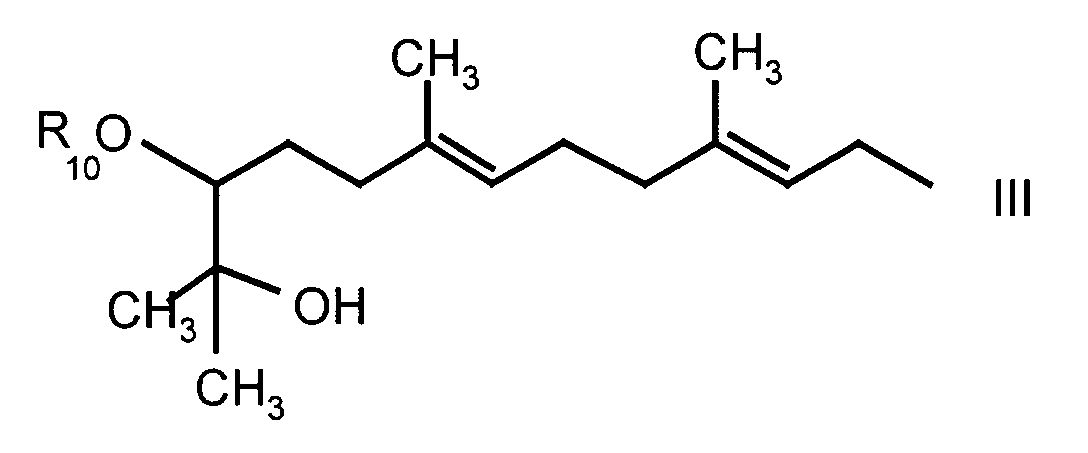
wenn R6 ein Rest der Formel II ist, bedeutet R5 eine Bindung an das Kohlenstoff-Atom C9 der Formel II und R7 H, oder R7 eine Bindung an das Kohlenstoff-Atom C9 der Formel II und R5 H, und
wenn R6 ein Rest der Formel III ist, bedeuten R5 und R7 H; - A
- eine oder mehrere Aminosäuren, wobei der Stickstoff im Iso-indolring mit dem N-terminalen Aminstickstoff der Aminosäure(n) identisch ist und
- n
- die Anzahl der Aminosäure(n) von 1 bis 12;
mit der Maßgabe daß A eine Aminosäure außer Glu ist, wenn n 1, R1 und R2 zusammen =O, R3 und R4 zusammen H2, R6 einen Rest der Formel II, R5 eine Bindung an das Kohlenstoff-Atom C9 des Restes der Formel II, R7 H, R8 H und R9 H bedeuten.
In der Formel I steht (A)n vorzugsweise für eine oder mehrere natürliche
Aminosäuren ausgewält aus: Gly, Ala, Val, Leu, Ile, Pro, Ser, Thr, Phe, Tyr, Trp,
Lys, Arg, Asp, His, Glu, Asn, Gln, Cys und Met. Besonders bevorzugt steht (A)n für
eine Peptidkette mit am mindestens 2, insbesondere 10, Aminosäuren.
C1-C4-Alkyl bedeutet ein geradkettiges oder verzweigtes Alkyl mit 1 bis 4 C-Atomen,
wie z.B. Methyl, Ethyl, i-Propyl und tert. Butyl.
Der Zucker kann einen Aldohexose bedeuten, wie z.B. Mannose.
Die vorliegende Erfindung betrifft weiterhin alle offensichtlichen Abkömmlinge der
Verbindungen der Formel I . Abkömmlinge sind Salze, Reduktionsprodukte, Ester,
Ether, Acetale sowie Amide und N-alkylierungsprodukte, darüber hinaus alle
optische Antipoden, Diastereomere und alle stereomere Formen.
Eine Verbindung der Formel 1 hat vorzugsweise der allgemeinen Formel IV
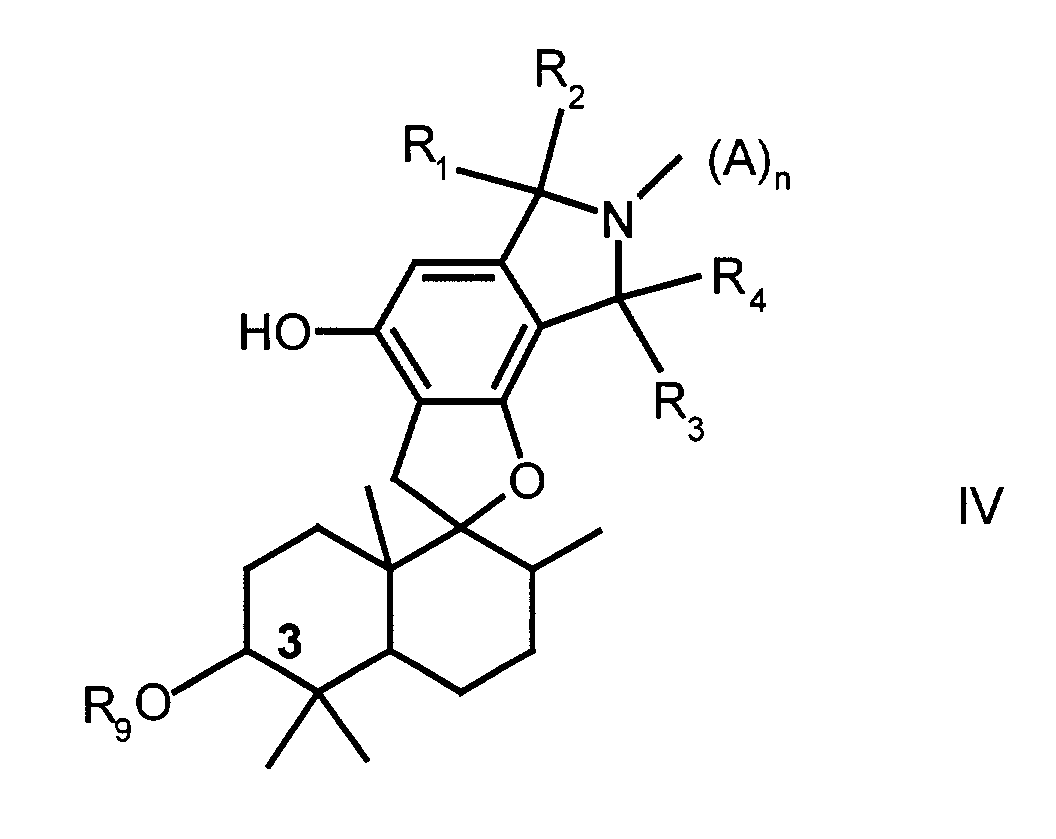 wobei die Reste R1, R2, R3, R4, R9 und (A)n die Bedeutung wie oben angegebene
haben.
wobei die Reste R1, R2, R3, R4, R9 und (A)n die Bedeutung wie oben angegebene
haben.
In der Formel IV bedeuten vorzugsweise R1 und R2 zusammen =O, R3 und R4
zusammen H2 und R9 H.
Eine bevorzugte Verbindung ist Memno-Peptid A, C76H108N16O18S, der
Formel IVa:

In dieser Formel ist das Dekalin-Gerüst mit den 4 Methyl- und einer Methylen-Gruppe
der Terpenteil, das substituierte Isoindol-Ringsystem der Ketid-Teil. Die
Aminosäure-Sequenz:
 ist ein Teil der Casein-Sequenz. Das Methionin (Met) kann zum Sulfoxid oxidiert
sein.
ist ein Teil der Casein-Sequenz. Das Methionin (Met) kann zum Sulfoxid oxidiert
sein.
Eine bevorzugte räumliche Form zeigt die Formel IVb:
 worin (A)n die Bedeutung wie oben angegeben hat.
Die physikalisch-chemischen sowie spektroskopischen Eigenschaften der
bevorzugte erfindungsgemäße Verbindung lassen sich wie folgt zusammenfassen:
Die Bezifferung der Kohlenstoffatome und die dazugehörigen NMR-chemischen
Verschiebungen sind entsprechend der Zählweise für cyclische Sesqui-Terpene
sortiert.
Figur1: Bezifferung eines cyclischen Sesquiterpen-Ketolids.

| NMR-Daten (chemische Verschiebungen) des Memno-Peptid A in DMSO - d6 bei 310° K. | |||||||
| δ-13C | m | δ-1H | m | nJ | nJ | assignment | |
| 1 | 15.42 | q | 0.668 | d | 1.802 | 1.802 | Terpen-8-Me |
| 2 | 15.72 | q | 0.978 | s | - | 2.035,1.763 | Terpen-10-Me |
| 3 | 20.37 | t | 1.409 | m | 2.035, 1.538 | 2.035 | Terpen-6 |
| 1.460 | 2.035, | ||||||
| 4 | 21.43 | q | 0.873 | d | 1.678 | 1.678, 1.428, 0.890 | Leu8-δ |
| 5 | 22.25 | q | 0.827 | s | 0.918 | 0.918, 2.035 | Terpen-4-Me |
| 6 | 22.64 | t | 2,182 | ddt | 4.892, 2.788 2.632 | 4.892, 2.788, 2.632 | Met1-β |
| 2.307 | ddt | ||||||
| 22.80 | t | 2.19 | ddt | 4.869, 2.757, 2.635 | 4.869, 2.757, 2.635 | ||
| 2.31 | ddt | ||||||
| 7 | 23.08 | q | 0.890 | d | 1.678 | 1.678, 1.428, 0.873 | Leu8-δ' |
| 8 | 23.88 br | d | 1.678 | m | 0.87, 0.88 | Leu8-γ | |
| 9 | 23.90 | t | 1.764 | m | 0.962, 1.416, 1.871 | 0.978, 1.416, 3.227 | Terpen-1 |
| 0.962 | m | ||||||
| 10 | 24.22 | t | 1.910 | m | 2.144, 4.588, 3.467 | 2.144, 1.771, 4.588, 3.467, 3.689 | Pro9-γ |
| 11 | 24.32 | t | 1.863 | m | 2.031, 1.798, 3.625 | 4.356, 3.625, 2.153, 1.792 | Pro4-γ |
| 12 | 24.37 | t | 1.927 | m | (2.153), (1.814), 3.624 | 4.388, 3.624, 1.814 | Pro7-γ |
| 13 | 24.43 | t | 1.926 | m | 2.144, 1.840, 3.655, 3.538 | 4.224, 3.655, 3.538 | Pro10-γ |
| 14 | 24.77 | t | 1.840 | m | 1.416, 1.740, 0.962 | - | Terpen-2 |
| 1.416 | m | 1.840, 0.926 | |||||
| 15 | 26.51 | t | 1.940 | m | 1.719, 4.484, 2.198 | 2.198 | Gln3-β |
| 1.719 | m | 1.719, 4.484, 2,198 | |||||
| 16 | 26.85 | t | 1.927 | m | 1.722, 4.468, 2.166 | 2.166 | Gln6-β |
| 1.722 | m | 1.927, 4.468, 2.166 | |||||
| 17 | 27.04 | t | 2.976 | dd | 4.598 | - | His5-β |
| br | 3.067 | dd | |||||
| 18 | 27.09 | t | 2.937 | dd | 4.570 | (4.570) | His2-β |
| 3.067 | dd | ||||||
| 19 | 27.50 | t | 2.144 | m | 1.771, 4.578, 1.905, 1.945 | 1.945, 3.689, 3.467, 4.578 | Pro9-β |
| 1.771 | m | 2.144, 4.578, 1.905, 1.945 | |||||
| 20 | 28.34 | t | 2.144 | m | 1.840, 4.223, 1.926 | 4.223, 3.669, 3.533 | Pro10-β |
| 1.840 | m | 2.144, 4.223, 1.926 | |||||
| 21 | 28.50 | q | 0.918 | s | 0.827 | 0.827 | Terpen-4-Me |
| 22 | 28.86 | t | 1.798 | m | 4.356, 2.031, (1.863) | Pro4-β | |
| 2.031 | m | ||||||
| 23 | 28.89 | t | 1.814 | m | 2.012, 4.388, (1.927) 1.814, 4.388, (1.927) | 4.388, 3.646 | Pro7-β |
| 2.012 | m | ||||||
| 24 | 30.63 | t | 1.538 | m | 1.430, 1.460, (1.409), | 0.667 | Terpen-7 |
| m | (1.802) | ||||||
| 1.430 | 1.538, 1.460, 1.802 | ||||||
| 25 | 30.64 | t | 2.166 | t | 1.927, 1.722 | 1.927, 1.722, 4.466, 6.807 | Gln6-γ |
| 26 | 30.65 | t | 2.192 | t | 1.940, 1.719 | 1.940, 1.719, 4.489, 6.789 | Gln3-γ |
| 27 | 31.62 | t | 3.154 | d | 2.792 | 6.598 | Terpen-11 |
| 2.792 | d | 3.154 | |||||
| 28 | 36.43 | d | 1.802 | ddq | 1.538, 1.430, 0.667 | 0.667, 2.790, 3.156 | Terpen-8 |
| 29 | 37.22 | s | - | - | - | 0.903, 0.824 | Terpen-4 |
| 30 | 37.73 | q | 2.548 | s | - | 2.682, 2.758 | Met1-ε |
| 37.84 | 2.546 | 2.633, 2.783 | |||||
| 31 | 39.45 | d | 2.035 | dd | 1.409, 1.460 | 0.903, 0.824, 0.971 | Terpen-5 |
| 32 | 40.07 40.03 | t | 1.428 | dt | 4.536, 1.678 | 0.890, 0.873, 4.536 | Leu8-β |
| 33 | 41.71 | s | - | - | - | 3.156, 2.790, 0.977, (1.764), 2.035 | Terpen-10 |
| 34 | 44.25 | t | 4.332 | - | - | 4.881 | Terpen-8' |
| 35 | 46.10 | t | 3.669 3.533 | 1.934 | 4.223, 2.147, 1.934, 1.851 | Pro10-δ | |
| 36 | 46.53 | t | 3.689 3.467 | m m | 1.905,1.936 | 4.588, 2.165, 1.781, 1.936 | Pro9-δ |
| 37 | 46.81 | t | 3.624 | m | 1.927 | 1.814, 4.388 | Pro7-δ |
| 38 | 46.87 | t | 3.644 | m | 1.863 | - | Pro4-δ |
| 39 | 48.56 | d | 4.534 | dt | 7.918,1.428 | 7.918, 1.428, 1.678 | Leu8-α |
| 40 | 49.44 | t | 2.682, | ddt | 2.758, 2.162, 2.289 | 4.892, 2.550 | Met1-γ |
| 2.758 | ddt | 2.682, 2.162, 2.289 2.783, 2.289, 2.162 2.633, 2.289, 2.162 | |||||
| 49.70 | t | 2.633, | ddt | 4.869, 2.545 | |||
| 2.783 | ddt | ||||||
| 41 | 50.18 | d | 4.466 | dt | 8.110, 1.927, 1.722 | 2.166 | Gln6-α |
| 42 | 50.31 | d | 4.484 | dt | 8.206, 1.935, 1.707 | 2.182 | Gln3-α |
| 43 | 51.37 | d | 4.570 | ddd | 8.135, 2.975, 3.082 | 2.975, 3.082 | His5-α |
| 44 | 51.68 | d | 4.590 | ddd | 8.496, 2.934, 3.067 | 2.934, 3.067 | His2-α |
| 4.585 | 8.506, 2.934, 3.067 | ||||||
| 45 | 53.30 | d | 4.892 | 2.162, 2.284 | 2.162 | Met1-α | |
| 53.62 | 4.869 | 2.162, 2.284 | |||||
| 46 | 57.33 | d | 4.588 | dd | 2.144, 1.771 | 2.144, 1.771, 1.905, 1.945, 3.684 | Pro9-α |
| 47 | 58.31 | d | 4.223 | dd | 2.144, 1.840 | 3.669, 3.553, 1.926, 2.144, (1.840) | Pro10-α |
| 48 | 59.20 | d | 4.388 | dd | 2.012, 1.814 | 2.012 | Pro7-α |
| 49 | 59.44 | d | 4.356 | dd | 2.031, 1.798 | 3.635,1.880 | Pro4-α |
| 50 | 73.50 | d | 3.227 | dd | 1.840, 1.416 | 0.903, 0.824 | Terpen-3 |
| 73.51 | |||||||
| 51 | 97.93 97.91 | s | - | - | - | 3.154, 2.792, 0.972, 0.668 | Terpen-9 |
| 52 | 100.90 | d | 6.598 | s | - | - | Terpen-3' |
| 100.88 | 6.596 | ||||||
| 53 | 112.62 112.55 | s | - | - | - | 6.593, 4.330 | Terpen-5' |
| 54 | 116.92 116.90 | s | - | - | - | 3.154, 2.792, 6.597 | Terpen-1' |
| 55 | 116.95 | d | 7.230 | s | 8.655 | (3.067), 2.937, 8.665 | His2-ε |
| 56 | 117.26 | d | 7.322 | s | 8.771 | 3.092, 3.000, 8.771 | His5-ε |
| 57 | 129.32 | s | - | - | - | 8.783, 7.322, 3.083 2.976, 4.585 | His5-γ |
| 58 | 129.63 | s | - | - | - | 7.230, 3.064, 2.937, 4.592 | His2-γ |
| 59 | 133.00 132.98 | s | - | - | - | 4.330 | 1-4' |
| 60 | 133.63 | d | 8.655 | s | 7.230 | 7.230 | His2-δ |
| 61 | 133.68 | d | 8.771 | s | 7.320 | 7.320 | His5-δ |
| 62 | 153.60 153.62 | s | - | - | - | 6.597, 3.157, 2.792 | Terpen-2' |
| 63 | 155.73 | s | - | - | - | (6.597), 3.154, 2.792, 4.330 | Terpen-6' |
| 64 | 168.11 168.07 | s | - | - | - | 6.597, 4.330, 4.881 | Terpen-7' |
| 65 | 169.57 | s | - | - | - | 4.588, (4.223) | Pro9-CO |
| 66 | 169.59 | s | - | - | - | 8.110, (4.570) | His5-CO |
| 67 | 169.69 | s | - | - | - | 4.534, 1.444 | Leu8-CO |
| 68 | 169.74 | s | - | - | - | 8.207, 2.937, 4.585 | His2-CO |
| 69 | 169.97 | s | - | - | - | 8.513, 4.869, 2.190 | Met1-CO |
| 169.89 | 8.499, 4.892, 2.182 | ||||||
| 70 | 170.07 | s | - | - | - | 4.471, 1.733, 1.924, 4.356 | Gln3-CO |
| 71 | 170.21 | s | - | - | - | 4.466, 1.722, 1.927, 4.388 | Gln6-CO |
| 72 | 170.99 | s | - | - | - | 4.538, 4.388, 2.012, 1.844, 7.918 | Pro7-CO |
| 73 | 171.32 | s | - | - | - | 8.138, 4.356, 2.003, 1.805, 4.570 | Pro4-CO |
| 74 | 173.10 | s | - | - | - | 4.225, 2.144, 1.840 | Pro10-CO |
| 75 | 173.80 173.81 | s | - | - | - | 2.19, 1.93, 1.73 | 3-Gln-δ-CO |
| 76 | 173.88 | s | - | - | - | 7.26, 2.19, 1.93, 1.73 | 4-Gln-δ-CO |
| 173.86 | |||||||
| OH | 9.75 | br | NOE : 6.598 | Terpen-2'-OH | |||
| NH | 8.506 | d | 4.585 | NOE: 4.869 /4.692 | His2-NH | ||
| 8.496 | d | 4.590 | |||||
| NH | 8.206 | d | 4.484 | NOE : 3.072, 2.948, 4.588 | Gln3-NH | ||
| NH | 8.135 | d | 4.563 | His5-NH | |||
| NH | 8.110 | d | 4.470 | NOE : 4.570, (4.470), 1.727, (1.927) | Gln6-NH | ||
| NH | 7.918 | d | 4.534 | NOE : 4.388, 1.827, 1.688, 1.427 | Leu8-NH | ||
| NH2 | 7.260 | s | (6.807) | Gln6-NH2 | |||
| 6.807 | s | (7.260) | |||||
| NH2 | 7.230 | s | (6.789) | Gln3-NH2 | |||
| 6.789 | s | (7.230) |
Erfindungsgemäß sind die Verbindungen der Formel I erhältlich durch Fermentation
des Memnoniella echinata FH 2272, DSM 13195, oder eines seiner Varianten oder
Mutanten unter geeigneten Bedingungen in einem Kulturmedium, bis sich ein oder
mehrere Memno-Peptide der Formel I im Kulturmedium anhäufen, und
anschließende Isolierung der Memno-Peptide.
Die Erfindung betrifft daher weiterhin ein Verfahren zur Herstellung einer Verbindung
der Formel I, dadurch gekennzeichnet, daß der Mikroorganismus Memnoniella
echinata FH 2272, DSM 13195, oder einer seiner Varianten oder Mutanten unter
geeigneten Bedingungen in einem Kulturmedium fermentiert wird, bis sich ein oder
mehrere Memno-Peptide der Formel I im Kulturmedium anhäufen und anschließend
aus dem Kulturmedium isoliert werden.
Vorzugsweise wird der Stamm FH 2272, DSM 13195, seine Mutanten und/oder
Varianten in einer Nährlösung (auch als Kulturmedium bezeichnet) mit Kohlenstoff
und Stickstoffquelle sowie den üblichen anorganischen Salzen fermentiert, bis sich
Memno-Peptide in dem Kulturmedium anhäufen. Anschließend werden die Memno-Peptide
aus dem Kulturmedium isoliert und gegebenenfalls in die einzelnen aktiven
Komponenten aufgetrennt und aufgereinigt.
Als Stickstoffquelle für die Fermentation werden vorzugsweise Aminosäuren und
Peptide (A)n, wie oben definiert, verwendet.
Das erfindungsgemäße Verfahren kann für die Fermentation im Labormaßstab
(Milliliter- bis Literbereich) und für den industriellen Maßstab (Kubikmetermaßstab)
eingesetzt werden.
Eine stark produzierende Kolonie von Memnoniella echinata FH 2272, wurde
vermehrt. Ein Isolat wurde bei der Deutschen Sammlung von Mikroorganismen und
Zellkulturen GmbH, Mascheroder Weg 1B, 3300 Braunschweig, Deutschland, nach
den Regeln des Budapester Vertrages am 14. Dezember 1999 unter der folgenden
Nummer hinterlegt: Memnoniella echinata FH 2272, DSM 13195.
Memnoniella echinata FH 2272, DSM 13195, besitzt ein braungrünes Mycel und ist
durch die für die Gattung Memnoniella characteristischen Conidiophoren
gekennzeichnet.
Anstelle des Stammes Memnoniella echinata FH 2272, DSM 13195, können auch
dessen Mutanten und Varianten eingesetzt werden, die ein oder mehrere
Verbindungen der erfindungsgemäßen Memno-Peptide synthetisieren. Solche
Mutanten können in an sich bekannter Weise durch physikalische Mittel,
beispielsweise Bestrahlung, wie mit Ultraviolet- oder Röntgenstrahlen, oder
chemische Mutagene, wie beispielsweise Ethylmethansulfonat (EMS), 2-Hydroxy-4-methoxy-benzophenon
(MOB) oder N-Methyl-N'-nitro-N-nitrosoguanidin (MNNG)
erzeugt werden. Als Varianten kommen die nahe verwandte Pilz- Spezies
Stachybotrys, wie Stachybotrys atra, Stachybotrys chartarum oder Stachybotrys
complementi beispielsweise in Betracht.
Das Screening nach Mutanten und Varianten, die ein oder mehrere Verbindungen
der erfindungsgemäßen Memno-Peptide synthetisieren, erfolgt nach folgendem
Schema:
- Abtrennung des Mycels nach der Fermentation;
- Extraktion der Mycels mit einem organische Lösungsmittel;
- Extraktion der Memno-Peptide aus dem Kulturfiltrat mit Festphasen
- Analytik mittels HPLC, DC oder durch testen der biologischen Wirksamkeit.
Die im folgenden beschriebenen Fermentationsbedingungen gelten für Memnoniella
echinata FH 2272, das hinterlegte Isolat DSM 13195 sowie Mutanten und Varianten
von diesen.
In einer Nährlösung, die eine Kohlenstoffquelle und als Stickstoffquelle
Caseinpepton sowie die üblichen anorganischen Salze enthält, produziert
Memnoniella echinata FH 2272, vorzugsweise DSM 13195, bevorzugt das
Memno-Peptid A.
Als bevorzugte Kohlenstoffquellen für die aerobe Fermentation eignen sich
assimilierbare Kohlenhydrate und Zuckeralkohole, wie Glukose, Laktose,
Saccharose oder D-Mannit sowie kohlenhydrathaltige Naturprodukte, wie z.B.
Malzextrakt. Als stickstoffhaltige Nährstoffe kommen in Betracht: Aminosäuren,
Peptide und Proteine sowie deren Abbauprodukte, wie Casein, Peptone oder
Tryptone, ferner Fleischextrakte, Hefeextrakte, gemahlene Samen, beispielsweise
von Mais, Weizen, Bohnen, Soja oder der Baumwollpflanze, Destillationsrückstände
der Alkoholherstellung, Fleischmehle oder Hefeextrakte, aber auch Ammoniumsalze
und Nitrate, insbesondere aber auch synthetisch bzw. biosynthetisch gewonnene
Peptide. An anorganischen Salzen kann die Nährlösung beispielsweise Chloride,
Carbonate, Sulfate oder Phosphate der Alkali- oder Erdalkalimetalle, Eisen, Zink,
Kobalt und Mangan enthalten.
Die Bildung der erfindungsgemäßen Memno-Peptide verläuft besonders gut in einer
Nährlösung, die etwa 0,05 bis 5 %, bevorzugt 0,1 bis 1 % Caseinpepton und 0,2 bis
5 %, bevorzugt 0,5 bis 3 % Glucose, 0,05 bis 1 %, bevorzugt 0,1 bis 0,5 %
Cornsteep und Spuren von Kaliumchlorid, Magnesiumsulfat und Eisensulfat
enthalten. Die Angaben in Prozent sind jeweils bezogen auf das Gewicht der
gesamten Nährlösung.
In dieser Nährlösung bildet Memnoniella echinata, vorzugsweise Memnoniella
echinata FH 2272, DSM 13195, ein Gemisch aus Memno-Peptiden. Je nach
Zusammensetzung der Nährlösung kann der mengenmäßige Anteil eines oder
mehrerer der erfindungs-gemäßen Memno-Peptide variieren. Außerdem kann durch
die Medienzusammensetzung die Synthese einzelner Memno-Peptide gesteuert
werden, so daß ein Memno-Peptid gar nicht bzw. in einer Menge unterhalb der
Nachweisgrenze vom Mikroorganismus hergestellt wird.
Die Kultivierung des Mikroorganismus erfolgt aerob, also beispielsweise submers
unter Schütteln oder Rühren in Schüttelkolben oder Fermentern, gegebenenfalls
unter Einführen von Luft oder Sauerstoff. Sie kann in einem Temperaturbereich von
etwa 18 bis 37°C, vorzugsweise bei etwa 20 bis 32°C, insbesondere bei 25 bis 30°C
durchgeführt werden. Der pH-Bereich sollte zwischen 6 und 8 liegen, vorzugsweise
zwischen 6,5 und 7,5. Man kultiviert den Mikroorganismus unter diesen Bedingungen
im allgemeinen über einen Zeitraum von 24 bis 300 Stunden, vorzugsweise 36
bis 140 Stunden.
Vorteilhaft kultiviert man in mehreren Stufen, d. h. man stellt zunächst eine oder
mehrere Vorkulturen in einem flüssigen Nährmedium her, die dann in das eigentliche
Produktionsmedium, die Hauptkultur, beispielsweise im Volumenverhältnis
1:10, überimpft werden. Die Vorkultur erhält man, z.B., indem man ein Mycel in eine
Nährlösung überimpft und etwa 36 bis 120 Stunden, bevorzugt 48 bis 72 Stunden,
wachsen läßt. Das Mycel kann beispielsweise erhalten werden, indem man den
Stamm etwa 3 bis 40 Tage, bevorzugt 4 bis 10 Tage, auf einem festen oder
flüssigen Nährboden, beispielsweise Malz-Hefe-Agar oder Potatodextrose-Agar
(Standardmedium für Schimmelpilze z.B. von Fa. Difco) wachsen läßt.
Der Fermentationsverlauf kann anhand des pH-Wertes der Kulturen oder des
Mycelvolumens sowie durch chromatographische Methoden, wie z.B.
Dünnschichtchromatographie oder High Pressure Liquid Chromatography oder
Ausprüfen der biologischen Aktivität überwacht werden. Eine erfindungsgemäßen
Verbindungen ist sowohl im Mycel als auch im Kulturfiltrat enthalten, der größte Teil
befindet sich jedoch im Kulturfiltrat.
Das im folgenden beschriebene Isolierungsverfahren dient zur Aufreinigung der
erfindungsgemäßen Memno-Peptide, bevorzugt jedoch für das Memno-Peptid A.
Die Isolierung bzw. Aufreinigung eines erfindungsgemäßen Memno-Peptids aus
dem Kulturmedium erfolgt nach bekannten Methoden unter Berücksichtigung der
chemischen, physikalischen und biologischen Eigenschaften der Naturstoffe. Zum
Testen der Memno-Peptid - Konzentrationen im Kulturmedium oder in den einzelnen
Isolierungsstufen kann die Dünnschichtchromatographie, beispielsweise an
Kieselgel mit lsopropanol/25%igem NH3 als Laufmittel oder HPLC verwendet
werden. Die Detektion bei der dünnschicht-chromatographischen Auftrennung kann
beispielsweise durch Färbereagentien wie Chlorsulfonsäure/Eisessig erfolgen,
wobei die Menge der gebildeten Substanz zweckmäßig mit einer Eichlösung
verglichen wird.
Zur Isolierung eines erfindungsgemäßen Memno-Peptide wird das Mycel zunächst
von der Kulturbrühe nach den üblichen Verfahren abgetrennt und anschließend
werden die Memno-Peptide von der Zellmasse mit einem gegebenenfalls mit
Wasser mischbaren organischen Lösungsmittel extrahiert. Die organische
Lösungsmittelphase enthält die erfindungsgemäßen Naturstoffe, sie wird gegebenenfalls
im Vakuum konzentriert und wie unten beschrieben weiter aufgereinigt.
Das Kulturfiltrat wird gegebenenfalls mit dem Konzentrat des Mycel-Extraktes
vereinigt und mit einem geeigneten, mit Wasser nicht mischbarem organischen
Lösungsmittel, zum Beispiel mit n-Butanol, extrahiert. Die anschließend abgetrennte
organische Phase wird ggf. im Vakuum konzentriert. Man kann das Konzentrat zum
entfetten des Wertproduktes mit einem unpolaren Lösungsmittel, in dem die
erfindungsgemäßen Verbindungen wenig löslich sind, wie zum Beispiel mit Hexan,
Petroleum-ether, Diethylether verdünnen. Hierbei präzipitieren die Memno-Peptide,
die lipophilen Verunreinigungen bleiben gelöst und werden durch übliche
Fest/flüssig-Phasentrennungen entfernt.
Der Niederschlag, der die gesamten Memno-Peptide enthält, wird in 1/30 des
ursprünglichen Volumens Wasser/Methanol gelöst. Der Niederschlag geht dabei
vollständig in Lösung und wird lyophilisiert. Das Lyophilisat, in der Folge als
Rohprodukt bezeichnet, enthält 5 bis 50 % Memno-Peptide und wird für die weitere
Isolierung eingesetzt.
Die weitere Aufreinigung eines oder mehrerer erfindungsgemäßen Memno-Peptide
erfolgt durch Chromatographie an geeigneten Materialien, vorzugsweise z.B. an
Molekularsieben, an Kieselgel, Aluminiumoxid, an lonenaustauschern oder an
Adsorberharzen bzw. an Umkehr-Phasen (reversed phase, RP). Mit Hilfe dieser
Chromatographie werden die Memno-Peptide getrennt. Die Chromatographie der
Memno-Peptide erfolgt mit gepufferten wässrigen Lösungen oder Gemischen von
wässrigen und organischen Lösungen.
Unter Gemischen von wässrigen oder organischen Lösungen versteht man alle mit
Wasser mischbaren organischen Lösemittel, vorzugsweise Methanol, Propanol und
Acetonitril, in einer Konzentration von 5 bis 80 % Lösemittel, vorzugsweise 20 bis 50
% Lösemittel oder auch alle gepufferten wässrigen Lösungen, die mit organi-schen
Lösemitteln mischbar sind. Die zu verwendeten Puffer sind die gleichen wie oben
angegeben.
Die Trennung der Memno-Peptide aufgrund ihrer unterschiedlichen Polarität erfolgt
mit Hilfe der Reversed Phase Chromatographie, beispielsweise an MCI®
(Adsorberharz von Mitsubishi, Japan) oder Amberlite XAD® (TOSOHAAS), an
weiteren hydrophoben Materialien, wie zum Beispiel an RP-8- oder RP-18-Phasen.
Außerdem kann die Trennung mit Hilfe der Normalphasen-Chromatographie, zum
Beispiel an Kieselgel, Aluminiumoxyd und ähnlichen erfolgen.
Die Chromatographie der Memno-Peptide erfolgt mit gepufferten oder angesäuerten
wäßrigen Lösungen oder Gemischen von wäßrigen Lösungen mit Alkoholen oder
anderen, mit Wasser mischbaren organischen Lösemitteln. Als organisches Lösemittel
wird vorzugsweise Propanol und Acetonitril verwendet.
Unter gepufferten oder angesäuerten wäßrigen Lösungen versteht man z.B.
Wasser, Phosphatpuffer, Ammoniumacetat, Citratpuffer in einer Konzentration von 0
bis 0,5 M sowie Ameisensäure, Essigsäure, Trifluoressigsäure oder allen
handelsüblichen, dem Fachmann bekannten Säuren, vorzugsweise in einer
Konzentration von 0 bis 1 %. Besonders bevorzugt wird 0,1 %.
Chromatographiert wird mit einem Gradienten, der mit 100 % Wasser beginnt und
mit 100 % Lösemittel endet, vorzugsweise wird ein linearer Gradient von 20 bis 50
% Propanol oder Acetonitril gefahren.
Alternativ kann auch eine Gelchromatographie oder die Chromatographie an
hydrophoben Phasen erfolgen.
Die Gelchromatographie wird an Polyacrylamid- oder Mischpolymergelen
durchgeführt, wie z.B. Biogel-P 2® (Fa. Biorad) oder Fractogel TSK HW 40® (Fa.
Merck, Deutschland oder Toso Haas, USA).
Eine weiteres, sehr wirksames Verfahren zur Reinigung der erfindungsgemäßen
Verbindungen ist die Anwendung von lonenaustauschern. Zum Beispiel kann das
basische Memno-Peptid A an Kationenaustauschern , wie Fractogel® EMD SO3,
sehr vorteihaft isoliert werden. Verwendung finden können Pufferlösungen zwischen
pH 5 und 8, vorzugsweise zwischen pH 6 bis 7,5. Die Elution kann z. B. mit einem
ansteigenden Salzgradienten erreicht werden. Es kann auch vorteilhaft sein als
Lösemittel neben Wasser auch Mischungen von wässrigen Pufferlösungen mit
einem organischen Lösungsmittel zu verwenden. Der Anteil des organischen
Lösungsmittels liegt zwischen 10% und 90%, vorzugsweise zwischen 30 und 60 %.
Die Reihenfolge der vorgenannten Chromatographien ist umkehrbar.
Ein weiterer, sehr wirksamer Reinigungsschritt für Memno-Peptide ist die
Kristallisation. Die Memno-Peptide kristallisieren aus Lösungen in organischen
Lösungsmitteln und aus Mischungen von Wasser mit organischen Lösungsmitteln
aus. Die Kristallisation wird in an sich bekannter Weise, zum Beispiel durch
Konzentrieren oder Abkühlen gesättigter Memno-Peptid-Lösungen, durchgeführt.
Die erfindungsgemäßen Memno-Peptide sind im festen Zustand und in Lösungen im
pH-Bereich zwischen 3 und 8, insbesondere 5 und 7, stabil und lassen sich damit in
übliche galenische Zubereitungen einarbeiten.
Die Bildung der stickstoffhaltigen Memno-Peptide kann begünstigt werden, indem
man der Memnonielle echinata ― Kultur die gewünschten Aminosäuren oder Peptide
als Vorprodukt hinzufügt. Es ist die Eigenart der Memnonielle echinata ― Spezies,
daß sie die Aminogruppen der angebotenen Aminosäuren und Peptiden unter
Synthese eines Fünfring-Lactams, meistens eines Isoindol-Ringsystems, binden.
Diese Bindung geschieht entweder ausgehend von der Aldehyd-Vorstufe im
Rahmen einer Oxidation oder von dem Lacton-Oxidatons-Stufe in ringgeöffneter
Form oder der cyclische Lactonform. Diese Fähigkeit des Memnonielle echinata zur
Bindung von Aminen ist völlig überraschend beobachtet worden und kann zur
Gewinnung von geschützten, umgewandelten Amin-Derivaten, vorzugsweise von
Terpenderivaten von Aminosäuren sowie Peptiden benützt werden.
Eine oder mehrere Verbindungen der erfindungsgemäßen Memno-Peptide eignen
sich aufgrund ihrer wertvollen pharmakologischen Eigenschaften zur Anwendung in
der Human- oder Tiermedizin als Arzneimittel.
Die vorliegende Erfindung betrifft somit die Verwendung der Verbindung der Formel
I oder ein physiologisch verträgliches Salz desselben zur Herstellung eines
Kardiakums zur Behandlung oder Propylaxe von Herzinsuffizienz.
Der Wirkmechanismus der Memno-Peptide ist unbekannt, jedoch konnte ein
signifikanter Effekt nachgewiesen werden.
Zum Nachweis der Aktivatoren von SERCA2, die den Phosphorylierungs-Effekt von
PLB nachahmen, bedient man sich eines colorimetrischen Testes, der die Aktivität
der Ca2+-ATPase in Hundeherzmikrosomen in Gegenwart von Prüfsubstanzen
bestimmt. Der Test wird in 96-well Mikrotiterplatten durchgeführt: Gemessen wird die
enzymatische Freisetzung von anorganischem Phosphat aus ATP, das mit
Ammoniummolybdat einen blauen Farbstoffkomplex bildet, der bei 620 nm im
Spektralphotometer gemessen werden kann.
Der IC50 für das Memno-Peptid A ist 6.5 µM; es ist die Konzentration, die SERCA2
zu 50 % aktiviert.
Die Memno-Peptide haben darüber hinaus eine antimikrobielle Wirkung.
Die vorliegende Erfindung betrifft somit die Verwendung der Verbindung der Formel I oder ein physiologisch verträgliches Salz desselben zur Herstellung eines Arzneimittels zur Behandlung mikrobieller, insbesondere bakterieller, Infektionen.
Die vorliegende Erfindung betrifft somit die Verwendung der Verbindung der Formel I oder ein physiologisch verträgliches Salz desselben zur Herstellung eines Arzneimittels zur Behandlung mikrobieller, insbesondere bakterieller, Infektionen.
Vom antimikrobiellen Spektrum zeigt die Tabelle 3 einige minimalen
Hemmkonzentrationen (MHK) des Memno-peptids A gegen einige ausgewählte
Bakterien.
| Stamm | Resistenz gegen: | MHK [µg/ml] |
| Staphylococcus aureus SG 511 | - | 16 |
| Staphylococcus aureus 285 | Penicillin | 16 |
| Staphylococcus aureus 503 | Penicillin | 16 |
| Staphylococcus aureus FH 1982 | Methicillin | 16 |
| Staphylococcus aureus 701E | Methicillin | 16 |
| Staphylococcus aureus 707E | Methicillin | 16 |
| Staphylococcus aureus 9 Tüb | Ofloxacin | 16 |
| Staph. epidermidis ZH 2c | - | 16 |
| Staph. epidermidis 763 | Methicillin | > 16 |
| Staph. epidermidis 5747IIW | Methicillin | 32 |
| Staph. epidermidis 291 | Ofloxacin | 8 |
| Staph. epidermidis 799 | Ofloxacin | 8 |
| Enterococcus faecium Md8B | - | 8 |
| Enterococcus faecium VR1 | Vancomycin | > 64 |
| Enterococcus faecium VR2 | Vancomycin | > 64 |
| Streptococcus pyogenes VR3 | Vancomycin | > 64 |
| Streptococcus pyogenes 308A | - | 8 |
| Streptococcus pyogenes 77A | - | 4 |
Neben der antibakteriellen Wirkung besitzen die erfindungsgemäßen Verbindungen
schwache antimykotische, d. h. pilzhemmende Eigenschaften, zum Beispiel gegen
Candida albicans.
Darüber hinaus besitzen die erfindungsgemäßen Substanzen eine gewisse günstige
Hemmwirkung auf die Glucose-6-Phosphat - Translocase (G-6-P ― TL), einem
Enzym der für den Glucose-Stoffwechsel und damit für die Behandlung des
Diabetes mellitus von Bedeutung ist. Insbesondere die Verbindung Memno-Peptid
A zeigt selektive Aktivitäten gegen die G-6-P ― TL, sie hemmt aber nicht das
Coenzym G-6-P ― Phosphatase.
Die vorliegende Erfindung betrifft somit die Verwendung der Verbindung der Formel
I oder ein physiologisch verträgliches Salz desselben zur Herstellung eines
Arzneimittels zur Therapie der Diabetes mellitus.
Die Erfindung betrifft auch pharmazeutische Zubereitungen einer oder mehrerer
Verbindungen der erfindungsgemäßen Memno-Peptide.
Ein oder mehrere Verbindungen der erfindungsgemäßen Memno-Peptide, bevorzugt
ein oder mehrere Verbindungen der Memno-Peptide, können grundsätzlich als
solche in Substanz verabreicht werden. Bevorzugt ist die Verwendung in Mischung
mit geeigneten Hilfsstoffen oder Trägermaterial. Als Trägermaterial können bei
Arzneimitteln die üblichen und pharmakologisch verträglichen Trägermaterialien
und/oder Hilfsstoffe verwendet werden.
Die erfindungsgemäßen Arzneimittel werden im allgemeinen oral oder parenteral
verabreicht, aber auch eine rektale Anwendung ist prinzipiell möglich. Geeignete
feste oder flüssige galenische Zubereitungsformen sind beispielsweise Granulate,
Pulver, Tabletten, Dragees, (Mikro-)Kapseln, Zäpfchen, Sirupe, Emulsionen,
Suspensionen, Aerosole, Tropfen oder injizierbare Lösungen in Ampullenform sowie
Präparate mit protrahierter Wirkstoff-Freigabe, bei deren Herstellung üblicherweise
Trägerstoffe und Zusätze und/oder Hilfsmittel wie Spreng-, Binde-, Überzugs-,
Quellungs-, Gleit- oder Schmiermittel, Geschmacksstoffe, Süßungsmittel oder
Lösungsvermittler Verwendung finden. Als häufig verwendete Träger- oder
Hilfsstoffe seien z.B. Magnesiumcarbonat, Titandioxid, Laktose, Mannit und andere
Zucker, Talkum, Milcheiweiß, Gelatine, Stärke, Vitamine, Cellulose und ihre
Derivate, tierische oder pflanzliche Öle, Polyethylenglykole und Lösungsmittel, wie
etwa steriles Wasser, Alkohole, Glycerin und mehrwertige Alkohole genannt.
Gegebenenfalls können die Dosierungseinheiten für die orale Verabreichung
mikroverkapselt werden, um die Abgabe zu verzögern oder über einen längeren
Zeitraum auszudehnen, wie beispielsweise durch Überziehen oder Einbetten des
Wirkstoffs in Teilchenform in geeignete Polymere, Wachse oder dergleichen.
Vorzugsweise werden die pharmazeutischen Präparate in Dosierungseinheiten
hergestellt und verabreicht, wobei jede Einheit als aktiven Bestandteil eine
bestimmte Dosis einer oder mehrerer Verbindungen der erfindungsgemäßen
Memno-Peptide enthält. Bei festen Dosierungseinheiten wie Tabletten, Kapseln und
Suppositorien kann diese Dosis bis zu etwa 500 mg, bevorzugt jedoch etwa 0,1 bis
200 mg, und bei Injektionslösungen in Ampullenform bis zu etwa 200 mg,
vorzugsweise aber etwa 0,5 bis 100 mg, pro Tag betragen.
Die zu verabreichende Tagesdosis ist abhängig vom Körpergewicht, Alter,
Geschlecht und Zustand des Säugers. Unter Umständen können jedoch auch
höhere oder niedrigere Tagesdosen angebracht sein. Die Verabreichung der
Tagesdosis kann sowohl durch Einmalgabe in Form einer einzelnen
Dosierungseinheit oder aber in mehreren kleineren Dosierungseinheiten als auch
durch Mehrfachgabe unterteilter Dosen in bestimmten Intervallen erfolgen.
Die erfindungsgemäßen Arzneimittel werden dadurch hergestellt, daß man ein oder
mehrere Verbindungen der erfindungsgemäßen Memno-Peptide mit üblichen
Träger- sowie gegebenenfalls Zusatz- und/oder Hilfstoffe in die bzw. eine geeignete
Darreichungsform bringt.
In den sich anschließenden Beispielen wird die Erfindung weiter erläutert.
Prozentangaben beziehen sich auf das Gewicht. Mischungsverhältnisse bei
Flüssigkeiten beziehen sich auf das Volumen, wenn keine anderen Angaben
gemacht wurden.
100 ml Nährlösung (Malzextrakt 2,0%, Hefeextract 0,2 %, Glucose 1,0 % (NH4)2
HPO4 0,05 %, pH 6,0) in einem sterilen 300 ml Erlenmeyerkolben werden mit dem
Stamm Memnoniella echinata FH 2272, DSM 13195, beimpft und 7 Tage bei 25° C
und 140 UpM auf einer rotierenden Schüttelmaschine inkubiert. 1,5 ml dieser Kultur
werden anschließend mit 2,5 ml 80 %igem Glycerin verdünnt und bei -20°C
gelagert.
Ein steriler 300 ml Erlenmeyerkolben mit 100 ml der folgende Nährlösung 10 g/l
Glucose, 5 g/l Casein-Pepton, 1,7 g/l Cornsteep flüssig, und 7 ml
Spurenelementlösung (10 g/l KCI, 10 g/l MgSO4 × 7 H2O, 3,6 g/l FeSO4 x 7 H2O und
6 g/l MgSO4 H2O) wird mit einer auf einem Schrägröhrchen (gleiche Nährlösung,
jedoch mit 2 % Agar) gewachsenen Kultur oder mit 1 ml einer Glycerinkultur (s.
Beispiel 1) beimpft und auf einer Schüttelmaschine bei 180 UpM und 30 C inkubiert.
Die maximale Produktion einer oder mehrerer Verbindungen der
erfindungsgemäßen Memno-Peptide ist nach ca. 120 Stunden erreicht. Zum
Animpfen von 10 und 200 I Fermentern genügt eine 48 bis 96 Std. alte
Submerskultur (Animpfmenge ca. 10 %) aus der gleichen Nährlösung.
Ein 30 I Fermenter wird unter folgenden Bedingungen betrieben:
| Nährmedium | 10 g/l Glucose |
| 0,5 g/l Casein-Pepton | |
| 1,7 g/l Cornsteep flüssig | |
| 7 ml Spurenelementlösung | |
| pH 6,5 (vor der Sterilisation) | |
| Spurenelementlösung | KCI 10 g/l, MgSO4 x 7 H2O 10 g/l, FeSO4 x 7 H2O 3,6 g/l und MnSO4 x H2O 6 g/l |
| Inkubationszeit | 45 Stunden |
| Inkubationstemperatur | 28° C |
| Rührergeschwindigkeit | 300 UpM |
| Belüftung | 15 l Min-1 |
Durch wiederholte Zugabe von ethanolischer Polyollösung kann die Schaumbildung
unterdrückt werden. Das Produktionsmaximum wird nach ca. 35 bis 70 Stunden
erreicht.
Nach Beendigung der Fermentation von Memnoniella echinata FH 2272, DSM
13195, wird die Kulturbrühe der Fermenter, gewonnen nach Beispiel 3, (200 Liter)
unter Zusatz von ca. 2 % Filterhilfsmittel (z.B. Celite®) filtriert und die Zellmasse (22
Liter) mit 66 Liter Methanol extrahiert. Die Wertstoff-haltige, methanolische Lösung
wird durch Filtration vom Mycel befreit und im Vakuum konzentriert. Das Konzentrat
wird mit Wasser verdünnt und gemeinsam mit dem Kulturfiltrat (180 Liter) auf eine
vorbereitete, 17 Liter MCI GEL, CHP20P-Säule aufgetragen. Eluiert wird mit einem
Gradienten von Wasser nach 60% Propanol-2 in Wasser. Der Säulendurchfluß (25
Liter pro Stunde) wird fraktioniert aufgefangen (je 10 Liter) und die Memno-Peptide
enthantenden Fraktionen (von 25% bis 30 % Propanol-2) zusammengefaßt.
Konzentrieren im Vakuum ergeben 20 Liter einer braunen Lösung. In eine Säule
(125 mm x 500 mm) werden 6 Liter, mit Kalium-Phosphat-Puffer bei pH 7 äquilibrierter
Kationenaustauscher, Fractogel® EMD SO3 -, gefüllt. Nach Beladen des
lonenaustauschers mit 20 Liter des oben beschriebenen Konzentrates wird mit
einem Gradient von 10 mM Kalium-Phosphat-Puffer, pH 7, nach 1 M NaCI in 10 mM
Kalium-Phosphat-Puffer, pH 7 in Wasser/ Methanol (1:1) eluiert. Der Säulen-Durchbruch,
d. h. das nicht gebundene Material enthält die neutralen Memno-Peptide
(49 g). Der Säulen-Durchfluß beträgt 12 Liter pro Stunde, er wird während
der Gradienten-Elution 1 Liter-Portionen fraktioniert aufgefangen . Mit 0.75 M NaCI
(Fraktionen 31 und 32) gewinnt man das Memno-Peptid A. Die Fraktionen 31 und
32 werden zusammengefaßt und im Vakuum auf etwa 500 ml konzentriert.
8 g des nach Beispiel 4 gewonnenen Produktes werden auf eine 3,9 Liter fassende
mit Fractogel® TSK HW-40 s gefüllte Säule (Breite x Höhe = 10 cm x 50 cm)
aufgetragen. Das Laufmittel: Methanol-Wasser (1:1) wird mit einer Flußrate von 20
ml pro Minute über die Säule gepumpt und der Säulenausfluß fraktioniert (20 ml)
aufgefangen. Hauptsächlich in den Fraktionen 75 bis 85 befinden sich die Memno-Peptide
A. Sie werden zusammengefaßt und im Vakuum vom Methanol befreit. Sie
ergeben 0.9 g Wirkstoff-Gemisch.
Das unten beschriebene System erlaubt die Reinheitsprüfung sowie Trennung und
Quantifiziertung der Memnoterpene, zum Beispiel im Rohgemisch bzw. im
Kulturfiltraten.
| Laufmittel | 0,1 % Trifluoressigsäure in 32 % Acetonitril. |
| Säule | Nucleosil 100C18AB 250/4, Macherey-Nagel. |
| Fluß | 1,0 ml/Min |
| Detektion | Ultravioletlicht-Absoption bei 210 nm. |
Unter den angegebenen Bedingungen hat das Memno-Peptid A folgende
Retentionszeit
| Memno-Peptid A | 7,0 Minuten, |
500 ml Lösung des nach Beispiel 5 isolierten und angereicherten Memno-Peptids A
werden auf 500 ml Nucleosil® 100-7 C18AB - Säule aufgetragen und mit einem
Gradienten von 25 bis 50 % Acetonitrl in 0.05 % Trifluoressigsäure/Wasser
chromatographiert. Der Durchfluß des Elutionsmittels beträgt 50 ml pro Minute, die
Fraktionsgröße 50 ml. In den Fraktionen 71 bis 88 befindet sich das Memno-Peptid
A. Die wiederholte Reinigung der zusammengefaßten Fraktionen mit konstanter
Lösungsmittelkonzentration von 28 % Acetonitril in 0.05 % Trifluoressigsäure ergibt
> 95 % reines Memno-Peptid C nach Gefriertrocknung (100 mg).
10 µg Memno-Peptid A werden in konstant-siedender Salzsäure hydrolysiert und
auf einem Aminosäuren-Analysator untersucht. Es werden folgende übliche Aminosäuren
gefunden:
Ultraviolett Absorption: λmax bei 269 nm, 305 nm (Schulter).
| Glutaminsäure | 11 nMol |
| Prolin | 22 nMol |
| Histidin | 10 nMol |
| Leucin | 5,6 nMol |
| Methionin-oxid | 5,5 nMol |
Das hochauflösende FAB Massenspektrum zeigt ein intensives MH+ bei m/z
1565.7819 Da, in guter Übereinstimmung mit der berechneten Masse (für
C76H109N16O18S, mono-isotopisch) von 1565.7827 Da. Die MS/MS ― Fragmentierung
entspricht der Formel IVa.
Claims (16)
- Verbindung der allgemeinen Formel Iworin bedeuten
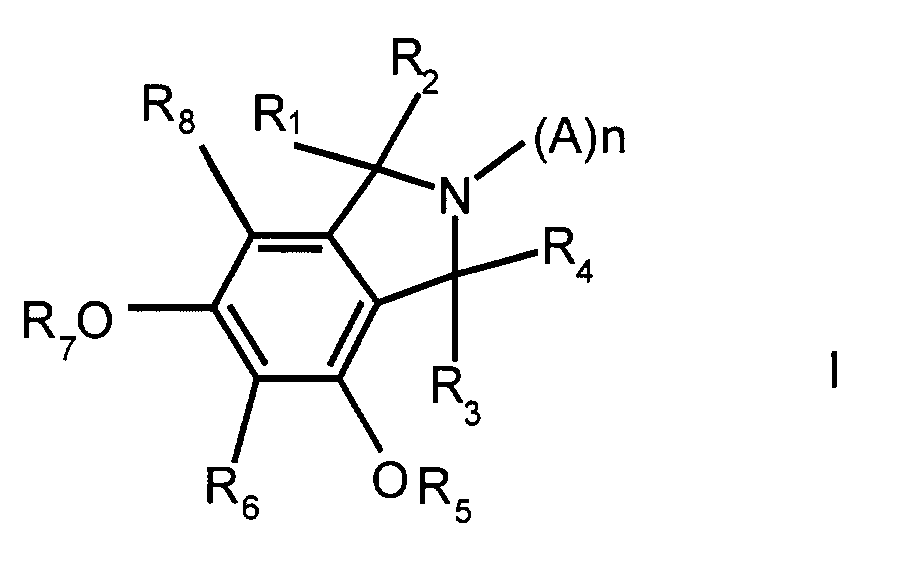
- R1 und R2
- zusammen = O, oder H2, oder H und OH oder H und O-C1-C4-Alkyl;
- R3 und R4
- zusammen = O, oder H2, oder H und OH oder H und O-C1-C4-Alkyl;
- R8
- H, OH, C1-C4-Alkyl oder O-C1-C4-Alkyl;
- R6
- einen Rest der Formel II
in der R9 für H oder einen Zucker, glycosidisch gebunden, steht, oder einen Rest der Formel III
 in der R10 für H oder einen Zucker, glycosidisch gebunden, steht, und worin,
wenn R6 ein Reste der Formel II ist, bedeutet R5 eine Bindung an das Kohlenstoff-Atom C9 der Formel II und R7 H oder R7 eine Bindung an das Kohlenstoff-Atom C9 der Formel II und R5 H; und wenn R6 ein Reste der Formel III ist, bedeuten R5 und R7 H; - A
- eine oder mehrere Aminosäuren, wobei der Stickstoff im Iso-indolring mit dem N-terminalen Aminstickstoff der Aminosäure(n) identisch ist und
- n
- die Anzahl der Aminosäure(n) von 1 bis 12;
mit der Maßgabe daß A eine Aminosäure außer Glu ist, wenn n 1, R1 und R2 zusammen =O, R3 und R4 zusammen H2, R6 ein Rest der Formel II, R5 eine Bindung an das Kohlenstoff-Atom C9 des Restes der Formel II, R7 H, R8 H und R9 H bedeuten. - Verbindung der Formel I oder ein physiologisch verträgliches Salz derselben gemäß Anspruch 1 der allgemeinen Formel IVwobei die Reste R1, R2, R3, R4, R9 und (A)n die Bedeutung wie oben angegeben haben.
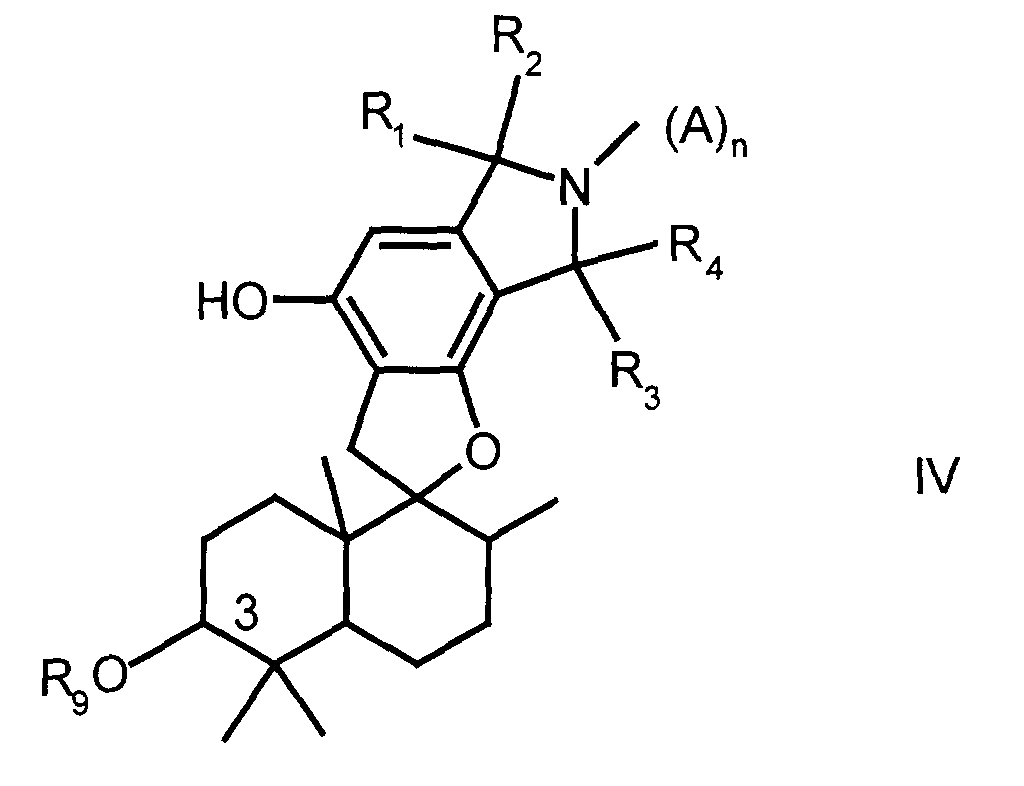
- Verbindung oder ein physiologisch verträgliches Salz derselben, gemäß Anspruch 2 worin R1 und R2 zusammen =O, R3 und R4 zusammen H2 und R9 H bedeuten.
- Verbindung oder ein physiologisch verträgliches Salz derselben, gemäß Anspruch 1 der Formel Vworin R1, R2, R3, R4, R5, R7, R8 und R10 die Bedeutung, wie oben angegeben, haben.
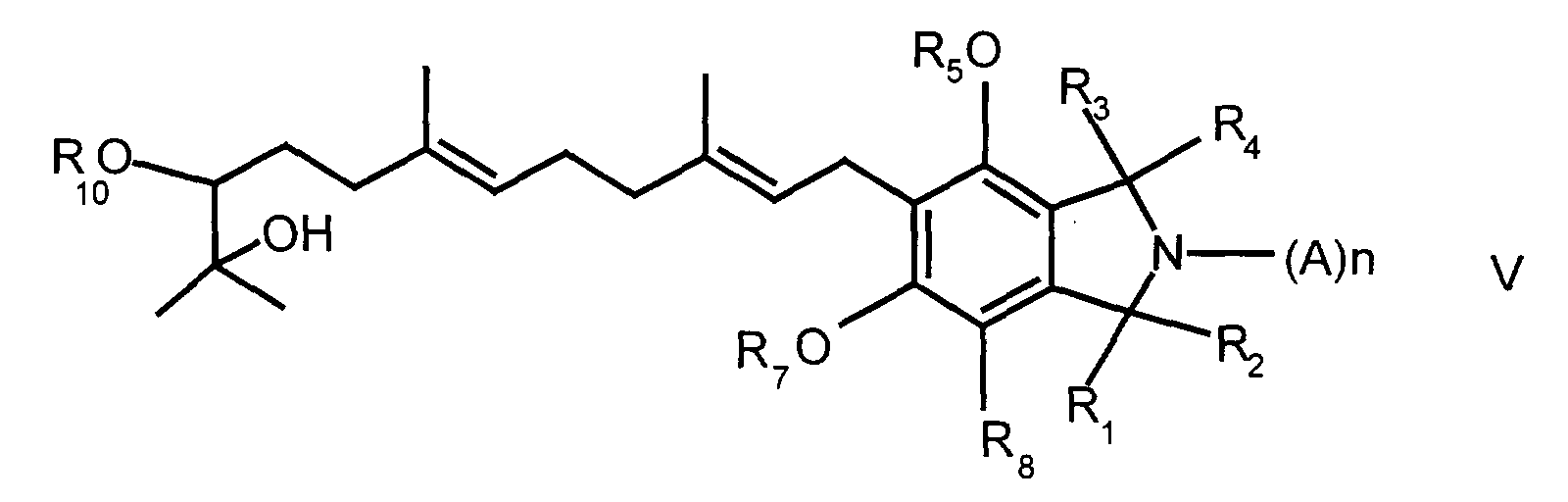
- Verbindung der Formel I oder ein physiologisch verträgliches Salz derselben, gemäß einem oder mehreren der Ansprüche 1 bis 4, worin (A)n für eine Peptidkette mit 2 bis 12 natürlichen Aminosäure-Resten steht.
- Verbindung der Formel I oder ein physiologisch verträgliches Salz derselben gemäß einem oder mehreren der Ansprüche 1 bis 5, worin (A)n für die Peptidkette: Met-His-Gln-Pro-His-Gln-Pro-lle-Pro-Pro (SEQ ID NO: 1) steht in der das Met zum Sulfoxid oxidiert sein kann.
- Verbindung der Formel I oder ein physiologisch verträgliches Salz derselben gemäß einem oder mehreren der Ansprüche 1 bis 6, worin R9 oder R10 eine Aldohexose bedeutet.
- Verbindung der Formel I gemäß einem oder mehreren der Ansprüche 1 bis 7 erhältlich durch Fermentation von Memnoniella echinata FH 2272, DSM 13195 , oder einer seiner Varianten oder Mutanten unter geeigneten Bedingungen in einem Kulturmedium, bis sich eine Verbindung der Formel I in dem Kulturmedium anhäuft, anschließende Isolierung der Verbindung und gegebenenfalls Umwandlung in chemische Derivate, sowie deren physiologisch verträglichen Salze.
- Verfahren zur Herstellung einer Verbindung der Formel I oder eines physiologisch verträglichen Salzes derselben gemäß einem oder mehreren der Ansprüche 1 bis 8, umfassend die Fermentation von Memnoniella echinata FH 2272, DSM 13195, oder einer seiner Varianten oder Mutanten unter geeigneten Bedingungen in einem Kulturmedium bis sich eine Verbindung der Formel I in dem Kulturmedium anhäuft und anschließende Isolierung der Verbindung und gegebenenfalls Umwandlung in chemische Derivate und/oder physiologisch verträglichen Salze.
- Verbindung der Formel I oder ein physiologisch verträgliches Salz derselben gemäß einem oder mehreren der Ansprüche 1 bis 8 zur Verwendung als Arzneimittel.
- Verwendung eine Verbindung der Formel I oder ein physiologisch verträgliches Salz derselben gemäß einem oder mehreren der Ansprüche 1 bis 8 zur Herstellung eines Arzneimittels zur Behandlung oder Propylaxe der Herzinsuffizienz.
- Verwendung eine Verbindung der Formel I oder ein physiologisch verträgliches Salz derselben gemäß einem oder mehreren der Ansprüche 1 bis 8 zur Behandlung von Krankheiten, bei denen die Herzinsuffizienz eine primäre oder sekundäre Ursache darstellt, und somit ihre Verwendung als Mittel gegen Herz- und Kreislaufschwächen.
- Verwendung eine Verbindung der Formel I oder ein physiologisch verträgliches Salz derselben gemäß einem oder mehreren der Ansprüche 1 bis 8 zur Herstellung eines Arzneimittels zur Therapie des Diabetes mellitus.
- Verwendung eine Verbindung der Formel I oder ein physiologisch verträgliches Salz derselben gemäß einem oder mehreren der Ansprüche 1 bis 8 zur Herstellung eines Arzneimittels zur Bekämpfung mikrobieller Infektionen.
- Pharmazeutische Zubereitung, enthaltend mindestes eine Verbindung der Formel I und/oder mindestens ein physiologisch verträgliches Salz derselben gemäß einem oder mehreren der Ansprüche 1 bis 8.
- Verfahren zur Herstellung eines pharmazeutischen Präparats, dadurch gekennzeichnet, daß mindestens eine Verbindung der Formel I und/oder mindestens ein physiologisch verträgliches Salz derselben gemäß einem oder mehreren der Ansprüche 1 bis 8, gegebenenfalls mit pharmazeutisch üblichen Trägerstoffen oder Verdünnungsmitteln in eine pharmazeutisch geeignete Verabreichungsform gebracht wird.
Priority Applications (33)
| Application Number | Priority Date | Filing Date | Title |
|---|---|---|---|
| EP00104114A EP1130027A1 (de) | 2000-02-29 | 2000-02-29 | Memno-Peptide, Verfahren zu ihrer Herstellung und Verwendung derselben |
| IL15145801A IL151458A0 (en) | 2000-02-29 | 2001-02-15 | Memno peptides, a process for their preparation and their use |
| EEP200200480A EE05406B1 (et) | 2000-02-29 | 2001-02-15 | Memnopeptiidhend, selle valmistamine ja kasutamine ning seda sisaldav farmatseutiline kompositsioon |
| DK01923574T DK1261625T3 (da) | 2000-02-29 | 2001-02-15 | Memnopeptider, en fremgangsmåde til deres fremstilling og deres anvendelse |
| JP2001564208A JP4787449B2 (ja) | 2000-02-29 | 2001-02-15 | メムノペプチド、その製造方法および使用 |
| CA2401032A CA2401032C (en) | 2000-02-29 | 2001-02-15 | Memno peptides, a process for their preparation and their use |
| HR20020703A HRP20020703B1 (en) | 2000-02-29 | 2001-02-15 | Memno peptides, a process for their preparation and their use |
| AT01923574T ATE313556T1 (de) | 2000-02-29 | 2001-02-15 | Memno-peptide, verfahren zu ihrer herstellung und ihre verwendung |
| RU2002125877/04A RU2261254C2 (ru) | 2000-02-29 | 2001-02-15 | Мемнопептиды, способ их получения и их применение |
| CZ20022904A CZ303552B6 (cs) | 2000-02-29 | 2001-02-15 | Memnopeptid, farmaceutická kompozice tento memnopeptid obsahující, zpusob prípravy tohoto memnopeptidu a jeho použití k príprave léciva |
| AU2001250318A AU2001250318B2 (en) | 2000-02-29 | 2001-02-15 | Memno peptides, a process for their preparation and their use |
| EP01923574A EP1261625B1 (de) | 2000-02-29 | 2001-02-15 | Memno-peptide, verfahren zu ihrer herstellung und ihre verwendung |
| SK1226-2002A SK287310B6 (sk) | 2000-02-29 | 2001-02-15 | Memnopeptidy, spôsob ich prípravy, kompozície, ktoré ich obsahujú a ich použitie ako liečiva |
| NZ521036A NZ521036A (en) | 2000-02-29 | 2001-02-15 | Memno peptides, a process for their preparation and their use |
| PCT/EP2001/001661 WO2001064715A2 (en) | 2000-02-29 | 2001-02-15 | Memno peptides, a process for their preparation and their use |
| HK03104943.7A HK1052712B (zh) | 2000-02-29 | 2001-02-15 | 乌霉肽及其制备方法和使用 |
| HU0204584A HU228067B1 (en) | 2000-02-29 | 2001-02-15 | Memnopeptides, a process for their preparation and their use |
| AU5031801A AU5031801A (en) | 2000-02-29 | 2001-02-15 | Memno peptides, a process for their preparation and their use |
| MEP-591/08A MEP59108A (en) | 2000-02-29 | 2001-02-15 | Memno peptides, a process for their preparation and their use |
| PL358300A PL206818B1 (pl) | 2000-02-29 | 2001-02-15 | Memnopeptydy, sposób ich wytwarzania, ich zastosowanie oraz kompozycja je zawierająca |
| ES01923574T ES2254394T3 (es) | 2000-02-29 | 2001-02-15 | Memno-peptidos, un procedimiento para su preparacion y su uso. |
| SI200130491T SI1261625T1 (sl) | 2000-02-29 | 2001-02-15 | Memno peptidi, postopek za njihovo pripravo in njihova uporaba |
| MXPA02007845A MXPA02007845A (es) | 2000-02-29 | 2001-02-15 | Memno peptidos, un proceso para su preparacion y su uso. |
| CNB018057144A CN1274715C (zh) | 2000-02-29 | 2001-02-15 | 乌霉肽及其制备方法和使用 |
| KR1020027011092A KR100997073B1 (ko) | 2000-02-29 | 2001-02-15 | 멤노 펩타이드, 이의 제조방법 및 이를 포함하는 약제학적 조성물 |
| BR0108757-6A BR0108757A (pt) | 2000-02-29 | 2001-02-15 | Peptìdeos memno processo para a preparação dos mesmos e uso dos mesmos |
| DE60116063T DE60116063T2 (de) | 2000-02-29 | 2001-02-15 | Memno-peptide, verfahren zu ihrer herstellung und ihre verwendung |
| ARP010100884A AR029808A1 (es) | 2000-02-29 | 2001-02-27 | Memno-peptidos, procedimiento para su preparacion y empleo de los mismos |
| US09/794,346 US6627604B2 (en) | 2000-02-29 | 2001-02-28 | Memno peptides, process for their preparation and use thereof |
| IL151458A IL151458A (en) | 2000-02-29 | 2002-08-25 | From it peptides, a process for their preparation and use |
| ZA200206841A ZA200206841B (en) | 2000-02-29 | 2002-08-27 | Memno peptides, a process for their preparation and their use. |
| NO20024105A NO329082B1 (no) | 2000-02-29 | 2002-08-28 | Memnopeptider, sammensetninger, fremgangsmate for deres fremstilling og anvendelse av disse. |
| CY20061100199T CY1105550T1 (el) | 2000-02-29 | 2006-02-13 | Μεμνο-πεπτιδια, μια διαδικασια για την παρασκευη και τη χρηση τους |
Applications Claiming Priority (1)
| Application Number | Priority Date | Filing Date | Title |
|---|---|---|---|
| EP00104114A EP1130027A1 (de) | 2000-02-29 | 2000-02-29 | Memno-Peptide, Verfahren zu ihrer Herstellung und Verwendung derselben |
Publications (1)
| Publication Number | Publication Date |
|---|---|
| EP1130027A1 true EP1130027A1 (de) | 2001-09-05 |
Family
ID=8167973
Family Applications (2)
| Application Number | Title | Priority Date | Filing Date |
|---|---|---|---|
| EP00104114A Withdrawn EP1130027A1 (de) | 2000-02-29 | 2000-02-29 | Memno-Peptide, Verfahren zu ihrer Herstellung und Verwendung derselben |
| EP01923574A Expired - Lifetime EP1261625B1 (de) | 2000-02-29 | 2001-02-15 | Memno-peptide, verfahren zu ihrer herstellung und ihre verwendung |
Family Applications After (1)
| Application Number | Title | Priority Date | Filing Date |
|---|---|---|---|
| EP01923574A Expired - Lifetime EP1261625B1 (de) | 2000-02-29 | 2001-02-15 | Memno-peptide, verfahren zu ihrer herstellung und ihre verwendung |
Country Status (30)
| Country | Link |
|---|---|
| US (1) | US6627604B2 (de) |
| EP (2) | EP1130027A1 (de) |
| JP (1) | JP4787449B2 (de) |
| KR (1) | KR100997073B1 (de) |
| CN (1) | CN1274715C (de) |
| AR (1) | AR029808A1 (de) |
| AT (1) | ATE313556T1 (de) |
| AU (2) | AU5031801A (de) |
| BR (1) | BR0108757A (de) |
| CA (1) | CA2401032C (de) |
| CY (1) | CY1105550T1 (de) |
| CZ (1) | CZ303552B6 (de) |
| DE (1) | DE60116063T2 (de) |
| DK (1) | DK1261625T3 (de) |
| EE (1) | EE05406B1 (de) |
| ES (1) | ES2254394T3 (de) |
| HK (1) | HK1052712B (de) |
| HR (1) | HRP20020703B1 (de) |
| HU (1) | HU228067B1 (de) |
| IL (2) | IL151458A0 (de) |
| ME (1) | MEP59108A (de) |
| MX (1) | MXPA02007845A (de) |
| NO (1) | NO329082B1 (de) |
| NZ (1) | NZ521036A (de) |
| PL (1) | PL206818B1 (de) |
| RU (1) | RU2261254C2 (de) |
| SI (1) | SI1261625T1 (de) |
| SK (1) | SK287310B6 (de) |
| WO (1) | WO2001064715A2 (de) |
| ZA (1) | ZA200206841B (de) |
Cited By (2)
| Publication number | Priority date | Publication date | Assignee | Title |
|---|---|---|---|---|
| DE10258650A1 (de) * | 2002-12-13 | 2004-06-24 | Aventis Pharma Deutschland Gmbh | Neue Spirobenzofuranlactame und ihre Derivate, Verfahren zu ihrer Herstellung und Verwendung derselben |
| DE202012012998U1 (de) | 2011-08-31 | 2014-06-13 | Daniel Elias | Bioaktive, regenerative Mischung zur Herstellung eines Ergänzungsnahrungsmittels |
Families Citing this family (6)
| Publication number | Priority date | Publication date | Assignee | Title |
|---|---|---|---|---|
| IT1308613B1 (it) | 1999-02-17 | 2002-01-09 | Pharmacia & Upjohn Spa | Acidi grassi essenziali nella prevenzione di eventi cardiovascolari. |
| EP1130027A1 (de) * | 2000-02-29 | 2001-09-05 | Aventis Pharma Deutschland GmbH | Memno-Peptide, Verfahren zu ihrer Herstellung und Verwendung derselben |
| DE10050091A1 (de) * | 2000-10-09 | 2002-04-25 | Biotechnolog Forschung Gmbh | Casein-Peptidfragmente mit wachstumsbeeinflußender Aktivität auf Zellkulturen |
| ITMI20010129A1 (it) * | 2001-01-25 | 2002-07-25 | Pharmacia & Upjohn Spa | Acidi grassi essenziali nella terapia di insufficienza cardiaca e scompenso cardiaco |
| US7160917B2 (en) * | 2002-12-13 | 2007-01-09 | Sanofi-Aventis Deutschland Gmbh | Spirobenzofuran lactams and their derivatives, processes for their preparation and use thereof |
| US11030144B2 (en) * | 2018-12-14 | 2021-06-08 | Texas Instruments Incorporated | Peripheral component interconnect (PCI) backplane connectivity system on chip (SoC) |
Family Cites Families (10)
| Publication number | Priority date | Publication date | Assignee | Title |
|---|---|---|---|---|
| JP3442815B2 (ja) * | 1992-05-13 | 2003-09-02 | 第一製薬株式会社 | ジアザビシクロアルケン誘導体 |
| WO1995004530A1 (en) * | 1993-08-06 | 1995-02-16 | Smithkline Beecham Corporation | Endothelin receptor antagonists |
| JPH07330622A (ja) * | 1994-06-06 | 1995-12-19 | Asahi Chem Ind Co Ltd | 新規生理活性物質スタキボシンd及びその製法 |
| RU2083585C1 (ru) * | 1994-12-13 | 1997-07-10 | Волгоградское акционерное общество открытого типа "Химпром" | Способ получения метилового эфира n-бензилоксикарбонил-l-аспартил-l-фенилаланина |
| JPH08283118A (ja) * | 1995-04-07 | 1996-10-29 | Kao Corp | 美白剤 |
| JPH10251262A (ja) * | 1997-01-13 | 1998-09-22 | Mercian Corp | プロテアーゼ阻害物質およびその製造方法 |
| DE19731571A1 (de) * | 1997-07-23 | 1999-01-28 | Merck Patent Gmbh | Endothelin-Rezeptor-Antagonisten |
| DE19754082A1 (de) * | 1997-12-05 | 1999-06-10 | Knoll Ag | Methode zur Bekämpfung der Fettleibigkeit |
| AU1726299A (en) * | 1997-12-16 | 1999-07-05 | Genencor International, Inc. | Novel egiii-like enzymes, dna encoding such enzymes and methods for producing such enzymes |
| EP1130027A1 (de) * | 2000-02-29 | 2001-09-05 | Aventis Pharma Deutschland GmbH | Memno-Peptide, Verfahren zu ihrer Herstellung und Verwendung derselben |
-
2000
- 2000-02-29 EP EP00104114A patent/EP1130027A1/de not_active Withdrawn
-
2001
- 2001-02-15 AT AT01923574T patent/ATE313556T1/de active
- 2001-02-15 CA CA2401032A patent/CA2401032C/en not_active Expired - Fee Related
- 2001-02-15 KR KR1020027011092A patent/KR100997073B1/ko not_active Expired - Fee Related
- 2001-02-15 HU HU0204584A patent/HU228067B1/hu not_active IP Right Cessation
- 2001-02-15 HR HR20020703A patent/HRP20020703B1/xx not_active IP Right Cessation
- 2001-02-15 AU AU5031801A patent/AU5031801A/xx active Pending
- 2001-02-15 PL PL358300A patent/PL206818B1/pl unknown
- 2001-02-15 WO PCT/EP2001/001661 patent/WO2001064715A2/en not_active Ceased
- 2001-02-15 EP EP01923574A patent/EP1261625B1/de not_active Expired - Lifetime
- 2001-02-15 IL IL15145801A patent/IL151458A0/xx active IP Right Grant
- 2001-02-15 HK HK03104943.7A patent/HK1052712B/zh not_active IP Right Cessation
- 2001-02-15 ME MEP-591/08A patent/MEP59108A/xx unknown
- 2001-02-15 BR BR0108757-6A patent/BR0108757A/pt active Search and Examination
- 2001-02-15 AU AU2001250318A patent/AU2001250318B2/en not_active Ceased
- 2001-02-15 JP JP2001564208A patent/JP4787449B2/ja not_active Expired - Fee Related
- 2001-02-15 NZ NZ521036A patent/NZ521036A/en not_active IP Right Cessation
- 2001-02-15 CZ CZ20022904A patent/CZ303552B6/cs not_active IP Right Cessation
- 2001-02-15 DK DK01923574T patent/DK1261625T3/da active
- 2001-02-15 EE EEP200200480A patent/EE05406B1/xx not_active IP Right Cessation
- 2001-02-15 MX MXPA02007845A patent/MXPA02007845A/es active IP Right Grant
- 2001-02-15 DE DE60116063T patent/DE60116063T2/de not_active Expired - Lifetime
- 2001-02-15 CN CNB018057144A patent/CN1274715C/zh not_active Expired - Fee Related
- 2001-02-15 ES ES01923574T patent/ES2254394T3/es not_active Expired - Lifetime
- 2001-02-15 SI SI200130491T patent/SI1261625T1/sl unknown
- 2001-02-15 RU RU2002125877/04A patent/RU2261254C2/ru not_active IP Right Cessation
- 2001-02-15 SK SK1226-2002A patent/SK287310B6/sk not_active IP Right Cessation
- 2001-02-27 AR ARP010100884A patent/AR029808A1/es active IP Right Grant
- 2001-02-28 US US09/794,346 patent/US6627604B2/en not_active Expired - Lifetime
-
2002
- 2002-08-25 IL IL151458A patent/IL151458A/en not_active IP Right Cessation
- 2002-08-27 ZA ZA200206841A patent/ZA200206841B/en unknown
- 2002-08-28 NO NO20024105A patent/NO329082B1/no not_active IP Right Cessation
-
2006
- 2006-02-13 CY CY20061100199T patent/CY1105550T1/el unknown
Non-Patent Citations (3)
| Title |
|---|
| B.E. ROGGO ET AL.: "Novel Spirodihydrobenzofuranlactams as Antagonists of Endothelin and as Inhibitors of HIV-1 Protease Produced by Stachybotrys sp.", JOURNAL OF ANTIBIOTICS., vol. 49, no. 1, January 1996 (1996-01-01), JAPAN ANTIBIOTICS RESEARCH ASSOCIATION. TOKYO., JP, pages 13 - 19, XP002146636, ISSN: 0021-8820 * |
| B.E. ROGGO ET AL.: "Novel Spirohydrobenzofuranlactams as Antagonists of Endothelin and as Inhibitors of HIV-1 Protease Produced by Stachybotrys sp.", JOURNAL OF ANTIBIOTICS., vol. 49, no. 4, April 1996 (1996-04-01), JAPAN ANTIBIOTICS RESEARCH ASSOCIATION. TOKYO., JP, pages 374 - 379, XP002146637, ISSN: 0021-8820 * |
| P. ALGENSTAEDT ET AL.: "Insulin Receptor Substrate Protein Create a Link between the Tyrosine Phosphorylation Cascade and the Ca2+-ATPase in Muscle and Heart", JOURNAL OF BIOLOGICAL CHEMISTRY, vol. 272, no. 38, 19 September 1997 (1997-09-19), BALTIMORE, MD US, pages 23696 - 23702, XP002146638 * |
Cited By (2)
| Publication number | Priority date | Publication date | Assignee | Title |
|---|---|---|---|---|
| DE10258650A1 (de) * | 2002-12-13 | 2004-06-24 | Aventis Pharma Deutschland Gmbh | Neue Spirobenzofuranlactame und ihre Derivate, Verfahren zu ihrer Herstellung und Verwendung derselben |
| DE202012012998U1 (de) | 2011-08-31 | 2014-06-13 | Daniel Elias | Bioaktive, regenerative Mischung zur Herstellung eines Ergänzungsnahrungsmittels |
Also Published As
Similar Documents
| Publication | Publication Date | Title |
|---|---|---|
| EP0864584B1 (de) | Lipopeptide aus Actinoplanes sp. mit pharmakologischer Wirkung, Verfahren zu ihrer Herstellung und Verwendung derselben | |
| DE69011006T2 (de) | Antibiotische Mittel. | |
| EP1175435B1 (de) | Cephaibole, antiparasitika aus acremonium tubakii, verfahren zu ihrer herstellung und verwendung derselben | |
| EP0916680B1 (de) | Lantibiotikum verwandt mit Actagardine, Verfahren zur Herstellung und Verwendung desselben | |
| DE69208494T2 (de) | Neue Verbindungen, "Leusstroducsins" gennant, ihre Herstellung und therapeutische Verwendungen | |
| DE60116063T2 (de) | Memno-peptide, verfahren zu ihrer herstellung und ihre verwendung | |
| DE60110908T2 (de) | Antibiotische tripropeptine und verfahren ihrer herstellung | |
| DE10021731B4 (de) | Cyclipostine, Verfahren zu ihrer Herstellung und pharmazeutische Zubereitung derselben | |
| DE10111682B4 (de) | Caloporosid-Derivate, Verfahren zu deren Herstellung und deren Verwendung | |
| DE4305249A1 (de) | Galaktosylbrefeldin A, ein neuer Metabolit mit pharmakologischer Wirkung, ein Verfahren zu seiner Herstellung und seine Verwendung | |
| EP0848064B1 (de) | Neues Antibiotikum, Feglymycin, Verfahren zu seiner Herstellung und Verwendung | |
| EP1740566B1 (de) | Hki10311129, neues antibiotikum, verfahren zu dessen herstellung und dessen verwendung | |
| DE60132703T2 (de) | Citrullimycine, verfahren zu ihrer herstellung und ihre verwendung als arzneimittel | |
| DE10130890A1 (de) | Eurotinone und Derivate davon, Verfahren zu ihrer Herstellung und Verwendung derselben | |
| DE19612807A1 (de) | Neue Benzaldehyd-Derivate aus Hericeum erinaceus | |
| DE4415344A1 (de) | Aurantimycin B, Peptidantibiotikum aus Streptomyces aurantiacus, ein Verfahren zur Herstellung und Verwendung desselben | |
| DE19649266A1 (de) | Neuer Peptidwirkstoff Lipohexin, Verfahren zu dessen Herstellung und dessen Verwendung |
Legal Events
| Date | Code | Title | Description |
|---|---|---|---|
| PUAI | Public reference made under article 153(3) epc to a published international application that has entered the european phase |
Free format text: ORIGINAL CODE: 0009012 |
|
| AK | Designated contracting states |
Kind code of ref document: A1 Designated state(s): AT BE CH CY DE DK ES FI FR GB GR IE IT LI LU MC NL PT SE |
|
| AX | Request for extension of the european patent |
Free format text: AL;LT;LV;MK;RO;SI |
|
| STAA | Information on the status of an ep patent application or granted ep patent |
Free format text: STATUS: THE APPLICATION HAS BEEN WITHDRAWN |
|
| 18W | Application withdrawn |
Withdrawal date: 20020207 |
|
| AKX | Designation fees paid |