EP1127180B1 - Gewebe mit schussfaden aus folienbändchen und vorrichtung zum formen derselben - Google Patents
Gewebe mit schussfaden aus folienbändchen und vorrichtung zum formen derselben Download PDFInfo
- Publication number
- EP1127180B1 EP1127180B1 EP99953012A EP99953012A EP1127180B1 EP 1127180 B1 EP1127180 B1 EP 1127180B1 EP 99953012 A EP99953012 A EP 99953012A EP 99953012 A EP99953012 A EP 99953012A EP 1127180 B1 EP1127180 B1 EP 1127180B1
- Authority
- EP
- European Patent Office
- Prior art keywords
- yarns
- flat film
- warp yarns
- film warp
- weft
- Prior art date
- Legal status (The legal status is an assumption and is not a legal conclusion. Google has not performed a legal analysis and makes no representation as to the accuracy of the status listed.)
- Expired - Lifetime
Links
- 239000002759 woven fabric Substances 0.000 title description 3
- 239000004744 fabric Substances 0.000 claims abstract description 70
- 239000004753 textile Substances 0.000 claims abstract description 18
- 229920000728 polyester Polymers 0.000 claims description 13
- 229920000742 Cotton Polymers 0.000 claims description 9
- 239000000203 mixture Substances 0.000 claims description 9
- 239000004698 Polyethylene Substances 0.000 claims description 7
- 239000000463 material Substances 0.000 claims description 7
- -1 polyethylene Polymers 0.000 claims description 7
- 229920000573 polyethylene Polymers 0.000 claims description 7
- 238000005520 cutting process Methods 0.000 abstract description 35
- 239000010408 film Substances 0.000 description 62
- 125000006850 spacer group Chemical group 0.000 description 27
- 238000009941 weaving Methods 0.000 description 7
- 238000000034 method Methods 0.000 description 6
- 235000004879 dioscorea Nutrition 0.000 description 5
- 239000010409 thin film Substances 0.000 description 4
- 238000001125 extrusion Methods 0.000 description 3
- 230000033001 locomotion Effects 0.000 description 3
- 238000004519 manufacturing process Methods 0.000 description 3
- 239000004677 Nylon Substances 0.000 description 2
- GWEVSGVZZGPLCZ-UHFFFAOYSA-N Titan oxide Chemical compound O=[Ti]=O GWEVSGVZZGPLCZ-UHFFFAOYSA-N 0.000 description 2
- 238000003490 calendering Methods 0.000 description 2
- 238000010276 construction Methods 0.000 description 2
- 230000001419 dependent effect Effects 0.000 description 2
- 229910003460 diamond Inorganic materials 0.000 description 2
- 239000010432 diamond Substances 0.000 description 2
- 239000000835 fiber Substances 0.000 description 2
- 238000012986 modification Methods 0.000 description 2
- 230000004048 modification Effects 0.000 description 2
- 229920001778 nylon Polymers 0.000 description 2
- 238000011282 treatment Methods 0.000 description 2
- 239000004743 Polypropylene Substances 0.000 description 1
- 229920000297 Rayon Polymers 0.000 description 1
- 230000004888 barrier function Effects 0.000 description 1
- 238000007664 blowing Methods 0.000 description 1
- 238000009960 carding Methods 0.000 description 1
- 239000003638 chemical reducing agent Substances 0.000 description 1
- 238000005562 fading Methods 0.000 description 1
- 239000000945 filler Substances 0.000 description 1
- 229920000642 polymer Polymers 0.000 description 1
- 229920006254 polymer film Polymers 0.000 description 1
- 229920001155 polypropylene Polymers 0.000 description 1
- 230000001681 protective effect Effects 0.000 description 1
- 239000002994 raw material Substances 0.000 description 1
- 239000002964 rayon Substances 0.000 description 1
- 238000009987 spinning Methods 0.000 description 1
- 238000004381 surface treatment Methods 0.000 description 1
- 238000004804 winding Methods 0.000 description 1
- 210000002268 wool Anatomy 0.000 description 1
Images


Classifications
-
- B—PERFORMING OPERATIONS; TRANSPORTING
- B26—HAND CUTTING TOOLS; CUTTING; SEVERING
- B26D—CUTTING; DETAILS COMMON TO MACHINES FOR PERFORATING, PUNCHING, CUTTING-OUT, STAMPING-OUT OR SEVERING
- B26D1/00—Cutting through work characterised by the nature or movement of the cutting member or particular materials not otherwise provided for; Apparatus or machines therefor; Cutting members therefor
- B26D1/01—Cutting through work characterised by the nature or movement of the cutting member or particular materials not otherwise provided for; Apparatus or machines therefor; Cutting members therefor involving a cutting member which does not travel with the work
- B26D1/02—Cutting through work characterised by the nature or movement of the cutting member or particular materials not otherwise provided for; Apparatus or machines therefor; Cutting members therefor involving a cutting member which does not travel with the work having a stationary cutting member
- B26D1/03—Cutting through work characterised by the nature or movement of the cutting member or particular materials not otherwise provided for; Apparatus or machines therefor; Cutting members therefor involving a cutting member which does not travel with the work having a stationary cutting member with a plurality of cutting members
- B26D1/035—Cutting through work characterised by the nature or movement of the cutting member or particular materials not otherwise provided for; Apparatus or machines therefor; Cutting members therefor involving a cutting member which does not travel with the work having a stationary cutting member with a plurality of cutting members for thin material, e.g. for sheets, strips or the like
-
- B—PERFORMING OPERATIONS; TRANSPORTING
- B65—CONVEYING; PACKING; STORING; HANDLING THIN OR FILAMENTARY MATERIAL
- B65H—HANDLING THIN OR FILAMENTARY MATERIAL, e.g. SHEETS, WEBS, CABLES
- B65H35/00—Delivering articles from cutting or line-perforating machines; Article or web delivery apparatus incorporating cutting or line-perforating devices, e.g. adhesive tape dispensers
- B65H35/02—Delivering articles from cutting or line-perforating machines; Article or web delivery apparatus incorporating cutting or line-perforating devices, e.g. adhesive tape dispensers from or with longitudinal slitters or perforators
-
- D—TEXTILES; PAPER
- D03—WEAVING
- D03D—WOVEN FABRICS; METHODS OF WEAVING; LOOMS
- D03D15/00—Woven fabrics characterised by the material, structure or properties of the fibres, filaments, yarns, threads or other warp or weft elements used
- D03D15/20—Woven fabrics characterised by the material, structure or properties of the fibres, filaments, yarns, threads or other warp or weft elements used characterised by the material of the fibres or filaments constituting the yarns or threads
- D03D15/208—Woven fabrics characterised by the material, structure or properties of the fibres, filaments, yarns, threads or other warp or weft elements used characterised by the material of the fibres or filaments constituting the yarns or threads cellulose-based
- D03D15/217—Woven fabrics characterised by the material, structure or properties of the fibres, filaments, yarns, threads or other warp or weft elements used characterised by the material of the fibres or filaments constituting the yarns or threads cellulose-based natural from plants, e.g. cotton
-
- D—TEXTILES; PAPER
- D03—WEAVING
- D03D—WOVEN FABRICS; METHODS OF WEAVING; LOOMS
- D03D15/00—Woven fabrics characterised by the material, structure or properties of the fibres, filaments, yarns, threads or other warp or weft elements used
- D03D15/20—Woven fabrics characterised by the material, structure or properties of the fibres, filaments, yarns, threads or other warp or weft elements used characterised by the material of the fibres or filaments constituting the yarns or threads
- D03D15/283—Woven fabrics characterised by the material, structure or properties of the fibres, filaments, yarns, threads or other warp or weft elements used characterised by the material of the fibres or filaments constituting the yarns or threads synthetic polymer-based, e.g. polyamide or polyester fibres
-
- D—TEXTILES; PAPER
- D03—WEAVING
- D03D—WOVEN FABRICS; METHODS OF WEAVING; LOOMS
- D03D15/00—Woven fabrics characterised by the material, structure or properties of the fibres, filaments, yarns, threads or other warp or weft elements used
- D03D15/40—Woven fabrics characterised by the material, structure or properties of the fibres, filaments, yarns, threads or other warp or weft elements used characterised by the structure of the yarns or threads
- D03D15/44—Woven fabrics characterised by the material, structure or properties of the fibres, filaments, yarns, threads or other warp or weft elements used characterised by the structure of the yarns or threads with specific cross-section or surface shape
- D03D15/46—Flat yarns, e.g. tapes or films
-
- D—TEXTILES; PAPER
- D03—WEAVING
- D03J—AUXILIARY WEAVING APPARATUS; WEAVERS' TOOLS; SHUTTLES
- D03J1/00—Auxiliary apparatus combined with or associated with looms
- D03J1/02—Auxiliary apparatus combined with or associated with looms for treating warp, e.g. cleaning, moistening
-
- D—TEXTILES; PAPER
- D10—INDEXING SCHEME ASSOCIATED WITH SUBLASSES OF SECTION D, RELATING TO TEXTILES
- D10B—INDEXING SCHEME ASSOCIATED WITH SUBLASSES OF SECTION D, RELATING TO TEXTILES
- D10B2201/00—Cellulose-based fibres, e.g. vegetable fibres
- D10B2201/01—Natural vegetable fibres
- D10B2201/02—Cotton
-
- D—TEXTILES; PAPER
- D10—INDEXING SCHEME ASSOCIATED WITH SUBLASSES OF SECTION D, RELATING TO TEXTILES
- D10B—INDEXING SCHEME ASSOCIATED WITH SUBLASSES OF SECTION D, RELATING TO TEXTILES
- D10B2201/00—Cellulose-based fibres, e.g. vegetable fibres
- D10B2201/20—Cellulose-derived artificial fibres
- D10B2201/22—Cellulose-derived artificial fibres made from cellulose solutions
- D10B2201/24—Viscose
-
- D—TEXTILES; PAPER
- D10—INDEXING SCHEME ASSOCIATED WITH SUBLASSES OF SECTION D, RELATING TO TEXTILES
- D10B—INDEXING SCHEME ASSOCIATED WITH SUBLASSES OF SECTION D, RELATING TO TEXTILES
- D10B2211/00—Protein-based fibres, e.g. animal fibres
- D10B2211/01—Natural animal fibres, e.g. keratin fibres
- D10B2211/02—Wool
-
- D—TEXTILES; PAPER
- D10—INDEXING SCHEME ASSOCIATED WITH SUBLASSES OF SECTION D, RELATING TO TEXTILES
- D10B—INDEXING SCHEME ASSOCIATED WITH SUBLASSES OF SECTION D, RELATING TO TEXTILES
- D10B2321/00—Fibres made from polymers obtained by reactions only involving carbon-to-carbon unsaturated bonds
- D10B2321/02—Fibres made from polymers obtained by reactions only involving carbon-to-carbon unsaturated bonds polyolefins
- D10B2321/021—Fibres made from polymers obtained by reactions only involving carbon-to-carbon unsaturated bonds polyolefins polyethylene
-
- D—TEXTILES; PAPER
- D10—INDEXING SCHEME ASSOCIATED WITH SUBLASSES OF SECTION D, RELATING TO TEXTILES
- D10B—INDEXING SCHEME ASSOCIATED WITH SUBLASSES OF SECTION D, RELATING TO TEXTILES
- D10B2331/00—Fibres made from polymers obtained otherwise than by reactions only involving carbon-to-carbon unsaturated bonds, e.g. polycondensation products
- D10B2331/02—Fibres made from polymers obtained otherwise than by reactions only involving carbon-to-carbon unsaturated bonds, e.g. polycondensation products polyamides
-
- D—TEXTILES; PAPER
- D10—INDEXING SCHEME ASSOCIATED WITH SUBLASSES OF SECTION D, RELATING TO TEXTILES
- D10B—INDEXING SCHEME ASSOCIATED WITH SUBLASSES OF SECTION D, RELATING TO TEXTILES
- D10B2331/00—Fibres made from polymers obtained otherwise than by reactions only involving carbon-to-carbon unsaturated bonds, e.g. polycondensation products
- D10B2331/04—Fibres made from polymers obtained otherwise than by reactions only involving carbon-to-carbon unsaturated bonds, e.g. polycondensation products polyesters, e.g. polyethylene terephthalate [PET]
-
- D—TEXTILES; PAPER
- D10—INDEXING SCHEME ASSOCIATED WITH SUBLASSES OF SECTION D, RELATING TO TEXTILES
- D10B—INDEXING SCHEME ASSOCIATED WITH SUBLASSES OF SECTION D, RELATING TO TEXTILES
- D10B2503/00—Domestic or personal
- D10B2503/06—Bed linen
-
- D—TEXTILES; PAPER
- D10—INDEXING SCHEME ASSOCIATED WITH SUBLASSES OF SECTION D, RELATING TO TEXTILES
- D10B—INDEXING SCHEME ASSOCIATED WITH SUBLASSES OF SECTION D, RELATING TO TEXTILES
- D10B2505/00—Industrial
- D10B2505/08—Upholstery, mattresses
Definitions
- the present invention relates generally to textiles and apparatus for producing textiles, and relates more specifically to textiles woven from threads formed from film sheets and apparatus for producing such fabrics.
- Fabrics used as functional decorative coverings are typically woven fabrics comprising yams of cotton, polyester, or cotton polyester blends.
- the materials are chosen based on the need for such fabrics to be attractive in appearance and texture, durable, stain resistant, and printable. Many factors can influence the ultimate properties of the fabric; these can include the material from which the yarns are formed, the weight of the yarns, the configuration of the yarns ( e.g. , multifilament, spun, cabled, etc.), and the weave density.
- thread count can be particularly important.
- a "percale" fabric (regarded in the industry as a highly desirable fabric for sheets and other bedding) typically has a thread count of at least 28 yarns per mm 2 .
- fabrics tend to be quite soft, strong and relatively opaque, thereby providing a highly desirable fabric.
- EP 0 340 992 A discloses a woven fabric for carpet backing formed from splittable ribbons extending in both the warp and weft directions; the ribbons are approximately 1.27 mm in width.
- GB 1236011 discloses a fabric woven from threads formed from a thin film.
- FR 892 703, DE 197 20 322 C1 and DE 90 15 910.1 disclose a machines for splitting thin films.
- the textile fabric of the present invention comprises a plurality of weft yarns extending generally in a weft direction and a plurality of flat film warp yarns extending generally in a warp direction.
- the warp yarns are interwoven with the weft yarns in a series of identical repeating units of a predetermined weave pattern.
- the flat film warp yarns are interwoven with the weft yarns such that, in each of the identical repeating units, the weft yarns are interwoven as coupled pairs, such that a first yarn of each of the coupled pairs follows the same interweaving pattern relative to each of the flat film warp yarns as a second yarn of that pair.
- This configuration known as a "double-pick' configuration, can produce a fabric that has acceptable appearance and feel through enhanced cover factor, but at a considerably lower cost than typical textile fabrics of comparable weight because of the presence of the flat film warp yarns.
- the feat film warp yarns are preferably between about 10 and 40 ⁇ m in thickness and 0.25 and 0.64 mm in width.
- the flat film warp yarns can be produced with a slitting apparatus which comprises: a support frame; a plurality of substantially planar cutting blades, each of which includes opposed cutting edges and opposed ends; a mounting structure for mounting the cutting blades to the support frame; and a feed roll attached to the support frame and configured to feed film in a downstream direction over the exposed cutting edges of the blades.
- the mounting structure is configured to mount the cutting blades in substantially aligned, parallel and spaced apart relationship, wherein the blades are mounted such that each blade has one of its cutting edges exposed for cutting, and wherein the cutting edges of adjacent blades are spaced apart from each other between about 0.25 and 0.64 mm.
- the blades are mounted in a blade cartridge, in which the blades are separated by spacers, each of which is recessed from the cutting edges to enable the film to be cut.
- the spacers and blades are mounted within a blade receiving compartment with one cutting edge of each blade exposed. It is preferred that both the blades and spacers have two planes of symmetry such that the cutting edges and ends thereof are substantially identical. This configuration can enable the cutting blades to be reoriented into one of four orientations within the cartridge and still be used for cutting, thereby enabling either cutting edges to be used irrespective of which end of the cutting blade extends in the downstream direction.
- the fabric 10 includes a plurality of flat film warp yarns 12 extending in a warp direction (designated in Figure 1 at WA ), and further includes a plurality of weft yarns 14 extending in a weft direction (designated in Figure 1 at WE ) that is generally perpendicular to the warp direction. As can be seen in Figure 1 , the weft yarns 14 are interwoven with the flat film warp yarns 12 to form the fabric 10.
- the flat film warp yarns 12 are formed of a flat polymeric thin film.
- the width of each flat film warp yarn 12 is typically between about 0.64 and 0.25 mm, with a width of between about 0.51 and 0.36 mm being preferred.
- the thickness of each flat film warp yarn 12 is between about 20 and 40 ⁇ m, with a thickness of between about 25 and 30 ⁇ m being preferred.
- the flat film warp yarns 12 are formed of a polymeric material.
- Exemplary polymeric materials include polyester, polyethylene, nylon, and blends thereof, with a blend of polyester and polyethylene being preferred. More preferably, the flat film warp yarns 12 are formed of a polyester/polyethylene blend comprising between about 70 to 90 percent polyester and between about 30 to 10 percent polyethylene by weight. These yarns are typically formed of a transparent or translucent polymeric material. Also, the material may include a gloss reducing agent, such as TiO 2 , as well as other fillers.
- the film from which the flat film warp yarns 12 are formed can be made by virtually any method of film forming known to those skilled in this art.
- the film is formed by an extrusion process that causes the polymer chains in the film to be generally aligned in the direction of extrusion. This alignment can add strength to the film in the direction of extrusion, which corresponds to the length dimension of the flat film warp yarns.
- the film may be formed through a blowing process known to those skilled in this art.
- the weft yarns 14 can comprise natural yarns, such as cotton or wool, or synthetic yarns, such as polyester, rayon, nylon, and polypropylene, and blends thereof.
- the weft yarns 14 may be, for example, monofilament or mulitfilament yarns, and may be spun, cabled, or twisted, or of any other form known to those skilled in this art to be suitable for textile fabrics.
- Such yarns preferably, have a "cotton count" (i.e. , the measure of the weight in pounds of 840 yards (768 m) of the yarn) of 4/1 to 47/1.
- the weft yarns 14 are preferably spun from staple fiber (as opposed to continuous filament yarns.)
- the flat film warp yarns 12 and weft yarns 14 are preferably interwoven in a "double pick" weave, in which each flat film warp yarn 12 passes over a pair of coupled weft yarns 14 (exemplified by weft yarns 14a, 14b ), then passes under the next adjacent pair of coupled weft yarns 14 (exemplified by weft yarns 14c, 14d ).
- Adjacent flat film warp yarns 12 alternatively pass over and under adjacent coupled pairs of weft yarns 14; for example, the flat film weft yarn 12a passes over the weft yarns 14a, 14b and under the weft yarns 14c , 14d , while the adjacent flat film warp yarn 12b passes under the weft yarns 14a, 14b and over the weft yarns 14c, 14d.
- the fabric 10 is interwoven such that between about 6 to 11 flat film warp yarns 12 and approximately 7 to 19 weft yarns 14 are present per mm 2 of fabric. More preferably, between about 7 and 10 flat film warp yarns 12 and 9 to 13 weft yarns 14 are present per mm 2 of fabric.
- double picked weave pattern is preferred for some embodiments, single picked weave patterns may also be used.
- double picked yams are illustrated herein as a plain weave, other weave patterns, such as twills, satins and sateens, may be employed with the present invention.
- the inclusion of the flat film warp yarns 12 can reduce the number of total yams present per square inch of fabric while maintaining an acceptable texture and fabric appearance.
- a flat film warp yarn 12 formed of 80 percent polyester and 20 percent polyethylene and having a width of 0.50 mm and a thickness of 25 ⁇ m is employed, such a flat film yarn is approximately 3.5 times greater in width than a spun yarn of equal weight.
- fewer warp yarns can be included than for a typical fabric to provide the same "coverage" and barrier (light and batting) properties within the plane of the fabric.
- some additional weft yarns may be desired to increase the weight, (and, in turn, the quality) of the fabric.
- the use of a double-picked weaving pattern provides an unsatisfactory appearance to a fabric, as coupled adjacent weft yarns tend to "pair" with each other, this pairing can create wide spacing between coupled weft yarn pairs and cause a striated appearance.
- the width of the flat film warp yarns 12 tends to match that of the paired weft yearns 14 and thus lends a more balanced ( i.e. , less striated) look to the fabric 10.
- the coverage provided by the flat film warp yarns 12 causes them to reflect more light than conventional yarns, which also tends to mask the pairing of the weft yarns 14.
- the resulting fabric 10 can have an acceptable appearance and feel at a reduced cost. It may be advantageous to subject the fabric 10 to a surface treatment, such as calendering or sanforizing, as doing so may soften rough edges of the flat film warp yarns 12.
- the flat film warp yarns 12 can also impart a "chintzed" look to the fabric (i.e. , the fabric has the appearance of polished cotton). Because the flat film warp yarns 12 are formed of a polymeric film, the chintzed appearance may be less prone to fading or otherwise subsiding ( i.e. may be more "permanent") than that of prior fabrics.
- the flat film warp yarns 12 of the fabric 10 can be formed from a wider sheet of film in a one-step slitting process.
- the slitting process can be carried out with a slitting apparatus such as that designated at 20 in Figure 4.
- the slitting apparatus 20 comprises a feed roll 22 over which a thin polymeric film 23 is wrapped, a blade cartridge frame 24 that houses a blade cartridge 26, and a loom beam 28.
- the film 23 is unrolled from the feed roll 22 and passes over the blade cartridge 26, which cuts the film 23 into a plurality of flat film warp yarns 12 that are received on the loom beam 28.
- the flat film warp yarns 12 can be fed into a loom for weaving with weft yarns 14.
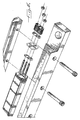
- FIG. 5 illustrates the interrelationship of the components of the slitting apparatus 20 , including a frame block 30 , a clamping block 40 , and the blade cartridge 26 .
- the frame block 30 includes a floor 32 which is covered by a protective elastomeric pad 33 , and further includes an upright panel 34 that extends upwardly from the front edge of the floor 32 .
- the clamping block 40 is positioned on the opposite side of the frame block 30 from the upright panel 34.
- the upright panel 34 includes a recess 36 that faces the clamping block 40 ; likewise, the clamping block 40 includes a recess 42 that faces the upright panel 34.
- the upright panel 34 and clamping block 40 include, respectively, apertures 38, 44 that receive bolts 45 for tightening the clamping block 40 into place.
- apertures 38, 44 that receive bolts 45 for tightening the clamping block 40 into place.
- the blade cartridge 26 includes a plurality of blades 46, each of which is held in spaced apart relation from adjacent blades 46 with spacers 52.
- Each blade 46 (typically about 0.10 mm in thickness) has a pair of cutting edges 48a, 48b along its longer sides and end projections 47a, 47b extending away from either end, such that two planes of symmetry are present: one bisecting the cutting blade 46 lengthwise; and the other bisecting the cutting blade 46 widthwise.
- Each blade 46 also includes an internal cutout area 50.
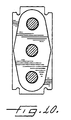
- Each spacer 52 is somewhat oblong, with parallel opposed edges 53 and rounded ends 54, and includes three interior apertures 56. Like the cutting blades 46, each spacer 52 has two planes of symmetry bisecting the spacer 52 lengthwise and widthwise perpendicular to the plane of the spacer 52. Illustratively and preferably, the spacers 52 are between about 0.25 and 1.0 mm in thickness such that the cutting edges 48a, 48b of the blades 46 are spaced about 0.5 to 1.27 mm apart. Together, the spacers 52 and blades 46 can be sufficiently numerous that, when assembled, the cartridge 26 can be of virtually any length, including up to and beyond 3.0 m as needed.
- the blades 46 and spacers 52 are mounted on mounting rods 58a, 58b, 58c, each of which extends through the apertures 56 of the spacers 52 and the cutout portions 50 of the blades 46.
- the cutting blades 46 are in substantially parallel, substantially aligned, spaced apart relationship.
- substantially aligned means that the perimeter of each blade 46 is substantially aligned with the perimeters of adjacent blades in the direction normal to the plane of the blade 46.
- the mounting rods 58a, 58b, 58c are held in place with nuts 60 attached at each end thereof.
- other mounting structures for the cutting blades such as a mounting block with slots to receive the blades, may also be used with the present invention.
- the blade cartridge 26 is secured in place in the blade cartridge frame 24. This is completed by positioning the blade cartridge 26 therein such that end projections 47a of the blades 46 extend within the recess 36 of the upright panel 34, and the end projections 47b of the blades 46 extend within the recess 42 of the clamping block 40. The cutting edges 48b of the blades 46 rest upon the pad 33. The clamping block 40 is then secured to the frame block 30 through tightening of the bolts 45.
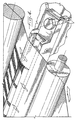
- the cutting edges 48a are exposed and therefore able to cut film 23 into flat film warp yarns 12 as it passes over the blades 46 (see Figure 6) in a general downstream direction D ; the width of the flat film yams 12 is dependent on the distance between cutting edges 48a of adjacent blades 46.
- each spacer 52 is configured such that its edges 53 and ends 54 are recessed from the cutting edges 48a , 48b and end projections 47a , 47b such that either cutting edge 48a , 48b of each blade 46 can be completely exposed when the blade cartridge 26 is mounted in the blade cartridge compartment 43.
- the film 23 can be cut without interference from the spacers 52 irrespective of the orientation of the blade 46 within the blade cartridge 26.
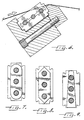
- the rounded ends 54 provide a smooth, nondamaging surface for the film to slide upon after slitting. Therefore, either cutting edge 48a, 48b can be used to cut the film 23, and can be used irrespective of which blade end 47a, 47b is positioned within the recess 36. Consequently, the blades 46 can be used twice as long as a prior art spacer illustrated in Figure 9, in which the portions of the cutting edges 48a', 48b' near the end 47a' cannot be used.
- the spacers 52 are of sufficient size to support the cutting edges 48a , 48b without undue deflection during slitting.
- the spacer, designated at 52' is a truncated diamond shape, with the wedge-shaped end 54' being recessed such that the spacer 52' fails to interfere with the film 23 as it is cut, but being configured to support the cutting edges of the attached blade.
- the corners 57 of the spacer 52' are preferably rounded somewhat to provide a proper sliding surface for the film after slitting.
- the spacer 52" is a diamond shape with rounded ends 54" and corners 55".
- the slitting apparatus 20 can be modified such that it is connected with and provides flat film warp yarns directly to the weaving process.
- the blade cartridge 26 would be mounted onto one end of a loom, and the flat film warp yarns 12, after being slit by the blades 46, would be fed directly into a fabric during weaving.
- the slitting apparatus 20 can be used to produce flat film weft yarns 12 for the fabric 10 in a simple, inexpensive operation.
- flat film warp yarns 12 can be produced at a far lower cost than spun yarns of corresponding size and weight.
- the fabric 10 can be produced considerably less expensively than a corresponding fabric employing spun yarns in place of the flat film warp yarns 12.
- a textile fabric was constructed from slit film warp yarns interwoven with spun weft yarns.
- the warn yarns were cut from a polymer film 25 ⁇ m thick formed of a blend of 80% polyester/20% polyethylene. Slitting was performed at a feed rate of 32 m minute on a slitting apparatus such as that illustrated in Figures 4 through 7, with the cutting blades mounted 0.5 mm apart.
- the warp yarns were then interwoven in a "double pick" weave pattern with weft yarns formed of 37/1 spun blend of 50% polyester and 50% cotton. After weaving, the fabric was calendered at a speed of 27 m minute at room temperature. The finished fabric was observed to have an acceptable appearance and feel.
Landscapes
- Engineering & Computer Science (AREA)
- Textile Engineering (AREA)
- Life Sciences & Earth Sciences (AREA)
- Botany (AREA)
- Forests & Forestry (AREA)
- Mechanical Engineering (AREA)
- Treatment Of Fiber Materials (AREA)
- Woven Fabrics (AREA)
- Yarns And Mechanical Finishing Of Yarns Or Ropes (AREA)
- Spinning Methods And Devices For Manufacturing Artificial Fibers (AREA)
Claims (8)
- Ein textiles Erzeugnis mit:einer Vielzahl von im wesentlichen in Schußrichtung verlaufenden Schußfäden;und einer Vielzahl von flachen, im wesentlichen in Kettrichtung verlaufenden Film-Kettfäden, wobei die Kettfäden mit den Schußfäden verwebt sind in einer Serie von übereinstimmenden Rapports eines vorherbestimmten Bindungsmusters, wobei in jedem der übereinstimmenden Rapports die Schußfäden mit den flachen Film-Kettfäden als verbundene Paare verwebt sind, und zwar derart, daß ein erster Faden von jedem der verbundenen Paare dem gleichen Webmuster in bezug auf jeden der flachen Film-Kettfäden folgt wie ein zweiter Faden dieses Paares.
- Textiles Erzeugnis nach Anspruch 1, bei dem in jedem der Rapports jeder flache Film-Kettfaden über ein verbundenes Paar von Schußfäden und unter ein verbundenes Paar von Schußfäden läuft, wobei nebeneinander liegende flache Film-Kettfäden unter wechselnden Paaren von Schußfäden und über wechselnden Paaren von Schußfäden verlaufen.
- Textiles Erzeugnis nach Anspruch 1 oder 2, bei dem die flachen Film-Kettfäden aus einem Material gebildet sind, das aus Polyester, Polyethylen und Mischungen davon ausgewählt ist.
- Textiles Erzeugnis nach einem der Ansprüche 1, 2 oder 3, bei dem jeder flache Film-Kettfaden eine Breite zwischen etwa 0,25 und 0,64 mm hat.
- Textiles Erzeugnis nach einem der vorherigen Ansprüche, bei dem jeder flache Film-Kettfaden eine Dicke zwischen etwa 10 und 40 µm hat.
- Textiles Erzeugnis nach einem der vorhergehenden Ansprüche, bei dem die Schußfäden eine Baumwoll-Nummer zwischen 4/1 und 47/1 haben.
- Textiles Erzeugnis nach einem der vorhergehenden Ansprüche, bei dem die Schußfäden und die flachen Film-Kettfäden derart bemessen und verwebt sind, daß pro Quadratzoll des Erzeugnisses zwischen etwa 40 und 70 flache Film-Kettfäden und zwischen etwa 50 und 120 Schußfäden vorhanden sind.
- Textiles Erzeugnis nach einem der vorhergehenden Ansprüche, bei dem die Schußfäden und die flachen Film-Kettfäden derart bemessen und verwebt sind, daß pro Quadratzoll des Erzeugnisses zwischen etwa 40 und 70 flache Film-Kettfäden und zwischen 50 und 90 Schußfäden vorhanden sind.
Applications Claiming Priority (3)
| Application Number | Priority Date | Filing Date | Title |
|---|---|---|---|
| US184487 | 1998-11-02 | ||
| US09/184,487 US6148871A (en) | 1998-11-02 | 1998-11-02 | Woven fabric with flat film warp yarns |
| PCT/US1999/022846 WO2000026453A2 (en) | 1998-11-02 | 1999-10-04 | Woven fabric with flat film warp yarns and apparatus for forming same |
Publications (2)
| Publication Number | Publication Date |
|---|---|
| EP1127180A2 EP1127180A2 (de) | 2001-08-29 |
| EP1127180B1 true EP1127180B1 (de) | 2003-12-10 |
Family
ID=22677084
Family Applications (1)
| Application Number | Title | Priority Date | Filing Date |
|---|---|---|---|
| EP99953012A Expired - Lifetime EP1127180B1 (de) | 1998-11-02 | 1999-10-04 | Gewebe mit schussfaden aus folienbändchen und vorrichtung zum formen derselben |
Country Status (8)
| Country | Link |
|---|---|
| US (1) | US6148871A (de) |
| EP (1) | EP1127180B1 (de) |
| JP (1) | JP2002529606A (de) |
| AT (1) | ATE256210T1 (de) |
| AU (1) | AU751535B2 (de) |
| CA (1) | CA2346947A1 (de) |
| DE (1) | DE69913561D1 (de) |
| WO (1) | WO2000026453A2 (de) |
Families Citing this family (23)
| Publication number | Priority date | Publication date | Assignee | Title |
|---|---|---|---|---|
| US7472535B2 (en) * | 2003-11-18 | 2009-01-06 | Casual Living Worldwide, Inc. | Coreless synthetic yarns and woven articles therefrom |
| US20090260707A1 (en) * | 2008-04-22 | 2009-10-22 | Arun Pal Aneja | Woven Textile Fabric with Cotton/Microdenier Filament Bundle Blend |
| EP2444535B1 (de) * | 2010-10-19 | 2013-09-04 | Tape Weaving Sweden AB | Verfahren und Mittel zur kontrollierten Steuerung von bandartigem Kettfaden für Fachbildungs- und Aufwickelvorgänge |
| US20120253501A1 (en) * | 2011-03-31 | 2012-10-04 | Springs Creative Products Group, Llc | System and a method for manufacturing substrates for coated fabrics |
| US9273418B2 (en) | 2012-05-17 | 2016-03-01 | Honeywell International Inc. | Hybrid fiber unidirectional tape and composite laminates |
| US9131790B2 (en) | 2013-08-15 | 2015-09-15 | Aavn, Inc. | Proliferated thread count of a woven textile by simultaneous insertion within a single pick insertion event of a loom apparatus multiple adjacent parallel yarns drawn from a multi-pick yarn package |
| US9493892B1 (en) | 2012-08-15 | 2016-11-15 | Arun Agarwal | Proliferated thread count of a woven textile by simultaneous insertion within a single pick insertion event of a loom apparatus multiple adjacent parallel yarns drawn from a multi-pick yarn package |
| US9243354B2 (en) | 2013-03-15 | 2016-01-26 | Honeywell International Inc. | Stab and ballistic resistant articles |
| US11359311B2 (en) | 2013-08-15 | 2022-06-14 | Arun Agarwal | Proliferated thread count of a woven textile by simultaneous insertion within a single pick insertion event of a loom apparatus multiple adjacent parallel yarns drawn from a multi-pick yarn package |
| US10443159B2 (en) | 2013-08-15 | 2019-10-15 | Arun Agarwal | Proliferated thread count of a woven textile by simultaneous insertion within a single pick insertion event of a loom apparatus multiple adjacent parallel yarns drawn from a multi-pick yarn package |
| US10808337B2 (en) | 2013-08-15 | 2020-10-20 | Arun Agarwal | Proliferated thread count of a woven textile by simultaneous insertion within a single pick insertion event of a loom apparatus multiple adjacent parallel yarns drawn from a multi-pick yarn package |
| US12091785B2 (en) | 2013-08-15 | 2024-09-17 | Aavn, Inc. | Proliferated thread count of a woven textile by simultaneous insertion within a single pick insertion event of a loom apparatus multiple adjacent parallel yarns drawn from a multi-pick yarn package |
| US11168414B2 (en) | 2013-08-15 | 2021-11-09 | Arun Agarwal | Selective abrading of a surface of a woven textile fabric with proliferated thread count based on simultaneous insertion within a single pick insertion event of a loom apparatus multiple adjacent parallel yarns drawn from a multi-pick yarn package |
| US9394634B2 (en) | 2014-03-20 | 2016-07-19 | Arun Agarwal | Woven shielding textile impervious to visible and ultraviolet electromagnetic radiation |
| US20160160406A1 (en) | 2014-05-29 | 2016-06-09 | Arun Agarwal | Production of high cotton number or low denier core spun yarn for weaving of reactive fabric and enhanced bedding |
| US20160278550A1 (en) * | 2015-03-25 | 2016-09-29 | Gagan Rai | Percale bedding system |
| US10272640B2 (en) | 2015-09-17 | 2019-04-30 | Honeywell International Inc. | Low porosity high strength UHMWPE fabrics |
| US20170297295A1 (en) | 2016-04-15 | 2017-10-19 | Honeywell International Inc. | Blister free composite materials molding |
| JP6663785B2 (ja) | 2016-04-27 | 2020-03-13 | Toyo Tire株式会社 | トッピングシートの形成方法及び装置 |
| JP6654093B2 (ja) * | 2016-04-27 | 2020-02-26 | Toyo Tire株式会社 | トッピングシートの形成方法及び装置 |
| IN201821014302A (de) * | 2018-04-14 | 2018-10-05 | ||
| US11225733B2 (en) | 2018-08-31 | 2022-01-18 | Arun Agarwal | Proliferated thread count of a woven textile by simultaneous insertion within a single pick insertion event of a loom apparatus multiple adjacent parallel yarns drawn from a multi-pick yarn package |
| US12024819B2 (en) | 2021-03-31 | 2024-07-02 | Cooley Group Holdings, Inc. | Composite structures and methods of preparation |
Family Cites Families (43)
| Publication number | Priority date | Publication date | Assignee | Title |
|---|---|---|---|---|
| FR892703A (fr) * | 1942-09-12 | 1944-05-17 | Goebel Ag | Procédé et dispositif pour la confection de bobines étroites de papier |
| US2533996A (en) * | 1947-11-07 | 1950-12-12 | Us Rubber Co | Fabric slitting machine |
| US2740443A (en) * | 1950-12-23 | 1956-04-03 | William R Brown | Cigarette making and cutting machine |
| US3110905A (en) * | 1961-09-26 | 1963-11-19 | Lees & Sons Co James | Tufted pile fabric comprising a flat woven synthetic plastic backing |
| US3317366A (en) * | 1962-05-18 | 1967-05-02 | Beaunit Corp | Woven polyester carpet backing and tufted carpet incorporating the same |
| GB1067514A (en) * | 1964-03-10 | 1967-05-03 | Mirsky Alexander | A method of and apparatus for preparing warp for weaving or warp-knitting by dividing sheet material longitudinally |
| US3283788A (en) * | 1964-04-07 | 1966-11-08 | Phillips Petroleum Co | Production of woven thermoplastic fabrics |
| US3398220A (en) * | 1964-06-26 | 1968-08-20 | Parker Pace Corp | Process for converting a web of synthetic material into bulk yarns |
| US3327468A (en) * | 1964-07-27 | 1967-06-27 | Hercules Inc | Decorative textile strand and fabric embodying same |
| GB1236011A (en) * | 1967-03-07 | 1971-06-16 | Creators Ltd | Improvements in or relating to weaving |
| FR1530498A (fr) * | 1967-05-03 | 1968-06-28 | Articles tissés à partir de bandelettes étirées en matière plastique | |
| US3611699A (en) * | 1968-03-08 | 1971-10-12 | Eastman Kodak Co | Fibrous yarn product |
| US3503106A (en) * | 1968-06-27 | 1970-03-31 | Avisun Corp | Continuous techniques for making flat woven synthetic fabrics |
| AT299085B (de) * | 1968-07-23 | 1972-06-12 | Viktor Dipl Ing Kovacec | Schneivorrichtung zur Herstellung von Bändchen aus Kunststoff-Folienbahnen |
| GB1193036A (en) * | 1968-12-04 | 1970-05-28 | Alberton Ltd | Improvements in and relating to Weaving Looms |
| US3604474A (en) * | 1969-04-22 | 1971-09-14 | Haruo Kamei | Scrubbing bath towel |
| DE1927899B2 (de) * | 1969-05-31 | 1972-08-03 | Rheinstahl Ag, 4300 Essen | Vorrichtung zum schneiden von baendchen aus einer folienbahn aus kunststoff |
| US3789469A (en) * | 1972-02-15 | 1974-02-05 | Fuji Spinning Co Ltd | Yarn treating method |
| US3918135A (en) * | 1973-09-17 | 1975-11-11 | Hercules Inc | Methods of making fabrics from synthetic tapes |
| SE419106B (sv) * | 1974-01-31 | 1981-07-13 | Standard Oil Co | Forfarande for framstellning av polypropenbandgarnstyg |
| US4107827A (en) * | 1975-01-03 | 1978-08-22 | Chemiefaser Lenzing Aktiengesellschaft | Apparatus for producing synthetic fibers |
| US3971279A (en) * | 1975-09-22 | 1976-07-27 | Wright William T | Copy trimmer machine |
| CA1041005A (en) * | 1976-03-11 | 1978-10-24 | Du Pont Of Canada Limited | Preparation of a warp beam wound with flexible tapes |
| DE2652011A1 (de) * | 1976-11-15 | 1978-05-24 | Windmoeller & Hoelscher | Vorrichtung zum herstellen von baendchen |
| DE2657506C2 (de) * | 1976-12-18 | 1984-07-05 | Messerschmitt-Bölkow-Blohm GmbH, 8000 München | Vorrichtung zum Schneiden von Streifen aus einer Folienbahn |
| IE46289B1 (en) * | 1977-01-11 | 1983-04-20 | Newell Co Inc | Synthetic plastics sheets for use in window shades |
| US4118842A (en) * | 1977-07-08 | 1978-10-10 | Champion International Corporation | Weave-de-weave process |
| US4107371A (en) * | 1977-10-25 | 1978-08-15 | Johnson & Johnson | Woven fabric that is relatively stiff in one direction and relatively flexible in the other |
| DE3137825A1 (de) * | 1980-09-27 | 1982-05-19 | Barmag Barmer Maschinenfabrik Ag, 5630 Remscheid | "monoaxial verstrecktes verbundfolienbaendchen" |
| US4466163A (en) * | 1981-05-11 | 1984-08-21 | Long Barry W | Wide fabric manufacturing method and apparatus |
| US4422359A (en) * | 1981-10-07 | 1983-12-27 | The Dow Chemical Company | Adjustable slitter blade holder |
| US4384018A (en) * | 1982-01-25 | 1983-05-17 | Wayn-Tex Inc. | Secondary carpet backing fabric |
| US4674380A (en) * | 1986-01-29 | 1987-06-23 | David Hecht | Apparatus for cutting ribbon |
| US4947897A (en) * | 1986-04-07 | 1990-08-14 | E. I. Du Pont De Nemours And Company | Method for producing a fabric made from thermoplastic melt impregnated tow |
| JPS6392750A (ja) * | 1986-10-03 | 1988-04-23 | ダイヤテツクス株式会社 | カ−ペツト基布とその製造方法 |
| US4819528A (en) * | 1987-12-03 | 1989-04-11 | Essex Manufacturing Company | Ribbon cutting apparatus having multiple, independently driven groups of cutting blades |
| DE68908252T2 (de) * | 1988-05-02 | 1994-01-27 | Du Pont | Gewebe aus spleissbaren Bändchen. |
| JPH0651939B2 (ja) * | 1988-06-14 | 1994-07-06 | 菊地工業株式会社 | 無地織柄ベルト |
| DE9015910U1 (de) * | 1990-11-22 | 1991-02-07 | Maschinenfabrik Goebel Gmbh, 6100 Darmstadt | Einrichtung zum Ändern des Arbeitspunktes |
| US5121885A (en) * | 1991-01-02 | 1992-06-16 | Chipman Donald I | Sheet fabric slitter and reroller |
| JP2739302B2 (ja) * | 1995-05-23 | 1998-04-15 | 株式会社安岡金銀糸 | 箔織編物用合撚糸 |
| DE19720322C1 (de) * | 1997-05-15 | 1998-05-14 | Saechsisches Textilforsch Inst | Vorrichtung zum Trennen von Foliebahnen zu schmalen Foliebändchen oder Fäden |
| US5902658A (en) * | 1997-08-15 | 1999-05-11 | Wyman; Oliver A. | Dimensionally stable, water impervious rug underlay with double sided pressure sensitive adhesive and protective peelable liners |
-
1998
- 1998-11-02 US US09/184,487 patent/US6148871A/en not_active Expired - Fee Related
-
1999
- 1999-10-04 WO PCT/US1999/022846 patent/WO2000026453A2/en not_active Ceased
- 1999-10-04 AT AT99953012T patent/ATE256210T1/de not_active IP Right Cessation
- 1999-10-04 JP JP2000579820A patent/JP2002529606A/ja active Pending
- 1999-10-04 DE DE69913561T patent/DE69913561D1/de not_active Expired - Lifetime
- 1999-10-04 CA CA002346947A patent/CA2346947A1/en not_active Abandoned
- 1999-10-04 AU AU65050/99A patent/AU751535B2/en not_active Ceased
- 1999-10-04 EP EP99953012A patent/EP1127180B1/de not_active Expired - Lifetime
Also Published As
| Publication number | Publication date |
|---|---|
| WO2000026453A2 (en) | 2000-05-11 |
| ATE256210T1 (de) | 2003-12-15 |
| JP2002529606A (ja) | 2002-09-10 |
| EP1127180A2 (de) | 2001-08-29 |
| DE69913561D1 (de) | 2004-01-22 |
| WO2000026453A3 (en) | 2000-09-28 |
| AU751535B2 (en) | 2002-08-22 |
| US6148871A (en) | 2000-11-21 |
| AU6505099A (en) | 2000-05-22 |
| CA2346947A1 (en) | 2000-05-11 |
Similar Documents
| Publication | Publication Date | Title |
|---|---|---|
| US6148871A (en) | Woven fabric with flat film warp yarns | |
| US5618624A (en) | Formable, heat-stabilizable textile pile material | |
| US5654067A (en) | Formable, heat-stabilizable textile loop pile material | |
| US4145467A (en) | Woven textile | |
| US6537640B1 (en) | Pile fabric | |
| US3889305A (en) | Heat barrier textile material | |
| CA1316678C (en) | Window blinds | |
| JPH08269841A (ja) | 二次成形しうる熱安定化可能な開口を有する網状構造の構造物 | |
| US20180080151A1 (en) | Performance fabrics and related articles | |
| EP2642003A1 (de) | Gewebe und bekleidung daraus | |
| US10323341B2 (en) | Highly air-permeable woven fabric resistant to washing | |
| US4384018A (en) | Secondary carpet backing fabric | |
| US4478900A (en) | Woven fabric containing partially fibrillated textile yarn | |
| US20240254666A1 (en) | Double Raschel Knitted Fabric and Upholstery Material Containing Same | |
| US6211099B1 (en) | Substrate fabric | |
| MXPA01004421A (en) | Woven fabric with flat film warp yarns and apparatus for forming same | |
| IE42077B1 (en) | Polyolefin ribbon yarn fabrics | |
| JP2022054364A (ja) | スリップ抑制パイル織物、及び、その製造方法 | |
| JP3789237B2 (ja) | 裏地 | |
| JP3072422B2 (ja) | 内装布帛 | |
| CA1072311A (en) | Method of aftertreating woven textile | |
| JPH0235056B2 (de) | ||
| JPS637485A (ja) | バーチカルブラインド | |
| KR0178051B1 (ko) | 폴리아미드계 중공섬유 스펀라이크사 및 그 직물의 제조방법 | |
| KR100737975B1 (ko) | 장섬유 벨벳직물 및 그의 제조 방법 |
Legal Events
| Date | Code | Title | Description |
|---|---|---|---|
| PUAI | Public reference made under article 153(3) epc to a published international application that has entered the european phase |
Free format text: ORIGINAL CODE: 0009012 |
|
| 17P | Request for examination filed |
Effective date: 20010414 |
|
| AK | Designated contracting states |
Kind code of ref document: A2 Designated state(s): AT BE CH CY DE DK ES FI FR GB GR IE IT LI LU MC NL PT SE |
|
| 17Q | First examination report despatched |
Effective date: 20020731 |
|
| GRAH | Despatch of communication of intention to grant a patent |
Free format text: ORIGINAL CODE: EPIDOS IGRA |
|
| GRAS | Grant fee paid |
Free format text: ORIGINAL CODE: EPIDOSNIGR3 |
|
| GRAA | (expected) grant |
Free format text: ORIGINAL CODE: 0009210 |
|
| AK | Designated contracting states |
Kind code of ref document: B1 Designated state(s): AT BE CH CY DE DK ES FI FR GB GR IE IT LI LU MC NL PT SE |
|
| PG25 | Lapsed in a contracting state [announced via postgrant information from national office to epo] |
Ref country code: NL Free format text: LAPSE BECAUSE OF FAILURE TO SUBMIT A TRANSLATION OF THE DESCRIPTION OR TO PAY THE FEE WITHIN THE PRESCRIBED TIME-LIMIT Effective date: 20031210 Ref country code: LI Free format text: LAPSE BECAUSE OF FAILURE TO SUBMIT A TRANSLATION OF THE DESCRIPTION OR TO PAY THE FEE WITHIN THE PRESCRIBED TIME-LIMIT Effective date: 20031210 Ref country code: IT Free format text: LAPSE BECAUSE OF FAILURE TO SUBMIT A TRANSLATION OF THE DESCRIPTION OR TO PAY THE FEE WITHIN THE PRESCRIBED TIME-LIMIT;WARNING: LAPSES OF ITALIAN PATENTS WITH EFFECTIVE DATE BEFORE 2007 MAY HAVE OCCURRED AT ANY TIME BEFORE 2007. THE CORRECT EFFECTIVE DATE MAY BE DIFFERENT FROM THE ONE RECORDED. Effective date: 20031210 Ref country code: FR Free format text: LAPSE BECAUSE OF FAILURE TO SUBMIT A TRANSLATION OF THE DESCRIPTION OR TO PAY THE FEE WITHIN THE PRESCRIBED TIME-LIMIT Effective date: 20031210 Ref country code: FI Free format text: LAPSE BECAUSE OF FAILURE TO SUBMIT A TRANSLATION OF THE DESCRIPTION OR TO PAY THE FEE WITHIN THE PRESCRIBED TIME-LIMIT Effective date: 20031210 Ref country code: CY Free format text: LAPSE BECAUSE OF FAILURE TO SUBMIT A TRANSLATION OF THE DESCRIPTION OR TO PAY THE FEE WITHIN THE PRESCRIBED TIME-LIMIT Effective date: 20031210 Ref country code: CH Free format text: LAPSE BECAUSE OF FAILURE TO SUBMIT A TRANSLATION OF THE DESCRIPTION OR TO PAY THE FEE WITHIN THE PRESCRIBED TIME-LIMIT Effective date: 20031210 Ref country code: BE Free format text: LAPSE BECAUSE OF FAILURE TO SUBMIT A TRANSLATION OF THE DESCRIPTION OR TO PAY THE FEE WITHIN THE PRESCRIBED TIME-LIMIT Effective date: 20031210 Ref country code: AT Free format text: LAPSE BECAUSE OF FAILURE TO SUBMIT A TRANSLATION OF THE DESCRIPTION OR TO PAY THE FEE WITHIN THE PRESCRIBED TIME-LIMIT Effective date: 20031210 |
|
| REG | Reference to a national code |
Ref country code: GB Ref legal event code: FG4D |
|
| REG | Reference to a national code |
Ref country code: CH Ref legal event code: EP |
|
| REG | Reference to a national code |
Ref country code: IE Ref legal event code: FG4D |
|
| REF | Corresponds to: |
Ref document number: 69913561 Country of ref document: DE Date of ref document: 20040122 Kind code of ref document: P |
|
| PG25 | Lapsed in a contracting state [announced via postgrant information from national office to epo] |
Ref country code: SE Free format text: LAPSE BECAUSE OF FAILURE TO SUBMIT A TRANSLATION OF THE DESCRIPTION OR TO PAY THE FEE WITHIN THE PRESCRIBED TIME-LIMIT Effective date: 20040310 Ref country code: GR Free format text: LAPSE BECAUSE OF FAILURE TO SUBMIT A TRANSLATION OF THE DESCRIPTION OR TO PAY THE FEE WITHIN THE PRESCRIBED TIME-LIMIT Effective date: 20040310 Ref country code: DK Free format text: LAPSE BECAUSE OF FAILURE TO SUBMIT A TRANSLATION OF THE DESCRIPTION OR TO PAY THE FEE WITHIN THE PRESCRIBED TIME-LIMIT Effective date: 20040310 |
|
| PG25 | Lapsed in a contracting state [announced via postgrant information from national office to epo] |
Ref country code: DE Free format text: LAPSE BECAUSE OF FAILURE TO SUBMIT A TRANSLATION OF THE DESCRIPTION OR TO PAY THE FEE WITHIN THE PRESCRIBED TIME-LIMIT Effective date: 20040311 |
|
| PG25 | Lapsed in a contracting state [announced via postgrant information from national office to epo] |
Ref country code: ES Free format text: LAPSE BECAUSE OF FAILURE TO SUBMIT A TRANSLATION OF THE DESCRIPTION OR TO PAY THE FEE WITHIN THE PRESCRIBED TIME-LIMIT Effective date: 20040321 |
|
| NLV1 | Nl: lapsed or annulled due to failure to fulfill the requirements of art. 29p and 29m of the patents act | ||
| REG | Reference to a national code |
Ref country code: CH Ref legal event code: PL |
|
| PG25 | Lapsed in a contracting state [announced via postgrant information from national office to epo] |
Ref country code: LU Free format text: LAPSE BECAUSE OF NON-PAYMENT OF DUE FEES Effective date: 20041004 Ref country code: IE Free format text: LAPSE BECAUSE OF NON-PAYMENT OF DUE FEES Effective date: 20041004 Ref country code: GB Free format text: LAPSE BECAUSE OF NON-PAYMENT OF DUE FEES Effective date: 20041004 |
|
| PLBE | No opposition filed within time limit |
Free format text: ORIGINAL CODE: 0009261 |
|
| STAA | Information on the status of an ep patent application or granted ep patent |
Free format text: STATUS: NO OPPOSITION FILED WITHIN TIME LIMIT |
|
| PG25 | Lapsed in a contracting state [announced via postgrant information from national office to epo] |
Ref country code: MC Free format text: LAPSE BECAUSE OF NON-PAYMENT OF DUE FEES Effective date: 20041031 |
|
| 26N | No opposition filed |
Effective date: 20040913 |
|
| EN | Fr: translation not filed | ||
| GBPC | Gb: european patent ceased through non-payment of renewal fee |
Effective date: 20041004 |
|
| REG | Reference to a national code |
Ref country code: IE Ref legal event code: MM4A |
|
| PG25 | Lapsed in a contracting state [announced via postgrant information from national office to epo] |
Ref country code: PT Free format text: LAPSE BECAUSE OF NON-PAYMENT OF DUE FEES Effective date: 20040510 |