EP1124409B1 - Andeckung von frühbeeten und gewächshäusern - Google Patents
Andeckung von frühbeeten und gewächshäusern Download PDFInfo
- Publication number
- EP1124409B1 EP1124409B1 EP99935595A EP99935595A EP1124409B1 EP 1124409 B1 EP1124409 B1 EP 1124409B1 EP 99935595 A EP99935595 A EP 99935595A EP 99935595 A EP99935595 A EP 99935595A EP 1124409 B1 EP1124409 B1 EP 1124409B1
- Authority
- EP
- European Patent Office
- Prior art keywords
- film
- light
- filler
- doped polymer
- polymer film
- Prior art date
- Legal status (The legal status is an assumption and is not a legal conclusion. Google has not performed a legal analysis and makes no representation as to the accuracy of the status listed.)
- Expired - Lifetime
Links
- 239000000654 additive Substances 0.000 claims abstract description 52
- 239000000203 mixture Substances 0.000 claims abstract description 48
- 239000004611 light stabiliser Substances 0.000 claims abstract description 30
- 230000000996 additive effect Effects 0.000 claims abstract description 27
- XGLACMHMUWZUKF-UHFFFAOYSA-N O=S.[Y].[Eu] Chemical compound O=S.[Y].[Eu] XGLACMHMUWZUKF-UHFFFAOYSA-N 0.000 claims abstract description 11
- 230000012010 growth Effects 0.000 claims abstract description 6
- 239000002952 polymeric resin Substances 0.000 claims abstract description 6
- 229920003002 synthetic resin Polymers 0.000 claims abstract description 6
- 229920006262 high density polyethylene film Polymers 0.000 claims abstract description 4
- 239000000945 filler Substances 0.000 claims description 48
- 239000000463 material Substances 0.000 claims description 48
- -1 polyethylene Polymers 0.000 claims description 31
- 239000004698 Polyethylene Substances 0.000 claims description 26
- 229920000573 polyethylene Polymers 0.000 claims description 26
- XLYOFNOQVPJJNP-UHFFFAOYSA-N water Substances O XLYOFNOQVPJJNP-UHFFFAOYSA-N 0.000 claims description 18
- 229920006254 polymer film Polymers 0.000 claims description 17
- 239000002245 particle Substances 0.000 claims description 14
- 239000000049 pigment Substances 0.000 claims description 14
- 229920003023 plastic Polymers 0.000 claims description 14
- 239000004033 plastic Substances 0.000 claims description 14
- 229920005989 resin Polymers 0.000 claims description 12
- 239000011347 resin Substances 0.000 claims description 12
- 229910052693 Europium Inorganic materials 0.000 claims description 6
- 238000011049 filling Methods 0.000 claims description 6
- 239000011256 inorganic filler Substances 0.000 claims description 6
- 229910003475 inorganic filler Inorganic materials 0.000 claims description 6
- 239000000843 powder Substances 0.000 claims description 6
- 239000003381 stabilizer Substances 0.000 claims description 5
- 150000001875 compounds Chemical class 0.000 claims description 4
- 239000011248 coating agent Substances 0.000 claims description 3
- 238000000576 coating method Methods 0.000 claims description 3
- 230000008021 deposition Effects 0.000 claims description 3
- 229920001169 thermoplastic Polymers 0.000 claims description 3
- 239000004416 thermosoftening plastic Substances 0.000 claims description 3
- 231100000252 nontoxic Toxicity 0.000 claims description 2
- 230000003000 nontoxic effect Effects 0.000 claims description 2
- 238000007789 sealing Methods 0.000 claims description 2
- XTQHKBHJIVJGKJ-UHFFFAOYSA-N sulfur monoxide Chemical compound S=O XTQHKBHJIVJGKJ-UHFFFAOYSA-N 0.000 claims description 2
- 239000011888 foil Substances 0.000 claims 1
- 230000006641 stabilisation Effects 0.000 claims 1
- 238000011105 stabilization Methods 0.000 claims 1
- 229920000642 polymer Polymers 0.000 abstract description 26
- 229920001903 high density polyethylene Polymers 0.000 abstract description 15
- 239000004700 high-density polyethylene Substances 0.000 abstract description 15
- 230000029553 photosynthesis Effects 0.000 abstract description 9
- 238000010672 photosynthesis Methods 0.000 abstract description 9
- 238000012423 maintenance Methods 0.000 abstract description 8
- 238000009826 distribution Methods 0.000 abstract description 3
- 244000038559 crop plants Species 0.000 abstract 1
- 239000012528 membrane Substances 0.000 description 19
- 241000196324 Embryophyta Species 0.000 description 18
- 230000001965 increasing effect Effects 0.000 description 13
- 238000002474 experimental method Methods 0.000 description 12
- 239000004594 Masterbatch (MB) Substances 0.000 description 11
- 230000003595 spectral effect Effects 0.000 description 11
- 230000009102 absorption Effects 0.000 description 10
- 238000010521 absorption reaction Methods 0.000 description 10
- 238000004519 manufacturing process Methods 0.000 description 10
- 230000000694 effects Effects 0.000 description 9
- 238000000034 method Methods 0.000 description 8
- 239000002689 soil Substances 0.000 description 8
- 238000001228 spectrum Methods 0.000 description 8
- 230000005855 radiation Effects 0.000 description 7
- 239000002585 base Substances 0.000 description 6
- 230000003287 optical effect Effects 0.000 description 6
- 238000012360 testing method Methods 0.000 description 6
- 241000227653 Lycopersicon Species 0.000 description 5
- 235000007688 Lycopersicon esculentum Nutrition 0.000 description 5
- 238000010276 construction Methods 0.000 description 5
- 230000002708 enhancing effect Effects 0.000 description 5
- 238000001125 extrusion Methods 0.000 description 5
- 239000008187 granular material Substances 0.000 description 5
- 238000002156 mixing Methods 0.000 description 5
- 230000008569 process Effects 0.000 description 5
- 241000220223 Fragaria Species 0.000 description 4
- CKLJMWTZIZZHCS-REOHCLBHSA-N L-aspartic acid Chemical group OC(=O)[C@@H](N)CC(O)=O CKLJMWTZIZZHCS-REOHCLBHSA-N 0.000 description 4
- 229910052772 Samarium Inorganic materials 0.000 description 4
- 241001464837 Viridiplantae Species 0.000 description 4
- 239000012190 activator Substances 0.000 description 4
- 230000007423 decrease Effects 0.000 description 4
- 238000011161 development Methods 0.000 description 4
- 230000018109 developmental process Effects 0.000 description 4
- 235000013399 edible fruits Nutrition 0.000 description 4
- 238000000295 emission spectrum Methods 0.000 description 4
- OGPBJKLSAFTDLK-UHFFFAOYSA-N europium atom Chemical compound [Eu] OGPBJKLSAFTDLK-UHFFFAOYSA-N 0.000 description 4
- 239000001023 inorganic pigment Substances 0.000 description 4
- 239000006259 organic additive Substances 0.000 description 4
- 239000002985 plastic film Substances 0.000 description 4
- 229920006255 plastic film Polymers 0.000 description 4
- 235000021012 strawberries Nutrition 0.000 description 4
- 229910052684 Cerium Inorganic materials 0.000 description 3
- 240000008415 Lactuca sativa Species 0.000 description 3
- 235000003228 Lactuca sativa Nutrition 0.000 description 3
- 229910052779 Neodymium Inorganic materials 0.000 description 3
- 229910052777 Praseodymium Inorganic materials 0.000 description 3
- 229910052775 Thulium Inorganic materials 0.000 description 3
- SKQWEERDYRHPFP-UHFFFAOYSA-N [Y].S=O Chemical class [Y].S=O SKQWEERDYRHPFP-UHFFFAOYSA-N 0.000 description 3
- 229920005601 base polymer Polymers 0.000 description 3
- 230000008901 benefit Effects 0.000 description 3
- 230000015572 biosynthetic process Effects 0.000 description 3
- 230000001276 controlling effect Effects 0.000 description 3
- 238000003306 harvesting Methods 0.000 description 3
- 238000005286 illumination Methods 0.000 description 3
- 230000007246 mechanism Effects 0.000 description 3
- 238000002844 melting Methods 0.000 description 3
- 230000008018 melting Effects 0.000 description 3
- 230000000243 photosynthetic effect Effects 0.000 description 3
- 239000004800 polyvinyl chloride Substances 0.000 description 3
- 229920000915 polyvinyl chloride Polymers 0.000 description 3
- 238000002360 preparation method Methods 0.000 description 3
- KZUNJOHGWZRPMI-UHFFFAOYSA-N samarium atom Chemical compound [Sm] KZUNJOHGWZRPMI-UHFFFAOYSA-N 0.000 description 3
- 239000000126 substance Substances 0.000 description 3
- 238000003786 synthesis reaction Methods 0.000 description 3
- 238000009281 ultraviolet germicidal irradiation Methods 0.000 description 3
- 235000013311 vegetables Nutrition 0.000 description 3
- 240000004160 Capsicum annuum Species 0.000 description 2
- 235000008534 Capsicum annuum var annuum Nutrition 0.000 description 2
- 235000007862 Capsicum baccatum Nutrition 0.000 description 2
- 240000008067 Cucumis sativus Species 0.000 description 2
- 235000009849 Cucumis sativus Nutrition 0.000 description 2
- BPQQTUXANYXVAA-UHFFFAOYSA-N Orthosilicate Chemical compound [O-][Si]([O-])([O-])[O-] BPQQTUXANYXVAA-UHFFFAOYSA-N 0.000 description 2
- OAICVXFJPJFONN-UHFFFAOYSA-N Phosphorus Chemical compound [P] OAICVXFJPJFONN-UHFFFAOYSA-N 0.000 description 2
- 235000004789 Rosa xanthina Nutrition 0.000 description 2
- 241000109329 Rosa xanthina Species 0.000 description 2
- 206010042496 Sunburn Diseases 0.000 description 2
- 229910052771 Terbium Inorganic materials 0.000 description 2
- 230000009471 action Effects 0.000 description 2
- 230000032683 aging Effects 0.000 description 2
- 229910052783 alkali metal Inorganic materials 0.000 description 2
- 150000001340 alkali metals Chemical class 0.000 description 2
- 230000015556 catabolic process Effects 0.000 description 2
- GWXLDORMOJMVQZ-UHFFFAOYSA-N cerium Chemical compound [Ce] GWXLDORMOJMVQZ-UHFFFAOYSA-N 0.000 description 2
- 238000006243 chemical reaction Methods 0.000 description 2
- 229930002875 chlorophyll Natural products 0.000 description 2
- 235000019804 chlorophyll Nutrition 0.000 description 2
- ATNHDLDRLWWWCB-AENOIHSZSA-M chlorophyll a Chemical compound C1([C@@H](C(=O)OC)C(=O)C2=C3C)=C2N2C3=CC(C(CC)=C3C)=[N+]4C3=CC3=C(C=C)C(C)=C5N3[Mg-2]42[N+]2=C1[C@@H](CCC(=O)OC\C=C(/C)CCC[C@H](C)CCC[C@H](C)CCCC(C)C)[C@H](C)C2=C5 ATNHDLDRLWWWCB-AENOIHSZSA-M 0.000 description 2
- 230000000875 corresponding effect Effects 0.000 description 2
- 230000003247 decreasing effect Effects 0.000 description 2
- 238000006731 degradation reaction Methods 0.000 description 2
- 239000006185 dispersion Substances 0.000 description 2
- 239000002019 doping agent Substances 0.000 description 2
- 239000004744 fabric Substances 0.000 description 2
- 230000036541 health Effects 0.000 description 2
- 239000000155 melt Substances 0.000 description 2
- QEFYFXOXNSNQGX-UHFFFAOYSA-N neodymium atom Chemical compound [Nd] QEFYFXOXNSNQGX-UHFFFAOYSA-N 0.000 description 2
- 229920013716 polyethylene resin Polymers 0.000 description 2
- PUDIUYLPXJFUGB-UHFFFAOYSA-N praseodymium atom Chemical compound [Pr] PUDIUYLPXJFUGB-UHFFFAOYSA-N 0.000 description 2
- 230000009467 reduction Effects 0.000 description 2
- 230000005070 ripening Effects 0.000 description 2
- 238000003756 stirring Methods 0.000 description 2
- 239000011782 vitamin Substances 0.000 description 2
- 229940088594 vitamin Drugs 0.000 description 2
- 229930003231 vitamin Natural products 0.000 description 2
- 235000013343 vitamin Nutrition 0.000 description 2
- 150000003722 vitamin derivatives Chemical class 0.000 description 2
- 229910052724 xenon Inorganic materials 0.000 description 2
- FHNFHKCVQCLJFQ-UHFFFAOYSA-N xenon atom Chemical compound [Xe] FHNFHKCVQCLJFQ-UHFFFAOYSA-N 0.000 description 2
- NMQPIBPZSLMCFI-UHFFFAOYSA-N 2-(4-methylphenyl)acetamide Chemical compound CC1=CC=C(CC(N)=O)C=C1 NMQPIBPZSLMCFI-UHFFFAOYSA-N 0.000 description 1
- 244000000626 Daucus carota Species 0.000 description 1
- 235000002767 Daucus carota Nutrition 0.000 description 1
- LFQSCWFLJHTTHZ-UHFFFAOYSA-N Ethanol Chemical compound CCO LFQSCWFLJHTTHZ-UHFFFAOYSA-N 0.000 description 1
- UPYKUZBSLRQECL-UKMVMLAPSA-N Lycopene Natural products CC(=C/C=C/C=C(C)/C=C/C=C(C)/C=C/C1C(=C)CCCC1(C)C)C=CC=C(/C)C=CC2C(=C)CCCC2(C)C UPYKUZBSLRQECL-UKMVMLAPSA-N 0.000 description 1
- GBUCFLDECOYPLY-UHFFFAOYSA-K N1=C(C=CC2=CC=C3C=CC=NC3=C12)C(=O)[O-].[Eu+3].N1=C(C=CC2=CC=C3C=CC=NC3=C12)C(=O)[O-].N1=C(C=CC2=CC=C3C=CC=NC3=C12)C(=O)[O-] Chemical compound N1=C(C=CC2=CC=C3C=CC=NC3=C12)C(=O)[O-].[Eu+3].N1=C(C=CC2=CC=C3C=CC=NC3=C12)C(=O)[O-].N1=C(C=CC2=CC=C3C=CC=NC3=C12)C(=O)[O-] GBUCFLDECOYPLY-UHFFFAOYSA-K 0.000 description 1
- 239000012963 UV stabilizer Substances 0.000 description 1
- JRXNKPSGXRHKCD-UHFFFAOYSA-N [Sm].[Eu].[Y] Chemical compound [Sm].[Eu].[Y] JRXNKPSGXRHKCD-UHFFFAOYSA-N 0.000 description 1
- PXMLGXWGOVHNQX-UHFFFAOYSA-N [Y].[Eu] Chemical compound [Y].[Eu] PXMLGXWGOVHNQX-UHFFFAOYSA-N 0.000 description 1
- 230000001133 acceleration Effects 0.000 description 1
- 239000000443 aerosol Substances 0.000 description 1
- 238000004458 analytical method Methods 0.000 description 1
- 238000004873 anchoring Methods 0.000 description 1
- 238000013459 approach Methods 0.000 description 1
- 238000000149 argon plasma sintering Methods 0.000 description 1
- QVGXLLKOCUKJST-UHFFFAOYSA-N atomic oxygen Chemical compound [O] QVGXLLKOCUKJST-UHFFFAOYSA-N 0.000 description 1
- 230000009286 beneficial effect Effects 0.000 description 1
- 230000005540 biological transmission Effects 0.000 description 1
- 150000001720 carbohydrates Chemical class 0.000 description 1
- BVKZGUZCCUSVTD-UHFFFAOYSA-N carbonic acid Chemical compound OC(O)=O BVKZGUZCCUSVTD-UHFFFAOYSA-N 0.000 description 1
- 150000001746 carotenes Chemical class 0.000 description 1
- 235000005473 carotenes Nutrition 0.000 description 1
- ZWNKRQYGMBHZEM-UHFFFAOYSA-N cerium(3+) yttrium(3+) silicate Chemical compound [Si]([O-])([O-])([O-])[O-].[Ce+3].[Y+3] ZWNKRQYGMBHZEM-UHFFFAOYSA-N 0.000 description 1
- 230000008859 change Effects 0.000 description 1
- 238000005253 cladding Methods 0.000 description 1
- 230000000295 complement effect Effects 0.000 description 1
- 239000002131 composite material Substances 0.000 description 1
- 238000009833 condensation Methods 0.000 description 1
- 230000005494 condensation Effects 0.000 description 1
- 238000001816 cooling Methods 0.000 description 1
- 230000002596 correlated effect Effects 0.000 description 1
- 238000005520 cutting process Methods 0.000 description 1
- 230000006378 damage Effects 0.000 description 1
- 238000007865 diluting Methods 0.000 description 1
- 239000003085 diluting agent Substances 0.000 description 1
- 125000000118 dimethyl group Chemical group [H]C([H])([H])* 0.000 description 1
- 238000007580 dry-mixing Methods 0.000 description 1
- 238000005538 encapsulation Methods 0.000 description 1
- 230000007613 environmental effect Effects 0.000 description 1
- AGAIOPSWUDRQIZ-UHFFFAOYSA-N europium samarium sulfur monoxide yttrium Chemical compound O=S.[Sm].[Eu].[Y] AGAIOPSWUDRQIZ-UHFFFAOYSA-N 0.000 description 1
- 230000005284 excitation Effects 0.000 description 1
- 230000035784 germination Effects 0.000 description 1
- 239000011521 glass Substances 0.000 description 1
- 238000010438 heat treatment Methods 0.000 description 1
- 231100000086 high toxicity Toxicity 0.000 description 1
- 230000006872 improvement Effects 0.000 description 1
- 230000003993 interaction Effects 0.000 description 1
- 150000002500 ions Chemical class 0.000 description 1
- 230000001788 irregular Effects 0.000 description 1
- 238000003475 lamination Methods 0.000 description 1
- 230000002045 lasting effect Effects 0.000 description 1
- 230000005923 long-lasting effect Effects 0.000 description 1
- 229920001684 low density polyethylene Polymers 0.000 description 1
- 239000004702 low-density polyethylene Substances 0.000 description 1
- 230000000921 morphogenic effect Effects 0.000 description 1
- 238000010899 nucleation Methods 0.000 description 1
- 238000005457 optimization Methods 0.000 description 1
- 229910052760 oxygen Inorganic materials 0.000 description 1
- 239000001301 oxygen Substances 0.000 description 1
- 230000000704 physical effect Effects 0.000 description 1
- 230000008635 plant growth Effects 0.000 description 1
- 239000000088 plastic resin Substances 0.000 description 1
- 239000004417 polycarbonate Substances 0.000 description 1
- 229920000515 polycarbonate Polymers 0.000 description 1
- 229920001021 polysulfide Polymers 0.000 description 1
- 238000001556 precipitation Methods 0.000 description 1
- 239000002243 precursor Substances 0.000 description 1
- 230000002028 premature Effects 0.000 description 1
- 238000006862 quantum yield reaction Methods 0.000 description 1
- 238000010791 quenching Methods 0.000 description 1
- 229910052761 rare earth metal Inorganic materials 0.000 description 1
- 230000009103 reabsorption Effects 0.000 description 1
- 230000002441 reversible effect Effects 0.000 description 1
- 239000005368 silicate glass Substances 0.000 description 1
- 150000004760 silicates Chemical class 0.000 description 1
- 239000006104 solid solution Substances 0.000 description 1
- 241000894007 species Species 0.000 description 1
- 238000005507 spraying Methods 0.000 description 1
- 230000000087 stabilizing effect Effects 0.000 description 1
- 238000004381 surface treatment Methods 0.000 description 1
- 230000002195 synergetic effect Effects 0.000 description 1
- GZCRRIHWUXGPOV-UHFFFAOYSA-N terbium atom Chemical compound [Tb] GZCRRIHWUXGPOV-UHFFFAOYSA-N 0.000 description 1
- 230000001131 transforming effect Effects 0.000 description 1
- 238000000870 ultraviolet spectroscopy Methods 0.000 description 1
- 230000017260 vegetative to reproductive phase transition of meristem Effects 0.000 description 1
- 238000001429 visible spectrum Methods 0.000 description 1
- NCYCYZXNIZJOKI-UHFFFAOYSA-N vitamin A aldehyde Natural products O=CC=C(C)C=CC=C(C)C=CC1=C(C)CCCC1(C)C NCYCYZXNIZJOKI-UHFFFAOYSA-N 0.000 description 1
- 239000011800 void material Substances 0.000 description 1
- 229910052727 yttrium Inorganic materials 0.000 description 1
- VWQVUPCCIRVNHF-UHFFFAOYSA-N yttrium atom Chemical compound [Y] VWQVUPCCIRVNHF-UHFFFAOYSA-N 0.000 description 1
- YPHUCAYHHKWBSR-UHFFFAOYSA-N yttrium(3+);trisilicate Chemical group [Y+3].[Y+3].[Y+3].[Y+3].[O-][Si]([O-])([O-])[O-].[O-][Si]([O-])([O-])[O-].[O-][Si]([O-])([O-])[O-] YPHUCAYHHKWBSR-UHFFFAOYSA-N 0.000 description 1
Images


Classifications
-
- A—HUMAN NECESSITIES
- A01—AGRICULTURE; FORESTRY; ANIMAL HUSBANDRY; HUNTING; TRAPPING; FISHING
- A01G—HORTICULTURE; CULTIVATION OF VEGETABLES, FLOWERS, RICE, FRUIT, VINES, HOPS OR SEAWEED; FORESTRY; WATERING
- A01G9/00—Cultivation in receptacles, forcing-frames or greenhouses; Edging for beds, lawn or the like
- A01G9/14—Greenhouses
- A01G9/1438—Covering materials therefor; Materials for protective coverings used for soil and plants, e.g. films, canopies, tunnels or cloches
-
- C—CHEMISTRY; METALLURGY
- C08—ORGANIC MACROMOLECULAR COMPOUNDS; THEIR PREPARATION OR CHEMICAL WORKING-UP; COMPOSITIONS BASED THEREON
- C08J—WORKING-UP; GENERAL PROCESSES OF COMPOUNDING; AFTER-TREATMENT NOT COVERED BY SUBCLASSES C08B, C08C, C08F, C08G or C08H
- C08J5/00—Manufacture of articles or shaped materials containing macromolecular substances
- C08J5/18—Manufacture of films or sheets
-
- Y—GENERAL TAGGING OF NEW TECHNOLOGICAL DEVELOPMENTS; GENERAL TAGGING OF CROSS-SECTIONAL TECHNOLOGIES SPANNING OVER SEVERAL SECTIONS OF THE IPC; TECHNICAL SUBJECTS COVERED BY FORMER USPC CROSS-REFERENCE ART COLLECTIONS [XRACs] AND DIGESTS
- Y02—TECHNOLOGIES OR APPLICATIONS FOR MITIGATION OR ADAPTATION AGAINST CLIMATE CHANGE
- Y02A—TECHNOLOGIES FOR ADAPTATION TO CLIMATE CHANGE
- Y02A40/00—Adaptation technologies in agriculture, forestry, livestock or agroalimentary production
- Y02A40/10—Adaptation technologies in agriculture, forestry, livestock or agroalimentary production in agriculture
- Y02A40/25—Greenhouse technology, e.g. cooling systems therefor
Definitions
- the present invention relates to a film and a structure used in temporary or permanent agricultural constructions, for example for covering hotbeds, and greenhouses.
- the agricultural plastic sheeting or films have specific technical properties designed for various growing conditions and are used for cladding greenhouses, hotbeds, tunnels, soil-mulching, etc.
- These plastic materials are made from high and low pressure polyethylene and polyvinyl chloride resins and manufactured as 20 to 300 ⁇ m thick films by numerous companies. Such films in quantities of thousands of tons are used to cover agricultural plants in trenches, to protect seeding in hotbeds to cultivate crops and flowers in greenhouses and to perform experiments in greenhouses. Recovering of said constructions with the film materials allows one to adapt temporary covered-soil constructions for different crops every season-if needed-thus controlling both gaseous exchange in plants and illumination conditions with substantial economic savings. Furthermore, the polymeric covering material is three to four times cheaper than silicate glass.
- Other additives are designed to provide internal temperature variations in the greenhouses beneficial for a particular growth season effecting the yield of the crops.
- the band of 400 to 700 nm represents the PAR ( Biophysical Ecology, D.M. Gates, Springer Verlag, N.Y. 1980 ).
- the absorption of the PAR radiation depends on absorbing species such as chlorophyll, carotene, etc., which have characteristic absorption wavelengths in that region.
- the plant's photosynthetic activity responds to specific wavelengths of the light (as disclosed in " Effect of Spectra Quality of Composite Lights", K. Inada, Japan Tour Crop Sci 49, 34-41, 1960 ).
- the action mechanism of such polymeric materials with additives involves biophysical phenomenon of acceleration of photosynthesis in the chlorophyll pigment through increased absorption of red or orange light that results in additional absorption of carbonic acid from air, synthesis of carbohydrate, and release of oxygen.
- Red-orange light complementary to sunlight is excited in the additive under the action of ultraviolet rays (UV) a fraction of which in sunlight is 3-6%-it is believed that solar UV radiation is not absorbed by green plants.
- UV ultraviolet rays
- a light converting material is known from EP-A-1 035 160 comprising a photo-transforming additive based on yttrium oxisulfite and a polymer resin.
- it is object of the invention is to provide a new composition for polymer sheeting that will enhance the sheeting's physical and chemical properties, allowing for excellent durability and high-maintenance, as well as photo-transforming properties.
- the longevity of the photo-transforming properties allows the photo-reproduction effects leading to increased crop yields over a period of at least two years.
- Another object of the invention is to incorporate this new composition in polymer sheeting so that the sheeting can be used over extended periods of time, without having to replace the sheeting, so that it can have photo-transforming properties of the sheeting lasting over at least two years, and it accelerates ripening period of crops over at least two years.
- It is also another object of the invention is to provide a new composition for polymer sheeting that increases harvest by at least 10% or more for strawberries, cucumbers, red peppers and tomatoes over at least two years, allows roses to bloom 30 days earlier over at least two years, reduces crop sunburns over at least two years, increases vitamin content in fruits over at least two years.
- It is also an object of the invention is to provide a new composition for polymer sheeting that increases temperature by 9 to 15 degrees Fahrenheit over at least two years, and provides frost protection to 18 degrees Fahrenheit over at least two years.
- a further object of the invention is to provide a new composition for polymer sheeting fabrication that will not have a significant effect on the cost of manufacturing the polyethylene film.
- one feature of the present invention resides in a doped polymer sheeting for covering hotbeds and greenhouses comprising a photo-transforming additive based on yttrium-europium oxysulfide, a light-stabilizing agent, and a polymer resin used to form high-density polymeric film.
- a method of preparation of doped polymer sheeting comprising the steps of: forming a master batch of yttrium-europium oxysulfide, light-stabilizing agent, and polyethylene with the concentration of additives 50 - 100 times higher than in the final film, and diluting this composition in polyethylene at the temperatures of 180-220 degrees C, concurrently moving a melted polyethylene within the feeding rate range of 0.5-30 kg/hr.
- a polymeric covering film for hotbeds and hothouses comprising a thermoplastic base of a polymeric material and a light-active inorganic filler added to it, said filler being a filler selected from the group consisting of a blue emitting filler, a red-emitting filler and a mix thereof, with compounds described by formula Y 2-x-y (TR ⁇ ) x (TR ⁇ ) y SiO 5 where
- a device for enhancing photosynthesis, which includes a frame having transverse lateral stabilizers made of plastic, resin pipe inserted into 90° Ts; two near-trapezoidal end-sections fabricated from plastic, resin pipe; and end-sections connected with 45° and 90° angle elbows, or a contiguously molded frame incorporating these angles, and a photo-transforming film arranged on the frame.
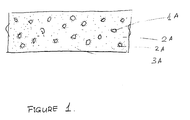
- Figure 1 shows a perspective view of the cross-section of the polymer sheeting.
- the significant elements in the sheeting are the photo-transforming particle, item 1a, and the light-stabilizing additive, item 2a.
- the bulk of the high-density polyethylene is also shown, item 3a.
- the polyethylene which represents more than 98.5% of the polymer sheeting mass, is doped with a powder composition of inorganic photo-transforming additive (PTA) and light-stabilizing additive (LSA) powders.
- PTA inorganic photo-transforming additive
- LSA light-stabilizing additive
- the homogenized composition of PTA and LSA materials is fed through a dosing mechanism into the melt where it is spread uniformly in the polyethylene by both stirring and Stokes precipitation. It is likely that the physically absorbed quaternary aminosuccinate, which is weakly coupled with the surface of the inorganic PTA-yttrium-europium oxysulfide----is dissolved in the melted polyethylene. However, a part of the LSA material that is chemically absorbed remains on the surface of the PTA grains as illustrated in figure 1 . The chemical absorption leads to effectiye micro-encapsulation of the PTA particles. This sharply improves uniformity of PTA dispersion in the bulk of the high-density polyethylene film fabricated from the above melt. In addition, thorough PTA dispersion improves the photo-transforming properties of the resultant polymer sheeting.
- the mechanism proposed here is not likely to be complete and comprehensive. However, it allows one to explain an observed high ly-improved-synergetic-effect of the polymer film's physical-mechanical strength with different concentrations of additives upon continuous UV irradiation of the polymeric material (see table 1).
- a 200 W xenon lamp was used to simulate the artificial UV irradiation and accelerate the aging test.
- the maximum irradiation time was 48 hours.
- Table 1 The Tensile Strength Behavior of the Five Typical Film Composition Upon UV Irradiation.
- composition of polymeric cover Concentration, Mass% Tensile strength, kg/cm 2 0 to 14 hours Tensile strength, kg/cm 2 28 hours Tensile strength, kg/cm 2 48 hours HDPE + 99.8 200 185 154 LSA 0.2 HDPE+ 99.9 150 75 40 PTA 0.1 HDPE+ 99.85 210 195 190 LSA+ 0.1 PTA 0.05 HDPE+ 99.75 222 202 195 LSA+ 0.1 PTA 0.15 HDPE+ 99.7 225 214 205 LSA+ 0.2 PTA 0.1
- Table 1 lists results of the five experiments with different concentrations of additives and measured tensile strength upon exposure to the UV xenon lamp for 14, 28 and 48 hours.
- the first experiment was performed on the polymer film with light-stabilizing additive only. It shows a significant decrease in the tensile strength upon 48 hours exposure. The tensile strength drops from 200kg/cm 2 to 154 kg/cm 2 .
- the additive used was the photo-transforming additive. The tensile strength dropped from 150 to 40 kg/cm 2 . This result is expected because no light-stabilizing agent was used.
- the third, fourth and fifth experiments show tensile strength behavior as the concentration and ratio of the two additives is vaned.
- the best result was achieved in the fifth experiment where the tensile strength decreased only slightly after a significant exposure to UV. At the same time a significant increase in the tensile strength of the polymer film is measured as result of the synergetic behavior described above.
- the initial tensile strength is 225 kg/cm 2 . It is this tensile strength result that provides the most important claim of durability and maintenance of the polymer sheeting with an appropriate PTA-LSA composition.
- a second, more complicated embodiment of the invention lies in preliminary wet mixing of the two additives (organic and inorganic) and obtaining of their homogeneous blend.
- Alcohol compositions on the basis of a primary standard composition added with dimethyl formamtde were used as a solvent---diluent, with the concentration of quaternary aminosuccinate being in the range 5-10 %.
- the composition was prepared in a set up with a reverse condenser where the mass heated up to 90- 100 C was continuously stirred. Then, the prepared composition was extruded into a chamber of the main mixer through a slit batcher at a rate of 1.5-2 kg/min and a schneck screw rotation speed of 40 to 80 rpm. The obtained mass was extruded into a granulator where the main component of an intermediate process- the master batch with the concentration of the additives up to 5%-was formed.
- the luminance intensity controlled the content of the inorganic additive in this master batch.
- the luminance intensity was correlated with the concentration of the inorganic PTA luminescent materials.
- the "wet" mixing process exhibited uniformity of distribution of the inorganic PTA material both in the first (50kg), and in the final fractions of the master batch at a level of plus or minus five percent.
- the composition of the polymer sheeting allows it to be used for at least two years, without having to replace the sheeting.
- the sheeting therefore, has excellent durability and high-maintenance qualities, as well as long-lasting photo-transforming properties.
- the use of this sheeting also accelerates the ripening period, provides for a faster crop harvest and extends the growing seasons by converting the harmful UV-light into light that enhances the crop growth, yield and quality.
- the harvest for strawberries, cucumbers, red peppers and tomatoes is Increased by at least 50%, while the vitamin content in fruits is increased and roses bloom thirty days earlier.
- the composition in the film allows also for a reduction in crop sunburns, while increasing temperature by nine to fifteen degrees Fahrenheit, and it provides frost protection to eighteen degrees Fahrenheit.
- Yttrium-europium, polyaminosuccinate and the high density polyethylene can be substituted by in respective order, other photo-transforming materials or phosphors, other light stabilizing materials and by low-density polyethylene, polyvinyl chloride or other inexpensive polymer precursor, resulting in synergy with the other two components, while yielding a mechanically strong polymer sheeting with the same excellent durability and maintenance, as well as photo-transforming properties.
- the said film is ecologically safe, non-toxic and non-flammable.
- a polymeric covering film has a thermoplastic base and a light-active inorganic filler additive based on yttrium oxysulphides and silicates.
- the composition of the filler is described by the following formula:
- the proposed polymeric covering film When excited by solar UV the proposed polymeric covering film has an intensive emission in three spectral sub-ranges: deep blue to blue, orange to red, and dark red to red and the re-emission spectrum is of a line-band character. It should be stressed once more that the re-emission spectrum of the proposed polymeric covering film is just multiline in character and occurs in three portions of the visible spectrum which is not available in all the previously proposed phototransforming films.
- the optical parameters of the polymeric covering films produced according to the invention are given in Table 1.
- the second characteristic property of the film with the fillers is that the film when excited by artificial or natural UV has a distinct blue-purple-red emission.
- Quantum energy fractions in the blue, orange, and red spectral regions depend on both a ratio between two main fillers in a polymer, and their fractions by mass in a covering film. With this, it has been found that a ratio of emitted integral intensity as well as intensity of individual lines in the blue - orange - red ranges are nonlinear in intensity relative to the amount of filler added (column 6, Table 2). For example, a sharp increase of the active blue filler fraction in the polymer (example No. 5, Table 2) up to 50% is accompanied by an increase in blue-line emitted intensity at 425 nm by 20% only.
- Table 2 also point to the inter-dependence of individual lines of the polymer emission spectrum upon a specific composition of a blue- or red-emitting pigment.
- yttrium-cerium orthosilicate results in a wide band emission centered at 425 nm.
- neodymium ions added to this pigment, the width of the main emission band decreases in its shorter wavelength part, but emission lines in the near-IR range manifest themselves.
- a mixture of cerium ions is added to the orthosilicate composition, a spectral band with its main emission lines falling at the end of the Timiryazev deep blue to blue range centered at 475nm appears on a background on the wide spectral band centered at 425 nm.
- the intensity of these emission lines has a nonlinear dependence with concentrations of cerium and thulium ions added to orthosilicate.
- Ce:Tm ratio of 3:1 to 10:1 should be considered as optimal, whereas, the co-addition of thulium and neodymium in equal proportions does not change the relationship between the bands at 425nm and 475 nm, but sharply increases the IR emission of the covering films.
- UV spectroscopy and emission of the second re-emitting filler appear much more complicated.
- the main drawback of Eu 3+ as an emitter is that it has only two intense lines at 616 nm and 626 nm and that the orange line at 585 nm far is removed from them.
- the absorption band of ⁇ -chlorophyll is not tightly "filled” with these Eu 3+ line emissions and an integral factor of spectral correspondence does not exceed 25 - 28%. Therefore, to obtain a higher correspondence (spectral fit), we optimized the emission spectrum (and, accordingly, the formula) of the second red-emitting filler. It was achieved by varying the concentrations of yttrium-europium oxysulphide added to the filler composition.
- Tb and Pr The relationship between the main activators, europium and samarium, must be maintained in the range 4:1-5:1. It is very important to point to the significance of the concentration of small active dopants such as Tb and Pr.
- Tb concentrations [Tb] ⁇ 0.01 an intense emission at near UV at 383nm and a blue band with a peak wavelength of 477nm are observed in the yttrium oxysulphide spectrum. An increase of Tb concentration lowers the intensity of these emission lines useful for the three-emission band film.
- the concentration of the main emitters in the inorganic red- and blue-emitting pigments is not the only factor that define key physical properties of the polymeric covering material.
- material's properties e.g. mechanical ones, are influenced by the concentration and grain shape of a filler added to the polymeric base composition.
- This quite uncommon experimental fact was discovered by us during production of the polymeric covering film on the basis of standard polyethylene 150-03-020 and polyethylene 159-13-02 will be described below. At first, we defined that the shape of inorganic pigment grains that caused extraordinary increases in the film tensile strength.
- T 1,150-1,175 °C
- a film was then extruded from the synthesized pigment with a constant mass ratio of polyethylene to filler. Temperatures of the extruder feeder and the edge, as well as the cooling rate with sleeve pressurization, were not constant. The test results are given in Table 4.
- an additional test condition is a special polymerophillic surface treatment of the inorganic pigment grains. This treatment was not a subject of this invention, but undoubtedly played its positive role.
- One more difficult to predict feature of the new polymeric covering films is its heat-retention property. All spectral range of solar energy passing through a covering film heat the soil in which there are seedlings or fruiting plants. A part of the solar energy is absorbed by green plants, a part is absorbed by the soil, and a part is carried-over by convective flows outside a hothouse covered with a polymeric film. If the convective part is constant, which is easy to achieve in modern skeleton hothouses, then soil temperature will be a measure of the heat-retention properties of the proposed covering films at equal values of hothouses filling.
- Optimal is a binary inorganic composition of yttrium orthosilicate doped with cerium, thulium, neodymium and yttrium-europium-samarium oxysulphide doped with terbium and praseodymium.
- an optimal complex red-blue-emitting pigment content of a base polymer lies in the range 0.08-0.2%.
- the polymeric material doped with the said additives efficiently absorbs natural solar UV. So, a covering film of 120microns thickness absorbs up to 84 - 86 % of the short wavelength light and, practically, all the absorption falls at absorption bands of the inorganic pigments. Re-emission occurs with a high quantum yield of 0.75-0.90. A spectral brightness of narrow emission bands of the inorganic dopants exceeds the corresponding spectral brightness of the solar spectrum in each specific range, which is a necessary condition for Timiryazev spectral effect to manifest itself. Besides, the polymeric covering film scatters or reflects inward the long wavelength IR radiation that promotes soil temperature increases in a hothouse. All the mentioned advantages of the covering film proposed are illustrated not only by the given tables (1-4), but by the examples below as well.
- 150 kg of polyethylene marked "158-05-20 in 2 - 4 mm granules" is loaded by a pneumatic transport into a rotary drum mixer and, at the same time, 2 kg of binary inorganic filler is added, with mass ratio between the red-emitting and blue-emitting fillers being 1:3.
- the polyethylene mixture fills is poured into an extruder where a temperature of 190°C is maintained. After complete melting of the whole mixture, the pressure in the extrusion system rises and a sleeve film is produced.
- the production rate using a standard extruder is 2 kg/min.
- the film sleeve is cooled by an air flow at a rate of 3m/s and then rolled on tightened rolls.
- the polyethylene covering film produced according to Example 1 has a thickness variation of 116 to 128 um and has sufficiently uniform mechanical and optimal properties.
- the inorganic pigment is further mixed with a light stabilizer of 4-aminosuccinate type at a mass ratio of 1:2.
- the film cloth is extruded using a previously prepared superconcentrate of a mixture of polyethylene, inorganic blue- and red-emitting fillers, and light stabilizer using ratio of 100:2:4.
- the material having a composition in accordance with the invention can be used not as a continuous integral film, but as a layer produced by a particle deposition (for example aerosol spraying) and applied on a corresponding surface.
- a particle deposition for example aerosol spraying
- the material can be applied on transparent glass, plastic (polycarbonate for example) etc. covering of a greenhouse.
- the material for the particle deposition can be formed as a powder in which individual particles can be composed of a polymeric core with blue and/or red phosphor of the present invention embedded in the core.
- the individual particles can also, to the contrary, include a core composed of blue and/or red phosphor enveloped with a polymeric microcoating.
- FIG. 2-7 A further embodiment of the invention is shown in Figures 2-7 .
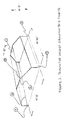
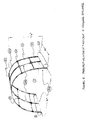
- Figure 2 is a perspective view and general arrangement drawing of a plant growing bed.
- the width is 4', the height is 4' high, and the length is 4, to 10' long.
- It is built of schedule 40 PVC pipe, fastened with 90°-45° Ls ( figure 2 , item 6), and single 90° Ts ( figure 2 item 5).
- the purpose of the growing bed is to provide a simple to assemble, lightweight, plant growing appliance with a novel light-transforming membrane for vegetable starting beds and for tomatoes and strawberries, which can be easily managed by the average homeowner.
- the frame will have a luminescent coating as a safety feature so that it will be visible at night to prevent collisions and accidents (e.g tripping and falling).
- the membrane or film described in detail herein above contains a photo-transforming additive that enhances photosynthesis by increasing conversion of the UV light spectrum.
- the luminescent additive may be included in the membrane, as well as in the frame, which will provide a still higher illumination level at nighttime.
- Figure 3 is a perspective view of fitted membrane which is made of 6-10 mil polyethylene plastic joined by heat-laminated seams over the previously mentioned frame1 anchored by two (2) water-filled bladders, each having a filling and sealing fixture.
- One such bladder is permanently affixed to the frame as a hinge and the other bladder may be fastened to the frame at will for the purpose of locking it in place.
- Figure 3A shows an inset which is a cross-section of the membrane with 20 ⁇ m particles of photo-transforming additive dispersed in it. The particle size of the the additive can vary from 50 A to 50 ⁇ m range and the partical size distribution of the photo-transforming additive can be wide or narrow.
- Figure 3B item 11, shows the Velcro fastener and Figure 3B , item 12, shows the lateral base stabilizer, the purpose of which is to show the anchoring and fastening system for the fitted membrane.
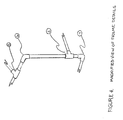
- Figure 4 is a perspective view of view of frame details.
- Figure 4 , item 5 shows the single 90°T, supporting the upper lateral frame support.
- Figure 4 , item 6, shows a 45° L as part of the end frame structure.
- Figure 4 , item 5, again shows a single 90° T, supporting a lower lateral frame support.
- Figure 4 , item 7 shows the 90° L for the lower side frame corner.
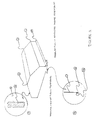
- Figure 5 is a perspective view of water ballast and fill fixture.
- Figure 5 item 2 shows the water ballast locking bag and figure 5 , item 13, shows the water ballast bag threaded plug which fits into the water ballast bag threaded filling fixture.
- Figure 6 is a perspective view of five foot plant growing appliance
- the width is 8', the height is 7'6" high, and the length is 5' to 10' long. It is built of plastic, resin pipe1 fastened with single and double 90° cross-Ts ( figure 6 , Items 18 and 19).
- the purpose of the plant growing appliance is to provide a simple to assemble, lightweight, plant growing appliance with a novel light-transforming membrane for vegetables, tomatoes, and strawberries, which can be easily managed by the average homeowner.
- the frame will have a luminescent coating as a safety feature so that it will be visible at night to prevent collisions and accidents (e.g. tripping and falling).
- the membrane or film contains a phototransforming additive that enhances photosynthesis by increasing conversion of the UV light spectrum as described hereinbefore.
- the luminescent additive may be included in the membrane, as well as the frame, which will provide a still higher illumination level at nighttime.
- Figure 6 , item 15, shows the membrane shell made with 6mil light transforming sheeting.
- Figure 6 , item 16, shows the membrane end with the wind valves, the purpose of which is to relieve pressure under severe weather conditions, as well as to enclose the structure.
- Figure 6 , item 17, shows stabilizer straps to facilitate erection and maintain the appropriate arc-radius of the appliance.
- Figure 6 , item 20 shows the radiused 1/2" plastic, resin pipe, which is laterally stabilized by figure 5 , item 21, with the 1" plastic, resin pipe.
- Figure 6 , item 22 shows the water bladder pocket, which is used to contain removal water bladders as anchor-weight stabilizers.
- FIG 7 is a perspective view of the membrane shell and water bladder of the 5 foot plant growing appliance with hinge-fastening detail.
- the membrane shell, item 15, is stabilized by two water bladders, item 23, that are contained in the water bladder pocket, item 22, prior to filling with water.
- the water bladder pocket is an integral part of the membrane shell.
- the membrane shell, figure 7 , items 15 and 16, is fastened to figure 6 , item 20A arc support, through hinged seamed sleeve as shown in figure 7 , detail Item 25.
- Figure 7 , detail item 25 shows an interlocking hinged sleeve formed by thermo-lamination, resulting in a function similar to a hinge.
- Figure 7 is a water bladder made of 6-10 mu polyethylene membrane with heat-laminated seams, containing a threaded water-filled fixture, as per figure 4 , items 13 and 14.
Landscapes
- Chemical & Material Sciences (AREA)
- Engineering & Computer Science (AREA)
- Life Sciences & Earth Sciences (AREA)
- Manufacturing & Machinery (AREA)
- Materials Engineering (AREA)
- Soil Sciences (AREA)
- Medicinal Chemistry (AREA)
- Polymers & Plastics (AREA)
- Organic Chemistry (AREA)
- Chemical Kinetics & Catalysis (AREA)
- Health & Medical Sciences (AREA)
- Environmental Sciences (AREA)
- Protection Of Plants (AREA)
- Greenhouses (AREA)
- Compositions Of Macromolecular Compounds (AREA)
- Manufacture Of Macromolecular Shaped Articles (AREA)
- Cultivation Receptacles Or Flower-Pots, Or Pots For Seedlings (AREA)
- Cultivation Of Plants (AREA)
- Laminated Bodies (AREA)
- Luminescent Compositions (AREA)
Claims (18)
- Ein dotierter Polymerfilm (3a) zum Abdecken von Treibbeeten und Gewächshäusern, aufweisend:einen lichtumwandelnden Zusatz (1a) auf der Grundlage von Yttrium-Europium-Oxysulfideinen lichtstabilisierenden Wirkstoff (2a)ein Polymerharz, das benutzt wird, um einen hochdichten Film zu bilden.
- Ein dotierter Polymerfilm (3a) wie in Anspruch 1 angegeben, worin der Inhalt besagten lichtumwandelnden Zusatzes (1a), der auf Yttrium-Europium-Oxysulfid basiert, 0,05 - 0,5% Gewichtsprozent beträgt.
- Ein dotierter Polymerfilm (3a) wie in Anspruch 1 angegeben, worin besagtes Yttrium-Europium-Oxysulfid eine Teilchengröße, die von 4 bis 20µ reicht, hat, und die Dicke der Abdeckung 1 bis 10*10-3 Zoll beträgt.
- Ein dotierter Polymerfilm (3a) wie in Anspruch 1 angegeben, worin besagte lichtstabilisierenden Wirkstoffe (2a) Polyaminosuccinat sind und sein Gehalt 0,1 - 1 Gewichtsprozent ist.
- Ein dotierter Polymerfilm (3a) wie in Anspruch 2 angegeben, worin ein Verhältnis des lichtumwandelnden Zusatzes Yttrium-Europium-Oxysulfid zum lichtstabilisierenden Wirkstoff (2a) Polyaminosuccinat in einem Bereich von 0,5:1 bis 2:1 liegt.
- Ein dotierter Polymerfilm (3a) wie in Anspruch 2 angegeben, worin besagtes Polymerharz, das benutzt wird, um hochdichten Polyäthylenfilm zu bilden, über 98,5 Gewichtsprozent in Beziehung auf die anderen beiden besagten Komponenten - der lichtumwandelnde Zusatz Yttrium-Europium-Oxysulfid und der lichtstabilisierende Wirkstoff Polyaminosuccinat - ist.
- Ein dotierter Polymerfilm (3a) wie in Anspruch 1 angegeben, worin er ökologisch sicher, ungiftig und nicht entflammbar ist.
- Ein dotierter Polymerfilm (3a) wie in Anspruch 1 angegeben, aufweisend eine thermoplastische Grundlage aus einem Polymermaterial und einen lichtaktiven anorganischen Füller, der dazu hinzugefügt ist, wobei besagter Füller ein Füller ist, der aus der Gruppe gewählt ist, die aus einem Blau aussendenden Füller, einem Rot aussendenden Füller und einer Mischung daraus besteht, mit Bestandteilen, die durch die Formel beschrieben sind
Y2-x-γ(TRα)x(TRβ)γSiO5
wobeiTrα = CeTrβ = Nd und/oder Tmx = 0,01 - 0,05y = 0,001 - 0,005die als der Blau aussendende Füller benutzt werden,
und Bestandteilen, die durch die Formel beschrieben sind
Y2-p-q-s(TRγ)p(TRδ)q(TRλ)sO2S
wobeiTr = EuTRδ = Sm und/oder PrTRλ = Tb und/oder Prp = 0,01 - 0,12q = 0,001 - 0,05s = 0,001 - 0,005die als der Rot aussendende Füller benutzt werden
mit den folgenden Verhältnissen besagter Füller in dem Polymer:-- Blau aussendender Füller 0,01 - 0,05 Massenprozent-- Rot aussendende Füller 0,05 - 0,2 Massenprozent-- Polymergrundlage der Rest. - Ein dotierter Polymerfilm (3a) wie in Anspruch 8 angegeben, worin eine Beziehung zwischen den Rot - und den Blau aussendenden Farbstoffen, optimal für Pflanzenwuchs, im Bereich 1:7 - 1:4 liegt, bei einem Massenprozent-Inhalt einer Farbstofffüllersumme in dem Bereich 0,08 - 2,5%.
- Ein dotierter Polymerfilm (3a) wie in Anspruch 8 angegeben, worin die Blau - Rot - Füllervolumendichte 0,5 - 2,5 mg/cm3 beträgt.
- Eine Vorrichtung zum Abdecken von Treibbeeten und Treibhäusern, aufweisend einen Rahmen (1) und einen dotierten Polymerfilm (3a) wie in Anspruch 1 angegeben und auf besagtem Rahmen (1) angeordnet.
- Eine Vorrichtung wie in Anspruch 11 angegeben, worin besagter Rahmen (1) querliegende seitliche Stabilisatoren aus Kunststoff, ein Harzrohr, das in 90°-Ts eingesetzt ist, zwei näherungsweise trapezoidale Endabschnitte aus Kunststoff, die Harzrohrendabschnitte mit 45°-und 90°-Winkelstücken verbunden oder ein fortlaufend gegossener Rahmen, der diese Winkel enthält, hat.
- Eine Vorrichtung wie in Anspruch 11 angegeben, worin besagter Rahmen (1) eine leuchtende Beschichtung als Sicherheitsmaßnahme hat.
- Eine Vorrichtung wie in Anspruch 11 angegeben, und weiter aufweisend Flügeltafeln, die eine Tragflächengestaltung haben und einen verminderten Windwiderstand bieten.
- Eine Vorrichtung wie in Anspruch 11 angegeben, worin besagter Film aus 6 - 10µ Polyäthylenkunststoff zusammengesetzt ist, verbunden durch hitzelaminierte Säume über besagten Rahmen (1) und durch wassergefüllte frisch spannungsbeladene Blasen stabilisiert, von denen jede einen Füll - und Verschlussanschluss hat; und eine Befestigung, die dauerhaft an dem Rahmen als eine Angel befestigt ist.
- Eine Vorrichtung wie in Anspruch 11 angegeben, und weiter aufweisend eine andere Befestigung, die an besagtem Rahmen zur Stabilisierung befestigt ist.
- Ein dotierter Polymerfilm (3a) zum Abdecken von Treibhäusern, aufweisend eine Schicht, die auf einer Treibhausabdeckung durch Ablagerung eines Pulvers von Teilchen einschließend den lichtumwandelnden Zusatz (1a), den lichtstabilisierenden Wirkstoff (2a) und das Polymerharz des Films des Anspruchs 1, angebracht ist.
- Ein dotierter Polymerfilm (3a) wie in Anspruch 1 angegeben, worin jedes der Teilchen einen Teil, der einen Kern, und einen anderen Teil der eine Mikrobeschichtung bildet, aufweist, wobei der Zusatz einen der Teile bildet, während das Harz den anderen Teil bildet.
Priority Applications (1)
| Application Number | Priority Date | Filing Date | Title |
|---|---|---|---|
| CY20091100389T CY1108959T1 (el) | 1998-10-26 | 2009-04-02 | Επικαλυψη θερμοστρωμνων και θερμοκηπιων |
Applications Claiming Priority (3)
| Application Number | Priority Date | Filing Date | Title |
|---|---|---|---|
| US178542 | 1988-04-07 | ||
| US09/178,542 US6153665A (en) | 1998-10-26 | 1998-10-26 | Doped polymer sheeting for covering hotbeds and greenhouses and method of fabrication of such |
| PCT/US1999/016036 WO2000024243A1 (en) | 1998-10-26 | 1999-07-12 | Covering of hotbeds and greenhouses |
Publications (3)
| Publication Number | Publication Date |
|---|---|
| EP1124409A1 EP1124409A1 (de) | 2001-08-22 |
| EP1124409A4 EP1124409A4 (de) | 2005-06-15 |
| EP1124409B1 true EP1124409B1 (de) | 2009-01-07 |
Family
ID=22652958
Family Applications (1)
| Application Number | Title | Priority Date | Filing Date |
|---|---|---|---|
| EP99935595A Expired - Lifetime EP1124409B1 (de) | 1998-10-26 | 1999-07-12 | Andeckung von frühbeeten und gewächshäusern |
Country Status (12)
| Country | Link |
|---|---|
| US (1) | US6153665A (de) |
| EP (1) | EP1124409B1 (de) |
| AT (1) | ATE419746T1 (de) |
| AU (1) | AU5104099A (de) |
| CA (1) | CA2348943C (de) |
| CY (1) | CY1108959T1 (de) |
| DE (1) | DE69940266D1 (de) |
| DK (1) | DK1124409T3 (de) |
| ES (1) | ES2320716T3 (de) |
| MX (1) | MXPA01004165A (de) |
| PT (1) | PT1124409E (de) |
| WO (1) | WO2000024243A1 (de) |
Families Citing this family (19)
| Publication number | Priority date | Publication date | Assignee | Title |
|---|---|---|---|---|
| CA2312871A1 (en) | 1997-11-25 | 1999-06-03 | Robert Nikolaevich Schelokov | Light-converting material and composition for producing the same |
| RU2229496C2 (ru) * | 2001-08-14 | 2004-05-27 | Государственное образовательное учреждение Высшего профессионального образования "Томский государственный университет" | Полимерная композиция для изготовления пленочного покрытия |
| DE102004037291B4 (de) * | 2004-07-29 | 2006-10-26 | Grafe Color Batch Gmbh | Verwendung von thermoplastischen Erzeugnissen für Außenanwendungen im Agrarbereich |
| FR2893945B1 (fr) * | 2005-11-29 | 2011-04-22 | Extrusion Du Polyethylene A Barbier & Cie Soc D | Films de couverture de serre fluorescents |
| JP5370148B2 (ja) | 2007-04-06 | 2013-12-18 | 旭硝子株式会社 | 波長変換フィルム、農業用フィルムおよび構造物 |
| GB2453953A (en) * | 2007-10-23 | 2009-04-29 | Univ Brunel | Protection of plastics using UV-absorbing phosphors |
| RU2435363C1 (ru) * | 2010-03-01 | 2011-12-10 | Общество с ограниченной ответственностью "Томскнефтехим" (ООО "Томскнефтехим") | Светокорректирующая полимерная пленка и композиция для ее получения |
| US20110236958A1 (en) * | 2010-03-23 | 2011-09-29 | Lan Wong | Multistory Bioreaction System for Enhancing Photosynthesis |
| US8222025B2 (en) * | 2010-03-23 | 2012-07-17 | Lan Wong | Multistory bioreaction system for enhancing photosynthesis |
| CN101810115B (zh) * | 2010-04-15 | 2011-08-17 | 林智勇 | 农田保温帘 |
| RU2581094C2 (ru) * | 2014-02-20 | 2016-04-10 | ОБЩЕСТВО С ОГРАНИЧЕННОЙ ОТВЕТСТВЕННОСТЬЮ "Некс-Т" | Флуоресцирующая полимерная пленка |
| RU2581093C2 (ru) * | 2014-02-20 | 2016-04-10 | ОБЩЕСТВО С ОГРАНИЧЕННОЙ ОТВЕТСТВЕННОСТЬЮ "Некс-Т" | Способ изготовления флуоресцирующей полимерной пленки |
| CN105265230A (zh) * | 2014-07-22 | 2016-01-27 | 天津市宝坻区蔬菜技术推广中心 | 一种用于设施蔬菜增温保温的工艺 |
| CN106633779A (zh) * | 2016-12-30 | 2017-05-10 | 量子光电科技(天津)有限公司 | 光合隔热阳光板及其制备方法 |
| CN108307884B (zh) * | 2018-03-30 | 2024-04-26 | 孙琪 | 一种组装式保温透气大棚膜 |
| MA56296B1 (fr) * | 2019-10-11 | 2022-11-30 | Solvay | Utilisation de silicates dans un film pour serre pour augmenter le développement de fruits de plantes |
| RU2768468C1 (ru) * | 2020-12-01 | 2022-03-24 | ОБЩЕСТВО С ОГРАНИЧЕННОЙ ОТВЕТСТВЕННОСТЬЮ "Фотонные Технологические Системы" | Люминесцентная полимерная композитная пленка для визуализации ультрафиолетового, видимого и инфракрасного излучения |
| DE202022000499U1 (de) | 2022-02-26 | 2022-04-26 | Institut für Agrar- und Stadtökologische Projekte an der Humboldt-Universität zu Berlin (IASP) | Rotlicht reflektierende Mehrschichtfolie für die optimierte Pflanzenanzucht |
| US20260248129A1 (en) * | 2023-06-22 | 2026-08-27 | Sensei Ag Holdings, Inc. | Sprayable substances for photosynthesis enhancement |
Family Cites Families (10)
| Publication number | Priority date | Publication date | Assignee | Title |
|---|---|---|---|---|
| IT594312A (de) * | 1957-08-01 | 1900-01-01 | ||
| LU52620A1 (de) * | 1965-12-21 | 1967-02-20 | ||
| US4490502A (en) * | 1979-05-15 | 1984-12-25 | Sumitomo Chemical Company, Limited | Agricultural plastic film |
| IL72879A (en) * | 1984-09-06 | 1988-12-30 | Ginegar Kibbutz | Plastic sheeting |
| US4622950A (en) * | 1985-01-29 | 1986-11-18 | George Greenbaum | Solamar II |
| DE69214780T2 (de) * | 1991-12-11 | 1997-05-15 | Agfa Gevaert Nv | Methode zur Herstellung eines radiographischen Schirmes |
| DE4424817A1 (de) * | 1994-07-14 | 1996-01-18 | Basf Ag | Vernetzte Polymerteilchen mit Fluoreszenzfarbstoff |
| US5815991A (en) * | 1995-09-15 | 1998-10-06 | De Ridder; Dick Nicolaas | Inflatable building construction |
| US5919552A (en) * | 1997-05-07 | 1999-07-06 | Xerox Corporation | Coated substrates and methods |
| CA2312871A1 (en) * | 1997-11-25 | 1999-06-03 | Robert Nikolaevich Schelokov | Light-converting material and composition for producing the same |
-
1998
- 1998-10-26 US US09/178,542 patent/US6153665A/en not_active Expired - Fee Related
-
1999
- 1999-07-12 AT AT99935595T patent/ATE419746T1/de not_active IP Right Cessation
- 1999-07-12 MX MXPA01004165A patent/MXPA01004165A/es unknown
- 1999-07-12 PT PT99935595T patent/PT1124409E/pt unknown
- 1999-07-12 DE DE69940266T patent/DE69940266D1/de not_active Expired - Fee Related
- 1999-07-12 AU AU51040/99A patent/AU5104099A/en not_active Abandoned
- 1999-07-12 EP EP99935595A patent/EP1124409B1/de not_active Expired - Lifetime
- 1999-07-12 CA CA002348943A patent/CA2348943C/en not_active Expired - Fee Related
- 1999-07-12 WO PCT/US1999/016036 patent/WO2000024243A1/en not_active Ceased
- 1999-07-12 ES ES99935595T patent/ES2320716T3/es not_active Expired - Lifetime
- 1999-07-12 DK DK99935595T patent/DK1124409T3/da active
-
2009
- 2009-04-02 CY CY20091100389T patent/CY1108959T1/el unknown
Also Published As
| Publication number | Publication date |
|---|---|
| ES2320716T3 (es) | 2009-05-27 |
| DK1124409T3 (da) | 2009-04-20 |
| CA2348943A1 (en) | 2000-05-04 |
| US6153665A (en) | 2000-11-28 |
| AU5104099A (en) | 2000-05-15 |
| PT1124409E (pt) | 2009-04-08 |
| CA2348943C (en) | 2005-02-22 |
| EP1124409A4 (de) | 2005-06-15 |
| DE69940266D1 (de) | 2009-02-26 |
| ATE419746T1 (de) | 2009-01-15 |
| EP1124409A1 (de) | 2001-08-22 |
| MXPA01004165A (es) | 2003-06-06 |
| CY1108959T1 (el) | 2014-07-02 |
| WO2000024243A1 (en) | 2000-05-04 |
Similar Documents
| Publication | Publication Date | Title |
|---|---|---|
| CA2348943C (en) | Covering of hotbeds and greenhouses | |
| KR100540268B1 (ko) | 광변환 물질 및 이를 제조하기 위한 조성물 | |
| CN109251488B (zh) | 一种可生物降解的转光膜及其制备方法 | |
| CN113302259A (zh) | 调节生物细胞状态的方法 | |
| CN109220420A (zh) | 一种高强度三层双色农用地膜及其制备方法 | |
| US20100307055A1 (en) | Protection of plastics | |
| US4189866A (en) | Polymer-optical brightener combinations in transparent film form useful as glazing materials capable of modifying plant growth rate | |
| US3896585A (en) | Furnace or thermal black in degradable agricultural mulch | |
| WO2009008562A1 (en) | Optically active inorganic additive and light transforming film including the additive | |
| KR100799224B1 (ko) | 긴 잔광을 얻을 수 있는 광전환 필름 | |
| CN1122814A (zh) | 转光薄膜 | |
| JPH08252882A (ja) | 波長変換資材 | |
| CN118752822A (zh) | 一种转光农膜的制备方法 | |
| Liu et al. | The application of phosphor in agricultural field | |
| RU2127511C1 (ru) | Композиция пленочного полимерного материала для покрытия теплиц и оптический активатор для полимерного материала (варианты) | |
| RU2053247C1 (ru) | Полимерная композиция для изготовления сельскохозяйственных пленок | |
| EP3657944A2 (de) | Sonnenschutzzusammensetzung für landwirtschaftliche produkte | |
| CN107722330A (zh) | 一种高效的保温农用塑料棚膜的制备方法 | |
| RU2609801C2 (ru) | Полимерная композиция для производства укрывного материала теплиц (варианты) | |
| RU2799902C1 (ru) | Способ получения структурного поликарбонатного листа | |
| DE102004037291B4 (de) | Verwendung von thermoplastischen Erzeugnissen für Außenanwendungen im Agrarbereich | |
| RU2160289C2 (ru) | Светотрансформирующий полимерный материал | |
| KR20070075014A (ko) | 광 변환 그린하우스 필름용 광 활성 무기첨가제 및 이를함유하는 그린하우스 필름 | |
| CN110467800A (zh) | 一种用于猕猴桃种植的纳米转光棚膜的制备方法 | |
| CN100429267C (zh) | 一种高效调光剂及其在棚室栽培中的应用 |
Legal Events
| Date | Code | Title | Description |
|---|---|---|---|
| PUAI | Public reference made under article 153(3) epc to a published international application that has entered the european phase |
Free format text: ORIGINAL CODE: 0009012 |
|
| 17P | Request for examination filed |
Effective date: 20010426 |
|
| AK | Designated contracting states |
Kind code of ref document: A1 Designated state(s): AT BE CH CY DE DK ES FI FR GB GR IE IT LI LU MC NL PT SE |
|
| A4 | Supplementary search report drawn up and despatched |
Effective date: 20050504 |
|
| RIC1 | Information provided on ipc code assigned before grant |
Ipc: 7A 01G 9/14 B Ipc: 7A 01G 7/00 A |
|
| 17Q | First examination report despatched |
Effective date: 20071029 |
|
| REG | Reference to a national code |
Ref country code: SE Ref legal event code: TRGR |
|
| GRAP | Despatch of communication of intention to grant a patent |
Free format text: ORIGINAL CODE: EPIDOSNIGR1 |
|
| GRAS | Grant fee paid |
Free format text: ORIGINAL CODE: EPIDOSNIGR3 |
|
| GRAA | (expected) grant |
Free format text: ORIGINAL CODE: 0009210 |
|
| AK | Designated contracting states |
Kind code of ref document: B1 Designated state(s): AT BE CH CY DE DK ES FI FR GB GR IE IT LI LU MC NL PT SE |
|
| REG | Reference to a national code |
Ref country code: GB Ref legal event code: FG4D |
|
| REG | Reference to a national code |
Ref country code: CH Ref legal event code: EP |
|
| REG | Reference to a national code |
Ref country code: IE Ref legal event code: FG4D |
|
| REF | Corresponds to: |
Ref document number: 69940266 Country of ref document: DE Date of ref document: 20090226 Kind code of ref document: P |
|
| REG | Reference to a national code |
Ref country code: CH Ref legal event code: NV Representative=s name: FIAMMENGHI-FIAMMENGHI |
|
| REG | Reference to a national code |
Ref country code: PT Ref legal event code: SC4A Free format text: AVAILABILITY OF NATIONAL TRANSLATION Effective date: 20090331 |
|
| REG | Reference to a national code |
Ref country code: DK Ref legal event code: T3 |
|
| REG | Reference to a national code |
Ref country code: GR Ref legal event code: EP Ref document number: 20090401012 Country of ref document: GR |
|
| REG | Reference to a national code |
Ref country code: ES Ref legal event code: FG2A Ref document number: 2320716 Country of ref document: ES Kind code of ref document: T3 |
|
| PGFP | Annual fee paid to national office [announced via postgrant information from national office to epo] |
Ref country code: PT Payment date: 20090616 Year of fee payment: 11 |
|
| PGFP | Annual fee paid to national office [announced via postgrant information from national office to epo] |
Ref country code: IE Payment date: 20090708 Year of fee payment: 11 Ref country code: FR Payment date: 20090729 Year of fee payment: 11 Ref country code: DK Payment date: 20090708 Year of fee payment: 11 |
|
| PLBE | No opposition filed within time limit |
Free format text: ORIGINAL CODE: 0009261 |
|
| STAA | Information on the status of an ep patent application or granted ep patent |
Free format text: STATUS: NO OPPOSITION FILED WITHIN TIME LIMIT |
|
| PGFP | Annual fee paid to national office [announced via postgrant information from national office to epo] |
Ref country code: SE Payment date: 20090727 Year of fee payment: 11 Ref country code: GB Payment date: 20090507 Year of fee payment: 11 Ref country code: FI Payment date: 20090720 Year of fee payment: 11 Ref country code: DE Payment date: 20090729 Year of fee payment: 11 Ref country code: CH Payment date: 20090717 Year of fee payment: 11 Ref country code: AT Payment date: 20090728 Year of fee payment: 11 |
|
| 26N | No opposition filed |
Effective date: 20091008 |
|
| PG25 | Lapsed in a contracting state [announced via postgrant information from national office to epo] |
Ref country code: MC Free format text: LAPSE BECAUSE OF NON-PAYMENT OF DUE FEES Effective date: 20090731 |
|
| PGFP | Annual fee paid to national office [announced via postgrant information from national office to epo] |
Ref country code: IT Payment date: 20090724 Year of fee payment: 11 |
|
| PGFP | Annual fee paid to national office [announced via postgrant information from national office to epo] |
Ref country code: GR Payment date: 20090730 Year of fee payment: 11 |
|
| PGFP | Annual fee paid to national office [announced via postgrant information from national office to epo] |
Ref country code: NL Payment date: 20100730 Year of fee payment: 12 Ref country code: ES Payment date: 20100715 Year of fee payment: 12 |
|
| PGFP | Annual fee paid to national office [announced via postgrant information from national office to epo] |
Ref country code: CY Payment date: 20100423 Year of fee payment: 12 |
|
| REG | Reference to a national code |
Ref country code: PT Ref legal event code: MM4A Free format text: LAPSE DUE TO NON-PAYMENT OF FEES Effective date: 20110112 |
|
| PGFP | Annual fee paid to national office [announced via postgrant information from national office to epo] |
Ref country code: BE Payment date: 20100803 Year of fee payment: 12 |
|
| REG | Reference to a national code |
Ref country code: CH Ref legal event code: PL |
|
| GBPC | Gb: european patent ceased through non-payment of renewal fee |
Effective date: 20100712 |
|
| REG | Reference to a national code |
Ref country code: FR Ref legal event code: ST Effective date: 20110331 |
|
| PG25 | Lapsed in a contracting state [announced via postgrant information from national office to epo] |
Ref country code: LI Free format text: LAPSE BECAUSE OF NON-PAYMENT OF DUE FEES Effective date: 20100731 Ref country code: LU Free format text: LAPSE BECAUSE OF NON-PAYMENT OF DUE FEES Effective date: 20090712 Ref country code: DE Free format text: LAPSE BECAUSE OF NON-PAYMENT OF DUE FEES Effective date: 20110201 Ref country code: CH Free format text: LAPSE BECAUSE OF NON-PAYMENT OF DUE FEES Effective date: 20100731 |
|
| REG | Reference to a national code |
Ref country code: DE Ref legal event code: R119 Ref document number: 69940266 Country of ref document: DE Effective date: 20110201 |
|
| PG25 | Lapsed in a contracting state [announced via postgrant information from national office to epo] |
Ref country code: FR Free format text: LAPSE BECAUSE OF NON-PAYMENT OF DUE FEES Effective date: 20100802 Ref country code: FI Free format text: LAPSE BECAUSE OF NON-PAYMENT OF DUE FEES Effective date: 20100712 Ref country code: AT Free format text: LAPSE BECAUSE OF NON-PAYMENT OF DUE FEES Effective date: 20100712 Ref country code: PT Free format text: LAPSE BECAUSE OF NON-PAYMENT OF DUE FEES Effective date: 20110112 Ref country code: IT Free format text: LAPSE BECAUSE OF NON-PAYMENT OF DUE FEES Effective date: 20100712 |
|
| PG25 | Lapsed in a contracting state [announced via postgrant information from national office to epo] |
Ref country code: GR Free format text: LAPSE BECAUSE OF NON-PAYMENT OF DUE FEES Effective date: 20110202 |
|
| PG25 | Lapsed in a contracting state [announced via postgrant information from national office to epo] |
Ref country code: GB Free format text: LAPSE BECAUSE OF NON-PAYMENT OF DUE FEES Effective date: 20100712 Ref country code: IE Free format text: LAPSE BECAUSE OF NON-PAYMENT OF DUE FEES Effective date: 20100712 |
|
| REG | Reference to a national code |
Ref country code: DK Ref legal event code: EBP |
|
| BERE | Be: lapsed |
Owner name: GENERAL PHOSPHORIX LLC Effective date: 20110731 |
|
| REG | Reference to a national code |
Ref country code: NL Ref legal event code: V1 Effective date: 20120201 |
|
| PG25 | Lapsed in a contracting state [announced via postgrant information from national office to epo] |
Ref country code: BE Free format text: LAPSE BECAUSE OF NON-PAYMENT OF DUE FEES Effective date: 20110731 |
|
| PG25 | Lapsed in a contracting state [announced via postgrant information from national office to epo] |
Ref country code: NL Free format text: LAPSE BECAUSE OF NON-PAYMENT OF DUE FEES Effective date: 20120201 |
|
| PG25 | Lapsed in a contracting state [announced via postgrant information from national office to epo] |
Ref country code: CY Free format text: LAPSE BECAUSE OF NON-PAYMENT OF DUE FEES Effective date: 20110712 |
|
| PG25 | Lapsed in a contracting state [announced via postgrant information from national office to epo] |
Ref country code: DK Free format text: LAPSE BECAUSE OF NON-PAYMENT OF DUE FEES Effective date: 20100802 |
|
| PG25 | Lapsed in a contracting state [announced via postgrant information from national office to epo] |
Ref country code: SE Free format text: LAPSE BECAUSE OF NON-PAYMENT OF DUE FEES Effective date: 20100713 |
|
| REG | Reference to a national code |
Ref country code: ES Ref legal event code: FD2A Effective date: 20130605 |
|
| PG25 | Lapsed in a contracting state [announced via postgrant information from national office to epo] |
Ref country code: ES Free format text: LAPSE BECAUSE OF NON-PAYMENT OF DUE FEES Effective date: 20110713 |
|
| REG | Reference to a national code |
Ref country code: GR Ref legal event code: ML Ref document number: 20090401012 Country of ref document: GR Effective date: 20110202 |