EP1123584B1 - Cancellation of pilot and unwanted traffic signals in a cdma system - Google Patents
Cancellation of pilot and unwanted traffic signals in a cdma system Download PDFInfo
- Publication number
- EP1123584B1 EP1123584B1 EP99904397A EP99904397A EP1123584B1 EP 1123584 B1 EP1123584 B1 EP 1123584B1 EP 99904397 A EP99904397 A EP 99904397A EP 99904397 A EP99904397 A EP 99904397A EP 1123584 B1 EP1123584 B1 EP 1123584B1
- Authority
- EP
- European Patent Office
- Prior art keywords
- output
- signal
- traffic signal
- coupled
- pilot
- Prior art date
- Legal status (The legal status is an assumption and is not a legal conclusion. Google has not performed a legal analysis and makes no representation as to the accuracy of the status listed.)
- Expired - Lifetime
Links
- 238000004891 communication Methods 0.000 claims abstract description 13
- 238000001228 spectrum Methods 0.000 description 8
- 238000010586 diagram Methods 0.000 description 7
- 238000012545 processing Methods 0.000 description 6
- 230000005540 biological transmission Effects 0.000 description 4
- 230000000694 effects Effects 0.000 description 4
- 238000000034 method Methods 0.000 description 3
- 238000005516 engineering process Methods 0.000 description 2
- 230000010363 phase shift Effects 0.000 description 2
- 238000013459 approach Methods 0.000 description 1
- 238000006243 chemical reaction Methods 0.000 description 1
- 230000001427 coherent effect Effects 0.000 description 1
- 230000003247 decreasing effect Effects 0.000 description 1
- 230000001934 delay Effects 0.000 description 1
- 238000001914 filtration Methods 0.000 description 1
- 230000002452 interceptive effect Effects 0.000 description 1
- 238000012986 modification Methods 0.000 description 1
- 230000004048 modification Effects 0.000 description 1
Images

Classifications
-
- H—ELECTRICITY
- H04—ELECTRIC COMMUNICATION TECHNIQUE
- H04B—TRANSMISSION
- H04B1/00—Details of transmission systems, not covered by a single one of groups H04B3/00 - H04B13/00; Details of transmission systems not characterised by the medium used for transmission
- H04B1/69—Spread spectrum techniques
- H04B1/707—Spread spectrum techniques using direct sequence modulation
- H04B1/7097—Interference-related aspects
- H04B1/7103—Interference-related aspects the interference being multiple access interference
-
- H—ELECTRICITY
- H04—ELECTRIC COMMUNICATION TECHNIQUE
- H04B—TRANSMISSION
- H04B1/00—Details of transmission systems, not covered by a single one of groups H04B3/00 - H04B13/00; Details of transmission systems not characterised by the medium used for transmission
- H04B1/69—Spread spectrum techniques
- H04B1/707—Spread spectrum techniques using direct sequence modulation
- H04B1/7097—Interference-related aspects
- H04B1/7103—Interference-related aspects the interference being multiple access interference
- H04B1/7107—Subtractive interference cancellation
-
- H—ELECTRICITY
- H04—ELECTRIC COMMUNICATION TECHNIQUE
- H04B—TRANSMISSION
- H04B1/00—Details of transmission systems, not covered by a single one of groups H04B3/00 - H04B13/00; Details of transmission systems not characterised by the medium used for transmission
- H04B1/69—Spread spectrum techniques
- H04B1/707—Spread spectrum techniques using direct sequence modulation
- H04B1/7097—Interference-related aspects
- H04B1/7103—Interference-related aspects the interference being multiple access interference
- H04B1/7107—Subtractive interference cancellation
- H04B1/71075—Parallel interference cancellation
-
- H—ELECTRICITY
- H04—ELECTRIC COMMUNICATION TECHNIQUE
- H04B—TRANSMISSION
- H04B1/00—Details of transmission systems, not covered by a single one of groups H04B3/00 - H04B13/00; Details of transmission systems not characterised by the medium used for transmission
- H04B1/69—Spread spectrum techniques
- H04B1/707—Spread spectrum techniques using direct sequence modulation
- H04B1/7097—Interference-related aspects
-
- H—ELECTRICITY
- H04—ELECTRIC COMMUNICATION TECHNIQUE
- H04B—TRANSMISSION
- H04B2201/00—Indexing scheme relating to details of transmission systems not covered by a single group of H04B3/00 - H04B13/00
- H04B2201/69—Orthogonal indexing scheme relating to spread spectrum techniques in general
- H04B2201/707—Orthogonal indexing scheme relating to spread spectrum techniques in general relating to direct sequence modulation
- H04B2201/70701—Orthogonal indexing scheme relating to spread spectrum techniques in general relating to direct sequence modulation featuring pilot assisted reception
Definitions
- the present invention relates generally to digital communications. More specifically, the invention relates to a system and method which cancels the global pilot signal and unwanted traffic signals from a received code division multiple access signal thereby removing them as interferers prior to decoding.
- CDMA code divisional multiple access
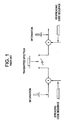
- Shown in Figure 1 is a simplified, single channel CDMA communication system.
- a data signal with a given bandwidth is mixed with a spreading code generated by a pn sequence generator producing a digital spread spectrum signal.
- the signal which carries data for a specific channel is known as a traffic signal.
- the data is reproduced after correlation with the same pn sequence used to transmit the data. Every other signal within the transmission bandwidth appears as noise to the signal being despread.
- an unmodulated traffic signal known as a pilot signal is required for every transmitter.
- the pilot signal allows respective receivers to synchronize with a given transmitter, allowing despreading of a traffic signal at the receiver.
- a base station communicates with a plurality of individual subscribers fixed or mobile.
- the base station which transmits many signals, transmits a global pilot signal common to the plurality of users serviced by that particular base station at a higher power level.
- the global pilot is used for the initial acquisition of an individual user and for the user to obtain signal-estimates for coherent reception and for the combining of multipath components during reception.
- each subscriber transmits a unique assigned pilot for communicating with the base station.
- the global pilot and traffic signals are noise to a traffic signal being despread. If the global pilot and all unwanted traffic signals could be removed prior to despreading a desired signal, much of the overall noise would be reduced, decreasing the bit error rate and in turn, improve the signal-to-noise ratio (SNR) of the despread signal.
- SNR signal-to-noise ratio
- U.S. Patent No. 5,224,122 to Brackert discloses a spread-spectrum noise canceler which cancels a portion of spread-spectrum noise signal in the received signal by generating an estimated signal by spreading the known signal. Subsequently, the known signal is processed out of the received spread-spectrum signal by subtracting the estimated signal from the demodulated form of the received spread-spectrum signal. Where the estimated signals is generated based on the amplitude and the phase information of the known signals received from a base station in a primary serving cell, and the amplitudes information from the noise of multipath signal and the noise signal from a secondary serving cell.
- WO 98 43362 to Yellin et al. from which the preamble of claim 1 has been derived discloses a CDMA noise canceler by detecting at least one noisy user signal from a spread-spectrum signal and removing the noise of pilot signal and its interference effect the particular user signal.
- the strength value is not an accurate characteristic for calculating interference due to the plurality of received signals with different time delays caused by reflections due to terrain. Multipath propagation makes power level estimates unreliable.
- the present invention reduces the contributive noise effects of the global pilot signal and unwanted traffic signals transmitted in a spread spectrum communication system.
- the present invention effectively cancels the global pilot and unwanted traffic signal(s) from a desired traffic signal at a receiver prior to decoding.
- the resulting signal has an increased signal-to-noise ratio.
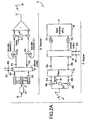
- a B-CDMATM communication system 17 as shown in Figure 2 includes a transmitter 19 and a receiver 21 , which may reside in either a base station or a mobile user receiver.
- the transmitter 19 includes a signal processor 23 which encodes voice and nonvoice signals 25 into data at various bit rates.
- the input data which can be considered a bi-phase modulated signal is encoded using forward error-correcting coding (FEC) 27 .
- FEC forward error-correcting coding
- One signal is designated the in-phase channel I 33x .
- the other signal is designated the quadrature channel Q 33y .
- Bi-phase modulated I and Q signals are usually referred to as quadrature phase shift keying (QPSK).
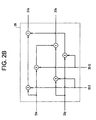
- the two bi-phase modulated data or symbols 33x, 33y are spread with a complex, pseudo-noise (pn) sequence 35I, 35Q using a complex number multiplier 39 .
- pn pseudo-noise
- the operation of a complex number multiplier 39 is shown in Figure 2B and is well understood in the art.
- the resulting I 37a and Q 37b spread signals are combined 45a, 45b with other spread signals (channels) having different spreading codes, multiplied (mixed) with a carrier signal 43 , and transmitted 47 .
- the transmission 47 may contain a plurality of individual signals.
- the receiver 21 includes a demodulator 49a , 49b which mixes down the transmitted broadband signal 47 with the transmitting carrier 43 into an intermediate carrier frequency 51a, 51b . A second down conversion reduces the signal to baseband.
- the QPSK signal 55a, 55b is then filtered 53 and mixed 56 with the locally generated complex pn sequence 35I, 35Q which matches the conjugate of the transmitted complex code. Only the original signals which were spread by the same code will be despread. All other signals will appear as noise to the receiver 21 .
- the data 57x , 57y is coupled to a signal processor 59 where FEC decoding is performed on the convolutionally encoded data.
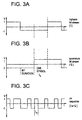
- a QPSK symbol consists of one bit each from both the in-phase ( I ) and quadrature ( Q ) signals.
- the bits may represent a quantized version of an analog sample or digital data. It can be seen that symbol duration t s is equal to bit duration.
- the transmitted symbols are spread by multiplying the QPSK symbol stream by the complex pn sequence.
- Both the I and Q pn sequences are comprised of a bit stream generated at a much higher frequency, typically 100 to 200 times the symbol rate.
- One such pn sequence is shown in Figure 3C .
- the complex pn sequence is mixed with the symbol bit stream producing the digital spread signal (as previously discussed).
- the components of the spread signal are known as chips having a much smaller duration t c .
- the baseband signal When the signal is received and demodulated, the baseband signal is at the chip level.
- the I and Q components of the signal are despread using the conjugate of the pn sequence used during spreading, the signal returns to the symbol level.
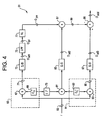
- a global pilot signal cancellation system 61 is shown in Figure 4 .
- the noise n includes all received noise and interference including all other traffic signals.
- the system 61 To cancel the global pilot signal from the received signal r , the system 61 must derive the signal strength of the pilot code ⁇ where: ⁇ ⁇ ⁇ since the global pilot is transmitted at a higher power level than a traffic signal.
- the received baseband signal r is input 63 into the pilot signal cancellation system 61 and into a pilot despreader 65 which despreads the pilot signal from the received signal r .
- a complex conjugate is one of a pair of complex numbers with identical real parts and with imaginary parts differing only in sign.
- the despread pilot signal 71 is coupled to a first sum and dump processor 73 where it is summed over time.
- the sum and dump 73 output O sd1 is coupled to a low pass filter 75 .
- the low pass filter 75 determines the mean value for each signal component.
- the mean value for pilot-traffic cross-correlation is zero and so is the mean value of the noise n . Therefore, after filtering 75 , the second and third terms in Equation (6) become zero.
- the low pass filter 75 output O lpf is coupled to a processing means 77 to derive the pilot code strength ⁇ .
- the processing means 77 calculates ⁇ by dividing the low pass filter 79 output O lpf by L .
- the pilot spreading code c * / p complex conjugate generator 69 is coupled to a complex conjugate processor 79 yielding the pilot spreading code c p .
- the pilot spreading code c p is input to a second mixer 81 and mixed with the output of a traffic spreading code c * / t complex conjugate generator 83 .
- the resulting product from the second mixer 81 output is coupled to a second sum and dump processor 85 .
- the output O sd2 of the second sum and dump processor 85 is ⁇ c p c * / t and is combined with ⁇ at a third mixer 87 .
- the third mixer 87 output 89 is ⁇ c p c * / t
- the received signal r is also despread by traffic despreader 91 .
- the traffic despreader 91 output 95 is coupled to a third sum and dump 97 .
- L is the product of the traffic spreading code c t and the complex conjugate of the traffic spreading code c * / t summed over L chips.
- the third sum and dump 97 output O sd3 is coupled to an adder 99 which subtracts the third mixer 87 output 89 .
- the invention uses a similar approach to cancel unwanted traffic signal(s) from a desired traffic signal. While traffic signals are interference to other traffic signals just as the global pilot signal is, unwanted traffic signal cancellation differs from global pilot signal cancellation since a traffic signal is modulated by the data and is therefore dynamic in nature. A global pilot signal has a constant phase, whereas a traffic signal constantly changes phase due to data modulation.
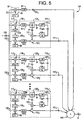
- a traffic signal canceler system 101 is shown in Figure 5 .
- the received signal r is a complex number and is comprised of the traffic code signal strength ⁇ multiplied with the traffic signal data d and the traffic code c d for the unwanted traffic signal to be canceled, summed with the desired traffic code strength ⁇ multiplied with the desired traffic code c t , summed with noise n .
- the noise n includes all received noise and interference including all other traffic signals and the global pilot signal.
- the system 101 To cancel the unwanted traffic signal(s) from the received signal r , the system 101 must derive the signal strength of the unwanted traffic code ⁇ to be subtracted and estimate the data d , where: ⁇ ⁇ d ⁇ ⁇ .
- the received baseband signal r is input 103 into the desired traffic signal despreader 91 which despreads the desired traffic signal from the received signal r .
- Desired traffic signal mixer 93 mixes the received signal r with the complex conjugate c * / t of the desired traffic pn code used during spreading.
- the despread traffic signal is coupled to a sum and dump processor 97 and summed over time.
- the traffic signal canceler system 101 shown in Figure 5 includes n unwanted traffic signal cancelers 115 1 -115 n .
- Each unwanted traffic signal canceler 115 1 -115 n comprises: an unwanted traffic signal despreader 139 1 -139 n that includes a first mixer 117 1 -117 n and an unwanted traffic signal code generator 119 1 -119 n ; second 133 1 -133 n mixer, first 121 1 -121 n and second 123 1 -123 n sum and dump processors, a hard decision processor 125 1 -125 n , a low pass filter 127 1 -127 n , a processing means 129 1 -129 n , third mixer 131 1 -131 n , a conjugate processor 135 1 -135 n , an adjustable amplifier 137 1 -137 n , and a desired traffic signal code generator 83 .
- the received signal r is input 103 into each unwanted traffic canceler 115 1 -115 n .
- the unwanted traffic signal despreader 139 1 -139 n is coupled to the input 103 where the received signal r is mixed 117 1 -117 n with the complex conjugate c d1 *-c dn * of the traffic pn sequence for each respective unwanted signal.
- the despread 139 1 -139 n traffic signal is coupled to a first sum and dump processor 121 1 -121 n where it is summed over time.
- L is the product of the unwanted traffic signal spreading code c dn and c * / dn is the complex conjugate of the unwanted traffic signal spreading code.
- the first sum and dump 121 1 -121 n output O sd1n is coupled to the hard decision processor 125 1 -125 n .
- the hard decision processor 125 1 -125 n determines the phase shift ⁇ in the data due to modulation.
- the hard decision processor 125 1 -125 n also determines the QPSK constellation position d that is closest to the despread symbol value.
- the hard decision processor 125 1 -125 n compares a received symbol p o of a signal to the four QPSK constellation points x 1,1 , x -1,1 , x -1,-1 , x 1,-1 . It is necessary to examine each received symbol p o due to corruption during transmission 47 by noise and distortion, whether multipath or radio frequency.
- the hard decision processor computes the four distances d 1 , d 2 , d 3 , d 4 to each quadrant from the received symbol p o and chooses the shortest distance d 2 and assigns that symbol d location x -1, 1 .
- the hard decision processor also derotates (rotates back) the original signal coordinate p o by a phase amount ⁇ that is equal to the phase corresponding to the selected symbol location x -1, 1 .
- the original symbol coordinate p o is discarded.
- the hard decision processor 125 1 -125 n phase output ⁇ is coupled to a low pass filter 127 1 -127 n .
- the low pass filter 127 1 -127 n determines the mean value for each signal component.
- the low pass filter 127 1 -127 n output O lpfn is coupled to the processing means 129 1 -129 n to derive the unwanted traffic signal code strength ⁇ .
- the processing means 129 1 -129 n estimates ⁇ by dividing the filter 127 1 -127 n output O lpfn by L .
- the other hard decision processor 125 1 -125 n output is data d .
- This is the data point d corresponding to the smallest of the distances d 1 , d 2 , d 3 , or d 4 as shown in Figure 6 .
- Third mixer 131 1 -131 n mixes the unwanted traffic signal strength ⁇ with each date value d .
- the unwanted traffic signal spreading code complex conjugate generator c d1 *-c dn * is coupled to the complex conjugate processor 135 1 -135 n yielding the unwanted traffic signal spreading code c d1 -c dn and is input to the second mixer 133 1 -133 n and mixed with the output of desired traffic signal spreading code complex conjugate generator c * / t .
- the product is coupled to the second sum and dump processor 123 1 -123 n .
- the second sum and dump processor 123 1 -123 n output O sd2n is ⁇ cd n c * / t and is coupled to variable amplifier 137 1 -137 n .
- Variable amplifier 137 1 -137 n amplifies the second sum and dump processor 123 1 -123 n output O sd2n in accorance with the third mixer 131 1 -131 n output which is the determined gain.
- the variable amplifier 137 1 -137 n output 141 1 -141 n is coupled to an adder 143 which subtracts the output from each variable amplifier 137 1 -137 n from the output of the desired traffic signal despreader 105 .
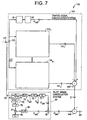
- the embodiment 145 cancelling the global pilot signal and unwanted traffic signals is shown in Figure 7 .
- the unwanted traffic cancellation system 101 includes the desired traffic signal despreader 91 and a plurality of unwanted traffic signal cancelers 115 1 -115 n .
- the traffic cancellation system is coupled in parallel with the pilot cancellation system 61 previously described, but without a desired traffic singal despreader.
- a common input 147 is coupled to both systems 101 , 61 with a common adder 149 which is coupled to the outputs O , O add from both systems 101 , 61 .
- the pilot and unwanted traffic signals are subtracted from the desired traffic signal yielding an output 151 free of interference contributions by the pilot and plurality of transmitted traffic signals.
Landscapes
- Engineering & Computer Science (AREA)
- Computer Networks & Wireless Communication (AREA)
- Signal Processing (AREA)
- Noise Elimination (AREA)
- Mobile Radio Communication Systems (AREA)
- Radio Relay Systems (AREA)
- Cable Transmission Systems, Equalization Of Radio And Reduction Of Echo (AREA)
- Traffic Control Systems (AREA)
- Circuits Of Receivers In General (AREA)
- Radar Systems Or Details Thereof (AREA)
- Dc Digital Transmission (AREA)
- Train Traffic Observation, Control, And Security (AREA)
- Selective Calling Equipment (AREA)
Priority Applications (3)
| Application Number | Priority Date | Filing Date | Title |
|---|---|---|---|
| EP09004606A EP2088682A3 (en) | 1998-10-20 | 1999-01-27 | Cancellation of pilot and unwanted traffic signals in a CDMA system |
| EP03018126A EP1376888B1 (en) | 1998-10-20 | 1999-01-27 | Cancellation of pilot and unwanted traffic signals in a CDMA system |
| EP03018127A EP1376889B1 (en) | 1998-10-20 | 1999-01-27 | Cancellation of pilot and unwanted traffic signals in a CDMA system |
Applications Claiming Priority (3)
| Application Number | Priority Date | Filing Date | Title |
|---|---|---|---|
| US09/175,174 US6498784B1 (en) | 1998-10-20 | 1998-10-20 | Cancellation of pilot and traffic signals |
| US175174 | 1998-10-20 | ||
| PCT/US1999/001883 WO2000024135A1 (en) | 1998-10-20 | 1999-01-27 | Cancellation of pilot and unwanted traffic signals in a cdma system |
Related Child Applications (2)
| Application Number | Title | Priority Date | Filing Date |
|---|---|---|---|
| EP03018127A Division EP1376889B1 (en) | 1998-10-20 | 1999-01-27 | Cancellation of pilot and unwanted traffic signals in a CDMA system |
| EP03018126A Division EP1376888B1 (en) | 1998-10-20 | 1999-01-27 | Cancellation of pilot and unwanted traffic signals in a CDMA system |
Publications (2)
| Publication Number | Publication Date |
|---|---|
| EP1123584A1 EP1123584A1 (en) | 2001-08-16 |
| EP1123584B1 true EP1123584B1 (en) | 2004-05-06 |
Family
ID=22639248
Family Applications (4)
| Application Number | Title | Priority Date | Filing Date |
|---|---|---|---|
| EP03018127A Expired - Lifetime EP1376889B1 (en) | 1998-10-20 | 1999-01-27 | Cancellation of pilot and unwanted traffic signals in a CDMA system |
| EP99904397A Expired - Lifetime EP1123584B1 (en) | 1998-10-20 | 1999-01-27 | Cancellation of pilot and unwanted traffic signals in a cdma system |
| EP03018126A Expired - Lifetime EP1376888B1 (en) | 1998-10-20 | 1999-01-27 | Cancellation of pilot and unwanted traffic signals in a CDMA system |
| EP09004606A Withdrawn EP2088682A3 (en) | 1998-10-20 | 1999-01-27 | Cancellation of pilot and unwanted traffic signals in a CDMA system |
Family Applications Before (1)
| Application Number | Title | Priority Date | Filing Date |
|---|---|---|---|
| EP03018127A Expired - Lifetime EP1376889B1 (en) | 1998-10-20 | 1999-01-27 | Cancellation of pilot and unwanted traffic signals in a CDMA system |
Family Applications After (2)
| Application Number | Title | Priority Date | Filing Date |
|---|---|---|---|
| EP03018126A Expired - Lifetime EP1376888B1 (en) | 1998-10-20 | 1999-01-27 | Cancellation of pilot and unwanted traffic signals in a CDMA system |
| EP09004606A Withdrawn EP2088682A3 (en) | 1998-10-20 | 1999-01-27 | Cancellation of pilot and unwanted traffic signals in a CDMA system |
Country Status (18)
| Country | Link |
|---|---|
| US (6) | US6498784B1 (enExample) |
| EP (4) | EP1376889B1 (enExample) |
| JP (5) | JP3527204B2 (enExample) |
| KR (1) | KR100424518B1 (enExample) |
| CN (3) | CN100583665C (enExample) |
| AT (3) | ATE396549T1 (enExample) |
| AU (4) | AU764714B2 (enExample) |
| BR (1) | BR9914658A (enExample) |
| CA (2) | CA2568247C (enExample) |
| DE (4) | DE69941098D1 (enExample) |
| DK (3) | DK1123584T3 (enExample) |
| EA (6) | EA005780B1 (enExample) |
| ES (3) | ES2329775T3 (enExample) |
| ID (1) | ID28838A (enExample) |
| IL (4) | IL142554A0 (enExample) |
| NO (3) | NO323536B1 (enExample) |
| SG (2) | SG141427A1 (enExample) |
| WO (1) | WO2000024135A1 (enExample) |
Families Citing this family (49)
| Publication number | Priority date | Publication date | Assignee | Title |
|---|---|---|---|---|
| US8352400B2 (en) | 1991-12-23 | 2013-01-08 | Hoffberg Steven M | Adaptive pattern recognition based controller apparatus and method and human-factored interface therefore |
| US7027490B2 (en) * | 1997-06-11 | 2006-04-11 | Intel Corporation | Method and apparatus for reducing spread spectrum noise |
| US6498784B1 (en) * | 1998-10-20 | 2002-12-24 | Interdigital Technology Corporation | Cancellation of pilot and traffic signals |
| US6859799B1 (en) | 1998-11-30 | 2005-02-22 | Gemstar Development Corporation | Search engine for video and graphics |
| US7966078B2 (en) | 1999-02-01 | 2011-06-21 | Steven Hoffberg | Network media appliance system and method |
| US7010061B2 (en) * | 1999-12-30 | 2006-03-07 | Infineon Technologies Ag | Configurable all-digital coherent demodulator system for spread spectrum applications |
| US7103906B1 (en) | 2000-09-29 | 2006-09-05 | International Business Machines Corporation | User controlled multi-device media-on-demand system |
| JP2004511937A (ja) | 2000-10-11 | 2004-04-15 | ユナイテッド ビデオ プロパティーズ, インコーポレイテッド | オン−デマンドメディア送達システムのサーバにおけるデータの格納を提供するシステムおよび方法 |
| CA2323164A1 (en) * | 2000-10-11 | 2002-04-11 | Ramesh Mantha | Method, system and apparatus for improving reception in multiple access communication systems |
| GB2369018A (en) * | 2000-11-10 | 2002-05-15 | Ubinetics Ltd | Control channel interference cancellation for a CDMA receiver |
| US6996159B2 (en) | 2001-05-17 | 2006-02-07 | Intel Corporation | Reducing spread spectrum noise |
| US8611311B2 (en) | 2001-06-06 | 2013-12-17 | Qualcomm Incorporated | Method and apparatus for canceling pilot interference in a wireless communication system |
| US7190749B2 (en) | 2001-06-06 | 2007-03-13 | Qualcomm Incorporated | Method and apparatus for canceling pilot interference in a wireless communication system |
| US7574723B2 (en) * | 2001-07-19 | 2009-08-11 | Macrovision Corporation | Home media network |
| US20030072282A1 (en) * | 2001-10-17 | 2003-04-17 | Ying-Chang Liang | Code division multiple access downlink receiver |
| US7236548B2 (en) * | 2001-12-13 | 2007-06-26 | Koninklijke Philips Electronics N.V. | Bit level diversity combining for COFDM system |
| US20030162573A1 (en) * | 2002-02-19 | 2003-08-28 | Jyhchau Horng | Down-link interference cancellation for high-data-rate channels in advanced digital wireless networks |
| US20070220580A1 (en) * | 2002-03-14 | 2007-09-20 | Daniel Putterman | User interface for a media convergence platform |
| KR100461543B1 (ko) | 2002-10-14 | 2004-12-16 | 한국전자통신연구원 | 다중 안테나 고속패킷전송 시스템에서 신호대 간섭비 측정장치 및 그 방법 |
| US7283532B2 (en) * | 2002-10-25 | 2007-10-16 | Alcatel Lucent | Hierarchical scheduler architecture for use with an access node |
| US8931010B2 (en) * | 2002-11-04 | 2015-01-06 | Rovi Solutions Corporation | Methods and apparatus for client aggregation of media in a networked media system |
| US7493646B2 (en) | 2003-01-30 | 2009-02-17 | United Video Properties, Inc. | Interactive television systems with digital video recording and adjustable reminders |
| US7574691B2 (en) * | 2003-03-17 | 2009-08-11 | Macrovision Corporation | Methods and apparatus for rendering user interfaces and display information on remote client devices |
| BRPI0511591A (pt) * | 2004-05-28 | 2008-01-02 | Koninkl Philips Electronics Nv | método para processar sinais digitais codificados de ofdm, processador de sinal e receptor arranjados para receber sinais digitais codificados de ofdm, dispositivo móvel, e, sistema de telecomunicação |
| US8086575B2 (en) * | 2004-09-23 | 2011-12-27 | Rovi Solutions Corporation | Methods and apparatus for integrating disparate media formats in a networked media system |
| US8099123B2 (en) * | 2004-12-23 | 2012-01-17 | Qualcomm Incorporated | Adaptation of transmit subchannel gains in a system with interference cancellation |
| US8422955B2 (en) * | 2004-12-23 | 2013-04-16 | Qualcomm Incorporated | Channel estimation for interference cancellation |
| US8406695B2 (en) | 2004-12-23 | 2013-03-26 | Qualcomm Incorporated | Joint interference cancellation of pilot, overhead and traffic channels |
| US8442441B2 (en) | 2004-12-23 | 2013-05-14 | Qualcomm Incorporated | Traffic interference cancellation |
| CN1798443B (zh) * | 2004-12-29 | 2010-04-28 | 华为技术有限公司 | 一种物理信道误码率的求取方法 |
| US7508864B2 (en) * | 2005-02-14 | 2009-03-24 | Intel Corporation | Apparatus and method of canceling interference |
| WO2006115227A1 (ja) * | 2005-04-21 | 2006-11-02 | Intellectual Property Bank Corp. | 調査対象文書の索引語抽出装置 |
| US8472877B2 (en) | 2005-10-24 | 2013-06-25 | Qualcomm Incorporated | Iterative interference cancellation system and method |
| US8385388B2 (en) | 2005-12-06 | 2013-02-26 | Qualcomm Incorporated | Method and system for signal reconstruction from spatially and temporally correlated received samples |
| US9467322B2 (en) | 2005-12-27 | 2016-10-11 | Rovi Solutions Corporation | Methods and apparatus for integrating media across a wide area network |
| US9681105B2 (en) | 2005-12-29 | 2017-06-13 | Rovi Guides, Inc. | Interactive media guidance system having multiple devices |
| US8607287B2 (en) * | 2005-12-29 | 2013-12-10 | United Video Properties, Inc. | Interactive media guidance system having multiple devices |
| US20070157240A1 (en) * | 2005-12-29 | 2007-07-05 | United Video Properties, Inc. | Interactive media guidance system having multiple devices |
| US7929551B2 (en) * | 2006-06-01 | 2011-04-19 | Rovi Solutions Corporation | Methods and apparatus for transferring media across a network using a network interface device |
| US7822399B2 (en) | 2007-05-11 | 2010-10-26 | Telefonaktiebolaget Lm Ericsson (Publ) | Image compensation for wireless receiver |
| US20090019492A1 (en) | 2007-07-11 | 2009-01-15 | United Video Properties, Inc. | Systems and methods for mirroring and transcoding media content |
| US7894555B2 (en) * | 2007-08-02 | 2011-02-22 | Telefonaktiebolaget Lm Ericsson (Publ) | IQ imbalance image suppression |
| US7986930B2 (en) * | 2007-08-02 | 2011-07-26 | Telefonaktiebolaget Lm Ericsson (Publ) | IQ imbalance image suppression in presence of unknown phase shift |
| US8601526B2 (en) | 2008-06-13 | 2013-12-03 | United Video Properties, Inc. | Systems and methods for displaying media content and media guidance information |
| US20110072452A1 (en) * | 2009-09-23 | 2011-03-24 | Rovi Technologies Corporation | Systems and methods for providing automatic parental control activation when a restricted user is detected within range of a device |
| US9014546B2 (en) | 2009-09-23 | 2015-04-21 | Rovi Guides, Inc. | Systems and methods for automatically detecting users within detection regions of media devices |
| US8805418B2 (en) | 2011-12-23 | 2014-08-12 | United Video Properties, Inc. | Methods and systems for performing actions based on location-based rules |
| US9674563B2 (en) | 2013-11-04 | 2017-06-06 | Rovi Guides, Inc. | Systems and methods for recommending content |
| US10805870B1 (en) | 2019-03-26 | 2020-10-13 | Star Solutions International Inc. | Wireless communication management system and private electronic communication network |
Family Cites Families (44)
| Publication number | Priority date | Publication date | Assignee | Title |
|---|---|---|---|---|
| JPH0693670B2 (ja) * | 1984-12-29 | 1994-11-16 | 京セラ株式会社 | スペクトラム拡散通信システム |
| US5506864A (en) * | 1990-12-05 | 1996-04-09 | Interdigital Technology Corporation | CDMA communications and geolocation system and method |
| US5235612A (en) * | 1990-12-21 | 1993-08-10 | Motorola, Inc. | Method and apparatus for cancelling spread-spectrum noise |
| US5224122A (en) * | 1992-06-29 | 1993-06-29 | Motorola, Inc. | Method and apparatus for canceling spread-spectrum noise |
| US5465413A (en) * | 1993-03-05 | 1995-11-07 | Trimble Navigation Limited | Adaptive noise cancellation |
| US5363403A (en) | 1993-04-22 | 1994-11-08 | Interdigital Technology Corporation | Spread spectrum CDMA subtractive interference canceler and method |
| US5553062A (en) | 1993-04-22 | 1996-09-03 | Interdigital Communication Corporation | Spread spectrum CDMA interference canceler system and method |
| US5740208A (en) * | 1993-06-25 | 1998-04-14 | Roke Manor Research Limited | Interference cancellation apparatus for mitigating the effects of poor affiliation between a base station and a mobile unit |
| GB2279851B (en) | 1993-07-01 | 1997-10-01 | Roke Manor Research | Threshold cancellation means for use in digital mobile radio networks |
| JP2570967B2 (ja) * | 1993-07-08 | 1997-01-16 | 日本電気株式会社 | Cdma受信機 |
| JP2938337B2 (ja) | 1994-03-09 | 1999-08-23 | 三菱電機株式会社 | スペクトル拡散通信用データ復調回路 |
| JPH0879130A (ja) | 1994-09-01 | 1996-03-22 | Oki Electric Ind Co Ltd | 受信装置及びパイロット信号除去装置 |
| ATE376284T1 (de) * | 1994-09-02 | 2007-11-15 | Matsushita Electric Industrial Co Ltd | Erkennungsvorrichtung zur modulationsgrad |
| US5724378A (en) | 1994-12-13 | 1998-03-03 | Nit Mobile Communications Network, Inc. | CDMA multiuser receiver and method |
| US5745485A (en) | 1995-06-19 | 1998-04-28 | Aloha Networks, Inc. | Dual code multiple access for wireless data networks |
| JP2798128B2 (ja) | 1996-08-06 | 1998-09-17 | 日本電気株式会社 | Cdmaマルチユーザ受信装置 |
| US6067292A (en) * | 1996-08-20 | 2000-05-23 | Lucent Technologies Inc | Pilot interference cancellation for a coherent wireless code division multiple access receiver |
| JP3390900B2 (ja) * | 1996-12-20 | 2003-03-31 | 富士通株式会社 | 干渉キャンセラ及び仮判定方法 |
| KR100204599B1 (ko) * | 1996-12-21 | 1999-06-15 | 정선종 | 적응형 직병렬 혼합 잡음 제거 방법 |
| JP3326679B2 (ja) | 1997-01-31 | 2002-09-24 | 沖電気工業株式会社 | Cdma受信装置 |
| IL120538A (en) * | 1997-03-26 | 2000-11-21 | Dspc Tech Ltd | Method and apparatus for reducing spread-spectrum noise |
| JP3373755B2 (ja) * | 1997-04-09 | 2003-02-04 | 株式会社鷹山 | 複素型逆拡散処理装置 |
| US6628701B2 (en) * | 1997-06-11 | 2003-09-30 | Intel Corporation | Method and apparatus for reducing spread spectrum noise |
| US6680928B1 (en) * | 1997-07-22 | 2004-01-20 | Ericsson Inc. | Communications system and method for multi-carrier orthogonal coding |
| SG77607A1 (en) * | 1997-08-26 | 2001-01-16 | Univ Singapore | A multi-user code division multiple access receiver |
| US6366607B1 (en) * | 1998-05-14 | 2002-04-02 | Interdigital Technology Corporation | Processing for improved performance and reduced pilot |
| JP3626852B2 (ja) * | 1998-05-29 | 2005-03-09 | Kddi株式会社 | ダイバーシチ受信下での信号合成方法及び装置 |
| JP2970656B1 (ja) * | 1998-06-25 | 1999-11-02 | 日本電気株式会社 | Ds−cdmaマルチユーザ干渉キャンセラ |
| US6154443A (en) * | 1998-08-11 | 2000-11-28 | Industrial Technology Research Institute | FFT-based CDMA RAKE receiver system and method |
| JP3800382B2 (ja) * | 1998-09-04 | 2006-07-26 | 富士通株式会社 | 干渉キャンセラにおける伝搬路推定方法及び干渉除去装置 |
| US6125137A (en) * | 1998-09-11 | 2000-09-26 | Motorola, Inc. | Apparatus and method for performing a signal search in a coherent wireless communication system |
| GB2341757B (en) * | 1998-09-21 | 2003-07-02 | Fujitsu Ltd | Code-division multiple access mobile comunications networks |
| US6498784B1 (en) * | 1998-10-20 | 2002-12-24 | Interdigital Technology Corporation | Cancellation of pilot and traffic signals |
| EP1125369B1 (en) * | 1998-10-27 | 2004-03-24 | Roke Manor Research Limited | Method and apparatus for improved signal extraction in cdma systems |
| US6333947B1 (en) * | 1998-11-25 | 2001-12-25 | Nortel Networks Limited | Interference cancellation system and method and CDMA receiver including an interference cancellation circuit |
| KR100343773B1 (ko) * | 1999-06-28 | 2002-07-19 | 한국전자통신연구원 | 코드분할다중접속시스템의 부분 병렬 간섭잡음 제거장치 및 방법 |
| US6404760B1 (en) * | 1999-07-19 | 2002-06-11 | Qualcomm Incorporated | CDMA multiple access interference cancellation using signal estimation |
| US6278726B1 (en) * | 1999-09-10 | 2001-08-21 | Interdigital Technology Corporation | Interference cancellation in a spread spectrum communication system |
| JP3371956B2 (ja) * | 1999-11-09 | 2003-01-27 | 日本電気株式会社 | 干渉キャンセラ装置 |
| US6834043B1 (en) * | 2000-07-24 | 2004-12-21 | Motorola, Inc. | Method and device for exploiting transmit diversity in time varying wireless communication systems |
| US6768727B1 (en) * | 2000-11-09 | 2004-07-27 | Ericsson Inc. | Fast forward link power control for CDMA system |
| US7133353B2 (en) * | 2001-01-08 | 2006-11-07 | Telefonaktiebolaget Lm Ericsson (Publ) | CDMA system using quasi-orthogonal codes |
| US6751264B2 (en) * | 2001-07-27 | 2004-06-15 | Motorola, Inc. | Receiver and method therefor |
| US6819720B1 (en) * | 2002-06-28 | 2004-11-16 | Nortel Networks Limited | Noise cancellation in a predistortion architecture |
-
1998
- 1998-10-20 US US09/175,174 patent/US6498784B1/en not_active Expired - Lifetime
-
1999
- 1999-01-27 DK DK99904397T patent/DK1123584T3/da active
- 1999-01-27 EP EP03018127A patent/EP1376889B1/en not_active Expired - Lifetime
- 1999-01-27 DK DK03018126T patent/DK1376888T3/da active
- 1999-01-27 EP EP99904397A patent/EP1123584B1/en not_active Expired - Lifetime
- 1999-01-27 ID IDW20010860A patent/ID28838A/id unknown
- 1999-01-27 CN CN200610095714A patent/CN100583665C/zh not_active Expired - Fee Related
- 1999-01-27 WO PCT/US1999/001883 patent/WO2000024135A1/en not_active Ceased
- 1999-01-27 JP JP2000577778A patent/JP3527204B2/ja not_active Expired - Fee Related
- 1999-01-27 BR BR9914658-4A patent/BR9914658A/pt not_active Application Discontinuation
- 1999-01-27 AT AT03018126T patent/ATE396549T1/de not_active IP Right Cessation
- 1999-01-27 AT AT99904397T patent/ATE266280T1/de not_active IP Right Cessation
- 1999-01-27 DE DE69941098T patent/DE69941098D1/de not_active Expired - Lifetime
- 1999-01-27 EA EA200301154A patent/EA005780B1/ru not_active IP Right Cessation
- 1999-01-27 DE DE69917060T patent/DE69917060T2/de not_active Expired - Lifetime
- 1999-01-27 CA CA2568247A patent/CA2568247C/en not_active Expired - Fee Related
- 1999-01-27 EA EA200501109A patent/EA007355B1/ru not_active IP Right Cessation
- 1999-01-27 ES ES03018127T patent/ES2329775T3/es not_active Expired - Lifetime
- 1999-01-27 AT AT03018127T patent/ATE436122T1/de not_active IP Right Cessation
- 1999-01-27 CA CA002347207A patent/CA2347207C/en not_active Expired - Fee Related
- 1999-01-27 SG SG200800352-7A patent/SG141427A1/en unknown
- 1999-01-27 EA EA200100371A patent/EA003472B1/ru not_active IP Right Cessation
- 1999-01-27 DK DK03018127T patent/DK1376889T3/da active
- 1999-01-27 DE DE69938796T patent/DE69938796D1/de not_active Expired - Lifetime
- 1999-01-27 AU AU24801/99A patent/AU764714B2/en not_active Ceased
- 1999-01-27 IL IL14255499A patent/IL142554A0/xx active IP Right Grant
- 1999-01-27 CN CNA2006100550100A patent/CN1822516A/zh active Pending
- 1999-01-27 ES ES99904397T patent/ES2221356T3/es not_active Expired - Lifetime
- 1999-01-27 EP EP03018126A patent/EP1376888B1/en not_active Expired - Lifetime
- 1999-01-27 DE DE1123584T patent/DE1123584T1/de active Pending
- 1999-01-27 EA EA200300068A patent/EA004419B1/ru not_active IP Right Cessation
- 1999-01-27 SG SG200301708A patent/SG120924A1/en unknown
- 1999-01-27 ES ES03018126T patent/ES2307857T3/es not_active Expired - Lifetime
- 1999-01-27 EP EP09004606A patent/EP2088682A3/en not_active Withdrawn
- 1999-01-27 EA EA200500247A patent/EA006354B1/ru not_active IP Right Cessation
- 1999-01-27 CN CNB99812401XA patent/CN1251417C/zh not_active Expired - Fee Related
- 1999-01-27 EA EA200600592A patent/EA200600592A1/ru unknown
- 1999-01-27 KR KR10-2001-7004934A patent/KR100424518B1/ko not_active Expired - Fee Related
-
2001
- 2001-04-11 NO NO20011878A patent/NO323536B1/no not_active IP Right Cessation
- 2001-04-12 IL IL142554A patent/IL142554A/en not_active IP Right Cessation
-
2002
- 2002-10-08 US US10/266,408 patent/US6603743B2/en not_active Expired - Lifetime
-
2003
- 2003-06-16 US US10/462,489 patent/US6950411B2/en not_active Expired - Fee Related
- 2003-10-24 AU AU2003257532A patent/AU2003257532B8/en not_active Ceased
- 2003-11-05 JP JP2003375359A patent/JP4008407B2/ja not_active Expired - Fee Related
-
2005
- 2005-03-14 JP JP2005070794A patent/JP4286802B2/ja not_active Expired - Fee Related
- 2005-09-23 US US11/234,768 patent/US7751465B2/en not_active Expired - Fee Related
- 2005-10-03 JP JP2005289741A patent/JP4309388B2/ja not_active Expired - Fee Related
-
2006
- 2006-03-01 AU AU2006200879A patent/AU2006200879B2/en not_active Ceased
- 2006-05-10 IL IL175551A patent/IL175551A/en not_active IP Right Cessation
-
2007
- 2007-01-08 NO NO20070112A patent/NO325092B1/no not_active IP Right Cessation
- 2007-07-19 JP JP2007188694A patent/JP2007312418A/ja not_active Ceased
-
2008
- 2008-01-21 NO NO20080404A patent/NO20080404L/no not_active Application Discontinuation
- 2008-11-06 AU AU2008243149A patent/AU2008243149B2/en not_active Ceased
-
2010
- 2010-06-01 IL IL206123A patent/IL206123A0/en unknown
- 2010-06-25 US US12/823,407 patent/US8369385B2/en not_active Expired - Fee Related
-
2013
- 2013-01-22 US US13/746,873 patent/US8594157B2/en not_active Expired - Fee Related
Also Published As
Similar Documents
| Publication | Publication Date | Title |
|---|---|---|
| EP1123584B1 (en) | Cancellation of pilot and unwanted traffic signals in a cdma system | |
| HK1038450B (en) | Cancellation of pilot and unwanted traffic signals in a cdma system | |
| HK1061612B (en) | Cancellation of pilot and unwanted traffic signals in a cdma system | |
| HK1063111B (en) | Cancellation of pilot and unwanted traffic signals in a cdma system | |
| HK1135243A (en) | Cancellation of pilot and unwanted traffic signals in a cdma system | |
| MXPA01003986A (en) | Cancellation of pilot and unwanted traffic signals in a cdma system |
Legal Events
| Date | Code | Title | Description |
|---|---|---|---|
| PUAI | Public reference made under article 153(3) epc to a published international application that has entered the european phase |
Free format text: ORIGINAL CODE: 0009012 |
|
| 17P | Request for examination filed |
Effective date: 20010411 |
|
| AK | Designated contracting states |
Kind code of ref document: A1 Designated state(s): AT BE CH CY DE DK ES FI FR GB GR IE IT LI LU MC NL PT SE |
|
| EL | Fr: translation of claims filed | ||
| DET | De: translation of patent claims | ||
| 17Q | First examination report despatched |
Effective date: 20020712 |
|
| GRAP | Despatch of communication of intention to grant a patent |
Free format text: ORIGINAL CODE: EPIDOSNIGR1 |
|
| GRAS | Grant fee paid |
Free format text: ORIGINAL CODE: EPIDOSNIGR3 |
|
| GRAA | (expected) grant |
Free format text: ORIGINAL CODE: 0009210 |
|
| AK | Designated contracting states |
Kind code of ref document: B1 Designated state(s): AT BE CH CY DE DK ES FI FR GB GR IE IT LI LU MC NL PT SE |
|
| PG25 | Lapsed in a contracting state [announced via postgrant information from national office to epo] |
Ref country code: NL Free format text: LAPSE BECAUSE OF FAILURE TO SUBMIT A TRANSLATION OF THE DESCRIPTION OR TO PAY THE FEE WITHIN THE PRESCRIBED TIME-LIMIT Effective date: 20040506 Ref country code: LI Free format text: LAPSE BECAUSE OF FAILURE TO SUBMIT A TRANSLATION OF THE DESCRIPTION OR TO PAY THE FEE WITHIN THE PRESCRIBED TIME-LIMIT Effective date: 20040506 Ref country code: CH Free format text: LAPSE BECAUSE OF FAILURE TO SUBMIT A TRANSLATION OF THE DESCRIPTION OR TO PAY THE FEE WITHIN THE PRESCRIBED TIME-LIMIT Effective date: 20040506 Ref country code: BE Free format text: LAPSE BECAUSE OF FAILURE TO SUBMIT A TRANSLATION OF THE DESCRIPTION OR TO PAY THE FEE WITHIN THE PRESCRIBED TIME-LIMIT Effective date: 20040506 Ref country code: AT Free format text: LAPSE BECAUSE OF FAILURE TO SUBMIT A TRANSLATION OF THE DESCRIPTION OR TO PAY THE FEE WITHIN THE PRESCRIBED TIME-LIMIT Effective date: 20040506 |
|
| REG | Reference to a national code |
Ref country code: GB Ref legal event code: FG4D |
|
| REG | Reference to a national code |
Ref country code: CH Ref legal event code: EP |
|
| REF | Corresponds to: |
Ref document number: 69917060 Country of ref document: DE Date of ref document: 20040609 Kind code of ref document: P |
|
| REG | Reference to a national code |
Ref country code: IE Ref legal event code: FG4D |
|
| PG25 | Lapsed in a contracting state [announced via postgrant information from national office to epo] |
Ref country code: GR Free format text: LAPSE BECAUSE OF FAILURE TO SUBMIT A TRANSLATION OF THE DESCRIPTION OR TO PAY THE FEE WITHIN THE PRESCRIBED TIME-LIMIT Effective date: 20040806 |
|
| REG | Reference to a national code |
Ref country code: SE Ref legal event code: TRGR |
|
| REG | Reference to a national code |
Ref country code: DK Ref legal event code: T3 |
|
| NLV1 | Nl: lapsed or annulled due to failure to fulfill the requirements of art. 29p and 29m of the patents act | ||
| REG | Reference to a national code |
Ref country code: CH Ref legal event code: PL |
|
| REG | Reference to a national code |
Ref country code: ES Ref legal event code: FG2A Ref document number: 2221356 Country of ref document: ES Kind code of ref document: T3 |
|
| ET | Fr: translation filed | ||
| PG25 | Lapsed in a contracting state [announced via postgrant information from national office to epo] |
Ref country code: CY Free format text: LAPSE BECAUSE OF FAILURE TO SUBMIT A TRANSLATION OF THE DESCRIPTION OR TO PAY THE FEE WITHIN THE PRESCRIBED TIME-LIMIT Effective date: 20050127 |
|
| REG | Reference to a national code |
Ref country code: HK Ref legal event code: GR Ref document number: 1038450 Country of ref document: HK |
|
| PLBE | No opposition filed within time limit |
Free format text: ORIGINAL CODE: 0009261 |
|
| STAA | Information on the status of an ep patent application or granted ep patent |
Free format text: STATUS: NO OPPOSITION FILED WITHIN TIME LIMIT |
|
| 26N | No opposition filed |
Effective date: 20050208 |
|
| PG25 | Lapsed in a contracting state [announced via postgrant information from national office to epo] |
Ref country code: PT Free format text: LAPSE BECAUSE OF NON-PAYMENT OF DUE FEES Effective date: 20041006 |
|
| PGFP | Annual fee paid to national office [announced via postgrant information from national office to epo] |
Ref country code: MC Payment date: 20081224 Year of fee payment: 11 |
|
| PGFP | Annual fee paid to national office [announced via postgrant information from national office to epo] |
Ref country code: LU Payment date: 20090129 Year of fee payment: 11 |
|
| PGFP | Annual fee paid to national office [announced via postgrant information from national office to epo] |
Ref country code: IE Payment date: 20100118 Year of fee payment: 12 |
|
| PG25 | Lapsed in a contracting state [announced via postgrant information from national office to epo] |
Ref country code: MC Free format text: LAPSE BECAUSE OF NON-PAYMENT OF DUE FEES Effective date: 20100131 |
|
| REG | Reference to a national code |
Ref country code: IE Ref legal event code: MM4A |
|
| PG25 | Lapsed in a contracting state [announced via postgrant information from national office to epo] |
Ref country code: IE Free format text: LAPSE BECAUSE OF NON-PAYMENT OF DUE FEES Effective date: 20110127 |
|
| PG25 | Lapsed in a contracting state [announced via postgrant information from national office to epo] |
Ref country code: LU Free format text: LAPSE BECAUSE OF NON-PAYMENT OF DUE FEES Effective date: 20100127 |
|
| REG | Reference to a national code |
Ref country code: FR Ref legal event code: PLFP Year of fee payment: 18 |
|
| PGFP | Annual fee paid to national office [announced via postgrant information from national office to epo] |
Ref country code: GB Payment date: 20151224 Year of fee payment: 18 Ref country code: DK Payment date: 20151221 Year of fee payment: 18 Ref country code: FI Payment date: 20151221 Year of fee payment: 18 |
|
| PGFP | Annual fee paid to national office [announced via postgrant information from national office to epo] |
Ref country code: FR Payment date: 20151222 Year of fee payment: 18 Ref country code: SE Payment date: 20151223 Year of fee payment: 18 |
|
| PGFP | Annual fee paid to national office [announced via postgrant information from national office to epo] |
Ref country code: DE Payment date: 20151217 Year of fee payment: 18 Ref country code: IT Payment date: 20160111 Year of fee payment: 18 Ref country code: ES Payment date: 20160115 Year of fee payment: 18 |
|
| REG | Reference to a national code |
Ref country code: DE Ref legal event code: R119 Ref document number: 69917060 Country of ref document: DE |
|
| REG | Reference to a national code |
Ref country code: DK Ref legal event code: EBP Effective date: 20170131 |
|
| GBPC | Gb: european patent ceased through non-payment of renewal fee |
Effective date: 20170127 |
|
| REG | Reference to a national code |
Ref country code: FR Ref legal event code: ST Effective date: 20170929 |
|
| PG25 | Lapsed in a contracting state [announced via postgrant information from national office to epo] |
Ref country code: FR Free format text: LAPSE BECAUSE OF NON-PAYMENT OF DUE FEES Effective date: 20170131 Ref country code: FI Free format text: LAPSE BECAUSE OF NON-PAYMENT OF DUE FEES Effective date: 20170127 |
|
| PG25 | Lapsed in a contracting state [announced via postgrant information from national office to epo] |
Ref country code: DE Free format text: LAPSE BECAUSE OF NON-PAYMENT OF DUE FEES Effective date: 20170801 Ref country code: GB Free format text: LAPSE BECAUSE OF NON-PAYMENT OF DUE FEES Effective date: 20170127 Ref country code: SE Free format text: LAPSE BECAUSE OF NON-PAYMENT OF DUE FEES Effective date: 20170128 |
|
| PG25 | Lapsed in a contracting state [announced via postgrant information from national office to epo] |
Ref country code: DK Free format text: LAPSE BECAUSE OF NON-PAYMENT OF DUE FEES Effective date: 20170131 |
|
| PG25 | Lapsed in a contracting state [announced via postgrant information from national office to epo] |
Ref country code: IT Free format text: LAPSE BECAUSE OF NON-PAYMENT OF DUE FEES Effective date: 20170127 |
|
| PG25 | Lapsed in a contracting state [announced via postgrant information from national office to epo] |
Ref country code: ES Free format text: LAPSE BECAUSE OF NON-PAYMENT OF DUE FEES Effective date: 20170128 |
|
| REG | Reference to a national code |
Ref country code: ES Ref legal event code: FD2A Effective date: 20180628 |