EP1121477B1 - Elektrochemische herstellung amorpher oder kristalliner metalloxide mit teilchengrössen im nanometerbereich - Google Patents
Elektrochemische herstellung amorpher oder kristalliner metalloxide mit teilchengrössen im nanometerbereich Download PDFInfo
- Publication number
- EP1121477B1 EP1121477B1 EP99944556A EP99944556A EP1121477B1 EP 1121477 B1 EP1121477 B1 EP 1121477B1 EP 99944556 A EP99944556 A EP 99944556A EP 99944556 A EP99944556 A EP 99944556A EP 1121477 B1 EP1121477 B1 EP 1121477B1
- Authority
- EP
- European Patent Office
- Prior art keywords
- electrolyte
- metal
- metals
- organic electrolyte
- oxide
- Prior art date
- Legal status (The legal status is an assumption and is not a legal conclusion. Google has not performed a legal analysis and makes no representation as to the accuracy of the status listed.)
- Expired - Lifetime
Links
Images

Classifications
-
- C—CHEMISTRY; METALLURGY
- C25—ELECTROLYTIC OR ELECTROPHORETIC PROCESSES; APPARATUS THEREFOR
- C25B—ELECTROLYTIC OR ELECTROPHORETIC PROCESSES FOR THE PRODUCTION OF COMPOUNDS OR NON-METALS; APPARATUS THEREFOR
- C25B1/00—Electrolytic production of inorganic compounds or non-metals
-
- C—CHEMISTRY; METALLURGY
- C25—ELECTROLYTIC OR ELECTROPHORETIC PROCESSES; APPARATUS THEREFOR
- C25B—ELECTROLYTIC OR ELECTROPHORETIC PROCESSES FOR THE PRODUCTION OF COMPOUNDS OR NON-METALS; APPARATUS THEREFOR
- C25B1/00—Electrolytic production of inorganic compounds or non-metals
- C25B1/01—Products
-
- Y—GENERAL TAGGING OF NEW TECHNOLOGICAL DEVELOPMENTS; GENERAL TAGGING OF CROSS-SECTIONAL TECHNOLOGIES SPANNING OVER SEVERAL SECTIONS OF THE IPC; TECHNICAL SUBJECTS COVERED BY FORMER USPC CROSS-REFERENCE ART COLLECTIONS [XRACs] AND DIGESTS
- Y02—TECHNOLOGIES OR APPLICATIONS FOR MITIGATION OR ADAPTATION AGAINST CLIMATE CHANGE
- Y02E—REDUCTION OF GREENHOUSE GAS [GHG] EMISSIONS, RELATED TO ENERGY GENERATION, TRANSMISSION OR DISTRIBUTION
- Y02E60/00—Enabling technologies; Technologies with a potential or indirect contribution to GHG emissions mitigation
- Y02E60/30—Hydrogen technology
- Y02E60/36—Hydrogen production from non-carbon containing sources, e.g. by water electrolysis
Definitions
- the invention relates to a method for producing powdery amorphous and / or crystalline Oxides of metals of the third to fifth main group or the subgroups, which have average particle diameters in the nanometer range.
- amorphous or crystalline metal oxides particle diameter in the range of about 5 up to about 100 nanometers.
- Such metal oxides can have different technical Find use: as dielectrics for miniaturized multilayer capacitors, as catalysts, as additives in paints and in cosmetics, as additives to plastics, to protect them against thermal or photochemical decomposition stabilize and / or their dielectric and / or magnetic properties change, and as a polishing agent.
- Metal oxides with particle diameters in the nanometer range can be obtained, for example, by alkoxides of the metals in one water-immiscible solvents, using suitable solvents Surfactants creates an emulsion of this solution in water, in which the emulsified Droplets of the solvent have a diameter in the nanometer range, and the Metal alkoxides hydrolyzed to the oxides.
- the disadvantages of this method lie in particular in that the metal alkoxides are expensive starting materials that additional emulsifiers must be used and that the preparation of Emulsion with droplet sizes in the nanometer range a more complex Process step represents.
- metal particles (not metal oxide particles!) With a Particle size less than 30 nm by making suitable metal salts in Presence of a stabilizer and optionally with the addition of a conductive salt in organic Solvents or in their mixtures with water reduced cathodically.
- a conductive salt in organic Solvents or in their mixtures with water reduced cathodically.
- the dissolution of metal salts in the electrolyte can be done cathodically Bring reducing metal ions into solution by removing anodes the corresponding metals used, which dissolve during the electrolysis.
- DE-A-44 08 512 also describes a method for electrolytic Manufacture of metal colloids known in which one or more metals the IV., VII., VIII. and I.b group of the periodic table anodically in the presence a conductive salt dissolves in aprotic organic solvents and cathodically in Presence of stabilizers to colloidal metal solutions or redispersible Metal colloid powders with a particle size below 30 nm reduced. You can the conducting salt and the stabilizer must be identical. If you run the cathodic Reduction in the presence of suitable carriers, so the Metal colloids on these carriers.
- Chemical Abstracts Unit 110 65662
- the hydrated zirconia can be crystallized zirconia be preserved.
- Chemical Abstracts Section 114: 31811 Produce mixed oxides of iron, nickel and zinc by Metal salt solutions a hydroxide mixture of these metals fails electrochemically and calcined the isolated hydroxides to the mixed oxides.
- the object of the invention is to provide a new method for powdery amorphous and / or crystalline oxides of metals or mixed oxides of manufacture several metals, the average particle diameter in the range of about 1 up to about 500 nm.
- the invention accordingly relates to a method for producing powdery amorphous and / or crystalline oxides of metals of the third to fifth main group or of Subgroups of the periodic table, the average particle diameter in the range of 1 have up to 500 nm, characterized in that in an organic electrolyte dissolved ions of these metals in the presence of an oxidizing agent using a cathode and an anode on the cathode electrochemically reduced, wherein one moves the electrolyte and / or irradiates it with ultrasound.
- the mean particle diameter is by varying the Temperature of the electrolyte, the electrical voltage or current and adjustable by the type of optional salt to be used.
- the process is carried out in such a way that the metal oxides obtained are medium Have particle diameters in the range from about 5 to about 100 nm.
- the process is not suitable for the production of oxides of alkali or alkaline earth metals. It is particularly suitable for the production of oxides of such metals, which at temperatures below about 100 ° C Atmospheric oxygen are oxidized.
- oxides of such metals which at temperatures below about 100 ° C Atmospheric oxygen are oxidized.
- the method is particularly suitable for Production of amorphous and / or crystalline oxides of Ti, Zr, Cr, Mo, Fe, Co, Ni and Al.
- a substance is preferably chosen which is in the Temperature range between about -78 ° C and about +120 ° C at normal pressure is liquid. In particular, one preferably selects a substance that Temperature range between about 0 and about 60 ° C at normal pressure is liquid.
- the organic electrolyte is preferably selected from alcohols, ketones, Ethers, nitriles and aromatic compounds, preferred ones being the are liquid in the temperature ranges mentioned. Are suitable as electrolyte in particular tetrahydrofuran, acetone, acetonitrile, toluene and mixtures thereof with alcohols.
- the electrolyte contains small amounts of water.
- the water content of the organic electrolytes in the range from about 0.01 to about 2% by weight and are in particular in the range from about 0.05 to about 1% by weight, the Percentages of the total amount of organic electrolyte and Water.
- the common conductive salts can be used here one usually uses one for the said electrolyte to impart sufficient electrical conductivity to electrochemical processes.
- conductive salts are, for example, soluble in the electrolyte Hexafluorophosphates, sulfonates, acetylacetonates, carboxylates and in particular quaternary phosphonium and / or ammonium salts with organic radicals on Phosphorus or nitrogen. Quaternary is preferably used Ammonium compounds, the aryl and / or alkyl groups on nitrogen wear and are preferably present as halides. A particularly suitable one An example is tetrabutylammonium bromide.
- the conductive salt is sufficiently soluble in the organic electrolyte.
- the organic electrolyte has a temperature in the range of about 30 to about 50 ° C.
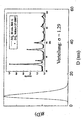
- the conductive salts have the additional effect that they are the oxide particles that are formed protect against agglomeration. This can be a very close Particle size distribution can be achieved. As in a subsequent one Described embodiment can be zirconia with a produce volume-average crystallite size of 8 nm, the particle size distribution, expressed as a logarithmic normal distribution, a sigma value of 1.29. If you don’t value narrow particle size distribution, one can do without the addition of the conductive salts if the electrolyte due to the dissolved salts of the metal to be deposited as an adequate electrical Has conductivity.
- the metal oxides result from the fact that the ions of Metals electrochemically in the presence of an oxidizing agent on a cathode reduced.
- the easiest oxidizer to use, its use therefore preferred is the oxygen in the air. So you do that Process preferably so that one during the electrochemical Reduction of the metal ions introduces air into the electrolyte. If desired, can also oxygen-enriched air or largely pure oxygen in the Electrolytes are introduced.
- Other suitable, but less preferred Oxidizing agents are hydrogen peroxide, organic or inorganic Peroxo compounds or oxo anions of the halogens chlorine, bromine or iodine which the halogen has an oxidation state between +1 and +5. In the However, using stronger oxidizing agents than atmospheric oxygen is a must make sure that no peroxide formation occurs with the electrolyte.
- the DC electrical voltage between cathode and anode is preferably set such that a current flow of the order of about 5 to about 100 mA, in particular in the range of about 10 to about 50 mA, occurs with an anode and cathode area of 800 mm 2 each. If the electrolyte is sufficiently conductive, this can be achieved by applying an electrical direct voltage in the range from approximately 1 to approximately 100 volts between the cathode and the anode.
- the electrolyte is held while the process is being carried out in the strongest possible movement. This can happen, for example, in that you stir the electrolyte.
- the Radiate electrolytes with ultrasound In addition or as an alternative to this, the Radiate electrolytes with ultrasound.
- the electrolyte movement and / or that Radiography with ultrasound has the advantage that the metal oxides formed do not stick to the cathode and this with an insulating layer cover.
- the ions of the metal or those metals whose oxides or mixed oxides are used wants to produce can get into the electrolyte in different ways.
- the anode can thus, for example, be made of that metal exist whose oxide you want to manufacture.
- the inventive method also allows mixed oxides of different To manufacture metals. You can either use an anode for this consists of or is coated with these different metals. alternative you can work with several anodes, each made of different metals exist or are covered with these. The latter approach has the The advantage of being between the cathode and the different anodes can apply different voltages to the different Taking into account the solution potential of the different metals.
- the process according to the invention can also be carried out in such a way that one uses an inert anode and that one uses a salt or salts thereof dissolves those metals in the electrolyte, its oxide or its mixed oxide to be manufactured.
- salts that are in have sufficient solubility in the electrolyte used.
- tetrahydrofuran is generally the case Chlorides or nitrates of the respective metals are suitable.
- the cathode material and optionally the anode material are preferably chosen a material that is inert under the chosen electrolysis conditions. Suitable are electrodes made of platinum or other platinum metals, gold, Stainless steel, titanium or glassy carbon.
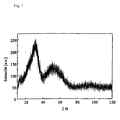
- the oxides or the mixed oxides fall in X-ray amorphous or in crystalline form. So you either show one X-ray diffraction pattern similar to that of a liquid and only a few broad ones Maxima shows (X-ray amorphous, Fig. 1) or clearly from individual remote X-ray reflexes exist (X-ray crystalline, Fig. 2, Fig. 3).
- the X-ray amorphous or X-ray crystalline metal oxides obtained are separated from the electrolyte, which can be done continuously or in batches. The Can be separated, for example, by continuous or discontinuous Filter or centrifuge. If necessary, wash them separated metal oxides, preferably with the one used as the electrolyte organic solvents to remove any salt residue. The metal oxides are then dried, for example at a Temperature in the range of 100 ° C.
- the length of time for the Calcination depends on the rate of conversion of the amorphous to the crystalline oxides and can range, for example, between about 5 minutes and lie about 4 hours.
- tetrahydrofuran THF
- water content in the range of 0.5 to 1 %
- TBAB tetrabutylammonium bromide
- a 20 x 40 mm metal sheet served as the anode (Thickness: 1 mm) and a 20 x 40 mm stainless steel or titanium sheet as cathode (Thickness: 1 mm).
- the electrolysis was carried out at a current flow of 10-50 mA Maintained for 12-18 hours. During the electrolysis period, air became passed through the electrolyte. In addition, the electrolyte was stirred.
- the Electrolysis must be carried out at 35 - 40 ° C, as below 35 ° C TBAB fails. After only a few minutes, the initially clear solution became cloudy. At the At the end of the electrolysis, the product was allowed to settle in the heat and filtered then with a filter slide (black belt filter). The product was dated Filter released and dried at 100 ° C. Phase purity, crystallite size and Crystallite size distribution was determined using wide-angle X-ray diffractometry (XRD) examined.
- XRD wide-angle X-ray diffractometry
- a 1 mm thick pure zircon sheet (99.99%) was used as the anode.
- the Experiment was carried out as described above. Between A current flow of 40 mA was applied to electrodes. After working up the The product obtained 1.5 g of white powder. The X-ray examination showed none Bragg reflections but a liquid-like diffraction pattern (Fig. 1). to A TEM image was taken to determine the particle size. From this the average particle size was 15 nm.
- Example 2 The procedure was analogous to Example 1 using a one-iron anode (Current flow 35 mA). After 12 hours, 1.2 g of X-ray amorphous Powder can be isolated.
- Example 2 The procedure was analogous to Example 1 using a pure titanium anode (Current flow 40 mA). After 12 hours, 1.7 g of X-ray amorphous Powder can be isolated.
- Example 2 The procedure was analogous to Example 1 using a pure aluminum andode (Current flow 45 mA). After 16 hours, 1.1 g X-ray amorphous powder can be isolated.
- Example 2 The procedure was analogous to Example 1 using a pure molybdenum anode (Current flow 40 mA). After 12 hours, 0.9 g of X-ray amorphous Powder can be isolated.
- This variant of the method avoids the anodic resolution of a Metal anode using a metal salt solution.
- the salts can be used as Chlorides or nitrates are used because they are soluble in THF.
- Inert electrodes made of platinum (20 x 40 mm, 1 mm thick) are used.
- the metal cations are present in the presence of TBAB the cathode is reduced and oxidized in-situ by dissolved oxygen. During the Air was passed through the electrolyte for the duration of the electrolysis. In addition the electrolyte stirred.
- Examples 1 to 7 always provides X-ray amorphous Products.
- TBAB conductive salt
- the goal here is to increase the crystallite size through the calcination conditions Taxes. Sizes between 5 and 100 nm are aimed for.
- the samples are in calcined in a tube furnace at a temperature between 400 and 1000 ° C. The Depending on the temperature and type of sample, the annealing time is between 15 and 200 Minutes. The resulting combustion gases are blown with an air stream away.
- 0.3 g of crude product was treated at 500 ° C for 30 minutes.
- the end product was examined with XRD.
- the calcination product consists of pure phase cubic zirconium oxide with a volume-average crystallite size of 8 mm. This value can also be confirmed using electron microscopy.
- the Product has a narrow crystallite size distribution (Fig. 2).
- the ⁇ value was 1.29 (a ⁇ value of 1.00 corresponds to a monodisperse system).
- Crystallization of amorphous iron oxide takes place at a sufficient rate even at a temperature of 600 ° C.
- the following crystallite sizes were obtained by calcining at 600 ° C: Time (minutes) Crystallite size [nm] 15 10 30 45 120 > 80
- Example 10 Crystallization of alumina
Landscapes
- Chemical & Material Sciences (AREA)
- Inorganic Chemistry (AREA)
- Engineering & Computer Science (AREA)
- Chemical Kinetics & Catalysis (AREA)
- Electrochemistry (AREA)
- Materials Engineering (AREA)
- Metallurgy (AREA)
- Organic Chemistry (AREA)
- Inorganic Compounds Of Heavy Metals (AREA)
- Oxygen, Ozone, And Oxides In General (AREA)
- Secondary Cells (AREA)
- Compounds Of Iron (AREA)
- Compounds Of Alkaline-Earth Elements, Aluminum Or Rare-Earth Metals (AREA)
- Electrolytic Production Of Non-Metals, Compounds, Apparatuses Therefor (AREA)
- Battery Electrode And Active Subsutance (AREA)
- Catalysts (AREA)
Description
| Zeit (Minuten) | Kristallitgröße [nm] |
| 15 | 10 |
| 30 | 45 |
| 120 | >80 |

Röntgendiffraktogramm von amorphem ZrO2-Rohprodukt. Es sind keine Bragg-Reflexe vorhanden
Röntgendiffraktogramm und Kristallitgrößenverteilung einer kalzinierten Zirkonoxidprobe.
Röntgendiffraktogramm einer Eisenoxidprobe im Herstellungszustand. Ohne Kalzinieren wird eine nanokristalline Struktur erhalten.
Claims (13)
- Verfahren zur Herstellung pulverförmiger amorpher und/oder kristalliner Oxide von Metallen der dritten bis fünften Hauptgruppe oder der Nebengruppen des Periodensystems, die mittlere Teilchendurchmesser im Bereich von 1 bis 500 nm haben, dadurch gekennzeichnet, daß man in einem organischen Elektrolyten gelöste Ionen dieser Metalle in Gegenwart eines Oxidationsmittels unter Verwendung einer Kathode und einer Anode an der Kathode elektrochemisch reduziert, wobei man den Elektrolyten bewegt und/oder ihn mit Ultraschall durchstrahlt.
- Verfahren nach Anspruch1, dadurch gekennzeichnet, daß der organische. Elektrolyt ausgewählt ist aus Ketonen, Alkoholen, Ethern, Nitrilen und aromatischen Verbindungen.
- Verfahren nach Anspruch 2, dadurch gekennzeichnet, daß der organische Elektrolyt ausgewählt ist aus Aceton, Tetrahydrofuran, Acetonitril, Toluol und deren Mischungen mit Alkoholen.
- Verfahren nach einem oder mehreren der Ansprüche 1 bis 3, dadurch gekennzeichnet, daß der organische Elektrolyt zusätzlich 0,01 bis 2 Gew.-%, bezogen auf die Gesamtmenge des organischen Elektrolyten und des Wassers, Wasser enthält.
- Verfahren nach einem oder mehreren der Ansprüche 1 bis 4, dadurch gekennzeichnet, daß der organische Elektrolyt ein gelöstes Leitsalz enthält.
- Verfahren nach einem oder mehreren der Ansprüche 1 bis 5, dadurch gekennzeichnet, daß der organische Elektrolyt eine Temperatur im Bereich von 30 bis 50 °C hat.
- Verfahren nach einem oder mehreren der Ansprüche 1 bis 6, dadurch gekennzeichnet, daß das Oxidationsmittel ausgewählt ist aus Sauerstoff, Wasserstoffperoxid, Peroxoverbindungen, Oxoanionen der Halogene Chlor, Brom oder Iod, bei denen das Halogen eine Oxidationsstufe zwischen +1 und +5 aufweist.
- Verfahren nach einem oder mehreren der Ansprüche 1 bis 7, dadurch gekennzeichnet, daß man zwischen Kathode und Anode eine elektrische Gleichspannung im Bereich von 1 bis 100 Volt anlegt.
- Verfahren nach einem oder mehreren der Ansprüche 1 bis 8, dadurch gekennzeichnet, daß man eine Anode verwendet, die dasjenige Metall enthält, dessen Oxid hergestellt werden soll.
- Verfahren nach einem oder mehreren der Ansprüche 1 bis 8, dadurch gekennzeichnet, daß man eine oder mehrere Anoden verwendet, die unterschiedliche Metalle enthält oder enthalten, deren Mischoxid hergestellt werden soll.
- Verfahren nach einem oder mehreren der Ansprüche 1 bis 8, dadurch gekennzeichnet, daß man ein Salz desjenigen oder Salze derjenigen Metalle in dem Elektrolyten auflöst, dessen Oxid oder deren Mischoxid hergestellt werden soll.
- Verfahren nach einem oder mehreren der Ansprüche 1 bis 11, dadurch gekennzeichnet, daß man das entstandene Metalloxid vom Elektrolyten abtrennt und trocknet.
- Verfahren nach Anspruch 12, dadurch gekennzeichnet, daß man das getrocknete Metalloxid bei einer Temperatur im Bereich zwischen 300 und 1200 °C kalziniert.
Applications Claiming Priority (3)
| Application Number | Priority Date | Filing Date | Title |
|---|---|---|---|
| DE19840842A DE19840842A1 (de) | 1998-09-07 | 1998-09-07 | Elektrochemische Herstellung amorpher oder kristalliner Metalloxide mit Teilchengrößen im Nanometerbereich |
| DE19840842 | 1998-09-07 | ||
| PCT/EP1999/006368 WO2000014302A1 (de) | 1998-09-07 | 1999-08-28 | Elektrochemische herstellung amorpher oder kristalliner metalloxide mit teilchengrössen im nanometerbereich |
Publications (2)
| Publication Number | Publication Date |
|---|---|
| EP1121477A1 EP1121477A1 (de) | 2001-08-08 |
| EP1121477B1 true EP1121477B1 (de) | 2003-04-09 |
Family
ID=7880126
Family Applications (1)
| Application Number | Title | Priority Date | Filing Date |
|---|---|---|---|
| EP99944556A Expired - Lifetime EP1121477B1 (de) | 1998-09-07 | 1999-08-28 | Elektrochemische herstellung amorpher oder kristalliner metalloxide mit teilchengrössen im nanometerbereich |
Country Status (9)
| Country | Link |
|---|---|
| US (1) | US6676821B1 (de) |
| EP (1) | EP1121477B1 (de) |
| JP (1) | JP2002524661A (de) |
| AT (1) | ATE237007T1 (de) |
| DE (2) | DE19840842A1 (de) |
| DK (1) | DK1121477T3 (de) |
| ES (1) | ES2196852T3 (de) |
| PT (1) | PT1121477E (de) |
| WO (1) | WO2000014302A1 (de) |
Families Citing this family (21)
| Publication number | Priority date | Publication date | Assignee | Title |
|---|---|---|---|---|
| DE10104302A1 (de) * | 2001-01-30 | 2002-08-22 | Henkel Kgaa | Elektrochemische Herstellung von nanoskaliger Metall(misch)oxiden |
| DE10163256A1 (de) | 2001-12-21 | 2003-07-10 | Henkel Kgaa | Oberflächenmodifiziertes Zinkoxid zur Herstellung nanopartikulärer Dispersionen |
| DE10245509B3 (de) * | 2002-09-27 | 2004-06-03 | Sustech Gmbh & Co. Kg | Elektrochemisches Verfahren zur Steuerung der Teilchengröße bei der Herstellung nanopartikulärer Metalloxide |
| USD543657S1 (en) | 2005-06-30 | 2007-05-29 | Cooper Technologies Company | Lampholder |
| US20090183994A1 (en) * | 2005-09-09 | 2009-07-23 | University Of Nevada, Reno | Preparation of nano-tubular titania substrate with oxygen vacancies and their use in photo-electrolysis of water |
| DE102005044873A1 (de) * | 2005-09-20 | 2007-03-29 | Leibniz-Institut Für Neue Materialien Gemeinnützige Gmbh | Elektrochemisches Verfahren zur Herstellung von nanoskaligen Metallverbindungen |
| PL377451A1 (pl) * | 2005-10-05 | 2007-04-16 | Instytut Wysokich Ciśnień PAN | Sposób prowadzenia reakcji i reaktor chemiczny |
| WO2008073968A2 (en) * | 2006-12-12 | 2008-06-19 | University Of Nevada, Reno | Self-ordered nanotubes of titanium oxides and titanium alloy oxides for energy storage and battery applications |
| PL207757B1 (pl) * | 2007-04-02 | 2011-01-31 | Univ W Białymstoku | Sposób nanoszenia warstw metali, zwłaszcza żelaza, kobaltu, niklu, miedzi i cynku oraz elektrolit do wytwarzania warstw metalicznych |
| CN101896422A (zh) * | 2007-12-13 | 2010-11-24 | 株式会社平昭 | 导电性无机氧化物粒子的制备方法及由该制备方法所得的导电性无机氧化物粒子 |
| EP2260123A1 (de) * | 2008-02-28 | 2010-12-15 | Corning Incorporated | Elektrochemische verfahren zur herstellung von nanostrukturen |
| RU2410472C1 (ru) * | 2009-09-01 | 2011-01-27 | Общество с ограниченной ответственностью "Научно-производственное объединение "Ликом" | Способ получения наночастиц меди в водной среде |
| RU2410471C1 (ru) * | 2009-09-01 | 2011-01-27 | Общество с ограниченной ответственностью "Научно-производственное объединение "Ликом" | Способ получения наночастиц металлов в водной среде |
| WO2011112153A1 (en) * | 2010-03-08 | 2011-09-15 | Nanyang Technological University | Method of manufacturing layered metal oxide particles and layered metal oxide particles formed thereof |
| US9162901B2 (en) * | 2013-03-14 | 2015-10-20 | Ppg Industries Ohio, Inc. | Electrolytic production of metal oxides |
| KR20150120552A (ko) | 2014-04-17 | 2015-10-28 | 한국과학기술원 | 금속 산화물 나노 입자의 제조방법 및 이에 따라 제조되는 금속 산화물 나노 입자 |
| EP3042981A1 (de) * | 2015-01-09 | 2016-07-13 | Vito NV | Elektrochemisches verfahren zur herstellung einer verbindung eines metalls oder metalloids und eines peroxids oder einer ionischen oder radikalischen spezies |
| CN104674290B (zh) * | 2015-02-15 | 2017-05-10 | 电子科技大学 | 一种金属氧化物纳米微球的制备方法 |
| KR102052533B1 (ko) * | 2015-03-10 | 2019-12-05 | 성균관대학교산학협력단 | 금속 표면의 산화물 또는 수산화물 나노구조체 및 이의 합성 방법 |
| US10647589B2 (en) | 2015-03-31 | 2020-05-12 | Jx Nippon Mining & Metals Corporation | Polyoxometalate and method for producing polyoxometalate |
| US9938628B2 (en) * | 2015-05-19 | 2018-04-10 | General Electric Company | Composite nanoparticles containing rare earth metal and methods of preparation thereof |
Family Cites Families (8)
| Publication number | Priority date | Publication date | Assignee | Title |
|---|---|---|---|---|
| US4067788A (en) | 1976-09-20 | 1978-01-10 | Electromedia, Inc. | Electrochemical production of finely divided metal oxides, metal hydroxides and metals |
| JPS54150406A (en) * | 1978-05-18 | 1979-11-26 | Nippon Soken | Ceramic honeycomb structure |
| FR2561265B1 (fr) * | 1984-03-16 | 1986-09-26 | Castillo Jean Michel | Procede de production de poudres fines et ultrafines de zinc par electrolyse en milieu basique |
| US4882014A (en) | 1988-02-24 | 1989-11-21 | Union Oil Company Of California | Electrochemical synthesis of ceramic films and powders |
| DE4408512A1 (de) | 1994-03-14 | 1995-09-21 | Studiengesellschaft Kohle Mbh | Verfahren zur Herstellung von hochdispersen Metallkolloiden und trägerfixierten Metallclustern |
| DK0672765T3 (da) | 1994-03-14 | 2000-01-24 | Studiengesellschaft Kohle Mbh | Fremgangsmåde til fremstilling af højdisperse metalkolloider og substratbundne metal-clusters ved elektrokemisk reduktion a |
| DE4443392A1 (de) | 1994-12-06 | 1996-06-13 | Studiengesellschaft Kohle Mbh | Elektrochemische Reduktion von Metallsalzen als Verfahren zur Herstellung von hochdispersen Metallkolloiden und trägerfixierten Metallclustern |
| US5462647A (en) * | 1994-09-09 | 1995-10-31 | Midwest Research Institute | Preparation of lead-zirconium-titanium film and powder by electrodeposition |
-
1998
- 1998-09-07 DE DE19840842A patent/DE19840842A1/de not_active Withdrawn
-
1999
- 1999-08-28 AT AT99944556T patent/ATE237007T1/de not_active IP Right Cessation
- 1999-08-28 WO PCT/EP1999/006368 patent/WO2000014302A1/de not_active Ceased
- 1999-08-28 DK DK99944556T patent/DK1121477T3/da active
- 1999-08-28 ES ES99944556T patent/ES2196852T3/es not_active Expired - Lifetime
- 1999-08-28 DE DE59904993T patent/DE59904993D1/de not_active Expired - Fee Related
- 1999-08-28 JP JP2000569039A patent/JP2002524661A/ja active Pending
- 1999-08-28 PT PT99944556T patent/PT1121477E/pt unknown
- 1999-08-28 US US09/786,605 patent/US6676821B1/en not_active Expired - Fee Related
- 1999-08-28 EP EP99944556A patent/EP1121477B1/de not_active Expired - Lifetime
Also Published As
| Publication number | Publication date |
|---|---|
| ES2196852T3 (es) | 2003-12-16 |
| WO2000014302A1 (de) | 2000-03-16 |
| DK1121477T3 (da) | 2003-08-04 |
| PT1121477E (pt) | 2003-08-29 |
| DE19840842A1 (de) | 2000-03-09 |
| JP2002524661A (ja) | 2002-08-06 |
| ATE237007T1 (de) | 2003-04-15 |
| EP1121477A1 (de) | 2001-08-08 |
| US6676821B1 (en) | 2004-01-13 |
| DE59904993D1 (de) | 2003-05-15 |
Similar Documents
| Publication | Publication Date | Title |
|---|---|---|
| WO2000014302A1 (de) | Elektrochemische herstellung amorpher oder kristalliner metalloxide mit teilchengrössen im nanometerbereich | |
| EP1360344B1 (de) | Elektrochemische herstellung von nanoskaligen metall(misch)oxiden | |
| DE69219882T2 (de) | Leitende titansuboxid teilchen | |
| DE3855888T2 (de) | Elektrisch leitfähige titansuboxide | |
| DE2636447C2 (de) | Mangandioxidelektroden | |
| EP2581971A1 (de) | Katalysatorbeschichtung und Verfahren zu ihrer Herstellung | |
| DE2543033C2 (de) | Verfahren zur Herstellung einer beschichteten Elektrode und ihre Verwendung | |
| EP2519471B1 (de) | Synthese von nanopartikeln mittels ionischer flüssigkeiten | |
| DE2403573A1 (de) | Neue elektroden und verfahren zu ihrer herstellung | |
| DE69306853T2 (de) | Legierungen aus Metall mit hohen Schmelzpunkten geeignet für die Umwandlung in homogene und rein Blöcke, und Herstellungsverfahren dieser Legierungen | |
| DE19848032A1 (de) | Pt/Rh/Fe-Legierungskatalysator für Brennstoffzellen und Verfahren zu dessen Herstellung | |
| DE3633309A1 (de) | Stabilisierte metalloxide | |
| EP0789784B1 (de) | Verfahren zum aufschluss und zur rückgewinnung der metallischen bestandteile aus superlegierungen | |
| DE1962860C3 (de) | Elektroden für elektrochemische Zellen | |
| DE1928929B2 (de) | Raney-Mischkatalysator | |
| DE69006428T2 (de) | Wasserstoff-Entwicklungselektrode mit hoher Dauerhaftigkeit und Stabilität. | |
| DE3854487T2 (de) | Herstellung eines Elektroaktiven Werkstoffs auf Basis von stromleitfähigen Fasern und seine Anwendung zur Herstellung von kathodischen Elementen. | |
| DE2121732A1 (de) | Verfahren zur Herstellung von Alkoxiden | |
| DE69206233T2 (de) | Stabilisierte Metalloxide. | |
| DE102010030293A1 (de) | Elektrode für die elektrolytische Chlorgewinnung | |
| DE69514825T2 (de) | Verfahren zur herstellung von pulvern für hartmaterialien aus kobaltsalzen und löslichen wolframatsalzen | |
| EP0483598B1 (de) | Verfahren zur Herstellung von feinteiligem, elektrisch leitfähigem Zinn-IV-Oxid | |
| DE2757808C2 (de) | Gesinterte Elektrode | |
| DE19800168A1 (de) | Verfahren zur Herstellung einer homogenen und stabilen Suspension aus Oxidvorprodukten | |
| DE2710802C3 (de) | Verfahren zur Herstellung von Elektroden für Elektrolysezellen |
Legal Events
| Date | Code | Title | Description |
|---|---|---|---|
| PUAI | Public reference made under article 153(3) epc to a published international application that has entered the european phase |
Free format text: ORIGINAL CODE: 0009012 |
|
| 17P | Request for examination filed |
Effective date: 20010223 |
|
| AK | Designated contracting states |
Kind code of ref document: A1 Designated state(s): AT BE CH CY DE DK ES FI FR GB GR IE IT LI LU MC NL PT SE |
|
| 17Q | First examination report despatched |
Effective date: 20020201 |
|
| GRAH | Despatch of communication of intention to grant a patent |
Free format text: ORIGINAL CODE: EPIDOS IGRA |
|
| GRAH | Despatch of communication of intention to grant a patent |
Free format text: ORIGINAL CODE: EPIDOS IGRA |
|
| GRAA | (expected) grant |
Free format text: ORIGINAL CODE: 0009210 |
|
| AK | Designated contracting states |
Designated state(s): AT BE CH CY DE DK ES FI FR GB GR IE IT LI LU MC NL PT SE |
|
| REG | Reference to a national code |
Ref country code: GB Ref legal event code: FG4D Free format text: NOT ENGLISH |
|
| REG | Reference to a national code |
Ref country code: CH Ref legal event code: EP |
|
| REG | Reference to a national code |
Ref country code: IE Ref legal event code: FG4D Free format text: GERMAN |
|
| REG | Reference to a national code |
Ref country code: SE Ref legal event code: TRGR |
|
| REG | Reference to a national code |
Ref country code: GR Ref legal event code: EP Ref document number: 20030402077 Country of ref document: GR |
|
| REG | Reference to a national code |
Ref country code: DK Ref legal event code: T3 |
|
| GBT | Gb: translation of ep patent filed (gb section 77(6)(a)/1977) | ||
| REG | Reference to a national code |
Ref country code: ES Ref legal event code: FG2A Ref document number: 2196852 Country of ref document: ES Kind code of ref document: T3 |
|
| ET | Fr: translation filed | ||
| PLBE | No opposition filed within time limit |
Free format text: ORIGINAL CODE: 0009261 |
|
| STAA | Information on the status of an ep patent application or granted ep patent |
Free format text: STATUS: NO OPPOSITION FILED WITHIN TIME LIMIT |
|
| 26N | No opposition filed |
Effective date: 20040112 |
|
| PGFP | Annual fee paid to national office [announced via postgrant information from national office to epo] |
Ref country code: AT Payment date: 20050622 Year of fee payment: 7 |
|
| PGFP | Annual fee paid to national office [announced via postgrant information from national office to epo] |
Ref country code: GR Payment date: 20050713 Year of fee payment: 7 |
|
| PGFP | Annual fee paid to national office [announced via postgrant information from national office to epo] |
Ref country code: CY Payment date: 20050715 Year of fee payment: 7 |
|
| PGFP | Annual fee paid to national office [announced via postgrant information from national office to epo] |
Ref country code: MC Payment date: 20050729 Year of fee payment: 7 |
|
| PGFP | Annual fee paid to national office [announced via postgrant information from national office to epo] |
Ref country code: NL Payment date: 20050803 Year of fee payment: 7 |
|
| PGFP | Annual fee paid to national office [announced via postgrant information from national office to epo] |
Ref country code: SE Payment date: 20050804 Year of fee payment: 7 |
|
| PGFP | Annual fee paid to national office [announced via postgrant information from national office to epo] |
Ref country code: FR Payment date: 20050809 Year of fee payment: 7 |
|
| PGFP | Annual fee paid to national office [announced via postgrant information from national office to epo] |
Ref country code: IE Payment date: 20050811 Year of fee payment: 7 |
|
| PGFP | Annual fee paid to national office [announced via postgrant information from national office to epo] |
Ref country code: FI Payment date: 20050812 Year of fee payment: 7 |
|
| PGFP | Annual fee paid to national office [announced via postgrant information from national office to epo] |
Ref country code: DK Payment date: 20050815 Year of fee payment: 7 |
|
| PGFP | Annual fee paid to national office [announced via postgrant information from national office to epo] |
Ref country code: GB Payment date: 20050824 Year of fee payment: 7 |
|
| PGFP | Annual fee paid to national office [announced via postgrant information from national office to epo] |
Ref country code: DE Payment date: 20050825 Year of fee payment: 7 |
|
| PGFP | Annual fee paid to national office [announced via postgrant information from national office to epo] |
Ref country code: PT Payment date: 20050826 Year of fee payment: 7 |
|
| PGFP | Annual fee paid to national office [announced via postgrant information from national office to epo] |
Ref country code: CH Payment date: 20050830 Year of fee payment: 7 |
|
| PGFP | Annual fee paid to national office [announced via postgrant information from national office to epo] |
Ref country code: LU Payment date: 20050921 Year of fee payment: 7 |
|
| PGFP | Annual fee paid to national office [announced via postgrant information from national office to epo] |
Ref country code: ES Payment date: 20050927 Year of fee payment: 7 |
|
| PGFP | Annual fee paid to national office [announced via postgrant information from national office to epo] |
Ref country code: BE Payment date: 20051014 Year of fee payment: 7 |
|
| PG25 | Lapsed in a contracting state [announced via postgrant information from national office to epo] |
Ref country code: IE Free format text: LAPSE BECAUSE OF NON-PAYMENT OF DUE FEES Effective date: 20060828 Ref country code: FI Free format text: LAPSE BECAUSE OF NON-PAYMENT OF DUE FEES Effective date: 20060828 Ref country code: CY Free format text: LAPSE BECAUSE OF NON-PAYMENT OF DUE FEES Effective date: 20060828 Ref country code: AT Free format text: LAPSE BECAUSE OF NON-PAYMENT OF DUE FEES Effective date: 20060828 |
|
| PG25 | Lapsed in a contracting state [announced via postgrant information from national office to epo] |
Ref country code: SE Free format text: LAPSE BECAUSE OF NON-PAYMENT OF DUE FEES Effective date: 20060829 |
|
| PG25 | Lapsed in a contracting state [announced via postgrant information from national office to epo] |
Ref country code: MC Free format text: LAPSE BECAUSE OF NON-PAYMENT OF DUE FEES Effective date: 20060831 Ref country code: LI Free format text: LAPSE BECAUSE OF NON-PAYMENT OF DUE FEES Effective date: 20060831 Ref country code: DK Free format text: LAPSE BECAUSE OF NON-PAYMENT OF DUE FEES Effective date: 20060831 Ref country code: CH Free format text: LAPSE BECAUSE OF NON-PAYMENT OF DUE FEES Effective date: 20060831 Ref country code: BE Free format text: LAPSE BECAUSE OF NON-PAYMENT OF DUE FEES Effective date: 20060831 |
|
| PGFP | Annual fee paid to national office [announced via postgrant information from national office to epo] |
Ref country code: IT Payment date: 20060831 Year of fee payment: 8 |
|
| PG25 | Lapsed in a contracting state [announced via postgrant information from national office to epo] |
Ref country code: PT Free format text: LAPSE BECAUSE OF NON-PAYMENT OF DUE FEES Effective date: 20070228 |
|
| PG25 | Lapsed in a contracting state [announced via postgrant information from national office to epo] |
Ref country code: NL Free format text: LAPSE BECAUSE OF NON-PAYMENT OF DUE FEES Effective date: 20070301 Ref country code: DE Free format text: LAPSE BECAUSE OF NON-PAYMENT OF DUE FEES Effective date: 20070301 |
|
| REG | Reference to a national code |
Ref country code: DK Ref legal event code: EBP |
|
| REG | Reference to a national code |
Ref country code: PT Ref legal event code: MM4A Free format text: LAPSE DUE TO NON-PAYMENT OF FEES Effective date: 20070228 |
|
| REG | Reference to a national code |
Ref country code: CH Ref legal event code: PL |
|
| EUG | Se: european patent has lapsed | ||
| GBPC | Gb: european patent ceased through non-payment of renewal fee |
Effective date: 20060828 |
|
| NLV4 | Nl: lapsed or anulled due to non-payment of the annual fee |
Effective date: 20070301 |
|
| REG | Reference to a national code |
Ref country code: IE Ref legal event code: MM4A |
|
| REG | Reference to a national code |
Ref country code: FR Ref legal event code: ST Effective date: 20070430 |
|
| REG | Reference to a national code |
Ref country code: ES Ref legal event code: FD2A Effective date: 20060829 |
|
| PG25 | Lapsed in a contracting state [announced via postgrant information from national office to epo] |
Ref country code: GB Free format text: LAPSE BECAUSE OF NON-PAYMENT OF DUE FEES Effective date: 20060828 |
|
| BERE | Be: lapsed |
Owner name: *HENKEL K.G.A.A. Effective date: 20060831 |
|
| PG25 | Lapsed in a contracting state [announced via postgrant information from national office to epo] |
Ref country code: ES Free format text: LAPSE BECAUSE OF NON-PAYMENT OF DUE FEES Effective date: 20060829 |
|
| PG25 | Lapsed in a contracting state [announced via postgrant information from national office to epo] |
Ref country code: FR Free format text: LAPSE BECAUSE OF NON-PAYMENT OF DUE FEES Effective date: 20060831 |
|
| PG25 | Lapsed in a contracting state [announced via postgrant information from national office to epo] |
Ref country code: LU Free format text: LAPSE BECAUSE OF NON-PAYMENT OF DUE FEES Effective date: 20060828 |
|
| PG25 | Lapsed in a contracting state [announced via postgrant information from national office to epo] |
Ref country code: GR Free format text: LAPSE BECAUSE OF NON-PAYMENT OF DUE FEES Effective date: 20070302 |
|
| PG25 | Lapsed in a contracting state [announced via postgrant information from national office to epo] |
Ref country code: IT Free format text: LAPSE BECAUSE OF NON-PAYMENT OF DUE FEES Effective date: 20070828 |