EP1108580A1 - Hayon de véhicule automobile - Google Patents
Hayon de véhicule automobile Download PDFInfo
- Publication number
- EP1108580A1 EP1108580A1 EP00403503A EP00403503A EP1108580A1 EP 1108580 A1 EP1108580 A1 EP 1108580A1 EP 00403503 A EP00403503 A EP 00403503A EP 00403503 A EP00403503 A EP 00403503A EP 1108580 A1 EP1108580 A1 EP 1108580A1
- Authority
- EP
- European Patent Office
- Prior art keywords
- tailgate
- panel
- hinges
- main
- main panel
- Prior art date
- Legal status (The legal status is an assumption and is not a legal conclusion. Google has not performed a legal analysis and makes no representation as to the accuracy of the status listed.)
- Granted
Links
Images




Classifications
-
- B—PERFORMING OPERATIONS; TRANSPORTING
- B60—VEHICLES IN GENERAL
- B60J—WINDOWS, WINDSCREENS, NON-FIXED ROOFS, DOORS, OR SIMILAR DEVICES FOR VEHICLES; REMOVABLE EXTERNAL PROTECTIVE COVERINGS SPECIALLY ADAPTED FOR VEHICLES
- B60J5/00—Doors
- B60J5/10—Doors arranged at the vehicle rear
- B60J5/101—Doors arranged at the vehicle rear for non-load transporting vehicles, i.e. family cars including vans
- B60J5/102—Doors arranged at the vehicle rear for non-load transporting vehicles, i.e. family cars including vans comprising door or part of door being pivotable downwards about horizontal axis to open position
- B60J5/103—Doors arranged at the vehicle rear for non-load transporting vehicles, i.e. family cars including vans comprising door or part of door being pivotable downwards about horizontal axis to open position where lower door part moves independently from other door structures, e.g. by being hinged on the vehicle body
-
- B—PERFORMING OPERATIONS; TRANSPORTING
- B60—VEHICLES IN GENERAL
- B60J—WINDOWS, WINDSCREENS, NON-FIXED ROOFS, DOORS, OR SIMILAR DEVICES FOR VEHICLES; REMOVABLE EXTERNAL PROTECTIVE COVERINGS SPECIALLY ADAPTED FOR VEHICLES
- B60J5/00—Doors
- B60J5/10—Doors arranged at the vehicle rear
- B60J5/12—Doors arranged at the vehicle rear slidable; foldable
-
- B—PERFORMING OPERATIONS; TRANSPORTING
- B60—VEHICLES IN GENERAL
- B60Q—ARRANGEMENT OF SIGNALLING OR LIGHTING DEVICES, THE MOUNTING OR SUPPORTING THEREOF OR CIRCUITS THEREFOR, FOR VEHICLES IN GENERAL
- B60Q1/00—Arrangement of optical signalling or lighting devices, the mounting or supporting thereof or circuits therefor
- B60Q1/26—Arrangement of optical signalling or lighting devices, the mounting or supporting thereof or circuits therefor the devices being primarily intended to indicate the vehicle, or parts thereof, or to give signals, to other traffic
- B60Q1/30—Arrangement of optical signalling or lighting devices, the mounting or supporting thereof or circuits therefor the devices being primarily intended to indicate the vehicle, or parts thereof, or to give signals, to other traffic for indicating rear of vehicle, e.g. by means of reflecting surfaces
- B60Q1/305—Indicating devices for towed vehicles
Definitions
- the present invention relates to a motor vehicle tailgate, and more particularly a tailgate intended to be mounted on hinges located along its lower horizontal edge, to rotate around this horizontal edge between a position closed substantially vertical and an open position substantially horizontal.
- the tailgate In the open position, the tailgate extends the floor of the trunk of the vehicle, so to facilitate loading.
- the bumper cannot be positioned too low given its essential protective function, the boot floor is often artificially raised to reach the level of the internal face of the open tailgate, this which causes a loss of volume of the trunk.
- the present invention relates to a motor vehicle tailgate intended for be pivotally mounted on a vehicle around hinges located near one of its edges, characterized in that in the vicinity of its hinges, the tailgate consists of a main panel secured to the hinges and by a secondary panel which is movable relative to the main panel between a closed position in which it is superimposed on the main panel to reconstitute the tailgate in all its thickness and a open position in which it is separated from the main panel, the latter does not thus forming a reduced thickness portion of the tailgate.
- This "thinned" part of the tailgate requires clearance around it less, for the angular movement of the tailgate, than if the latter retained its initial thickness at the time of its opening.
- the invention thus makes it possible to bring the trunk floor closer to the bumper rear, in the case of a tailgate pivoting around its lower horizontal edge, because the minimum distance between the boot floor and the bumper is the thickness of the only main panel, not the entire tailgate.
- the secondary panel of the tailgate is located on the outside of the tailgate.
- the secondary panel is mounted pivoting relative to the main panel about a centrally located axis, relative to the panel secondary, opposite the tailgate hinges.
- the secondary panel can be oriented perpendicular to the tailgate in the open position.
- the panel pivoting perpendicular to the open tailgate is vertical.
- the secondary panel can then serve as a support for a device signal optics and / or police license plate, possibly with lighting, which allows the vehicle to be used with the tailgate open while respecting the rules in force.
- the secondary panel can be detached from the main panel.
- the secondary panel detached from the panel main can be re-attached at another point on the tailgate.
- the secondary panel can be fixed perpendicular to the tailgate at its rearmost point of the vehicle, to serve as an optical support or police plate, while materializing the rear end of the vehicle which is formed by the end edge of the tailgate opposite its hinges.
- the secondary panel thus fixed at the rearmost point of the vehicle serves additionally bumper for low energy shocks, which protects the edge of the tailgate opposite its hinges, which is particularly vulnerable if the vehicle is used tailgate open.
- a mechanism for locking retains the secondary panel in the closed position against the panel main.
- this locking device is coupled to the tailgate lock control so that the secondary panel passes from its closed position to its open position when the tailgate is opened.
- a synchronization mechanism toggles the secondary panel in the open position, when the tailgate pivots into the position open, and vice versa.
- the secondary panel constitutes a fusible area of the tailgate.
- This trunk is closed by a tailgate 4 pivotally mounted on the vehicle around hinges 5 located along its lower horizontal edge 6.
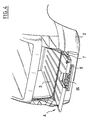
- the tailgate 4 is shown diagrammatically in FIGS. 1 to 3. Its external shape is detailed in figure 4.
- the tailgate is constituted by an internal panel 7 which constitutes, within the meaning of the invention, the main tailgate panel.
- This internal panel 7 extends over the entire surface of the tailgate from its hinges up to its upper horizontal edge opposite the hinges. It forms the whole inner side of the tailgate.
- This main panel 7 comprises a part 7 a , adjacent to the hinges, of reduced thickness and a complementary part 7 b , distant from the hinges, the thickness of which corresponds to the total thickness of the tailgate.
- the main panel 7 constitutes the tailgate 4 by itself.
- the main panel constitutes only one half of the tailgate, the other half being formed by a secondary panel 8 which comes to take place in the recess left by the main panel due to its thickness reduction between its part 7 a near the hinges and its part 7 b far from the hinges.
- the secondary panel 8 is pivotally mounted on the main panel 7 around an axis 9 parallel to the axis defined by the hinges 5.
- the bumper can be positioned high enough at the rear of the vehicle.
- the secondary panel 8 is connected to the hinges 5 of the tailgate 4 by a synchronization or slaving mechanism which acts on the secondary panel a torque designed to keep it upright, while the tailgate goes from its closed vertical position to its open horizontal position.
- this synchronization mechanism can be constituted by a link 10 which, on the principle of the deformable parallelogram, maintains a point 11 of the secondary panel distant from its axis at equal distance from a point 12 of the hinge away from its axis.
- the synchronization mechanism could be constituted by an unlocking system releasing the secondary panel, which, under the action of a spring, would immediately go into the open position from the start the tailgate pivot.
- the synchronization mechanism comprises a toothed belt 13 connecting a fixed toothed wheel 14, secured to the vehicle at the level hinges but not pivoting with the tailgate, to a toothed wheel 15 located at the level axis 9 of the secondary panel and integral with this secondary panel.
- the toothed belt 13 prevents the toothed wheel 15 from changing orientation, so that the secondary panel remains vertical.
- FIGS. 7 a and 7 b there is a belt 16 connecting a fixed wheel 17 secured to the vehicle at the hinges to a wheel 18 secured to the secondary panel, by means of references 16 a which hold the belt in place. inside the main panel 7.
- the belt 16 keeps on the panel secondary its initial vertical orientation.
- Belt tensioners 19 are housed on either side thereof, so to allow it to adapt to an extension of the distance separating the two wheels 17 and 18.
- the axis 9 of the secondary panel (corresponding to the wheel 18 in the figure) is mounted on the main panel 7 in a slot 20 in which said axis 9 can evolve.
- One of the longitudinal edges of the slot 20 is cut into a rack 21, while the wheel 18 secured to the secondary panel has a toothed sector 22 which meshes with this rack.
- the operation of the synchronization mechanism is as follows.
- the secondary panel remains vertical, as in the variant of Figure 6, which separates it from the main panel.
- This distance has the effect of raising the secondary panel relative to at the tailgate at the start of the latter's pivoting, which compensates for the descent tailgate due to its opening.
- the secondary panel can remain at a substantially constant altitude during a first phase of the pivoting of the tailgate, until it has exceeded the rear end of the bumper, after which it can descend beyond the bumper -shocks, as seen in Figure 7 b .
- This variant of the synchronization mechanism allows the maintenance of a relatively high prominent bumper behind the tailgate.
- the secondary panel is connected to its hinge pin on the main panel by curved arms 23 which are intended to bypass a visor 24 masking the axis 9 of articulation of the secondary panel when the tailgate is in the closed position.
- a lock 25 can ensure the maintenance of the secondary panel 8 against the main panel 7 in the closed position, in order to relieve the synchronization mechanism which does not start until the tailgate pivoting, without having to keep the two panels glued together when the tailgate is closed.
- the latch 25 is open at the start of the tailgate pivoting, for example under the action of the tailgate lock control.
- the secondary panel 8 is separable from its curved arms 23, so that it can be attached to the rear end of the tailgate in the open position, that is to say on its edge 25 opposite its hinges, in order to materialize the rear end of the vehicle.
- the vehicle can be used with the tailgate open to transport long objects.
- the secondary panel 8 can support the number plate or plate of vehicle police, as well as the scout 26 of this plate.
- the secondary panel 8 When the secondary panel 8 is attached to the rear end of the tailgate, preferably position the binding at the highest point of the tailgate, so as to increase ground clearance at the rear of the vehicle.
- the tailgate according to the invention fills perfectly its traditional role of closing the luggage compartment because closed position, it has a constant thickness corresponding to the normal thickness a tailgate.
- the secondary panel constitutes a fusible zone of the tailgate which can, in the event of a minor impact, be the only one damaged and therefore the only one to be replaced, this which is economically interesting.
Landscapes
- Engineering & Computer Science (AREA)
- Mechanical Engineering (AREA)
- Body Structure For Vehicles (AREA)
- Superstructure Of Vehicle (AREA)
- Lock And Its Accessories (AREA)
Abstract
Description
- la figure 1 est une section transversale selon un plan vertical de l'extrémité arrière d'un véhicule,
- la figure 2 est une vue analogue à la figure 1 après pivotement du hayon,
- la figure 3 est une vue analogue à la figure 2 montrant une variante du panneau secondaire,
- la figure 4 est une vue en perspective de trois quarts arrière du véhicule,
- les figures 5a et 5b sont des vues schématiques à plus grande échelle d'un mécanisme d'asservissement du panneau secondaire à l'ouverture du hayon, avant et après pivotement de ce dernier,
- les figures 6a et 6b sont des vues analogues aux figures 5a et 5b d'un autre mécanisme d'asservissement,
- les figures 7a et 7b sont des vues analogues aux figures 5a et 5b d'un autre mécanisme d'asservissement,
- la figure 8 est une vue éclatée de l'arrière du véhicule, avec le mécanisme d'asservissement de la figure 5.
Claims (10)
- Hayon (4) de véhicule automobile destiné à être monté pivotant sur un véhicule autour de charnières (5) situées à proximité d'un de ses bords (6), caractérisé par le fait qu'au voisinage de ses charnières (5), le hayon est constitué par un panneau principal (7) solidaire des charnières (5) et par un panneau secondaire (8) qui est mobile par rapport au panneau principal entre une position de fermeture dans laquelle il se superpose au panneau principal pour reconstituer le hayon dans toute son épaisseur et une position d'ouverture dans laquelle il est séparé du panneau principal, ce dernier ne formant alors qu'une partie d'épaisseur réduite du hayon.
- Hayon selon la revendication 1, caractérisé par le fait que le panneau secondaire (8) est situé sur la face externe du hayon.
- Hayon selon l'une quelconque des revendications 1 et 2, caractérisé par le fait que le panneau secondaire (8) est monté pivotant par rapport au panneau principal (7) autour d'un axe (9) situé, par rapport au panneau secondaire, à l'opposé des charnières (5) du hayon.
- Hayon selon l'une quelconque des revendications 1 à 3, caractérisé par le fait que le panneau secondaire (8) peut s'orienter perpendiculairement au hayon en position d'ouverture.
- Hayon selon l'une quelconque des revendications 1 à 4, caractérisé par le fait que le panneau secondaire (8) peut être détaché du panneau principal (7).
- Hayon selon la revendication 5, caractérisé par le fait que le panneau secondaire (8) détaché du panneau principal peut être re-fixé en un autre point du hayon.
- Hayon selon l'une quelconque des revendications 1 à 6, caractérisé par le fait qu'un mécanisme de verrouillage (25) retient le panneau secondaire (8) en position de fermeture contre le panneau principal (7).
- Hayon selon la revendication 7, caractérisé par le fait que le dispositif de verrouillage est accouplé à la commande de serrure du hayon de manière que le panneau secondaire passe de sa position de fermeture à sa position d'ouverture au moment de l'ouverture du hayon.
- Hayon selon l'une quelconque des revendications 1 à 6, caractérisé par le fait qu'il comporte un mécanisme de synchronisation qui bascule le panneau secondaire (8) en position d'ouverture lorsque le hayon pivote en position ouverte, et inversement.
- Hayon selon l'une quelconque des revendications 1 à 9, caractérisé par le fait que le panneau secondaire (8) constitue une zone fusible du hayon.
Applications Claiming Priority (2)
| Application Number | Priority Date | Filing Date | Title |
|---|---|---|---|
| FR9915846 | 1999-12-15 | ||
| FR9915846A FR2802497B1 (fr) | 1999-12-15 | 1999-12-15 | Hayon de vehicule automobile |
Publications (2)
| Publication Number | Publication Date |
|---|---|
| EP1108580A1 true EP1108580A1 (fr) | 2001-06-20 |
| EP1108580B1 EP1108580B1 (fr) | 2007-11-07 |
Family
ID=9553308
Family Applications (1)
| Application Number | Title | Priority Date | Filing Date |
|---|---|---|---|
| EP00403503A Expired - Lifetime EP1108580B1 (fr) | 1999-12-15 | 2000-12-13 | Hayon de véhicule automobile |
Country Status (5)
| Country | Link |
|---|---|
| US (1) | US6338519B2 (fr) |
| EP (1) | EP1108580B1 (fr) |
| DE (1) | DE60036998T2 (fr) |
| ES (1) | ES2294999T3 (fr) |
| FR (1) | FR2802497B1 (fr) |
Cited By (1)
| Publication number | Priority date | Publication date | Assignee | Title |
|---|---|---|---|---|
| FR2923778A1 (fr) * | 2007-11-15 | 2009-05-22 | Peugeot Citroen Automobiles Sa | Vehicule automobile equipe d'un hayon arriere |
Families Citing this family (19)
| Publication number | Priority date | Publication date | Assignee | Title |
|---|---|---|---|---|
| US6768103B2 (en) * | 2000-10-24 | 2004-07-27 | The Chicago Faucet Company | System and method of automatic dynamic calibration for infrared sensing device |
| US6991618B2 (en) * | 2001-09-24 | 2006-01-31 | Becton Dickinson And Company | Single use syringe and plunger rod locking device therefor |
| DE10225482A1 (de) * | 2002-06-09 | 2004-01-08 | Webasto Vehicle Systems International Gmbh | Kraftfahrzeug mit einer Heckklappe |
| US7185451B2 (en) * | 2002-09-17 | 2007-03-06 | Fuji Jukogyo Kabushiki Kaisha | License plate holding bracket and the holding structure thereof |
| US6779824B1 (en) * | 2003-06-06 | 2004-08-24 | Daimlerchrysler Corporation | Vehicle cargo tray and table assembly |
| JP2005076375A (ja) * | 2003-09-02 | 2005-03-24 | Denso Corp | 通信装置 |
| FR2864006B1 (fr) * | 2003-12-17 | 2007-02-02 | Renault Sas | Element d'ouvrant d'un vehicule automobile |
| US6991277B1 (en) | 2005-02-09 | 2006-01-31 | Toyota Technical Center Usa, Inc. | Integrated multi-function tailgate |
| DE102006051645A1 (de) * | 2006-11-02 | 2008-05-08 | Bayerische Motoren Werke Ag | Kraftfahrzeug mit einem Kofferraum |
| US7677626B2 (en) * | 2007-10-23 | 2010-03-16 | Gm Global Technology Operations, Inc. | Multi-functional vehicle tailgate |
| US7950728B2 (en) * | 2008-11-03 | 2011-05-31 | Nissan North America, Inc. | Table assemblies for a vehicle |
| JP5434299B2 (ja) * | 2009-06-26 | 2014-03-05 | アイシン精機株式会社 | 車両用バックドア開閉装置 |
| US9316044B2 (en) * | 2013-04-07 | 2016-04-19 | Ford Global Technologies, Llc | Tailgate rock guard structure for pick-up trucks |
| US9327771B2 (en) * | 2014-08-12 | 2016-05-03 | Valentin Mantchev | Adjustable vehicle tailgate device |
| US9988103B1 (en) * | 2017-03-14 | 2018-06-05 | Ford Global Technologies, Llc | Tailgate assembly and method for accessing a cargo box of a pickup truck hitched to a trailer |
| US11220301B2 (en) | 2018-11-13 | 2022-01-11 | Rivian Ip Holdings, Llc | Multi-position tailgate for a vehicle |
| US10926815B2 (en) * | 2019-05-03 | 2021-02-23 | Ford Global Technologies, Llc | Pickup truck box deflector |
| US11066111B2 (en) * | 2019-12-04 | 2021-07-20 | Ford Global Technologies, Llc | Articulating tailgate |
| US11472326B1 (en) * | 2021-04-26 | 2022-10-18 | Ford Global Technologies, Llc | Vehicle door assembly having a ramp |
Citations (6)
| Publication number | Priority date | Publication date | Assignee | Title |
|---|---|---|---|---|
| US3612601A (en) * | 1970-01-26 | 1971-10-12 | Gen Motors Corp | Vehicle closure arrangement |
| US3749440A (en) * | 1971-11-26 | 1973-07-31 | Gen Motors Corp | Tailgate |
| DE4103651C1 (en) * | 1991-02-07 | 1992-08-06 | Mercedes-Benz Aktiengesellschaft, 7000 Stuttgart, De | Car boot flap linked by parallelogram leverage - has car body side two-arm lever, whose free end couples to parallelogram end |
| FR2684347A1 (fr) * | 1991-12-02 | 1993-06-04 | Chausson Ingenierie | Vehicule modulaire. |
| FR2699867A1 (fr) * | 1992-12-29 | 1994-07-01 | Renault | Hayon de véhicule automobile à couverture partielle. |
| FR2748969A1 (fr) * | 1996-05-23 | 1997-11-28 | Renault | Porte de coffre de vehicule automobile, du type a abattant et muni d'un support de plaque d'immatriculation pivotant |
Family Cites Families (3)
| Publication number | Priority date | Publication date | Assignee | Title |
|---|---|---|---|---|
| US4813842A (en) * | 1988-03-28 | 1989-03-21 | Morton R C | Tail gate apparatus for pick-up trucks |
| US5918925A (en) * | 1996-08-19 | 1999-07-06 | Chrysler Corporation | Nesting vehicle tailgate assembly |
| US5741039A (en) * | 1997-03-10 | 1998-04-21 | Habdas; Edward P. | Cargo box extending tailgate utilizing a two panel/intermeshing design |
-
1999
- 1999-12-15 FR FR9915846A patent/FR2802497B1/fr not_active Expired - Fee Related
-
2000
- 2000-11-30 US US09/726,053 patent/US6338519B2/en not_active Expired - Fee Related
- 2000-12-13 ES ES00403503T patent/ES2294999T3/es not_active Expired - Lifetime
- 2000-12-13 EP EP00403503A patent/EP1108580B1/fr not_active Expired - Lifetime
- 2000-12-13 DE DE60036998T patent/DE60036998T2/de not_active Expired - Fee Related
Patent Citations (6)
| Publication number | Priority date | Publication date | Assignee | Title |
|---|---|---|---|---|
| US3612601A (en) * | 1970-01-26 | 1971-10-12 | Gen Motors Corp | Vehicle closure arrangement |
| US3749440A (en) * | 1971-11-26 | 1973-07-31 | Gen Motors Corp | Tailgate |
| DE4103651C1 (en) * | 1991-02-07 | 1992-08-06 | Mercedes-Benz Aktiengesellschaft, 7000 Stuttgart, De | Car boot flap linked by parallelogram leverage - has car body side two-arm lever, whose free end couples to parallelogram end |
| FR2684347A1 (fr) * | 1991-12-02 | 1993-06-04 | Chausson Ingenierie | Vehicule modulaire. |
| FR2699867A1 (fr) * | 1992-12-29 | 1994-07-01 | Renault | Hayon de véhicule automobile à couverture partielle. |
| FR2748969A1 (fr) * | 1996-05-23 | 1997-11-28 | Renault | Porte de coffre de vehicule automobile, du type a abattant et muni d'un support de plaque d'immatriculation pivotant |
Cited By (1)
| Publication number | Priority date | Publication date | Assignee | Title |
|---|---|---|---|---|
| FR2923778A1 (fr) * | 2007-11-15 | 2009-05-22 | Peugeot Citroen Automobiles Sa | Vehicule automobile equipe d'un hayon arriere |
Also Published As
| Publication number | Publication date |
|---|---|
| EP1108580B1 (fr) | 2007-11-07 |
| DE60036998D1 (de) | 2007-12-20 |
| ES2294999T3 (es) | 2008-04-16 |
| FR2802497A1 (fr) | 2001-06-22 |
| US6338519B2 (en) | 2002-01-15 |
| FR2802497B1 (fr) | 2002-02-15 |
| US20010004155A1 (en) | 2001-06-21 |
| DE60036998T2 (de) | 2008-08-28 |
Similar Documents
| Publication | Publication Date | Title |
|---|---|---|
| EP1108580B1 (fr) | Hayon de véhicule automobile | |
| EP2663705B1 (fr) | Poignee d'ouvrant de vehicule comprenant une partie de prehension | |
| EP0860313B1 (fr) | Dispositif pour commander l'ouverture et la fermeture de la malle arrière et de la plage arrière d'un véhicule découvrable | |
| EP1136321B1 (fr) | Module de rangement pour véhicule automobile, fermé à l'arrière par une façade formant un élément de carrosserie | |
| EP1611929B1 (fr) | Fixitation de chaussure de sport sur planche de glisse avec chaussage/dechaussage facilite | |
| WO2018210682A1 (fr) | Dispositif de déverrouillage d'une serrure de porte | |
| EP1369276A1 (fr) | Dispositif formant volet de coffre arrière d'un véhicule automobile | |
| EP1470012B1 (fr) | Capot de coffre arriere pour un vehicule decouvrable a toit repliable | |
| WO2004082972A1 (fr) | Toit escamotable de vehicule | |
| EP0337886A1 (fr) | Dispositif antivol pour portes de véhicules ou de conteneurs | |
| EP1523423B1 (fr) | Dispositif adapte a faciliter l'introduction d'objets sous un toit replie dans un coffre de vehicule automobile | |
| FR2467615A1 (fr) | Vehicule jouet a elements deployables | |
| EP1852309A1 (fr) | Dispositif cache-bagages pour véhicule automobile, à ouverture partielle automatique, et véhicule automobile correspondant. | |
| EP3888979B1 (fr) | Porte-vélo escamotable | |
| EP1319561A1 (fr) | Dispositif de protection des piétons en cas de choc frontal avec un véhicule automobile | |
| EP1151880A1 (fr) | Porte transformable de véhicule automobile | |
| FR2793754A1 (fr) | Hayon arriere pour vehicule automobile | |
| EP2011698A2 (fr) | Dispositif anti-encastrement rétractable | |
| FR2695596A1 (fr) | Dispositif d'obturation d'ouverture, notamment dispositif de toit ouvrant, pour véhicule. | |
| EP1093971A1 (fr) | Porte-charge pour un véhicule automobile ainsi que véhicule automobile avec un porte-charge | |
| EP0876946A1 (fr) | Dispositif opérateur de porte, porte pourvue de ce dispositif et véhicule ferroviaire équipé d'au moins un tel dispositif et/ou porte | |
| FR2701686A1 (fr) | Ouvrant de véhicule à vitre articulée et dispositif de verrouillage direct de cette vitre. | |
| EP1053899A1 (fr) | Hayon arrière pour véhicule automobile | |
| FR2992599A1 (fr) | Vehicule a compartiment a bagages dote d'un tendelet escamotable motorise | |
| FR2576257A1 (fr) | Dispositif d'ouverture de porte de benne basculante de hauteur variable |
Legal Events
| Date | Code | Title | Description |
|---|---|---|---|
| PUAI | Public reference made under article 153(3) epc to a published international application that has entered the european phase |
Free format text: ORIGINAL CODE: 0009012 |
|
| AK | Designated contracting states |
Kind code of ref document: A1 Designated state(s): DE ES FR GB IT |
|
| AX | Request for extension of the european patent |
Free format text: AL;LT;LV;MK;RO;SI |
|
| 17P | Request for examination filed |
Effective date: 20011112 |
|
| AKX | Designation fees paid |
Free format text: DE ES FR GB IT |
|
| GRAP | Despatch of communication of intention to grant a patent |
Free format text: ORIGINAL CODE: EPIDOSNIGR1 |
|
| GRAS | Grant fee paid |
Free format text: ORIGINAL CODE: EPIDOSNIGR3 |
|
| GRAA | (expected) grant |
Free format text: ORIGINAL CODE: 0009210 |
|
| AK | Designated contracting states |
Kind code of ref document: B1 Designated state(s): DE ES FR GB IT |
|
| REG | Reference to a national code |
Ref country code: GB Ref legal event code: FG4D Free format text: NOT ENGLISH |
|
| RIN1 | Information on inventor provided before grant (corrected) |
Inventor name: POMMERET, MAELIG Inventor name: DELAVALLE, DOMINIQUE Inventor name: DECKER, LAURENT |
|
| REF | Corresponds to: |
Ref document number: 60036998 Country of ref document: DE Date of ref document: 20071220 Kind code of ref document: P |
|
| GBT | Gb: translation of ep patent filed (gb section 77(6)(a)/1977) |
Effective date: 20080204 |
|
| REG | Reference to a national code |
Ref country code: ES Ref legal event code: FG2A Ref document number: 2294999 Country of ref document: ES Kind code of ref document: T3 |
|
| PGFP | Annual fee paid to national office [announced via postgrant information from national office to epo] |
Ref country code: ES Payment date: 20071228 Year of fee payment: 8 Ref country code: GB Payment date: 20071218 Year of fee payment: 8 |
|
| PGFP | Annual fee paid to national office [announced via postgrant information from national office to epo] |
Ref country code: DE Payment date: 20071221 Year of fee payment: 8 Ref country code: IT Payment date: 20071220 Year of fee payment: 8 |
|
| PLBE | No opposition filed within time limit |
Free format text: ORIGINAL CODE: 0009261 |
|
| STAA | Information on the status of an ep patent application or granted ep patent |
Free format text: STATUS: NO OPPOSITION FILED WITHIN TIME LIMIT |
|
| 26N | No opposition filed |
Effective date: 20080808 |
|
| GBPC | Gb: european patent ceased through non-payment of renewal fee |
Effective date: 20081213 |
|
| PG25 | Lapsed in a contracting state [announced via postgrant information from national office to epo] |
Ref country code: DE Free format text: LAPSE BECAUSE OF NON-PAYMENT OF DUE FEES Effective date: 20090701 |
|
| PG25 | Lapsed in a contracting state [announced via postgrant information from national office to epo] |
Ref country code: GB Free format text: LAPSE BECAUSE OF NON-PAYMENT OF DUE FEES Effective date: 20081213 |
|
| REG | Reference to a national code |
Ref country code: ES Ref legal event code: FD2A Effective date: 20081215 |
|
| PG25 | Lapsed in a contracting state [announced via postgrant information from national office to epo] |
Ref country code: ES Free format text: LAPSE BECAUSE OF NON-PAYMENT OF DUE FEES Effective date: 20081215 |
|
| PG25 | Lapsed in a contracting state [announced via postgrant information from national office to epo] |
Ref country code: IT Free format text: LAPSE BECAUSE OF NON-PAYMENT OF DUE FEES Effective date: 20081213 |
|
| REG | Reference to a national code |
Ref country code: FR Ref legal event code: PLFP Year of fee payment: 16 |
|
| REG | Reference to a national code |
Ref country code: FR Ref legal event code: PLFP Year of fee payment: 17 |
|
| REG | Reference to a national code |
Ref country code: FR Ref legal event code: PLFP Year of fee payment: 18 |
|
| PGFP | Annual fee paid to national office [announced via postgrant information from national office to epo] |
Ref country code: FR Payment date: 20181220 Year of fee payment: 19 |
|
| PG25 | Lapsed in a contracting state [announced via postgrant information from national office to epo] |
Ref country code: FR Free format text: LAPSE BECAUSE OF NON-PAYMENT OF DUE FEES Effective date: 20191231 |