EP1106597A1 - Verfahren zur Herstellung von Ketonen, insbesondere von 6-Methylheptan-2-On - Google Patents
Verfahren zur Herstellung von Ketonen, insbesondere von 6-Methylheptan-2-On Download PDFInfo
- Publication number
- EP1106597A1 EP1106597A1 EP00125625A EP00125625A EP1106597A1 EP 1106597 A1 EP1106597 A1 EP 1106597A1 EP 00125625 A EP00125625 A EP 00125625A EP 00125625 A EP00125625 A EP 00125625A EP 1106597 A1 EP1106597 A1 EP 1106597A1
- Authority
- EP
- European Patent Office
- Prior art keywords
- catalyst system
- dimethylamine
- ketone
- aldehyde
- general formula
- Prior art date
- Legal status (The legal status is an assumption and is not a legal conclusion. Google has not performed a legal analysis and makes no representation as to the accuracy of the status listed.)
- Withdrawn
Links
- 150000002576 ketones Chemical class 0.000 title claims abstract description 42
- 238000002360 preparation method Methods 0.000 title claims abstract description 9
- 238000000034 method Methods 0.000 title claims description 46
- DPLGXGDPPMLJHN-UHFFFAOYSA-N 6-Methylheptan-2-one Chemical compound CC(C)CCCC(C)=O DPLGXGDPPMLJHN-UHFFFAOYSA-N 0.000 title claims description 13
- ROSDSFDQCJNGOL-UHFFFAOYSA-N Dimethylamine Chemical compound CNC ROSDSFDQCJNGOL-UHFFFAOYSA-N 0.000 claims abstract description 58
- 239000003054 catalyst Substances 0.000 claims abstract description 42
- RWRDLPDLKQPQOW-UHFFFAOYSA-N Pyrrolidine Chemical compound C1CCNC1 RWRDLPDLKQPQOW-UHFFFAOYSA-N 0.000 claims abstract description 37
- 150000001299 aldehydes Chemical class 0.000 claims abstract description 29
- 125000004432 carbon atom Chemical group C* 0.000 claims abstract description 14
- 229920006395 saturated elastomer Polymers 0.000 claims abstract description 10
- 238000010992 reflux Methods 0.000 claims abstract description 8
- 125000002015 acyclic group Chemical group 0.000 claims abstract description 6
- 125000004122 cyclic group Chemical group 0.000 claims abstract description 6
- 125000001931 aliphatic group Chemical group 0.000 claims abstract description 5
- QTBSBXVTEAMEQO-UHFFFAOYSA-N Acetic acid Chemical compound CC(O)=O QTBSBXVTEAMEQO-UHFFFAOYSA-N 0.000 claims description 54
- CSCPPACGZOOCGX-UHFFFAOYSA-N Acetone Chemical compound CC(C)=O CSCPPACGZOOCGX-UHFFFAOYSA-N 0.000 claims description 49
- YGHRJJRRZDOVPD-UHFFFAOYSA-N 3-methylbutanal Chemical compound CC(C)CC=O YGHRJJRRZDOVPD-UHFFFAOYSA-N 0.000 claims description 47
- RSNMTAYSENLHOW-UHFFFAOYSA-N 6-Methyl-3-hepten-2-one Natural products CC(C)CC=CC(C)=O RSNMTAYSENLHOW-UHFFFAOYSA-N 0.000 claims description 9
- RSNMTAYSENLHOW-GQCTYLIASA-N 6-Methyl-3-hepten-2-one, trans- Chemical compound CC(C)C\C=C\C(C)=O RSNMTAYSENLHOW-GQCTYLIASA-N 0.000 claims description 9
- 150000001735 carboxylic acids Chemical class 0.000 claims description 7
- 238000009835 boiling Methods 0.000 claims description 4
- 239000008346 aqueous phase Substances 0.000 claims description 3
- 239000000203 mixture Substances 0.000 claims description 3
- 239000007864 aqueous solution Substances 0.000 claims description 2
- 150000001732 carboxylic acid derivatives Chemical class 0.000 abstract description 9
- 239000011541 reaction mixture Substances 0.000 abstract description 5
- XNGIFLGASWRNHJ-UHFFFAOYSA-N phthalic acid Chemical compound OC(=O)C1=CC=CC=C1C(O)=O XNGIFLGASWRNHJ-UHFFFAOYSA-N 0.000 description 16
- 238000005882 aldol condensation reaction Methods 0.000 description 15
- 238000005984 hydrogenation reaction Methods 0.000 description 15
- WNLRTRBMVRJNCN-UHFFFAOYSA-N adipic acid Chemical compound OC(=O)CCCCC(O)=O WNLRTRBMVRJNCN-UHFFFAOYSA-N 0.000 description 14
- 238000004519 manufacturing process Methods 0.000 description 14
- 238000006243 chemical reaction Methods 0.000 description 13
- MUBZPKHOEPUJKR-UHFFFAOYSA-N Oxalic acid Chemical compound OC(=O)C(O)=O MUBZPKHOEPUJKR-UHFFFAOYSA-N 0.000 description 12
- NBIIXXVUZAFLBC-UHFFFAOYSA-N Phosphoric acid Chemical compound OP(O)(O)=O NBIIXXVUZAFLBC-UHFFFAOYSA-N 0.000 description 8
- 239000002253 acid Substances 0.000 description 8
- 150000001412 amines Chemical class 0.000 description 8
- NEHNMFOYXAPHSD-UHFFFAOYSA-N citronellal Chemical compound O=CCC(C)CCC=C(C)C NEHNMFOYXAPHSD-UHFFFAOYSA-N 0.000 description 8
- 230000000052 comparative effect Effects 0.000 description 8
- 229910052739 hydrogen Inorganic materials 0.000 description 8
- 239000001361 adipic acid Substances 0.000 description 7
- 235000011037 adipic acid Nutrition 0.000 description 7
- 238000009833 condensation Methods 0.000 description 7
- 230000005494 condensation Effects 0.000 description 7
- 239000001257 hydrogen Substances 0.000 description 7
- 150000003335 secondary amines Chemical class 0.000 description 7
- WSFSSNUMVMOOMR-UHFFFAOYSA-N Formaldehyde Chemical compound O=C WSFSSNUMVMOOMR-UHFFFAOYSA-N 0.000 description 6
- UFHFLCQGNIYNRP-UHFFFAOYSA-N Hydrogen Chemical compound [H][H] UFHFLCQGNIYNRP-UHFFFAOYSA-N 0.000 description 6
- 150000002081 enamines Chemical class 0.000 description 6
- -1 vitamin E Natural products 0.000 description 6
- 238000002474 experimental method Methods 0.000 description 5
- GVJHHUAWPYXKBD-UHFFFAOYSA-N (±)-α-Tocopherol Chemical compound OC1=C(C)C(C)=C2OC(CCCC(C)CCCC(C)CCCC(C)C)(C)CCC2=C1C GVJHHUAWPYXKBD-UHFFFAOYSA-N 0.000 description 4
- 229910000147 aluminium phosphate Inorganic materials 0.000 description 4
- 229930003633 citronellal Natural products 0.000 description 4
- 235000000983 citronellal Nutrition 0.000 description 4
- BDAGIHXWWSANSR-UHFFFAOYSA-N methanoic acid Natural products OC=O BDAGIHXWWSANSR-UHFFFAOYSA-N 0.000 description 4
- 235000006408 oxalic acid Nutrition 0.000 description 4
- 238000003756 stirring Methods 0.000 description 4
- ZWEHNKRNPOVVGH-UHFFFAOYSA-N 2-Butanone Chemical compound CCC(C)=O ZWEHNKRNPOVVGH-UHFFFAOYSA-N 0.000 description 3
- OKTJSMMVPCPJKN-UHFFFAOYSA-N Carbon Chemical compound [C] OKTJSMMVPCPJKN-UHFFFAOYSA-N 0.000 description 3
- NQRYJNQNLNOLGT-UHFFFAOYSA-N Piperidine Chemical compound C1CCNCC1 NQRYJNQNLNOLGT-UHFFFAOYSA-N 0.000 description 3
- HEMHJVSKTPXQMS-UHFFFAOYSA-M Sodium hydroxide Chemical compound [OH-].[Na+] HEMHJVSKTPXQMS-UHFFFAOYSA-M 0.000 description 3
- 239000003513 alkali Substances 0.000 description 3
- 230000015572 biosynthetic process Effects 0.000 description 3
- ZTQSAGDEMFDKMZ-UHFFFAOYSA-N butyric aldehyde Natural products CCCC=O ZTQSAGDEMFDKMZ-UHFFFAOYSA-N 0.000 description 3
- 230000006735 deficit Effects 0.000 description 3
- ZBCBWPMODOFKDW-UHFFFAOYSA-N diethanolamine Chemical compound OCCNCCO ZBCBWPMODOFKDW-UHFFFAOYSA-N 0.000 description 3
- 238000004817 gas chromatography Methods 0.000 description 3
- 239000000047 product Substances 0.000 description 3
- 238000009419 refurbishment Methods 0.000 description 3
- 238000000926 separation method Methods 0.000 description 3
- 239000000243 solution Substances 0.000 description 3
- 238000003786 synthesis reaction Methods 0.000 description 3
- XLYOFNOQVPJJNP-UHFFFAOYSA-N water Substances O XLYOFNOQVPJJNP-UHFFFAOYSA-N 0.000 description 3
- SLMWIBBJFMTGLJ-UXBLZVDNSA-N (3e)-6,10-dimethylundeca-3,9-dien-2-one Chemical compound CC(C)=CCCC(C)C\C=C\C(C)=O SLMWIBBJFMTGLJ-UXBLZVDNSA-N 0.000 description 2
- OSWFIVFLDKOXQC-UHFFFAOYSA-N 4-(3-methoxyphenyl)aniline Chemical compound COC1=CC=CC(C=2C=CC(N)=CC=2)=C1 OSWFIVFLDKOXQC-UHFFFAOYSA-N 0.000 description 2
- ZVJYRWZHXCWWPC-UHFFFAOYSA-N 4-hydroxy-6-methylheptan-2-one Chemical compound CC(C)CC(O)CC(C)=O ZVJYRWZHXCWWPC-UHFFFAOYSA-N 0.000 description 2
- 229910018072 Al 2 O 3 Inorganic materials 0.000 description 2
- 239000007848 Bronsted acid Substances 0.000 description 2
- YNAVUWVOSKDBBP-UHFFFAOYSA-N Morpholine Chemical compound C1COCCN1 YNAVUWVOSKDBBP-UHFFFAOYSA-N 0.000 description 2
- NBBJYMSMWIIQGU-UHFFFAOYSA-N Propionic aldehyde Chemical compound CCC=O NBBJYMSMWIIQGU-UHFFFAOYSA-N 0.000 description 2
- 229930003427 Vitamin E Natural products 0.000 description 2
- 150000007513 acids Chemical class 0.000 description 2
- 239000004480 active ingredient Substances 0.000 description 2
- 229910052784 alkaline earth metal Inorganic materials 0.000 description 2
- 239000007795 chemical reaction product Substances 0.000 description 2
- 238000004587 chromatography analysis Methods 0.000 description 2
- JHIVVAPYMSGYDF-UHFFFAOYSA-N cyclohexanone Chemical compound O=C1CCCCC1 JHIVVAPYMSGYDF-UHFFFAOYSA-N 0.000 description 2
- 238000011156 evaluation Methods 0.000 description 2
- 235000019253 formic acid Nutrition 0.000 description 2
- WIGCFUFOHFEKBI-UHFFFAOYSA-N gamma-tocopherol Natural products CC(C)CCCC(C)CCCC(C)CCCC1CCC2C(C)C(O)C(C)C(C)C2O1 WIGCFUFOHFEKBI-UHFFFAOYSA-N 0.000 description 2
- 239000007789 gas Substances 0.000 description 2
- HNZUNIKWNYHEJJ-UHFFFAOYSA-N geranyl acetone Natural products CC(C)=CCCC(C)=CCCC(C)=O HNZUNIKWNYHEJJ-UHFFFAOYSA-N 0.000 description 2
- 150000002500 ions Chemical class 0.000 description 2
- 239000012071 phase Substances 0.000 description 2
- 239000000376 reactant Substances 0.000 description 2
- 239000000126 substance Substances 0.000 description 2
- HGBOYTHUEUWSSQ-UHFFFAOYSA-N valeric aldehyde Natural products CCCCC=O HGBOYTHUEUWSSQ-UHFFFAOYSA-N 0.000 description 2
- 229930003231 vitamin Natural products 0.000 description 2
- 229940088594 vitamin Drugs 0.000 description 2
- 235000013343 vitamin Nutrition 0.000 description 2
- 239000011782 vitamin Substances 0.000 description 2
- 229940046009 vitamin E Drugs 0.000 description 2
- 235000019165 vitamin E Nutrition 0.000 description 2
- 239000011709 vitamin E Substances 0.000 description 2
- 238000010626 work up procedure Methods 0.000 description 2
- PFTIYHYMOUKOHA-UHFFFAOYSA-N (±)-2-methyl-3-(2-methylphenyl)propanal Chemical compound O=CC(C)CC1=CC=CC=C1C PFTIYHYMOUKOHA-UHFFFAOYSA-N 0.000 description 1
- JWNPPQNGBZUOBQ-UHFFFAOYSA-N 3-(2-methoxyphenyl)-2-methylpropanal Chemical compound COC1=CC=CC=C1CC(C)C=O JWNPPQNGBZUOBQ-UHFFFAOYSA-N 0.000 description 1
- QIWBYSQASNEEEW-UHFFFAOYSA-N 3-(2-tert-butylphenyl)-2-methylpropanal Chemical compound O=CC(C)CC1=CC=CC=C1C(C)(C)C QIWBYSQASNEEEW-UHFFFAOYSA-N 0.000 description 1
- NHLDGLQQQRVMRM-UHFFFAOYSA-N 6-(2-tert-butylphenyl)-5-methylhexan-2-one Chemical compound CC(=O)CCC(C)CC1=CC=CC=C1C(C)(C)C NHLDGLQQQRVMRM-UHFFFAOYSA-N 0.000 description 1
- 206010016803 Fluid overload Diseases 0.000 description 1
- 238000006683 Mannich reaction Methods 0.000 description 1
- 101100010166 Mus musculus Dok3 gene Proteins 0.000 description 1
- KDLHZDBZIXYQEI-UHFFFAOYSA-N Palladium Chemical compound [Pd] KDLHZDBZIXYQEI-UHFFFAOYSA-N 0.000 description 1
- 229930040373 Paraformaldehyde Natural products 0.000 description 1
- 239000007868 Raney catalyst Substances 0.000 description 1
- NPXOKRUENSOPAO-UHFFFAOYSA-N Raney nickel Chemical compound [Al].[Ni] NPXOKRUENSOPAO-UHFFFAOYSA-N 0.000 description 1
- 229910000564 Raney nickel Inorganic materials 0.000 description 1
- 229910004298 SiO 2 Inorganic materials 0.000 description 1
- 229910010413 TiO 2 Inorganic materials 0.000 description 1
- 229910021536 Zeolite Inorganic materials 0.000 description 1
- GEIAQOFPUVMAGM-UHFFFAOYSA-N ZrO Inorganic materials [Zr]=O GEIAQOFPUVMAGM-UHFFFAOYSA-N 0.000 description 1
- 238000010521 absorption reaction Methods 0.000 description 1
- 230000002378 acidificating effect Effects 0.000 description 1
- 230000004913 activation Effects 0.000 description 1
- 150000001298 alcohols Chemical class 0.000 description 1
- 238000005575 aldol reaction Methods 0.000 description 1
- 150000001342 alkaline earth metals Chemical class 0.000 description 1
- 239000002585 base Substances 0.000 description 1
- 238000005815 base catalysis Methods 0.000 description 1
- 150000007514 bases Chemical class 0.000 description 1
- 239000000440 bentonite Substances 0.000 description 1
- 229910000278 bentonite Inorganic materials 0.000 description 1
- SVPXDRXYRYOSEX-UHFFFAOYSA-N bentoquatam Chemical compound O.O=[Si]=O.O=[Al]O[Al]=O SVPXDRXYRYOSEX-UHFFFAOYSA-N 0.000 description 1
- WPYMKLBDIGXBTP-UHFFFAOYSA-N benzoic acid Chemical compound OC(=O)C1=CC=CC=C1 WPYMKLBDIGXBTP-UHFFFAOYSA-N 0.000 description 1
- 239000006227 byproduct Substances 0.000 description 1
- 238000004364 calculation method Methods 0.000 description 1
- 229910052799 carbon Inorganic materials 0.000 description 1
- 125000003178 carboxy group Chemical group [H]OC(*)=O 0.000 description 1
- 238000009903 catalytic hydrogenation reaction Methods 0.000 description 1
- 229910017052 cobalt Inorganic materials 0.000 description 1
- 239000010941 cobalt Substances 0.000 description 1
- GUTLYIVDDKVIGB-UHFFFAOYSA-N cobalt atom Chemical compound [Co] GUTLYIVDDKVIGB-UHFFFAOYSA-N 0.000 description 1
- 239000007859 condensation product Substances 0.000 description 1
- 238000006482 condensation reaction Methods 0.000 description 1
- 238000001816 cooling Methods 0.000 description 1
- 238000002425 crystallisation Methods 0.000 description 1
- 230000008025 crystallization Effects 0.000 description 1
- 150000001991 dicarboxylic acids Chemical class 0.000 description 1
- HPNMFZURTQLUMO-UHFFFAOYSA-N diethylamine Chemical compound CCNCC HPNMFZURTQLUMO-UHFFFAOYSA-N 0.000 description 1
- RXKJFZQQPQGTFL-UHFFFAOYSA-N dihydroxyacetone Chemical compound OCC(=O)CO RXKJFZQQPQGTFL-UHFFFAOYSA-N 0.000 description 1
- 238000004821 distillation Methods 0.000 description 1
- 229910052737 gold Inorganic materials 0.000 description 1
- 229910052736 halogen Inorganic materials 0.000 description 1
- 150000002367 halogens Chemical class 0.000 description 1
- 239000002638 heterogeneous catalyst Substances 0.000 description 1
- 150000002431 hydrogen Chemical class 0.000 description 1
- 150000004679 hydroxides Chemical class 0.000 description 1
- 229910052741 iridium Inorganic materials 0.000 description 1
- 238000002955 isolation Methods 0.000 description 1
- 239000000463 material Substances 0.000 description 1
- WSFSSNUMVMOOMR-NJFSPNSNSA-N methanone Chemical compound O=[14CH2] WSFSSNUMVMOOMR-NJFSPNSNSA-N 0.000 description 1
- 150000007522 mineralic acids Chemical class 0.000 description 1
- 238000006386 neutralization reaction Methods 0.000 description 1
- 229910052759 nickel Inorganic materials 0.000 description 1
- PXHVJJICTQNCMI-UHFFFAOYSA-N nickel Substances [Ni] PXHVJJICTQNCMI-UHFFFAOYSA-N 0.000 description 1
- 229910000510 noble metal Inorganic materials 0.000 description 1
- 150000007524 organic acids Chemical class 0.000 description 1
- 235000005985 organic acids Nutrition 0.000 description 1
- 229910052763 palladium Inorganic materials 0.000 description 1
- 229920002866 paraformaldehyde Polymers 0.000 description 1
- 230000000737 periodic effect Effects 0.000 description 1
- 229910052697 platinum Inorganic materials 0.000 description 1
- 229920001467 poly(styrenesulfonates) Polymers 0.000 description 1
- 239000002243 precursor Substances 0.000 description 1
- 229910052703 rhodium Inorganic materials 0.000 description 1
- 229910052707 ruthenium Inorganic materials 0.000 description 1
- 229910052709 silver Inorganic materials 0.000 description 1
- 239000002904 solvent Substances 0.000 description 1
- 238000010189 synthetic method Methods 0.000 description 1
- 230000007306 turnover Effects 0.000 description 1
- 239000010457 zeolite Substances 0.000 description 1
Classifications
-
- C—CHEMISTRY; METALLURGY
- C07—ORGANIC CHEMISTRY
- C07C—ACYCLIC OR CARBOCYCLIC COMPOUNDS
- C07C45/00—Preparation of compounds having >C = O groups bound only to carbon or hydrogen atoms; Preparation of chelates of such compounds
- C07C45/87—Preparation of ketenes or dimeric ketenes
-
- C—CHEMISTRY; METALLURGY
- C07—ORGANIC CHEMISTRY
- C07C—ACYCLIC OR CARBOCYCLIC COMPOUNDS
- C07C45/00—Preparation of compounds having >C = O groups bound only to carbon or hydrogen atoms; Preparation of chelates of such compounds
- C07C45/61—Preparation of compounds having >C = O groups bound only to carbon or hydrogen atoms; Preparation of chelates of such compounds by reactions not involving the formation of >C = O groups
- C07C45/67—Preparation of compounds having >C = O groups bound only to carbon or hydrogen atoms; Preparation of chelates of such compounds by reactions not involving the formation of >C = O groups by isomerisation; by change of size of the carbon skeleton
- C07C45/68—Preparation of compounds having >C = O groups bound only to carbon or hydrogen atoms; Preparation of chelates of such compounds by reactions not involving the formation of >C = O groups by isomerisation; by change of size of the carbon skeleton by increase in the number of carbon atoms
- C07C45/72—Preparation of compounds having >C = O groups bound only to carbon or hydrogen atoms; Preparation of chelates of such compounds by reactions not involving the formation of >C = O groups by isomerisation; by change of size of the carbon skeleton by increase in the number of carbon atoms by reaction of compounds containing >C = O groups with the same or other compounds containing >C = O groups
- C07C45/74—Preparation of compounds having >C = O groups bound only to carbon or hydrogen atoms; Preparation of chelates of such compounds by reactions not involving the formation of >C = O groups by isomerisation; by change of size of the carbon skeleton by increase in the number of carbon atoms by reaction of compounds containing >C = O groups with the same or other compounds containing >C = O groups combined with dehydration
-
- C—CHEMISTRY; METALLURGY
- C07—ORGANIC CHEMISTRY
- C07C—ACYCLIC OR CARBOCYCLIC COMPOUNDS
- C07C45/00—Preparation of compounds having >C = O groups bound only to carbon or hydrogen atoms; Preparation of chelates of such compounds
- C07C45/61—Preparation of compounds having >C = O groups bound only to carbon or hydrogen atoms; Preparation of chelates of such compounds by reactions not involving the formation of >C = O groups
- C07C45/62—Preparation of compounds having >C = O groups bound only to carbon or hydrogen atoms; Preparation of chelates of such compounds by reactions not involving the formation of >C = O groups by hydrogenation of carbon-to-carbon double or triple bonds
-
- C—CHEMISTRY; METALLURGY
- C07—ORGANIC CHEMISTRY
- C07C—ACYCLIC OR CARBOCYCLIC COMPOUNDS
- C07C45/00—Preparation of compounds having >C = O groups bound only to carbon or hydrogen atoms; Preparation of chelates of such compounds
- C07C45/61—Preparation of compounds having >C = O groups bound only to carbon or hydrogen atoms; Preparation of chelates of such compounds by reactions not involving the formation of >C = O groups
- C07C45/67—Preparation of compounds having >C = O groups bound only to carbon or hydrogen atoms; Preparation of chelates of such compounds by reactions not involving the formation of >C = O groups by isomerisation; by change of size of the carbon skeleton
- C07C45/68—Preparation of compounds having >C = O groups bound only to carbon or hydrogen atoms; Preparation of chelates of such compounds by reactions not involving the formation of >C = O groups by isomerisation; by change of size of the carbon skeleton by increase in the number of carbon atoms
- C07C45/72—Preparation of compounds having >C = O groups bound only to carbon or hydrogen atoms; Preparation of chelates of such compounds by reactions not involving the formation of >C = O groups by isomerisation; by change of size of the carbon skeleton by increase in the number of carbon atoms by reaction of compounds containing >C = O groups with the same or other compounds containing >C = O groups
- C07C45/73—Preparation of compounds having >C = O groups bound only to carbon or hydrogen atoms; Preparation of chelates of such compounds by reactions not involving the formation of >C = O groups by isomerisation; by change of size of the carbon skeleton by increase in the number of carbon atoms by reaction of compounds containing >C = O groups with the same or other compounds containing >C = O groups combined with hydrogenation
Definitions
- the invention relates to a method for producing ketones by a so-called "crossed aldol condensation" from one Ketone with an aldehyde in the presence of a catalyst system consisting of approximately equimolar amounts of a secondary amine and a carboxylic acid to form an ⁇ , ⁇ -unsaturated Ketones and, if necessary, subsequent catalytic hydrogenation.
- a catalyst system consisting of approximately equimolar amounts of a secondary amine and a carboxylic acid to form an ⁇ , ⁇ -unsaturated Ketones and, if necessary, subsequent catalytic hydrogenation.
- the process is used in particular for the production of 6-methyl-3-hepten-2-one, by reacting acetone with isovaleraldehyde, or for the preparation of the hydrogenation product of 6-methyl-3-hepten-2-one, 6-methyl-heptan-2-one (MHA), which is used as a precursor for numerous active ingredients, especially for manufacturing fat-soluble vitamins, such as vitamin E, are important.
- MHA 6-methyl-heptan-2-one
- aldol condensation especially when the aldol condensation is carried out, for example, between a ketone and an aldehyde (ie as a so-called "crossed aldol condensation"), that the selectivity leaves something to be desired; since the reactants often react with themselves on a larger scale.
- this problem can be solved by the targeted production of an enamine of one of the reaction components and its further implementation, as described, for example, by HD Engels et al. in Chem. Ber. 95 (1962), pages 1495-1504, or in the paper by Dokl. Akad.
- This process variant can be carried out without separate isolation of the enamine in the presence of an acid, but according to the results of K. Eiter in Ann. 658 (1962), pages 91-99, only in poor yields if both reactants are capable of forming an enamine.
- a complex catalyst system consisting of a secondary Amine, a halogen acid and a carboxylic acid is used in the process according to EP 0 429 603 B1 for the addition of formaldehyde, in particular of paraformaldehyde, claimed on ketones.
- EP 765 853 A1 describes a method for producing MHA Aldol condensation described, according to the acetone and isovaleraldehyde in the presence of a basic compound to 4-hydroxy-6-methyl-heptan-2-one condensed and the condensation product obtained is hydrogenated under dehydrating conditions.
- Disadvantageous What is particular about the process is that the condensation in the first process step only with insufficient yields runs. This is shown in the examples after the condensation only yields of 4-hydroxy-6-methyl-heptan-2-one by gas chromatography and the directly formed 6-methyl-3-hepten-6-one of together 76.1% in Example 1 and 80.6% in Example 2 determined.
- EP 816 321 A1 describes a method for manufacturing for manufacturing of 6-methyl-3-hepten-2-one by crossed aldol condensation known in which isovaleraldehyde and aqueous Alkali, containing a basic substance, with increased Continuously enters temperature in excess acetone.
- a disadvantage of this method is that the gas chromatographic Analysis determined yield of 6-methyl-3-hepten-2-one with 66% of theory is absolutely unsatisfactory.
- EP 816 321 A1 is a method for Production of 6-methyl-heptan-2-one or its homologs known where hydrogen, acetone and an aldehyde are present of aqueous alkali containing a basic substance, and a conventional hydrogenation catalyst to be implemented.
- this method Disadvantageous about this method is that in the majority of the examples for this process only selectivities determined by gas chromatography an 6-methyl-heptan-2-one of less than 70% of theory be achieved. In the only more advantageous example the selectivity after working up only about 82%.
- ketones in particular 6-methyl-3-hepten-2-one
- crossed aldol condensation of acetone with an aliphatic aldehyde, in particular with isovaleraldehyde, and optionally subsequent hydrogenation to 6-methyl-heptan-2-one to develop that allows the ketone to be used on an industrial scale without the use of very high temperatures and without complex refurbishment steps during ketone synthesis and with very good ones Establish selectivities.
- Ketones and aldehydes under the conditions of an aldol condensation can condense with itself and both are capable of forming an enamine, such as acetone and isovaleraldehyde, in good yields and with very good selectivities a crossed aldol condensation between the aldehyde and the Ketone can carry out if the reaction in the presence of a Performs catalyst system that consists of a special secondary Amine such as dimethylamine or pyrrolidine and a carboxylic acid containing at least 2 carbon atoms, especially acetic acid, Adipic acid or phthalic acid.
- a Performs catalyst system that consists of a special secondary Amine such as dimethylamine or pyrrolidine and a carboxylic acid containing at least 2 carbon atoms, especially acetic acid, Adipic acid or phthalic acid.
- the new method is advantageously carried out in such a way that initially excess ketone, with the secondary amine and the Carboxylic acid in the presence of water and then heated slowly add the aldehyde, for example isovalerianaldehyde.
- the aldehyde for example isovalerianaldehyde.
- the invention accordingly relates to a process for the preparation of ⁇ , ⁇ -unsaturated ketones of the general formula I. in which R 1 represents an unbranched or branched cyclic or acyclic saturated or unsaturated aliphatic radical having 4 to 20 C atoms, and R 2 represents a branched or unbranched cyclic or acyclic saturated or unsaturated aliphatic radical having 1 to 10 C atoms, by reacting a ketone of the general formula II with an aldehyde of the general formula III in which R 1 has the meaning given above, which is characterized in that the ketone in the presence of a catalyst system consisting of dimethylamine or pyrrolidine and a carboxylic acid containing at least 2 C atoms, preferably a carboxylic acid containing 2 to 10 C atoms, in particular acetic acid, adipic acid or phthalic acid are heated to boiling under reflux and slowly add the aldehyde of the general formula III to this mixture.
- EP 0 058 927 B1 and EP 0 092 097 B1 had already disclosed processes for the preparation of ⁇ -alkyl acroleins by reacting alkanals with formaldehyde and secondary amines in the presence of carboxylic acids or dicarboxylic acids, these are based on Mannich Reaction-based methods, the activation of formaldehyde as an acceptor component with the aid of the amine according to scheme 1 below (see Organikum, 16th edition (1986), pages 466f.).
- the process described here is characterized in that, according to Scheme 2, the donor component is activated by the formation of an intermediate enamine.
- ketone especially the acetone
- Amounts of ketone of at least 2 mol have been found to be advantageous per mole of the aldehyde of formula III, preferably about 4 to 8 moles, especially about 5 moles per mole of the aldehyde of the formula III proven.
- the method according to the invention is particularly advantageous, if you in the catalyst system the dimethylamine or Pyrrolidine and the carboxylic acid in approximately equimolar amounts uses and this catalyst system in amounts of about 0.5 to 10 mol%, preferably 7 to 8 mol%, in particular approximately 7.5 mol%, based on the generally in molar deficit aldehyde of general formula III used.
- Dimethylamine or pyrrolidine are advantageously used in the form of an aqueous solution.
- Suitable ketones for the process according to the invention are especially called acetone, methyl ethyl ketone and cyclohexanone, as suitable aldehydes, in particular propionaldehyde, butyraldehyde, Valeraldehyde, isovaleraldehyde, citronellal, 3- (tert-butylphenyl) -2-methyl-propanal, 3- (methylphenyl) -2-methyl propanal and 3- (methoxy-phenyl) -2-methyl-propanal, especially isover-aldehyde and Citronellal.
- suitable aldehydes in particular propionaldehyde, butyraldehyde, Valeraldehyde, isovaleraldehyde, citronellal, 3- (tert-butylphenyl) -2-methyl-propanal, 3- (methylphenyl) -2-methyl propanal and 3- (methoxy-phenyl) -2-methyl-
- Suitable amines are, in particular, secondary amines such as Pyrrolidine and dimethylamine, especially dimethylamine, called.
- the carboxylic acids are preferably carboxylic acids having 2 to 10 carbon atoms into consideration. It is irrelevant whether a aliphatic or an aromatic carboxylic acid is used. It can also carboxylic acids containing 2 or more carboxyl groups, such as adipic acid or phthalic acid can be used. With acetic acid, phthalic acid and Adipic acid, especially acetic acid.
- the reaction can take place under atmospheric pressure or under higher pressures be carried out. However, atmospheric pressure is generally sufficient out.
- the temperature can range between about -10 can be varied up to 200 ° C.
- acetone is used as a ketone component used, the reaction is preferred in the Executed temperature at which the submitted acetone boils.
- the process according to the invention can be carried out batchwise or can also be carried out semi-continuously or continuously.
- the new process is particularly suitable for the production of 6-methyl-heptan-2-one, initially acetone in the presence of a Catalyst consisting of aqueous dimethylamine and acetic acid is reacted with isovaleraldehyde and the reaction product, that after separation of the aqueous phase formed in consists essentially of 6-methyl-3-hepten-2-one (MHE) in itself known manner on a hydrogenation catalyst with hydrogen MHA is hydrogenated.
- MHE 6-methyl-3-hepten-2-one
- Example 15 shows, that of the aqueous formed Phase freed condensation discharge on a conventional hydrogenation catalyst, such as a catalyst containing 5% by weight of Pd Activated carbon, at 3 to 20 ° C and approx. 1 bar hydrogen pressure, so under very mild hydrogenation conditions, with quantitative conversion be hydrogenated.
- a conventional hydrogenation catalyst such as a catalyst containing 5% by weight of Pd Activated carbon
- Suitable hydrogenation catalysts are catalysts which contain at least one element from subgroup 8 to 10 of the periodic table, preferably Ni or Co, or else a noble metal such as Pt, Pd, Rh, Ru, Ir, Au or Ag, in particular Pd .
- the hydrogenation catalysts can be in metallic or oxidic form on inert support materials, such as carbon, SiO 2 , TiO 2 , ZrO 2 or Al 2 O 3, or else in a form without support, such as that when using Raney nickel or Raney cobalt Case is to be used.
- the hydrogenation can under the usual conditions at a Hydrogen overpressure from 0.5 to 50 bar, preferably at 1 to 10 bar and temperatures from 0 to 100 ° C, preferably from 20 to 40 ° C are carried out.
- Workup can be at the unsaturated ketone or after hydrogenation using the usual methods, for example by distillation or crystallization.
- MHA is an important intermediate for the production of fat-soluble Vitamins, such as vitamin E
- EP 816 3221 The disadvantage of this method is often the poor ratio of selectivity and space-time yield to call.
- the process according to the invention enables 6-MHA with selectivities > 92%, based on the aldehyde used in the deficit be produced in good space-time yields.
- Dimethylamine was used as the base for these experiments.
- the organic acids used were acetic acid, adipic acid, phthalic acid and oxalic acid, also the acidic ion exchangers Dowex 50 WX8, Lewatit SPC 112 / H, and as inorganic acids Amberlist 15, Amberlit IR, Deloxan, ⁇ -zeolite GE 1494, Montmorillonit KSF, Al 2 O 3 and bentonite K-10 are used.
- the amount of heterogeneous acids was set at 0.5 g and the amount of 40% aqueous DMA required for neutralization was determined in preliminary tests.
- the soluble catalyst systems (DMA / adipic acid, DMA / phthalic acid and DMA / oxalic acid), as indicated above for the amine, in a ratio of 7.5 mol%, based on the aldehyde used IVA used.
- the ratio of acetone to IVA was 3: 1 set.
- Example or comparative example Amount of dimethylamine Amount of acid Sales to IVA Yield of 6-MHE 10 1.32 g 1.8 g acetic acid > 99% 84.2% 20 * 1.32 g 1.38 g formic acid 21% 13.0% 21 * 1.32 g 3.0 g phosphoric acid 0% 0% 22 * 2.64 g 3.0 g phosphoric acid 35% 15.6% 23 * 3.96 g 3.0 g phosphoric acid 70% 35.4%
- Example 12 100 g of the reaction discharge from Example 12 (see Table 4) was after separation of the aqueous resulting in the condensation reaction Phase without further workup in the presence of 2 g of a Hydrogenation catalyst containing 5 wt .-% Pd on carbon at 20 ° C and Hydrogen pressure approx. 1 bar. After 2.5 h the hydrogen absorption came to a halt. The GC analysis of the hydrogenation output confirmed the quantitative turnover of 6-MHE in the desired one 6-methyl-heptanone. This attempt documents that it is principally is possible to 6-MHE under very mild conditions with unexpected high selectivities to hydrogenate the saturated ketone.
Landscapes
- Chemical & Material Sciences (AREA)
- Organic Chemistry (AREA)
- Chemical Kinetics & Catalysis (AREA)
- Organic Low-Molecular-Weight Compounds And Preparation Thereof (AREA)
- Low-Molecular Organic Synthesis Reactions Using Catalysts (AREA)
Abstract
Verfahren zur Herstellung von Ketonen durch eine sogenannte "gekreuzte Aldolkondensation" von einem Keton mit einem Aldehyd in Gegenwart eines Katalysatorsystems bestehend aus etwa äquimolaren Mengen an einem sekundären Amin und einer Carbonsäure enthaltend mindestens 2 C-Atome, unter Bildung eines α,β-ungesättigten Ketons und ggf. anschließende katalytische Hydrierung. Das Verfahren dient insbesondere zur Herstellung von 6-Methyl-3-hepten-2-on durch Umsetzen von Aceton mit Isovaleraldehyd, bzw. zur Herstellung von dessen Hydrierungsprodukt, dem 6-Methylheptan-2-on, welches als Vorprodukt für zahlreiche Wirkstoffe, insbesondere für die Herstellung fettlöslicher Vitamine, wie Vitamin E, Bedeutung hat.
Description
Die Erfindung betrifft ein Verfahren zur Herstellung von Ketonen
durch eine sogenannte "gekreuzte Aldolkondensation" von einem
Keton mit einem Aldehyd in Gegenwart eines Katalysatorsystems
bestehend aus etwa äquimolaren Mengen an einem sekundären Amin
und einer Carbonsäure, unter Bildung eines α,β-ungesättigten
Ketons und ggf. anschließende katalytische Hydrierung.
Das Verfahren dient insbesondere zur Herstellung von 6-Methyl-3-hepten-2-on,
durch Umsetzen von Aceton mit Isovaleraldehyd,
bzw. zur Herstellung des Hydrierungsproduktes von 6-Methyl-3-hepten-2-on,
dem 6-Methyl-heptan-2-on (MHA), welches als Vorprodukt
für zahlreiche Wirkstoffe, insbesondere für die Herstellung
fettlöslicher Vitamine, wie Vitamin E, Bedeutung hat.
Die Verwendung der Aldol-Reaktion zum Aufbau höherer Ketone oder
Aldehyde ist in der organischen Synthese weit verbreitet und wird
in der wissenschaftlichen Literatur umfangreich dokumentiert.
Einen Überblick hierzu erhält man u.a. durch das Werk Houben-Weyl,
Methoden der organischen Chemie, Band 7/1, 4. Auflage,
1979, Seite 77 f. und Band 7/2b Seite 1449 f.
Neben Säure-katalysierten Varianten sind Methoden zur Aldolkondensation
unter Basenkatalyse bekannt, wobei vielfach die
Hydroxide der Alkali- und Erdalkalimetalle oder auch basische
Ionentauscher eingesetzt werden (vgl. oben zitierte Literatur).
Auch die Verwendung von Aminen als Katalysator für die Aldolkondensation
ist in der Literatur schon beschrieben worden (vgl.
Houben-Weyl, Methoden der organischen Chemie, Band 7/1, 4. Auflage,
1979, Seiten 87 f. und Band 7/2b Seiten 1452 f.).
Nachteilig bei der Aldolkondensation ist, insbesondere dann, wenn
die Aldolkondensation beispielsweise zwischen einem Keton und
einem Aldehyd (also als eine sogenannte "gekreuzte Aldolkondensation")
ausgeführt wird, daß die Selektivität zu wünschen übrig
läßt; da hierbei die Reaktion der Reaktanten mit sich selbst
häufig in größerem Umfang erfolgt. Dieses Problem kann in vielen
Fällen durch die gezielte Herstellung eines Enamins eines der
Reaktionskomponenten und dessen weitere Umsetzung gelöst werden,
wie beispielsweise von H. D. Engels et al. in Chem. Ber. 95
(1962), Seiten 1495-1504, oder in dem Referat von Dokl. Akad.
Nauk SSSR, 149 (1963), Seite 94, beschrieben worden ist. Allerdings
wird auf diese Weise die höhere Selektivität durch die
Notwendigkeit einer weiteren Synthesestufe inklusive der entsprechenden
Aufarbeitungsoperationen erkauft.
Die Durchführung dieser Verfahrensvariante ohne separate Isolierung
des Enamins gelingt zwar in Gegenwart einer Säure, dies
allerdings nach Ergebnissen von K. Eiter in Ann. 658 (1962),
Seiten 91-99, nur in schlechten Ausbeuten, wenn beide Reaktionspartner
zur Bildung eines Enamins befähigt sind.
Dementsprechend wurde in den Patenten US 5,214,151 und
EP 0 771 780 auch nur die Aldolkondensation von Aceton mit
aromatischen Aldehyden, also Aldehyden, die nicht zur Bildung
von Enaminen fähig sind, in Gegenwart eines sekundären Amins
beschrieben und beansprucht.
Ein komplexes Katalysatorsystem, bestehend aus einem sekundären
Amin, einer Halogensäure und einer Carbonsäure wird in dem Verfahren
gemäß EP 0 429 603 B1 zur Addition von Formaldehyd, insbesondere
von Paraformaldehyd, an Ketone beansprucht.
Auch die Herstellung von 6-Methyl-3-hepten-2-on durch eine Aldolkondensation
von Aceton mit Isovaleraldehyd in Gegenwart von
wässriger Natronlauge in relativ guter Ausbeute ist schon lange
bekannt (vgl. Berichte 33 (1900), Seiten 559-566, insbesondere
Seite 561).
Eine Möglichkeit zur direkten technischen Herstellung von MHA und
ähnlichen Ketonen bot sich beispielsweise durch das Verfahren gemäß
DE 26 15 308, bei dem man ein aliphatisches Keton, vorzugsweise
Aceton, mit einem aliphatischen Aldehyd, beispielsweise
Isovaleraldehyd, in Gegenwart von Wasserstoff und einem Katalysatorsystem,
welches sowohl die Kondensation von Keton und
Aldehyd als auch die anschließende Hydrierung katalysiert, bei
Temperaturen von 80-280°C umsetzen kann. Das Verfahren wird mit
Vorteil kontinuierlich an einem Festbettkatalysator durchgeführt.
Bei der technischen Durchführung sind isolierbare Ausbeuten von
mehr als 80 % der Theorie erreichbar. Nachteilig an diesem Verfahren
ist allenfalls, daß man relativ hohe Temperaturen anwenden
muß, wodurch die Gefahr besteht, durch Überhydrierung unerwünschte
Nebenprodukte zu erhalten.
In EP 765 853 A1 wird ein Verfahren zur Herstellung von MHA durch
Aldolkondensation beschrieben, gemäß dem Aceton und Isovaleraldehyd
in Gegenwart einer basischen Verbindung zu 4-Hydroxy-6-methyl-heptan-2-on
kondensiert und das erhaltene Kondensationsprodukt
unter dehydratisierenden Bedingungen hydriert wird. Nachteilig
an dem Verfahren ist insbesondere, daß die Kondensation
im ersten Verfahrensschritt nur mit unzureichenden Ausbeuten
verläuft. So werden ausweislich der Beispiele nach der Kondensation
gaschromatographisch nur Ausbeuten an 4-Hydroxy-6-methyl-heptan-2-on
und dem direkt gebildeten 6-Methyl-3-hepten-6-on von
zusammen 76,1% in Beispiel 1 bzw. 80,6 % in Beispiel 2 bestimmt.
Da hiervon durch aufwendige Aufarbeitungsschritte noch Wertprodukt
verloren geht, und bei der anschließenden Hydrierung
unter dehydratisierenden Bedingungen nachweislich der Beispiele
nur Ausbeuten von maximal 92 % erzielt werden, können mit diesem
Verfahren trotz aufwendiger Verfahrensführung nur Ausbeuten von
maximal 74 % erreicht werden, was für ein großtechnisches Verfahren
unzureichend ist.
Aus EP 816 321 A1 ist ein Verfahren zur Herstellung zur Herstellung
von 6-Methyl-3-hepten-2-on durch gekreuzte Aldolkondensation
bekannt, bei dem man Isovaleraldehyd und wäßriges
Alkali, enthaltend eine basische Substanz, bei erhöhter
Temperatur kontinuierlich in überschüssiges Aceton einträgt.
Nachteilig an diesem Verfahren ist, daß die durch gaschromatographische
Analyse bestimmte Ausbeute an 6-Methyl-3-hepten-2-on
mit 66% der Theorie absolut unbefriedigend ist.
Weiterhin ist aus Anspruch 11 von EP 816 321 A1 ein Verfahren zur
Herstellung von 6-Methyl-heptan-2-on oder dessen Homologen bekannt,
bei dem Wasserstoff, Aceton und ein Aldehyd in Gegenwart
von wässrigem Alkali, enthaltend eine basische Substanz, und
einem üblichen Hydrierkatalysator umgesetzt werden sollen. Nachteilig
an diesem Verfahren ist, daß in der Mehrzahl der Beispiele
für dies Verfahren nur gaschromatographisch bestimmte Selektivitäten
an 6-Methyl-heptan-2-on von weniger als 70 % der Theorie
erzielt werden. Bei dem einzigen vorteilhafteren Beispiel beträgt
die Selektivität nach der Aufarbeitung nur etwa 82 %.
Es war daher die Aufgabe der Erfindung, ein Verfahren zur großtechnischen
Herstellung von Ketonen, insbesondere von 6-Methyl-3-hepten-2-on,
durch gekreuzte Aldolkondensation von Aceton, mit
einem aliphatischen Aldehyd, insbesondere mit Isovaleraldehyd,
und gegebenenfalls anschließende Hydrierung zu 6-Methyl-heptan-2-on
zu entwickeln, das es erlaubt das Keton großtechnisch auch
ohne Anwendung sehr hoher Temperaturen und ohne aufwendige Aufarbeitungsschritte
während der Ketonsynthese und mit sehr guten
Selektivitäten herzustellen.
Es wurde nun überraschenderweise gefunden, daß man auch bei
Ketonen und Aldehyden, die unter den Bedingungen einer Aldolkondensation
mit sich selbst kondensieren können und die beide
zur Bildung eines Enamins befähigt sind, wie Aceton und Isovaleraldehyd,
in guten Ausbeuten und mit sehr guten Selektivitäten
eine gekreuzte Aldolkondensation zwischen dem Aldehyd und dem
Keton durchführen kann, wenn man die Umsetzung in Gegenwart eines
Katalysatorsystems durchführt, das aus einem speziellen sekundären
Amin, wie Dimethylamin oder Pyrrolidin, und einer Carbonsäure
enthaltend mindestens 2 C-Atome, insbesondere Essigsäure,
Adipinsäure oder Phthalsäure, besteht. Das zunächst bei Aldolkondensationen
entstehende β-Hydroxy-keton wird dabei im Reaktionsaustrag
nur noch in sehr geringen Mengen gefunden.
Das neue Verfahren wird mit Vorteil so durchgeführt, daß man
zunächst überschüssiges Keton, mit dem sekundären Amin und der
Carbonsäure in Gegenwart von Wasser vorlegt und erhitzt und dann
den Aldehyd, beispielsweise Isovalerianaldehyd, langsam zufügt.
Durch diese Reaktionsführung können α,β-ungesättigte Ketone mit
Selektivitäten von mehr als 92 % hergestellt werden. Der Umsatz
bezogen auf den im Unterschuß eingesetzten Aldehyd ist dabei
quantitativ.
Gegenstand der Erfindung ist dementsprechend ein Verfahren
zur Herstellung von α,β-ungesättigten Ketonen der allgemeinen
Formel I
 in der R1 für einen unverzweigten oder verzweigten cyclischen oder
acyclischen gesättigten oder ungesättigten aliphatischen Rest mit
4 bis 20 C-Atomen steht,
in der R1 für einen unverzweigten oder verzweigten cyclischen oder
acyclischen gesättigten oder ungesättigten aliphatischen Rest mit
4 bis 20 C-Atomen steht,
und R2 für einen verzweigten oder unverzweigten cyclischen oder acyclischen gesättigten oder ungesättigten aliphatischen Rest mit 1 bis 10 C-Atomen steht,
durch Umsetzen von einem Keton der allgemeinen Formel II mit einem Aldehyd der allgemeinen Formel III
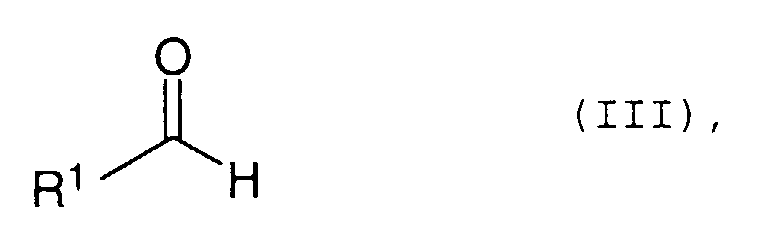 in der R1 die oben angegebene Bedeutung hat, das dadurch
gekennzeichnet ist, daß man das Keton in Gegenwart von einem
Katalysatorsystem bestehend aus Dimethylamin oder Pyrrolidin und
einer Carbonsäure enthaltend mindestens 2 C-Atome, vorzugsweise
einer Carbonsäure enthaltend 2 bis 10 C-Atome, insbesondere
Essigsäure, Adipinsäure oder Phthalsäure unter Rückfluß zum Sieden
erhitzt und zu dieser Mischung langsam den Aldehyd der allgemeinen
Formel III zufügt.
in der R1 die oben angegebene Bedeutung hat, das dadurch
gekennzeichnet ist, daß man das Keton in Gegenwart von einem
Katalysatorsystem bestehend aus Dimethylamin oder Pyrrolidin und
einer Carbonsäure enthaltend mindestens 2 C-Atome, vorzugsweise
einer Carbonsäure enthaltend 2 bis 10 C-Atome, insbesondere
Essigsäure, Adipinsäure oder Phthalsäure unter Rückfluß zum Sieden
erhitzt und zu dieser Mischung langsam den Aldehyd der allgemeinen
Formel III zufügt.
und R2 für einen verzweigten oder unverzweigten cyclischen oder acyclischen gesättigten oder ungesättigten aliphatischen Rest mit 1 bis 10 C-Atomen steht,
durch Umsetzen von einem Keton der allgemeinen Formel II
Es waren zwar aus EP 0 058 927 B1 und EP 0 092 097 B1 schon
Verfahren zur Herstellung von α-Alkyl-acroleinen durch Umsetzen
von Alkanalen mit Formaldehyd und sekundären Aminen in Gegenwart
von Carbonsäuren oder Dicarbonsäuren bekannt, jedoch erfolgt bei
diesen auf der Mannich-Reaktion basierenden Verfahren die Aktivierung
des Formaldehyds als Akzeptorkomponente mit Hilfe des
Amins gemäß dem nachfolgenden Schema 1 (vgl. Organikum, 16. Auflage
(1986), Seiten 466f.).
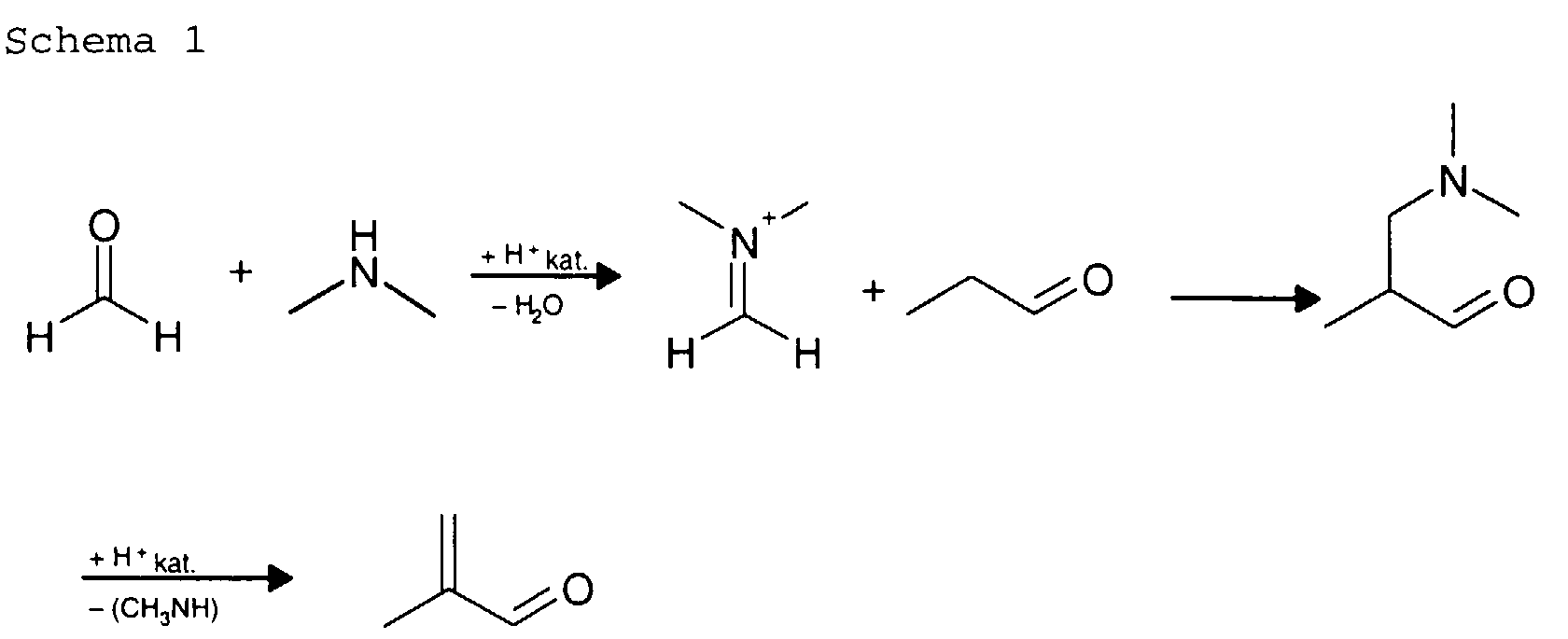
Dagegen zeichnet sich das hier beschriebene Verfahren dadurch
aus, daß gemäß Schema 2 die Donorkomponente durch die Bildung
eines intermediären Enamins aktiviert wird.

Zur Erzielung guter Umsätze und guter Selektivitäten ist es
wichtig, daß man das Keton, insbesondere das Aceton, in einem
molaren Überschuß gegenüber dem Aldehyd der Formel III verwendet.
Als vorteilhaft haben sich Mengen an Keton von mindestens 2 Mol
pro Mol des Aldehyds der Formel III, vorzugsweise etwa 4 bis
8 Mol, insbesondere etwa 5 Mol pro Mol des Aldehyds der Formel
III erwiesen.
Das erfindungsgemäße Verfahren gelingt besonders vorteilhaft,
wenn man in dem Katalysatorsystem das Dimethylamin oder das
Pyrrolidin und die Carbonsäure in etwa äquimolaren Mengen
einsetzt und dieses Katalysatorsystem in Mengen von etwa 0,5
bis 10 Mol-%, vorzugsweise 7 bis 8 Mol-%, insbesondere etwa
7,5 Mol-%, bezogen auf den im allgemeinen im molaren Unterschuß
eingesetzten Aldehyd der allgemeinen Formel III verwendet.
Besonders gute Selektivitäten an dem ungesättigten Keton werden
mit Hilfe des erfindungsgemäßen Verfahrens erzielt, wenn man ein
Katalysatorsystem verwendet, das aus Dimethylamin und Essigsäure
besteht.
Mit Vorteil verwendet man das Dimethylamin oder das Pyrrolidin
in Form einer wässrigen Lösung.
Zur Herstellung des entsprechenden gesättigten Ketons, insbesondere
von 2-Methyl-heptan-2-on, kann man das nach dem
erfindungsgemäßen Verfahren erhaltene, das ungesättigte Keton
der allgemeinen Formel I enthaltende Reaktionsgemisch nach
Abtrennung der gebildeten wäßrigen Phase ohne weitere Aufarbeitung
in an sich bekannter Weise zu dem entsprechenden
gesättigten Keton hydrieren.
Als für das erfindungsgemäße Verfahren geeignete Ketone seien
insbesondere Aceton, Methylethylketon und Cyclohexanon genannt,
als geeignete Aldehyde insbesondere Propionaldehyd, Butyraldehyd,
Valeraldehyd, Isovaleraldehyd, Citronellal, 3-(tert.-Butyl-phenyl)-2-methyl-propanal,
3-(Methyl-phenyl)-2-methyl-propanal
und 3-(Methoxy-phenyl)-2-methyl-propanal, insbesondere Isover-aldehyd
und Citronellal.
Als geeignete Amine seien insbesondere sekundären Amine wie
Pyrrolidin und Dimethylamin, insbesondere das Dimethylamin,
genannt.
Als Carbonsäure kommen vorzugsweise Carbonsäuren mit 2 bis 10 C-Atomen
in Betracht. Hierbei ist es unerheblich, ob eine
aliphatische oder eine aromatische Carbonsäure verwendet wird. Es
können auch Carbonsäuren, die 2 oder mehrere Carboxylgruppen enthalten,
wie Adipinsäure oder Phthalsäure verwendet werden. Mit
besonderem Vorteil verwendet man Essigsäure, Phthalsäure und
Adipinsäure, insbesondere Essigsäure.
Die Reaktion kann unter Atmosphärendruck oder unter höheren Drukken
ausgeführt werden. Im allgemeinen reicht jedoch Atmosphärendruck
aus.
Die Temperatur kann über einen weiten Bereich zwischen etwa -10
bis 200°C variiert werden. Wird beispielsweise Aceton als Keton-komponente
verwendet, so wird die Reaktion bevorzugt bei der
Temperatur ausgeführt, bei der das vorgelegte Aceton siedet.
Das erfindungsgemäße Verfahren kann sowohl diskontinuierlich, als
auch halbkontinuierlich oder kontinuierlich durchgeführt werden.
Das neue Verfahren ist besonders geeignet zu Herstellung von
6-Methyl-heptan-2-on, wobei zunächst Aceton in Gegenwart eines
Katalysators bestehend aus wässrigem Dimethylamin und Essigsäure
mit Isovaleraldehyd zur Reaktion gebracht wird und das Reaktionsprodukt,
das nach Abtrennung der gebildeten wäßrigen Phase im
wesentlichen aus 6-Methyl-3-hepten-2-on (MHE) besteht, in an sich
bekannter Weise an einem Hydrierkatalysator mit Wasserstoff zu
MHA hydriert wird.
Wie das Beispiel 15 zeigt, kann der von der gebildeten wäßrigen
Phase befreite Kondensationsaustrag an einem üblichen Hydrierkatalysator,
wie einem Katalysator enthaltend 5-Gew.-% Pd auf
Aktivkohle, bei 3 bis 20 °C und ca. 1 bar Wasserstoffdruck, also
unter sehr milden Hydrierbedingungen, mit quantitativem Umsatz
hydriert werden.
Als übliche Hydrierkatalysatoren sind beispielsweise Katalysatoren
geeignet, die mindestens ein Element der 8. bis 10. Nebengruppe
des Periodensystems enthalten, vorzugsweise Ni oder Co,
oder aber ein Edelmetall, wie Pt, Pd, Rh, Ru, Ir, Au oder Ag,
insbesondere Pd. Die Hydrierkatalysatoren können in metallischer
oder oxidischer Form auf inerten Trägermaterialien, wie Kohle,
SiO2, TiO2, ZrO2 oder Al2O3 oder aber in Träger-loser Form, wie
das beispielsweise bei Verwendung von Raney-Nickel oder Raney-Cobalt
der Fall ist, eingesetzt werden.
Die Hydrierung kann unter den üblichen Bedingungen bei einem
Wasserstoffüberdruck von 0,5 bis 50 bar, vorzugsweise bei 1 bis
10 bar und Temperaturen von 0 bis 100°C, vorzugsweise von 20 bis
40°C durchgeführt werden.
Die Aufarbeitung kann auf der Stufe des ungesättigten Ketons oder
nach der Hydrierung mit Hilfe der üblichen Methoden, zum Beispiel
durch Destillation oder Kristallisation erfolgen.
MHA ist ein wichtiges Vorprodukt zur Herstellung von fettlöslichen
Vitaminen, wie Vitamin-E. In der wissenschaftlichen
Literatur existiert eine Vielzahl von Synthese-methoden, die u.a.
in EP 816 321 genannt werden. Als Nachteil dieser Verfahren ist
oft das schlechte Verhältnis von Selektivität und Raum-Zeit-Ausbeute
zu nennen.
Durch das erfindungsgemäße Verfahren kann 6-MHA mit Selektivitäten
> 92 %, bezogen auf den im Unterschuß eingesetzten Aldehyd
in guten Raum-Zeit-Ausbeuten hergestellt werden.
Auch das für die Herstellung von verschiedenen Wirkstoffen geeignete
und daher begehrte 6,10-Dimethyl-undeca-3,9-dien-2-on sowie
6-(tert.-Butyl-phenyl)-5-methyl-hexan-2-on können mit unerwartet
hohen Selektivitäten erhalten werden.
Ferner lassen sich die aus der Kondensation hevorgegangenen
Ketone je nach Art des eingesetzten Katalysators und den
gewählten Reaktionsbedingungen zu den entsprechenden Alkoholen
umsetzen.
Die Versuche wurden in einer 250 ml Rührapparatur mit aufgesetztem
Rückflußkühler und Tropftrichter nach folgender Standardvorschrift
durchgeführt:
In die Rührapparatur wurden 113 g (1,95 mol) Aceton und die in
der Tabelle angegebene Menge Katalysator (angegeben in Mol-%,
bezogen auf den eingesetzten Aldehyd) unter Rühren bis zum Rückfluß
erhitzt. Anschließend wurde zu diesem siedenden Gemisch
0,65 mol Isovaleraldehyd (IVA) innerhalb von 5 bis 6 Stunden (h)
bei Normaldruck zugetropft und das Reaktionsgemisch nach Beendigung
des Zutropfens noch 1 h nachgerührt. Die Auswertung der Versuche
erfolgte durch gaschromatographische Analyse (GC) auf Basis
der GC-Flächenprozente (Methode: 50 m OV 1701, 25 µm, 50/10/240),
wobei Aceton als Lösungsmittel bewertet wurde und nicht in die
Auswertung mit einging. Für die Berechnung von Umsatz und
Selektivität wurde die Summe der Wertprodukte (WP) aus den Reaktionsprodukten
6-MHE, dessen dekonjugierten Isomeren und dem
β-Hydroxy-keton (6-MHOL) gebildet.
Für das Katalysatorsystem wurden als Aminkomponenten Dimethylamin
(DMA), Diethylamin (DEA), Pyrrolidin (Pyrr), Piperidin (Pip) und
Morpholin (Morph) in Gegenwart von Essigsäure getestet. Hierzu
wurden bei der Herstellung der Katalysatorsysteme alle Amine in
Form einer 40 Gew.-%-igen Lösung in Wasser vorgelegt und hierzu
unter Kühlung Essigsäure zugetropft. Im Vergleichsbeispiel 5*
wurden Diethanolamin (DIEA) und Oxalsäure (Oxals) als Katalysator
eingesetzt. Im Vergleichsbeispiel 4* wurde nur wäßrige DMA-Lösung
ohne Säure eingesetzt. Die Ergebnisse der durchgeführten Versuche
sind in Tabelle 1 zusammengefaßt.

Die Ergebnisse aus Tabelle 1 zeigen, daß mit dem Katalysatorsystem
Dimethylamin/Essigsäure bei nahezu vollständigem Umsatz
die größten Selektivitäten erreicht werden können, wenn der
Katalysator in Mengen von etwa 7,5 Mol-% zum Isovaleraldehyd IVA
eingesetzt wird. Alle anderen Amin-Carbonsäure-Kombinationen
liefern schlechtere Selektivitäten bzw. versagen, wie im Falle
des Systems Diethanolamin/Oxalsäure ganz.
Für diese Versuche wurde Dimethylamin als Base eingesetzt.
Als Brönstedtsäuren wurden als organische Säuren Essigsäure,
Adipinsäure, Phthalsäure und Oxalsäure eingesetzt, außerdem die
sauren Ionenaustauscher Dowex 50 WX8, Lewatit SPC 112/H, und als
anorganische Säuren Amberlist 15, Amberlit IR, Deloxan, β-Zeolith
GE 1494, Montmorillonit KSF, Al2O3 und Bentonit K-10 verwendet.
Die Menge der heterogenen Säuren wurde auf 0,5 g festgelegt und
in Vorversuchen die zur Neutralisation erforderliche Menge an
40 %-igem wässrigen DMA bestimmt.
Die löslichen Katalysatorssyteme (DMA/Adipinsäure, DMA/Phthalsäure
und DMA/Oxalsäure) wurden, wie oben für das Amin angegeben,
im Verhältnis von 7,5 Mol-%, bezogen auf den eingesetzten Aldehyd
IVA verwendet. Das Verhältnis von Aceton zu IVA wurde auf 3:1
eingestellt.
Die erzielten Ergebnisse sind in Tabelle 2 dargestellt.

Aus den in Tabelle 2 dargestellten Ergebnissen wird die überraschende
deutliche Überlegenheit der in Wasser löslichen Katalysatorsysteme
gegenüber den partiell heterogenen Katalysatorsystemen
ersichtlich, wobei sich Essigsäure als beste Säurekomponente
erwies. Essigsäure wurde daher auch für die folgenden
Versuche eingesetzt. Alternativ sind aber auch Phthalsäure und
Adipinsäure für den Kondensationsschritt gut geeignet.
In Vergleichsversuch 15* wurde vergeblich versucht, die Kondensation
in Abwesenheit eines Amins, also nur in Gegenwart von
Phthalsäure durchzuführen.
Jeweils 70 g Aceton wurden bei Raumtemperatur (Rt) zusammen mit
der aus der folgenden Tabelle 3 ersichtlichen Menge an DMA und
der in der Tabelle 3 angegebenen Säure in der dort angegebenen
Menge (entsprechend 7,5 Mol-% Katalysatorsystem) in einer Rührapparatur
vorgelegt und unter Rühren erhitzt. Nach Erreichen der
Rückflußtemperatur wurden innerhalb von 5 h 34,4 g IVA, gelöst
in 46,5 g Aceton, zugetropft. Die Reaktionsausträge wurden
mittels GC analysiert.
| Beispiel bzw. Vergleichsbeispiel* | Menge Dimethylamin | Menge Säure | Umsatz an IVA | Ausbeute an 6-MHE |
| 10 | 1,32 g | 1,8 g Essigsäure | > 99 % | 84,2 % |
| 20* | 1,32 g | 1,38 g Ameisensäure | 21 % | 13,0 % |
| 21* | 1,32 g | 3,0 g Phosphorsäure | 0 % | 0 % |
| 22* | 2,64 g | 3,0 g Phosphorsäure | 35 % | 15,6 % |
| 23* | 3,96 g | 3,0 g Phosphorsäure | 70 % | 35,4 % |
Aus den Vergleichsversuchen 20* bis 23* geht hervor, daß die
Selektivitäten an 6-MHE mit den Säuren Ameisensäure oder
Phosphorsäure im Katalysatorsystem wesentlich schlechter sind,
als mit Essigsäure.
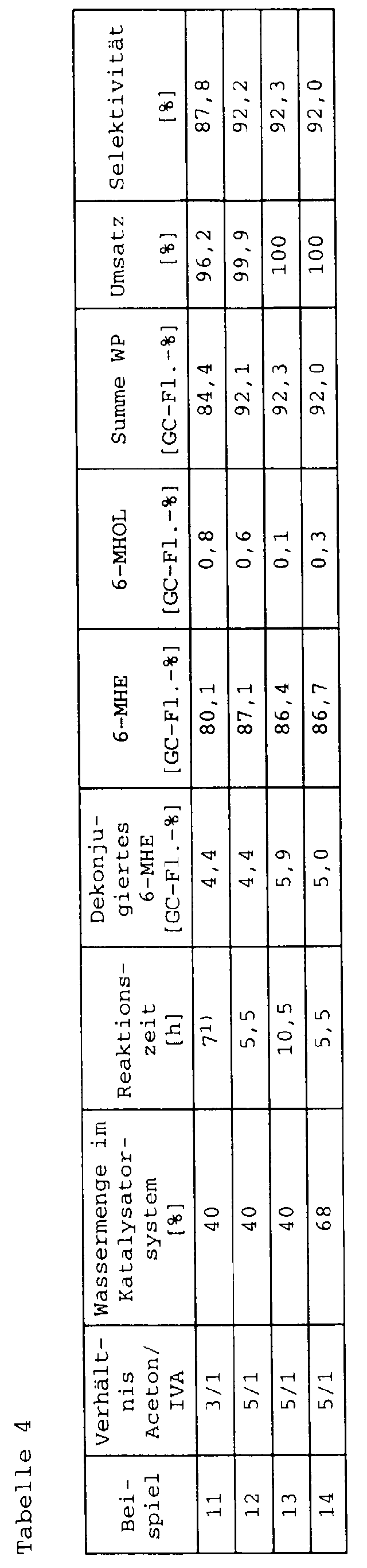
Als Katalysatorsystem wurde DMA/Essigsäure nach der bereits
oben beschriebenen Standardvorschrift (je 7,5 Mol-%), jedoch bei
einem Aceton/IVA-Verhältnis von 5 : 1 eingesetzt, wobei 40 % des
Acetons zum Vorverdünnen des IVA verwendet wurden. Die Ergebnisse
wurden in Tabelle 4 dargestellt.
Die in Tabelle 4 dargestellten Ergebnisse zeigen, daß sich durch
die Erhöhung des Aceton/IVA-Verhältnisses auf 5/1 die Selektivität
der Aldolkondensation auf über 92 % steigern läßt.
100 g des Reaktionsaustrags aus Beispiel 12 (s. Tabelle 4) wurde
nach Abtrennung der in der Kondensationsreaktion anfallenden wäßrigen
Phase ohne weitere Aufarbeitung in Gegenwart von 2 g eines
Hydrierkatalysators enthaltend 5 Gew.-% Pd auf Kohle bei 20°C und
ca. 1 bar Wasserstoffdruck hydriert. Nach 2,5 h kam die Wasserstoffaufnahme
zum Erliegen. Die GC-Analyse des Hydrieraustrages
bestätigte den quantitativen Umsatz von 6-MHE in das gewünschte
6-Methyl-heptanon. Dieser Versuch dokumentiert, daß es prinzipiell
möglich ist, 6-MHE unter sehr milden Bedingungen mit unerwartet
hohen Selektivitäten zum gesättigten Keton zu hydrieren.
150 g Aceton wurden bei Rt zusammen mit 1,32 g Dimethylamin
und 1,8 g Essigsäure (entsprechend 7,5 Mol-%, bezogen auf das
Katalysatorsystem) in einer Rührapparatur vorgelegt und unter
Rühren erhitzt. Nach Erreichen der Rückflußtemperatur wurden
innerhalb von 5 h 100 g Citronellal zu dem siedenden Reaktionsgemisch
zugetropft. Die Reaktionsausträge wurden mittels GC
analysiert. Der Umsatz an Citronellal betrug 84 %, die Selektivität
an 6,10-Dimethyl-undeca-3,9-dien- 2-on betrug 95 % der
Theorie.
Claims (10)
- Verfahren zur Herstellung von α,β-ungesättigten Ketonen der allgemeinen Formel Iin der R1 für einen verzweigten oder unverzweigten cyclischen oder acyclischen gesättigten oder ungesättigten aliphatischen oder araliphatischen Rest mit 4 bis 20 C-Atomen steht, und R2 für einen verzweigten oder unverzweigten cyclischen oder acyclischen gesättigten oder ungesättigten aliphatischen oder araliphatischen Rest mit 1 bis 10 C-Atomen steht, durch Umsetzen von einem Keton der allgemeinen Formel II
 in der R2 die oben angegebene Bedeutung hat, mit einem Aldehyd der allgemeinen Formel III
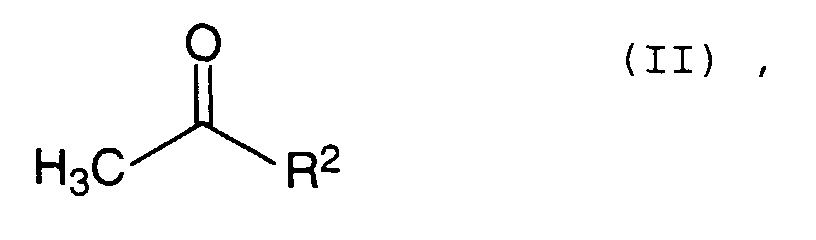 in der R1 die oben angegebene Bedeutung hat, dadurch gekennzeichnet, daß man das Keton in molarem Überschuß in Gegenwart von einem Katalysatorsystem bestehend aus Dimethylamin oder Pyrrolidin und einer Carbonsäure enthaltend mindestens 2 C-Atome unter Rückfluß zum Sieden erhitzt und zu dieser Mischung langsam den Aldehyd der allgemeinen Formel III zufügt.
- Verfahren gemäß Anspruch 1, dadurch gekennzeichnet, daß man in dem Katalysatorsystem das Dimethylamin oder das Pyrrolidin und die Carbonsäure in etwa äquimolaren Mengen einsetzt.
- Verfahren gemäß Anspruch 1, dadurch gekennzeichnet, daß man das Katalysatorsystem in Mengen von etwa 5 bis 10 Mol-%, bezogen auf den eingesetzten Aldehyd der allgemeinen Formel III verwendet.
- Verfahren gemäß Anspruch 1, dadurch gekennzeichnet, daß man das Katalysatorsystem in Mengen von etwa 7 bis 8 Mol-%, bezogen auf den eingesetzten Aldehyd der allgemeinen Formel III verwendet.
- Verfahren gemäß Anspruch 1, dadurch gekennzeichnet, daß das Katalysatorsystem aus Dimethylamin oder Pyrrolidin und einer Carbonsäure enthaltend 2 bis 10 C-Atome besteht.
- Verfahren gemäß Anspruch 1, dadurch gekennzeichnet, daß das Katalysatorsystem aus Dimethylamin und Essigsäure besteht.
- Verfahren gemäß Anspruch 1, dadurch gekennzeichnet, daß man das Dimethylamin oder das Pyrrolidin in Form einer wäßrigen Lösung verwendet.
- Verfahren gemäß Anspruch 1, dadurch gekennzeichnet, daß man das erhaltene ungesättigte Keton der allgemeinen Formel I nach Abtrennen der gebildeten wäßrigen Phase ohne weitere Aufarbeitung in an sich bekannter Weise in das entsprechende gesättigte Keton hydriert.
- Verfahren gemäß Anspruch 1, dadurch gekennzeichnet, daß man das Keton in einem mindestens 2-molaren Überschuß gegenüber dem Aldehyd der Formel III verwendet.
- Verfahren gemäß Anspruch 1, dadurch gekennzeichnet, daß man zur Herstellung von 6-Methyl-heptan-2-on Isovaleraldehyd mit Aceton in einem 4,5- bis 5,5-fach molarem Überschuß in Gegenwart von einem Katalysatorsystem bestehend aus etwa äquimolaren Mengen an Dimethylamin und Essigsäure in Mengen von etwa 6 bis 8 Mol-%, bezogen auf den Isovaleraldehyd, umsetzt und das erhaltene 6-Methyl-3-hepten-2-on in an sich bekannter Weise katalytisch hydriert.
Applications Claiming Priority (2)
| Application Number | Priority Date | Filing Date | Title |
|---|---|---|---|
| DE19959053A DE19959053A1 (de) | 1999-12-07 | 1999-12-07 | Verfahren zur Herstellung von Ketonen, insbesondere von 6-Methylheptan-2-on |
| DE19959053 | 1999-12-07 |
Publications (1)
| Publication Number | Publication Date |
|---|---|
| EP1106597A1 true EP1106597A1 (de) | 2001-06-13 |
Family
ID=7931783
Family Applications (1)
| Application Number | Title | Priority Date | Filing Date |
|---|---|---|---|
| EP00125625A Withdrawn EP1106597A1 (de) | 1999-12-07 | 2000-11-23 | Verfahren zur Herstellung von Ketonen, insbesondere von 6-Methylheptan-2-On |
Country Status (6)
| Country | Link |
|---|---|
| US (1) | US6303823B2 (de) |
| EP (1) | EP1106597A1 (de) |
| JP (1) | JP2001163822A (de) |
| KR (1) | KR20010062160A (de) |
| CN (1) | CN1302791A (de) |
| DE (1) | DE19959053A1 (de) |
Cited By (2)
| Publication number | Priority date | Publication date | Assignee | Title |
|---|---|---|---|---|
| WO2002010103A1 (en) * | 2000-08-02 | 2002-02-07 | Astrazeneca Ab | PROCESS FOR SYNTHESIS OF α,β-UNSATURATED KETONES |
| WO2006029737A1 (en) * | 2004-09-14 | 2006-03-23 | Dsm Ip Assets B.V. | Process for the preparation of saturated aliphatic ketones |
Families Citing this family (10)
| Publication number | Priority date | Publication date | Assignee | Title |
|---|---|---|---|---|
| JP5297036B2 (ja) * | 2007-12-25 | 2013-09-25 | 花王株式会社 | 2−(1−ヒドロキシアルキル)シクロアルカノンとその脱水体との混合物の製造方法 |
| US9458663B2 (en) * | 2010-04-16 | 2016-10-04 | Hunter Douglas Inc. | Process and system for manufacturing a roller blind |
| CN102531861A (zh) * | 2012-01-05 | 2012-07-04 | 淮海工学院 | 5-乙基-2-壬酮的制备新方法 |
| BR112017008899A2 (pt) * | 2014-10-29 | 2017-12-19 | Bp Corp North America Inc | métodos para produzir combustíveis, aditivos de gasolina e lubrificantes usando catalisadores de amina |
| EP3212602A1 (de) | 2014-10-29 | 2017-09-06 | The Regents of the University of California | Verfahren zur herstellung von kraftstoffen, benzinadditiven und schmierstoffen mit aminkatalysatoren |
| CN105218339B (zh) * | 2015-11-03 | 2017-03-22 | 山东新和成药业有限公司 | 一种由异戊烯醛制备甲基庚烯酮的方法 |
| CN105399613B (zh) * | 2015-12-31 | 2018-09-25 | 山东新和成药业有限公司 | 一种香料6-甲基-3-庚烯-2-酮的制备方法 |
| CN108101761B (zh) * | 2017-12-08 | 2021-08-03 | 陕西嘉禾生物科技股份有限公司 | 一种姜黄素的制备方法 |
| CN112955423A (zh) * | 2018-11-13 | 2021-06-11 | 伊士曼化工公司 | 醛的自缩合 |
| WO2022268285A1 (en) * | 2021-06-21 | 2022-12-29 | Symrise Ag | Aroma or fragrance compositions, comprising 4-methylheptan-3-one, and methods for producing them |
Citations (4)
| Publication number | Priority date | Publication date | Assignee | Title |
|---|---|---|---|---|
| GB506850A (en) * | 1937-02-06 | 1939-06-06 | Ig Farbenindustrie Ag | Improvements in the manufacture and production of high molecular weight aldehydes, keytones and alcohols |
| FR2201280A1 (en) * | 1972-10-02 | 1974-04-26 | Bush Boake Allen Ltd | Parasols prepn from vanillin and methyl alkyl ketone - in presence of catalyst system contg. weak base and weak acid, for increased yields |
| US5214151A (en) * | 1989-11-17 | 1993-05-25 | Nippon Soda Co., Ltd. | Method for the preparation of α, β-unsaturated ketones |
| EP0816321A1 (de) * | 1996-07-05 | 1998-01-07 | Kuraray Co., Ltd. | Verfahren zur Herstellung von 6-Methyl-3-Hepten-2-on und 6-Methyl-2-Heptanon Analogen, und Verfahren zur Herstellung von Phyton oder Isophytol |
Family Cites Families (9)
| Publication number | Priority date | Publication date | Assignee | Title |
|---|---|---|---|---|
| IT1085879B (it) | 1976-04-08 | 1985-05-28 | Basf Ag | Processo per la preparazione di chetoni superiori |
| DE2615308C3 (de) | 1976-04-08 | 1980-06-26 | Basf Ag, 6700 Ludwigshafen | Verfahren zur Herstellung von höheren Ketonen |
| DE2625541A1 (de) * | 1976-06-05 | 1977-12-22 | Basf Ag | Verfahren zur herstellung einer zink und nickel oder kobalt enthaltenden kontaktmasse |
| DE3106557A1 (de) | 1981-02-21 | 1982-09-16 | Basf Ag, 6700 Ludwigshafen | Verfahren zur herstellung von (alpha)-alkylacroleinen |
| DE3213681A1 (de) | 1982-04-14 | 1983-10-27 | Basf Ag, 6700 Ludwigshafen | Verfahren zur herstellung von (alpha)-alkylacroleinen |
| US4945184A (en) | 1989-06-19 | 1990-07-31 | Aristech Chemical Corporation | Preparation of unsaturated ketones |
| US5004839A (en) * | 1989-10-23 | 1991-04-02 | Aristech Chemical Corporation | Preparation of unsaturated ketones from acetone and paraformaldehyde (II) |
| WO1996031454A1 (en) * | 1995-04-04 | 1996-10-10 | Kuraray Co., Ltd. | Process for preparing 6-methylheptan-2-one |
| GB9522359D0 (en) | 1995-11-01 | 1996-01-03 | Bp Chemicals Additives | Alkylation process |
-
1999
- 1999-12-07 DE DE19959053A patent/DE19959053A1/de not_active Withdrawn
-
2000
- 2000-11-23 EP EP00125625A patent/EP1106597A1/de not_active Withdrawn
- 2000-12-05 JP JP2000370495A patent/JP2001163822A/ja not_active Withdrawn
- 2000-12-05 US US09/729,459 patent/US6303823B2/en not_active Expired - Fee Related
- 2000-12-06 KR KR1020000073710A patent/KR20010062160A/ko not_active Withdrawn
- 2000-12-07 CN CN00137191A patent/CN1302791A/zh active Pending
Patent Citations (4)
| Publication number | Priority date | Publication date | Assignee | Title |
|---|---|---|---|---|
| GB506850A (en) * | 1937-02-06 | 1939-06-06 | Ig Farbenindustrie Ag | Improvements in the manufacture and production of high molecular weight aldehydes, keytones and alcohols |
| FR2201280A1 (en) * | 1972-10-02 | 1974-04-26 | Bush Boake Allen Ltd | Parasols prepn from vanillin and methyl alkyl ketone - in presence of catalyst system contg. weak base and weak acid, for increased yields |
| US5214151A (en) * | 1989-11-17 | 1993-05-25 | Nippon Soda Co., Ltd. | Method for the preparation of α, β-unsaturated ketones |
| EP0816321A1 (de) * | 1996-07-05 | 1998-01-07 | Kuraray Co., Ltd. | Verfahren zur Herstellung von 6-Methyl-3-Hepten-2-on und 6-Methyl-2-Heptanon Analogen, und Verfahren zur Herstellung von Phyton oder Isophytol |
Cited By (4)
| Publication number | Priority date | Publication date | Assignee | Title |
|---|---|---|---|---|
| WO2002010103A1 (en) * | 2000-08-02 | 2002-02-07 | Astrazeneca Ab | PROCESS FOR SYNTHESIS OF α,β-UNSATURATED KETONES |
| US6995289B2 (en) | 2000-08-02 | 2006-02-07 | Astrazeneca Ab | Process for synthesis of alpha, beta-unsaturated ketones |
| WO2006029737A1 (en) * | 2004-09-14 | 2006-03-23 | Dsm Ip Assets B.V. | Process for the preparation of saturated aliphatic ketones |
| US7935849B2 (en) | 2004-09-14 | 2011-05-03 | Dsm Ip Assets B.V. | Process for the preparation of saturated aliphatic ketones |
Also Published As
| Publication number | Publication date |
|---|---|
| US20010003784A1 (en) | 2001-06-14 |
| CN1302791A (zh) | 2001-07-11 |
| DE19959053A1 (de) | 2001-06-13 |
| US6303823B2 (en) | 2001-10-16 |
| JP2001163822A (ja) | 2001-06-19 |
| KR20010062160A (ko) | 2001-07-07 |
Similar Documents
| Publication | Publication Date | Title |
|---|---|---|
| DE2702582C3 (de) | Verfahren zur Herstellung von Trimethylolalkanen | |
| DE69003093T2 (de) | Verfahren zur herstellung von alpha-beta-ungesättigten ketonen. | |
| DE69712984T2 (de) | Verfahren zur Herstellung von 6-Methyl-2-Heptanon Analogen, und Verfahren zur Herstellung von Phyton und Isophytol | |
| DE4222708A1 (de) | Verfahren zur Herstellung von 1,3-Propandiol | |
| EP1106597A1 (de) | Verfahren zur Herstellung von Ketonen, insbesondere von 6-Methylheptan-2-On | |
| WO2018007207A1 (de) | Verfahren zur herstellung von sekundären, cycloaliphatischen aminen | |
| DE19754848C2 (de) | Verfahren zur Herstellung von Alkoholen | |
| DE2742981C2 (de) | Verfahren zur Herstellung von SerinoK 13-Dihydroxy-2-amino-propan) | |
| EP0435072B1 (de) | Verfahren zur Herstellung von N,N-Dimethylaminen | |
| EP0013385B1 (de) | Verfahren zur Herstellung von aliphatischen Carbonylverbindungen | |
| DE2626676A1 (de) | Verfahren zur herstellung von 2-pyrrolidon | |
| EP3010880B1 (de) | Verfahren zur herstellung von 2-chlordialkylbenzylaminen durch hydrierung | |
| EP0919532B1 (de) | Verfahren zur Herstellung von gesättigten Alkoholen | |
| EP0915838B1 (de) | Verfahren zur herstellung von 6-aminocapronitril | |
| EP1914218A1 (de) | Verfahren zur Herstellung von 1,2-Diolen aus Carbonylverbindungen | |
| EP0058326B1 (de) | Verfahren zur Herstellung von araliphatischen Aldehyden und/oder Aminen | |
| EP0468320B1 (de) | Verfahren zur Herstellung von Glykolen aus Formaldehyd | |
| DE10122758B4 (de) | Verfahren zur Herstellung von gemischten, sekundären Aminen | |
| DE2615308C3 (de) | Verfahren zur Herstellung von höheren Ketonen | |
| EP1090899B1 (de) | Verfahren zur Herstellung von 1,3-Diolen | |
| WO2001000564A1 (de) | Reduktive aminierung von aldehyden | |
| DE69008488T2 (de) | Verfahren zur Herstellung von N-Alkylaminophenolen und von N,N-Dialkylaminophenolen. | |
| DE2041976B2 (de) | Verfahren zur Herstellung von 3-Methyl-2-buten-l-al aus 3-Methyl-2-buten-l-ol | |
| EP0436860A1 (de) | Verfahren zur Herstellung von 2-(4-Chlorphenyl)-3-methyl-buttersäure | |
| EP0484790B1 (de) | Verfahren zur Herstellung von N-Methyl-alkylaminen |
Legal Events
| Date | Code | Title | Description |
|---|---|---|---|
| PUAI | Public reference made under article 153(3) epc to a published international application that has entered the european phase |
Free format text: ORIGINAL CODE: 0009012 |
|
| 17P | Request for examination filed |
Effective date: 20010404 |
|
| AK | Designated contracting states |
Kind code of ref document: A1 Designated state(s): AT BE CH CY DE DK ES FI FR GB GR IE IT LI LU MC NL PT SE TR |
|
| AX | Request for extension of the european patent |
Free format text: AL;LT;LV;MK;RO PAYMENT 20010404;SI PAYMENT 20010404 |
|
| STAA | Information on the status of an ep patent application or granted ep patent |
Free format text: STATUS: THE APPLICATION HAS BEEN WITHDRAWN |
|
| 18W | Application withdrawn |
Withdrawal date: 20011016 |