EP1103842B1 - Elektrochrome Vorrichtung - Google Patents
Elektrochrome Vorrichtung Download PDFInfo
- Publication number
- EP1103842B1 EP1103842B1 EP00124242A EP00124242A EP1103842B1 EP 1103842 B1 EP1103842 B1 EP 1103842B1 EP 00124242 A EP00124242 A EP 00124242A EP 00124242 A EP00124242 A EP 00124242A EP 1103842 B1 EP1103842 B1 EP 1103842B1
- Authority
- EP
- European Patent Office
- Prior art keywords
- red
- electrochromic
- bis
- oder
- cell
- Prior art date
- Legal status (The legal status is an assumption and is not a legal conclusion. Google has not performed a legal analysis and makes no representation as to the accuracy of the status listed.)
- Expired - Lifetime
Links
- 150000001875 compounds Chemical class 0.000 claims abstract description 34
- 230000003647 oxidation Effects 0.000 claims abstract description 28
- 238000007254 oxidation reaction Methods 0.000 claims abstract description 28
- 239000011521 glass Substances 0.000 claims abstract description 15
- 230000009467 reduction Effects 0.000 claims abstract description 13
- 238000000576 coating method Methods 0.000 claims abstract description 7
- 239000011248 coating agent Substances 0.000 claims abstract description 5
- 238000007789 sealing Methods 0.000 claims abstract description 5
- 239000004033 plastic Substances 0.000 claims abstract 3
- 239000004020 conductor Substances 0.000 claims abstract 2
- WPPDXAHGCGPUPK-UHFFFAOYSA-N red 2 Chemical compound C1=CC=CC=C1C(C1=CC=CC=C11)=C(C=2C=3C4=CC=C5C6=CC=C7C8=C(C=9C=CC=CC=9)C9=CC=CC=C9C(C=9C=CC=CC=9)=C8C8=CC=C(C6=C87)C(C=35)=CC=2)C4=C1C1=CC=CC=C1 WPPDXAHGCGPUPK-UHFFFAOYSA-N 0.000 claims description 5
- 239000012799 electrically-conductive coating Substances 0.000 claims description 2
- 238000001228 spectrum Methods 0.000 claims description 2
- 239000002985 plastic film Substances 0.000 claims 1
- 229920006255 plastic film Polymers 0.000 claims 1
- 239000011888 foil Substances 0.000 abstract description 5
- 230000001590 oxidative effect Effects 0.000 abstract description 2
- 102100038191 Double-stranded RNA-specific editase 1 Human genes 0.000 abstract 2
- 101000742223 Homo sapiens Double-stranded RNA-specific editase 1 Proteins 0.000 abstract 2
- 101000686491 Platymeris rhadamanthus Venom redulysin 1 Proteins 0.000 abstract 2
- 101150113227 RED3 gene Proteins 0.000 abstract 1
- -1 palladium hydride Chemical class 0.000 description 41
- 239000000126 substance Substances 0.000 description 31
- 229910052739 hydrogen Inorganic materials 0.000 description 28
- 239000001257 hydrogen Substances 0.000 description 28
- UFHFLCQGNIYNRP-UHFFFAOYSA-N Hydrogen Chemical compound [H][H] UFHFLCQGNIYNRP-UHFFFAOYSA-N 0.000 description 25
- 150000003254 radicals Chemical class 0.000 description 22
- 230000005540 biological transmission Effects 0.000 description 20
- 125000002496 methyl group Chemical group [H]C([H])([H])* 0.000 description 16
- 125000004093 cyano group Chemical group *C#N 0.000 description 15
- 150000002431 hydrogen Chemical class 0.000 description 15
- 125000001997 phenyl group Chemical group [H]C1=C([H])C([H])=C(*)C([H])=C1[H] 0.000 description 13
- 150000001450 anions Chemical class 0.000 description 12
- 229910052736 halogen Inorganic materials 0.000 description 12
- 150000002367 halogens Chemical class 0.000 description 12
- 150000003839 salts Chemical class 0.000 description 12
- BOXSCYUXSBYGRD-UHFFFAOYSA-N cyclopenta-1,3-diene;iron(3+) Chemical compound [Fe+3].C=1C=C[CH-]C=1.C=1C=C[CH-]C=1 BOXSCYUXSBYGRD-UHFFFAOYSA-N 0.000 description 10
- 229910052751 metal Inorganic materials 0.000 description 10
- 239000002184 metal Substances 0.000 description 10
- 239000000203 mixture Substances 0.000 description 10
- 239000012476 oxidizable substance Substances 0.000 description 10
- 229910052760 oxygen Inorganic materials 0.000 description 10
- 239000000243 solution Substances 0.000 description 10
- 0 CN(C=C1)C(*)=C(*)C1=NN=C1C(*)=C(*)N(*)C=C1 Chemical compound CN(C=C1)C(*)=C(*)C1=NN=C1C(*)=C(*)N(*)C=C1 0.000 description 9
- 125000003118 aryl group Chemical group 0.000 description 9
- JFDZBHWFFUWGJE-UHFFFAOYSA-N benzonitrile Chemical compound N#CC1=CC=CC=C1 JFDZBHWFFUWGJE-UHFFFAOYSA-N 0.000 description 9
- 230000002441 reversible effect Effects 0.000 description 9
- 229910052717 sulfur Inorganic materials 0.000 description 9
- 230000007704 transition Effects 0.000 description 9
- 125000000484 butyl group Chemical group [H]C([*])([H])C([H])([H])C([H])([H])C([H])([H])[H] 0.000 description 8
- 125000004432 carbon atom Chemical group C* 0.000 description 8
- 238000010276 construction Methods 0.000 description 8
- PXBRQCKWGAHEHS-UHFFFAOYSA-N dichlorodifluoromethane Chemical compound FC(F)(Cl)Cl PXBRQCKWGAHEHS-UHFFFAOYSA-N 0.000 description 8
- 125000001495 ethyl group Chemical group [H]C([H])([H])C([H])([H])* 0.000 description 8
- 229920000642 polymer Polymers 0.000 description 8
- VEAUDLLZYJVHRI-UHFFFAOYSA-N Trichlormethine Chemical compound Cl.ClCCN(CCCl)CCCl VEAUDLLZYJVHRI-UHFFFAOYSA-N 0.000 description 7
- BQCADISMDOOEFD-UHFFFAOYSA-N Silver Chemical compound [Ag] BQCADISMDOOEFD-UHFFFAOYSA-N 0.000 description 6
- 230000008859 change Effects 0.000 description 6
- 125000000058 cyclopentadienyl group Chemical group C1(=CC=CC1)* 0.000 description 6
- ZSWFCLXCOIISFI-UHFFFAOYSA-N endo-cyclopentadiene Natural products C1C=CC=C1 ZSWFCLXCOIISFI-UHFFFAOYSA-N 0.000 description 6
- 125000004344 phenylpropyl group Chemical group 0.000 description 6
- 239000000853 adhesive Substances 0.000 description 5
- 230000001070 adhesive effect Effects 0.000 description 5
- KTWOOEGAPBSYNW-UHFFFAOYSA-N ferrocene Chemical group [Fe+2].C=1C=C[CH-]C=1.C=1C=C[CH-]C=1 KTWOOEGAPBSYNW-UHFFFAOYSA-N 0.000 description 5
- 238000005259 measurement Methods 0.000 description 5
- 125000000449 nitro group Chemical group [O-][N+](*)=O 0.000 description 5
- 238000006479 redox reaction Methods 0.000 description 5
- 229910052709 silver Inorganic materials 0.000 description 5
- 239000004332 silver Substances 0.000 description 5
- 239000002904 solvent Substances 0.000 description 5
- MXFOQZLUCVHVRD-UHFFFAOYSA-N 2-methylsulfonyloxyethyl-[2,3,4,5-tetrahydroxy-6-(2-methylsulfonyloxyethylamino)hexyl]azanium;chloride Chemical compound [Cl-].CS(=O)(=O)OCCNCC(O)C(O)C(O)C(O)C[NH2+]CCOS(C)(=O)=O MXFOQZLUCVHVRD-UHFFFAOYSA-N 0.000 description 4
- JCXJVPUVTGWSNB-UHFFFAOYSA-N Nitrogen dioxide Chemical class O=[N]=O JCXJVPUVTGWSNB-UHFFFAOYSA-N 0.000 description 4
- 239000011324 bead Substances 0.000 description 4
- 238000006243 chemical reaction Methods 0.000 description 4
- 125000003187 heptyl group Chemical group [H]C([*])([H])C([H])([H])C([H])([H])C([H])([H])C([H])([H])C([H])([H])C([H])([H])[H] 0.000 description 4
- 125000004051 hexyl group Chemical group [H]C([H])([H])C([H])([H])C([H])([H])C([H])([H])C([H])([H])C([H])([H])* 0.000 description 4
- 239000007788 liquid Substances 0.000 description 4
- 125000000951 phenoxy group Chemical group [H]C1=C([H])C([H])=C(O*)C([H])=C1[H] 0.000 description 4
- 125000001436 propyl group Chemical group [H]C([*])([H])C([H])([H])C([H])([H])[H] 0.000 description 4
- RUOJZAUFBMNUDX-UHFFFAOYSA-N propylene carbonate Chemical compound CC1COC(=O)O1 RUOJZAUFBMNUDX-UHFFFAOYSA-N 0.000 description 4
- WEVYAHXRMPXWCK-UHFFFAOYSA-N Acetonitrile Chemical compound CC#N WEVYAHXRMPXWCK-UHFFFAOYSA-N 0.000 description 3
- ZAMOUSCENKQFHK-UHFFFAOYSA-N Chlorine atom Chemical compound [Cl] ZAMOUSCENKQFHK-UHFFFAOYSA-N 0.000 description 3
- PXGOKWXKJXAPGV-UHFFFAOYSA-N Fluorine Chemical compound FF PXGOKWXKJXAPGV-UHFFFAOYSA-N 0.000 description 3
- ZMXDDKWLCZADIW-UHFFFAOYSA-N N,N-Dimethylformamide Chemical compound CN(C)C=O ZMXDDKWLCZADIW-UHFFFAOYSA-N 0.000 description 3
- 230000006399 behavior Effects 0.000 description 3
- 230000008901 benefit Effects 0.000 description 3
- 229910052799 carbon Inorganic materials 0.000 description 3
- 229910052801 chlorine Inorganic materials 0.000 description 3
- 239000000460 chlorine Substances 0.000 description 3
- 229910052731 fluorine Inorganic materials 0.000 description 3
- 239000011737 fluorine Substances 0.000 description 3
- 125000000623 heterocyclic group Chemical group 0.000 description 3
- RAXXELZNTBOGNW-UHFFFAOYSA-N imidazole Natural products C1=CNC=N1 RAXXELZNTBOGNW-UHFFFAOYSA-N 0.000 description 3
- HBPXFHNNLMCUPA-UHFFFAOYSA-M molport-023-277-200 Chemical compound [Br-].C1N(C2)CN3CN2C[N+]1(CCO)C3 HBPXFHNNLMCUPA-UHFFFAOYSA-M 0.000 description 3
- 230000003287 optical effect Effects 0.000 description 3
- KDLHZDBZIXYQEI-UHFFFAOYSA-N palladium Substances [Pd] KDLHZDBZIXYQEI-UHFFFAOYSA-N 0.000 description 3
- 239000002151 riboflavin Substances 0.000 description 3
- 239000005266 side chain polymer Substances 0.000 description 3
- 239000004149 tartrazine Substances 0.000 description 3
- 125000000094 2-phenylethyl group Chemical group [H]C1=C([H])C([H])=C(C([H])=C1[H])C([H])([H])C([H])([H])* 0.000 description 2
- YEJRWHAVMIAJKC-UHFFFAOYSA-N 4-Butyrolactone Chemical compound O=C1CCCO1 YEJRWHAVMIAJKC-UHFFFAOYSA-N 0.000 description 2
- IJGRMHOSHXDMSA-UHFFFAOYSA-N Atomic nitrogen Chemical compound N#N IJGRMHOSHXDMSA-UHFFFAOYSA-N 0.000 description 2
- WKBOTKDWSSQWDR-UHFFFAOYSA-N Bromine atom Chemical compound [Br] WKBOTKDWSSQWDR-UHFFFAOYSA-N 0.000 description 2
- VEXZGXHMUGYJMC-UHFFFAOYSA-N Hydrochloric acid Chemical compound Cl VEXZGXHMUGYJMC-UHFFFAOYSA-N 0.000 description 2
- SIKJAQJRHWYJAI-UHFFFAOYSA-N Indole Chemical compound C1=CC=C2NC=CC2=C1 SIKJAQJRHWYJAI-UHFFFAOYSA-N 0.000 description 2
- KYQCOXFCLRTKLS-UHFFFAOYSA-N Pyrazine Chemical compound C1=CN=CC=N1 KYQCOXFCLRTKLS-UHFFFAOYSA-N 0.000 description 2
- JUJWROOIHBZHMG-UHFFFAOYSA-N Pyridine Chemical compound C1=CC=NC=C1 JUJWROOIHBZHMG-UHFFFAOYSA-N 0.000 description 2
- SMWDFEZZVXVKRB-UHFFFAOYSA-N Quinoline Chemical compound N1=CC=CC2=CC=CC=C21 SMWDFEZZVXVKRB-UHFFFAOYSA-N 0.000 description 2
- YTPLMLYBLZKORZ-UHFFFAOYSA-N Thiophene Chemical compound C=1C=CSC=1 YTPLMLYBLZKORZ-UHFFFAOYSA-N 0.000 description 2
- IOJUPLGTWVMSFF-UHFFFAOYSA-N benzothiazole Chemical compound C1=CC=C2SC=NC2=C1 IOJUPLGTWVMSFF-UHFFFAOYSA-N 0.000 description 2
- 125000001797 benzyl group Chemical group [H]C1=C([H])C([H])=C(C([H])=C1[H])C([H])([H])* 0.000 description 2
- GDTBXPJZTBHREO-UHFFFAOYSA-N bromine Substances BrBr GDTBXPJZTBHREO-UHFFFAOYSA-N 0.000 description 2
- 229910052794 bromium Inorganic materials 0.000 description 2
- NIKBCKTWWPVAIC-UHFFFAOYSA-N butyl benzenesulfonate Chemical compound CCCCOS(=O)(=O)C1=CC=CC=C1 NIKBCKTWWPVAIC-UHFFFAOYSA-N 0.000 description 2
- 239000003638 chemical reducing agent Substances 0.000 description 2
- 238000002484 cyclic voltammetry Methods 0.000 description 2
- IPZJQDSFZGZEOY-UHFFFAOYSA-N dimethylmethylene Chemical compound C[C]C IPZJQDSFZGZEOY-UHFFFAOYSA-N 0.000 description 2
- 238000007323 disproportionation reaction Methods 0.000 description 2
- 239000012039 electrophile Substances 0.000 description 2
- 229920006332 epoxy adhesive Polymers 0.000 description 2
- ZTOMUSMDRMJOTH-UHFFFAOYSA-N glutaronitrile Chemical compound N#CCCCC#N ZTOMUSMDRMJOTH-UHFFFAOYSA-N 0.000 description 2
- 230000005283 ground state Effects 0.000 description 2
- 239000012442 inert solvent Substances 0.000 description 2
- 150000002500 ions Chemical class 0.000 description 2
- 230000002427 irreversible effect Effects 0.000 description 2
- 239000000463 material Substances 0.000 description 2
- 239000011159 matrix material Substances 0.000 description 2
- 230000003446 memory effect Effects 0.000 description 2
- 238000002156 mixing Methods 0.000 description 2
- 239000012299 nitrogen atmosphere Substances 0.000 description 2
- 125000004433 nitrogen atom Chemical group N* 0.000 description 2
- QGLKJKCYBOYXKC-UHFFFAOYSA-N nonaoxidotritungsten Chemical compound O=[W]1(=O)O[W](=O)(=O)O[W](=O)(=O)O1 QGLKJKCYBOYXKC-UHFFFAOYSA-N 0.000 description 2
- 239000012038 nucleophile Substances 0.000 description 2
- 238000005457 optimization Methods 0.000 description 2
- 239000007800 oxidant agent Substances 0.000 description 2
- 229910052763 palladium Inorganic materials 0.000 description 2
- 229920000058 polyacrylate Polymers 0.000 description 2
- 238000010791 quenching Methods 0.000 description 2
- 230000027756 respiratory electron transport chain Effects 0.000 description 2
- 229910052711 selenium Inorganic materials 0.000 description 2
- 239000011734 sodium Substances 0.000 description 2
- 125000001424 substituent group Chemical group 0.000 description 2
- 229910001930 tungsten oxide Inorganic materials 0.000 description 2
- JGTNAGYHADQMCM-UHFFFAOYSA-M 1,1,2,2,3,3,4,4,4-nonafluorobutane-1-sulfonate Chemical compound [O-]S(=O)(=O)C(F)(F)C(F)(F)C(F)(F)C(F)(F)F JGTNAGYHADQMCM-UHFFFAOYSA-M 0.000 description 1
- YFSUTJLHUFNCNZ-UHFFFAOYSA-M 1,1,2,2,3,3,4,4,5,5,6,6,7,7,8,8,8-heptadecafluorooctane-1-sulfonate Chemical compound [O-]S(=O)(=O)C(F)(F)C(F)(F)C(F)(F)C(F)(F)C(F)(F)C(F)(F)C(F)(F)C(F)(F)F YFSUTJLHUFNCNZ-UHFFFAOYSA-M 0.000 description 1
- YGTAZGSLCXNBQL-UHFFFAOYSA-N 1,2,4-thiadiazole Chemical compound C=1N=CSN=1 YGTAZGSLCXNBQL-UHFFFAOYSA-N 0.000 description 1
- CSNIZNHTOVFARY-UHFFFAOYSA-N 1,2-benzothiazole Chemical compound C1=CC=C2C=NSC2=C1 CSNIZNHTOVFARY-UHFFFAOYSA-N 0.000 description 1
- XTFIVUDBNACUBN-UHFFFAOYSA-N 1,3,5-trinitro-1,3,5-triazinane Chemical compound [O-][N+](=O)N1CN([N+]([O-])=O)CN([N+]([O-])=O)C1 XTFIVUDBNACUBN-UHFFFAOYSA-N 0.000 description 1
- BCMCBBGGLRIHSE-UHFFFAOYSA-N 1,3-benzoxazole Chemical compound C1=CC=C2OC=NC2=C1 BCMCBBGGLRIHSE-UHFFFAOYSA-N 0.000 description 1
- HYZJCKYKOHLVJF-UHFFFAOYSA-N 1H-benzimidazole Chemical compound C1=CC=C2NC=NC2=C1 HYZJCKYKOHLVJF-UHFFFAOYSA-N 0.000 description 1
- LBLYYCQCTBFVLH-UHFFFAOYSA-M 2-methylbenzenesulfonate Chemical compound CC1=CC=CC=C1S([O-])(=O)=O LBLYYCQCTBFVLH-UHFFFAOYSA-M 0.000 description 1
- BCGCCTGNWPKXJL-UHFFFAOYSA-N 3-(2-cyanoethoxy)propanenitrile Chemical compound N#CCCOCCC#N BCGCCTGNWPKXJL-UHFFFAOYSA-N 0.000 description 1
- CMJLMPKFQPJDKP-UHFFFAOYSA-N 3-methylthiolane 1,1-dioxide Chemical compound CC1CCS(=O)(=O)C1 CMJLMPKFQPJDKP-UHFFFAOYSA-N 0.000 description 1
- YMZDYYLYLMYJCE-UHFFFAOYSA-N 5,10-dimethyl-1,2-dihydrophenazine Chemical compound CN1C2=CC=CC=C2N(C)C2=C1C=CCC2 YMZDYYLYLMYJCE-UHFFFAOYSA-N 0.000 description 1
- 229910002012 Aerosil® Inorganic materials 0.000 description 1
- PLXMOAALOJOTIY-FPTXNFDTSA-N Aesculin Natural products OC[C@@H]1[C@@H](O)[C@H](O)[C@@H](O)[C@H](O)[C@H]1Oc2cc3C=CC(=O)Oc3cc2O PLXMOAALOJOTIY-FPTXNFDTSA-N 0.000 description 1
- CPELXLSAUQHCOX-UHFFFAOYSA-M Bromide Chemical compound [Br-] CPELXLSAUQHCOX-UHFFFAOYSA-M 0.000 description 1
- 125000006539 C12 alkyl group Chemical group [H]C([H])([H])C([H])([H])C([H])([H])C([H])([H])C([H])([H])C([H])([H])C([H])([H])C([H])([H])C([H])([H])C([H])([H])C([H])([H])C([H])([H])* 0.000 description 1
- 125000000882 C2-C6 alkenyl group Chemical group 0.000 description 1
- XXVWSAZVFMJKHU-UHFFFAOYSA-N CCC(C)(CC)OCCCCCCCCCCCN1c2ccccc2N(CCCCCCCCCCCOCO)c2c1cccc2 Chemical compound CCC(C)(CC)OCCCCCCCCCCCN1c2ccccc2N(CCCCCCCCCCCOCO)c2c1cccc2 XXVWSAZVFMJKHU-UHFFFAOYSA-N 0.000 description 1
- VEXZGXHMUGYJMC-UHFFFAOYSA-M Chloride anion Chemical compound [Cl-] VEXZGXHMUGYJMC-UHFFFAOYSA-M 0.000 description 1
- 240000006829 Ficus sundaica Species 0.000 description 1
- DGAQECJNVWCQMB-PUAWFVPOSA-M Ilexoside XXIX Chemical compound C[C@@H]1CC[C@@]2(CC[C@@]3(C(=CC[C@H]4[C@]3(CC[C@@H]5[C@@]4(CC[C@@H](C5(C)C)OS(=O)(=O)[O-])C)C)[C@@H]2[C@]1(C)O)C)C(=O)O[C@H]6[C@@H]([C@H]([C@@H]([C@H](O6)CO)O)O)O.[Na+] DGAQECJNVWCQMB-PUAWFVPOSA-M 0.000 description 1
- 229910021578 Iron(III) chloride Inorganic materials 0.000 description 1
- WHXSMMKQMYFTQS-UHFFFAOYSA-N Lithium Chemical compound [Li] WHXSMMKQMYFTQS-UHFFFAOYSA-N 0.000 description 1
- AFVFQIVMOAPDHO-UHFFFAOYSA-N Methanesulfonic acid Chemical compound CS(O)(=O)=O AFVFQIVMOAPDHO-UHFFFAOYSA-N 0.000 description 1
- SECXISVLQFMRJM-UHFFFAOYSA-N N-Methylpyrrolidone Chemical compound CN1CCCC1=O SECXISVLQFMRJM-UHFFFAOYSA-N 0.000 description 1
- 229910002651 NO3 Inorganic materials 0.000 description 1
- NHNBFGGVMKEFGY-UHFFFAOYSA-N Nitrate Chemical compound [O-][N+]([O-])=O NHNBFGGVMKEFGY-UHFFFAOYSA-N 0.000 description 1
- ZCQWOFVYLHDMMC-UHFFFAOYSA-N Oxazole Chemical compound C1=COC=N1 ZCQWOFVYLHDMMC-UHFFFAOYSA-N 0.000 description 1
- 229910019142 PO4 Inorganic materials 0.000 description 1
- PCNDJXKNXGMECE-UHFFFAOYSA-N Phenazine Natural products C1=CC=CC2=NC3=CC=CC=C3N=C21 PCNDJXKNXGMECE-UHFFFAOYSA-N 0.000 description 1
- WTKZEGDFNFYCGP-UHFFFAOYSA-N Pyrazole Chemical compound C=1C=NNC=1 WTKZEGDFNFYCGP-UHFFFAOYSA-N 0.000 description 1
- CZPWVGJYEJSRLH-UHFFFAOYSA-N Pyrimidine Chemical compound C1=CN=CN=C1 CZPWVGJYEJSRLH-UHFFFAOYSA-N 0.000 description 1
- QAOWNCQODCNURD-UHFFFAOYSA-L Sulfate Chemical compound [O-]S([O-])(=O)=O QAOWNCQODCNURD-UHFFFAOYSA-L 0.000 description 1
- FZWLAAWBMGSTSO-UHFFFAOYSA-N Thiazole Chemical compound C1=CSC=N1 FZWLAAWBMGSTSO-UHFFFAOYSA-N 0.000 description 1
- 239000006096 absorbing agent Substances 0.000 description 1
- 239000000654 additive Substances 0.000 description 1
- 239000002390 adhesive tape Substances 0.000 description 1
- 238000005273 aeration Methods 0.000 description 1
- 229910052783 alkali metal Inorganic materials 0.000 description 1
- 150000001340 alkali metals Chemical class 0.000 description 1
- 125000003545 alkoxy group Chemical group 0.000 description 1
- 125000000217 alkyl group Chemical group 0.000 description 1
- 150000001408 amides Chemical class 0.000 description 1
- 125000000129 anionic group Chemical group 0.000 description 1
- 238000000149 argon plasma sintering Methods 0.000 description 1
- 150000005840 aryl radicals Chemical class 0.000 description 1
- SRSXLGNVWSONIS-UHFFFAOYSA-M benzenesulfonate Chemical compound [O-]S(=O)(=O)C1=CC=CC=C1 SRSXLGNVWSONIS-UHFFFAOYSA-M 0.000 description 1
- 229940077388 benzenesulfonate Drugs 0.000 description 1
- 235000013877 carbamide Nutrition 0.000 description 1
- 150000001720 carbohydrates Chemical class 0.000 description 1
- 150000004649 carbonic acid derivatives Chemical class 0.000 description 1
- 125000006297 carbonyl amino group Chemical group [H]N([*:2])C([*:1])=O 0.000 description 1
- 125000003178 carboxy group Chemical group [H]OC(*)=O 0.000 description 1
- 125000002091 cationic group Chemical group 0.000 description 1
- 150000001768 cations Chemical class 0.000 description 1
- JOYKCMAPFCSKNO-UHFFFAOYSA-N chloro benzenesulfonate Chemical compound ClOS(=O)(=O)C1=CC=CC=C1 JOYKCMAPFCSKNO-UHFFFAOYSA-N 0.000 description 1
- 239000003086 colorant Substances 0.000 description 1
- 238000004040 coloring Methods 0.000 description 1
- 150000004696 coordination complex Chemical class 0.000 description 1
- 230000003247 decreasing effect Effects 0.000 description 1
- 238000013461 design Methods 0.000 description 1
- 238000011161 development Methods 0.000 description 1
- 230000018109 developmental process Effects 0.000 description 1
- 238000009792 diffusion process Methods 0.000 description 1
- 238000002845 discoloration Methods 0.000 description 1
- 238000006073 displacement reaction Methods 0.000 description 1
- 239000012153 distilled water Substances 0.000 description 1
- YRIUSKIDOIARQF-UHFFFAOYSA-N dodecyl benzenesulfonate Chemical compound CCCCCCCCCCCCOS(=O)(=O)C1=CC=CC=C1 YRIUSKIDOIARQF-UHFFFAOYSA-N 0.000 description 1
- 229940071161 dodecylbenzenesulfonate Drugs 0.000 description 1
- 239000000975 dye Substances 0.000 description 1
- 230000000694 effects Effects 0.000 description 1
- 150000002148 esters Chemical class 0.000 description 1
- CCIVGXIOQKPBKL-UHFFFAOYSA-M ethanesulfonate Chemical compound CCS([O-])(=O)=O CCIVGXIOQKPBKL-UHFFFAOYSA-M 0.000 description 1
- 239000012530 fluid Substances 0.000 description 1
- 230000006870 function Effects 0.000 description 1
- PCHJSUWPFVWCPO-UHFFFAOYSA-N gold Chemical compound [Au] PCHJSUWPFVWCPO-UHFFFAOYSA-N 0.000 description 1
- 229910052737 gold Inorganic materials 0.000 description 1
- 239000010931 gold Substances 0.000 description 1
- 125000005842 heteroatom Chemical group 0.000 description 1
- 150000004761 hexafluorosilicates Chemical class 0.000 description 1
- 125000002887 hydroxy group Chemical group [H]O* 0.000 description 1
- 238000003384 imaging method Methods 0.000 description 1
- AMGQUBHHOARCQH-UHFFFAOYSA-N indium;oxotin Chemical compound [In].[Sn]=O AMGQUBHHOARCQH-UHFFFAOYSA-N 0.000 description 1
- PZOUSPYUWWUPPK-UHFFFAOYSA-N indole Natural products CC1=CC=CC2=C1C=CN2 PZOUSPYUWWUPPK-UHFFFAOYSA-N 0.000 description 1
- RKJUIXBNRJVNHR-UHFFFAOYSA-N indolenine Natural products C1=CC=C2CC=NC2=C1 RKJUIXBNRJVNHR-UHFFFAOYSA-N 0.000 description 1
- RBTARNINKXHZNM-UHFFFAOYSA-K iron trichloride Chemical compound Cl[Fe](Cl)Cl RBTARNINKXHZNM-UHFFFAOYSA-K 0.000 description 1
- ZLTPDFXIESTBQG-UHFFFAOYSA-N isothiazole Chemical compound C=1C=NSC=1 ZLTPDFXIESTBQG-UHFFFAOYSA-N 0.000 description 1
- WOFDVDFSGLBFAC-UHFFFAOYSA-N lactonitrile Chemical compound CC(O)C#N WOFDVDFSGLBFAC-UHFFFAOYSA-N 0.000 description 1
- 229910052744 lithium Inorganic materials 0.000 description 1
- 150000002734 metacrylic acid derivatives Chemical class 0.000 description 1
- 229910021645 metal ion Inorganic materials 0.000 description 1
- 150000002739 metals Chemical class 0.000 description 1
- 238000000034 method Methods 0.000 description 1
- 125000001160 methoxycarbonyl group Chemical group [H]C([H])([H])OC(*)=O 0.000 description 1
- 239000002105 nanoparticle Substances 0.000 description 1
- 125000001624 naphthyl group Chemical group 0.000 description 1
- 125000004957 naphthylene group Chemical group 0.000 description 1
- 229910052757 nitrogen Inorganic materials 0.000 description 1
- 125000003261 o-tolyl group Chemical group [H]C1=C([H])C(*)=C(C([H])=C1[H])C([H])([H])[H] 0.000 description 1
- TWBKZBJAVASNII-UHFFFAOYSA-N pentadecane-1-sulfonic acid Chemical compound CCCCCCCCCCCCCCCS(O)(=O)=O TWBKZBJAVASNII-UHFFFAOYSA-N 0.000 description 1
- 125000001147 pentyl group Chemical group C(CCCC)* 0.000 description 1
- VLTRZXGMWDSKGL-UHFFFAOYSA-M perchlorate Inorganic materials [O-]Cl(=O)(=O)=O VLTRZXGMWDSKGL-UHFFFAOYSA-M 0.000 description 1
- VLTRZXGMWDSKGL-UHFFFAOYSA-N perchloric acid Chemical compound OCl(=O)(=O)=O VLTRZXGMWDSKGL-UHFFFAOYSA-N 0.000 description 1
- 125000000843 phenylene group Chemical group C1(=C(C=CC=C1)*)* 0.000 description 1
- NBIIXXVUZAFLBC-UHFFFAOYSA-K phosphate Chemical compound [O-]P([O-])([O-])=O NBIIXXVUZAFLBC-UHFFFAOYSA-K 0.000 description 1
- 239000010452 phosphate Substances 0.000 description 1
- 238000000016 photochemical curing Methods 0.000 description 1
- IEQIEDJGQAUEQZ-UHFFFAOYSA-N phthalocyanine Chemical compound N1C(N=C2C3=CC=CC=C3C(N=C3C4=CC=CC=C4C(=N4)N3)=N2)=C(C=CC=C2)C2=C1N=C1C2=CC=CC=C2C4=N1 IEQIEDJGQAUEQZ-UHFFFAOYSA-N 0.000 description 1
- 229920000867 polyelectrolyte Polymers 0.000 description 1
- 238000006116 polymerization reaction Methods 0.000 description 1
- 230000008569 process Effects 0.000 description 1
- FVSKHRXBFJPNKK-UHFFFAOYSA-N propionitrile Chemical compound CCC#N FVSKHRXBFJPNKK-UHFFFAOYSA-N 0.000 description 1
- 239000013225 prussian blue Substances 0.000 description 1
- UMJSCPRVCHMLSP-UHFFFAOYSA-N pyridine Natural products COC1=CC=CN=C1 UMJSCPRVCHMLSP-UHFFFAOYSA-N 0.000 description 1
- 150000003242 quaternary ammonium salts Chemical class 0.000 description 1
- 150000005837 radical ions Chemical class 0.000 description 1
- 230000001105 regulatory effect Effects 0.000 description 1
- 230000004044 response Effects 0.000 description 1
- 230000011218 segmentation Effects 0.000 description 1
- 229910052708 sodium Inorganic materials 0.000 description 1
- 239000007787 solid Substances 0.000 description 1
- 125000006850 spacer group Chemical group 0.000 description 1
- 125000003011 styrenyl group Chemical class [H]\C(*)=C(/[H])C1=C([H])C([H])=C([H])C([H])=C1[H] 0.000 description 1
- HXJUTPCZVOIRIF-UHFFFAOYSA-N sulfolane Chemical compound O=S1(=O)CCCC1 HXJUTPCZVOIRIF-UHFFFAOYSA-N 0.000 description 1
- 230000002123 temporal effect Effects 0.000 description 1
- 125000000999 tert-butyl group Chemical group [H]C([H])([H])C(*)(C([H])([H])[H])C([H])([H])[H] 0.000 description 1
- 238000012360 testing method Methods 0.000 description 1
- 150000005621 tetraalkylammonium salts Chemical class 0.000 description 1
- DZLFLBLQUQXARW-UHFFFAOYSA-N tetrabutylammonium Chemical compound CCCC[N+](CCCC)(CCCC)CCCC DZLFLBLQUQXARW-UHFFFAOYSA-N 0.000 description 1
- MYOWBHNETUSQPA-UHFFFAOYSA-N tetradecane-1-sulfonic acid Chemical compound CCCCCCCCCCCCCCS(O)(=O)=O MYOWBHNETUSQPA-UHFFFAOYSA-N 0.000 description 1
- 229930192474 thiophene Natural products 0.000 description 1
- 150000003852 triazoles Chemical class 0.000 description 1
- ITMCEJHCFYSIIV-UHFFFAOYSA-M triflate Chemical compound [O-]S(=O)(=O)C(F)(F)F ITMCEJHCFYSIIV-UHFFFAOYSA-M 0.000 description 1
- UZPUXLRDLVOKTB-UHFFFAOYSA-N trifluoromethyl benzenesulfonate Chemical compound FC(F)(F)OS(=O)(=O)C1=CC=CC=C1 UZPUXLRDLVOKTB-UHFFFAOYSA-N 0.000 description 1
- 150000003672 ureas Chemical class 0.000 description 1
- 150000003673 urethanes Chemical class 0.000 description 1
- XLYOFNOQVPJJNP-UHFFFAOYSA-N water Chemical compound O XLYOFNOQVPJJNP-UHFFFAOYSA-N 0.000 description 1
Images


Classifications
-
- C—CHEMISTRY; METALLURGY
- C09—DYES; PAINTS; POLISHES; NATURAL RESINS; ADHESIVES; COMPOSITIONS NOT OTHERWISE PROVIDED FOR; APPLICATIONS OF MATERIALS NOT OTHERWISE PROVIDED FOR
- C09K—MATERIALS FOR MISCELLANEOUS APPLICATIONS, NOT PROVIDED FOR ELSEWHERE
- C09K9/00—Tenebrescent materials, i.e. materials for which the range of wavelengths for energy absorption is changed as a result of excitation by some form of energy
- C09K9/02—Organic tenebrescent materials
-
- G—PHYSICS
- G02—OPTICS
- G02F—OPTICAL DEVICES OR ARRANGEMENTS FOR THE CONTROL OF LIGHT BY MODIFICATION OF THE OPTICAL PROPERTIES OF THE MEDIA OF THE ELEMENTS INVOLVED THEREIN; NON-LINEAR OPTICS; FREQUENCY-CHANGING OF LIGHT; OPTICAL LOGIC ELEMENTS; OPTICAL ANALOGUE/DIGITAL CONVERTERS
- G02F1/00—Devices or arrangements for the control of the intensity, colour, phase, polarisation or direction of light arriving from an independent light source, e.g. switching, gating or modulating; Non-linear optics
- G02F1/01—Devices or arrangements for the control of the intensity, colour, phase, polarisation or direction of light arriving from an independent light source, e.g. switching, gating or modulating; Non-linear optics for the control of the intensity, phase, polarisation or colour
- G02F1/15—Devices or arrangements for the control of the intensity, colour, phase, polarisation or direction of light arriving from an independent light source, e.g. switching, gating or modulating; Non-linear optics for the control of the intensity, phase, polarisation or colour based on an electrochromic effect
- G02F1/1503—Devices or arrangements for the control of the intensity, colour, phase, polarisation or direction of light arriving from an independent light source, e.g. switching, gating or modulating; Non-linear optics for the control of the intensity, phase, polarisation or colour based on an electrochromic effect caused by oxidation-reduction reactions in organic liquid solutions, e.g. viologen solutions
Definitions
- the present invention relates to an electrochromic device with improved switching behavior.
- Type 1 is used, for example, in electrically darkenable window panes or electrically dimming car mirrors. Such devices are for example off US Pat. No. 4,902,108 known.
- Type 2 is used for segment and matrix displays.
- Such display devices are for example in DE-A 196 31 728 been proposed.
- Such devices can be considered transmissive or reflective in mirroring.
- a) is the most well-known as electrochromic material, the pair tungsten oxide / palladium hydride.
- viologens have been described as electrochromic substances. These devices are not self-extinguishing, so the generated image remains after switching off the current and can only be deleted by reversing the voltage. Such devices are not very durable and do not allow a high number of switching cycles.
- one electrochemically reversibly reducible and one reversibly oxidizable substance is used as a pair of electrochromic substances. Both are colorless or only slightly colored in the ground state. Under the influence of an electrical voltage, the one substance is reduced, the other oxidizes, both of which become colored. After switching off the voltage, the ground state of both substances is restored, whereby discoloration or color lightening occurs.
- electrochromic cells For such c type electrochromic cells, various applications have been described. Thus, they can be designed, for example, as an automotive rearview mirror, which can be darkened at night by applying a voltage and thus prevents the dazzling by headlights of subsequent vehicles (see, eg US Pat. No. 3,280,701 . US Pat. No. 4,902,108 . EP-A 0 435 689 ). Furthermore, such cells can also be used in window panes or car sunroofs, where they darken the sunlight after applying a voltage. Also described is the use of such devices as electrochromic display devices, for example in segment or matrix displays with structured electrodes DE-A 196 31 728 ).
- D 1 RU 2130630 discloses an electrochromic device according to the preamble of claim 1.
- the electrochromic cells usually consist of a pair of glass plates, one of which is mirrored in the case of the car mirror.
- a transparent, electrically conductive layer such as indium tin oxide (ITO), surface, wherein in the case of the display devices, this conductive coating is divided into electrically separate segments, which are contacted individually.
- ITO indium tin oxide
- a cell is now constructed by being connected with their mutually facing electrically conductive coated side via a sealing ring to a cell.
- An electrochromic liquid is now filled into this cell via an opening and the cell is sealed.
- the two disks are connected to a voltage source via the ITO layers.
- Electrochromic devices of the construction c are self-extinguishing, ie when the voltage is switched off, the coloring of the device disappears on its own. This can be done, for example, by shorting the poles of the device or are accelerated by briefly applying a voltage of opposite polarity. In accordance with the equation given above, the non-colored molecules RED 1 and OX 2 are then formed by electron transfer from the colored molecules OX 1 and RED 2 .
- this self-erasure can be greatly slowed down, especially in the case of display devices in which the electrically conductive coating is divided into individually contacted segments in at least one of the two plates or films, in particular if individual segments are subjected to voltage for a longer period of time.
- an electrochromic device in particular an electrochromic display device
- the electrochromic medium contains, in addition to the electrochromic substances OX 2 and RED 1 , another reducible or oxidizable electrochromic compound OX 3 or RED 3 contains, the reduction or oxidation potential of the amount is not greater than the reduction potential of OX 2 or the oxidation potential of RED 1 .
- the invention accordingly provides an electrochromic device according to claim 1.
- OX 3 or RED 3 are in principle no further limits except that the electrochemical conversion OX 3 ⁇ RED 3 (G1.2) is reversible and is not accompanied by any chemical or electrochemical follow-up, especially of such irreversible nature.
- the redox reactions between OX 3 and RED 1 or RED 2 or between RED 3 and OX 2 or OX 1 must also have no irreversible components.
- electrochromic device of the invention is the corresponding to OX 2 RED 2 used as RED. 3
- reducible substance is meant OX 2 and OX 3 , with oxidizable substance RED 1 and RED 3 .
- the electrochromic device according to the invention contains OX 2 and RED 1 in the same or similar concentrations in the electrochromic medium, ie the concentrations do not generally differ by more than a factor of 3, in particular 2, in particular 1.1.
- the concentration of OX 3 or RED 3 in the electrochromic medium is 20-30%.
- any monochrome hues can be set.
- two or more such electrochromic devices can be laid flat on one another, wherein each of these devices can produce a different color tone.
- a stack is constructed so that the contacting devices have a translucent plate in common, which is then coated on both sides conductive and is divided into segments depending on the design.
- a stack of three electrochromic devices consists of at least four plates. By turning on segments in different of these stacked devices, multicolor displays can be realized. If successive segments of different such devices are switched on, a subtractive color mixture is obtained.
- Trichromic arbitrary colors can be represented, so for example colorful pictures.
- OX 2 and RED 1 suitable for the purposes of the invention are those substances which, upon their reduction or oxidation at the cathode or anode in the mentioned solvent, give products RED 2 and OX 1 which do not undergo a chemical follow-up reaction, but completely back to OX 2 and RED 1 can be oxidized or reduced.
- any monochrome hues can be set.
- the preferred shades of gray can be adjusted in a known manner by suitable mixing of trichrome dyes ( Color Physics for Industry, Roderick McDonald, ed., Society of Dyers and Colourists, 1987, chapter 3 and 5 ). This is also on WO-A 98/44384 directed.
- RED 1 is also suitable as RED 1 .
- anions such as I - , I 3 - , Br - , SCN - .
- electrochromic compounds of formula (L) are such polymeric compounds of the formulas OX 2 - (B-RED 1 -B-OX 2 ) d -B-RED 1 (Ld), OX 2 - (B-OX 2 ) e -B-OX 2 (Le), RED 1 - (B-RED 1 ) e -B-RED 1 (Lf), meant, wherein OX 2 , RED 1 and B have the abovementioned meaning, d is an integer from 5 to 100,000, preferably 10 to 10,000, and e is an integer from 5 to 100,000, preferably 10 to 10,000, wherein OX 2 , RED 1 and / or B, especially when d and / or e> 1, may have different meanings in each repeating unit.
- Oligo- or polymeric electrochromic compounds which do not correspond to the formula (L) are, in particular, side-chain polymers of the formulas ...- (D) f -...- (EB 1 -Y) g -...- (FB 2 -Z) h -... (CL) and ...- (D) f -...- [E- (B 1 -Y) i - (B 2 -Z) j ] g -...- (FB 2 -Z) h -...
- oligomers or polymers of the formula (CL) are those of the formulas ...- (D) f -...- (EB 1 -OX 2 ) g -...- (FB 2 -RED 1 ) h -... (CLa), ...- (D) f -...- (EB 1 -OX 2 ) g - (CLb), ...- (D) f -...- (FB 2 -RED 1 ) h -... (CLc), ...- (D) f -...- [EB 1 -OX 2 -B 2 -RED 1 ] g -...
- (CLXa) or ...- (D) f -...- [FB 2 -RED 1 -B 1 -OX 2 ] h -... (CLXb) meant, wherein f is an integer from 0 to 10 000, g and h independently of one another are an integer from 1 to 10 000, preferably 1 to 1000, particularly preferably 1 to 100, and the other radicals have the abovementioned meaning, wherein OX 2 and / or RED 1 , especially when g and / or h> 1, may have different meanings in each repeating unit.
- f 10 * (g + h), more preferably f> 100 * (g + h).
- OX 2 and RED 1 in the formulas (L) and (La) to (Lf) and (CL) and (CLa) to (CLc) and (CLX) and (CLXa) to (CLXb) are in particular radicals of the above Redox systems of the formulas (I) to (X), (CI) to CIV) and (XX) to (XXXIII) meant, wherein the bond to the bridge member B, B 1 or B 2 via one of the radicals R 2 to R 19 , R 22 to R 27 , R 28 to R 58 R 61 R 62 , R 67 , R 68 , R 83 , R 88 , R 122 or in the case that one of the radicals E 1 or E 2 is NR 1 or one of the radicals E 3 to E 11 is NR 59 or one of the radicals E 101 to E 102 is NR 119 , via R 1 , R 59 or R 119 is carried out and said radicals are then a direct bond, and B, B 1
- OX 2 or RED 1 in the above formulas (L) and (La) to (Lf) and (CL) and (CLa) to (CLc) and (CLX) and (CLXa) to (CLXb) metal complexes are meant if they can be connected via a covalent bond with the bridge members B, B 1 or B 2 .
- An example is ferrocene.
- D, E and F in the formulas (CL) and (CLa) to (CLc) and (CLX) and (CLXa) to (CLXb) are meant those units which are used to construct oligo- or polyacrylates, methacrylates, styrenes, siloxanes, carbonates, amides, esters, ureas, urethanes or saccharides.
- oligo- and polyacrylates, -methacrylates and -styrenes and their Mischoligo- or -polymere are meant.
- D preferably corresponds to the formula -CHY 10 -CHY 11 - (CLXXI) and E and F preferably correspond independently of one another to the formula -CHY 12 -CHY 13 - (CLXXII), wherein Y 10 and Y 12 independently of one another represent hydrogen or C 1 - to C 4 -alkyl, Y 11 is hydrogen, halogen, C 1 - to C 4 -alkyl, aryl or -COO-C 1 - to C 8 -alkyl and Y 13 represents a direct bond or one of the bridges of the formulas -O-, -CO-O-, -CO-NH- or -C 6 H 4 - to B 1 or B 2 .
- counterions for metal ions and cationic complexes are all redox-inert anions X -, as described in more detail later in question, as counterions of the anionic complexes are all redox-inert cations M '+, for example, alkali metals or quaternary ammonium salts such as Na + , K + , N (CH 3 ) 4 + , N (C 4 H 9 ) 4 + , C 6 H 5 CH 2 N (CH 3 ) 3 + and others.
- alkali metals or quaternary ammonium salts such as Na + , K + , N (CH 3 ) 4 + , N (C 4 H 9 ) 4 + , C 6 H 5 CH 2 N (CH 3 ) 3 + and others.
- an electrochromic device which contains mixtures of the electrochromic substances mentioned above generally and preferably.
- mixtures are (I) + (CI) + (XXVI), (I) + (IV) + (XXII), (La) + (I) + (XXVI), (La) + (CI), ( LX) + (LXI), (LXV) + (XXVI), (CLII) + (XXVI), without any limitation being expressed thereby.
- the mixing ratios are variable within wide limits. They allow the optimization of a desired hue, in particular gray tone, and / or the optimization of the desired dynamics of the device.
- alkyl radicals are also modified, for example alkoxy or aralkyl radicals, preferably those having 1 to 12 C atoms, in particular having 1 to 8 C atoms, unless stated otherwise. They may be straight-chain or branched and optionally carry further substituents, such as C 1 - to C 4 -alkoxy, fluorine, chlorine, hydroxyl, cyano, C 1 - to C 4 -alkoxycarbonyl or COOH.
- Cycloalkyl radicals are preferably understood as meaning those having 3 to 7 C atoms, in particular having 5 or 6 C atoms.
- Alkenyl radicals are preferably those having 2 to 8 C atoms, in particular 2 to 4 C atoms.
- Aryl radicals including those in aralkyl radicals, are phenyl or naphthyl radicals, in particular phenyl radicals. They can be substituted by 1 to 3 of the following radicals: C 1 - to C 6 -alkyl, C 1 - to C 6 -alkoxy, fluorine, chlorine, bromine, cyano, hydroxyl, C 1 - to C 6 -alkoxycarbonyl or nitro , Two adjacent remnants can also form a ring.
- benzanellated aromatic or quasi-aromatic five- or six-membered heterocyclic rings are in particular imidazole, benzimidazole, oxazole, benzoxazole, thiazole, benzothiazole, indole, pyrazole, triazole, thiophene, isothiazole, benzisothiazole, 1,3,4- or 1,2,4 Thiadiazole, pyridine, quinoline, pyrimidine and pyrazine understood.
- C 1 - to C 6 -alkyl C 1 - to C 6 -alkoxy, fluorine, chlorine, bromine, cyano, nitro, hydroxy, mono- or di-C 1 - to C 6 -alkylamino, C 1 - to C 6 -alkoxycarbonyl, C 1 - to C 6 -alkylsulfonyl, C 1 - to C 6 -alkanoylamino, phenyl or naphthyl.
- Two adjacent remnants can also form a ring.
- the electrochromic substances are either known ( Topics in Current Chemistry, Vol. 92, pp. 1-44, (1980 ) Angew. Chem. 90, 927 (1978 ) or can be prepared analogously.
- the compounds of the formula (L) are likewise known ( WO-A 97/30134 ) or can be synthesized from per se known building blocks, for example according to the following scheme:
- the compounds of the formula (CL) and (CLX) can be prepared from known components, for example the following, by polymerization:
- Synthetically induced ions such as bromide are subsequently exchanged for redox-inert ions.
- electrochromic compounds of the formulas (I), (II), (III), (IV), (V), (XX), (XXII), (XXIII), (XXVI), (XXVII) and ferrocene as well as the at least one of these formulas as OX 2 or RED 1 containing bridged compounds of the formula (L) or side-chain polymers of the formula (CL) or (CLX).
- the electrochromic medium contains at least one OX 2 and at least one RED 1 .
- OX 2 formula (I)
- the electrochromic medium must also contain a RED 1 , preferably from the selection of the preferred RED 1 of formulas (XX), (XXII), (XXIII), (XXVI) and (XXVII ), but also from the general selection of the RED 1 of the formulas (XX) to (XXXIII) and the abovementioned metal salts, complexes or anions X - suitable as RED 1 .
- This also applies analogously to the preferred and particularly preferred RED 1 .
- the electrochromic device according to the invention optionally contains in its electrochromic medium at least one solvent in which the electrochromic substances, optionally a conductive salt and optionally further additives are dissolved.
- the solvent may also be gel-thickened, for example by polyelectrolytes, porous solids or nanoparticles with a large active surface.
- polymeric electrochromic compounds in particular of the formulas (L) and (Ld) to (Lf) and (CL) and (CLa) to (CLc) and (CLX) and (CLXa) to (CLXb) can be dispensed with the solvent. It is also possible to mix such polymers, for example formula (LXV) and (LXVII). If appropriate, further OX 2 or RED 1 are mixed in with the polymer, for example formula (XXVI) in polymer of the formula (LXV).
- Suitable solvents are all redox-inert solvents under the chosen tensions which can not cleave electrophiles or nucleophiles or which themselves can react as sufficiently strong electrophiles or nucleophiles and thus react with the colored radical ions.
- Examples are propylene carbonate, ⁇ -butyrolactone, acetonitrile, propionitrile, benzonitrile, glutaronitrile, methylglutamitrile, 3,3'-oxydipropionitrile, hydroxypropionitrile, dimethylformamide, N-methylpyrrolidone, sulfolane, 3-methylsulfolane or mixtures thereof.
- Particularly preferred is propylene carbonate.
- benzonitrile is benzonitrile.
- the electrochromic medium may contain at least one inert conducting salt.
- at least one of the substances of the redox couple RED 1 / OX 2 ionic nature can be dispensed with the addition of a conductive salt.
- Suitable inert conducting salts are lithium, sodium and tetraalkylammonium salts, in particular the latter.
- the alkyl groups may have between 1 and 18 carbon atoms and be the same or different. Preference is given to tetrabutylammonium.
- As anions to these salts but also as anions X - in the formulas (I) to (VI), (CI), (CII) and (CV) to (CVII) and in the metal salts, all redox-inert, colorless anions in question.
- Examples are tetrafluoroborate, tetraphenylborate, cyano-triphenylborate, tetramethoxyborate, tetrapropoxyborate, tetraphenoxyborate, perchlorate, chloride, nitrate, sulfate, phosphate, methanesulfonate, ethanesulfonate, tetradecanesulfonate, pentadecanesulfonate, trifluoromethanesulfonate, perfluorobutanesulfonate, perfluorooctanesulfonate, benzenesulfonate, chlorobenzenesulfonate, toluenesulfonate, butylbenzenesulfonate, tert.
- anions X in the formulas (I) to (VI), (CI), (CII) and (CV) to (CVII) and in the metal salts are the abovementioned anions, which also have the role of a RED 1 , for example I - , I 3 - .
- Sem is a radical species, and usually deep-colored, while Ox and Red are colorless or less deep (hypsochromic relative to Sem).
- Preferred OX 3 are the oxidation states Sem formed by corresponding RED 3 , in particular of the formulas (XII) to (XX), in the sense of this equation by one-electron oxidation, and the oxidation states Ox resulting from two-electron oxidation.
- Preferred RED 3 are the oxidation states Sem arising from corresponding OX 3 , in particular of the formulas (I) to (XII), in the sense of this equation by means of one-electron reduction, and the oxidation states Red resulting from two-electron reduction.
- OX 3 or RED 3 can also be incorporated into oligomers or polymers of the formulas (L), (CL) or (CLX), where at least one Y or Z stands for OX 3 or RED 3 and the others for OX 2 and / or RED 1 .
- the OX 3 or RED 3 can react with the other electrochromic substances OX 2 and RED 1 of the electrochromic medium.
- OX 3 or RED 3 will be present in the currentless electrochromic medium in the oxidation state Sem, provided that it is one of the above-described redox system according to Equation 3.
- preferred OX 3 are [Fe (cyclopentadienyl) 2 ] + , the oxidation state Sem of compounds of the formula (XXII), (XXIII), (XXIV), (XXV), (XXVI), particularly preferred [Fe (cyclopentadienyl) 2 ] + and the oxidation state Sem of compounds of formulas (XXII) and (XXVI).
- preferred RED 3 are the oxidation state Sem of compounds of the formulas (I), (II), (III), (IV) and (V), particularly preferably the oxidation state Sem of the formula (IV).
- OX 3 or RED 3 can be added to the electrochromic medium as a substance or be generated in the medium, for example by Komproportionierungs- or disproportionation or other redox reactions.
- OX 3 or RED 3 examples of directly added OX 3 or RED 3 are [Fe (cyclopentadienyl) 2 ] + and the oxidation state Sem of compounds of the formulas (XXII), (XXVI) and (IV).
- the product formed in the redox reaction from the oxidizing or reducing agent (here Fe [Cp] 2 ) can finally play the role of a RED 1 (as in the case of the example equation) or OX 2 in the electrochromic medium.
- these devices are display devices.
- at least one of the two conductive layers is divided into electrically isolated segments, which are electrically contacted via leads. These leads are advantageously electrically isolated from the electrochromic medium.
- the display devices may display simple symbols, fonts or numbers, or bars or dots that may be used to display complex patterns such as characters or numbers, but also images, depending on the structuring of the segmentation.
- Such display devices may also be part of a touch sensor, ie they are integrated into the sensor and indicate its switching state.
- a touch sensor For example, it responds to pressure, changing the conductivity of current or light, or changing the inductance.
- it consists of a plate whose contact triggers the sensor. In this plate, a display device according to the invention can now be integrated, wherein it can be located both in and outside the touch-sensitive part of the plate.
- the electrochromic devices according to the invention are analog displays.
- the two conductive coatings are generally not segmented. But they can have different conductivity.
- such a device is constructed from two strip-shaped or arcuate plates or foils, which are supplied with voltage at the two opposite ends.
- the two conductive layers at one end of the device may be electrically connected together, e.g. via a resistor or via a control unit.
- the device may also be circular, oval, rectangular or square or constructed in a similar shape.
- the electrochromic devices according to the invention are devices of all types in which rapid self-extinction is important.
- This can also be, for example, single-segment devices that are used, for example, to indicate a rapidly changing switching state.
- lenses, screens or automotive rearview mirrors may be such applications.
- the electrochromic medium according to the invention In display devices, by using the electrochromic medium according to the invention, rapid self-extinction of the switched segments takes place, when they go from the switched to the non-switched, for example, short-circuited state. A quick change of the displayed image is possible. This is also the case when a segment has been on for a long time. In addition, the segments exhibit increased edge sharpness and a reduction of colored zones around the segment, which can result from lateral diffusion of the colored electrochromic substances.
- the use of the electrochromic medium according to the invention produces a sharp boundary between the colored zone and the colorless zone, as well as a rapid displacement of this boundary when the applied voltage changes, that is to say a rapid response to rapidly changing signals. This is especially important with a shutter in a photographic apparatus or a film camera.
- Example 1 display device, test setup
- An ITO-coated glass plate (50 ⁇ 45 mm 2 ) was coated on the ITO-coated side with an adhesive tape strip (Tesapack 124 from Beiersdorf, Hamburg), which was about 7 mm wide and about 20 mm long, from the edge of the shorter edge the glass plate taped into the inside.
- the thus prepared glass plate was placed in an aqueous bath containing 47.5% concentrated hydrochloric acid and 5% ferric chloride which had been heated to about 40 ° C. After 10 minutes, the glass plate was removed and rinsed with distilled water. This gave a glass plate (1), which carried only a 20x7 mm 2 large ITO strip (2).
- a mixture of 97% photo-setting epoxy adhesive DELO-Katiobond ® 4594, DELO, Landsberg, and 3% glass beads of 100 micron diameter was ring (3) onto the ITO-coated side of a second glass plate (4) (50x45 mm 2) , wherein an opening (5) has been recessed.
- the first glass plate (1) was placed on the adhesive bead so that the ITO layers of the two plates (1) and (4) faced each other.
- the adhesive was cured by exposure to daylight near a window for 10 minutes and then at 105 ° C. for 20 minutes without exposure. One received such a cell, as in Fig. 1 is shown.
- the cell was placed under a nitrogen atmosphere with the opening (5) downwards vertically in a dish containing a solution containing 0.05 molar of the electrochromic compound of the formula and 0.05 molar ferrocene of the formula and 0.001 molar of ferrocenium tetrafluoroborate of the formula and finally 0.2 molar of UV absorber of the formula in anhydrous, oxygen-free propylene carbonate.
- the opening (5) of the cell was below the liquid level in the shell.
- the dish with the cell was placed in a desiccator. This was evacuated to 0.05 mbar and then aerated gently with nitrogen. During aeration, the electrochromic solution entered the cell and filled all but a small bladder.
- the cell was removed from the solution under nitrogen atmosphere at the opening (5), cleaned by wiping with a paper towel, and then with the photo-curing epoxy adhesive DELO-Katiobond ® 4594, DELO, Landsberg, thickened with 2% silica-Aerosil . locked. Finally, exposed to daylight near a window for 10 minutes and cured at room temperature overnight.
- cell 1 The cell thus prepared will hereinafter be referred to as cell 1 .
- the stationary electro-optical characteristic ie the relationship between the cell voltage and the stationarily adjusting optical transmission
- the Display Measuring System from the company autronic-MELCHERS GmbH, Düsseldorf, of the type DMS 301.
- the result of this measurement shows the Fig. 2 .
- the division of the electro-optical characteristic with increasing content of ferrocenium can be clearly seen, especially in the range of low cell voltages. For example, at a cell voltage of 0.65 volts, the transmission of cell 1 has already decreased by 9.2%, but only 0.3% in cell 2. This division of the electro-optical characteristic is of great advantage for many technical applications.
- the optical switching characteristic was measured, ie the temporal development of the optical transmission following a sudden change in the cell voltage from 0 volts to 1.05 volts (switch-on) or from 1.05 volts to 0 volts (turn-off). After completion of the measurement of the turn-on characteristic, the turn-off characteristic measurement was started directly in one case. In the second case, before measuring the turn-off characteristic, it was waited for 60 seconds while the voltage of 1.05 volts continued to be applied to the cell.
- Example 1 On an ITO coated glass plate (11) with a surface resistance of 15 ⁇ / ⁇ (s. Fig. 5 ) a second glass plate (12) as described in Example 1 was glued with an adhesive bead (13), so that there was a plate spacing of 110 microns and a filling opening (14) remained.
- the cell was treated with a solution containing 0.05 molar of the electrochromic compound of the formula and 0.05 molar ferrocene of the formula and 0.0175 molar of ferrocenium tetrafluoroborate of the formula was, filled and closed.
- a cable (15) and (18) were soldered to the short edges of the plate (12) by means of conductive silver.
- the long edge was completely coated with conductive silver (16) and also a cable (17) was soldered.
- cell 3 The cell produced in this way is referred to below as cell 3 .
- Cell 3 was connected to the two cables (15) and (17) to a regulated voltage, while cable (18) was directly connected to cable (17).
- cable (15) facing part of the cell turned blue, the other part, however, remained colorless.
- the transition zone could be shifted blue - colorless along the cell and thus served as an indication of the applied voltage.
- the cell 4 could be operated.
- both cells differed characteristically in the width of the transition zone blue - colorless. This was determined by measuring the transmission at 605 nm over the entire length of the cell. The range between 10 and 90% of the maximum transmission change was defined as the transition zone.
- Cell 3 had a width of 11 mm and cell 4 had a width of 19 mm. Thus, cell 3 is superior to the electrochromic solution of the present invention because a narrower transition zone allows for increased display and reading accuracy of the applied voltage.
- cell 5 The cell produced in this way is referred to below as cell 5 .
- both cells differed characteristically in the width of the transition zone blue - colorless. This was determined by measuring the transmission at 605 nm over the radius of the round surface (25) of the cell. The area between 10 and 90% of the maximum transmission change was determined as the transition zone.
- Cell 5 had a width of 0.7 mm
- cell 6 had a width of 1.3 mm.
- cell 5 is superior to the electrochromic solution of the present invention because a narrower transition zone allows for greater depth of field of imaging in a camera.
Landscapes
- Chemical & Material Sciences (AREA)
- Physics & Mathematics (AREA)
- Nonlinear Science (AREA)
- Chemical Kinetics & Catalysis (AREA)
- General Physics & Mathematics (AREA)
- Optics & Photonics (AREA)
- Engineering & Computer Science (AREA)
- Materials Engineering (AREA)
- Organic Chemistry (AREA)
- Electrochromic Elements, Electrophoresis, Or Variable Reflection Or Absorption Elements (AREA)
- Plural Heterocyclic Compounds (AREA)
Description
- Die vorliegende Erfindung betrifft eine elektrochrome Vorrichtung mit verbessertem Schaltverhalten.
- Elektrochrome Vorrichtungen sind bereits bekannt, beispielsweise aus D. Theis in Ullmann's Encyclopedia of Industrial Chemistry, Vol. A 8, S. 622, Verlag Chemie 1987 und
WO-A 94/23333 - Typ 1:
- vollflächige elektrochrome Vorrichtungen.
- Typ 2:
- elektrochrome Anzeigevorrichtungen mit strukturierten Elektroden.
- Typ 1 findet beispielsweise bei elektrisch abdunkelbaren Fensterscheiben oder elektrisch abblendbaren Autospiegeln Anwendung. Solche Vorrichtungen sind beispielsweise aus
US-A 4 902 108 bekannt. - Typ 2 findet bei Segment- und Matrixanzeigen Verwendung. Solche Anzeigevorrichtungen sind beispielsweise in
DE-A 196 31 728 vorgeschlagen worden. Derartige Vorrichtungen können transmissiv oder bei Verspiegelung reflektiv betrachtet werden. - In
WO-A 94/23333 - Bauweise a:
- Die elektrochromen Substanzen liegen als Film oder Schicht fest auf den Elektroden (vgl. Ullmann, s.o.).
- Bauweise b:
- Die elektrochromen Substanzen werden beim Redoxprozeß auf den Elektroden als Schicht abgeschieden (vgl. Ullmann, s.o.).
- Bauweise c:
- Die elektrochromen Substanzen bleiben permanent in Lösung.
- Für Bauweise a) ist als elektrochromes Material das Paar Wolframoxid/Palladiumhydrid das bekannteste.
- Für Bauweise b) sind Viologene als elektrochrome Substanzen beschrieben worden. Diese Vorrichtungen sind nicht selbstlöschend, das erzeugte Bild bleibt also nach dem Abschalten des Stromes bestehen und kann nur durch Umpolen der Spannung wieder gelöscht werden. Solche Vorrichtungen sind nicht besonders beständig und erlauben keine hohe Zahl an Schaltzyklen.
- Zudem sind insbesondere solche mit Wolframoxid/Palladiumhydrid aufgebauten Zellen wegen der Lichtstreuung an diesen elektrochromen Schichten nicht im durchfallenden Licht zu betreiben, sondern lediglich reflektiv.
- Aus Elektrokhimiya 13, 32-37 (1977),
US-A 4 902 108 undUS-A 5 140 455 ist ein elektrochromes System dieser letztgenannten Bauweise c) bekannt. In einer elektrochromen Zelle, die aus leitfähig beschichteten Glasplatten aufgebaut ist, ist eine Lösung eines Paares elektrochromer Substanzen in einem inerten Lösungsmittel enthalten. - Als Paar von elektrochromen Substanzen wird je eine elektrochemisch reversibel reduzierbare und eine reversibel oxidierbare Substanz verwendet. Beide sind im Grundzustand farblos oder nur schwach gefärbt. Unter Einfluß einer elektrischen Spannung wird die eine Substanz reduziert, die andere oxidiert, wobei beide farbig werden. Nach Abschalten der Spannung bildet sich bei beiden Substanzen der Grundzustand wieder zurück, wobei Entfärbung bzw. Farbaufhellung auftritt.

- Aus
US-A 4 902 108 ist bekannt, daß solche Paare von Redoxsubstanzen geeignet sind, bei denen die reduzierbare Substanz wenigstens zwei chemisch reversible Reduktionswellen im Cyclischen Voltammogramm und die oxidierbare Substanz entsprechend wenigstens zwei chemisch reversible Oxidationswellen besitzt. - Für solche elektrochromen Zellen der Bauweise c sind verschiedene Anwendungen beschrieben worden. So können sie beispielsweise als Automobilrückspiegel ausgebildet sein, der bei Nachtfahrt durch Anlegen einer Spannung abgedunkelt werden kann und somit das Blenden durch Scheinwerfer nachfolgender Fahrzeuge verhindert (vgl. z.B.
US-A 3 280 701 ,US-A 4 902 108 ,EP-A 0 435 689 ). Weiterhin können solche Zellen auch in Fensterscheiben oder Auto-Sonnendächern eingesetzt werden, wo sie nach Anlegen einer Spannung das Sonnenlicht abdunkeln. Ebenfalls beschrieben ist die Anwendung solcher Vorrichtungen als elektrochrome Anzeigevorrichtungen, beispielsweise in Segment- oder Matrix-Displays mit strukturierten ElektrodenDE-A 196 31 728 ). - D1 =
RU 2130630 - Die elektrochromen Zellen bestehen normalerweise aus einem Paar Glasplatten, von denen im Falle des Autospiegels eine verspiegelt ist. Eine Seite dieser Scheiben ist mit einer lichtdurchlässigen, elektrisch leitfähigen Schicht, beispielsweise Indium-Zinn-Oxid (ITO), flächig beschichtet, wobei im Falle der Anzeigevorrichtungen diese leitfähige Beschichtung in elektrisch voneinander getrennte Segmente aufgeteilt ist, die einzeln kontaktiert sind. Aus diesen Scheiben wird nun eine Zelle aufgebaut, indem sie mit ihrer einander zugewandten elektrisch leitfähig beschichteten Seite über einen Dichtungsring zu einer Zelle verbunden werden. In diese Zelle wird nun über eine Öffnung eine elektrochrome Flüssigkeit eingefüllt und die Zelle dicht verschlossen. Über die ITO-Schichten werden die beiden Scheiben mit einer Spannungsquelle verbunden.
- Elektrochrome Vorrichtungen der Bauweise c, wie sie oben näher beschrieben wurden, sind selbstlöschend, d.h. wenn die Spannung abgeschaltet wird, verschwindet die Färbung der Vorrichtung von alleine. Dies kann z.B. durch Kurzschließen der Pole der Vorrichtung oder durch kurzzeitiges Anlegen einer Spannung entgegengesetzer Polarität beschleunigt werden. Im Sinne der oben angeführten Gleichung bilden sich dann durch Elektronenübertragung aus den farbigen Molekülen OX1 und RED2 die nichtfarbigen Moleküle RED1 und OX2 zurück.
- Diese Selbstlöschung kann aber besonders bei Anzeigevorrichtungen, bei denen bei wenigstens einer der beiden Platten oder Folien die elektrisch leitfähige Beschichtung in einzeln kontaktierte Segmente aufgeteilt ist, stark verlangsamt sein, insbesondere dann, wenn einzelne Segmente längere Zeit an Spannung anlagen.
- Es wurde nun überraschenderweise gefunden, daß die Selbstlöschung einer elektrochromen Vorrichtung, insbesondere einer elektrochromen Anzeigevorrichtung erheblich beschleunigt werden kann, wenn das elektrochrome Medium zusätzlich zu den elektrochromen Substanzen OX2 und RED1 noch eine weitere reduzierbare oder oxidierbare elektrochrome Verbindung OX3 bzw. RED3 enthält, deren Reduktions- bzw. Oxidationspotential vom Betrag her nicht größer ist als das Reduktionspotential von OX2 bzw. das Oxidationspotential von RED1.
- Als weiterer Vorteil einer solchen elektrochromen Vorrichtung, die neben OX2 und RED1 noch ein OX3 bzw. RED3 enthält, wurde gefunden, daß die Kantenschärfe der geschalteten Segmente einer elektrochromen Anzeigevorrichtung deutlich erhöht ist.
- Gegenstand der Erfindung ist demnach eine elektrochrome Vorrichtung gemäß Anspruch 1.
- Der Auswahl von OX3 bzw. RED3 sind prinzipiell keine weiteren Grenzen gesetzt außer, daß die elektrochemische Umwandlung
OX3 ⇄ RED3 (G1.2)
reversibel erfolgt und von keinen chemischen oder elektrochemischen Folgeschritten, insbesondere solchen irreversibler Natur, begleitet wird. Insbesondere dürfen auch die Redoxreaktionen zwischen OX3 und RED1 oder RED2 bzw. zwischen RED3 und OX2 oder OX1 keine irreversiblen Anteile aufweisen. - In einen bevorzugten Form der erfindungsgemäßen elektrochromen Vorrichtung wird als OX3 das zu RED1 korrespondierende OX1 eingesetzt.
- In einer anderen bevorzugten Form der erfindungsgemäßen elektrochromen Vorrichtung wird als RED3 das zu OX2 korrespondierende RED2 eingesetzt.
- Ebenfalls bevorzugt sind solche erfindungsgemäßen elektrochromen Vorrichtungen, in denen OX3 bzw. RED3 im sichtbaren Teil des elektromagnetischen Spektrums möglichst nicht oder nur schwach absorbieren.
- Im Sinne der Erfindung bevorzugt sind solche elektrochromen Vorrichtungen mit verbessertem Schaltverhalten, in denen
- a) die reduzierbare Substanz mindestens eine, vorzugsweise wenigstens zwei chemisch reversible Reduktionswellen im cyclischen Voltammogramm und die oxidierbare Substanz entsprechend mindestens eine, vorzugsweise wenigstens zwei chemisch reversible Oxidationswellen besitzen, oder
- b) die reduzierbare Substanz und die oxidierbare Substanz über eine Brücke B kovalent aneinander gebunden sind, oder
- c) als reduzierbare und/oder oxidierbare Substanz solche ausgewählt sind, bei denen der reversible Übergang zwischen der oxidierbaren Form und der reduzierbaren Form oder umgekehrt mit dem Bruch bzw. dem Aufbau einer σ-Bindung verbunden ist, oder
- d) die reduzierbare Substanz und/oder die oxidierbare Substanz Metallsalze oder Metallkomplexe sind von solchen Metallen, die in mindestens zwei Oxidationsstufen existieren, oder
- e) die reduzierbare und/oder oxidierbare Substanz Oligo- und Polymere sind, die mindestens eines der genannten Redoxsysteme, aber auch Paare solcher Redoxsysteme, wie sie unter a) bis d) definiert sind, enthalten, oder
- f) als reduzierbare und/oder oxidierbare Substanz Mischungen der in a) bis e) beschriebenen Substanzen eingesetzt werden, vorausgesetzt diese Mischungen enthalten mindestens ein reduzierbares und mindestens ein oxidierbares Redoxsystem.
- Mit reduzierbare Substanz sind OX2 und OX3, mit oxidierbare Substanz RED1 und RED3 gemeint.
- Die erfindungsgemäße elektrochrome Vorrichtung enthält OX2 und RED1 in dem elektrochromen Medium in ähnlichen oder gleichen Konzentrationen, d. h. die Konzentrationen unterscheiden sich in der Regel nicht um mehr als den Faktor 3, insbesondere 2, ganz besonders 1.1. Die Konzentration von OX3 bzw. RED3 in dem elektrochromen Medium beträgt dagegen 20-30%.
- Durch Auswahl der elektrochromen Verbindungen RED1, OX2 und OX3 bzw. RED3 und/oder Mischungen davon lassen sich beliebige monochrome Farbtöne einstellen. Für eine polychrome Farbdarstellung können zwei oder mehrere solcher elektrochromer Vorrichtungen flächig aufeinander gelegt werden, wobei jede dieser Vorrichtungen einen anderen Farbton erzeugen kann. Vorzugsweise wird ein solcher Stapel so aufgebaut, daß die sich berührenden Vorrichtungen eine lichtdurchlässige Platte gemeinsam haben, die dann auch auf beiden Seiten leitfähig beschichtet ist und je nach Ausführung in Segmente unterteilt ist. Beispielsweise besteht dann ein Stapel aus drei elektrochromen Vorrichtungen aus mindestens vier Platten. Durch Einschalten von Segmenten in verschiedenen dieser gestapelten Vorrichtungen lassen sich mehrfarbige Anzeigen realisieren. Werden hintereinander liegende Segmente verschiedener solcher Vorrichtungen eingeschaltet, erhält man eine subtraktive Farbmischung. So lassen sich im Rahmen einer Trichromic beliebige Farben darstellen, also beispielsweise bunte Bilder.
- Im Sinne der Erfindung geeignete OX2 und RED1 sind solche Substanzen, die bei ihrer Reduktion bzw. Oxidation an der Kathode bzw. Anode in dem genannten Lösungsmittel Produkte RED2 und OX1 liefern, die keine chemische Folgereaktion eingehen, sondern komplett wieder zu OX2 und RED1 oxidiert bzw. reduziert werden können.
- Durch Auswahl der elektrochromen Verbindungen RED1 und OX2 und/oder Mischungen davon lassen sich beliebige monochrome Farbtöne einstellen. Die bevorzugten Grautöne lassen sich in bekannter Weise durch geeignete Mischung von Trichromiefarben einstellen (Colour Physics for Industry, Roderick McDonald, ed., Society of Dyers and Colourists, 1987, chapter 3 and 5). Hierzu sei auch auf
WO-A 98/44384 - Geeignete reduzierbare Substanzen OX2 sind beispielsweise


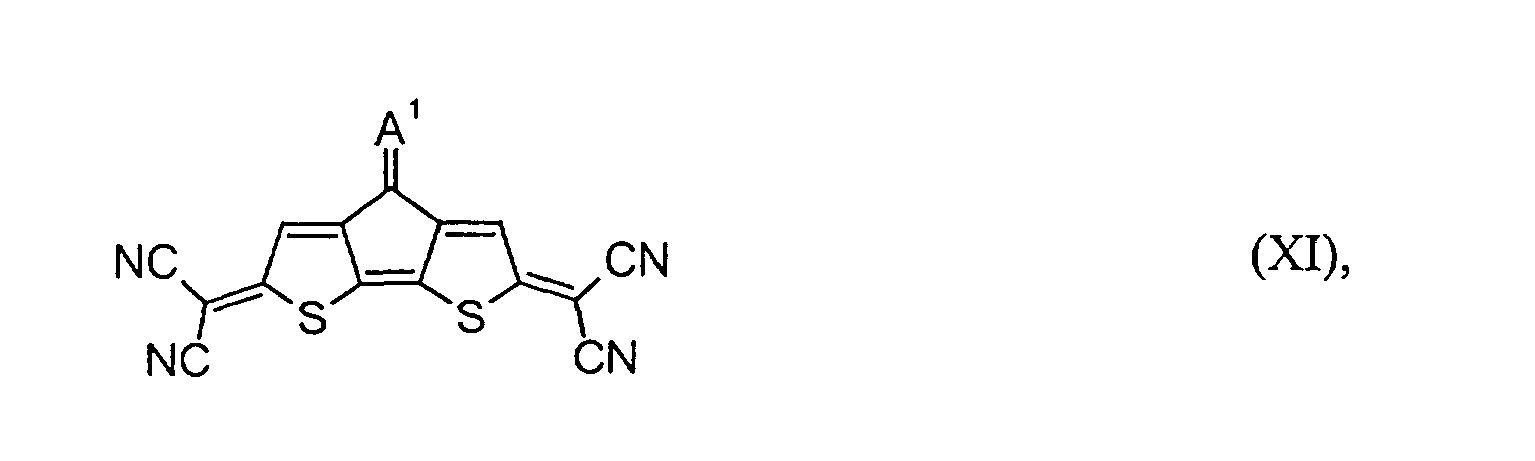


- R2 bis R5, R8, R9, R16 bis R19 unabhängig voneinander C1- bis C18-Alkyl, C2- bis C12-Alkenyl, C4- bis C7-Cycloalkyl, C7- bis C15-Aralkyl oder C6- bis C10-Aryl bedeuten oder
- R4; R5 bzw. R8; R9 gemeinsam eine -(CH2)2- oder -(CH2)3-Brücke bilden können,
- R6, R7 und R22 bis R25 unabhängig voneinander Wasserstoff, C1- bis C4-Alkyl, C1- bis C4-Alkoxy, Halogen, Cyan, Nitro oder C1- bis C4-Alkoxycarbonyl bedeuten oder
- R22; R23 und/oder R24; R25 eine -CH=CH-CH=CH-Brücke bilden können,
- R10; R11, R10; R13, R12; R13 und R14; R15 unabhängig voneinander Wasserstoff oder paarweise eine -(CH2)2-, -(CH2)3- oder -CH=CH-Brücke bedeuten,
- R20 und R21 unabhängig voneinander O, N-CN, C(CN)2 oder N-C6- bis C10-Aryl bedeuten,
- R26 und R27 Wasserstoff, C1- bis C4-Alkyl, C1- bis C4-Alkoxy, Halogen, Cyan, Nitro, C1- bis C4-Alkoxycarbonyl oder C6- bis C10-Aryl bedeuten,
- R69 bis R74, R80, und R81 unabhängig voneinander Wasserstoff oder C1- bis C6-Alkyl bedeuten und
- R69 bis R74 unabhängig voneinander zusätzlich Aryl bedeuten oder
- R69; R12, R70; R13, R73; R80 und/oder R74; R81 gemeinsam eine -CH=CH-CH=CH-Brücke bilden,
- E1 und E2 unabhängig voneinander O, S, NR1 oder C(CH3)2 bedeuten oder
- E1 und E2 gemeinsam eine -N-(CH2)2-N-Brücke bilden,
- R1 C1- bis C18-Alkyl, C2- bis C12-Alkenyl, C4- bis C7-Cycloalkyl, C7- bis C15-Aralkyl, C6- bis C10-Aryl bedeutet,
- Z1 eine direkte Bindung, -CH=CH-, -C(CH3)=CH-, -C(CN)=CH-, -CCl=CCl-, -C(OH)=CH-, -CCl=CH-, -C≡C-, -CH=N-N=CH-, -C(CH3)=N-N=C(CH3)-, -CCI=N-N=CCI- oder -C6H4- bedeutet,
- Z2 -(CH2)r- oder -CH2-C6H4-CH2- bedeutet,
- r eine ganze Zahl von 1 bis 10 bedeutet,
- R94 und R95 unabhängig voneinander Wasserstoff oder Cyano bedeuten,
- R101 bis R105 unabhängig voneinander C6- bis C10-Aryl oder einen ggf. benzanellierten aromatischen oder quasiaromatischen fünf- oder sechsgliedrigen heterocyclischen Ring bedeuten,
- R107, R109, R113 und R114 unabhängig voneinander einen Rest der Formeln (CV) bis (CVII)


- R108, R115 und R116 unabhängig voneinander C6- bis C10-Aryl oder einen Rest der Formel (CV) bedeuten,
- R110 bis R112, R117 und R118 unabhängig voneinander Wasserstoff, C1- bis C4-Alkyl, Halogen oder Cyano bedeuten,
- E101 und E102 unabhängig voneinander O, S oder N-R119 bedeuten,
- R119 und R122 unabhängig voneinander C1- bis C18-Alkyl, C2- bis C8-Alkenyl, C4- bis C7-Cycloalkyl, C7- bis C15-Aralkyl oder C6- bis C10-Aryl bedeuten,
- R106, R120, R121, R123 und R124 unabhängig voneinander Wasserstoff, C1- bis C4-Alkyl, C1- bis C4-Alkoxy, Halogen, Cyano, Nitro oder C1- bis C4-Alkoxycarbonyl bedeuten oder
- R120, R121 bzw. R123, R124 gemeinsam eine -CH=CH-CH=CH-Brücke bilden,
- A1, A2 und A3 unabhängig voneinander O oder C(CN)2 bedeuten,
- R96, Wasserstoff, Phenyl oder tert.-Butyl bedeutet und
- X- ein unter den Bedingungen redox-inertes Anion bedeutet.
- Geeignete oxidierbare Substanzen RED1 sind beispielsweise


- R28 bis R31, R34, R35, R38, R39, R46, R53 und R54 unabhängig voneinander C1- bis C18-Alkyl, C2- bis C12-Alkenyl, C4- bis C7-Cycloalkyl, C7- bis C15-Aralkyl oder C6- bis C10-Aryl bedeuten,
- R32, R33, R36, R37, R40, R41, R42 bis R45, R47, R48, R49 bis R52, R55 bis R58 und R97 bis R100 unabhängig voneinander Wasserstoff, C1- bis C4-Alkyl, C1- bis C4-Alkoxy, Halogen, Cyan, Nitro, C1- bis C4-Alkoxycarbonyl, C6- bis C10-Aryl oder C6- bis C10-Aryloxy bedeuten
und - R57 und R58 zusätzlich einen aromatischen oder quasiaromatischen fünf- oder sechsgliedrigen heterocyclischen Ring, der gegebenenfalls benzanneliert ist, bedeuten und R48 zusätzlich NR75R76 bedeutet oder
- R49; R50, R51; R52 und/oder R48; R97 oder R48; R99, R97; R98 oder R98; R100 unabhängig voneinander eine -(CH2)3-, -(CH2)4-, -(CH2)5- oder -CH=CH-CH=CH-Brücke bilden,
- Z3 eine direkte Bindung, eine -CH=CH- oder -N=N-Brücke bedeutet,
- =Z4= eine direkte Doppelbindung, eine =CH-CH= oder =N-N=-Brücke bedeutet,
- E3 bis E5, E10 und E11 unabhängig voneinander O, S, NR59 oder C(CH3)2 bedeuten und
- E5 zusätzlich C=O oder SO2 bedeutet,
- E3 und E4 unabhängig voneinander zusätzlich -CH=CH- bedeuten können,
- E6 bis E9 unabhängig voneinander S, Se oder NR59 bedeuten,
- R59, R75 und R76 unabhängig voneinander C1- bis C12-Alkyl, C2- bis C8-Alkenyl, C4- bis C7-Cycloalkyl, C7- bis C15-Aralkyl, C6- bis C10-Aryl bedeuten,
und - R75 zusätzlich Wasserstoff bedeutet oder R75 und R76 in der Bedeutung von NR75R76 gemeinsam mit dem N-Atom, an das sie gebunden sind, einen fünf-oder sechsgliedrigen Ring bedeuten, der gegebenenfalls weitere Heteroatome enthält,
- R61 bis R68 unabhängig voneinander Wasserstoff, C1- bis C6-Alkyl, C1- bis C4-Alkoxy, Cyan, C1- bis C4-Alkoxycarbonyl oder C6- bis C10-Aryl bedeuten und
- R61; R62 und R67; R68 unabhängig voneinander zusätzlich eine -(CH2)3-, -(CH2)4- oder -CH=CH-CH=CH-Brücke bilden oder
- R62; R63, R64; R65 und R66; R67 eine -O-CH2CH2-O- oder -O-CH2CH2CH2-O-Brücke bilden,
- v eine ganze Zahl zwischen 0 und 100 bedeutet,
- R82, R83, R88 und R89 unabhängig voneinander C1- bis C18-Alkyl, C2- bis C12-Alkenyl, C4- bis C7-Cycloalkyl, C7- bis C15-Aralkyl oder C6- bis C10-Aryl bedeuten,
- R84 bis R87 und R90 bis R93 unabhängig voneinander Wasserstoff oder C1- bis C6-Alkyl bedeuten oder
- R84; R86, R85; R87, R90; R92 und/oder R91; R93 gemeinsam eine -CH=CH-CH=CH-Brücke bilden.
- Ebenfalls geeignet als RED1 sind Anionen wie z.B. I-, I3 - , Br-, SCN-.
- Über eine Brücke B verknüpfte, gegebenenfalls oligo- oder polymere Redoxsysteme sind beispielsweise solche der Formel
Y-[-(-B-Z-)a-(-B-Y-)b-]c-B-Z (L),
worin
Y und Z unabhängig voneinander für einen Rest OX2 oder RED1 stehen,
wobei - OX2
- für den Rest eines reversibel elektrochemisch reduzierbaren Redoxsystems steht, und
- RED1
- für den Rest eines reversibel elektrochemisch oxidierbaren Redoxsystems steht,
- B
- für ein Brückenglied steht,
- c
- für eine ganze Zahl von 0 bis 1 000 steht, und
- a und b
- unabhängig voneinander für eine ganze Zahl von 0 bis 100 stehen.
- Hierbei ist unter reversibel elektrochemisch reduzierbar oder oxidierbar gemeint, daß die Elektronenübertragung ohne oder auch mit Änderung des σ-Gerüsts erfolgen kann ganz im Sinne der oben genannten Definition der erfindungsgemäßen OX2 und RED1.
- Insbesondere sind mit den elektrochromen Verbindungen der Formel (L) solche oligomeren Verbindungen der Formeln
OX2-B-RED1 (La),
OX2-B-RED1-B-OX2 (Lb),
RED1-B-OX2-B-RED1 (Lc),
OX2-(B-RED1-B-OX2)d-B-RED1 (Ld),
OX2-(B-OX2)c-B-OX2 (Le)
oder
RED1-(B-RED1)e-B-RED1 (Lf)
gemeint,
worin
OX2, RED1 und B die oben angegebene Bedeutung haben,
d für eine ganze Zahl von 1 bis 5 steht und
e für eine ganze Zahl von 0 bis 5 steht,
wobei OX2, RED1 und/oder B, insbesondere wenn d und/oder e >1 sind, in jeder wiederkehrenden Einheit verschiedene Bedeutung haben können. - Insbesondere sind mit den elektrochromen Verbindungen der Formel (L) solche polymeren Verbindungen der Formeln
OX2-(B-RED1-B-OX2)d-B-RED1 (Ld),
OX2-(B-OX2)e-B-OX2 (Le),
RED1-(B-RED1)e-B-RED1 (Lf),
gemeint,
worin
OX2, RED1 und B die oben angegebene Bedeutung haben,
d für eine ganze Zahl von 5 bis 100 000, vorzugsweise 10 bis 10 000 steht und
e für eine ganze Zahl von 5 bis 100 000, vorzugsweise 10 bis 10 000 steht,
wobei OX2, RED1 und/oder B, insbesondere wenn d und/oder e >1 sind, in jeder wiederkehrenden Einheit verschiedene Bedeutung haben können. - Oligo- oder polymere elektrochrome Verbindungen, die nicht der Formel (L) entsprechen, sind insbesondere Seitenkettenpolymere der Formeln
...-(D)f-...-(E-B1-Y)g-...-(F-B2-Z)h-... (CL)
und
...-(D)f-...-[E-(B1-Y)i-(B2-Z)j]g-...-(F-B2-Z)h-... (CLX),
worin
D, E und F Bausteine einer Oligomer- oder Polymerkette darstellen, wobei die Einheiten D, E und F sowohl statistisch verteilt als auch in Blöcken angeordnet sein können,
B1 und B2 für ein Brückenglied stehen,
Y und Z unabhängig voneinander für einen Rest OX2 oder RED1 stehen,
wobei
OX2 für den Rest eines reversibel elektrochemisch reduzierbaren Redoxsystems steht, und
RED1 für den Rest eines reversibel elektrochemisch oxidierbaren Redoxsystems steht,
f, g und h unabhängig voneinander für eine ganze Zahl von 1 bis 100 000, insbesondere 1 bis 10 000 stehen,
wobei
f+g+h >2,
f und h unabhängig voneinander auch für 0 stehen können und
i und j unabhängig voneinander für eine ganze Zahl von 1 bis 100, insbesondere 1 bis 10, ganz besonders 1 oder 2 stehen. - Insbesondere sind mit Oligomeren oder Polymeren der Formel (CL) solche der Formeln
...-(D)f-...-(E-B1-OX2)g-...-(F-B2-RED1)h-... (CLa),
...-(D)f-...-(E-B1-OX2)g- (CLb),
...-(D)f-...-(F-B2-RED1)h-... (CLc),
...-(D)f-...-[E-B1-OX2-B2-RED1]g-... (CLXa)
oder
...-(D)f-...-[F-B2-RED1-B1-OX2]h-... (CLXb)
gemeint,
worin
f für eine ganze Zahl von 0 bis 10 000 steht,
g und h unabhängig voneinander für eine ganze Zahl von 1 bis 10 000, vorzugsweise 1 bis 1000, besonders bevorzugt 1 bis 100 stehen und
die anderen Reste die oben angegebene Bedeutung besitzen,
wobei OX2 und/oder RED1, insbesondere wenn g und/oder h >1 sind, in jeder wiederkehrenden Einheit verschiedene Bedeutung besitzen können. - Bevorzugt ist f >10·(g+h), besonders bevorzugt ist f >100·(g+h).
- Mit OX2 und RED1 in den Formeln (L) und (La) bis (Lf) sowie (CL) und (CLa) bis (CLc) sowie (CLX) und (CLXa) bis (CLXb) sind insbesondere Reste der oben beschriebenen Redoxsysteme der Formeln (I) bis (X), (CI) bis CIV) und (XX) bis (XXXIII) gemeint, wobei die Bindung zum Brückenglied B, B1 oder B2 über einen der Reste R2 bis R19, R22 bis R27, R28 bis R58 R61 R62, R67, R68, R83, R88, R122 oder im Falle, daß einer der Reste E1 oder E2 für NR1 oder einer der Reste E3 bis E11 für NR59 oder einer der Reste E101 bis E102 für NR119 steht, über R1, R59 bzw. R119 erfolgt und die genannten Reste dann für eine direkte Bindung stehen, und
B, B1 oder B2 unabhängig voneinander für eine Brücke der Formeln -(CH2)n- oder -Y1 s-[(CH2)m-Y2]o-(CH2)p-Y3 q- stehen, die durch C1- bis C4-Alkyl, C1- bis C4-Alkoxy, Halogen oder Phenyl substituiert sein kann,
Y1 bis Y3 unabhängig voneinander für O, S, NR60, COO, CONH, NHCONH, Cyclopentandiyl, Cyclohexandiyl, Phenylen oder Naphthylen stehen,
R60 C1- bis C6-Alkyl, C2- bis C6-Alkenyl, C4- bis C7-Cycloalkyl, C7- bis C15-Aralkyl oder C6- bis C10-Aryl bedeutet,
n eine ganze Zahl von 1 bis 12 bedeutet,
m und p unabhängig voneinander eine ganze Zahl von 0 bis 8 bedeuten,
o eine ganze Zahl von 0 bis 6 bedeutet und
q und s unabhängig voneinander 0 oder 1 bedeuten,
wobei für o >1 Y2 und m in jeder wiederkehrenden Einheit verschieden sein können. - Ebenfalls mit OX2 oder RED1 in den genannten Formeln (L) und (La) bis (Lf) sowie (CL) und (CLa) bis (CLc) sowie (CLX) und (CLXa) bis (CLXb) sind Metallkomplexe gemeint, sofern sie über eine kovalente Bindung mit den Brückengliedern B, B1 oder B2 verbunden sein können. Als Beispiel sei Ferrocen genannt.
- In ganz besonderem Maße sind mit OX2 und RED1 in den Formeln (L) und (La) bis (Lf) sowie (CL) und (CLa) bis (CLc) und (CLX) und (CLXa) bis (CLXb) Reste der oben beschriebenen Redoxsysteme der Formeln (I), (V), (XX), (XXII), (XXIII), (XXV), (XXVI) und (XXXIII) sowie für RED1 Ferrocen gemeint.
- Mit D, E und F in den Formeln (CL) und (CLa) bis (CLc) sowie (CLX) und (CLXa) bis (CLXb) sind solche Einheiten gemeint, die zum Aufbau von Oligo- oder Polyacrylaten, -methacrylaten, -styrolen, -siloxanen, -carbonaten, -amiden, -estern, -harnstoffen, -urethanen oder -sachariden führen. Insbesondere sind Oligo- und Polyacrylate, -methacrylate und -styrole sowie deren Mischoligo- oder -polymere gemeint.
D entspricht vorzugsweise der Formel
-CHY10-CHY11- (CLXXI)
und
E und F entsprechen vorzugsweise unabhängig voneinander der Formel
-CHY12-CHY13 - (CLXXII),
worin
Y10 und Y12 unabhängig voneinander für Wasserstoff oder C1- bis C4-Alkyl stehen,
Y11 für Wasserstoff, Halogen, C1- bis C4-Alkyl, Aryl oder -COO-C1- bis C8-Alkyl steht und
Y13 für eine direkte Bindung oder eine der Brücken der Formeln -O-, -CO-O-, -CO-NH- oder -C6H4- zu B1 bzw. B2 steht. - Beispiele sind gemäß Formel (La)


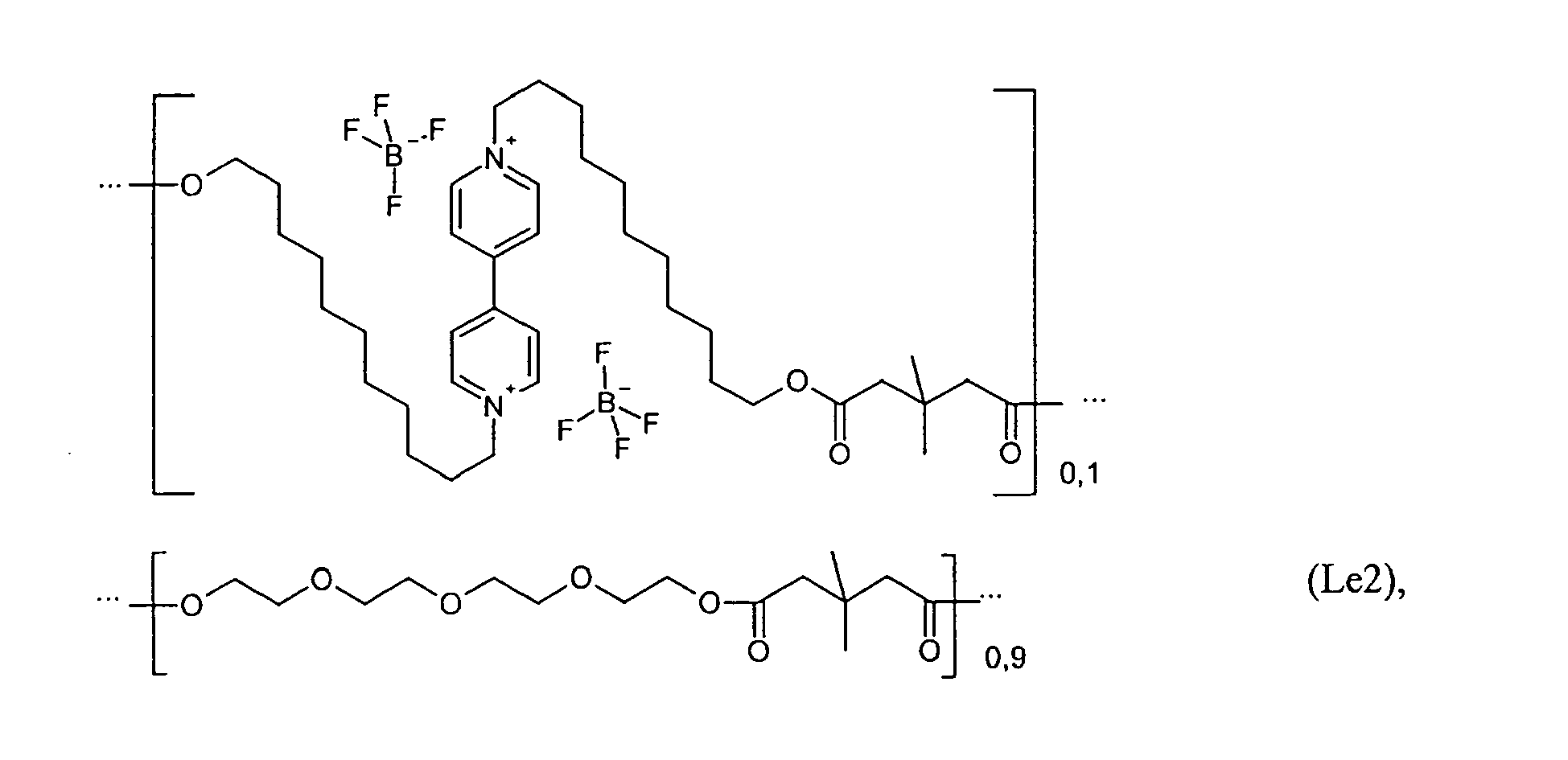


m1 bis m4 unabhängig voneinander für eine ganze Zahl von 1 bis 5 stehen,
u für 0 oder 1 steht und
die anderen Reste die oben angegebene Bedeutung besitzen. - Beispiele sind gemäß Formel (CLa)

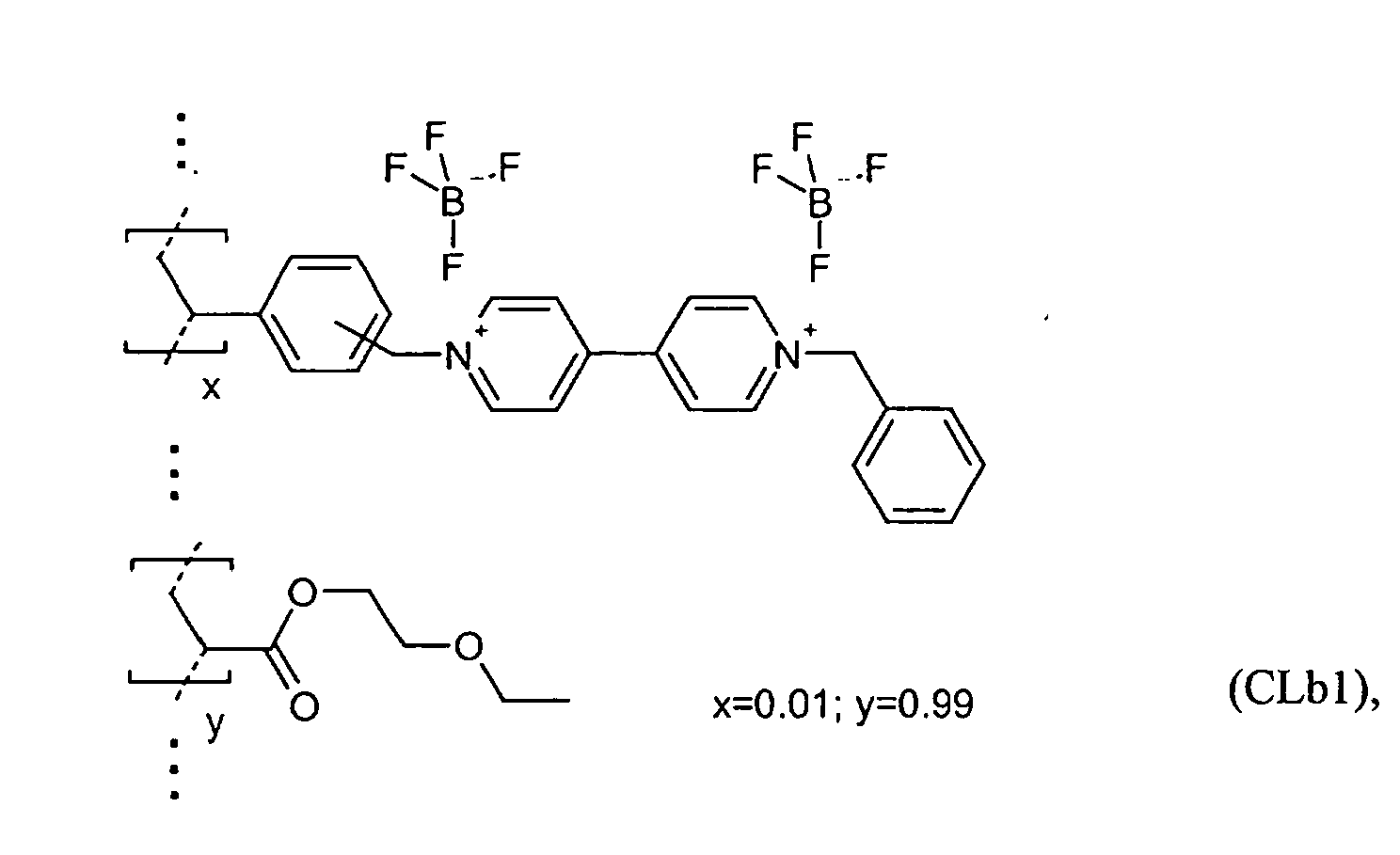

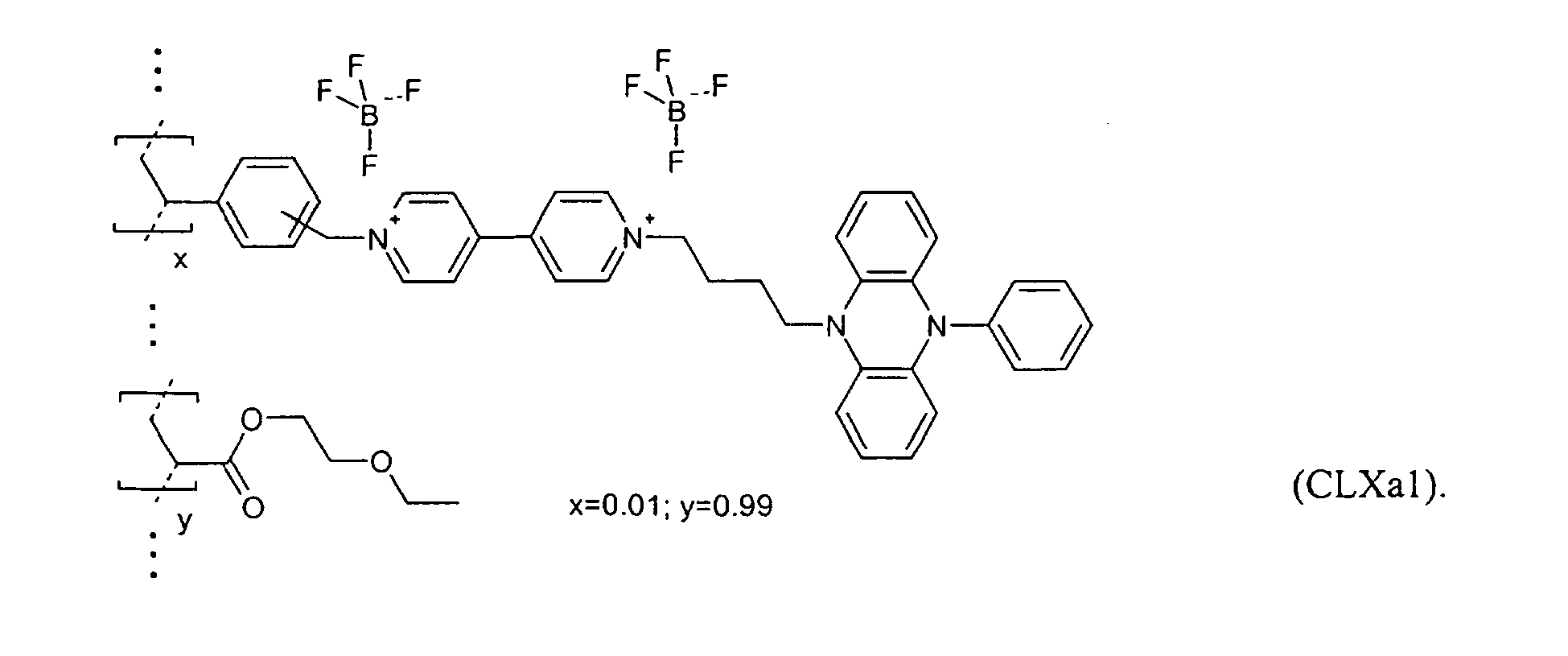
- Beispiele für Metallsalze oder Metallkomplexe, die als OX2 oder RED1 eingesetzt werden können, sind Fe3+/2+, Ni3+/2+, Co3+/2+, Cu2+/+, [Fe(CN)6]3-/4-, Fe4[Fe(CN)6]3 0/4-, [Co(CN)6]3-/4, [Fe(Cyclopentadienyl)2]0/+, Lu(Pc)2+ bis 2- (Pc = Phthalocyanin), Fe[Fe(CN)6]0/1-.
- Als Gegenionen für Metallionen und kationische Komplexe kommen alle redox-inerten Anionen X-, wie sie später noch genauer beschrieben werden, in Frage, als Gegenionen der anionischen Komplexe alle redox-inerten Kationen M'+ in Frage, beispielsweise Alkalimetalle oder quaternierte Ammoniumsalze wie Na+, K+, N(CH3)4 +, N(C4H9)4 +, C6H5CH2N(CH3)3 + und andere.
- Ebenfalls bevorzugt ist eine erfindungsgemäße elektrochrome Vorrichtung, die Mischungen der oben allgemein und bevorzugt genannten elektrochromen Substanzen enthält. Beispiele für solche Mischungen sind (I) + (CI) + (XXVI), (I) + (IV) + (XXII), (La) + (I) + (XXVI), (La) + (CI), (LX) + (LXI), (LXV) + (XXVI), (CLII) + (XXVI), ohne daß dadurch irgendeine Einschränkung ausgedrückt werden soll.
- Die Mischungsverhältnisse sind in weiten Grenzen variabel. Sie erlauben die Optimierung eines gewünschten Farbtons, insbesondere Grautons, und/oder die Optimierung der gewünschten Dynamik der Vorrichtung.
- In den oben genannten Substituentenbedeutungen sind Alkylreste, auch abgewandelte, beispielsweise Alkoxy- oder Aralkylreste, vorzugsweise solche mit 1 bis 12 C-Atomen, insbesondere mit 1 bis 8 C-Atomen, sofern nichts anderes angegeben ist. Sie können geradkettig oder verzweigt sein und gegebenenfalls weitere Substituenten tragen wie C1- bis C4-Alkoxy, Fluor, Chlor, Hydroxy, Cyano, C1- bis C4-Alkoxycarbonyl oder COOH.
- Unter Cycloalkylresten werden vorzugsweise solche mit 3 bis 7 C-Atomen, insbesondere mit 5 oder 6 C-Atomen verstanden.
- Alkenylreste sind vorzugsweise solche mit 2 bis 8 C-Atomen, insbesondere 2 bis 4 C-Atomen.
- Arylreste, auch solche in Aralkylresten, sind Phenyl oder Naphthylreste, insbesondere Phenylreste. Sie können durch 1 bis 3 der folgenden Reste substituiert sein: C1- bis C6-Alkyl, C1- bis C6-Alkoxy, Fluor, Chlor, Brom, Cyano, Hydroxy, C1- bis C6-Alkoxycarbonyl oder Nitro. Zwei benachbarte Reste können auch einen Ring bilden.
- Unter gegebenenfalls benzanellierten aromatischen oder quasiaromatischen fünf-oder sechsgliedrigen heterocyclischen Ringen werden insbesondere Imidazol, Benzimidazol, Oxazol, Benzoxazol, Thiazol, Benzthiazol, Indol, Pyrazol, Triazol, Thiophen, Isothiazol, Benzisothiazol, 1,3,4- oder 1,2,4-Thiadiazol, Pyridin, Chinolin, Pyrimidin und Pyrazin verstanden. Sie können durch 1 bis 3 der folgenden Reste substituiert sein: C1- bis C6-Alkyl, C1- bis C6-Alkoxy, Fluor, Chlor, Brom, Cyano, Nitro, Hydroxy, Mono- oder Di-C1- bis C6-alkylamino, C1- bis C6-Alkoxycarbonyl, C1- bis C6-Alkylsulfonyl, C1- bis C6- Alkanoylamino, Phenyl oder Naphthyl. Zwei benachbarte Reste können auch einen Ring bilden.
- Die elektrochromen Substanzen sind entweder bekannt (Topics in Current Chemistry, Vol. 92, S. 1-44, (1980), Angew. Chem. 90, 927 (1978) oder lassen sich analog herstellen. Die Verbindungen der Formel (L) sind ebenfalls bekannt (
WO-A 97/30134 
- Die Verbindungen der Formel (CL) sowie (CLX) lassen sich aus an sich bekannten Bausteinen, beispielsweise den folgenden, durch Polymerisation herstellen:

- Synthetisch bedingte Ionen wie Bromid werden im Anschluß gegen redox-inerte Ionen ausgetauscht.
- Besonders bevorzugt sind die elektrochromen Verbindungen der Formeln (I), (II), (III), (IV), (V), (XX), (XXII), (XXIII), (XXVI), (XXVII) und Ferrocen, sowie die mindestens eine dieser Formeln als OX2 bzw. RED1 enthaltenden überbrückten Verbindungen der Formel (L) oder Seitenkettenpolymeren der Formel (CL) oder (CLX).
- Bei dieser Auswahl und ebenfalls bei den anschließend aufgeführten besonderen und herausragenden Auswahlen an elektrochromen Verbindungen muß stets sichergestellt sein, daß das elektrochrome Medium mindestens ein OX2 und mindestens ein RED1 enthält. Wenn beispielsweise OX2 = Formel (I) ist, dann muß das elektrochrome Medium auch ein RED1 enthalten, vorzugsweise aus der Auswahl der bevorzugten RED1 der Formeln (XX), (XXII), (XXIII), (XXVI) und (XXVII), aber auch aus der oben allgemein aufgeführten Auswahl der RED1 der Formeln (XX) bis (XXXIII) sowie der oben erwähnten, als RED1 geeigneten Metallsalze, -komplexe oder Anionen X-. Dies gilt analog auch für die bevorzugten und besonders bevorzugten RED1.
- Ganz besonders bevorzugt sind die elektrochromen Verbindungen der Formeln (I), (II), (IV), (V), (XXII) (XXIII), (XXVI) und (XXVII),
worin
R2, R3, R8 und R9 unabhängig voneinander Methyl, Ethyl, Propyl, Butyl, Pentyl, Hexyl, Heptyl, Benzyl, Phenethyl, Phenylpropyl, Phenyl, 2-Methylphenyl oder 2,6-Dimethylphenyl bedeuten oder
R8 und R9 gemeinsam eine -(CH2)2- oder -(CH2)3-Brücke bilden,
R10 bis R15 Wasserstoff bedeuten,
R69 bis R73, R80 und R81 unabhängig voneinander Wasserstoff oder Methyl bedeuten oder
R12; R69, R13; R70, R73; R80 und/oder R74; R81 eine -CH=CH-CH=CH-Brücke bilden,
Z1 eine direkte Bindung oder -CH=CH- bedeutet,
Z2 -(CH2)r- bedeutet,
r eine ganze Zahl von 2 bis 6 bedeutet,
X- ein unter den Bedingungen redox-inertes Anion bedeutet,
R34, R35, R38 und R39 unabhängig voneinander Methyl, Ethyl, Propyl, Butyl, Benzyl, Phenethyl, Phenylpropyl oder Phenyl bedeuten,
R36 und R37 Wasserstoff bedeuten,
Z3 eine direkte Bindung oder eine -CH=CH-Brücke bedeutet,
Z4 eine direkte Doppelbindung bedeutet,
R40 und R41 gleich sind und Wasserstoff oder Methyl bedeuten,
E3 und E4 gleich sind und S, N-R59 oder C(CH3)2 bedeuten,
E5 NR59 bedeutet
E6 bis E9 gleich sind und S bedeuten,
R47, R48, R97 und R98 unabhängig voneinander Wasserstoff, Methyl, Methoxy, Cyan, Phenyl oder Phenoxy bedeuten,
R49 bis R52 unabhängig voneinander Wasserstoff, Methyl, Cyano oder Methoxycarbonyl bedeuten oder
R49; R50 und/oder R51; R52 eine -(CH2)3- oder -CH=CH-CH=CH-Brücke bilden,
R46 und R59 unabhängig voneinander Methyl, Ethyl, Propyl, Butyl oder Phenyl bedeuten und
R99 und R100 Wasserstoff bedeuten,
sowie die mindestens eine dieser Formeln als OX2 bzw. RED1 enthaltenden überbrückten Verbindungen der Formel (L), insbesondere der Formel (La), wobei
B -(CH2)n- bedeutet und
n eine ganze Zahl von 3 bis 6 bedeutet,
sowie die mindestens eine dieser Formeln als OX2 bzw. RED1 enthaltenden Seitenkettenpolymeren der Formel (CL) und (CLX), insbesondere der Formel (CLXa),
wobei
D für die Formel (CLXXI) steht,
E und F für die Formel (CLXXII) stehen,
Y10 und Y12 unabhängig voneinander für Wasserstoff oder Methyl stehen,
Y11 für -COOCH3 oder -COOCH2CH2OCH2CH3 steht,
Y13 für eine Brücke der Formeln -CO-O- oder -C6H4- zu B1 bzw. B2 steht,
B1 und B2 unabhängig voneinander für eine Brücke der Formeln -(CH2)n- stehen und
n eine ganze Zahl von 1 bis 6 bedeutet. - Im Sinne der Erfindung ganz herausragend geeignet sind die elektrochromen Verbindungen der Formeln (I) und (II),
worin
R2 und R3 gleich sind und Methyl, Ethyl, Butyl, Heptyl oder Phenylpropyl bedeuten,
R12 bis R15 und R69 bis R72 Wasserstoff bedeuten,
Z1 eine direkte Bindung bedeutet,
Z2 -(CH2)3- oder -(CH2)4- bedeutet und
X- ein redoxinertes Anion oder I- bedeutet. - Im Sinne der Erfindung ganz herausragend geeignet sind die elektrochromen Verbindungen der Formel (XXVI),
worin
E5 für NR59 steht,
R46 und R59 unabhängig voneinander für Methyl, Ethyl, Propyl, Butyl, Phenylpropyl oder Phenyl stehen,
R47, R48, R97 und R98 unabhängig voneinander für Wasserstoff, Phenyl oder Phenoxy stehen und
R99 und R100 für Wasserstoff stehen. - Im Sinne der Erfindung ebenfalls ganz herausragend geeignet sind die elektrochromen Verbindungen der Formel (La),
worin
OX2 für einen Rest der Formel (I) steht,
RED1 für einen Rest der Formel (XXVI) steht und
B für -(CH2)n- steht,
wobei
n eine ganze Zahl von 3 bis 6 bedeutet,
R2und R46 eine direkte Bindung zu B bedeuten,
R3, R12 bis R15, R69 bis R72, Z1 und X- die oben angegebene herausragende Bedeutung besitzen,
R47, R48, R97 bis R100 Wasserstoff bedeuten oder maximal 2 der Reste R47, R48, R97 und R98 Phenoxy bedeuten,
E5 NR59 bedeutet und
R59 Methyl, Ethyl, Butyl, Heptyl, Phenylpropyl oder Phenyl bedeutet. - Im Sinne der Erfindung ebenfalls ganz herausragend geeignet sind die elektrochromen Verbindungen der Formel (CLXa),
worin
OX2 für einen Rest der Formel (I) steht,
RED1 für einen Rest der Formel (XXVI) steht,
D für die Formel (CLXXI) steht,
E für die Formel (CLXXII) steht,
Y10 und Y12 unabhängig voneinander für Wasserstoff oder Methyl stehen,
Y11 für -COOCH2CH2OCH2CH3 steht,
Y13 für eine Brücke der Formeln -CO-O- oder -C6H4- zu B1 bzw. B2 steht,
B1 und B2 unabhängig voneinander für eine Brücke der Formeln -(CH2)n- stehen
wobei
n eine ganze Zahl von 1 bis 6 bedeutet,
R2 eine direkte Bindung zu B1 bedeutet,
R3 und R46 eine direkte Bindung zu B2 bedeuten,
R12 bis R15, R69 bis R72, Z1 und X- die oben angegebene herausragende Bedeutung besitzen,
R47, R48, R97 bis R100 Wasserstoff bedeuten oder maximal 2 der Reste R47, R48, R97 und R98 Phenoxy bedeuten,
E5 NR59 bedeutet und
R59 Methyl, Ethyl, Butyl, Heptyl, Phenylpropyl oder Phenyl bedeutet. - Die erfindungsgemäße elektrochrome Vorrichtung enthält in ihrem elektrochromen Medium gegebenenfalls mindestens ein Lösungsmittel, in dem die elektrochromen Substanzen, gegebenenfalls ein Leitsalz und gegebenenfalls weitere Zusätze gelöst sind. Das Lösungsmittel kann auch gelförmig verdickt sein, beispielsweise durch Polyelektrolyte, poröse Feststoffe oder Nanopartikel mit großer aktiver Oberfläche.
- Bei Verwendung polymerer elektrochromer Verbindungen insbesondere der Formeln (L) und (Ld) bis (Lf) sowie (CL) und (CLa) bis (CLc) sowie (CLX) und (CLXa) bis (CLXb) kann auf das Lösungsmittel verzichtet werden. Es können auch solche Polymeren gemischt werden, z.B. Formel (LXV) und (LXVII). Gegebenenfalls werden dem Polymer weitere OX2 oder RED1 untergemischt, z.B. Formel (XXVI) in Polymer der Formel (LXV).
- Geeignete Lösungsmittel sind alle unter den gewählten Spannungen redox-inerten Lösungsmittel, die keine Elektrophile oder Nukleophile abspalten können oder selber als ausreichend starke Elektrophile oder Nukleophile reagieren und so mit den farbigen Radikalionen reagieren könnten. Beispiele sind Propylencarbonat, γ-Butyrolacton, Acetonitril, Propionitril, Benzonitril, Glutaronitril, Methylglutamitril, 3,3'-Oxydipropionitril, Hydroxypropionitril, Dimethylformamid, N-Methylpyrrolidon, Sulfolan, 3-Methylsulfolan oder Mischungen davon. Bevorzugt sind Propylencarbonat, Benzonitril und Mischungen untereinander oder mit Glutaronitril oder 3-Methylsulfolan. Insbesondere bevorzugt ist Propylencarbonat. Ebenfalls insbesondere bevorzugt ist Benzonitril.
- Das elektrochrome Medium kann mindestens ein inertes Leitsalz enthalten. Insbesondere wenn wenigstens eine der Substanzen des Redoxpaares RED1/OX2 ionischer Natur ist, kann auf den Zusatz eines Leitsalzes verzichtet werden.
- Als inertes Leitsalz sind Lithium-, Natrium- und Tetraalkylammoniumsalze geeignet, insbesondere letztere. Die Alkylgruppen können zwischen 1 und 18 C-Atome aufweisen und gleich oder verschieden sein. Bevorzugt ist Tetrabutylammonium. Als Anionen zu diesen Salzen, aber auch als Anionen X- in den Formeln (I) bis (VI), (CI), (CII) und (CV) bis (CVII) und in den Metallsalzen kommen alle redox-inerten, farblosen Anionen in Frage.
- Beispiele sind Tetrafluoroborat, Tetraphenylborat, Cyano-triphenylborat, Tetramethoxyborat, Tetrapropoxyborat, Tetraphenoxyborat, Perchlorat, Chlorid, Nitrat, Sulfat, Phosphat, Methansulfonat, Ethansulfonat, Tetradecansulfonat, Pentadecansulfonat, Trifluormethansulfonat, Perfluorbutansulfonat, Perfluoroctansulfonat, Benzolsulfonat, Chlorbenzolsulfonat, Toluolsulfonat, Butylbenzolsulfonat, tert. Butylbenzolsulfonat, Dodecylbenzolsulfonat, Trifluormethylbenzolsulfonat, Hexafluorophosphat, Hexafluoroarsenat, Hexafluorosilicat, 7,8- oder 7,9-Dicarbanidoundecaborat(-1) oder (-2), die gegebenenfalls an den B- und/oder C-Atomen durch eine oder zwei Methyl-, Ethyl-, Butyl- oder Phenyl-Gruppen substituiert sind, Dodecahydro-dicarbadodecaborat(-2) oder B-Methyl-C-phenyl-dodecahydro-dicarbadodecaborat(-1).
- Ebenfalls geeignet, auch als Anionen X in den Formeln (I) bis (VI), (CI), (CII) und (CV) bis (CVII) und in den Metallsalzen, sind die oben erwähnten Anionen, die auch die Rolle eines RED1 übernehmen können, beispielsweise I-, I3 -.
- Wie beispielsweise aus K. Deuchert und S. Hünig, Angew. Chem. 90, 927-938 (1978) und S. Hünig und H. Bemeth, Topics in Current Chemistry, Vol. 92, S. 1-44 (1980) bekannt ist, existieren viele Redoxsysteme, beispielsweise die der Formeln (I) bis (XII) und (XX) bis (XXXIII) in drei Oxidationsstufen, die miteinander im Gleichgewicht stehen:

- Sem ist eine radikalische Spezies und in der Regel tieffarbig, während Ox und Red farblos oder weniger tief (hypsochrom relativ zu Sem) gefärbt sind.
- Bevorzugte OX3 sind die aus entsprechenden RED3, insbesondere der Formeln (XII) bis (XX), im Sinne dieser Gleichung durch Einelektronenoxidation entstehenden Oxidationsstufen Sem und die durch Zweielektronenoxidation entstehenden Oxidationsstufen Ox.
- Bevorzugte RED3 sind die aus entsprechenden OX3, insbesondere der Formeln (I) bis (XII), im Sinne dieser Gleichung durch Einelektronenreduktion entstehenden Oxidationsstufen Sem und die durch Zweielektronenreduktion entstehenden Oxidationsstufen Red.
- Diese OX3 bzw. RED3 können auch in Oligo- oder Polymere der Formeln (L), (CL) oder (CLX) eingebaut sein, wobei wenigstens ein Y oder Z für OX3 bzw. RED3 steht und die anderen für OX2 und/oder RED1 stehen.
- Durch Dis- oder Komproportionierungsreaktionen können die OX3 bzw. RED3 mit den anderen elektrochromen Substanzen OX2 und RED1 des elektrochromen Mediums reagieren. In der Regel wird OX3 bzw. RED3 im stromlosen elektrochromen Medium in der Oxidationsstufe Sem vorliegen, vorausgesetzt, es handelt sich um ein der oben beschriebenen, der Gleichung 3 gehorchendes Redoxsystem.
- Analoges gilt für Metallsalze und -komplexe. Unterscheiden sich die Oxidationsstufen solcher Salze oder Komplex dagegen nur um 1, wie z.B. in [Fe(Cyclopentadienyl)2]0/+, dann entfällt die Oxdationsstufe Sem gemäß Gleichung 3.
- Bevorzugte OX3 sind demnach [Fe(Cyclopentadienyl)2]+, die Oxidationsstufe Sem von Verbindungen der Formel (XXII), (XXIII), (XXIV), (XXV), (XXVI), besonders bevorzugt sind [Fe(Cyclopentadienyl)2]+ und die Oxidationsstufe Sem von Verbindungen der Formeln (XXII) und (XXVI).
- Bevorzugte RED3 sind demnach die Oxidationsstufe Sem von Verbindungen der Formeln (I), (II), (III), (IV) und (V), besonders bevorzugt ist die Oxidationsstufe Sem der Formel (IV).
- OX3 bzw. RED3 können dem elektrochromen Medium als Substanz zugesetzt werden oder aber im Medium erzeugt werden, z.B. durch Komproportionierungs- oder Disproportionierungsreaktionen oder andere Redoxreaktionen.
- Beispiele für direkt zugegebene OX3 bzw. RED3 sind [Fe(Cyclopentadienyl)2]+ und die Oxidationsstufe Sem von Verbindungen der Formeln (XXII), (XXVI) und (IV).
- Ein Beispiel für eine Komproportionierungsreaktion ist die Reaktion der Oxidationsstufen Red und Ox von Verbindungen der Formel (XXII) entsprechend der Formelgleichung

- Unter anderen Redoxreaktionen wird beispielsweise die Reduktion oder Oxidation von elektrochromen Verbindungen des elektrochromen Mediums, vorzugsweise einem Teil (<30 %, bevorzugt <10 % der in dem elektrochromen Medium vorhandenen Menge) von OX2 bzw. RED1 zu vorzugsweise ihren Oxidationsstufen Sem, die die Rolle von RED3 bzw. OX3 übernehmen, durch ein Reduktions- bzw. Oxidationsmittel verstanden, dessen Redoxpotential vom Betrag her größer ist als das von OX2 bzw. RED1. Ein Beispiel für eine solche andere Redoxreaktion unter Beteiligung einer Verbindung der Formel (XXVI) und eines Metallkomplexes ist in der folgenden Formelgleichung dargestellt:

- Das bei der Redoxreaktion aus dem Oxidations- bzw. Reduktionsmittel entstehende Produkt (hier Fe[Cp]2) kann schließlich in dem elektrochromen Medium die Rolle eines RED1 (wie im Falle des Beispiels der Formelgleichung) bzw. OX2 übernehmen.
- Beispiele für Kombinationen von OX2, RED1 und OX3/RED3 sind tn den folgenden Tabellen zusammengestellt:
Beispiel OX2 RED1 OX3 a 
Fe[Cp]2 a) Fe[Cp]2 + BF4 -a) b 


c 

d 
Fe[Cp]2 + BF4 -a) e 

f 


Beispiel OX2 RED1 RED3 g 

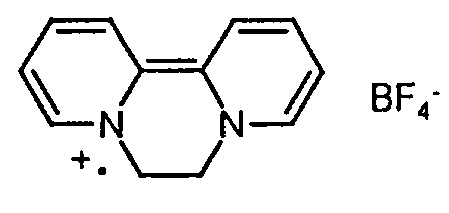
h 

a) Cp = Cyclopentadienyl
b) aus 5,10-Dimethyldihydrophenazin + Fe[Cp]2 +BF4 - - Die oben geschilderten Vorteile der beschleunigten Selbstlöschung und der erhöhten Kantenschärfe machen die erfindungsgemäßen elektrochromen Medien besonders geeignet für den Einsatz in erfindungsgemäßen elektrochromen Vorrichtungen.
- Insbesondere handelt es sich bei diesen Vorrichtungen um Anzeigevorrichtungen. Bei solchen Anzeigevorrichtungen ist mindestens eine der beiden leitfähigen Schichten in elektrisch voneinander isolierte Segmente aufgeteilt, die über Zuleitungen elektrisch kontaktiert sind. Diese Zuleitungen sind vorteilhaft vom elektrochromen Medium elektrisch isoliert. Die Anzeigevorrichtungen können je nach Strukturierung der Aufteilung in Segmente einfache Symbole, Schriftzeichnen oder Zahlen anzeigen, oder Balken oder Punkte, die zur Anzeige von komplexen Mustern wie Schriftzeichen oder Zahlen, aber auch von Bildern dienen können. Solche Anzeigevorrichtungen können auch Bestandteil eines Berührungssensors sein, d. h. sie sind in den Sensor integriert und zeigen seinen Schaltzustand an. Ein Berührungssensor reagiert beispielsweise auf Druck, Änderung des Leitvermögens für Strom oder Licht oder Änderung der Induktivität. In der Regel besteht er aus einer Platte, deren Berührung den Sensor auslöst. In diese Platte kann nun eine erfindungsgemäße Anzeigevorrichtung integriert sein, wobei sie sich sowohl in als auch außerhalb des berührungsempfindlichen Teils der Platte befinden kann.
- Insbesondere handelt es sich bei den erfindungsgemäßen elektrochromen Vorrichtungen um Analoganzeigen. Bei Analoganzeigen sind die beiden leitfähigen Beschichtungen im allgemeinen nicht in Segmente aufgeteilt. Sie können aber unterschiedliche Leitfähigkeit aufweisen. Beispielsweise wird eine solche Vorrichtung aus zwei streifenförmigen oder bogenförmigen Platten oder Folien aufgebaut, denen an den beiden gegenüberliegenden Enden Spannung zugeführt wird. Zusätzlich können die beiden leitfähigen Schichten an einem Ende der Vorrichtung elektrisch miteinander verbunden sein, z.B. über einen Widerstand oder über eine Regeleinheit. Die Vorrichtung kann aber auch kreisförmig, oval, rechteckig oder quadratisch oder in einer ähnlichen Form aufgebaut sein. Durch mindestens eine elektrische Verbindung zwischen den leitfähigen Schichten der beiden Platten oder Folien an beliebiger Stelle bauen sich beim Anlegen von Spannung beliebige Farbtiefegradienten auf, die zu Anzeigezwecken dienen können. Eine kreisrunde oder quadratische Anordnung mit einer elektrischen Verbindung in ihrem Mittelpunkt kann als regelbare Blende für Licht dienen.
- Insbesondere handelt es sich bei den erfindungsgemäßen elektrochromen Vorrichtungen um Vorrichtungen aller Art, bei denen die schnelle Selbstlöschung von Bedeutung ist. Das können beispielsweise auch Einsegmentvorrichtungen sein, die beispielsweise zur Anzeige eines sich schnell ändernden Schaltzustands verwendet werden. Auch Brillengläser, Sichtschutzscheiben oder Automobilrückspiegel können solche Anwendungen sein.
- Bei Anzeigevorrichtungen findet durch Anwendung des erfindungsgemäßen elektrochromen Mediums eine schnelle Selbstlöschung der geschalteten Segmente statt, wenn sie vom geschalteten in den nichtgeschalteten, bespielsweise kurzgeschlossenen Zustand übergehen. Eine rasche Veränderung des angezeigten Bildes wird so möglich. Dies ist auch dann der Fall, wenn ein Segment lange Zeit eingeschaltet war. Darüberhinaus zeigen die Segmente eine erhöhte Kantenschärfe und eine Verringerung von farbigen Zonen um das Segment herum, die durch laterale Diffusion der farbigen elektrochromen Substanzen entstehen können.
- Bei Analoganzeigen oder Blenden bewirkt die Verwendung des erfindungsgemäßen elektrochromen Mediums eine scharfe Grenze zwischen der farbigen und der farblosen Zone sowie eine rasche Verschiebbarkeit dieser Grenze bei Änderung der angelegten Spannung, also ein rasches Reagieren auf sich schnell ändernde Signale. Das ist insbesondere bei einer Blende in einem photographischen Apparat oder einer Filmkamera wichtig.
- Die Erfindung wird durch die nachfolgenden Figuren näher erläutert. Es zeigen:
- Fig.1
- Schema einer strukturierten elektrochromen Zelle
- Fig.2
- Elektro-optische Kennlinie zweier Beispielzellen: Relative Transmission (= Verhältnis der Transmission bei der Zellenspannung U zur Transmission bei der Zellenspannung 0) in Abhängikeit der Zellenspannung
- Fig. 3
- Einschaltcharakteristik dieser Beispielzellen: Zeitlicher Verlauf der relativen Transmission nach Umschalten der Zellenspannung von 0 nach 1 Volt.
- Fig. 4
- Ausschaltcharakteristik dieser Beispielzellen:
Zeitlicher Verlauf der relativen Transmission nach Umschalten der Zellenspannung von 1 Volt nach 0.
Die vorangegangene Anschaltzeit (Zellenspannung 1 Volt) betrug 60 Sekunden. - Fig. 5
- Schema einer elektrochromen Analoganzeige.
- Fig. 6
- Schema einer elektrochromen Blende.
- Eine mit ITO beschichtete Glasplatte (50x45 mm2) wurde auf der ITO-beschichteten Seite mit einem Klebebandstreifen (Tesapack 124 der Fa. Beiersdorf, Hamburg), der ca. 7 mm breit und ca. 20 mm lang war, vom Rande der kürzeren Kante der Glasplatte her in das Innere abgeklebt. Die so vorbereitete Glasplatte wurde in ein wässriges Bad mit 47,5 %-iger konzentrierter Salzsäure und 5 % Eisen(III)-Chlorid gegeben, das auf ca. 40°C aufgeheizt war. Nach 10 min wurde die Glasplatte entnommen und mit destilliertem Wasser abgespült. Man erhielt so eine Glasplatte (1), die nur einen 20x7 mm2 großen ITO-Streifen (2) trug.
- Eine Mischung aus 97 % photohärtendem Epoxikleber DELO-Katiobond® 4594, DELO Industrieklebstoffe, Landsberg, und 3 % Glaskugeln mit 100 µm Durchmesser wurde ringförmig (3) auf die mit ITO-beschichtete Seite einer zweiten Glasplatte (4) (50x45 mm2) aufgetragen, wobei eine Öffnung (5) ausgespart wurde. Nun wurde die erste Glasplatte (1) so auf die Kleberaupe gelegt, daß die ITO-Schichten der beiden Platten (1) und (4) einander zugewandt waren. Die Aushärtung des Klebers erfolgte durch 10-minütiges Belichten mit Tageslicht in der Nähe eines Fensters und anschließend für 20 min bei 105°C ohne Belichtung. Man erhielt so eine Zelle, wie sie in
Fig. 1 dargestellt ist. - Dann wurde die Zelle unter Stickstoffatmosphäre mit der Öffnung (5) nach unten senkrecht in eine Schale gestellt, die eine Lösung enthielt, die 0,05 molar an der elektrochromen Verbindung der Formel


- Die derart hergestellte Zelle wird im folgenden als Zelle 1 bezeichnet.
- Außerdem wurde eine zweite Zelle (= Zelle 2) auf dieselbe Weise wie soeben beschrieben hergestellt mit dem einzigen Unterschied, daß die elektrochrome Flüssigkeit statt 0,001 molar jetzt 0,01 molar an Ferroceniumtetrafluoroborat war.
- Von diesen beiden Zellen wurde die stationäre elektro-optische Kennlinie, also der Zusammmenhang zwischen der Zellenspannung und der sich stationär einstellenden optischen Transmission, mit dem Display Measuring System der Firma autronic-MELCHERS GmbH, Karlsruhe, vom Typ DMS 301 durchgeführt. Das Ergebnis dieser Messung zeigt die
Fig. 2 . Die Aufsteilung der elektro-optischen Kennlinie mit zunehmendem Gehalt an Ferrocenium ist deutlich zu erkennen, insbesondere im Bereich niedriger Zellenspannungen. Zum Beispiel hat bei einer Zellenspannung von 0,65 Volt die Transmission der Zelle 1 bereits um 9,2 % abgenommen, bei der Zelle 2 jedoch lediglich um 0,3 %. Diese Aufsteilung der elektro-optischen Kennlinie ist für viele technische Anwendungen von großem Vorteil. - Ebenfalls mit dem Display Measuring System DM 301 wurde die optische Schaltcharakteristik gemessen, also die zeitliche Entwicklung der optischen Transmission im Anschluß an eine sprunghafte Änderung der Zellenspannung von 0 Volt auf 1,05 Volt (Einschaltcharakteristik) bzw. von 1,05 Volt auf 0 Volt (Ausschaltcharakteristik). Nach dem Abschluß der Messung der Einschaltcharakteristik wurde in einem Fall direkt mit der Messung der Abschaltcharakteristik begonnen. Im zweiten Fall wurde vor der Messung der Abschaltcharakteristik 60 sec bei weiterhin an die Zelle angelegter Spannung von 1,05 Volt gewartet.
- Die in den
Fig. 3 und 4 wiedergegebenen Meßergebnisse dokumentieren das durch die höhere Konzentration an Ferroceniumtetrafluoroborat verbesserte Schaltverhalten der elektrochromen Zelle 2. Die Einschaltcharakteristik ändert sich nur wenig, die Zelle wird mit steigendem Ferroceniumgehalt sogar geringfügig langsamer. Im Abschaltverhalten wird sie aber deutlich schneller. Der Wiederanstieg der Transmission um 50 % des ursprünglichen Transmissionshubs erfolgt bei der Zelle 1 in 1,6 sec, bei der Zelle 2 jedoch in 0,8 sec. - Noch deutlicher ist der Effekt des Ferroceniums bezüglich des sogenannten Speichereffektes. Damit ist die Veränderung der Abschaltcharakteristik mit der Zeitdauer gemeint, während der die Zelle vor dieser Messung geschaltet war. Bei nur geringem Ferroceniumgehalt (Zelle 1) schaltet die Zelle nach 60 sec Wartezeit bei 1,05 V zunächst nur auf einen Transmissionswert zurück, der gut 20 % unter dem Startwert liegt. Diese Restfärbung geht dann erst nach etwa 90 sec vollständig zurück. Die Zelle 2 dagegen zeigt bei 60 sec Wartezeit praktisch keinen Speichereffekt.
- Eine Zelle, die wie Zelle 1 hergestellt wurde, aber kein Ferroceniumtetrafluoroborat enthielt, verhielt sich in allen hier geschilderten Eigenschaften praktisch wie Zelle 1.
- Auf eine mit ITO beschichtete Glasplatte (11) mit einem Flächenwiderstand von 15 Ω / □ (s.
Fig. 5 ) wurde eine zweite Glasplatte (12) wie in Beispiel 1 beschrieben mit einer Klebstoffraupe (13) aufgeklebt, so dass sich ein Plattenabstand von 110 µm ergab und eine Einfüllöffnung (14) verblieb. - Wie in Beispiel 1 beschrieben wurde die Zelle mit einer Lösung, die 0,05 molar an der elektrochromen Verbindung der Formel


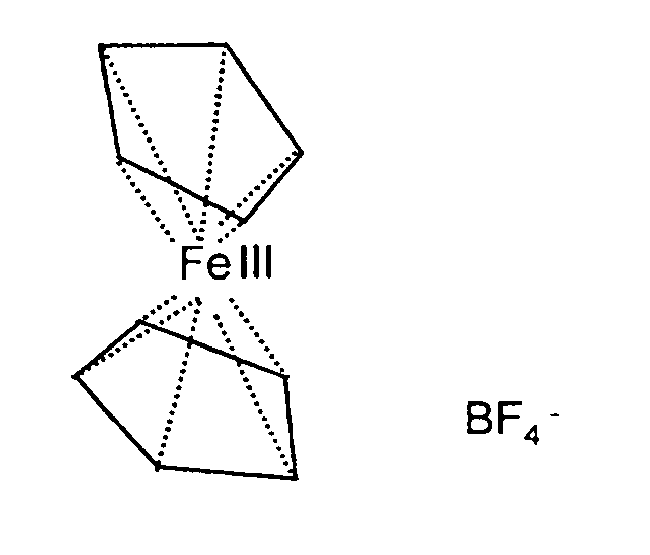
- An die kurzen Kanten der Platte (12) wurde jeweils ein Kabel (15) und (18) mittels Leitsilber angelötet. Bei der Platte (11) wurde die lange Kante komplett mit Leitsilber (16) bestrichen und ebenfalls ein Kabel (17) angelötet.
- Die derart hergestellte Zelle wird im Folgenden als Zelle 3 bezeichnet.
- Außerdem wurde eine zweite Zelle (= Zelle 4) auf dieselbe Weise wie soeben beschrieben hergestellt mit dem einzigen Unterschied, dass die elektrochrome Flüssigkeit kein Ferroceniumtetrafluoroborat enthielt.
- Zelle 3 wurde mit den beiden Kabeln (15) und (17) an eine geregelte Spannung angelegt, während Kabel (18) mit Kabel (17) direkt verbunden war. Dabei färbte sich der dem Kabel (15) zugewandte Teil der Zelle blau, der andere Teil dagegen blieb farblos. Durch Veränderung der Spannung im Bereich 0,7 - 3 V konnte die Übergangszone blau - farblos entlang der Zelle verschoben werden und diente somit als Anzeige der angelegten Spannung.
- Ganz analog ließ sich die Zelle 4 betreiben.
- Beide Zellen unterschieden sich jedoch charakteristisch in der Breite der Übergangszone blau - farblos. Diese wurde ermittelt durch Vermessen der Transmission bei 605 nm über die gesamte Länge der Zelle. Der Bereich zwischen 10 und 90 % der maximalen Transmissionsänderung wurde als Übergangszone festgelegt. Bei Zelle 3 ergab sich eine Breite von 11 mm, bei Zelle 4 eine von 19 mm. Somit ist Zelle 3 mit der erfindungsgemäßen elektrochromen Lösung überlegen, da eine schmalere Übergangszone eine höhere Anzeige- und Ablesegenauigkeit der angelegten Spannung ermöglicht.
- Wurden Kabel (17) und (18) nicht direkt miteinander verbunden, sondern über einen regelbaren Widerstand (0 - 500 Ω), so konnte der Bereich der Zelle, in dem durch Variation der angelegten Spannung die Übergangszone verschoben werden konnte, vergrößert werden.
- Zwei sechseckige mit ITO beschichtete Glasplatten (21) und (22) (Flächenwiderstand 6,8 Ω/□) wurden auf der unbeschichteten Seite mit einem Ring (23) bzw. (24) aus Leitsilber versehen. An den Ecken wurde dieser Ring mit der ITO-Schicht durch Leitsilber elektrisch leitend verbunden. Auf Platte (21) wurde auf die ITO-beschichtete Seite wie in Beispiel 1 beschrieben Klebstoff und Abstandshalter so aufgetragen wurde, dass im Zentrum eine runde Fläche (25) sowie eine Einfüllöffnung (26) frei blieb. Im Zentrum der runden Fläche (25) wurde ein Goldkügelchen (27) mit einem Durchmesser von 130 µm gelegt. Die Platte (22) wurde mit ihrer ITO-beschichteten Seite aufgelegt, angedrückt, und der Klebstoff wurde wie in Beispiel 1 beschrieben ausgehärtet. Man erhielt so eine Zelle wie in
Fig. 6 gezeigt mit einem Schichtabstand von 110 µm. - Diese Zelle wurde wie in Beispiel 2 beschrieben mit der Lösung des Beispiels 2 gefüllt und verschlossen. Schließlich wurden an die beiden Ringe (23) und (24) Kabel mit Leitsilber angelötet.
- Die derart hergestellte Zelle wird im Folgenden als Zelle 5 bezeichnet.
- Außerdem wurde eine zweite Zelle (= Zelle 6) auf dieselbe Weise wie soeben beschrieben hergestellt mit dem einzigen Unterschied, dass die elektrochrome Flüssigkeit kein Ferroceniumtetrafluoroborat enthielt.
- Durch Anlegen einer regelbaren Spannung von 0,5 - 1,4 V an die beiden Kabel färbten sich die Zelle 5 und 6 ringförmig blau, wobei das Zentrum farblos blieb. Mit zunehmender Spannung ließ sich die Größe des farblosen Zentrums verkleinern.
- Beide Zellen unterschieden sich jedoch charakteristisch in der Breite der Übergangszone blau - farblos. Diese wurde ermittelt durch Vermessen der Transmission bei 605 nm über den Radius der runden Fläche (25) der Zelle. Der Bereich zwischen 10 und 90 % der maximalen Transmissionsänderung wurde als Übergangszone festgelegt. Bei Zelle 5 ergab sich eine Breite von 0,7 mm, bei Zelle 6 eine von 1,3 mm. Somit ist Zelle 5 mit der erfindungsgemäßen elektrochromen Lösung überlegen, da eine schmalere Übergangszone eine größere Tiefenschärfe der Abbildung in einer Kamera ermöglicht.
Claims (8)
- Elektrochrome Vorrichtung, enthaltend ein Paar Glas- oder Kunststoffplatten oder Kunststoffolien, von denen mindestens eine Platte oder Folie, vorzugsweise beide Platten oder Folien auf jeweils einer Seite mit einer elektrisch leitfähigen Beschichtung versehen sind, von denen wenigstens eine Platte oder Folie und ihre leitfähige Beschichtung transparent sind, von denen die andere verspiegelt sein kann und von denen wenigstens bei einer der beiden Platten oder Folien die elektrisch leitfähige Schicht in getrennte, einzeln kontaktierte Flächensegmente aufgeteilt ist und die leitfähigen Beschichtungen an mindestens einer Stelle mit einem elektrischen Leiter verbunden sein können, wobei die Platten oder Folien über einen Dichtungsring auf den Seiten ihrer leitfähigen Beschichtung zusammengefügt sind, und das Volumen, gebildet aus den beiden Platten oder Folien und dem Dichtungsring, mit einem elektrochromen Medium gefüllt ist, das mindestens eine reduzierbare elektrochrome Verbindung OX2 und mindestens eine oxidierbare elektrochrome Verbindung RED1 enthält, dadurch gekennzeichnet, daß das elektrochrome Medium noch eine weitere reduzierbare oder oxidierbare elektrochrome Verbindung OX3 bzw. RED3 in einer Konzentration von 20 % bis 30 % der Konzentration von OX2 oder RED1 enthält, deren Reduktions- bzw. Oxidationspotential vom Betrag her nicht größer ist als das Reduktionspotential von OX2 bzw. das Oxidationspotential von RED1.
- Elektrochrome Vorrichtung gemäß Anspruch 1, dadurch gekennzeichnet, daß als OX3 das zu RED1 korrespondierende OX1 eingesetzt wird.
- Elektrochrome Vorrichtung gemäß Anspruch 1, dadurch gekennzeichnet, daß als RED3 das zu OX2 korrespondierende RED2 eingesetzt wird.
- Elektrochrome Vorrichtung gemäß einem oder mehrerer der Ansprüche 1 bis 3, dadurch gekennzeichnet, daß OX3 bzw. RED3 im sichtbaren Teil des elektromagnetischen Spektrums möglichst nicht oder nur schwach absorbieren.
- Elektrochrome Vorrichtung gemäß einem oder mehrerer der Ansprüche 1 bis 4, dadurch gekennzeichnet, daß es sich bei der Vorrichtung um eine Anzeigevorrichtung handelt.
- Elektrochrome Vorrichtung gemäß einem oder mehrerer der Ansprüche 1 bis 4, dadurch gekennzeichnet, daß es sich bei der Vorrichtung um eine Analoganzeige handelt.
- Elektrochrome Vorrichtung gemäß einem oder mehrerer der Ansprüche 1 bis 4, dadurch gekennzeichnet, daß es sich bei der Vorrichtung um eine veränderliche Blende handelt.
- Elektrochrome Vorrichtung gemäß einem oder mehrerer der Ansprüche 1 bis 4, dadurch gekennzeichnet, daß es sich bei der Vorrichtung um einen Berührungssensor handelt.
Applications Claiming Priority (2)
| Application Number | Priority Date | Filing Date | Title |
|---|---|---|---|
| DE19956228 | 1999-11-23 | ||
| DE19956228A DE19956228A1 (de) | 1999-11-23 | 1999-11-23 | Elektrochrome Vorrichtung mit verbessertem Schaltverhalten |
Publications (3)
| Publication Number | Publication Date |
|---|---|
| EP1103842A2 EP1103842A2 (de) | 2001-05-30 |
| EP1103842A3 EP1103842A3 (de) | 2003-05-07 |
| EP1103842B1 true EP1103842B1 (de) | 2009-07-22 |
Family
ID=7929979
Family Applications (1)
| Application Number | Title | Priority Date | Filing Date |
|---|---|---|---|
| EP00124242A Expired - Lifetime EP1103842B1 (de) | 1999-11-23 | 2000-11-10 | Elektrochrome Vorrichtung |
Country Status (8)
| Country | Link |
|---|---|
| US (1) | US6509999B1 (de) |
| EP (1) | EP1103842B1 (de) |
| JP (1) | JP2001194689A (de) |
| KR (1) | KR100697154B1 (de) |
| AT (1) | ATE437386T1 (de) |
| DE (2) | DE19956228A1 (de) |
| ES (1) | ES2328331T3 (de) |
| TW (1) | TWI291073B (de) |
Families Citing this family (14)
| Publication number | Priority date | Publication date | Assignee | Title |
|---|---|---|---|---|
| CN100409094C (zh) | 2003-12-22 | 2008-08-06 | Lg化学株式会社 | 具有提高寿命的电致变色材料 |
| JPWO2008111321A1 (ja) * | 2007-03-14 | 2010-06-24 | コニカミノルタホールディングス株式会社 | 表示素子 |
| JP5256505B2 (ja) * | 2008-02-07 | 2013-08-07 | コニカミノルタ株式会社 | 表示素子 |
| US10303035B2 (en) | 2009-12-22 | 2019-05-28 | View, Inc. | Self-contained EC IGU |
| US11314139B2 (en) | 2009-12-22 | 2022-04-26 | View, Inc. | Self-contained EC IGU |
| CN112731720A (zh) | 2010-12-08 | 2021-04-30 | 唯景公司 | 绝缘玻璃装置的改良隔板 |
| US9442339B2 (en) | 2010-12-08 | 2016-09-13 | View, Inc. | Spacers and connectors for insulated glass units |
| US10344208B2 (en) | 2014-06-09 | 2019-07-09 | iGlass Technology, Inc. | Electrochromic device and method for manufacturing electrochromic device |
| US10294415B2 (en) | 2014-06-09 | 2019-05-21 | iGlass Technology, Inc. | Electrochromic composition and electrochromic device using same |
| US10975612B2 (en) | 2014-12-15 | 2021-04-13 | View, Inc. | Seals for electrochromic windows |
| EP3458906B1 (de) * | 2016-05-17 | 2022-10-26 | Merck Patent GmbH | Vorrichtung zur steuerung der übertragung von strahlung |
| WO2019172474A1 (ko) * | 2018-03-09 | 2019-09-12 | 한국에너지기술연구원 | 자기구동 전기변색소자 |
| CN108795383A (zh) * | 2018-06-05 | 2018-11-13 | 燕山大学 | 一种提高金刚石自锐性的制备方法 |
| US11966139B2 (en) * | 2020-07-31 | 2024-04-23 | Ricoh Company, Ltd. | Electrochromic element, and method for driving the same |
Family Cites Families (12)
| Publication number | Priority date | Publication date | Assignee | Title |
|---|---|---|---|---|
| US3280701A (en) | 1961-09-05 | 1966-10-25 | Donnelly Mirrors Inc | Optically variable one-way mirror |
| JPS57211122A (en) * | 1981-06-23 | 1982-12-24 | Citizen Watch Co Ltd | All solid-state complementary type electrochromic display element |
| US4902108A (en) | 1986-03-31 | 1990-02-20 | Gentex Corporation | Single-compartment, self-erasing, solution-phase electrochromic devices, solutions for use therein, and uses thereof |
| JPH01211734A (ja) * | 1987-05-29 | 1989-08-24 | Nissan Motor Co Ltd | エレクトロクロミック表示体 |
| US5151816A (en) | 1989-12-29 | 1992-09-29 | Donnelly Corporation | Method for reducing current leakage and enhancing uv stability in electrochemichromic solutions and devices |
| US5140455A (en) | 1989-11-29 | 1992-08-18 | Donnelly Corporation | High performance electrochemichromic solutions and devices thereof |
| US5818636A (en) | 1990-02-26 | 1998-10-06 | Molecular Displays, Inc. | Complementary surface confined polmer electrochromic materials, systems, and methods of fabrication therefor |
| US5457564A (en) | 1990-02-26 | 1995-10-10 | Molecular Displays, Inc. | Complementary surface confined polymer electrochromic materials, systems, and methods of fabrication therefor |
| DE19605451A1 (de) * | 1996-02-15 | 1997-08-21 | Bayer Ag | Elektrochromes System |
| DE19631728A1 (de) | 1996-08-06 | 1998-02-12 | Bayer Ag | Elektrochrome Anzeigevorrichtung |
| US6020987A (en) * | 1997-04-02 | 2000-02-01 | Gentex Corporation | Electrochromic medium capable of producing a pre-selected color |
| RU2130630C1 (ru) * | 1997-12-18 | 1999-05-20 | Гаврилов Владимир Иванович | Электрохромный состав |
-
1999
- 1999-11-23 DE DE19956228A patent/DE19956228A1/de not_active Withdrawn
-
2000
- 2000-11-10 DE DE50015694T patent/DE50015694D1/de not_active Expired - Fee Related
- 2000-11-10 AT AT00124242T patent/ATE437386T1/de not_active IP Right Cessation
- 2000-11-10 ES ES00124242T patent/ES2328331T3/es not_active Expired - Lifetime
- 2000-11-10 EP EP00124242A patent/EP1103842B1/de not_active Expired - Lifetime
- 2000-11-21 JP JP2000354555A patent/JP2001194689A/ja not_active Withdrawn
- 2000-11-22 US US09/718,577 patent/US6509999B1/en not_active Expired - Fee Related
- 2000-11-22 KR KR1020000069499A patent/KR100697154B1/ko not_active Expired - Fee Related
- 2000-11-23 TW TW089125099A patent/TWI291073B/zh not_active IP Right Cessation
Also Published As
| Publication number | Publication date |
|---|---|
| TWI291073B (en) | 2007-12-11 |
| KR100697154B1 (ko) | 2007-03-21 |
| ATE437386T1 (de) | 2009-08-15 |
| US6509999B1 (en) | 2003-01-21 |
| ES2328331T3 (es) | 2009-11-12 |
| EP1103842A2 (de) | 2001-05-30 |
| DE50015694D1 (de) | 2009-09-03 |
| KR20010051868A (ko) | 2001-06-25 |
| JP2001194689A (ja) | 2001-07-19 |
| EP1103842A3 (de) | 2003-05-07 |
| DE19956228A1 (de) | 2001-05-31 |
Similar Documents
| Publication | Publication Date | Title |
|---|---|---|
| EP0917556B1 (de) | Elektrochrome anzeigevorrichtung | |
| DE69033714T2 (de) | Verfahren zur mindestens teilweisen Füllung einer elektrochemichromischen Vorrichtung | |
| EP1285040B1 (de) | Elektrochrome vorrichtung | |
| EP0880568B1 (de) | Elektrochromes system | |
| DE60003773T2 (de) | Elektrochromes medium mit konzentration verbesserter stabilität, verfahren zu seiner herstellung und seiner verwendung | |
| EP1007602B1 (de) | Uv-geschützte elektrochrome lösung | |
| EP1088256B1 (de) | Elektrochrome anzeigevorrichtung mit vom elektrochomen medium isolierten zuleitungen | |
| EP1116767B1 (de) | Elektrochrome Vorrichtung | |
| EP1114117B1 (de) | Elektrochrome vorrichtung mit gelbfilter | |
| DE19956228A1 (de) | Elektrochrome Vorrichtung mit verbessertem Schaltverhalten | |
| EP0467846B1 (de) | Neue elektrochrome Stoffzusammensetzungen auf der Basis von Diketopyrrolopyrrolen | |
| EP1042427B1 (de) | Uv-geschützte elektrochrome vorrichtung | |
| DE60319122T2 (de) | Elektrochromische einrichtungen mit elektronen-shuttle | |
| EP1015524A1 (de) | Elektrochromes system mit gekoppeltem red-ox-system und speziellen anionen | |
| EP1030212A2 (de) | Elektrochrome Vorrichtung mit verbesserter Lichtechtheit | |
| EP0880567A1 (de) | Elektrochromes system | |
| EP1169667B1 (de) | Elektrochrome vorrichtung mit nanoteilchen und uv-absorber in der schutzschicht | |
| DE10249054A1 (de) | Elektrochrome Vorrichtung und neue elektrochrome Verbindungen | |
| EP1156098A2 (de) | Elektrochrome Anzeigevorrichtung mit hoher Kantenschärfe | |
| DE69813118T2 (de) | Optische Vorrichtung und elektrolytische Lösung | |
| DE10148438B4 (de) | Elektrochrome Vorrichtung | |
| DE10131988A1 (de) | Elektrochrome Rayleigh-Benard-Zelle | |
| DE19840938A1 (de) | Elektrochrome Vorrichtung mit Gelbfilter | |
| DE19920360A1 (de) | Elektrochrome Vorrichtung mit Gelbfilter |
Legal Events
| Date | Code | Title | Description |
|---|---|---|---|
| PUAI | Public reference made under article 153(3) epc to a published international application that has entered the european phase |
Free format text: ORIGINAL CODE: 0009012 |
|
| AK | Designated contracting states |
Kind code of ref document: A2 Designated state(s): AT BE CH CY DE DK ES FI FR GB GR IE IT LI LU MC NL PT SE TR |
|
| AX | Request for extension of the european patent |
Free format text: AL;LT;LV;MK;RO;SI |
|
| PUAL | Search report despatched |
Free format text: ORIGINAL CODE: 0009013 |
|
| AK | Designated contracting states |
Designated state(s): AT BE CH CY DE DK ES FI FR GB GR IE IT LI LU MC NL PT SE TR |
|
| AX | Request for extension of the european patent |
Extension state: AL LT LV MK RO SI |
|
| RAP1 | Party data changed (applicant data changed or rights of an application transferred) |
Owner name: BAYER CHEMICALS AG |
|
| 17P | Request for examination filed |
Effective date: 20031107 |
|
| AKX | Designation fees paid |
Designated state(s): AT BE CH CY DE DK ES FI FR GB GR IE IT LI LU MC NL PT SE TR |
|
| RAP1 | Party data changed (applicant data changed or rights of an application transferred) |
Owner name: BAYER INNOVATION GMBH |
|
| 17Q | First examination report despatched |
Effective date: 20050415 |
|
| GRAP | Despatch of communication of intention to grant a patent |
Free format text: ORIGINAL CODE: EPIDOSNIGR1 |
|
| GRAS | Grant fee paid |
Free format text: ORIGINAL CODE: EPIDOSNIGR3 |
|
| GRAA | (expected) grant |
Free format text: ORIGINAL CODE: 0009210 |
|
| AK | Designated contracting states |
Kind code of ref document: B1 Designated state(s): AT BE CH CY DE DK ES FI FR GB GR IE IT LI LU MC NL PT SE TR |
|
| REG | Reference to a national code |
Ref country code: GB Ref legal event code: FG4D Free format text: NOT ENGLISH |
|
| REG | Reference to a national code |
Ref country code: CH Ref legal event code: EP |
|
| REG | Reference to a national code |
Ref country code: IE Ref legal event code: FG4D |
|
| REF | Corresponds to: |
Ref document number: 50015694 Country of ref document: DE Date of ref document: 20090903 Kind code of ref document: P |
|
| REG | Reference to a national code |
Ref country code: ES Ref legal event code: FG2A Ref document number: 2328331 Country of ref document: ES Kind code of ref document: T3 |
|
| NLV1 | Nl: lapsed or annulled due to failure to fulfill the requirements of art. 29p and 29m of the patents act | ||
| PG25 | Lapsed in a contracting state [announced via postgrant information from national office to epo] |
Ref country code: FI Free format text: LAPSE BECAUSE OF FAILURE TO SUBMIT A TRANSLATION OF THE DESCRIPTION OR TO PAY THE FEE WITHIN THE PRESCRIBED TIME-LIMIT Effective date: 20090722 Ref country code: SE Free format text: LAPSE BECAUSE OF FAILURE TO SUBMIT A TRANSLATION OF THE DESCRIPTION OR TO PAY THE FEE WITHIN THE PRESCRIBED TIME-LIMIT Effective date: 20090722 |
|
| PG25 | Lapsed in a contracting state [announced via postgrant information from national office to epo] |
Ref country code: NL Free format text: LAPSE BECAUSE OF FAILURE TO SUBMIT A TRANSLATION OF THE DESCRIPTION OR TO PAY THE FEE WITHIN THE PRESCRIBED TIME-LIMIT Effective date: 20090722 |
|
| REG | Reference to a national code |
Ref country code: IE Ref legal event code: FD4D |
|
| PG25 | Lapsed in a contracting state [announced via postgrant information from national office to epo] |
Ref country code: PT Free format text: LAPSE BECAUSE OF FAILURE TO SUBMIT A TRANSLATION OF THE DESCRIPTION OR TO PAY THE FEE WITHIN THE PRESCRIBED TIME-LIMIT Effective date: 20091122 |
|
| PG25 | Lapsed in a contracting state [announced via postgrant information from national office to epo] |
Ref country code: IE Free format text: LAPSE BECAUSE OF FAILURE TO SUBMIT A TRANSLATION OF THE DESCRIPTION OR TO PAY THE FEE WITHIN THE PRESCRIBED TIME-LIMIT Effective date: 20090722 Ref country code: DK Free format text: LAPSE BECAUSE OF FAILURE TO SUBMIT A TRANSLATION OF THE DESCRIPTION OR TO PAY THE FEE WITHIN THE PRESCRIBED TIME-LIMIT Effective date: 20090722 |
|
| PLBE | No opposition filed within time limit |
Free format text: ORIGINAL CODE: 0009261 |
|
| STAA | Information on the status of an ep patent application or granted ep patent |
Free format text: STATUS: NO OPPOSITION FILED WITHIN TIME LIMIT |
|
| BERE | Be: lapsed |
Owner name: BAYER INNOVATION G.M.B.H. Effective date: 20091130 |
|
| 26N | No opposition filed |
Effective date: 20100423 |
|
| PG25 | Lapsed in a contracting state [announced via postgrant information from national office to epo] |
Ref country code: MC Free format text: LAPSE BECAUSE OF NON-PAYMENT OF DUE FEES Effective date: 20091130 |
|
| REG | Reference to a national code |
Ref country code: CH Ref legal event code: PL |
|
| GBPC | Gb: european patent ceased through non-payment of renewal fee |
Effective date: 20091110 |
|
| REG | Reference to a national code |
Ref country code: FR Ref legal event code: ST Effective date: 20100730 |
|
| PG25 | Lapsed in a contracting state [announced via postgrant information from national office to epo] |
Ref country code: CH Free format text: LAPSE BECAUSE OF NON-PAYMENT OF DUE FEES Effective date: 20091130 Ref country code: BE Free format text: LAPSE BECAUSE OF NON-PAYMENT OF DUE FEES Effective date: 20091130 Ref country code: FR Free format text: LAPSE BECAUSE OF NON-PAYMENT OF DUE FEES Effective date: 20091130 Ref country code: GR Free format text: LAPSE BECAUSE OF FAILURE TO SUBMIT A TRANSLATION OF THE DESCRIPTION OR TO PAY THE FEE WITHIN THE PRESCRIBED TIME-LIMIT Effective date: 20091023 Ref country code: LI Free format text: LAPSE BECAUSE OF NON-PAYMENT OF DUE FEES Effective date: 20091130 |
|
| PG25 | Lapsed in a contracting state [announced via postgrant information from national office to epo] |
Ref country code: DE Free format text: LAPSE BECAUSE OF NON-PAYMENT OF DUE FEES Effective date: 20100601 |
|
| PG25 | Lapsed in a contracting state [announced via postgrant information from national office to epo] |
Ref country code: GB Free format text: LAPSE BECAUSE OF NON-PAYMENT OF DUE FEES Effective date: 20091110 |
|
| PG25 | Lapsed in a contracting state [announced via postgrant information from national office to epo] |
Ref country code: AT Free format text: LAPSE BECAUSE OF NON-PAYMENT OF DUE FEES Effective date: 20091110 |
|
| PG25 | Lapsed in a contracting state [announced via postgrant information from national office to epo] |
Ref country code: IT Free format text: LAPSE BECAUSE OF FAILURE TO SUBMIT A TRANSLATION OF THE DESCRIPTION OR TO PAY THE FEE WITHIN THE PRESCRIBED TIME-LIMIT Effective date: 20090722 |
|
| REG | Reference to a national code |
Ref country code: ES Ref legal event code: FD2A Effective date: 20110404 |
|
| PG25 | Lapsed in a contracting state [announced via postgrant information from national office to epo] |
Ref country code: LU Free format text: LAPSE BECAUSE OF NON-PAYMENT OF DUE FEES Effective date: 20091110 |
|
| PG25 | Lapsed in a contracting state [announced via postgrant information from national office to epo] |
Ref country code: ES Free format text: LAPSE BECAUSE OF NON-PAYMENT OF DUE FEES Effective date: 20110323 |
|
| PG25 | Lapsed in a contracting state [announced via postgrant information from national office to epo] |
Ref country code: TR Free format text: LAPSE BECAUSE OF FAILURE TO SUBMIT A TRANSLATION OF THE DESCRIPTION OR TO PAY THE FEE WITHIN THE PRESCRIBED TIME-LIMIT Effective date: 20090722 |
|
| PG25 | Lapsed in a contracting state [announced via postgrant information from national office to epo] |
Ref country code: ES Free format text: LAPSE BECAUSE OF NON-PAYMENT OF DUE FEES Effective date: 20091111 Ref country code: CY Free format text: LAPSE BECAUSE OF FAILURE TO SUBMIT A TRANSLATION OF THE DESCRIPTION OR TO PAY THE FEE WITHIN THE PRESCRIBED TIME-LIMIT Effective date: 20090722 |