EP1099716A1 - Composition, notamment cosmétique, comprenant un copolymère sur lequel est fixé au moins un azurant optique - Google Patents
Composition, notamment cosmétique, comprenant un copolymère sur lequel est fixé au moins un azurant optique Download PDFInfo
- Publication number
- EP1099716A1 EP1099716A1 EP00402928A EP00402928A EP1099716A1 EP 1099716 A1 EP1099716 A1 EP 1099716A1 EP 00402928 A EP00402928 A EP 00402928A EP 00402928 A EP00402928 A EP 00402928A EP 1099716 A1 EP1099716 A1 EP 1099716A1
- Authority
- EP
- European Patent Office
- Prior art keywords
- composition according
- composition
- copolymer
- optical brightener
- formula
- Prior art date
- Legal status (The legal status is an assumption and is not a legal conclusion. Google has not performed a legal analysis and makes no representation as to the accuracy of the status listed.)
- Granted
Links
- 0 C*(CC(C)(C=*=C)N)C(*(C)=C)C#*C=CC Chemical compound C*(CC(C)(C=*=C)N)C(*(C)=C)C#*C=CC 0.000 description 1
- JMPOZASRNZQEML-UHFFFAOYSA-N Cc1ccc(C=C(c2ccccc2)C(O2)=O)c2c1 Chemical compound Cc1ccc(C=C(c2ccccc2)C(O2)=O)c2c1 JMPOZASRNZQEML-UHFFFAOYSA-N 0.000 description 1
Classifications
-
- C—CHEMISTRY; METALLURGY
- C08—ORGANIC MACROMOLECULAR COMPOUNDS; THEIR PREPARATION OR CHEMICAL WORKING-UP; COMPOSITIONS BASED THEREON
- C08F—MACROMOLECULAR COMPOUNDS OBTAINED BY REACTIONS ONLY INVOLVING CARBON-TO-CARBON UNSATURATED BONDS
- C08F246/00—Copolymers in which the nature of only the monomers in minority is defined
-
- A—HUMAN NECESSITIES
- A61—MEDICAL OR VETERINARY SCIENCE; HYGIENE
- A61K—PREPARATIONS FOR MEDICAL, DENTAL OR TOILETRY PURPOSES
- A61K8/00—Cosmetics or similar toiletry preparations
- A61K8/18—Cosmetics or similar toiletry preparations characterised by the composition
- A61K8/30—Cosmetics or similar toiletry preparations characterised by the composition containing organic compounds
- A61K8/49—Cosmetics or similar toiletry preparations characterised by the composition containing organic compounds containing heterocyclic compounds
-
- A—HUMAN NECESSITIES
- A61—MEDICAL OR VETERINARY SCIENCE; HYGIENE
- A61K—PREPARATIONS FOR MEDICAL, DENTAL OR TOILETRY PURPOSES
- A61K8/00—Cosmetics or similar toiletry preparations
- A61K8/18—Cosmetics or similar toiletry preparations characterised by the composition
- A61K8/30—Cosmetics or similar toiletry preparations characterised by the composition containing organic compounds
- A61K8/33—Cosmetics or similar toiletry preparations characterised by the composition containing organic compounds containing oxygen
- A61K8/34—Alcohols
- A61K8/347—Phenols
-
- A—HUMAN NECESSITIES
- A61—MEDICAL OR VETERINARY SCIENCE; HYGIENE
- A61K—PREPARATIONS FOR MEDICAL, DENTAL OR TOILETRY PURPOSES
- A61K8/00—Cosmetics or similar toiletry preparations
- A61K8/18—Cosmetics or similar toiletry preparations characterised by the composition
- A61K8/30—Cosmetics or similar toiletry preparations characterised by the composition containing organic compounds
- A61K8/40—Cosmetics or similar toiletry preparations characterised by the composition containing organic compounds containing nitrogen
- A61K8/41—Amines
- A61K8/415—Aminophenols
-
- A—HUMAN NECESSITIES
- A61—MEDICAL OR VETERINARY SCIENCE; HYGIENE
- A61K—PREPARATIONS FOR MEDICAL, DENTAL OR TOILETRY PURPOSES
- A61K8/00—Cosmetics or similar toiletry preparations
- A61K8/18—Cosmetics or similar toiletry preparations characterised by the composition
- A61K8/30—Cosmetics or similar toiletry preparations characterised by the composition containing organic compounds
- A61K8/49—Cosmetics or similar toiletry preparations characterised by the composition containing organic compounds containing heterocyclic compounds
- A61K8/4973—Cosmetics or similar toiletry preparations characterised by the composition containing organic compounds containing heterocyclic compounds with oxygen as the only hetero atom
-
- A—HUMAN NECESSITIES
- A61—MEDICAL OR VETERINARY SCIENCE; HYGIENE
- A61K—PREPARATIONS FOR MEDICAL, DENTAL OR TOILETRY PURPOSES
- A61K8/00—Cosmetics or similar toiletry preparations
- A61K8/18—Cosmetics or similar toiletry preparations characterised by the composition
- A61K8/30—Cosmetics or similar toiletry preparations characterised by the composition containing organic compounds
- A61K8/60—Sugars; Derivatives thereof
-
- A—HUMAN NECESSITIES
- A61—MEDICAL OR VETERINARY SCIENCE; HYGIENE
- A61K—PREPARATIONS FOR MEDICAL, DENTAL OR TOILETRY PURPOSES
- A61K8/00—Cosmetics or similar toiletry preparations
- A61K8/18—Cosmetics or similar toiletry preparations characterised by the composition
- A61K8/30—Cosmetics or similar toiletry preparations characterised by the composition containing organic compounds
- A61K8/63—Steroids; Derivatives thereof
-
- A—HUMAN NECESSITIES
- A61—MEDICAL OR VETERINARY SCIENCE; HYGIENE
- A61K—PREPARATIONS FOR MEDICAL, DENTAL OR TOILETRY PURPOSES
- A61K8/00—Cosmetics or similar toiletry preparations
- A61K8/18—Cosmetics or similar toiletry preparations characterised by the composition
- A61K8/30—Cosmetics or similar toiletry preparations characterised by the composition containing organic compounds
- A61K8/67—Vitamins
- A61K8/676—Ascorbic acid, i.e. vitamin C
-
- A—HUMAN NECESSITIES
- A61—MEDICAL OR VETERINARY SCIENCE; HYGIENE
- A61K—PREPARATIONS FOR MEDICAL, DENTAL OR TOILETRY PURPOSES
- A61K8/00—Cosmetics or similar toiletry preparations
- A61K8/18—Cosmetics or similar toiletry preparations characterised by the composition
- A61K8/72—Cosmetics or similar toiletry preparations characterised by the composition containing organic macromolecular compounds
- A61K8/81—Cosmetics or similar toiletry preparations characterised by the composition containing organic macromolecular compounds obtained by reactions involving only carbon-to-carbon unsaturated bonds
- A61K8/8141—Compositions of homopolymers or copolymers of compounds having one or more unsaturated aliphatic radicals, each having only one carbon-to-carbon double bond, and at least one being terminated by only one carboxyl radical, or of salts, anhydrides, esters, amides, imides or nitriles thereof; Compositions of derivatives of such polymers
- A61K8/8152—Homopolymers or copolymers of esters, e.g. (meth)acrylic acid esters; Compositions of derivatives of such polymers
-
- A—HUMAN NECESSITIES
- A61—MEDICAL OR VETERINARY SCIENCE; HYGIENE
- A61K—PREPARATIONS FOR MEDICAL, DENTAL OR TOILETRY PURPOSES
- A61K8/00—Cosmetics or similar toiletry preparations
- A61K8/18—Cosmetics or similar toiletry preparations characterised by the composition
- A61K8/72—Cosmetics or similar toiletry preparations characterised by the composition containing organic macromolecular compounds
- A61K8/90—Block copolymers
-
- A—HUMAN NECESSITIES
- A61—MEDICAL OR VETERINARY SCIENCE; HYGIENE
- A61Q—SPECIFIC USE OF COSMETICS OR SIMILAR TOILETRY PREPARATIONS
- A61Q19/00—Preparations for care of the skin
-
- A—HUMAN NECESSITIES
- A61—MEDICAL OR VETERINARY SCIENCE; HYGIENE
- A61Q—SPECIFIC USE OF COSMETICS OR SIMILAR TOILETRY PREPARATIONS
- A61Q19/00—Preparations for care of the skin
- A61Q19/02—Preparations for care of the skin for chemically bleaching or whitening the skin
-
- A—HUMAN NECESSITIES
- A61—MEDICAL OR VETERINARY SCIENCE; HYGIENE
- A61K—PREPARATIONS FOR MEDICAL, DENTAL OR TOILETRY PURPOSES
- A61K2800/00—Properties of cosmetic compositions or active ingredients thereof or formulation aids used therein and process related aspects
- A61K2800/40—Chemical, physico-chemical or functional or structural properties of particular ingredients
- A61K2800/57—Compounds covalently linked to a(n inert) carrier molecule, e.g. conjugates, pro-fragrances
-
- A—HUMAN NECESSITIES
- A61—MEDICAL OR VETERINARY SCIENCE; HYGIENE
- A61Q—SPECIFIC USE OF COSMETICS OR SIMILAR TOILETRY PREPARATIONS
- A61Q1/00—Make-up preparations; Body powders; Preparations for removing make-up
- A61Q1/02—Preparations containing skin colorants, e.g. pigments
-
- A—HUMAN NECESSITIES
- A61—MEDICAL OR VETERINARY SCIENCE; HYGIENE
- A61Q—SPECIFIC USE OF COSMETICS OR SIMILAR TOILETRY PREPARATIONS
- A61Q1/00—Make-up preparations; Body powders; Preparations for removing make-up
- A61Q1/02—Preparations containing skin colorants, e.g. pigments
- A61Q1/04—Preparations containing skin colorants, e.g. pigments for lips
- A61Q1/06—Lipsticks
-
- A—HUMAN NECESSITIES
- A61—MEDICAL OR VETERINARY SCIENCE; HYGIENE
- A61Q—SPECIFIC USE OF COSMETICS OR SIMILAR TOILETRY PREPARATIONS
- A61Q1/00—Make-up preparations; Body powders; Preparations for removing make-up
- A61Q1/02—Preparations containing skin colorants, e.g. pigments
- A61Q1/10—Preparations containing skin colorants, e.g. pigments for eyes, e.g. eyeliner, mascara
-
- A—HUMAN NECESSITIES
- A61—MEDICAL OR VETERINARY SCIENCE; HYGIENE
- A61Q—SPECIFIC USE OF COSMETICS OR SIMILAR TOILETRY PREPARATIONS
- A61Q3/00—Manicure or pedicure preparations
- A61Q3/02—Nail coatings
-
- A—HUMAN NECESSITIES
- A61—MEDICAL OR VETERINARY SCIENCE; HYGIENE
- A61Q—SPECIFIC USE OF COSMETICS OR SIMILAR TOILETRY PREPARATIONS
- A61Q5/00—Preparations for care of the hair
Definitions
- the subject of the invention is a composition for topical application comprising, in a physiologically acceptable medium, at least one copolymer comprising at least one optical brightener fixed on the copolymer chain by a covalent bond.
- the invention has also relates to the uses of this composition in the care and makeup of the skin, integuments and / or mucous membranes.
- the substances most used as a bleaching agent are hydroquinone and its derivatives, kojic acid and its derivatives, azelaic acid, arbutin and its derivatives, alone or in combination with other active ingredients.
- compositions comprising bleaches are also used by people with discolored skin, which can be of various origins: age (age spots), UV exposure, pregnancy mask, skin pathology, etc.
- hydroquinone and its derivatives are used in an effective amount to see appear a whitening effect.
- hydroquinone is known for its cytotoxicity towards of the melanocyte.
- kojic acid and its derivatives have the disadvantage of being expensive and of not for this reason can be used in large quantities in products with large commercial distribution.
- compositions capable of standardizing the complexion, and possibly to confer an immediate white appearance, these compositions being constituted powders dispersed in a binder.
- the powders are generally white pigments or colored according to the desired effect and / or fillers of different shapes (lamellar, spherical) according to the desired effect.
- the uniformity of the complexion is obtained essentially thanks to the covering power provided by pigments and fillers.
- compositions The disadvantage of such compositions is that the blurring of skin defects is brought by the covering power of compositions. The skin thus made up loses its natural appearance due to the lack of transparency of these compositions.
- optical brighteners are optical bleaching agents, made up of chemical compounds with fluorescent properties, which absorb in the ultraviolet (maximum absorption at a wavelength less than 400 nm) and re-emit energy by fluorescence for a wavelength between 380 nm and 830 nm.
- An energy emission between 400 nm and 480 nm results in a emission in the blue of the visible domain, which contributes, when this emission takes place on the skin, to visually whiten it.
- the present invention thus relates to a composition for topical application comprising, in a physiologically acceptable medium, at least one copolymer comprising at least one optical brightener fixed on the copolymer chain by a link covalent.
- This particular copolymer advantageously confers on the composition according to the invention fluorescence emission of optimal light intensity in the purple-blue region of the visible spectrum and can be manufactured by methods which are easy to implement from polymerizable monomers soluble in organic solvents.
- optical brightener is fixed by a covalent bond on the chain polymer prevents its release into the surrounding environment, which makes it compatible with various hydrophilic or hydrophobic media. This fixation thus makes him insensitive to chemical reactions and makes it compatible with other dyes, if necessary.
- the copolymer is formed of units A and of patterns B comprising an optical brightener C covalently bonded to the patterns B, and it comprises from 4 to 30% by weight of optical brightener C relative to the weight of the copolymer total.
- the light intensity of the fluorescent emission is maximum when the optical brightener content of the copolymer is limited to a precise range. It is in particular higher than that observed for the copolymers described in the two publications mentioned above.
- a content of brightener optic of the copolymer greater than 30% by weight may lead to extinction or "quenching" of the fluorescence phenomenon.
- optical brightener fixed in this copolymer can be chosen from optical brighteners known and used until now as whiteners.
- the aromatic groups used can be groups having one or more benzene rings, for example groups phenyl, biphenyl, substituted phenyl or aromatic groups formed from polycyclic aromatic hydrocarbons, such as naphthyl, phenanthryl groups, anthracenyl, fluoranthenyl, etc.
- Heterocyclic groups are hydrocarbon groups, saturated or unsaturated, having one or more heteroatoms such as O, N and S.
- groups heterocyclic there may be mentioned thienyl, furyl, pyrannyl, isobenzofurannyl groups, isobenzothienyl, pyrrolyl, pyridyl, pyrazolyl.
- the alkylene groups used can be linear or branched and contain from 3 to 16 carbon atoms.
- the alkyl groups which can be used are linear or branched groups, having preferably from 1 to 16 carbon atoms.
- the tert-butyl group is used.
- a 8 , A 9 , A 12 and / or A 13 represent a dialkylamino group
- the alkyl groups preferably have from 1 to 12 carbon atoms.
- the optical brightener may correspond to formula (III) in which A 4 and A 5 represent an alkyl group, for example the tert-butyl group and A 6 , A 7 , B 1 and B 2 represent a hydrogen atom.
- the units A and B can come from various polymerizable monomers of similar or different structures.
- the succession of units A and B can correspond to the backbone of a polymer natural such as cellulose hydroxyethers, polysaccharides, cellulose esters, modified proteins and protein hydrolysates.
- patterns A and B are units of synthetic polymers, for example units derived from monomers acrylic, methacrylic, vinyl, olefinic and / or styrenic.
- the copolymer comprises units A originating from methyl methacrylate and B units derived from the methacrylate of the optical brightener.
- the copolymer can correspond to formula (V) in which x and y are such that the mass proportion of optical brightening groups C of formula (VI): represents from 4 to 30% of the total weight of the copolymer.
- the units A are formed from methyl methacrylate and the units B of the optical brightener methacrylate. They are distributed randomly in the chain of copolymer.
- the mass proportion of optical brightening groups C represents 8 to 10% by weight of the total copolymer. This limitation of the quantity of optical brightener makes it possible to reduce the cost of the copolymer used according to the invention, and consequently of the composition itself, while obtaining the maximum effect of reemitted fluorescence.
- copolymers of the invention can be prepared by conventional methods, by example by radical copolymerization of a monomer A 'and a monomer B' on which is fixed the optical brightener C by a covalent bond.
- This copolymerization radical is generally carried out in organic solution in the presence of an initiator of polymerization such as azoisobutyronitrile. It is also possible to prepare the copolymer of the invention by the process described in application FR 99/10942.
- composition according to the invention finds an application in the care and makeup of the skin, mucous membranes and dander.
- the invention thus relates to a cosmetic process for increasing the clarity and / or the radiance of the skin, mucous membranes or integuments, characterized by the fact that it is applied to the skin, mucous membranes or integuments a composition as defined above.
- the invention also relates to a cosmetic process for increasing the shine of hair, characterized in that a composition such as this is applied to the hair as defined above.
- the invention particularly relates to the use of the above composition as cosmetic composition, or for the preparation of a dermatological composition, for topical application to the skin, to whiten the skin and / or give the complexion a more greater uniformity, greater transparency and / or porcelain appearance.
- a use is particularly effective on Asian skin, although it is suitable also for Caucasian skin.
- the composition according to the invention when the composition according to the invention is a skin care composition, the composition according to the invention also preferably comprises at least one agent depigmenting. This combination makes it possible to combine the long-term whitening effect of the depigmenting agent, by inhibiting melanin synthesis, and the whitening effect immediate optical brightener.
- compositions according to the invention can for example comprise at least one of the following compounds: kojic acid; ellagic acid; arbutin and its derivatives such as those described in applications EP-895,779 and EP-524 109; hydroquinone; aminophenol derivatives such as those described in the applications WO 99/10318 and WO 99/32077, and in particular N-cholesteryloxycarbonyl-para-aminophenol and N-ethyloxycarbonyl-para-aminophenol; iminophenol derivatives, in in particular those described in application WO 99/22707; L-2-oxothiazolidine-4-carboxylic acid or procysteine, and its salts and esters; ascorbic acid and its derivatives, in particular ascorbyl glucoside; and plant extracts, especially licorice, mulberry and skullcap, without this list being exhaustive.
- such a composition also comprises at least one agent capable of filter UV and / or at least one scaling agent.
- the copolymer according to the invention can itself be considered as a UV absorber, so that its association with a conventional UV filter makes it possible to add the effects of these two compounds and possibly reduce the amount of UV filter necessary to obtain a given Sun Protection Factor. This has an advantage, since UV filters have a strong influence on the rheology of the compositions containing them, so that they restrict the freedom of formulation of these compositions in terms of texture.
- organic filters hydrophilic or lipophilic and mineral filters there may be mentioned organic filters hydrophilic or lipophilic and mineral filters.
- the hydrophilic filters can in particular be chosen from derivatives of benzophenone, p-aminobenzoic acid derivatives, camphor derivatives or still among the benzimidazole derivatives.
- Hydrophilic filters can be present in the final composition according to the invention at a content which can vary from 0.1 to 20%, preferably from 0.2 to 10%, by weight, per relative to the total weight of the composition.
- the lipophilic filters which are particularly suitable for the present invention can be chosen from dibenzoylmethane derivatives, benzimidazole derivatives, derivatives cinnamics, salicylic derivatives, camphor derivatives, triazine derivatives, benzophenone derivatives, ⁇ , ⁇ -diphenylacrylate derivatives, paminobenzoic acid derivatives, filter polymers and filter silicones described in the applications WO-93/04665 and WO-94/06404.
- Other examples of organic filters are given in patent application EP-A 0 487 404.
- the lipophilic filter or filters may be present in the composition according to the invention at a content which can vary from 0.5 to 30%, preferably from 0.5 to 20%, by weight, per relative to the total weight of the composition.
- the mineral filters can be pigments or even nanopigments (size average of primary particles: generally between 5 nm and 150 nm, preferably between 10 and 100 nm) of coated or uncoated metal oxides such as for example titanium oxide nanopigments (amorphous or crystallized in rutile and / or anatase form), of iron, zinc, zirconium or cerium which are all good photoprotective agents known per se acting by physical blocking (reflection and / or diffusion) of the radiation UV.
- Conventional coating agents are moreover alumina and / or stearate aluminum, silicones.
- Such nanopigments of metal oxides, coated or not coated, are in particular described in patent applications EP-A- 0 518 772 and EP-A- 0 518 773.
- the mineral filters may be present in the final composition according to the invention at a content which can vary from 0.1 to 20%, preferably from 0.2 to 10% by weight, relative the total weight of the composition.
- the scaling agents capable of being used in the compositions according to the invention include in particular ⁇ -hydroxy acids such as citric, lactic, glycolic, mandelic, malic and tartaric; ⁇ -hydroxy acids and especially acid salicylic acid and its derivatives described in applications FR-A-2,581,542, EP-875,495, WO 98/35973 and EP-756,866; ⁇ -keto acids and ⁇ -keto acids; retinoids and in particular retinol and retinyl esters; HMG-CoA reductase inhibitors, as described in application EP-738 510; and sugar derivatives such as those described in application EP-853 472, and in particular O-octanoyl-6'- ⁇ -D-maltose.
- ⁇ -hydroxy acids such as citric, lactic, glycolic, mandelic, malic and tartaric
- the composition according to the invention when it is a care or make-up composition for the skin, it may be a cosmetic composition for preventing and / or treating dark circles. Dark circles manifested by the presence of a darker surface, see gray or black, around the eyes and / or by the presence of bags under the eyes and / or by an appearance withered eye contour can thus decrease, or even disappear, thanks to the application on these of the composition according to the invention.
- Such a composition particularly effective in the prevention and / or treatment of dark circles preferably further comprises at least one moisturizing agent.
- hydrating agents capable of being used in these compositions, it is possible to mention in particular urea or its derivatives, polyols, such as for example glycerin, sorbitol, propylene glycol.
- composition according to the invention is a composition for making up the skin, it may alternatively be a foundation or powder composition.
- a subject of the invention is also the use of the above composition as composition for caring for or making up the integuments or mucous membranes.
- the subject of the invention is the use of the above composition as a lip stick (colored or non-colored), mascara or nail polish, to increase clarity and / or radiance lips, eyelashes or nails.
- Another subject of the invention is the use of the above composition as hair composition, intended in particular to increase the shine of the hair and / or to modify their reflections.
- composition according to the invention can also make it possible to modify the color of the lips, eyelashes and nails in case it contains one or more pigments colored.
- the copolymer previously described is used in the composition according to the present invention preferably in an amount ranging from 0.1 to 15% by weight, and even more preferably from 0.5 to 10% by weight relative to the total weight of the composition.
- compositions according to the invention can have all the galenical forms normally used for topical application, for example in the form of solutions, gels, dispersions of the lotion or serum type, emulsions of liquid consistency or semi-liquid of the milk type, obtained by dispersing a fatty phase in a phase aqueous (O / W) or vice versa (W / O), or of suspensions or emulsions of consistency soft, semi-solid or solid of the cream or gel or stick type, or else of microemulsions, microcapsules, microparticles or vesicular dispersions of the ionic type and / or non-ionic.
- These compositions are prepared according to the usual methods.
- the compositions, more particularly cosmetic, of the invention may contain adjuvants customary in the cosmetic field, such as emulsifiers, hydrophilic or lipophilic gelling agents, hydrophilic active agents or lipophiles, preservatives, antioxidants, fragrances, fillers, materials coloring.
- adjuvants customary in the cosmetic field such as emulsifiers, hydrophilic or lipophilic gelling agents, hydrophilic active agents or lipophiles, preservatives, antioxidants, fragrances, fillers, materials coloring.
- the quantities of these various adjuvants are those conventionally used in the cosmetic field, for example from 0.01 to 20% of the total weight of the composition.
- These adjuvants depending on their nature, can be introduced in the phase fatty, in the aqueous phase and / or in the lipid vesicles.
- water-in-oil (W / O) or oil-in-water emulsifiers can be used (O / W) according to the desired final emulsion.
- emulsifiers mention may be made, for example, of the mixture of stearate PEG-100 glyceryl / stearate (Arlacel 165 sold by the company ICI), PEG-20 stearate (Myrj 49 sold by the company ICI), PEG-40 stearate (Myrj 52 sold by the company ICI) and sorbitan tristearate (Span 65 sold by the company ICI).
- the rate of emulsifier can range from 0.1 to 15% by weight, and preferably from 0.5 to 5% by weight, relative to the total weight of the composition.
- Coemulsifiers can be added to the composition according to the invention, for example in an amount ranging from 0.05% to 10% by weight relative to the total weight of the composition.
- the emulsifier can consist of the vesicles themselves, of ionic and / or nonionic lipids.
- hydrophilic active agents it is possible to use, for example, proteins or hydrolysates of protein, amino acids, urea, allantoin, sugars and their derivatives, acid glycyrrhetinic.
- tocopherol vitamin E
- essential fatty acids ceramides
- essential oils one can use tocopherol (vitamin E) and its derivatives, essential fatty acids, ceramides, essential oils.
- This cream gives the skin a porcelain look.
- This composition blurs the appearance of dark circles.
- This conditioner brings shine to the hair.
Landscapes
- Health & Medical Sciences (AREA)
- Life Sciences & Earth Sciences (AREA)
- Veterinary Medicine (AREA)
- Animal Behavior & Ethology (AREA)
- General Health & Medical Sciences (AREA)
- Public Health (AREA)
- Epidemiology (AREA)
- Birds (AREA)
- Dermatology (AREA)
- Chemical & Material Sciences (AREA)
- Chemical Kinetics & Catalysis (AREA)
- Medicinal Chemistry (AREA)
- Polymers & Plastics (AREA)
- Organic Chemistry (AREA)
- Emergency Medicine (AREA)
- Cosmetics (AREA)
- Addition Polymer Or Copolymer, Post-Treatments, Or Chemical Modifications (AREA)
Abstract
Description




- Palmitate d'éthyl-2 hexyle 8 %
- Huile de vaseline 8 %
- Mono-di-isostéarate de glycéryle 2 %
- Mélange de mono-di-stéarate de glycéryle, acide stéarique, glycérine (40/50/5/5) 2 %
- Copolymère (V)* 1 %
- Triéthanolamine 0,9 %
- Propylène glycol 2 %
- Acide stéarique 2 %
- Stéarate de magnésium 2 %
- Conservateurs qs
- Eau qsp 100%
- Hyaluronate de sodium 0,1 %
- Copolymère (V)* 5 %
- Acide acrylamidométhyl propane sulfonique neutralisé partiellement à l'ammoniaque réticulé 1,5 %
- Glycérine 5 %
- Alcool éthylique 5 %
- Di-oléate de méthyl glucose oxyéthyléné (120 OE) 0,5 %
- Mono-laurate de sorbitane oxyéthyléné (20 OE) 0,5 %
- Conservateurs qs
- Eau qsp 100 %
- Polybutène 15 %
- Benzoate d'alkyle en C12-C15 20 %
- Trimellitate de tridécyle 15 %
- Phényltriméthicone 5 %
- Di-isostéarylmalate 7 %
- Lanoline 13 %
- Cire de polyéthylène 4 %
- Cire de candellila 7 %
- Cire de carnauba 3,9 %
- BHT 0,1 %
- Copolymère (V) 100 %
- FD & C Yellow n° 6 Al Lake 1 %
- TiO2 0,5 %
- DC Red n° 7 Calcium Lake 0,7 %
- Mélange d'alcool cétéarylique et d'alcool cétéarylique oxyéthyléné (30 OE) 5,0 %
- Chlorure de béhényl triméthyl ammonium 2,0 %
- Amodiméthicone 1,2 %
- Copolymère (V)* 0,8 %
- Carbomer neutralisé 0,5 %
- Eau qsp 100 %
Claims (22)
- Composition pour application topique comprenant, dans un milieu physiologiquement acceptable, au moins un copolymère comportant au moins un azurant optique fixé sur la chaíne du copolymère par une liaison covalente.
- Composition selon la revendication 1, caractérisée en ce que ledit copolymère est formé de motifs A et de motifs B comportant un azurant optique C lié de façon covalente aux motifs B, et en ce qu'il comprend 4 à 30% en poids d'azurant optique C par rapport au poids total du copolymère.
- Composition selon la revendication 2, caractérisée en ce que ledit copolymère comprend de 8 à 10% en poids d'azurant optique C par rapport au poids total du copolymère.
- Composition selon l'une quelconque des revendications 1 à 3, caractérisée en ce que ledit azurant optique est choisi dans le groupe constitué :1) des bis(benzoxazol-2-yl) de formule (I):dans laquelle A1 est un groupe aromatique, hétérocyclique ou alcoylène, et A2 est un atome d'hydrogène ou un groupe alkyle ;
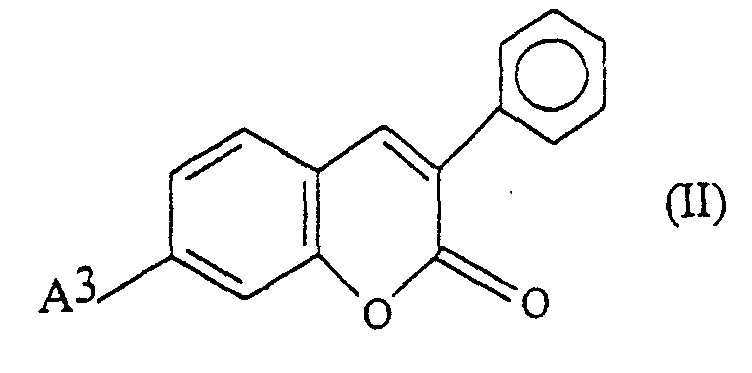
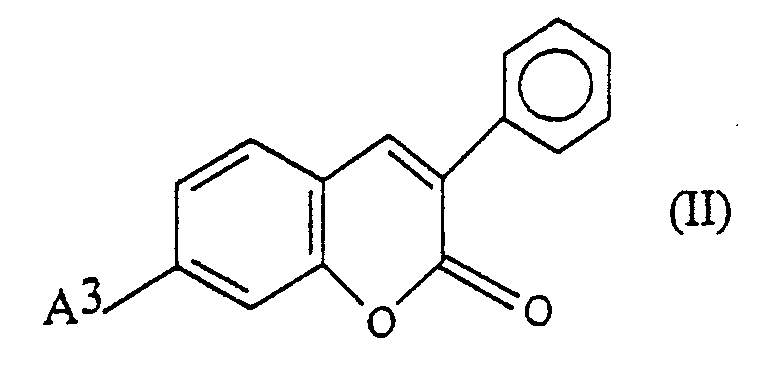
 2) des coumarines de formule (II) :dans laquelle A3 est est un groupe hétérocyclique ;
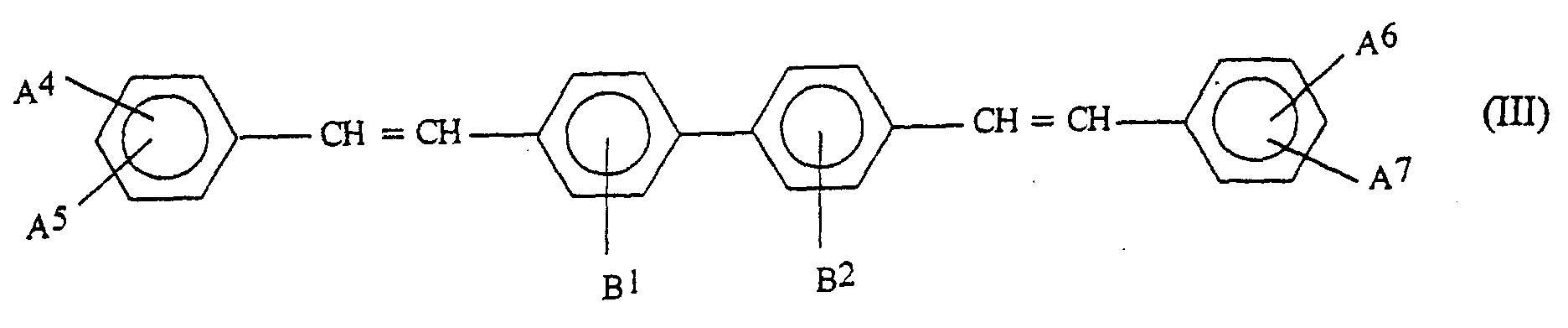
 3) des bis(styryl)biphényle de formule (III) :dans laquelle A4, A5, A6, A7, B1 et B2, qui peuvent être identiques ou différents, représentent indépendamment un atome d'hydrogène, -SO3Na ou un groupe alkyle ; et
 4) des dérivés de triazine-stilbène de formule (IV) :dans laquelle A8, A9, A12 et A13 représentent indépendamment un atome d'hydrogène, un groupe -SO3Na ou un groupe phénylamino, dialkylamino ou morpholino, et A10 et A11 représentent indépendamment un atome d'hydrogène ou -SO3Na.
- Composition selon la revendication 4, caractérisée en ce que l'azurant optique répond à la formule (III) dans laquelle A4 et A5 représentent un groupe alkyle et A6, A7, B1 et B2 représentent un atome d'hydrogène.
- Composition selon la revendication 5, caractérisée en ce que A4 et A5 représentent le groupe tert-butyle.
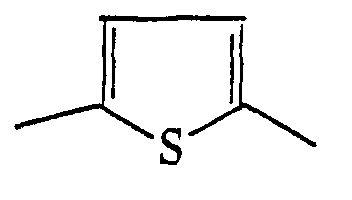
- Composition selon la revendication 4, caractérisée en ce que ledit azurant optique répond à la formule (I) dans laquelle A1 représente le groupe :et A2 représente le groupe tert-butyle.

- Composition selon la revendication 4, caractérisée en ce que ledit azurant optique répond à la formule (IV) dans laquelle A10 et A11 représentent -SO3Na et A8, A9, A12 et A13 représentent le groupe phénylamino.
- Composition selon l'une quelconque des revendications 2 à 8, caractérisée en ce que le motif A est issu du méthacrylate de méthyle et le motif B est issu du méthacrylate de l'azurant optique.
- Composition selon l'une quelconque des revendications 1 à 6, caractérisée en ce que ledit copolymère répond à la formule (V)dans laquelle x et y sont tels que la proportion massique de groupes azurants optiques C de formule (VI):
 représente de 4 à 30% du poids total du copolymère.
- Composition selon l'une quelconque des revendications 1 à 10, caractérisée en ce qu'elle comprend en outre au moins un agent dépigmentant.
- Composition selon l'une quelconque des revendications 1 à 11, caractérisée en ce qu'elle comprend en outre au moins un agent susceptible de filtrer les UV et/ou au moins un agent desquamant.
- Composition selon l'une quelconque des revendications 1 à 12, caractérisée en ce que ledit copolymère est présent en quantité allant de 0,1 à 15% en poids, et encore plus préférentiellement de 0,5 à 10% en poids, par rapport au poids total de la composition.
- Utilisation de la composition selon l'une quelconque des revendications 1 à 13 comme composition cosmétique, ou pour la préparation d'une composition dermatologique, pour application topique sur la peau, en vue de blanchir la peau et/ou conférer au teint une plus grande uniformité, une plus grande transparence et/ou un aspect de porcelaine.
- Utilisation de la composition selon l'une quelconque des revendications 1 à 13 comme composition cosmétique de prévention et/ou de traitement des cernes.
- Utilisation selon la revendication 15, caractérisée en ce que ladite composition comprend en outre au moins un agent hydratant.
- Utilisation de la composition selon l'une quelconque des revendications 1 à 13 comme composition de fond de teint ou de poudre.
- Utilisation de la composition selon l'une quelconque des revendications 1 à 13 comme composition de soin ou de maquillage des phanères ou des muqueuses.
- Utilisation de la composition selon l'une quelconque des revendications 1 à 13 comme stick à lèvres, mascara ou vernis à ongles, pour augmenter la clarté et/ou l'éclat des lèvres, des cils ou des ongles.
- Utilisation de la composition selon l'une quelconque des revendications 1 à 13 comme composition capillaire destinée à augmenter la brillance des cheveux et/ou à modifier leurs reflets.
- Procédé cosmétique pour augmenter la clarté et/ou l'éclat de la peau, des muqueuses ou des phanères, caractérisé par le fait que l'on applique sur la peau, les muqueuses ou les phanères une composition selon l'une quelconque des revendications 1 à 13.
- Procédé cosmétique pour augmenter la brillance et/ou modifier les reflets des cheveux, caractérisé par le fait que l'on applique sur les cheveux une composition selon l'une quelconque des revendications 1 à 13.
Applications Claiming Priority (2)
| Application Number | Priority Date | Filing Date | Title |
|---|---|---|---|
| FR9914150 | 1999-11-10 | ||
| FR9914150A FR2800612B1 (fr) | 1999-11-10 | 1999-11-10 | Composition, notamment cosmetique, comprenant un copolymere sur lequel est fixe au moins un azurant optique |
Publications (2)
| Publication Number | Publication Date |
|---|---|
| EP1099716A1 true EP1099716A1 (fr) | 2001-05-16 |
| EP1099716B1 EP1099716B1 (fr) | 2006-03-01 |
Family
ID=9551982
Family Applications (1)
| Application Number | Title | Priority Date | Filing Date |
|---|---|---|---|
| EP00402928A Expired - Lifetime EP1099716B1 (fr) | 1999-11-10 | 2000-10-23 | Composition, notamment cosmétique, comprenant un copolymère sur lequel est fixé au moins un azurant optique |
Country Status (8)
| Country | Link |
|---|---|
| EP (1) | EP1099716B1 (fr) |
| JP (1) | JP3732086B2 (fr) |
| KR (1) | KR100478968B1 (fr) |
| CN (1) | CN1200670C (fr) |
| AT (1) | ATE318574T1 (fr) |
| DE (1) | DE60026269T2 (fr) |
| ES (1) | ES2259598T3 (fr) |
| FR (1) | FR2800612B1 (fr) |
Cited By (2)
| Publication number | Priority date | Publication date | Assignee | Title |
|---|---|---|---|---|
| EP1459730A1 (fr) * | 2003-03-19 | 2004-09-22 | L'oreal | Composition de vernis à ongles comprenant des fibres recouvertes d'au moins un azurant optique |
| FR2877838A1 (fr) * | 2004-11-18 | 2006-05-19 | Oreal | Compositions cosmetiques comprenant un compose organique fluorescent et une terre rare. |
Families Citing this family (25)
| Publication number | Priority date | Publication date | Assignee | Title |
|---|---|---|---|---|
| FR2830189B1 (fr) | 2001-09-28 | 2004-10-01 | Oreal | Composition de teinture a effet eclaircissant pour fibres keratiniques humaines |
| KR100829719B1 (ko) * | 2001-12-20 | 2008-05-15 | 주식회사 코리아나화장품 | 주름개선 활성물질을 함유하는 분말형 화장료 조성물 |
| KR100485305B1 (ko) * | 2002-05-10 | 2005-04-25 | 주식회사 웰스킨 | 스핑고신-1-포스페이트 및 그 유도체를 포함하는 미백화장료 조성물 |
| US7306809B2 (en) | 2002-09-13 | 2007-12-11 | Lipo Chemicals, Inc. | Optically activated particles for use in cosmetic compositions |
| US7261744B2 (en) | 2002-12-24 | 2007-08-28 | L'oreal S.A. | Method for dyeing or coloring human keratin materials with lightening effect using a composition comprising at least one fluorescent compound and at least one optical brightener |
| US7736631B2 (en) | 2003-04-01 | 2010-06-15 | L'oreal S.A. | Cosmetic dye composition with a lightening effect for human keratin materials, comprising at least one fluorescent dye and at least one aminosilicone, and process of dyeing |
| US7150764B2 (en) | 2003-04-01 | 2006-12-19 | L'oreal S.A. | Composition for dyeing a human keratin material, comprising at least one fluorescent dye and at least one insoluble conditioning agent, process thereof, use thereof, and devices thereof |
| US7195650B2 (en) | 2003-04-01 | 2007-03-27 | L'oreal S.A. | Process for dyeing, with a lightening effect, human keratin fibers that have been permanently reshaped, using at least one composition comprising at least one fluorescent dye |
| US7186278B2 (en) | 2003-04-01 | 2007-03-06 | L'oreal S.A. | Composition for dyeing human keratin materials, comprising at least one fluorescent dye and at least one compound comprising an acid functional group and processes therefor |
| US7250064B2 (en) | 2003-04-01 | 2007-07-31 | L'oreal S.A. | Dye composition comprising at least one fluorescent dye and a non-associative thickening polymer for human keratin materials, process therefor, and method thereof |
| US7192454B2 (en) | 2003-04-01 | 2007-03-20 | L'oreal S.A. | Composition for dyeing human keratin materials, comprising a fluorescent dye and a particular sequestering agent, process therefor and use thereof |
| US7204860B2 (en) | 2003-04-01 | 2007-04-17 | L'oreal | Composition for dyeing human keratin materials, comprising at least one fluorescent dye and at least one polyol, process therefor and use thereof |
| US7195651B2 (en) | 2003-04-01 | 2007-03-27 | L'oreal S.A. | Cosmetic composition for dyeing human keratin materials, comprising at least one fluorescent dye and at least one cationic polymer, and a dyeing process therefor |
| US7198650B2 (en) | 2003-04-01 | 2007-04-03 | L'oreal S.A. | Method of dyeing human keratin materials with a lightening effect with compositions comprising at least one fluorescent dye and at least one amphoteric or nonionic surfactant, composition thereof, process thereof, and device therefor |
| US7303589B2 (en) | 2003-04-01 | 2007-12-04 | L'oreal S.A. | Process for dyeing human keratin fibers, having a lightening effect, comprising at least one fluorescent compound and compositions of the same |
| US7147673B2 (en) | 2003-04-01 | 2006-12-12 | L'oreal S.A. | Composition for dyeing human keratin materials, comprising at least one fluorescent dye and at least one insoluble polyorganosiloxane conditioning polymer, process therefor and use thereof |
| US7208018B2 (en) | 2003-04-01 | 2007-04-24 | L'oreal | Composition for dyeing human keratin materials, comprising at least one fluorescent dye and at least one associative polymer, process therefor and use thereof |
| FR2853234B1 (fr) * | 2003-04-01 | 2007-10-12 | Oreal | Composition de coloration comprenant un colorant fluorescent et un polymere epaississant non associatif pour matieres keratiniques humaines, procede et utilisation |
| JP2012167088A (ja) * | 2011-01-27 | 2012-09-06 | Rohto Pharmaceutical Co Ltd | 有機蛍光剤含有マイクロカプセル |
| JP2013028665A (ja) * | 2011-07-27 | 2013-02-07 | Shikoku Chem Corp | ゴム・カーボンブラック用カップリング剤及びそれを含むタイヤ用ゴム組成物 |
| US8871880B2 (en) * | 2012-03-22 | 2014-10-28 | Evonik Corporation | Superabsorbent copolymer |
| US10030022B2 (en) | 2015-03-20 | 2018-07-24 | Elc Management Llc | Method of stabilizing riboflavin |
| US9962565B2 (en) | 2015-03-20 | 2018-05-08 | Elc Management Llc | Optically-activated system for reducing the appearance of skin imperfections |
| US9545371B2 (en) | 2015-03-20 | 2017-01-17 | Elc Management Llc | Method of making an optically-activated system |
| KR101978640B1 (ko) * | 2017-09-13 | 2019-05-15 | 코스맥스 주식회사 | 수성 네일 폴리쉬의 광택을 증진시키기 위한 조성물 |
Citations (3)
| Publication number | Priority date | Publication date | Assignee | Title |
|---|---|---|---|---|
| FR2741261A1 (fr) * | 1995-11-17 | 1997-05-23 | Gen Electric | Procede d'augmentation de l'eclat des cheveux ou de l'intensite de la couleur d'un produit cosmetique, a l'aide d'un agent fluorescent d'avivage, et compositions utilisees dans ce procede |
| EP0894798A1 (fr) * | 1997-07-30 | 1999-02-03 | Ciba SC Holding AG | Dikétopyrrolopyrroles polymérisables |
| EP0962224A2 (fr) * | 1998-05-14 | 1999-12-08 | L'oreal | Azurants optiques comme agents blanchissants |
-
1999
- 1999-11-10 FR FR9914150A patent/FR2800612B1/fr not_active Expired - Fee Related
-
2000
- 2000-10-23 AT AT00402928T patent/ATE318574T1/de not_active IP Right Cessation
- 2000-10-23 EP EP00402928A patent/EP1099716B1/fr not_active Expired - Lifetime
- 2000-10-23 DE DE60026269T patent/DE60026269T2/de not_active Expired - Lifetime
- 2000-10-23 ES ES00402928T patent/ES2259598T3/es not_active Expired - Lifetime
- 2000-11-09 CN CNB00132389XA patent/CN1200670C/zh not_active Expired - Fee Related
- 2000-11-09 JP JP2000342549A patent/JP3732086B2/ja not_active Expired - Fee Related
- 2000-11-09 KR KR10-2000-0066385A patent/KR100478968B1/ko not_active Expired - Fee Related
Patent Citations (3)
| Publication number | Priority date | Publication date | Assignee | Title |
|---|---|---|---|---|
| FR2741261A1 (fr) * | 1995-11-17 | 1997-05-23 | Gen Electric | Procede d'augmentation de l'eclat des cheveux ou de l'intensite de la couleur d'un produit cosmetique, a l'aide d'un agent fluorescent d'avivage, et compositions utilisees dans ce procede |
| EP0894798A1 (fr) * | 1997-07-30 | 1999-02-03 | Ciba SC Holding AG | Dikétopyrrolopyrroles polymérisables |
| EP0962224A2 (fr) * | 1998-05-14 | 1999-12-08 | L'oreal | Azurants optiques comme agents blanchissants |
Cited By (3)
| Publication number | Priority date | Publication date | Assignee | Title |
|---|---|---|---|---|
| EP1459730A1 (fr) * | 2003-03-19 | 2004-09-22 | L'oreal | Composition de vernis à ongles comprenant des fibres recouvertes d'au moins un azurant optique |
| FR2852510A1 (fr) * | 2003-03-19 | 2004-09-24 | Oreal | Composition de vernis a ongles comprenant des fibres recouvertes d'au moins un azurant optique |
| FR2877838A1 (fr) * | 2004-11-18 | 2006-05-19 | Oreal | Compositions cosmetiques comprenant un compose organique fluorescent et une terre rare. |
Also Published As
| Publication number | Publication date |
|---|---|
| CN1200670C (zh) | 2005-05-11 |
| JP2001181132A (ja) | 2001-07-03 |
| KR20010051561A (ko) | 2001-06-25 |
| ES2259598T3 (es) | 2006-10-16 |
| KR100478968B1 (ko) | 2005-03-24 |
| DE60026269T2 (de) | 2006-11-09 |
| ATE318574T1 (de) | 2006-03-15 |
| DE60026269D1 (de) | 2006-04-27 |
| FR2800612A1 (fr) | 2001-05-11 |
| JP3732086B2 (ja) | 2006-01-05 |
| CN1295830A (zh) | 2001-05-23 |
| FR2800612B1 (fr) | 2003-02-28 |
| EP1099716B1 (fr) | 2006-03-01 |
Similar Documents
| Publication | Publication Date | Title |
|---|---|---|
| EP1099716B1 (fr) | Composition, notamment cosmétique, comprenant un copolymère sur lequel est fixé au moins un azurant optique | |
| CA2271275C (fr) | Azurants optiques comme agents blanchissants | |
| EP0966954B1 (fr) | Compositions cosmétiques photoprotectrices, contenant un nanopigment d'oxyde métallique et un terpolymère acrylique et utilisation de ces compositions pour protéger les matières kératiniques contre le rayonnement ultraviolet | |
| EP0685227B1 (fr) | Compositions cosmétiques photoprotectrices contenant un système filtrant les rayons UV et des polymères particuliers et utilisations | |
| CA2071277A1 (fr) | Composition cosmetique filtrante contenant un melange d'acide benzene 1,4-di(3-methylidene-10-camphosulfonique) partiellement ou totalement neutralise et de nanopigments d'oxydes metalliques | |
| FR2751542A1 (fr) | Composition de protection de la peau ou des cheveux contenant des nanopigments et un organopolysiloxane solide elastomere associe a une phase grasse | |
| FR3068247A1 (fr) | Composition de coloration a base de copolymeres d' acide crotonique ou derive d’ ester de vinyle, et de silicone | |
| EP1046388A1 (fr) | Composition cosmétique contenant des particules de résine de mélamine-formaldéhyde ou d'urée-formaldéhyde et ses utilisations | |
| FR3066111A1 (fr) | Composition de coloration a base de copolymeres issu de la polymerisation d’au moins un monomere acide crotonique ou derive d’acide crotonique et d’au moins un polymere epaississant a motif(s) acide (meth)acrylique, procede de coloration des fibres keratiniques la mettant en œuvre | |
| EP0766959B1 (fr) | Compositions cosmétique photoprotectrices contenant des nanopigments de Tio2 et un acylaminoacide | |
| FR2820977A1 (fr) | Composition cosmetique matifiante a base de dispersion aqueuse de polytetrafluoroethylene | |
| EP0951276B1 (fr) | Composition cosmetique sous forme d'emulsion comprenant un colorant polymerique | |
| FR2905070A1 (fr) | Composition cosmetique pour l'eclaicissement ou l'homogeneisation du teint | |
| FR2820972A1 (fr) | Utilisation comme agent matifiant dans une composition cosmetique d'un polymere ou copolymere alkyle de polylvinylpyrrolidone | |
| EP1785129A2 (fr) | Composition cosmétique comprenant un actif et des particules contenant au moins un pigment inorganique coloré dans une matrice, et utilisation en soin de la peau. | |
| FR2863889A1 (fr) | Composition cosmetique comprenant un azurant optique et un polymere demi cristallin, et procede cosmetique d'eclaicissement mettant en oeuvre cette composition | |
| FR3066109A1 (fr) | Composition de coloration a base de copolymeres issu de la polymerisation d'au moins un monomere acide crotonique ou derive d'acide crotonique et d'au moins un monomere ester de vinyle et de corps gras non silicone, procede de coloration des fibres keratiniques la mettant en œuvre | |
| EP1103245A1 (fr) | Composition cosmétique contenant un copolymère styrène/acrylique, et ses utilisations | |
| WO1998026751A1 (fr) | Composition cosmetique anhydre comprenant un composant gras et un colorant polymerique | |
| EP3831357B1 (fr) | Composition cosmétique à effet métallique | |
| FR2857254A1 (fr) | Composition cosmetique, notamment de type fond de teint, pour le soin et/ou le maquillage de la peau | |
| FR2903006A1 (fr) | Utilisation de derive c-glyoside pour le maquillage de peaux foncees | |
| WO2021190735A1 (fr) | Composition cosmétique de maquillage ou de soin des matières kératiniques comprenant un composé fluorescent de la famille des 4-bora-3a,4a-diaza-s-indacènes, et/ou de la famille des beta-dicétonate de difluoroborane | |
| FR3156314A1 (fr) | Composition cosmétique sous forme d’émulsion eau-dans-huile comprenant une combinaison de polymère liposoluble à base de pullulane modifié et de polymère hydrosoluble | |
| FR3157158A1 (fr) | Procédé de coloration des cheveux comprenant l’application d’une composition comprenant un composé urée, un acide aminé et un polyol et d’une composition de coloration des cheveux comprenant un composé (poly)carbodiimide particulier et un agent colorant |
Legal Events
| Date | Code | Title | Description |
|---|---|---|---|
| PUAI | Public reference made under article 153(3) epc to a published international application that has entered the european phase |
Free format text: ORIGINAL CODE: 0009012 |
|
| AK | Designated contracting states |
Kind code of ref document: A1 Designated state(s): AT BE CH CY DE DK ES FI FR GB GR IE IT LI LU MC NL PT SE |
|
| AX | Request for extension of the european patent |
Free format text: AL;LT;LV;MK;RO;SI |
|
| 17P | Request for examination filed |
Effective date: 20011116 |
|
| AKX | Designation fees paid |
Free format text: AT BE CH CY DE DK ES FI FR GB GR IE IT LI LU MC NL PT SE |
|
| GRAP | Despatch of communication of intention to grant a patent |
Free format text: ORIGINAL CODE: EPIDOSNIGR1 |
|
| GRAS | Grant fee paid |
Free format text: ORIGINAL CODE: EPIDOSNIGR3 |
|
| GRAA | (expected) grant |
Free format text: ORIGINAL CODE: 0009210 |
|
| RIC1 | Information provided on ipc code assigned before grant |
Ipc: A61Q 19/02 20060101ALI20060102BHEP Ipc: A61Q 19/00 20060101ALI20060102BHEP Ipc: A61Q 1/10 20060101ALI20060102BHEP Ipc: A61Q 1/06 20060101ALI20060102BHEP Ipc: A61Q 1/02 20060101ALI20060102BHEP Ipc: A61K 8/67 20060101ALI20060102BHEP Ipc: A61K 8/41 20060101ALI20060102BHEP Ipc: C08F 246/00 20060101ALI20060102BHEP Ipc: A61K 8/60 20060101ALI20060102BHEP Ipc: A61Q 3/02 20060101ALI20060102BHEP Ipc: A61K 8/34 20060101AFI20060102BHEP Ipc: A61K 8/81 20060101ALI20060102BHEP Ipc: A61Q 5/00 20060101ALI20060102BHEP Ipc: A61K 8/63 20060101ALI20060102BHEP Ipc: A61K 8/49 20060101ALI20060102BHEP |
|
| AK | Designated contracting states |
Kind code of ref document: B1 Designated state(s): AT BE CH CY DE DK ES FI FR GB GR IE IT LI LU MC NL PT SE |
|
| PG25 | Lapsed in a contracting state [announced via postgrant information from national office to epo] |
Ref country code: NL Free format text: LAPSE BECAUSE OF FAILURE TO SUBMIT A TRANSLATION OF THE DESCRIPTION OR TO PAY THE FEE WITHIN THE PRESCRIBED TIME-LIMIT Effective date: 20060301 Ref country code: FI Free format text: LAPSE BECAUSE OF FAILURE TO SUBMIT A TRANSLATION OF THE DESCRIPTION OR TO PAY THE FEE WITHIN THE PRESCRIBED TIME-LIMIT Effective date: 20060301 Ref country code: IT Free format text: LAPSE BECAUSE OF FAILURE TO SUBMIT A TRANSLATION OF THE DESCRIPTION OR TO PAY THE FEE WITHIN THE PRESCRIBED TIME-LIMIT;WARNING: LAPSES OF ITALIAN PATENTS WITH EFFECTIVE DATE BEFORE 2007 MAY HAVE OCCURRED AT ANY TIME BEFORE 2007. THE CORRECT EFFECTIVE DATE MAY BE DIFFERENT FROM THE ONE RECORDED. Effective date: 20060301 Ref country code: AT Free format text: LAPSE BECAUSE OF FAILURE TO SUBMIT A TRANSLATION OF THE DESCRIPTION OR TO PAY THE FEE WITHIN THE PRESCRIBED TIME-LIMIT Effective date: 20060301 Ref country code: IE Free format text: LAPSE BECAUSE OF FAILURE TO SUBMIT A TRANSLATION OF THE DESCRIPTION OR TO PAY THE FEE WITHIN THE PRESCRIBED TIME-LIMIT Effective date: 20060301 |
|
| REG | Reference to a national code |
Ref country code: GB Ref legal event code: FG4D Free format text: NOT ENGLISH |
|
| REG | Reference to a national code |
Ref country code: CH Ref legal event code: EP |
|
| REG | Reference to a national code |
Ref country code: IE Ref legal event code: FG4D Free format text: LANGUAGE OF EP DOCUMENT: FRENCH |
|
| REF | Corresponds to: |
Ref document number: 60026269 Country of ref document: DE Date of ref document: 20060427 Kind code of ref document: P |
|
| PG25 | Lapsed in a contracting state [announced via postgrant information from national office to epo] |
Ref country code: DK Free format text: LAPSE BECAUSE OF FAILURE TO SUBMIT A TRANSLATION OF THE DESCRIPTION OR TO PAY THE FEE WITHIN THE PRESCRIBED TIME-LIMIT Effective date: 20060601 Ref country code: SE Free format text: LAPSE BECAUSE OF FAILURE TO SUBMIT A TRANSLATION OF THE DESCRIPTION OR TO PAY THE FEE WITHIN THE PRESCRIBED TIME-LIMIT Effective date: 20060601 |
|
| GBT | Gb: translation of ep patent filed (gb section 77(6)(a)/1977) |
Effective date: 20060515 |
|
| PG25 | Lapsed in a contracting state [announced via postgrant information from national office to epo] |
Ref country code: PT Free format text: LAPSE BECAUSE OF FAILURE TO SUBMIT A TRANSLATION OF THE DESCRIPTION OR TO PAY THE FEE WITHIN THE PRESCRIBED TIME-LIMIT Effective date: 20060801 |
|
| NLV1 | Nl: lapsed or annulled due to failure to fulfill the requirements of art. 29p and 29m of the patents act | ||
| REG | Reference to a national code |
Ref country code: ES Ref legal event code: FG2A Ref document number: 2259598 Country of ref document: ES Kind code of ref document: T3 |
|
| PG25 | Lapsed in a contracting state [announced via postgrant information from national office to epo] |
Ref country code: MC Free format text: LAPSE BECAUSE OF NON-PAYMENT OF DUE FEES Effective date: 20061031 Ref country code: CH Free format text: LAPSE BECAUSE OF NON-PAYMENT OF DUE FEES Effective date: 20061031 Ref country code: LI Free format text: LAPSE BECAUSE OF NON-PAYMENT OF DUE FEES Effective date: 20061031 |
|
| REG | Reference to a national code |
Ref country code: IE Ref legal event code: FD4D |
|
| PLBE | No opposition filed within time limit |
Free format text: ORIGINAL CODE: 0009261 |
|
| STAA | Information on the status of an ep patent application or granted ep patent |
Free format text: STATUS: NO OPPOSITION FILED WITHIN TIME LIMIT |
|
| 26N | No opposition filed |
Effective date: 20061204 |
|
| REG | Reference to a national code |
Ref country code: CH Ref legal event code: PL |
|
| BERE | Be: lapsed |
Owner name: L'OREAL Effective date: 20061031 |
|
| PG25 | Lapsed in a contracting state [announced via postgrant information from national office to epo] |
Ref country code: GR Free format text: LAPSE BECAUSE OF FAILURE TO SUBMIT A TRANSLATION OF THE DESCRIPTION OR TO PAY THE FEE WITHIN THE PRESCRIBED TIME-LIMIT Effective date: 20060602 |
|
| PG25 | Lapsed in a contracting state [announced via postgrant information from national office to epo] |
Ref country code: LU Free format text: LAPSE BECAUSE OF NON-PAYMENT OF DUE FEES Effective date: 20061023 |
|
| PG25 | Lapsed in a contracting state [announced via postgrant information from national office to epo] |
Ref country code: CY Free format text: LAPSE BECAUSE OF FAILURE TO SUBMIT A TRANSLATION OF THE DESCRIPTION OR TO PAY THE FEE WITHIN THE PRESCRIBED TIME-LIMIT Effective date: 20060301 |
|
| PG25 | Lapsed in a contracting state [announced via postgrant information from national office to epo] |
Ref country code: BE Free format text: LAPSE BECAUSE OF FAILURE TO SUBMIT A TRANSLATION OF THE DESCRIPTION OR TO PAY THE FEE WITHIN THE PRESCRIBED TIME-LIMIT Effective date: 20061031 |
|
| REG | Reference to a national code |
Ref country code: FR Ref legal event code: PLFP Year of fee payment: 16 |
|
| REG | Reference to a national code |
Ref country code: FR Ref legal event code: PLFP Year of fee payment: 17 |
|
| REG | Reference to a national code |
Ref country code: FR Ref legal event code: PLFP Year of fee payment: 18 |
|
| PGFP | Annual fee paid to national office [announced via postgrant information from national office to epo] |
Ref country code: DE Payment date: 20171018 Year of fee payment: 18 |
|
| PGFP | Annual fee paid to national office [announced via postgrant information from national office to epo] |
Ref country code: GB Payment date: 20171018 Year of fee payment: 18 Ref country code: ES Payment date: 20171102 Year of fee payment: 18 Ref country code: IT Payment date: 20171024 Year of fee payment: 18 |
|
| REG | Reference to a national code |
Ref country code: FR Ref legal event code: PLFP Year of fee payment: 19 |
|
| PGFP | Annual fee paid to national office [announced via postgrant information from national office to epo] |
Ref country code: FR Payment date: 20180913 Year of fee payment: 19 |
|
| REG | Reference to a national code |
Ref country code: DE Ref legal event code: R119 Ref document number: 60026269 Country of ref document: DE |
|
| GBPC | Gb: european patent ceased through non-payment of renewal fee |
Effective date: 20181023 |
|
| PG25 | Lapsed in a contracting state [announced via postgrant information from national office to epo] |
Ref country code: DE Free format text: LAPSE BECAUSE OF NON-PAYMENT OF DUE FEES Effective date: 20190501 |
|
| PG25 | Lapsed in a contracting state [announced via postgrant information from national office to epo] |
Ref country code: GB Free format text: LAPSE BECAUSE OF NON-PAYMENT OF DUE FEES Effective date: 20181023 Ref country code: IT Free format text: LAPSE BECAUSE OF NON-PAYMENT OF DUE FEES Effective date: 20181023 |
|
| REG | Reference to a national code |
Ref country code: ES Ref legal event code: FD2A Effective date: 20191203 |
|
| PG25 | Lapsed in a contracting state [announced via postgrant information from national office to epo] |
Ref country code: ES Free format text: LAPSE BECAUSE OF NON-PAYMENT OF DUE FEES Effective date: 20181024 |
|
| PG25 | Lapsed in a contracting state [announced via postgrant information from national office to epo] |
Ref country code: FR Free format text: LAPSE BECAUSE OF NON-PAYMENT OF DUE FEES Effective date: 20191031 |