EP1090692B1 - Method of optimizing a mail sorting process - Google Patents
Method of optimizing a mail sorting process Download PDFInfo
- Publication number
- EP1090692B1 EP1090692B1 EP00121776A EP00121776A EP1090692B1 EP 1090692 B1 EP1090692 B1 EP 1090692B1 EP 00121776 A EP00121776 A EP 00121776A EP 00121776 A EP00121776 A EP 00121776A EP 1090692 B1 EP1090692 B1 EP 1090692B1
- Authority
- EP
- European Patent Office
- Prior art keywords
- sorting
- delivery
- addressability
- margin
- delivery locations
- Prior art date
- Legal status (The legal status is an assumption and is not a legal conclusion. Google has not performed a legal analysis and makes no representation as to the accuracy of the status listed.)
- Expired - Lifetime
Links
Images







Classifications
-
- G—PHYSICS
- G06—COMPUTING OR CALCULATING; COUNTING
- G06Q—INFORMATION AND COMMUNICATION TECHNOLOGY [ICT] SPECIALLY ADAPTED FOR ADMINISTRATIVE, COMMERCIAL, FINANCIAL, MANAGERIAL OR SUPERVISORY PURPOSES; SYSTEMS OR METHODS SPECIALLY ADAPTED FOR ADMINISTRATIVE, COMMERCIAL, FINANCIAL, MANAGERIAL OR SUPERVISORY PURPOSES, NOT OTHERWISE PROVIDED FOR
- G06Q10/00—Administration; Management
- G06Q10/08—Logistics, e.g. warehousing, loading or distribution; Inventory or stock management
-
- B—PERFORMING OPERATIONS; TRANSPORTING
- B07—SEPARATING SOLIDS FROM SOLIDS; SORTING
- B07C—POSTAL SORTING; SORTING INDIVIDUAL ARTICLES, OR BULK MATERIAL FIT TO BE SORTED PIECE-MEAL, e.g. BY PICKING
- B07C3/00—Sorting according to destination
-
- Y—GENERAL TAGGING OF NEW TECHNOLOGICAL DEVELOPMENTS; GENERAL TAGGING OF CROSS-SECTIONAL TECHNOLOGIES SPANNING OVER SEVERAL SECTIONS OF THE IPC; TECHNICAL SUBJECTS COVERED BY FORMER USPC CROSS-REFERENCE ART COLLECTIONS [XRACs] AND DIGESTS
- Y10—TECHNICAL SUBJECTS COVERED BY FORMER USPC
- Y10S—TECHNICAL SUBJECTS COVERED BY FORMER USPC CROSS-REFERENCE ART COLLECTIONS [XRACs] AND DIGESTS
- Y10S209/00—Classifying, separating, and assorting solids
- Y10S209/90—Sorting flat-type mail
Definitions
- the present invention relates to a method of optimizing a mail sorting process.
- Mail sorting machines are known from EP-A-0 947 862 and EP-A-0 916 412 . They receive a randomly arranged stream of mail items at the input, and supply a sequenced stream of mail items at the output, i.e. a stream of mail items arranged in a predetermined order enabling sequential delivery by one or more postmen, each assigned a particular route.
- known sorting machines normally comprise an input receiving a mail batch, i.e. a group of mail items for sorting; a number of outputs, which may have respective containers for respective groups of mail items; and a sorting device interposed between the sorting machine input and outputs, and controlled by an electronic processing unit for directing each mail item to a respective output on the basis of a code, normally impressed on the mail item, and a table correlating the code to a given machine output.
- the order in which the mail items in each batch are fed to the machine outputs may be defined, for example, by a sequence of adjacent delivery locations or destinations corresponding to address numbers, or groups of address numbers, of buildings along the delivery route of the mail items in that particular batch.
- Each operative delivering the mail items in the batch is assigned a distinct group of machine outputs from which the assigned mail items are removed at the end of the sorting process.
- a generic sorting process performed by the machine on a given mail batch normally comprises a number of sorting cycles by which groups of mail items are fed repeatedly and in orderly manner back into the machine input, and directed to outputs from whose containers the mail items deposited in the previous cycle have been removed.
- the mail items are fed into the machine input and sorted into the outputs according to a first given criterion.
- the mail items are then removed in orderly manner from the outputs and fed back into the machine input in a predetermined order to perform a second sorting cycle, and so on up to the last sorting cycle, in which the mail items are sorted into the outputs according to an nth given criterion, and are then removed from the outputs, e.g. for actual delivery.
- the groups of mail items coming off the sorting machine are arranged in a predetermined order enabling sequential delivery by an operative assigned a subsection of a predetermined route.
- the maximum number of delivery locations the sorting machine can handle in a given sorting process depends on the number of machine outputs available for the sorting process and the number of cycles in the sorting process, and, in particular, equals a value NU NC , where NU is the total number of machine outputs available for the sorting process, and NC the number of cycles in the sorting process.
- the relationship between the maximum number of delivery locations that can be handled by the machine in a given sorting process, the number of machine outputs available for the sorting process, and the number of cycles in the sorting process, may result in inefficient utilization of the sorting machine.
- Number 1 in Figure 1 indicates as a whole a sorting machine comprising an input I for receiving a stream F of mail items 2 (e.g. letters, postcards, enveloped documents, or flat; substantially rectangular items in general) arranged sequentially (e.g. in stacks) and fed to input I on a known (e.g. belt) conveying device 4; and a number (N) of separate outputs U1, U2, U3, .., UN, each of which may conveniently be provided with a pull-out container 6 (shown schematically) into and from which mail items 2 are stacked and removed.
- a stream F of mail items 2 e.g. letters, postcards, enveloped documents, or flat; substantially rectangular items in general
- a known (e.g. belt) conveying device 4 e.g. belt) conveying device 4
- N a number of separate outputs U1, U2, U3, .., UN, each of which may conveniently be provided with a pull-out container 6 (shown schematically) into and from which mail items 2 are
- Stream F of mail items 2 comprises a number of mail items 2, each impressed beforehand with a code, e.g. a bar code, indicating the delivery location or destination of mail item 2, and which are arranged in a random sequence, i.e. with no order and no relationship between the arrangement of mail items 2 and the order in which they are eventually delivered.
- a code e.g. a bar code
- Input I of sorting machine 1 is provided with a separating device 10 (shown schematically), which receives mail items 2 from conveying device 4, withdraws mail items 2 from stream F, and spaces each mail item 2 apart from the other mail items 2 in stream F; a reading device 12 (shown schematically), which receives mail items 2 from separating device 10 and reads the code on each mail item 2; a delay module 14 (shown schematically), which receives mail items 2 from reading device 12; and a sorting device 16 housed inside sorting machine 1 and interposed between the output of delay module 14 and outputs U1, U2, U3, .., UN.
- Sorting machine 1 is controlled by a programmable electronic unit 22, under the control of which, sorting device 16 directs the incoming stream F at input I into all N outputs of sorting machine 1, i.e. operates in common sorting mode whereby each incoming mail item 2 at input I may potentially be fed into any one of the N number of outputs.
- Mail item feed through sorting device 16 i.e. the path T traveled by a mail item 2 through sorting device 16 from input I into a given output Ui, depends on the code impressed on mail item 2 and read by reading device 12.
- electronic unit 22 comprises an electronic table, which is supplied, e.g. by reading device 12, with data relative to the code impressed on each mail item 2, and in turn supplies a set of output data indicating the output Ui to which mail item 2 is to be directed.
- the output data is transmitted to sorting machine 1 to generate control signals governing actuating members, e.g. blade selectors, transmission members, etc. (not shown), which combine to form through sorting device 16 the path T along which to feed mail item 2 to the selected output Ui.
- actuating members e.g. blade selectors, transmission members, etc.
- Utilization of the sorting machine outputs at the end of the first and second cycle in the sorting process can be represented by a matrix of the type shown in Figure 2a , in which each column indicates the operating status of a respective sorting machine output in the second sorting cycle, and each row indicates the operating status of a respective sorting machine output in the first sorting cycle.
- each matrix box assume precise meanings related to the delivery locations or destinations of the mail items; and, in particular, each matrix box defines, within the matrix, a respective virtual location, which may be assigned a real address of a delivery location to which the mail items are to be delivered.
- each virtual location to which a delivery location is assignable may therefore be represented by the pair of numbers identifying the row and column of the respective box.
- each pair of numbers indicating the column and row of a respective virtual location also represents the sorting machine output which the mail items of the delivery location assigned to that particular virtual location will occupy at the end of the first and second sorting cycle respectively.
- the actual physical location of the sorting machine outputs does not necessarily correspond to the consecutive numeration of the matrix columns and rows, i.e. the sorting machine outputs are not necessarily arranged in ascending order corresponding to that of the column and row numbers.
- the sorting machine output represented by column “1” need not be physically the first output on the sorting machine; and the output represented by column “2", which in the matrix is adjacent to and follows the first column, need not be physically the second output on sorting machine 1, or even be adjacent to or follow the output represented by column "1".
- the consecutive numeration of the columns is a "logic" numeration, which corresponds to a "physical" arrangement of the sorting machine outputs on the basis of a predetermined relation memorized in electronic control unit 22 and employed in the sorting process to direct the mail items to the desired output.
- logically adjacent outputs is intended to mean sorting machine outputs related to columns or rows represented by successive identification numbers, even though the outputs themselves need not be physically adjacent, or their relative position deducible from the identification numbers of the respective columns or rows.
- the ascending consecutive logic numeration of the rows corresponds to the order in which the sorting machine outputs are cleared at the end of the first sorting cycle, i.e. the matrix row identified by number n corresponds to the nth sorting machine output cleared at the end of the first sorting cycle; and the ascending consecutive logic numeration of the columns corresponds to the order in which the mail items are subsequently processed, e.g. during actual delivery.
- sorting machine outputs and the terms “matrix columns” and “matrix rows” will be used indifferently in the following description, depending on which is clearer.
- the electronic table memorized in electronic unit 22, and which provides for determining the output to which a given mail item is to be directed on the basis of the data in the code impressed on the mail item, defines a biunique relationship between all the possible codes impressed on the mail items (to indicate, as stated, respective mail item delivery locations) and corresponding virtual matrix locations related to the coded delivery locations and each identified by a pair of numbers identifying the row and column of a respective matrix box.
- the way in which the delivery locations are sorted into the sorting machine outputs at the end of the first and second sorting cycle can be deduced from the above matrix by assigning to a delivery location related to a given matrix box the sorting machine output corresponding to the box row number in the first sorting cycle, and the sorting machine output corresponding to the box column number in the second sorting cycle.
- the code-related virtual location and the two numbers identifying the row and column defining the virtual location are determined; and the virtual location is employed by the sorting machine to generate, via said table, control signals governing actuating members, e.g. blade selectors, transmission members, etc. (not shown), which combine to define through sorting device 16 a path T along which to feed the mail item into the selected output.
- control signals governing actuating members e.g. blade selectors, transmission members, etc. (not shown)
- the mail items in each sorting machine output at the end of the second sorting cycle are arranged in a predetermined order enabling sequential delivery by an operative covering a given route, and since the delivery order is defined, for example, by a sequence of adjacent delivery locations corresponding to address numbers, or groups of address numbers, of buildings along the delivery route, the relation between all the possible codes impressed on the mail items and the corresponding virtual locations defined by said table must be such as to define a criterion by which the delivery locations are assigned to the respective sorting machine outputs in conformance with the above delivery order of the mail items.
- the delivery locations are assigned to the matrix boxes in ascending order, both as regards the columns - i.e. ascending along the x axis in Figure 2a - and as regards the rows - i.e. ascending along the y axis in Figure 2a . That is, the delivery locations are assigned, as shown in Figure 2a , from the box in the bottom row of the first matrix column up to the box in the last row of the first column, and then from the box in the bottom row of the second column up to the box in the last row of the second column, and so on for all the other consecutive columns.
- the order in which the delivery locations are assigned to the matrix boxes defines a delivery location to box assignment "direction" allowing of no change in position of the box numbers in the same column, which would, in fact, disrupt the sequential delivery order of the mail items along the delivery route.
- the assignment order only imposes an assignment "direction", and not that the delivery locations also be assigned to adjacent boxes. While still conforming with the assignment order, in fact, two boxes assigned delivery locations that are consecutive in the assignment order may possibly be separated by one or more boxes to which no delivery locations have been assigned.
- Each box in the Figure 2a matrix may also be assigned a number indicating, in absolute or exact terms or in terms of predicted traffic, the amount of mail expected for delivery to the box-related delivery location.
- the sum of the numbers assigned to the boxes in each row indicates the load present at the sorting machine output corresponding to that row at the end of the first sorting cycle; while the sum of the numbers assigned to the boxes in each column indicates the load present at the sorting machine output corresponding to that column at the end of the second sorting cycle.
- a generic mail sorting process therefore comprises creating an empty matrix; assigning the delivery locations to the matrix boxes according to the above assignment criterion to conform with the delivery order of the mail items; and creating the electronic table memorized in electronic unit 22, and which provides for determining the sorting machine outputs to which the mail items are to be directed.
- a balancing step is also normally performed to balance the load at the sorting machine outputs at the end of the first and second sorting cycle, and so prevent one or more outputs from being filled completely, which would inevitably call for interrupting the sorting process to clear the outputs.
- the balancing step makes changes to the delivery location to matrix box assignments to distribute the mail items as evenly as possible between the sorting machine outputs in both the first and second sorting cycle.
- the optimization method according to the present invention stems from the fact that the cost of sorting a mail batch on a sorting machine having a predetermined number of outputs substantially depends on two distinct factors : the time taken to feed in and sort the mail items, i.e. the number of mail items fed into the input and sorted into the outputs of the sorting machine in each sorting cycle; and the time taken to remove the mail items at the end of each sorting cycle, i.e. the number of mail items which, at the end of each sorting cycle, are removed in orderly manner from the sorting machine outputs and fed back into the sorting machine input for the next sorting cycle.
- the optimization method according to the present invention is based on the principle of only removing part of the mail items in the batch at the end of each sorting cycle, so that some of the mail items are put through all the sorting cycles in the sorting process, and others through fewer sorting cycles, thus reducing the running time and cost referred to above, without necessarily increasing the number of output clearing operations or reducing the number of addresses that can be processed.
- the optimization method according to the present invention also stems from the fact that the mail items of a delivery location assigned to a diagonally located box in the Figure 2a matrix - shown more clearly in Figure 2b - are sorted into the same sorting machine output in both the first and second sorting cycle.
- Figure 2c matrix has the following characteristics:
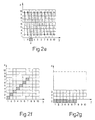
- the irregular matrix in Figure 2d comprises a number of complete rows equal to the difference between the number of sorting machine outputs assigned to the sorting process, and the number of delivery locations to be processed as described above, i.e. only putting the relative mail items through the first sorting cycle, not removing them from the relative machine outputs, and sorting other mail items on top of then in the second sorting cycle.
- the standard matrix representation must be altered accordingly for each one as shown in Figures 2f and 2g . More specifically, the hatching in Figure 2f shows the diagonally located boxes assigned delivery locations for one-cycle processing; and Figure 2g shows the irregular matrix obtained by altering the Figure 2f matrix as described above.
- the Figure 2g matrix has an incomplete bottom row containing a number of boxes equal to the number of delivery locations for one-cycle processing; and a number of complete rows equal to the number of sorting machine outputs into which the mail items removed for the second cycle are sorted.
- Assigning a zero identification number to the bottom row has a precise meaning, which has to do with the relation between the sorting process and corresponding matrix representation.
- the mail items of delivery locations assigned to boxes in the bottom row may be said to be sorted, in the first sorting cycle, on the basis of second sorting cycle "addresses".
- the identification number of the bottom row has no significance and is therefore assigned a zero number.
- the identification number of the bottom row therefore precedes those of all the other rows in the matrix (from 1 to NR), and the mail items of delivery locations assigned to the boxes in the bottom row are located, at the end of the second sorting cycle, in the relative outputs before all the other mail items.
- Renumbering the rows in the irregular Figure 2g matrix also alters the relationship described above between the rows in the matrix and the machine outputs in the first sorting cycle, which new relationship is easily deducible from the previous one.
- the identification numbers of the rows still represent the order in which the mail items must be recirculated
- the identification numbers of the columns still represent the order in which the mail items are subsequently processed, e.g. during actual delivery.
- the optimization method according to the present invention is based on the principle of not processing all the delivery locations in the same way, but, for example, of distinguishing, as described in detail later on, which are to be put through all the sorting cycles in the process, and which through a smaller number of sorting cycles.
- Each mail item is therefore put through the sorting cycles indicated by the sorting identifier of the mail item delivery location.
- the possible sorting identifiers are ⁇ 1, 2 ⁇ and ⁇ 1 ⁇ : the first indicating that the mail items of the delivery locations indicated by that sorting identifier are to undergo both the first and second sorting cycle; and the second indicating that the mail items of the delivery locations indicated by that sorting identifier are only to undergo the first sorting cycle.
- the mail items are therefore sorted into all the machine outputs, and not only those into which the mail items of the delivery locations in the first group have already been sorted.
- the delivery locations which are only to undergo the first sorting cycle are determined according to a formation criterion based on the principle of maximizing the mail traffic which is not removed from the machine outputs at the end of the first sorting cycle to undergo the second sorting cycle, which amounts to minimizing the time required to perform the sorting process.
- Maximizing the mail traffic which is not removed from the machine outputs at the end of the first sorting cycle therefore minimizes not only the time taken by clearing resources to clear the machine outputs at the end of the first sorting cycle, and the time taken to feed the mail items removed from their outputs at the end of the first sorting cycle back into the machine input, but also the mail traffic sorted in the second cycle, thus reducing the time taken to perform the second cycle with respect to a standard sorting cycle.
- Maximizing the mail traffic not removed from the machine outputs at the end of the first sorting cycle therefore calls for sorting in one cycle the maximum possible number of mail items compatible with the capacity of the machine, which means sorting in one cycle the mail items of "heavy", i.e. high-mail-load, delivery locations, and also putting through the second sorting cycle the mail items of "light”, i.e. low-mail-load, delivery locations.
- the number of times the mail items are fed on average through the machine is less than two, and asymptotically approaches 1 as the mail traffic sorted in the first cycle gets larger.
- main outputs the machine outputs into which are sorted mail items undergoing only the first sorting cycle, and from which the mail items are not removed until the end of the sorting process
- recirculating outputs the machine outputs into which are sorted mail items which are removed from the outputs to undergo the second sorting cycle
- the total number of machine outputs equals the number of main outputs plus the number of recirculating outputs, and, in the second sorting cycle, no distinction is made between main and recirculating outputs on account of the mail items, in the second cycle, being sorted into all the machine outputs.
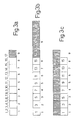
- Figures 3a, 3b and 3c show, schematically, the arrangement of the mail items in the machine outputs prior to commencement of the sorting process, at the end of the first sorting cycle, and at the end of the second sorting cycle respectively; the last two being obtained implementing the first optimization procedure.
- the mail batch has seventeen delivery locations, and the sorting machine has a total number of nine outputs, one recirculating output, and eight main outputs.
- Figure 3a shows, schematically, the initial machine output situation prior to commencement of the sorting process, and in which the nine machine outputs are represented by a vector of nine boxes - one for each output - indicated by respective identification numbers increasing consecutively from 1 to 9 from the leftmost to the rightmost box in the vector.
- the first eight unmarked boxes in the vector represent the eight main outputs
- the hatched ninth box represents the recirculating output
- Figure 3b shows a similar schematic to the one in Figure 3a , and which illustrates the relationship between the delivery locations and the machine outputs at the end of the first sorting cycle, and therefore the actual arrangement of the mail items of the delivery locations in the machine outputs.
- the first eight boxes, representing the eight main machine outputs, in the Figure 3b vector indicate the eight delivery locations whose mail items, after the first sorting cycle, are not removed from the machine outputs for the second sorting cycle; and the ninth box, representing the recirculating output, indicates the delivery locations whose mail items, after the first sorting cycle, are removed from the machine outputs for the second sorting cycle.
- the Figure 3c schematic shows the relationship between the delivery locations and the machine outputs at the end of the second sorting cycle.
- Figure 3c shows an irregular two-row matrix of the type shown in Figure 2g and comprising a first row (bottom row) having a number of boxes equal to the number of main machine outputs, and a second row having a number of boxes equal to the total number of machine outputs.
- the bottom row comprises a first vector defined by the first eight boxes in the Figure 3b vector and therefore showing the relationship between the main machine outputs and the delivery locations to be put through only the first sorting cycle; and the second row comprises a second vector showing the relationship between the machine outputs and the delivery locations also to be put through the second sorting cycle, and the mail items of which were in the recirculating output at the end of the first sorting cycle.
- each column in the Figure 3c matrix shows the mail item arrangement in a respective machine output - both main and recirculating - at the end of the second sorting cycle; and each row in the Figure 3c matrix, with the exception of the first (in the example shown, the second row), shows the mail item population in a respective recirculating output of the machine at the end of the first sorting cycle.
- the first box (bottom row) in each column shows the delivery location whose mail items were only put through the first sorting cycle, were not removed from the respective output for the second sorting cycle, and were therefore deposited physically first into the output; and the second box (second row) in each column shows the delivery location whose mail items were removed from the recirculating output at the end of the first sorting cycle, were fed back into the machine for the second sorting cycle, and were deposited on top of the mail items already in the output.
- the second row in the Figure 3c matrix shows the mail item population in the recirculating output of the machine at the end of the first sorting cycle.
- the first box (first column) in the second row of the matrix shows the delivery location whose mail items are located in the recirculating output at the end of the first sorting cycle and are physically sorted on top of the items already inside the first output at the end of the second sorting cycle;
- the second box (second column) in the second row of the matrix shows the delivery location whose mail items are located in the recirculating output at the end of the first sorting cycle and are physically sorted on top of the items already inside the second output at the end of the second sorting cycle, and so on.
- a representation of the relationship between the delivery locations and machine outputs at the end of a sorting process comprising a first and second sorting cycle and more than one recirculating output is a generalization of the Figure 3c matrix.
- a sorting process comprising a first and second sorting cycle and more than one recirculating output may be represented by an irregular matrix having a number of rows equal to the number of recirculating outputs plus one, and in which the bottom row has a number of boxes equal to the number of main machine outputs, and the other rows have a number of boxes equal to the number of main and recirculating outputs on the machine.
- Figure 3c also shows clearly the order in which the delivery locations are assigned to the matrix boxes. That is, the first delivery location, indicated “1”, is assigned to the bottom-row box in the first column; the second delivery location, indicated “2”, is assigned to the second-row box in the first column; the third delivery location, indicated “3”, is assigned to the bottom-row box in the second column, and so on.
- the number of delivery locations in the mail batch for processing equals the number of matrix boxes, i.e. the number of delivery locations addressable in the sorting process.
- none of the matrix boxes is vacant, i.e. without an assigned delivery location, and the order, described above, in which the delivery locations are assigned to the matrix boxes must be as shown in Figure 3c , with the odd-number delivery locations in the bottom row, and the even-number delivery locations in the second row.
- the number of boxes is normally greater than the delivery locations in the mail batch, so that some of the boxes are vacant, and the bottom row does not necessarily only contain odd-number delivery locations.
- the search for delivery locations by which to maximize the mail traffic processed in the first sorting cycle may, and often does, locate a high-traffic delivery location which, in the assignment order, should be assigned to a box in other than the bottom row, but which the optimization procedure would tend to assign to a bottom-row box to maximize the traffic processed in the first sorting cycle.
- Such a delivery location may only be assigned to a bottom-row box, i.e. be selected to maximize the traffic processed in the first sorting cycle, providing it does not conflict with the delivery location assignment order.
- the second condition is only met if the number of boxes succeeding the bottom-row box to which the delivery location should be assigned - i.e. the number of boxes in all the matrix rows to the right of said box, plus the number of recirculating rows to also take into account the boxes on top of it - is at least equal to the number of delivery locations still to be assigned and succeeding, in the assignment order, the delivery location assigned to said bottom-row box.
- a delivery location may therefore only be assigned to a bottom-row box, as opposed to the one called for in the assignment order, providing residual addressability is such as to permit assignment of the delivery locations succeeding the one in question in the assignment order.
- residual addressability calculated as described in detail later on, may be used as an index by which to determine whether or not a delivery location may be assigned to a bottom-row box as opposed to the one called for in the assignment order.
- Assigning a delivery location to a bottom-row box as opposed to the one called for in the assignment order also results in a loss of total machine capacity, and can therefore only be done providing the total capacity of the machine is sufficient to sort the assigned delivery locations.
- a first block 100 acquires a number of parameters relative to the characteristics of the mail batch for processing and the sorting machine used. More specifically, block 100 acquires:
- Block 100 goes on to a block 110, which, on the basis of the data acquired in block 100, calculates the total capacity CT of the machine by multiplying the total number NU of outputs assigned to the sorting process by the capacity CU of each output, and the total traffic TT of the mail batch by adding the mail traffics TU of all the delivery locations.
- Block 110 goes on to a block 120, which determines whether the total capacity CT of the machine is greater than total traffic TT.
- Block 140 goes on to a block 150, in which the number PR of delivery locations in the mail batch is compared with the calculated PT1, PT2, PT3 values to determine the type of optimization procedure to perform.
- the first optimization procedure - performed when the number PR of delivery locations in the mail batch lies between the number PT1 of delivery locations addressable in one sorting cycle, and the number PT2 of delivery locations addressable in two sorting cycles - provides for dividing the number PR of delivery locations in the mail batch into a separate first and second group of delivery locations, wherein the mail items of the delivery locations in the first group are only put through the first sorting cycle, and the mail items of the delivery locations in the second group are put through both the first and second sorting cycle.
- Figures 5a and 5b show a flow chart of the operations performed in the first optimization procedure.
- a first block 200 acquires the number NR of recirculating outputs on the machine.
- This number may either be entered externally by an operator, or be determined by a special procedure on the basis of the mail batch parameters and machine capacity.
- the number of recirculating outputs is closely related to the type of machine utilization inefficiency being dealt with, and which may occur, as stated, when the number of delivery locations to be addressed is slightly higher than the maximum number actually addressable in the sorting process using one sorting cycle, but is well below the maximum number actually addressable using two sorting cycles, or when the number of delivery locations to be addressed is comparable with the maximum number actually addressable in the sorting process using two sorting cycles, but certain delivery locations have such a high mail traffic as to fill the assigned machine outputs on their own.
- the number of mail items exceeding the sorting capacity of the machine in the first sorting cycle is relatively small, and the number of main outputs is therefore far greater than the number of recirculating outputs.
- the maximum number of recirculating outputs is deduced from the number of high-mail-traffic delivery locations to be sorted in one cycle, and the number of recirculating outputs employed is normally greater than in the first case.
- Block 210 goes on to a block 220, which acquires a balancing addressability margin M1 expressed as a percentage value and indicating the number of matrix boxes which are not to be assigned delivery locations in the first optimization procedure, so as to be available for a subsequent balancing step, as described in detail later on.
- the balancing addressability margin M1 may, for example, be 10% or at any rate greater than 1/NU expressed as a percentage.
- Block 220 goes on to a block 230, which calculates an optimization addressability margin M2 indicating the maximum addressability loss allowed in the search for delivery locations to maximize the mail traffic sorted in the first cycle, i.e. the maximum number of vacant boxes that can be formed in the search as a result of assigning delivery locations to bottom-row boxes as opposed to those called for in the assignment order.
- an optimization addressability margin M2 indicating the maximum addressability loss allowed in the search for delivery locations to maximize the mail traffic sorted in the first cycle, i.e. the maximum number of vacant boxes that can be formed in the search as a result of assigning delivery locations to bottom-row boxes as opposed to those called for in the assignment order.
- Block 230 goes on to a block 235, which acquires a sorting capacity margin M3 indicating the maximum machine sorting capacity loss allowed in the search for delivery locations to maximize the mail traffic sorted in the first cycle.
- Block 235 goes on to a series of blocks, which search for the delivery locations by which to maximize the mail traffic sorted in the first cycle, so as to form a list of delivery locations for entry into the bottom matrix row, and which, hereinafter, will be referred to as "base delivery locations”.
- block 235 goes on to a block 240, which determines the maximum-traffic delivery location from those in the mail batch not yet considered for assignment to the bottom matrix row.
- Block 240 goes on to a block 250, which, for the delivery location determined in block 240, determines, not only mail traffic TL, but also an order number DR indicating the position of the delivery location within the mail batch delivery location sequence defined by the delivery order, i.e. the order number of the delivery location in the assignment order.
- Block 250 goes on to a block 260, which, from the base delivery locations already assigned to the bottom matrix row (none initially), determines the base delivery location immediately upstream and immediately downstream, in the assignment order, from the delivery location considered, and which hereinafter will be referred to as the upstream base delivery location and downstream base delivery location respectively.
- the upstream base delivery location is the one "closest”, in the assignment order, to the delivery location considered; and, of the base delivery locations downstream from the delivery location considered, the downstream base delivery location is the one "closest”, in the assignment order, to the delivery location considered.
- a first dummy delivery location which is also upstream from the first delivery location in the mail batch, is defined as the upstream base delivery location; and, if there are no base delivery locations downstream from the delivery location considered, a second dummy delivery location, which is also downstream from the last delivery location in the mail batch, is defined as the downstream base delivery location.
- Block 260 goes on to a block 270, which determines a first and second order number DM and DV respectively indicating the position of the upstream base delivery location and the downstream base delivery location within the mail batch delivery location sequence defined by the delivery order, i.e. the order number of the delivery location in the assignment order; the first and second dummy delivery location being assumed to have order numbers of zero and PR+1 respectively, so that the new base delivery location is always located between another two, possibly dummy, base delivery locations.
- a block 270 determines a first and second order number DM and DV respectively indicating the position of the upstream base delivery location and the downstream base delivery location within the mail batch delivery location sequence defined by the delivery order, i.e. the order number of the delivery location in the assignment order; the first and second dummy delivery location being assumed to have order numbers of zero and PR+1 respectively, so that the new base delivery location is always located between another two, possibly dummy, base delivery locations.
- Block 270 goes on to a block 280, which determines:
- ⁇ Y 0 x ( NR + 1 ) + Remainder x NR + 1
- Y 1 x NR - Remainder x - 1 NR + 1
- Block 290 goes on to a block 300, which calculates a new optimization addressability margin M2 by subtracting total addressability loss YT from the previous optimization addressability margin M2, i.e. M ⁇ 2 ⁇ M ⁇ 2 - YT
- Block 300 goes on to a block 305, which calculates the sorting capacity loss PC of the machine as a result of assigning a delivery location to the bottom matrix row.
- sorting capacity loss PC may be calculated as follows.
- Block 305 goes on to a block 308, which calculates the current sorting capacity margin M3 by subtracting sorting capacity loss PC from the previous sorting capacity margin M3, i.e.: M ⁇ 3 ⁇ M ⁇ 3 - PC
- Block 308 goes on to a block 310, which determines whether the optimization addressability margin M2 calculated in block 300 and the sorting capacity margin M3 calculated in block 308 are both greater than or equal to zero, so as to determine whether or not the delivery location in question can be assigned to the bottom matrix row.
- optimization addressability margin M2 and sorting capacity margin M3 are both greater than or equal to zero (YES output of block 310), then the delivery location considered can be assigned to the bottom matrix row, by optimization addressability and sorting capacity margins M2 and M3 indicating the possibility of still assigning the succeeding delivery locations to the matrix boxes in conformance with the assignment order; in which case, block 310 goes on to a block 320.
- Block 320 therefore memorizes that the delivery location considered is a base delivery location, e.g. by entering the order number of the delivery location onto a list formed beforehand, or by assigning the delivery location a logic indicator (flag) having a predetermined logic value (e.g. 1).
- a logic indicator e.g. 1
- Block 320 then goes on to a block 350 described below.
- the delivery location considered is excluded from any further base delivery location search operations, e.g. by memorizing it as such as described with reference to block 320.
- Block 330 goes on to a block 340, which resets the previous optimization addressability margin M2 and sorting capacity margin M3 values, at least one of which had become less than zero.
- Block 340 goes on to block 350, which determines whether there is another delivery location to examine and succeeding the one considered according to the above assignment criterion.
- block 350 If there is another delivery location to examine (YES output of block 350), the search for delivery locations to assign to the bottom matrix row continues, and block 350 goes back to block 240 to determine the next base delivery location. Conversely, if all the delivery locations have been examined (NO output of block 350), the search for delivery locations to assign to the bottom matrix row is terminated, and block 350 goes on to a block 360.
- the delivery locations are actually assigned to the boxes of a matrix of the type shown in Figure 2g , in which, more generally speaking, the occupiable boxes in the bottom row are not necessarily adjacent.
- the delivery locations are assigned from the first to the last delivery location in the mail batch according to the assignment order, which as stated, corresponds to the order in which the mail items of the delivery locations are actually delivered.
- the base delivery locations determined must be assigned to the boxes in the bottom matrix row, so that, if, in the light of the assignment criterion, a base delivery location is not to be assigned to a bottom-row box, it must be assigned to the first box in the column following the one to which it should be assigned.
- the bottom-row matrix boxes are obviously definitely assigned all the base delivery locations, but not necessarily only these. That is, in addition to the base delivery locations, non-base delivery locations, i.e. those not selected in block 310 as base delivery locations, may also be assigned.
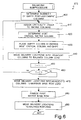
- Block 360 then goes on to a block 370, which performs a balancing subprocedure - described in detail later on with reference to Figure 6 - to balance the load of the matrix columns, to further maximize the load of the bottom matrix row, and to also balance the load of the other rows in the matrix.
- a first block 400 determines the number T of matrix columns left completely empty - i.e. whose boxes are all vacant - following assignment of the delivery locations in block 360.
- Block 400 goes on to a block 410, which assigns the matrix columns a criticality order on the basis of the total load of each column, equal to the total traffic of the delivery locations assigned to it.
- the most critical column will be the one with the highest mail load, i.e. the highest total traffic of the delivery locations assigned to it, and the least critical column will be the one with the lowest mail load.
- Block 410 goes on to a block 420, which determines, according to the criticality order assigned to the columns, the most critical matrix column having a number of assigned delivery locations greater than one.
- Block 420 goes on to a block 430, which places an empty column alongside the most critical one determined in block 420.
- the most critical machine output (to which the most critical column is related) is assigned and flanked with a further machine output for use in the sorting process.
- Flanking the most critical column with an empty one is obviously followed by a one-position shift (to the right) of the columns following the most critical.
- Block 430 goes on to a block 440, which, in conformance with the assignment criterion, moves particular non-base delivery locations - i.e. particular delivery locations not defined as base delivery locations - to balance the load of the columns.
- block 440 simulates moving particular non-base delivery locations between the two columns, and implements the simulated movement best improving the load balance of the two columns, thus altering the configuration of the two columns.
- the first subprocedure moves delivery locations from the assigned machine outputs to respective logically adjacent machine outputs in conformance with the order in which the delivery locations are assigned to the respective groups of outputs.
- the matrix columns are examined successively in pairs, from the first two to the last two columns, in ascending numerical order; and, for each pair of adjacent columns, the following two movements are simulated separately:
- balance is assessed by determining the maximum of the two column loads prior to simulation and in both simulations, and then determining the lesser of the two. If the lesser load is equal to one of the maximum loads determined in the two simulations, then simulation has brought about an improvement in the load balance of the columns, and the simulation resulting in the lower load is implemented; conversely, if the lower load is equal to the maximum load prior to the two simulations, then neither has brought about an improvement in the load balance of the columns, and therefore neither simulation is implemented.
- Block 450 goes on to a block 460, which determines whether the number T of columns left empty following assignment of the delivery locations is greater than zero.
- block 460 goes back to block 410 to repeat the block 410-460 operations; if T ⁇ 0 (NO output of block 460), block 460 goes on to a block 470.
- block 470 moves particular non-base delivery locations in the same way as described with reference to block 440, but this time to maximize the load of the bottom row in the matrix, and on condition that at least NR free boxes are left in the bottom row (i.e. no movement should result in delivery locations being assigned to the NR boxes corresponding to the machine outputs reserved, in the first sorting cycle, for mail items of delivery locations to be recirculated).
- block 470 examines successive pairs of matrix columns, from the first two to the last two in ascending numerical order, and, for each pair of adjacent columns, simulates separately the two movements described with reference to block 440.
- the simulated movements fail to maximize the load of the bottom row in the matrix, then neither simulated movement is implemented and the configuration of the two columns remains unchanged. Conversely, if either or both the simulated movements result in an increase in bottom-row load with respect to the previous load, and the load of the column into which the delivery location is moved does not exceed a predetermined maximum limit, then the simulated movement maximizing the load of the bottom row in the matrix is implemented and the configuration of the two columns altered accordingly.
- Block 470 goes on to a block 480, where the bottom row in the matrix is "frozen", i.e. excluded from any further balancing operations to prevent its content being altered.
- Block 480 goes on to a block 490, which, while conforming with the assignment criterion, moves delivery locations assigned to the other matrix rows to balance the load of these rows.
- the first subprocedure simulates redistributing the delivery locations in the column into all the boxes in the column, and actually implements the simulation resulting in the best improvement in the balance of the rows, thus altering the configuration of the column. Obviously, if no simulated movement brings about an improvement in load balance, the configuration of the column remains unchanged.
- the first subprocedure redistributes the numbers in the occupied boxes in each column into all the boxes in the column, so as to appropriately alternate the vacant and occupied boxes in the columns.
- the first subprocedure obviously only applies if the relative column contains at least one vacant box.
- the second subprocedure simulates moving each of the numbers in the row into adjacent free boxes in the same column, and only implements the movement resulting in improvement in the balance of the rows.
- the second subprocedure simulates moving each of the numbers in the occupied boxes of each row into adjacent boxes in the same column, while at the same time conforming with the order in which the switched delivery locations are assigned to the matrix boxes.
- the second subprocedure obviously only applies if at least one of the occupied boxes has at least one adjacent free box in the same column.
- the third subprocedure simulates switching, between adjacent rows, pairs of delivery locations in different columns, and only implements the switches bringing about an improvement in the load balance of the two columns.
- the third subprocedure simulates moving, in a first column, a number in an occupied box in row RC into a free box in an adjacent row RT, and simultaneously moving, in a second column, a number in an occupied box in row RT into a free box in row RC.
- Each switch is made in conformance with the order in which the switched delivery locations are assigned to the matrix boxes.
- the third subprocedure only applies if each of the columns contains at least one free box.
- the fourth subprocedure simulates dividing (bisecting) each of the delivery locations in the rows into two virtually distinct delivery locations, and assigning them separately to nearby vacant boxes in the same column, and only implements the division bringing about an improvement in the load balance of the two rows.
- the fourth subprocedure if a delivery location is bisected, it is removed from the matrix and replaced with two new delivery locations: the first delivery location resulting from the bisection is assigned to the same box as the original bisected delivery location; and the second delivery location resulting from the bisection is assigned to a box in the same column as the original bisected delivery location, but in a nearby row, depending on the available free boxes in the matrix.
- the traffic of the first and second delivery locations resulting from the bisection is reduced, typically halved, with respect to the traffic of the original bisected delivery location, so that the sum of the two equals the traffic of the original bisected delivery location.
- Each two virtually distinct delivery locations are assigned to two boxes in the same column in conformance with the order in which the delivery location from which the two virtually distinct delivery locations are derived is assigned to the matrix boxes.
- the fourth subprocedure only applies when at least one of the boxes close to the one examined and located in the same column is free.
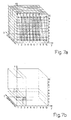
- Figure 7a shows a three-dimensional matrix representing the machine outputs at the end of the first, second, and third cycle in the sorting process, and in which:
- the mail items that will be sorted into the i-th output in the j-th sorting cycle may generally be said to correspond to delivery locations assigned to the boxes in the matrix lying in the plane which cuts the axis of the j-th sorting cycle perpendicularly at value i.
- Figure 7a also shows the order in which the delivery locations are assigned to the matrix boxes.
- Figures 7b-7g show the changes made to the Figure 7a matrix when applying the optimization method according to the present invention, so that the mail items of a given delivery location are only subjected to two sorting cycles. More specifically, the Figure 7b-7g matrixes relate to delivery locations whose mail items are only put through the first and third sorting cycle.
- Figure 7b-7g matrixes are similar to those described with reference to Figures 2b-2g and relative to a two-cycle sorting process, the only difference being that they are three- as opposed to two-dimensional.
- the three-dimensional matrix in Figure 7a is therefore modified to given the three-dimensional irregular matrix in Figure 7c , which has no plane yz containing the determined vector, so as to prevent any other delivery locations from being assigned to the boxes in that plane; and the Figure 7b vector, as opposed to being located diagonally, is located, still in the same column, in a base plane yz.
- Figure 7c matrix graphically to eliminate the empty plane (i.e. "compacting" the three-dimensional matrix) gives the Figure 7d matrix, in which the pre-existing relation between the matrix planes and machine outputs in the various sorting cycles still applies, and the properties of the standard Figure 7a matrix remain unchanged.
- Figure 7e shows the Figure 7d irregular matrix illustrating the order in which the delivery locations are assigned to the matrix boxes.
- Figures 7f and 7g show the changes made to the standard Figure 7a matrix to handle a number of delivery locations as described above.
- Figure 7f the hatched boxes are the diagonally located ones relative to delivery locations for two-cycle sorting; and Figure 7g shows the irregular matrix obtained by altering the Figure 7f matrix as described above.
- the Figure 7g matrix has an incomplete base plane yz having a number of vectors equal to the number of delivery locations for two-cycle sorting; and a number of complete planes yz equal to the number of machine outputs into which the mail items removed to also undergo the second cycle are sorted.
- the Figure 7g matrix need simply be balanced - employing a process derived, as explained later on, from the one described previously - to obtain sorting rules from the matrix.
- Matrixes identical to those in Figures 7b-7g may be constructed for a delivery location to undergo only the first and second sorting cycle, in which case, the missing plane in Figure 7c is a plane xz as opposed to yz.
- the Figure 7b vector may generally be said to be determined by first determining the plane cutting the axis of the j-th sorting cycle at output value i, and then compressing the plane so determined into a vector with respect to the axis of the (j+1)-th sorting cycle.
- the vector will therefore be defined as follows: in the j-th sorting cycle plane, it assumes a value of zero (by having to be located beneath all the other mail items sorted into the i-th output); in the (j+1)-th sorting cycle plane, it assumes a value i; and, in the (j-1)-th or (j+2)-th sorting cycle plane, it assumes the same values as in the standard matrix.
- the only possible ones are the following four: ⁇ 1, 2, 3 ⁇ , ⁇ 1, 2 ⁇ , ⁇ 1, 3 ⁇ , ⁇ 1 ⁇ , in that the mail items must be put through the first sorting cycle.
- the sorting identifiers are still different from one another, but, unlike a two-cycle sorting process - in which, the number of sorting cycles indicated by the sorting identifiers are also different from one another - the number of sorting cycles indicated by the sorting identifiers may even be the same, and the number of sorting cycles indicated by two sorting identifiers assigned to two delivery location groups may even be both less than the number of cycles in the sorting process.
- the number of delivery locations to be put through only two out of three sorting cycles is determined by the second optimization procedure described with reference to block 170 in Figure 4 , i.e. bearing in mind that assigning a delivery location to the base plane of the Figure 7g matrix results in a loss of both addressability and total machine sorting capacity.
- the second optimization procedure implements operations similar to those described with reference to Figures 5a and 5b , and therefore requiring no further explanation, the only difference being that all the two-dimensional considerations and equations - e.g. for calculating upstream, downstream and intermediate addressability losses - are simply adapted to the three-dimensional case on the basis of purely geometric considerations similar to those adopted in the two-dimensional case.
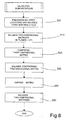
- the delivery locations are assigned to the three-dimensional matrix boxes and the machine output load in each sorting cycle balanced as described below with reference to the Figure 8 block diagram.
- Block 500 goes on to a block 510, which subjects each two-dimensional matrix in plane xy to a "two-dimensional" balancing process of the type described with reference to Figures 5a , 5b and 6 , and wherein the columns are those perpendicular to the y axis, and the rows those perpendicular to the x axis.
- Block 510 goes on to a block 520, in which the Figure 7g three-dimensional matrix is compressed in a plane yz into a two-dimensional matrix, in which each box shows a mail load equal to the sum of all the mail loads in the compressed boxes in the same column parallel to the x axis.
- each column along the x axis in the Figure 7g two-dimensional matrix is compacted into one box in plane yz, which box indicates a mail load equal to the sum of the mail loads of the compacted boxes.
- Block 520 goes on to a block 530, which subjects the resulting two-dimensional matrix to a "two-dimensional" balancing process of the type described with reference to Figure 6 , and wherein the columns are those perpendicular to the z axis, and the rows those perpendicular to the y axis, i.e. the y axis sorting cycle being considered as preceding that of the z axis.
- Block 530 goes on to a block 540, which expands the compressed two-dimensional matrix back into a three-dimensional matrix.
- the second and third sorting cycles are by now balanced, and it therefore only remains to balance the first sorting cycle.
- the new matrix is then subjected to a "two-dimensional" balancing process of the type described with reference to Figure 6 , as though it related to the first sorting cycle, i.e. the x axis sorting cycle being considered as preceding that of the other axis, which relates to the succeeding sorting cycles.
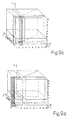
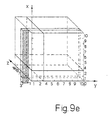
- Figures 9a-9e show the changes made to a standard matrix of the type shown in Figure 7a , when the optimization method according to the present invention is applied to subject the mail items of a delivery location to only one of the three sorting cycles, necessarily the first.
- Figure 9b matrix is compacted to eliminate the empty plane and obtain the three-dimensional matrix in Figure 9c .
- Figure 9c matrix may be further modified as shown in Figure 9d . That is, bearing in mind that, in the first sorting cycle, the mail items of the delivery location assigned to the box shown in Figure 9b will be sorted into a given machine output and will not be removed until the end of the third sorting cycle, nothing prevents these mail items from being superimposed, in the second sorting cycle, with others that will also not be removed until the end of the third sorting cycle.
- the Figure 9d matrix may then be compacted to eliminate the missing plane and obtain the matrix shown in Figure 9e .
- the same may then be repeated for all the delivery locations whose mail items are to be put through only one sorting cycle.
- the base delivery locations may be determined otherwise than as described, and in particular by considering only one of optimization addressability and sorting capacity margins M2 and M3.
Landscapes
- Business, Economics & Management (AREA)
- Engineering & Computer Science (AREA)
- Economics (AREA)
- Quality & Reliability (AREA)
- Tourism & Hospitality (AREA)
- Human Resources & Organizations (AREA)
- Marketing (AREA)
- Operations Research (AREA)
- Development Economics (AREA)
- Strategic Management (AREA)
- Entrepreneurship & Innovation (AREA)
- Physics & Mathematics (AREA)
- General Business, Economics & Management (AREA)
- General Physics & Mathematics (AREA)
- Theoretical Computer Science (AREA)
- Sorting Of Articles (AREA)
- Container Filling Or Packaging Operations (AREA)
- Crystals, And After-Treatments Of Crystals (AREA)
- Analysing Materials By The Use Of Radiation (AREA)
Applications Claiming Priority (2)
| Application Number | Priority Date | Filing Date | Title |
|---|---|---|---|
| ITTO990865 | 1999-10-07 | ||
| IT1999TO000865A IT1307718B1 (it) | 1999-10-07 | 1999-10-07 | Metodo di ottimizzazione di un processo di sequenziazione di oggettipostali. |
Publications (3)
| Publication Number | Publication Date |
|---|---|
| EP1090692A2 EP1090692A2 (en) | 2001-04-11 |
| EP1090692A3 EP1090692A3 (en) | 2002-05-02 |
| EP1090692B1 true EP1090692B1 (en) | 2008-03-19 |
Family
ID=11418125
Family Applications (1)
| Application Number | Title | Priority Date | Filing Date |
|---|---|---|---|
| EP00121776A Expired - Lifetime EP1090692B1 (en) | 1999-10-07 | 2000-10-05 | Method of optimizing a mail sorting process |
Country Status (5)
| Country | Link |
|---|---|
| US (1) | US6576857B1 (it) |
| EP (1) | EP1090692B1 (it) |
| AT (1) | ATE389465T1 (it) |
| DE (1) | DE60038347T2 (it) |
| IT (1) | IT1307718B1 (it) |
Families Citing this family (28)
| Publication number | Priority date | Publication date | Assignee | Title |
|---|---|---|---|---|
| AU2002235185A1 (en) * | 2000-12-14 | 2002-06-24 | United States Postal Service | Organizing a plurality of items into a delivery point sequence |
| WO2002048946A2 (en) * | 2000-12-15 | 2002-06-20 | United States Postal Service | Just-in-time sort plan creation |
| EP1258297A1 (de) * | 2001-05-18 | 2002-11-20 | Siemens Schweiz AG | Verfahren zur Steigerung der Sortierkapazität bei der Sortierung von flachen Sortiergutstücken |
| DE10145295A1 (de) * | 2001-09-14 | 2003-04-24 | Siemens Dematic Ag | Verfahren zur Verteilreihenfolgesortierung |
| US20070102329A1 (en) * | 2001-10-04 | 2007-05-10 | Siemens Aktiengesellschaft | Parcel dispatch manager system and method |
| US7084365B2 (en) * | 2002-08-19 | 2006-08-01 | Lands' End Direct Merchants, Inc. | Methods and apparatus for a non-discrete sortation process |
| US20050033473A1 (en) * | 2003-01-22 | 2005-02-10 | Neopost Industrie Sa | Item sorting system and method |
| US6881916B2 (en) * | 2003-02-13 | 2005-04-19 | Lockheed Martin Corporation | Flats sequencing system and method of use |
| US8818911B2 (en) * | 2003-08-12 | 2014-08-26 | Pitney Bowes Inc. | Permit creation and tracking in a mailing machine |
| WO2005040969A2 (en) * | 2003-10-02 | 2005-05-06 | Planmatics, Inc | System and method for optimizing equipment schedules |
| US8078539B2 (en) * | 2003-11-17 | 2011-12-13 | Pitney Bowes Inc. | Method and system for sorting checks according to a priority order associated with the account number |
| WO2005107965A2 (en) * | 2004-04-15 | 2005-11-17 | United States Postal Service | Methods and systems for sorting unaddressed items |
| DE102004035365A1 (de) * | 2004-07-21 | 2006-02-16 | Deutsche Post Ag | Verfahren und Vorrichtung zum Sortieren von Postsendungen |
| US7507930B2 (en) * | 2004-12-22 | 2009-03-24 | Lockheed Martin Corporation | Operations for product processing |
| US20070075000A1 (en) * | 2005-09-30 | 2007-04-05 | Lockheed Martin Corporation | Sort mechanism and method of use |
| US7860602B2 (en) * | 2006-05-30 | 2010-12-28 | Xerox Corporation | Mail processing system |
| US7769765B2 (en) * | 2006-07-25 | 2010-08-03 | Lockheed Martin Corporation | Method and system for sorting mail |
| DE102008006752A1 (de) * | 2008-01-30 | 2009-08-06 | Siemens Aktiengesellschaft | Verfahren und Vorrichtung zum Sortieren von flachen Gegenständen in mehreren Sortierläufen |
| US7999206B2 (en) * | 2008-03-14 | 2011-08-16 | Siemens Industry, Inc. | Method and system for sorting of extended capability mail |
| US8748768B2 (en) * | 2008-05-16 | 2014-06-10 | Bell And Howell, Llc | Method and system to indicate bin sweep status on document processing equipment |
| FR2959680B1 (fr) * | 2010-05-10 | 2012-04-20 | Solystic | Methode pour optimiser un processus de traitement et de transport du courrier en bacs utilisant un tri stratifie |
| US20130124255A1 (en) * | 2011-11-11 | 2013-05-16 | American Express Travel Related Services Company, Inc. | Presort Scheme Optimizer and Simulator |
| JP2015150478A (ja) * | 2014-02-12 | 2015-08-24 | 株式会社東芝 | 区分装置および区分設定情報の生成方法 |
| US9849487B2 (en) | 2014-11-13 | 2017-12-26 | United States Postal Service | System and method of sorting and sequencing items |
| CA3103219C (en) | 2016-01-12 | 2025-06-17 | United States Postal Service | HIGH-EFFICIENCY SORTING SYSTEMS AND METHODS |
| WO2017192824A1 (en) | 2016-05-06 | 2017-11-09 | United States Postal Service | System and method for sorting and delivering items |
| US10974283B2 (en) | 2017-10-05 | 2021-04-13 | United States Postal Service | System and method of sorting and sequencing items |
| CN112132168B (zh) * | 2019-06-25 | 2025-03-21 | 顺丰科技有限公司 | 快件分拣方法、装置、设备及存储介质 |
Family Cites Families (8)
| Publication number | Priority date | Publication date | Assignee | Title |
|---|---|---|---|---|
| US5287271A (en) * | 1991-08-22 | 1994-02-15 | International Business Machines Corporation | Data processing system for optimized mail piece sorting and mapping to carrier walk sequence using real time statistical data |
| DE4302231C2 (de) * | 1993-01-28 | 1995-08-10 | Licentia Gmbh | Verfahren zum Sortieren von Sendungen in der Verteilgangsequenz bei Briefverteilanlagen |
| GB2289966A (en) * | 1994-05-24 | 1995-12-06 | Ibm | Mail sorting |
| JPH09239325A (ja) * | 1996-03-11 | 1997-09-16 | Hitachi Ltd | 郵便物配達順並べ替え区分方法および装置 |
| NL1003154C2 (nl) * | 1996-05-17 | 1997-11-18 | Nederland Ptt | Werkwijze voor het sorteren op bestelvolgorde van poststukken. |
| IT1295970B1 (it) * | 1997-11-14 | 1999-05-28 | Finmeccanica Spa | Metodo di sequenziazione di oggetti postali. |
| ITTO980233A1 (it) * | 1998-03-17 | 1999-09-17 | Finmeccanica Spa | Metodo di bilanciamento del carico in un processo di sequenziazione di oggetti, in particolare oggetti postali. |
| GB2335639B (en) * | 1998-03-27 | 2002-06-12 | Post Office | Sorting system |
-
1999
- 1999-10-07 IT IT1999TO000865A patent/IT1307718B1/it active
-
2000
- 2000-10-05 AT AT00121776T patent/ATE389465T1/de not_active IP Right Cessation
- 2000-10-05 DE DE60038347T patent/DE60038347T2/de not_active Expired - Lifetime
- 2000-10-05 EP EP00121776A patent/EP1090692B1/en not_active Expired - Lifetime
- 2000-10-06 US US09/680,748 patent/US6576857B1/en not_active Expired - Fee Related
Also Published As
| Publication number | Publication date |
|---|---|
| US6576857B1 (en) | 2003-06-10 |
| IT1307718B1 (it) | 2001-11-14 |
| EP1090692A2 (en) | 2001-04-11 |
| ITTO990865A0 (it) | 1999-10-07 |
| ITTO990865A1 (it) | 2001-04-07 |
| ATE389465T1 (de) | 2008-04-15 |
| DE60038347D1 (de) | 2008-04-30 |
| DE60038347T2 (de) | 2009-04-30 |
| EP1090692A3 (en) | 2002-05-02 |
Similar Documents
| Publication | Publication Date | Title |
|---|---|---|
| EP1090692B1 (en) | Method of optimizing a mail sorting process | |
| US5901855A (en) | Method and apparatus for sorting and rearranging mails in sequence sorting | |
| DE69521934T2 (de) | Postsortierung | |
| US6685030B1 (en) | Expanded flats bundle collator | |
| Moodie | A heuristic method of assembly line balancing for assumptions of constantor variable work element times | |
| US6703574B1 (en) | Process for sorting distribution sequences | |
| EP0781172B2 (en) | Method and apparatus for weight controlled portioning of articles having non-uniform weight | |
| EP0021614B1 (en) | Document sorting method | |
| US6365862B1 (en) | Ergonomic method for sorting and sweeping mail pieces | |
| US5924576A (en) | Method for sorting items of mail in order of delivery | |
| Johnson | The impact of sorting strategies on automated sortation system performance | |
| JP4343298B2 (ja) | 郵便物を区分する方法 | |
| GB1281963A (en) | Article sorting system | |
| US20030094404A1 (en) | Method and apparatus for weight controlled portioning of articles having non-uniform weight | |
| EP0999902B1 (de) | Verfahren zum sortieren von sendungen | |
| EP1220721B1 (de) | Einrichtung und verfahren zum ordnen von flachen sendungen | |
| DE60005549T2 (de) | Verfahren und vorrichtung zum mischen von geordneten gruppen von gegenständen, insbesondere gruppen von poststücken | |
| US6337451B1 (en) | Planning procedure for clearing mail sorting machine outputs concurrently with a mail sorting process | |
| US20040139036A1 (en) | Method and system for scheduling supply driven processing such as mail sorting | |
| AU2012261487B2 (en) | A method of processing mailpieces, the method including aggregating the batches of mailpieces | |
| RU2511538C1 (ru) | Способ оптимизации процесса обработки и транспортировки почты в лотках с использованием послойной сортировки | |
| JPH10508250A (ja) | 郵便物仕分け方法 | |
| EP0947962A2 (en) | A method of balancing the load in a process for sorting objects | |
| US4277057A (en) | Method for using a multiple input bin collating machine with a single output hopper | |
| JPH09173987A (ja) | 郵便処理方法およびシステム |
Legal Events
| Date | Code | Title | Description |
|---|---|---|---|
| PUAI | Public reference made under article 153(3) epc to a published international application that has entered the european phase |
Free format text: ORIGINAL CODE: 0009012 |
|
| AK | Designated contracting states |
Kind code of ref document: A2 Designated state(s): AT BE CH CY DE DK ES FI FR GB GR IE IT LI LU MC NL PT SE |
|
| AX | Request for extension of the european patent |
Free format text: AL;LT;LV;MK;RO;SI |
|
| PUAL | Search report despatched |
Free format text: ORIGINAL CODE: 0009013 |
|
| RIC1 | Information provided on ipc code assigned before grant |
Free format text: 7B 07C 3/00 A, 7B 07C 3/02 B |
|
| AK | Designated contracting states |
Kind code of ref document: A3 Designated state(s): AT BE CH CY DE DK ES FI FR GB GR IE IT LI LU MC NL PT SE |
|
| AX | Request for extension of the european patent |
Free format text: AL;LT;LV;MK;RO;SI |
|
| 17P | Request for examination filed |
Effective date: 20021029 |
|
| AKX | Designation fees paid |
Free format text: AT BE CH CY DE DK ES FI FR GB GR IE IT LI LU MC NL PT SE |
|
| 17Q | First examination report despatched |
Effective date: 20050429 |
|
| GRAP | Despatch of communication of intention to grant a patent |
Free format text: ORIGINAL CODE: EPIDOSNIGR1 |
|
| RAP1 | Party data changed (applicant data changed or rights of an application transferred) |
Owner name: ELSAG DATAMAT S.P.A. |
|
| GRAS | Grant fee paid |
Free format text: ORIGINAL CODE: EPIDOSNIGR3 |
|
| GRAA | (expected) grant |
Free format text: ORIGINAL CODE: 0009210 |
|
| AK | Designated contracting states |
Kind code of ref document: B1 Designated state(s): AT BE CH CY DE DK ES FI FR GB GR IE IT LI LU MC NL PT SE |
|
| REG | Reference to a national code |
Ref country code: GB Ref legal event code: FG4D |
|
| REG | Reference to a national code |
Ref country code: CH Ref legal event code: EP |
|
| REF | Corresponds to: |
Ref document number: 60038347 Country of ref document: DE Date of ref document: 20080430 Kind code of ref document: P |
|
| REG | Reference to a national code |
Ref country code: IE Ref legal event code: FG4D |
|
| PG25 | Lapsed in a contracting state [announced via postgrant information from national office to epo] |
Ref country code: FI Free format text: LAPSE BECAUSE OF FAILURE TO SUBMIT A TRANSLATION OF THE DESCRIPTION OR TO PAY THE FEE WITHIN THE PRESCRIBED TIME-LIMIT Effective date: 20080319 |
|
| PG25 | Lapsed in a contracting state [announced via postgrant information from national office to epo] |
Ref country code: AT Free format text: LAPSE BECAUSE OF FAILURE TO SUBMIT A TRANSLATION OF THE DESCRIPTION OR TO PAY THE FEE WITHIN THE PRESCRIBED TIME-LIMIT Effective date: 20080319 |
|
| NLV1 | Nl: lapsed or annulled due to failure to fulfill the requirements of art. 29p and 29m of the patents act | ||
| PG25 | Lapsed in a contracting state [announced via postgrant information from national office to epo] |
Ref country code: BE Free format text: LAPSE BECAUSE OF FAILURE TO SUBMIT A TRANSLATION OF THE DESCRIPTION OR TO PAY THE FEE WITHIN THE PRESCRIBED TIME-LIMIT Effective date: 20080319 |
|
| ET | Fr: translation filed | ||
| PG25 | Lapsed in a contracting state [announced via postgrant information from national office to epo] |
Ref country code: SE Free format text: LAPSE BECAUSE OF FAILURE TO SUBMIT A TRANSLATION OF THE DESCRIPTION OR TO PAY THE FEE WITHIN THE PRESCRIBED TIME-LIMIT Effective date: 20080619 Ref country code: PT Free format text: LAPSE BECAUSE OF FAILURE TO SUBMIT A TRANSLATION OF THE DESCRIPTION OR TO PAY THE FEE WITHIN THE PRESCRIBED TIME-LIMIT Effective date: 20080826 Ref country code: ES Free format text: LAPSE BECAUSE OF FAILURE TO SUBMIT A TRANSLATION OF THE DESCRIPTION OR TO PAY THE FEE WITHIN THE PRESCRIBED TIME-LIMIT Effective date: 20080630 |
|
| PG25 | Lapsed in a contracting state [announced via postgrant information from national office to epo] |
Ref country code: NL Free format text: LAPSE BECAUSE OF FAILURE TO SUBMIT A TRANSLATION OF THE DESCRIPTION OR TO PAY THE FEE WITHIN THE PRESCRIBED TIME-LIMIT Effective date: 20080319 |
|
| PLBE | No opposition filed within time limit |
Free format text: ORIGINAL CODE: 0009261 |
|
| STAA | Information on the status of an ep patent application or granted ep patent |
Free format text: STATUS: NO OPPOSITION FILED WITHIN TIME LIMIT |
|
| PG25 | Lapsed in a contracting state [announced via postgrant information from national office to epo] |
Ref country code: DK Free format text: LAPSE BECAUSE OF FAILURE TO SUBMIT A TRANSLATION OF THE DESCRIPTION OR TO PAY THE FEE WITHIN THE PRESCRIBED TIME-LIMIT Effective date: 20080319 |
|
| 26N | No opposition filed |
Effective date: 20081222 |
|
| PG25 | Lapsed in a contracting state [announced via postgrant information from national office to epo] |
Ref country code: MC Free format text: LAPSE BECAUSE OF NON-PAYMENT OF DUE FEES Effective date: 20081031 |
|
| REG | Reference to a national code |
Ref country code: CH Ref legal event code: PL |
|
| GBPC | Gb: european patent ceased through non-payment of renewal fee |
Effective date: 20081005 |
|
| PG25 | Lapsed in a contracting state [announced via postgrant information from national office to epo] |
Ref country code: IT Free format text: LAPSE BECAUSE OF FAILURE TO SUBMIT A TRANSLATION OF THE DESCRIPTION OR TO PAY THE FEE WITHIN THE PRESCRIBED TIME-LIMIT Effective date: 20080319 |
|
| PG25 | Lapsed in a contracting state [announced via postgrant information from national office to epo] |
Ref country code: CY Free format text: LAPSE BECAUSE OF FAILURE TO SUBMIT A TRANSLATION OF THE DESCRIPTION OR TO PAY THE FEE WITHIN THE PRESCRIBED TIME-LIMIT Effective date: 20080319 |
|
| PG25 | Lapsed in a contracting state [announced via postgrant information from national office to epo] |
Ref country code: LI Free format text: LAPSE BECAUSE OF NON-PAYMENT OF DUE FEES Effective date: 20081031 Ref country code: IE Free format text: LAPSE BECAUSE OF NON-PAYMENT OF DUE FEES Effective date: 20081006 Ref country code: CH Free format text: LAPSE BECAUSE OF NON-PAYMENT OF DUE FEES Effective date: 20081031 |
|
| PG25 | Lapsed in a contracting state [announced via postgrant information from national office to epo] |
Ref country code: GB Free format text: LAPSE BECAUSE OF NON-PAYMENT OF DUE FEES Effective date: 20081005 |
|
| PG25 | Lapsed in a contracting state [announced via postgrant information from national office to epo] |
Ref country code: LU Free format text: LAPSE BECAUSE OF NON-PAYMENT OF DUE FEES Effective date: 20081005 |
|
| PG25 | Lapsed in a contracting state [announced via postgrant information from national office to epo] |
Ref country code: GR Free format text: LAPSE BECAUSE OF FAILURE TO SUBMIT A TRANSLATION OF THE DESCRIPTION OR TO PAY THE FEE WITHIN THE PRESCRIBED TIME-LIMIT Effective date: 20080620 |
|
| REG | Reference to a national code |
Ref country code: FR Ref legal event code: PLFP Year of fee payment: 17 |
|
| REG | Reference to a national code |
Ref country code: FR Ref legal event code: PLFP Year of fee payment: 18 |
|
| REG | Reference to a national code |
Ref country code: FR Ref legal event code: PLFP Year of fee payment: 19 |
|
| PGFP | Annual fee paid to national office [announced via postgrant information from national office to epo] |
Ref country code: DE Payment date: 20191031 Year of fee payment: 20 |
|
| PGFP | Annual fee paid to national office [announced via postgrant information from national office to epo] |
Ref country code: FR Payment date: 20191025 Year of fee payment: 20 |
|
| REG | Reference to a national code |
Ref country code: DE Ref legal event code: R071 Ref document number: 60038347 Country of ref document: DE |