EP1079648B1 - International roaming service for permitting a cellular/wireless telephone instrument to access different wireless telephone network/systems - Google Patents
International roaming service for permitting a cellular/wireless telephone instrument to access different wireless telephone network/systems Download PDFInfo
- Publication number
- EP1079648B1 EP1079648B1 EP00112746A EP00112746A EP1079648B1 EP 1079648 B1 EP1079648 B1 EP 1079648B1 EP 00112746 A EP00112746 A EP 00112746A EP 00112746 A EP00112746 A EP 00112746A EP 1079648 B1 EP1079648 B1 EP 1079648B1
- Authority
- EP
- European Patent Office
- Prior art keywords
- foreign
- local
- cellular
- telephone instrument
- telephone
- Prior art date
- Legal status (The legal status is an assumption and is not a legal conclusion. Google has not performed a legal analysis and makes no representation as to the accuracy of the status listed.)
- Expired - Lifetime
Links
Images

Classifications
-
- H—ELECTRICITY
- H04—ELECTRIC COMMUNICATION TECHNIQUE
- H04W—WIRELESS COMMUNICATION NETWORKS
- H04W88/00—Devices specially adapted for wireless communication networks, e.g. terminals, base stations or access point devices
- H04W88/02—Terminal devices
- H04W88/06—Terminal devices adapted for operation in multiple networks or having at least two operational modes, e.g. multi-mode terminals
-
- H—ELECTRICITY
- H04—ELECTRIC COMMUNICATION TECHNIQUE
- H04W—WIRELESS COMMUNICATION NETWORKS
- H04W8/00—Network data management
- H04W8/26—Network addressing or numbering for mobility support
Definitions
- This invention relates to the accessing of different and distinct cellular/wireless (C/W) telephone network/systems with a particular cellular/wireless (C/W) telephone instrument not necessarily adapted to operation in any one of the particular systems. Access is consummated by means of adapting an interface with the system requirements through adaptation of processing procedures of the cellular/wireless network/system alone. In particular the network adaptation process granting access and functionality is attuned for a C/W telephone instrument in response to entries transmitted to the network system from the C/W telephone instrument.
- a normal cellular/wireless (C/W) telephone instrument is designed to operate only with a particular cellular/wireless (C/W) communication network/system and as such is designed in accord with interface requirements specific to the network/system sought to be accessed. Such requirements include modulation schemes, format, signal structure, link protocols, signal waveforms and signal frequencies. These are all unique to each network/system and a cellular/wireless telephone instrument designed to work in one cellular/wireless network/system will not function in another C/W network/system having a different operating environment.
- a cellular/wireless telephone instrument is designed to be operative in more than one cellular/wireless/ network/system.
- AMPS two separate protocols
- IS-136 the AMPS/IS-136 system cannot handle other, foreign, protocols.
- cellular/cordless telephone instruments operate in either a cellular or cordless medium.
- Such a telephone instrument however carries a large over head of redundant design and feature amenities. As a result such a telephone instrument is expensive and may even be unwieldy in size in order to support all the various features so that the user may properly interact with the different systems.
- a common dilemma is the different operating parameters and operating characteristics of C/W telephone instruments associated with different C/W networks.
- One solution to these dilemma has been to provide a "universal" telephone instrument associated with a network/system that accepts a database encoded on a card (e.g., a smartcard) to control and/or modify telephone instrument operations. This causes the telephone instrument to operate in a manner identical with operations that the user is used to in his home network/system.
- Universal telephone instruments for example, are associated with a particular network but can be programmed to mimic responses of a telephone instrument associated with a different telephone network. They often include a smartcard reader to provide a database for such purpose. The foreign user inserts a smartcard into the telephone instrument. It includes all the data as to how the telephone instrument should appear to the user, what language to use, how it should respond and how it is operated in order to make it conform to a telephone instrument that the user is accustomed to. A database of this operational information may be contained solely on the smartcard or it may be included in a database located in the universal telephone instrument. Such a technique is disclosed in U.S. patent 5,878,124 , which also provides an overlay device to the telephone instrument to provide the home appearance and functions that the user is accustomed to.
- the universal telephone instrument is a specialized telephone instrument which must be provided by the system the user is attempting to access. It does not concern a cellular/wireless telephone instrument, which within the cellular/wireless network/system is personally assigned to the user and likely to be used in another system.
- Personalized features of a home base network/system are provided to the traveling telephone user in using a telephone instrument in another network/system with a different exchange in which the user enters a code and a personal identification number (PIN) to any telephone instrument of a foreign system.
- the personalized features are retrieved from a national database, as described in U.S. patent 4,899,373 , and used to provide the telephone user with his specialized features.
- the features are encoded on a card which features are conveyed to the network database.
- the invention provides a local wireless communication network and a method as set out in the accompanying claims.
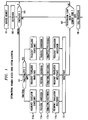
- FIG. 1 An algorithm process for adapting a foreign cellular/wireless telephone instrument for operation with a new/local cellular/wireless telephone network/system is shown in the flow chart of FIG. 1.
- a subscriber traveling within an area other than his/her home/foreign area wishes to use a cellular/wireless telephone instrument in a new area serviced by a local cellular/wireless telephone network/system different in operation and location from his/her normal home/foreign area.
- the process is initiated with a service request as indicated in block 101.
- the service request is transmitted over the access channel used by cellular/wireless network/systems for this purpose.
- the receiving network/system accepts/detects the signal and as indicated in the block 103 detects and characterizes the request signal as to its format, frequency, modulation, framing, etc. Whether the request for service is from a local or foreign cellular/wireless telephone instrument (i.e., foreign vs. US) is determined as indicated by decision block 105. If the request is from a US/local C/W telephone instrument the flow proceeds to process registration, authentication for US/local processing as indicated in decision block 107.
- a local or foreign cellular/wireless telephone instrument i.e., foreign vs. US
- the flow process proceeds to determine the type of modulation, as per decision block 111, that the requesting foreign cellular/wireless telephone instrument is using. For illustrative purposes three types of modulation are illustrated although it is to be understood that the invention is not limited to the three designated modulation types. If the detected modulation scheme is time division modulation (i.e., TDMA,GSM) the flow process proceeds all the way through blocks 113a, 115a, 117a and 119a. The system processing frequency is adjusted to the signal frequency and the demodulation scheme of the transmitting telephone instrument, as per block 113a.
- time division modulation i.e., TDMA,GSM
- a Mux/Demux process 121 provides bi-directional connection between the appropriate processing circuitry and the requesting telephone instrument.
- the Mux/Demux process 121 is coupled to a decision block 107 concerned with registration and authentication. If the codes (IRACN and PIN) entered are approved the flow proceed to call processing as shown in the block 109. The requesting telephone instrument may now communicate through the network/system.
- the process flow (b and c) for amps and PCS is similar to that for TDMA/GSM and hence it is not necessary to discuss.
- an International Roamers Access Radio System (IRARS) participant requests service, the received signal frequency is determined, and the IRACN and PIN are verified for validity.
- the signal undergoes frequency adjustment, demodulation and carrier recovery, decoded and de-interleaved. It is deframed; the deframing process removes all the overhead bits by the Decision circuitry and stores it in the RAM. Only the information bits remain.
- Protocol conversion takes place, after bandwidth/time slot adjustment, channel spacing, and rate adjustment are made in the processor.
- the outputs of the protocol converter as discussed below, are looped back to the modulator where signal is modulated with pi/4DQPSK, to adapt to NA-TDMA type modulation.
- the processor sends the modulated signal to the framer where the information is structured and adapted to NA-TDMA. It is encoded and interleaved such that the final bit count and the bit pattern is equal 1944 bits (972 symbols) per frame and is similar the NA-TDMA frame structure.
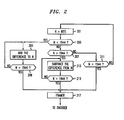
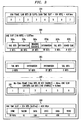
- Fig. 2 shows the framing algorithm to accomplish this structuring, and the bit patterns for the framing transformation are shown in the diagram of FIG. 3. For example, if the GSM system is chosen for processing, Fig 2 shows the transformation algorithm for this modulation scheme.
- the invention is not limited to GSM framing and framing for other modulation schemes is included within the scope of the invention.
- Framing processing starts with the number of bits N of the incoming frame being determined as indicated in block 201. If the number of bits N is less than 1944, as per decision block 203, the process proceeds to a block 205 whose instruction is to add the difference between the number of bits and 1944. If the number of bits now equals 1944 as per decision block 209 the process proceeds to the framing process of block 217 from whence the frame is transmitted to an encoder.
- the results of the framing process are detailed graphically in the FIG. 3 diagram.
- the GSM frame 301 is shown comprising a total of 1248 bits with 8 slots each slot including 156 bits and a time duration of 4.615 ms.
- the content of each GSM slot 303 includes three tail bits 303a; fifty eight information bits 303c; a training sequence 303e of twenty six bits; fifty eight more information bits 303g; three tail bits 303h and a guard section 303j of eight bits.
- Each slot 303 has a total of 156 bits for a duration of 0.577ms.
- the frame 305 in process has a bit pattern in each slot in which all the overhead bits except the tail bits have been removed. This leaves 120 bits in each slot or a total of 960 bits per frame.
- the in-process frame is now adjusted to adapt the signal to the NA TDMA format and structure to be ready for encoding and interleaving.
- the NA-TDMA frame 307 has 1944 bits or 972 symbols in which each slot 309 had 324 bits at a rate of 48.6 kbps or 6.67 ms/slot. This is the NA-TDMA frame and down link structure processed by the network/system.
- the bit pattern is adapted to GSM standards, shown by frame 309, which the subscribers cellular/wireless telephone instrument is able to receive while GSM NA-TDMA transition is shown the invention is not so limited. Other transitions fall within the purview of the invention.
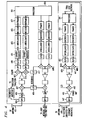
- a radio transceiver used in the network/system, which illustrates the invention, is shown in the FIG. 4 and includes a RF front end; an IF section and a Baseband section. Uplink signals are received at a receiving antenna 401 and are coupled to a bandpass filter (BPF) 403.
- BPF bandpass filter
- a frequency detector is coupled to the input of BPF 403 and detects the frequency of the uplink signal as well as the type of system in use (i.e., GSM, PCS, FDMA, etc.) and IRARS and PIN validity. This frequency determination and other information determined is coupled to the IRARS processor 501 discussed below with reference to FIG. 4.
- the filtered signal output of BPF 403 is amplified in amplifier 405 and mixed in mixer 407 with the reference signal frequency of local oscillator 409 to achieve the IF signal. After further filtering and amplification the signal is bifurcated to form I (In-phase) and Q (Quadrature-phase) signals.
- the I and Q signals are applied to mixers 413 and 415 for demodulation and referencing by a second reference signal (by local oscillator 417) to achieve baseband frequency, respectively.
- the signal is further processed, to recover original signal information, in both paths by an A/D converter 419 to recover a digital signal format and in various processes the carrier is recovered 421, and de-interleaved 423, decoded 425 (to recover original information) and deframed 427 (to remove overhead bits).
- A/D converter 419 to recover a digital signal format and in various processes the carrier is recovered 421, and de-interleaved 423, decoded 425 (to recover original information) and deframed 427 (to remove overhead bits).
- These signals are applied to the processor 501 discussed in reference to FIG. 5.
- These signals are also processed in path 451 to adjust to signal characteristics of the local C/W network/system connected to lead 453
- Downlink I and Q signals as processed in processor 501, are framed 431, encoded 433, interleaved 435 and converted from digital to analog format in D/A converter 437. Framing reinserts the overhead bits and structures the packet into a suitable format.
- the signal is modulated in mixer 439 and upped to IF frequency in mixer 441 to produce a modulated IF signal for the front end. After filtering and amplification the signal is converted to RF, suitable for the foreign subscriber's telephone instrument, in mixer 443 amplified in amplifier 445 filtered by BPF 447, for spectrum control, and applied to a transmitting antenna 449.
- Processor 501 accepts both I and Q incoming signals from the subscriber, on leads 502 and 503, and in a pair of switches 504 and 505 selects subsequent circuit connections to (in the example) enable processing of GSM or NA-TDMA processing.
- Time slot control GBW (Gaussian Modulation Shift Keying BW) 541 applies a control signal to a GSM channel 514 or 516 and changes the time slots and framing of the GSM incoming signal.
- the I and Q signal has the rate appropriately adjusted in mixers 518 and 520, respectively, in response to control signals provided by a variable rate generator 526 which is controlled by a processor 530.
- a second channel is included to provide North American TDMA (NABW) control to a NA-TDMA channel 524 and 526 also under control of processor 530, through time slot control 543.
- NABW North American TDMA
- Outgoing signals (downlink) intended for the C/W telephone instrument of the foreign user are modulated to its operating requirements in mixers 551 and 552 and output on leads 561 and 562 to the radio output circuitry shown in the Fig. 4.
- Signals for C/W network/system processing are output on leads 571 and 572.
Landscapes
- Engineering & Computer Science (AREA)
- Computer Networks & Wireless Communication (AREA)
- Signal Processing (AREA)
- Mobile Radio Communication Systems (AREA)
- Telephonic Communication Services (AREA)
Applications Claiming Priority (2)
| Application Number | Priority Date | Filing Date | Title |
|---|---|---|---|
| US384451 | 1999-08-27 | ||
| US09/384,451 US6754490B2 (en) | 1999-08-27 | 1999-08-27 | International roaming service for permitting a cellular/wireless telephone instrument to access different wireless telephone network/systems |
Publications (2)
| Publication Number | Publication Date |
|---|---|
| EP1079648A1 EP1079648A1 (en) | 2001-02-28 |
| EP1079648B1 true EP1079648B1 (en) | 2007-09-26 |
Family
ID=23517376
Family Applications (1)
| Application Number | Title | Priority Date | Filing Date |
|---|---|---|---|
| EP00112746A Expired - Lifetime EP1079648B1 (en) | 1999-08-27 | 2000-06-16 | International roaming service for permitting a cellular/wireless telephone instrument to access different wireless telephone network/systems |
Country Status (6)
| Country | Link |
|---|---|
| US (2) | US6754490B2 (enExample) |
| EP (1) | EP1079648B1 (enExample) |
| JP (1) | JP3766783B2 (enExample) |
| BR (1) | BR0003715A (enExample) |
| CA (1) | CA2316088C (enExample) |
| DE (1) | DE60036517T2 (enExample) |
Families Citing this family (20)
| Publication number | Priority date | Publication date | Assignee | Title |
|---|---|---|---|---|
| JP3416610B2 (ja) * | 2000-03-28 | 2003-06-16 | 三洋電機株式会社 | 移動電話装置及び通信プロトコルの処理手順切り換え方法 |
| US8479189B2 (en) | 2000-11-17 | 2013-07-02 | Hewlett-Packard Development Company, L.P. | Pattern detection preprocessor in an electronic device update generation system |
| US7409685B2 (en) | 2002-04-12 | 2008-08-05 | Hewlett-Packard Development Company, L.P. | Initialization and update of software and/or firmware in electronic devices |
| JP4059025B2 (ja) * | 2002-07-12 | 2008-03-12 | 日本電気株式会社 | 着信側情報表示システムおよび通信端末 |
| US8555273B1 (en) | 2003-09-17 | 2013-10-08 | Palm. Inc. | Network for updating electronic devices |
| US7904895B1 (en) | 2004-04-21 | 2011-03-08 | Hewlett-Packard Develpment Company, L.P. | Firmware update in electronic devices employing update agent in a flash memory card |
| US8526940B1 (en) | 2004-08-17 | 2013-09-03 | Palm, Inc. | Centralized rules repository for smart phone customer care |
| US7680477B2 (en) | 2004-09-03 | 2010-03-16 | Texas Instruments Incorporated | Integrated radio frequency filters for multiband transceivers |
| WO2006034284A1 (en) * | 2004-09-20 | 2006-03-30 | Claude Charles Buchert | System and method for control of air time of communication devices |
| US20060077943A1 (en) * | 2004-10-12 | 2006-04-13 | Mino Holdings, Inc. C/O M&C Corporate Services Limited | Method and system for processing international calls using a voice over IP process |
| US20070015538A1 (en) * | 2005-07-15 | 2007-01-18 | Eugene Wang | Network and method for the localization and customization of new mobile devices employing SIM/smart card |
| US20070280441A1 (en) * | 2006-05-03 | 2007-12-06 | Mino Holdings, Inc. | Method And System For Using Advertisement To Sponsor International Mobile Phone Calls For Cellular Telephone Networks |
| US20080020755A1 (en) * | 2006-05-16 | 2008-01-24 | Mino Holdings, Inc. | Method and system for international roaming using virtual sim card |
| US8209676B2 (en) | 2006-06-08 | 2012-06-26 | Hewlett-Packard Development Company, L.P. | Device management in a network |
| EP2047420A4 (en) | 2006-07-27 | 2009-11-18 | Hewlett Packard Development Co | USER EXPERIENCE AND DEPENDENCE MANAGEMENT IN A MOBILE DEVICE |
| JP5097615B2 (ja) | 2008-05-13 | 2012-12-12 | 株式会社エヌ・ティ・ティ・ドコモ | 携帯端末装置及びその制御方法並びに通信システム |
| US11441916B1 (en) | 2016-01-22 | 2022-09-13 | State Farm Mutual Automobile Insurance Company | Autonomous vehicle trip routing |
| US11119477B1 (en) | 2016-01-22 | 2021-09-14 | State Farm Mutual Automobile Insurance Company | Anomalous condition detection and response for autonomous vehicles |
| US11719545B2 (en) | 2016-01-22 | 2023-08-08 | Hyundai Motor Company | Autonomous vehicle component damage and salvage assessment |
| US11242051B1 (en) | 2016-01-22 | 2022-02-08 | State Farm Mutual Automobile Insurance Company | Autonomous vehicle action communications |
Family Cites Families (20)
| Publication number | Priority date | Publication date | Assignee | Title |
|---|---|---|---|---|
| DE3420460A1 (de) | 1984-06-01 | 1985-12-05 | Philips Patentverwaltung Gmbh, 2000 Hamburg | Verfahren zum erkennen der unerlaubten benutzung einer, einer beweglichen funkstation zugeordneten identifizierung in einem funkuebertragungssystem |
| US5610973A (en) * | 1991-01-28 | 1997-03-11 | Bellsouth Corporation | Interactive roamer contact system for cellular mobile radiotelephone network |
| FI87963C (fi) * | 1991-06-06 | 1993-03-10 | Telenokia Oy | Foerfarande foer bildande av ett ankommande samtal till en radiotelefon i ett cellradiotelefonsystem |
| US5463675A (en) * | 1991-06-17 | 1995-10-31 | At&T Ipm Corp. | Extended home indentification being used by the same service provider as a home identification in a service area other than the home service area for cellular radio telephone systems |
| SE517451C2 (sv) * | 1993-06-02 | 2002-06-04 | Telia Ab | Anordning vid radiosystem med kort räckvidd |
| SE515750C2 (sv) * | 1994-01-28 | 2001-10-08 | Telia Ab | Anordning vid telesystem |
| FR2718312B1 (fr) * | 1994-03-29 | 1996-06-07 | Rola Nevoux | Procédé d'authentification combinée d'un terminal de télécommunication et d'un module d'utilisateur. |
| US5781612A (en) * | 1995-03-10 | 1998-07-14 | Northern Telecom Limited | Radio terminal interfaces for voice and data telecommunications, and methods for their operation |
| AU1459297A (en) * | 1996-01-18 | 1997-08-11 | Telefonaktiebolaget Lm Ericsson (Publ) | Method and system for reducing fraud in a cellular telecommunications system |
| US5960340A (en) * | 1996-02-28 | 1999-09-28 | At&T Corporation | Automatic cellular telephone registration for universal telephone number service |
| JP2000507422A (ja) * | 1996-03-28 | 2000-06-13 | マークポート・リミテッド | 移動電気通信システムのためのローミング融合ゲートウェイ |
| US5862481A (en) * | 1996-04-08 | 1999-01-19 | Northern Telecom Limited | Inter-technology roaming proxy |
| JP2877199B2 (ja) * | 1996-06-21 | 1999-03-31 | 日本電気株式会社 | ローミング方式 |
| US5933784A (en) * | 1996-06-28 | 1999-08-03 | Synacom Technology, Inc. | Signaling gateway system and method |
| CA2260108A1 (en) | 1996-07-10 | 1998-01-15 | American Pcs Communications, Llc | A gateway unit |
| US6097950A (en) | 1996-12-27 | 2000-08-01 | Telefonaktiebolaget Lm Ericsson (Publ) | Method and system for global roaming in a cellular telecommunications system |
| US5907803A (en) | 1997-01-14 | 1999-05-25 | Telefonaktiebolaget L M Ericsson (Publ) | User assisted fraud detection in a cellular communications system |
| TW379494B (en) * | 1997-11-12 | 2000-01-11 | Ericsson Inc | Method and apparatus for increasing traffic channels within an AMPS/IS-136 cellular system |
| US6259914B1 (en) * | 1998-08-07 | 2001-07-10 | Bellsouth Intellectual Property Corporation | Method and apparatus for implementing international wireless roaming |
| US6456858B1 (en) * | 1998-12-21 | 2002-09-24 | Verizon Wireless | System and methods in a dual mode wireless system for transmitting rescan command based on detected network conditions |
-
1999
- 1999-08-27 US US09/384,451 patent/US6754490B2/en not_active Expired - Fee Related
-
2000
- 2000-06-16 EP EP00112746A patent/EP1079648B1/en not_active Expired - Lifetime
- 2000-06-16 DE DE60036517T patent/DE60036517T2/de not_active Expired - Lifetime
- 2000-08-17 CA CA002316088A patent/CA2316088C/en not_active Expired - Fee Related
- 2000-08-21 BR BR0003715-0A patent/BR0003715A/pt not_active Application Discontinuation
- 2000-08-25 JP JP2000254818A patent/JP3766783B2/ja not_active Expired - Fee Related
-
2004
- 2004-06-17 US US10/871,289 patent/US7164910B2/en not_active Expired - Fee Related
Also Published As
| Publication number | Publication date |
|---|---|
| DE60036517D1 (de) | 2007-11-08 |
| DE60036517T2 (de) | 2008-06-26 |
| US7164910B2 (en) | 2007-01-16 |
| EP1079648A1 (en) | 2001-02-28 |
| JP2001095061A (ja) | 2001-04-06 |
| US6754490B2 (en) | 2004-06-22 |
| CA2316088C (en) | 2005-05-10 |
| US20030013429A1 (en) | 2003-01-16 |
| CA2316088A1 (en) | 2001-02-27 |
| US20040224679A1 (en) | 2004-11-11 |
| BR0003715A (pt) | 2001-03-27 |
| JP3766783B2 (ja) | 2006-04-19 |
Similar Documents
| Publication | Publication Date | Title |
|---|---|---|
| CA2316088C (en) | International roaming service for permitting a cellular/wireless telephone instrument to access different wireless telephone network/systems | |
| JP4555261B2 (ja) | データ伝送を暗号処理する方法とその方法を利用するセルラ無線システム | |
| US7821990B2 (en) | Method of transmitting service information, and radio system | |
| EP0821507A3 (en) | Protocol converter and router for multi-mode wireless data communications | |
| WO2001031840A1 (en) | Method and arrangement for reliably identifying a user in a computer system | |
| US6799023B2 (en) | Method of automatic gain control in base station of cellular radio network | |
| WO2005120113A1 (en) | Authentication of mobile comunication networks | |
| JP2001095061A5 (enExample) | ||
| US6185227B1 (en) | Method and packet radio system for transmitting modulation and signalling information | |
| AU756579B2 (en) | Method and packet radio system for transmitting modulation and signalling information | |
| WO1998025356A1 (en) | Method and apparatus for distinguishing in-band signaling from user data | |
| WO1999043133A3 (en) | High-speed access from mobile station to tcp/ip network | |
| US20060092877A1 (en) | Data transport in GSM system | |
| US7096267B2 (en) | Data transmission method and arrangement using method calls | |
| US20020004818A1 (en) | Data transmission method and arrangement | |
| JP2001517394A (ja) | データ伝送方法、受信方法、及び受信器 | |
| JPH09107344A (ja) | 音声信号/非音声信号の同時伝送方法及び装置 | |
| JPH0311831A (ja) | 移動通信信号方式 | |
| US20040252663A1 (en) | Cdma transmission diversity apparatus | |
| JPH09327056A (ja) | 移動通信方法 | |
| HK1104741A (en) | Authentication of mobile communication networks |
Legal Events
| Date | Code | Title | Description |
|---|---|---|---|
| PUAI | Public reference made under article 153(3) epc to a published international application that has entered the european phase |
Free format text: ORIGINAL CODE: 0009012 |
|
| AK | Designated contracting states |
Kind code of ref document: A1 Designated state(s): DE FR GB |
|
| AX | Request for extension of the european patent |
Free format text: AL;LT;LV;MK;RO;SI |
|
| 17P | Request for examination filed |
Effective date: 20010824 |
|
| RAP1 | Party data changed (applicant data changed or rights of an application transferred) |
Owner name: AT&T WIRELESS SERVICES, INC. |
|
| AKX | Designation fees paid |
Free format text: DE FR GB |
|
| RAP1 | Party data changed (applicant data changed or rights of an application transferred) |
Owner name: CINGULAR WIRELESS II, LLC |
|
| 17Q | First examination report despatched |
Effective date: 20060922 |
|
| GRAP | Despatch of communication of intention to grant a patent |
Free format text: ORIGINAL CODE: EPIDOSNIGR1 |
|
| GRAS | Grant fee paid |
Free format text: ORIGINAL CODE: EPIDOSNIGR3 |
|
| GRAA | (expected) grant |
Free format text: ORIGINAL CODE: 0009210 |
|
| AK | Designated contracting states |
Kind code of ref document: B1 Designated state(s): DE FR GB |
|
| REG | Reference to a national code |
Ref country code: GB Ref legal event code: FG4D |
|
| REF | Corresponds to: |
Ref document number: 60036517 Country of ref document: DE Date of ref document: 20071108 Kind code of ref document: P |
|
| ET | Fr: translation filed | ||
| PLBE | No opposition filed within time limit |
Free format text: ORIGINAL CODE: 0009261 |
|
| STAA | Information on the status of an ep patent application or granted ep patent |
Free format text: STATUS: NO OPPOSITION FILED WITHIN TIME LIMIT |
|
| 26N | No opposition filed |
Effective date: 20080627 |
|
| PGFP | Annual fee paid to national office [announced via postgrant information from national office to epo] |
Ref country code: DE Payment date: 20120629 Year of fee payment: 13 |
|
| REG | Reference to a national code |
Ref country code: DE Ref legal event code: R119 Ref document number: 60036517 Country of ref document: DE |
|
| PG25 | Lapsed in a contracting state [announced via postgrant information from national office to epo] |
Ref country code: DE Free format text: LAPSE BECAUSE OF NON-PAYMENT OF DUE FEES Effective date: 20140101 |
|
| REG | Reference to a national code |
Ref country code: DE Ref legal event code: R079 Ref document number: 60036517 Country of ref document: DE Free format text: PREVIOUS MAIN CLASS: H04Q0007380000 Ipc: H04W0004000000 |
|
| REG | Reference to a national code |
Ref country code: DE Ref legal event code: R079 Ref document number: 60036517 Country of ref document: DE Free format text: PREVIOUS MAIN CLASS: H04Q0007380000 Ipc: H04W0004000000 Effective date: 20140527 Ref country code: DE Ref legal event code: R119 Ref document number: 60036517 Country of ref document: DE Effective date: 20140101 |
|
| PGFP | Annual fee paid to national office [announced via postgrant information from national office to epo] |
Ref country code: GB Payment date: 20140527 Year of fee payment: 15 |
|
| PGFP | Annual fee paid to national office [announced via postgrant information from national office to epo] |
Ref country code: FR Payment date: 20140527 Year of fee payment: 15 |
|
| GBPC | Gb: european patent ceased through non-payment of renewal fee |
Effective date: 20150616 |
|
| REG | Reference to a national code |
Ref country code: FR Ref legal event code: ST Effective date: 20160229 |
|
| PG25 | Lapsed in a contracting state [announced via postgrant information from national office to epo] |
Ref country code: GB Free format text: LAPSE BECAUSE OF NON-PAYMENT OF DUE FEES Effective date: 20150616 |
|
| PG25 | Lapsed in a contracting state [announced via postgrant information from national office to epo] |
Ref country code: FR Free format text: LAPSE BECAUSE OF NON-PAYMENT OF DUE FEES Effective date: 20150630 |