EP1079367A2 - Saitenmusikinstrument mit einem Kopf mit einer glänzender Oberfläche und Verfahren zu ihrer Herstellung - Google Patents
Saitenmusikinstrument mit einem Kopf mit einer glänzender Oberfläche und Verfahren zu ihrer Herstellung Download PDFInfo
- Publication number
- EP1079367A2 EP1079367A2 EP00117830A EP00117830A EP1079367A2 EP 1079367 A2 EP1079367 A2 EP 1079367A2 EP 00117830 A EP00117830 A EP 00117830A EP 00117830 A EP00117830 A EP 00117830A EP 1079367 A2 EP1079367 A2 EP 1079367A2
- Authority
- EP
- European Patent Office
- Prior art keywords
- finishing
- panel
- musical instrument
- neck
- stringed musical
- Prior art date
- Legal status (The legal status is an assumption and is not a legal conclusion. Google has not performed a legal analysis and makes no representation as to the accuracy of the status listed.)
- Withdrawn
Links
- 238000000034 method Methods 0.000 title claims description 16
- 230000008569 process Effects 0.000 title claims description 16
- 238000004519 manufacturing process Methods 0.000 title description 6
- 239000002131 composite material Substances 0.000 claims description 14
- 239000011120 plywood Substances 0.000 claims description 13
- 239000000057 synthetic resin Substances 0.000 claims description 9
- 229920003002 synthetic resin Polymers 0.000 claims description 9
- 238000010422 painting Methods 0.000 claims description 6
- 239000002023 wood Substances 0.000 claims description 6
- 239000000463 material Substances 0.000 claims description 3
- 238000004873 anchoring Methods 0.000 claims description 2
- 238000005498 polishing Methods 0.000 claims 1
- 239000003973 paint Substances 0.000 abstract description 6
- 230000000873 masking effect Effects 0.000 description 4
- 239000000853 adhesive Substances 0.000 description 3
- 230000001070 adhesive effect Effects 0.000 description 3
- 238000004804 winding Methods 0.000 description 3
- 238000001746 injection moulding Methods 0.000 description 2
- 238000000465 moulding Methods 0.000 description 2
- 241000208140 Acer Species 0.000 description 1
- 244000137852 Petrea volubilis Species 0.000 description 1
- 230000008859 change Effects 0.000 description 1
- 150000001875 compounds Chemical class 0.000 description 1
- 238000007730 finishing process Methods 0.000 description 1
- 239000011796 hollow space material Substances 0.000 description 1
- 238000003475 lamination Methods 0.000 description 1
- 230000004048 modification Effects 0.000 description 1
- 238000012986 modification Methods 0.000 description 1
- 238000002360 preparation method Methods 0.000 description 1
- 230000009467 reduction Effects 0.000 description 1
- 239000007787 solid Substances 0.000 description 1
Images


Classifications
-
- G—PHYSICS
- G10—MUSICAL INSTRUMENTS; ACOUSTICS
- G10D—STRINGED MUSICAL INSTRUMENTS; WIND MUSICAL INSTRUMENTS; ACCORDIONS OR CONCERTINAS; PERCUSSION MUSICAL INSTRUMENTS; AEOLIAN HARPS; SINGING-FLAME MUSICAL INSTRUMENTS; MUSICAL INSTRUMENTS NOT OTHERWISE PROVIDED FOR
- G10D3/00—Details of, or accessories for, stringed musical instruments, e.g. slide-bars
- G10D3/06—Necks; Fingerboards, e.g. fret boards
-
- G—PHYSICS
- G10—MUSICAL INSTRUMENTS; ACOUSTICS
- G10D—STRINGED MUSICAL INSTRUMENTS; WIND MUSICAL INSTRUMENTS; ACCORDIONS OR CONCERTINAS; PERCUSSION MUSICAL INSTRUMENTS; AEOLIAN HARPS; SINGING-FLAME MUSICAL INSTRUMENTS; MUSICAL INSTRUMENTS NOT OTHERWISE PROVIDED FOR
- G10D1/00—General design of stringed musical instruments
- G10D1/04—Plucked or strummed string instruments, e.g. harps or lyres
- G10D1/05—Plucked or strummed string instruments, e.g. harps or lyres with fret boards or fingerboards
- G10D1/08—Guitars
-
- G—PHYSICS
- G10—MUSICAL INSTRUMENTS; ACOUSTICS
- G10D—STRINGED MUSICAL INSTRUMENTS; WIND MUSICAL INSTRUMENTS; ACCORDIONS OR CONCERTINAS; PERCUSSION MUSICAL INSTRUMENTS; AEOLIAN HARPS; SINGING-FLAME MUSICAL INSTRUMENTS; MUSICAL INSTRUMENTS NOT OTHERWISE PROVIDED FOR
- G10D3/00—Details of, or accessories for, stringed musical instruments, e.g. slide-bars
- G10D3/22—Material for manufacturing stringed musical instruments; Treatment of the material
Definitions
- This invention relates to a stringed musical instrument and, more particularly, to a stringed musical instrument with a head formed at the leading end of a neck and a process for fabricating the stringed musical instrument.
- a musician plays the stringed musical instrument by bowing or plucking. In either case, strings are stretched over a neck, and are anchored at a head and a body. Thus, the body, neck, head and strings are indispensable component parts of the stringed musical instrument.
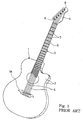
- Figure 1 illustrates a typical example of an acoustic guitar.
- the acoustic guitar is categorized in the stringed musical instrument.
- the prior art acoustic guitar is broken down into a body 1, a neck 3, a head 4 and six strings 5.
- Several boards 2 are assembled together, and a resonator is defined inside of the body 1.
- the resonator is open through a sound hole to the outside of the body 1.
- a tailpiece 1a is attached to the front board 2 of the body 1, and is located on one side of the sound hole.
- the neck 3 is fixed to the body 1, and projects from the other side of the body 1.
- the neck 3 includes a neck beam fixed to the body 1, a fingerboard 6 attached to the upper surface of the neck beam and frets 7 partially embedded in the fingerboard 6 at intervals.
- the fingerboard 6 extends from the neck beam onto the front board 2 of the body 1.
- the head 4 is formed at the leading end of the neck beam, and the neck beam and the head 4 are formed in a monolithic body.
- Pegs 8 are attached to the head 4, and are rotatable with respect to the head 4.
- the six strings 5 are stretched between the pegs 8 and the tailpiece 1a. The six strings 5 extend over the fingerboard 6 and the front board 2, and pass over the sound hole.
- Figure 2 illustrates the monolithic body for the neck beam 3a and the head 4.
- the fingerboard 6 is bonded to a part of the monolithic body serving as the neck beam 3a, and the head 4 is uncovered with the fingerboard 6.
- Six peg holes are formed in the head 4, and are respectively assigned to the pegs 8.
- a wood plate is shaped into the monolithic body, and the peg holes are formed in the monolithic body.
- the fingerboard 6 is bonded to the neck beam 3a of the monolithic body, and, thereafter, the monolithic body is finished.
- the fingerboard 6 is usually not painted from viewpoints of good appearance and fine finger touch.
- the exposed surface of the neck beam 3a is painted for frost finishing, or is treated with oil.
- the head 4 is painted for bright finish.
- a masking work is required.
- the painter masks the fingerboard 6 and the head 4 with a piece of masking sheet, and the exposed surface of the neck beam 3a is painted for the frost finishing.
- the masking sheet is removed from the head 4, and the frosted surface of the neck beam 3a is masked with a piece of masking sheet.
- the head 4 is painted for the bright finishing, and, thereafter, the painted surface is polished with a buff.
- the present invention proposes to assemble a monolithic body with a decorative board.
- a stringed musical instrument comprising a body, at least one string anchored at one end thereof to the body and vibratory for generating sound variable in pitch, a neck projecting from the body and having a front surface over which the at least one string is stretched and another surface treated through a first kind of finishing, and a head connected to a leading end of the neck and having a bulk portion, a panel attached to the bulk portion and treated through a second kind of finishing different from the first kind of finishing and an anchoring means to which the other end of the at least one string is anchored.
- a process for fabricating a stringed musical instrument comprising the steps of a) preparing a composite component part including a neck having a front surface and another surface treated through a first kind of finishing and an incomplete head connected to a leading end of the neck and a panel treated through a second kind of finishing different from the first kind of finishing, b) fixing the panel to the incomplete head of the composite component part, and c) completing the stringed musical instrument on the basis of the resultant structure in the step b).
- an acoustic guitar embodying the present invention largely comprises a body 11, a neck 13, a head 14 and six strings 15.
- the body 11 is a generally gourd-shaped, and, accordingly, has a large round portion and a small round portion.
- Several wooden boards 12a are appropriately shaped, and are assembled into the body 11.
- a hollow space is defined inside of the body11, and serves as a resonator.
- a sound hole 12b is formed in the front board 12a, and the resonator is open through the sound hole 12b to the outside of the body 11.
- the sound hole 12b is formed in the boundary between the large round portion and the small round portion.
- the body 11 has a tail piece 12c, which is attached to the rear portion of the front board 12a.
- a monolithic body is used for the neck 13 and head 14.
- the monolithic body is partially used as a neck beam 13a and partially as a bulk portion 14a (see figure 4).
- the monolithic body is adhered to the small round portion of the body 11, and frontward projects from the front end surface.
- a fingerboard 16 is attached to the front surface of the neck body 13a, and forms the neck 13 together with the neck beam 13. Frets 17 are embedded in the fingerboard 16 at intervals.
- the fingerboard 16 rearward extends from the neck beam 13a onto the front board 12a, and the sound hole 12b is partially overlapped with the fingerboard 16.
- the fingerboard 16 is not painted because of good appearance and fine finger touch when a player presses the strings 15 thereto.
- the neck beam 13a and the bulk portion 14a are painted for frost frosted surface or treated with oil except a front surface of the head 14.
- a decorative panel 20 is adhered to the front surface of the bulk portion 14a.
- the decorative panel 20 is painted for the bright finish.
- the fingerboard 16, the monolithic body 13a/ 14a and the decorative panel 20 are differently finished.
- Peg holes 19 are formed in the bulk portion 14a, and corresponding holes 21 are formed in the decorative panel 20.
- Pegs 18 have respective winding portions, and the winding portions are exposed to the peg holes 19/ 21 (see figure 3).
- the winding portions are bi-directionally rotated when a player manipulates knobs.
- the knobs form parts of the pegs 18, and projects from a side surface of the head 14.
- the strings 15 are stretched between the pegs 18 and the tail piece 12c.
- the strings 15 extend over the fingerboard 16 and the sound hole 12b. Although the strings 15 are held in contact with the fret closest to the head 14, the strings 15 are slightly spaced from the other frets 17.
- a player selectively presses the strings 15 to the fingerboard 16 between the frets 17 with the fingers so as to change the pitch of guitar sound depending upon the fret 17 into which the vibrating string 15 is brought into contact.
- the acoustic guitar according to the present invention is substantially identical in appearance with the prior art acoustic guitar, the acoustic guitar according to the present invention is lower in production cost than the prior art acoustic guitar by virtue of the usage of decorative panel 20.
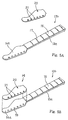
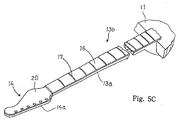
- a process for fabricating the acoustic guitar is broken down into two steps, i.e., preparation of the body 11, a composite component part 13b and the decorative panel 20, assemblage of the decorative panel 20 with the composite component part 13b and completion of the acoustic as shown in figures 5A to 5C.
- the wooden plates are shaped through wood working into the wooden boards 12a, and the wooden boards 12a are assembled into the body 11.
- a wooden plate is shaped into the monolithic body 13a/ 14a, and the fingerboard 16 is attached to the front surface of the neck beam 13a.
- the frets 17 have been already embedded in the fingerboard 16 at intervals.
- the fingerboard 16 and the front surface of the bulk portion 14a are coated with a mask, and the resultant structure is painted for a frosted surface or treated with oil.
- the mask prevents the front surface of the bulk portion 14a from the paint or oil.
- the decorative panel 20 is prepared as follows.
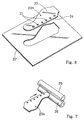
- a sheet of plywood 22 is prepared, and a base panel 20a is cut from the sheet of plywood 22 as shown in figure 6.
- the sheet of plywood 22 is a lamination of a front layer 23 and a bottom layer 24.
- the front layer 23 is formed of wood such as, for example, maple, and the thickness is 0.2 millimeter to 1 millimeter.
- the bottom layer 24 is formed of wood or synthetic resin, and the thickness ranges from 1 millimeter to 1.5 millimeters.
- the total thickness of the plywood 22 is greater than 1.0 millimeters and less than 3.0 millimeters, and preferably ranges from 1.2 millimeters to 2.5 millimeters.
- the base panel 20a is warped after painting. On the other hand, if the base panel 20a is equal to or greater than 3 millimeters thick, the side surface of the decorative panel 20 is clearly seen, and makes the appearance bad.
- the plywood 22 is effective against the warp after the painting. This is the reason why the base panel 20a is cut from the sheet of plywood 22.
- the front layer 23 provides a front surface to be painted. If the front layer 23 and/ or the bottom layer 24 is formed of different material, the manufacturer can reduce the total thickness.
- the sheet of plywood 22 is placed in a die (not shown), and is punched. Then, the base panel 20a is cut from the sheet of plywood 22. Otherwise, the base panel 20a is cut from the sheet of plywood 22 by using a numerical controlled rooter (not shown).
- the base panel 20a is finished or ground by using a piece of sand paper, and, thereafter, is painted. Paint is sprayed onto the base plate 20a. Finally, the painted base plate 20a is polished with a buff.
- the manufacturer may pass the base panel 20a between a pair of rollers 25/ 26 as shown in figure 7.
- the rollers 25/ 26 are full of the paint, and are rotatable as indicated by arrows. While the base panel 20a is passing between the rollers 25 and 26, the base panel 20a is coated with paint.
- the paint is as thin as 200 microns to 400 microns.
- the manufacturer may coat the base panel 20a with synthetic resin by using an injection molding machine.
- the base panel 20a is put in a molding die, and melted synthetic resin is injected into the molding die. Then, the base panel 20a is coated with the synthetic resin.
- the synthetic resin ranges from 500 microns to 800 microns thick and, preferably, from 200 microns to 400 microns thick.
- the base panel 20 for the injection molding may be 2.0 millimeters thick, i.e., the front layer 23 is 0.5 millimeter thick and the bottom layer 24 is 1.5 millimeters thick, and the synthetic resin may be transparent.
- the body 11 may form the composite component part 13b and the decorative panel 20 in another order different from the order of description. It is necessary to prepare the body 11, the composite component part 13b and the decorative panel 20 at the end of the first step.
- the process sequence proceeds to the second step shown in figure 5B.
- the decorative panel 20 is bonded to the front surface of the bulk portion 14a by using adhesive compound. Otherwise, adhesive double coated tape is used between the front surface of the bulk portion 14a and the decorative panel 20. A kind of adhesive double coated tape allows the decorative panel 20 to peel off from the bulk portion 14a. When the decorative panel 20 is cracked or damaged, the user easily replaces the cracked decorative panel 20 with a new decorative panel 20.
- the decorative panel 20 may be bolted to the bulk portion 14a.
- the process sequence proceeds to the final step. Namely, the composite component part 13b is adhered to the front end portion of the body 11 as shown in figure 5C.
- the pegs 18 are attached to the head 14, and the strings 15 are stretched between the pegs 18 and the tail piece 12c.
- the painting for the frosted surface and the treatment with oil are corresponding to the first kind of finishing, and the painting for bright finish is corresponding to the second kind of finishing.
- the body, the composite component part 13b and the decorative panel 20 are separately prepared before the assembling step. Any mask is not required for the different finishing between the decorative panel 20 and the composite component part 13b, and the manufacturer easily automates the production of the decorative panel 20. This results in enhancement of the productivity and, accordingly, reduction of the production cost.
- the manufacturer produces various kinds of decorative panels 20 and the composite component parts 13b, and stocks them until customer's order.
- the manufacturer can deliver the product after the assemblage.
- the process according to the present invention allows the manufacturer to reduce the time period from the order to the delivery.
- the manufacturer can prepare the decorative panels 20 different in color, pattern and material before the assembling step, and attaches one of the decorative panels 20 to the bulk portion 14a depending upon user's demand. As a result, the manufacturer offers a wide variety of products to the user.
- the present invention is applicable to any kind of stringed musical instrument in so far as the musical instrument has a neck and a head. If the present invention is applied to an electric guitar, the body is solid.
Landscapes
- Engineering & Computer Science (AREA)
- Physics & Mathematics (AREA)
- Acoustics & Sound (AREA)
- Multimedia (AREA)
- Manufacturing & Machinery (AREA)
- Stringed Musical Instruments (AREA)
Applications Claiming Priority (2)
| Application Number | Priority Date | Filing Date | Title |
|---|---|---|---|
| JP11234332A JP2001056681A (ja) | 1999-08-20 | 1999-08-20 | 弦楽器及び弦楽器の製造方法 |
| JP23433299 | 1999-08-20 |
Publications (2)
| Publication Number | Publication Date |
|---|---|
| EP1079367A2 true EP1079367A2 (de) | 2001-02-28 |
| EP1079367A3 EP1079367A3 (de) | 2003-08-06 |
Family
ID=16969350
Family Applications (1)
| Application Number | Title | Priority Date | Filing Date |
|---|---|---|---|
| EP00117830A Withdrawn EP1079367A3 (de) | 1999-08-20 | 2000-08-18 | Saitenmusikinstrument mit einem Kopf mit einer glänzender Oberfläche und Verfahren zu ihrer Herstellung |
Country Status (3)
| Country | Link |
|---|---|
| US (1) | US6395968B1 (de) |
| EP (1) | EP1079367A3 (de) |
| JP (1) | JP2001056681A (de) |
Families Citing this family (7)
| Publication number | Priority date | Publication date | Assignee | Title |
|---|---|---|---|---|
| USD513277S1 (en) * | 2004-07-23 | 2005-12-27 | Thornton Charles P | Guitar |
| USD553180S1 (en) * | 2005-08-09 | 2007-10-16 | Heflen Conceptions Llc | Guitar |
| USD557331S1 (en) * | 2007-05-21 | 2007-12-11 | Oren Clark | Guitar headstock |
| USD731586S1 (en) * | 2013-03-08 | 2015-06-09 | Ernie Ball, Inc. | Guitar |
| KR101655891B1 (ko) * | 2016-02-29 | 2016-09-08 | 이세강 | 기타용 장식 패널 및 그 제조 방법 |
| USD1016133S1 (en) * | 2022-09-15 | 2024-02-27 | Guizhou Zhenan Natasha Musical Instrument Manufacturing Co., Ltd | Guitar |
| USD1015419S1 (en) * | 2022-10-31 | 2024-02-20 | Weifang Musi Instrument Co., Ltd. | Guitar body |
Family Cites Families (14)
| Publication number | Priority date | Publication date | Assignee | Title |
|---|---|---|---|---|
| JPS52154228A (en) | 1976-06-15 | 1977-12-21 | Matsushita Electric Works Ltd | Stored room |
| JPS52154229A (en) | 1976-06-15 | 1977-12-21 | Matsushita Electric Works Ltd | Gate door with post |
| US4144793A (en) * | 1977-06-20 | 1979-03-20 | Soika Emil H | Stringed instrument construction employing an integral, hollow, one piece body portion |
| US4362079A (en) * | 1981-05-15 | 1982-12-07 | Thomas L. Ribbecke | Accentuator plate for vibrating soundboard in stringed musical instruments |
| US4989491A (en) * | 1989-01-12 | 1991-02-05 | Baggs Lloyd R | Stringed instrument with resonator rod assembly |
| US4916995A (en) * | 1989-01-23 | 1990-04-17 | Soler Alejandro S | Electrical guitar |
| JPH0448587U (de) * | 1990-08-28 | 1992-04-24 | ||
| US5333527A (en) * | 1991-08-26 | 1994-08-02 | Richard Janes | Compression molded composite guitar soundboard |
| US5661252A (en) * | 1996-04-08 | 1997-08-26 | Krawczak; Kazimierz Marian | Acoustic arm |
| US6034310A (en) * | 1997-05-14 | 2000-03-07 | Kolano; Jozef | String instrument, method of playing a string instrument, apparatus for manufacture of a string instrument, and string instrument kit |
| US6011205A (en) * | 1998-04-01 | 2000-01-04 | Tucker; John Nichols | Material and method for construction of solid body stringed instruments |
| US6037532A (en) * | 1998-06-18 | 2000-03-14 | Beckmeir; Fred | Stringed musical instrument with removable fingerboard |
| US6087568A (en) * | 1998-11-27 | 2000-07-11 | Seal; Ellis C. | Acoustically tailored, composite material stringed instrument |
| US6069306A (en) * | 1999-03-01 | 2000-05-30 | Gibson Guitar Corp. | Stringed musical instrument and methods of manufacturing same |
-
1999
- 1999-08-20 JP JP11234332A patent/JP2001056681A/ja active Pending
-
2000
- 2000-08-16 US US09/640,308 patent/US6395968B1/en not_active Expired - Fee Related
- 2000-08-18 EP EP00117830A patent/EP1079367A3/de not_active Withdrawn
Also Published As
| Publication number | Publication date |
|---|---|
| JP2001056681A (ja) | 2001-02-27 |
| US6395968B1 (en) | 2002-05-28 |
| EP1079367A3 (de) | 2003-08-06 |
Similar Documents
| Publication | Publication Date | Title |
|---|---|---|
| US4969381A (en) | Composite-materials acoustic stringed musical instrument | |
| US4873907A (en) | Composite-materials acoustic stringed musical instrument | |
| US6114616A (en) | Guitar body | |
| JP3658547B2 (ja) | 弦楽器トップ部材 | |
| US6395968B1 (en) | Stringed musical instrument having head covered with bright panel and process of fabrication thereof | |
| WO2018127964A1 (ja) | 弦楽器用板材、アコースティック弦楽器及び弦楽器用板材の製造方法 | |
| US4916995A (en) | Electrical guitar | |
| CN103514857A (zh) | 具有镶嵌品板的弦乐器及其制作方法 | |
| US2649828A (en) | Fretted finger board for stringed musical instruments and method of making the same | |
| CN110277077A (zh) | 用于弦乐器的轻质主体结构 | |
| US10789915B2 (en) | Acoustic string instrument, and methods for manufacturing and repairing same | |
| US20050211052A1 (en) | Guitar having a metal plate insert | |
| US6420638B2 (en) | Guitar neck assembly and method of manufacturing same | |
| CN106169291A (zh) | 一种弦乐器及其制作方法 | |
| US20100107849A1 (en) | Coated Neck Assembly For A Stringed Musical Instrument | |
| KR100336708B1 (ko) | 기타용 바디 및 그 제조방법 | |
| JPH08156086A (ja) | フラッシュ構造の化粧板 | |
| KR100573345B1 (ko) | 피아노 본체용 측판 등의 악기용 부품과 그 제조 방법 | |
| KR100336707B1 (ko) | 키타용 바디 및 그 제조방법 | |
| JPS63170696A (ja) | 軽量の中実体ギター | |
| KR100348455B1 (ko) | 전기기타 및 그 제조방법 | |
| JP2003253969A (ja) | フラッシュ構造のドア | |
| JP4544701B2 (ja) | 複合木質化粧成形品の製造方法 | |
| CN115909995A (zh) | 古琴的琴身 | |
| KR20050071013A (ko) | 스노우보드의 탑시트 가공 방법 및 이에 의해 제조된스노우보드 |
Legal Events
| Date | Code | Title | Description |
|---|---|---|---|
| PUAI | Public reference made under article 153(3) epc to a published international application that has entered the european phase |
Free format text: ORIGINAL CODE: 0009012 |
|
| AK | Designated contracting states |
Kind code of ref document: A2 Designated state(s): AT BE CH CY DE DK ES FI FR GB GR IE IT LI LU MC NL PT SE |
|
| AX | Request for extension of the european patent |
Free format text: AL;LT;LV;MK;RO;SI |
|
| PUAL | Search report despatched |
Free format text: ORIGINAL CODE: 0009013 |
|
| AK | Designated contracting states |
Designated state(s): AT BE CH CY DE DK ES FI FR GB GR IE IT LI LU MC NL PT SE |
|
| AX | Request for extension of the european patent |
Extension state: AL LT LV MK RO SI |
|
| 17P | Request for examination filed |
Effective date: 20040204 |
|
| AKX | Designation fees paid |
Designated state(s): DE GB |
|
| RAP1 | Party data changed (applicant data changed or rights of an application transferred) |
Owner name: YAMAHA CORPORATION |
|
| STAA | Information on the status of an ep patent application or granted ep patent |
Free format text: STATUS: THE APPLICATION IS DEEMED TO BE WITHDRAWN |
|
| 18D | Application deemed to be withdrawn |
Effective date: 20100915 |