EP1072620A2 - Klebstoffzusammensetzung für Keilzinkenverleimung - Google Patents
Klebstoffzusammensetzung für Keilzinkenverleimung Download PDFInfo
- Publication number
- EP1072620A2 EP1072620A2 EP00115031A EP00115031A EP1072620A2 EP 1072620 A2 EP1072620 A2 EP 1072620A2 EP 00115031 A EP00115031 A EP 00115031A EP 00115031 A EP00115031 A EP 00115031A EP 1072620 A2 EP1072620 A2 EP 1072620A2
- Authority
- EP
- European Patent Office
- Prior art keywords
- adhesive composition
- weight
- range
- prepolymer
- component
- Prior art date
- Legal status (The legal status is an assumption and is not a legal conclusion. Google has not performed a legal analysis and makes no representation as to the accuracy of the status listed.)
- Granted
Links
Classifications
-
- C—CHEMISTRY; METALLURGY
- C09—DYES; PAINTS; POLISHES; NATURAL RESINS; ADHESIVES; COMPOSITIONS NOT OTHERWISE PROVIDED FOR; APPLICATIONS OF MATERIALS NOT OTHERWISE PROVIDED FOR
- C09J—ADHESIVES; NON-MECHANICAL ASPECTS OF ADHESIVE PROCESSES IN GENERAL; ADHESIVE PROCESSES NOT PROVIDED FOR ELSEWHERE; USE OF MATERIALS AS ADHESIVES
- C09J175/00—Adhesives based on polyureas or polyurethanes; Adhesives based on derivatives of such polymers
- C09J175/04—Polyurethanes
- C09J175/08—Polyurethanes from polyethers
-
- C—CHEMISTRY; METALLURGY
- C08—ORGANIC MACROMOLECULAR COMPOUNDS; THEIR PREPARATION OR CHEMICAL WORKING-UP; COMPOSITIONS BASED THEREON
- C08G—MACROMOLECULAR COMPOUNDS OBTAINED OTHERWISE THAN BY REACTIONS ONLY INVOLVING UNSATURATED CARBON-TO-CARBON BONDS
- C08G18/00—Polymeric products of isocyanates or isothiocyanates
- C08G18/06—Polymeric products of isocyanates or isothiocyanates with compounds having active hydrogen
- C08G18/08—Processes
- C08G18/10—Prepolymer processes involving reaction of isocyanates or isothiocyanates with compounds having active hydrogen in a first reaction step
- C08G18/12—Prepolymer processes involving reaction of isocyanates or isothiocyanates with compounds having active hydrogen in a first reaction step using two or more compounds having active hydrogen in the first polymerisation step
-
- C—CHEMISTRY; METALLURGY
- C08—ORGANIC MACROMOLECULAR COMPOUNDS; THEIR PREPARATION OR CHEMICAL WORKING-UP; COMPOSITIONS BASED THEREON
- C08G—MACROMOLECULAR COMPOUNDS OBTAINED OTHERWISE THAN BY REACTIONS ONLY INVOLVING UNSATURATED CARBON-TO-CARBON BONDS
- C08G18/00—Polymeric products of isocyanates or isothiocyanates
- C08G18/06—Polymeric products of isocyanates or isothiocyanates with compounds having active hydrogen
- C08G18/08—Processes
- C08G18/16—Catalysts
- C08G18/18—Catalysts containing secondary or tertiary amines or salts thereof
- C08G18/20—Heterocyclic amines; Salts thereof
- C08G18/2009—Heterocyclic amines; Salts thereof containing one heterocyclic ring
- C08G18/2018—Heterocyclic amines; Salts thereof containing one heterocyclic ring having one nitrogen atom in the ring
-
- C—CHEMISTRY; METALLURGY
- C08—ORGANIC MACROMOLECULAR COMPOUNDS; THEIR PREPARATION OR CHEMICAL WORKING-UP; COMPOSITIONS BASED THEREON
- C08G—MACROMOLECULAR COMPOUNDS OBTAINED OTHERWISE THAN BY REACTIONS ONLY INVOLVING UNSATURATED CARBON-TO-CARBON BONDS
- C08G18/00—Polymeric products of isocyanates or isothiocyanates
- C08G18/06—Polymeric products of isocyanates or isothiocyanates with compounds having active hydrogen
- C08G18/28—Polymeric products of isocyanates or isothiocyanates with compounds having active hydrogen characterised by the compounds used containing active hydrogen
- C08G18/40—High-molecular-weight compounds
- C08G18/48—Polyethers
- C08G18/4804—Two or more polyethers of different physical or chemical nature
- C08G18/4812—Mixtures of polyetherdiols with polyetherpolyols having at least three hydroxy groups
-
- C—CHEMISTRY; METALLURGY
- C08—ORGANIC MACROMOLECULAR COMPOUNDS; THEIR PREPARATION OR CHEMICAL WORKING-UP; COMPOSITIONS BASED THEREON
- C08G—MACROMOLECULAR COMPOUNDS OBTAINED OTHERWISE THAN BY REACTIONS ONLY INVOLVING UNSATURATED CARBON-TO-CARBON BONDS
- C08G18/00—Polymeric products of isocyanates or isothiocyanates
- C08G18/06—Polymeric products of isocyanates or isothiocyanates with compounds having active hydrogen
- C08G18/28—Polymeric products of isocyanates or isothiocyanates with compounds having active hydrogen characterised by the compounds used containing active hydrogen
- C08G18/40—High-molecular-weight compounds
- C08G18/48—Polyethers
- C08G18/4804—Two or more polyethers of different physical or chemical nature
- C08G18/482—Mixtures of polyethers containing at least one polyether containing nitrogen
-
- C—CHEMISTRY; METALLURGY
- C08—ORGANIC MACROMOLECULAR COMPOUNDS; THEIR PREPARATION OR CHEMICAL WORKING-UP; COMPOSITIONS BASED THEREON
- C08G—MACROMOLECULAR COMPOUNDS OBTAINED OTHERWISE THAN BY REACTIONS ONLY INVOLVING UNSATURATED CARBON-TO-CARBON BONDS
- C08G18/00—Polymeric products of isocyanates or isothiocyanates
- C08G18/06—Polymeric products of isocyanates or isothiocyanates with compounds having active hydrogen
- C08G18/70—Polymeric products of isocyanates or isothiocyanates with compounds having active hydrogen characterised by the isocyanates or isothiocyanates used
- C08G18/72—Polyisocyanates or polyisothiocyanates
- C08G18/74—Polyisocyanates or polyisothiocyanates cyclic
- C08G18/76—Polyisocyanates or polyisothiocyanates cyclic aromatic
- C08G18/7657—Polyisocyanates or polyisothiocyanates cyclic aromatic containing two or more aromatic rings
- C08G18/7664—Polyisocyanates or polyisothiocyanates cyclic aromatic containing two or more aromatic rings containing alkylene polyphenyl groups
- C08G18/7671—Polyisocyanates or polyisothiocyanates cyclic aromatic containing two or more aromatic rings containing alkylene polyphenyl groups containing only one alkylene bisphenyl group
Definitions
- the invention relates to an adhesive composition, a method for Production of the same, a composite containing it, and use the adhesive composition or the composite in high, low, marine, Aircraft or vehicle construction.
- Glued laminated timber is used to allow cut beams.
- Glulam is preferably by gluing individual board lamellas over the entire surface industrially manufactured. Through glued connections of short wooden slats in Longitudinal direction, the so-called finger joint, it is possible, practically to manufacture infinitely long individual lamellas that fit the required size be capped.
- the gluing offers one Remuneration for the natural material wood, as there are natural defects such as knots cut out and the shrinking and swelling of the wood as a result climate changes can be significantly reduced.
- Adhesive compositions are generally currently used for such purposes used mainly on phenol / resorcinol or melamine / urea resins based.
- the glue systems mainly used today are amino and Phenoplasts that are used in a polycondensation reaction to produce the finished glue joint Harden.
- the chemical curing reaction of this predominantly in two Systems present is made by mixing glue and Harder to the glue liquor started. Initiation of hardening occurs with aminoplasts mostly by lowering the pH value, in the case of phenoplasts by adding Formaldehyde or paraformaldehyde.
- the finished glue joint is also still there Free formaldehyde is present in small quantities over a long period the ambient air can be emitted. Formaldehyde is in the Suspected of causing health damage.
- DE 441 27 59 A1 discloses a formaldehyde-free filler Adhesive composition based on an isocyanate-containing polyurethane prepolymer, known.
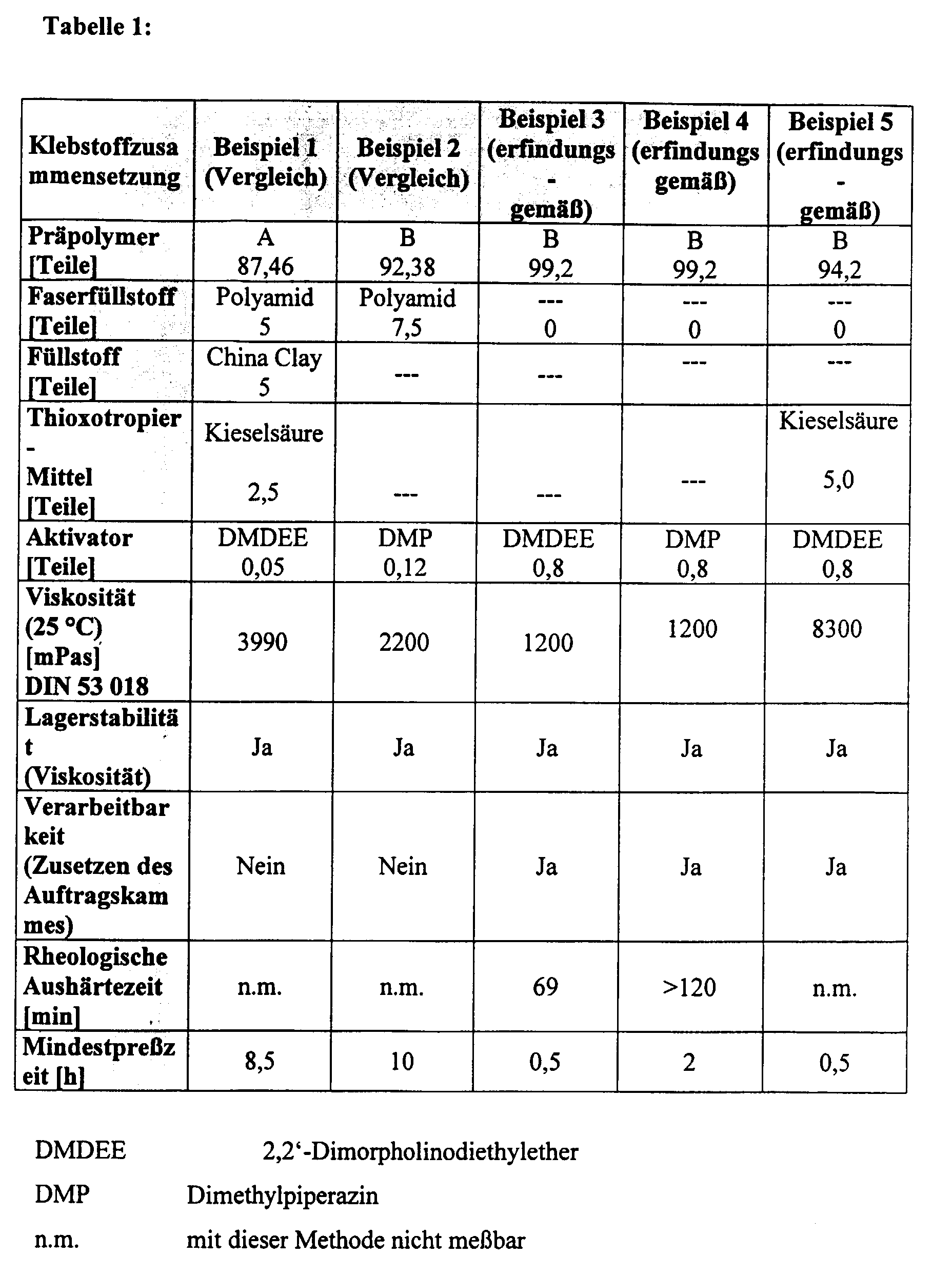
- This adhesive composition has in particular a viscosity that is not very suitable for processing and unrelated pressing times on. The viscosity is particularly important for the pumpability and ability of the Penetrating adhesive composition into the substrate to be bonded by of great importance (adhesion).
- Filler-containing adhesive compositions are particularly useful in the mechanical bonding of surfaces disadvantageous, the tight and deep Have incisions.
- a surface is, for example, at Finger jointing in accordance with DIN 68140 Part 1 can be found.
- the Tines are generally designed as pointed triangles in their cross-section, so that an equally pointed, triangular incision from one leg of two adjacent tines is formed.
- the adhesive application area is adapted in its shape to the incisions.
- the adhesive composition from the flanks of this Applicator comb which usually have approximately the same length as the legs, by means of slots arranged in this area.
- An object of the present invention is therefore, a To provide adhesive composition that is associated with clogging and the formation of deposits associated disadvantages. About that In addition, such an adhesive composition is said to have no formaldehyde emissions exhibit. In addition, this adhesive composition must be a good one Show pumpability, processability and storage stability.
- Adhesive composition especially in civil engineering existing requirements, in particular from state testing institutes be at least as sufficient as the previously used Adhesive compositions, especially those based on phenol / resorcinol or Melamine / urea resins or on an isocyanate-containing polyurethane prepolymer as well as filler-based adhesive compositions comparable applications.
- the adhesive composition in the Range from 70 to 99.99, preferably 80 to 99.99 and particularly preferably 85 to 99.99% by weight of the prepolymer and 0.01 to 5, preferably 0.01 to 3 and particularly preferably 0.01 to 1 wt .-% of the activator and optionally as The rest, up to a total of 100% by weight, of further additives and auxiliaries, each based on the adhesive composition.
- the viscosity at 25 ° C of the prepolymer is preferably in a range between 300 and 15,000, preferably 500 and 10,000 mPas if the Adhesive composition should be pumpable.
- the adhesive composition is low in solvents. This is the case if those in the Amount of solvent contained in the adhesive composition ⁇ 10, preferably ⁇ 5 and is particularly preferably ⁇ 2% by weight.
- solvents According to the invention organic and inorganic liquids, which are carriers the other components of the adhesive composition and not with harden at least some of the other components but from the cured adhesive are removable.
- the invention Adhesive composition preferably solvent-free.
- the adhesive composition according to the invention are both the aforementioned main feature (a) of the prepolymer and that Main feature (b) of component A realized.
- Adhesive composition are all of the main features as well as all of them Sub-characteristics met.
- the activator of the adhesive composition according to the invention consists at least from a morpholine derivative.
- morpholine derivatives 4-methylmorpholine, 4-ethylmorpholine, 4-cyclohexylmorpholine are suitable, 2,2'-dimorpholinodiethyl ether or dimorpholinopolyethylene glycol, or at least two of them.
- other activating compounds such as those used as polyurethane catalysts in Becker / Braun, Kunststoff Handbuch 7 (1993), are used, preferably the proportion of the morpholine derivatives prevails.
- thixotropic auxiliaries of Adhesive composition can be added. It is preferred that the thixotropic auxiliaries are not present as solids, which can act as fillers would be suitable. Soluble thixotropic auxiliaries are therefore particularly useful preferred, for example, via the reaction of an isocyanate in the presence can be obtained from amines, as described in EP 300 388 A1, DD 156 480, DD 211 689, DD 211 930 and DD 211 931.
- the adhesive composition have no adhesive composition Filler as an ingredient, but beyond that is also in the Adhesive composition used prepolymer free of fillers.
- Adhesive compositions are used thixotropic aids, whereby it is particularly preferred that in addition to the thixotropic auxiliaries Fillers are used.
- Thixotropic aids are very small substances that Liquids already thicken when in small amounts of the liquid, for example up to a maximum of 10% by weight, based on the liquid become. These small particles preferably have on their surface Silano groups, with the liquid with which they are dispersed under Formation of hydrogen bonds interact and thus lead to a thickening of this liquid.
- Typical for thixotropic Aid is that with the same amount the thickening effect decreases Particle size with appropriate careful dispersion by vigorous mixing increases.
- the thixotropic auxiliaries have the advantage that they Do not sediment in the dispersed liquid.
- thixotropic auxiliaries are in fine powder form montmorillonite, Mg / Al silicate, Al / Na silicate, bentonite, hectorite, Na / Mg silicate, pyrogenic silicas, hydrated silica, hornblende-chrysotile, chrysotile-asbestos, chrysotile-silica as well as precipitated MgO, with pyrogenic silicas, for example available as Aerosil from Degussa-Hüls AG, and Mg silicates, available as Bentone from Kronos Titan GmbH Leverkusen, are preferred and Aerosil is particularly preferred.
- the adhesive composition according to the invention is produced by by bringing the previously defined components into contact with each other. This is preferably done in the presence of mixing devices, whereby both dynamic and static, preferably dynamic, Mixing devices can be used.
- the prepolymer according to the invention is preferably obtained by submitted component B and component A, in a temperature range between 20 and 120, preferably 40 to 100 and particularly preferably 60 to 90 ° C. is added in a reactor with a mixing unit.
- the ingredients are preferably so extensive by the mixing devices mixed with each other that a homogeneous adhesive composition is available from the ingredients.
- the viscosity of the adhesive composition is preferably at 25 ° C. a range from 300 to 15,000, preferably 500 to 10,000 mPas for pumpable adhesive compositions.
- the storage stability of the adhesive composition is determined by the viscosity of the Adhesive composition determined.
- the storage stability exists if in a rapid aging test the viscosity at 25 ° C Adhesive composition after storage for a given period of time with the exclusion of air and moisture by no more than 20% the value before storage has increased.
- the processability is present when there is a Operating time of 8 hours no residue of adhesive composition residues on the comb-like applicator for finger jointing results.
- Adhesive composition has at least of the aforementioned features the viscosity (A) and the storage stability (C).
- Adhesive composition of the aforementioned material properties at least the viscosity (A), the storage stability (C) and the NCO content (D) on.
- Adhesive composition of the aforementioned material properties at least the viscosity (A), the storage stability (C) and the NCO content (D) and the minimum pressing time (E).
- Adhesive composition exhibits all of the aforementioned material properties (A) to (E).
- the invention further relates to a composite comprising at least one substrate and contains an adhesive composition according to the invention.
- the substrate is preferably a cellulosic material.
- cellulosic materials come all naturally occurring and artificially known to the expert manufactured materials into consideration.
- naturally occurring materials in particular woods of different trees, for example conifers or Hardwoods, called.
- Artificial, cellulose-containing materials are, for example Papers, cardboards, laminates, chipboard and the like.
- a preferred composite are continuous wood boards that consist of at least two their end pieces connected to each other via a finger joint Single boards exist, the finger joints by means of the invention Adhesive composition are connected.
- a further preferred composite according to the invention is glulam that consist of a large number of flat glued single boards, the Boards with each other at least partially, preferably entirely, by means of the adhesive composition according to the invention are connected.
- Single boards can also be used in continuous wood boards.
- the adhesive composition according to the invention is particularly suitable for Manufacture of finger-glued wooden boards.
- the flexural strength of the wood type spruce which is usually used for the production of broad-layer wood, is in the range from 65 to 70 N / mm 2 .
- the composites according to the invention are suitable as load-bearing structures Part of roof, bridge and ceiling structures also for Manufacture of concrete formwork, in particular as a concrete formwork beam and in Scaffolding, especially as scaffolding coverings.
- the substrate breakage and shear strength values for different types of wood can be found in the wood dictionary DRW-Verlag, 3rd edition 1988.
- the substrate breakage of the commonly used spruce wood is approximately 7.5 N / mm 2 .
- components A and B are preferred in adhesive composition such a ratio that the properties described above of the prepolymer, in particular the NCO content and the viscosity become.
- auxiliaries and Additives or catalysts are used.
- polyols selected from the group of polyetherols and Polyesterols, polythioether polyols, hydroxyl-containing polyacetals and aliphatic polycarbonates containing hydroxyl groups, polycarbonate diols and Polycaprolactone diols or mixtures of at least two of the above Polyols. Polyesterols and / or polyetherols are preferably used.
- the hydroxyl number of the polyhydroxyl compounds is generally 20 up to 850 mg KOH / g and preferably 25 to 500 mg KOH / g.
- Diols and / or Triols with molecular weights from 60 to ⁇ 400 as chain extenders and / or Crosslinking agents used in the inventive method become.
- the chain extension and / or Crosslinking agents preferably have a molecular weight of 60 to 300 g / mol.
- polyetherols in particular polyetherols based on highly functional alcohols, sugar alcohols and / or saccharides can be used as starter molecules.
- 2- and / or 3-functional polyether or polyesterols are based Glycerin and / or trimethylolpropane and / or glycols as starter molecules or alcohols to be esterified.
- the polyetherols are produced here according to a known technology.
- Suitable alkylene oxides for the preparation of the Examples of polyols are tetrahydrofuran, ethylene oxide, 1,3-propylene oxide, 1,2- and 2,3-butylene oxide, styrene oxide, preferably ethylene oxide and 1,2-propylene oxide.
- the alkylene oxides can be used individually, alternately in succession or as Mixtures are used.
- are particularly preferred in the prepolymer such as polyetherols in the adhesive composition according to the invention used, which alkoxylated with ethylene oxide to complete the alkoxylation were and thus have primary hydroxyl groups.
- starter molecules are: water, glycols, such as Ethylene glycol, propylene glycol, 1,4-butanediol and 1,6-hexanediol, amines, such as Ethylenediamine, hexamethylenediamine, and 4,4'-diaminodiphenylmethane and Amino alcohols, such as ethanolamine or triethanolamine.
- glycols such as Ethylene glycol, propylene glycol, 1,4-butanediol and 1,6-hexanediol
- amines such as Ethylenediamine, hexamethylenediamine, and 4,4'-diaminodiphenylmethane
- Amino alcohols such as ethanolamine or triethanolamine.
- the polyetherols have a functionality of preferably 2 to 6 and in particular 2 to 3 and molecular weights of 400 to 10,000, preferably 1,000 to 7,000.
- the polyetherols can be used alone or in mixtures become.
- Polycarbonate diols are also suitable. Such come as polycarbonate diols with aromatic dihydroxy compounds, e.g. B. based on 4,4'-dihydroxydiphenyl-2,2-propane or those based on aliphatic dihydroxy compounds, e.g. B. 1,6-hexanediol, in question.
- the molar masses range from 500 to 4,000, preferably from 1,000 to 2,000.
- Suitable polyesterols as the polyol component can, for example, consist of organic dicarboxylic acids having 2 to 12 carbon atoms, preferably aliphatic dicarboxylic acids with 4 to 6 carbon atoms, and polyvalent Alcohols, preferably diols, having 2 to 12 carbon atoms, preferably 2 up to 6 carbon atoms or by polymerizing lactones with 3 to 20 Carbon atoms are made.
- Can be used as dicarboxylic acids for example glutaric acid, pimelic acid, suberic acid, sebacic acid, dodecanoic acid and preferably use adipic acid, succinic acid and phthalic acid.
- the Dicarboxylic acids can be used individually or as mixtures.
- Dicarboxylic acids are the corresponding acid derivatives, such as carboxylic anhydrides or to use carboxylic acid chlorides.
- Suitable aromatic dicarboxylic acids are terephthalic acid, isophthalic acid or mixtures of these with others Dicarboxylic acids, e.g. B. diphenic acid, sebacic acid, succinic acid and Adipic acid.
- suitable glycols are diethylene glycol, 1,5-pentanediol, 1,10-decanediol and 2,2,4-trimenthylpentanediol-1,5.
- 1,2-ethanediol, 1,4-butanediol, 1,6-hexanediol and 2,2-dimethylpropanediol-1,3 are used; 1,4-dimethylolcyclohexane; 1,4-diethanolcyclohexane, ethoxylated / propoxylated products of 2,2-bis (4-hydroxy-phenylene) propane (Bisphenol A).
- B 2,2-bis (4-hydroxy-phenylene) propane
- Suitable lactones for the preparation of the polyesterols are, for. B.
- polyesterols preferably have a functionality of 2 to 4, in particular 2 to 3, and a molecular weight of 1,200 to 3,000, preferably 1,500 to 3,000 and in particular 1,500 to 2,500.
- polyol mixtures have been found in particular for the prepolymer proven.
- Such polyol mixtures preferably have at least one diol, preferably polypropylene glycol and at least one triol, preferably Polyether triol.
- Particularly suitable diols have a medium one Molecular weight in the range from 500 to 3,000, preferably 700 to 1,500 and particularly preferably 800 to 1,500 and more preferably 800 to 1,200 on.
- Triols with an average molecular weight of 1,000 have been found to 8,000, preferably 2,000 to 6,000 and particularly preferably 3,000 to 5,000 proven.
- the polyol mixture has an OH number in the Range from 30 to 140, preferably 50 to 90 and particularly preferably 60 to 80 mg KOH / g.
- the aforementioned diols and triols can not only be used as Polyol mixture but also individually for the preparation of the prepolymer be used.
- a polyether polyol which preferably has primary hydroxyl groups has, with an OH number in the range of 10 to 60, preferably 20 to 40 and proven particularly preferred 25 to 35 mg KOH / g.
- Chain extenders are used to prepare the prepolymers, Crosslinking agents or mixtures thereof are used, these come expediently in an amount of 0 to 20% by weight, preferably 0.5 up to 5% by weight, based on the weight of the total used Isocyanate-reactive compounds are used.
- Component B isocyanates or polyisocyanates come per se known aliphatic, cycloaliphatic, araliphatic and / or aromatic isocyanates, preferably diisocyanates, in question, if appropriate biuretized and / or isocyanurated by generally known methods may have been.
- Alkylene diisocyanates with 4 to 12 carbon atoms with alkylene radical such as 1,12-dodecane diisocyanate, 2-ethyltetramethylene diisocyanate-1,4, 2-methylpentamethylene diisocyanate-1,5, 1,4-tetramethylene diisocyanate, Lysine ester diisocyanates (LDI), hexamethylene diisocyanate 1,6 (HDI), cyclohexane 1,3- and / or 1,4-diisocyanate, 2,4- and 2,6-hexahydro-toluenediisocyanate and the corresponding mixtures of isomers, 4,4'-, 2,2'- and 2,4'-dicyclohexylmethane diisocyanate and the corresponding isomer mixtures, 1-isocyanato-3,3,5-trimethyl-5-isocyanotomethylcyclohexane (IPDI), 2,4- and / or 2,
- IPDI
- MDI such as polymer MDI or preferably monomer MDI, in particular 4,4'-MDI, or mixtures of 2,4'-MDI and 4,4'-MDI.
- the prepolymer has been shown to be:
- a polymer MDI with medium functionality has proven particularly suitable in the range from 1 to 5, preferably 1.5 to 4 and particularly preferably 2 to 3.5 and a viscosity in the range of 100 to 400, preferably 150 to 300 and particularly preferably 160 to 260 mPas to use.
- Well-known compounds can be used as catalysts, which is the reaction of isocyanates with those reactive towards isocyanates Accelerate connections strongly, preferably a Total catalyst content of 0.01 to 8% by weight, in particular 0.1 to 5% by weight, based on the weight of the total isocyanates used reactive compounds.
- the following Compounds are used: triethylamine, tributylamine, Dimethylbenzylamine, dicyclohexylmethylamine, dimethylcyclohexylamine, N, N, N ', N'-tetramethyl-diamino-diethyl ether, bis- (dimethylaminopropyl) urea, N-methyl or N-ethylmorpholine, N, N'-dimorpholinodiethyl ether (DMDEE), N-cyclohexylmorpholine, N, N, N ', N'-tetramethylethylenediamine, N, N, N ', N'-tetramethylbutanediamine, N, N, N', N'-tetramethylhexanediamine-1,6, Pentamethyldiethylenetriamine, dimethylpiperazine, N-dimethylaminoethylpiperidine, 1,2-dimethylimidazole, N-hydroxypropylim
- N, N ', N-tris- (dimethylaminopropyl) -s-hexahydrotriazine Iron (II) chloride, zinc chloride, lead octoate and preferably tin salts, such as tin dioctoate, tin diethylhexoate, Dibuthyltin dilaurate and / or dibutyldilauryltin mercaptide, 2,3-dimethyl-3,4,5,6-tetrahydropyrimidine, Tetraalkylammonium hydroxides, such as Tetramethylammonium hydroxide, alkali hydroxides, such as sodium hydroxide, Alkaline alcoholates, such as sodium methylate and potassium isopropoxide and / or Alkali salts of long chain fatty acids with 10 to 20 carbon atoms and optionally pendant OH groups.
- Iron (II) chloride zinc chloride
- lead octoate and preferably tin salts
- Trimerization catalysts such as alkali or alkaline earth acetate, preferably Potassium acetate.
- the above catalysts can also be added used as an activator for the morpholine derivatives used as activators become.
- catalysts are incorporated into the prepolymer as such Production and activators with the prepolymer as an additional component of the adhesive composition according to the invention incorporated therein.
- Ti compounds in particular Ti (IV) -O-alkyl compounds, with alkyl groups such as methyl, ethyl, n-propyl, Isopropyl, n-butyl, isobutyl, tert-butyl, n-penty, 2-pentyl, 3-pentyl, preferred Ethyl, n-propyl, isopropyl, n-butyl, isobutyl, tert-butyl and particularly preferred Ti (IV) butylate, proven.
- auxiliaries and / or additives can be added to the reaction mixture for producing the prepolymers.
- auxiliaries and / or additives can be added to the reaction mixture for producing the prepolymers.
- examples include surface-active substances, stabilizers, cell regulators, dyes, pigments, flame retardants, hydrolysis protection agents, fungistatic and bacteriostatic substances.
- the surface-active substances and stabilizers act as one Skin formation "against the surface of the adhesive composition facing the air. Furthermore, the surface-active substances and stabilizers improve the flow of the adhesive composition as well as the creeping ability of the adhesive composition and the degassing thereof.
- Emulsifiers such as the sodium salts of castor oil sulfates or of fatty acids and salts of fatty acids with amines, for example oleic acid diethylamine, stearic acid diethanolamine, ricinoleic acid diethanolamine, salts of sulfonic acids, for example alkali metal or ammonium salts of dodecylbenzene may be mentioned, for example - or dinaphthylmethane disulfonic acid and ricinoleic acid; stabilizers, such as siloxane-oxalkylene copolymers and other organopolysiloxanes, ethoxylated alkylphenols, ethoxylated fatty alcohols, paraffin oils, castor oil or ricinoleic acid esters, door kisch red oil and peanut oil, and cell regulators, such as paraffins, fatty alcohols and dimethyl
- oligomeric acrylates described above with polyoxyalkylene and fluoroalkane radicals as side groups are also suitable for improving the emulsifying action, the cell structure and / or stabilizing the prepolymer. If foaming is to be reduced or avoided, trialkyl phosphates are preferred as defoamers.
- alkyl groups such as methyl, ethyl, n-propyl, isopropyl, n-butyl, isobutyl, tert-butyl, n-pentyl, 2-pentyl, 3-pentyl, preferably ethyl, n-propyl, isopropyl, n-butyl , Isobutyl, tert-butyl.
- the surface-active substances are usually used in amounts of from 0.01 to 5% by weight, based on 100% by weight of the total of compounds used which are reactive toward isocyanates.
- Suitable flame retardants are, for example, tricresyl phosphate, tris (2-chloroethyl) phosphate, Tris (2-chloropropyl) phosphate, tris (1,3-dichloropropyl) phosphate, Tris (2,3-dibromopropyl) phosphate, tetrakis (2-chloroethyl) ethylene diphosphate, Dimethylmethanephosphonat, Diethanolaminomethylphosphonklarediethylester as well as commercially available halogen-containing flame retardant polyols.
- Halogen-substituted phosphates mentioned can also be inorganic or organic flame retardants, such as red phosphorus, aluminum oxide hydrate, Antimony trioxide, arsenic oxide, ammonium polyphosphate and calcium sulfate, expandable graphite or cyanuric acid derivatives, such as. B. melamine, or mixtures of at least two flame retardants, such as. B. ammonium polyphosphates and Melamine and optionally corn starch or ammonium polyphosphate, Melamine and expandable graphite and / or optionally aromatic polyester for Increase the flame resistance of the prepolymer or the adhesive composition be used.
- flame retardants such as red phosphorus, aluminum oxide hydrate, Antimony trioxide, arsenic oxide, ammonium polyphosphate and calcium sulfate, expandable graphite or cyanuric acid derivatives, such as. B. melamine, or mixtures of at least two flame retardants, such as. B. ammonium polyphosphates and Melamine and optional
- An adhesive composition according to the invention or one according to the invention Verbund can be used in building, civil engineering, shipbuilding, vehicle or aircraft construction, preferably use in civil engineering.
- the adhesive composition according to the invention in finger joint gluing use.
- Such finger joints are preferably spaced apart between the flank surfaces of the finger-jointed boards in the area from 0.05 to 0.2 mm, preferably 0.09 to 0.13 mm.
- the invention relates to high, low, ship, vehicle or Aircraft structures that have an adhesive composition or a composite or have both.
- the prepolymer has an NCO content of 17.5% and a viscosity of 750 mPas.
- the prepolymer has an NCO content of 15.0% and a viscosity of 1,200 mPas.
- Either the corresponding amount of activator was added after the preparation of the prepolymer, as described above by way of example, after the post-stirring phase, but before cooling, or it was dried in a container equipped with a stirrer, under a dryer, in a step following the preparation of the prepolymer
- the appropriate amount of prepolymer was introduced into the atmosphere and the appropriate amount of activator was added at room temperature, and the mixture was then homogenized using a stirrer.
- the storage stability is determined by the viscosity of the adhesive composition certainly. According to the invention, storage stability is accordingly present if in one Aging rapid test the viscosity of the adhesive composition after the Storage for 4 weeks at 60 ° C in the absence of air and moisture has not increased by more than 20% compared to the initial value.
Landscapes
- Chemical & Material Sciences (AREA)
- Organic Chemistry (AREA)
- Health & Medical Sciences (AREA)
- Chemical Kinetics & Catalysis (AREA)
- Medicinal Chemistry (AREA)
- Polymers & Plastics (AREA)
- Adhesives Or Adhesive Processes (AREA)
- Materials For Medical Uses (AREA)
- Prostheses (AREA)
- Brushes (AREA)
- Gloves (AREA)
- Socks And Pantyhose (AREA)
Abstract
- bis zu 99,999 Gew.-% der Klebstoffzusammensetzung eines Präpolymers, erhältlich aus mindestens einer eine gegenüber Isocyanaten reaktive Verbindung aufweisenden Komponente A und mindestens einer ein Isocyanat aufweisenden Komponente B,
- 0 bis 20 Gew.-% übliche Zusatz- und Hilfsstoffe,
- 0,001 bis 10 Gew.-% eines Aktivators,
wobei kein Füllstoff enthalten ist,
ein Verfahren zur Herstellung der Klebstoffzusammensetzung, sowie die Verwendung der Klebstoffzusammensetzung oder eines diese Klebstoffzusammensetzung enthaltenden Verbunds im Hoch-, Tief-, Schiffs-, Flugzeug- oder Fahrzeugbau.
Description
- bis zu 99,999 Gew.-% der Klebstoffzusammensetzung eines Präpolymers, erhältlich aus mindestens einer eine gegenüber Isocyanaten reaktive Verbindung aufweisenden Komponente A und mindestens einer ein Isocyanat aufweisenden Komponente B,
- 0 bis 20 Gew.-% übliche Zusatz- und Hilfsstoffe,
- 0,001 bis 10 Gew.-% eines Aktivators,
wobei kein Füllstoff als Bestandteil enthalten ist.
- für Lamellen der Sortierklasse S10, MS 10 ≥ 30 N/mm2
- für Lamellen der Sortierklasse S13 ≥ 35 N/mm2
- für Lamellen der Sortierklasse MS13 ≥ 40 N/mm2
- für Lamellen der Sortierklasse MS17 ≥ 45 N/mm2

| Zugscherprüfung nach DIN EN 302 Teil 1 | ||
| Behandlung | Mindestanforderung DIN EN 301 | Beispiel 3 |
| A1 | ||
| 0,1 mm | 10 | 11,3 |
| 0,3 mm | 9 | 9,2 |
| A4 | ||
| 0,1 mm | 6 | 6,4 |
| 0,3 mm | 5 | 5,3 |
| A5 | ||
| 0,1 mm | 8 | 9,3 |
| 0,3 mm | 7,2 | 7,2 |
Claims (12)
- Klebstoffzusammensetzung, als Bestandteile mindestens enthaltend:bis zu 99,999 Gew.-% der Klebstoffzusammensetzung eines Präpolymers, erhältlich aus mindestens einer eine gegenüber Isocyanaten reaktive Verbindung aufweisenden Komponente A und mindestens einer ein Isocyanat aufweisenden Komponente B,0 bis 20 Gew.-% übliche Zusatz- und Hilfsstoffe,0,001 bis 10 Gew.-% eines Aktivators,
wobei kein Füllstoff enthalten ist. - Klebstoffzusammensetzung nach Anspruch 1, mit mindestens einem der folgenden Hauptmerkmale:(a) das Präpolymer weist mindestens eines der folgenden Untermerkmale auf:(i) einen NCO-Gehalt von 5 bis 30 Gew.-%, bezogen auf das Präpolymer,(ii) eine Viskosität bei 25 °C im Bereich von 300 bis 15.000 mPas,(b) die Komponente A weist eines der folgenden Untermerkmale auf:(i) Komponente A enthält mindestens ein Diol oder Polyol,(ii) die OH-Zahl der Komponente A liegt im Bereich von 10 bis 500 KOH/g liegt.
- Klebstoffzusammensetzung nach einem der Ansprüche 1 bis 2, wobei der Aktivator aus mindestens einem Morpholinderivat besteht.
- Klebstoffzusammensetzung nach einem der Ansprüche 1 bis 3, wobei die Klebstoffzusammensetzung lösungsmittelarm ist.
- Verfahren zur Herstellung einer Klebstoffzusammensetzung nach einem der Ansprüche 1 bis 4, wobei die in Anspruch 1 definierten Bestandteile miteinander in Kontakt gebracht werden.
- Klebstoffzusammensetzung, erhältlich durch Inkontaktbringen der in Anspruch 1 definierten Bestandteile.
- Klebstoffzusammensetzung nach einem der Ansprüche 1 bis 4 oder 6 mit mindestens einer der folgenden Materialeigenschaften (A) bis (F):(A) Viskosität bei 25 °C im Bereich von 300 bis 15.000 mPas,(B) rheologische Aushärtezeit im Bereich von 10 bis 150 Minuten,(C) Lagerstabilität von 1 bis 4 Monaten,(D) NCO-Gehalt im Bereich von 3 bis 30 18 Gew.-%, bezogen auf die Klebstoffzusammensetzung,(E) Mindespreßzeit gemäß DIN 68141 im Bereich von 15 bis 150 Minuten.
- Verbund, mindestens enthaltend ein Substrat und eine Klebstoffzusammensetzung nach einem der Ansprüche 1 bis 4, 6 oder 7.
- Verbund nach Anspruch 8, mit mindestens einer der folgenden Materialeigenschaften:(F) eine Biegefestigkeit nach den Durchführungsrichtlinien der Gütegemeinschaft BS-Holz RAL RG 421 im Bereich von 20 bis 70 N/mm2,(G) eine Delaminierungsbeständigkeit nach DIN EN 302 Teil 2 von maximal 5 %, nach DIN EN 301,(H) eine Trockenscherfestigkeit im Bereich von mindestens 6 N/mm2 bis Substratbruch nach den Güterichtlinien der RAL-Gütegemeinschaft Holzleimbau.
- Verbund nach Anspruch 8 oder 9, wobei ein mindestens Holz enthaltendes Substrat schicht- oder keilzinkenverleimt, oder beides, wird.
- Verwendung einer Klebstoffzusammensetzung nach einem der Ansprüche 1 bis 4, 6 oder 7 oder eines Verbundes nach einem der Ansprüche 8 bis 10 im Hoch-, Tief-, Schiffs-, Fahrzeug- oder Flugzeugbau, vorzugsweise in Keilzinkenverleimungen.
- Hoch-, Tief-, Schiffs-, Fahrzeug- oder Flugzeugbauten aufweisend eine Klebstoffzusammensetzung nach einem der Ansprüche 1 bis 4, 6 oder 7 oder einen Verbund nach einem der Ansprüche 8 bis 10.
Applications Claiming Priority (2)
| Application Number | Priority Date | Filing Date | Title |
|---|---|---|---|
| DE19935489 | 1999-07-28 | ||
| DE19935489A DE19935489A1 (de) | 1999-07-28 | 1999-07-28 | Klebstoffzusammensetzung für Keilzinkenverleimung |
Publications (3)
| Publication Number | Publication Date |
|---|---|
| EP1072620A2 true EP1072620A2 (de) | 2001-01-31 |
| EP1072620A3 EP1072620A3 (de) | 2001-11-07 |
| EP1072620B1 EP1072620B1 (de) | 2005-09-21 |
Family
ID=7916383
Family Applications (1)
| Application Number | Title | Priority Date | Filing Date |
|---|---|---|---|
| EP00115031A Expired - Lifetime EP1072620B1 (de) | 1999-07-28 | 2000-07-25 | Klebstoffzusammensetzung für Keilzinkenverleimung |
Country Status (5)
| Country | Link |
|---|---|
| EP (1) | EP1072620B1 (de) |
| AT (1) | ATE305016T1 (de) |
| DE (2) | DE19935489A1 (de) |
| DK (1) | DK1072620T3 (de) |
| NO (1) | NO326177B1 (de) |
Cited By (7)
| Publication number | Priority date | Publication date | Assignee | Title |
|---|---|---|---|---|
| DE102007028922A1 (de) | 2007-06-22 | 2008-12-24 | Bayer Materialscience Ag | Polyisocyanatmischungen |
| DE102008018160A1 (de) | 2008-04-10 | 2009-10-15 | Bayer Materialscience Ag | Polyisocyanatgemische |
| DE102009058463A1 (de) | 2009-12-16 | 2011-06-22 | Bayer MaterialScience AG, 51373 | Polyisocyanatmischungen |
| WO2011138274A1 (de) | 2010-05-06 | 2011-11-10 | Bayer Materialscience Ag | Polyisocyanatprepolymere und deren verwendung |
| US8563137B2 (en) | 2009-04-30 | 2013-10-22 | Basf Se | Composite material comprising two or more superimposed layers of woods |
| WO2023285453A1 (en) | 2021-07-13 | 2023-01-19 | Akzo Nobel Coatings International B.V. | One-component moisture-curable adhesive composition |
| JP2024525541A (ja) * | 2021-07-13 | 2024-07-12 | アクゾ ノーベル コーティングス インターナショナル ビー ヴィ | 一液型湿気硬化性接着剤組成物 |
Families Citing this family (1)
| Publication number | Priority date | Publication date | Assignee | Title |
|---|---|---|---|---|
| DE50305488D1 (de) | 2002-02-08 | 2006-12-07 | Henkel Kgaa | Farbneutraler 1K Polyurethan-Klebstoff |
Family Cites Families (3)
| Publication number | Priority date | Publication date | Assignee | Title |
|---|---|---|---|---|
| DE4032191A1 (de) * | 1990-10-08 | 1992-04-09 | Basf Schwarzheide Gmbh | Verfahren zur herstellung eines feuchtigkeitshaertenden polyurethan-einkomponentenklebstoffes |
| AU667448B2 (en) * | 1994-02-22 | 1996-03-21 | National Starch And Chemical Investment Holding Corporation | Catalyst for reactive hot melt adhesives |
| DE4412759A1 (de) * | 1994-04-13 | 1995-10-19 | Beiersdorf Ag | Polyurethan-Klebstoff für tragende Holzbauteile |
-
1999
- 1999-07-28 DE DE19935489A patent/DE19935489A1/de not_active Withdrawn
-
2000
- 2000-07-25 DK DK00115031T patent/DK1072620T3/da active
- 2000-07-25 EP EP00115031A patent/EP1072620B1/de not_active Expired - Lifetime
- 2000-07-25 AT AT00115031T patent/ATE305016T1/de active
- 2000-07-25 DE DE50011197T patent/DE50011197D1/de not_active Expired - Lifetime
- 2000-07-27 NO NO20003854A patent/NO326177B1/no not_active IP Right Cessation
Cited By (17)
| Publication number | Priority date | Publication date | Assignee | Title |
|---|---|---|---|---|
| DE102007028922A1 (de) | 2007-06-22 | 2008-12-24 | Bayer Materialscience Ag | Polyisocyanatmischungen |
| WO2009000405A1 (de) | 2007-06-22 | 2008-12-31 | Bayer Materialscience Ag | Polyisocyanatmischungen |
| US7985479B2 (en) | 2007-06-22 | 2011-07-26 | Bayer Materialscience Ag | Polyisocyanate mixtures, processes for preparing the same and uses therefor |
| DE102008018160A1 (de) | 2008-04-10 | 2009-10-15 | Bayer Materialscience Ag | Polyisocyanatgemische |
| US8563137B2 (en) | 2009-04-30 | 2013-10-22 | Basf Se | Composite material comprising two or more superimposed layers of woods |
| DE102009058463A1 (de) | 2009-12-16 | 2011-06-22 | Bayer MaterialScience AG, 51373 | Polyisocyanatmischungen |
| WO2011138274A1 (de) | 2010-05-06 | 2011-11-10 | Bayer Materialscience Ag | Polyisocyanatprepolymere und deren verwendung |
| DE102010019504A1 (de) | 2010-05-06 | 2011-11-10 | Bayer Materialscience Ag | Polyisocyanatprepolymere und deren Verwendung |
| WO2023285453A1 (en) | 2021-07-13 | 2023-01-19 | Akzo Nobel Coatings International B.V. | One-component moisture-curable adhesive composition |
| CN117615905A (zh) * | 2021-07-13 | 2024-02-27 | 阿克佐 诺贝尔国际涂料股份有限公司 | 单组分可湿固化粘合剂组合物 |
| EP4370328A1 (de) * | 2021-07-13 | 2024-05-22 | Akzo Nobel Coatings International B.V. | Einkomponentige feuchtigkeitshärtende klebstoffzusammensetzung |
| JP2024525549A (ja) * | 2021-07-13 | 2024-07-12 | アクゾ ノーベル コーティングス インターナショナル ビー ヴィ | 一液型湿気硬化性接着剤組成物 |
| JP2024525541A (ja) * | 2021-07-13 | 2024-07-12 | アクゾ ノーベル コーティングス インターナショナル ビー ヴィ | 一液型湿気硬化性接着剤組成物 |
| US12091587B2 (en) * | 2021-07-13 | 2024-09-17 | Akzo Nobel Coatings International B.V. | One-component moisture-curable adhesive composition |
| EP4370328B1 (de) * | 2021-07-13 | 2025-06-11 | Akzo Nobel Coatings International B.V. | Einkomponentige feuchtigkeitshärtbare klebstoffzusammensetzung |
| US12460106B2 (en) | 2021-07-13 | 2025-11-04 | Akzo Nobel Coatings International B.V. | One-component moisture-curable adhesive composition |
| CN117615905B (zh) * | 2021-07-13 | 2025-12-23 | 阿克佐诺贝尔国际涂料股份有限公司 | 单组分可湿固化粘合剂组合物 |
Also Published As
| Publication number | Publication date |
|---|---|
| DE50011197D1 (de) | 2006-02-02 |
| NO326177B1 (no) | 2008-10-13 |
| DE19935489A1 (de) | 2001-02-08 |
| NO20003854L (no) | 2001-01-29 |
| EP1072620A3 (de) | 2001-11-07 |
| DK1072620T3 (da) | 2006-01-16 |
| EP1072620B1 (de) | 2005-09-21 |
| NO20003854D0 (no) | 2000-07-27 |
| ATE305016T1 (de) | 2005-10-15 |
Similar Documents
| Publication | Publication Date | Title |
|---|---|---|
| DE69407306T2 (de) | Feuchtigkeitsaktivierbare klebstoffzusammensetzungen | |
| DE4033221A1 (de) | Zweikomponenten-polyurethanklebstoffe | |
| DE4443432A1 (de) | Unter Druck stehende, Treibmittel enthaltende Isocyanat-Semirpräpolymermischungen auf Basis von Mischungen aus Polyhydroxylverbindungen und Monoalkoholen und/oder Hydroxyketonen, ihre Verwendung zur Herstellung von Polyurethanschaumstoffen und ein Verfahren hierfür | |
| EP0093357A1 (de) | Verfahren zum Verleimen von lignocellulosehaltigen Rohstoffen mit einem Präpolymeren auf Basis eines urethanmodifizierten Diphenylmethandiisocyanatgemisches | |
| DE2141805A1 (de) | Polymere vom Polyurethantyp und diese enthaltende Klebstoffsysteme | |
| EP0019859B1 (de) | Verwendung selbsttrennender Bindemittel auf Isocyanat-/Sulfonsäure-Basis zur Herstellung von Formkörpern | |
| EP0957130B1 (de) | Verfahren zur Herstellung von Polyisocyanat-Polyadditionsprodukten | |
| EP1681310A1 (de) | Holzklebstoffe | |
| DE2455679C3 (de) | Verfahren und Bindemittel zum Herstellen einer elastischen Schicht aus Granulaten und einem Bindemittel | |
| WO2010125038A1 (de) | Verbundwerkstoff umfassend zwei oder mehrere übereinander angeordnete schichten eines holzartigen werkstoffes | |
| EP2424726A1 (de) | Verwendung eines verbundwerkstoffes auf basis eines einkomponenten-polyurethanklebstoffes | |
| EP1072620B1 (de) | Klebstoffzusammensetzung für Keilzinkenverleimung | |
| EP0903362A1 (de) | Verfahren zur Herstellung von Polyurethanschaumstoffen | |
| EP1072621B1 (de) | Faserhaltige Klebstoffzusammensetzung | |
| EP2424727A1 (de) | Verbundwerkstoff, umfassend zwei oder mehrere übereinander angeordnete schichten eines holzes | |
| EP3746294B1 (de) | Verbundelement mit verbesserten eigenschaften | |
| AU2002229693B2 (en) | Derived timber products consisting of wood parts glued by means of polyisocyanates | |
| DE19746807A1 (de) | Verfahren zur Herstellung von Polyurethanschaumstoffen | |
| EP1199319B1 (de) | Faserhaltige Klebstoffzusammensetzung | |
| EP3712189A1 (de) | Zweikomponentige polyurethanzusammensetzung | |
| DE19546371A1 (de) | Verfahren zur Herstellung Oligo- und/oder Polysaccharid-haltiger Polyurethane und daraus hergestellte Formteile | |
| DE1914365C3 (de) | Verwendung von Isocyanatgruppen aufweisenden Polyurethanen als Fugenvergußmassen | |
| EP1022297A1 (de) | Schalldämpfendes Polyurethan | |
| DE2415467A1 (de) | Fluessiger klebstoff | |
| EP0676427A2 (de) | Im Volumenverhältnis von 1:1 dosierbare 2 Komponentenpolyurethan-Reaktivklebstoffmassen |
Legal Events
| Date | Code | Title | Description |
|---|---|---|---|
| PUAI | Public reference made under article 153(3) epc to a published international application that has entered the european phase |
Free format text: ORIGINAL CODE: 0009012 |
|
| AK | Designated contracting states |
Kind code of ref document: A2 Designated state(s): AT BE CH CY DE DK ES FI FR GB GR IE IT LI LU MC NL PT SE |
|
| AX | Request for extension of the european patent |
Free format text: AL;LT;LV;MK;RO;SI |
|
| PUAL | Search report despatched |
Free format text: ORIGINAL CODE: 0009013 |
|
| AK | Designated contracting states |
Kind code of ref document: A3 Designated state(s): AT BE CH CY DE DK ES FI FR GB GR IE IT LI LU MC NL PT SE |
|
| AX | Request for extension of the european patent |
Free format text: AL;LT;LV;MK;RO;SI |
|
| 17P | Request for examination filed |
Effective date: 20011212 |
|
| AKX | Designation fees paid |
Free format text: AT BE CH CY DE DK ES FI FR GB GR IE IT LI LU MC NL PT SE |
|
| 17Q | First examination report despatched |
Effective date: 20021206 |
|
| GRAP | Despatch of communication of intention to grant a patent |
Free format text: ORIGINAL CODE: EPIDOSNIGR1 |
|
| GRAS | Grant fee paid |
Free format text: ORIGINAL CODE: EPIDOSNIGR3 |
|
| GRAA | (expected) grant |
Free format text: ORIGINAL CODE: 0009210 |
|
| AK | Designated contracting states |
Kind code of ref document: B1 Designated state(s): AT BE CH CY DE DK ES FI FR GB GR IE IT LI LU MC NL PT SE |
|
| PG25 | Lapsed in a contracting state [announced via postgrant information from national office to epo] |
Ref country code: GB Free format text: LAPSE BECAUSE OF FAILURE TO SUBMIT A TRANSLATION OF THE DESCRIPTION OR TO PAY THE FEE WITHIN THE PRESCRIBED TIME-LIMIT Effective date: 20050921 Ref country code: NL Free format text: LAPSE BECAUSE OF FAILURE TO SUBMIT A TRANSLATION OF THE DESCRIPTION OR TO PAY THE FEE WITHIN THE PRESCRIBED TIME-LIMIT Effective date: 20050921 Ref country code: IE Free format text: LAPSE BECAUSE OF FAILURE TO SUBMIT A TRANSLATION OF THE DESCRIPTION OR TO PAY THE FEE WITHIN THE PRESCRIBED TIME-LIMIT Effective date: 20050921 |
|
| REG | Reference to a national code |
Ref country code: GB Ref legal event code: FG4D Free format text: NOT ENGLISH |
|
| REG | Reference to a national code |
Ref country code: CH Ref legal event code: EP |
|
| REG | Reference to a national code |
Ref country code: IE Ref legal event code: FG4D Free format text: LANGUAGE OF EP DOCUMENT: GERMAN |
|
| REF | Corresponds to: |
Ref document number: 50011197 Country of ref document: DE Date of ref document: 20051027 Kind code of ref document: P |
|
| PG25 | Lapsed in a contracting state [announced via postgrant information from national office to epo] |
Ref country code: GR Free format text: LAPSE BECAUSE OF FAILURE TO SUBMIT A TRANSLATION OF THE DESCRIPTION OR TO PAY THE FEE WITHIN THE PRESCRIBED TIME-LIMIT Effective date: 20051221 |
|
| PG25 | Lapsed in a contracting state [announced via postgrant information from national office to epo] |
Ref country code: ES Free format text: LAPSE BECAUSE OF FAILURE TO SUBMIT A TRANSLATION OF THE DESCRIPTION OR TO PAY THE FEE WITHIN THE PRESCRIBED TIME-LIMIT Effective date: 20060101 |
|
| REG | Reference to a national code |
Ref country code: SE Ref legal event code: TRGR |
|
| REG | Reference to a national code |
Ref country code: DK Ref legal event code: T3 |
|
| REF | Corresponds to: |
Ref document number: 50011197 Country of ref document: DE Date of ref document: 20060202 Kind code of ref document: P |
|
| PG25 | Lapsed in a contracting state [announced via postgrant information from national office to epo] |
Ref country code: PT Free format text: LAPSE BECAUSE OF FAILURE TO SUBMIT A TRANSLATION OF THE DESCRIPTION OR TO PAY THE FEE WITHIN THE PRESCRIBED TIME-LIMIT Effective date: 20060221 |
|
| NLV1 | Nl: lapsed or annulled due to failure to fulfill the requirements of art. 29p and 29m of the patents act | ||
| GBV | Gb: ep patent (uk) treated as always having been void in accordance with gb section 77(7)/1977 [no translation filed] |
Effective date: 20050921 |
|
| REG | Reference to a national code |
Ref country code: IE Ref legal event code: FD4D |
|
| ET | Fr: translation filed | ||
| PLBE | No opposition filed within time limit |
Free format text: ORIGINAL CODE: 0009261 |
|
| STAA | Information on the status of an ep patent application or granted ep patent |
Free format text: STATUS: NO OPPOSITION FILED WITHIN TIME LIMIT |
|
| PG25 | Lapsed in a contracting state [announced via postgrant information from national office to epo] |
Ref country code: MC Free format text: LAPSE BECAUSE OF NON-PAYMENT OF DUE FEES Effective date: 20060731 Ref country code: BE Free format text: LAPSE BECAUSE OF NON-PAYMENT OF DUE FEES Effective date: 20060731 |
|
| 26N | No opposition filed |
Effective date: 20060622 |
|
| BERE | Be: lapsed |
Owner name: BASF A.G. Effective date: 20060731 |
|
| PG25 | Lapsed in a contracting state [announced via postgrant information from national office to epo] |
Ref country code: LU Free format text: LAPSE BECAUSE OF NON-PAYMENT OF DUE FEES Effective date: 20060725 |
|
| PG25 | Lapsed in a contracting state [announced via postgrant information from national office to epo] |
Ref country code: CY Free format text: LAPSE BECAUSE OF FAILURE TO SUBMIT A TRANSLATION OF THE DESCRIPTION OR TO PAY THE FEE WITHIN THE PRESCRIBED TIME-LIMIT Effective date: 20050921 |
|
| REG | Reference to a national code |
Ref country code: FR Ref legal event code: PLFP Year of fee payment: 16 |
|
| REG | Reference to a national code |
Ref country code: FR Ref legal event code: PLFP Year of fee payment: 17 |
|
| REG | Reference to a national code |
Ref country code: FR Ref legal event code: PLFP Year of fee payment: 18 |
|
| REG | Reference to a national code |
Ref country code: FR Ref legal event code: PLFP Year of fee payment: 19 |
|
| PGFP | Annual fee paid to national office [announced via postgrant information from national office to epo] |
Ref country code: IT Payment date: 20190725 Year of fee payment: 20 Ref country code: FI Payment date: 20190722 Year of fee payment: 20 Ref country code: FR Payment date: 20190726 Year of fee payment: 20 Ref country code: SE Payment date: 20190729 Year of fee payment: 20 Ref country code: DK Payment date: 20190723 Year of fee payment: 20 |
|
| PGFP | Annual fee paid to national office [announced via postgrant information from national office to epo] |
Ref country code: AT Payment date: 20190725 Year of fee payment: 20 |
|
| PGFP | Annual fee paid to national office [announced via postgrant information from national office to epo] |
Ref country code: DE Payment date: 20190930 Year of fee payment: 20 Ref country code: CH Payment date: 20190725 Year of fee payment: 20 |
|
| REG | Reference to a national code |
Ref country code: DE Ref legal event code: R071 Ref document number: 50011197 Country of ref document: DE |
|
| REG | Reference to a national code |
Ref country code: DK Ref legal event code: EUP Expiry date: 20200725 |
|
| REG | Reference to a national code |
Ref country code: CH Ref legal event code: PL |
|
| REG | Reference to a national code |
Ref country code: FI Ref legal event code: MAE |
|
| REG | Reference to a national code |
Ref country code: SE Ref legal event code: EUG |
|
| REG | Reference to a national code |
Ref country code: AT Ref legal event code: MK07 Ref document number: 305016 Country of ref document: AT Kind code of ref document: T Effective date: 20200725 |
|
| REG | Reference to a national code |
Ref country code: SE Ref legal event code: EUG |