EP1069758B1 - Übertragungsvorrichtung und -verfahren und Aufzeichnungsmedium - Google Patents
Übertragungsvorrichtung und -verfahren und Aufzeichnungsmedium Download PDFInfo
- Publication number
- EP1069758B1 EP1069758B1 EP00305505A EP00305505A EP1069758B1 EP 1069758 B1 EP1069758 B1 EP 1069758B1 EP 00305505 A EP00305505 A EP 00305505A EP 00305505 A EP00305505 A EP 00305505A EP 1069758 B1 EP1069758 B1 EP 1069758B1
- Authority
- EP
- European Patent Office
- Prior art keywords
- authentication information
- received data
- password
- data
- received
- Prior art date
- Legal status (The legal status is an assumption and is not a legal conclusion. Google has not performed a legal analysis and makes no representation as to the accuracy of the status listed.)
- Expired - Lifetime
Links
- 238000004891 communication Methods 0.000 title claims description 89
- 238000000034 method Methods 0.000 title claims description 58
- 230000006870 function Effects 0.000 claims description 29
- 230000005540 biological transmission Effects 0.000 claims description 14
- 230000008569 process Effects 0.000 description 14
- 238000012545 processing Methods 0.000 description 12
- 238000006243 chemical reaction Methods 0.000 description 6
- 230000008859 change Effects 0.000 description 3
- 238000010586 diagram Methods 0.000 description 3
- 230000006835 compression Effects 0.000 description 2
- 238000007906 compression Methods 0.000 description 2
- 238000012217 deletion Methods 0.000 description 2
- 230000037430 deletion Effects 0.000 description 2
- 230000000694 effects Effects 0.000 description 2
- 230000003287 optical effect Effects 0.000 description 2
- 101000628535 Homo sapiens Metalloreductase STEAP2 Proteins 0.000 description 1
- 102100026711 Metalloreductase STEAP2 Human genes 0.000 description 1
- 230000003213 activating effect Effects 0.000 description 1
- 230000004913 activation Effects 0.000 description 1
- 238000013475 authorization Methods 0.000 description 1
- 230000010365 information processing Effects 0.000 description 1
- 230000002401 inhibitory effect Effects 0.000 description 1
- 239000004973 liquid crystal related substance Substances 0.000 description 1
- 230000001360 synchronised effect Effects 0.000 description 1
- 238000013519 translation Methods 0.000 description 1
Images





Classifications
-
- H—ELECTRICITY
- H04—ELECTRIC COMMUNICATION TECHNIQUE
- H04N—PICTORIAL COMMUNICATION, e.g. TELEVISION
- H04N1/00—Scanning, transmission or reproduction of documents or the like, e.g. facsimile transmission; Details thereof
- H04N1/32—Circuits or arrangements for control or supervision between transmitter and receiver or between image input and image output device, e.g. between a still-image camera and its memory or between a still-image camera and a printer device
- H04N1/32358—Circuits or arrangements for control or supervision between transmitter and receiver or between image input and image output device, e.g. between a still-image camera and its memory or between a still-image camera and a printer device using picture signal storage, e.g. at transmitter
- H04N1/324—Circuits or arrangements for control or supervision between transmitter and receiver or between image input and image output device, e.g. between a still-image camera and its memory or between a still-image camera and a printer device using picture signal storage, e.g. at transmitter intermediate the transmitter and receiver terminals, e.g. at an exchange
-
- H—ELECTRICITY
- H04—ELECTRIC COMMUNICATION TECHNIQUE
- H04N—PICTORIAL COMMUNICATION, e.g. TELEVISION
- H04N1/00—Scanning, transmission or reproduction of documents or the like, e.g. facsimile transmission; Details thereof
- H04N1/32—Circuits or arrangements for control or supervision between transmitter and receiver or between image input and image output device, e.g. between a still-image camera and its memory or between a still-image camera and a printer device
- H04N1/32358—Circuits or arrangements for control or supervision between transmitter and receiver or between image input and image output device, e.g. between a still-image camera and its memory or between a still-image camera and a printer device using picture signal storage, e.g. at transmitter
- H04N1/324—Circuits or arrangements for control or supervision between transmitter and receiver or between image input and image output device, e.g. between a still-image camera and its memory or between a still-image camera and a printer device using picture signal storage, e.g. at transmitter intermediate the transmitter and receiver terminals, e.g. at an exchange
- H04N1/32406—Circuits or arrangements for control or supervision between transmitter and receiver or between image input and image output device, e.g. between a still-image camera and its memory or between a still-image camera and a printer device using picture signal storage, e.g. at transmitter intermediate the transmitter and receiver terminals, e.g. at an exchange in connection with routing or relaying, e.g. using a fax-server or a store-and-forward facility
- H04N1/32411—Handling instructions for routing or relaying
-
- H—ELECTRICITY
- H04—ELECTRIC COMMUNICATION TECHNIQUE
- H04N—PICTORIAL COMMUNICATION, e.g. TELEVISION
- H04N1/00—Scanning, transmission or reproduction of documents or the like, e.g. facsimile transmission; Details thereof
- H04N1/44—Secrecy systems
- H04N1/4406—Restricting access, e.g. according to user identity
- H04N1/4413—Restricting access, e.g. according to user identity involving the use of passwords, ID codes or the like, e.g. PIN
-
- H—ELECTRICITY
- H04—ELECTRIC COMMUNICATION TECHNIQUE
- H04L—TRANSMISSION OF DIGITAL INFORMATION, e.g. TELEGRAPHIC COMMUNICATION
- H04L63/00—Network architectures or network communication protocols for network security
- H04L63/04—Network architectures or network communication protocols for network security for providing a confidential data exchange among entities communicating through data packet networks
- H04L63/0428—Network architectures or network communication protocols for network security for providing a confidential data exchange among entities communicating through data packet networks wherein the data content is protected, e.g. by encrypting or encapsulating the payload
-
- H—ELECTRICITY
- H04—ELECTRIC COMMUNICATION TECHNIQUE
- H04N—PICTORIAL COMMUNICATION, e.g. TELEVISION
- H04N1/00—Scanning, transmission or reproduction of documents or the like, e.g. facsimile transmission; Details thereof
- H04N1/32—Circuits or arrangements for control or supervision between transmitter and receiver or between image input and image output device, e.g. between a still-image camera and its memory or between a still-image camera and a printer device
- H04N1/32101—Display, printing, storage or transmission of additional information, e.g. ID code, date and time or title
- H04N1/32128—Display, printing, storage or transmission of additional information, e.g. ID code, date and time or title attached to the image data, e.g. file header, transmitted message header, information on the same page or in the same computer file as the image
-
- H—ELECTRICITY
- H04—ELECTRIC COMMUNICATION TECHNIQUE
- H04N—PICTORIAL COMMUNICATION, e.g. TELEVISION
- H04N2201/00—Indexing scheme relating to scanning, transmission or reproduction of documents or the like, and to details thereof
- H04N2201/32—Circuits or arrangements for control or supervision between transmitter and receiver or between image input and image output device, e.g. between a still-image camera and its memory or between a still-image camera and a printer device
- H04N2201/3201—Display, printing, storage or transmission of additional information, e.g. ID code, date and time or title
- H04N2201/3225—Display, printing, storage or transmission of additional information, e.g. ID code, date and time or title of data relating to an image, a page or a document
- H04N2201/3233—Display, printing, storage or transmission of additional information, e.g. ID code, date and time or title of data relating to an image, a page or a document of authentication information, e.g. digital signature, watermark
-
- H—ELECTRICITY
- H04—ELECTRIC COMMUNICATION TECHNIQUE
- H04N—PICTORIAL COMMUNICATION, e.g. TELEVISION
- H04N2201/00—Indexing scheme relating to scanning, transmission or reproduction of documents or the like, and to details thereof
- H04N2201/32—Circuits or arrangements for control or supervision between transmitter and receiver or between image input and image output device, e.g. between a still-image camera and its memory or between a still-image camera and a printer device
- H04N2201/3201—Display, printing, storage or transmission of additional information, e.g. ID code, date and time or title
- H04N2201/3278—Transmission
Definitions
- the present invention relates to a communication apparatus and, more particularly, to a communication apparatus having a facsimile function and capable of connection to a LAN.
- a communication apparatus which has a facsimile function capable of connecting to a LAN in addition to an existing communication line such as a public services telephone network (PSTN).
- a communication apparatus of this type can output communication data, received via a public services telephone network (PSTN), onto a recording paper sheet and can also store the data in a predetermined memory (to be referred to as a memory box hereinafter) from which the stored data can be extracted from a terminal on a LAN.
- a document received in a memory box for which a predetermined password is set is treated as a secret document. This document is extracted by using the password set for the memory box.
- the present invention has been made to solve this problem, and has a concern to provide a communication apparatus capable of maintaining the secrecy of data received in a memory box when forwarding the data.
- United States Patent Specification No US-A-5751813 discloses an encryption server which receives a first encrypted message and decrypts the encrypted message using a first key, yielding a decrypted message comprising a second encrypted message, an identification of a sender of the first encrypted message, and an identification of a first recipient.
- the second encrypted message, the identification of the sender, and the identification of the first recipient are determined from the decrypted message.
- the second encrypted message and the identification of the sender are encrypted with a second key, yielding a third encrypted message.
- the third encrypted message is transmitted to the first recipient.
- United States Patent Specification No US-A-5621727 discloses a network hub system is connected to a communication cloud as well as messaging systems.
- a public access port interacts with a public virtual messaging system.
- a private access port interacts with a private virtual messaging system.
- Address translation tables are used to provide for identification of members of messaging communities which allow for the implementation of virtual private networks connected to hub system and other hubs.
- One aspect of the present invention provides a communication system as set out in claim 1.
- Another aspect of the present invention provides a method of transmitting data received by an image communication apparatus from another image communication device to a destination apparatus as set out in claim 13.
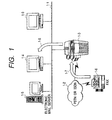
- Fig. 1 is a view showing the system configuration of a communication system using a communication apparatus according to this embodiment.
- a communication apparatus 1-3 is connected to a LAN (Local Area Network) 1-1 and a public line (PSTN or ISDN) 1-2.
- a plurality of terminal devices e.g., workstations or personal computers
- a facsimile apparatus 1-6 is connected to the public line 1-2.
- the communication apparatus 1-3 receives image data in a memory box via the public line 1-2 (a route 1-7). This image data can be extracted by the terminal device 1-4 or 1-9 via the LAN 1-1 (a route 1-8).
- Fig. 2 is a block diagram showing the arrangement of the communication apparatus according to the present invention.
- a CPU 2-3 and individual blocks are connected via a system bus 2-1 and an image bus 2-10.
- a ROM 2-2 is a boot ROM storing a boot program of the system. System software for realizing each means of the present invention is stored in this ROM 2-2 (or a storage memory 2-5) and read out and executed by the CPU 2-3.
- a RAM 2-4 is a system work memory area for executing software and stores data of a memory box management table for executing a memory box function and data of a conversion table required for format conversion. This RAM 2-4 also functions as an image memory for temporarily storing image data.
- the storage memory 2-5 stores facsimile coded data, image data, and system software.
- a LAN (Local Area Network) I/F unit 2-6 is an I/F unit for connecting to the Internet and is connected to the Internet via a device such as a remote router connected to the LAN.
- a line I/F unit 2-7 is connected to an ISDN or a public services telephone network and controlled by a communication control program in the ROM 2-2. This line I/F unit 2-7 has a function of exchanging data with a remote terminal via an ISDN I/F, a modem, or an NCU (Network Control Unit).
- the IO control B unit 2-8 is an I/F unit with which software controls the operation unit 2-15 including a display device and a keypad device. The above blocks are arranged on the system bus 2-1.
- An IO control A unit 2-9 is a bus bridge which connects the system bus 2-1 to the image bus 2-10 for transferring image data at high speed, and converts the data structure of the system bus 2-1.
- the image bus 2-10 is a PCI bus or IEEE1394. The following blocks are arranged on this image bus 2-10. That is, a reader unit 2-14 and printer unit 2-13 as image I/O devices are connected to a control unit 2-16 to perform synchronous/asynchronous conversion of image data.
- An image processing unit 2-11 corrects, processes, and edits input and output image data.
- An image converting unit 2-12 performs rotation, compression/expansion, binary-multilevel conversion, image density conversion, and compression/expansion processes such as JPEG, JBIG, MR, and MMR for image data.
- the ROM 2-2 stores a process program as a format converting means of the present invention, which converts facsimile image data into a password added image format and forms a password added file.
- a password added file is a file formed by adding password data of a predetermined format to image data.
- a workstation receiving this password added file is requested to input the password when opening the file by predetermined viewer software.
- the file can be referred to only when the passwords match.
- a secret document is received as a facsimile image in a memory box by a sub-address signal (to be referred to as an SUB signal hereinafter) of ITU-T recommendation T. 30 and a password signal (PWD signal).
- SUB signal sub-address signal
- PWD signal password signal
- Fig. 3 is a flow chart showing a pre-procedure in facsimile reception based on ITU-T recommendation T. 30.
- "SUB”, "PWD”, and "SEP” represent a sub-address frame, a password frame, and a selective polling frame, respectively.
- Node names (A), (B), (C), (D), (F), (R), and (III) are the same as node names in a flow chart recommended by ITU-T recommendation T. 30.
- “NSF”, “CSI”, “DIS”, “NSC”, “CIG”, “DTC”, “TSI”, “TCF”, “CFR”, and “FTT” are procedure signals defined by ITU-T recommendation T. 30.
- a procedure signal from a transmitter is received (step 3-3) while a DIS signal and the like are sent (step 3-2).
- This DIS signal declares that a "selective polling function” and a "password function” are available.
- a DCS signal and the like are received (step 3-7), the flow advances to step 3-8, and a known facsimile receiving procedure is executed to receive an image. Since a PWD signal and an SUB signal are sent as multiframes together with the DCS signal (step 3-7), these signals are acquired at this timing and used in the subsequent control.
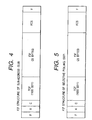
- Fig. 4 is a view showing the frame configuration of the SUB signal.
- An FIF facsimile information field of this sub-address stores a 20-byte ASCII code.
- this FIF stores information (a memory box number or the like) for specifying an internal memory box of the communication apparatus of the present invention in accordance with a predetermined format.
- Fig. 5 is a view showing the frame configuration of a selective polling signal (to be referred to as an SEP signal hereinafter).
- An FIF facsimile information field
- this selective polling FIF stores information for specifying an internal memory box of the communication apparatus of the present invention in accordance with a predetermined format as in the case of the sub-address.
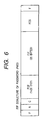
- Fig. 6 is a view showing the frame configuration of the PWD signal.
- An FIF of the password stores password information for classifying a facsimile image in accordance with a predetermined format.
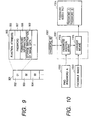
- Fig. 9 is a view showing an example of the data structure of a memory box management table for realizing a memory box function.
- data 902, 903, and 904 for managing box numbers 01, 02, and 03, respectively are set in a memory box management table 901.
- attribute information of a target memory box e.g., "confidential" meaning a secret document or "forwarding" to another apparatus is set.
- password 907 password data acquired from the PWD signal when an image is received is set. This password is preregistered by the operation unit 2-15 and forced to be input when image data in the target memory box is to be read out or erased.
- password data acquired from the PWD signal when an image is received is set.
- a storage destination of image data 909 information indicating the storage destination, in the communication apparatus 1-3, of the received image data is set.
- forwarding destination information of the image data is set. More specifically, a forwarding destination type, i.e., an Internet FAX, a common FAX other than an Internet FAX, a terminal device such as a workstation having an e-mail function, or a file server is set.
- This forwarding destination type is used to check for the ability of a forwarding destination apparatus to receive a secret document. For example, if the type is a common FAX, a document is transmitted as a facsimile image by sub-address/password communication. If the type is a workstation, a document is converted into a password added file and sent as e-mail.
- address information of the forwarding destination the telephone number as the address of a facsimile apparatus or the e-mail address as the address of an e-mail terminal and a file sharing device is set.
- image data received by sub-address/password communication is forwarded by converting it into a predetermined secret document format.
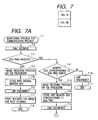
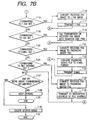
- Figs. 7A and 7B are flow charts showing an operation of processing an image received via the public line 1-7.
- a communication request such as a originating request or a terminating request is monitored (step 7-1)
- call incoming is received via the public line 1-2 (step 7-2).
- step 7-3 When an image is received, whether a sub-address or a password is received from the source station is checked by a pre-procedure (step 7-3).
- step 7-4/step 7-5 If neither a sub-address nor a password is received, the image is received in a common memory box (step 7-4/step 7-5). After the reception is completed, the line is disconnected (step 7-6), only one of printing and storage is performed in accordance with the user's setting (step 7-7), and the process is completed (step 7-8).
- the memory box management table 901 is searched to check whether a memory box corresponding to the received sub-address and password exists in the communication apparatus of the present invention (step 7-9). If no corresponding memory box exists, the line is disconnected (step 7-10), and the process is completed (step 7-11).
- step 7-9 If a memory box corresponding to the received sub-address and password exists in step 7-9, the image is received in this memory box (step 7-12/step 7-13), and the line is disconnected (step 7-14) after the reception is completed.
- the memory box management table 901 is checked for preset memory box forwarding setting (step 7-15/step 7-18/step 7-20/step 7-24/step 7-27). The image is forwarded or stored in accordance with the setting contents. If no forwarding is set, the image stored in the memory box is kept stored (step 7-28), and the process is completed (step 7-29).
- the image is converted into an Internet FAX image (step 7-16), and Internet FAX transmission is performed (step 7-17).
- the Internet FAX standard function has no secrecy (confidentiality) setting. However, control based on a unique procedure for adding the password received in step 7-3 is possible. Also, since the Internet FAX standard function has no secrecy (confidentiality) setting, to maintain the secrecy of data it is possible not to execute forwarding if the forwarding destination is an Internet FAX.
- step 7-19 Even if forwarding to a common FAX rather than an Internet FAX is set, the image is not converted into a secret document but transmitted as a confidential document to the other FAX by using the sub-address and password received in step 7-3 (step 7-19). If the other FAX apparatus has no confidential receiving function, no data forwarding is performed.
- the image is converted into a document data format (secret document) in which a password can be set (7-21), thereby forming a secret document in which the password received in step 7-3 is set.
- This secret document is converted into data transmittable by e-mail (step 7-22), and the e-mail is transmitted (step 7-23).
- This e-mail is transmitted to the terminal device 1-4 via the electronic mail server 1-5 by using, e.g., an STMP/POP protocol.
- the image is converted into a secret document in which the received password is set (step 7-25), as in the case of e-mail, and the document is transmitted to the file sharing destination (file server) (step 7-26).
- FTP or HTTP is an example of the transmission protocol.
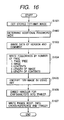
- step S1601 information (e.g., storage address) pertaining to the TIFF-MMR image stored in the memory box in step 7-13 of Fig. 7A is acquired.
- information e.g., storage address
- step S1602 on the basis of the password received in step 7-3 of Fig. 7A, an encryption key for encrypting the TIFF-MMR image is calculated.
- This cryptographic algorithm can be stream type encryption such as RC4. However, another cryptographic algorithm having an equivalent effect can also be used.
- An area is secured in the storage memory 2-5, and the generated file data is written in the area by the following processing steps.
- a password added file used in this embodiment is composed of a header portion, body portion, cross-reference portion, and trailer portion.
- the body portion stores the text of document data and individual components such as illustrations as objects.
- the cross-reference portion the storage positions of the objects stored in the body portion and the like are set.
- step S1603 version information and the like are written in the header portion of the file.
- step S1604 the body of the image, its attribute information, and the like are written in the body portion.
- step S1605 the TIFF-MMR image is encrypted by using the encryption key determined in step S1602.
- step S1606 a security handler for decrypting the data encrypted in step S1605 by using the encryption key is embedded in the trailer portion of the file.
- step S1607 pieces of information such as the trailer portion and the cross-reference portion to be set in the file are written.
- the password added file generated in the storage memory 2-5 is appropriately forwarded.
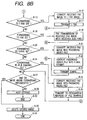
- Figs. 8A and 8B are flow charts showing an operation of performing calling from the communication apparatus 1-3 and processing an image received by selective polling from the facsimile apparatus 1-6 via the public line 1-7.
- polling reception activation is requested while a communication request such as a originating request or a terminating request is monitored (step 8-1)
- calling is performed via the public line 1-2 (step 8-2).
- step 8-3 Whether the user designates selective polling settings (settings of selective polling and a password) when activating polling reception is checked (step 8-3).
- step 8-4/step 8-5 If neither selective polling nor a password is set or if only selective polling is set, an image is received by polling in an ordinary memory box (step 8-4/step 8-5), and the line is disconnected after the reception is completed (step 8-6). After that, one of printing or storage is performed in accordance with the user's setting (step 8-7), and the process is completed (step 8-8). If the user designates both selective polling and a password, the flow advances from step 8-3 to step 8-9, and selective polling and the password are transmitted to the destination station (step 8-9). If the destination station does not permit selective polling and the password, this destination station disconnects the line (step 8-10), so the process is completed (step 8-11).
- the image is received in the corresponding memory box (step 8-12/step 8-13), and the line is disconnected after the reception is completed (step 8-14). After that, forwarding or storage is performed in accordance with forwarding setting (step 8-15/step 8-18/step 8-20/step 8-24/step 8-27) previously set by the user. If no forwarding is set, the image stored in the memory box is kept stored (step 8-28), and the process is completed (step 8-29). If forwarding to an Internet FAX is set, the image is not converted into a secret document because an Internet FAX has no secrecy (confidentiality) setting. That is, the image is converted into an Internet FAX image (step 8-16) and transmitted by Internet FAX (step 8-17).
- the Internet FAX standard function has no secrecy (confidentiality) setting. However, control based on a unique procedure for adding the password received in step 8-9 is possible. Also, since the Internet FAX standard function has no secrecy (confidentiality) setting, to maintain the secrecy of data, it is possible not to execute forwarding if the forwarding destination is an Internet FAX. Even if forwarding to a common FAX rather than an Internet FAX is set, the image is not converted into a secret document but transmitted as a confidential document to the other FAX by using selective polling and the password received in step 8-9 (step 8-19).
- the image is converted into a document data format (secret document) in which a password can be set (8-21), thereby forming a secret document in which the transmitted password is set.
- This secret document is converted into data transmittable by e-mail (step 8-22), and the e-mail is transmitted (step 8-23).
- the image is converted into a secret document in which the received password is set (step 8-25), as in the case of e-mail, and the document is transmitted to the file sharing destination (step 8-26). If even one of the above forwardings is implemented, the stored image in the communication apparatus 1-3 is deleted (step 8-30), and the process is completed (step 8-31).
- a communication apparatus of this third embodiment sets a plurality of stages of access modes when converting a received facsimile image into a password added file.
- versatile password added files use a plurality of types of passwords, e.g., a "read password” for permitting only read of a file and inhibiting change or deletion, and a "write password” for permitting read, change, and deletion of a file.
- a "read password” for permitting only read of a file and inhibiting change or deletion
- a "write password” for permitting read, change, and deletion of a file.
- the communication apparatus of this third embodiment When converting a received facsimile image into a password added file, the communication apparatus of this third embodiment generates a plurality of types of passwords and embeds them in the file.
- Fig. 10 is a view for explaining the arrangement of the third embodiment.
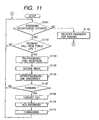
- Fig. 11 is a flow chart showing the operation of the communication apparatus of this third embodiment.
- step S1101 if it is detected in step S1101 that password registration is operated by the operation unit (2-15 in Fig. 2), the flow advances to step S1102 to register a "password B" 1007 as a read password in the RAM (2-4 in Fig. 2).
- step S1103 If in step S1103 a call incoming from a public line is detected, a pre-procedure is executed (step S1104). Subsequently, a facsimile image 1003 is received (step S1105), an after-procedure is executed, and the line is disconnected (step S1106). In the pre-procedure in step S1104, a "password A" 1002 is acquired from the FIF of a PWD signal received from the destination transmitter.
- step S1107 whether the facsimile image 1003 received in step S1105 is to be forwarded is determined. As in the first embodiment, this determination is done on the basis of the contents of preset forwarding setting of a memory box by checking the memory box management table 901. If the image is not to be forwarded, the image stored in the memory box is kept stored, and the flow advances to step S1101 to return to the wait state.
- step S1108 to convert the facsimile image 1003 into a password added file of a predetermined format which is data-exchanged on personal computers (corresponding to a convert means 1106 in Fig. 10).
- the "password B" registered in step S1002 and the "password A” acquired in step S1104 are embedded as a read password and a write password, respectively, in the file (corresponding to a password addition means 1105 in Fig. 10).
- a password added file 1004 generated by processes in steps S1108 and S1109 is forwarded (the path 1-8 in Fig. 1) to the addressed terminal device (1-4 or 1-9 in Fig. 1) as a forwarding destination on the LAN (1-1 in Fig. 1).
- a password preregistered by the apparatus is used as a read password
- a password (to be referred to as a received password) received by a PWD signal is used as a write password.
- This is to use the received password as a password having a higher secrecy level than that of the registered password.
- the relationship between these passwords can also be reversed. That is, it is also possible to use the received password as a read password and the registered password as a write password.
- a plurality of stages of secrecy levels can be set in image data to be forwarded by using a password acquired on a communication procedure and a password preregistered in the apparatus.
- a communication apparatus of this fourth embodiment has a means for acquiring a plurality of types of passwords during a communication procedure for receiving a facsimile image.
- the apparatus sets a plurality of stages of access modes for the file by using the acquired different types of passwords.
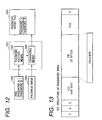
- Fig. 13 is a view showing the frame configuration of a PWD signal.
- a first password "1234" and a second password "5678" are set together with a delimiter "#".
- the communication apparatus of this fourth embodiment analyzes the FIF of a PWD signal acquired during image reception, sequentially reads out the numerical data delimited by the delimiter "#", and uses them as passwords. That is, the apparatus uses a password ("1234" in Fig. 13) read out first from the leading position of the FIF as a read password, and a password ("5678" in Fig. 13) read out next as a write password.
- a predetermined symbol e.g., "*"
- data in the FIF is "*1234#5678”
- "1234" having the identification symbol "*” attached can be used as a read password.
- a plurality of types of passwords can be acquired by directly using the procedure of ITU-T recommendation T. 30. This obviates the need to, e.g., add a new procedure signal.
- Fig. 12 is a view for explaining the arrangement of the fourth embodiment.
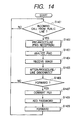
- Fig. 14 is a flow chart showing the operation of the communication apparatus of the fourth embodiment.
- step S1401 a call incoming from a public line is detected, a pre-procedure is executed (step S1402), and the contents of the FIF of a PWD signal are analyzed to acquire a plurality of types of passwords (step S1403). From the acquired passwords, a plurality of passwords are extracted on the basis of the method explained with reference to Fig. 13, and whether each password is a read password or a write password is determined. Assume that a "password A" is extracted as a read password and a "password B" is extracted as a write password.
- step S1404 a facsimile image 1203 is received (step S1404), an after-procedure is executed, and the line is disconnected (step S1405).
- step S1406 whether the facsimile image 1203 received in step S1404 is to be forwarded is determined. As in the first embodiment described earlier, this determination is done on the basis of the contents of preset forwarding setting of a memory box by checking the memory box management table 901. If the image is not to be forwarded, the image stored in the memory box is kept stored, and the flow advances to step S1401 to return to the wait state.
- step S1407 converts the facsimile image 1203 into a password added file of a predetermined format which is data-exchanged on personal computers (corresponding to a converting means 1206 in Fig. 12).
- the "password A" and the "password B" acquired in step S1403 are embedded as a read password and a write password, respectively, in the file (corresponding to a password addition means 1205 in Fig. 12).
- a password added file 1204 generated by processes in steps S1408 and S1409 is forwarded (the path 1-8 in Fig. 1) to the addressed terminal device (1-4 or 1-9 in Fig. 1) as a forwarding destination on the LAN (1-1 in Fig. 1).
- a plurality of stages of secrecy levels can be set in image data to be forwarded by using a plurality of types of passwords acquired on a communication procedure and devices.
- the effect that the above third embodiment does not have is to allow the destination transmitter (1-6 in Fig. 1) to control a plurality of stages of secrecy levels to be set in a file.
- the fifth embodiment will be described below.
- the received facsimile image is converted into a password added file.
- the received facsimile image is converted into a password added file and stored in a memory box designated by a sub-address.
- the secrecy of a received image can be maintained when a received image in a memory box is forwarded in accordance with a transmission request from the terminal device 1-4 on the LAN 1-1 or when a received image in a memory box is forwarded to the terminal device 1-4 on the LAN 1-1 by an operation from the communication apparatus.
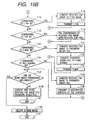
- Figs. 15A and 15B are flow charts showing the operation of the communication apparatus of the fifth embodiment. In these flow charts, the process in step 7-28 of the operation flow chart shown in Fig. 7B is changed to step 15-28.
- step 7-27 After a received image from a public line is stored in a memory box, in step 7-27 whether forwarding is set for the memory box storing the received image in step 7-13 is determined by checking the memory box management table 901. If no forwarding is set, the flow advances to step 15-28.
- step 15-28 the received image stored in the memory box in step 7-13 is converted into a password added file to which a password received in step 7-3 is added, and the file is kept stored.
- the received image in the memory box can be forwarded as the password added file in accordance with a forwarding request from the terminal device 1-4 on the LAN 1-1 or can be forwarded as the password added file to the terminal device 1-4 on the LAN 1-1 by a forwarding operation from the communication apparatus.
- a password added file stored in the designated memory box is forwarded to the terminal device 1-4.
- a memory box and an addressed terminal device on the LAN 1-1 are designated from the operation unit 2-15.
- a password added file stored in the designated memory box is forwarded to the terminal device 1-4.
- the communication apparatus of the fifth embodiment can extract a facsimile image from an arbitrary terminal device on a network while maintaining the secrecy of the image.
- the sixth embodiment relates to the communication apparatus 1-6 as a transmission source for transmitting an image to the communication apparatus 1-3 according to the fourth embodiment.
- This sixth embodiment is characterized in that a plurality of types of passwords entered when an image is transmitted are set in a predetermined frame of a communication procedure and notified to the communication apparatus 1-3.
- the arrangement of the communication apparatus 1-6 is identical with the communication apparatus 1-3 shown in Fig. 2.
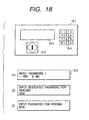
- Fig. 18 is a view showing the arrangement of the operation unit 2-15 and examples of displayed messages.
- the communication apparatus 1-6 has an operation panel 18-1.
- a start button 18-2 is a key button for inputting a facsimile transmission instruction.
- An LCD (Liquid Crystal Display) 18-3 is a display means for displaying messages during operation.
- a ten-key pad 18-4 is an input means for inputting the telephone number of a facsimile transmission destination and inputting an instruction for each operation.
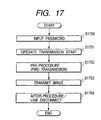
- step S1700 a user inputs passwords corresponding to transmission data in accordance with messages, indicated by (1) to (3) in Fig. 18, displayed on the LCD 18-3.
- the user inputs "1234" and "5678" as a read password and a write password, respectively.
- step S1701 the user inputs the destination telephone number of the communication apparatus 1-3 by using the ten-key pad 18-4 on the operation panel 18-1 and presses the start button 18-2 to activate an image transmission operation.
- an image to be transmitted can be an image obtained by reading an original by the reader unit 2-14 or an image prestored in the memory 2-5.
- step S1702 When the image transmission operation is activated, the input destination telephone number is dialed to connect to the communication apparatus 1-3, and a communication procedure from step S1702 is started.
- the read password "1234" and the write password "5678” are set together with a delimiter "#" in an information field FIF of a PWD signal shown in Fig. 13.
- the password (“1234" in Fig. 13) set first from the leading position of the FIF is used as a read password, and the password ("5678" in Fig. 13) set next is used as a write password.
- a predetermined symbol e.g., "*” can be added to the numerical data in the FIF to identify the type of password.
- "*" can be added to the numerical data in the FIF to identify the type of password.
- data in the FIF is "*1234#5678”
- "1234" having the identification symbol "*” attached can be used as a read password.
- a plurality of types of passwords can be acquired by directly using the procedure of ITU-T recommendation T. 30. This eliminates the need to, e.g., add a new procedure signal.
- a facsimile image 1203 is transmitted (step S1703), an after-procedure is executed, and the line is disconnected (step S1704).
- the communication apparatus 1-3 is informed of a plurality of passwords input by the operation shown in Fig. 18 together with image transmission.
- the communication apparatus 1-3 sets a plurality of stages of secrecy levels in the received image by the operation explained in the fourth embodiment and forwards the image.
- the communication apparatus of the sixth embodiment can inform the transmission destination of a plurality of pieces of password information corresponding to a transmission image when transmitting the image.
- password types are a "write password” and a "read password”.
- passwords having different security levels such as an "owner password” and a "user password”
- an owner password when an owner password is supplied to a document file, all accesses such as change, erasure, and read to that document file are permitted.
- a user password when a user password is supplied to a document file, only read access to that document file is permitted.
- the object of the present invention is also achieved by an integrated system obtained by connecting a plurality of apparatuses (e.g., a scanner, printer, personal computer, and modem) by a predetermined interface.
- a plurality of apparatuses e.g., a scanner, printer, personal computer, and modem
- the communication apparatuses (1-3 and 1-6) according to the present invention can be constituted by computers.
- the communication apparatus (1-6) can be realized by a PC (Personal Computer) including a modem as shown in Fig. 19.
- a PC (Personal Computer) 19-3 connects to a LAN 19-14 via an I/F 19-8.
- a plurality of terminal devices e.g., workstations or PCs
- a printer and the like are connected to the LAN 19-14.
- this LAN 19-14 connects to a public line via a facsimile modem 19-12 to exchange facsimile data with the line.
- a RAM 19-2 stores programs to be executed by a CPU (Central Processing Unit) 19-1.
- a ROM 19-3 also stores programs.
- the CPU 19-1 reads out data input via a keyboard controller 19-5.
- the UI shown in Fig. 18 is to be displayed by a known GUI (Graphical User Interface) or the like, image data is supplied to a CRT controller 19-6, and a video signal corresponding to the image data is supplied to and displayed on a CRT 19-10.
- GUI Graphic User Interface
- a memory unit 19-11 stores programs and data as files.
- This memory unit 19-11 can be a fixed hard disk or a memory unit having a removable medium, such as a removable hard disk, a flexible disk, an optical disk, or a magnetooptical disk. Data is read out from and written in the memory unit 19-11 via a memory controller 19-7. These blocks are connected by a system bus 19-4.
- the communication apparatus (1-3) can be realized by a PC (Fig. 19).
- the memory unit 19-1 stores facsimile coded data, image data received from the communication apparatus 1-6, and system software.
- the facsimile modem 19-12 can also be the line I/F unit (2-7).
- the image processing unit (2-11) and the image converting unit (2-12) are also necessary.
- the present invention is naturally applicable to a case in which the programs for realizing the above embodiments, stored in the ROM 2-2 shown in Fig. 2, are supplied to a system or an apparatus by various storage media.
- the object of the present invention can also be achieved by storing program codes of software for performing the functions of the above embodiments in a storage medium and reading out and executing the program codes stored in the storage medium by a computer (or a CPU or MPU) of a system or an apparatus.
- a computer or a CPU or MPU
- the program codes themselves read out from the storage medium realize the functions of the above embodiments, so the storage medium storing the program codes constitutes the present invention.
- this storage medium for supplying the program codes it is possible to use, e.g., a floppy disk, a hard disk, an optical disk, a magnetooptical disk, a CD-ROM, a magnetic tape, a nonvolatile memory card, or a ROM.
- an OS Operating System
- an OS running on the computer can also execute a part of the processing via API or the like on the basis of instructions by the program codes.
- the present invention also includes a case where, after the program codes read out from the storage medium are written in a memory of a function extension board inserted into a computer or of a function extension unit connected to a computer, a CPU or the like of the function extension board or function extension unit performs a part or the whole of the processing on the basis of instructions by the program codes and thereby realizes the functions of the above embodiments.
- the program codes can be MPU native codes or codes described in a predetermined interpreter language and converted into MPU native codes during run time.
- the program codes can also be script data described in a predetermined format and interpreted and executed by an operating system.
Landscapes
- Engineering & Computer Science (AREA)
- Multimedia (AREA)
- Signal Processing (AREA)
- Computer Networks & Wireless Communication (AREA)
- Facsimile Transmission Control (AREA)
- Facsimiles In General (AREA)
- Storing Facsimile Image Data (AREA)
- Editing Of Facsimile Originals (AREA)
- Data Exchanges In Wide-Area Networks (AREA)
- Telephonic Communication Services (AREA)
Claims (25)
- Bildkommunikationsvorrichtung zum Übertragen von von einer anderen Kommunikationseinrichtung empfangenen Daten an eine Zielvorrichtung, umfassend:eine Beschaffungseinrichtung (2-3) zum Beschaffen von Authentifizierungsinformationen, die zu den empfangenen Daten gehören;eine Bestimmungseinrichtung zum Bestimmen der Art von Zielvorrichtung, an welche die Daten zu übertragen sind;eine Hinzufügeeinrichtung (2-3) zum Hinzufügen der Authentifizierungsinformationen zu den empfangenen Daten unter Nutzung des Ergebnisses der Bestimmung durch die Bestimmungseinrichtung; undeine Übertragungseinrichtung zum Übertragen, als zweite Daten, der empfangenen Daten einschließlich der hinzugefügten Authentifizierungsinformationen an die Zielvorrichtung.
- Vorrichtung nach Anspruch 1, bei der die Beschaffungseinrichtung dazu ausgelegt ist, die Authentifizierungsinformationen aus einem bei dem Empfangen der empfangenen Daten verwendeten Prozedursignal zu gewinnen.
- Vorrichtung nach Anspruch 1, bei der die Beschaffungseinrichtung dazu ausgelegt ist, die Authentifizierungsinformationen aus einem mit den empfangenen Daten zusammen mit einem durch ITU-T empfohlenen Unteradresssignal empfangenen Passwortsignal zu gewinnen.
- Vorrichtung nach Anspruch 1, bei der die Kommunikationsvorrichtung dazu ausgelegt ist, die empfangenen Daten durch Abfragen zu empfangen, und
die Beschaffungseinrichtung dazu ausgelegt ist, die Authentifizierungsinformationen aus einem mit den empfangenen Daten zusammen mit einem durch ITU-T empfohlenen selektiven Abfragesignal empfangenen Passwortsignal zu gewinnen. - Vorrichtung nach Anspruch 1, bei dem dann, wenn die bestimmte Art der Zielvorrichtung eine E-Mail-Funktion hat, die Hinzufügeeinrichtung dazu ausgelegt ist, die empfangenen Daten in eine Datei eines vorbestimmten Formats umzuwandeln, und die beschafften Authentifizierungsinformationen zu der Datei hinzufügt.
- Vorrichtung nach Anspruch 1, bei der dann, wenn die bestimmte Art der Zielvorrichtung eine Telefax-Funktion hat, die Hinzufügeeinrichtung dazu ausgelegt ist, die beschafften Authentifizierungsinformationen zu einem Passwortsignal hinzuzufügen, das zusammen mit einem durch ITU-T empfohlenen Unteradresssignal an die Zielvorrichtung zu übertragen ist.
- Vorrichtung nach einem der vorangehenden Ansprüche und mit
einer Speichereinrichtung (2-5) zum Speichern empfangener Daten, und zum Bereitstellen einer Vielzahl von Speicherboxen,
einer Registriereinrichtung zum Registrieren von Authentifizierungsinformationen in Bezug auf eine oder mehrere Speicherboxen,
einer Einrichtung zum Bestimmen, ob empfangene Daten in einer angegebenen Speicherbox zu speichern sind, und
einer Einrichtung zum Vergleichen der durch die Beschaffungseinrichtung beschafften Authentifizierungsinformationen, um eine Übertragung der empfangenen Daten nur dann auszuführen, wenn die beschafften Authentifizierungsinformationen und die registrierten Authentifizierungsinformationen übereinstimmen. - Vorrichtung nach einem der vorangehenden Ansprüche, bei der die Übertragungseinrichtung aufweist:eine erste Betriebsart zum automatischen Übertragen der zweiten Daten an die Zielvorrichtung auf der Grundlage der durch die Beschaffungseinrichtung beschafften Authentifizierungsinformationen, undeine zweite Betriebsart zum Speichern der empfangenen Daten in einer Speicherbox und, in Übereinstimmung mit einer Weiterleitungsanforderung von einem Bediener oder der Zielvorrichtung, Übertragen der empfangenen Daten in der Speicherbox an die Zielvorrichtung.
- Vorrichtung nach einem der vorangehenden Ansprüche, ferner umfassend:wobei das Sicherheitsattribut eine Information zum Identifizieren der Erlaubnis zur Benutzung der empfangenen Daten ist.eine Festlegeeinrichtung zum Festlegen eines Sicherheitsattributs in den empfangenen Daten auf der Grundlage der durch die Beschaffungseinrichtung beschafften Authentifizierungsinformationen,
- Vorrichtung nach Anspruch 9, ferner umfassend:wobei die Festlegeeinrichtung dazu ausgelegt ist, eine Vielzahl von Ebenen des Sicherheitsattributs in den empfangenen Daten auf der Grundlage der durch die Beschaffungseinrichtung beschafften Authentifizierungsinformationen und der registrieren Authentifizierungsinformationen festzulegen.eine Einrichtung zum Registrieren der Authentifizierungsinformationen,
- Vorrichtung nach Anspruch 9, bei der die Festlegeeinrichtung dazu ausgelegt ist, ein Sicherheitsattribut oder Attribute in den empfangenen Daten auf der Grundlage der durch die Beschaffungseinrichtung beschafften Authentifizierungsinformationen festzulegen.
- Vorrichtung nach Anspruch 9, bei der die Festlegeeinrichtung dazu ausgelegt ist, ein Sicherheitsattribut mit einer ersten Ebene, welche nur das Lesen der empfangenen Daten erlaubt, und einer zweiten Ebene, welche das Lesen und Ändern der empfangenen Daten erlaubt, festzulegen.
- Verfahren zum Übertragen von Daten, die durch eine Bildkommunikationsvorrichtung von einer anderen Kommunikationseinrichtung empfangen werden, an eine Zielvorrichtung, umfassend die Schritte:Beschaffen von Authentifizierungsinformationen, die zu den empfangenen Daten gehören;Bestimmen der Art von Zielvorrichtung, an welche die Daten zu übertragen sind;Hinzufügen der Authentifizierungsinformationen zu den empfangenen Daten mittels einem Verfahren, das das Ergebnis der Bestimmung durch die Bestimmungseinrichtung nutzt; undÜbertragen, als zweite Daten, der empfangenen Daten einschließlich der hinzugefügten Authentifizierungsinformationen an die Zielvorrichtung.
- Verfahren nach Anspruch 13, bei dem der Beschaffungsschritt die Authentifizierungsinformationen aus einem bei dem Empfangen der empfangenen Daten verwendeten Prozedursignal gewinnt.
- Verfahren nach Anspruch 13, bei dem der Beschaffungsschritt die Authentifizierungsinformationen aus einem mit den empfangenen Daten zusammen mit einem durch ITU-T empfohlenen Unteradresssignal empfangenen Passwortsignal gewinnt.
- Verfahren nach Anspruch 13, bei dem die Kommunikationsvorrichtung die empfangenen Daten durch Abfragen empfängt, und
der Beschaffungsschritt die Authentifizierungsinformationen aus einem mit den empfangenen Daten zusammen mit einem durch ITU-T empfohlenen selektiven Abfragesignal empfangenen Passwortsignal gewinnt. - Verfahren nach Anspruch 13, bei dem dann, wenn die bestimmte Art der Zielvorrichtung eine E-Mail-Funktion hat, der Hinzufügeschritt die empfangenen Daten in eine Datei eines vorbestimmten Formats umwandelt und die beschafften Authentifizierungsinformationen zu der Datei hinzufügt.
- Verfahren nach Anspruch 13, bei dem dann, wenn die bestimmte Art der Zielvorrichtung eine Telefax-Funktion hat, der Hinzufügeschritt die beschafften Authentifizierungsinformationen zu einem Passwortsignal hinzufügt, welches zusammen mit einem durch ITU-T empfohlenen Unteradresssignal an die Zielvorrichtung übertragen wird.
- Verfahren nach einem der Ansprüche 13 bis 18, einschließlich
einem Speichern empfangener Daten, wobei die Speichereinrichtung eine Vielzahl von Speicherboxen bereitstellt,
einem Registrieren von Authentifizierungsinformationen in Bezug auf eine oder mehrere Speicherboxen,
einem Bestimmen, ob empfangene Daten in einer angegebenen Speicherbox zu speichern sind, und
einem Vergleichen der durch die Beschaffungseinrichtung beschafften Authentifizierungsinformationen, um eine Übertragung der empfangenen Daten nur dann auszuführen, wenn die beschafften Authentifizierungsinformationen und die registrierten Authentifizierungsinformationen übereinstimmen. - Verfahren nach einem der Ansprüche 13 bis 19, bei dem der Übertragungsschritt aufweist:eine erste Betriebsart zum automatischen Übertragen der zweiten Daten an die Zielvorrichtung auf der Grundlage der durch die Beschaffungseinrichtung beschafften Authentifizierungsinformationen, undeine zweite Betriebsart zum Speichern der empfangenen Daten in einer Speicherbox und, in Übereinstimmung mit einer Weiterleitungsanforderung von einem Bediener oder der Zielvorrichtung, Übertragen der empfangenen Daten in der Speicherbox an die Zielvorrichtung.
- Verfahren nach einem der Ansprüche 13 bis 20, ferner umfassend:wobei das Sicherheitsattribut eine Information zum Identifizieren der Erlaubnis zur Benutzung der empfangenen Daten ist.ein Festlegen eines Sicherheitsattributs in den empfangenen Daten auf der Grundlage der durch die Beschaffungseinrichtung beschafften Authentifizierungsinformationen,
- Verfahren nach Anspruch 21, ferner umfassend:wobei der Festlegeschritt eine Vielzahl von Ebenen des Sicherheitsattributs in den empfangenen Daten auf der Grundlage der durch die Beschaffungseinrichtung beschafften Authentifizierungsinformationen und der registrieren Authentifizierungsinformationen festlegt.ein Registrieren der Authentifizierungsinformationen,
- Verfahren nach Anspruch 13, bei dem die Festlegeeinrichtung dazu ausgelegt ist, ein Sicherheitsattribut oder Attribute in den empfangenen Daten auf der Grundlage der durch die Beschaffungseinrichtung beschafften Authentifizierungsinformationen festzulegen.
- Verfahren nach Anspruch 13, bei dem der Festlegeschritt ein Sicherheitsattribut mit einer ersten Ebene, welche nur das Lesen der empfangenen Daten erlaubt, oder einer zweiten Ebene, welche das Lesen und Ändern der empfangenen Daten erlaubt, festlegt.
- Speichermedium, das Prozessor-implementierbare Anweisungen zum Steuern eines Prozessors zum Durchführen des Verfahrens nach einem der Ansprüche 13 bis 24 speichert.
Applications Claiming Priority (6)
| Application Number | Priority Date | Filing Date | Title |
|---|---|---|---|
| JP19874499 | 1999-07-13 | ||
| JP19874499 | 1999-07-13 | ||
| JP36257199 | 1999-12-21 | ||
| JP36257199 | 1999-12-21 | ||
| JP2000178221 | 2000-06-14 | ||
| JP2000178221A JP2001245163A (ja) | 1999-07-13 | 2000-06-14 | 通信装置および方法ならびに記憶媒体 |
Publications (3)
| Publication Number | Publication Date |
|---|---|
| EP1069758A2 EP1069758A2 (de) | 2001-01-17 |
| EP1069758A3 EP1069758A3 (de) | 2002-01-30 |
| EP1069758B1 true EP1069758B1 (de) | 2004-11-03 |
Family
ID=27327538
Family Applications (1)
| Application Number | Title | Priority Date | Filing Date |
|---|---|---|---|
| EP00305505A Expired - Lifetime EP1069758B1 (de) | 1999-07-13 | 2000-06-30 | Übertragungsvorrichtung und -verfahren und Aufzeichnungsmedium |
Country Status (4)
| Country | Link |
|---|---|
| US (1) | US7095830B1 (de) |
| EP (1) | EP1069758B1 (de) |
| JP (1) | JP2001245163A (de) |
| DE (1) | DE60015445T2 (de) |
Families Citing this family (10)
| Publication number | Priority date | Publication date | Assignee | Title |
|---|---|---|---|---|
| JP3697607B2 (ja) * | 2001-03-22 | 2005-09-21 | 村田機械株式会社 | インターネットファクシミリ装置 |
| JP2003299146A (ja) | 2002-02-01 | 2003-10-17 | Canon Inc | 無線通信装置 |
| US20030210803A1 (en) * | 2002-03-29 | 2003-11-13 | Canon Kabushiki Kaisha | Image processing apparatus and method |
| JP4079159B2 (ja) * | 2005-05-19 | 2008-04-23 | コニカミノルタビジネステクノロジーズ株式会社 | ファクシミリ装置、ファクシミリ送信処理方法及び同受信処理方法 |
| EP1973329B1 (de) * | 2007-03-19 | 2017-02-15 | Ricoh Company, Ltd. | Bildverarbeitungsgerät und Bildverarbeitungsverfahren |
| JP4714240B2 (ja) * | 2008-05-30 | 2011-06-29 | 株式会社沖データ | ファクシミリ装置、ファクシミリ通知システム及び通信端末装置 |
| JP5772860B2 (ja) * | 2012-12-28 | 2015-09-02 | キヤノンマーケティングジャパン株式会社 | 情報処理装置、情報処理方法、及びプログラム |
| JP6737016B2 (ja) * | 2016-07-06 | 2020-08-05 | 富士ゼロックス株式会社 | 処理装置及びプログラム |
| CN107220554B (zh) * | 2017-06-20 | 2020-11-27 | 深圳市六度人和科技有限公司 | 一种文件转发管理方法及对应的系统、终端设备 |
| JP7635659B2 (ja) * | 2021-07-06 | 2025-02-26 | ブラザー工業株式会社 | 通信装置及び通信装置のためのコンピュータプログラム |
Family Cites Families (15)
| Publication number | Priority date | Publication date | Assignee | Title |
|---|---|---|---|---|
| JPS63151140A (ja) * | 1986-12-15 | 1988-06-23 | Nippon Telegr & Teleph Corp <Ntt> | 親展通信方式 |
| US5452099A (en) * | 1993-04-12 | 1995-09-19 | Faxguard Systems Corporation | Method and system for storage and/or transmission of confidential facsimile documents |
| JPH07154569A (ja) * | 1993-11-26 | 1995-06-16 | Canon Inc | ファクシミリ装置 |
| US6421429B1 (en) * | 1993-12-29 | 2002-07-16 | At&T Corporation | Network-based system enabling image communications |
| US5621727A (en) * | 1994-09-16 | 1997-04-15 | Octel Communications Corporation | System and method for private addressing plans using community addressing |
| JP3688830B2 (ja) * | 1995-11-30 | 2005-08-31 | 株式会社東芝 | パケット転送方法及びパケット処理装置 |
| US5751813A (en) * | 1996-04-29 | 1998-05-12 | Motorola, Inc. | Use of an encryption server for encrypting messages |
| US5859967A (en) * | 1996-07-09 | 1999-01-12 | Faxsav Incorporated | Method and system for relaying communications from authorized users |
| US5982506A (en) | 1996-09-10 | 1999-11-09 | E-Stamp Corporation | Method and system for electronic document certification |
| JPH10173936A (ja) * | 1996-12-06 | 1998-06-26 | Ricoh Co Ltd | ネットワークファクシミリ装置の制御方法 |
| US5862202A (en) * | 1997-04-10 | 1999-01-19 | Information Medical Retrieval, Inc. | Fax routing system and method using standard fax machine and personal computer |
| JP3774547B2 (ja) * | 1997-07-25 | 2006-05-17 | キヤノン株式会社 | 通信装置 |
| JP3706717B2 (ja) | 1997-08-01 | 2005-10-19 | キヤノン株式会社 | 通信装置 |
| US6240445B1 (en) * | 1998-04-24 | 2001-05-29 | Openware Systems Inc. | Computer implemented method and apparatus for receiving facsimile messages using an indentifier appended to a shared telephone number |
| US6725276B1 (en) * | 1999-04-13 | 2004-04-20 | Nortel Networks Limited | Apparatus and method for authenticating messages transmitted across different multicast domains |
-
2000
- 2000-06-14 JP JP2000178221A patent/JP2001245163A/ja active Pending
- 2000-06-27 US US09/604,407 patent/US7095830B1/en not_active Expired - Fee Related
- 2000-06-30 DE DE60015445T patent/DE60015445T2/de not_active Expired - Lifetime
- 2000-06-30 EP EP00305505A patent/EP1069758B1/de not_active Expired - Lifetime
Also Published As
| Publication number | Publication date |
|---|---|
| DE60015445T2 (de) | 2005-10-13 |
| US7095830B1 (en) | 2006-08-22 |
| EP1069758A3 (de) | 2002-01-30 |
| JP2001245163A (ja) | 2001-09-07 |
| EP1069758A2 (de) | 2001-01-17 |
| DE60015445D1 (de) | 2004-12-09 |
Similar Documents
| Publication | Publication Date | Title |
|---|---|---|
| US8838704B2 (en) | System and process for transmitting electronic mail using a conventional facsimile device | |
| US7672003B2 (en) | Network scanner for global document creation, transmission and management | |
| US20150103383A1 (en) | Network scanner for global document creation, transmission and management | |
| US20070250717A1 (en) | Image forming apparatus, image reproducing apparatus and image processing system | |
| JP6873642B2 (ja) | 画像形成装置及びその画像通信方法、並びにプログラム | |
| US7152159B2 (en) | Encrypted mail transmission system | |
| EP1968302A1 (de) | Bildverarbeitungsvorrichtung | |
| US7111068B2 (en) | Communication control apparatus and a communication control method | |
| EP1069758A2 (de) | Ubertragungsvorrichtung und -Verfahren, und Aufzeichnungsmedium | |
| JP4046876B2 (ja) | 通信装置及び通信方法 | |
| CN100512365C (zh) | 通过电子邮件发送或接收图像的装置和方法 | |
| US7072062B2 (en) | Server device and communication method | |
| JP2004266559A (ja) | プッシュ型スキャナー装置、その制御方法、その制御プログラム、及びプッシュ型スキャナーシステム | |
| US20060179317A1 (en) | E-mail terminal device | |
| JPH10327288A (ja) | 電子メール機能付通信端末装置 | |
| JP3731371B2 (ja) | ネットワークファクシミリ装置およびその通信制御方法 | |
| US20020131089A1 (en) | Internet facsimile machine, and internet facsimile communication method | |
| US7196824B2 (en) | Confidential facsimile transmission and receipt notification | |
| JP2007208957A (ja) | Ipファクシミリ配信システム及びipファクシミリ配信プログラム | |
| JP3622050B2 (ja) | インターネットファクシミリ装置 | |
| JP2008061164A (ja) | ネットワークファクシミリ装置 | |
| JP2006109271A (ja) | 画像通信装置、通信方法、ならびにプログラム、記憶媒体 | |
| US20070041048A1 (en) | Network system, data processing device, and data transmission device | |
| JP2007115025A (ja) | 画像形成方法および画像形成装置並びにプログラムおよび記録媒体 | |
| JP2004201088A (ja) | ネットワーク対応型電子複合機および画像処理方法 |
Legal Events
| Date | Code | Title | Description |
|---|---|---|---|
| PUAI | Public reference made under article 153(3) epc to a published international application that has entered the european phase |
Free format text: ORIGINAL CODE: 0009012 |
|
| AK | Designated contracting states |
Kind code of ref document: A2 Designated state(s): AT BE CH CY DE DK ES FI FR GB GR IE IT LI LU MC NL PT SE Kind code of ref document: A2 Designated state(s): DE FR GB |
|
| AX | Request for extension of the european patent |
Free format text: AL;LT;LV;MK;RO;SI |
|
| PUAL | Search report despatched |
Free format text: ORIGINAL CODE: 0009013 |
|
| AK | Designated contracting states |
Kind code of ref document: A3 Designated state(s): AT BE CH CY DE DK ES FI FR GB GR IE IT LI LU MC NL PT SE |
|
| AX | Request for extension of the european patent |
Free format text: AL;LT;LV;MK;RO;SI |
|
| 17P | Request for examination filed |
Effective date: 20020628 |
|
| AKX | Designation fees paid |
Free format text: DE FR GB |
|
| 17Q | First examination report despatched |
Effective date: 20020905 |
|
| GRAP | Despatch of communication of intention to grant a patent |
Free format text: ORIGINAL CODE: EPIDOSNIGR1 |
|
| GRAS | Grant fee paid |
Free format text: ORIGINAL CODE: EPIDOSNIGR3 |
|
| GRAA | (expected) grant |
Free format text: ORIGINAL CODE: 0009210 |
|
| AK | Designated contracting states |
Kind code of ref document: B1 Designated state(s): DE FR GB |
|
| REG | Reference to a national code |
Ref country code: GB Ref legal event code: FG4D |
|
| REF | Corresponds to: |
Ref document number: 60015445 Country of ref document: DE Date of ref document: 20041209 Kind code of ref document: P |
|
| REG | Reference to a national code |
Ref country code: IE Ref legal event code: FG4D |
|
| PLBE | No opposition filed within time limit |
Free format text: ORIGINAL CODE: 0009261 |
|
| STAA | Information on the status of an ep patent application or granted ep patent |
Free format text: STATUS: NO OPPOSITION FILED WITHIN TIME LIMIT |
|
| ET | Fr: translation filed | ||
| 26N | No opposition filed |
Effective date: 20050804 |
|
| REG | Reference to a national code |
Ref country code: FR Ref legal event code: PLFP Year of fee payment: 16 |
|
| PGFP | Annual fee paid to national office [announced via postgrant information from national office to epo] |
Ref country code: GB Payment date: 20150626 Year of fee payment: 16 Ref country code: DE Payment date: 20150630 Year of fee payment: 16 |
|
| PGFP | Annual fee paid to national office [announced via postgrant information from national office to epo] |
Ref country code: FR Payment date: 20150626 Year of fee payment: 16 |
|
| REG | Reference to a national code |
Ref country code: DE Ref legal event code: R119 Ref document number: 60015445 Country of ref document: DE |
|
| GBPC | Gb: european patent ceased through non-payment of renewal fee |
Effective date: 20160630 |
|
| REG | Reference to a national code |
Ref country code: FR Ref legal event code: ST Effective date: 20170228 |
|
| PG25 | Lapsed in a contracting state [announced via postgrant information from national office to epo] |
Ref country code: DE Free format text: LAPSE BECAUSE OF NON-PAYMENT OF DUE FEES Effective date: 20170103 Ref country code: FR Free format text: LAPSE BECAUSE OF NON-PAYMENT OF DUE FEES Effective date: 20160630 |
|
| PG25 | Lapsed in a contracting state [announced via postgrant information from national office to epo] |
Ref country code: GB Free format text: LAPSE BECAUSE OF NON-PAYMENT OF DUE FEES Effective date: 20160630 |