EP1069718B1 - Umwandlung von nahtloser Verkettung zu virtueller Verkettung in einem synchronen digitalen Nachrichtenübertragungsnetz - Google Patents
Umwandlung von nahtloser Verkettung zu virtueller Verkettung in einem synchronen digitalen Nachrichtenübertragungsnetz Download PDFInfo
- Publication number
- EP1069718B1 EP1069718B1 EP00440200A EP00440200A EP1069718B1 EP 1069718 B1 EP1069718 B1 EP 1069718B1 EP 00440200 A EP00440200 A EP 00440200A EP 00440200 A EP00440200 A EP 00440200A EP 1069718 B1 EP1069718 B1 EP 1069718B1
- Authority
- EP
- European Patent Office
- Prior art keywords
- multiplex units
- multiplex
- payload data
- units
- concatenation
- Prior art date
- Legal status (The legal status is an assumption and is not a legal conclusion. Google has not performed a legal analysis and makes no representation as to the accuracy of the status listed.)
- Expired - Lifetime
Links
- 230000001360 synchronised effect Effects 0.000 title claims abstract description 35
- 230000005540 biological transmission Effects 0.000 title claims description 30
- 238000006243 chemical reaction Methods 0.000 title claims description 13
- 230000002093 peripheral effect Effects 0.000 claims abstract description 20
- 238000000034 method Methods 0.000 claims description 12
- 230000007274 generation of a signal involved in cell-cell signaling Effects 0.000 claims 1
- 238000012546 transfer Methods 0.000 abstract description 2
- 238000004891 communication Methods 0.000 description 19
- 238000012545 processing Methods 0.000 description 15
- 239000011159 matrix material Substances 0.000 description 11
- RGNPBRKPHBKNKX-UHFFFAOYSA-N hexaflumuron Chemical compound C1=C(Cl)C(OC(F)(F)C(F)F)=C(Cl)C=C1NC(=O)NC(=O)C1=C(F)C=CC=C1F RGNPBRKPHBKNKX-UHFFFAOYSA-N 0.000 description 4
- 238000007726 management method Methods 0.000 description 4
- 230000006835 compression Effects 0.000 description 3
- 238000007906 compression Methods 0.000 description 3
- 238000010586 diagram Methods 0.000 description 3
- 230000006870 function Effects 0.000 description 3
- 230000002457 bidirectional effect Effects 0.000 description 2
- 238000001514 detection method Methods 0.000 description 2
- 230000007704 transition Effects 0.000 description 2
- 241001370750 Echinopsis oxygona Species 0.000 description 1
- 230000000712 assembly Effects 0.000 description 1
- 238000000429 assembly Methods 0.000 description 1
- 230000001419 dependent effect Effects 0.000 description 1
- 238000011156 evaluation Methods 0.000 description 1
- 239000000945 filler Substances 0.000 description 1
- 238000002372 labelling Methods 0.000 description 1
- 230000003287 optical effect Effects 0.000 description 1
- 238000012856 packing Methods 0.000 description 1
- 230000009993 protective function Effects 0.000 description 1
- 238000011144 upstream manufacturing Methods 0.000 description 1
Images

Classifications
-
- H—ELECTRICITY
- H04—ELECTRIC COMMUNICATION TECHNIQUE
- H04J—MULTIPLEX COMMUNICATION
- H04J3/00—Time-division multiplex systems
- H04J3/16—Time-division multiplex systems in which the time allocation to individual channels within a transmission cycle is variable, e.g. to accommodate varying complexity of signals, to vary number of channels transmitted
- H04J3/1605—Fixed allocated frame structures
- H04J3/1611—Synchronous digital hierarchy [SDH] or SONET
-
- H—ELECTRICITY
- H04—ELECTRIC COMMUNICATION TECHNIQUE
- H04J—MULTIPLEX COMMUNICATION
- H04J2203/00—Aspects of optical multiplex systems other than those covered by H04J14/05 and H04J14/07
- H04J2203/0001—Provisions for broadband connections in integrated services digital network using frames of the Optical Transport Network [OTN] or using synchronous transfer mode [STM], e.g. SONET, SDH
- H04J2203/0089—Multiplexing, e.g. coding, scrambling, SONET
- H04J2203/0094—Virtual Concatenation
-
- Y—GENERAL TAGGING OF NEW TECHNOLOGICAL DEVELOPMENTS; GENERAL TAGGING OF CROSS-SECTIONAL TECHNOLOGIES SPANNING OVER SEVERAL SECTIONS OF THE IPC; TECHNICAL SUBJECTS COVERED BY FORMER USPC CROSS-REFERENCE ART COLLECTIONS [XRACs] AND DIGESTS
- Y10—TECHNICAL SUBJECTS COVERED BY FORMER USPC
- Y10S—TECHNICAL SUBJECTS COVERED BY FORMER USPC CROSS-REFERENCE ART COLLECTIONS [XRACs] AND DIGESTS
- Y10S370/00—Multiplex communications
- Y10S370/901—Wide area network
- Y10S370/902—Packet switching
- Y10S370/903—Osi compliant network
- Y10S370/907—Synchronous optical network, SONET
Definitions
- the invention relates to a method for transmitting user data via a synchronous digital communication network according to the preamble of Claim 1 and a multiplexer for a synchronous digital Communication network according to the preamble of claim 5 and a Peripheral device according to the preamble of claim 6.
- a synchronous digital message transmission network such as in SDH or SONET systems
- messages to be transmitted are transmitted as a payload by multiplex units.
- multiplex units are referred to as virtual containers, in SONET as virtual tributaries .
- STM-N 1, 4, 16, 64
- the largest multiplex unit is the virtual container VC-4 with a payload capacity of 149.760 Mbit.
- the VC-4 is referred to as AU-4 ( Administrative Unit ).
- the largest multiplex unit at SONET is a VT-3 with a capacity of 48.384 Mbit, which together with a corresponding pointer is referred to as AU-3. If payload signals whose bit rate is greater than the payload of the largest multiplex unit are to be transmitted, a chain of several multiplex units is formed.
- peripheral devices e.g. for IP routers that are synchronous use digital communications network as a backbone network that is seamless Chaining is preferred because it is easier to handle from a network perspective preferred virtual linking because of the greater flexibility.
- the Conversion from seamless chaining to virtual chaining is in itself known.
- the individual multiplex units are each with one provide your own pointer.
- An identification in the head area (overhead) of the Multiplex units refer to the concatenation. For labeling currently uses bits 1 and 2 of the H4 byte, using others However, overhead bytes are also conceivable.
- the virtually chained Multiplex units can then be in separate transport modules be transported.
- an SDH multiplexer is used for the purpose of transportation an ATM data stream (Asynchronous Transfer Mode) a conversion of runs seamless chaining in virtual chaining and that in seamless Concatenation contained ATM data stream by inverse multiplexing into a number divides slower parallel data streams, which are then used as the respective payload in the individual virtually chained multiplex units can be transported.
- ATM data stream Asynchronous Transfer Mode
- peripheral devices such as e.g. IP router preferred the seamless chaining.
- IP router preferred the seamless chaining.
- the device optionally with a OC-3c / STM-1c interface or with an OC-12c / STM-4c interface can be equipped.
- Both types of interfaces use seamless Concatenation of multiplex units. Because the number of seamlessly chained Multiplex units depends on the interface type of the router regardless of the bandwidth actually used for IP payload transmit the same number of multiplex units.
- the object of the invention is a method for the transmission of user data to specify via a synchronous digital communications network, at the number of chained multiplex units to the actually required Bandwidth can be adjusted.
- Another object of the invention consists of a multiplexer for a synchronous digital Communication network and a peripheral specify that are suitable for carrying out the method according to the invention.
- a basic idea of the invention is to provide seamless peripheral equipment Generate concatenation of multiplex units, but only a part of the concatenated multiplex units to use for payload and the rest leave blank or fill up with a fill pattern.
- Another The basic idea of the invention is that the multiplexer on Transition to a synchronous digital communications network Performs the seamless chaining to virtual chaining and omits those multiplex units that are not included in the conversion Payload are filled. Thus an adjustment of the number of chained Multiplex units to the bandwidth actually required at the Conversion from seamless chaining to virtual chaining performed.
- the transmission can also be bidirectional.
- FIG. 1 shows how one from a first peripheral device 10 Payload over a synchronous digital communications network SDH too is transmitted to a second peripheral device 16.
- the peripheral devices are IP router and the payload consists of data packets that follow the Internet protocol are structured.
- the first IP router 10 is a synchronous Message signal 11 generated. It is a frame-structured multiplex signal of the type STM-4.
- the STM-4 frame consists of four byte-by-nested transport modules of type STM-1. Each of the four STM-1 frames contains a multiplex unit VC-4.
- IP router 10, 16 are part of a data network and use the synchronous digital SDH communication network as a backbone network.
- the synchronous message signal 11 arrives from the first IP router 10 a multiplexer 12 of the synchronous digital communications network SDH.
- each of the four multiplex units has its own Provide pointer and there is a marking in the head area (overhead) of the multiplex units inserted, which indicates the chaining.
- the four Virtually chained multiplex units VC-4 can now be used independently of each other in separate smaller or common larger ones Transport modules are transmitted through the SDH communications network. in the Embodiment is indicated that each of the four virtually chained Multiplex units is transmitted over its own path 13a-d.
- the virtual chaining is called VC-4-4v.
- the virtual concatenated multiplex units are now replaced by the SDH data transmission network for data sink, a second multiplexer 14 transferred. This converts the virtual chain back into a seamless one Chaining and transmits the four seamlessly linked multiplex units in a message signal 15 structured into STM-4 frames to the second IP router 16.
- the multiplexers can be so-called add / drop multiplexers or are terminal multiplexers, the individual or all paths terminate that in the received frame structured multiplex signals are included.
- the IP router 10 only packs three of the four concatenated multiplex units VC-4-4c.
- the fourth multiplex unit remains empty.
- the message signal 11 that the IP router 10 sends to the multiplexer 12 transmits, but still has the same structure, namely an STM-4 frame with four seamlessly linked multiplex units VC-4-4c.
- Multiplexer 12 will seamlessly chain into virtual chaining converted.
- the fourth is not packed with data packets Multiplex unit omitted. This creates a virtual chain three multiplex units VC-4-3v, which via paths 13a-c to the second Multiplexer 14 is transmitted. There the virtual chaining becomes closed again converted into a seamless chain and with an empty multiplex unit added to VC-4-4c transmitted to the second IP router 16.
- the IP router Because the STM-4 frame consists of four STM-1 frames nested in bytes , it is extremely easy for the IP router to free a multiplex unit leave: He simply inserts a filler byte (e.g. hex00) after three bytes.
- the Multiplexer needed to convert seamless chaining of four Multiplex units in a virtual chain of three multiplex units Information which and which of the four multiplex units should be omitted.
- the IP router provides the information. This can either be via a dedicated control channel in the head area of the Multiplex units or transport modules or via a higher-level Network management system. Another option is that in the multiplexer automatically e.g.
- the automatic detection can Monitor the payload in the multiplexer, or else in that unused multiplex units from the IP router in the header be marked.
- IP packets are in HDLC frames framed. Bytes between the HDLC frames are fill patterns.
- the invention is not restricted to a chaining of virtual containers from Type VC-4.
- VC-12 containers with a Payload of 2 Mbit can be used.
- the conversion to a small number of virtually chained Multiplex units can also be predefined so that e.g. To determine Times the full bandwidth of all multiplex units is available, too other times only a reduced capacity. For example, from 8:00 to 10:00 and from 16:00 to 18:00 a chain of three VC-4 be selected, a virtual one at peak times from 10 a.m. to 4 p.m. Chaining of all four VC-4 and in non-productive times from 6:00 p.m. to 8:00 a.m. from just one or two VC-4. So the actually transmitted payload can the statistical utilization of the data network can be adjusted. Alternatively, you can also a dynamic adjustment after a determined Traffic around every 10 minutes. respectively. Will be a preset used, the transmission of the information is omitted Multiplex units currently used for data packets are used by the IP router the multiplexer.
- Another preferred use of the method according to the invention is for Transmission of data packets according to the protocol for asynchronous Transport mode (ATM) are structured.
- ATM asynchronous Transport mode
- Ethernet frames are framed in HDLC frames and are transported transparently in linked SDH containers. Between A fill pattern can be inserted in HDLC frames Compression according to the invention is removed, so the number of to reduce linked containers.
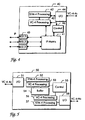
- the IP router 40 of the exemplary embodiment is in one in FIG Block diagram shown schematically. It has several LAN interfaces 45 (LAN: local area network), which corresponds to the standard for Ethernet IEEE 802.3 using an asynchronous transmission method Collision detection work. There is a local one on each of the LAN interfaces Data network connected and the IP router 40 receives data packets IP structured according to the internet protocol. The data packets are from the LAN interfaces to an IP matrix 41. This decides based on the destination address of each data packet, where it should be sent. Data packets for another data network connected to the IP router are sent to the corresponding LAN interface. The other data packets, i.e.
- the data packets that are not for one of the to the LAN interfaces connected local data networks are determined, are switched from the IP matrix 41 to a processing unit 42.
- There four multiplex units of the type VC-4 are formed and with the Packed data packets.
- the packed multiplex units are sent to one Processing unit 43 for transport modules of type STM-4 forwarded, where by seamless chaining and byte-by-byte nesting of the four A frame-structured multiplex signal of the type STM-4, VC-4-4c is formed, which is then on the interface I / O 44 as synchronous Message signal is sent.
- a pointer determines and in the head area of the transport modules written, which points to the beginning of the first multiplex unit.
- the Interface I / O 44 is an optical interface.
- the IP router 40 also has a control device 46, which is connected to the IP matrix 41 and the processing unit 42 for multiplex units VC-4 connected is.
- a current traffic volume is recorded in the IP matrix 41 determined and passed to the control device 46. This decides then at regular intervals in accordance with the Traffic volume or alternatively according to a given Schedule how many of the four multiplex units are packed with data packets and communicates this to the VC-4 processor 42. Accordingly, only the selected multiplex units are packed, the rest are packed with a Fill pattern filled. They are not in the processing unit 42 packed multiplex units marked in the header. For this one of the reserved overhead bytes used for proprietary purposes.
- the IP router can also be configured so that only two or three of the four seamlessly linked multiplex units can be filled with user data. In this case, a control device 46 is not necessary.
- the Processing unit 42 is then set so that only the predetermined ones Multiplex units are packed with IP packets and the rest are always free stay.
- the IP matrix 41 has a filter function executes since only such IP packets from the matrix to the VC-4 processing unit be routed through the synchronous digital Message transmission network transported to other local data networks should not be directly on a LAN interface of the IP router are connected.
- the IP matrix 41 can also have a further filter function execute by sending data packets whose delivery via the synchronous digital communication network is not possible, discards or with a sends the corresponding error message back to the sender.
- Such Filter function can be done by making appropriate entries in the routing table IP matrix can be executed. So nonexistent or due incorrect IP addresses are filtered out due to a configuration error.
- a protective function in the manner of a firewall can be achieved in this way will be realized.
- the multiplexer 50 which receives the synchronous message signal, the converts seamless chaining into virtual chaining and that Multiplex units via the synchronous message transmission system is shown schematically in Figure 5. He receives on a first Interface I / O 51 the synchronous message signal from the Peripheral. In a first processing unit 52 for transport modules of type STM-4 the byte-by-byte interleaving is resolved and the pointer evaluated on the first multiplex unit. According to the pointer value the four linked multiplex units are read out and sent to a first one Processing unit 53 for multiplex units of the type VC-4 directed. There the head area of the individual multiplex units is evaluated. A Mark indicating that the corresponding multiplex unit is not is filled with user data, is recognized and the corresponding multiplex unit then discarded.
- the information about this is also sent to a Control device 55 forwarded.
- the remaining multiplex units are buffered in a buffer memory 54.
- the second VC-4 processing unit receives from the control unit 56 the information, which and how many Multiplex units can be combined into a virtual chain should.
- the virtual chaining is done by a corresponding one Identification in the head area of the multiplex units. This is currently the H4 byte used.
- the concatenated multiplex units then become a second one Processing unit 57 for transport modules of type STM-4 fed where they are each packed in their own STM-1 frame.
- the STM-1 frame are interleaved byte by byte to create a transport module from Type STM-4 to form an existing synchronous message signal, which then at a second interface I / O 58 in dos synchronous digital Message transmission network is sent.
- the second STM-4 processing unit 56 also determines a pointer for each of the Multiplex units, which points to the beginning of the respective multiplex unit and written in the header of the respective STM-1 transport modules becomes.
- the input signal of the multiplexer contains one Seamless interlinking VC-4-4c from four multiplex units of the type VC-4.
- the four multiplex units are not for transport, for example used by user data and identified as such in the header area.
- So an output signal is formed that a virtual chain VC-4-3v contains three multiplex units VC-4.
- the rest Transmission capacity can be used for additional traffic, for example for a Bundle of telephone connections can be used.
- the Multiplexer the network management system with how many multiplex units the virtual chain includes, therefore, via the network management system the free transmission capacity can be allocated for other purposes.
- the header area can indicate which of the chained Multiplex units are used for the transport of user data, too via the network management system from the peripheral device to the Multiplexers are forwarded.
- the multiplexer Evaluation of the payload contained in each multiplex unit takes place in order to determine which of the multiplex units are packed with user data and which are unused.
- the multiplexer can be a terminal multiplexer, a Add / drop multiplexer or a digital cross-connect. He can also further assemblies such as a time and space switching matrix for Multiplex units and other interfaces to the Have communication network.
- Type VC-4 multiplex units can also do other, smaller ones Sub-units from the multiplex hierarchy of the transmission system are used, such as VC-12 or VC-3.
- An alternative embodiment of the peripheral device is an ATM switch. This is constructed similarly to the IP router in Figure 4, but has corresponding ATM interfaces instead of the LAN interfaces and instead the IP matrix is a switching matrix for ATM cells.
Landscapes
- Engineering & Computer Science (AREA)
- Computer Networks & Wireless Communication (AREA)
- Signal Processing (AREA)
- Data Exchanges In Wide-Area Networks (AREA)
- Time-Division Multiplex Systems (AREA)
- Mobile Radio Communication Systems (AREA)
- Communication Control (AREA)
Description
- Figuren 1 bis 3:
- Einen IP-Router, der an ein synchrones digitales Nachrichtenübertragungsnetz angeschlossen ist und ein synchrones Nachrichtensignal mit nahtlos verketteten Multiplexeinheiten erzeugt, wobei die nahtlose Verkettung in einem Multiplexer des Nachrichtenübertragungsnetzes in virtuelle Verkettung umgewandelt wird,
- Figur 4:
- ein Blockdiagramm von einem IP-Router als Peripheriegerät für ein synchrones Nachrichtenübertragungsnetz und
- Figur 5:
- ein Blockdiagramm von einem Multiplexer des Nachrichtenübertragungsnetzes, der die Umwandlung durchführt.
Claims (8)
- Verfahren zur Übertragung von Nutzdaten über ein synchrones digitales Nachrichtenübertragungsnetz (SDH), bei dem die Nutzdaten in Multiplexeinheiten verpackt werden, bei dem mehrere Multiplexeinheiten (VC-4-4c) nahtlos verkettet werden, bei dem die nahtlos verketteten Multiplexeinheiten (VC-4-4c) in einem gemeinsamen Transportmodul (STM-4) übertragen werden und bei dem die nahtlose Verkettung der Multiplexeinheiten (VC-4-4c) in eine virtuelle Verkettung von Multiplexeinheiten (VC-4-4v, VC-4-3v, VC-4-2v, VC-4-Nv) umgewandelt wird,
dadurch gekennzeichnet, dass
mindestens eine der Multiplexeinheiten nicht mit Nutzdaten gefüllt wird und bei der Umwandlung solche Multiplexeinheiten weggelassen werden, die nicht mit Nutzdaten gefüllt sind. - Verfahren nach Anspruch 1, bei dem die Nutzdaten Datenpakete sind, die nach dem Internetprotokoll strukturiert sind, bei dem das Verpacken der Datenpakete in die Multiplexeinheiten in einem IP-Router (10; 40) durchgeführt wird, bei dem das Umwandeln der nahtlosen Verkettung (VC-4-4c) in die virtuelle Verkettung (VC-4-Nv) in einem Multiplexer (12; 50) des synchronen digitalen Nachrichtenübertragungsnetzes (SDH) durchgeführt wird und bei dem der IP-Router (10; 40) dem Multiplexer (12; 50) mitteilt, welche der verketteten Multiplexeinheiten mit Datenpaketen gefüllt sind.
- Verfahren nach Anspruch 1, bei dem die Nutzdaten Datenpakete sind, die nach dem Protokoll für asynchronen Transport Modus strukturiert sind, bei dem das Verpacken der Datenpakete in die Multiplexeinheiten in einem ATM-Switch durchgeführt wird, bei dem das Umwandeln der nahtlosen Verkettung in die virtuelle Verkettung in einem Multiplexer (12; 50) des synchronen digitalen Nachrichtenübertragungsnetzes (SDH) durchgeführt wird und bei dem der ATM-Switch dem Multiplexer (12; 50) mitteilt, welche der verketteten Multiplexeinheiten mit Datenpaketen gefüllt sind.
- Verfahren nach Anspruch 1, bei dem die virtuelle Verkettung anschließend wieder in eine nahtlose Verkettung umgewandelt wird und dabei die weggelassenen Multiplexeinheiten durch leere Multiplexeinheiten ergänzt werden.
- Multiplexer (12; 50) für ein synchrones digitales Nachrichtenübertragungsnetz (SDH),dadurch gekennzeichnet, dassmit einer ersten Schnittstelle (51) zum Empfangen eines ersten zu Transportmodulen (STM-4) strukturierten Nachrichtensignals, in dem mehrere nahtlos verkettete Multiplexeinheiten (VC-4-4c) enthalten sind, die zu übertragende Nutzdaten enthalten,mit einer Umwandlungseinheit (53, 54, 55, 56) zum Umwandeln der nahtlosen Verkettung (VC-4-4c) in eine virtuelle Verkettung der Multiplexeinheiten (VC-4-4v, VC-4-3v, VC-4-2v, VC-4-Nv) undmit mindestens einer zweiten Schnittstelle (58) zum Senden mindestens eines zweiten zu Transportmodulen strukturierten Nachrichtensignals, in dem die virtuell verketteten Multiplexeinheiten (VC-4-4v, VC-4-3v, VC-4-2v, VC-4-Nv) enthalten sind,
die Umwandlungseinheit (53, 54, 55, 56) angepasst ist, für den Fall, dass mindestens eine der nahtlos verketteten Multiplexeinheiten nicht mit Nutzdaten gefüllt ist, bei der Umwandlung der nahtlosen Verkettung (VC-4-4c) in die virtuelle Verkettung (VC-4-4v, VC-4-3v, VC-4-2v, VC-4-Nv) solche Multiplexeinheiten wegzulassen, die nicht mit Nutzdaten gefüllt sind. - Peripheriegerät (10, 40) zum Übertragen von Nutzdaten über ein synchrones digitales Nachrichtenübertragungsnetz, wobei das Peripheriegerät (10; 40) eine Signalerzeugungseinrichtung (43) zum Erzeugen eines zu Transportmodulen strukturierten Nachrichtensignals aufweist, in dem mehrere nahtlos verkettete Multiplexeinheiten (VC-4-4c) enthalten sind, die zu übertragende Nutzdaten enthalten sowie eine Multiplexeinrichtung (42) zum Packen der Nutzdaten in die Multiplexeinheiten,
dadurch gekennzeichnet, dass
die Multiplexeinrichtung (42) dazu geeignet ist, stets nur ausgewählte Multiplexeinheiten der nahtlosen Verkettung (VC-4-4c) mit Nutzdaten zu füllen und mindestens eine nicht ausgewählte Multiplexeinheit stets nicht mit Nutzdaten zu füllen. - Peripheriegerät (10, 40) nach Anspruch 6 mit einer Steuerungseinrichtung (46), die ausgebildet ist zu entscheiden, wie viele der Multiplexeinheiten mit Datenpaketen gefüllt werden sollen und die Multiplexeinrichtung (42) so zu steuern, dass diese nur die so ausgewählten Multiplexeinheiten mit Nutzdaten füllt, während die übrigen nicht mit Nutzdaten gefüllt werden.
- Peripheriegerät (10, 40) nach Anspruch 6, bei dem die Multiplexeinrichtung (42) derart konfigurierbar ist, dass voreingestellt werden kann, welche Multiplexeinheiten ausgewählt sind um mit Nutzdaten gefüllt zu werden und welche stets nicht mit Nutzdaten gefüllt werden.
Applications Claiming Priority (2)
| Application Number | Priority Date | Filing Date | Title |
|---|---|---|---|
| DE19932739 | 1999-07-14 | ||
| DE19932739A DE19932739A1 (de) | 1999-07-14 | 1999-07-14 | Umwandlung von nahtloser Verkettung zu virtueller Verkettung in einem synchronen digitalen Nachrichtenübertragungsnetz |
Publications (3)
| Publication Number | Publication Date |
|---|---|
| EP1069718A2 EP1069718A2 (de) | 2001-01-17 |
| EP1069718A3 EP1069718A3 (de) | 2003-03-19 |
| EP1069718B1 true EP1069718B1 (de) | 2003-11-12 |
Family
ID=7914634
Family Applications (1)
| Application Number | Title | Priority Date | Filing Date |
|---|---|---|---|
| EP00440200A Expired - Lifetime EP1069718B1 (de) | 1999-07-14 | 2000-06-30 | Umwandlung von nahtloser Verkettung zu virtueller Verkettung in einem synchronen digitalen Nachrichtenübertragungsnetz |
Country Status (5)
| Country | Link |
|---|---|
| US (2) | US6842455B1 (de) |
| EP (1) | EP1069718B1 (de) |
| JP (1) | JP4423759B2 (de) |
| AT (1) | ATE254365T1 (de) |
| DE (2) | DE19932739A1 (de) |
Families Citing this family (18)
| Publication number | Priority date | Publication date | Assignee | Title |
|---|---|---|---|---|
| ATE253791T1 (de) * | 2000-05-26 | 2003-11-15 | Cit Alcatel | Verfahren zum übertragen von synchronen transportmodulen über ein synchrones transportnetz |
| US7260099B1 (en) * | 2000-07-14 | 2007-08-21 | Nortel Networks Limited | Processing of arbitrarily formatted client signals to achieve compatibility with existing transport networks |
| DE10047510A1 (de) * | 2000-09-26 | 2002-04-11 | Alcatel Sa | Transportmodul für SDH/SONET |
| EP1248399A1 (de) * | 2001-04-02 | 2002-10-09 | Lucent Technologies Inc. | Verfahren zur Übertragung eines Gigabit pro Sekunde Datenstroms über ein SONET/SDH Netzwerk |
| US7177314B2 (en) * | 2001-08-30 | 2007-02-13 | Pmc-Sierra, Inc. | Transmit virtual concatenation processor |
| JP2003078496A (ja) * | 2001-08-31 | 2003-03-14 | Fujitsu Ltd | パス制御方法 |
| US20030074449A1 (en) * | 2001-10-12 | 2003-04-17 | Rory Smith | Bandwidth allocation in a synchronous transmission network for packet oriented signals |
| US8543681B2 (en) * | 2001-10-15 | 2013-09-24 | Volli Polymer Gmbh Llc | Network topology discovery systems and methods |
| US8868715B2 (en) * | 2001-10-15 | 2014-10-21 | Volli Polymer Gmbh Llc | Report generation and visualization systems and methods and their use in testing frameworks for determining suitability of a network for target applications |
| CA2416659C (en) * | 2002-01-22 | 2007-01-16 | Nippon Telegraph And Telephone Corporation | Capacity variable link apparatus and capacity variable link setting method |
| EP1367751A1 (de) * | 2002-05-28 | 2003-12-03 | Alcatel | Rückfall bei Übertragung von Datensignalen über ein synchrones digitales Netz mit virtuellen verknüpften Containern |
| US20050147106A1 (en) * | 2002-09-26 | 2005-07-07 | Kazumasa Sonoda | Transmission system |
| DE10245638A1 (de) * | 2002-09-30 | 2004-04-15 | Siemens Ag | Verfahren zur Übertragung von Datensignalen mittels virtuell verknüpfter Teilsignale über synchrone Datennetze |
| US8204085B1 (en) * | 2003-12-15 | 2012-06-19 | Ciena Corporation | Virtual concatenation for parallel data streams |
| US7298744B1 (en) * | 2003-12-30 | 2007-11-20 | Intel Corporation | Method and apparatus for centralized processing of contiguously and virtually concatenated payloads |
| US7684426B2 (en) * | 2005-01-21 | 2010-03-23 | Netlogic Microsystems, Inc. | System and method for performing concatentation of diversely routed channels |
| JP2010273016A (ja) * | 2009-05-20 | 2010-12-02 | Nec Corp | データ伝送システム、データ伝送方法および装置 |
| JP6123882B2 (ja) * | 2013-03-19 | 2017-05-10 | 富士通株式会社 | 伝送装置、伝送システム、及び伝送方法 |
Family Cites Families (9)
| Publication number | Priority date | Publication date | Assignee | Title |
|---|---|---|---|---|
| US4513884A (en) | 1982-04-05 | 1985-04-30 | Enviro-Spray Systems, Inc. | Dispensing system and a refill pouch |
| FI90297C (fi) * | 1992-04-02 | 1994-01-10 | Nokia Telecommunications Oy | Digitaalisen siirtoverkon verkkoliitäntämenetelmä ja verkkoliitäntä |
| GB9604619D0 (en) * | 1996-03-04 | 1996-05-01 | Plessey Telecomm | Combined multiplexer |
| US5765640A (en) * | 1996-03-07 | 1998-06-16 | Baker Hughes Incorporated | Multipurpose tool |
| US5764645A (en) * | 1996-06-12 | 1998-06-09 | Microsoft Corporation | IP/ATM network adaptation |
| GB9718831D0 (en) * | 1997-09-05 | 1997-11-12 | Plessey Telecomm | Data transmission in an sdh network |
| US6014708A (en) * | 1998-02-19 | 2000-01-11 | Alcatel | Adaptor and method for mapping a fast ethernet payload input signal to a synchronous payload envelope, as well as a clock selector for use therewith |
| JP3490611B2 (ja) * | 1998-07-02 | 2004-01-26 | 富士通株式会社 | バーチャルコンカチチャネル管理方法及びこれに用いられる伝送装置 |
| US6584118B1 (en) * | 1998-08-27 | 2003-06-24 | Nortel Networks Limited | Payload mapping in synchronous networks |
-
1999
- 1999-07-14 DE DE19932739A patent/DE19932739A1/de not_active Withdrawn
-
2000
- 2000-06-30 AT AT00440200T patent/ATE254365T1/de not_active IP Right Cessation
- 2000-06-30 EP EP00440200A patent/EP1069718B1/de not_active Expired - Lifetime
- 2000-06-30 DE DE50004402T patent/DE50004402D1/de not_active Expired - Lifetime
- 2000-06-30 JP JP2000197780A patent/JP4423759B2/ja not_active Expired - Fee Related
- 2000-07-13 US US09/615,700 patent/US6842455B1/en not_active Ceased
-
2007
- 2007-01-10 US US11/651,626 patent/USRE40809E1/en not_active Expired - Lifetime
Also Published As
| Publication number | Publication date |
|---|---|
| JP4423759B2 (ja) | 2010-03-03 |
| DE19932739A1 (de) | 2001-01-18 |
| DE50004402D1 (de) | 2003-12-18 |
| JP2001060931A (ja) | 2001-03-06 |
| USRE40809E1 (en) | 2009-06-30 |
| EP1069718A2 (de) | 2001-01-17 |
| US6842455B1 (en) | 2005-01-11 |
| ATE254365T1 (de) | 2003-11-15 |
| EP1069718A3 (de) | 2003-03-19 |
Similar Documents
| Publication | Publication Date | Title |
|---|---|---|
| EP1069718B1 (de) | Umwandlung von nahtloser Verkettung zu virtueller Verkettung in einem synchronen digitalen Nachrichtenübertragungsnetz | |
| EP1158710B1 (de) | Verfahren zum Übertragen von synchronen Transportmodulen über ein synchrones Transportnetz | |
| EP0903959B1 (de) | Verfahren zum Übertragen von Datenpaketen und zur Durchführung des Verfahrens geeignetes Netzelement | |
| DE69827349T2 (de) | Gigabit-Ethernet Schnittstelle für ein synchrones Netz (SONET) | |
| DE60036062T2 (de) | Halbtransparente Untereinheiten für synchrone Übertragung | |
| DE69917871T2 (de) | Flusskontrole von rahmenbasierten Daten in einem synchronen digitalen Netz | |
| DE69936697T2 (de) | Verkettung von Containern in einem SDH-Netzwerk | |
| DE69329433T2 (de) | Vorrichtung und Verfahren zur Übertragung SONET-Zusatzsignalinformation | |
| DE69925548T2 (de) | Übertragung von rahmenbasierten Daten über ein synchrones hierarchisches digitales Netzwerk | |
| EP0429888B1 (de) | Verfahren zur Übertragung eines digitalen Breitbandsignals in einer Untersystemeinheitenkette über ein Netz einer Synchron-Digital-Multiplexhierarchie | |
| DE60213430T2 (de) | Stm-1 bis stm-64 sdh/sonet rahmenanpasser mit datenmultiplexen aus einer serie von konfigurierbaren e/a ports | |
| DE60221178T2 (de) | Verfahren und Gerät zur Einbindung von Fast Ethernet Paketen in SONET-Container über ein Funksystem | |
| DE112005003224T5 (de) | Techniken zum Übertragen und Empfangen von Datenverkehr über Advanced Switching kompatible Schaltstrukturen | |
| DE112022001592B4 (de) | System und verfahren zum durchführen der ratenanpassung von client-daten mit konstanter bitrate (cbr) und einer variablen anzahl von leerblöcken zur übertragung über ein metro-transportnetzwerk (mtn) | |
| DE112022001195B4 (de) | System und verfahren zum durchführen einer ratenanpassung von client-daten mit konstanter bitrate (cbr) mit einer festen anzahl von leerblöcken zur übertragung über ein metro-transportnetzwerk (mtn) | |
| EP0902600A2 (de) | Verfahren zum Einrichten von logischen Verbindungen in einem synchronen digitalen Nachrichtenübertragungsnetz, Netzelement und Managementsystem | |
| DE60037957T2 (de) | Transportsystem und -verfahren | |
| DE112022001975T5 (de) | System und verfahren zur durchführung einer ratenanpassung und multiplexing von client-daten mit konstanter bitrate (cbr) zur übertragung über ein metro-transportnetzwerk (mtn) | |
| EP1051057A2 (de) | Transport von verknüpften Containern in einem synchronen Nachrichtenübertragungsnetz | |
| DE60037393T2 (de) | Nachrichtenübertragungssystem | |
| EP0598455B1 (de) | Übertragungssystem der synchronen digitalen Hierarchie | |
| DE69431948T2 (de) | Paketieranordnung zur Verringerung von Konkurrenzsituationen am Ausgang einer Vermittlungsstelle | |
| DE60203690T2 (de) | Verfahren und Vorrichtung zur Übertragung eines SDH/SONET Client-Signals als Dienstleistung | |
| DE60115144T2 (de) | Verkettung über unabhängige Zeiger-Prozessoren | |
| DE602004012066T2 (de) | Zeitmultiplexstreckenverbindungen zwischen einer Koppelmatrix und einem Port in einem Netzelement |
Legal Events
| Date | Code | Title | Description |
|---|---|---|---|
| PUAI | Public reference made under article 153(3) epc to a published international application that has entered the european phase |
Free format text: ORIGINAL CODE: 0009012 |
|
| AK | Designated contracting states |
Kind code of ref document: A2 Designated state(s): AT BE CH CY DE DK ES FI FR GB GR IE IT LI LU MC NL PT SE |
|
| AX | Request for extension of the european patent |
Free format text: AL;LT;LV;MK;RO;SI |
|
| PUAL | Search report despatched |
Free format text: ORIGINAL CODE: 0009013 |
|
| AK | Designated contracting states |
Designated state(s): AT BE CH CY DE DK ES FI FR GB GR IE IT LI LU MC NL PT SE Kind code of ref document: A3 Designated state(s): AT BE CH CY DE DK ES FI FR GB GR IE IT LI LU MC NL PT SE |
|
| AX | Request for extension of the european patent |
Extension state: AL LT LV MK RO SI |
|
| 17P | Request for examination filed |
Effective date: 20030213 |
|
| GRAH | Despatch of communication of intention to grant a patent |
Free format text: ORIGINAL CODE: EPIDOS IGRA |
|
| 17Q | First examination report despatched |
Effective date: 20030328 |
|
| GRAS | Grant fee paid |
Free format text: ORIGINAL CODE: EPIDOSNIGR3 |
|
| GRAA | (expected) grant |
Free format text: ORIGINAL CODE: 0009210 |
|
| AK | Designated contracting states |
Kind code of ref document: B1 Designated state(s): AT BE CH CY DE DK ES FI FR GB GR IE IT LI LU MC NL PT SE |
|
| PG25 | Lapsed in a contracting state [announced via postgrant information from national office to epo] |
Ref country code: IE Free format text: LAPSE BECAUSE OF FAILURE TO SUBMIT A TRANSLATION OF THE DESCRIPTION OR TO PAY THE FEE WITHIN THE PRESCRIBED TIME-LIMIT Effective date: 20031112 Ref country code: NL Free format text: LAPSE BECAUSE OF FAILURE TO SUBMIT A TRANSLATION OF THE DESCRIPTION OR TO PAY THE FEE WITHIN THE PRESCRIBED TIME-LIMIT Effective date: 20031112 Ref country code: FI Free format text: LAPSE BECAUSE OF FAILURE TO SUBMIT A TRANSLATION OF THE DESCRIPTION OR TO PAY THE FEE WITHIN THE PRESCRIBED TIME-LIMIT Effective date: 20031112 Ref country code: CY Free format text: LAPSE BECAUSE OF FAILURE TO SUBMIT A TRANSLATION OF THE DESCRIPTION OR TO PAY THE FEE WITHIN THE PRESCRIBED TIME-LIMIT Effective date: 20031112 |
|
| REG | Reference to a national code |
Ref country code: GB Ref legal event code: FG4D Free format text: NOT ENGLISH |
|
| REG | Reference to a national code |
Ref country code: CH Ref legal event code: EP |
|
| AKX | Designation fees paid |
Designated state(s): AT BE CH CY DE DK ES FI FR GB GR IE IT LI LU MC NL PT SE |
|
| REF | Corresponds to: |
Ref document number: 50004402 Country of ref document: DE Date of ref document: 20031218 Kind code of ref document: P |
|
| GBT | Gb: translation of ep patent filed (gb section 77(6)(a)/1977) |
Effective date: 20031217 |
|
| REG | Reference to a national code |
Ref country code: IE Ref legal event code: FG4D Free format text: GERMAN |
|
| PG25 | Lapsed in a contracting state [announced via postgrant information from national office to epo] |
Ref country code: SE Free format text: LAPSE BECAUSE OF FAILURE TO SUBMIT A TRANSLATION OF THE DESCRIPTION OR TO PAY THE FEE WITHIN THE PRESCRIBED TIME-LIMIT Effective date: 20040212 Ref country code: DK Free format text: LAPSE BECAUSE OF FAILURE TO SUBMIT A TRANSLATION OF THE DESCRIPTION OR TO PAY THE FEE WITHIN THE PRESCRIBED TIME-LIMIT Effective date: 20040212 Ref country code: GR Free format text: LAPSE BECAUSE OF FAILURE TO SUBMIT A TRANSLATION OF THE DESCRIPTION OR TO PAY THE FEE WITHIN THE PRESCRIBED TIME-LIMIT Effective date: 20040212 |
|
| PG25 | Lapsed in a contracting state [announced via postgrant information from national office to epo] |
Ref country code: ES Free format text: LAPSE BECAUSE OF FAILURE TO SUBMIT A TRANSLATION OF THE DESCRIPTION OR TO PAY THE FEE WITHIN THE PRESCRIBED TIME-LIMIT Effective date: 20040223 |
|
| LTIE | Lt: invalidation of european patent or patent extension |
Effective date: 20031112 |
|
| NLV1 | Nl: lapsed or annulled due to failure to fulfill the requirements of art. 29p and 29m of the patents act | ||
| PG25 | Lapsed in a contracting state [announced via postgrant information from national office to epo] |
Ref country code: CH Free format text: LAPSE BECAUSE OF NON-PAYMENT OF DUE FEES Effective date: 20040630 Ref country code: AT Free format text: LAPSE BECAUSE OF NON-PAYMENT OF DUE FEES Effective date: 20040630 Ref country code: BE Free format text: LAPSE BECAUSE OF NON-PAYMENT OF DUE FEES Effective date: 20040630 Ref country code: LI Free format text: LAPSE BECAUSE OF NON-PAYMENT OF DUE FEES Effective date: 20040630 Ref country code: MC Free format text: LAPSE BECAUSE OF NON-PAYMENT OF DUE FEES Effective date: 20040630 Ref country code: LU Free format text: LAPSE BECAUSE OF NON-PAYMENT OF DUE FEES Effective date: 20040630 |
|
| REG | Reference to a national code |
Ref country code: IE Ref legal event code: FD4D |
|
| ET | Fr: translation filed | ||
| PLBE | No opposition filed within time limit |
Free format text: ORIGINAL CODE: 0009261 |
|
| STAA | Information on the status of an ep patent application or granted ep patent |
Free format text: STATUS: NO OPPOSITION FILED WITHIN TIME LIMIT |
|
| 26N | No opposition filed |
Effective date: 20040813 |
|
| BERE | Be: lapsed |
Owner name: *ALCATEL Effective date: 20040630 |
|
| REG | Reference to a national code |
Ref country code: CH Ref legal event code: PL |
|
| REG | Reference to a national code |
Ref country code: GB Ref legal event code: 732E |
|
| REG | Reference to a national code |
Ref country code: FR Ref legal event code: TP |
|
| PG25 | Lapsed in a contracting state [announced via postgrant information from national office to epo] |
Ref country code: PT Free format text: LAPSE BECAUSE OF NON-PAYMENT OF DUE FEES Effective date: 20040412 |
|
| REG | Reference to a national code |
Ref country code: GB Ref legal event code: 746 Effective date: 20091130 |
|
| PGFP | Annual fee paid to national office [announced via postgrant information from national office to epo] |
Ref country code: DE Payment date: 20120622 Year of fee payment: 13 |
|
| PGFP | Annual fee paid to national office [announced via postgrant information from national office to epo] |
Ref country code: FR Payment date: 20120705 Year of fee payment: 13 Ref country code: GB Payment date: 20120622 Year of fee payment: 13 |
|
| PGFP | Annual fee paid to national office [announced via postgrant information from national office to epo] |
Ref country code: IT Payment date: 20120627 Year of fee payment: 13 |
|
| GBPC | Gb: european patent ceased through non-payment of renewal fee |
Effective date: 20130630 |
|
| REG | Reference to a national code |
Ref country code: FR Ref legal event code: ST Effective date: 20140228 |
|
| REG | Reference to a national code |
Ref country code: DE Ref legal event code: R119 Ref document number: 50004402 Country of ref document: DE Effective date: 20140101 |
|
| PG25 | Lapsed in a contracting state [announced via postgrant information from national office to epo] |
Ref country code: DE Free format text: LAPSE BECAUSE OF NON-PAYMENT OF DUE FEES Effective date: 20140101 Ref country code: GB Free format text: LAPSE BECAUSE OF NON-PAYMENT OF DUE FEES Effective date: 20130630 |
|
| PG25 | Lapsed in a contracting state [announced via postgrant information from national office to epo] |
Ref country code: FR Free format text: LAPSE BECAUSE OF NON-PAYMENT OF DUE FEES Effective date: 20130701 Ref country code: IT Free format text: LAPSE BECAUSE OF NON-PAYMENT OF DUE FEES Effective date: 20130630 |