EP1066968B1 - Ink jet printing apparatus and ink jet printing method - Google Patents
Ink jet printing apparatus and ink jet printing method Download PDFInfo
- Publication number
- EP1066968B1 EP1066968B1 EP00114305A EP00114305A EP1066968B1 EP 1066968 B1 EP1066968 B1 EP 1066968B1 EP 00114305 A EP00114305 A EP 00114305A EP 00114305 A EP00114305 A EP 00114305A EP 1066968 B1 EP1066968 B1 EP 1066968B1
- Authority
- EP
- European Patent Office
- Prior art keywords
- processing liquid
- ink
- bku
- black ink
- black
- Prior art date
- Legal status (The legal status is an assumption and is not a legal conclusion. Google has not performed a legal analysis and makes no representation as to the accuracy of the status listed.)
- Expired - Lifetime
Links
- 238000000034 method Methods 0.000 title claims description 33
- 238000007641 inkjet printing Methods 0.000 title claims description 23
- 239000000976 ink Substances 0.000 claims description 218
- 239000007788 liquid Substances 0.000 claims description 152
- 238000012545 processing Methods 0.000 claims description 131
- 238000007639 printing Methods 0.000 claims description 93
- 230000035699 permeability Effects 0.000 claims description 26
- 239000000463 material Substances 0.000 claims description 25
- 239000000049 pigment Substances 0.000 claims description 23
- 238000004040 coloring Methods 0.000 claims description 17
- XLYOFNOQVPJJNP-UHFFFAOYSA-N water Substances O XLYOFNOQVPJJNP-UHFFFAOYSA-N 0.000 claims description 13
- 239000000203 mixture Substances 0.000 claims description 12
- 239000000693 micelle Substances 0.000 claims description 10
- 239000004094 surface-active agent Substances 0.000 claims description 9
- 238000006243 chemical reaction Methods 0.000 claims description 7
- 125000000129 anionic group Chemical group 0.000 claims description 4
- 239000002736 nonionic surfactant Substances 0.000 claims description 3
- 229920006317 cationic polymer Polymers 0.000 claims 2
- 239000002861 polymer material Substances 0.000 claims 2
- QFXZANXYUCUTQH-UHFFFAOYSA-N ethynol Chemical compound OC#C QFXZANXYUCUTQH-UHFFFAOYSA-N 0.000 description 26
- 230000000740 bleeding effect Effects 0.000 description 20
- 235000019241 carbon black Nutrition 0.000 description 16
- 239000006229 carbon black Substances 0.000 description 15
- MTHSVFCYNBDYFN-UHFFFAOYSA-N diethylene glycol Chemical compound OCCOCCO MTHSVFCYNBDYFN-UHFFFAOYSA-N 0.000 description 12
- PEDCQBHIVMGVHV-UHFFFAOYSA-N Glycerine Chemical compound OCC(O)CO PEDCQBHIVMGVHV-UHFFFAOYSA-N 0.000 description 10
- 239000000975 dye Substances 0.000 description 10
- 239000003086 colorant Substances 0.000 description 6
- 239000002270 dispersing agent Substances 0.000 description 6
- 239000000243 solution Substances 0.000 description 6
- 238000010586 diagram Methods 0.000 description 5
- 235000011187 glycerol Nutrition 0.000 description 5
- 239000012466 permeate Substances 0.000 description 5
- 238000002474 experimental method Methods 0.000 description 4
- 239000000376 reactant Substances 0.000 description 4
- 125000001424 substituent group Chemical group 0.000 description 4
- QTBSBXVTEAMEQO-UHFFFAOYSA-N Acetic acid Chemical compound CC(O)=O QTBSBXVTEAMEQO-UHFFFAOYSA-N 0.000 description 3
- QGZKDVFQNNGYKY-UHFFFAOYSA-O Ammonium Chemical compound [NH4+] QGZKDVFQNNGYKY-UHFFFAOYSA-O 0.000 description 3
- 230000007423 decrease Effects 0.000 description 3
- 230000000694 effects Effects 0.000 description 3
- 239000002245 particle Substances 0.000 description 3
- VEXZGXHMUGYJMC-UHFFFAOYSA-N Hydrochloric acid Chemical compound Cl VEXZGXHMUGYJMC-UHFFFAOYSA-N 0.000 description 2
- 241000872198 Serjania polyphylla Species 0.000 description 2
- CIUQDSCDWFSTQR-UHFFFAOYSA-N [C]1=CC=CC=C1 Chemical compound [C]1=CC=CC=C1 CIUQDSCDWFSTQR-UHFFFAOYSA-N 0.000 description 2
- 238000013019 agitation Methods 0.000 description 2
- 229910052783 alkali metal Inorganic materials 0.000 description 2
- 150000001340 alkali metals Chemical class 0.000 description 2
- 125000000217 alkyl group Chemical group 0.000 description 2
- RWZYAGGXGHYGMB-UHFFFAOYSA-N anthranilic acid Chemical compound NC1=CC=CC=C1C(O)=O RWZYAGGXGHYGMB-UHFFFAOYSA-N 0.000 description 2
- 150000001721 carbon Chemical group 0.000 description 2
- 229910052799 carbon Inorganic materials 0.000 description 2
- 238000007796 conventional method Methods 0.000 description 2
- 230000003247 decreasing effect Effects 0.000 description 2
- 125000001997 phenyl group Chemical group [H]C1=C([H])C([H])=C(*)C([H])=C1[H] 0.000 description 2
- 239000002002 slurry Substances 0.000 description 2
- LPXPTNMVRIOKMN-UHFFFAOYSA-M sodium nitrite Chemical compound [Na+].[O-]N=O LPXPTNMVRIOKMN-UHFFFAOYSA-M 0.000 description 2
- 238000012360 testing method Methods 0.000 description 2
- BJVVUENRMAKDOD-UHFFFAOYSA-N CO.CO.CO.N Chemical compound CO.CO.CO.N BJVVUENRMAKDOD-UHFFFAOYSA-N 0.000 description 1
- DGAQECJNVWCQMB-PUAWFVPOSA-M Ilexoside XXIX Chemical compound C[C@@H]1CC[C@@]2(CC[C@@]3(C(=CC[C@H]4[C@]3(CC[C@@H]5[C@@]4(CC[C@@H](C5(C)C)OS(=O)(=O)[O-])C)C)[C@@H]2[C@]1(C)O)C)C(=O)O[C@H]6[C@@H]([C@H]([C@@H]([C@H](O6)CO)O)O)O.[Na+] DGAQECJNVWCQMB-PUAWFVPOSA-M 0.000 description 1
- WHXSMMKQMYFTQS-UHFFFAOYSA-N Lithium Chemical compound [Li] WHXSMMKQMYFTQS-UHFFFAOYSA-N 0.000 description 1
- BAVYZALUXZFZLV-UHFFFAOYSA-O Methylammonium ion Chemical compound [NH3+]C BAVYZALUXZFZLV-UHFFFAOYSA-O 0.000 description 1
- ZLMJMSJWJFRBEC-UHFFFAOYSA-N Potassium Chemical compound [K] ZLMJMSJWJFRBEC-UHFFFAOYSA-N 0.000 description 1
- 229910006074 SO2NH2 Inorganic materials 0.000 description 1
- 239000005708 Sodium hypochlorite Substances 0.000 description 1
- 241000610628 Trichoptilium incisum Species 0.000 description 1
- 238000010521 absorption reaction Methods 0.000 description 1
- 239000002253 acid Substances 0.000 description 1
- 239000007864 aqueous solution Substances 0.000 description 1
- 229960000686 benzalkonium chloride Drugs 0.000 description 1
- CADWTSSKOVRVJC-UHFFFAOYSA-N benzyl(dimethyl)azanium;chloride Chemical compound [Cl-].C[NH+](C)CC1=CC=CC=C1 CADWTSSKOVRVJC-UHFFFAOYSA-N 0.000 description 1
- 230000005587 bubbling Effects 0.000 description 1
- 125000002091 cationic group Chemical group 0.000 description 1
- ZBNARPCCDMHDDV-UHFFFAOYSA-N chembl1206040 Chemical compound C1=C(S(O)(=O)=O)C=C2C=C(S(O)(=O)=O)C(N=NC3=CC=C(C=C3C)C=3C=C(C(=CC=3)N=NC=3C(=CC4=CC(=CC(N)=C4C=3O)S(O)(=O)=O)S(O)(=O)=O)C)=C(O)C2=C1N ZBNARPCCDMHDDV-UHFFFAOYSA-N 0.000 description 1
- 238000013329 compounding Methods 0.000 description 1
- 230000001419 dependent effect Effects 0.000 description 1
- 238000006073 displacement reaction Methods 0.000 description 1
- 125000004435 hydrogen atom Chemical group [H]* 0.000 description 1
- 229910052744 lithium Inorganic materials 0.000 description 1
- 238000004519 manufacturing process Methods 0.000 description 1
- 238000005259 measurement Methods 0.000 description 1
- 230000003287 optical effect Effects 0.000 description 1
- 230000001590 oxidative effect Effects 0.000 description 1
- 229920000083 poly(allylamine) Polymers 0.000 description 1
- 229910052700 potassium Inorganic materials 0.000 description 1
- 239000011591 potassium Substances 0.000 description 1
- 230000002265 prevention Effects 0.000 description 1
- 239000000047 product Substances 0.000 description 1
- 230000001105 regulatory effect Effects 0.000 description 1
- 239000011347 resin Substances 0.000 description 1
- 229920005989 resin Polymers 0.000 description 1
- 230000000452 restraining effect Effects 0.000 description 1
- 229910052708 sodium Inorganic materials 0.000 description 1
- 239000011734 sodium Substances 0.000 description 1
- SUKJFIGYRHOWBL-UHFFFAOYSA-N sodium hypochlorite Chemical compound [Na+].Cl[O-] SUKJFIGYRHOWBL-UHFFFAOYSA-N 0.000 description 1
- 235000010288 sodium nitrite Nutrition 0.000 description 1
- 239000007787 solid Substances 0.000 description 1
- 239000002904 solvent Substances 0.000 description 1
- 239000002344 surface layer Substances 0.000 description 1
- ZMANZCXQSJIPKH-UHFFFAOYSA-O triethylammonium ion Chemical compound CC[NH+](CC)CC ZMANZCXQSJIPKH-UHFFFAOYSA-O 0.000 description 1
- ZIBGPFATKBEMQZ-UHFFFAOYSA-N triethylene glycol Chemical compound OCCOCCOCCO ZIBGPFATKBEMQZ-UHFFFAOYSA-N 0.000 description 1
- GETQZCLCWQTVFV-UHFFFAOYSA-N trimethylamine Chemical compound CN(C)C GETQZCLCWQTVFV-UHFFFAOYSA-N 0.000 description 1
- 239000011800 void material Substances 0.000 description 1
Images



Classifications
-
- B—PERFORMING OPERATIONS; TRANSPORTING
- B41—PRINTING; LINING MACHINES; TYPEWRITERS; STAMPS
- B41J—TYPEWRITERS; SELECTIVE PRINTING MECHANISMS, i.e. MECHANISMS PRINTING OTHERWISE THAN FROM A FORME; CORRECTION OF TYPOGRAPHICAL ERRORS
- B41J2/00—Typewriters or selective printing mechanisms characterised by the printing or marking process for which they are designed
- B41J2/005—Typewriters or selective printing mechanisms characterised by the printing or marking process for which they are designed characterised by bringing liquid or particles selectively into contact with a printing material
- B41J2/01—Ink jet
- B41J2/21—Ink jet for multi-colour printing
- B41J2/2107—Ink jet for multi-colour printing characterised by the ink properties
- B41J2/2114—Ejecting specialized liquids, e.g. transparent or processing liquids
Definitions
- the present invention relates to an ink jet printing apparatus and an ink jet printing method, and particularly to an ink jet printing apparatus and an ink jet printing method for performing printing using a processing liquid that makes inks insoluble.
- Ink jet printing apparatuses which have advantages such as their capability of simple printing on various printing mediums, are enjoying more and more applications due to their improved print quality.
- Ink jet printers are not only used personally but also in offices in order to output various types of information, for example.
- the ink jet printing apparatuses are what are also used as printout apparatuses in facsimile machines, copy machines, and word processors or the like.
- the ink jet printing apparatuses are further desired to provide a higher image quality.
- printed characters such as black letters have high density and have sharp edges without feathering, that is, bleeding in a form of whiskers.
- bleeding is desirably prevented at boundaries between colors.
- Some conventional methods which increase the density (for example, OD: optical density) of black characters and form an image with sharp edges, use ink as a black (Bk) ink, what is called a remaining upper part-type ink, which permeates through a plain paper at a relatively low speed so that a coloring material remain at a upper part (shallower part) of a printing medium.
- Bk black
- a remaining upper part-type ink which permeates through a plain paper at a relatively low speed so that a coloring material remain at a upper part (shallower part) of a printing medium.
- a known means for improving, in particular, the fixing capability provides heaters along a paper feed path to evaporate moisture from the inks in order to promote fixation. This configuration enables faster fixing which contributes to faster printing.
- the method of allowing the inks to be ejected at different points of time or using the process black as described above has difficulties in realizing fast printing.
- the method of using the heaters for fixing is not practical because more thermal energy is required to achieve fast printing.
- the assignee of the present application has proposed use of a processing liquid for making color materials in ink insoluble, in order to improve the above-described black character grade or to improve color-developing capability.
- the processing liquid is ejected before ejection of the ink so that the processing liquid reacts with the ink ejected after and much color material in the ink remains on a surface of the paper, thereby increasing the density and the color-developing capability and preventing feathering from occurring.
- the processing liquid with a relatively low permeation speed is conventionally used to create a pool of the processing liquid on the paper so that the ink can be applied to this pool. The ink thereby reacts on a surface of the paper as described above.
- EP 0858900 A2 discloses an ink jet printing apparatus and an ink jet printing method according to the preambles of claims 1 and 15, respectively.
- the object of the present invention is to provide an ink jet printing apparatus and an ink jet printing method that can realize fast printing based on fast fixing and that can print black characters with high density and little feathering and images with little bleeding at boundaries between colors.
- Another object of the present invention is to provide an ink jet printing apparatus and an ink jet printing method that can achieve the above object and that can solve a problem that may occur when a head of a large printable width is used.
- the problem caused by the use of the head of large width is an increase in temperature associated with continuous printing.
- the width of the head becomes longer to shift a landing position of the ink from a normal one.
- the landing position may vary among the heads, that is, a misregistration problem may occur.
- the remain upper part-type (low permeation speed) Bk(black) ink was used and was applied to a paper as a printing medium, and a given time later, the processing liquid of a relatively high permeability was applied to the Bk ink in an overlapping manner.
- the processing liquid of a relatively high permeability was applied to the Bk ink in an overlapping manner.
- a color image was printed around and adjacent to a area on which the black (Bk) image was printed under the above conditions.
- color inks for example, cyan (C), magenta (M), and yellow (Y) inks
- C cyan
- M magenta
- Y yellow
- the dot-on-dot relationship was established between the processing liquid and the color inks, as with the Bk ink.
- Figs. 1A, 1B and 1C are diagrams schematically showing results of the described printing. In these figures, illustration of the color inks is omitted.
- the processing liquid Ss is applied to respective whole pixels to which the Bk and color inks have been applied respectively.
- a reactant between the previously applied Bk ink and the processing liquid or the Bk ink Bku is fluidized so that a part of the Bk image collapses like an avalanche, as an arrow 1 ⁇ shown in Fig. 1B.
- the processing liquid has already permeated through the periphery of the black image, so that the reactant or the ink collapsed as described above flows over a surface layer portion of the paper as an arrow 2 ⁇ shown in Fig. 1B.
- the reactant or the ink further flows into the periphery of the image.
- bleeding in the form of whiskers occurs.
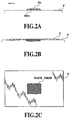
- the Bk ink Bku is of the remain upper part-type and after a given time elapsed from applying the Bk ink Bku the highly-permeable processing liquid Ss is applied to the Bk ink Bku in an overlapping manner to print a black image.
- the processing liquid is not applied to the pixels to which the color ink C is to be applied and only the color ink C is applied, as shown in Fig. 2B.
- the black image printed in the above manner has sharp edges without bleeding as shown in Fig. 2C and can be fixed in a relatively short time.
- the color image thus obtained is clear and has a relatively high OD and little bleeding at the boundary between itself and a black image.
- a generally high-grade image can be printed and printing can be performed with a high fixing speed.
- the identical ejection data is used both for the Bk ink and for the processing liquid
- the application of the present invention is not limited to this example. That is, the ejection data for the Bk ink and for the processing liquid may be different as long as the above-described deviation of the landing position does not significantly affect the image quality.
- a first embodiment of the present invention uses a dye as a coloring material in the Bk ink. Then, identical ejection data is used both for the Bk ink and for the processing liquid. That is, the processing liquid is ejected onto the Bk ink on the dot-on-dot basis. On the other hand, upon printing a color image by selectively ejecting the Y, M, and C inks, the processing liquid is not ejected onto these inks. These inks and the processing liquid are ejected in an order of the Bk ink, the processing liquid, and the color inks. The color inks may be ejected in an arbitrary order, for example, in the order of C, M, and Y. In addition, coloring materials for the color inks are dyes.
- the ejection order of the Bk ink, the processing liquid, and the color inks is not limited to the above example. It is arbitrary unless applying the color inks does not affect the reaction between the Bk ink and the processing liquid.
- the color inks may be applied before applying the Bk ink and the processing liquid.
- the Bk ink used is that has lower permeability than the processing liquid has, and the processing liquid used is that permeates at relatively high speed.
- the Bk ink and the processing liquid react to each other before most of them have permeated, so that the dye constituting the color material of the Bk ink becomes insoluble, whereas a solvent or the like containing water permeates through the paper at a high speed due to its high permeability.
- black images with a high OD and sharp edges can be obtained without bleeding and fixed in a short time.
- this embodiment can provide following effects: First, since no processing liquid is applied to the color inks, only a small amount of the ink and the processing liquid must be applied to the overall paper, thereby restraining the paper from being curled or cockled.
- the use frequency of the head for ejecting the processing liquid can be reduced to improve its durability.
- the durability of the heaters is improved. This is advantageous for fast printers responsible for a large amount of printing.
- the present invention is not limited to this example.
- a pigment can be used as the coloring material.
- a dispersing agent-free pigment is more preferable in terms of reliability including the wettability of a print head face.
- a mixture of a dye and a pigment may be used instead of a single dye or pigment.
- a mixture of a pigment and a dye serves to achieve a higher OD and faster fixing than a single pigment or dye.
- the mixed ink may be obtained by ejecting pigment and dye inks from separate heads or a single head and mixing these inks on the paper, or may contain previously mixed color materials.
- the processing liquid is applied after applying the Bk ink
- the Bk ink may be further applied after applying the processing liquid.
- an applying order that the processing liquid is applied before the Bk ink is applied may be used as one applying order of the Bk ink and the processing liquid. Also, this configuration can be applied to other embodiments described below.
- the ink and the processing liquid when the Bk ink and the processing liquid react to each other to make the ink color material insoluble, the ink and the processing liquid does not need to have fixed characteristics for insolublization.
- the Bk ink is anionic, while the processing liquid is cationic.
- a nonionic surfactant is preferably used.
- Embodiment 2 uses a printing method similar to that in the above-described Embodiment 1.
- Embodiment 2 differs from Embodiment 1 in that the heads for use in ejecting the inks or the processing liquid are of the full-line type.
- the heads each including a relatively large number of ejection openings and thus a large number of heaters are likely to become hot during continuous printing or the like, and this is more significant when the printing duty is high. Consequently, the heads expand and elongate, and a misregistration or a deviation of landing position of the ink and the processing liquid may occur among the heads when they elongate in different manners.
- This embodiment prevents the misregistration and ensures the overlapping between the Bk ink and the processing liquid to reliably provide the effects described in Embodiment 1, including the improved OD and so on. That is, the ejection data for the processing liquid is generated in association with the ejection data for the Bk ink. More specifically, increases in respective temperatures of the processing liquid head and the Bk ink head are set so that the misregistration is unnoticeable.
- a preferable condition is that the ejection data for the processing liquid is identical to that for the Bk ink. This condition allows the Bk ink head and the processing liquid head to elongate in almost the same manner, thereby ensuring the prevention of the misregistration or the like.
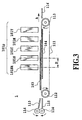
- Fig. 3 is a schematic diagram showing a general configuration of a full-line type printing apparatus according to one example of the present invention.
- the printing apparatus 1 employs an ink jet printing method of ejecting inks or a processing liquid from a plurality of full-line type print heads located at predetermined positions along a direction (direction shown by an arrow A in the figure) in which printing paper as a printing medium is fed.
- the printing apparatus 1 operates under the control of a control circuit (not shown).
- Print heads 101Bk, 101S, 101C, 101M, and 101Y in a head group 101g are of the full-line type described above and each has about 7,200 ink ejection openings arranged in a cross direction (that is perpendicular to the sheet of the drawing) of the printing paper, which is fed in direction A in the figure. Accordingly, these heads enable printing on the printing paper of an A3 size at maximum.
- the printing paper 103 is fed in direction A when a pair of resist rollers 114 driven by rotation of a feed motor.
- the printing paper is guided by a pair of guide plates 115 so as to have its tip registered and is then fed by a conveying belt 111.
- the conveying belt 111 an endless belt, is held by two rollers 112, 113, and vertical displacement of its upper part is regulated by a platen 104.
- Rotative driving of the roller 113 causes the printing paper to be conveyed.
- the printing paper 103 is electrostatically attracted to the conveying belt 111.
- the roller 113 is rotatively driven by a drive source such as a motor (not shown) in a direction that allows the printing paper 103 to be conveyed in direction A.
- the printing paper 103 is conveyed on the conveying belt 111 while having images printed thereon by the print head group 101g, and is then discharged onto a stocker 116.
- Each print head of the print head group 101g uses thermal energy to produce a bubble in the ink or the liquid so that pressure of the bubble causes the ink or the liquid to be ejected.
- the print head group 101g has a head 101Bk for ejecting the black (Bk) ink described in the above embodiments and a processing liquid head 101S for ejecting the processing liquid also described in the above embodiments, and further has color ink heads (a cyan head 101C, a magenta head 101M, and a yellow head 101Y) arranged along direction A in which the printing paper 103 is conveyed, as illustrated.
- the print heads eject the corresponding inks and the processing liquid to enable black characters and color images to be printed.
- the black ink ejected from the head 101 Bk has a low permeation speed (such an ink is called as the "remaining upper part -type ink” in this example), whereas the processing liquid and cyan, magenta, and yellow inks ejected from the heads 101S, 101C, 101M, 101Y, respectively have a high permeation speed (such liquid or inks are called as a "highly-permeable inks" in this example).
- the permeation speed will be described in brief.
- Fig. 4 is a chart showing values of the proportion factor Ka with respect to a rate of acetylenol contained in the liquid as experimentally determined.
- the Ka value was measured using a dynamic liquid permeability testing device (manufactured by Toyo Precision Machine Manufacturing Company) based on the Bristow method.
- This experiment used PB paper from Canon Inc., which is the applicant, as the printing paper.
- the PB paper can be used both for copiers and LBPs (laser beam printers) using the electro-photographic system and for printers using the ink jet printing system.
- the curve shown in Fig. 4 indicates that the Ka value (shown by an ordinate) increases linearly with increase of the rate of acetylenol content (shown by an abscissa).
- the proportion factor Ka depends on the rate of acetylenol content.
- the ink permeation speed is substantially determined by the rate of acetylenol content.
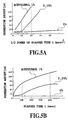
- Figs. 11A and 11B are characteristic diagrams showing the ink permeation volume plotted as a function of the elapsed time; this graph shows results of experiments using the printing paper (PB paper) described above, which was 64g/m 2 , 80 ⁇ m in thickness, and about 50% in void percentage.
- PB paper printing paper
- an abscissa indicates a value of the half power of the elapsed time (msec 1/2 ), whereas in Fig. 5B, an abscissa indicates the elapsed time t (msec).
- ordinates indicate the permeation volume V ( ⁇ m) and the curves indicate the rate of acetylenol content varied between 0 and 0.35 and 1%, respectively.
- Figs. 11A and 11B indicate that the wet time tw decreases with an increase in acetylenol content and that the permeability increases linearly with the rate of acetylenol content even before the time tw is reached.
- a liquid free from acetylenol (the acetylenol content is 0%) has a low permeability and exhibits the characteristics of the remaining upper part-type ink, which will be defined later. Additionally, when the liquid has 1% of acetylenol content, it permeates through the printing paper 103 at a high speed and exhibits the characteristics of the highly-permeable ink, which will be defined later. An ink with 0.35% of acetylenol content exhibits the characteristics of a semi-permeable ink, which is an intermediate between the remaining upper part-type ink and the highly-permeable ink.
- Table 1 shows the characteristics of the "remaining upper part-type ink” and “highly-permeable ink” described above and of the “semi-permeable ink", which is an intermediate between these inks.
- Table 1 shows the Ka value, acetylenol content (%), and surface tension (dyne/cm) of each of the "remaining upper part-type ink", the “semi-permeable ink”, and the “highly-permeable ink”.
- the permeability of each ink on the printing paper as a printing medium increases consistently with increasing of the Ka value. That is, it increases when surface tension decreases.
- the Ka value in Table 1 was measured using the dynamic liquid permeability testing device (manufactured by Toyo Seiki Seisaku-Sho, Ltd.) based on the Bristow method as described above. This experiment used PB paper from Canon Inc., which is the applicant, as the printing paper. Additionally, similar results were obtained using PPC paper that is electrophotographic paper also available from Canon Inc.
- CMC critical micelle concentration
- the critical micelle concentration refers to an increased concentration of a solution of the surfactant at which dozens of molecules are associated rapidly with one another to form micelles.
- the acetylenol which is contained in the liquid described above to adjust the permeability, is a type of surfactant that has a critical micelle concentration depending on the liquid.
- CMC critical micelle concentration
- compositions of the processing liquid and inks used in this example are shown below.
- the rate of each component is shown in terms of parts by weight.
- [Processing liquid] Glycerin 7 pts.wt. Diethylene glycol 5 pts.wt. Acetylenol EH (manufactured by Kawaken Fine Chemicals Co., Ltd.) 2 pts.wt. Polyallylamine 4 pts.wt. Acetic acid 4 pts.wt. Benzalkonium chloride 0.5 pts.wt. Water Remaining part [Yellow (Y) ink] C.I. direct yellow 86 3 pts.wt. Glycerin 5 pts.wt.
- a solution was prepared by dissolving 5 g of thick hydrochloric acid in 5.3 g of water, and 1.58 g of anthranilic acid was added to this solution at 5°C.
- the solution was maintained at 10°C or lower by means of agitation in an ice bath, and was then mixed with a solution prepared by adding 1.78 g of sodium nitrite to 8.7 g of water at 5°C. Further, after 15 minutes of agitation, 20 g of carbon black having a surface area of 320 m 2 /g and a DBP oil absorption of 120 ml/100g was added to the mixture. Subsequently, the mixture was further agitated for 15 minutes.
- a slurry thus obtained was filtered using Toyo Filter Paper No.2 (manufactured by Advantec), pigment particles were washed off, and the slurry was dried in an oven at 110°C. Water was added to this pigment to produce an aqueous solution of pigment containing 10 wt.% of pigment.
- the above method was used to obtain the pigment dispersing agent containing an anionically charged self-dispersing carbon black having a hydrophilic radical bound thereto via phenyl group as shown in a formula below.
- the black ink is set to be of the remaining upper part-type and the processing liquid and the C, M, and Y inks are set to be of the highly-permeable type.
- the black ink is, what is called, a dispersing agent-free pigment, which has been described in the above example.
- a self-dispersing carbon black dispersant having at least one type of hydrophilic radical bound to a surface thereof directly or via another atomic group is preferably used as the anionic carbon black dispersant.
- the self-dispersing carbon black is preferably ionic and more preferably anionically charged.
- the hydrophilic radical bound to the surface may be, for example, -COOM, -SO 3 M, -PO 3 HM, -PO 3 M 2 , -SO 2 NH 2 , or -SO 2 NHOR (where M denotes hydrogen atom, alkali metal, ammonium, or organic ammonium, and R denotes an alkyl group with a carbon atom number of 1 to 12, a phenyl radical that may have a substituent, or a naphthyl radical that may have a substituent).
- M denotes hydrogen atom, alkali metal, ammonium, or organic ammonium
- R denotes an alkyl group with a carbon atom number of 1 to 12
- a phenyl radical that may have a substituent or a naphthyl radical that may have a substituent.
- an anionically-charged carbon black having -COOM or -SO 3 M bound to its surface is preferable.
- the alkali metal may be, for example, lithium, sodium, or potassium
- the organic ammonium may be mono- or tri-methyl ammonium, mono-or tri-ethyl ammonium, or mono- or tri-methanol ammonium.
- -COONa may be introduced into the carbon black surface by, for example, oxidizing the carbon black with sodium hypochlorite.
- the present invention is not limited to this method.
- the carbon black with the hydrophilic radical bound to its surface via another atomic group is preferable.
- the another atomic group may be, for example, an alkyl group with a carbon atom number of 1 to 12, a phenyl radical that may have a substituent, or a naphthyl radical that may have a substituent.
- Specific examples of the hydrophilic radical bound to the carbon black surface via the another atomic group include, for example, -CH 4 COOM, -PhSO 3 M, and -PhCOOM (where Ph denotes a phenyl group) in addition to those listed above.
- the present invention is not limited to these examples.
- This dispersing agent-free carbon black is superior to conventional carbon blacks and thus does not require the addition of a pigment dispersing resin or a surfactant.
- this carbon black is appropriately fixed and wetted and can be reliably used for print heads, compared to conventional pigments.
- each print head has the ink ejection openings arranged therein at a density of 600 dpi and carries out printing at a dot density of 600 dpi in the printing paper feed direction. Accordingly, images or the like printed according to this embodiment have a dot density of 600 dpi both in the row direction and in the column direction.
- each head has an ejection frequency of 4 kHz, so that the printing paper is fed at about 170 mm/sec. Furthermore, since a distance D between the Bk ink head 101Bk and the processing liquid head 101S (see Fig. 3) is 40 mm, the time from the Bk ink ejection until the processing liquid ejection is therefor about 0.24 sec.
- 80% of the particles in the self-dispersing pigment used in this embodiment preferably have a particle size between 0.05 and 0.3 ⁇ m, and more preferably between 0.1 and 0.25 ⁇ m.
- Fig. 6 is a schematic perspective view showing the configuration of a serial printing apparatus 5 according to another example of the present invention.
- the printing apparatus applying the Bk ink to the printing medium and then ejecting the processing liquid for reaction is applicable not only to the above-described full-line type but also to the serial type.
- the same elements as shown in Fig. 3 carry the same reference numerals and detailed description thereof is omitted.
- the printing paper 103 which is the printing medium, is inserted from a paper feed section 105 and discharged through a printing section 126.
- a carriage 107 mounts the print heads 101S, 101Bk, 101C, 101M, and 101Y and is adapted to reciprocate along a guide rail 109 based on a driving force applied by a motor (not shown).
- the print head 101S can eject the processing liquid described above in the embodiments.
- the black head 101Bk and the heads 101C, 101M, 101Y eject the black ink, the cyan ink, the magenta ink, and the yellow ink, respectively. These heads are driven so that after the black ink and then the processing liquid are ejected, the remaining inks are ejected onto the printing paper 103 in the above order.
- Each head is supplied with the processing liquid or the corresponding ink from an ink tank 108Bk, 108S, 108C, 108M, 108Y.
- a drive signal is supplied to an electro-thermal converting element (heaters) provided for each the ejection opening of each head to apply thermal energy to the ink or the processing liquid in order to generate bubbles, whereby pressure provided upon bubbling is used to eject the ink or the processing liquid.
- Each head has 64 ejection openings arranged at a density of 360 dpi in a direction almost the same as a direction Y in which the printing paper 103 is fed, that is, a direction substantially perpendicular to a head scanning direction. And an amount of the inks or the processing liquid ejected from each ejection opening realizes any of the embodiments described above.
- the respective distance between the heads are 1 inch, so that the distance between the heads 101Bk and 101S is 1 inch.
- the print density in the scanning direction is 720 dpi, and the ejection frequency of each head is 7.2 kHz. Accordingly, the time from the Bk ink ejection from the head 101 Bk until the processing liquid ejection from the head 101S is 0.05 sec.
- the black ink is applied to the printing medium and the processing liquid is then applied so as to mix the black ink and the processing liquid together on the printing medium in a liquid state, and with a timing different from that for the reaction resulting from the mixture of the black ink and the processing liquid, for example, after the reaction, the color inks are applied to an area of the printing medium to which the black ink and the processing liquid are not applied.
- a reactant between the black ink and the processing liquid or the black ink becomes insoluble so as to be prevented from flowing out to the peripheries thereof, thereby reducing bleeding at the boundary between a color image and a black image even when the color ink is applied to the peripheries.
- the processing liquid or another ink is applied to the peripheries of the black ink, a liquid which has not become completely insoluble may flow out, but the present invention can prevent such a phenomenon.
- the processing liquid and the color inks are that permeate at a high speed, the black and color images can be printed with high fixing capability.
- black characters of high density can be printed with little feathering and images can be printed with little bleeding at the boundaries between colors.
- the present invention also avoids the misregistration between the inks and the processing liquid to achieve the above-described objects such as high-grade printing.
Landscapes
- Ink Jet (AREA)
- Ink Jet Recording Methods And Recording Media Thereof (AREA)
Applications Claiming Priority (2)
| Application Number | Priority Date | Filing Date | Title |
|---|---|---|---|
| JP11190579A JP2001018425A (ja) | 1999-07-05 | 1999-07-05 | インクジェットプリント方法およびインクジェットプリント装置 |
| JP19057999 | 1999-07-05 |
Publications (3)
| Publication Number | Publication Date |
|---|---|
| EP1066968A2 EP1066968A2 (en) | 2001-01-10 |
| EP1066968A3 EP1066968A3 (en) | 2001-10-10 |
| EP1066968B1 true EP1066968B1 (en) | 2005-06-01 |
Family
ID=16260419
Family Applications (1)
| Application Number | Title | Priority Date | Filing Date |
|---|---|---|---|
| EP00114305A Expired - Lifetime EP1066968B1 (en) | 1999-07-05 | 2000-07-04 | Ink jet printing apparatus and ink jet printing method |
Country Status (4)
| Country | Link |
|---|---|
| US (1) | US6517191B1 (enExample) |
| EP (1) | EP1066968B1 (enExample) |
| JP (1) | JP2001018425A (enExample) |
| DE (1) | DE60020454T2 (enExample) |
Families Citing this family (12)
| Publication number | Priority date | Publication date | Assignee | Title |
|---|---|---|---|---|
| US7079712B1 (en) * | 1999-05-25 | 2006-07-18 | Silverbrook Research Pty Ltd | Method and system for providing information in a document |
| JP3549159B2 (ja) * | 2001-09-13 | 2004-08-04 | 東芝テック株式会社 | インクジェット記録装置 |
| US20040169709A1 (en) * | 2003-02-28 | 2004-09-02 | Geoff Wotton | Printing device and method |
| JP4421198B2 (ja) | 2003-03-04 | 2010-02-24 | 東芝テック株式会社 | インク評価方法、インク及びインク吐出装置 |
| JP4508703B2 (ja) * | 2003-04-24 | 2010-07-21 | キヤノン株式会社 | インクジェット用インク及びこれを用いたインクジェット記録方法 |
| JP4812078B2 (ja) | 2004-12-28 | 2011-11-09 | キヤノン株式会社 | インクジェット記録装置 |
| JP5490474B2 (ja) | 2009-09-18 | 2014-05-14 | 富士フイルム株式会社 | 画像形成方法及びインク組成物 |
| JP5430315B2 (ja) * | 2009-09-18 | 2014-02-26 | 富士フイルム株式会社 | 画像形成方法及びインク組成物 |
| JP5540794B2 (ja) * | 2010-03-18 | 2014-07-02 | セイコーエプソン株式会社 | 液体噴射方法、及び、液体噴射装置 |
| JP2014188806A (ja) * | 2013-03-27 | 2014-10-06 | Seiko Epson Corp | 印刷装置 |
| JP6171464B2 (ja) * | 2013-03-27 | 2017-08-02 | セイコーエプソン株式会社 | 印刷装置 |
| JP6253243B2 (ja) * | 2013-04-16 | 2017-12-27 | キヤノン株式会社 | 記録装置および記録方法 |
Family Cites Families (11)
| Publication number | Priority date | Publication date | Assignee | Title |
|---|---|---|---|---|
| JP3332465B2 (ja) * | 1993-04-05 | 2002-10-07 | キヤノン株式会社 | インクジェット記録方法、インクジェット記録装置 |
| JP3347541B2 (ja) * | 1994-08-10 | 2002-11-20 | キヤノン株式会社 | インクジェット記録方法、インクジェット記録装置、記録ヘッド、情報処理システム、および記録物 |
| US5568169A (en) * | 1994-10-19 | 1996-10-22 | Xerox Corporation | Method and apparatus using two different black inks to reduce intercolor bleeding and provide high quality edge definition with thermal ink jet systems |
| US5581284A (en) * | 1994-11-25 | 1996-12-03 | Xerox Corporation | Method of extending the life of a printbar of a color ink jet printer |
| JP3320292B2 (ja) * | 1995-02-13 | 2002-09-03 | キヤノン株式会社 | インクジェットプリント装置およびインクジェットプリント方法 |
| DE69725374T2 (de) * | 1996-04-19 | 2004-08-12 | Canon K.K. | Tintenstrahldruckverfahren und -gerät unter Verwendung einer Druckqualität verbessernden Flüssigkeit |
| JP3313977B2 (ja) * | 1996-08-02 | 2002-08-12 | キヤノン株式会社 | インクジェット記録方法およびインクジェット記録装置 |
| JP3212264B2 (ja) * | 1997-02-14 | 2001-09-25 | キヤノン株式会社 | インクジェット記録装置およびインクジェット記録方法 |
| US5853465A (en) * | 1997-03-24 | 1998-12-29 | Hewlett-Packard Company | Black-to-color bleed alleviation using non-specific ionic, pH, and colloidal effects |
| JP3679553B2 (ja) * | 1997-06-26 | 2005-08-03 | キヤノン株式会社 | インクジェット記録装置及びインクジェット記録方法 |
| JP4036407B2 (ja) * | 1997-12-26 | 2008-01-23 | キヤノン株式会社 | インクジェットプリント装置およびその方法 |
-
1999
- 1999-07-05 JP JP11190579A patent/JP2001018425A/ja active Pending
-
2000
- 2000-07-04 EP EP00114305A patent/EP1066968B1/en not_active Expired - Lifetime
- 2000-07-04 DE DE60020454T patent/DE60020454T2/de not_active Expired - Lifetime
- 2000-07-05 US US09/610,913 patent/US6517191B1/en not_active Expired - Fee Related
Also Published As
| Publication number | Publication date |
|---|---|
| DE60020454T2 (de) | 2005-11-03 |
| DE60020454D1 (de) | 2005-07-07 |
| JP2001018425A (ja) | 2001-01-23 |
| EP1066968A2 (en) | 2001-01-10 |
| EP1066968A3 (en) | 2001-10-10 |
| US6517191B1 (en) | 2003-02-11 |
Similar Documents
| Publication | Publication Date | Title |
|---|---|---|
| US6474778B1 (en) | Ink jet printing apparatus and ink jet printing method | |
| KR100338617B1 (ko) | 잉크의 색재를 불용화시키는 기능을 가진 잉크를 사용하여 프린트하는 잉크 프린트 방법 및 잉크젯 프린트 장치 | |
| EP0925919B1 (en) | Ink-jet printing apparatus | |
| JP3997019B2 (ja) | プリント方法およびプリント装置 | |
| US6550904B2 (en) | Ink printing method and ink printer | |
| JP3658223B2 (ja) | 画像形成方法および画像形成装置 | |
| EP1066968B1 (en) | Ink jet printing apparatus and ink jet printing method | |
| US6471348B1 (en) | Ink printing method and ink printer | |
| US6367923B1 (en) | Ink-jet printing method, system using an ink and a treating liquid, and ink set | |
| JP4343329B2 (ja) | インクプリント方法およびインクジェットプリント装置 | |
| US6454402B1 (en) | Ink-jet printing method an ink-jet printing apparatus | |
| JP3658196B2 (ja) | 記録方法 | |
| JP4227267B2 (ja) | インクジェットプリント方法およびインクジェットプリント装置 | |
| JP4235331B2 (ja) | インクジェットプリント方法 | |
| JP4036463B2 (ja) | インクジェットプリント装置およびプリント方法 |
Legal Events
| Date | Code | Title | Description |
|---|---|---|---|
| PUAI | Public reference made under article 153(3) epc to a published international application that has entered the european phase |
Free format text: ORIGINAL CODE: 0009012 |
|
| AK | Designated contracting states |
Kind code of ref document: A2 Designated state(s): AT BE CH CY DE DK ES FI FR GB GR IE IT LI LU MC NL PT SE Kind code of ref document: A2 Designated state(s): DE FR GB IT |
|
| AX | Request for extension of the european patent |
Free format text: AL;LT;LV;MK;RO;SI |
|
| PUAL | Search report despatched |
Free format text: ORIGINAL CODE: 0009013 |
|
| AK | Designated contracting states |
Kind code of ref document: A3 Designated state(s): AT BE CH CY DE DK ES FI FR GB GR IE IT LI LU MC NL PT SE |
|
| AX | Request for extension of the european patent |
Free format text: AL;LT;LV;MK;RO;SI |
|
| 17P | Request for examination filed |
Effective date: 20020219 |
|
| AKX | Designation fees paid |
Free format text: DE FR GB IT |
|
| 17Q | First examination report despatched |
Effective date: 20030120 |
|
| GRAP | Despatch of communication of intention to grant a patent |
Free format text: ORIGINAL CODE: EPIDOSNIGR1 |
|
| GRAS | Grant fee paid |
Free format text: ORIGINAL CODE: EPIDOSNIGR3 |
|
| GRAA | (expected) grant |
Free format text: ORIGINAL CODE: 0009210 |
|
| AK | Designated contracting states |
Kind code of ref document: B1 Designated state(s): DE FR GB IT |
|
| PG25 | Lapsed in a contracting state [announced via postgrant information from national office to epo] |
Ref country code: IT Free format text: LAPSE BECAUSE OF FAILURE TO SUBMIT A TRANSLATION OF THE DESCRIPTION OR TO PAY THE FEE WITHIN THE PRESCRIBED TIME-LIMIT;WARNING: LAPSES OF ITALIAN PATENTS WITH EFFECTIVE DATE BEFORE 2007 MAY HAVE OCCURRED AT ANY TIME BEFORE 2007. THE CORRECT EFFECTIVE DATE MAY BE DIFFERENT FROM THE ONE RECORDED. Effective date: 20050601 |
|
| REG | Reference to a national code |
Ref country code: GB Ref legal event code: FG4D |
|
| REF | Corresponds to: |
Ref document number: 60020454 Country of ref document: DE Date of ref document: 20050707 Kind code of ref document: P |
|
| PLBE | No opposition filed within time limit |
Free format text: ORIGINAL CODE: 0009261 |
|
| STAA | Information on the status of an ep patent application or granted ep patent |
Free format text: STATUS: NO OPPOSITION FILED WITHIN TIME LIMIT |
|
| 26N | No opposition filed |
Effective date: 20060302 |
|
| EN | Fr: translation not filed | ||
| PG25 | Lapsed in a contracting state [announced via postgrant information from national office to epo] |
Ref country code: FR Free format text: LAPSE BECAUSE OF NON-PAYMENT OF DUE FEES Effective date: 20050731 |
|
| PG25 | Lapsed in a contracting state [announced via postgrant information from national office to epo] |
Ref country code: FR Free format text: LAPSE BECAUSE OF NON-PAYMENT OF DUE FEES Effective date: 20050601 |
|
| PGFP | Annual fee paid to national office [announced via postgrant information from national office to epo] |
Ref country code: DE Payment date: 20130731 Year of fee payment: 14 |
|
| PGFP | Annual fee paid to national office [announced via postgrant information from national office to epo] |
Ref country code: GB Payment date: 20130712 Year of fee payment: 14 |
|
| REG | Reference to a national code |
Ref country code: DE Ref legal event code: R119 Ref document number: 60020454 Country of ref document: DE |
|
| GBPC | Gb: european patent ceased through non-payment of renewal fee |
Effective date: 20140704 |
|
| PG25 | Lapsed in a contracting state [announced via postgrant information from national office to epo] |
Ref country code: DE Free format text: LAPSE BECAUSE OF NON-PAYMENT OF DUE FEES Effective date: 20150203 |
|
| REG | Reference to a national code |
Ref country code: DE Ref legal event code: R119 Ref document number: 60020454 Country of ref document: DE Effective date: 20150203 |
|
| PG25 | Lapsed in a contracting state [announced via postgrant information from national office to epo] |
Ref country code: GB Free format text: LAPSE BECAUSE OF NON-PAYMENT OF DUE FEES Effective date: 20140704 |