EP1066729B1 - Flexible radio access and resource allocation in a universal mobile telephone system (umts) - Google Patents
Flexible radio access and resource allocation in a universal mobile telephone system (umts) Download PDFInfo
- Publication number
- EP1066729B1 EP1066729B1 EP99921332A EP99921332A EP1066729B1 EP 1066729 B1 EP1066729 B1 EP 1066729B1 EP 99921332 A EP99921332 A EP 99921332A EP 99921332 A EP99921332 A EP 99921332A EP 1066729 B1 EP1066729 B1 EP 1066729B1
- Authority
- EP
- European Patent Office
- Prior art keywords
- radio
- service
- radio access
- channel
- utran
- Prior art date
- Legal status (The legal status is an assumption and is not a legal conclusion. Google has not performed a legal analysis and makes no representation as to the accuracy of the status listed.)
- Expired - Lifetime
Links
Images



Classifications
-
- H—ELECTRICITY
- H04—ELECTRIC COMMUNICATION TECHNIQUE
- H04W—WIRELESS COMMUNICATION NETWORKS
- H04W28/00—Network traffic management; Network resource management
- H04W28/02—Traffic management, e.g. flow control or congestion control
- H04W28/0252—Traffic management, e.g. flow control or congestion control per individual bearer or channel
- H04W28/0263—Traffic management, e.g. flow control or congestion control per individual bearer or channel involving mapping traffic to individual bearers or channels, e.g. traffic flow template [TFT]
-
- H—ELECTRICITY
- H04—ELECTRIC COMMUNICATION TECHNIQUE
- H04W—WIRELESS COMMUNICATION NETWORKS
- H04W28/00—Network traffic management; Network resource management
- H04W28/16—Central resource management; Negotiation of resources or communication parameters, e.g. negotiating bandwidth or QoS [Quality of Service]
- H04W28/18—Negotiating wireless communication parameters
-
- H—ELECTRICITY
- H04—ELECTRIC COMMUNICATION TECHNIQUE
- H04W—WIRELESS COMMUNICATION NETWORKS
- H04W72/00—Local resource management
- H04W72/50—Allocation or scheduling criteria for wireless resources
- H04W72/54—Allocation or scheduling criteria for wireless resources based on quality criteria
-
- H—ELECTRICITY
- H04—ELECTRIC COMMUNICATION TECHNIQUE
- H04J—MULTIPLEX COMMUNICATION
- H04J13/00—Code division multiplex systems
- H04J13/16—Code allocation
-
- H—ELECTRICITY
- H04—ELECTRIC COMMUNICATION TECHNIQUE
- H04W—WIRELESS COMMUNICATION NETWORKS
- H04W72/00—Local resource management
- H04W72/04—Wireless resource allocation
-
- H—ELECTRICITY
- H04—ELECTRIC COMMUNICATION TECHNIQUE
- H04W—WIRELESS COMMUNICATION NETWORKS
- H04W74/00—Wireless channel access
-
- H—ELECTRICITY
- H04—ELECTRIC COMMUNICATION TECHNIQUE
- H04W—WIRELESS COMMUNICATION NETWORKS
- H04W76/00—Connection management
- H04W76/10—Connection setup
-
- H—ELECTRICITY
- H04—ELECTRIC COMMUNICATION TECHNIQUE
- H04W—WIRELESS COMMUNICATION NETWORKS
- H04W88/00—Devices specially adapted for wireless communication networks, e.g. terminals, base stations or access point devices
- H04W88/12—Access point controller devices
Definitions
- the present invention relates in general to mobile communications, and in particular, to flexibly providing a wide variety of mobile communications services and efficiently allocating resources to support those services.
- UMTS Universal Mobile Telephone communications System
- IMT 2000 the Universal Mobile Telephone communications System
- UMTS Universal Mobile Telephone communications System
- IMT 2000 the Universal Mobile Telephone communications System
- UMTS is "communication to everyone, everywhere," where communication also includes the provision of information using different types of media, i.e., multimedia communications.
- PSTNs Public Switched Telephone Networks
- ISDNs Integrated Services Digital Networks
- packet-switched networks such as the Internet
- wireline communication terminals e.g., personal computers
- wireless mobile radio terminals are at a considerable disadvantage because of the limited bandwidth of the radio/air interface that separates the mobile terminals from packet-switched networks.
- Mobile terminals are currently limited in the data rates for data communications services such as facsimile, electronic mail, and Internet. While it is feasible perhaps to provide some slow-scan video and picture transfer at this limited rate over the radio air interface at this limited rate, as long as demands on quality are not too high, the expectations regarding real time use of the Internet are a more difficult challenge.
- the demand is growing for higher data transfer speeds in order the "surf the net" using mobile terminals with fast access to text, images, and sound.
- This multimedia application demands high peak bit rates in short bursts while the information is downloaded to the mobile terminal.
- Another challenging multimedia, mobile terminal application is simultaneous voice and data, e.g., PC application sharing or shared whiteboard.
- GSM already meets some of the requirements for UMTS.
- HSCSD High Speed Circuit Switched Data
- GPRS General Packet Radio Service
- Both services are designed to integrate with the current GSM system.
- HSCSD bearer services bundle up eight Time Division Multiple Access (TDMA) time slots within a 200 kHz GSM carrier to create a higher bandwidth channel. In other words, a 64 kbps circuit switched bearer channel uses all available TDMA slots.
- TDMA Time Division Multiple Access
- HSCSD is also being developed to provide bandwidth on demand at variable data rates.
- GPRS is a packet switching technique that employs reduced channel coding to achieve a net bit rate of 14.4 kbps per time slot providing a maximum throughput rate of 115 kbps. It is more suited to handling "bursty" traffic such as the infrequent transmission of e-mail messages, Internet information, and other data. Because GPRS is a packet switching service, it only requires a channel when data is being sent thereby enabling the frequency spectrum to be more efficiently allocated across voice and data calls and allowing channels to be shared between several users simultaneously.
- a UMTS Wideband-Code Division Multiple Access (WCDMA) radio access network provides wireless access at very high data rates and supports enhanced bearer services not realistically attainable with the first and second generation mobile communication systems.
- WCDMA currently supports 5 MHz-15 MHz, and in the future, promises an even greater bandwidth.
- WCDMA also improves the quality of service by providing robust operation in fading environments and transparent ("soft") handoffs between base stations.
- Multiplath fading is used to advantage to enhance quality, i.e., using a RAKE receiver and improved signal processing techniques, contrasted in narrowband systems where fading substantially degrades signal quality.
- the present invention provides a method according to claim 1.
- a UMTS Terrestrial Radio Access Network responds to radio access bearer service requests with flexible and efficient allocation of resources needed to support a communication with a mobile radio.
- the UTRAN includes plural base stations for communicating with mobile radios over a radio air interface using radio channel resources allocated by a radio network controller connected to the base stations.
- External network service nodes that interface with external networks communicate with mobiles via the UTRAN.
- the service node requests a radio access bearer from the UTRAN rather than a specific radio channel resource.
- a radio access bearer is a logical connection with the mobile station through the UTRAN and over the radio air interface and corresponds to a single data stream.
- one radio access bearer may support a speech connection
- another bearer may support a video connection
- a third bearer may support a data packet connection.
- Each radio access bearer is associated with quality of service (QoS) parameters describing how the UTRAN should handle the data stream. Examples of quality of service parameters include data rate, variability of data rate, amount and variability of delay, guaranteed vs. best effort delivery, error rate, etc.
- QoS quality of service
- the radio access bearers are dynamically assigned to UTRAN transport and radio channel resources by the UTRAN.
- the radio access bearer service and the UTRAN isolate the details of transport and radio resource allocation handling as well as details of radio control, e.g., soft handoff.
- the UTRAN approach is different from traditional approaches where an external network and/or an external network service node is involved in the details of requesting, allocating, and controlling specific radio connections to and from the mobile radio. Instead, the external network service node only needs to request a radio access bearer service over a RAN interface to the UTRAN along with a specific quality of service for a communication to a specific mobile radio.
- the UTRAN provides the requested service at the requested quality of service (if possible).
- Plural radio access bearers may be established and released independently to one mobile radio including bearers from different networks. Moreover, plural radio access bearers, e.g., one carrying circuit-switched information and another carrying packet-switched information, intended for the specific mobile radio may be multiplexed onto the same CDMA channel. Each bearer may have its own Asynchronous Transfer Mode (ATM) transport connection through the UTRAN, or it may be multiplexed with other bearers onto one ATM transport connection.
- ATM Asynchronous Transfer Mode
- a request is transmitted to the UTRAN for communication with a mobile radio.
- One or more parameters accompany the radio access bearer service request.
- the UTRAN flexibly "maps" or allocates the radio access bearer to physical transport and radio channel resources through the UTRAN and over the radio air interface, respectively.
- the transport connection between nodes in the UTRAN in a preferred example embodiment is an ATM type connection.
- a radio channel over the air interface includes one or more CDMA spreading codes.
- the mapping is based on the one or more parameters associated with the radio access bearer service request.
- the parameters may also include one or more traffic condition parameters like a congestion level on a common channel, an interference level in the geographic location area in which the mobile radio is currently operating, a distance between the mobile radio and the base station, radio transmit power, the availability of dedicated channel resources, the existence of a dedicated channel to a mobile station, and other traffic parameters or conditions.
- a dedicated type of channel delivers frames of information as received without substantial delay.
- a common or shared type of channel delivers packets of information in a scheduled manner.
- the dedicated channel may for example be selected.
- the common channel may for example be selected.
- the channel type selection may also take into account traffic parameters like the interference level in the geographic location area in which the mobile radio is currently operating. If that interference level is high, a dedicated radio channel may for example be selected which typically includes mobile transmit power control to help reduce the interference level. When the interference level is low, the shared radio channel may for example be selected to available more dedicated channel resources for other connections. Indeed, if the availability of dedicated channels is low, the dedicated radio channel may be selected.
- the channel type selection may be based on one parameter, e.g., one quality of service parameter, it is preferably based on plural quality of service parameters associated with the connection, or on a quality of service parameter associated with a connection and a current traffic condition, like the interference level in the mobile's geographic location area.
- a new logical connection is mapped to the already-existing dedicated channel since the UTRAN can multiplex different logical connections associated with the mobile station onto the single dedicated channel.
- control signaling associated with the logical connection while generally transferred on the common channel, is transferred on a dedicated channel if one exists to the mobile station.
- one or more parameter values relating to quality of service, traffic conditions, etc. is monitored during the lifetime of the connection. If the monitored parameter(s) changes enough from what was initially determined when the channel type for the connection was selected, the connection may be switched to another type of radio channel. For example, if a common radio channel is established for the connection based on an initial quality of service value, and the quality of service associated with that connection subsequently increases (preferably by a certain threshold amount over the initial quality of service value), the connection may be switched to a dedicated radio channel.
- the connection may be switched to the common radio channel.
- the interference level in the cell may subsequently may have increased such that it warrants switching the connection to a dedicated radio channel in order to decrease the interference level in the cell.
- the document WO 98/03030 refers to an automatic data transfer mode control, in particular to provide a method, which automatically optimises the data transfer mode in use. This is achieved by making the data transfer mode such that it is automatically adjusted according to the quality of the connection and by using a measure of the connection quality as an adjustment criterion. For transparent connections a desired maximum threshold value for the RXQUAL value can be determined and when the uplink or downlink RXQUAL exceeds the maximum threshold a more error-tolerant channel coding of a lower transmission speed is taken into use.
- the document WO 95/28814 relates to a method for adapting the transmission mode in a mobile radio communication system.
- the method provides at least two coding modes, each mode corresponding to a predetermined source coding and channel coding for each transmission direction.
- two distinct analyses of the transmission quality are carried out for each transmission direction respectively and for each of said directions one of said coding modes is selected.
- a representative, connection-oriented, external core network shown as a cloud 12 may be for example the Public Switched Telephone Network (PSTN) and/or the Integrated Services Digital Network (ISDN).
- PSTN Public Switched Telephone Network
- ISDN Integrated Services Digital Network
- a representative, connectionless-oriented, external core network, shown as a cloud 14 may be for example the Internet. Both core networks are coupled to corresponding service nodes 16.
- the PSTN/ISDN connection-oriented network 12 is connected to a connection-oriented service node shown as a mobile switching center (MSC) node 18, that provides circuit-switched services.
- MSC mobile switching center
- the mobile switching center 18 is connected over an interface A to a base station system (BSS) 22 which in turn is connected to a radio base station 23 over interface A'.
- the Internet connectionless-oriented network 14 is connected to a General Packet Radio Service (GPRS) node 20 tailored to provide packet-switched type services.
- GPRS General Packet Radio Service
- Each of the core network service nodes 18 and 20 connects to a UMTS Terrestrial Radio Access Network (UTRAN) 24 over a Radio Access Network (RAN) interface.
- the UTRAN 24 includes one or more radio network controllers (RNCs) 26.
- Each RNC 26 is connected to a plurality of base stations (BS) 28 and to any other RNCs in the UTRAN 24. Radio communications between the base stations 28 and mobile radio stations (MS) 30 are by way of a radio interface.
- radio access is based on Wideband-CDMA (WCDMA) with individual radio channels allocated using WCDMA spreading codes.
- WCDMA Wideband-CDMA
- WCDMA provides the wide bandwidth for multimedia services and other high rate demands as well as robust features like diversity handoff and RAKE receivers to ensure high quality.
- the RAN interface is an "open" interface between the GSM-based service nodes 18 and 20 which provide services to/from mobile radios over the radio interface to the external core networks 12 and 14 (and ultimately to external, core network end users) without having to request specific radio resources necessary to provide those services.
- the RAN interface essentially hides those details from the service nodes, external networks, and users. Instead, logical radio access bearers are simply requested, established, maintained, and released at the RAN interface by the service nodes.
- a radio access bearer is a logical connection between an external core network support node and a mobile station through the UTRAN. It is the task of the UTRAN 24 to map radio access bearers onto physical transport channels in a flexible, efficient, and optimal manner.
- the mapping includes selecting channel parameters based on quality of service parameters that accompany the radio access bearer request.
- Example parameters include transport and radio channel type (common or dedicated), retransmission protocol (RLC) parameters, selection of encoding and interleaving (MAC and physical layer) parameters, selection of radio access bearer multiplexing options, (i.e., which radio access bearers will be multiplexed with each other and at which level), and selection of CDMA code(s) and bit rate(s).
- RNC radio network controller
- the service nodes Instead of the external core networks and/or service nodes having to request specific radio resources and getting involved in the allocation and control of radio resources, (which can be quite involved for WCDMA calls -- especially for multimedia calls), the service nodes simply transmit a request for one or more radio access bearers in order to obtain access to a particular mobile station.
- the RAN interface and the UTRAN 24 handle the radio access bearer request and perform the necessary allocation, control, release, and other management tasks for transport and radio resources.
- the UTRAN employs ATM-type transport and WCDMA radio access resources. While ATM and WCDMA are wideband, flexible, and robust, they are also fairly complicated communication resources to manage.
- the service nodes are isolated from this complexity. Each service node only requests one (or more) radio access bearer(s) specifying the identity of the mobile to be communicated with one or more quality of service parameters to be associated with that bearer. Quality of service may include a desired bit rate, an amount of delay before information is transferred, a minimum bit error rate, etc.
- a radio access bearer or UTRAN connection is simply a logical data flow or "pipe" from the service node through the UTRAN 24 to the desired mobile station 30 the details of which are not important to and are hidden from the core network service node.
- the RAN interface therefore permits the use of relatively simple, high level signaling commands to establish, maintain, and release radio access bearers through the UTRAN 24.
- a service from the core network service node is requested using a signaling connection between the mobile station and the core network service node.
- the signaling connection may be set up in response to a page from the core network, activation of a service in the mobile station, or by some other procedure, e.g., a location update.
- the RNC assigns an ATM transport connection through the UTRAN and a WCDMA radio channel over the radio interface to establish an end-to-end connection between the MS and the core network end user.
- the RNC also releases radio access bearers when a call is terminated.
- the RNC further coordinates multiple radio access bearers to one mobile terminal which may include mapping multiple radio access bearers onto a single radio channel.
- this includes assigning multiple bearer connections to a specific CDMA spreading code (a radio channel).
- radio access bearers from both of the core network service nodes 18 and 20 may be mapped onto the same CDMA channel to the same mobile station by the RNC.
- the RNC supervises establishing and releasing of ATM transport connections and radio channels and performs higher level supervisory types of radio control operations such as diversity handoff or scheduling of packet data.
- the base station handles the WCDMA radio interface to the mobile station and includes the radio equipment such as transceivers, digital signal processors, and antennas needed to serve each cell in the network.
- the RNC selects the particular quality of radio access bearer service for the radio access bearer along with other features such as for example a link layer protocol, e.g., radio link control (RLC) retransmission protocol, a vocoder with a specific bit rate, etc.
- RLC radio link control
- the transport through the UTRAN such as a dedicated ATM connection, and whether the radio access bearer will be multiplexed with other radio access bearers on an existing ATM connection is also controlled.
- the RNC aggregates the new RAN bearer services for all radio access bearers for each mobile station, and selects the transport connection and radio channel type to be employed based on the aggregated UTRAN bearer services for a mobile station.
- Radio channel types include common channels which may be shared by more than one mobile station during the connection, and dedicated channels which may only be used by a single mobile station during the connection. Still further, the RNC handles other radio related aspects of a radio connection like the mobility of a radio connection, e.g., handover and control signaling between the mobile station cell and core networks. The RNC also monitors the availability of radio resources, cell interference, and congestion levels.
- Fig. 2 illustrates the logical architecture and approach of the UMTS 10 of Fig. 1 in accordance with the present invention.
- the logical network of the UMTS 10 includes a non-access plane 50 and an access plane 52.
- the non-access and access planes are logical elements that do not correspond to physical nodes.
- the access plane 52 contains all of the radio access and radio specific functionality. In that way, if a different radio access scheme is used, e.g., something other than WCDMA and ATM, or the access scheme is modified, its impact on the UMTS is restricted to the access plane 52 and does not impact the non-access plane 50.
- the radio interface and the radio access network interface from Fig. 1 are included in the access plane 52.
- the non-access plane 50 includes only logical control connections or logical traffic connections corresponding to each radio access bearer between a mobile station 30 and a core network 18 or 20. All signaling relating to call control, mobility management, supplementary services, short message service, etc. is "transparently" performed (from the perspective of non-access plane 50) through the access plane 52 and over the RAN-CN interface using the mobile station-core network signaling connection. Service access points shown by the arrow connections that link the access plane 52 and the non-access plane 50 in both the service node (SN) and the mobile station (MS) define the radio access bearer services provided by the access plane 52 to the non-access plane 50.
- SN service node
- MS mobile station
- the radio access bearer services are requested by the non-access plane 50 using one and preferably plural quality of service parameters.
- the UTRAN 24 includes both user data flows, represented by the radio access bearer service block, as well as a radio interface control toward the mobile station 30 and an RAN interface control toward the core network.
- An optional interworking function (IWF) is shown assuming that the core network service nodes 18 and 20 are GSM nodes.
- the interworking function adapts the GSM-based interfaces to the UMTS radio interface and the RAN interface, i.e., the IWF performs mapping between the RAN-CN interface and the existing GSM A interface.
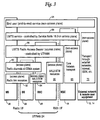
- Fig. 3 illustrates in greater detail the functionality of the non-access plane 50 and access plane 52.
- the non-access plane 50 includes an end user (end-to-end) service 54.
- this is the logical "connection" between an external user or server connected to an external core network with mobile station 30.
- Block 70 illustrates the functions of transporting information through the external networks to the external network user.
- block 54 shows that the end users of the service are isolated from the particulars of how that service is provided.
- Block 56 represents the UMTS service which uses a transport service 68 between the service node (in this example the MSC 18) and the core networks together with the radio access bearer service provided by UTRAN 24 which includes the RAN interface, the RNC 26, the BS 28, and the radio interface.
- Blocks 54, 56, 68, and 70 correspond to logical functions/services attributable to the non-access plane 50.
- the access plane 52 includes the logical functionality and services represented by blocks 58, 60, 62, 64, and 66.
- the UMTS radio access bearer service provides a transport connection service through the UTRAN 24 which preferably is based on Asynchronous Transfer Mode (ATM) via blocks 64 and 66.
- Block 62 represents the actual radio link resources which in a WCDMA system correspond to individual CDMA spreading codes.
- the UTRAN 24 provides radio access bearers that are independent of the user services, and a radio access bearer service is provided to the service node rather than to an end user. Moreover, the radio access bearers are logically separated from the physical transport media through the UTRAN 24 and over the radio interface, i.e., there is no predetermined mapping of radio access bearers to specific transport connections and radio channels. This separation allows flexible and efficient mapping of radio access bearers to specific transport connections and to different types of radio channels by the UTRAN 24.
- the access plane 52 controlled by UTRAN 24 provides radio access bearers for different traffic classes.
- Each traffic class is defined by quality of service and/or traffic parameters that specify a particular radio access capability.
- Using different traffic classes permits a wide range of services to be provided, e.g., from a best effort, unspecified bit rate service to a guaranteed constant bit rate service.
- radio access bearers having different capabilities may be requested for uplink and downlink connections by specifying different uplink and downlink quality of service and/or traffic parameters. In this way, "asymmetric" radio access bearers are provided in the sense that one bearer uplink may transport very little data and requires only a low quality of service, while one or more downlink bearers transport enormous amounts of multimedia data requiring high quality of service.
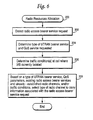
- Fig. 4 is a flowchart diagram the illustrates a radio access bearer establishment routine (block 80).
- a core network service node requests a radio bearer access service (in the non-access plane 50) over the RAN interface to the UTRAN 24 to establish a connection with the mobile station (block 81).
- the UTRAN 24 receives and processes the service request which includes quality of service parameters (block 82).
- the transport resources such as one or more AAL/ATM connections are established through the UTRAN to support the connection with the mobile station (block 83). If a dedicated channel is not currently established to the mobile station, a dedicated channel may be established between the UTRAN and the mobile station if appropriate for the requested radio access bearer service (block 84).
- the new radio access bearer service is multiplexed onto that existing dedicated channel to the mobile station (block 85).
- common channel resources are allocated, e.g., allocating sufficient space in a buffer memory to handle the connection information to be transmit over the common channel (block 86).
- the UTRAN preferably assigns a reference identifier to the new radio access bearer (block 87) to distinguish it from other bearers which is particularly useful when plural bearers are multiplexed onto one channel.
- the UTRAN 24 may establish and release three independent radio access bearers to one mobile station, one bearer for each of the speech, video, and data streams.
- Multiple remote, core network "users" including computer servers, telephones, videophones, etc. connect to core networks which connect to corresponding core network service nodes such as the MSC, GPRS, etc.
- These remote users communicate with a single mobile station where that mobile station may be running multiple different processes or applications (again generally viewed as "users").
- a mobile station including a personal computer where the mobile station human operator is "surfing the Web" over the Internet, one computer application/process may be required for handling speech, one computer application/process for handling video, and one computer application/process for handling data.
- each radio access bearer may be supported by its own AAL/ATM transport connection through the UTRAN even though it is multiplexed with other radio access bearers onto a single WCDMA radio channel, i.e., the same spreading code, associated with the mobile station.
- each radio access bearer may be allocated its own radio channel if appropriate.
- the radio access bearer service may be organized using traffic classes.
- traffic classes there are six traffic classes.
- For two of the traffic classes a fixed amount AAL/ATM transport and WCDMA radio channel resources are allocated in a dedicated fashion to a radio access bearer. Because the resources are specifically reserved, that "amount" of resources does not change during the connection unless a channel-type switch is made during the connection as described in more detail below.
- the transport and radio resources may be dynamically allocated during the connection.
- the UTRAN 24 provides a minimum quality of service, and in addition, if there are free resources, the service quality may increase. In terms of efficiency, the resources for these four traffic classes may be utilized more efficiently taking into account various traffic conditions and variations in those traffic conditions throughout the life of the connection to the mobile station.
- Traffic classes that will likely employ a dedicated radio channel include speech service and Synchronized Service (SS).
- Traffic classes that may employ a common or shared radio channel might include: Constant Bit Rate service (CBR), Unspecified Bit Rate service (UBR), Available Bit Rate service (ABR), and Variable Bit Rate service (VBR).
- CBR Constant Bit Rate service
- UBR Unspecified Bit Rate service
- ABR Available Bit Rate service
- VBR Variable Bit Rate service
- the UTRAN speech service transfers PCM speech samples between the MS and UTRAN 24, and generally provides speech compression/decompression via a CODEC.
- UTRAN synchronized service handles resources based on peak bit rate allocation. Peak bit rate may be dynamically changed between a predetermined number of values. Both the traffic source and the RNC may trigger a change in the current peak bit rate.
- the transport of frames of predefined sizes over the RAN interface is synchronized in the sense the predefined size frames corresponding to the current bit rate are transferred over the radio interface at predetermined time intervals.
- the synchronized service is well suited for multimedia, real-time services providing compression of speech, video, audio, and data. Both the UTRAN speech and SS are synchronized with the radio interface.
- the CBR service provides a guaranteed peak-allocated bit rate, and AAL/ATM transport and radio channel resources are allocated on a peak bit rate basis.
- the UTRAN CBR service can be used to transport circuit-switched data including HSCSD as well as packet-switched data to achieve a higher quality of service.
- the UBR service is a best effort delivery service and uses free bandwidth when available. If there are no AAL/ATM transport and radio channel resources currently available, the information to be transported is queued. If the queue overflows, the overflowed frames are lost. Typically, the UBR service supports packet-switched type data, and in some instances, this traffic class can be used for a short messaging service.
- the ABR service allocates AAL/ATM transport and radio channel resources for sending information at a guaranteed minimum bit rate but higher bit rates are used on a best effort basis when free bandwidth is available.
- the UTRAN ABR service may be used for both packet-switched data (with quality of service additions) as well as for circuit-switched data if flow control is supported by the service node.
- the VBR service provides a variable bit rate based on statistical traffic parameters using average throughput/sustainable bit rate and a frame loss ratio as controlling parameters.
- the UTRAN VBR may be used for similar services as UTRAN ABR.
- the radio access bearer parameters can be divided into categories such as traffic parameters, quality of service parameters, information parameters, and content parameters.
- the traffic parameters include peak bit rate (PBR), sustainable bit rate (SBR), minimum bit rate (MBR), maximum burst size (MBS), and frame size.
- PBR is the maximum instantaneous bit rate in a particular connection with a maximum burst size.
- MBR is the upper bound on the average bit rate of the connection.
- the MBR is simply a parameter used when requesting a UTRAN ABR type of radio access bearer.
- the MBR provides an estimate of a maximum size of data burst that may be transmitted at a peak bit rate.
- the frame size specifies minimum and maximum sizes of a Protocol Data Unit (PDU), where plural PDUs are contained in each frame. When the UTRAN synchronized service is requested, one of a predetermined number of different PDU/frame sizes is selected.
- PDU Protocol Data Unit
- Quality of service parameters may include for example data transfer rate, bit error rate (BER), transfer delay, frame loss ratio, priority, etc.
- the data transfer rate defines the speed at which data is transferred over an interface per unit time.
- Bit error rate is the average number of bit errors for a particular unit of data received.
- the delay is the amount of time between receipt of a request to transmit data and actual transmission of that data.
- the delay may include a fixed delay component as well as a rate dependent delay component.
- Soft/softer handover a feature available on dedicated channels, improves the quality of reception by compensating for multipath fading.
- Frame loss ratio is the number of frames lost because of errors, failed retransmissions, etc. divided by the total number of frames transmitted. Priority may be indicated for individual frames to ensure that prioritized frames receive special treatment with respect to quality of service.
- Information parameters include direction, configuration, and type.
- direction indicates whether a connection is uplink (MS ⁇ CN) or downlink (CN ⁇ MS).
- Configuration indicates whether the connection is to be point-to-point, point-to-multipoint, or broadcast.
- Type includes control, unsynchronized, and synchronized categories.
- a control type defines traffic as control signaling type traffic.
- An unsynchronized type means that the radio access bearer is not synchronized to the radio interface.
- a synchronized type indicates that the radio access bearer is synchronized at both the radio interface and at the RAN interface.
- Content parameters include single message transport, two-way transaction, and coding.
- the single message transport and two-way transaction parameters are used in setting up the radio access bearer.
- single message transport the data is simply transported as a connectionless message by the bearer service.
- two-way transaction an additional response to the transported message is required to complete the transaction.
- the coding parameter indicates that a speeched coder/decoder processes user data in the UTRAN.
- This multimedia call includes speech, video, and data intended for the same mobile station.
- This multimedia call is requested via plural service nodes (block 102) with each service node analyzing the types of parameters involved for the call including the types of media, any coding for video and speech, bearer request characteristics such as traffic class, and one or more traffic parameters including quality of service. Also analyzed are other parameters like packet size, burst descriptor, and type of data (real time or non-real). For example, speech is real time data, while Internet data is non-real time (block 104).
- the service node establishes a buffer for each medium involved in the multimedia call including the depth and the width of each buffer (block 106).
- the service node requests one or more radio access bearers from the UTRAN (block 110).
- the radio access bearer request from the service node to the UTRAN specifies a quality of service, traffic class, and traffic parameters. From those specifications, the radio access bearer controller 32 establishes one or more radio access bearers for connection to the mobile station (block 112).
- the mobile station acknowledges the bearer establishment (block 114), and the multimedia call proceeds.
- the UTRAN provides core networks and their respective service nodes with a flexible set of radio access bearer services described with quality of service parameters such as bit rate, delay, bit error rate, etc. that "carry" circuit-switched and packet-switched information to a mobile station.
- UTRAN manages multiple bearers related to one mobile station terminal even if they come from different core networks.
- the UTRAN flexibly balances and attempts to optimize a number of parameters including quality of service, range (distance to base station), traffic load/capacity/conditions, mobile station transmission power, etc.
- the UTRAN thus provides one set of radio channels of different types to carry both circuit-switched and packet-switched information.
- a single radio channel can carry simultaneously packet-switched and circuit-switched information to a mobile station.
- the two different types of radio channels which may be selected by the RNC differ by the degree of reservation with more resources being reserved for dedicated channels than common channels.
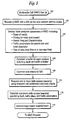
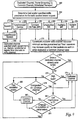
- Fig. 6 shows a radio resource allocation routine (block 200) for flexible mapping of bearer services onto different channel types.
- the RNC detects a radio access bearer service request from a service node (block 202), and determines the type of radio access bearer service and the quality of service parameter(s) requested for that bearer service (block 204).
- the RNC determines one or more traffic conditions at the cell or cells where the mobile station to be involved in the connection is currently located (block 206). Based on the quality of service parameter(s) and traffic condition(s) determined, the radio resource controller 36 selects the type of channel to carry information associated with the radio access bearer service request (block 208).
- the RNC may map the bearer information onto a dedicated radio channel to achieve a frame streaming type of transport.
- a dedicated channel supports diversity handover (including "soft” and “softer” handover) and fast power control -- both of which are important factors in wideband CDMA communications as well as in efficient transfer of a continuous stream of data or a large bulk data transfer.
- the bearer information may be mapped onto a dedicated channel to support either or both of these features.
- packet type data it may also be desirable to map frequent or large packets to a dedicated channel as may well be the case for some high intensity data transmissions.
- the RNC may map the radio access bearer information onto a packet-based, common access channel for scheduled transport.
- Dedicated channels therefore support special services such as soft handoff over multiple cells and offer a frame streaming service where different parallel bearers may be time multiplexed or code multiplexed on the same dedicated WCDMA code channel.
- the UTRAN treats multiple bearers (which correspond to different services) as one radio connection, and as a result, all of the services receive the same soft handoff or fast power control operations.
- a dedicated channel may use radio resources inefficiently because the channel remains dedicated even when no information is being sent.
- Packet-based, common access channels offer packet oriented transport services that can be either connection-oriented or connectionless which may be scheduled packets and low level retransmissions. Scheduling permits more efficient use of the radio channel resources.
- Speech and synchronized data will usually be mapped to a dedicated channel.
- Packet data may be sent either on a dedicated channel for frame streaming transport or on a single cell, packet-access channel using the scheduled transport.
- the particular type of channel to use for packet data is determined based on the quality of service requested and on other traffic factors like the traffic intensity of the geographical area or cell in which the mobile station is located.
- a common channel is generally used; whereas for high packet intensity or strict real time requirements (no delay), a dedicated channel with soft handoff support is employed.
- a dedicated channel connection is already established between the mobile station and the UTRAN, e.g., for speech service, then packet data is transferred over that existing dedicated channel connection rather than transferred over a common channel.
- a connection from a service node to the mobile station may be handled at a radio link layer which may be divided into two sub-layers: a logical link layer and a radio link control (RLC)/media access control (MAC) layer.
- RLC radio link control
- MAC media access control
- the logical link layer the physical transport and channel resources are allocated including selection of the appropriate type of radio channel to carry information from a particular radio access bearer over the air interface to the mobile station.
- the RLC/MAC layer performs various lower level communication functions like assembling frames for delivery over a CDMA radio channel.
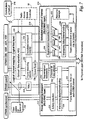
- Fig. 7 is a function block diagram illustrating a non-limiting example of how various radio access bearers may be mapped at the logical link layer and/or RLC/MAC layers onto WCDMA radio channels.
- the RAN protocol stack includes a logical channel mapping block 210 (logical link layer), a frame streaming transport block 212 (RLC/MAC layer), and a scheduled transport block 214 (RLC/MAC layer) which provide frames to the physical layer corresponding to CDMA code channels.
- the radio access bearer layer exists in a control plane of the RAN interface indicated at block 216.
- the control plane is where requests are made for bearer services and is shown connected to the various bearer services divided by traffic class including UTRAN speech, UTRAN CBR, UBR, ABR, and VBR, which are connected to a radio access bearer controller 32 in the RNC.
- traffic class including UTRAN speech, UTRAN CBR, UBR, ABR, and VBR, which are connected to a radio access bearer controller 32 in the RNC.
- the bearer information is provided directly to the frame streaming transport block 212 which includes a frame delivery block 222 delivering frames, for example, every 10 milliseconds, for a WCDMA radio channel.
- the bearer request contains UTRAN speech
- that speech is processed in a transcoder (TRAU) 224 which converts, for example, 64 kilobit per second (kbps) speech coming from the core network into a compressed data rate appropriate for delivery over the radio interface such as 12 kbps.
- TRU transcoder
- Both a UTRAN synchronized service connection and a UTRAN speech connection are processed in an activity detection block 224 so that silence is not transmitted over the radio interface wasting radio resources and causing unnecessary interference.
- Actual information for transfer is then provided to an interleaving delay and channel coding block 226 that formats the data into frames and codes the data to provide forward error correction.
- the framed and coded information is transmitted by the frame delivery block 222 using wideband CDMA radio transmission equipment and procedures over a WCDMA channel.
- a dedicated channel with frame streaming transport is usually selected predominantly because these two bearer services do not tolerate delays in transmission which are usually a part of the scheduled transport service.
- the radio access bearer controller 32 may select either a dedicated channel with frame streaming or a common channel with scheduled transport based on the current quality of service requested and traffic conditions.
- the logical channel mapping block 210 may include an optional rate adaptation function to manage data bursts having infrequent but higher data rates. Rate adaptation may be performed using leaky bucket control, flow control, padding, discarding of frames at buffer overflow, etc.
- the rate adaptation function may also include retransmission of packets (ARQ), although this retransmission function may also be provided in the core network or in the RLC/MAC layer.
- the radio access bearer controller 32 controls the dedicated channel, frame streaming selector 232 and the common channel, scheduled transport selector 234 based upon a number of factors some of were noted above. If the common channel type transport is selected by the radio access bearer controller 32, e.g., for a "bursty" service for the UBR, ABR, or VBR traffic classes, (CBR is constant bit rate and therefore is not bursty), burst queues 236 are provided to make it possible to allocate a lower frame streaming peak bit rate than the peak bit rate received over the RAN interface which is likely to be higher than the frame streaming bit rate for the traffic classes UBR, ABR, or VBR.
- a "bursty" service for the UBR, ABR, or VBR traffic classes
- frame streaming selector 232 is activated to carry CBR, UBR, ABR, or VBR data packets, the radio resources are allocated at a predetermined rate and with a constant delay making frame streaming appropriate for speech and other real time services.
- Data is delivered in sequence on the selected radio channel, and the segmentation/reassembly block 240 divides the information into packets frames in block 240.
- An channel bit rate selector 242 like the activity detection block 224, controls the bit rate of the bit stream and also makes sure that "silence" is not transmitted over the radio interface.
- the segmented data is processed in the interleaving delay/channel coding block 224 and passed on to the frame delivery block 222. Frames are transmitted over the radio interface without further delay.
- the bit rate allocation for the frame streaming transport is on a peak bit rate basis.
- connection data are routed to the scheduled transport block 214 which provides a common channel well-suited for many types of non-real time services. However, features like soft handoff and fast power control are not supported. Radio resources are allocated at a lower bit rate than the peak bit rate. Traffic channels with a predefined target quality of service or a best effort characteristic are both provided. The transfer delay may vary from frame to frame. Segmentation/reassembly and automatic retransmission 224 are performed from the scheduled transport selector 234. The segmentation/reassembly function in block 244 is used to adapt the data streams to the appropriate frame size used over the radio interface.
- the frames are queued in one of the queues 246 controlled by a resource manager 252.
- One queue 246 may be used for each established radio access bearer.
- the resource manager 252 controls the queues 246 to deliver frames via the interleaving delay/channel coding block 248 and frame delivery block 250 so that the total interference level is minimized.
- the resource manager 252 schedules the transport from the two corresponding radio access bearer queues 246 to prevent a significant data surge on the radio interface.
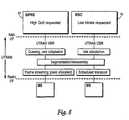
- Fig. 8 illustrates a simple example of mapping different types of connections to different types of radio channels.
- a radio access bearer requesting a high quality service for a UTRAN variable bit rate access bearer is transmitted over the RAN interface.
- the MSC service node 18 requests a relatively low quality, low bit rate, UTRAN constant bit rate access bearer request for a circuit switched data service.
- the flexible mapping of these two bearers onto different types of radio resource channels in the UTRAN allows the high quality and demanding GPRS service, even though for packetized data, to be mapped to a dedicated channel to take advantage of features provided by the frame streaming transport service.
- relatively "expensive" dedicated channel resources are not "wasted" for a relatively low quality, low bit rate packet data service which is adequately and efficiently delivered using the scheduled transport of a common channel.
- Blocks 254-264 illustrate several types of UTRAN radio access bearer services including: speech (block 254), synchronized service (block 256), constant bit rate (CBR) (block 258), unspecified bit rate (UBR) (block 260), available bit rate (ABR) (block 262), and variable bit rate (VBR) (block 264).
- speech block 254
- synchronized service block 256
- CBR constant bit rate
- UBR unspecified bit rate
- ABR available bit rate
- VBR variable bit rate
- a dedicated channel is typically selected (block 268) so that the frames are transferred over the radio interface at regular time intervals on a radio channel, i.e., frame streaming.
- the speech is coded/decoded to convert between the core network bit rate and the lower radio interface bit rate.
- the efficient types of radio channel resources are allocated to support a radio access bearer service based on quality of service parameters and/or on current traffic conditions so that data packets may be sent either on a dedicated or a common type of channel (block 270).
- a minimum bit rate service is guaranteed with the additional option of increasing that minimum service thereby increasing quality if additional radio channel resources become available.
- a decision is made (block 272) whether a dedicated channel already exists for the particular mobile station. If so, the data associated with the new radio access bearer is multiplexed onto that dedicated channel since this is more efficient than establishing a new scheduled transport connection (block 274).
- control signaling associated with the new radio access bearer may also be multiplexed onto that dedicated channel for the same reason.
- a decision may be made periodically or continuously in block 286 whether there has been a change in a condition or parameter with respect to the radio access bearer sufficient to warrant a reassessment of whether the current type of radio channel is desirable or otherwise appropriate (block 286).
- One or more of the procedures indicated in blocks 272-284 may then be repeated, and if appropriate, and as a result, the type of channel which supports that radio access bearer may be changed during the connection. For example, the type of data to be sent might change over the connection, the interference level may have changed, etc.
- the functional separation between the radio access bearer service and the CDMA radio transport mechanism allows flexible initial selection and subsequent changing of the type of physical radio channel ultimately used to convey the information associated with a radio access bearer supporting a connection to a mobile station.
Landscapes
- Engineering & Computer Science (AREA)
- Computer Networks & Wireless Communication (AREA)
- Signal Processing (AREA)
- Quality & Reliability (AREA)
- Mobile Radio Communication Systems (AREA)
Applications Claiming Priority (5)
| Application Number | Priority Date | Filing Date | Title |
|---|---|---|---|
| US8054898P | 1998-04-03 | 1998-04-03 | |
| US80548P | 1998-04-03 | ||
| US283248 | 1999-04-01 | ||
| PCT/SE1999/000552 WO1999052307A1 (en) | 1998-04-03 | 1999-04-01 | Flexible radio access and resource allocation in a universal mobile telephone system (umts) |
| US09/283,248 US6374112B1 (en) | 1998-04-03 | 1999-04-01 | Flexible radio access and resource allocation in a universal mobile telephone system |
Publications (2)
| Publication Number | Publication Date |
|---|---|
| EP1066729A1 EP1066729A1 (en) | 2001-01-10 |
| EP1066729B1 true EP1066729B1 (en) | 2005-06-29 |
Family
ID=26763654
Family Applications (1)
| Application Number | Title | Priority Date | Filing Date |
|---|---|---|---|
| EP99921332A Expired - Lifetime EP1066729B1 (en) | 1998-04-03 | 1999-04-01 | Flexible radio access and resource allocation in a universal mobile telephone system (umts) |
Country Status (9)
| Country | Link |
|---|---|
| US (1) | US6374112B1 (enExample) |
| EP (1) | EP1066729B1 (enExample) |
| JP (1) | JP4354641B2 (enExample) |
| KR (1) | KR100658293B1 (enExample) |
| CN (1) | CN1135013C (enExample) |
| AU (1) | AU756958B2 (enExample) |
| CA (1) | CA2326750C (enExample) |
| DE (1) | DE69925990T2 (enExample) |
| WO (1) | WO1999052307A1 (enExample) |
Cited By (1)
| Publication number | Priority date | Publication date | Assignee | Title |
|---|---|---|---|---|
| CN101765158B (zh) * | 2008-12-25 | 2012-11-07 | 中国移动通信集团广西有限公司 | 通用分组无线业务gprs网络及其数据信道分配方法、装置 |
Families Citing this family (401)
| Publication number | Priority date | Publication date | Assignee | Title |
|---|---|---|---|---|
| US6850540B1 (en) * | 1999-10-28 | 2005-02-01 | Telefonaktiebolaget Lm Ericsson (Publ) | Packet scheduling in a communications system |
| US6937566B1 (en) * | 1997-07-25 | 2005-08-30 | Telefonaktiebolaget Lm Ericsson (Publ) | Dynamic quality of service reservation in a mobile communications network |
| FI106172B (fi) * | 1998-01-29 | 2000-11-30 | Nokia Networks Oy | Menetelmä uudelleenkonfiguroida solukkoradioverkossa yhteys |
| US20020176009A1 (en) * | 1998-05-08 | 2002-11-28 | Johnson Sandra Marie | Image processor circuits, systems, and methods |
| FI105975B (fi) * | 1998-05-11 | 2000-10-31 | Nokia Networks Oy | Suurinopeuksinen datasiirto matkaviestinjärjestelmässä |
| FI981407L (fi) * | 1998-05-11 | 1999-11-12 | Nokia Networks Oy | Handover ja verkkosovitus radiojärjestelmässä |
| FI105438B (fi) * | 1998-09-21 | 2000-08-15 | Nokia Networks Oy | Yhteydenmuodostus langattomassa tietoliikenneverkossa |
| KR100619598B1 (ko) * | 1998-10-01 | 2006-12-01 | 엘지전자 주식회사 | 이동통신시스템에서의 신호 포맷방법 |
| KR100640908B1 (ko) * | 1998-10-01 | 2007-01-31 | 엘지전자 주식회사 | 이동통신 시스템에서의 트랜스포트 포맷 설정 방법 및 송신 장치 |
| KR100563592B1 (ko) * | 1998-10-01 | 2006-09-22 | 엘지전자 주식회사 | 이동통신시스템에서의 데이터 분기방법 |
| CA2346128C (en) * | 1998-10-05 | 2006-11-28 | Nokia Networks Oy | Frame control method and apparatus |
| US6724813B1 (en) * | 1998-10-14 | 2004-04-20 | Telefonaktiebolaget Lm Ericsson (Publ) | Implicit resource allocation in a communication system |
| FI107220B (fi) * | 1998-11-06 | 2001-06-15 | Nokia Networks Oy | Menetelmä kantajien ominaisuuksien hallitsemiseksi |
| FI108203B (fi) | 1998-11-27 | 2001-11-30 | Nokia Mobile Phones Ltd | Menetelmä ja järjestely tiedon siirtämiseksi pakettiradiopalvelussa |
| KR100396508B1 (ko) * | 1998-12-07 | 2003-11-28 | 삼성전자주식회사 | 부호분할다중접속통신시스템의채널할당장치및방법 |
| DE19857406A1 (de) * | 1998-12-12 | 2000-06-15 | Bosch Gmbh Robert | Telekommunikationssystem und Verfahren zur Datenübertragung |
| FI982854L (fi) * | 1998-12-31 | 2000-07-01 | Nokia Networks Oy | Datasiirto tietoliikennejärjestelmässä |
| FI109444B (fi) * | 1999-01-11 | 2002-07-31 | Nokia Corp | Menetelmä ja järjestelmä datansiirtokanavien rinnakkaiskäyttöä varten |
| EP1142429B1 (en) * | 1999-01-12 | 2007-07-25 | Nokia Corporation | A method for managing physical resources of a radio access network |
| US6594242B1 (en) * | 1999-01-14 | 2003-07-15 | Ericsson, Inc. | Broadcasting of two generation cellular system control channel information over a three generation control channel to support roaming and handover to two generation cellular networks |
| CA2359471C (en) * | 1999-01-25 | 2006-05-16 | Nokia Networks Oy | Interworking between radio access networks |
| FI107487B (fi) * | 1999-03-08 | 2001-08-15 | Nokia Mobile Phones Ltd | Datalähetyksen salausmenetelmä radiojärjestelmässä |
| FI114077B (fi) * | 1999-03-10 | 2004-07-30 | Nokia Corp | Tunnuksen varausmenetelmä |
| US6804202B1 (en) * | 1999-04-08 | 2004-10-12 | Lg Information And Communications, Ltd. | Radio protocol for mobile communication system and method |
| KR100382470B1 (ko) * | 1999-04-08 | 2003-05-01 | 엘지전자 주식회사 | Imt-2000 이동 통신 시스템의 무선 프로토콜 |
| FI108599B (fi) * | 1999-04-14 | 2002-02-15 | Ericsson Telefon Ab L M | Toipuminen matkaviestinjärjestelmissä |
| US6606311B1 (en) * | 1999-04-20 | 2003-08-12 | Nortel Networks Limited | QoS framework for CDMA 2000 |
| US6563809B1 (en) | 1999-04-28 | 2003-05-13 | Tantivy Communications, Inc. | Subscriber-controlled registration technique in a CDMA system |
| FI111683B (fi) * | 1999-04-30 | 2003-08-29 | Nokia Corp | Menetelmä langattoman viestimen ominaisuuksien tallentamiseksi ja informoimiseksi, langaton viestin sekä langaton tiedonsiirtojärjestelmä |
| US6584321B1 (en) * | 1999-05-07 | 2003-06-24 | At&T Wireless Services, Inc. | Method and apparatus for wireless data services over a selected bearer service |
| GB9911084D0 (en) * | 1999-05-12 | 1999-07-14 | Nokia Telecommunications Oy | Transmitting method |
| US6372494B1 (en) * | 1999-05-14 | 2002-04-16 | Advanced Tissue Sciences, Inc. | Methods of making conditioned cell culture medium compositions |
| SE522068C2 (sv) * | 1999-07-15 | 2004-01-13 | Ericsson Telefon Ab L M | Metod och anordning för att åstadkomma radioaccessbärartjänster |
| US7006530B2 (en) | 2000-12-22 | 2006-02-28 | Wi-Lan, Inc. | Method and system for adaptively obtaining bandwidth allocation requests |
| US8462810B2 (en) | 1999-05-21 | 2013-06-11 | Wi-Lan, Inc. | Method and system for adaptively obtaining bandwidth allocation requests |
| US6925068B1 (en) | 1999-05-21 | 2005-08-02 | Wi-Lan, Inc. | Method and apparatus for allocating bandwidth in a wireless communication system |
| US20090219879A1 (en) | 1999-05-21 | 2009-09-03 | Wi-Lan, Inc. | Method and apparatus for bandwidth request/grant protocols in a wireless communication system |
| GB2389750B (en) * | 1999-05-28 | 2004-02-25 | Nec Corp | Mobile telecommunications system |
| GB9913221D0 (en) * | 1999-06-07 | 1999-08-04 | Nokia Telecommunications Oy | Cell update in a cellular communications system |
| FI109072B (fi) * | 1999-06-16 | 2002-05-15 | Nokia Corp | Menetelmä ja järjestely kanavakoodaus- ja lomitusmenettelyn valitsemiseksi eräissä pakettidatayhteyksissä |
| FI109170B (fi) * | 1999-06-28 | 2002-05-31 | Nokia Corp | Sijainninhallinta solukkojärjestelmiä varten |
| DE69938466D1 (de) | 1999-06-30 | 2008-05-15 | Nokia Siemens Networks Oy | Verfahren und vorrichtung zur handhabung von multimedia anrufen |
| KR100317261B1 (ko) * | 1999-07-02 | 2001-12-22 | 서평원 | 능동적 무선 접속 베어러 제어 방법 |
| EP1069798B1 (en) * | 1999-07-12 | 2008-04-16 | Lucent Technologies Inc. | Universal mobile telephone system network with improved rate matching method |
| US6701149B1 (en) * | 1999-07-19 | 2004-03-02 | Nortel Networks Limited | Handoff framework to support real-time delay-critical services in a next generation network |
| US6466556B1 (en) * | 1999-07-23 | 2002-10-15 | Nortel Networks Limited | Method of accomplishing handover of packet data flows in a wireless telecommunications system |
| JP2001095033A (ja) * | 1999-07-28 | 2001-04-06 | Hyundai Electronics Ind Co Ltd | 同期コア網と非同期無線網を連動させる方法及び装置 |
| US6741868B1 (en) * | 1999-07-30 | 2004-05-25 | Curitell Communications Inc. | Method and apparatus for interfacing among mobile terminal, base station and core network in mobile telecommunications system |
| US6578082B1 (en) * | 1999-08-02 | 2003-06-10 | Nortel Networks Limited | Distributed flow control system and method for GPRS networks based on leaky buckets |
| US6873597B1 (en) * | 1999-08-11 | 2005-03-29 | Nortel Networks Limited | Reduced data rate communication system |
| GB9919851D0 (en) * | 1999-08-20 | 1999-10-27 | Lucent Technologies Inc | Core network allocation for gsm/umts |
| GB9919853D0 (en) * | 1999-08-20 | 1999-10-27 | Lucent Technologies Inc | Parallel core networks for gsm/umts |
| GB9919850D0 (en) * | 1999-08-20 | 1999-10-27 | Lucent Technologies Inc | Combined location areas for gsm/umts |
| FI107674B (fi) * | 1999-08-30 | 2001-09-14 | Nokia Mobile Phones Ltd | Menetelmä tiedonsiirron optimoimiseksi pakettikytkentäisessä langattomassa tiedonsiirtojärjestelmässä |
| US6728365B1 (en) * | 1999-09-13 | 2004-04-27 | Nortel Networks Limited | Method and system for providing quality-of-service on packet-based wireless connections |
| GB9921706D0 (en) * | 1999-09-14 | 1999-11-17 | Nokia Telecommunications Oy | Relocation in a communication system |
| FI107361B (fi) * | 1999-09-16 | 2001-07-13 | Nokia Mobile Phones Ltd | Radioresurssien varaaminen verkosta pakettivälitteisessä tiedonsiirtojärjestelmässä |
| KR100359808B1 (ko) * | 1999-12-31 | 2002-11-07 | 엘지전자 주식회사 | 이동 통신 시스템의 호 처리 방법 |
| JP4074036B2 (ja) * | 1999-09-29 | 2008-04-09 | 株式会社東芝 | 無線通信端末 |
| AUPQ319099A0 (en) * | 1999-10-01 | 1999-10-28 | Telefonaktiebolaget Lm Ericsson (Publ) | Transport of amr encoded information across an atm core network |
| FI19992246A7 (fi) * | 1999-10-18 | 2001-04-19 | Nokia Corp | Järjestely tietoliikenneverkkojen yhdistämiseksi |
| US6631125B1 (en) * | 1999-10-20 | 2003-10-07 | Nokia Corporation | Channel set-up in wideband, code division multiple access systems |
| US6463274B1 (en) * | 1999-10-26 | 2002-10-08 | Denso Corporation | Multiple class of service determination for digital cellular telephones |
| US6618591B1 (en) * | 1999-10-28 | 2003-09-09 | Nokia Mobile Phones Ltd. | Mechanism to benefit from min and max bitrates |
| US6519461B1 (en) | 1999-10-29 | 2003-02-11 | Telefonaktiebolaget Lm Ericsson (Publ) | Channel-type switching from a common channel to a dedicated channel based on common channel load |
| US20030012217A1 (en) * | 1999-10-29 | 2003-01-16 | Christoffer Andersson | Channel-type switching to a common channel based on common channel load |
| KR100694026B1 (ko) * | 1999-11-01 | 2007-03-12 | 삼성전자주식회사 | 광대역 무선 전송방법 및 장치 |
| US8463231B1 (en) | 1999-11-02 | 2013-06-11 | Nvidia Corporation | Use of radius in UMTS to perform accounting functions |
| FI109320B (fi) * | 1999-11-02 | 2002-06-28 | Nokia Corp | Signalointimenetelmä |
| US8117291B1 (en) | 1999-11-02 | 2012-02-14 | Wireless Technology Solutions Llc | Use of internet web technology to register wireless access customers |
| US6865169B1 (en) * | 1999-11-02 | 2005-03-08 | Ipwireless, Inc. | Cellular wireless internet access system using spread spectrum and internet protocol |
| US6873609B1 (en) | 1999-11-02 | 2005-03-29 | Ipwireless, Inc. | Use of internet WEB technology for wireless internet access |
| FI111314B (fi) | 1999-11-05 | 2003-06-30 | Nokia Corp | Multimediasanomanvälityspalvelu |
| GB2356770A (en) * | 1999-11-23 | 2001-05-30 | Ericsson Telefon Ab L M | SRNS relocation in a UMTS network |
| US6968190B1 (en) * | 1999-11-29 | 2005-11-22 | Nokia Mobile Phones, Ltd. | Transfer of optimization algorithm parameters during handover of a mobile station between radio network subsystems |
| US6879580B1 (en) * | 1999-11-29 | 2005-04-12 | Telefonaktiebolaget Lm Ericsson | Combined CDMA multi-service carrier and TDMA/CDMA packet carrier |
| US6594241B1 (en) | 1999-12-08 | 2003-07-15 | Telefonaktiebolaget Lm Ericsson (Publ) | Channel-type switching control |
| US7149193B2 (en) * | 1999-12-15 | 2006-12-12 | Nortel Networks Limited | Dynamic, dual-mode wireless network architecture with a split layer 2 protocol |
| KR100390405B1 (ko) * | 1999-12-21 | 2003-07-07 | 엘지전자 주식회사 | 범용 이동통신 시스템의 기지국과 제어국간 인터페이스운용 방법 |
| US6466544B1 (en) * | 1999-12-22 | 2002-10-15 | Nortel Networks Limited | GPRS MAC procedures to support real-time services |
| JP4180236B2 (ja) * | 1999-12-28 | 2008-11-12 | 株式会社エヌ・ティ・ティ・ドコモ | ハンドオーバ制御方法及びシステム |
| US7990882B1 (en) * | 1999-12-30 | 2011-08-02 | Avaya Inc. | Adaptively maintaining quality of service (QoS) in distributed PBX networks |
| EP1447998A1 (en) * | 1999-12-30 | 2004-08-18 | Nortel Networks Limited | Adaptively maintaining quality of service (Qos) in distributed PBX networks |
| US6654384B1 (en) * | 1999-12-30 | 2003-11-25 | Aperto Networks, Inc. | Integrated self-optimizing multi-parameter and multi-variable point to multipoint communication system |
| FI110831B (fi) * | 1999-12-31 | 2003-03-31 | Nokia Corp | Menetelmä tiedonsiirron tehostamiseksi ja tiedonsiirtoprotokolla |
| FI108593B (fi) * | 1999-12-31 | 2002-02-15 | Nokia Oyj | Paketinreititys monipalveluverkossa |
| US6810256B2 (en) * | 2000-01-03 | 2004-10-26 | Telefonaktiebolaget Lm Ericsson | Method and system for handling the transcoding of connections handed off between mobile switching centers |
| US6795428B1 (en) * | 2000-01-07 | 2004-09-21 | Ericsson Inc. | Fast notification access channel for realtime users in EGPRS networks |
| DE60035481T2 (de) * | 2000-01-19 | 2008-03-20 | Lucent Technologies Inc. | Verfahren zur Zuteilung von Funkressourcen |
| US7302497B2 (en) * | 2000-02-08 | 2007-11-27 | Telefonaktiebolaget Lm Ericsson (Publ) | Using internet protocol (IP) in radio access network |
| US7054938B2 (en) * | 2000-02-10 | 2006-05-30 | Telefonaktiebolaget Lm Ericsson (Publ) | Method and apparatus for network service reservations over wireless access networks |
| FI112304B (fi) * | 2000-02-14 | 2003-11-14 | Nokia Corp | Datapakettien numerointi pakettivälitteisessä tiedonsiirrossa |
| GB0003369D0 (en) * | 2000-02-14 | 2000-04-05 | Nokia Networks Oy | Radio resource management in a communication system |
| DE60016373T2 (de) * | 2000-02-15 | 2005-12-01 | Lucent Technologies Inc. | Verfahren und Mobilfunksystem mit verbesserten Ressourcenzuweisung für die Aufwärtsrichtung |
| US6795689B1 (en) * | 2000-02-22 | 2004-09-21 | Telefonaktiebolaget Lm Ericsson (Publ) | Cell status messaging in a radio communications system |
| GB0004178D0 (en) | 2000-02-22 | 2000-04-12 | Nokia Networks Oy | Integrity check in a communication system |
| WO2001063857A1 (en) * | 2000-02-25 | 2001-08-30 | Telefonaktiebolaget Lm Ericsson (Publ) | Overload handling in a communications system |
| US6944150B1 (en) * | 2000-02-28 | 2005-09-13 | Sprint Communications Company L.P. | Method and system for providing services in communications networks |
| FI109957B (fi) * | 2000-03-06 | 2002-10-31 | Nokia Corp | Menetelmä palveluinformaation siirtämiseksi ja radiojärjestelmä |
| EP1133201A1 (en) * | 2000-03-07 | 2001-09-12 | Lucent Technologies Inc. | Radio telecommunications system with improved use of air interface (I) |
| FR2806576B1 (fr) * | 2000-03-15 | 2004-04-23 | Nortel Matra Cellular | Procede d'emission de signaux radio, reseau d'acces et terminal de radiocommunication appliquant le procede |
| FI109443B (fi) * | 2000-03-16 | 2002-07-31 | Nokia Corp | Tilaajatietojen päivitys |
| US6941132B2 (en) * | 2000-03-20 | 2005-09-06 | Telefonaktiebolaget L M Ericsson (Publ) | Transport of radio network-originated control information |
| EP1137296A1 (de) * | 2000-03-21 | 2001-09-26 | TELEFONAKTIEBOLAGET LM ERICSSON (publ) | Verfahren und Vorrichtungen für ein zellulares Kommunikationsnetz |
| US6801512B1 (en) * | 2000-03-23 | 2004-10-05 | Motorola, Inc. | Method and apparatus for providing a distributed architecture digital wireless communication system |
| DE10014396C2 (de) * | 2000-03-23 | 2002-10-24 | Siemens Ag | Verfahren zur Ressourcenzuteilung in einem Funk-Kommunikationssystem und Funk-Kommunikationssystem zum Durchführen des Verfahrens |
| GB0007266D0 (en) | 2000-03-25 | 2000-05-17 | Hewlett Packard Co | Providing location data about a mobile entity |
| GB2360671B (en) * | 2000-03-25 | 2003-09-03 | Hewlett Packard Co | Providing location data about a mobile entity |
| GB0007258D0 (en) * | 2000-03-25 | 2000-05-17 | Hewlett Packard Co | Providing location data about a mobile entity |
| SE518904C2 (sv) * | 2000-04-05 | 2002-12-03 | Telia Ab | Metod och anordning vid telekommunikationssystem |
| FI108769B (fi) * | 2000-04-07 | 2002-03-15 | Nokia Corp | Liityntäpisteen liittäminen langattomassa tietoliikennejärjestelmässä |
| BR0107546A (pt) * | 2000-04-07 | 2004-01-06 | Nokia Corp | Método e aparelho de transmissão de unidades de dados de protocolo de tamanho fixo através da camada de controle de enlace de rádio transparente |
| US8295269B1 (en) | 2000-04-10 | 2012-10-23 | Nokia Corporation | Technique for informing network of voice traffic |
| US7123920B1 (en) * | 2000-04-10 | 2006-10-17 | Nokia Corporation | Technique for setting up calls in mobile network |
| US6801519B1 (en) * | 2000-04-11 | 2004-10-05 | Sprint Communications Company, L.P. | Traffic distribution in a wireless communication system |
| GB0009226D0 (en) * | 2000-04-12 | 2000-05-31 | Nokia Networks Oy | Transporting information in a communication system |
| DE10019402B4 (de) * | 2000-04-19 | 2013-05-23 | Ipcom Gmbh & Co. Kg | Vorrichtung für einen weiteren Verbindungsaufbau zur Datenübertragung über ein mobiles Telekommunikationssystem |
| US7054943B1 (en) * | 2000-04-28 | 2006-05-30 | International Business Machines Corporation | Method and apparatus for dynamically adjusting resources assigned to plurality of customers, for meeting service level agreements (slas) with minimal resources, and allowing common pools of resources to be used across plural customers on a demand basis |
| US20060068841A1 (en) * | 2000-05-04 | 2006-03-30 | Curitel Communications Inc. | Method and apparatus for interfacing among mobile terminal, base station and core network in mobile telecommunications system |
| US20010040877A1 (en) * | 2000-05-09 | 2001-11-15 | Motorola, Inc. | Method of dynamic transmit scheduling using channel quality feedback |
| CA2308564A1 (en) * | 2000-05-15 | 2001-11-15 | Mark J. Frazer | Communication structure for multiplexed links |
| US6829482B2 (en) | 2000-05-16 | 2004-12-07 | Telefonaktiebolaget Lm Ericsson (Publ) | Switching from dedicated to common channels when radio resources are controlled by drift radio network |
| US6901060B1 (en) * | 2000-05-17 | 2005-05-31 | Nokia Corporation | Method and apparatus for multiplexing a plurality of data connections onto one temporary block flow |
| US6621793B2 (en) | 2000-05-22 | 2003-09-16 | Telefonaktiebolaget Lm Ericsson (Publ) | Application influenced policy |
| DE60130114T2 (de) * | 2000-05-22 | 2008-05-15 | Telefonaktiebolaget Lm Ericsson (Publ) | Anwendungsbeeinflusste richtlinie |
| US7072329B2 (en) * | 2000-05-22 | 2006-07-04 | Telefonaktiebolaget Lm Ericsson (Publ) | Combining differing transport technologies in a telecommunications system |
| CA2310188A1 (en) | 2000-05-30 | 2001-11-30 | Mark J. Frazer | Communication structure with channels configured responsive to reception quality |
| EP1168871A1 (en) * | 2000-06-20 | 2002-01-02 | Alcatel | Telecommunication system with real time protocol synchronization after hand-over procedure |
| AU2001263472A1 (en) * | 2000-06-28 | 2002-01-08 | Broadcom Corporation | Multi-mode controller |
| FI20001544A7 (fi) | 2000-06-29 | 2001-12-30 | Nokia Corp | Poikkeavan päätelaitteen tukeminen verkossa |
| CA2313290A1 (en) | 2000-06-30 | 2001-12-30 | Frank Van Heeswyk | Adaptive rate power control cdma system |
| CA2313314A1 (en) | 2000-06-30 | 2001-12-30 | Frank Van Heeswyk | Control channel for a wireless digital subscriber line system |
| GB2364206B (en) * | 2000-06-30 | 2004-12-15 | Motorola Inc | Transmission procedures |
| GB0016086D0 (en) | 2000-07-01 | 2000-08-23 | Ericsson Telefon Ab L M | Data transmission in a telecommunications network |
| CN1656840A (zh) * | 2000-07-03 | 2005-08-17 | 艾利森电话股份有限公司 | 用于在电路交换环境和分组交换环境之间执行切换的系统和方法 |
| EP1170919A1 (en) | 2000-07-04 | 2002-01-09 | TELEFONAKTIEBOLAGET LM ERICSSON (publ) | Method and device for improving the transmission efficiency in a communication system with a layered protocol stack |
| DE60037208T2 (de) | 2000-07-05 | 2008-04-03 | Telefonaktiebolaget Lm Ericsson (Publ) | Telesystem mit koppeleinrichtung und verfahren in verbindung damit |
| US7111163B1 (en) | 2000-07-10 | 2006-09-19 | Alterwan, Inc. | Wide area network using internet with quality of service |
| FI20001705L (fi) * | 2000-07-24 | 2002-01-25 | Nokia Networks Oy | Lõhetysluvan mõõrõõminen tietoliikennejõrjestelmõssõ |
| US7068599B1 (en) * | 2000-07-26 | 2006-06-27 | At&T Corp. | Wireless network having link-condition based proxies for QoS management |
| US6856954B1 (en) * | 2000-07-28 | 2005-02-15 | Mindspeed Technologies, Inc. | Flexible variable rate vocoder for wireless communication systems |
| SE0002852L (sv) * | 2000-08-07 | 2002-02-08 | Ericsson Telefon Ab L M | Förfarande i ett kommunikationssystem |
| FR2813006B1 (fr) * | 2000-08-10 | 2003-01-31 | Cit Alcatel | Procede pour tenir compte de la capacite de traitement du trafic, pour le controle de la charge de trafic dans un reseau de radiocommunications mobiles |
| JP2002057699A (ja) * | 2000-08-11 | 2002-02-22 | Nec Corp | パケット伝送方式、パケット伝送方法及び記録媒体 |
| EP1227621B1 (en) * | 2000-08-30 | 2011-11-23 | Panasonic Corporation | Communication terminal accommodating apparatus and scheduling method |
| KR100761185B1 (ko) * | 2000-08-31 | 2007-09-21 | 유티스타콤코리아 유한회사 | 차세대 이동 통신 시스템에서의 비동기식 무선망과 동기식코어 네트워크 간 연동시 멀티 콜을 지원하는 방법 |
| US6765887B1 (en) * | 2000-09-06 | 2004-07-20 | Qualcomm Inc. | Method and apparatus for processing a received transmission based on processing delays requirement |
| DE60038704T2 (de) * | 2000-09-20 | 2009-07-09 | Fujitsu Ltd., Kawasaki | Mobilkommunikationssystem |
| US7283502B1 (en) * | 2000-09-21 | 2007-10-16 | Lucent Technologies Inc. | Enhancement of framing protocol frame format to support quality of service |
| KR100525380B1 (ko) * | 2000-09-22 | 2005-11-02 | 엘지전자 주식회사 | Cdma 통신 시스템의 호 설정 방법 |
| GB0024694D0 (en) | 2000-10-09 | 2000-11-22 | Nokia Networks Oy | Connection set-up in a communication system |
| DE50106700D1 (de) * | 2000-10-09 | 2005-08-11 | Siemens Ag | Verfahren zur übertragung von datenpaketen über eine luftschnittstelle eines mobilfunksystems |
| US6636488B1 (en) * | 2000-10-11 | 2003-10-21 | Aperto Networks, Inc. | Automatic retransmission and error recovery for packet oriented point-to-multipoint communication |
| SE518479C2 (sv) * | 2000-10-13 | 2002-10-15 | Ericsson Telefon Ab L M | Kommunikationssystem som stödjer trådlös kommunikation av paketdata och förfarande och anordning relaterande därtill |
| KR100525381B1 (ko) * | 2000-10-14 | 2005-11-02 | 엘지전자 주식회사 | 차세대 이동통신 시스템 기지국에서의 시스템 정보 방송구현 방법 |
| GB2369003A (en) * | 2000-11-07 | 2002-05-15 | Ericsson Telefon Ab L M | Channel switching in UMTS |
| SE517721C2 (sv) * | 2000-11-10 | 2002-07-09 | Ericsson Telefon Ab L M | Metod att generera och upprätthålla önskad tjänstekvalitet för datatrafik i ett kommunikationssystem |
| GB2369268B (en) * | 2000-11-21 | 2003-01-22 | Ericsson Telefon Ab L M | Controlling channel switching in a UMTS network |
| US6889050B1 (en) * | 2000-11-22 | 2005-05-03 | Telefonaktiebolaget Lm Ericsson (Publ) | Variable transmission rate services in a radio access network |
| US7266107B2 (en) * | 2000-11-23 | 2007-09-04 | Samsung Electronics Co., Ltd. | Apparatus and method for allocating a common channel in a CDMA mobile communication system |
| FR2817435B1 (fr) * | 2000-11-24 | 2003-02-07 | Cit Alcatel | Procede de repartition des ressources dans un reseau de telecommunication et application de ce procede a l'admission d'appels |
| FI111423B (fi) * | 2000-11-28 | 2003-07-15 | Nokia Corp | Järjestelmä kanavanvaihdon jälkeen tapahtuvan tietoliikenteen salauksen varmistamiseksi |
| US6999471B1 (en) | 2000-11-28 | 2006-02-14 | Soma Networks, Inc. | Communication structure for multiplexed links |
| KR20020043139A (ko) * | 2000-12-01 | 2002-06-08 | 윤종용 | 이동통신시스템에서 고속 데이터 서비스를 위한 스케쥴링방법 |
| US7333482B2 (en) * | 2000-12-22 | 2008-02-19 | Interactive People Unplugged Ab | Route optimization technique for mobile IP |
| KR100493444B1 (ko) * | 2000-12-26 | 2005-06-07 | 엘지전자 주식회사 | 전송채널 변경에 의한 과금 비율 변경 및 데이터 생성 방법 |
| US20020085536A1 (en) * | 2000-12-29 | 2002-07-04 | Rudrapatna Ashok N. | System and method for implementing a wireless isochronous data service |
| US8849276B2 (en) * | 2000-12-29 | 2014-09-30 | At&T Mobility Ii Llc | Intelligent network selection based on quality of service and applications over different wireless networks |
| KR100493280B1 (ko) * | 2000-12-29 | 2005-06-02 | 엘지전자 주식회사 | 이동 단말의 위치 등록 제어 방법 |
| US7433929B2 (en) * | 2000-12-29 | 2008-10-07 | At&T Mobility Ii Llc | Intelligent network selection based on quality of service and applications over different wireless networks |
| KR100390432B1 (ko) * | 2000-12-30 | 2003-07-07 | 엘지전자 주식회사 | 차세대 이동통신 시스템에서 다변 비트 레이트를 위한정보 보고 방법 |
| FR2821515B1 (fr) * | 2001-02-23 | 2003-05-23 | Cit Alcatel | Procede de gestion de ressources de traitement dans un systeme de radiocommunications mobiles |
| FI112995B (fi) | 2001-01-16 | 2004-02-13 | Nokia Corp | Virheellisen datan käsittely pakettivälitteistä tiedonsiirtoa tarjoavassa tietoliikennejärjestelmässä |
| DE10103334A1 (de) * | 2001-01-25 | 2002-08-08 | Siemens Ag | Verfahren zur Übergabe von funkbasierten Datenverbindungen mit Qualitätsmerkmalen zwischen Funkbasisstationen |
| US20020099810A1 (en) * | 2001-01-25 | 2002-07-25 | Martin Kiesel | Method, system & apparatus for interactive multimedia remote processor control, diagnostics and maintenance |
| US20020101827A1 (en) * | 2001-02-01 | 2002-08-01 | Motorola, Inc. | Method for optimizing quality of service in a data transmission session based on a predetermined level of quality of service |
| KR100387044B1 (ko) * | 2001-02-01 | 2003-06-12 | 삼성전자주식회사 | 무선통신 시스템에서 패킷 호 서비스의 제공방법 |
| ES2296733T3 (es) * | 2001-02-06 | 2008-05-01 | Nokia Corporation | Sistema de acceso para una red celular. |
| CA2437725A1 (en) * | 2001-02-06 | 2002-08-15 | Harris Corporation | System and method for real time adaptive capacity scheduling |
| US6834044B2 (en) * | 2001-02-15 | 2004-12-21 | Telefonaktiebolaget L M Ericsson (Publ) | Multi-path data streaming in a wireless packet data network |
| WO2002065796A1 (en) * | 2001-02-15 | 2002-08-22 | Nokia Corporation | Method and system for managing a connection of a mobile element to a network |
| JP3566218B2 (ja) * | 2001-02-19 | 2004-09-15 | 株式会社東芝 | Bluetoothネットワーク通信方法およびシステム |
| DE10107700A1 (de) * | 2001-02-19 | 2002-08-29 | Siemens Ag | Verfahren und Vorrichtung zum Multiplexen und/oder Demultiplexen sowie entsprechende Computerprogramme und ein entsprechendes Computerprogramm-Erzeugnis |
| US20020160781A1 (en) * | 2001-02-23 | 2002-10-31 | Gunnar Bark | System, method and apparatus for facilitating resource allocation in a communication system |
| IL141740A (en) * | 2001-03-01 | 2005-12-18 | Eci Telecom Ltd | Method and system for handling optical signals |
| WO2002073366A2 (en) * | 2001-03-14 | 2002-09-19 | Mashinsky | A method and system for dynamic spectrum allocation and management |
| US20030050070A1 (en) * | 2001-03-14 | 2003-03-13 | Alex Mashinsky | Method and system for dynamic spectrum allocation and management |
| KR100414919B1 (ko) * | 2001-03-16 | 2004-01-13 | 삼성전자주식회사 | 이동통신시스템에서 패킷서비스 방법 및 네트워크 구조 |
| US7406315B2 (en) * | 2001-03-20 | 2008-07-29 | Arraycomm Llc | Method and apparatus for resource management in a wireless data communication system |
| US6978144B1 (en) * | 2001-04-19 | 2005-12-20 | Cisco Technology, Inc. | Method and system for managing real-time bandwidth in a wireless network |
| US6985746B2 (en) * | 2001-04-30 | 2006-01-10 | Ipr Licensing, Inc. | Wireless communication system having mobility-based content delivery |
| FI20010979L (fi) * | 2001-05-09 | 2002-11-10 | Nokia Corp | Puhelunohjausmenetelmä |
| US7366533B2 (en) | 2001-05-16 | 2008-04-29 | Motorola, Inc. | Methods for providing access to wireless resources in a trunked radio communication system |
| US20020173315A1 (en) * | 2001-05-17 | 2002-11-21 | Mazen Chmaytelli | Method and apparatus for adapting capabilities of a wireless communication system to load requirements |
| FI20011111A7 (fi) * | 2001-05-28 | 2002-11-29 | Nokia Corp | Yhteydenmuodostusparametrien välittäminen pakettidataverkossa |
| US20020183053A1 (en) * | 2001-05-29 | 2002-12-05 | Muralimohan Gopalakrishna | Methods and systems for testing macrodiversity and handover functionality of a radio network controller |
| US20020183010A1 (en) * | 2001-06-05 | 2002-12-05 | Catreux Severine E. | Wireless communication systems with adaptive channelization and link adaptation |
| TWI289999B (en) | 2001-06-08 | 2007-11-11 | Benq Corp | Transmission method for relay signal of wireless communication system |
| JP3892682B2 (ja) * | 2001-06-18 | 2007-03-14 | 株式会社エヌ・ティ・ティ・ドコモ | パケット伝送方法、基地局及び移動局 |
| US7020472B2 (en) * | 2001-06-22 | 2006-03-28 | Gallitzin Allegheny Llc | Cellular channel bonding for improved data transmission |
| US7050411B2 (en) * | 2001-07-25 | 2006-05-23 | Motorola, Inc. | Dynamic DCCH/FCH switching |
| US20040165596A1 (en) * | 2001-08-01 | 2004-08-26 | Garcia Javier Romero | Apparatus and method for flow scheduling based on priorities in a mobile network |
| FI20011603A7 (fi) * | 2001-08-03 | 2003-02-04 | Nokia Corp | Menetelmä palvelun toteuttamiseksi radiojärjestelmässä, radiojärjestelmän käyttäjälaite ja radiojärjestelmä |
| US20030027579A1 (en) * | 2001-08-03 | 2003-02-06 | Uwe Sydon | System for and method of providing an air interface with variable data rate by switching the bit time |
| US20030035383A1 (en) * | 2001-08-07 | 2003-02-20 | Stephen Hershey | Method, system and computer program product for bandwidth-on-demand signaling |
| US6850125B2 (en) * | 2001-08-15 | 2005-02-01 | Gallitzin Allegheny Llc | Systems and methods for self-calibration |
| US20030035388A1 (en) * | 2001-08-15 | 2003-02-20 | Schmidt Dominik J. | RF sniffer |
| EP1419634A1 (en) * | 2001-08-22 | 2004-05-19 | Nokia Corporation | Method and system for interworking between different radio access network in umts; using q.2630 |
| US7149195B2 (en) * | 2001-08-28 | 2006-12-12 | Nokia Corporation | Apparatus, and associated method, for multicasting data in a radio communications system |
| US7058040B2 (en) * | 2001-09-21 | 2006-06-06 | Schmidt Dominik J | Channel interference reduction |
| US20030195006A1 (en) * | 2001-10-16 | 2003-10-16 | Choong Philip T. | Smart vocoder |
| DE60111431T2 (de) * | 2001-10-29 | 2006-05-18 | Nokia Corp. | Verfahren zur bereitstellung von multicast- und/oder rundsendediensten zu benutzerendgeräten |
| US7263354B2 (en) * | 2001-11-09 | 2007-08-28 | Alcatel Wireless, Inc. | Method and system for providing wireless services using an access network and a core network based on different technologies |
| GB2382268B (en) * | 2001-11-16 | 2005-07-13 | Hutchison Whampoa Three G Ip | Streaming sevices in radio networks |
| WO2003044999A1 (en) * | 2001-11-21 | 2003-05-30 | Nokia Corporation | Method for multiplexing data streams onto a transport bearer between an originating network node and a receiving network node |
| CA2436142C (en) * | 2001-12-03 | 2007-04-24 | Nokia Corporation | Apparatus, and associated method, for retrieving mobile-node logic tree information |
| CN1173500C (zh) * | 2001-12-05 | 2004-10-27 | 华为技术有限公司 | 高速下行数据包接入系统对不同服务质量业务的支持方法 |
| KR100430564B1 (ko) * | 2001-12-21 | 2004-05-12 | 한국전자통신연구원 | 무선통신 기지국 채널카드에서 다중 호의 트래픽 처리를위한 스케쥴링 방법 |
| US20030139183A1 (en) * | 2002-01-11 | 2003-07-24 | Nokia Corporation | Method and apparatus for reducing premature termination of mobile station LCS procedure during RR operations |
| SE0200106D0 (sv) * | 2002-01-14 | 2002-01-14 | Ericsson Telefon Ab L M | A method and arrangement for paging in a mobile telecommunication system |
| US7031254B2 (en) * | 2002-01-25 | 2006-04-18 | Lucent Technologies Inc. | Rate control system and method for a link within a wireless communications system |
| JP3828431B2 (ja) * | 2002-01-31 | 2006-10-04 | 株式会社エヌ・ティ・ティ・ドコモ | 基地局、制御装置、通信システム及び通信方法 |
| US20050191280A1 (en) * | 2002-03-01 | 2005-09-01 | Leguern Christian A. | Immune regulation |
| US20060160543A1 (en) * | 2002-03-14 | 2006-07-20 | Alex Mashinsky | Method and system for dynamic spectrum allocation and management |
| US7406068B2 (en) * | 2002-03-26 | 2008-07-29 | Interdigital Technology Corporation | TDD-RLAN wireless telecommunication system with RAN IP gateway and methods |
| US20030185177A1 (en) * | 2002-03-26 | 2003-10-02 | Interdigital Technology Corporation | TDD-RLAN wireless telecommunication system with RAN IP gateway and methods |
| US7394795B2 (en) * | 2002-03-26 | 2008-07-01 | Interdigital Technology Corporation | RLAN wireless telecommunication system with RAN IP gateway and methods |
| US7505431B2 (en) * | 2002-03-26 | 2009-03-17 | Interdigital Technology Corporation | RLAN wireless telecommunication system with RAN IP gateway and methods |
| US8432893B2 (en) | 2002-03-26 | 2013-04-30 | Interdigital Technology Corporation | RLAN wireless telecommunication system with RAN IP gateway and methods |
| US7489672B2 (en) * | 2002-03-26 | 2009-02-10 | Interdigital Technology Corp. | RLAN wireless telecommunication system with RAN IP gateway and methods |
| US8619718B2 (en) | 2002-04-05 | 2013-12-31 | Interdigital Technology Corporation | Method and apparatus for coordinating a radio network controller and node B resource management for high speed downlink packet data service |
| US20030189950A1 (en) * | 2002-04-08 | 2003-10-09 | Stephen Spear | Optimization of a wireless interface based on communication type |
| WO2003088693A1 (en) * | 2002-04-12 | 2003-10-23 | Siemens Aktiengesellschaft | Mechanism to support high speed circuit switched data services via an iu interface |
| SE0201143D0 (sv) * | 2002-04-15 | 2002-04-15 | Ericsson Telefon Ab L M | Packet switched Services |
| US20030210665A1 (en) | 2002-05-08 | 2003-11-13 | Matti Salmenkaita | System and method for dynamic frequency allocation for packet switched services |
| CN1526225B (zh) * | 2002-05-08 | 2010-05-12 | 诺基亚有限公司 | 无线电资源的动态分配 |
| KR100827136B1 (ko) * | 2002-05-17 | 2008-05-02 | 삼성전자주식회사 | 이동통신시스템에서의 시그널링 연결 설정방법 |
| WO2003098948A1 (en) * | 2002-05-21 | 2003-11-27 | Nokia Corporation | Repacking procedure for streaming packet switched services |
| US20030224814A1 (en) | 2002-05-29 | 2003-12-04 | Hai Qu | Method and apparatus for sending a message from a wireless device |
| BR0305016A (pt) * | 2002-06-06 | 2004-11-09 | Thomson Licensing Sa | Função de interação (iwf) como controlador de rede de rádio lógico (rnc) para acoplamento hìbrido em uma interação entre wlan e uma rede de comunicação móvel |
| JP4016255B2 (ja) * | 2002-06-11 | 2007-12-05 | 日本電気株式会社 | 移動通信システム及び複数周波数の負荷分散方式 |
| KR100433581B1 (ko) * | 2002-06-17 | 2004-05-31 | 에스케이 텔레콤주식회사 | 세션 정보 변경에 따른 종단간 서비스 품질 보장을 위한호 제어방법 |
| US6782269B2 (en) | 2002-06-17 | 2004-08-24 | Nokia Corporation | Two threshold uplink rate control to enable uplink scheduling |
| JP4021256B2 (ja) * | 2002-06-24 | 2007-12-12 | 株式会社エヌ・ティ・ティ・ドコモ | 移動通信システムにおける無線チャネル設定方法、移動通信システム及び移動通信制御装置 |
| US7130625B2 (en) * | 2002-07-01 | 2006-10-31 | 3Com Corporation | System and method for a universal wireless access gateway |
| CA2393373A1 (en) | 2002-07-15 | 2004-01-15 | Anthony Gerkis | Apparatus, system and method for the transmission of data with different qos attributes. |
| AU2003256549A1 (en) | 2002-07-31 | 2004-02-16 | Interdigital Technology Corporation | Handover between a cellular system and a wireless local area network |
| TWM240065U (en) | 2002-08-07 | 2004-08-01 | Interdigital Tech Corp | Wireless transmit/receive unit for multimedia broadcast and multicast services |
| ES2274313T3 (es) * | 2002-08-28 | 2007-05-16 | Interdigital Technology Corporation | Sistema de gestion de recursos de radio inalambrico que utiliza una maquina de estado finito. |
| KR100871254B1 (ko) * | 2002-09-02 | 2008-11-28 | 삼성전자주식회사 | 이동통신 시스템 내에서 무선 접속 베어러 재 설정 방법 |
| AU2002325970A1 (en) * | 2002-09-20 | 2004-04-08 | Nokia Corporation | Multicast transmission in a cellular network |
| US8161158B2 (en) | 2002-09-25 | 2012-04-17 | Nokia Corporation | Method in a communication system, a communication system and a communication device |
| US20040121778A1 (en) * | 2002-10-08 | 2004-06-24 | Interdigital Technology Corporation | Quality of service mapping between various types of wireless communication systems |
| NO319065B1 (no) * | 2002-10-11 | 2005-06-13 | Telenor Asa | Apen aksessnettverks-arkitektur |
| US7283782B2 (en) * | 2002-10-22 | 2007-10-16 | Qualcomm Incorporated | Method and apparatus for switching between shared and individual channels to provide broadcast content services in a wireless telephone network |
| US6791968B2 (en) * | 2002-10-24 | 2004-09-14 | Motorola, Inc. | Method and apparatus for wirelessly communicating different information streams |
| RU2364025C2 (ru) * | 2002-11-18 | 2009-08-10 | Моторола, Инк. | Способ и устройство для виртуального однонаправленного канала |
| US20040100903A1 (en) * | 2002-11-25 | 2004-05-27 | Seung-Jae Han | Quality of service mechanisms for mobility access device |
| US7471658B2 (en) * | 2002-12-04 | 2008-12-30 | Qualcomm, Incorporated | Adaptive control of transmission procedures |
| US7197314B2 (en) * | 2002-12-05 | 2007-03-27 | Nokia Corporation | Communication system |
| US7292538B1 (en) | 2002-12-06 | 2007-11-06 | Cisco Technology, Inc. | System and method for distributing information in a network environment |
| JP3988043B2 (ja) * | 2002-12-12 | 2007-10-10 | 日本電気株式会社 | 無線アクセスネットワークの制御方法および無線アクセスネットワーク |
| US20040117504A1 (en) * | 2002-12-12 | 2004-06-17 | Pedersen Klaus I. | Communication channel |
| DE10260401B4 (de) * | 2002-12-16 | 2007-05-24 | Teles Ag Informationstechnologien | Verfahren und Gateway zur Bereitstellung von Verbindungen, insbesondere zwischen einem Telekommunikations-Festnetz und einem Telekommunikations-Mobilfunknetz |
| US7174184B2 (en) * | 2002-12-20 | 2007-02-06 | Nokia Corporation | Method and apparatus for controlling communication between user equipment and a base station in a radio access network |
| FR2849337B1 (fr) * | 2002-12-24 | 2005-04-29 | Evolium Sas | Procede de dimensionnement de reseau de transport pour reseau d'acces radio d'un reseau de radiocommunications mobiles |
| JP4127052B2 (ja) * | 2003-01-10 | 2008-07-30 | 日本電気株式会社 | コンテンツ配信システム、ネットワーク及びチャネル切替制御方法 |
| US7079854B2 (en) * | 2003-01-11 | 2006-07-18 | Lg Electronics Inc. | Packet service system and method for controlling packet transmission |
| US7020087B2 (en) * | 2003-01-13 | 2006-03-28 | Motorola, Inc. | Segmented and distributed path optimization in a communication network |
| CN1518255A (zh) * | 2003-01-13 | 2004-08-04 | ��������ͨ�ż����о�����˾ | 解决处于rrc连接模式ue移动的方法 |
| EP1587337B1 (en) * | 2003-01-23 | 2012-09-19 | Fujitsu Limited | Communication resource management device |
| DE10303095A1 (de) * | 2003-01-27 | 2004-08-12 | Infineon Technologies Ag | Datenverarbeitungsvorrichtung |
| JP2004235695A (ja) * | 2003-01-28 | 2004-08-19 | Evolium Sas | Cdma方式移動体無線システムのチャネル切り替え方法、及びcdma方式移動体無線システムの基地局 |
| FR2850828B1 (fr) * | 2003-01-31 | 2005-04-29 | Evolium Sas | Procede pour la gestion de la qualite de service dans un systeme de radiocommunications mobiles |
| DE60311062T8 (de) * | 2003-02-06 | 2008-02-21 | Huawei Technologies Co., Ltd. | Verfahren zur Unterstützung von Verkehr, der verschiedene Dienstqualitäten hat, durch ein Hochgeschwindigkeits-Downlink-Paketzugriffssystem |
| US6909703B2 (en) * | 2003-02-11 | 2005-06-21 | Interdigital Technology Corporation | Method for distribution of wireless transmit/receive unit (WTRU) capability between point to point and point to multipoint services |
| WO2004073256A1 (en) * | 2003-02-12 | 2004-08-26 | Samsung Electronics Co., Ltd. | Method for managing service context for paging user equipment in a multimedia broadcast/multicast service |
| CN1523797B (zh) * | 2003-02-17 | 2012-07-04 | 北京三星通信技术研究有限公司 | Wcdma系统增强型上行专用信道harq的重排序方法 |
| CN1523798A (zh) * | 2003-02-17 | 2004-08-25 | ��������ͨ�ż����о�����˾ | 在ggsn、sgsn及rnc中有效更新mbms业务服务参数的方法 |
| EP1453339A1 (de) * | 2003-02-28 | 2004-09-01 | Siemens Aktiengesellschaft | Verfahren zur Zuweisung funktechnischer Ressourcen für eine Datenübertragung in einem Funkkommunikationssystem |
| US7382745B2 (en) * | 2003-02-28 | 2008-06-03 | Nokia Siemens Networks Gmbh & Co. Kg | Method for allocating radio technical resources for data transmission in a radio communication network |
| KR100559979B1 (ko) | 2003-04-03 | 2006-03-13 | 엘지전자 주식회사 | 이동통신 시스템에서의 메시지 전송방법 |
| AU2003236117A1 (en) * | 2003-04-09 | 2004-11-01 | Utstarcom (China) Co. Ltd. | A method for data transmission manage in ue switch process |
| US6895410B2 (en) * | 2003-05-02 | 2005-05-17 | Nokia Corporation | Method and apparatus for providing a multimedia data stream |
| PL1625694T3 (pl) * | 2003-05-16 | 2007-03-30 | Nokia Solutions & Networks Gmbh & Co Kg | Sposób działania MBMS (usługi emisji rozgłoszeniowej/grupowej multimediów) dla stacji przenośnych zgodnie z położeniem i jakością sygnału |
| US20040248603A1 (en) * | 2003-06-03 | 2004-12-09 | Canoy Michael-David N. | Method and apparatus for controlling a broadcast communication data rate in a wireless communication system |
| US7085575B2 (en) * | 2003-08-18 | 2006-08-01 | Motorola, Inc. | Power allocation method for multicast services |
| EP1661309B1 (en) * | 2003-08-18 | 2020-01-01 | Nokia Technologies Oy | Apparatus and associated method for selecting quality of service-related information in a radio communication system |
| KR100548393B1 (ko) * | 2003-08-20 | 2006-02-02 | 엘지전자 주식회사 | 이동통신 단말기의 패킷 서비스 성능 향상 방법 |
| US6907019B2 (en) * | 2003-08-25 | 2005-06-14 | Motorola Inc. | Communication controller and method for managing the traffic flow of a communication connection during a cell reselection |
| DE10345220B4 (de) * | 2003-09-29 | 2012-02-16 | Infineon Technologies Ag | Verfahren zur Übertragung von Daten |
| KR100937419B1 (ko) * | 2003-10-02 | 2010-01-18 | 엘지전자 주식회사 | 이동 통신 시스템에서 망 요소간 방송 또는 멀티캐스트서비스 연결 방법 |
| US7561879B2 (en) * | 2003-10-07 | 2009-07-14 | Motorola, Inc. | Wireless access network sharing among core networks and methods |
| KR100564528B1 (ko) * | 2003-10-17 | 2006-03-29 | 에스케이 텔레콤주식회사 | Wcdma 패킷망에서 디폴트 접속점명(apn)에 대한서비스 품질 결정방법 |
| US7366542B2 (en) * | 2003-10-21 | 2008-04-29 | Gallitzin Allegheny Llc | Wireless security |
| US7483436B2 (en) * | 2003-10-28 | 2009-01-27 | Samsung Electronics Co., Ltd. | System and method for establishing mobile station-to-mobile station packet data calls directly between base stations of a wireless network |
| FI20031911A0 (fi) * | 2003-12-29 | 2003-12-29 | Nokia Corp | Menetelmä ja järjestelmä access-verkkopalvelun kontrolloimiseksi reaaliaikaisessa datapalvelussa |
| KR100664278B1 (ko) * | 2004-01-09 | 2007-01-04 | 엘지전자 주식회사 | Mbms 무선통신 시스템 |
| US20050159166A1 (en) * | 2004-01-21 | 2005-07-21 | Telefonaktiebolaget Lm Ericsson (Publ) | Quality of service controlled link adaptation |
| US20050174965A1 (en) * | 2004-02-06 | 2005-08-11 | Nokia Corporation | Network optimization based on service behavior |
| JP4938965B2 (ja) * | 2004-02-24 | 2012-05-23 | キヤノン株式会社 | 無線アクセスポイント装置、無線lanシステムおよび無線アクセスポイント装置の通信方法 |
| KR101084113B1 (ko) * | 2004-03-05 | 2011-11-17 | 엘지전자 주식회사 | 이동통신의 핸드오버에 적용되는 서비스 정보 전달 방법 |
| CN1930893B (zh) * | 2004-03-08 | 2013-06-12 | 苹果公司 | 在无线网络中进行通信的方法和系统 |
| GB0407140D0 (en) * | 2004-03-30 | 2004-05-05 | Nokia Corp | Delivering services in a wireless communications system |
| US8285215B2 (en) * | 2004-04-14 | 2012-10-09 | Jones Aka Jabari Keith | Radio vision electronic network / analog output / viewing system |
| US8259752B2 (en) | 2004-05-07 | 2012-09-04 | Interdigital Technology Corporation | Medium access control layer architecture for supporting enhanced uplink |
| FI20040865A0 (fi) * | 2004-06-21 | 2004-06-21 | Nokia Corp | Tiedonsiirto tietoliikennejärjestelmässä |
| WO2006010373A1 (en) * | 2004-07-27 | 2006-02-02 | Telecom Italia S.P.A. | Video-communication in mobile networks |
| US8254921B2 (en) | 2004-08-12 | 2012-08-28 | Qualcomm Incorporated | Default configurations with differential encoding in a wireless communication system |
| US20060039333A1 (en) * | 2004-08-19 | 2006-02-23 | Dell Products L.P. | Information handling system including wireless bandwidth management feature |
| DE602004021643D1 (de) * | 2004-09-10 | 2009-07-30 | Telecom Italia Spa | Verfahren und system zur verwaltung von funkbetriebsmitteln in mobilkommunikationsnetzen, diesbezügliches netz und computerprogrammprodukt dafür |
| FR2875667A1 (fr) * | 2004-09-22 | 2006-03-24 | France Telecom | Procede de preemption pour la gestion des ressources radio dans un reseau de communication mobile |
| US7450531B2 (en) * | 2004-10-26 | 2008-11-11 | Cisco Technology, Inc. | System and method for allocating and distributing end user information in a network environment |
| CN1910881B (zh) * | 2004-10-29 | 2010-09-29 | 日本电信电话株式会社 | 分组通信网络和分组通信方法 |
| US8175031B2 (en) * | 2004-11-18 | 2012-05-08 | Telefonaktiebolaget Lm Ericsson (Publ) | Method and apparatus for supporting packet data services in service area boundary regions |
| CN101073279B (zh) * | 2004-12-03 | 2011-05-25 | 艾利森电话股份有限公司 | 基于负荷和信道不活动性的无线电资源管理 |
| JP4605365B2 (ja) * | 2004-12-06 | 2011-01-05 | 日本電気株式会社 | アクセスネットワークシステム及び内部ネットワーク中継装置の移動方法 |
| CN100466802C (zh) * | 2004-12-14 | 2009-03-04 | 华为技术有限公司 | Wcdma与td-scdma混合网络业务承载分配方法 |
| FI20041672A0 (fi) * | 2004-12-27 | 2004-12-27 | Nokia Corp | Yhteyden varaus yhteysrajapinnassa |
| US20060142051A1 (en) * | 2004-12-28 | 2006-06-29 | Nokia Corporation | Method and apparatus to optimize the utilization of the carriers in a flexible multi-carrier system |
| US8130781B2 (en) * | 2005-02-28 | 2012-03-06 | Intellectual Ventures I Llc | Method and apparatus for providing dynamic selection of carriers |
| JP4718227B2 (ja) * | 2005-04-14 | 2011-07-06 | 株式会社日立製作所 | 無線通信システム、これを構成する無線中継装置及び無線通信端末、及び無線中継装置の通信負荷調整方法 |
| CN101238452B (zh) * | 2005-05-10 | 2012-04-18 | Nxp股份有限公司 | 用于发送数据的系统和方法 |
| US8289952B2 (en) * | 2005-05-25 | 2012-10-16 | Telefonaktiebolaget Lm Ericsson (Publ) | Enhanced VoIP media flow quality by adapting speech encoding based on selected modulation and coding scheme (MCS) |
| US20060268848A1 (en) * | 2005-05-25 | 2006-11-30 | Telefonaktiebolaget Lm Ericsson (Publ) | Connection type handover of voice over internet protocol call based low-quality detection |
| US8112094B1 (en) | 2005-06-09 | 2012-02-07 | At&T Mobility Ii Llc | Radio access layer management |
| US7672297B2 (en) * | 2005-06-24 | 2010-03-02 | Aylus Networks, Inc. | Mediation system and method for hybrid network including an IMS network |
| US20060291487A1 (en) * | 2005-06-24 | 2006-12-28 | Aylus Networks, Inc. | IMS networks with AVS sessions with multiple access networks |
| US7724753B2 (en) | 2005-06-24 | 2010-05-25 | Aylus Networks, Inc. | Digital home networks having a control point located on a wide area network |
| US7561535B2 (en) * | 2005-06-24 | 2009-07-14 | Aylus Networks, Inc. | System and method for providing dynamic call models for users as function of the user environment in an IMS network |
| US20060291412A1 (en) | 2005-06-24 | 2006-12-28 | Naqvi Shamim A | Associated device discovery in IMS networks |
| US7792528B2 (en) | 2005-06-24 | 2010-09-07 | Aylus Networks, Inc. | Method and system for provisioning IMS networks with virtual service organizations having distinct service logic |
| US7864936B2 (en) | 2005-06-24 | 2011-01-04 | Aylus Networks, Inc. | Method of avoiding or minimizing cost of stateful connections between application servers and S-CSCF nodes in an IMS network with multiple domains |
| WO2007006174A1 (en) * | 2005-07-08 | 2007-01-18 | Zte Corporation | A method of channel allocation in wcdma mobile communication system |
| KR101189945B1 (ko) * | 2005-08-23 | 2012-10-12 | 엘지전자 주식회사 | 이동통신 시스템의 mbms서비스 전송방법 |
| CN100418386C (zh) * | 2005-08-26 | 2008-09-10 | 清华大学 | 基于可用信道搜索的动态信道接入方法 |
| US20070063982A1 (en) * | 2005-09-19 | 2007-03-22 | Tran Bao Q | Integrated rendering of sound and image on a display |
| CN101167286B (zh) * | 2005-09-23 | 2010-12-22 | 中兴通讯股份有限公司 | 一种高速分组接入系统的信道迁移实现方法 |
| US8391254B2 (en) * | 2005-10-06 | 2013-03-05 | Samsung Electronics Co., Ltd | Channel configuration and bandwidth allocation in multi-hop cellular communication networks |
| GB2432752B (en) * | 2005-11-29 | 2008-04-09 | Motorola Inc | Resource partitioning in a cellular communication system |
| US7944880B2 (en) * | 2005-12-12 | 2011-05-17 | Telefonaktiebolaget L M Ericsson (Publ) | Method and arrangement for establishing a communication session for multimedia |
| US20070142071A1 (en) * | 2005-12-20 | 2007-06-21 | Hart Thomas B | Method and apparatus for facilitating establishment of a communication resource |
| US20090046666A1 (en) * | 2005-12-30 | 2009-02-19 | Teliasonera Ab | Resource Control in a Wireless Communication Network |
| US20070155427A1 (en) * | 2005-12-30 | 2007-07-05 | Tran Bao O | Wireless mobile video |
| US20070230378A1 (en) * | 2006-03-31 | 2007-10-04 | Clifford Tavares | Traffic prediction in wireless communication networks |
| US8005041B2 (en) * | 2006-05-08 | 2011-08-23 | Ipwireless, Inc. | Wireless communication system, apparatus for supporting data flow and method therefor |
| US9026117B2 (en) | 2006-05-16 | 2015-05-05 | Aylus Networks, Inc. | Systems and methods for real-time cellular-to-internet video transfer |
| US8730945B2 (en) * | 2006-05-16 | 2014-05-20 | Aylus Networks, Inc. | Systems and methods for using a recipient handset as a remote screen |
| US8432899B2 (en) * | 2007-02-22 | 2013-04-30 | Aylus Networks, Inc. | Systems and methods for enabling IP signaling in wireless networks |
| US8611334B2 (en) * | 2006-05-16 | 2013-12-17 | Aylus Networks, Inc. | Systems and methods for presenting multimedia objects in conjunction with voice calls from a circuit-switched network |
| CN101479997B (zh) * | 2006-10-30 | 2011-09-14 | 华为技术有限公司 | 用户设备mbms测量结果报告的负载控制 |
| GB0621767D0 (en) * | 2006-11-01 | 2006-12-13 | Nec Corp | Resource allocation |
| US20080123621A1 (en) * | 2006-11-29 | 2008-05-29 | Alexander Bachmutsky | High speed access broadcast system solution |
| US8045994B2 (en) * | 2006-11-30 | 2011-10-25 | Telefonaktiebolaget L M Ericsson (Publ) | Adjusting the targeted number of transmission attempts |
| US8395993B2 (en) * | 2006-12-13 | 2013-03-12 | Viasat, Inc. | Video and data network load balancing with video placeholder |
| US20090041100A1 (en) | 2006-12-13 | 2009-02-12 | Viasat, Inc. | Link aware mobile data network |
| US8576858B2 (en) * | 2006-12-13 | 2013-11-05 | Viasat, Inc. | Multiple transmission paths for hierarchical layers |
| US8358690B2 (en) * | 2006-12-13 | 2013-01-22 | Viasat, Inc. | Predictive adaptive coding and modulation |
| US8456986B2 (en) * | 2006-12-13 | 2013-06-04 | Viasat, Inc. | Video and data network load balancing |
| US8411571B2 (en) * | 2006-12-13 | 2013-04-02 | Viasat, Inc. | Video and data network load balancing with video drop |
| US8411572B2 (en) * | 2006-12-13 | 2013-04-02 | Viasat, Inc. | ACM and fixed coding and modulation of hierarchical layers |
| EP2122882A2 (en) * | 2006-12-13 | 2009-11-25 | ViaSat, Inc. | Acm aware encoding systems and methods |
| KR20080081589A (ko) * | 2007-03-06 | 2008-09-10 | 삼성전자주식회사 | 무선통신시스템에서 자원할당 장치 및 방법 |
| WO2009009167A1 (en) * | 2007-03-19 | 2009-01-15 | Aylus Networks, Inc. | Presenting multimedia objects in conjunction with voice calls from a circuit-switched network |
| US7856226B2 (en) * | 2007-04-17 | 2010-12-21 | Aylus Networks, Inc. | Systems and methods for IMS user sessions with dynamic service selection |
| US20080270866A1 (en) * | 2007-04-26 | 2008-10-30 | Infineon Technologies Ag | Transmission with automatic repeat request process |
| GB2448762B (en) * | 2007-04-27 | 2009-09-30 | Nec Corp | Scheduliing information method and related communications devices |
| KR100869812B1 (ko) | 2007-05-09 | 2008-11-21 | 주식회사 케이티프리텔 | Wcdma의 노드 b에서 위치등록 채널을 할당하는 방법및 이를 이용하는 이동통신시스템 |
| CN101330439A (zh) * | 2007-06-21 | 2008-12-24 | 中兴通讯股份有限公司 | 跨Iur口的宏分集方法 |
| US20080317010A1 (en) * | 2007-06-22 | 2008-12-25 | Aylus Networks, Inc. | System and method for signaling optimization in ims services by using a service delivery platform |
| KR101472058B1 (ko) * | 2008-01-29 | 2014-12-16 | 삼성전자주식회사 | 채널 대역폭을 적응적으로 제어하는 통신 장치 및 통신방법 |
| US8504091B2 (en) * | 2008-02-01 | 2013-08-06 | Qualcomm Incorporated | Interference mitigation for control channels in a wireless communication network |
| US8599705B2 (en) * | 2008-02-01 | 2013-12-03 | Qualcomm Incorporated | Interference management based on enhanced pilot measurement reports |
| US8687573B2 (en) | 2008-05-30 | 2014-04-01 | Nokia Siemens Networks Oy | Allocating resources within communication system |
| US8160600B2 (en) * | 2008-11-04 | 2012-04-17 | Motorola Solutions, Inc. | Method and apparatus for resource allocation |
| US8693338B2 (en) * | 2009-03-02 | 2014-04-08 | Nec Corporation | Quality measuring system, quality measuring apparatus, quality measuring method, and program |
| EP2259520A1 (en) * | 2009-06-02 | 2010-12-08 | ST-Ericsson SA | Process for computing a frequency offset for a UMTS communication system based on the CPICH pilot signals |
| US8705361B2 (en) * | 2009-06-16 | 2014-04-22 | Tellabs Operations, Inc. | Method and apparatus for traffic management in a wireless network |
| CN102498479B (zh) * | 2009-06-19 | 2015-05-13 | 日本技术贸易株式会社 | 内容管理装置和内容管理方法 |
| US8843614B2 (en) | 2009-12-21 | 2014-09-23 | Electronics And Telecommunications Research Institute | Apparatus and method for distributing cloud computing resources using mobile devices |
| US9807602B2 (en) | 2010-04-07 | 2017-10-31 | Qualcomm Incorporated | Apparatus and method for connection establishment in a communications network |
| US9125068B2 (en) | 2010-06-04 | 2015-09-01 | Ixia | Methods, systems, and computer readable media for simulating realistic movement of user equipment in a long term evolution (LTE) network |
| CN101877829B (zh) * | 2010-06-22 | 2012-08-29 | 上海交通大学 | 实现负载均衡的功率控制方法 |
| US9413811B2 (en) * | 2011-02-28 | 2016-08-09 | Red Hat, Inc. | Establishing upload channels to a cloud data distribution service |
| US8787159B2 (en) * | 2011-04-14 | 2014-07-22 | Alcatel Lucent | Mechanism for wireless access networks to throttle traffic during congestion |
| US9106507B1 (en) * | 2011-06-08 | 2015-08-11 | Sprint Communications Company L.P. | Selective packet voice trigger use in a wireless communication network |
| US9504034B2 (en) * | 2011-07-05 | 2016-11-22 | Tait Limited | Overlay of bearers in a radio communication system |
| CN104025475B (zh) * | 2011-10-03 | 2018-04-13 | 英特尔公司 | 装置到装置(d2d)通信机制 |
| EP2773145B1 (en) * | 2011-11-18 | 2017-05-17 | Huawei Technologies Co., Ltd. | Wireless communication system |
| WO2013117211A1 (en) * | 2012-02-06 | 2013-08-15 | Nokia Siemens Networks Oy | Customer experience management interaction with caching |
| US9510378B2 (en) | 2012-03-07 | 2016-11-29 | Intel Corporation | Systems and methods for implementing a peer-to-peer connection |
| US9426718B2 (en) | 2012-05-16 | 2016-08-23 | Qualcomm Incorporated | Systems and methods for data exchange over common communication links |
| US8965391B1 (en) * | 2013-03-22 | 2015-02-24 | Sprint Spectrum L.P. | Methods, systems, and computer readable media for dynamic toggling of synchronization signaling to provide access control and free up resources |
| US9596166B2 (en) | 2013-04-26 | 2017-03-14 | Ixia | Methods, systems, and computer readable media for testing inter-cell interference coordination capabilities of wireless access access nodes |
| WO2014186747A1 (en) * | 2013-05-16 | 2014-11-20 | Ixia | Methods, systems, and computer readable media for frequency selective channel modeling |
| US10362619B2 (en) | 2014-10-01 | 2019-07-23 | Telefonaktiebolaget Lm Ericsson (Publ) | UE initiated service-driven end-to-end bearer data path modification |
| CN110856223B (zh) * | 2017-05-05 | 2020-10-27 | 华为技术有限公司 | 通信方法、集中式单元、分布式单元、基站及终端设备 |
| US10542443B2 (en) | 2017-10-27 | 2020-01-21 | Keysight Technologies, Inc. | Methods, systems, and computer readable media for testing long term evolution (LTE) air interface device using emulated noise in unassigned resource blocks (RBs) |
| US10530645B2 (en) * | 2018-06-02 | 2020-01-07 | Verizon Patent And Licensing Inc. | Systems and methods for localized and virtualized radio access networks |
| US11089495B2 (en) | 2019-07-11 | 2021-08-10 | Keysight Technologies, Inc. | Methods, systems, and computer readable media for testing radio access network nodes by emulating band-limited radio frequency (RF) and numerology-capable UEs in a wideband 5G network |
| CN111371701B (zh) * | 2020-03-17 | 2023-01-31 | 重庆邮电大学 | 基于tdma的mac层队列调度方法 |
Citations (1)
| Publication number | Priority date | Publication date | Assignee | Title |
|---|---|---|---|---|
| WO1995028814A1 (fr) * | 1994-04-13 | 1995-10-26 | Alcatel Mobile Communication France | Procede d'adaptation du mode de transmission dans un systeme de radiocommunication mobile |
Family Cites Families (7)
| Publication number | Priority date | Publication date | Assignee | Title |
|---|---|---|---|---|
| SE516556C2 (sv) | 1995-04-24 | 2002-01-29 | Ericsson Telefon Ab L M | Förfarande och anordning i ett telesystem |
| US5673259A (en) | 1995-05-17 | 1997-09-30 | Qualcomm Incorporated | Random access communications channel for data services |
| GB9509921D0 (en) | 1995-05-17 | 1995-07-12 | Roke Manor Research | Improvements in or relating to mobile radio systems |
| GB2301992B (en) * | 1995-06-07 | 1999-07-21 | Nippon Telegraph & Telephone | Method and system for data communication |
| US5666348A (en) | 1995-09-18 | 1997-09-09 | Telefonaktiebolaget L M Ericsson (Publ.) | Packet switched radio channel admission control in a cellular telecommunications system |
| FI103850B (fi) | 1996-07-12 | 1999-09-30 | Nokia Mobile Phones Ltd | Tiedonsiirtotilan automaattinen ohjaus |
| US6031832A (en) | 1996-11-27 | 2000-02-29 | Telefonaktiebolaget L M Ericsson (Publ) | Method and apparatus for improving performance of a packet communications system |
-
1999
- 1999-04-01 EP EP99921332A patent/EP1066729B1/en not_active Expired - Lifetime
- 1999-04-01 WO PCT/SE1999/000552 patent/WO1999052307A1/en not_active Ceased
- 1999-04-01 KR KR1020007011009A patent/KR100658293B1/ko not_active Expired - Lifetime
- 1999-04-01 JP JP2000542939A patent/JP4354641B2/ja not_active Expired - Lifetime
- 1999-04-01 AU AU38571/99A patent/AU756958B2/en not_active Expired
- 1999-04-01 DE DE69925990T patent/DE69925990T2/de not_active Expired - Lifetime
- 1999-04-01 CA CA2326750A patent/CA2326750C/en not_active Expired - Lifetime
- 1999-04-01 US US09/283,248 patent/US6374112B1/en not_active Expired - Lifetime
- 1999-04-01 CN CNB998069884A patent/CN1135013C/zh not_active Expired - Lifetime
Patent Citations (1)
| Publication number | Priority date | Publication date | Assignee | Title |
|---|---|---|---|---|
| WO1995028814A1 (fr) * | 1994-04-13 | 1995-10-26 | Alcatel Mobile Communication France | Procede d'adaptation du mode de transmission dans un systeme de radiocommunication mobile |
Cited By (1)
| Publication number | Priority date | Publication date | Assignee | Title |
|---|---|---|---|---|
| CN101765158B (zh) * | 2008-12-25 | 2012-11-07 | 中国移动通信集团广西有限公司 | 通用分组无线业务gprs网络及其数据信道分配方法、装置 |
Also Published As
| Publication number | Publication date |
|---|---|
| AU756958B2 (en) | 2003-01-30 |
| CN1304619A (zh) | 2001-07-18 |
| AU3857199A (en) | 1999-10-25 |
| WO1999052307A1 (en) | 1999-10-14 |
| EP1066729A1 (en) | 2001-01-10 |
| US6374112B1 (en) | 2002-04-16 |
| CA2326750C (en) | 2010-03-16 |
| CA2326750A1 (en) | 1999-10-14 |
| DE69925990T2 (de) | 2006-05-11 |
| JP4354641B2 (ja) | 2009-10-28 |
| KR100658293B1 (ko) | 2006-12-14 |
| CN1135013C (zh) | 2004-01-14 |
| KR20010042426A (ko) | 2001-05-25 |
| DE69925990D1 (de) | 2005-08-04 |
| JP2002511672A (ja) | 2002-04-16 |
Similar Documents
| Publication | Publication Date | Title |
|---|---|---|
| EP1066729B1 (en) | Flexible radio access and resource allocation in a universal mobile telephone system (umts) | |
| CN1191726C (zh) | 移动无线通信系统中的信道切换方法及无线网控制节点 | |
| US6507567B1 (en) | Efficient handling of connections in a mobile communications network | |
| JP4335619B2 (ja) | パケット優先制御装置及びその方法 | |
| EP1236371B1 (en) | Channel-type switching control | |
| US20030012217A1 (en) | Channel-type switching to a common channel based on common channel load | |
| US6452911B1 (en) | Method of allocating vocoder resources in a mobile communication system | |
| JP2005533418A (ja) | 異なるQoS属性を有するデータの伝送装置、システム及び方法 | |
| JP2005117654A (ja) | パケット通信システムで速い転送率変化を支援する逆方向転送率スケジューリング方法及び装置 | |
| JP3739707B2 (ja) | 通信システムにおける情報の搬送 | |
| CN101073280A (zh) | 为在高速下行链路共享信道上传送的移动终端设置上行链路传输速率限制 | |
| US8644246B2 (en) | Scheduling information at serving cell change | |
| KR20070013317A (ko) | 원격 통신 시스템 내에서의 데이터 운반 | |
| US20070127369A1 (en) | Scheduling with hidden rate request | |
| KR100299414B1 (ko) | 무선시스템에서 버퍼 및 타이머 관리를 이용한 비대칭 채널 변환방법 | |
| Khan et al. | MPEG-4 video over packet switched connection of the WCDMA air interface | |
| JP2008502245A (ja) | 送信制御方法、ネットワーク要素、基地局、無線ネットワーク制御装置 | |
| Schieder et al. | Resource efficient streaming bearer concept for GERAN | |
| Sarikaya et al. | An evaluation of quality of service characteristics of PACS packet channel |
Legal Events
| Date | Code | Title | Description |
|---|---|---|---|
| PUAI | Public reference made under article 153(3) epc to a published international application that has entered the european phase |
Free format text: ORIGINAL CODE: 0009012 |
|
| 17P | Request for examination filed |
Effective date: 20001005 |
|
| AK | Designated contracting states |
Kind code of ref document: A1 Designated state(s): DE GB IT SE |
|
| 17Q | First examination report despatched |
Effective date: 20040322 |
|
| RAP1 | Party data changed (applicant data changed or rights of an application transferred) |
Owner name: TELEFONAKTIEBOLAGET LM ERICSSON (PUBL) |
|
| GRAP | Despatch of communication of intention to grant a patent |
Free format text: ORIGINAL CODE: EPIDOSNIGR1 |
|
| GRAS | Grant fee paid |
Free format text: ORIGINAL CODE: EPIDOSNIGR3 |
|
| GRAA | (expected) grant |
Free format text: ORIGINAL CODE: 0009210 |
|
| AK | Designated contracting states |
Kind code of ref document: B1 Designated state(s): DE GB IT SE |
|
| REG | Reference to a national code |
Ref country code: GB Ref legal event code: FG4D |
|
| REF | Corresponds to: |
Ref document number: 69925990 Country of ref document: DE Date of ref document: 20050804 Kind code of ref document: P |
|
| PG25 | Lapsed in a contracting state [announced via postgrant information from national office to epo] |
Ref country code: SE Free format text: LAPSE BECAUSE OF FAILURE TO SUBMIT A TRANSLATION OF THE DESCRIPTION OR TO PAY THE FEE WITHIN THE PRESCRIBED TIME-LIMIT Effective date: 20050929 |
|
| PLBE | No opposition filed within time limit |
Free format text: ORIGINAL CODE: 0009261 |
|
| STAA | Information on the status of an ep patent application or granted ep patent |
Free format text: STATUS: NO OPPOSITION FILED WITHIN TIME LIMIT |
|
| 26N | No opposition filed |
Effective date: 20060330 |
|
| PGFP | Annual fee paid to national office [announced via postgrant information from national office to epo] |
Ref country code: DE Payment date: 20180427 Year of fee payment: 20 |
|
| PGFP | Annual fee paid to national office [announced via postgrant information from national office to epo] |
Ref country code: IT Payment date: 20180423 Year of fee payment: 20 |
|
| PGFP | Annual fee paid to national office [announced via postgrant information from national office to epo] |
Ref country code: GB Payment date: 20180427 Year of fee payment: 20 |
|
| REG | Reference to a national code |
Ref country code: DE Ref legal event code: R071 Ref document number: 69925990 Country of ref document: DE |
|
| REG | Reference to a national code |
Ref country code: GB Ref legal event code: PE20 Expiry date: 20190331 |
|
| PG25 | Lapsed in a contracting state [announced via postgrant information from national office to epo] |
Ref country code: GB Free format text: LAPSE BECAUSE OF EXPIRATION OF PROTECTION Effective date: 20190331 |