EP1056234A2 - Apparatus and method for internet protocol flow ring protection switching - Google Patents
Apparatus and method for internet protocol flow ring protection switching Download PDFInfo
- Publication number
- EP1056234A2 EP1056234A2 EP00303902A EP00303902A EP1056234A2 EP 1056234 A2 EP1056234 A2 EP 1056234A2 EP 00303902 A EP00303902 A EP 00303902A EP 00303902 A EP00303902 A EP 00303902A EP 1056234 A2 EP1056234 A2 EP 1056234A2
- Authority
- EP
- European Patent Office
- Prior art keywords
- router
- path
- port
- datagrams
- routing
- Prior art date
- Legal status (The legal status is an assumption and is not a legal conclusion. Google has not performed a legal analysis and makes no representation as to the accuracy of the status listed.)
- Withdrawn
Links
- 238000000034 method Methods 0.000 title claims description 14
- 238000012423 maintenance Methods 0.000 claims abstract description 19
- 230000004044 response Effects 0.000 claims abstract description 6
- 238000004891 communication Methods 0.000 claims description 16
- RGNPBRKPHBKNKX-UHFFFAOYSA-N hexaflumuron Chemical compound C1=C(Cl)C(OC(F)(F)C(F)F)=C(Cl)C=C1NC(=O)NC(=O)C1=C(F)C=CC=C1F RGNPBRKPHBKNKX-UHFFFAOYSA-N 0.000 claims description 11
- 238000012544 monitoring process Methods 0.000 claims 1
- 238000013507 mapping Methods 0.000 description 11
- 238000010586 diagram Methods 0.000 description 10
- 230000008569 process Effects 0.000 description 7
- 238000001514 detection method Methods 0.000 description 5
- 238000012545 processing Methods 0.000 description 5
- 238000007726 management method Methods 0.000 description 4
- 230000007246 mechanism Effects 0.000 description 4
- 230000000644 propagated effect Effects 0.000 description 4
- 238000011144 upstream manufacturing Methods 0.000 description 4
- 238000012986 modification Methods 0.000 description 3
- 230000004048 modification Effects 0.000 description 3
- 235000008694 Humulus lupulus Nutrition 0.000 description 2
- 238000013459 approach Methods 0.000 description 2
- 230000005540 biological transmission Effects 0.000 description 2
- 230000008859 change Effects 0.000 description 2
- 230000001934 delay Effects 0.000 description 2
- 238000011084 recovery Methods 0.000 description 2
- 238000012360 testing method Methods 0.000 description 2
- 241000465502 Tobacco latent virus Species 0.000 description 1
- 230000009118 appropriate response Effects 0.000 description 1
- 239000000835 fiber Substances 0.000 description 1
- 230000001902 propagating effect Effects 0.000 description 1
- 230000008054 signal transmission Effects 0.000 description 1
- 238000012546 transfer Methods 0.000 description 1
Images


Classifications
-
- H—ELECTRICITY
- H04—ELECTRIC COMMUNICATION TECHNIQUE
- H04L—TRANSMISSION OF DIGITAL INFORMATION, e.g. TELEGRAPHIC COMMUNICATION
- H04L45/00—Routing or path finding of packets in data switching networks
- H04L45/28—Routing or path finding of packets in data switching networks using route fault recovery
-
- H—ELECTRICITY
- H04—ELECTRIC COMMUNICATION TECHNIQUE
- H04J—MULTIPLEX COMMUNICATION
- H04J3/00—Time-division multiplex systems
- H04J3/02—Details
- H04J3/14—Monitoring arrangements
-
- H—ELECTRICITY
- H04—ELECTRIC COMMUNICATION TECHNIQUE
- H04L—TRANSMISSION OF DIGITAL INFORMATION, e.g. TELEGRAPHIC COMMUNICATION
- H04L12/00—Data switching networks
- H04L12/28—Data switching networks characterised by path configuration, e.g. LAN [Local Area Networks] or WAN [Wide Area Networks]
- H04L12/42—Loop networks
- H04L12/437—Ring fault isolation or reconfiguration
-
- H—ELECTRICITY
- H04—ELECTRIC COMMUNICATION TECHNIQUE
- H04L—TRANSMISSION OF DIGITAL INFORMATION, e.g. TELEGRAPHIC COMMUNICATION
- H04L45/00—Routing or path finding of packets in data switching networks
- H04L45/22—Alternate routing
-
- H—ELECTRICITY
- H04—ELECTRIC COMMUNICATION TECHNIQUE
- H04L—TRANSMISSION OF DIGITAL INFORMATION, e.g. TELEGRAPHIC COMMUNICATION
- H04L45/00—Routing or path finding of packets in data switching networks
- H04L45/50—Routing or path finding of packets in data switching networks using label swapping, e.g. multi-protocol label switch [MPLS]
-
- H—ELECTRICITY
- H04—ELECTRIC COMMUNICATION TECHNIQUE
- H04L—TRANSMISSION OF DIGITAL INFORMATION, e.g. TELEGRAPHIC COMMUNICATION
- H04L69/00—Network arrangements, protocols or services independent of the application payload and not provided for in the other groups of this subclass
- H04L69/40—Network arrangements, protocols or services independent of the application payload and not provided for in the other groups of this subclass for recovering from a failure of a protocol instance or entity, e.g. service redundancy protocols, protocol state redundancy or protocol service redirection
-
- H—ELECTRICITY
- H04—ELECTRIC COMMUNICATION TECHNIQUE
- H04Q—SELECTING
- H04Q11/00—Selecting arrangements for multiplex systems
- H04Q11/04—Selecting arrangements for multiplex systems for time-division multiplexing
-
- H—ELECTRICITY
- H04—ELECTRIC COMMUNICATION TECHNIQUE
- H04Q—SELECTING
- H04Q2213/00—Indexing scheme relating to selecting arrangements in general and for multiplex systems
- H04Q2213/13141—Hunting for free outlet, circuit or channel
-
- H—ELECTRICITY
- H04—ELECTRIC COMMUNICATION TECHNIQUE
- H04Q—SELECTING
- H04Q2213/00—Indexing scheme relating to selecting arrangements in general and for multiplex systems
- H04Q2213/13163—Fault alarm
-
- H—ELECTRICITY
- H04—ELECTRIC COMMUNICATION TECHNIQUE
- H04Q—SELECTING
- H04Q2213/00—Indexing scheme relating to selecting arrangements in general and for multiplex systems
- H04Q2213/13166—Fault prevention
-
- H—ELECTRICITY
- H04—ELECTRIC COMMUNICATION TECHNIQUE
- H04Q—SELECTING
- H04Q2213/00—Indexing scheme relating to selecting arrangements in general and for multiplex systems
- H04Q2213/13167—Redundant apparatus
-
- H—ELECTRICITY
- H04—ELECTRIC COMMUNICATION TECHNIQUE
- H04Q—SELECTING
- H04Q2213/00—Indexing scheme relating to selecting arrangements in general and for multiplex systems
- H04Q2213/13204—Protocols
-
- H—ELECTRICITY
- H04—ELECTRIC COMMUNICATION TECHNIQUE
- H04Q—SELECTING
- H04Q2213/00—Indexing scheme relating to selecting arrangements in general and for multiplex systems
- H04Q2213/13216—Code signals, frame structure
-
- H—ELECTRICITY
- H04—ELECTRIC COMMUNICATION TECHNIQUE
- H04Q—SELECTING
- H04Q2213/00—Indexing scheme relating to selecting arrangements in general and for multiplex systems
- H04Q2213/1329—Asynchronous transfer mode, ATM
-
- H—ELECTRICITY
- H04—ELECTRIC COMMUNICATION TECHNIQUE
- H04Q—SELECTING
- H04Q2213/00—Indexing scheme relating to selecting arrangements in general and for multiplex systems
- H04Q2213/13296—Packet switching, X.25, frame relay
-
- H—ELECTRICITY
- H04—ELECTRIC COMMUNICATION TECHNIQUE
- H04Q—SELECTING
- H04Q2213/00—Indexing scheme relating to selecting arrangements in general and for multiplex systems
- H04Q2213/13353—Routing table, map memory
-
- H—ELECTRICITY
- H04—ELECTRIC COMMUNICATION TECHNIQUE
- H04Q—SELECTING
- H04Q2213/00—Indexing scheme relating to selecting arrangements in general and for multiplex systems
- H04Q2213/13367—Hierarchical multiplexing, add-drop multiplexing
-
- H—ELECTRICITY
- H04—ELECTRIC COMMUNICATION TECHNIQUE
- H04Q—SELECTING
- H04Q2213/00—Indexing scheme relating to selecting arrangements in general and for multiplex systems
- H04Q2213/13389—LAN, internet
Definitions
- the invention relates to communications networks and, more particularly, to switches and routers for communications networks that employ the TCP/IP Internet protocol suite.
- Communications networks such as local area network (LAN), wide area networks (WAN), and the Internet, support an increasing number services. For example, voice, facsimile, and video services have been added to traditional packet-based services.
- Many TCP/IP applications on such multi-service networks rely upon the IP layer for transport.
- the reliability and speed of such networks was adequate for traditional packet-based traffic, the delivery of voice, facsimile and video information typically requires a higher level of reliability and, in the event of a failure, more rapid recovery from a failure than is generally available from a conventional TCP/IP communications network.
- Optimized for spare link efficiency and topological flexibility such conventional IP networks rely upon best-effort packet delivery. Improved reliability is required for TCP/IP applications that rely on the IP layer for transport.
- IP restoration is slow and unpredictable.
- IP compliant communications networks include a plurality of paths between IP routers or switches (for the sake of clarity, the term “routers” will be used hereinafter to describe both routers and switches).
- the routers select among the various paths to form a circuit that permits the delivery of signals from an entry point to an exit point within the network.
- the failure must be detected, the fault information must be propagated so that all the affected circuits may be reconfigured, and, finally, the appropriate response, re-routing of the circuits, must be computed and effected. This three-step process may require minutes to complete.
- upper layer protocols and applications such as TCP retransmission, sufficiently addresses reliability problems for conventional packet-based applications, IP restoration is too slow and unpredictable for the voice, video, fax, or virtual private network applications which otherwise might employ IP networks as a multi-service backbone.
- a TCP/IP communications network that provides rapid restoration, thereby permitting the use of such networks for the reliable, readily restored transmission of voice, video, fax, or virtual private network signals would therefore be highly desirable.
- a router in accordance with the principles of the present invention employs explicit routing protocols to establish a plurality of explicitly routed paths between source and sink routers.
- the sink router selects one of these explicitly routed paths as a primary path and communicates along that path.
- a secondary path is instantaneously selected as the new primary path. Since the new route has already been established, there is no need to compute the path at this at this time-sensitive juncture.
- One of the new routers may employ physical level maintenance information, such as loss of signal (LOS) or loss of pointer (LOP), for example, to detect such path failures.
- the new router may employ provisioned flow information in order to propagate failure information.
- a router in accordance with the principles of the present invention may be employed to establish one or more circuit paths among a plurality of routers. Rather than establishing a hop-to-hop path in order to permit the transmission of signals along a circuit, a router in accordance with the principles of the invention operates as an explicitly routed line switched router (ERLSP) to establish a plurality of paths from a source (entry) router to a sink (destination) router.
- ERP explicitly routed line switched router
- the paths are provisioned at the source router, through a network management system, for example, which may, in accordance with the principles of the present invention, ensure that the paths are disjoint. All of the new routers between the source and sink routers operate to establish the plurality of paths.
- the sink router selects an operational one of the pre-established paths. Additionally, in order to accommodate a failure in the newly selected path, the sink and source nodes may establish another path back to the source router to maintain the desired redundancy and the secondary (and ternary, etc.) path(s) may also be monitored for failure so that they may be replaced in the event of their failure.
- a relatively simple network implementation in accordance with the principles of the invention may entail the establishment of a primary path and secondary, or backup, path for each router in the network.
- This concept may be extended to include a plurality of primary paths, with one or more secondary paths for each of the primary paths.
- An operations control center may provision each of the routers with the number and type (that is, primary or secondary) of each path. Multiple secondary paths would accommodate multiple failures, but at the price of more complexity in the provisioning and in the operation of the protection scheme.
- a failure may be detected through physical layer indicators in a primary path. In response to the physical layer failure indication, the failure is propagated and the exit router selects an alternative, previously established, path for immediate use.
- a router in accordance with the principles of the invention may employ physical level maintenance information for failure detection.
- a router in accordance with the principles of the present invention may employ such indicators to determine when a routing path has failed. Because the physical level maintenance information indicating a failure is typically available to routers much more rapidly than conventional path failure indications, a communications system which employs one of the new routers may be alerted to path failures more rapidly than conventional routers.
- a router in accordance with the principles of the invention may employ provisioned flow information in order to propagate failure information.
- provisioned flow information By propagating the failure information in this manner, rather than by a conventional approach, which encounters hop-by-hop routing delays, a communications system may propagate failure information more quickly than conventional routers would allow.
- IP flow ring protection switching mechanism provided by a router in accordance with the principles of the present invention can provide restoration in substantially less time than that required for conventional IP restoration mechanisms. Additionally, because a router in accordance with the principles of the present invention operates at the physical layer, it is independent of link layer protocols. Consequently, the router, and network systems which employ it, automatically support asynchronous transfer mode (ATM), frame relay (FR) and point-to-point (PPP) protocols.
- ATM synchronous transfer mode
- FR frame relay
- PPP point-to-point
- the sink router chooses one of these paths as the primary path and communicates along this primary path unless the primary path fails. If the primary path fails, the sink router switches to communications over the secondary path.
- all the routers along the explicitly routed paths may monitor this information to quickly detect any path failures. For example, in a SONET-based system the routers may employ SONET fault indicators to detect path failures. If such a failure is detected, the router that first detects the failure propagates this information to the source and sink routers. The failure information may be propagated, for example, through provisioned flow information. When the source and sink routers are alerted to the path failure, the sink router switches to the secondary path for communications. The source router may then establish another explicitly routed communications path to act as a new secondary path.
- the routers along the secondary path may also monitor the path, and propagate failure information, as described above, so that the source and sink routers may establish another secondary path in the event of a secondary path failure.
- TCP/IP networks typically allow for the establishment of any one of many possible paths between IP routers, but routers select only one path as a primary path. When that path fails, the routers exchange information to establish an alternative path. Failure detection in such conventional networks is based on "reachability" information from the routing protocol. Execution of these routing protocols requires a great deal of time, on the order of seconds or minutes. Failure also requires and inordinate amount of time, since failure propagation occurs by hop-by-bop routing. In order to restore service, routing algorithms require additional time to compute and connect new routes around the affected path(s).
- a router in accordance with the principles of the present invention employs explicit routing protocols to establish a plurality of explicitly routed paths between source (entry) and sink (destination) routers.
- the sink router selects one of these explicitly routed paths as the primary path and communicates along that path.
- a secondary path is instantaneously selected as the new primary path. Since the new route is already established, and data is already flowing to the sink router along the secondary path, a path need not be computed, and, consequently the time that conventional TCP/IP networks devote to computing a recovery route and establishing a new connection is substantially eliminated.
- one of the new routers may employ physical level maintenance information to detect such path failures.
- Such physical level maintenance information may be provided by an underlying system, such as a SONET system, and may include fault indicators like loss of signal (LOS) or loss of pointer (LOP), for example.
- LOS loss of signal
- LOP loss of pointer
- a network system that employs the new router may substantially reduce the amount of time required to detect a path failure.
- a new router may employ provisioned flow information in order to propagate failure information; thereby avoiding the hop-by-hop routing delays encountered by conventional TCP/IP networks.
- the time to detect a path failure, propagate the path failure information, and respond to the failure may be reduced from something on the order of minutes, to milliseconds.
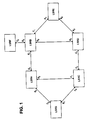
- the conceptual block diagram of Figure 1 illustrates a multiprotocol label switched routing communications system that employs a router in accordance with the principles of the present invention.
- the communications system includes label switching routers (LSRs) LSR A, B, C, D, E, F and S.
- LSRs label switching routers
- Each of the routers may be an abstract router that is, it may actually be any one of a plurality of routers within a network.
- communications from node S to node E may be established employing a plurality of explicit label switched routing paths (ELSRPs) between nodes S and E.
- ELSRPs explicit label switched routing paths
- an explicitly routed path may be established by an ingress router sending a request downstream for an explicit route to a specific egress router and, once the egress router has been reached, the egress router returns an acknowledgement of the request.
- Priority levels may be employed to insure that, once the explicit path has been established, it is not disrupted by other traffic. Commands are available for the release of the routers along the explicitly routed path once the transmission for which the ingress router requested the explicitly routed path has completed.
- the ingress router will establish a plurality of explicitly routed paths between itself and the target egress router.
- each ERLSP will use at least one router that is different than that employed by other ERLSP(s) for at least one "hop".
- the ingress router requests an explicitly routed path between itself and LSR E.
- the ingress router combines the contents of an IP forwarding table with forwarding equivalence class-to-label mappings to produce a label information base in accordance with the principles of the present invention.
- the label information base may be organized, for example, into a label information base table.
- the forwarding equivalence class to next hop mapping table may be produced by network layer routing protocols such as Open Shortest Path First (OSPF) or Border Gateway Protocol (BGP).
- OSPF Open Shortest Path First
- BGP Border Gateway Protocol
- IP routing is known and discussed, for example, in Douglas E Comer, Internetworking With TCP/IP Volume I,1995, Prentiss Hall, pages 109 through 121, which is hereby incorporated by reference.
- indirect delivery that is delivery of a datagram between two machines that are not directly connected together across a single physical network, employs an Internet Protocol (IP) routing table resident on each host or router in the Internet.
- IP Internet Protocol
- the IP routing table stores information about possible destinations and how to reach those destinations.
- the pertinent routing information typically includes the destination's network prefix, not destination host machine or the corresponding full IP address, and the IP address of the "next' router along the path to the destination network.
- a plurality of explicitly routed label switched paths are established from the ingress router, that is, router S, to the egress router, router E.
- the ingress router that is, router S
- the egress router chooses the one of the paths as its primary source of datagrams.
- router E switches to a secondary route, the S - C -D - E route in this example.
- LDP Label Distribution Protocol
- LSP label switched path
- explicit routing constraints provide an end-to-end setup mechanism, including a way of reserving resources using the label distribution protocol of a constraint-based routed LSP (CRLSP) initiated by the ingress LSR.
- CTLSP constraint-based routed LSP
- Explicit Routing is a subset of the more general constraint-based routing where the constraint is the explicit route.
- An explicit route is represented in a Label Request Message as a list of nodes or groups of nodes along the constraint-based route.
- the CRLSP is established, all or a subset of the nodes in a group may be traversed by the LSP.
- Certain operations to be performed along the path can also be encoded in the constraint-based route.
- a constraint-based route is encoded as a series of ER-Hops contained in a constraint-based route Type Length and Value (TLV). Each ER-Hop may identify a group of nodes in me constraint-based route.
- a constraint-based route is a path including all of the identified groups of nodes.
- each group of nodes may be referred to hereinafter as an abstract node.
- a request at an ingress LSR to setup a CRLSP might originate from a management system or an application, for example.
- the ingress LSR uses information provided by the management system or the application and possibly also information from the routing database to calculate the explicit route and to create a Label Request Message.
- a Label Request Message containing a explicit route TLV determines the next hop for this path. Selection of this next hop may involve a selection from a set of possible alternatives. Each node along the path makes a best effort attempt to determine a loop-free path.
- a node To determine the next hop for the path, a node performs the following steps;
- the sample network used here is a four node network with two edge LSRs and two core LSRs as follows: LSRS------LSRC------LSRD------LSRE
- LSRS To establish the ERLSP the ingress router, LSRS, generates a Label Request Message, including the ER-TLV, and sends it to LSRC.
- the ER-TLV is a vector composed of three ER-hop TLVs, corresponding to the S/C, C/D, and D/E hops.
- LSRC Since the ER-TLV was not removed, LSRC is not a member of the abstract node described by the first ER-Hop ⁇ S/C ⁇ , and the first ER-Hop ⁇ S/C ⁇ is a strict hop, new hops are not inserted.
- the selection of the next hop has been already done is step 4 and the processing of the ER-TLV is completed at LSRC.
- the Label Request Message including the ER-TLV ⁇ S/C, C/D ⁇ is passed by LSRC to LSRD.
- a plurality of Explicit routed label switched paths are established in this manner between the ingress router and the egress router, routers LSRS and LSRE, respectively in the illustrative conceptual block diagram of Figure 1.
- the traffic characteristics of a given path include parameters related to peak rate, committed rate, and service granularity.
- the peak and committed rates define the bandwidth constraints of the path.
- the service granularity may be employed to specify a constraint on the delay variation a CRLDP MPLS domain may introduce to a path's traffic.Setup and holding priorities may be employed to rank paths and to thereby determine whether a new path may preempt an existing path.
- An attempt to establish an Explicitly Routed LSP may fail for a variety of reasons and each such failure is classified as an advisory condition that is signaled by a Notification Message.
- a CRLSP may be cleared through use of Label Release and Label Withdraw messages.
- the ingress router combines the contents of an IP forwarding table with forwarding equivalence class-to-label mappings to produce a label information base in accordance with the principles of the present invention.
- the label information base may be organized, for example, into a label information base table.
- the forwarding equivalence class to next hop mapping table may be produced by network layer routing protocols such as Open Shortest Path First (OSPF) or Border Gateway Protocol (BGP).
- OSPF Open Shortest Path First
- BGP Border Gateway Protocol
- Figures 2, 3, and 4 are conceptual block diagrams which illustrates the contents, respectively, of an IP forwarding table, a table containing the mappings between FEC and labels, and a label information base, which is a combination of information gleaned from the prior two tables.
- the table of Figure 2 a product of OSPF, includes an IP destination prefix 302, an IP destination mask 304, the type of service 306, the next hop identifier 308, an IFINDEX 310, router type 312, metrics 314, and a status block 316.
- the IP destination prefix as is known in the art, is a destination prefix, such as 128.3/16, for example, that is recognized as indicating that the value of the first sixteen bits of a destination address 128.3.
- the IP destination mask 304 is used to obtain the effective bits from the destination address field of a packet, such as 255.255.0.0 which may be employed to select the first sixteen bits of a given IP destination address.
- the type of service (TOS) field 306 provides quality of service information.
- the Next Hop field 308 indicates the IP address of the next router along the way to a packet's final destination.
- the IFINDEX field 310 indicates which egress link from the current router should be employed to reach the next hop router.
- the router type field 312 indicates whether the router is an internal router, an area border router, a backbone router, or an AS boundary router. Because OSPF is based on a shortest path first algorithm, the metrics block field 314 is used to provision the weight of the associated egress link.
- the status field 316 indicates whether the associated link is up or down, that is, whether the link is operating or not.
- the table of Figure 3 includes a forwarding equivalency class (FEC) index 402, a field equivalency class identifier 404, an Internet protocol address prefix 406, an egress router identifier 408, and a flow block 410.
- the FEC index 402 field includes the MIB index for the corresponding FEC.
- the FEC ID field 404 uniquely identifies the FEC, and the IP address prefix field 406 is the same as the IP address prefix field of Figure 2.
- the Egress link ID field 408 is the identical to the IFINDEX field 310 of Figure 2, and the flow field 410 includes attributes of the flow, such as the source/destination address, and source/destination port information.
- the table of Figure 4 depicts a label information base.
- the label information base in accordance with the principles of the present invention, is created from information contained within the IP forwarding table of Figure 2 and the FEC table of Figure 3.
- the label information base includes an ERLSP ID 502, which provides a unique ID for the associated flow.
- An incoming label 504, forwarding equivalence class identifier 506, outgoing label 508, next hop 510, outgoing interface 512 and protection status 514 are also included.
- the incoming label field 504 contains an ingress label for the label switched path.
- the FEC ID field 506 contains the same information as the FEC ID field 404 of Figure 3.
- the outgoing label field 508 contains the egress label for the label switched path.
- the next hop field 510 and outgoing interface field 512 contain the same information as their respective counterparts, that is, the Next Hop and IFINDEX fields of the IP forwarding table of Figure 2.
- the protection status may take on a value of 0, 1, 2, or 3, respectively corresponding to "unprotected”, “protected”, “active”, and “backup”, statuses, with "unprotected” meaning that the flow simply is not equipped for protection flow.
- the outgoing interface 512 indicates the physical port through which flow will proceed.
- the table of Figure 5 is a label information base table in accordance with the principles of the present invention, which may be employed to establish and provision the two ERLSPs provisioned for flow 192.6/16 between LSRS and LSRE illustrated in Figure 1.
- the FEC ID is deleted from the table for convenience.
- the protection status column will be processed by hardware at the ingress interface, that is, at LSR S, and those flows with a protection status of 3 will be filtered, that is, dropped, at the sink router.
- datagrams will flow through both the S - A - B -E and S - C -D - E ERLSPs, with the egress router, LSR E employing active protection switching to select one of the flows to pass through.
- LSRs will detect the broken link through physical layer fault detection mechanisms.
- SONET fault indicators as loss of signal (LOS), loss of frame (LOF), loss of pointer (LOP) or other such physical layer fault indicators may be employed to detect a broken link in an ERLSP.
- LOS loss of signal
- LPF loss of frame
- LOP loss of pointer
- a MPLS system in accordance with the principles of the present invention may detect a fault almost instantaneously.
- Physical layer fault indicators are known and described, for example in Bellcore GR253 R5-198, R6-152, O6-120, and O6-127 which are hereby incorporated by reference.
- both LSRA and LSRB will remain in the "established state", release related label resources, and separately propagate Nak messages upstream and downstream.
- the "established" state is discussed in ietf draft MLPS documents, a list of which may be accessed at http://www.ietf.org/ietf/lid-abstracts.txt , all of which are hereby incorporated by reference.
- ingress router LSRS and egress router LSRE will receive Nak messages for the S - A - B -E ERLSP.
- the ingress and egress routers will respond according to the state machine set forth in the ietf MPLS document listed above, except that, the egress node, will determine whether the failed ERLSP is protected. If it is protected, the LSR will change the protection status of the failed ERLSP from 3 to 0.
- the egress LSR completes the hardware protection switching, such as SONET protection switching, since the hardware protection switching relies upon the protection status of a given link to switch.
- LSRS will proceed according to the state machine set forth in the ietf MPLS document listed above and, additionally, will determine whether the failed link involves a protected ERLSP. If the ERLSP was protected, the LSRS will change the protection status of the ERLSP from 1 to 0. That is, at this stage, the protected flow, also referred to as the backup or secondary flow, is used as the active flow but another disjoint flow has not yet been established to protect this newly established primary flow. Consequently, the newly established (by virtue of the sink routers selection) primary flow is unprotected, and its status indication is updated from protected (1) to unprotected (0). Additionally the alarm is reported to the network management system.
- a router in accordance with the principles of the present invention employs physical layer fault detection, such as might be supplied in a SONET/SDH system to immediately detect faults.
- Flow based propagation of these faults for example, Nak propagation through provisioned flow provides a rapid indication of the faults, and, because duplicate paths have been established, a sink router may select a backup or secondary path as soon as the fault is detected and propagated.
Landscapes
- Engineering & Computer Science (AREA)
- Computer Networks & Wireless Communication (AREA)
- Signal Processing (AREA)
- Computer Security & Cryptography (AREA)
- Data Exchanges In Wide-Area Networks (AREA)
- Maintenance And Management Of Digital Transmission (AREA)
Applications Claiming Priority (2)
| Application Number | Priority Date | Filing Date | Title |
|---|---|---|---|
| US318694 | 1999-05-25 | ||
| US09/318,694 US6721269B2 (en) | 1999-05-25 | 1999-05-25 | Apparatus and method for internet protocol flow ring protection switching |
Publications (1)
| Publication Number | Publication Date |
|---|---|
| EP1056234A2 true EP1056234A2 (en) | 2000-11-29 |
Family
ID=23239224
Family Applications (1)
| Application Number | Title | Priority Date | Filing Date |
|---|---|---|---|
| EP00303902A Withdrawn EP1056234A2 (en) | 1999-05-25 | 2000-05-09 | Apparatus and method for internet protocol flow ring protection switching |
Country Status (4)
| Country | Link |
|---|---|
| US (1) | US6721269B2 (enExample) |
| EP (1) | EP1056234A2 (enExample) |
| JP (1) | JP2001007859A (enExample) |
| CA (1) | CA2308693A1 (enExample) |
Cited By (3)
| Publication number | Priority date | Publication date | Assignee | Title |
|---|---|---|---|---|
| WO2002093803A1 (en) * | 2001-05-15 | 2002-11-21 | Marconi Uk Intellectual Property Ltd | Restoration protection in communication networks |
| US6522630B1 (en) * | 1999-05-07 | 2003-02-18 | Alcatel | Explicit routing method |
| WO2004075452A3 (fr) * | 2003-02-18 | 2004-12-16 | Thales Sa | Architecture de reseau ethernet/ip a haute disponibilite de service |
Families Citing this family (109)
| Publication number | Priority date | Publication date | Assignee | Title |
|---|---|---|---|---|
| US6987769B1 (en) * | 1999-09-08 | 2006-01-17 | Qwest Communications International Inc. | System and method for dynamic distributed communication |
| US7561895B1 (en) * | 1999-09-08 | 2009-07-14 | Qwest Communications International, Inc. | Reverse sectorization wireless communication |
| US7388846B1 (en) | 1999-09-08 | 2008-06-17 | Qwest Communications International Inc. | Cellularized packetized voice and data |
| US8005077B1 (en) | 1999-09-08 | 2011-08-23 | Qwest Communications International Inc. | Distributively routed VDSL and high-speed information packets |
| US6831902B1 (en) | 1999-09-08 | 2004-12-14 | Qwest Communications International, Inc. | Routing information packets in a distributed network |
| WO2001020829A1 (en) * | 1999-09-14 | 2001-03-22 | Megaxess, Inc. | Method and apparatus for prevention of congestion in atm networks through atm protection switching |
| US7151775B1 (en) * | 1999-09-23 | 2006-12-19 | Pluris, Inc. | Apparatus and method for forwarding data on multiple label-switched data paths |
| US6970451B1 (en) | 1999-10-12 | 2005-11-29 | At&T Corp. | Smart routers-simple optics: network architecture for IP over WDM |
| US7315510B1 (en) | 1999-10-21 | 2008-01-01 | Tellabs Operations, Inc. | Method and apparatus for detecting MPLS network failures |
| US7298693B1 (en) * | 1999-10-21 | 2007-11-20 | Tellabs Operations, Inc. | Reverse notification tree for data networks |
| AU1098101A (en) * | 1999-10-21 | 2001-04-30 | Tellabs Operations, Inc. | Method for establishing an mpls data network protection pathway |
| US7804767B1 (en) | 1999-10-25 | 2010-09-28 | Tellabs Operations, Inc. | Protection/restoration of MPLS networks |
| US6985436B1 (en) * | 1999-12-07 | 2006-01-10 | Cisco Technology, Inc. | Ticket insertion: load information for assured forwarding classes |
| JP3356145B2 (ja) * | 1999-12-22 | 2002-12-09 | 日本電気株式会社 | 伝送路障害救済方法、伝送路障害救済システム、記憶媒体およびルータ |
| JP3817400B2 (ja) * | 2000-01-11 | 2006-09-06 | 富士通株式会社 | ラベルスイッチングシステムにおける明示ルート指定方法及びパケット中継装置 |
| EP1126741A1 (de) * | 2000-02-15 | 2001-08-22 | Siemens Aktiengesellschaft | Verfahren zum Ersatzschalten von Übertragungseinrichtungen in MPLS-Netzen |
| US7412168B2 (en) * | 2000-02-22 | 2008-08-12 | Nortel Networks Limited | MPLS application to optical cross-connect using wavelength as a label |
| EP1130852A1 (de) * | 2000-02-29 | 2001-09-05 | Siemens Aktiengesellschaft | Verfahren zum Ersatzschalten von Übertragungseinrichtungen in MPLS-Packete führende Ringarchitekturen |
| EP1130853A1 (de) * | 2000-02-29 | 2001-09-05 | Siemens Aktiengesellschaft | Schaltungsanordnung zum Ersatzschalten von Übertragungseinrichtungen in MPLS-Pakete führende Ringarchitekturen |
| US6765921B1 (en) * | 2000-06-28 | 2004-07-20 | Nortel Networks Limited | Communications network |
| US7046669B1 (en) * | 2000-06-28 | 2006-05-16 | Nortel Networks Limited | Communications network |
| US20020093954A1 (en) * | 2000-07-05 | 2002-07-18 | Jon Weil | Failure protection in a communications network |
| US6996065B2 (en) * | 2000-07-06 | 2006-02-07 | Lucent Technologies Inc. | Dynamic backup routing of network tunnel paths for local restoration in a packet network |
| US7184396B1 (en) * | 2000-09-22 | 2007-02-27 | Nortel Networks Limited | System, device, and method for bridging network traffic |
| US7324647B1 (en) * | 2000-10-23 | 2008-01-29 | Bbn Technologies Corp. | Quantum cryptographic key distribution networks with untrusted switches |
| US7289433B1 (en) * | 2000-10-24 | 2007-10-30 | Nortel Networks Limited | Method and system for providing robust connections in networking applications |
| KR100725005B1 (ko) * | 2000-11-22 | 2007-06-04 | 주식회사 케이티 | 다중 프로토콜 레이블 스위칭 망에서의 고속 재라우팅 방법 |
| KR100703499B1 (ko) * | 2000-12-09 | 2007-04-03 | 삼성전자주식회사 | 다중 프로토콜 레이블 교환 시스템에서 트래픽 엔지니어링기능을 구현하기 위한 데이터구조 및 구축 방법 |
| US7234001B2 (en) * | 2000-12-20 | 2007-06-19 | Nortel Networks Limited | Dormant backup link for OSPF network protection |
| US7319700B1 (en) * | 2000-12-29 | 2008-01-15 | Juniper Networks, Inc. | Communicating constraint information for determining a path subject to such constraints |
| US20020087724A1 (en) * | 2000-12-29 | 2002-07-04 | Ragula Systems D/B/A Fatpipe Networks | Combining connections for parallel access to multiple frame relay and other private networks |
| US6862288B2 (en) * | 2001-01-16 | 2005-03-01 | Fujitsu Network Communications, Inc. | Circuit reestablishment and tear down in a highly available communications system |
| US6990086B1 (en) * | 2001-01-26 | 2006-01-24 | Cisco Technology, Inc. | Method and system for label edge routing in a wireless network |
| US6956821B2 (en) * | 2001-01-30 | 2005-10-18 | Telefonaktiebolaget L M Ericsson (Publ) | Path determination in a data network |
| WO2002065661A1 (en) * | 2001-02-12 | 2002-08-22 | Maple Optical Systems, Inc. | System and method for fast-rerouting of data in a data communication network |
| US20020152320A1 (en) * | 2001-02-14 | 2002-10-17 | Lau Pui Lun | System and method for rapidly switching between redundant networks |
| US7130926B1 (en) * | 2001-03-29 | 2006-10-31 | Nortel Networks Limited | Control plane failure recovery in a network |
| JP3762749B2 (ja) * | 2001-04-19 | 2006-04-05 | 富士通株式会社 | リストレーション・プロテクション方法及び装置 |
| US7506064B1 (en) * | 2001-05-01 | 2009-03-17 | Palmsource, Inc. | Handheld computer system that attempts to establish an alternative network link upon failing to establish a requested network link |
| US20020167899A1 (en) * | 2001-05-11 | 2002-11-14 | Thompson Richard A. | System and method for the configuration, repair and protection of virtual ring networks |
| KR100392648B1 (ko) * | 2001-06-21 | 2003-07-25 | 에스케이 텔레콤주식회사 | 데이터 통신망에서의 멀티-프로토콜 라벨 스위칭 방식을위한 데이터 트래픽 경로 설정 방법 |
| US7212490B1 (en) * | 2001-07-06 | 2007-05-01 | Cisco Technology, Inc. | Dynamic load balancing for dual ring topology networks |
| JP2003032280A (ja) * | 2001-07-16 | 2003-01-31 | Fujitsu Ltd | コネクション型通信ネットワークにおけるリンク識別子の割当システム |
| US7372803B2 (en) * | 2001-07-24 | 2008-05-13 | Nortel Networks Limited | Apparatus and method for establishment and protection of connections within mesh networks |
| JP2005503092A (ja) * | 2001-08-28 | 2005-01-27 | アイピーツーエイチ アーゲー | リレーシステムにおける通信パスを維持および/または質的に改良する方法 |
| JP3844982B2 (ja) * | 2001-09-10 | 2006-11-15 | 富士通株式会社 | 伝送装置 |
| DE10147748A1 (de) * | 2001-09-27 | 2003-04-17 | Siemens Ag | Verfahren und Vorrichtung zur Anpassung von Label-Switched-Pfaden in Paketnetzen |
| US7120151B1 (en) * | 2001-09-27 | 2006-10-10 | Cisco Technology, Inc. | Method for fast label switchover with multiprotocol label switching |
| US7215664B2 (en) * | 2001-11-01 | 2007-05-08 | Telefonaktiebolaget Lm Ericsson (Publ) | Arrangement and method for protection switching |
| US7617302B1 (en) * | 2001-11-02 | 2009-11-10 | Nortel Networks Limited | Communication networks |
| US7373401B1 (en) | 2001-12-31 | 2008-05-13 | Nortel Networks Limited | Label switched path OAM wrapper |
| US7496096B1 (en) * | 2002-01-31 | 2009-02-24 | Cisco Technology, Inc. | Method and system for defining hardware routing paths for networks having IP and MPLS paths |
| JP2003229888A (ja) * | 2002-02-01 | 2003-08-15 | Nec Corp | ラベルスイッチングネットワーク及びそれに用いるラベルスイッチングパス設定方法 |
| US8014380B2 (en) * | 2002-07-03 | 2011-09-06 | Alcatel Lucent | Method and system for automatically establishing a return label switched path |
| US20040131051A1 (en) * | 2002-09-06 | 2004-07-08 | Rafi Rabipour | Methods and apparatus for data communication |
| US7639601B2 (en) * | 2002-07-05 | 2009-12-29 | Nortel Networks Limited | Methods and apparatus for data communication |
| US7525907B2 (en) * | 2002-07-05 | 2009-04-28 | Nortel Networks Limited | Method, device and software for establishing protection paths on demand and revertive protection switching in a communications network |
| US7466697B1 (en) * | 2002-07-23 | 2008-12-16 | Atrica Israel Ltd | Link multiplexing mechanism utilizing path oriented forwarding |
| DE10237584B4 (de) * | 2002-08-16 | 2005-10-06 | Siemens Ag | Verfahren zur Verwaltung von Ressourcen beim Aufbau eines Ersatzpfades in einem transparent schaltbaren Netzwerk |
| JP2004128723A (ja) * | 2002-09-30 | 2004-04-22 | Fujitsu Ltd | ラベルスイッチルータ及びそのパス切替制御方法 |
| US7627126B1 (en) | 2002-10-15 | 2009-12-01 | Bbn Technologies Corp. | Systems and methods for implementing path length control for quantum cryptographic systems |
| US7342890B1 (en) * | 2002-12-20 | 2008-03-11 | Juniper Networks, Inc. | Data duplication for transmission over computer networks |
| US8254372B2 (en) * | 2003-02-21 | 2012-08-28 | Genband Us Llc | Data communication apparatus and method |
| US7706535B1 (en) | 2003-03-21 | 2010-04-27 | Bbn Technologies Corp. | Systems and methods for implementing routing protocols and algorithms for quantum cryptographic key transport |
| GB0315745D0 (en) * | 2003-07-04 | 2003-08-13 | Novartis Ag | Organic compounds |
| KR100553722B1 (ko) | 2003-09-04 | 2006-02-24 | 삼성전자주식회사 | 트리 구조의 무선 네트워크에서 라우팅 경로 복구 방법 |
| US20050086385A1 (en) * | 2003-10-20 | 2005-04-21 | Gordon Rouleau | Passive connection backup |
| US7542414B1 (en) * | 2003-10-31 | 2009-06-02 | Cisco Technology, Inc. | Computing a diverse path while providing optimal usage of line protected links |
| US7860115B1 (en) * | 2003-12-18 | 2010-12-28 | Cisco Technology, Inc. | Withdrawing multiple advertised routes based on a single tag which may be of particular use in border gateway protocol |
| US7362712B1 (en) * | 2003-12-29 | 2008-04-22 | At&T Corp. | SONET network outage impact measurement |
| US7697693B1 (en) | 2004-03-09 | 2010-04-13 | Bbn Technologies Corp. | Quantum cryptography with multi-party randomness |
| US8027265B2 (en) | 2004-03-19 | 2011-09-27 | Genband Us Llc | Providing a capability list of a predefined format in a communications network |
| US7990865B2 (en) * | 2004-03-19 | 2011-08-02 | Genband Us Llc | Communicating processing capabilities along a communications path |
| CN100372337C (zh) * | 2004-05-31 | 2008-02-27 | 华为技术有限公司 | 一种实现跨域约束路由的选路方法 |
| US7348283B2 (en) * | 2004-12-27 | 2008-03-25 | Intel Corporation | Mechanically robust dielectric film and stack |
| US7933197B2 (en) * | 2005-02-22 | 2011-04-26 | Cisco Technology, Inc. | Method and apparatus for constructing a repair path around a non-available component in a data communications network |
| JP4381448B2 (ja) * | 2005-03-16 | 2009-12-09 | 富士通株式会社 | Ipネットワークにおけるマルチキャストツリー監視方法およびシステム |
| US7609620B2 (en) * | 2005-08-15 | 2009-10-27 | Cisco Technology, Inc. | Method and apparatus using multiprotocol label switching (MPLS) label distribution protocol (LDP) to establish label switching paths (LSPS) for directed forwarding |
| US7995461B2 (en) * | 2005-08-24 | 2011-08-09 | Cisco Technology, Inc. | Efficient constrained shortest path first optimization technique |
| KR101203463B1 (ko) * | 2005-11-03 | 2012-11-21 | 삼성전자주식회사 | IPv6 기반 모바일 시스템에서 이웃 탐색을 제공하는장치 및 방법 |
| US20070174483A1 (en) * | 2006-01-20 | 2007-07-26 | Raj Alex E | Methods and apparatus for implementing protection for multicast services |
| JP4603494B2 (ja) * | 2006-02-14 | 2010-12-22 | 富士通株式会社 | 伝送装置および学習情報保全方法 |
| JP2007274485A (ja) * | 2006-03-31 | 2007-10-18 | Fujitsu Ltd | パス警報処理方法及び装置 |
| US8570857B2 (en) * | 2006-04-07 | 2013-10-29 | At&T Intellectual Property I, Lp | Resilient IP ring protocol and architecture |
| US8208372B2 (en) * | 2006-06-02 | 2012-06-26 | Cisco Technology, Inc. | Technique for fast activation of a secondary head-end node TE-LSP upon failure of a primary head-end node TE-LSP |
| US7899049B2 (en) | 2006-08-01 | 2011-03-01 | Cisco Technology, Inc. | Methods and apparatus for minimizing duplicate traffic during point to multipoint tree switching in a network |
| EP2108193B1 (en) | 2006-12-28 | 2018-08-15 | Genband US LLC | Methods, systems, and computer program products for silence insertion descriptor (sid) conversion |
| US7969898B1 (en) | 2007-03-09 | 2011-06-28 | Cisco Technology, Inc. | Technique for breaking loops in a communications network |
| CN100558082C (zh) * | 2007-03-20 | 2009-11-04 | 华为技术有限公司 | 一种通信系统、标签交换路由器及路由切换方法 |
| US7940776B2 (en) * | 2007-06-13 | 2011-05-10 | Cisco Technology, Inc. | Fast re-routing in distance vector routing protocol networks |
| US9350639B2 (en) * | 2007-09-06 | 2016-05-24 | Cisco Technology, Inc. | Forwarding data in a data communications network |
| US8248918B2 (en) * | 2008-02-13 | 2012-08-21 | Broadcom Corporation | Routing failover with accurate multicast delivery |
| US8155028B2 (en) * | 2008-03-17 | 2012-04-10 | Alcatel Lucent | Method and apparatus for providing full logical connectivity in MPLS networks |
| US8392421B1 (en) * | 2008-04-17 | 2013-03-05 | Narus, Inc. | System and method for internet endpoint profiling |
| CA2748266C (en) * | 2008-12-23 | 2017-11-14 | Jonathan Allan Arsenault | Methods and systems for enabling end-user equipment at an end-user premise to effect communications when an ability of the end-user equipment to communicate via a communication link connecting the end-user equipment to a communications network is disrupted |
| KR101034586B1 (ko) * | 2008-12-23 | 2011-05-12 | 한국전자통신연구원 | 노드 이동 속도를 고려한 트리 기반의 멀티 홉 무선 통신 방법 |
| US8908541B2 (en) * | 2009-08-04 | 2014-12-09 | Genband Us Llc | Methods, systems, and computer readable media for intelligent optimization of digital signal processor (DSP) resource utilization in a media gateway |
| JP5383415B2 (ja) * | 2009-10-02 | 2014-01-08 | キヤノン株式会社 | 通信装置及び通信装置の通信方法並びにプログラム |
| US8542578B1 (en) | 2010-08-04 | 2013-09-24 | Cisco Technology, Inc. | System and method for providing a link-state path to a node in a network environment |
| US8824488B2 (en) | 2010-12-10 | 2014-09-02 | At&T Intellectual Property I, L.P. | Methods, apparatus and articles of manufacture to select label switched paths (LSPs) for preemption |
| US8780896B2 (en) | 2010-12-29 | 2014-07-15 | Juniper Networks, Inc. | Methods and apparatus for validation of equal cost multi path (ECMP) paths in a switch fabric system |
| US8798077B2 (en) | 2010-12-29 | 2014-08-05 | Juniper Networks, Inc. | Methods and apparatus for standard protocol validation mechanisms deployed over a switch fabric system |
| US9270584B2 (en) * | 2012-02-28 | 2016-02-23 | Cisco Technology, Inc. | Diverse paths using a single source route in computer networks |
| KR101640211B1 (ko) * | 2013-01-16 | 2016-07-15 | 한국전자통신연구원 | 다 계층 네트워크에서의 장애 복구 방법 및 그 장치 |
| CN104579952B (zh) * | 2013-10-25 | 2017-12-15 | 新华三技术有限公司 | 一种抵御主隧道多点故障的保护隧道创建方法及设备 |
| US9973578B2 (en) * | 2015-06-01 | 2018-05-15 | Telefonaktiebolaget Lm Ericsson (Publ) | Real time caching efficient check in a content centric networking (CCN) |
| US10193795B2 (en) | 2016-12-21 | 2019-01-29 | Sony Corporation | Robust data routing in wireless networks with directional transmissions |
| US11050658B2 (en) * | 2018-09-14 | 2021-06-29 | Cisco Technology, Inc. | IOAM-based quality of experience propagation to endpoints and seamless switchover to alternate call path |
| EP3942755B1 (en) * | 2019-05-23 | 2025-07-02 | Hewlett Packard Enterprise Development LP | System and method for facilitating data-driven intelligent network with endpoint congestion detection and control |
Family Cites Families (9)
| Publication number | Priority date | Publication date | Assignee | Title |
|---|---|---|---|---|
| US5307342A (en) * | 1991-08-30 | 1994-04-26 | International Business Machines Corporation | Heterogeneous ports switch |
| CA2232507A1 (en) * | 1995-09-22 | 1997-03-27 | Mci Communications Corporation | Communication system and method providing optimal restoration of failed paths |
| US6047331A (en) * | 1997-02-19 | 2000-04-04 | Massachusetts Institute Of Technology | Method and apparatus for automatic protection switching |
| US5881243A (en) * | 1997-05-07 | 1999-03-09 | Zaumen; William T. | System for maintaining multiple loop free paths between source node and destination node in computer network |
| US5959972A (en) * | 1997-05-27 | 1999-09-28 | 3Com Corporation | Method of port/link redundancy in an ATM switch |
| US6311288B1 (en) * | 1998-03-13 | 2001-10-30 | Paradyne Corporation | System and method for virtual circuit backup in a communication network |
| US6272107B1 (en) * | 1998-05-12 | 2001-08-07 | 3Com Corporation | Method of path restoration in an ATM network utilizing point to point switched virtual circuits |
| US6324162B1 (en) * | 1998-06-03 | 2001-11-27 | At&T Corp. | Path-based restoration mesh networks |
| US6111673A (en) * | 1998-07-17 | 2000-08-29 | Telcordia Technologies, Inc. | High-throughput, low-latency next generation internet networks using optical tag switching |
-
1999
- 1999-05-25 US US09/318,694 patent/US6721269B2/en not_active Expired - Fee Related
-
2000
- 2000-05-09 EP EP00303902A patent/EP1056234A2/en not_active Withdrawn
- 2000-05-15 CA CA002308693A patent/CA2308693A1/en not_active Abandoned
- 2000-05-23 JP JP2000151713A patent/JP2001007859A/ja active Pending
Cited By (3)
| Publication number | Priority date | Publication date | Assignee | Title |
|---|---|---|---|---|
| US6522630B1 (en) * | 1999-05-07 | 2003-02-18 | Alcatel | Explicit routing method |
| WO2002093803A1 (en) * | 2001-05-15 | 2002-11-21 | Marconi Uk Intellectual Property Ltd | Restoration protection in communication networks |
| WO2004075452A3 (fr) * | 2003-02-18 | 2004-12-16 | Thales Sa | Architecture de reseau ethernet/ip a haute disponibilite de service |
Also Published As
| Publication number | Publication date |
|---|---|
| US6721269B2 (en) | 2004-04-13 |
| CA2308693A1 (en) | 2000-11-25 |
| JP2001007859A (ja) | 2001-01-12 |
| US20020181485A1 (en) | 2002-12-05 |
Similar Documents
| Publication | Publication Date | Title |
|---|---|---|
| US6721269B2 (en) | Apparatus and method for internet protocol flow ring protection switching | |
| EP1676451B1 (en) | TRANSPARENT RE-ROUTING OF MPLS TRAFFIC ENGINEERING LSPs WITHIN A LINK BUNDLE | |
| Bonaventure et al. | Achieving sub-50 milliseconds recovery upon BGP peering link failures | |
| US7039005B2 (en) | Protection switching in a communications network employing label switching | |
| EP2549703B1 (en) | Reoptimization triggering by path computation elements | |
| US7535828B2 (en) | Algorithm for backup PE selection | |
| US7512063B2 (en) | Border router protection with backup tunnel stitching in a computer network | |
| US8885460B2 (en) | Technique for determining whether to reestablish fast rerouted primary tunnels based on backup tunnel path quality feedback | |
| EP2036273B1 (en) | A technique for efficiently determining acceptable link-based loop free alternatives in a computer network | |
| US20020093954A1 (en) | Failure protection in a communications network | |
| US20070180105A1 (en) | Technique for distinguishing between link and node failure using bidirectional forwarding detection (BFD) | |
| CN101317405B (zh) | 标签交换路径保护方法及装置 | |
| EP2190150A1 (en) | A method, device and system of multi-protocol label exchange traffic engineering flow capacity switch | |
| JP2002190825A (ja) | トラフィックエンジニアリング方法及びそれを用いたノード装置 | |
| MXPA04010567A (es) | Control de flujo de red de trafico usando metricas modificadas dinamicamente por conexiones de redundancia. | |
| EP2658177B1 (en) | Method for detecting tunnel faults and traffic engineering node | |
| EP1905196B1 (en) | Method and apparatus for updating label-switched paths | |
| Oh et al. | Fault restoration and spare capacity allocation with QoS constraints for MPLS networks | |
| US7590051B1 (en) | Method and apparatus for redialing a connection on a communication network | |
| US7702810B1 (en) | Detecting a label-switched path outage using adjacency information | |
| François | Improving the convergence of IP routing protocols | |
| Mon et al. | Enhancing Recovery Scheme in Software-Defined Network using Segment Routing | |
| Habib | An efficient hybrid recovery mechanism for MPLS-based networks | |
| Headquarters | Cisco IOS XR MPLS Command Reference |
Legal Events
| Date | Code | Title | Description |
|---|---|---|---|
| PUAI | Public reference made under article 153(3) epc to a published international application that has entered the european phase |
Free format text: ORIGINAL CODE: 0009012 |
|
| AK | Designated contracting states |
Kind code of ref document: A2 Designated state(s): AT BE CH CY DE DK ES FI FR GB GR IE IT LI LU MC NL PT SE |
|
| AX | Request for extension of the european patent |
Free format text: AL;LT;LV;MK;RO;SI |
|
| STAA | Information on the status of an ep patent application or granted ep patent |
Free format text: STATUS: THE APPLICATION HAS BEEN WITHDRAWN |
|
| 18W | Application withdrawn |
Withdrawal date: 20021029 |