EP1053412B1 - Short pitch tooth chain - Google Patents
Short pitch tooth chain Download PDFInfo
- Publication number
- EP1053412B1 EP1053412B1 EP99905913.2A EP99905913A EP1053412B1 EP 1053412 B1 EP1053412 B1 EP 1053412B1 EP 99905913 A EP99905913 A EP 99905913A EP 1053412 B1 EP1053412 B1 EP 1053412B1
- Authority
- EP
- European Patent Office
- Prior art keywords
- link
- chain
- links
- tension
- tooth chain
- Prior art date
- Legal status (The legal status is an assumption and is not a legal conclusion. Google has not performed a legal analysis and makes no representation as to the accuracy of the status listed.)
- Expired - Lifetime
Links
Images






Classifications
-
- F—MECHANICAL ENGINEERING; LIGHTING; HEATING; WEAPONS; BLASTING
- F16—ENGINEERING ELEMENTS AND UNITS; GENERAL MEASURES FOR PRODUCING AND MAINTAINING EFFECTIVE FUNCTIONING OF MACHINES OR INSTALLATIONS; THERMAL INSULATION IN GENERAL
- F16G—BELTS, CABLES, OR ROPES, PREDOMINANTLY USED FOR DRIVING PURPOSES; CHAINS; FITTINGS PREDOMINANTLY USED THEREFOR
- F16G13/00—Chains
- F16G13/02—Driving-chains
- F16G13/04—Toothed chains
Definitions
- the present invention relates to the chain arts, and in particular, a short pitch tooth chain that provides improved noise reduction over conventional tooth chains.
- Drive chain systems and timing chain systems incorporating known chains such as inverted tooth chains and roller chains have several components of undesirable noise.
- a major source of noise is the sound generated as the chain engaging members, such as inverted teeth or rollers, leave the span and collide with a sprocket during meshing. The resulting impact noise is repeated with a frequency generally equal to that of the frequency of the chain meshing with the sprocket. It is known that the impact noise levels associated with chains can be reduced by altering the engagement geometry of the chain and/or sprocket to, in part, reduce the impact energy that must be absorbed during the meshing process.
- the present invention contemplates a new and improved short pitch tooth chain which provides improved noise reduction over conventional inverted tooth chains.
- US-A1-2655816 discloses a silent chain structure including an automatic slack take-up assembly, comprising a plurality of chain links interconnected by pins of identical construction, each of said pins having operatively associated therewith double liners each defining a bushing with a curvature whose radii vary in length and are less than the diameter of their associated pin and arranged so that the pin is forced to nest in the bushing by deflecting the curvature of the bushing when load is placed upon the chain, said arrangement being particularly characterized in its operation by a spring action of each joint responsive to the load place upon the chain.
- EP-A-0877178 which falls under Article 54(3) EPC, discloses a chain assembly using formed bushings with inverted teeth in which a roller chain is provided with a bushing with a silent chain link profile.
- the bushing has a pair of depending toes which engage the teeth of a sprocket to provide power transmission.
- a tooth chain comprising a plurality of link members each comprising a body portion defining a first toe and a second toe spaced from the first toe by a predetermined distance (T p ), the toes adapted for meshing engagement with tooth spaces associated with a sprocket and wherein each of said link members further comprises a single aperture extending through the body portion, said tooth chain further comprising a plurality of tension links each comprising first and second apertures spaced from each other by a chain pitch distance (C p ), each of said tension links including a first one of said link members pivotally connected to said tension link by a first pin that extends through said first aperture of said tension link and through said single aperture of said first link member, and a second one of said link members pivotally connected to said tension link by a second pin that extends through said second aperture of said tension link and through said single aperture of said second link member, such that each tension link carries two of said link members.
- a chain system comprising a tooth chain according to the aforesaid first aspect of the invention said tooth chain meshed with first and second sprockets and the first and second sprockets each defining a sprocket chordal pitch (S p ) that is substantially equal to the predetermined distance (T p ).
- One advantage of the present invention is the provision of a short pitch tooth chain which reduces noise levels by increasing the frequency at which the chain meshes with a sprocket to a level which is inaudible, or at least less audible to the human ear.
- Another advantage of the present invention is the provision of a short pitch tooth chain having a chain pitch value which is approximately twice a sprocket chordal pitch value.
- a further advantage of the present invention is the provision of a chain system having a short pitch tooth chain that reduces noise levels by increasing the frequency at which the chain meshes with a sprocket to a level which is inaudible, or at least less audible to the human ear.
- Yet another advantage of the present invention is the provision of chain system having a short pitch tooth chain with a chain pitch value which is approximately twice a sprocket chordal pitch value.
- a conventional double-toed link 10 for a known inverted tooth chain 11 includes a body portion 12 having a first toe 14 spaced from a second toe 16.
- the toes 14, 16 consecutively engage adjacent and mutually conforming tooth spaces 17 associated with a sprocket 17a.
- the link 10 also includes a first aperture 18 and a second aperture 20 spaced apart from the first aperture.
- the apertures 18, 20 receive conventional pins 21 for joining together a number of different links, including links 10, to form the known inverted tooth chain 11.
- Such a conventional double-toed link is disclosed in US-A-2655816 .
- a major source of chain drive noise is the sound generated as the chain engaging members, i.e. the toes 14, 16, leave the span and collide with the sprocket during meshing.
- the resultant impact noise is repeated with a frequency generally equal to that of the frequency of the chain meshing with the sprocket. It is contemplated herein that the overall noise levels associated with a chain drive system can be reduced by increasing the frequency at which the chain meshes with the sprocket to a level which is inaudible, or at least less audible, to the human ear.
- reducing the chain pitch C p of the conventional link 10 to about 8.0mm or less is problematic.
- the size of the link 10 decreases, and a corresponding decrease in strength and load capacity of the chain results. More particularly, as the size of the link 10 decreases, there is less link material between the apertures 18, 20, and between each aperture 18, 20 and the corresponding edge of the link 10 thereby resulting in a structurally weaker link.
- a chain system 30 such as a drive chain system, timing chain system, etc. which incorporates the features of the present invention therein.
- the chain system 30 rotates in a counter-clockwise direction as shown by arrow 32.
- the chain system 30 includes at least a drive sprocket 34, a driven sprocket 36, and a short pitch tooth chain 38.
- the short pitch tooth chain 38 engages and wraps about sprockets 34 and 36 and has two spans extending between the sprockets, slack strand 40 and taut strand 42.
- the taut strand 42 is under tension as shown by arrows 44.
- the short pitch tooth chain 38 includes a number of double-toed links 46, tension links 48, and pins 50 interconnecting the links 46, 48.
- the links 46, 48 are each pivotal about the pins 50 so that as the links enter the sprocket wrap, each link may articulate independently about the respective pin to conform with the curvature of the sprocket.
- the links 46, 48 and pins 50 may be interconnected in various lacing patterns known in the art to produce short pitch tooth chains having different strength and load capacity characteristics.
- An exemplary lacing pattern is shown in Figure 4 .
- the dimensions (e.g. length, width, height, etc.) and material considerations (powdered metal, stamped metal, steel, etc.) of the links 46, 48 and the pins 50 can be varied to produce chains having different strength and load capacity characteristics in a known manner.
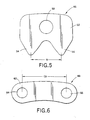
- the double-toed link 46 ( Figure 5 ) includes a body portion 52 having a first toe 54 spaced from a second toe 56 by a distance T p (toe pitch).
- a central aperture 58 extends through the body portion 52.
- the toes 54, 56 engage mutually conforming tooth spaces 59, 60 ( Figure 3 ) of the sprockets 34, 36, respectively.
- the sprockets 34, 36 each have sprocket chordal pitch S p which is substantially equal to the toe pitch T p . It should be appreciated that by providing a link 46 with a single aperture therethrough, more link material extends between the aperture and each side edge thereof, relative to the link 10.
- the tension link 48 ( Figure 6 ) primarily carries the load on the chain 38.
- Each tension link 48 includes an arcuate-shaped body portion 62 having a first aperture 64 proximate one end thereof, and a second aperture 66 proximate the other end.
- each tension link 48 carries two double-toed links 46 via two pins 50 each extending through a respective aperture 64, 66.
- the chain pitch C p for the chain 38 is defined as the distance between the centers of the apertures 64, 66.
- the tension links 48 have substantially the same chain pitch C p as the prior art links 10.
- the chain 38 maintains substantially the same high-strength and load capacity characteristics as a known inverted tooth chain incorporating the links 10.
- the chain 38 also permits the sprocket chordal pitch S p to be reduced to substantially one-half of the chain pitch.
- the overall noise levels associated with the chain 38 are reduced by increasing the frequency at which the chain meshes with the sprockets to a level which is inaudible, or at least less audible to the human ear.
- a timing, drive, etc. chain system 80 incorporates the features of the present invention therein.
- the chain system 80 rotates in a counter-clockwise direction as shown by arrow 82, and includes a drive sprocket 84, a driven sprocket 86, and a short pitch tooth chain 88.
- the short pitch tooth chain 88 engages and wraps about sprockets 84 and 86 and has two spans extending between the sprockets, slack strand 90 and taut strand 92.
- the taut strand 92 is under tension as shown by arrows 94.
- the short pitch tooth chain 88 includes a number of double-toed links 96, tension links 98, guide links 100, spring links 102, and pins 104.
- the double-toed links 96, tension links 98, and spring links 102 are each pivotal about the pins 104.
- the double-toed links 96, tension links 98, guide links 100, and spring links 102 may be interconnected in various lacing patterns to produce chains having different strength and load capacity characteristics.
- FIG. 8 An exemplary lacing pattern is shown in Figure 8 .
- the tension links 98 and guide links 100 can be interchanged.
- the dimensions (e.g. length, width, height, etc.) and material considerations of the various links and pins can be varied to produce chains having different strength and load capacity characteristics in a known manner.
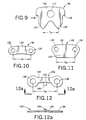
- the double-toed link 96 ( Figure 9 ) includes a body portion 106 having a first toe 108 spaced from a second toe 110 by a distance T p (toe pitch).
- a central aperture 112 extends through the body portion 106.
- the toes 108, 110 engage mutually conforming tooth spaces 114, 116 ( Figure 7 ) of the sprockets 84, 86, respectively.
- the sprockets 84, 86 each have a sprocket chordal pitch S p which is substantially equal to the toe pitch T p .
- the link 96 also includes a ledge or shoulder portion 118 on each side thereof.
- the tension links 98 ( Figure 10 ) primarily carry the load on the chain 88.
- Each tension link 98 includes a body portion 120 having a first aperture 122 proximate one end thereof and a second aperture 124 proximate the other end.
- each tension link 98 carries two double-toed links 96 via two pins 104 each extending through a respective aperture 122, 124.
- the guide links 100 ( Figure 11 ) primarily constrain lateral movement of the chain 88 relative to the sprockets 84, 86. In the embodiment being described, the guide links 100 are not pivotal relative to the pins 104. Each guide link 100 includes a body portion 126 having a first aperture 128 proximate one end thereof and a second aperture 130 proximate the other end. As with the tension links 98, the centers of the apertures 128, 130 are separated by the distance C p .
- the guide links 100 also include an extended lower portion 132 which is constrained within a groove (not shown) on an external peripheral surface of the sprockets 84, 86 when the link 100 enters the respective sprocket wraps.
- the guide links 100 can also carry the chain load.
- each spring link 102 provides means for preventing adjacent double-toed links 96 from contacting each other in the slack strand 90 or taut strand 92.
- each spring link 102 includes a body portion 134 having a first aperture 136 proximate one end thereof and a second aperture 138 proximate the other end. As with the other links 98, 100, the centers of the apertures 136, 138 are separated by the distance C p .
- the spring links 102 also include a cantilevered arm portion 140 extending transversely from a central portion of the body 134. A blade spring 142 or other biasing means is secured to a free end of the arm 140.
- the blade springs 142 are interposed between adjacent double-toed links 96 such that the blade springs 142 are in tension by continuously contacting mutually opposing side walls of adjacent links 96.
- the double-toed links 96 are freely articulatable about the respective pins 94. Accordingly, the blade springs 142 urge the adjacent links 96 apart to prevent the links 96 from impacting, and thus generating undesirable noise.
- the tension links 98 and guide links 100 have substantially the same chain pitch C p as the prior art links 10.
- the chain 88 maintains substantially the same high-strength and load capacity characteristics as a known inverted tooth chain incorporating the links 10.
- the chain 88 also permits the sprocket chordal pitch S p to be reduced to substantially one-half of the chain pitch.
- the overall noise levels associated with the chain 88 are reduced by increasing the frequency at which the chain meshes with the sprockets to a level which is inaudible, or at least less audible to the human ear.
- a timing, drive, etc. chain system 150 incorporates the features of the present invention therein.
- the chain system 150 rotates in a counter-clockwise direction as shown by arrow 152, and includes a drive sprocket 154, a driven sprocket 156, and a short pitch tooth chain 158.
- the short pitch tooth chain 158 engages and wraps about sprockets 154 and 156 and has two spans extending between the sprockets, slack strand 160 and taut strand 162.
- the taut strand 162 is under tension as shown by arrows 164.
- the short pitch tooth chain 158 includes a number of double-toed links 166, tension links 168, guide links 170, and pins 172.
- the double-toed links 166 and tension links 168 are each pivotal about the pins 172.
- the guide links 170 are not pivotal relative to the pins 172.
- the double-toed links 166, tension links 168, and guide links 170 may be interconnected in various lacing patterns to produce chains having different strength and load capacity characteristics.
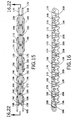
- An exemplary lacing pattern is shown in Figures 15 and 16 .
- the dimensions (e.g. length, width, height, etc.) and material considerations of the various links and pins can be varied to produce chains having different strength and load capacity characteristics in a known manner.
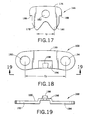
- the double-toed link 166 ( Figure 17 ) includes a body portion 176 having a first toe 178 spaced from a second toe 180 by a distance T p (toe pitch).
- a central aperture 182 extends through the body portion 176.
- the toes 178, 180 engage mutually conforming tooth spaces 184, 186 ( Figure 14 ) of the sprockets 154, 156, respectively.
- the sprockets 154, 156 each have a sprocket chordal pitch S p which is substantially equal to the toe pitch T p .
- the link 166 also includes a ledge or shoulder portion 188 on each side thereof.
- the tension links 168 ( Figures 18 and 19 ) primarily carry the load on the chain 158.
- Each tension link 168 includes a body portion 190 having a first aperture 192 proximate one end thereof and a second aperture 194 proximate the other end.
- each tension link 168 carries two double-toed links 166 via two pins 172 each extending through a respective aperture 192, 194 and link 166.
- the tension link 168 further includes a raised pad 196 for supporting a wedge portion 198.
- the wedge portion 198 forms a trapezoid in a plan view.
- the pad portion 196 extends between two adjacent guide links 170, and the wedge portion 198 extends between two adjacent double-toed links 166.
- the thickness 196a of the raised pad 196 is substantially equal to the thickness of the guide links 170 to permit the wedge portion 198 to extend at least partially between adjacent double-toed links 166.
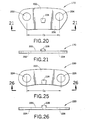
- the guide links 170 ( Figures 20 and 21 ) primarily constrain lateral movement of the chain 158 relative to the sprockets 154, 156.
- Each guide link 170 includes a body portion 200 having a first aperture 202 proximate one end thereof and a second aperture 204 proximate the other end. As with the tension links 168, the centers of the apertures 202, 204 are separated by the distance C p .
- the guide links 170 also include an extended lower portion 206 which is constrained within a groove (not shown) on an external peripheral surface of the sprockets 154, 156 when the link 170 enters the respective sprocket wraps.
- the guide links 170 can also carry a portion of the loading on the chain 158.
- the guide link 170 further includes a raised wedge portion 208.
- the wedge portion 208 forms a trapezoid in a plan view. As best seen in Figure 15 , the wedge portion 208 extends at least partially between two adjacent double-toed links 166.
- the wedge portions 198, 208 provide means for preventing adjacent double-toed links 96 from inadvertently contacting each other in the slack strand 160 or taut strand 162.
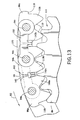
- the raised wedge portion 208b of guide link 170b extends between adjacent double-toed links 166c, 166d.
- the mutually opposing shoulder portions 188 of the links 166c, 166d abut the wedge portion 208b and thus prevent the adjacent double-toed links from articulating about the pins 172 while in the strands 160, 162.
- the wedge portion 198a of the tension link 168a extends between adjacent double-toed links 166b, 166c.
- the mutually opposing shoulder portions 188 of the links 166b, 166c abut the raised wedge portion 198a and thus prevent the double-toed links from articulating about the pins 172 while in the strands 160, 162.
- the trapezoidal shape of the raised wedge portions 198, 208 permit adjacent double-toed links 166 to pivot toward each other in the sprocket wrap.
- the side walls of the wedge portion 208a converge in a radially inward direction (relative to the sprocket center) to permit the toes 180a, 178b to consecutively pivot toward each other as the links enter the sprocket wrap.
- the links 166 will exit the wrap back into the slack strand 160.
- the links 166 will rotate about the respective pins 172 until the shoulder portions 188 abut the wedge portions 198, 208 to prevent the links 166 from impacting, and thus generating undesirable noise.
- the frequency of impacts between the toes 178, 180 and the tooth spaces 184, 186 is increased, while maintaining high strength and load capacity characteristics of the conventional chain 11. That is, the tension links 168 and guide links 170 have substantially the same chain pitch C p as the prior art links 10.
- the overall noise levels associated with the chain 158 are reduced by increasing the frequency at which the chain meshes with the sprockets to a level which is inaudible, or at least less audible to the human ear.
- the double-toed links 166, tension links 168, and guide links 170 may be interconnected in various lacing patterns to produce chains having different strength and load capacity characteristics.
- Figures 22 and 23 illustrate an exemplary lacing pattern having greater strength and load capacity characteristics than the lacing pattern of Figures 15 and 16 .
- two different tension link configurations must be utilized.
- a second tension link 220 includes a body portion 222 having a first aperture 224 proximate one end thereof and a second aperture 226 proximate the other end.
- each tension link 220 carries two double-toed links 166 via two pins 172 each extending through a respective aperture 224, 226.
- the second tension link 220 further includes a raised wedge portion 228 that forms a trapezoid in a plan view.
- the wedge portion 228 extends at least partially between two adjacent double-toed links 166 to prevent the double-toed links from articulating about the pins 172 while in the spans 160, 162 in the same manner as the first tension links 168 and guide links 170.
- the raised wedge portion 208 of the guide links 170 cooperate with the raised wedge portions 228 of the second tension links 220 to prevent adjacent double-toed links 166 from contacting each other.
- the wedge portions 198, 208, 228 of the tension links 168, 220, and guide links 170 (and the pads 196 of the links 168) can be formed by molding, stamping, pressing, cutting, etc. the links in any known manner.
Landscapes
- Engineering & Computer Science (AREA)
- General Engineering & Computer Science (AREA)
- Mechanical Engineering (AREA)
- Devices For Conveying Motion By Means Of Endless Flexible Members (AREA)
- Chairs For Special Purposes, Such As Reclining Chairs (AREA)
- Gears, Cams (AREA)
Applications Claiming Priority (3)
| Application Number | Priority Date | Filing Date | Title |
|---|---|---|---|
| US7425298P | 1998-02-10 | 1998-02-10 | |
| US74252P | 1998-02-10 | ||
| PCT/US1999/002827 WO1999040342A1 (en) | 1998-02-10 | 1999-02-10 | Short pitch tooth chain |
Publications (3)
| Publication Number | Publication Date |
|---|---|
| EP1053412A1 EP1053412A1 (en) | 2000-11-22 |
| EP1053412A4 EP1053412A4 (en) | 2005-07-13 |
| EP1053412B1 true EP1053412B1 (en) | 2013-10-30 |
Family
ID=22118579
Family Applications (1)
| Application Number | Title | Priority Date | Filing Date |
|---|---|---|---|
| EP99905913.2A Expired - Lifetime EP1053412B1 (en) | 1998-02-10 | 1999-02-10 | Short pitch tooth chain |
Country Status (6)
| Country | Link |
|---|---|
| US (3) | US6186920B1 (enExample) |
| EP (1) | EP1053412B1 (enExample) |
| JP (1) | JP2002502944A (enExample) |
| BR (1) | BR9907799A (enExample) |
| CA (1) | CA2312567C (enExample) |
| WO (1) | WO1999040342A1 (enExample) |
Families Citing this family (24)
| Publication number | Priority date | Publication date | Assignee | Title |
|---|---|---|---|---|
| US6186920B1 (en) * | 1998-02-10 | 2001-02-13 | Cloyes Gear And Products, Inc. | Short pitch tooth chain |
| US20020049107A1 (en) * | 2000-07-20 | 2002-04-25 | Ledvina Timothy J. | Small pitch silent chain with freely rotating pins having wear resistant coating |
| JP2002130385A (ja) * | 2000-10-26 | 2002-05-09 | Tsubakimoto Chain Co | 耐摩耗伸びサイレントチェーン |
| US6443795B1 (en) * | 2001-09-11 | 2002-09-03 | Wen-Pin Lin | Transmission chain for toys |
| DE102004007100B4 (de) * | 2003-02-20 | 2017-02-16 | Schaeffler Technologies AG & Co. KG | Laschen für eine Mehrzahl unterschiedlicher Laschenketten für Kegelscheibenumschlingungsgetriebe sowie Laschenkette |
| EP1802893A1 (en) * | 2004-09-24 | 2007-07-04 | Cloyes Gear and Products, Inc. | Inverted tooth chain system with inside flank engagement |
| US7686722B2 (en) * | 2005-10-01 | 2010-03-30 | Luk Lamellen Und Kupplungsbau Beteiligungs Kg | Plate-link chain for a continuously variable transmission |
| DE202006002416U1 (de) | 2006-02-15 | 2007-06-28 | JOH. WINKLHOFER & SÖHNE GMBH & Co. KG | Zahnkette mit optimiertem Kettengelenk und vergrößtertem Außenflankenwinkel |
| US20070205085A1 (en) * | 2006-03-02 | 2007-09-06 | Esco Corporation | Chain For Conveying Logs Or The Like |
| US8529389B2 (en) * | 2008-09-09 | 2013-09-10 | Cloyes Gear And Products, Inc. | Inverted tooth chain and sprocket drive system with reduced meshing impact |
| CN102144111B (zh) | 2008-09-09 | 2014-07-02 | 克劳伊斯传动装置产品有限公司 | 降低啮合冲击的逆齿链以及链轮驱动系统 |
| US9377082B2 (en) | 2008-09-09 | 2016-06-28 | Cloyes Gear And Products, Inc. | Inverted tooth chain and sprocket drive system with reduced meshing impact |
| US8672786B2 (en) * | 2008-09-09 | 2014-03-18 | Cloyes Gear And Products, Inc. | Inverted tooth chain and sprocket drive system with reduced meshing impact |
| DE102009009369A1 (de) * | 2009-02-18 | 2010-08-19 | Schaeffler Technologies Gmbh & Co. Kg | Zahnkette |
| DE102009009526A1 (de) * | 2009-02-18 | 2010-08-19 | Schaeffler Technologies Gmbh & Co. Kg | Zahnkette |
| JP5522965B2 (ja) * | 2009-04-03 | 2014-06-18 | ボーグワーナー インコーポレーテッド | チェーン |
| JP5334710B2 (ja) * | 2009-06-30 | 2013-11-06 | ボーグワーナー インコーポレーテッド | チェーン |
| DE102011111943A1 (de) * | 2011-08-30 | 2013-02-28 | Robert Bosch Gmbh | Transportzahnkette zum Transportieren von erwärmten Transportgütern |
| JP5766140B2 (ja) * | 2012-03-13 | 2015-08-19 | 株式会社椿本チエイン | チェーン伝動装置 |
| EP3033544B1 (en) * | 2013-08-14 | 2019-02-20 | Borgwarner Inc. | Chain with alternating inside link position to enable narrow lacing with improved nvh behavior |
| US10767729B2 (en) * | 2015-09-16 | 2020-09-08 | GM Global Technology Operations LLC | Chain composed of different pitch links with repeated sequence |
| KR101937780B1 (ko) * | 2016-12-29 | 2019-01-15 | 유신정밀공업 주식회사 | 사일런트 체인 |
| US10351186B1 (en) * | 2017-12-30 | 2019-07-16 | Caterpillar Inc. | Undercarriage support for a track chain |
| USD998059S1 (en) * | 2021-07-14 | 2023-09-05 | Jinfeng Cai | Marble run toy |
Family Cites Families (25)
| Publication number | Priority date | Publication date | Assignee | Title |
|---|---|---|---|---|
| US515004A (en) | 1894-02-20 | Gsbmgjsjsje | ||
| US587387A (en) | 1897-08-03 | Drive-chain | ||
| US1028893A (en) | 1910-09-21 | 1912-06-11 | Francis E Knowles | Drive-chain. |
| US2158622A (en) | 1937-04-06 | 1939-05-16 | Bruno V Festenberg-Pakisch | Driving chain |
| US2655816A (en) * | 1949-05-21 | 1953-10-20 | Morse Chain Co | Spring bushed chain |
| US2769346A (en) | 1952-11-17 | 1956-11-06 | Flocke Alexander | Drive chain |
| US4342560A (en) | 1980-05-16 | 1982-08-03 | Borg-Warner Corporation | Composite chain link assembly |
| US4509937A (en) | 1981-12-18 | 1985-04-09 | Borg-Warner Corporation | Power transmission chain |
| JPH06682Y2 (ja) | 1988-06-15 | 1994-01-05 | 大同工業株式会社 | チェーン |
| US4906224A (en) | 1989-02-22 | 1990-03-06 | Magna International, Inc. | Inverted tooth chain |
| US4915675B1 (en) | 1989-02-28 | 1998-12-29 | Borg Warner Automotive | Pitch equalized chain with frequency modulated engagement |
| US5154674A (en) | 1990-04-25 | 1992-10-13 | Borg-Warner Automotive Transmission & Engine Components Corporation | Power transmission chain constructed with asymmetrical links |
| US5334111A (en) | 1991-10-17 | 1994-08-02 | Borg-Warner Automotive, Inc. | Single pin rocker joint CVT chain |
| US5397280A (en) | 1993-10-04 | 1995-03-14 | Borg-Warner Automotive, Inc. | System phasing of overhead cam engine timing chains |
| US5453059A (en) | 1992-05-19 | 1995-09-26 | Borg-Warner Automotive, Inc. | Variable pitch silent chain |
| US5427580A (en) * | 1992-05-19 | 1995-06-27 | Borg-Warner Automotive, Inc. | Phased chain assemblies |
| US5322483A (en) * | 1993-06-28 | 1994-06-21 | Yaban Chain Ind'l Co., Ltd. | Renovated bicycle chain |
| US5345753A (en) | 1993-07-28 | 1994-09-13 | Borg-Warner Automotive, K.K. | Silent chain |
| JP2540948Y2 (ja) * | 1993-08-31 | 1997-07-09 | 株式会社椿本チエイン | コンベヤチェーンのシール装置 |
| US5445570A (en) * | 1994-02-15 | 1995-08-29 | Borg-Warner Automotive, Inc. | Chain guide link |
| US5588926A (en) * | 1995-04-20 | 1996-12-31 | Borg-Warner Automotive, Inc. | Self-guided chain assemblies |
| US5813934A (en) | 1995-11-09 | 1998-09-29 | Borg-Warner Automotive, Inc. | Phased chain assembly with chain and sprocket of unmatched pitch |
| US5800301A (en) * | 1997-05-09 | 1998-09-01 | Borg-Warner Automotive, Inc. | Chain assembly using formed bushings with inverted teeth |
| US6186920B1 (en) * | 1998-02-10 | 2001-02-13 | Cloyes Gear And Products, Inc. | Short pitch tooth chain |
| US6203460B1 (en) * | 1998-10-14 | 2001-03-20 | Borgwarner Inc. | Phased continuously variable transmission chain with asymmetrical guide link and modified strut location |
-
1999
- 1999-02-09 US US09/247,211 patent/US6186920B1/en not_active Expired - Lifetime
- 1999-02-10 CA CA002312567A patent/CA2312567C/en not_active Expired - Fee Related
- 1999-02-10 BR BR9907799-0A patent/BR9907799A/pt not_active IP Right Cessation
- 1999-02-10 JP JP2000530720A patent/JP2002502944A/ja active Pending
- 1999-02-10 WO PCT/US1999/002827 patent/WO1999040342A1/en not_active Ceased
- 1999-02-10 EP EP99905913.2A patent/EP1053412B1/en not_active Expired - Lifetime
-
2000
- 2000-12-21 US US09/742,655 patent/US6287229B2/en not_active Expired - Lifetime
-
2001
- 2001-09-07 US US09/949,180 patent/US6623392B2/en not_active Expired - Fee Related
Also Published As
| Publication number | Publication date |
|---|---|
| EP1053412A4 (en) | 2005-07-13 |
| CA2312567A1 (en) | 1999-08-12 |
| US6287229B2 (en) | 2001-09-11 |
| EP1053412A1 (en) | 2000-11-22 |
| JP2002502944A (ja) | 2002-01-29 |
| US20020006843A1 (en) | 2002-01-17 |
| WO1999040342A1 (en) | 1999-08-12 |
| BR9907799A (pt) | 2001-09-04 |
| US6186920B1 (en) | 2001-02-13 |
| US20010000781A1 (en) | 2001-05-03 |
| US6623392B2 (en) | 2003-09-23 |
| CA2312567C (en) | 2007-09-18 |
Similar Documents
| Publication | Publication Date | Title |
|---|---|---|
| US6287229B2 (en) | Short pitch tooth chain | |
| EP0384076B1 (en) | Improved inverted tooth chain | |
| EP0385681B1 (en) | Power transmission chain | |
| JP2622259B2 (ja) | 動力伝達チェーン | |
| US5989141A (en) | Silent chain | |
| US5267910A (en) | Silent chain having improved noise reduction | |
| US7972234B2 (en) | Silent chain | |
| EP0127270B1 (en) | Power transmission chain-belt | |
| US7993229B2 (en) | Power transmission chain and power transmission assembly using the same | |
| EP0463711A1 (en) | Low-noise chain and chain power transmission apparatus using the low-noise chain | |
| JPS60231045A (ja) | 無段階調整可能な円錐車伝動装置のためのプレートリンクチエン | |
| US5507697A (en) | Minimal pin projection roller chain | |
| GB2361514A (en) | Silent chain power transmission apparatus | |
| WO2025161143A1 (zh) | 一种用于电动汽车的高速静音链传动系统 | |
| JPH11218198A (ja) | サイレントチェーン伝動装置 | |
| US5645503A (en) | Power transmission chain having a spring link | |
| CA2062532C (en) | Chain belt | |
| US7329198B2 (en) | Silent chain | |
| JPS5853226B2 (ja) | マルチストランド駆動ロ−ラ−チエ−ン | |
| EP0092900A2 (en) | Improved transmission chain | |
| US4822323A (en) | Endless transmission belt | |
| JPH0535771B2 (enExample) | ||
| JP4277556B2 (ja) | 端部可撓性ピンによるチェーンベルト | |
| MXPA00006345A (en) | Short pitch tooth chain | |
| EP1544503B1 (en) | A chain |
Legal Events
| Date | Code | Title | Description |
|---|---|---|---|
| PUAI | Public reference made under article 153(3) epc to a published international application that has entered the european phase |
Free format text: ORIGINAL CODE: 0009012 |
|
| 17P | Request for examination filed |
Effective date: 20000614 |
|
| AK | Designated contracting states |
Kind code of ref document: A1 Designated state(s): DE FR GB |
|
| RIN1 | Information on inventor provided before grant (corrected) |
Inventor name: REBER, REINHOLD, F. |
|
| RAP1 | Party data changed (applicant data changed or rights of an application transferred) |
Owner name: THE MESH COMPANY LLC |
|
| A4 | Supplementary search report drawn up and despatched |
Effective date: 20050527 |
|
| GRAP | Despatch of communication of intention to grant a patent |
Free format text: ORIGINAL CODE: EPIDOSNIGR1 |
|
| INTG | Intention to grant announced |
Effective date: 20130607 |
|
| GRAS | Grant fee paid |
Free format text: ORIGINAL CODE: EPIDOSNIGR3 |
|
| GRAA | (expected) grant |
Free format text: ORIGINAL CODE: 0009210 |
|
| AK | Designated contracting states |
Kind code of ref document: B1 Designated state(s): DE FR GB |
|
| REG | Reference to a national code |
Ref country code: GB Ref legal event code: FG4D |
|
| REG | Reference to a national code |
Ref country code: DE Ref legal event code: R096 Ref document number: 69944917 Country of ref document: DE Effective date: 20131224 |
|
| PGFP | Annual fee paid to national office [announced via postgrant information from national office to epo] |
Ref country code: DE Payment date: 20140228 Year of fee payment: 16 |
|
| REG | Reference to a national code |
Ref country code: DE Ref legal event code: R097 Ref document number: 69944917 Country of ref document: DE |
|
| PLBE | No opposition filed within time limit |
Free format text: ORIGINAL CODE: 0009261 |
|
| STAA | Information on the status of an ep patent application or granted ep patent |
Free format text: STATUS: NO OPPOSITION FILED WITHIN TIME LIMIT |
|
| 26N | No opposition filed |
Effective date: 20140731 |
|
| REG | Reference to a national code |
Ref country code: DE Ref legal event code: R097 Ref document number: 69944917 Country of ref document: DE Effective date: 20140731 |
|
| REG | Reference to a national code |
Ref country code: FR Ref legal event code: PLFP Year of fee payment: 17 |
|
| PGFP | Annual fee paid to national office [announced via postgrant information from national office to epo] |
Ref country code: FR Payment date: 20150126 Year of fee payment: 17 Ref country code: GB Payment date: 20150126 Year of fee payment: 17 |
|
| REG | Reference to a national code |
Ref country code: DE Ref legal event code: R119 Ref document number: 69944917 Country of ref document: DE |
|
| PG25 | Lapsed in a contracting state [announced via postgrant information from national office to epo] |
Ref country code: DE Free format text: LAPSE BECAUSE OF NON-PAYMENT OF DUE FEES Effective date: 20150901 |
|
| GBPC | Gb: european patent ceased through non-payment of renewal fee |
Effective date: 20160210 |
|
| REG | Reference to a national code |
Ref country code: FR Ref legal event code: ST Effective date: 20161028 |
|
| PG25 | Lapsed in a contracting state [announced via postgrant information from national office to epo] |
Ref country code: GB Free format text: LAPSE BECAUSE OF NON-PAYMENT OF DUE FEES Effective date: 20160210 Ref country code: FR Free format text: LAPSE BECAUSE OF NON-PAYMENT OF DUE FEES Effective date: 20160229 |