EP1050536A2 - 2-(Benz-)Imidazol-, 2-(Benz-)Oxazol- und 2-(Benz-)Thiazol-substituierte Silane - Google Patents
2-(Benz-)Imidazol-, 2-(Benz-)Oxazol- und 2-(Benz-)Thiazol-substituierte Silane Download PDFInfo
- Publication number
- EP1050536A2 EP1050536A2 EP00109019A EP00109019A EP1050536A2 EP 1050536 A2 EP1050536 A2 EP 1050536A2 EP 00109019 A EP00109019 A EP 00109019A EP 00109019 A EP00109019 A EP 00109019A EP 1050536 A2 EP1050536 A2 EP 1050536A2
- Authority
- EP
- European Patent Office
- Prior art keywords
- atom
- benz
- oder
- halogen
- tert
- Prior art date
- Legal status (The legal status is an assumption and is not a legal conclusion. Google has not performed a legal analysis and makes no representation as to the accuracy of the status listed.)
- Withdrawn
Links
Classifications
-
- C—CHEMISTRY; METALLURGY
- C07—ORGANIC CHEMISTRY
- C07F—ACYCLIC, CARBOCYCLIC OR HETEROCYCLIC COMPOUNDS CONTAINING ELEMENTS OTHER THAN CARBON, HYDROGEN, HALOGEN, OXYGEN, NITROGEN, SULFUR, SELENIUM OR TELLURIUM
- C07F7/00—Compounds containing elements of Groups 4 or 14 of the Periodic Table
- C07F7/02—Silicon compounds
- C07F7/08—Compounds having one or more C—Si linkages
- C07F7/0803—Compounds with Si-C or Si-Si linkages
- C07F7/081—Compounds with Si-C or Si-Si linkages comprising at least one atom selected from the elements N, O, halogen, S, Se or Te
- C07F7/0812—Compounds with Si-C or Si-Si linkages comprising at least one atom selected from the elements N, O, halogen, S, Se or Te comprising a heterocyclic ring
- C07F7/0814—Compounds with Si-C or Si-Si linkages comprising at least one atom selected from the elements N, O, halogen, S, Se or Te comprising a heterocyclic ring said ring is substituted at a C ring atom by Si
Definitions
- the invention relates to 2- (benz) imidazole, 2- (benz) oxazole and 2- (Benz-) thiazole-substituted silanes and a process for their manufacture.
- (benz) imidazole here means both imidazole as well as benzimidazole. The same applies to the names (Benz-) oxazole and (Benz-) thiazole.
- imidazole-substituted silanes contain trimethylsilyl groups [Moore et al., J. Org. Chem. 1982, 47, 1489; Jutzi et al., Chem. Ber. 1973, 106, 2815; Pinkerton et al., J. Heterocyclic Chem. 1972, 9, 67].
- 2- (trimethylsilyl) -1-methylimidazole is accessible via salt elimination reactions between trimethylchlorosilane and 2-lithio-1-methylimidazole [Jutzi et al., Chem. Ber. 1973, 106, 2815].
- the object of the invention is 2- (benz) imidazole, 2- (benz) oxazole and 2- (benz) thiazole substituted silanes one or more tertiary or secondary Hydrocarbon groups in the ⁇ position to the silicon atom, in particular through an economic process to deliver.
- R can assume the meanings of R 1 and can additionally be unbranched in the ⁇ position to the silicon atom.
- R preferably denotes substituted or unsubstituted alkyl radicals having 1 to 20 carbon atoms, such as the methyl, ethyl, propyl, iso-propyl, butyl, iso-butyl, tert-butyl, 1,1-dimethyl -2-methylpropyl, 3,3,3-trifluoropropyl, 3-chloropropyl or a cycloalkyl radical having 5 to 8 carbon atoms, such as the cyclopentyl or cyclohexyl radical or an aryl radical such as the phenyl radical.
- the radical R is preferably a hydrogen atom, the methyl, isopropyl or phenyl radical, particularly preferably the methyl radical.
- R 1 is preferably a secondary or tertiary hydrocarbon radical having at most 20, in particular at most 15 carbon atoms, preferably alkyl, branched in the ⁇ position to the silicon atom.
- tertiary hydrocarbon radicals examples include the tert-butyl, 1,1-dimethylpropyl, 1,1-diethylpropyl, 1,1-dimethyl-2-methylpropyl radical or one containing aryl groups Hydrocarbon radical, such as the 1,1-dimethyl-2-phenylethyl radical, the tert-butyl radical is particularly preferred.
- Examples of preferred secondary hydrocarbon radicals R 1 are the iso-propyl, iso-butyl, iso-pentyl, cyclobutyl, cyclopentyl, cyclohexyl, cycloheptyl and cyclooctyl radicals, with the iso-propyl radical or the iso-butyl radical being preferred , the iso-propyl radical is particularly preferred.
- hydrocarbon radical which is substituted on the nitrogen atom of group E are alkyl radicals having 1 to 20, in particular 1 to 10, carbon atoms, such as the methyl, ethyl, propyl, butyl, isobutyl radical, halogen-substituted alkyl radicals having 1 to 20 carbon atoms, in particular 1 to 10 carbon atoms, such as the 3,3,3-trifluoropropyl, 3-chloropropyl radical or a cycloalkyl radical with 5 to 8 carbon atoms, such as the cyclopentyl or cyclohexyl radical or an aryl radical, such as the phenyl radical.
- the group E is particularly preferably the methyl, ethyl or phenylamino group, particularly preferably the methylamino group.
- 2- (1-methylimidazole) derivatives are also corresponding 2-oxazole, 2-thiazole, 2-benzimidazole, 2-benzoxazole and the 2-benzothiazole derivatives in particular prefers.
- silanes of the general formula (I) can be isolated not only in situ but also as a pure substance. It is noteworthy that due to the gentle preparation, the silanes of the general formula (I), in particular 2- (tert-butyldimethylsilyl) -1-methylimidazole, can be isolated as a pure substance by working up by distillation, without undergoing, for example, thermally induced cycloadditions via the N-methylimidazole ring and so dimerize.
- M is preferably selected from lithium, sodium, potassium, magnesium, aluminum, copper and zinc, with lithium being particularly preferred.
- heterocycle of the general formulas (IV) and (V) it is preferably 2-lithio-1-methylimidazole and 2-lithiooxazole, particularly preferably 2-lithio-1-methylimidazole.
- X stands for a halogen atom, such as the chlorine, bromine or iodine atom, preferably around the chlorine or bromine atom, in particular the chlorine atom.
- the reaction according to the invention is preferred for a Temperature between -30 ° C and 160 ° C, particularly preferred between 0 ° C and 40 ° C.
- the 2- (benz) imidazole, 2- (benz) oxazole and 2- (benz) thiazole substituted Silane of the general formula (I) by distillation as a pure substance from the reaction mixture or after the addition of a suitable solvent as the corresponding one Solution are distilled.
- the implementation can be in an apolar aprotic, polar aprotic, solvent or a combination of such Solvents are made.
- Pure aprotic polar or aprotic nonpolar organic solvents or mixtures thereof can be used in the process according to the invention.
- the solvents can be coordinating or non-coordinating.
- the solvents or their mixtures preferably have a boiling point of at most 250 ° C., in particular at most 200 ° C. at 1013 hPa.
- aprotic suitable organic solvents are hydrocarbons, such as saturated linear hydrocarbons, preferably hexane or heptane; saturated cyclic hydrocarbons, preferably cyclohexane; unsaturated hydrocarbons, preferably aromatic hydrocarbons, such as benzene, toluene, xylene; Ethers, preferably diethyl ether, di-n-butyl ether, tert-butyl methyl ether, dimethoxyethane, cyclic ethers; or other, heteroatom-substituted compounds such as, for example, amines, preferably tributylamine or pyridine.
- hydrocarbons such as saturated linear hydrocarbons, preferably hexane or heptane
- saturated cyclic hydrocarbons preferably cyclohexane
- unsaturated hydrocarbons preferably aromatic hydrocarbons, such as benzene, toluene, xylene
- Ethers preferably die
- solvents are used, the amounts are preferably 0.01-1000, in particular 1-100, weight equivalents based on the total weight of the reactive components of the general formulas (IV) and (V), and (VI). If solvents are used, they are preferably removed after the reaction according to the invention.
- the metallated heterocycle of the general formulas (IV) or (V) is produced by deprotonation with a metal such as lithium or aluminum, a metal hydride such as lithium, sodium, potassium, magnesium, lithium aluminum hydride, copper or zinc hydride, an organometallic reagent, preferably, but not exclusively, lithium, sodium, potassium, aluminum organylene, particularly preferably lithium organylene, or an (inorganic) organic salt, preferably, but not exclusively, lithium or sodium amide, particularly preferably lithium amide, Sodium amide, lithium bis (trimethylsilyl) amide or sodium bis (trimethylsilyl) amide or lithium diisopropylamide (LDA).
- the metalation can also be carried out by alcoholates such as sodium or potassium tert-butoxide or metal-base combinations such as Li / NH 3 / NH 4 Cl or by combinations of the bases listed above.
- silanes produced by the process according to the invention of the general formula (I) are found in particular for synthetic (e.g. area of pharmaceutical synthesis or agrochemistry) and analytical purposes application.
- silanes of the general Formula (I) makes it possible to do both that between the two hetero atoms to protect the located carbon atom of the heterocycle and at the same time in subsequent reactions on the heterocycle steric claim of tertiary or secondary Hydrocarbon groups on the silyl groups to benefit and to achieve certain selectivities.
- reaction residue After removal of the solvent at 25 ° C / 10 mbar, 300 ml of hexane was added to the reaction residue, filtered and again the solvent and the other volatile components removed in vacuum. The reaction residue was used for complete purification subjected to a fractional distillation.
- Example 1 was repeated with the modification that instead of of 90.4 g (0.6 mol) of tert-butyldimethylchlorosilane 164.9 g (0.6 mol) tert-butyldiphenylchlorosilane were used.
- Example 1 was repeated with the modification that instead of of 90.4 g (0.6 mol) of tert-butyldimethylchlorosilane 98.9 g (0.6 mol) 1,1-dimethylpropyldimethylchlorosilane were used.
- Example 1 was repeated with the modification that instead of of 90.4 g (0.6 mol) tert-butyldimethylchlorosilane 173.3 g (0.6 mol) 1,1-dimethylpropyldiphenylchlorosilane were used.
- Example 1 was repeated with the modification that instead of of 90.4 g (0.6 mol) tert-butyldimethylchlorosilane 107.3 g (0.6 mol) 1,1-dimethyl-2-methylpropyldimethylchlorosilane used were.
- Example 1 was repeated with the modification that instead of of 90.4 g (0.6 mol) tert-butyldimethylchlorosilane 64.0 g (0.3 mol) di (tert-butyl) dichlorosilane were used.
- Example 1 was repeated with the modification that instead of of 90.4 g (0.6 mol) of tert-butyldimethylchlorosilane 38.3 g (0.2 mol) tert-butyltrichlorosilane were used.
- Example 1 was repeated with the modification that instead of of 90.4 g (0.6 mol) of tert-butyldimethylchlorosilane 115.7 g (0.6 mol) di- (tert-butyl) methylchlorosilane were used.
- Example 1 was repeated with the modification that instead of of 90.4 g (0.6 mol) tert-butyldimethylchlorosilane 82.0 g (0.6 mol) iso-propyldimethylchlorosilane were used.
- Example 1 was repeated with the modification that instead of of 90.44 g (0.6 mol) tert-butyldimethylchlorosilane 156.5 g (0.6 mol) iso-propyldiphenylchlorosilane were used.
- Example 1 was repeated with the modification that instead of of 90.4 g (0.6 mol) tert-butyldimethylchlorosilane 98.9 g (0.6 mol) di-iso-propylmethylchlorosilane were used.
- Example 1 was repeated with the modification that instead of of 90.4 g (0.6 mol) tert-butyldimethylchlorosilane 115.7 g (0.6 mol) tri-iso-propylchlorosilane were used.
- Example 1 was repeated with the modification that instead of of 90.4 g (0.6 mol) of tert-butyldimethylchlorosilane 55.6 g (0.3 mol) di-iso-propyldichlorosilane were used.
- Example 1 was repeated with the modification that instead of of 90.4 g (0.6 mol) of tert-butyldimethylchlorosilane 35.5 g (0.2 mol) iso-propyltrichlorosilane were used.
- Example 1 was repeated with the modification that instead of of 90.4 g (0.6 mol) of tert-butyldimethylchlorosilane 90.4 g (0.6 mol) iso-butyldimethylchlorosilane were used.
- Example 1 was repeated with the modification that instead of of 90.4 g (0.6 mol) tert-butyldimethylchlorosilane 106.1 g (0.6 mol) cyclohexyldimethylchlorosilane were used.
- Example 1 was repeated with the modification that instead of of 49.3 g (0.6 mol) of 1-methylimidazole 79.3 g (0.6 mol) of 1-methylbenzimidazole were used.
- Example 1 was repeated with the modification that instead of of 49.3 g (0.6 mol) of 1-methylimidazole 41.4 g (0.6 mol) of oxazole were used.
- Example 1 was repeated with the modification that instead of of 49.3 g (0.6 mol) 1-methylimidazole 71.5 g (0.6 mol) Benzoxazole were used.
- Example 1 was repeated with the modification that instead of of 49.3 g (0.6 mol) of 1-methylimidazole 132.7 g (0.6 mol) of thiazole were used.
- Example 1 was repeated with the modification that instead of of 49.3 g (0.6 mol) 1-methylimidazole 81.1 g (0.6 mol) Benzothiazole were used.
- Example 1 was repeated with the modification that instead of of 375 ml (0.6 mol) BuLi / Hexane (1.6 M) 13.8 g (0.6 mol) Lithium amide were used.
- Example 1 was repeated with the modification that 110.0 g (0.6 mol) of sodium bis (trimethylsilyl) amide were used instead of 375 ml (0.6 mol) of BuLi / hexane (1.6 M).
Landscapes
- Chemical & Material Sciences (AREA)
- Organic Chemistry (AREA)
- Developing Agents For Electrophotography (AREA)
- Lubricants (AREA)
Abstract
- A
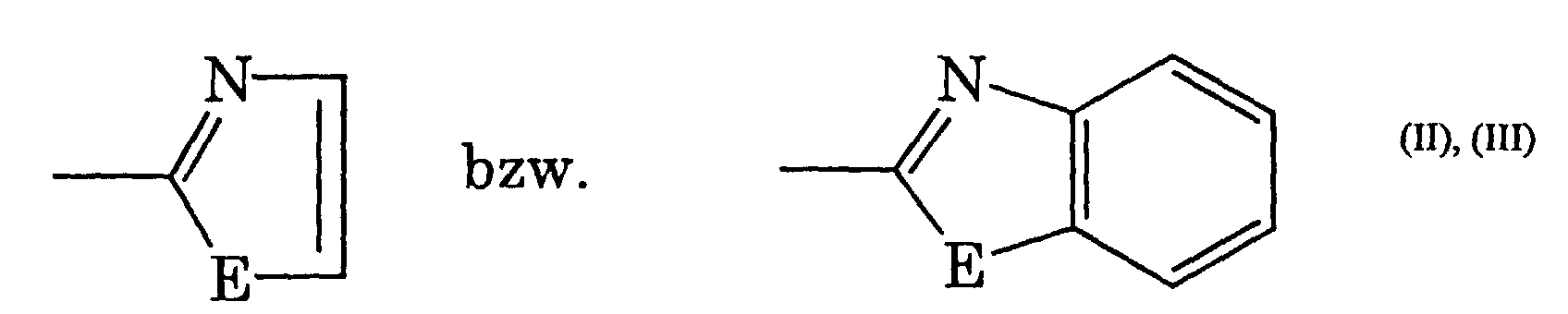
- einen Rest der allgemeinen Formeln (II) bzw. (III),
- R
- ein Wasserstoff-Atom oder einen einwertigen, gegebenenfalls mit Halogen-, Sauerstoff-, Stickstoff-, Schwefel- oder Phosphoratomen substituierten Kohlenwasserstoffrest mit 1 bis 20 Kohlenstoffatomen,
- R1
- einen in α-Position zum Silicium-Atom verzweigten, einwertigen, gegebenenfalls mit Halogen-, Sauerstoff-, Stickstoff-, Schwefel- oder Phosphoratomen substituierten Kohlenwasserstoffrest mit 3 bis 30 Kohlenstoffatomen,
- E
- ein Stickstoff-Atom, welches substituiert ist mit einem einwertigen, gegebenenfalls mit Halogen-, Sauerstoff-, Stickstoff-, Schwefel- oder Phosphoratomen substituierten Kohlenwasserstoffrest mit 1 bis 20 Kohlenstoffatomen, ein Sauerstoff- oder ein Schwefel-Atom,
- u
- die Werte 0, 1, 2 oder 3 und
- a
- die Werte 1, 2 oder 3 und
- y
- die Werte 1, 2 oder 3 bedeuten.
Description
2-(Trimethylsilyl)-1-methylimidazol ist prinzipiell über Salzeliminierungsreaktionen zwischen Trimethylchlorsilan und 2-Lithio-1-methylimidazol zugänglich [Jutzi et al., Chem. Ber. 1973, 106, 2815].
- A
- einen Rest der allgemeinen Formeln (II) bzw. (III),

- R
- ein Wasserstoff-Atom oder einen einwertigen, gegebenenfalls mit Halogen-, Sauerstoff-, Stickstoff-, Schwefel- oder Phosphoratomen substituierten Kohlenwasserstoffrest mit 1 bis 20 Kohlenstoffatomen,
- R1
- einen in α-Position zum Silicium-Atom verzweigten, einwertigen, gegebenenfalls mit Halogen-, Sauerstoff-, Stickstoff-, Schwefel- oder Phosphoratomen substituierten Kohlenwasserstoffrest mit 3 bis 30 Kohlenstoffatomen,
- E
- ein Stickstoff-Atom, welches substituiert ist mit einem einwertigen, gegebenenfalls mit Halogen-, Sauerstoff-, Stickstoff-, Schwefel- oder Phosphoratomen substituierten Kohlenwasserstoffrest mit 1 bis 20 Kohlenstoffatomen, ein Sauerstoff- oder ein Schwefel-Atom,
- u
- die Werte 0, 1, 2 oder 3 und
- a
- die Werte 1, 2 oder 3 und
- y
- die Werte 1, 2 oder 3 bedeuten,
wobei 2-(tert.-Butyldimethylsilyl)-thiazol ausgenommen ist.

- M
- ein Metall der ersten, zweiten oder dritten Hauptgruppe oder einer Nebengruppe des Periodensystems und
- X
- ein Halogenatom bedeuten und
- R, R1, X, E, u, a und y
- die vorstehenden Bedeutungen aufweisen.
Bemerkenswert ist, daß aufgrund der schondenden Herstellung die Silane der allgemeinen Formel (I), insbesondere 2-(tert.-Butyldimethylsilyl)-1-methylimidazol durch destillative Aufarbeitung als Reinsubstanz isolierbar sind, ohne beispielsweise über den N-Methylimidazolring thermisch induzierte Cycloadditionen einzugehen und so zu dimerisieren.
Das Verfahren liefert eine hohe Ausbeute und Reinheit an Silan der allgemeinen Formel (I) bei kurzer Reaktionszeit und benötigt weder einen Katalysator noch eine zusätzliche Aktivierung z.B. durch einen Lösemittelbestandteil.
Beispiele für aprotische geeignete organische Lösemittel sind Kohlenwasserstoffe, wie gesättigte lineare Kohlenwasserstoffe, bevorzugt Hexan oder Heptan; gesättigte cyclische Kohlenwasserstoffe, bevorzugt Cyclohexan; ungesättigte Kohlenwasserstoffe, bevorzugt aromatische Kohlenwasserstoffe, wie z.B. Benzol, Toluol, Xylol; Ether, bevorzugt Diethylether, Di-n-butylether, tert.-Butylmethylether, Dimethoxyethan, cyclische Ether; oder andere, Heteroatom-substituierte Verbindungen wie z.B., Amine, bevorzugt Tributylamin oder Pyridin.
Falls Lösemittel eingesetzt werden, handelt es sich um Mengen von vorzugsweise, 0.01-1000, insbesondere 1-100 Gewichtsäquivalente bezogen auf das Gesamtgewicht der reaktiven Komponenten der allgemeinen Formeln (IV) bzw. (V), und (VI). Bei der Verwendung von Lösemitteln werden diese nach der erfindungsgemäßen Umsetzung vorzugsweise entfernt.
| Beispiel | Ausbeute [g] | Ausbeute [%] | Reinheit [%] |
| 1 | 138.6 | 92 | 99 |
| 2 | 173.1 | 90 | 98 |
| 3 | 108.6 | 86 | 99 |
| 4 | 170.6 | 85 | 98 |
| 5 | 117.2 | 87 | 97 |
| 6 | 159.0 | 87 | 97 |
| 7 | 175.4 | 89 | 98 |
| 8 | 130.8 | 91 | 99 |
| 9 | 98.5 | 90 | 98 |
| 10 | 156.4 | 85 | 97 |
| 11 | 107.4 | 85 | 98 |
| 12 | 123.1 | 86 | 98 |
| 13 | 149.4 | 90 | 98 |
| 14 | 164.2 | 87 | 97 |
| 15 | 103.6 | 88 | 97 |
| 16 | 117.4 | 88 | 99 |
| 17 | 133.1 | 90 | 97 |
| 18 | 94.6 | 86 | 97 |
| 19 | 126.1 | 90 | 98 |
| 20 | 108.8 | 91 | 97 |
| 21 | 127.2 | 85 | 98 |
| 22 | 102.5 | 87 | 98 |
| 23 | 101.3 | 86 | 98 |
Claims (7)
- 2-(Benz-)Imidazol-, 2-(Benz-)Oxazol- und 2-(Benz-)Thiazol-substituierte Silane der allgemeinen Formel (I)
- A
- einen Rest der allgemeinen Formeln (II) bzw. (III),

- R
- ein Wasserstoff-Atom oder einen einwertigen, gegebenenfalls mit Halogen-, Sauerstoff-, Stickstoff-, Schwefel- oder Phosphoratomen substituierten Kohlenwasserstoffrest mit 1 bis 20 Kohlenstoffatomen,
- R1
- einen in α-Position zum Silicium-Atom verzweigten, einwertigen, gegebenenfalls mit Halogen-, Sauerstoff-, Stickstoff-, Schwefel- oder Phosphoratomen substituierten Kohlenwasserstoffrest mit 3 bis 30 Kohlenstoffatomen,
- E
- ein Stickstoff-Atom, welches substituiert ist mit einem einwertigen, gegebenenfalls mit Halogen-, Sauerstoff-, Stickstoff-, Schwefel- oder Phosphoratomen substituierten Kohlenwasserstoffrest mit 1 bis 20 Kohlenstoffatomen, ein Sauerstoff- oder ein Schwefel-Atom,
- u
- die Werte 0, 1, 2 oder 3 und
- a
- die Werte 1, 2 oder 3 und
- y
- die Werte 1, 2 oder 3 bedeuten,
wobei 2-(tert.-Butyldimethylsilyl)-thiazol ausgenommen ist.
- Silane nach Anspruch 1, wobei R ein Wasserstoffatom, eine Methyl-, iso-Propyl- oder Phenyl-Gruppe bedeutet.
- Silane nach Anspruch 1 oder 2, wobei R1 höchstens 20 Kohlenstoffatome aufweist.
- Silane nach Anspruch 1 bis 3, wobei die Gruppe E eine Methyl-, Ethyl- oder Phenylamino-Gruppe ist.
- Verfahren zur Herstellung der Silane der allgemeinen Formel (I) gemäß Anspruch 1 bis 4, bei dem metallierte Heterozyklen der allgemeinen Formeln (IV) bzw. (V),mit Silanen der allgemeinen Formel (VI)

- M
- ein Metall der ersten, zweiten oder dritten Hauptgruppe oder einer Nebengruppe des Periodensystems und
- X
- ein Halogenatom bedeuten und
- R, R1, X, E, u, a und y die
- in den Ansprüchen 1 bis 4 angegebenen Bedeutungen aufweisen.
- Verfahren nach Anspruch 5, wobei M ausgewählt wird aus Lithium, Natrium, Kalium, Magnesium, Aluminium, Kupfer und Zink.
- Verfahren nach Anspruch 5 oder 6, wobei das Lösemittel ausgewählt wird aus Kohlenwasserstoffen und Ethern.
Applications Claiming Priority (2)
| Application Number | Priority Date | Filing Date | Title |
|---|---|---|---|
| DE19920955 | 1999-05-06 | ||
| DE1999120955 DE19920955C2 (de) | 1999-05-06 | 1999-05-06 | 2-(Benz-)Imidazol-,2-(Benz-)Oxazol- und 2-(Benz-)Thiazol-substituierte Silane und Verfahren zu deren Herstellung |
Publications (2)
| Publication Number | Publication Date |
|---|---|
| EP1050536A2 true EP1050536A2 (de) | 2000-11-08 |
| EP1050536A3 EP1050536A3 (de) | 2000-11-15 |
Family
ID=7907236
Family Applications (1)
| Application Number | Title | Priority Date | Filing Date |
|---|---|---|---|
| EP00109019A Withdrawn EP1050536A3 (de) | 1999-05-06 | 2000-04-27 | 2-(Benz-)Imidazol-, 2-(Benz-)Oxazol- und 2-(Benz-)Thiazol-substituierte Silane |
Country Status (3)
| Country | Link |
|---|---|
| EP (1) | EP1050536A3 (de) |
| JP (1) | JP2000336091A (de) |
| DE (1) | DE19920955C2 (de) |
Family Cites Families (2)
| Publication number | Priority date | Publication date | Assignee | Title |
|---|---|---|---|---|
| JP3120857B2 (ja) * | 1990-02-19 | 2000-12-25 | 中外製薬株式会社 | 新規な縮合複素環化合物とこれを用いた抗喘息剤 |
| EP0491218A1 (de) * | 1990-12-17 | 1992-06-24 | F. Hoffmann-La Roche Ag | Benzodiazepinone |
-
1999
- 1999-05-06 DE DE1999120955 patent/DE19920955C2/de not_active Expired - Fee Related
-
2000
- 2000-04-27 EP EP00109019A patent/EP1050536A3/de not_active Withdrawn
- 2000-05-02 JP JP2000133727A patent/JP2000336091A/ja active Pending
Also Published As
| Publication number | Publication date |
|---|---|
| DE19920955A1 (de) | 2000-11-16 |
| EP1050536A3 (de) | 2000-11-15 |
| DE19920955C2 (de) | 2002-11-28 |
| JP2000336091A (ja) | 2000-12-05 |
Similar Documents
| Publication | Publication Date | Title |
|---|---|---|
| DE2642833C3 (de) | Oxysilan-Verbindungen, Verfahren zu ihrer Herstellung und ihre Verwendung | |
| DE4219375C2 (de) | Verfahren zur Herstellung von 1,3-Disilacyclobutanen | |
| US3382279A (en) | Process for the production of siliconcontaining n:n':n"-triorgano-b:b':b"-trihydrido-borazoles | |
| EP1317463B1 (de) | Hochtemperaturstabile siliciumborcarbidnitridkeramiken aus silylalkylborazinen, verfahren zu deren herstellung sowie deren verwendung | |
| EP0560363A1 (de) | Verfahren zur Herstellung von Dimethylchlorsilan | |
| DE19920955C2 (de) | 2-(Benz-)Imidazol-,2-(Benz-)Oxazol- und 2-(Benz-)Thiazol-substituierte Silane und Verfahren zu deren Herstellung | |
| US4412078A (en) | Hydantoinylsilanes | |
| DE102014203770A1 (de) | Verfahren zur Hydrosilylierung unter Zusatz organischer Salze | |
| EP2872522B1 (de) | Oxasilacyclen und verfahren zu deren herstellung | |
| EP0031996B1 (de) | Hydantoinylsilane und Bis(hydantoinyl)disiloxane und Verfahren zur deren Herstellung | |
| EP0031436B1 (de) | Verfahren zur Spaltung von Siloxanen | |
| EP0483479B1 (de) | Alkoxysilylgruppen aufweisende Pyridiniumsalze | |
| EP0295401A2 (de) | Verfahren zur Polymerisation von polaren Verbindungen | |
| DE3726028A1 (de) | Verfahren zur herstellung von niedermolekularen organo-(poly)siloxanen | |
| DE1154477B (de) | Verfahren zur Herstellung von Nitro- oder Nitritogruppen enthaltenden Silanen | |
| DE3728575A1 (de) | Silylaromatische imide und verfahren zu ihrer herstellung | |
| EP0601578A1 (de) | Verfahren zur Entfernung von Wasserstoffhaltigen Silanen aus Silanen | |
| US4623741A (en) | Chlorosilane compounds | |
| DE3634524A1 (de) | Verfahren zur herstellung von alkoxysilanen | |
| DE69202485T2 (de) | Allylfunktionelle Cyclosilalaktame. | |
| DE19962567C1 (de) | Verfahren zur Herstellung von 1.3-Dihalogen-1.1.3.3-tetra(organyl)disiloxanen | |
| US2645644A (en) | Thienyl halosilanes | |
| EP0195996B1 (de) | Stickstoff enthaltende Organosilicium-Verbindungen | |
| DE19848482C1 (de) | Verfahren zur Herstellung von Organosiliciumdisulfanen | |
| DE1165027B (de) | Verfahren zur Herstellung von 1, 2-Siloxaalkanen |
Legal Events
| Date | Code | Title | Description |
|---|---|---|---|
| PUAI | Public reference made under article 153(3) epc to a published international application that has entered the european phase |
Free format text: ORIGINAL CODE: 0009012 |
|
| PUAL | Search report despatched |
Free format text: ORIGINAL CODE: 0009013 |
|
| 17P | Request for examination filed |
Effective date: 20000427 |
|
| AK | Designated contracting states |
Kind code of ref document: A2 Designated state(s): CH DE LI |
|
| AX | Request for extension of the european patent |
Free format text: AL;LT;LV;MK;RO;SI |
|
| AK | Designated contracting states |
Kind code of ref document: A3 Designated state(s): AT BE CH CY DE DK ES FI FR GB GR IE IT LI LU MC NL PT SE |
|
| AX | Request for extension of the european patent |
Free format text: AL;LT;LV;MK;RO;SI |
|
| 17Q | First examination report despatched |
Effective date: 20010409 |
|
| AKX | Designation fees paid |
Free format text: CH DE LI |
|
| STAA | Information on the status of an ep patent application or granted ep patent |
Free format text: STATUS: THE APPLICATION IS DEEMED TO BE WITHDRAWN |
|
| 18D | Application deemed to be withdrawn |
Effective date: 20010821 |