EP1046627A2 - Procédé pour la séparation d'énantiomères et réactif énantiopur - Google Patents
Procédé pour la séparation d'énantiomères et réactif énantiopur Download PDFInfo
- Publication number
- EP1046627A2 EP1046627A2 EP00201285A EP00201285A EP1046627A2 EP 1046627 A2 EP1046627 A2 EP 1046627A2 EP 00201285 A EP00201285 A EP 00201285A EP 00201285 A EP00201285 A EP 00201285A EP 1046627 A2 EP1046627 A2 EP 1046627A2
- Authority
- EP
- European Patent Office
- Prior art keywords
- group
- reagent
- amino acid
- enantiomers
- separation
- Prior art date
- Legal status (The legal status is an assumption and is not a legal conclusion. Google has not performed a legal analysis and makes no representation as to the accuracy of the status listed.)
- Granted
Links
- 239000003153 chemical reaction reagent Substances 0.000 title claims abstract description 88
- 238000000926 separation method Methods 0.000 title claims abstract description 52
- HBAQYPYDRFILMT-UHFFFAOYSA-N 8-[3-(1-cyclopropylpyrazol-4-yl)-1H-pyrazolo[4,3-d]pyrimidin-5-yl]-3-methyl-3,8-diazabicyclo[3.2.1]octan-2-one Chemical class C1(CC1)N1N=CC(=C1)C1=NNC2=C1N=C(N=C2)N1C2C(N(CC1CC2)C)=O HBAQYPYDRFILMT-UHFFFAOYSA-N 0.000 title claims abstract description 50
- 238000000034 method Methods 0.000 title claims abstract description 48
- 150000001413 amino acids Chemical class 0.000 claims abstract description 65
- 239000000203 mixture Substances 0.000 claims abstract description 62
- 125000000524 functional group Chemical group 0.000 claims abstract description 26
- 229940024606 amino acid Drugs 0.000 claims description 69
- 235000001014 amino acid Nutrition 0.000 claims description 69
- -1 (4-nitrophenyloxy) carbonyl group Chemical group 0.000 claims description 37
- 125000001424 substituent group Chemical group 0.000 claims description 29
- 235000004279 alanine Nutrition 0.000 claims description 27
- QNAYBMKLOCPYGJ-REOHCLBHSA-N L-alanine Chemical compound C[C@H](N)C(O)=O QNAYBMKLOCPYGJ-REOHCLBHSA-N 0.000 claims description 26
- 125000003178 carboxy group Chemical group [H]OC(*)=O 0.000 claims description 18
- COLNVLDHVKWLRT-QMMMGPOBSA-N L-phenylalanine Chemical compound OC(=O)[C@@H](N)CC1=CC=CC=C1 COLNVLDHVKWLRT-QMMMGPOBSA-N 0.000 claims description 16
- 230000003213 activating effect Effects 0.000 claims description 15
- 239000002243 precursor Substances 0.000 claims description 14
- 229960005190 phenylalanine Drugs 0.000 claims description 13
- 150000001875 compounds Chemical class 0.000 claims description 12
- KZSNJWFQEVHDMF-BYPYZUCNSA-N L-valine Chemical compound CC(C)[C@H](N)C(O)=O KZSNJWFQEVHDMF-BYPYZUCNSA-N 0.000 claims description 11
- KZSNJWFQEVHDMF-UHFFFAOYSA-N Valine Natural products CC(C)C(N)C(O)=O KZSNJWFQEVHDMF-UHFFFAOYSA-N 0.000 claims description 11
- 125000001997 phenyl group Chemical group [H]C1=C([H])C([H])=C(*)C([H])=C1[H] 0.000 claims description 11
- 239000004474 valine Substances 0.000 claims description 11
- COLNVLDHVKWLRT-UHFFFAOYSA-N phenylalanine Natural products OC(=O)C(N)CC1=CC=CC=C1 COLNVLDHVKWLRT-UHFFFAOYSA-N 0.000 claims description 10
- 239000003495 polar organic solvent Substances 0.000 claims description 10
- AYFVYJQAPQTCCC-UHFFFAOYSA-N Threonine Natural products CC(O)C(N)C(O)=O AYFVYJQAPQTCCC-UHFFFAOYSA-N 0.000 claims description 9
- 125000003277 amino group Chemical group 0.000 claims description 8
- 238000001212 derivatisation Methods 0.000 claims description 8
- IRZQDMYEJPNDEN-NETXQHHPSA-N (2s)-2-amino-3-phenylbutanoic acid Chemical compound OC(=O)[C@@H](N)C(C)C1=CC=CC=C1 IRZQDMYEJPNDEN-NETXQHHPSA-N 0.000 claims description 6
- CSKLNJOBXITXRM-UHFFFAOYSA-N 2-amino-3-(4-hydroxyphenyl)butanoic acid Chemical compound OC(=O)C(N)C(C)C1=CC=C(O)C=C1 CSKLNJOBXITXRM-UHFFFAOYSA-N 0.000 claims description 6
- ULGZDMOVFRHVEP-RWJQBGPGSA-N Erythromycin Chemical compound O([C@@H]1[C@@H](C)C(=O)O[C@@H]([C@@]([C@H](O)[C@@H](C)C(=O)[C@H](C)C[C@@](C)(O)[C@H](O[C@H]2[C@@H]([C@H](C[C@@H](C)O2)N(C)C)O)[C@H]1C)(C)O)CC)[C@H]1C[C@@](C)(OC)[C@@H](O)[C@H](C)O1 ULGZDMOVFRHVEP-RWJQBGPGSA-N 0.000 claims description 6
- 239000002253 acid Substances 0.000 claims description 6
- QWCKQJZIFLGMSD-UHFFFAOYSA-N alpha-aminobutyric acid Chemical compound CCC(N)C(O)=O QWCKQJZIFLGMSD-UHFFFAOYSA-N 0.000 claims description 6
- 238000004587 chromatography analysis Methods 0.000 claims description 6
- 239000012948 isocyanate Substances 0.000 claims description 6
- IQPQWNKOIGAROB-UHFFFAOYSA-N isocyanate group Chemical group [N-]=C=O IQPQWNKOIGAROB-UHFFFAOYSA-N 0.000 claims description 6
- 150000002513 isocyanates Chemical class 0.000 claims description 6
- 238000000746 purification Methods 0.000 claims description 6
- OKTJSMMVPCPJKN-UHFFFAOYSA-N Carbon Chemical compound [C] OKTJSMMVPCPJKN-UHFFFAOYSA-N 0.000 claims description 5
- 229910052799 carbon Inorganic materials 0.000 claims description 5
- 239000004475 Arginine Substances 0.000 claims description 4
- BMYNFMYTOJXKLE-UHFFFAOYSA-N DL-isoserine Natural products NCC(O)C(O)=O BMYNFMYTOJXKLE-UHFFFAOYSA-N 0.000 claims description 4
- ODKSFYDXXFIFQN-BYPYZUCNSA-P L-argininium(2+) Chemical compound NC(=[NH2+])NCCC[C@H]([NH3+])C(O)=O ODKSFYDXXFIFQN-BYPYZUCNSA-P 0.000 claims description 4
- OUYCCCASQSFEME-QMMMGPOBSA-N L-tyrosine Chemical compound OC(=O)[C@@H](N)CC1=CC=C(O)C=C1 OUYCCCASQSFEME-QMMMGPOBSA-N 0.000 claims description 4
- ODKSFYDXXFIFQN-UHFFFAOYSA-N arginine Natural products OC(=O)C(N)CCCNC(N)=N ODKSFYDXXFIFQN-UHFFFAOYSA-N 0.000 claims description 4
- QVGXLLKOCUKJST-UHFFFAOYSA-N atomic oxygen Chemical group [O] QVGXLLKOCUKJST-UHFFFAOYSA-N 0.000 claims description 4
- 125000000753 cycloalkyl group Chemical group 0.000 claims description 4
- 238000004128 high performance liquid chromatography Methods 0.000 claims description 4
- ZBKFYXZXZJPWNQ-UHFFFAOYSA-N isothiocyanate group Chemical group [N-]=C=S ZBKFYXZXZJPWNQ-UHFFFAOYSA-N 0.000 claims description 4
- 239000001301 oxygen Substances 0.000 claims description 4
- 229910052760 oxygen Inorganic materials 0.000 claims description 4
- OUYCCCASQSFEME-UHFFFAOYSA-N tyrosine Natural products OC(=O)C(N)CC1=CC=C(O)C=C1 OUYCCCASQSFEME-UHFFFAOYSA-N 0.000 claims description 4
- 229960004441 tyrosine Drugs 0.000 claims description 4
- 125000003349 3-pyridyl group Chemical group N1=C([H])C([*])=C([H])C([H])=C1[H] 0.000 claims description 3
- 125000001255 4-fluorophenyl group Chemical group [H]C1=C([H])C(*)=C([H])C([H])=C1F 0.000 claims description 3
- WHUUTDBJXJRKMK-UHFFFAOYSA-N Glutamic acid Natural products OC(=O)C(N)CCC(O)=O WHUUTDBJXJRKMK-UHFFFAOYSA-N 0.000 claims description 3
- SNDPXSYFESPGGJ-BYPYZUCNSA-N L-2-aminopentanoic acid Chemical compound CCC[C@H](N)C(O)=O SNDPXSYFESPGGJ-BYPYZUCNSA-N 0.000 claims description 3
- XUJNEKJLAYXESH-REOHCLBHSA-N L-Cysteine Chemical compound SC[C@H](N)C(O)=O XUJNEKJLAYXESH-REOHCLBHSA-N 0.000 claims description 3
- ZGUNAGUHMKGQNY-ZETCQYMHSA-N L-alpha-phenylglycine zwitterion Chemical compound OC(=O)[C@@H](N)C1=CC=CC=C1 ZGUNAGUHMKGQNY-ZETCQYMHSA-N 0.000 claims description 3
- CKLJMWTZIZZHCS-REOHCLBHSA-N L-aspartic acid Chemical compound OC(=O)[C@@H](N)CC(O)=O CKLJMWTZIZZHCS-REOHCLBHSA-N 0.000 claims description 3
- GGLZPLKKBSSKCX-YFKPBYRVSA-N L-ethionine Chemical compound CCSCC[C@H](N)C(O)=O GGLZPLKKBSSKCX-YFKPBYRVSA-N 0.000 claims description 3
- WHUUTDBJXJRKMK-VKHMYHEASA-N L-glutamic acid Chemical compound OC(=O)[C@@H](N)CCC(O)=O WHUUTDBJXJRKMK-VKHMYHEASA-N 0.000 claims description 3
- JTTHKOPSMAVJFE-VIFPVBQESA-N L-homophenylalanine Chemical compound OC(=O)[C@@H](N)CCC1=CC=CC=C1 JTTHKOPSMAVJFE-VIFPVBQESA-N 0.000 claims description 3
- AGPKZVBTJJNPAG-WHFBIAKZSA-N L-isoleucine Chemical compound CC[C@H](C)[C@H](N)C(O)=O AGPKZVBTJJNPAG-WHFBIAKZSA-N 0.000 claims description 3
- ROHFNLRQFUQHCH-YFKPBYRVSA-N L-leucine Chemical compound CC(C)C[C@H](N)C(O)=O ROHFNLRQFUQHCH-YFKPBYRVSA-N 0.000 claims description 3
- FFEARJCKVFRZRR-BYPYZUCNSA-N L-methionine Chemical compound CSCC[C@H](N)C(O)=O FFEARJCKVFRZRR-BYPYZUCNSA-N 0.000 claims description 3
- SNDPXSYFESPGGJ-UHFFFAOYSA-N L-norVal-OH Natural products CCCC(N)C(O)=O SNDPXSYFESPGGJ-UHFFFAOYSA-N 0.000 claims description 3
- LRQKBLKVPFOOQJ-YFKPBYRVSA-N L-norleucine Chemical compound CCCC[C@H]([NH3+])C([O-])=O LRQKBLKVPFOOQJ-YFKPBYRVSA-N 0.000 claims description 3
- AYFVYJQAPQTCCC-GBXIJSLDSA-N L-threonine Chemical compound C[C@@H](O)[C@H](N)C(O)=O AYFVYJQAPQTCCC-GBXIJSLDSA-N 0.000 claims description 3
- QIVBCDIJIAJPQS-VIFPVBQESA-N L-tryptophane Chemical compound C1=CC=C2C(C[C@H](N)C(O)=O)=CNC2=C1 QIVBCDIJIAJPQS-VIFPVBQESA-N 0.000 claims description 3
- ROHFNLRQFUQHCH-UHFFFAOYSA-N Leucine Natural products CC(C)CC(N)C(O)=O ROHFNLRQFUQHCH-UHFFFAOYSA-N 0.000 claims description 3
- 239000004473 Threonine Substances 0.000 claims description 3
- QIVBCDIJIAJPQS-UHFFFAOYSA-N Tryptophan Natural products C1=CC=C2C(CC(N)C(O)=O)=CNC2=C1 QIVBCDIJIAJPQS-UHFFFAOYSA-N 0.000 claims description 3
- 229960005261 aspartic acid Drugs 0.000 claims description 3
- 235000003704 aspartic acid Nutrition 0.000 claims description 3
- OQFSQFPPLPISGP-UHFFFAOYSA-N beta-carboxyaspartic acid Natural products OC(=O)C(N)C(C(O)=O)C(O)=O OQFSQFPPLPISGP-UHFFFAOYSA-N 0.000 claims description 3
- 238000003776 cleavage reaction Methods 0.000 claims description 3
- XUJNEKJLAYXESH-UHFFFAOYSA-N cysteine Natural products SCC(N)C(O)=O XUJNEKJLAYXESH-UHFFFAOYSA-N 0.000 claims description 3
- 229960002433 cysteine Drugs 0.000 claims description 3
- 235000018417 cysteine Nutrition 0.000 claims description 3
- 229960003067 cystine Drugs 0.000 claims description 3
- 235000013922 glutamic acid Nutrition 0.000 claims description 3
- 239000004220 glutamic acid Substances 0.000 claims description 3
- AGPKZVBTJJNPAG-UHFFFAOYSA-N isoleucine Natural products CCC(C)C(N)C(O)=O AGPKZVBTJJNPAG-UHFFFAOYSA-N 0.000 claims description 3
- 229960000310 isoleucine Drugs 0.000 claims description 3
- 229930182817 methionine Natural products 0.000 claims description 3
- 125000003854 p-chlorophenyl group Chemical group [H]C1=C([H])C(*)=C([H])C([H])=C1Cl 0.000 claims description 3
- 125000002924 primary amino group Chemical group [H]N([H])* 0.000 claims description 3
- 108090000765 processed proteins & peptides Proteins 0.000 claims description 3
- 230000007017 scission Effects 0.000 claims description 3
- GMKMEZVLHJARHF-UHFFFAOYSA-N (2R,6R)-form-2.6-Diaminoheptanedioic acid Natural products OC(=O)C(N)CCCC(N)C(O)=O GMKMEZVLHJARHF-UHFFFAOYSA-N 0.000 claims description 2
- MTCFGRXMJLQNBG-REOHCLBHSA-N (2S)-2-Amino-3-hydroxypropansäure Chemical compound OC[C@H](N)C(O)=O MTCFGRXMJLQNBG-REOHCLBHSA-N 0.000 claims description 2
- UKAUYVFTDYCKQA-UHFFFAOYSA-N -2-Amino-4-hydroxybutanoic acid Natural products OC(=O)C(N)CCO UKAUYVFTDYCKQA-UHFFFAOYSA-N 0.000 claims description 2
- LELXPXFAAIPMKW-UHFFFAOYSA-N 1-amino-5-hydroxy-2,3-dihydro-1h-indene-2-carboxylic acid Chemical compound OC1=CC=C2C(N)C(C(O)=O)CC2=C1 LELXPXFAAIPMKW-UHFFFAOYSA-N 0.000 claims description 2
- JUQLUIFNNFIIKC-UHFFFAOYSA-N 2-aminopimelic acid Chemical compound OC(=O)C(N)CCCCC(O)=O JUQLUIFNNFIIKC-UHFFFAOYSA-N 0.000 claims description 2
- CDULPPOISZOUTK-UHFFFAOYSA-N 2-azaniumyl-3,4-dihydro-1h-naphthalene-2-carboxylate Chemical compound C1=CC=C2CC(N)(C(O)=O)CCC2=C1 CDULPPOISZOUTK-UHFFFAOYSA-N 0.000 claims description 2
- 125000004204 2-methoxyphenyl group Chemical group [H]C1=C([H])C(*)=C(OC([H])([H])[H])C([H])=C1[H] 0.000 claims description 2
- DCXYFEDJOCDNAF-UHFFFAOYSA-N Asparagine Natural products OC(=O)C(N)CC(N)=O DCXYFEDJOCDNAF-UHFFFAOYSA-N 0.000 claims description 2
- AHLPHDHHMVZTML-BYPYZUCNSA-N L-Ornithine Chemical compound NCCC[C@H](N)C(O)=O AHLPHDHHMVZTML-BYPYZUCNSA-N 0.000 claims description 2
- DCXYFEDJOCDNAF-REOHCLBHSA-N L-asparagine Chemical compound OC(=O)[C@@H](N)CC(N)=O DCXYFEDJOCDNAF-REOHCLBHSA-N 0.000 claims description 2
- RHGKLRLOHDJJDR-BYPYZUCNSA-N L-citrulline Chemical compound NC(=O)NCCC[C@H]([NH3+])C([O-])=O RHGKLRLOHDJJDR-BYPYZUCNSA-N 0.000 claims description 2
- ZDXPYRJPNDTMRX-VKHMYHEASA-N L-glutamine Chemical compound OC(=O)[C@@H](N)CCC(N)=O ZDXPYRJPNDTMRX-VKHMYHEASA-N 0.000 claims description 2
- UKAUYVFTDYCKQA-VKHMYHEASA-N L-homoserine Chemical compound OC(=O)[C@@H](N)CCO UKAUYVFTDYCKQA-VKHMYHEASA-N 0.000 claims description 2
- RHGKLRLOHDJJDR-UHFFFAOYSA-N Ndelta-carbamoyl-DL-ornithine Natural products OC(=O)C(N)CCCNC(N)=O RHGKLRLOHDJJDR-UHFFFAOYSA-N 0.000 claims description 2
- AHLPHDHHMVZTML-UHFFFAOYSA-N Orn-delta-NH2 Natural products NCCCC(N)C(O)=O AHLPHDHHMVZTML-UHFFFAOYSA-N 0.000 claims description 2
- UTJLXEIPEHZYQJ-UHFFFAOYSA-N Ornithine Natural products OC(=O)C(C)CCCN UTJLXEIPEHZYQJ-UHFFFAOYSA-N 0.000 claims description 2
- MTCFGRXMJLQNBG-UHFFFAOYSA-N Serine Natural products OCC(N)C(O)=O MTCFGRXMJLQNBG-UHFFFAOYSA-N 0.000 claims description 2
- 229960001230 asparagine Drugs 0.000 claims description 2
- 235000009582 asparagine Nutrition 0.000 claims description 2
- 235000013477 citrulline Nutrition 0.000 claims description 2
- 229960002173 citrulline Drugs 0.000 claims description 2
- ZDXPYRJPNDTMRX-UHFFFAOYSA-N glutamine Natural products OC(=O)C(N)CCC(N)=O ZDXPYRJPNDTMRX-UHFFFAOYSA-N 0.000 claims description 2
- GMKMEZVLHJARHF-SYDPRGILSA-N meso-2,6-diaminopimelic acid Chemical compound [O-]C(=O)[C@@H]([NH3+])CCC[C@@H]([NH3+])C([O-])=O GMKMEZVLHJARHF-SYDPRGILSA-N 0.000 claims description 2
- 229960003104 ornithine Drugs 0.000 claims description 2
- 125000004200 2-methoxyethyl group Chemical group [H]C([H])([H])OC([H])([H])C([H])([H])* 0.000 claims 1
- LEVWYRKDKASIDU-QWWZWVQMSA-N D-cystine Chemical compound OC(=O)[C@H](N)CSSC[C@@H](N)C(O)=O LEVWYRKDKASIDU-QWWZWVQMSA-N 0.000 claims 1
- HNDVDQJCIGZPNO-YFKPBYRVSA-N L-histidine Chemical compound OC(=O)[C@@H](N)CC1=CN=CN1 HNDVDQJCIGZPNO-YFKPBYRVSA-N 0.000 claims 1
- KDXKERNSBIXSRK-YFKPBYRVSA-N L-lysine Chemical compound NCCCC[C@H](N)C(O)=O KDXKERNSBIXSRK-YFKPBYRVSA-N 0.000 claims 1
- KDXKERNSBIXSRK-UHFFFAOYSA-N Lysine Natural products NCCCCC(N)C(O)=O KDXKERNSBIXSRK-UHFFFAOYSA-N 0.000 claims 1
- 239000004472 Lysine Substances 0.000 claims 1
- HNDVDQJCIGZPNO-UHFFFAOYSA-N histidine Natural products OC(=O)C(N)CC1=CN=CN1 HNDVDQJCIGZPNO-UHFFFAOYSA-N 0.000 claims 1
- 125000000467 secondary amino group Chemical class [H]N([*:1])[*:2] 0.000 claims 1
- RTZKZFJDLAIYFH-UHFFFAOYSA-N Diethyl ether Chemical compound CCOCC RTZKZFJDLAIYFH-UHFFFAOYSA-N 0.000 description 37
- WEVYAHXRMPXWCK-UHFFFAOYSA-N Acetonitrile Chemical compound CC#N WEVYAHXRMPXWCK-UHFFFAOYSA-N 0.000 description 24
- ZMANZCXQSJIPKH-UHFFFAOYSA-N Triethylamine Chemical compound CCN(CC)CC ZMANZCXQSJIPKH-UHFFFAOYSA-N 0.000 description 18
- 239000000243 solution Substances 0.000 description 16
- RYHBNJHYFVUHQT-UHFFFAOYSA-N 1,4-Dioxane Chemical compound C1COCCO1 RYHBNJHYFVUHQT-UHFFFAOYSA-N 0.000 description 12
- 238000001514 detection method Methods 0.000 description 12
- 125000003118 aryl group Chemical group 0.000 description 10
- XEKOWRVHYACXOJ-UHFFFAOYSA-N Ethyl acetate Chemical compound CCOC(C)=O XEKOWRVHYACXOJ-UHFFFAOYSA-N 0.000 description 9
- 150000002894 organic compounds Chemical class 0.000 description 9
- IJGRMHOSHXDMSA-UHFFFAOYSA-N Atomic nitrogen Chemical compound N#N IJGRMHOSHXDMSA-UHFFFAOYSA-N 0.000 description 8
- XLYOFNOQVPJJNP-UHFFFAOYSA-N water Substances O XLYOFNOQVPJJNP-UHFFFAOYSA-N 0.000 description 8
- 238000006243 chemical reaction Methods 0.000 description 7
- 239000000047 product Substances 0.000 description 7
- 239000007787 solid Substances 0.000 description 7
- 239000002904 solvent Substances 0.000 description 7
- 238000004809 thin layer chromatography Methods 0.000 description 7
- 238000000870 ultraviolet spectroscopy Methods 0.000 description 7
- OKKJLVBELUTLKV-UHFFFAOYSA-N Methanol Chemical compound OC OKKJLVBELUTLKV-UHFFFAOYSA-N 0.000 description 6
- ZMXDDKWLCZADIW-UHFFFAOYSA-N N,N-Dimethylformamide Chemical compound CN(C)C=O ZMXDDKWLCZADIW-UHFFFAOYSA-N 0.000 description 6
- 238000005481 NMR spectroscopy Methods 0.000 description 6
- YXFVVABEGXRONW-UHFFFAOYSA-N Toluene Chemical compound CC1=CC=CC=C1 YXFVVABEGXRONW-UHFFFAOYSA-N 0.000 description 6
- QTBSBXVTEAMEQO-UHFFFAOYSA-N Acetic acid Chemical compound CC(O)=O QTBSBXVTEAMEQO-UHFFFAOYSA-N 0.000 description 5
- 239000003480 eluent Substances 0.000 description 5
- 230000014759 maintenance of location Effects 0.000 description 5
- 239000012074 organic phase Substances 0.000 description 5
- VEXZGXHMUGYJMC-UHFFFAOYSA-N Hydrochloric acid Chemical compound Cl VEXZGXHMUGYJMC-UHFFFAOYSA-N 0.000 description 4
- KFZMGEQAYNKOFK-UHFFFAOYSA-N Isopropanol Chemical compound CC(C)O KFZMGEQAYNKOFK-UHFFFAOYSA-N 0.000 description 4
- UIIMBOGNXHQVGW-UHFFFAOYSA-M Sodium bicarbonate Chemical compound [Na+].OC([O-])=O UIIMBOGNXHQVGW-UHFFFAOYSA-M 0.000 description 4
- 125000005161 aryl oxy carbonyl group Chemical group 0.000 description 4
- 229960004132 diethyl ether Drugs 0.000 description 4
- 229910052757 nitrogen Inorganic materials 0.000 description 4
- 230000003287 optical effect Effects 0.000 description 4
- 239000011541 reaction mixture Substances 0.000 description 4
- 239000000126 substance Substances 0.000 description 4
- RYHBNJHYFVUHQT-NMFSSPJFSA-N 2,2,3,3,5,5-hexadeuterio-1,4-dioxane Chemical compound [2H]C1([2H])COC([2H])([2H])C([2H])([2H])O1 RYHBNJHYFVUHQT-NMFSSPJFSA-N 0.000 description 3
- UHOVQNZJYSORNB-UHFFFAOYSA-N Benzene Chemical compound C1=CC=CC=C1 UHOVQNZJYSORNB-UHFFFAOYSA-N 0.000 description 3
- KXDHJXZQYSOELW-UHFFFAOYSA-M Carbamate Chemical compound NC([O-])=O KXDHJXZQYSOELW-UHFFFAOYSA-M 0.000 description 3
- ONIBWKKTOPOVIA-BYPYZUCNSA-N L-Proline Chemical compound OC(=O)[C@@H]1CCCN1 ONIBWKKTOPOVIA-BYPYZUCNSA-N 0.000 description 3
- ONIBWKKTOPOVIA-UHFFFAOYSA-N Proline Natural products OC(=O)C1CCCN1 ONIBWKKTOPOVIA-UHFFFAOYSA-N 0.000 description 3
- VYPSYNLAJGMNEJ-UHFFFAOYSA-N Silicium dioxide Chemical compound O=[Si]=O VYPSYNLAJGMNEJ-UHFFFAOYSA-N 0.000 description 3
- 238000010521 absorption reaction Methods 0.000 description 3
- 125000000217 alkyl group Chemical group 0.000 description 3
- 150000003863 ammonium salts Chemical class 0.000 description 3
- 125000001797 benzyl group Chemical group [H]C1=C([H])C([H])=C(C([H])=C1[H])C([H])([H])* 0.000 description 3
- 230000015572 biosynthetic process Effects 0.000 description 3
- 239000012043 crude product Substances 0.000 description 3
- 230000000694 effects Effects 0.000 description 3
- 150000002148 esters Chemical class 0.000 description 3
- 230000004927 fusion Effects 0.000 description 3
- 125000001841 imino group Chemical group [H]N=* 0.000 description 3
- 125000001624 naphthyl group Chemical group 0.000 description 3
- 239000003960 organic solvent Substances 0.000 description 3
- 125000006503 p-nitrobenzyl group Chemical group [H]C1=C([H])C(=C([H])C([H])=C1[N+]([O-])=O)C([H])([H])* 0.000 description 3
- 239000003208 petroleum Substances 0.000 description 3
- 239000000741 silica gel Substances 0.000 description 3
- 229910002027 silica gel Inorganic materials 0.000 description 3
- KRHNXNZBLHHEIU-CRCLSJGQSA-N (2r,4s)-4-hydroxypiperidin-1-ium-2-carboxylate Chemical compound O[C@H]1CCN[C@@H](C(O)=O)C1 KRHNXNZBLHHEIU-CRCLSJGQSA-N 0.000 description 2
- LWHHAVWYGIBIEU-LURJTMIESA-N (2s)-2-methylpyrrolidin-1-ium-2-carboxylate Chemical compound [O-]C(=O)[C@]1(C)CCC[NH2+]1 LWHHAVWYGIBIEU-LURJTMIESA-N 0.000 description 2
- NXLNNXIXOYSCMB-UHFFFAOYSA-N (4-nitrophenyl) carbonochloridate Chemical compound [O-][N+](=O)C1=CC=C(OC(Cl)=O)C=C1 NXLNNXIXOYSCMB-UHFFFAOYSA-N 0.000 description 2
- OXFGRWIKQDSSLY-UHFFFAOYSA-N 1,2,3,4-tetrahydroisoquinolin-2-ium-1-carboxylate Chemical compound C1=CC=C2C(C(=O)O)NCCC2=C1 OXFGRWIKQDSSLY-UHFFFAOYSA-N 0.000 description 2
- BWKMGYQJPOAASG-UHFFFAOYSA-N 1,2,3,4-tetrahydroisoquinoline-3-carboxylic acid Chemical compound C1=CC=C2CNC(C(=O)O)CC2=C1 BWKMGYQJPOAASG-UHFFFAOYSA-N 0.000 description 2
- 125000001622 2-naphthyl group Chemical group [H]C1=C([H])C([H])=C2C([H])=C(*)C([H])=C([H])C2=C1[H] 0.000 description 2
- CRAGDYRHPWTZJL-UHFFFAOYSA-N 6-hydroxy-1,2,3,4-tetrahydroisoquinolin-2-ium-3-carboxylate Chemical compound OC1=CC=C2CNC(C(=O)O)CC2=C1 CRAGDYRHPWTZJL-UHFFFAOYSA-N 0.000 description 2
- LFQSCWFLJHTTHZ-UHFFFAOYSA-N Ethanol Chemical compound CCO LFQSCWFLJHTTHZ-UHFFFAOYSA-N 0.000 description 2
- YCKRFDGAMUMZLT-UHFFFAOYSA-N Fluorine atom Chemical compound [F] YCKRFDGAMUMZLT-UHFFFAOYSA-N 0.000 description 2
- LEVWYRKDKASIDU-IMJSIDKUSA-N L-cystine Chemical compound [O-]C(=O)[C@@H]([NH3+])CSSC[C@H]([NH3+])C([O-])=O LEVWYRKDKASIDU-IMJSIDKUSA-N 0.000 description 2
- JGFZNNIVVJXRND-UHFFFAOYSA-N N,N-Diisopropylethylamine (DIPEA) Chemical compound CCN(C(C)C)C(C)C JGFZNNIVVJXRND-UHFFFAOYSA-N 0.000 description 2
- AKCRVYNORCOYQT-YFKPBYRVSA-N N-methyl-L-valine Chemical compound CN[C@@H](C(C)C)C(O)=O AKCRVYNORCOYQT-YFKPBYRVSA-N 0.000 description 2
- JUJWROOIHBZHMG-UHFFFAOYSA-N Pyridine Chemical compound C1=CC=NC=C1 JUJWROOIHBZHMG-UHFFFAOYSA-N 0.000 description 2
- WYURNTSHIVDZCO-UHFFFAOYSA-N Tetrahydrofuran Chemical compound C1CCOC1 WYURNTSHIVDZCO-UHFFFAOYSA-N 0.000 description 2
- DTQVDTLACAAQTR-UHFFFAOYSA-N Trifluoroacetic acid Chemical compound OC(=O)C(F)(F)F DTQVDTLACAAQTR-UHFFFAOYSA-N 0.000 description 2
- XSQUKJJJFZCRTK-UHFFFAOYSA-N Urea Chemical compound NC(N)=O XSQUKJJJFZCRTK-UHFFFAOYSA-N 0.000 description 2
- 229960000583 acetic acid Drugs 0.000 description 2
- 125000001931 aliphatic group Chemical group 0.000 description 2
- GDCXBZMWKSBSJG-UHFFFAOYSA-N azane;4-methylbenzenesulfonic acid Chemical class [NH4+].CC1=CC=C(S([O-])(=O)=O)C=C1 GDCXBZMWKSBSJG-UHFFFAOYSA-N 0.000 description 2
- 235000013877 carbamide Nutrition 0.000 description 2
- PMMYEEVYMWASQN-IMJSIDKUSA-N cis-4-Hydroxy-L-proline Chemical compound O[C@@H]1CN[C@H](C(O)=O)C1 PMMYEEVYMWASQN-IMJSIDKUSA-N 0.000 description 2
- PMMYEEVYMWASQN-UHFFFAOYSA-N dl-hydroxyproline Natural products OC1C[NH2+]C(C([O-])=O)C1 PMMYEEVYMWASQN-UHFFFAOYSA-N 0.000 description 2
- 230000032050 esterification Effects 0.000 description 2
- 238000005886 esterification reaction Methods 0.000 description 2
- 229940052303 ethers for general anesthesia Drugs 0.000 description 2
- 229910052731 fluorine Inorganic materials 0.000 description 2
- 239000011737 fluorine Substances 0.000 description 2
- 229960002989 glutamic acid Drugs 0.000 description 2
- 229910052736 halogen Inorganic materials 0.000 description 2
- 150000002367 halogens Chemical class 0.000 description 2
- 125000002887 hydroxy group Chemical group [H]O* 0.000 description 2
- 230000001939 inductive effect Effects 0.000 description 2
- HXEACLLIILLPRG-RXMQYKEDSA-N l-pipecolic acid Natural products OC(=O)[C@H]1CCCCN1 HXEACLLIILLPRG-RXMQYKEDSA-N 0.000 description 2
- 238000004811 liquid chromatography Methods 0.000 description 2
- 125000002496 methyl group Chemical group [H]C([H])([H])* 0.000 description 2
- GRVDJDISBSALJP-UHFFFAOYSA-N methyloxidanyl Chemical compound [O]C GRVDJDISBSALJP-UHFFFAOYSA-N 0.000 description 2
- JUNOWSHJELIDQP-UHFFFAOYSA-N morpholin-4-ium-3-carboxylate Chemical compound OC(=O)C1COCCN1 JUNOWSHJELIDQP-UHFFFAOYSA-N 0.000 description 2
- 230000007935 neutral effect Effects 0.000 description 2
- 238000000655 nuclear magnetic resonance spectrum Methods 0.000 description 2
- 239000012071 phase Substances 0.000 description 2
- HXEACLLIILLPRG-UHFFFAOYSA-N pipecolic acid Chemical compound OC(=O)C1CCCCN1 HXEACLLIILLPRG-UHFFFAOYSA-N 0.000 description 2
- NROKBHXJSPEDAR-UHFFFAOYSA-M potassium fluoride Chemical compound [F-].[K+] NROKBHXJSPEDAR-UHFFFAOYSA-M 0.000 description 2
- 239000012713 reactive precursor Substances 0.000 description 2
- 238000010992 reflux Methods 0.000 description 2
- 238000004007 reversed phase HPLC Methods 0.000 description 2
- 235000017557 sodium bicarbonate Nutrition 0.000 description 2
- 229910000030 sodium bicarbonate Inorganic materials 0.000 description 2
- 238000003756 stirring Methods 0.000 description 2
- 238000003786 synthesis reaction Methods 0.000 description 2
- 150000003512 tertiary amines Chemical class 0.000 description 2
- CZDYPVPMEAXLPK-UHFFFAOYSA-N tetramethylsilane Chemical compound C[Si](C)(C)C CZDYPVPMEAXLPK-UHFFFAOYSA-N 0.000 description 2
- 125000002813 thiocarbonyl group Chemical group *C(*)=S 0.000 description 2
- 125000003396 thiol group Chemical group [H]S* 0.000 description 2
- JOKIQGQOKXGHDV-UHFFFAOYSA-N thiomorpholine-3-carboxylic acid Chemical compound [O-]C(=O)C1CSCC[NH2+]1 JOKIQGQOKXGHDV-UHFFFAOYSA-N 0.000 description 2
- RKEYKDXXZCICFZ-CRCLSJGQSA-N (2r,5s)-5-hydroxypiperidine-2-carboxylic acid Chemical compound O[C@H]1CC[C@H](C(O)=O)NC1 RKEYKDXXZCICFZ-CRCLSJGQSA-N 0.000 description 1
- KTIAHKGGBSIHNG-AWEZNQCLSA-N (2s)-2-[(4-nitrophenoxy)carbonylamino]-3-phenylpropanoic acid Chemical compound C([C@@H](C(=O)O)NC(=O)OC=1C=CC(=CC=1)[N+]([O-])=O)C1=CC=CC=C1 KTIAHKGGBSIHNG-AWEZNQCLSA-N 0.000 description 1
- SEUPQWHWULSGJC-QMMMGPOBSA-N (2s)-2-azaniumyl-3-(2-methoxyphenyl)propanoate Chemical compound COC1=CC=CC=C1C[C@H](N)C(O)=O SEUPQWHWULSGJC-QMMMGPOBSA-N 0.000 description 1
- VIQRGGYMUJUSLC-UHFFFAOYSA-N (4-nitrophenoxy) carbonochloridate Chemical compound [O-][N+](=O)C1=CC=C(OOC(Cl)=O)C=C1 VIQRGGYMUJUSLC-UHFFFAOYSA-N 0.000 description 1
- 125000001637 1-naphthyl group Chemical group [H]C1=C([H])C([H])=C2C(*)=C([H])C([H])=C([H])C2=C1[H] 0.000 description 1
- XNWFRZJHXBZDAG-UHFFFAOYSA-N 2-METHOXYETHANOL Chemical compound COCCO XNWFRZJHXBZDAG-UHFFFAOYSA-N 0.000 description 1
- NJWGQARXZDRHCD-UHFFFAOYSA-N 2-Methylanthraquinone Natural products C1=CC=C2C(=O)C3=CC(C)=CC=C3C(=O)C2=C1 NJWGQARXZDRHCD-UHFFFAOYSA-N 0.000 description 1
- OFYAYGJCPXRNBL-UHFFFAOYSA-N 2-azaniumyl-3-naphthalen-1-ylpropanoate Chemical compound C1=CC=C2C(CC(N)C(O)=O)=CC=CC2=C1 OFYAYGJCPXRNBL-UHFFFAOYSA-N 0.000 description 1
- HCZLRNBCUGOZSQ-KRWDZBQOSA-N 2-methoxyethyl (2s)-2-[(4-fluorophenoxy)carbothioylamino]-3-phenylpropanoate Chemical compound C([C@@H](C(=O)OCCOC)NC(=S)OC=1C=CC(F)=CC=1)C1=CC=CC=C1 HCZLRNBCUGOZSQ-KRWDZBQOSA-N 0.000 description 1
- VOLRSQPSJGXRNJ-UHFFFAOYSA-N 4-nitrobenzyl bromide Chemical compound [O-][N+](=O)C1=CC=C(CBr)C=C1 VOLRSQPSJGXRNJ-UHFFFAOYSA-N 0.000 description 1
- WKBOTKDWSSQWDR-UHFFFAOYSA-N Bromine atom Chemical class [Br] WKBOTKDWSSQWDR-UHFFFAOYSA-N 0.000 description 1
- ZAMOUSCENKQFHK-UHFFFAOYSA-N Chlorine atom Chemical compound [Cl] ZAMOUSCENKQFHK-UHFFFAOYSA-N 0.000 description 1
- OKKJLVBELUTLKV-MZCSYVLQSA-N Deuterated methanol Chemical compound [2H]OC([2H])([2H])[2H] OKKJLVBELUTLKV-MZCSYVLQSA-N 0.000 description 1
- HXEACLLIILLPRG-YFKPBYRVSA-N L-pipecolic acid Chemical compound [O-]C(=O)[C@@H]1CCCC[NH2+]1 HXEACLLIILLPRG-YFKPBYRVSA-N 0.000 description 1
- KWYHDKDOAIKMQN-UHFFFAOYSA-N N,N,N',N'-tetramethylethylenediamine Chemical compound CN(C)CCN(C)C KWYHDKDOAIKMQN-UHFFFAOYSA-N 0.000 description 1
- FXHOOIRPVKKKFG-UHFFFAOYSA-N N,N-Dimethylacetamide Chemical compound CN(C)C(C)=O FXHOOIRPVKKKFG-UHFFFAOYSA-N 0.000 description 1
- SECXISVLQFMRJM-UHFFFAOYSA-N N-Methylpyrrolidone Chemical compound CN1CCCC1=O SECXISVLQFMRJM-UHFFFAOYSA-N 0.000 description 1
- XOGPDSATLSAZEK-UHFFFAOYSA-N Nc(cc1C(c2ccccc22)=O)ccc1C2=O Chemical compound Nc(cc1C(c2ccccc22)=O)ccc1C2=O XOGPDSATLSAZEK-UHFFFAOYSA-N 0.000 description 1
- 239000002202 Polyethylene glycol Substances 0.000 description 1
- NINIDFKCEFEMDL-UHFFFAOYSA-N Sulfur Chemical compound [S] NINIDFKCEFEMDL-UHFFFAOYSA-N 0.000 description 1
- WLNNBXGXZLPBOU-UHFFFAOYSA-N [O-]C(Cl)=[S+]OC(C=C1)=CC=C1F Chemical compound [O-]C(Cl)=[S+]OC(C=C1)=CC=C1F WLNNBXGXZLPBOU-UHFFFAOYSA-N 0.000 description 1
- LTNBDKFBIUSYIU-UHFFFAOYSA-N [O-][N+](C(C=C1)=CC=C1OOC=O)=O.Cl Chemical compound [O-][N+](C(C=C1)=CC=C1OOC=O)=O.Cl LTNBDKFBIUSYIU-UHFFFAOYSA-N 0.000 description 1
- 239000000654 additive Substances 0.000 description 1
- 150000001298 alcohols Chemical class 0.000 description 1
- 238000004458 analytical method Methods 0.000 description 1
- 150000001450 anions Chemical class 0.000 description 1
- 239000007864 aqueous solution Substances 0.000 description 1
- 150000008378 aryl ethers Chemical class 0.000 description 1
- 125000004429 atom Chemical group 0.000 description 1
- 230000004071 biological effect Effects 0.000 description 1
- 239000004202 carbamide Substances 0.000 description 1
- 125000002915 carbonyl group Chemical group [*:2]C([*:1])=O 0.000 description 1
- 239000007795 chemical reaction product Substances 0.000 description 1
- 239000000460 chlorine Substances 0.000 description 1
- 229910052801 chlorine Inorganic materials 0.000 description 1
- 238000002425 crystallisation Methods 0.000 description 1
- 230000008025 crystallization Effects 0.000 description 1
- 238000004821 distillation Methods 0.000 description 1
- 239000012153 distilled water Substances 0.000 description 1
- 238000001035 drying Methods 0.000 description 1
- 230000005670 electromagnetic radiation Effects 0.000 description 1
- 238000010828 elution Methods 0.000 description 1
- 150000002170 ethers Chemical class 0.000 description 1
- 125000001495 ethyl group Chemical group [H]C([H])([H])C([H])([H])* 0.000 description 1
- 238000001914 filtration Methods 0.000 description 1
- 239000007789 gas Substances 0.000 description 1
- 238000004817 gas chromatography Methods 0.000 description 1
- 239000012362 glacial acetic acid Substances 0.000 description 1
- 125000005226 heteroaryloxycarbonyl group Chemical group 0.000 description 1
- 238000006698 hydrazinolysis reaction Methods 0.000 description 1
- 150000001261 hydroxy acids Chemical class 0.000 description 1
- 238000002347 injection Methods 0.000 description 1
- 239000007924 injection Substances 0.000 description 1
- 125000000959 isobutyl group Chemical group [H]C([H])([H])C([H])(C([H])([H])[H])C([H])([H])* 0.000 description 1
- 125000001449 isopropyl group Chemical group [H]C([H])([H])C([H])(*)C([H])([H])[H] 0.000 description 1
- 125000004108 n-butyl group Chemical group [H]C([H])([H])C([H])([H])C([H])([H])C([H])([H])* 0.000 description 1
- 125000004123 n-propyl group Chemical group [H]C([H])([H])C([H])([H])C([H])([H])* 0.000 description 1
- 238000006386 neutralization reaction Methods 0.000 description 1
- 125000000449 nitro group Chemical group [O-][N+](*)=O 0.000 description 1
- 150000002926 oxygen Chemical class 0.000 description 1
- 150000003014 phosphoric acid esters Chemical class 0.000 description 1
- JSSXHAMIXJGYCS-UHFFFAOYSA-N piperazin-4-ium-2-carboxylate Chemical compound OC(=O)C1CNCCN1 JSSXHAMIXJGYCS-UHFFFAOYSA-N 0.000 description 1
- PRAYXGYYVXRDDW-UHFFFAOYSA-N piperidin-2-ylmethanol Chemical compound OCC1CCCCN1 PRAYXGYYVXRDDW-UHFFFAOYSA-N 0.000 description 1
- DJIWKBNZEOPEAM-UHFFFAOYSA-N piperidine-2-carboxylic acid Chemical compound OC(=O)C1CCCCN1.OC(=O)C1CCCCN1 DJIWKBNZEOPEAM-UHFFFAOYSA-N 0.000 description 1
- 229920001515 polyalkylene glycol Polymers 0.000 description 1
- 229920001223 polyethylene glycol Polymers 0.000 description 1
- 229920001451 polypropylene glycol Polymers 0.000 description 1
- 235000003270 potassium fluoride Nutrition 0.000 description 1
- 239000011698 potassium fluoride Substances 0.000 description 1
- 239000002244 precipitate Substances 0.000 description 1
- 238000002360 preparation method Methods 0.000 description 1
- 150000003141 primary amines Chemical class 0.000 description 1
- 102000004196 processed proteins & peptides Human genes 0.000 description 1
- UMJSCPRVCHMLSP-UHFFFAOYSA-N pyridine Natural products COC1=CC=CN=C1 UMJSCPRVCHMLSP-UHFFFAOYSA-N 0.000 description 1
- 239000000376 reactant Substances 0.000 description 1
- 239000012429 reaction media Substances 0.000 description 1
- 150000003335 secondary amines Chemical class 0.000 description 1
- 238000004611 spectroscopical analysis Methods 0.000 description 1
- 239000003381 stabilizer Substances 0.000 description 1
- 229910052717 sulfur Inorganic materials 0.000 description 1
- 239000011593 sulfur Substances 0.000 description 1
- 150000003467 sulfuric acid derivatives Chemical class 0.000 description 1
- 125000000999 tert-butyl group Chemical group [H]C([H])([H])C(*)(C([H])([H])[H])C([H])([H])[H] 0.000 description 1
- YLQBMQCUIZJEEH-UHFFFAOYSA-N tetrahydrofuran Natural products C=1C=COC=1 YLQBMQCUIZJEEH-UHFFFAOYSA-N 0.000 description 1
- 150000003573 thiols Chemical class 0.000 description 1
- JOXIMZWYDAKGHI-UHFFFAOYSA-N toluene-4-sulfonic acid Chemical compound CC1=CC=C(S(O)(=O)=O)C=C1 JOXIMZWYDAKGHI-UHFFFAOYSA-N 0.000 description 1
- RKEYKDXXZCICFZ-UHFFFAOYSA-N trans-5-OH-L-pipecolic acid Natural products OC1CCC(C(O)=O)NC1 RKEYKDXXZCICFZ-UHFFFAOYSA-N 0.000 description 1
- 150000003672 ureas Chemical class 0.000 description 1
Classifications
-
- C—CHEMISTRY; METALLURGY
- C07—ORGANIC CHEMISTRY
- C07C—ACYCLIC OR CARBOCYCLIC COMPOUNDS
- C07C227/00—Preparation of compounds containing amino and carboxyl groups bound to the same carbon skeleton
- C07C227/30—Preparation of optical isomers
- C07C227/34—Preparation of optical isomers by separation of optical isomers
-
- C—CHEMISTRY; METALLURGY
- C07—ORGANIC CHEMISTRY
- C07B—GENERAL METHODS OF ORGANIC CHEMISTRY; APPARATUS THEREFOR
- C07B57/00—Separation of optically-active compounds
-
- C—CHEMISTRY; METALLURGY
- C07—ORGANIC CHEMISTRY
- C07C—ACYCLIC OR CARBOCYCLIC COMPOUNDS
- C07C271/00—Derivatives of carbamic acids, i.e. compounds containing any of the groups, the nitrogen atom not being part of nitro or nitroso groups
- C07C271/06—Esters of carbamic acids
- C07C271/40—Esters of carbamic acids having oxygen atoms of carbamate groups bound to carbon atoms of six-membered aromatic rings
- C07C271/42—Esters of carbamic acids having oxygen atoms of carbamate groups bound to carbon atoms of six-membered aromatic rings with the nitrogen atoms of the carbamate groups bound to hydrogen atoms or to acyclic carbon atoms
- C07C271/54—Esters of carbamic acids having oxygen atoms of carbamate groups bound to carbon atoms of six-membered aromatic rings with the nitrogen atoms of the carbamate groups bound to hydrogen atoms or to acyclic carbon atoms to carbon atoms of hydrocarbon radicals substituted by carboxyl groups
-
- C—CHEMISTRY; METALLURGY
- C07—ORGANIC CHEMISTRY
- C07C—ACYCLIC OR CARBOCYCLIC COMPOUNDS
- C07C333/00—Derivatives of thiocarbamic acids, i.e. compounds containing any of the groups, the nitrogen atom not being part of nitro or nitroso groups
- C07C333/02—Monothiocarbamic acids; Derivatives thereof
- C07C333/04—Monothiocarbamic acids; Derivatives thereof having nitrogen atoms of thiocarbamic groups bound to hydrogen atoms or to acyclic carbon atoms
-
- C—CHEMISTRY; METALLURGY
- C07—ORGANIC CHEMISTRY
- C07C—ACYCLIC OR CARBOCYCLIC COMPOUNDS
- C07C2603/00—Systems containing at least three condensed rings
- C07C2603/02—Ortho- or ortho- and peri-condensed systems
- C07C2603/04—Ortho- or ortho- and peri-condensed systems containing three rings
- C07C2603/06—Ortho- or ortho- and peri-condensed systems containing three rings containing at least one ring with less than six ring members
- C07C2603/10—Ortho- or ortho- and peri-condensed systems containing three rings containing at least one ring with less than six ring members containing five-membered rings
- C07C2603/12—Ortho- or ortho- and peri-condensed systems containing three rings containing at least one ring with less than six ring members containing five-membered rings only one five-membered ring
- C07C2603/18—Fluorenes; Hydrogenated fluorenes
-
- C—CHEMISTRY; METALLURGY
- C07—ORGANIC CHEMISTRY
- C07C—ACYCLIC OR CARBOCYCLIC COMPOUNDS
- C07C2603/00—Systems containing at least three condensed rings
- C07C2603/02—Ortho- or ortho- and peri-condensed systems
- C07C2603/04—Ortho- or ortho- and peri-condensed systems containing three rings
- C07C2603/22—Ortho- or ortho- and peri-condensed systems containing three rings containing only six-membered rings
- C07C2603/24—Anthracenes; Hydrogenated anthracenes
Definitions
- the invention relates to a process for the separation of enantiomers and reagents based on an enantiopure amino acid, usable in separation enantiomers.
- the derivative obtained in the reaction of the amino acid with the reagent must be isolated by successive operations of neutralization, drying, redissolution and filtration. These operations are time consuming and are therefore of little interest for industrial application. In addition we risk, in the case of analytical applications, errors in the analysis results, caused by a different solubility of diastereomeric derivatives in the redissolution solvent. When performing quantitative analyzes using UV spectrometry, in the known process, we encounter difficulties due to differences in absorption coefficient of derivatives diastereomers. Finally, the high price of the reagent makes it desirable to find alternatives.
- the invention aims to remedy these problems.
- the method according to the invention provides good results in separation of enantiomers comprising at least less free functional grouping, especially in applications quantitative analytics.
- the method according to the invention allows a derivatization and separation of enantiomers, fast and under conditions flexible and economical.
- the invention also relates to a reagent based on an enantiopure amino acid. in which at least one amino group of the amino acid carries a activating group to form an active precursor of a group isocyanate and in which at least one carboxyl group of the amino acid is substituted.
- amino acid is meant for the purposes of the present invention any compound comprising at least one NH 2 group and at least one carboxyl group.
- the amino acids used in the present invention are chiral amino acids containing at least one asymmetric carbon. Any chiral amino acid well known per se, of natural or synthetic origin, can be used.
- reagents according to the invention are based, for example, on the following natural amino acids: Alanine, Valine, Norvaline, Leucine, Norleucine, Isoleucine, Serine, Isoserine, Homoserine, Threonine, Allothreonine, Methionine, Ethionine, Glutamic Acid, Aspartic Acid, Asparagine, Cysteine, Cystine, Phenylalanine, Tyrosine, Tryptin Omithine, Glutamine and Citrulline.
- Unnatural enantiomers can also be used.
- amino acids of synthetic origin which can be used as base of the reagent according to the invention include, for example, amino acids following: (1-Naphtyl) alanine, (2-Naphtyl) alanine, Homophenylalanine, (4-Chlorophenyl) alanine, (4-Fluorophenyl) alanine, (3-Pyridyl) alanine, Phenylglycine, Diaminopimelic Acid (2-6-Diaminoheptane-1,7-d ⁇ oique Acid), 2-aminobutyric acid, 2-aminotetralin-2-carboxylic acid, Erythro ⁇ -Methylphenylalanine, Threo ⁇ -Methylphenylalanine, (2-Methoxyphenyl) alanine, 1-amino-5-hydroxyindane-2-carboxylic acid, 2-Aminoheptane-1,7-dioic acid, (2,6-
- enantiopure amino acid is meant a chiral amino acid essentially consisting of an enantiomer.
- an enantiopure amino acid is used, the excess of which enantiomeric is greater than or equal to 99%.
- an amino acid enantiopur whose enantiomeric excess is greater than or equal to 99.5%.
- an enantiopure amino acid is used whose enantiomeric excess is greater than or equal to 99.9%.
- any enantiopure amino acid can be used as the base of the reagent according to the invention.
- the enantiopure amino acid is selected from the amino acids of natural or synthetic origin named above.
- the amino acids comprising at least one aromatic nucleus such as for example the phenylalanine or its derivatives are well suited as an enantiopure amino acid.
- the enantiopure amino acid is selected among phenylalanine, (1-naphthyl) alanine, (2-naphthyl) alanine or ⁇ or ⁇ tryptophan ((2-indolyl) alanine or (3-indolyl) alanine), optionally substituted.
- At least one amino group of the enantiopure amino acid carries an activating group to form a active precursor of an isocyanate group.
- active precursor of an isocyanate group is intended to denote any precursor which, when used in a solvent which can be used in the process according to the invention, with an equivalent of phenylalanine in the presence of 1 equivalent of base, reacts at a lower temperature. or equal to 35 ° C in a period less than or equal to 30 min essentially completely, to form the corresponding urea.
- the reactive precursor releases the isocyanate group at a temperature less than or equal to 30 ° C. in a time less than or equal to 15 min.
- the reactive precursor releases the isocyanate group at room temperature in a time less than or equal to 10 min. Test conditions which can be used to determine the active precursor are described, for example in Example 3 below.
- the activating group generally consists of a carbonyl derivative linked to an electronegative substituent.
- the aryloxycarbonyl groups those which carry at least one substituent -I, -M on an aromatic ring are very suitable.
- a substituent -I, -M is a group which has a negative inductive and resonance effect as defined in J. March, Advanced Organic Chemistry, 4. Ed., 1992, p. 17-19, 273-275.
- substituents -I, -M are, for example -NO 2 , -SO 2 R, -SO 2 OR, -NR 3 + , SR 2 + .
- the substituents are preferably found at at least one of positions 2, 4 or 6 of the aromatic ring or at positions analogous to positions 2 or 4 in condensed aromatic systems. It is preferred to use an aryloxycarbonyl activating group which carries at least one nitro substituent on an aromatic ring.
- the (4-nitrophenyloxy) carbonyl group is particularly preferred.
- the electronegative substituent comprises a substituent -I (inductive negative effect) independently of the resonance effect (M) such that defined above.
- the activating group is preferably an aryloxycarbonyl group carrying at least one substituent -I.
- the substituting -I is found, preferably in the positions indicated above for the substituents -I, -M.
- substituents -I usable in the reagent according to the invention are, for example, halogens. Chlorine and fluorine agree well. Fluorine is preferred.
- the reagent is based on an enantiopure amino acid in which at least one amino group of the amino acid carries an activating group to form an active precursor of an isothiocyanate group.
- activating group a thiocarbonyl group linked to a electronegative grouping as described above.
- a (4-nitrophenyloxy) thiocarbonyl group or (4-fluorophenyloxy) thiocarbonyl is preferred.
- reaction of the reagent with the organic compound comprising a free functional group gives generally result in the formation of derivatives comprising a group thiocarbonyl which can give a further separation of enantiomers improved compared to oxygen derivatives.
- the presence of sulfur in diastereomeric derivatives further facilitates the detection of said derivatives, especially by UV spectrometry.
- the substituent by which the carboxyl group of the amino acid is substituted does not comprise a free functional group, likely to react with the active precursor.
- the usable substituents there are, for example, alkyl groups comprising from 1 to 4 atoms, linear or branched, such as the methyl, ethyl, n-propyl, i-propyl, n-butyl group, i-butyl or t-butyl, ethers, aryl groups, groups alkyl, ether or aryl being optionally functionalized by, for example, halogens, carboxylic, sulphonic esters, sulphate esters, phosphonic esters, phosphate esters.
- the hydrophilic substituents which ensure good solubility of the reagent in mixtures of water with organic solvents.
- the hydrophilic substituent generally ensures that a solution of the reagent in a dioxane / water mixture 1: 1 by volume is homogeneous at 20 ° C when the concentration of the reagent is at least 0.5 * 10 -3 mol / l. Often the concentration is at least 1 * 10 -3 mol / l. Preferably the concentration is at least 0.5 * 10 -2 mol / l. Good hydrophilic substituents ensure that the solution is homogeneous at 20 ° C when the concentration of the reagent is at least 1 * 10 -2 mol / l.
- substituents containing at least one bond ether are, for example, alkyl or aryl ethers of mono- oligo- or polyalkylene glycols such as, for example, mono-oligo or polyethylene glycol or mono- oligo- or polypropylene glycol.
- the 2-methoxyethyl substituent is particularly preferred.
- the substituent by which the carboxyl group of the amino acid is substituted comprises at least one chromophore.
- chromophore is intended to denote a functional group which absorbs electromagnetic radiation.
- the maximum absorption of chromophores is from 170 to 2500 nm.
- the maximum absorption chromophores is 200 to 1000 nm.
- Examples of chromophores usable are aromatic systems, optionally substituted in position 2 or 4 with a substituent -I, -M as described above.
- substituents comprising at least one chromophore 4-nitrobenzyl, (2-anthraquinoyl) methyl groups and (9 (9H-fluorenylmethyl) are particularly preferred.
- hydrophilic substituent comprising at least a chromophore.
- the enantiopure amino acid contains more than one group carboxyl, it is preferred to protect all the carboxyl groups. So particularly preferred, all the carboxyl groups are substituted by a substituent as described above.
- the reagent according to the invention can be obtained from the amino acid respective enantiopure.
- Known methods can be used to carry out the esterification of at least one carboxyl group of the amino acid.
- We can, for example, using the enantiopure amino acid and alcohol corresponding to the substituent to be introduced into an organic solvent such as by example toluene or benzene, in the presence of p-toluenesulphonic acid, preferably under azeotropic esterification conditions.
- an organic solvent such as by example toluene or benzene
- an activating group As an example of the introduction of an activating group, mention is made of the reaction of an aryloxycarbonyl chloride with the group -NH 2 , optionally converted into an ammonium derivative, an amino acid or an ester. amino acid in basic or neutral medium in a polar organic solvent.
- a base tertiary amine bases such as, for example, triethylamine or pyridine are suitable.
- sodium hydrogen carbonate When working in a neutral medium, it is preferable to use sodium hydrogen carbonate.
- a ammonium tosylate of amino acid ester is reacted with p-nitrophenyloxycarbonyl chloride in the presence of sodium hydrogen carbonate in a polar organic solvent such as acetonitrile.
- the reagent according to the invention is reacted in basic medium with a mixture comprising at least enantiomers comprising at least one free functional group.
- Scheme 1 illustrates, without limitation, the reaction of a reagent according to the invention, obtained from the 2-methoxyethyl ester of L-phenylalanine and (4-nitrophenoxy) formate chloride with an amino acid .
- the products of this reaction are ureas comprising two amino acids in which at least one carboxyl function is substituted with a substituent.
- the free functional group is an amino group, optionally monoalkylated, a hydroxyl group or a thiol group.
- the free functional group can also consist of an anion such as for example a carbanion or an enolate.
- the enantiomers comprising at at least one free functional group separable by the process according to the invention are generally amino acids, primary amines or secondary, peptides, alcohols, hydroxy acids or thiols.
- the process according to the invention gives good results for separating the enantiomers amino acids such as, for example, naturally occurring amino acids or synthetic mentioned above.
- imino acid means designate any compound comprising at least one NHR group, in which R represents an organic radical such as for example an alkyl radical or aryl, and at least one carboxyl group.
- Such imino acids are by example those belonging to the group consisting of Proline, Pipecolic acid (Piperidine-2-carboxylic acid), Morpholine-3-carboxylic acid, Acid piperazine-2-carboxylic, 1-Thia-4-azacyclohexane-3-carboxylic acid, ⁇ -Methylproline, Cis-4-hydroxyproline, Baikaine (1,2,3,5-tetrahydropyridine-2-carboxylic acid), Cis-4-hydroxypipecolic acid, Acid Trans-5-hydroxypipecolic, 1,2,3,4-tetrahydronorharmane-1-carboxylic acid, 1,2,3,4-tetrahydro-6-hydroxyisoquinoline-3-carboxylic acid, 1,2,3,4-tetrahydroisoquinoline-3-carboxylic acid, 1,2,3,4-tetrahydroisoquinoline-1-carboxylic acid and N-Methylvaline.
- the process according to the invention is carried out in a solvent system, in which the mixture of enantiomers and the reagent have a solubility sufficient and the free functional group has nucleophilicity sufficient to react with an isocyanate.
- a solvent system in which the mixture of enantiomers and the reagent have a solubility sufficient and the free functional group has nucleophilicity sufficient to react with an isocyanate.
- solvent system systems comprising at least one organic solvent polar and possibly water.
- Polar organic solvents that can be used are, for example aliphatic or alicyclic ethers such as diethyl ether, tetrahydrofuran or 1,4-dioxane as well as aliphatic esters such as for example ethyl acetate, aliphatic secondary amides such as by example dimethylformamide and dimethylacetamide or for example N-methylpyrrolidone or acetonitrile.
- a solvent system comprising a polar organic solvent and some water.
- Dioxane is preferred as the polar organic solvent.
- the weight ratio between the polar organic solvent and the water in the solvent is generally less than or equal to 99: 1. Most often, the report is less than or equal to 75:25. The ratio is generally greater than or equal to 1: 99. Most often, the ratio is greater than or equal to 25: 75.
- the invention also relates to a solution of the reagent according to the invention in a polar organic solvent such as for example the polar organic solvents described above.
- concentration of the reagent in the solution is generally at least 1.10 -3 mol / l.
- concentration is at least 1.10 -2 mol / l.
- concentration of the reagent in the solution is generally at most 1.10 -1 mol / l.
- concentration is at most 6.10 -2 mol / l.
- the solution according to the invention it is preferred to use a polar organic solvent of analytical purity.
- the solution according to the invention can contain additives such as, for example, stabilizers.
- the invention also relates to the use of the solution according to the invention in an automatic device for derivatization and separation enantiomers of organic compounds comprising at least one group free functional.
- the quantity of reagent to be used depends on the number free functional groups in the organic compound. We put in uses at least 1 molar equivalent of reagent per functional group free. Generally, at most 10 molar equivalents of reactive by free functional group. Most often, we implement plus 5 molar equivalents of reagent per free functional group. Of preferably, at most 3 molar equivalents of reagent are used per free functional grouping. In a particularly preferred manner, work of 1.1 to 2.5 molar equivalents of reagent per functional group free.
- the basic character of the reaction medium is generated by methods known. It is preferred to work in the presence of at least one base.
- bases are in particular suitable tertiary amine bases such as by example triethylamine or diisopropylethylamine, which include a basic functionality respectively or N, N, N, N-tetramethylethylenediamine which includes 2 basic features.
- the amount of base to be used depends on the amount of the reagent and the number of basic functionalities in the database.
- the molar ratio between the responsive and basic functionality is usually at least 1.
- the ratio is generally at most 2.
- a ratio of 1 gives good results.
- the duration during which one reacts the reagent with the mixture comprising the enantiomers is generally less than or equal to 30 min. Most often, the duration is less than or equal to 20 min. Preferably the duration is less than or equal to 15 min. Good results are obtained with a duration greater than or equal to 15 seconds. In In practice, a duration greater than or equal to 1 min is most often applied. A duration of 5 to 15 min is suitable.
- the temperature at which the reactant is reacted with the mixture comprising at least the enantiomers of an organic compound is generally less than or equal to 35 ° C. Most often the temperature is less than or equal to 30 ° C. The temperature is generally higher or equal to -20 ° C. Most often, the temperature is greater than or equal to 0 ° C. In a particularly preferred manner, the temperature is room temperature, that is to say generally from 15 to 30 ° C, preferably 20 to 25 ° C.
- the mixture of diastereomers obtained in a separation operation In the process according to the invention, the mixture of diastereomers obtained in a separation operation.
- the operations of separation usable for the separation of a mixture of diastereomers are described for example in E. Eliel, Stereochemistry of Organic compounds, 1994, p. 344-381.
- liquid chromatography operations such as for example the HPLC chromatography are preferred.
- the separation operation is HPLC-RP chromatography (reverse phase).
- Information concerning HPLC chromatography is contained, for example, in R ⁇ MPP CHEMIE-LEXIKON, 9. Ed., p. 1860-1861. We can also use thin layer chromatography.
- Eluents usable in a chromatography operation are known.
- the method according to the invention comprises, as an operation separation HPLC-RP chromatography, good results have been obtained with an eluent comprising acetonitrile or methanol.
- the process according to the invention is subjects the mixture of diastereomers obtained to the separation operation without prior purification.
- a crude mixture of diastereomers is isolated which must be subjected to a purification prior to the separation of the diastereomers.
- the process and the reagent according to the invention makes it possible not to isolate the crude mixture of diastereomers and to carry out the separation operation without prior purification.
- the process and the reagent according to the invention can be used for the preparative or analytical separation of enantiomers.
- Process and reagent are well suited for analytical separation of enantiomers.
- the method and the reagent are used to determine the excess enantiomeric of an amino acid or a primary or secondary amine.
- the method or the reagent is used to determine the excess enantiomeric of a peptide.
- a cleavage operation it is possible to use, for example, an operation hydrazinolysis in a solvent such as, for example, an alcohol.
- Steps A and B were carried out using L-phenylalanine at titer of enantiopure amino acid.
- the crude product was recrystallized from isopropanol until the desired purity is obtained.
- Stage yield B was 64%.
- a crystalline solid was obtained which was stable on storage at ambient temperature.
- NMR Nuclear Magnetic Resonance
- the mixture of enantiomers of an organic compound comprising at least one free functional group was precisely weighed according to examples 3-48 (see table) (1 equivalent) which was dissolved in distilled water (concentration 5.10 -3 mol / l) in the presence of triethylamine.
- the molar ratio of triethylamine to the reagent was 1.
- the reagent obtained according to Example 1 was introduced in which the enantiopure amino acid was L-phenylalanine.
- the reagent was dissolved in dioxane of analytical purity (concentration 3.10 -2 mol / l).
- the aqueous solution of the amino acid in the solution of the derivatization reagent was transferred via syringe, and with vigorous stirring. After 15 minutes of stirring at room temperature, 500 ⁇ l of the reaction mixture were withdrawn and diluted with 500 ⁇ l of dioxane. This solution was analyzed by reverse phase HPLC by injection of 10 ⁇ l of solution on a VYDAC® column.
- VYDAC® Reverse Phase C18 CAT 201TP54 column was used.
- Detection was carried out by UV spectrometry at 205 and 220 nm.
- Steps A and B were carried out using L- (2-naphthyl) alanine as an enantiopure amino acid.
- the gross product has been recrystallized from isopropanol until the desired purity is obtained.
- the Step B yield was 77%.
- Step B
- step 1 The solid obtained in step 1 was diluted in 25 ml of glacial acetic acid. Carefully added 6.9 ml (3 eq.) Of a 33% by weight solution of HBr in acetic acid. The mixture is stirred for an hour and a half at room temperature. The mixture was diluted with 200 ml of ethyl ether and the white precipitate formed was filtered and washed with three times 200 ml of ethyl ether. The solid was dried in the oven overnight. Yield: 5.53 gr (99%)
- Step C
- TLC Thin layer chromatography
- Table 4 shows the result of separation of a mixture enantiomers of valine which has been used with the reagent obtained according to Example 51 according to the procedure of Example 3.
- this reagent allows detection at 220 nm and 270 nm. We obtained, at these wavelengths, a separation factor greater than when the detection was carried out at 205 nm.
- the 2-methylanthraquinone ester was synthesized according to the procedure of Example 51 N - ((4-nitrophenoxy) carbonyl) phenylalanine.
- the Table 5 presents the result of separation of a mixture of enantiomers of valine which has been used with the reagent obtained according to Example 51 according to the procedure of Example 3.
- this reagent allows detection at 270 nm and 330 nm. We obtained a slightly higher separation factor at these wavelengths larger than when the detection was performed at 205 nm.
- the reagent according to the invention can be obtained easily.
- the reagent according to the invention has good stability at room temperature.
- the method according to the invention makes it possible to separate a wide variety of chiral organic compounds comprising at least one functional group free, simple, fast and under uniform conditions of separation without having to isolate the reaction product before the separation step.
- the reagent allows very efficient separation of enantiomers. Detection by UV spectrometry can be performed at a single wavelength and it is highly sensitive.
Landscapes
- Chemical & Material Sciences (AREA)
- Organic Chemistry (AREA)
- Analytical Chemistry (AREA)
- Organic Low-Molecular-Weight Compounds And Preparation Thereof (AREA)
- Epoxy Compounds (AREA)
- Nitrogen- Or Sulfur-Containing Heterocyclic Ring Compounds With Rings Of Six Or More Members (AREA)
- Other In-Based Heterocyclic Compounds (AREA)
- Hydrogenated Pyridines (AREA)
- Pyridine Compounds (AREA)
- Heterocyclic Carbon Compounds Containing A Hetero Ring Having Nitrogen And Oxygen As The Only Ring Hetero Atoms (AREA)
- Pyrrole Compounds (AREA)
- Indole Compounds (AREA)
- Peptides Or Proteins (AREA)
- Nitrogen Condensed Heterocyclic Rings (AREA)
Abstract
Description
Alanine, Valine, Norvaline, Leucine, Norleucine, Isoleucine, Sérine, Isosérine, Homosérine, Thréonine, Allothréonine, Méthionine, Ethionine, Acide Glutamique, Acide Aspartique, Asparagine, Cystéine, Cystine, Phénylalanine, Tyrosine, Tryptophane, Lysine, Arginine, Histidine, Omithine, Glutamine et Citrulline.
à température ambiante en une durée inférieure ou égale à 10 min. Des conditions de test utilisables pour déterminer le précurseur actif sont décrites, par exemple dans l'exemple 3 plus bas.





| RMN (H1) | (référence Dioxanne à 3,71 ppm; produit dissous dans le dioxanne-d6) |
| 8,40 (2H, d) | 2H du (4-nitrophenyloxy)carbonyl |
| 7,44 (7H, m) | 2H du (4-nitrophenyloxy)carbonyl et 5H du phényl |
| 7,31 (1H, d) | NH du carbamate |
| 4,83 (1H, m) | CH de la Phénylalanine |
| 4,41 (2H, m) | CH2OC=O |
| 3,70 (2H, m) | CH2OMe |
| 3,47 (3H, s) | CH3O |
| 3,27 (2H, AB) | 2H benzyliques |
| Point de fusion | 71-72 °C |
| Rotation optique | [α] : + 42,608 (c=0,86 gr/100 ml dans le dioxanne; T° = 26 °C, λ = 589 mn) |
| Ex. | Mélange d'énantiomères | Tr L,L (a) | Tr D,L (b) | α (c) | Rs (d) | Quantité de réactif (e) (Equivalents) |
| 3 | Alanine | 15.08 | 16.40 | 1.096 | 6.01 | 2 |
| 4 | Valine | 18.73 | 20.94 | 1.127 | 10.83 | 2 |
| 5 | Norvaline | 19.28 | 21.26 | 1.11 | 9.45 | 2 |
| 6 | Leucine | 21.53 | 23.50 | 1.098 | 8.96 | 2 |
| 7 | Norleucine | 22.06 | 23.96 | 1.091 | 8.78 | 2 |
| 8 | Isoleucine | 21.08 | 23.46 | 1.120 | 11.55 | 2 |
| 9 | Thréonine | 14.39 | 15.41 | 1.078 | 4.76 | 2 |
| 10 | Allothréonine | 14.39 | 14.85 | 1.036 | 2.09 | 2 |
| 11 | Méthionine | 18.97 | 20.59 | 1.092 | 7.74 | 2 |
| 12 | Ethionine | 21.26 | 22.89 | 1.082 | 7.77 | 2 |
| 13 | Acide Glutamique | 14.56 | 15.00 | 1.033 | 2.07 | 2 |
| 14 | Acide Aspartique | 14.22 | 14.66 | 1.034 | 2.08 | 2 |
| 15 | Cystéine | 26.65 | 27.19 | 1.021 | 2.85 | 5* |
| 16 | Cystine | 25.59 | 26.08 | 1.020 | 2.76 | 4* |
| 17 | Proline | 17.09 | 17.75 | 1.042 | 2.75 | 2 |
| 18 | Phénylalanine | 22.64 | 24.08 | 1.068 | 6.25 | 2 |
| 19 | Tyrosine | 28.82 | 29.24 | 1.015 | 1.99 | 5* |
| 20 | Tryptophane | 22.79 | 24.03 | 1.058 | 6.54 | 2 |
| 21 | Ornithine | 24.44 | 24.92 | 1.021 | 2.26 | 6* |
| 22 | Acide pipéridine-2-carboxylique (Acide pipécolique) | 19.86 | 20.62 | 1.041 | 3.51 | 2 |
| 23 | Acide morpholine-3-carboxylique | 16.05 | 15.56 | 1.034 | 2.28 | 2 |
| 24 | Acide 1-Thia-4-azacyclohexane-3-carboxylique | 18.76 | 19.43 | 1.038 | 3.30 | 2 |
| 25 | (2-Naphtyl) alanine | 27.43 | 28.53 | 1.042 | 5.19 | 2 |
| 26 | Homophénylalanine | 24.71 | 26.20 | 1.064 | 7.94 | 2 |
| 27 | (4-Chlorophényl) alanine | 25.91 | 27.20 | 1.053 | 5.58 | 2 |
| 28 | (4-Fluorophényl) Alanine | 23.65 | 25.033 | 1.062 | 6.53 | 2 |
| 29 | (3-Pyridyl)alanine | 14.32 | 13.57 | 1.061 | 3.20 | 2 |
| 30 | Phénylglycine | 20.98 | 22.69 | 1.087 | 8.24 | 2 |
| 31 | 2-Méthylproline | 19.29 | 20.55 | 1.07 | 5.76 | 2 |
| 32 | Cis-4-Hydroxyproline | 13.92 | 14.44 | 1.041 | 2.19 | 2 |
| 33 | Baïkaine | 19.05 | 20.27 | 1.069 | 6.03 | 2 |
| 34 | Acide Cis-4-hydroxy pipécolique | 15.12 | 15.91 | 1.058 | 3.97 | 2 |
| 35 | Acide Trans-5-hydroxy pipécolique | 13.76 | 14.36 | 1.049 | 2.70 | 2 |
| 36 | Acide 2-amino-butyrique | 16.84 | 18.64 | 1.116 | 8.31 | 2 |
| 37 | Acide 1,2,3,4-tétrahydroisoquinoline-3-carboxylique | 23.71 | 24.75 | 1.046 | 4.89 | 2 |
| 38 | Acide 1,2,3,4-tétrahydro-isoquinoline-1-carboxylique | 23.66$ | 24.67$ | 1.045 | 4.75 | 2 |
| 39 | Erythro β-Méthyl phenylalanine | 24.03$ | 25.73$ | 1.075 | 8.67 | 2 |
| 40 | Threo β-Méthyl phenylalanine | 23.79$ | 25.56$ | 1.079 | 7.22 | 2 |
| 41 | o-Methoxy-Phenylalanine | 23.08$ | 24.31$ | 1.057 | 5.64 | 2 |
| 42 | Acide 1,2,3,4-tetrahydronorhar mane-1-carboxylique | 26.26$ | 27.09$ | 1.031 | 3.44 | 5* |
| 43 | Acide 1,2,3,4-tétrahydro-6-hydroxy isoquinoline-3-carboxylique | 29.14$ | 29.67$ | 1.019 | 2.49 | 5* |
| 44 | Acide 2-amino heptane 1,7dïoique | 18.09$ | 19.21$ | 1.067 | 6.41 | 2 |
| 45 | Erythro β-Méthyltyrosine | 29.84$ | 30.53$ | 1.024 | 3.65 | 5* |
| 46 | Threo β-Méthyltyrosine | 29,51$ | 30.07$ | 1.02 | 2.97 | 5* |
| 47 | N-Méthylvaline | 21.47 | 22.59 | 1.056 | 5.62 | 2 |
| 48 | 2-Hydroxyméthyl pipéridine | 19.79 | 20.4 | 1.033 | 2.73 | 2 |

| RMN (H1) | (référence Dioxanne à 3,71 ppm; produit dissous dans le dioxanne-d6) |
| 8,20 (2H, d) | 2H du (4-nitrophenyloxy)carbonyl |
| 7,79 (4H, m) | 4H du naphtyl |
| 7,45 (3H, m) | 3H du naphtyl |
| 7,21 (3H, m) | 2H du (4-nitrophenyloxy)carbonyl et 1H du naphtyl |
| 4,78 (1H, m) | CH du Naphtylalanine |
| 4,27 (2H, m) | CH2OC=O |
| 3,52 (2H, m) | CH2OMe |
| 3,28 (3H, s) | CH3O |
| 3,29 (2H, AB) | 2H benzyliques |
| Point de fusion | 76-77 °C |
| Rotation optique | [α] : 83,5 (c = 1,025 gr/100 ml dans le dioxanne; T° = 26 °C, λ = 589 nm) |
| Exemple | Mélange d'énantiomères | Tr L,L (a) | Tr D,L (b) | α (c) | Rs (d) | Quantité de réactif (e) (Equivalents) |
| 49 | Arginine | 20.168 | 19.625 | 1.030 | 1.73 | 2 |
| Exemple | Mélange d'énantiomères | Tr L,L (a) | Tr D,L (b) | α (c) | Rs (d) | Quantité de réactif (e) (Equivalents) |
| 50 | Valine | 19.19 | 20.42 | 1.069 | 5.80 | 2 |
Rendement : 6,3 gr (85 % )
Rendement : 5,53 gr (99 % )
| Rendement | 1,44 gr (82 % ) |
| RMN (H1) | (référence Méthanol à 3,32 ppm; produit dissous dans le Méthanol-d4) |
| 8,32 (2H, d) | 2H du 4-nitrophenoxycarbonyl |
| 8,28 (2H, d) | 2H du 4-nitrobenzyle |
| 7,63 (2H, d) | 2H du 4-nitrophenoxycarbonyl |
| 7,34-7,41 (7H, m) | 2H du 4-nitrobenzyle et 5H du phényl |
| 5,37 (2H, s) | CH2 benzylique du 4-nitrobenzyle |
| 4,65 (1H, m) | CH de la Phénylalanine |
| 3,23 (2H, AB) | CH2 benzyliques de la phényalanine |
| Point de fusion | 118,3 °C |
| Rotation optique | [α] : + 20,83 (c = 0.96 gr/100 ml dans le dioxanne; |
| T° = 24 °C, λ = 589 nm) |
| Ex. | Mélange d'énantiomères | Tr L,L (a) | Tr D,L (b) | α (c) | Rs (d) (nm) | Equivalents de réactifs | Rs (nm) |
| 52 | Valine | 26.207 | 27.246 | 1.042 | 3.92 (205 nm) | 2 | 4.77 (220 - 270) |
| Ex. | Mélange d'énantiomères | Tr L,L (a) | Tr D,L (b) | α (c) | Rs (d) (nm) | Equivalents de réactifs | Rs (nm) |
| 53 | Valine | 30.168 | 30.884 | 1.025 | 3.01 (205 nm) | 2 | 3.11 (270 et 330) |
Le réactif ainsi obtenu a été le (S)-N-(4-Fluoro-phenoxythiocarbonyl)phenylalanine methoxyethyl ester. Il a présenté les données analytiques suivantes :
| Exemples | Mélange d'énantiomères | Tr L,L (a) | Tr D,L (b) | α (c) | RS (d) | Quantité de réactif (Equivalents) |
| 55 | Valine | 24.79 | 22.11 | 1.129 | 12.89 | 2 |
| 56 | Proline | 19.42 | 21.22 | 1.099 | 7.68 | 2 |
| 57 | Tyrosine | 22.14 | 23.26 | 1.054 | 4.4 | 5 |
Claims (17)
- Procédé pour la séparation d'énantiomères comprenant au moins un groupement fonctionnel libre dans lequel(a) on fait réagir un mélange comprenant les énantiomères en milieu basique avec un réactif à base d'un aminoacide énantiopur, réactif dans lequel au moins un groupement amino de l'aminoacide porte un groupement activant pour former un précurseur actif d'un groupement isocyanate et dans lequel au moins un groupement carboxyle de l'aminoacide est substitué et(b) on soumet le mélange de diastéréomères obtenu à une opération de séparation.
- Procédé selon la revendication 1, dans lequel le groupement carboxyle de l'aminoacide est substitué avec un substituant hydrophile et/ou un substituant comprenant au moins un chromophore.
- Procédé selon la revendication 2 dans lequel le substituant hydrophile dans le réactif est un groupement 2-méthoxyéthyl.
- Procédé selon l'une quelconque des revendications 1 à 3, dans lequel le groupement activant dans le réactif est un groupement (4-nitrophényloxy)carbonyl.
- Procédé selon l'une quelconque des revendications 1 à 4, dans lequel le réactif est à base d'un aminoacide énantiopur sélectionné parmi le groupe constitué de Alanine, Valine, Norvaline, Leucine, Norleucine, Isoleucine, Sérine, Isosérine, Homosérine, Thréonine, Allothréonine, Méthionine, Ethionine, Acide Glutamique, Acide Aspartique, Asparagine, Cystéine, Cystine, Phénylalanine, Tyrosine, Tryptophane, Lysine, Arginine, Histidine, Ornithine, Glutamine, Citrulline, (1-Naphtyl)alanine, (2-Naphtyl)alanine, Homophénylalanine, (4-Chlorophényl)alanine, (4-Fluorophényl)alanine, (3-Pyridyl)alanine, Phénylglycine, Acide Diaminopimélique (Acide 2-6-Diaminoheptane-1,7-dïoique), Acide 2-aminobutyrique, Acide-2-aminotétraline-2-carboxylique, Erythro β-Méthylphenylalanine, Threo β-Méthylphenylalanine, (2-Méthoxyphenyl)alanine, Acide 1-amino-5-hydroxyindane-2-carboxylique, Acide 2-Aminoheptane-1,7-dïoique, (2,6-Diméthyl-4-hydroxyphényl)alanine, Erythro β-Méthyltyrosine et Threo β-Méthyltyrosine.
- Procédé selon l'une quelconque des revendications 1 à 5 dans lequel on fait réagir le mélange d'énantiomères avec le réactif à température ambiante pendant une durée inférieure ou égale à 15 minutes et on soumet le mélange de diastéréomères obtenu à l'opération de séparation sans épuration préalable.
- Procédé selon l'une quelconque des revendications 1 à 5, dans lequel l'opération de séparation est une chromatographie HPLC.
- Réactif à base d'un aminoacide énantiopur dans lequel au moins un groupement amino de l'aminoacide porte un groupement activant pour former un précurseur actif d'un groupement isocyanate ou isothiocyanate et dans lequel au moins un groupement carboxyle de l'aminoacide est substitué.
- Réactif selon la revendication 8, dans lequel au moins un groupement amino de l'aminoacide énantiopur porte un groupement activant pour former un précurseur actif d'un groupement isocyanate.
- Réactif selon la revendication 9, répondant à la formule générale (I)dans laquelle Z1 et/ou Z2 = NO2 R1= Phényl, α ou β-Indolyl, 1-Naphtyl ou 2-Naphtyl, R2 = Me, Et, C3-C6 alkyl ou cycloalkyl et x représente un nombre intégral de 1 à 5.

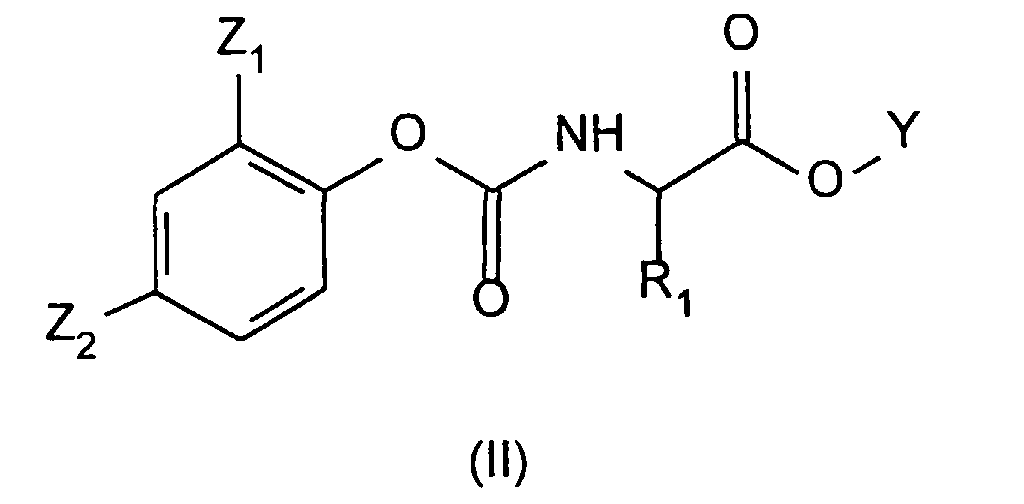
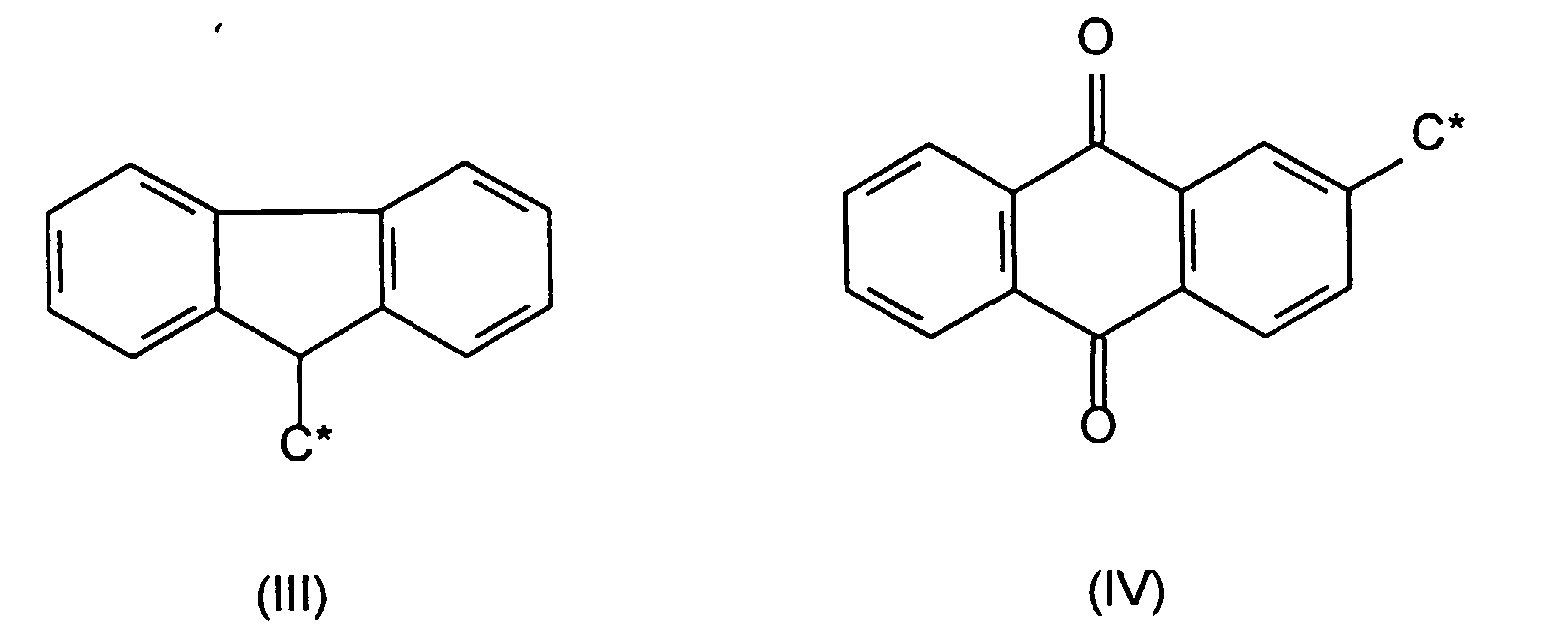
- Réactif selon la revendication 9 comprenant au moins un chromophore, répondant à la formule générale (II)

 dans laquelle Z1 et/ou Z2 = NO2 R1= Phényl, α ou β-Indolyl, 1-Naphtyl ou 2-Naphtyl, et Y correspond à l'une quelconque des formules III à V, le carbone par lequel Y est lié à l'oxygène du groupement carboxyle de l'aminoacide énantiopur étant marqué par *.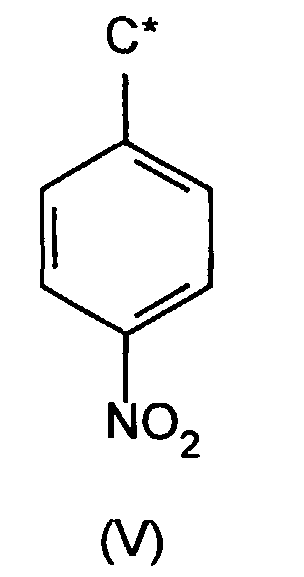
- Réactif selon la revendication 8 répondant à la formule générale (VI)dans laquelle Z1 et/ou Z2 = NO2 ou F, R1= Phényl, α ou β-Indolyl, 1-Naphtyl ou 2-Naphtyl, R2 = Me, Et, C3-C6 alkyl ou cycloalkyl et x représente un nombre intégral de 1 à 5.
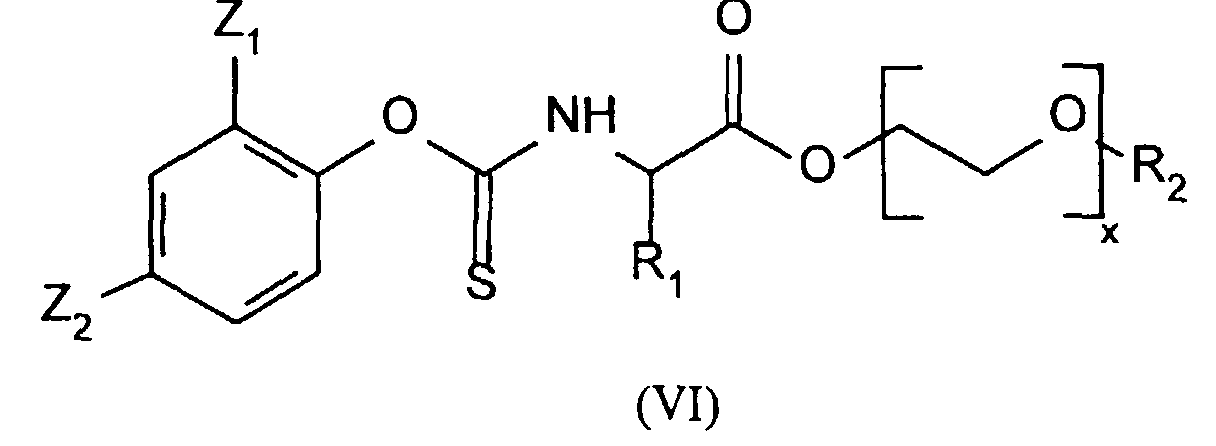
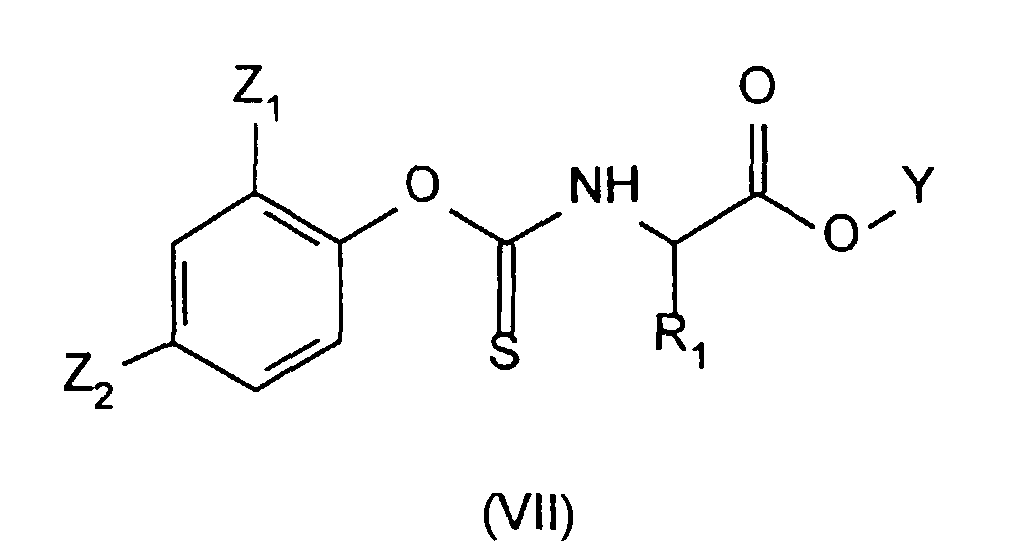
- Réactif selon la revendication 8 comprenant au moins un chromophore, répondant à la formule générale (VII)

 dans laquelle Z1 et/ou Z2 = NO2 R1= Phényl, α ou β-Indolyl, 1-Naphtyl ou 2-Naphtyl, et Y correspond à l'une quelconque des formules III à V, le carbone par lequel Y est lié à l'oxygène du groupement carboxyle de l'aminoacide énantiopur étant marqué par *.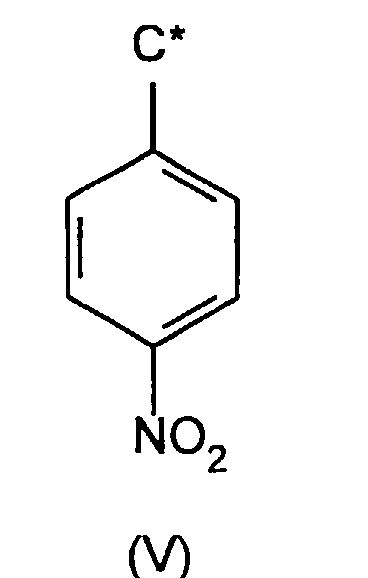
- Solution du réactif selon l'une quelconque des revendications 8 à 12 dans un solvant organique polaire.
- Utilisation de la solution selon la revendication 13 dans un appareil automatique de dérivatisation et de séparation d'énantiomères de composés organiques comprenant au moins un groupement fonctionnel libre.
- Utilisation du procédé, du réactif ou de la solution selon l'une quelconque des revendications 1 à 14 pour la séparation d'énantiomères d'un aminoacide, d'une amine primaire ou secondaire ou d'un peptide.
- Procédé pour l'obtention d'un composé énantiopur comprenant au moins un groupement fonctionnel libre dans lequel(a) on soumet un mélange comprenant les énantiomères du composé comprenant au moins un groupement fonctionnel libre au procédé de séparation selon l'invention(b) on effectue une opération de clivage d'un diastéréomère pur obtenu par séparation du mélange de diastéréomères(c) on récupère le composé énantiopur.
Applications Claiming Priority (2)
| Application Number | Priority Date | Filing Date | Title |
|---|---|---|---|
| BE9900280A BE1012622A3 (fr) | 1999-04-21 | 1999-04-21 | Procede pour la separation d'enantiomeres et reactif enantiopur. |
| BE9900280 | 1999-04-21 |
Publications (3)
| Publication Number | Publication Date |
|---|---|
| EP1046627A2 true EP1046627A2 (fr) | 2000-10-25 |
| EP1046627A3 EP1046627A3 (fr) | 2000-11-02 |
| EP1046627B1 EP1046627B1 (fr) | 2004-02-11 |
Family
ID=3891880
Family Applications (1)
| Application Number | Title | Priority Date | Filing Date |
|---|---|---|---|
| EP00201285A Expired - Lifetime EP1046627B1 (fr) | 1999-04-21 | 2000-04-10 | Procédé pour la séparation d'énantiomères et réactif énantiopur |
Country Status (13)
| Country | Link |
|---|---|
| US (1) | US6743373B1 (fr) |
| EP (1) | EP1046627B1 (fr) |
| JP (1) | JP2000327594A (fr) |
| AT (1) | ATE259339T1 (fr) |
| AU (1) | AU774082B2 (fr) |
| BE (1) | BE1012622A3 (fr) |
| CA (1) | CA2305944A1 (fr) |
| DE (1) | DE60008160T2 (fr) |
| DK (1) | DK1046627T3 (fr) |
| ES (1) | ES2215559T3 (fr) |
| HU (2) | HUP0001612A3 (fr) |
| IL (1) | IL135606A (fr) |
| PL (1) | PL339828A1 (fr) |
Cited By (3)
| Publication number | Priority date | Publication date | Assignee | Title |
|---|---|---|---|---|
| WO2003060523A1 (fr) * | 2002-01-10 | 2003-07-24 | Johns Hopkins University | Agents d'imagerie et procedes d'imagerie de naaladase et psma |
| US6743373B1 (en) * | 1999-04-21 | 2004-06-01 | Solvay (Societe Anonyme) | Process for the separation of enantiomers and enantiopure reagent |
| US7138538B2 (en) | 2000-04-14 | 2006-11-21 | Solvay (Societe Anonyme) | Process for the separation of enantiomers and enantiopure reagent |
Families Citing this family (5)
| Publication number | Priority date | Publication date | Assignee | Title |
|---|---|---|---|---|
| JP2002080435A (ja) * | 2000-06-26 | 2002-03-19 | Kanegafuchi Chem Ind Co Ltd | 3−アミノ−2−ヒドロキシプロピオン酸誘導体の製造法 |
| MX2009001806A (es) * | 2006-08-18 | 2009-02-26 | Schering Corp | Procedimiento para resolver piperidin alcohol quiral y procedimiento para la sintesis de derivados de pirazolo[1,5-a]pirimidina que utilizan los mismos. |
| WO2010109490A1 (fr) | 2009-03-27 | 2010-09-30 | Council Of Scientific & Industrial Research | Procédé de préparation d'une membrane composite énantiosélective |
| WO2013110135A1 (fr) * | 2012-01-25 | 2013-08-01 | Spinifex Pharmaceuticals Pty Ltd | Composés hétérocycliques et leurs procédés d'utilisation |
| CN117843513B (zh) * | 2024-03-07 | 2024-05-28 | 深圳创元生物医药科技有限公司 | 一种(S)-3-Carboxytyrosine的制备方法 |
Family Cites Families (10)
| Publication number | Priority date | Publication date | Assignee | Title |
|---|---|---|---|---|
| US4463176A (en) * | 1982-09-13 | 1984-07-31 | Mead Johnson & Company | Process for resolution of optical isomers |
| US4885292A (en) * | 1986-02-03 | 1989-12-05 | E. R. Squibb & Sons, Inc. | N-heterocyclic alcohol renin inhibitors |
| US5217958A (en) * | 1988-03-03 | 1993-06-08 | E. R. Squibb & Sons, Inc. | 1,2-hydroxy phosphonates and derivatives thereof |
| JPH02196765A (ja) * | 1989-01-26 | 1990-08-03 | Kyowa Hakko Kogyo Co Ltd | (―)―n―(2,2,5,5―テトラメチルシクロペンタンカルボニル)アラニンアミドの製造法 |
| JPH0469624A (ja) * | 1990-07-10 | 1992-03-04 | Seizo Miyata | 非線形光学材料 |
| US5461067A (en) * | 1993-02-25 | 1995-10-24 | Abbott Laboratories | Retroviral protease inhibiting compounds |
| IL111991A (en) * | 1994-01-28 | 2000-07-26 | Abbott Lab | Liquid pharmaceutical composition of HIV protease inhibitors in organic solvent |
| DE19524337C1 (de) * | 1995-07-04 | 1997-05-07 | Degussa | Verfahren zur Herstellung von beta-Amino-alpha-hydroxycarbonsäuren und deren Derivaten |
| US5919846A (en) * | 1998-02-19 | 1999-07-06 | Milliken Research Corporation | Colorant having isocyanate substituent |
| BE1012622A3 (fr) * | 1999-04-21 | 2001-01-09 | Solvay | Procede pour la separation d'enantiomeres et reactif enantiopur. |
-
1999
- 1999-04-21 BE BE9900280A patent/BE1012622A3/fr not_active IP Right Cessation
-
2000
- 2000-04-10 ES ES00201285T patent/ES2215559T3/es not_active Expired - Lifetime
- 2000-04-10 AT AT00201285T patent/ATE259339T1/de not_active IP Right Cessation
- 2000-04-10 DK DK00201285T patent/DK1046627T3/da active
- 2000-04-10 EP EP00201285A patent/EP1046627B1/fr not_active Expired - Lifetime
- 2000-04-10 DE DE60008160T patent/DE60008160T2/de not_active Expired - Fee Related
- 2000-04-11 IL IL135606A patent/IL135606A/en active IP Right Grant
- 2000-04-12 AU AU27720/00A patent/AU774082B2/en not_active Ceased
- 2000-04-14 US US09/549,928 patent/US6743373B1/en not_active Expired - Fee Related
- 2000-04-18 CA CA002305944A patent/CA2305944A1/fr not_active Abandoned
- 2000-04-20 PL PL00339828A patent/PL339828A1/xx not_active Application Discontinuation
- 2000-04-20 HU HU0001612A patent/HUP0001612A3/hu not_active IP Right Cessation
- 2000-04-20 HU HU0001612D patent/HU224571B1/hu active IP Right Grant
- 2000-04-21 JP JP2000120313A patent/JP2000327594A/ja active Pending
Cited By (4)
| Publication number | Priority date | Publication date | Assignee | Title |
|---|---|---|---|---|
| US6743373B1 (en) * | 1999-04-21 | 2004-06-01 | Solvay (Societe Anonyme) | Process for the separation of enantiomers and enantiopure reagent |
| US7138538B2 (en) | 2000-04-14 | 2006-11-21 | Solvay (Societe Anonyme) | Process for the separation of enantiomers and enantiopure reagent |
| WO2003060523A1 (fr) * | 2002-01-10 | 2003-07-24 | Johns Hopkins University | Agents d'imagerie et procedes d'imagerie de naaladase et psma |
| US7408079B2 (en) | 2002-01-10 | 2008-08-05 | The Johns Hopkins University | Imaging agents and methods of imaging NAALADase or PSMA |
Also Published As
| Publication number | Publication date |
|---|---|
| EP1046627B1 (fr) | 2004-02-11 |
| DE60008160D1 (de) | 2004-03-18 |
| EP1046627A3 (fr) | 2000-11-02 |
| DK1046627T3 (da) | 2004-06-21 |
| ATE259339T1 (de) | 2004-02-15 |
| AU774082B2 (en) | 2004-06-17 |
| IL135606A0 (en) | 2001-05-20 |
| BE1012622A3 (fr) | 2001-01-09 |
| ES2215559T3 (es) | 2004-10-16 |
| HU224571B1 (hu) | 2005-11-28 |
| HUP0001612A3 (en) | 2002-02-28 |
| AU2772000A (en) | 2000-10-26 |
| JP2000327594A (ja) | 2000-11-28 |
| HUP0001612A2 (hu) | 2001-12-28 |
| CA2305944A1 (fr) | 2000-10-21 |
| HU0001612D0 (en) | 2000-06-28 |
| PL339828A1 (en) | 2000-10-23 |
| US6743373B1 (en) | 2004-06-01 |
| IL135606A (en) | 2006-04-10 |
| DE60008160T2 (de) | 2004-12-09 |
Similar Documents
| Publication | Publication Date | Title |
|---|---|---|
| Nishizawa et al. | Synthesis and structure-activity relations of bestatin analogs, inhibitors of aminopeptidase B | |
| EP1046627B1 (fr) | Procédé pour la séparation d'énantiomères et réactif énantiopur | |
| FR2579461A1 (fr) | Amides de l'acide para-methoxycinnamique et de l'acide urocanique utilises comme filtres solaires; procedes d'obtention, compositions dermo-pharmaceutiques et cosmetiques les contenant et applications | |
| Casara et al. | Stereospecific synthesis of (2 R, 5 R)-hept-6-yne-2, 5-diamine: a potent and selective enzyme-activated irreversible inhibitor of ornithine decarboxylase (ODC) | |
| EP0185578B1 (fr) | Procédé de synthèse d'esters actifs d'acides carboxyliques, carbonates alpha-halogénés utiles pour cette synthèse et leur mode d'obtention | |
| US7138538B2 (en) | Process for the separation of enantiomers and enantiopure reagent | |
| EP0154581B1 (fr) | Nouveaux carbonates alpha-chlorés, leur procédé de fabrication et leur application à la protection des fonctions amines des amino-acides | |
| US4818704A (en) | Method for the separation and determination of enantiomeric amine compounds using an optically active agent | |
| EP2084125B1 (fr) | Derives d'aminobenzocycloheptene, leurs procedes de preparation et leur utilisation en therapeutique | |
| EP0270595B1 (fr) | Reactif optiquement actif et procede pour la determination de composes d'amine enantiomeres | |
| EP0155862B1 (fr) | Procédé de préparation de dérivés de l'acide carbamique | |
| AU2004309315B2 (en) | Preparation of R-5-(2-(2-(2-ethoxyphenoxy)ethylamino)propyl)-2-methoxybenzenesulphonamide hydrochloride of high chemical purity | |
| FR2584399A1 (fr) | Procede de synthese stereospecifique d'acides amino-4 hydroxy-3 carboxyliques | |
| CA1331496C (fr) | Composes guanidiniques comprenant un ion tetraphenylborate, procede d'obtention de ces composes et utilisation des composes lors de la synthese peptidique | |
| WO2022136366A1 (fr) | Nouveau procédé de synthèse de composés ncas | |
| EP0633267B1 (fr) | Procédé de préparation d'amides d'alpha-aminoacide, utilisables en synthèse peptidique | |
| EP0629612B1 (fr) | Procédé de préparation d'uréines dérivées d'alpha,omega-diaminoacides | |
| JP7444363B2 (ja) | 2-(2-オキソ-4-置換ピペラジニル)シクロアルキルカルバメート化合物又はその塩、当該化合物を用いる鏡像異性体の分析方法 | |
| JP7302847B2 (ja) | 新規フルオロジニトロフェニル化合物及びその用途 | |
| EP0209430B1 (fr) | L-di ou tripeptides possédant une activité biologique utilisable en médecine humaine et vétérinaire, procédé pour leur obtention et médicament les contenant | |
| JP2010260832A (ja) | アミノ酸−n−カルボキシ無水物の製造方法 | |
| FR2585354A1 (fr) | Procede stereoselectif de preparation de derives de la proline | |
| WO1990010009A1 (fr) | Sels de phosphonium comme reactifs de couplage peptidique | |
| FR2559767A1 (fr) | Procede de fabrication d'amino-acide a fonction amine protegee | |
| FR2881741A1 (fr) | Procede de synthese de derives de la cysteine, notamment thiocarbaester, utiles en tant que produits intermediaires dans la synthese de medicaments |
Legal Events
| Date | Code | Title | Description |
|---|---|---|---|
| PUAI | Public reference made under article 153(3) epc to a published international application that has entered the european phase |
Free format text: ORIGINAL CODE: 0009012 |
|
| PUAL | Search report despatched |
Free format text: ORIGINAL CODE: 0009013 |
|
| AK | Designated contracting states |
Kind code of ref document: A2 Designated state(s): AT BE CH CY DE DK ES FI FR GB GR IE IT LI LU MC NL PT SE |
|
| AX | Request for extension of the european patent |
Free format text: AL;LT;LV;MK;RO;SI |
|
| AK | Designated contracting states |
Kind code of ref document: A3 Designated state(s): AT BE CH CY DE DK ES FI FR GB GR IE IT LI LU MC NL PT SE |
|
| AX | Request for extension of the european patent |
Free format text: AL;LT;LV;MK;RO;SI |
|
| 17P | Request for examination filed |
Effective date: 20010502 |
|
| AKX | Designation fees paid |
Free format text: AT BE CH CY DE DK ES FI FR GB GR IE IT LI LU MC NL PT SE |
|
| 17Q | First examination report despatched |
Effective date: 20020416 |
|
| GRAH | Despatch of communication of intention to grant a patent |
Free format text: ORIGINAL CODE: EPIDOS IGRA |
|
| GRAS | Grant fee paid |
Free format text: ORIGINAL CODE: EPIDOSNIGR3 |
|
| GRAA | (expected) grant |
Free format text: ORIGINAL CODE: 0009210 |
|
| AK | Designated contracting states |
Kind code of ref document: B1 Designated state(s): AT BE CH CY DE DK ES FI FR GB GR IE IT LI LU MC NL PT SE |
|
| PG25 | Lapsed in a contracting state [announced via postgrant information from national office to epo] |
Ref country code: FI Free format text: LAPSE BECAUSE OF FAILURE TO SUBMIT A TRANSLATION OF THE DESCRIPTION OR TO PAY THE FEE WITHIN THE PRESCRIBED TIME-LIMIT Effective date: 20040211 Ref country code: CY Free format text: LAPSE BECAUSE OF FAILURE TO SUBMIT A TRANSLATION OF THE DESCRIPTION OR TO PAY THE FEE WITHIN THE PRESCRIBED TIME-LIMIT Effective date: 20040211 Ref country code: AT Free format text: LAPSE BECAUSE OF FAILURE TO SUBMIT A TRANSLATION OF THE DESCRIPTION OR TO PAY THE FEE WITHIN THE PRESCRIBED TIME-LIMIT Effective date: 20040211 |
|
| REG | Reference to a national code |
Ref country code: GB Ref legal event code: FG4D Free format text: NOT ENGLISH |
|
| REG | Reference to a national code |
Ref country code: CH Ref legal event code: EP |
|
| REG | Reference to a national code |
Ref country code: IE Ref legal event code: FG4D Free format text: FRENCH |
|
| REF | Corresponds to: |
Ref document number: 60008160 Country of ref document: DE Date of ref document: 20040318 Kind code of ref document: P |
|
| PG25 | Lapsed in a contracting state [announced via postgrant information from national office to epo] |
Ref country code: LU Free format text: LAPSE BECAUSE OF NON-PAYMENT OF DUE FEES Effective date: 20040410 |
|
| PG25 | Lapsed in a contracting state [announced via postgrant information from national office to epo] |
Ref country code: MC Free format text: LAPSE BECAUSE OF NON-PAYMENT OF DUE FEES Effective date: 20040430 |
|
| PG25 | Lapsed in a contracting state [announced via postgrant information from national office to epo] |
Ref country code: GR Free format text: LAPSE BECAUSE OF FAILURE TO SUBMIT A TRANSLATION OF THE DESCRIPTION OR TO PAY THE FEE WITHIN THE PRESCRIBED TIME-LIMIT Effective date: 20040511 |
|
| REG | Reference to a national code |
Ref country code: CH Ref legal event code: NV Representative=s name: E. BLUM & CO. PATENTANWAELTE |
|
| REG | Reference to a national code |
Ref country code: SE Ref legal event code: TRGR |
|
| GBT | Gb: translation of ep patent filed (gb section 77(6)(a)/1977) |
Effective date: 20040517 |
|
| REG | Reference to a national code |
Ref country code: DK Ref legal event code: T3 |
|
| REG | Reference to a national code |
Ref country code: ES Ref legal event code: FG2A Ref document number: 2215559 Country of ref document: ES Kind code of ref document: T3 |
|
| PLBE | No opposition filed within time limit |
Free format text: ORIGINAL CODE: 0009261 |
|
| STAA | Information on the status of an ep patent application or granted ep patent |
Free format text: STATUS: NO OPPOSITION FILED WITHIN TIME LIMIT |
|
| 26N | No opposition filed |
Effective date: 20041112 |
|
| PGFP | Annual fee paid to national office [announced via postgrant information from national office to epo] |
Ref country code: NL Payment date: 20070403 Year of fee payment: 8 |
|
| PGFP | Annual fee paid to national office [announced via postgrant information from national office to epo] |
Ref country code: SE Payment date: 20070404 Year of fee payment: 8 |
|
| PGFP | Annual fee paid to national office [announced via postgrant information from national office to epo] |
Ref country code: DE Payment date: 20070405 Year of fee payment: 8 |
|
| PGFP | Annual fee paid to national office [announced via postgrant information from national office to epo] |
Ref country code: IE Payment date: 20070412 Year of fee payment: 8 |
|
| PGFP | Annual fee paid to national office [announced via postgrant information from national office to epo] |
Ref country code: CH Payment date: 20070413 Year of fee payment: 8 |
|
| PGFP | Annual fee paid to national office [announced via postgrant information from national office to epo] |
Ref country code: DK Payment date: 20070416 Year of fee payment: 8 |
|
| PGFP | Annual fee paid to national office [announced via postgrant information from national office to epo] |
Ref country code: ES Payment date: 20070521 Year of fee payment: 8 |
|
| PGFP | Annual fee paid to national office [announced via postgrant information from national office to epo] |
Ref country code: BE Payment date: 20070614 Year of fee payment: 8 |
|
| REG | Reference to a national code |
Ref country code: CH Ref legal event code: PFA Owner name: SOLVAY (SOCIETE ANONYME) Free format text: SOLVAY (SOCIETE ANONYME)#RUE DU PRINCE ALBERT, 33#1050 BRUXELLES (BE) -TRANSFER TO- SOLVAY (SOCIETE ANONYME)#RUE DU PRINCE ALBERT, 33#1050 BRUXELLES (BE) |
|
| PGFP | Annual fee paid to national office [announced via postgrant information from national office to epo] |
Ref country code: GB Payment date: 20070404 Year of fee payment: 8 |
|
| PG25 | Lapsed in a contracting state [announced via postgrant information from national office to epo] |
Ref country code: PT Free format text: LAPSE BECAUSE OF NON-PAYMENT OF DUE FEES Effective date: 20040711 |
|
| PGFP | Annual fee paid to national office [announced via postgrant information from national office to epo] |
Ref country code: IT Payment date: 20070519 Year of fee payment: 8 |
|
| PGFP | Annual fee paid to national office [announced via postgrant information from national office to epo] |
Ref country code: FR Payment date: 20070411 Year of fee payment: 8 |
|
| BERE | Be: lapsed |
Owner name: S.A. *SOLVAY Effective date: 20080430 |
|
| REG | Reference to a national code |
Ref country code: CH Ref legal event code: PL |
|
| REG | Reference to a national code |
Ref country code: DK Ref legal event code: EBP |
|
| EUG | Se: european patent has lapsed | ||
| GBPC | Gb: european patent ceased through non-payment of renewal fee |
Effective date: 20080410 |
|
| NLV4 | Nl: lapsed or anulled due to non-payment of the annual fee |
Effective date: 20081101 |
|
| REG | Reference to a national code |
Ref country code: IE Ref legal event code: MM4A |
|
| PG25 | Lapsed in a contracting state [announced via postgrant information from national office to epo] |
Ref country code: NL Free format text: LAPSE BECAUSE OF NON-PAYMENT OF DUE FEES Effective date: 20081101 Ref country code: CH Free format text: LAPSE BECAUSE OF NON-PAYMENT OF DUE FEES Effective date: 20080430 Ref country code: DE Free format text: LAPSE BECAUSE OF NON-PAYMENT OF DUE FEES Effective date: 20081101 Ref country code: LI Free format text: LAPSE BECAUSE OF NON-PAYMENT OF DUE FEES Effective date: 20080430 |
|
| REG | Reference to a national code |
Ref country code: FR Ref legal event code: ST Effective date: 20081231 |
|
| PG25 | Lapsed in a contracting state [announced via postgrant information from national office to epo] |
Ref country code: BE Free format text: LAPSE BECAUSE OF NON-PAYMENT OF DUE FEES Effective date: 20080430 |
|
| PG25 | Lapsed in a contracting state [announced via postgrant information from national office to epo] |
Ref country code: IE Free format text: LAPSE BECAUSE OF NON-PAYMENT OF DUE FEES Effective date: 20080410 Ref country code: FR Free format text: LAPSE BECAUSE OF NON-PAYMENT OF DUE FEES Effective date: 20080430 Ref country code: DK Free format text: LAPSE BECAUSE OF NON-PAYMENT OF DUE FEES Effective date: 20080430 |
|
| REG | Reference to a national code |
Ref country code: ES Ref legal event code: FD2A Effective date: 20080411 |
|
| PG25 | Lapsed in a contracting state [announced via postgrant information from national office to epo] |
Ref country code: GB Free format text: LAPSE BECAUSE OF NON-PAYMENT OF DUE FEES Effective date: 20080410 |
|
| PG25 | Lapsed in a contracting state [announced via postgrant information from national office to epo] |
Ref country code: ES Free format text: LAPSE BECAUSE OF NON-PAYMENT OF DUE FEES Effective date: 20080411 |
|
| PG25 | Lapsed in a contracting state [announced via postgrant information from national office to epo] |
Ref country code: IT Free format text: LAPSE BECAUSE OF NON-PAYMENT OF DUE FEES Effective date: 20080410 |
|
| PG25 | Lapsed in a contracting state [announced via postgrant information from national office to epo] |
Ref country code: SE Free format text: LAPSE BECAUSE OF NON-PAYMENT OF DUE FEES Effective date: 20080411 |