EP1039968B1 - Polybetain-stabilisierte platin-nanopartikel, verfahren zu ihrer herstellung und verwendung für elektrokatalysatoren in brennstoffzellen - Google Patents
Polybetain-stabilisierte platin-nanopartikel, verfahren zu ihrer herstellung und verwendung für elektrokatalysatoren in brennstoffzellen Download PDFInfo
- Publication number
- EP1039968B1 EP1039968B1 EP98965752A EP98965752A EP1039968B1 EP 1039968 B1 EP1039968 B1 EP 1039968B1 EP 98965752 A EP98965752 A EP 98965752A EP 98965752 A EP98965752 A EP 98965752A EP 1039968 B1 EP1039968 B1 EP 1039968B1
- Authority
- EP
- European Patent Office
- Prior art keywords
- platinum
- soluble
- betaine
- nanosize particles
- particles
- Prior art date
- Legal status (The legal status is an assumption and is not a legal conclusion. Google has not performed a legal analysis and makes no representation as to the accuracy of the status listed.)
- Expired - Lifetime
Links
Classifications
-
- C—CHEMISTRY; METALLURGY
- C25—ELECTROLYTIC OR ELECTROPHORETIC PROCESSES; APPARATUS THEREFOR
- C25C—PROCESSES FOR THE ELECTROLYTIC PRODUCTION, RECOVERY OR REFINING OF METALS; APPARATUS THEREFOR
- C25C5/00—Electrolytic production, recovery or refining of metal powders or porous metal masses
- C25C5/02—Electrolytic production, recovery or refining of metal powders or porous metal masses from solutions
-
- B—PERFORMING OPERATIONS; TRANSPORTING
- B01—PHYSICAL OR CHEMICAL PROCESSES OR APPARATUS IN GENERAL
- B01J—CHEMICAL OR PHYSICAL PROCESSES, e.g. CATALYSIS OR COLLOID CHEMISTRY; THEIR RELEVANT APPARATUS
- B01J35/00—Catalysts, in general, characterised by their form or physical properties
- B01J35/40—Catalysts, in general, characterised by their form or physical properties characterised by dimensions, e.g. grain size
- B01J35/45—Nanoparticles
-
- B—PERFORMING OPERATIONS; TRANSPORTING
- B82—NANOTECHNOLOGY
- B82Y—SPECIFIC USES OR APPLICATIONS OF NANOSTRUCTURES; MEASUREMENT OR ANALYSIS OF NANOSTRUCTURES; MANUFACTURE OR TREATMENT OF NANOSTRUCTURES
- B82Y30/00—Nanotechnology for materials or surface science, e.g. nanocomposites
-
- H—ELECTRICITY
- H01—ELECTRIC ELEMENTS
- H01M—PROCESSES OR MEANS, e.g. BATTERIES, FOR THE DIRECT CONVERSION OF CHEMICAL ENERGY INTO ELECTRICAL ENERGY
- H01M4/00—Electrodes
- H01M4/86—Inert electrodes with catalytic activity, e.g. for fuel cells
- H01M4/90—Selection of catalytic material
- H01M4/92—Metals of platinum group
-
- H—ELECTRICITY
- H01—ELECTRIC ELEMENTS
- H01M—PROCESSES OR MEANS, e.g. BATTERIES, FOR THE DIRECT CONVERSION OF CHEMICAL ENERGY INTO ELECTRICAL ENERGY
- H01M4/00—Electrodes
- H01M4/86—Inert electrodes with catalytic activity, e.g. for fuel cells
- H01M4/90—Selection of catalytic material
- H01M4/92—Metals of platinum group
- H01M4/925—Metals of platinum group supported on carriers, e.g. powder carriers
- H01M4/926—Metals of platinum group supported on carriers, e.g. powder carriers on carbon or graphite
-
- H—ELECTRICITY
- H01—ELECTRIC ELEMENTS
- H01M—PROCESSES OR MEANS, e.g. BATTERIES, FOR THE DIRECT CONVERSION OF CHEMICAL ENERGY INTO ELECTRICAL ENERGY
- H01M2300/00—Electrolytes
- H01M2300/0017—Non-aqueous electrolytes
- H01M2300/0065—Solid electrolytes
- H01M2300/0082—Organic polymers
-
- Y—GENERAL TAGGING OF NEW TECHNOLOGICAL DEVELOPMENTS; GENERAL TAGGING OF CROSS-SECTIONAL TECHNOLOGIES SPANNING OVER SEVERAL SECTIONS OF THE IPC; TECHNICAL SUBJECTS COVERED BY FORMER USPC CROSS-REFERENCE ART COLLECTIONS [XRACs] AND DIGESTS
- Y02—TECHNOLOGIES OR APPLICATIONS FOR MITIGATION OR ADAPTATION AGAINST CLIMATE CHANGE
- Y02E—REDUCTION OF GREENHOUSE GAS [GHG] EMISSIONS, RELATED TO ENERGY GENERATION, TRANSMISSION OR DISTRIBUTION
- Y02E60/00—Enabling technologies; Technologies with a potential or indirect contribution to GHG emissions mitigation
- Y02E60/30—Hydrogen technology
- Y02E60/50—Fuel cells
Definitions
- the invention relates to soluble nanoparticles, which are platinum alone or platinum together with other platinum group metals and by Protective colloids are stabilized, and a process for their preparation according to Sol process, characterized in that the protective colloids in whole or in part consist of polymers which carry side chains with a sulfobetaine group and are degradable by hydrolysis.
- the invention further relates to Catalysts produced above and their Use for electrodes of membrane fuel cells.
- Electric drives for operating motor vehicles have reasons an ever-decreasing energy reserve and environmental protection Significance as a future-oriented alternative to conventional ones Internal combustion engines. This poses a significant technical problem nor the provision of electrical energy on board the vehicle. With Rechargeable battery powered vehicles have only a small number Storage capacity and therefore only allow limited ranges. Offer against Fuel cells, which generate the electrical energy on board the vehicle generate chemical fuel because of the high storage density of the chemical Energy source and because of its superior efficiency at Energy conversion comparable ranges as the current one Internal combustion engines.
- membrane fuel cells For drive purposes have fuel cells based on platinum catalysts and of polymeric solid electrolyte membranes have considerable advantages. Because of her Construction is membrane fuel cells as "polymer electrode membrane fuel cells ", PEMFC or PEFC.
- the heart of a PEMFC is a gas-tight proton-permeable one Cation exchange polymer membrane, d. H. made of a polymer which negatively charged acidic groups are bound. Both sides of the Membranes are made with a thin layer of a mixture of nanodisperse Platinum particles and fine particles of electrically conductive carbon covered.
- the platinum acts as a catalyst for the two electrochemical substeps, the Oxidation of the fuel at the anode and reduction of the oxygen at the Cathode.
- the outer cover of the platinum / carbon layer consists of the current collector, a gas-permeable fleece or paper made of electricity conductive carbon fibers. Together with the platinum / carbon layer, the Current collector the anode or the cathode of the fuel cell.
- MEA membrane electrode assembly
- the gaseous reactants are transported to the electrodes, ie the fuel to the anode or the atmospheric oxygen to the cathode, from the rear through the gas-permeable current collector.
- the anodic current collector is used to discharge the electrons that are released during the oxidation of the fuel.
- the cathodic current collector is used to supply electrons that are needed at the cathode for the reduction of oxygen.
- the external, electronic charge flow from the anode to the cathode corresponds to the external circuit with the current consumer connected in between.
- the internal, protic charge transport takes place in such a way that the protons formed on the anode during the oxidation of the fuel are transported through the cation exchange membrane to the cathode with the aid of the negatively charged partitions and combine there with the reduction products of the oxygen to form water.
- WO 91/19 566 discloses alloys of noble metals with cobalt, chromium and / or Vanadium on carbon supports by gradual deposition of the metals generated on the support and subsequent calcining.
- EP-A-0 106 197 discloses catalysts consisting u. a. made of thin, flat platinum crystallites on a graphite support and a process for their production characterized by an electrochemical deposition on the carrier.
- heterogeneous catalysts for chemical and electrochemical processes can manufacture on the basis of a sol process.
- a sol of the relevant, catalytically active metal is generated or possibly several metals in a separate process stage and immobilized then the dissolved or solubilized nanoparticles on the carrier.
- the general advantage of the sol process is the high dispersibility that can be achieved of particles, with the lower limit for platinum currently being around 1 Nanometer reaches.
- the brines are made using a stabilizer, especially when you can process brine with a Metal concentration of 0.1% or higher is required.
- the stabilizer envelops the Metal particles and prevents the particles from clumping together electrostatic or steric repulsion.
- the Stabilizer to some extent the solubility of the particles.
- Platinum sols containing polymeric stabilizers and their use in Manufacture of catalysts, including for fuel cells have also been described. These are, for example Polyacrylic acid, polyvinyl alcohol or poly (N-vinyl pyrrolidone). Except for the purpose the mentioned polymers have no stabilization of the sol in question functional importance.
- J. Am. Chem .. Soc. 101 (1979) 7214 describes platinum colloids for the photolysis of Water with a hydrodynamic diameter of 22 to 106 nm, which with Polyvinyl alcohol are stabilized.
- DE-A-25 59 617 discloses the preparation of catalysts by using a Platinum salt converted into a metastable colloid in the presence of a carrier, which is knocked down on the carrier.
- US-A-4 937 220 discloses a method for reducing recrystallization, by creating a dispersion of different crystal sizes and shapes applies the carbon carrier.
- DE-A-2848138 teaches a method for reducing recrystallization by porous carbon on and around those on the carbon particles Platinum crystallite is deposited.
- US-A-4 610 938 discloses electrodes for fuel cells, other of which are catalytic effective surface a layer of a fluorinated acidic group bearing Polymers adjoins.
- US-A-4 876 115 describes the coating of carbon supports, which are loaded with platinum particles of 2 to 5 nanometers in diameter in an amount of about 0.35 mg / cm 2 Pt, with a perfluorinated cation exchange resin to increase the proton conductivity ,
- the task was firstly secondly, to achieve a high dispersion of the catalytically active platinum centers an unhindered transport of starting materials, products as well as protons and To ensure electrons and thirdly, the recrystallization of the platinum particles reduce larger particles on the carbon carrier.
- Betainen brine with particularly small particles with a diameter of typically receives 1 nanometer. This creates a very high dispersity and so that the expensive precious metals are used economically.
- the invention relates to nanoparticles, the platinum alone or platinum and others Contain metals of the platinum group, characterized in that they are in a through Hydrolysis-degradable protective colioid containing polymeric betaines embedded are, wherein the polymeric betaine from a substantially unbranched Polymethylene backbone and various types of betaine groups Side chains are built up, the nanoparticles have a diameter of 0.5 to 3 nm and the nanoparticles do not contain palladium.
- the invention further relates to a method for producing Nanoparticles containing platinum alone or platinum and other metals Platinum group, and embedded in a polymeric betaine which is degradable by hydrolysis protective colloid containing, by reacting a platinum compound alone or a platinum compound together with one or more compounds of Metals selected from the group consisting of rhodium, ruthenium and iridium, with a Reducing agent in water or a solvent, characterized in that the reduction is carried out in the presence of a polymeric betaine, or that polymeric betaine after the reduction step, but before the onset of Agglomeration, to which sol is added, the polymeric betaine being hydrolysed is degradable, and if necessary subsequently cleans the stabilized sol by reprecipitation and / or concentrated by evaporation.
- Catalysts for fuel cells obtainable by one finely powdered, conductive carrier made of finely dispersed carbon, carbon black or graphite brings a sol of the above-mentioned nanoparticles into contact, the formed Separate catalyst by filtering or centrifuging from the liquid phase and, if appropriate, the protective colloid subsequently by treatment with a Base completely or partially removed from the catalyst.
- nanoparticles resulting from the invention or those obtained therefrom are one for the anode and the cathode Suitable membrane fuel cell.
- the brine of the nanoparticles becomes, preferably after previous cleaning and concentration, applied to the carrier, the stabilizer shell in remains essentially intact.
- a preferred embodiment of the invention is that after Immobilization of the coating consisting of a polymeric betaine All or part of the catalytically active centers are removed. By this measure becomes the transport of the electrons and / or protons from or to the centers supported.
- the polymeric betaines to be used for this purpose according to the invention consist for example of derivatives of polyacrylic acid, in which the Side chains bearing betaine groups via carboxylic acid ester group and / or a Carboxamide group are linked to the main polymer chain.
- the mining is carried out by hydrolysis of the carboxylic acid ester group or carboxamide group.
- the cleavage can be accomplished by treating the catalyst with a base for example with an alkali hydroxide or ammonia.
- the soluble nanoparticles obtainable according to the invention are particles with a Diameters from about 0.5 to 3 nanometers, preferably from about 1 to 2 Nanometers related to the metal core.
- the particles are in water or one organic solvents soluble, with “soluble” also “solubilizable”, i.e. H. brine educating means.
- Starting materials are the metals used in the form of soluble Compounds, especially water-soluble compounds, such as Hexachloroplatinic acid hydrate, hexachloroiridium (IV) acid hydrate, iridium (III) acetylacetonate, ruthenium (III) acetylacetonate, ruthenium (III) nitrate, Rhodium (III) chloride hydrate.
- the metal compounds are in a concentration of about 0.1 to 100 g per liter, preferably from 1 to 50 g per liter based on the Solvent used.
- Polymeric betaines used according to the invention consist essentially of one unbranched polymethylene backbone and various betaine groups load-bearing side chains built.
- the side chains consist of an alkylene group of about 2 to 12 Carbon atoms, preferably 2 to 4 carbon atoms and bear finally a betaine group. Linking the side chain to the main chain takes place via a carboxylic acid ester group or via a carboxamide group. In the case of polymers of the type described above, it is easy to do so Way, for example by reaction with a base, split off the side chain.
- the side chain can also be from an N-containing, heterocyclic ring system, for example, a pyridine ring are formed, the nitrogen atom of the Betain group belongs to the ring system and the link with the main chain via carbon or possibly further nitrogen atoms of the ring system.
- the betaine group can consist of a carbobetaine, -N + R 1 R 2 - (- CH 2 -) n -CO 2 - , a phosphobetaine, -N + R 1 R 2 - (- CH 2 -) n -PO 3 - or preferably consist of a sulfobetaine -N + R 1 R 2 - (- CH 2 -) n -SO 3 - , where R 1 and R 2 are the same or different alkyl radicals of 1 to 6 carbon atoms and n 1, 2 or 3 mean.
- Suitable polymers are, for example, poly- [N, N-dimethyl-N-methacryloxyethyl-N- (3-sulfopropyl) ammonium betaine] according to formula 1, Poly- [N, N-dimethyl-N-methacrylamidopropyl-N- (3-sulfopropyl) ammonium betaine] according to formula 2, Poly- [1- (3'-sulfopropyl) -2-vinylpyridinium betaine] according to formula 3
- the polymers described above are by radical polymerization made from the corresponding monomers that are commercially available.
- the polybetaines have degrees of polymerization of about 50 to 10,000, preferably from 100 to 1000.
- copolymers made from different monomers of the above described categories are used.
- copolymers can be used, which from the above Monomers described with betaine groups and other monomers such as for example acrylic acid, acrylic acid esters, acrylic acid amides, Carboxylic acid vinyl esters, vinyl alkyl ethers, N-vinyl pyridine, N-vinyl pyrrolidone, N-vinyl carboxamides are built up.
- the polybetaines are used in quantities by weight from 5 to 2000%, preferably from 20 to 400% based on the metal or Metals used.
- the process according to the invention is carried out in water or in a mixture Water and one (or more) water-miscible organic Solvent (s) or in the absence of water in an organic solvent carried out.
- Suitable solvents are, for example, methanol, ethanol, ethylene glycol, Tetrahydrofuran, dimethoxyethane, acetone, N-methylpyrrolidone, dimethylformamide or dimethylacetamide.
- the production of brines in water is preferred (Hydrosols) or in water with the addition of 1 to 50% by weight, preferably from 5 to 25% of an organic solvent.
- Suitable reducing agents are all customary reducing agents, the one have sufficiently negative reduction potential, such as hydrogen, Sodium borohydride, ethanol, ethylene glycol, hydroxymethanesulfinic acid sodium salt.
- the preferred reducing agent is hydroxymethanesulfinic acid sodium salt (Rongalit®) used.
- the reducing agent is generally in stoichiometric amounts based on the metal compound (s), preferably but used in a certain excess. The excess can, for example 10 to 100%.
- the brine is produced at temperatures between 0 and 200 ° C, preferably between 20 and 100 ° C.
- the components can generally be found in in any order. It is useful that Support mixing by stirring.
- the reducing agent is added last. If you have the polymeric betaine only after the reduction is added, has the addition before the onset Agglomeration to take place.
- the platinum-polybetaine complexes contained in the sols according to the invention are new compounds of relatively uniform composition.
- the Transmission electron microscopic examination (TEM) of the particles revealed a very narrow size distribution. Typically 90% of the particles give way less than 20% from the mean diameter.
- the diameter of the Metal core depends to some extent on the type and amount of stabilizer used. It is usually less than 3 nanometers, mostly less than 2 nanometers. In most cases, the diameter of the metal core is included about 1 nanometer.
- d. H. for the production of the Platinum / carbon black mixtures are generally at least metal concentrations 10 g / liter desired.
- the brine obtained according to the invention can, if appropriate, by gently distilling off water and / or the solvent. If necessary, the brine obtained according to the invention can in itself known way cleaned by falling and possibly concentrated at the same time become.
- the precipitation of a colloidally dissolved platinum cation exchange polymer Complex can be done by adding acetone or isopropanol.
- the platinum cation exchange polymer gels obtained are soluble in water again.
- the metal concentrations that can be achieved are between 50 and 100 g / liter.
- catalysts For the preparation of catalysts, they are as described above prepared aqueous brine with a fine powder, conductive carbon carrier brought into contact and then the liquid phase separated. This is done an immobilization of the platinum cation exchange polymer complex on the Carrier particles. It has been found that the platinum cation exchange polymer according to the invention Complexes preferentially on or in the surface deposit near the surface of the carrier and ensure good adhesion to the Have carriers.
- the carrier consists of finely dispersed carbon, soot or graphite.
- the carbon carriers to be used can be loaded with the before or after loading Pt nanoparticles according to the invention additionally acted on with materials be, for example with proton-conducting polymers. This procedure is described in principle in US-A-4,876,115.
- One way of carrying out the loading of the carbon carrier is to that one to a suspension of the carrier in water or a water / alcohol mixture the sol enters with thorough mixing, the suspension is stirred and the Platinum / carbon mixture isolated by filtration or centrifugation.
- Immobilization was carried out analogously to Example 4. 2.00 g of ®Vulcan XC 72R (manufacturer: Cabot BV, Rozenburg, the Netherlands) was used as the carrier material, which had previously been treated with a solution of sulfonated polyether ether ketone (PEEK), molecular weight M n approx. 80,000, degree of sulfonation 50.7%;) had been treated. 6.6 g (about 0.33 g of platinum, stabilizer: poly- [N, N-dimethyl-N-methacryloxyethyl-N- (3-sulfopropyl) ammonium betaine]) sol concentrate were used, which according to Example 1 had been produced. The weight was 1.9 g.
- PEEK polyether ether ketone
Landscapes
- Chemical & Material Sciences (AREA)
- Engineering & Computer Science (AREA)
- Materials Engineering (AREA)
- Chemical Kinetics & Catalysis (AREA)
- Electrochemistry (AREA)
- Organic Chemistry (AREA)
- Nanotechnology (AREA)
- General Chemical & Material Sciences (AREA)
- Physics & Mathematics (AREA)
- Composite Materials (AREA)
- Condensed Matter Physics & Semiconductors (AREA)
- General Physics & Mathematics (AREA)
- Crystallography & Structural Chemistry (AREA)
- Metallurgy (AREA)
- Catalysts (AREA)
- Inert Electrodes (AREA)
- Colloid Chemistry (AREA)
Abstract
Description
Der interne, protische Ladungstransport erfolgt in der Weise, daß die an der Anode bei der Oxidation des Brennstoffs gebildeten Protonen mit Hilfe der negativ geladenen Festionen durch die Kationentauschermembran an die Kathode transportiert werden und sich dort mit den Reduktionsprodukten des Sauerstoffs zu Wasser vereinigen.


Nach Aufarbeitung erhält man 20,0 g eines dunkel-rotbraunen Sols .
Die Analyse des erhaltenen Katalysators ergab 11 % Platin (ICP-OES).
Die TEM-Analyse des Katalysators (Transmissionselektronenmikroskop: Philips CM 30; die Teilchen wurden auf ein mit Kohlenstoff befilmtes Kupfernetz aufgebracht) ergab einen feinen Belag von Platinpartikeln, deren Durchmesser maximal etwa 1 Nanometer betrug.
Die Auswaage betrug 1,9 g.
Claims (18)
- Nanopartikel, die Platin allein oder Platin und andere Metalle der Platingruppe enthalten, dadurch gekennzeichnet, daß sie in ein durch Hydrolyse abbaubares, polymere Betaine enthaltendes Schutzkolloid eingebettet sind, wobei das polymere Betain aus einer im wesentlichen unverzweigten Polymethylen-Hauptkette und verschiedenartigen, Betain-Gruppen tragenden Seitenketten aufgebaut sind, die Nanopartikel einen Durchmesser von 0,5 bis 3 nm aufweisen und die Nanopartikel kein Palladium enthalten.
- Lösliche Nanopartikel nach Anspruch 1, dadurch gekennzeichnet, daß sie einen Durchmesser von 1 bis 2 nm aufweisen.
- Lösliche Nanopartikel nach Anspruch 1 und/oder 2, dadurch gekennzeichnet, daß sie mindestens ein Polymer mit Betain-Gruppen enthalten, das eine Seitenkette trägt, die aus einem Alkylenrest mit etwa 2 bis 12, vorzugsweise 2 bis 4 Kohlenstoffatomen besteht.
- Lösliche Nanopartikel nach einem oder mehreren der Ansprüche 1 bis 3, dadurch gekennzeichnet, daß es sich bei dem Betain um ein Carbobetain der Formel -N+R1 R2-(-CH2-)n-CO2 -, einem Phosphobetain der Formel -N+R1R2-(-CH2-)n-PO3 - oder, vorzugsweise, um ein Sulfobetain der Formel -N+R1R2-(-CH2-)n-SO3 - handelt, wobei R1 und R2 unabhängig voneinander gleich oder verschieden sein können, und Alkylreste von 1 bis 6 Kohlenstoffatome bedeuten, und n 1, 2 oder 3 bedeutet.
- Lösliche Nanopartikel nach einem oder mehreren der Ansprüche 1 bis 4, dadurch gekennzeichnet, daß die Schutzkolloide Verbindungen der Formeln
 oder
oder sind, worin n 1, 2 oder 3 bedeutet.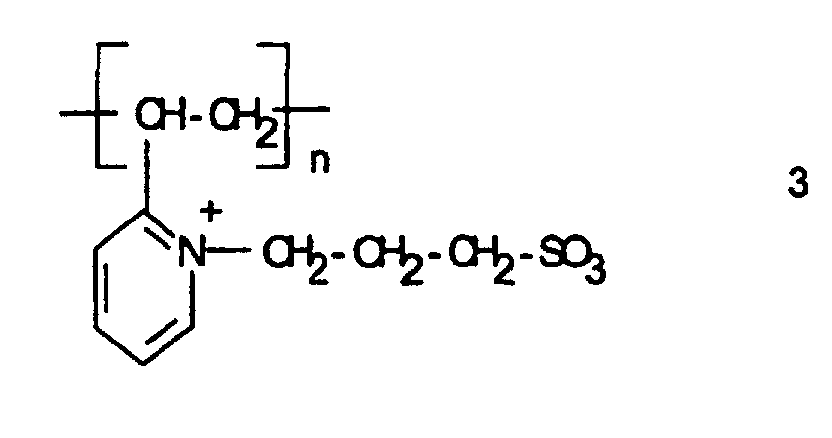
- Lösliche Nanopartikel nach einem oder mehreren der Ansprüche 1 bis 5, dadurch gekennzeichnet, daß sie mindestens ein Polymer mit Betain-Gruppen enthalten, das einen Polymerisationsgrad von 50 bis 10000, vorzugsweise von 100 bis 1000 aufweist.
- Lösliche Nanopartikel nach einem oder mehreren der Ansprüche 1 bis 6, dadurch gekennzeichnet, daß sie ein Polymer enthalten, das neben Monomeren, die Betain-Gruppen enthalten, auch Monomere ausgewählt aus der Gruppe Acrylsäure, Acrylsäureester, Acrylsäureamide, Carbonsäurevinylester, Vinyl-alkylether, N-Vinylpyridin, N-Vinylpyrrolidon, N-Vinylcarbonsäureamide enthält.
- Verfahren zur Herstellung von löslichen Nanopartikeln nach einem oder mehreren der Ansprüche 1 bis 7 durch Umsetzung einer Platinverbindung allein oder einer Platinverbindung zusammen mit einer oder mehreren Verbindungen von Metallen ausgewählt aus der Gruppe Rhodium, Ruthenium und Iridium, mit einem Reduktionsmittel in Wasser oder einem Lösemittel, dadurch gekennzeichnet, daß man die Reduktion in Gegenwart eines polymeren Betains durchführt, oder das polymere Betain nach dem Reduktionsschritt, aber vor dem Einsetzen der Zusammenballung, zu dem Sol gibt, wobei das polymere Betain durch Hydrolyse abbaubar ist, und die Herstellung der Sole bei einer Temperatur zwischen 0 und 200°C erfolgt.
- Verfahren nach Anspruch 8, dadurch gekennzeichnet, daß das Sol durch Umfällen gereinigt und/oder durch Eindampfen aufkonzentriert wird.
- Verfahren nach Anspruch 8 und/oder 9, dadurch gekennzeichnet, daß die Ausgangsstoffe für die Herstellung der löslichen Nanopartikel lösliche Verbindungen, insbesondere wasserlösliche Salze, speziell Hexachloroplatin(IV)-säure Hydrat, Hexachloroiridium(IV)-säure Hydrat, lridium(III)-acetylacetonat, Ruthenium(III)-acetylacetonat, Ruthenium(III)-nitrat, Rhodium(III)-chlorid Hydrat sind.
- Verfahren nach einem oder mehreren der Ansprüche 8 bis 10, dadurch gekennzeichnet, daß die Ausgangsstoffe für die Herstellung der löslichen Nanopartikel in Konzentrationen von etwa 0,1 bis 100 g pro Liter, vorzugsweise von 1 bis 50 g pro Liter bezogen auf das Lösemittel eingesetzt werden.
- Verfahren nach einem oder mehreren der Ansprüche 8 bis 11, dadurch gekennzeichnet, daß als Reduktionsmittel Wasserstoff, Natriumborhydrid, Ethanol, Ethylenglykol oder, bevorzugt, Hydroxymethansulfinsäure-Natriumsalz verwendet werden.
- Verfahren nach einem oder mehreren der Ansprüche 8 bis 12, dadurch gekennzeichnet, daß das Reduktionsmittel in stöchiometrischen Mengen bezogen auf die Metallverbindung(en), oder, vorzugsweise, im Überschuß von 10 bis 100 % verwendet wird.
- Verfahren nach einem oder mehreren der Ansprüche 8 bis 13, dadurch gekennzeichnet, daß das Lösemittel Methanol, Ethanol, Ethylenglykol, N-Methylpyrrolidon, Dimethylformamid, Dimethylacetamid oder Tetrahydrofuran, oder eine Mischung dieser Stoffe mit Wasser ist.
- Verfahren nach einem oder mehreren der Ansprüche 8 bis 14, dadurch gekennzeichnet, daß es bei Temperaturen von 20 bis 100°C durchgeführt wird.
- Katalysatoren für Membranbrennstoffzellen, dadurch erhältlich, daß man einen feinpulvrigen, leitfähigen Träger aus feindispersem Kohlenstoff, Ruß oder Graphit mit einem Sol der Nanopartikel nach einem oder mehreren der Ansprüche 1 bis 7 in Kontakt bringt.
- Katalysatoren nach Anspruch 16, dadurch gekennzeichnet, daß sie mit protonenleitenden Polymeren beaufschlagt sind.
- Verwendung von Katalysatoren nach Anspruch 16 und/oder 17 in Membranbrennstoffzellen.
Applications Claiming Priority (3)
| Application Number | Priority Date | Filing Date | Title |
|---|---|---|---|
| DE19754304A DE19754304A1 (de) | 1997-12-08 | 1997-12-08 | Polybetain-stabilisierte Platin-Nanopartikel, Verfahren zu ihrer Herstellung und Verwendung für Elektrokatalysatoren in Brennstoffzellen |
| DE19754304 | 1997-12-08 | ||
| PCT/EP1998/007863 WO1999029423A1 (de) | 1997-12-08 | 1998-12-03 | Polybetain-stabilisierte platin-nanopartikel, verfahren zu ihrer herstellung und verwendung für elektrokatalysatoren in brennstoffzellen |
Publications (2)
| Publication Number | Publication Date |
|---|---|
| EP1039968A1 EP1039968A1 (de) | 2000-10-04 |
| EP1039968B1 true EP1039968B1 (de) | 2003-11-12 |
Family
ID=7851062
Family Applications (1)
| Application Number | Title | Priority Date | Filing Date |
|---|---|---|---|
| EP98965752A Expired - Lifetime EP1039968B1 (de) | 1997-12-08 | 1998-12-03 | Polybetain-stabilisierte platin-nanopartikel, verfahren zu ihrer herstellung und verwendung für elektrokatalysatoren in brennstoffzellen |
Country Status (5)
| Country | Link |
|---|---|
| US (1) | US6391818B1 (de) |
| EP (1) | EP1039968B1 (de) |
| JP (1) | JP2001525247A (de) |
| DE (2) | DE19754304A1 (de) |
| WO (1) | WO1999029423A1 (de) |
Families Citing this family (40)
| Publication number | Priority date | Publication date | Assignee | Title |
|---|---|---|---|---|
| SE9803838D0 (sv) * | 1998-11-09 | 1998-11-09 | Knut Irgum | A chromatography method and a column material useful in said method |
| GB9918229D0 (en) * | 1999-08-04 | 1999-10-06 | Ici Plc | Improvements relating to metal-compound catalysed processes |
| DE10037071A1 (de) | 2000-07-29 | 2002-02-21 | Omg Ag & Co Kg | Edelmetall-Nanopartikel, Verfahren zu ihrer Herstellung und Verwendung |
| EP1236512A1 (de) * | 2001-02-28 | 2002-09-04 | Council Of Scientific And Industrial Research | Edelmetallkatalysator in Nanogrösse und Verfahren zur selektiven Herstellung von 1,4 Butendiol |
| KR100457824B1 (ko) * | 2001-08-10 | 2004-11-18 | 한국화학연구원 | 용액 열분해법에 의한 나노 크기 2가 금속 산화물 분말의제조 |
| US6686308B2 (en) * | 2001-12-03 | 2004-02-03 | 3M Innovative Properties Company | Supported nanoparticle catalyst |
| US6890703B2 (en) | 2002-03-06 | 2005-05-10 | International Business Machines Corporation | Preparation of crosslinked particles from polymers having activatible crosslinking groups |
| US7825064B2 (en) | 2003-06-03 | 2010-11-02 | William Marsh Rice University | Supported catalysts using nanoparticles as the support material |
| US7152609B2 (en) * | 2003-06-13 | 2006-12-26 | Philip Morris Usa Inc. | Catalyst to reduce carbon monoxide and nitric oxide from the mainstream smoke of a cigarette |
| US7243658B2 (en) * | 2003-06-13 | 2007-07-17 | Philip Morris Usa Inc. | Nanoscale composite catalyst to reduce carbon monoxide in the mainstream smoke of a cigarette |
| US9107452B2 (en) * | 2003-06-13 | 2015-08-18 | Philip Morris Usa Inc. | Catalyst to reduce carbon monoxide in the mainstream smoke of a cigarette |
| US7767864B2 (en) | 2003-07-03 | 2010-08-03 | Lucite International Uk Limited | Process for the hydroformylation of ethylenically unsaturated compounds |
| US7481858B2 (en) * | 2005-02-25 | 2009-01-27 | Societe Bic | Hydrogen generating fuel cell cartridges |
| FR2859117B1 (fr) * | 2003-08-27 | 2006-02-03 | Commissariat Energie Atomique | Utilisation de nanoparticules a coeur metallique et double enrobage organique en tant que catalyseurs et nanoparticules utiles comme catalyseurs |
| GB0403592D0 (en) | 2004-02-18 | 2004-03-24 | Lucite Int Uk Ltd | A catalyst system |
| KR100953545B1 (ko) | 2004-03-23 | 2010-04-21 | 삼성에스디아이 주식회사 | 담지촉매 및 그 제조 방법 |
| GB0411951D0 (en) | 2004-05-28 | 2004-06-30 | Lucite Int Uk Ltd | Carbonylation of ester |
| US7727293B2 (en) * | 2005-02-25 | 2010-06-01 | SOCIéTé BIC | Hydrogen generating fuel cell cartridges |
| GB0516556D0 (en) | 2005-08-12 | 2005-09-21 | Lucite Int Uk Ltd | Improved catalyst system |
| JP5377962B2 (ja) * | 2005-08-19 | 2013-12-25 | ナノシス・インク. | 電子グレード金属ナノ構造 |
| KR20080077201A (ko) | 2005-11-17 | 2008-08-21 | 루사이트 인터내셔널 유케이 리미티드 | 에틸렌성 불포화 화합물의 카르보닐화 |
| GB0607494D0 (en) | 2006-04-13 | 2006-05-24 | Lucite Int Uk Ltd | Metal complexes |
| GB0610409D0 (en) * | 2006-05-26 | 2006-07-05 | Johnson Matthey Plc | Process for producing metal nanoparticles |
| US20090215615A1 (en) * | 2006-07-11 | 2009-08-27 | 3M Innovative Properties Company | Method of forming supported nanoparticle catalysts |
| WO2008065448A1 (en) | 2006-12-02 | 2008-06-05 | Lucite International Uk Limited | Novel carbonylation ligands and their use in the carbonylation of ethylenically unsaturated compounds |
| GB0625518D0 (en) * | 2006-12-21 | 2007-01-31 | Lucite Int Uk Ltd | Carbonylation of conjugated dienes |
| JP4785757B2 (ja) * | 2007-01-16 | 2011-10-05 | シャープ株式会社 | 貴金属担持電極触媒の製造方法および該製造方法により得られる貴金属担持電極触媒 |
| CN101641816B (zh) * | 2007-12-04 | 2012-05-23 | 韩华石油化学株式会社 | 用于基于聚合物电解质的燃料电池的电化学催化剂的方法 |
| GB0812297D0 (en) | 2008-07-04 | 2008-08-13 | Lucite Int Uk Ltd | Novel carbonylation ligand sand thier use of in the carbonylation of ethylenically unsaturated compounds |
| US9399075B2 (en) | 2008-12-29 | 2016-07-26 | General Electric Company | Nanoparticle contrast agents for diagnostic imaging |
| GB201000078D0 (en) | 2010-01-05 | 2010-02-17 | Lucite Int Uk Ltd | Process for the carbonylation of ethylenically unsaturated compounds, novel carbonylation ligands and catalyst systems incorporatng such ligands |
| US10173169B2 (en) | 2010-03-26 | 2019-01-08 | Dioxide Materials, Inc | Devices for electrocatalytic conversion of carbon dioxide |
| US9566574B2 (en) * | 2010-07-04 | 2017-02-14 | Dioxide Materials, Inc. | Catalyst mixtures |
| EP2704239A1 (de) | 2012-08-29 | 2014-03-05 | SolviCore GmbH & Co KG | Kolloidale Dispersionen mit Edelmetallpartikeln und sauren Ionomerkomponenten und Herstellungsverfahren und Verwendung dafür |
| US10647652B2 (en) | 2013-02-24 | 2020-05-12 | Dioxide Materials, Inc. | Process for the sustainable production of acrylic acid |
| US10774431B2 (en) | 2014-10-21 | 2020-09-15 | Dioxide Materials, Inc. | Ion-conducting membranes |
| US10975480B2 (en) | 2015-02-03 | 2021-04-13 | Dioxide Materials, Inc. | Electrocatalytic process for carbon dioxide conversion |
| JP6558566B2 (ja) * | 2015-03-31 | 2019-08-14 | 国立研究開発法人日本原子力研究開発機構 | 白金族元素の収集方法 |
| CA3276112A1 (en) | 2017-11-04 | 2025-10-30 | Sona Nanotech Inc. | Metal nanoparticles and methods of making same |
| JP2023106633A (ja) * | 2020-04-15 | 2023-08-02 | 富士フイルム株式会社 | 非水二次電池用バインダー組成物、電極用組成物、電極シート、及び非水二次電池、並びに、これら電極シート及び非水二次電池の製造方法 |
Citations (2)
| Publication number | Priority date | Publication date | Assignee | Title |
|---|---|---|---|---|
| EP0672765A1 (de) * | 1994-03-14 | 1995-09-20 | Studiengesellschaft Kohle mbH | Verfahren zur Herstellung von hoch verstreuten Metall-Kolloiden und von auf einem Substrat gebundenen Metall-Clusters durch elektrochemische Reduktion von Metallsalzen |
| EP0715889A2 (de) * | 1994-12-08 | 1996-06-12 | Degussa Aktiengesellschaft | Schalenkatalysatoren, Verfahren zu ihrer Herstellung und ihre Verwendung |
Family Cites Families (2)
| Publication number | Priority date | Publication date | Assignee | Title |
|---|---|---|---|---|
| DE4443705A1 (de) | 1994-12-08 | 1996-06-13 | Studiengesellschaft Kohle Mbh | Verfahren zur Herstellung von tensidstabilisierten Mono- und Bimetallkolloiden der Gruppe VIII und Ib des Periodensystems als isolierbare und in hoher Konzentration wasserlösliche Precursor für Katalysatoren |
| DE19721601A1 (de) | 1997-05-23 | 1998-11-26 | Hoechst Ag | Polybetain-stabilisierte, Palladium-haltige Nanopartikel, ein Verfahren zu ihrer Herstellung sowie daraus hergestellte Katalysatoren zur Gewinnung von Vinylacetat |
-
1997
- 1997-12-08 DE DE19754304A patent/DE19754304A1/de not_active Withdrawn
-
1998
- 1998-12-03 EP EP98965752A patent/EP1039968B1/de not_active Expired - Lifetime
- 1998-12-03 WO PCT/EP1998/007863 patent/WO1999029423A1/de not_active Ceased
- 1998-12-03 DE DE59810188T patent/DE59810188D1/de not_active Expired - Fee Related
- 1998-12-03 US US09/555,980 patent/US6391818B1/en not_active Expired - Fee Related
- 1998-12-03 JP JP2000524074A patent/JP2001525247A/ja active Pending
Patent Citations (2)
| Publication number | Priority date | Publication date | Assignee | Title |
|---|---|---|---|---|
| EP0672765A1 (de) * | 1994-03-14 | 1995-09-20 | Studiengesellschaft Kohle mbH | Verfahren zur Herstellung von hoch verstreuten Metall-Kolloiden und von auf einem Substrat gebundenen Metall-Clusters durch elektrochemische Reduktion von Metallsalzen |
| EP0715889A2 (de) * | 1994-12-08 | 1996-06-12 | Degussa Aktiengesellschaft | Schalenkatalysatoren, Verfahren zu ihrer Herstellung und ihre Verwendung |
Also Published As
| Publication number | Publication date |
|---|---|
| US6391818B1 (en) | 2002-05-21 |
| EP1039968A1 (de) | 2000-10-04 |
| DE19754304A1 (de) | 1999-06-10 |
| DE59810188D1 (de) | 2003-12-18 |
| JP2001525247A (ja) | 2001-12-11 |
| WO1999029423A1 (de) | 1999-06-17 |
Similar Documents
| Publication | Publication Date | Title |
|---|---|---|
| EP1039968B1 (de) | Polybetain-stabilisierte platin-nanopartikel, verfahren zu ihrer herstellung und verwendung für elektrokatalysatoren in brennstoffzellen | |
| EP1025600B1 (de) | Polymerstabilisierte metallkolloid-enhaltende katalysatoren, verfahren zu ihrer herstellung und ihre verwendung als katalysatoren für brennstoffzellen | |
| DE112007002953B4 (de) | Brennstoffzelle und Verfahren zum Herstellen eines getragenen Katalysators für eine Brennstoffzelle | |
| DE60208262T2 (de) | Verfahren zur Herstellung eines Anodenkatalysators für Brennstoffzellen | |
| EP2481113B1 (de) | Katalysator mit metalloxiddotierungen für brennstoffzellen | |
| DE112006001111B4 (de) | Brennstoffzellen | |
| EP4019666A1 (de) | Iridiumhaltiger katalysator für die wasserelektrolyse | |
| DE112006000205B4 (de) | Photokatalytische Verfahren zur Herstellung von Elektrokatalysator-Materialien | |
| EP4267781B1 (de) | Beschichtete membran für die wasserelektrolyse | |
| DE102014110578B4 (de) | Brennstoffzellenelektrodenkatalysator, mit brennstoffzellenkatalysator beladende elektrode und brennstoffzelle | |
| DE102008023781A1 (de) | Kohlenstoff-Titanoxid-Träger für Elektrokatalysatoren zur Sauerstoffreduktion in PEM-Brennstoffzellen | |
| WO2018056774A2 (ko) | 카본닷-백금-팔라듐 복합체의 제조방법, 이에 따라 제조된 카본닷-백금-팔라듐 촉매 및 이를 이용하는 연료전지 | |
| DE102018206378B4 (de) | Verfahren zur Herstellung eines Elektrodenkatalysators für Brennstoffzellen | |
| US20200144630A1 (en) | Method for producing fuel cell catalyst, and fuel cell catalyst produced thereby | |
| EP2609233B1 (de) | Elektrochemische abscheidung von nanoskaligen katalysatorpartikeln | |
| DE10226073B4 (de) | Elektrode für eine ein Festpolymerelektrolyt aufweisende Brennstoffzelle und Herstellungsverfahren dafür | |
| DE102007056352B4 (de) | Verfahren zur Herstellung von Elektrodenkatalysator-Materialgemischen für Brennstoffzellen | |
| DE10362173B4 (de) | Brennstoffzelle | |
| Chen et al. | Enhanced stabilization and deposition of Pt nanocrystals on carbon by dumbbell-like polyethyleniminated poly (oxypropylene) diamine | |
| CN109174119B (zh) | 一种分级枝状PtCu电催化剂及其制备方法 | |
| JP2002231255A (ja) | 高分子固体電解質型燃料電池用触媒の製造方法 | |
| DE112023001237T5 (de) | Binuklear-platin(iii)katalysator, der einen sulfat- oder hydrogenphosphat-brückenliganden enthält, der von einem material auf kohlenstoffbasis getragen wird, für elektrochemische energiesysteme sowie verfahren zur herstellung dieses katalysators | |
| WO2025098664A1 (de) | Ruthenium-iridium-mischoxidkatalysatoren für die wasserelektrolyse | |
| DE112004002176T5 (de) | Ameisensäure-Brennstoffzellen und Katalysatoren | |
| DE10318863A1 (de) | Dendritisch strukturierte Brennstoffzellenkatalysatoren |
Legal Events
| Date | Code | Title | Description |
|---|---|---|---|
| PUAI | Public reference made under article 153(3) epc to a published international application that has entered the european phase |
Free format text: ORIGINAL CODE: 0009012 |
|
| 17P | Request for examination filed |
Effective date: 20000710 |
|
| AK | Designated contracting states |
Kind code of ref document: A1 Designated state(s): DE FR GB IT NL |
|
| RAP1 | Party data changed (applicant data changed or rights of an application transferred) |
Owner name: CELANESE VENTURES GMBH |
|
| 17Q | First examination report despatched |
Effective date: 20020508 |
|
| GRAH | Despatch of communication of intention to grant a patent |
Free format text: ORIGINAL CODE: EPIDOS IGRA |
|
| GRAS | Grant fee paid |
Free format text: ORIGINAL CODE: EPIDOSNIGR3 |
|
| GRAA | (expected) grant |
Free format text: ORIGINAL CODE: 0009210 |
|
| AK | Designated contracting states |
Kind code of ref document: B1 Designated state(s): DE FR GB IT NL |
|
| REG | Reference to a national code |
Ref country code: GB Ref legal event code: FG4D Free format text: NOT ENGLISH |
|
| REF | Corresponds to: |
Ref document number: 59810188 Country of ref document: DE Date of ref document: 20031218 Kind code of ref document: P |
|
| GBT | Gb: translation of ep patent filed (gb section 77(6)(a)/1977) |
Effective date: 20040104 |
|
| ET | Fr: translation filed | ||
| PLBE | No opposition filed within time limit |
Free format text: ORIGINAL CODE: 0009261 |
|
| STAA | Information on the status of an ep patent application or granted ep patent |
Free format text: STATUS: NO OPPOSITION FILED WITHIN TIME LIMIT |
|
| 26N | No opposition filed |
Effective date: 20040813 |
|
| PGFP | Annual fee paid to national office [announced via postgrant information from national office to epo] |
Ref country code: NL Payment date: 20041220 Year of fee payment: 7 |
|
| PGFP | Annual fee paid to national office [announced via postgrant information from national office to epo] |
Ref country code: FR Payment date: 20041223 Year of fee payment: 7 |
|
| PGFP | Annual fee paid to national office [announced via postgrant information from national office to epo] |
Ref country code: GB Payment date: 20041229 Year of fee payment: 7 |
|
| PGFP | Annual fee paid to national office [announced via postgrant information from national office to epo] |
Ref country code: DE Payment date: 20050119 Year of fee payment: 7 |
|
| REG | Reference to a national code |
Ref country code: GB Ref legal event code: 732E |
|
| NLS | Nl: assignments of ep-patents |
Owner name: PEMEAS GMBH Effective date: 20050815 |
|
| PG25 | Lapsed in a contracting state [announced via postgrant information from national office to epo] |
Ref country code: IT Free format text: LAPSE BECAUSE OF NON-PAYMENT OF DUE FEES;WARNING: LAPSES OF ITALIAN PATENTS WITH EFFECTIVE DATE BEFORE 2007 MAY HAVE OCCURRED AT ANY TIME BEFORE 2007. THE CORRECT EFFECTIVE DATE MAY BE DIFFERENT FROM THE ONE RECORDED. Effective date: 20051203 Ref country code: GB Free format text: LAPSE BECAUSE OF NON-PAYMENT OF DUE FEES Effective date: 20051203 |
|
| REG | Reference to a national code |
Ref country code: FR Ref legal event code: TP |
|
| PG25 | Lapsed in a contracting state [announced via postgrant information from national office to epo] |
Ref country code: NL Free format text: LAPSE BECAUSE OF NON-PAYMENT OF DUE FEES Effective date: 20060701 Ref country code: DE Free format text: LAPSE BECAUSE OF NON-PAYMENT OF DUE FEES Effective date: 20060701 |
|
| GBPC | Gb: european patent ceased through non-payment of renewal fee |
Effective date: 20051203 |
|
| PG25 | Lapsed in a contracting state [announced via postgrant information from national office to epo] |
Ref country code: FR Free format text: LAPSE BECAUSE OF NON-PAYMENT OF DUE FEES Effective date: 20060831 |
|
| NLV4 | Nl: lapsed or anulled due to non-payment of the annual fee |
Effective date: 20060701 |
|
| REG | Reference to a national code |
Ref country code: FR Ref legal event code: ST Effective date: 20060831 |