EP1035222A1 - Continuous casting slab suitable for the production of non-tempered high tensile steel material - Google Patents
Continuous casting slab suitable for the production of non-tempered high tensile steel material Download PDFInfo
- Publication number
- EP1035222A1 EP1035222A1 EP00105108A EP00105108A EP1035222A1 EP 1035222 A1 EP1035222 A1 EP 1035222A1 EP 00105108 A EP00105108 A EP 00105108A EP 00105108 A EP00105108 A EP 00105108A EP 1035222 A1 EP1035222 A1 EP 1035222A1
- Authority
- EP
- European Patent Office
- Prior art keywords
- continuous casting
- casting slab
- steel
- less
- rem
- Prior art date
- Legal status (The legal status is an assumption and is not a legal conclusion. Google has not performed a legal analysis and makes no representation as to the accuracy of the status listed.)
- Granted
Links
Images

Classifications
-
- B—PERFORMING OPERATIONS; TRANSPORTING
- B22—CASTING; POWDER METALLURGY
- B22D—CASTING OF METALS; CASTING OF OTHER SUBSTANCES BY THE SAME PROCESSES OR DEVICES
- B22D11/00—Continuous casting of metals, i.e. casting in indefinite lengths
- B22D11/001—Continuous casting of metals, i.e. casting in indefinite lengths of specific alloys
-
- C—CHEMISTRY; METALLURGY
- C22—METALLURGY; FERROUS OR NON-FERROUS ALLOYS; TREATMENT OF ALLOYS OR NON-FERROUS METALS
- C22C—ALLOYS
- C22C38/00—Ferrous alloys, e.g. steel alloys
- C22C38/14—Ferrous alloys, e.g. steel alloys containing titanium or zirconium
-
- B—PERFORMING OPERATIONS; TRANSPORTING
- B22—CASTING; POWDER METALLURGY
- B22D—CASTING OF METALS; CASTING OF OTHER SUBSTANCES BY THE SAME PROCESSES OR DEVICES
- B22D11/00—Continuous casting of metals, i.e. casting in indefinite lengths
- B22D11/12—Accessories for subsequent treating or working cast stock in situ
-
- C—CHEMISTRY; METALLURGY
- C21—METALLURGY OF IRON
- C21D—MODIFYING THE PHYSICAL STRUCTURE OF FERROUS METALS; GENERAL DEVICES FOR HEAT TREATMENT OF FERROUS OR NON-FERROUS METALS OR ALLOYS; MAKING METAL MALLEABLE, e.g. BY DECARBURISATION OR TEMPERING
- C21D8/00—Modifying the physical properties of ferrous metals or ferrous alloys by deformation combined with, or followed by, heat treatment
- C21D8/02—Modifying the physical properties of ferrous metals or ferrous alloys by deformation combined with, or followed by, heat treatment during manufacturing of plates or strips
- C21D8/021—Modifying the physical properties of ferrous metals or ferrous alloys by deformation combined with, or followed by, heat treatment during manufacturing of plates or strips involving particular fabrication steps or treatments of ingots or slabs
-
- C—CHEMISTRY; METALLURGY
- C22—METALLURGY; FERROUS OR NON-FERROUS ALLOYS; TREATMENT OF ALLOYS OR NON-FERROUS METALS
- C22C—ALLOYS
- C22C38/00—Ferrous alloys, e.g. steel alloys
- C22C38/04—Ferrous alloys, e.g. steel alloys containing manganese
-
- C—CHEMISTRY; METALLURGY
- C22—METALLURGY; FERROUS OR NON-FERROUS ALLOYS; TREATMENT OF ALLOYS OR NON-FERROUS METALS
- C22C—ALLOYS
- C22C38/00—Ferrous alloys, e.g. steel alloys
- C22C38/12—Ferrous alloys, e.g. steel alloys containing tungsten, tantalum, molybdenum, vanadium, or niobium
-
- C—CHEMISTRY; METALLURGY
- C21—METALLURGY OF IRON
- C21D—MODIFYING THE PHYSICAL STRUCTURE OF FERROUS METALS; GENERAL DEVICES FOR HEAT TREATMENT OF FERROUS OR NON-FERROUS METALS OR ALLOYS; MAKING METAL MALLEABLE, e.g. BY DECARBURISATION OR TEMPERING
- C21D8/00—Modifying the physical properties of ferrous metals or ferrous alloys by deformation combined with, or followed by, heat treatment
- C21D8/02—Modifying the physical properties of ferrous metals or ferrous alloys by deformation combined with, or followed by, heat treatment during manufacturing of plates or strips
- C21D8/0221—Modifying the physical properties of ferrous metals or ferrous alloys by deformation combined with, or followed by, heat treatment during manufacturing of plates or strips characterised by the working steps
- C21D8/0226—Hot rolling
-
- C—CHEMISTRY; METALLURGY
- C22—METALLURGY; FERROUS OR NON-FERROUS ALLOYS; TREATMENT OF ALLOYS OR NON-FERROUS METALS
- C22C—ALLOYS
- C22C38/00—Ferrous alloys, e.g. steel alloys
- C22C38/005—Ferrous alloys, e.g. steel alloys containing rare earths, i.e. Sc, Y, Lanthanides
-
- C—CHEMISTRY; METALLURGY
- C22—METALLURGY; FERROUS OR NON-FERROUS ALLOYS; TREATMENT OF ALLOYS OR NON-FERROUS METALS
- C22C—ALLOYS
- C22C38/00—Ferrous alloys, e.g. steel alloys
- C22C38/02—Ferrous alloys, e.g. steel alloys containing silicon
-
- C—CHEMISTRY; METALLURGY
- C22—METALLURGY; FERROUS OR NON-FERROUS ALLOYS; TREATMENT OF ALLOYS OR NON-FERROUS METALS
- C22C—ALLOYS
- C22C38/00—Ferrous alloys, e.g. steel alloys
- C22C38/06—Ferrous alloys, e.g. steel alloys containing aluminium
Definitions
- the present invention is directed to continuous casting slab suitable for the production of non-tempered high tensile steel materials having high tensile strength and excellent toughness.
- the present invention is also directed to a method of manufacturing non-tempered high tensile steel materials using the casting slab as the raw material.
- Japanese Patent Laid-Open No. 186848/1989 discloses a technique of dispersing composite precipitates of TiN-MnS-VN with the addition of Ti, thereby effectively providing the ferrite forming function with VN acting as ferrite nucleation site, thereby improving the toughness in weld heat affected zones.
- Japanese Patent Laid-Open No. 125140/1997 discloses a method of manufacturing wide beam flanges of large thickness that is excellent in toughness and material homogeneity by the composite addition of V and N and by ferrite grain size control.
- an object of the present invention is to provide a continuous casting slab with no surface cracks while containing VN in the steels.
- the material properties that can be provided in embodiments of the steel materials according to the invention are: yield strength (YS) of about 325 MPa or more, tensile strength (TS) of about 490 MPa or more, Charpy impact absorption energy at -20°C (vE-20) of about 200 J or more, and impact absorption energy at 0°C (vE0) in weld heat affected zones of about 110 J or more.
- the tensile strength can be 520 MPa or more.
- the present inventors have attained a compatibility between the material properties and the inhibition of surface cracks of the casting slab that has been difficult to obtain. Particularly, by controlling the steel composition, and by controlling the relation between each of the specific components of the compositions, the precipitation of VN and MnS can be controlled.
- the invention provides a steel continuous casting slab with no surface cracks comprising: C: about 0.05 to 0.18 wt%, Si: about 0.6 wt% or less, Mn: about 0.80 to 1.80 wt%, P: about 0.030 wt% or less, S: about 0.004 wt% or less, Al: about 0.050 wt% or less, V: about 0.04 to 0.15 wt% and N: about 0.0050 to 0.0150 wt%, and at least one of Ti: about 0.004 to 0.030 wt% and B: about 0.0003 to 0.0030 wt% within a range satisfying the equation (1) below; and further comprising at least one of Ca: about 0.0010 to 0.0100 wt% and REM: about 0.0010 to 0.0100 wt% within a range satisfying the equation (2) below; with the balance being iron and inevitable impurities: 5.0 ⁇ [V](wt%)/([N](wt%) - 0.292 x [
- the steel can also comprise Cu, Ni, Cr, Mo and Nb.
- the invention provides a method of manufacturing non-tempered high tensile steel materials.
- Exemplary embodiments of the method according to the invention comprise heating the continuous casting slab at a temperature of from about 1050° to 1250°C, and applying hot working with a cumulative draft of 30% or more within a temperature range of from about 1050° to 950°C.
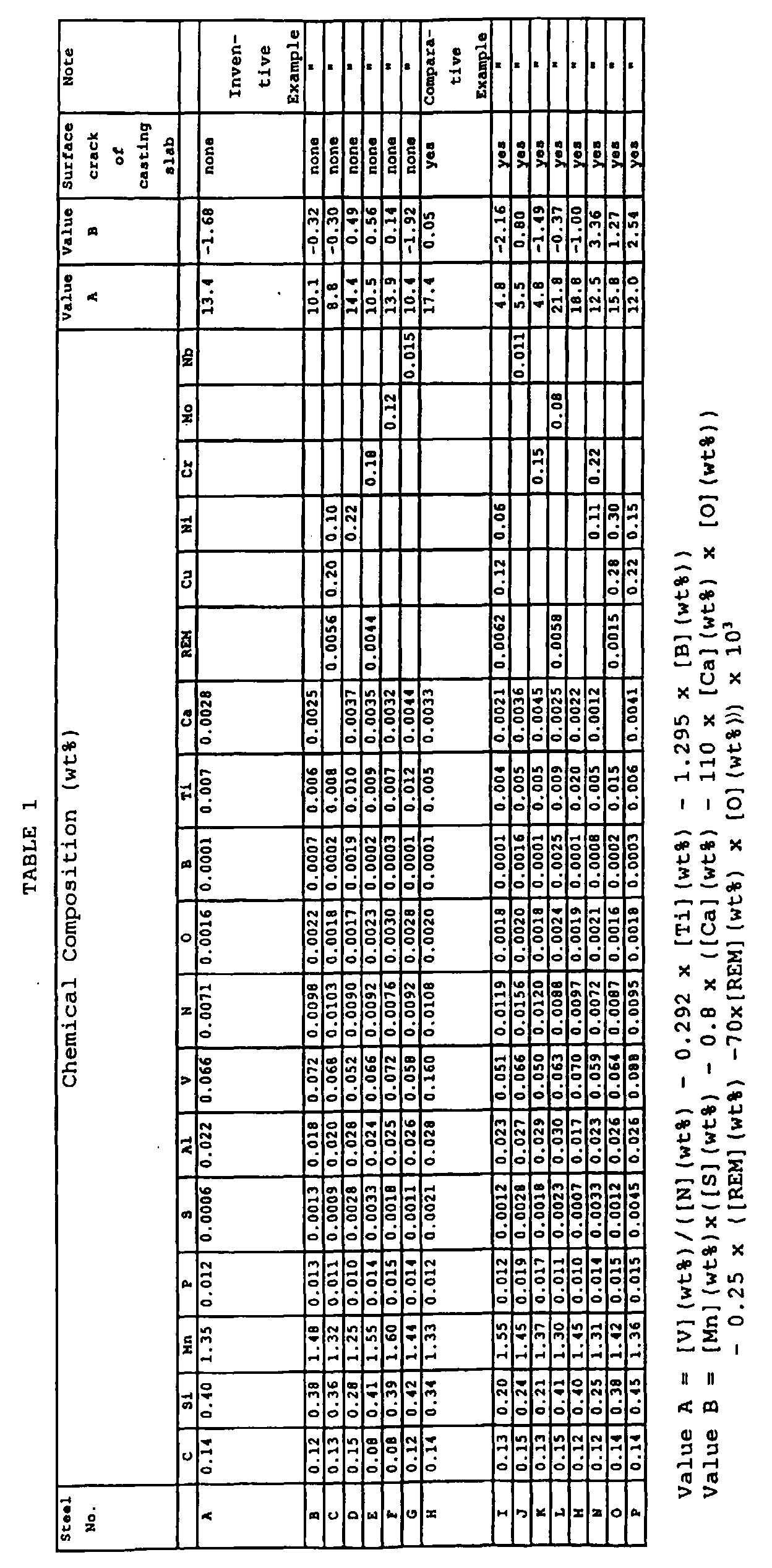
- the Figure is a graph showing the effect, on the reduction value (RA) in a high temperature tensile test, of a value B given by: [Mn](wt%) x ([S](wt%) - 0.8 x [Ca](wt%) - 110 x [Ca](wt%) x [O](wt%)) - 0.25 x ([REM](wt%) - 70 x [REM](wt%) x [O](wt%))) x 10 3 ) .
- the present invention provides compatibility between material properties and the inhibition of surface cracks of casting slabs, which has been previously difficult to achieve.
- the present invention controls the steel composition and also the relation between each of specific components of the composition, thereby controlling the precipitation of VN and MnS.
- the invention is based on the following findings that have been obtained by various experiments and studies by the inventors.
- MnS precipitated along the austenite grain boundaries functions as VN precipitation sites to promote grain boundary precipitation of VN and further increase the sensitivity to cracks at the grain boundaries. Grain boundary deposition of MnS and VN tends to cause surface cracking of the continuous casting slab. Accordingly, in the present invention, the S content is desirably reduced to be as low as possible. Further, because S is trapped as sulfides by adding Ca or REM, the amount of MnS segregating along the austenite grain boundaries can be decreased.
- composition of the continuous casting slab according to the present invention is described as follows.
- C increases the strength of steels.
- C should be added in an amount of 0.05 wt% or more.
- the C content is within the range of from about 0.05 to 0.18 wt%. In some preferred embodiments, the C content is from about 0.08 to 0.16 wt%.
- Si acts as a deoxidizer and contributes to an increase of the steel strength by solid-solution hardening.
- an addition in excess of 0.6 wt% of Si remarkably deteriorates the weldability of products and also the toughness in the heat affected zones formed by welding. Accordingly, the Si content should be 0.6 wt% or less.
- Mn increases the strength of steels. In order to ensure a desired strength level, Mn should be added in an amount of 0.80 wt% or more. However, when Mn is added in an amount in excess of 1.80 wt%, the structure of the products changes from mainly comprising ferrite + pearlite to mainly comprising low temperature transformation products such as bainite, which reduces the toughness of the products. Accordingly, in embodiments, the Mn content is within the range from 0.80 to 1.80 wt%. In some preferred embodiments, the Mn content is from about 1.00 to 1.70 wt%.
- the P content is desirably as low as possible. Up to about 0.030 wt% of P is permissible. Accordingly, in embodiments, the P content is about 0.030 wt% or less. In some preferred embodiments, the P content is about 0.020 wt% or less.
- the S content is about 0.004 wt% or less.
- Al acts as a deoxidizer. However, when Al is added in a large amount, non-metal inclusion formation increases, which deteriorates the cleanness and the toughness. Further, Al is likely to be bonded with N to form AlN, which inhibits stable precipitation of VN. Accordingly, in embodiments, the Al content is about 0.050 wt% or less.
- V has an important role in the invention.
- V is bonded with N to form nitrides, which are precipitated in austenite during hot working or subsequent cooling.
- VN acts as ferrite nucleation site and contributes to the refinement of ferrite crystal grains.
- the toughness of the products is improved.
- vanadium carbo-nitride is precipitated also in the ferrite after transformation, the strength of products can be improved without compulsory cooling. Because compulsory cooling is not necessary upon cooling, properties can be kept uniform along the thickness of the plate and neither residual stresses nor residual strains are produced. For effectively providing these effects, the V content needs to be about 0.04 wt% or more.
- V is added in an amount in the range from about 0.04 to 0.15 wt%. In some preferred embodiments, an amount of V added is from about 0.04 to 0.12 wt%.
- N is bonded with V and/or Ti to form nitrides.
- the nitrides suppress the growth of austenite grains upon heating of slabs. Further, the nitrides also act as ferrite nucleation site. Consequently, the ferrite crystal grains are refined and the toughness of the products is improved.
- N needs to be added in an amount of about 0.0050 wt% or more. However, when N is added in an amount in excess of about 0.0150 wt%, the solid solubilizing amount of N increases, which greatly deteriorates the toughness and the weldability of the products. Accordingly, in embodiments, the N content is from about 0.0050 to 0.0150 wt%. In some preferred embodiments, the N content is from about 0.0060 to 0.0120 wt%.
- Ti is bonded with N to form TiN.
- TiN suppresses the growth of the austenite grains during heating of slabs and also functions as VN precipitating sites. That is, when TiN is finely dispersed in the steels, VN can precipitate uniformly to suppress grain boundary cracks on the surface of the continuous casting slab. For attaining such an effect, Ti needs to be added in an amount of about 0.004 wt% or more. However, if Ti is added in an amount in excess of about 0.030 wt%, the cleanness of the steels is deteriorated and precipitation of VN is significantly suppressed. Accordingly, in embodiments, Ti is added in an amount within the range of from about 0.004 to 0.030 wt%. In some preferred embodiments, the Ti content is within the range of from about 0.005 to 0.020 wt%.
- B suppresses grain boundary formation of film-like ferrite along the austenite grain boundaries, which lowers the sensitivity to cracks at the grain boundaries. Further, B promotes the formation of intra-grain ferrite to refine the structure. For attaining these effects, B needs to be added in an amount of about 0.0003 wt% or more. However, if B is added in an amount in excess of about 0.0030 wt%, the toughness of the products is deteriorated. Accordingly, in embodiments, the amount of B is from about 0.0003 to 0.0030 wt%. A preferred amount of B is from about 0.0005 to 0.0020 wt%.
- Both of Ca and REM (rare earth metal) form stable sulfides at a high temperature to trap S in the steels.
- Ca and REM reduce solid solubilized S segregating along the austenite grain boundaries, they contribute to lowering of the sensitivity to cracks on the surface of the continuous casting slab.
- Ca and REM suppress the growing of austenite grains during slab heating to refine the ferrite grains after rolling.
- Ca and REM also have an effect of improving the toughness of the heat affected zones formed by welding. For attaining these effects, each of Ca and REM need to be added in an amount of about 0.0010 wt% or more.
- both of Ca and REM are added in an amount of from 0.0010 to 0.0100 wt%.
- each of the elements Cu, Ni, Cr and Mo increases the strength of the slabs by improving the hardenability. These elements are added optionally. For providing this effect, each of Cu, Ni and Cr needs to be added in an amount of about 0.05 wt% or more, and Mo needs to be added in an amount of about 0.02 wt% or more. However, even if each of Cu and Ni is added in an amount in excess of about 0.50 wt%, their effect does not further improve and it is also economically disadvantageous. Cr and Mo deteriorate the weldability and the toughness when added in excess of about 0.50 wt% and about 0.20 wt%, respectively. Accordingly, in embodiments, each of Cu, Ni and Cr is added in an amount within the range of from about 0.05 to 0.50 wt%, and Mo is added in an amount of within the range of from about 0.02 to 0.20 wt%.
- Nb improves both the strength and the toughness of the slabs by the structure refining effect and the precipitation hardening effect. Further, as also for Ti, Nb also promotes precipitation of VN. To provide these effects, Nb needs to be added in an amount of about 0.003 wt% or more. However, when Nb is added in an amount in excess of about 0.030 wt%, the weldability of the products and the toughness of the heat affected zones formed by welding are deteriorated. Accordingly, Nb is added within the range of from about 0.003 to 0.030 wt%.
- the value A represents the relationship between the amount of V and the amount of N that can be bonded with the V. If the value A is less than about 5.0, because the amount of solid solubilized N increases, cracks tend to be formed on the surface of continuous casting slabs. Further, an increase in the amount of solid solubilized N deteriorates the toughness of the heat affected zones or causes strain aging.
- the value A exceeds about 18.0, because VC is formed in a large amount, it increases the sensitivity to cracks on the surface of casting slabs and deteriorates the toughness of the products. Accordingly, in embodiments, the value A is within the range of from about 5.0 to 18.0. A preferred range for the value A is from about 6.0 to 12.0.
- the value B represents the relationship between the amount of Mn and S that can be bonded therewith. If the value B exceeds about 1.0, because a large amount of MnS precipitates along the austenite grain boundaries during continuous casting, surface cracks tend to form along the grain boundaries. Accordingly, it is necessary to restrict the value B to about 1.0 or less.
- the high temperature tensile test was conducted at a strain rate of 10 -4 s -1 after heating the test specimens at 1350°C to solid solubilize additive elements and then cooling them to 900°C.
- the condition is selected for reproducing tensile strains that the surface of the casting slab undergoes during continuous casting.
- Figure shows the relationship between the reduction value (RA) determined by the high temperature tensile test and the value B. It can be seen from Fig. 1 that when the value B is 1.0 or less, RA is 60% or more to provide excellent ductility.
- a method of manufacturing non-tempered high tensile steel materials is described as follows.
- a continuous casting slab is adjusted for the components and are heated to 1050°C to 1250°C.
- the heating temperature of the casting slab is lower than about 1050°C, precipitation elements such as V and Nb are not sufficiently solid solubilized, so that the effect of the precipitation elements cannot be provided effectively.
- the deformation resistance increases, it is difficult to ensure the rolling reduction in hot rolling.
- the casting slabs are heated at a temperature in excess of about 1250°C, austenite grains become remarkably coarse. Further, scale loss increase causes frequent furnace repair. Accordingly, the heating temperature for the casting slab is within the range of from about 1050°C to 1250°C.
- the slabs were heated and hot rolled under the conditions shown in TABLE 2 below to form steel plates with a thickness from 40 to 80 mm. After rolling, cooling was conducted by air cooling.
- tensile test pieces and Charpy impact test pieces were sampled from a central portion along the thickness of the plate and a tensile test and a Charpy impact test were conducted. Further, the Charpy impact test was conducted also on test pieces undergoing heat cycles with the highest heating temperature at 1400°C and 30 seconds of cooling period at a temperature of 800 to 500°C for reproducing heat affected zones by welding.
- continuous casting slab as the raw material for non-tempered high tensile steel materials having a tensile strength of 490 MPa or more can be obtained without forming surface cracks.
- products having both excellent strength and toughness can be produced without adding a large amount of expensive elements, with no requirement of large rolling reduction at low temperature.
- the products can be made without industrial problems.
- the non-tempered high tensile steel materials can form, for example, steel plates, hoops, sections and steel bars.
- the non-tempered high tensile steel materials can be utilized, for example, in buildings, bridge beams, marine structures, pipings, ship buildings, storage tanks, civil engineering and construction machines.
Landscapes
- Chemical & Material Sciences (AREA)
- Engineering & Computer Science (AREA)
- Mechanical Engineering (AREA)
- Materials Engineering (AREA)
- Metallurgy (AREA)
- Organic Chemistry (AREA)
- Physics & Mathematics (AREA)
- Thermal Sciences (AREA)
- Crystallography & Structural Chemistry (AREA)
- Heat Treatment Of Steel (AREA)
- Continuous Casting (AREA)
Abstract
Description

Claims (14)
- A steel continuous casting slab with no surface cracks comprising:C: about 0.05 to 0.18 wt%, Si: about 0.6 wt% or less, Mn: about 0.80 to 1.80 wt%, P: about 0.030 wt% or less, S: about 0.004 wt% or less, Al: about 0.050 wt% or less, V: about 0.04 to 0.15 wt% and N: about 0.0050 to 0.0150 wt%;at least one of Ti: about 0.004 to 0.030 wt% and B: about 0.0003 to 0.0030 wt% within a range satisfying the following equation (1); andat least one of Ca: about 0.0010 to 0.0100 wt% and REM: about 0.0010 to 0.0100 wt% within a range satisfying the following equation (2), with the balance being iron and inevitable impurities:
- The steel continuous casting slab of claim 1, further comprising at least one of Cu: about 0.05 to 0.50 wt%, Ni: about 0.05 to 0.50 wt%, Cr: about 0.05 to 0.50 wt%, and Mo: about 0.02 to 0.20 wt%.
- The steel continuous casting slab of claim 1, further comprising from about 0.003 to 0.030 wt% of Nb.
- A non-tempered high tensile steel article formed from the steel continuous casting slab according to claim 1.
- The non-tempered high tensile strength steel article of claim 4, wherein the article is a plate.
- The non-tempered high tensile strength steel article of claim 4, wherein the article is a bar.
- The non-tempered high tensile strength steel article of anyone of claims 5 or 6, characterized as having a yield strength of at least about 325 MPa, a tensile strength of at least about 490 MPa and a Charpy impact absorption energy at -20° of at least about 200 J.
- A method of manufacturing a non-tempered high tensile steel material, comprising:providing a steel continuous casting slab with no surface cracks comprising vanadium and nitrogen;heating the steel continuous casting slab;
andhot working the steel continuous casting slab to form a non-tempered high tensile steel material;
wherein the steel material having a yield strength of at least about 325 MPa, a tensile strength of at least about 490 MPa and a Charpy impact absorption energy at -20°C of at least about 200 J. - The method of claim 8, wherein:the heating comprises heating the steel continuous casting slab to a temperature of from about 1050°C to 1250°C; andthe hot working comprises hot working with a cumulative draft of at least 30% at a temperature of from about 1050°C to 950°C.
- The method of claim 8, wherein the steel continuous casting slab comprises:C: about 0.05 to 0.18 wt%, Si: about 0.6 wt% or less, Mn: about 0.80 to 1.80 wt%, P: about 0.030 wt% or less, S: about 0.004 wt% or less, Al: about 0.050 wt% or less, V: about 0.04 to 0.15 wt% and N: about 0.0050 to 0.0150 wt%;at least one of Ti: about 0.004 to 0.030 wt% and B: about 0.0003 to 0.0030 wt% within a range satisfying the following equation (1); andat least one of Ca: about 0.0010 to 0.0100 wt% and REM: about 0.0010 to 0.0100 wt% within a range satisfying the following equation (2), with the balance being iron and inevitable impurities:
- The method of claim 8, wherein the steel material has a tensile strength is at least about 520 MPa.
- The method of claim 8, wherein the steel material has an impact absorption energy at 0°C in a heat affected zone formed by welding of at least about 110 J.
- The method of claim 8, wherein the steel continuous casting slab comprises from about 0.04 to 0.15 wt% V and from about 0.0050 to 0.0150 wt% N.
- A method of manufacturing a non-tempered high tensile steel material, comprising:heating a continuous casting slab to a temperature of from about 1050°C to 1250°C; andhot working the continuous casting slab with a cumulative draft of at least 30% within the temperature range of from about 1050 to 950°C,
wherein the continuous casting slab comprising:C: about 0.05 to 0.18 wt%, Si: about 0.6 wt% or less, Mn: about 0.80 to 1.80 wt%, P: about 0.030 wt% or less, S: about 0.004 wt% or less, Al: about 0.050 wt% or less, V: about 0.04 to 0.15 wt% and N: about 0.0050 to 0.0150 wt%;at least one of Ti: about 0.004 to 0.030 wt% and B: about 0.0003 to 0.0030 wt% within a range satisfying the equation (1);and at least one of Ca: about 0.0010 to 0.0100 wt% and REM: about 0.0010 to 0.0100 wt% within a range satisfying the equation (2);
Applications Claiming Priority (2)
| Application Number | Priority Date | Filing Date | Title |
|---|---|---|---|
| JP06275399A JP3719037B2 (en) | 1999-03-10 | 1999-03-10 | Continuous cast slab having no surface crack and method for producing non-tempered high strength steel using this slab |
| JP6275399 | 1999-03-10 |
Publications (2)
| Publication Number | Publication Date |
|---|---|
| EP1035222A1 true EP1035222A1 (en) | 2000-09-13 |
| EP1035222B1 EP1035222B1 (en) | 2004-06-09 |
Family
ID=13209491
Family Applications (1)
| Application Number | Title | Priority Date | Filing Date |
|---|---|---|---|
| EP00105108A Expired - Lifetime EP1035222B1 (en) | 1999-03-10 | 2000-03-10 | Continuous casting slab suitable for the production of non-tempered high tensile steel material |
Country Status (7)
| Country | Link |
|---|---|
| US (1) | US6358335B1 (en) |
| EP (1) | EP1035222B1 (en) |
| JP (1) | JP3719037B2 (en) |
| KR (1) | KR100699629B1 (en) |
| CN (1) | CN1113109C (en) |
| DE (1) | DE60011326T2 (en) |
| TW (1) | TW515732B (en) |
Cited By (3)
| Publication number | Priority date | Publication date | Assignee | Title |
|---|---|---|---|---|
| WO2008045631A2 (en) | 2006-10-06 | 2008-04-17 | Exxonmobil Upstream Research Company | Low yield ratio dual phase steel linepipe with superior strain aging resistance |
| EP2236631A4 (en) * | 2007-12-06 | 2017-03-29 | Nippon Steel & Sumitomo Metal Corporation | Process for producing thick high-strength steel plate excellent in brittle fracture arrestability and toughness of zone affected by heat in large-heat-input welding and thick high-strength steel plate excellent in brittle fracture arrestability and toughness of zone affected by heat in large-heat-input welding |
| US10889876B2 (en) | 2015-11-12 | 2021-01-12 | Posco | Non-heat treated wire rod having excellent cold workability and manufactured method therefor |
Families Citing this family (12)
| Publication number | Priority date | Publication date | Assignee | Title |
|---|---|---|---|---|
| KR100867800B1 (en) * | 2004-07-07 | 2008-11-10 | 제이에프이 스틸 가부시키가이샤 | Method for Producing High Tensile Steel Sheet |
| JP5277648B2 (en) * | 2007-01-31 | 2013-08-28 | Jfeスチール株式会社 | High strength steel sheet with excellent delayed fracture resistance and method for producing the same |
| CN100457326C (en) * | 2007-04-20 | 2009-02-04 | 攀枝花钢铁(集团)公司 | Control method for transverse cracks of vanadium-containing high-nitrogen steel continuous casting slab corners |
| CN100457327C (en) * | 2007-04-20 | 2009-02-04 | 攀枝花钢铁(集团)公司 | Method for controlling net-shaped cracks of vanadium-containing high-nitrogen high-strength weathering steel continuous casting billet |
| JP5223720B2 (en) * | 2009-02-18 | 2013-06-26 | 新日鐵住金株式会社 | Continuous casting slab of steel for B-containing high-strength thick steel plate and method for producing the same |
| CN102102137B (en) * | 2009-12-22 | 2013-09-04 | 鞍钢股份有限公司 | Method for reducing internal cracks of high-carbon steel continuous rolling billet |
| CN105821348A (en) * | 2015-01-06 | 2016-08-03 | 宝钢特钢有限公司 | Ball stud steel of automobile steering system and manufacturing method thereof |
| JP7141944B2 (en) * | 2018-02-15 | 2022-09-26 | 株式会社神戸製鋼所 | Non-tempered forged parts and steel for non-tempered forgings |
| CN113832413B (en) * | 2020-06-23 | 2022-11-18 | 宝山钢铁股份有限公司 | Ultra-thick 800 MPa-grade quenched and tempered steel plate with excellent core low-temperature impact toughness and weldability and manufacturing method thereof |
| CN114561589A (en) * | 2022-02-28 | 2022-05-31 | 北京理工大学重庆创新中心 | Uncoated high-temperature oxidation-resistant hot stamping forming steel added with Y element |
| CN114561590A (en) * | 2022-02-28 | 2022-05-31 | 北京理工大学重庆创新中心 | Uncoated high-temperature oxidation resistant hot stamping forming steel added with Ce element |
| CN116574973A (en) * | 2023-05-15 | 2023-08-11 | 包头钢铁(集团)有限责任公司 | A kind of low-alloy high-strength rare-earth micro-alloyed hot-rolled π-shaped steel for road bridge expansion joint device and its manufacturing method |
Citations (7)
| Publication number | Priority date | Publication date | Assignee | Title |
|---|---|---|---|---|
| JPH08197102A (en) * | 1995-01-20 | 1996-08-06 | Kawasaki Steel Corp | Manufacturing method of extra-thick H-section steel with excellent toughness and weldability |
| JPH1068016A (en) * | 1996-08-26 | 1998-03-10 | Kawasaki Steel Corp | Method for manufacturing extra thick H-section steel |
| JPH1088230A (en) * | 1996-09-10 | 1998-04-07 | Kawasaki Steel Corp | Method for manufacturing high-tensile steel with excellent toughness |
| JPH1088275A (en) * | 1996-09-19 | 1998-04-07 | Kawasaki Steel Corp | High strength steel for welded structures with excellent weld heat affected zone toughness and weld crack resistance |
| US5743972A (en) * | 1995-08-29 | 1998-04-28 | Kawasaki Steel Corporation | Heavy-wall structural steel and method |
| JPH10306315A (en) * | 1997-04-30 | 1998-11-17 | Kawasaki Steel Corp | Method for producing non-heat treated high strength steel excellent in low temperature toughness |
| EP0940477A1 (en) * | 1998-03-05 | 1999-09-08 | Kawasaki Steel Corporation | Wide-flange beams made from a steel with high toughness and yield strength, and process for manufacturing these products |
Family Cites Families (9)
| Publication number | Priority date | Publication date | Assignee | Title |
|---|---|---|---|---|
| JPS5531819B2 (en) * | 1974-06-08 | 1980-08-21 | ||
| JPS56123350A (en) * | 1980-02-28 | 1981-09-28 | Nippon Steel Corp | High tensile steel for welded structure with superior weld crack resistance |
| JPS59200741A (en) * | 1983-04-28 | 1984-11-14 | Nippon Steel Corp | High strength steel having excellent resistance to plating brittleness and processability by forging |
| JPH01186848A (en) | 1988-01-18 | 1989-07-26 | Mitsubishi Kasei Corp | Method for producing 4-alkylbenzylamines |
| JP2661845B2 (en) * | 1992-09-24 | 1997-10-08 | 新日本製鐵株式会社 | Manufacturing method of oxide-containing refractory section steel by controlled rolling |
| JPH0736574A (en) * | 1993-06-29 | 1995-02-07 | Casio Comput Co Ltd | Electronic device initialization apparatus and method |
| US5622572A (en) * | 1995-08-28 | 1997-04-22 | Newport News Shipbuilding And Dry Dock Company | Extra-strength steel and method of making |
| JPH1096043A (en) * | 1996-09-24 | 1998-04-14 | Kawasaki Steel Corp | Refractory steel for building structures with excellent galvanization crack resistance and method of manufacturing the same |
| JP2003026344A (en) * | 2001-07-17 | 2003-01-29 | Ricoh Co Ltd | Paper dust removing device, paper dust removing method and paper evaluating method |
-
1999
- 1999-03-10 JP JP06275399A patent/JP3719037B2/en not_active Expired - Fee Related
-
2000
- 2000-02-29 US US09/515,654 patent/US6358335B1/en not_active Expired - Lifetime
- 2000-03-09 KR KR1020000011700A patent/KR100699629B1/en not_active Expired - Fee Related
- 2000-03-09 TW TW089104280A patent/TW515732B/en not_active IP Right Cessation
- 2000-03-10 EP EP00105108A patent/EP1035222B1/en not_active Expired - Lifetime
- 2000-03-10 CN CN00107039A patent/CN1113109C/en not_active Expired - Fee Related
- 2000-03-10 DE DE60011326T patent/DE60011326T2/en not_active Expired - Lifetime
Patent Citations (7)
| Publication number | Priority date | Publication date | Assignee | Title |
|---|---|---|---|---|
| JPH08197102A (en) * | 1995-01-20 | 1996-08-06 | Kawasaki Steel Corp | Manufacturing method of extra-thick H-section steel with excellent toughness and weldability |
| US5743972A (en) * | 1995-08-29 | 1998-04-28 | Kawasaki Steel Corporation | Heavy-wall structural steel and method |
| JPH1068016A (en) * | 1996-08-26 | 1998-03-10 | Kawasaki Steel Corp | Method for manufacturing extra thick H-section steel |
| JPH1088230A (en) * | 1996-09-10 | 1998-04-07 | Kawasaki Steel Corp | Method for manufacturing high-tensile steel with excellent toughness |
| JPH1088275A (en) * | 1996-09-19 | 1998-04-07 | Kawasaki Steel Corp | High strength steel for welded structures with excellent weld heat affected zone toughness and weld crack resistance |
| JPH10306315A (en) * | 1997-04-30 | 1998-11-17 | Kawasaki Steel Corp | Method for producing non-heat treated high strength steel excellent in low temperature toughness |
| EP0940477A1 (en) * | 1998-03-05 | 1999-09-08 | Kawasaki Steel Corporation | Wide-flange beams made from a steel with high toughness and yield strength, and process for manufacturing these products |
Non-Patent Citations (4)
| Title |
|---|
| PATENT ABSTRACTS OF JAPAN vol. 1996, no. 12 26 December 1996 (1996-12-26) * |
| PATENT ABSTRACTS OF JAPAN vol. 1998, no. 08 30 June 1998 (1998-06-30) * |
| PATENT ABSTRACTS OF JAPAN vol. 1998, no. 09 31 July 1998 (1998-07-31) * |
| PATENT ABSTRACTS OF JAPAN vol. 1999, no. 02 26 February 1999 (1999-02-26) * |
Cited By (4)
| Publication number | Priority date | Publication date | Assignee | Title |
|---|---|---|---|---|
| WO2008045631A2 (en) | 2006-10-06 | 2008-04-17 | Exxonmobil Upstream Research Company | Low yield ratio dual phase steel linepipe with superior strain aging resistance |
| EP2089556A4 (en) * | 2006-10-06 | 2011-10-05 | Exxonmobile Upstream Res Company | BIPHASIC STEEL PIPE HOSE WITH LOW FLOW RATE HAVING HIGHER AGING RESISTANCE AFTER MILLING |
| EP2236631A4 (en) * | 2007-12-06 | 2017-03-29 | Nippon Steel & Sumitomo Metal Corporation | Process for producing thick high-strength steel plate excellent in brittle fracture arrestability and toughness of zone affected by heat in large-heat-input welding and thick high-strength steel plate excellent in brittle fracture arrestability and toughness of zone affected by heat in large-heat-input welding |
| US10889876B2 (en) | 2015-11-12 | 2021-01-12 | Posco | Non-heat treated wire rod having excellent cold workability and manufactured method therefor |
Also Published As
| Publication number | Publication date |
|---|---|
| US6358335B1 (en) | 2002-03-19 |
| JP2000256795A (en) | 2000-09-19 |
| EP1035222B1 (en) | 2004-06-09 |
| CN1113109C (en) | 2003-07-02 |
| KR100699629B1 (en) | 2007-03-23 |
| JP3719037B2 (en) | 2005-11-24 |
| CN1270237A (en) | 2000-10-18 |
| DE60011326T2 (en) | 2005-06-23 |
| TW515732B (en) | 2003-01-01 |
| DE60011326D1 (en) | 2004-07-15 |
| KR20000062788A (en) | 2000-10-25 |
Similar Documents
| Publication | Publication Date | Title |
|---|---|---|
| US5948183A (en) | Hot-rolled steel sheet and method for forming hot-rolled steel sheet having low yield ratio, high strength and excellent toughness | |
| EP3556889B1 (en) | High strength multi-phase steel having excellent burring properties at low temperature, and method for producing same | |
| KR101388334B1 (en) | High tensile steel products excellent in the resistance to delayed fracture and process for production of the same | |
| CN1168700A (en) | Ultra-high strength secondary hardened steel with excellent toughness and weldability | |
| CA2353407C (en) | Method of making an as-rolled multi-purpose weathering steel plate and product therefrom | |
| EP1035222B1 (en) | Continuous casting slab suitable for the production of non-tempered high tensile steel material | |
| JP7244718B2 (en) | Steel material for thick high-strength line pipe with excellent low-temperature toughness, elongation and small yield ratio, and method for producing the same | |
| KR20070095373A (en) | High tensile steel with excellent delayed fracture resistance and manufacturing method | |
| EP3730658A1 (en) | Steel material for low yield ratio, high-strength steel pipe having excellent low-temperature toughness, and manufacturing method therefor | |
| JP3981615B2 (en) | Non-water-cooled thin low yield ratio high-tensile steel and method for producing the same | |
| EP2441854B1 (en) | High strength steel pipe and method for producing same | |
| JPH0860292A (en) | High-strength steel with excellent toughness | |
| JP4133175B2 (en) | Non-water cooled thin low yield ratio high strength steel with excellent toughness and method for producing the same | |
| JP2776174B2 (en) | Manufacturing method of high tensile strength and high toughness fine bainite steel | |
| EP4450671A1 (en) | Steel product and method of manufacturing the same | |
| US20250019812A1 (en) | Hot-rolled steel sheet and method for manufacturing same | |
| JPH11131177A (en) | Steel plate for medium and normal temperature pressure vessel which can omit post-weld heat treatment and method for producing the same | |
| KR101767771B1 (en) | The steel sheet for welding structure having excellent heat affected zone toughness and method for manufacturing the same | |
| JP2532176B2 (en) | Method for producing high-strength steel with excellent weldability and brittle crack propagation arresting properties | |
| JPS6256518A (en) | Production of high strength steel sheet for high heat input welding | |
| JP3255004B2 (en) | High strength steel material for welding excellent in toughness and arrestability and method for producing the same | |
| EP4079906A1 (en) | Structural steel material and method for manufacturing same | |
| JP3887860B2 (en) | Manufacturing method of steel sheet with excellent SCC resistance | |
| JPS63190117A (en) | Production of high tension steel plate having high toughness and less than 90% low yield ratio by direct quenching method | |
| KR100241306B1 (en) | The manufacturing method for low temperature steel with hot working |
Legal Events
| Date | Code | Title | Description |
|---|---|---|---|
| PUAI | Public reference made under article 153(3) epc to a published international application that has entered the european phase |
Free format text: ORIGINAL CODE: 0009012 |
|
| AK | Designated contracting states |
Kind code of ref document: A1 Designated state(s): DE GB LU |
|
| AX | Request for extension of the european patent |
Free format text: AL;LT;LV;MK;RO;SI |
|
| 17P | Request for examination filed |
Effective date: 20001215 |
|
| AKX | Designation fees paid |
Free format text: DE GB LU |
|
| 17Q | First examination report despatched |
Effective date: 20030502 |
|
| GRAP | Despatch of communication of intention to grant a patent |
Free format text: ORIGINAL CODE: EPIDOSNIGR1 |
|
| RAP1 | Party data changed (applicant data changed or rights of an application transferred) |
Owner name: JFE STEEL CORPORATION |
|
| GRAS | Grant fee paid |
Free format text: ORIGINAL CODE: EPIDOSNIGR3 |
|
| GRAA | (expected) grant |
Free format text: ORIGINAL CODE: 0009210 |
|
| AK | Designated contracting states |
Kind code of ref document: B1 Designated state(s): DE GB LU |
|
| REG | Reference to a national code |
Ref country code: GB Ref legal event code: FG4D |
|
| REF | Corresponds to: |
Ref document number: 60011326 Country of ref document: DE Date of ref document: 20040715 Kind code of ref document: P |
|
| PLBE | No opposition filed within time limit |
Free format text: ORIGINAL CODE: 0009261 |
|
| STAA | Information on the status of an ep patent application or granted ep patent |
Free format text: STATUS: NO OPPOSITION FILED WITHIN TIME LIMIT |
|
| 26N | No opposition filed |
Effective date: 20050310 |
|
| PGFP | Annual fee paid to national office [announced via postgrant information from national office to epo] |
Ref country code: LU Payment date: 20120330 Year of fee payment: 13 |
|
| PGFP | Annual fee paid to national office [announced via postgrant information from national office to epo] |
Ref country code: GB Payment date: 20120307 Year of fee payment: 13 |
|
| PGFP | Annual fee paid to national office [announced via postgrant information from national office to epo] |
Ref country code: DE Payment date: 20120411 Year of fee payment: 13 |
|
| GBPC | Gb: european patent ceased through non-payment of renewal fee |
Effective date: 20130310 |
|
| REG | Reference to a national code |
Ref country code: DE Ref legal event code: R119 Ref document number: 60011326 Country of ref document: DE Effective date: 20131001 |
|
| PG25 | Lapsed in a contracting state [announced via postgrant information from national office to epo] |
Ref country code: DE Free format text: LAPSE BECAUSE OF NON-PAYMENT OF DUE FEES Effective date: 20131001 Ref country code: GB Free format text: LAPSE BECAUSE OF NON-PAYMENT OF DUE FEES Effective date: 20130310 |
|
| PG25 | Lapsed in a contracting state [announced via postgrant information from national office to epo] |
Ref country code: LU Free format text: LAPSE BECAUSE OF NON-PAYMENT OF DUE FEES Effective date: 20130310 |