EP3556889B1 - High strength multi-phase steel having excellent burring properties at low temperature, and method for producing same - Google Patents
High strength multi-phase steel having excellent burring properties at low temperature, and method for producing same Download PDFInfo
- Publication number
- EP3556889B1 EP3556889B1 EP17880227.8A EP17880227A EP3556889B1 EP 3556889 B1 EP3556889 B1 EP 3556889B1 EP 17880227 A EP17880227 A EP 17880227A EP 3556889 B1 EP3556889 B1 EP 3556889B1
- Authority
- EP
- European Patent Office
- Prior art keywords
- steel
- hot
- high strength
- less
- cooling
- Prior art date
- Legal status (The legal status is an assumption and is not a legal conclusion. Google has not performed a legal analysis and makes no representation as to the accuracy of the status listed.)
- Active
Links
Images
Classifications
-
- C—CHEMISTRY; METALLURGY
- C22—METALLURGY; FERROUS OR NON-FERROUS ALLOYS; TREATMENT OF ALLOYS OR NON-FERROUS METALS
- C22C—ALLOYS
- C22C38/00—Ferrous alloys, e.g. steel alloys
-
- C—CHEMISTRY; METALLURGY
- C21—METALLURGY OF IRON
- C21D—MODIFYING THE PHYSICAL STRUCTURE OF FERROUS METALS; GENERAL DEVICES FOR HEAT TREATMENT OF FERROUS OR NON-FERROUS METALS OR ALLOYS; MAKING METAL MALLEABLE, e.g. BY DECARBURISATION OR TEMPERING
- C21D9/00—Heat treatment, e.g. annealing, hardening, quenching or tempering, adapted for particular articles; Furnaces therefor
- C21D9/46—Heat treatment, e.g. annealing, hardening, quenching or tempering, adapted for particular articles; Furnaces therefor for sheet metals
-
- C—CHEMISTRY; METALLURGY
- C21—METALLURGY OF IRON
- C21D—MODIFYING THE PHYSICAL STRUCTURE OF FERROUS METALS; GENERAL DEVICES FOR HEAT TREATMENT OF FERROUS OR NON-FERROUS METALS OR ALLOYS; MAKING METAL MALLEABLE, e.g. BY DECARBURISATION OR TEMPERING
- C21D6/00—Heat treatment of ferrous alloys
- C21D6/002—Heat treatment of ferrous alloys containing Cr
-
- C—CHEMISTRY; METALLURGY
- C21—METALLURGY OF IRON
- C21D—MODIFYING THE PHYSICAL STRUCTURE OF FERROUS METALS; GENERAL DEVICES FOR HEAT TREATMENT OF FERROUS OR NON-FERROUS METALS OR ALLOYS; MAKING METAL MALLEABLE, e.g. BY DECARBURISATION OR TEMPERING
- C21D6/00—Heat treatment of ferrous alloys
- C21D6/005—Heat treatment of ferrous alloys containing Mn
-
- C—CHEMISTRY; METALLURGY
- C21—METALLURGY OF IRON
- C21D—MODIFYING THE PHYSICAL STRUCTURE OF FERROUS METALS; GENERAL DEVICES FOR HEAT TREATMENT OF FERROUS OR NON-FERROUS METALS OR ALLOYS; MAKING METAL MALLEABLE, e.g. BY DECARBURISATION OR TEMPERING
- C21D6/00—Heat treatment of ferrous alloys
- C21D6/008—Heat treatment of ferrous alloys containing Si
-
- C—CHEMISTRY; METALLURGY
- C21—METALLURGY OF IRON
- C21D—MODIFYING THE PHYSICAL STRUCTURE OF FERROUS METALS; GENERAL DEVICES FOR HEAT TREATMENT OF FERROUS OR NON-FERROUS METALS OR ALLOYS; MAKING METAL MALLEABLE, e.g. BY DECARBURISATION OR TEMPERING
- C21D8/00—Modifying the physical properties of ferrous metals or ferrous alloys by deformation combined with, or followed by, heat treatment
- C21D8/02—Modifying the physical properties of ferrous metals or ferrous alloys by deformation combined with, or followed by, heat treatment during manufacturing of plates or strips
-
- C—CHEMISTRY; METALLURGY
- C21—METALLURGY OF IRON
- C21D—MODIFYING THE PHYSICAL STRUCTURE OF FERROUS METALS; GENERAL DEVICES FOR HEAT TREATMENT OF FERROUS OR NON-FERROUS METALS OR ALLOYS; MAKING METAL MALLEABLE, e.g. BY DECARBURISATION OR TEMPERING
- C21D8/00—Modifying the physical properties of ferrous metals or ferrous alloys by deformation combined with, or followed by, heat treatment
- C21D8/02—Modifying the physical properties of ferrous metals or ferrous alloys by deformation combined with, or followed by, heat treatment during manufacturing of plates or strips
- C21D8/0221—Modifying the physical properties of ferrous metals or ferrous alloys by deformation combined with, or followed by, heat treatment during manufacturing of plates or strips characterised by the working steps
- C21D8/0226—Hot rolling
-
- C—CHEMISTRY; METALLURGY
- C21—METALLURGY OF IRON
- C21D—MODIFYING THE PHYSICAL STRUCTURE OF FERROUS METALS; GENERAL DEVICES FOR HEAT TREATMENT OF FERROUS OR NON-FERROUS METALS OR ALLOYS; MAKING METAL MALLEABLE, e.g. BY DECARBURISATION OR TEMPERING
- C21D8/00—Modifying the physical properties of ferrous metals or ferrous alloys by deformation combined with, or followed by, heat treatment
- C21D8/02—Modifying the physical properties of ferrous metals or ferrous alloys by deformation combined with, or followed by, heat treatment during manufacturing of plates or strips
- C21D8/0247—Modifying the physical properties of ferrous metals or ferrous alloys by deformation combined with, or followed by, heat treatment during manufacturing of plates or strips characterised by the heat treatment
- C21D8/0263—Modifying the physical properties of ferrous metals or ferrous alloys by deformation combined with, or followed by, heat treatment during manufacturing of plates or strips characterised by the heat treatment following hot rolling
-
- C—CHEMISTRY; METALLURGY
- C22—METALLURGY; FERROUS OR NON-FERROUS ALLOYS; TREATMENT OF ALLOYS OR NON-FERROUS METALS
- C22C—ALLOYS
- C22C38/00—Ferrous alloys, e.g. steel alloys
- C22C38/001—Ferrous alloys, e.g. steel alloys containing N
-
- C—CHEMISTRY; METALLURGY
- C22—METALLURGY; FERROUS OR NON-FERROUS ALLOYS; TREATMENT OF ALLOYS OR NON-FERROUS METALS
- C22C—ALLOYS
- C22C38/00—Ferrous alloys, e.g. steel alloys
- C22C38/002—Ferrous alloys, e.g. steel alloys containing In, Mg, or other elements not provided for in one single group C22C38/001 - C22C38/60
-
- C—CHEMISTRY; METALLURGY
- C22—METALLURGY; FERROUS OR NON-FERROUS ALLOYS; TREATMENT OF ALLOYS OR NON-FERROUS METALS
- C22C—ALLOYS
- C22C38/00—Ferrous alloys, e.g. steel alloys
- C22C38/02—Ferrous alloys, e.g. steel alloys containing silicon
-
- C—CHEMISTRY; METALLURGY
- C22—METALLURGY; FERROUS OR NON-FERROUS ALLOYS; TREATMENT OF ALLOYS OR NON-FERROUS METALS
- C22C—ALLOYS
- C22C38/00—Ferrous alloys, e.g. steel alloys
- C22C38/04—Ferrous alloys, e.g. steel alloys containing manganese
-
- C—CHEMISTRY; METALLURGY
- C22—METALLURGY; FERROUS OR NON-FERROUS ALLOYS; TREATMENT OF ALLOYS OR NON-FERROUS METALS
- C22C—ALLOYS
- C22C38/00—Ferrous alloys, e.g. steel alloys
- C22C38/06—Ferrous alloys, e.g. steel alloys containing aluminium
-
- C—CHEMISTRY; METALLURGY
- C22—METALLURGY; FERROUS OR NON-FERROUS ALLOYS; TREATMENT OF ALLOYS OR NON-FERROUS METALS
- C22C—ALLOYS
- C22C38/00—Ferrous alloys, e.g. steel alloys
- C22C38/18—Ferrous alloys, e.g. steel alloys containing chromium
- C22C38/22—Ferrous alloys, e.g. steel alloys containing chromium with molybdenum or tungsten
-
- C—CHEMISTRY; METALLURGY
- C22—METALLURGY; FERROUS OR NON-FERROUS ALLOYS; TREATMENT OF ALLOYS OR NON-FERROUS METALS
- C22C—ALLOYS
- C22C38/00—Ferrous alloys, e.g. steel alloys
- C22C38/18—Ferrous alloys, e.g. steel alloys containing chromium
- C22C38/24—Ferrous alloys, e.g. steel alloys containing chromium with vanadium
-
- C—CHEMISTRY; METALLURGY
- C22—METALLURGY; FERROUS OR NON-FERROUS ALLOYS; TREATMENT OF ALLOYS OR NON-FERROUS METALS
- C22C—ALLOYS
- C22C38/00—Ferrous alloys, e.g. steel alloys
- C22C38/18—Ferrous alloys, e.g. steel alloys containing chromium
- C22C38/26—Ferrous alloys, e.g. steel alloys containing chromium with niobium or tantalum
-
- C—CHEMISTRY; METALLURGY
- C22—METALLURGY; FERROUS OR NON-FERROUS ALLOYS; TREATMENT OF ALLOYS OR NON-FERROUS METALS
- C22C—ALLOYS
- C22C38/00—Ferrous alloys, e.g. steel alloys
- C22C38/18—Ferrous alloys, e.g. steel alloys containing chromium
- C22C38/28—Ferrous alloys, e.g. steel alloys containing chromium with titanium or zirconium
-
- C—CHEMISTRY; METALLURGY
- C22—METALLURGY; FERROUS OR NON-FERROUS ALLOYS; TREATMENT OF ALLOYS OR NON-FERROUS METALS
- C22C—ALLOYS
- C22C38/00—Ferrous alloys, e.g. steel alloys
- C22C38/18—Ferrous alloys, e.g. steel alloys containing chromium
- C22C38/32—Ferrous alloys, e.g. steel alloys containing chromium with boron
-
- C—CHEMISTRY; METALLURGY
- C22—METALLURGY; FERROUS OR NON-FERROUS ALLOYS; TREATMENT OF ALLOYS OR NON-FERROUS METALS
- C22C—ALLOYS
- C22C38/00—Ferrous alloys, e.g. steel alloys
- C22C38/18—Ferrous alloys, e.g. steel alloys containing chromium
- C22C38/38—Ferrous alloys, e.g. steel alloys containing chromium with more than 1.5% by weight of manganese
-
- C—CHEMISTRY; METALLURGY
- C21—METALLURGY OF IRON
- C21D—MODIFYING THE PHYSICAL STRUCTURE OF FERROUS METALS; GENERAL DEVICES FOR HEAT TREATMENT OF FERROUS OR NON-FERROUS METALS OR ALLOYS; MAKING METAL MALLEABLE, e.g. BY DECARBURISATION OR TEMPERING
- C21D2211/00—Microstructure comprising significant phases
- C21D2211/001—Austenite
-
- C—CHEMISTRY; METALLURGY
- C21—METALLURGY OF IRON
- C21D—MODIFYING THE PHYSICAL STRUCTURE OF FERROUS METALS; GENERAL DEVICES FOR HEAT TREATMENT OF FERROUS OR NON-FERROUS METALS OR ALLOYS; MAKING METAL MALLEABLE, e.g. BY DECARBURISATION OR TEMPERING
- C21D2211/00—Microstructure comprising significant phases
- C21D2211/002—Bainite
-
- C—CHEMISTRY; METALLURGY
- C21—METALLURGY OF IRON
- C21D—MODIFYING THE PHYSICAL STRUCTURE OF FERROUS METALS; GENERAL DEVICES FOR HEAT TREATMENT OF FERROUS OR NON-FERROUS METALS OR ALLOYS; MAKING METAL MALLEABLE, e.g. BY DECARBURISATION OR TEMPERING
- C21D2211/00—Microstructure comprising significant phases
- C21D2211/005—Ferrite
-
- C—CHEMISTRY; METALLURGY
- C21—METALLURGY OF IRON
- C21D—MODIFYING THE PHYSICAL STRUCTURE OF FERROUS METALS; GENERAL DEVICES FOR HEAT TREATMENT OF FERROUS OR NON-FERROUS METALS OR ALLOYS; MAKING METAL MALLEABLE, e.g. BY DECARBURISATION OR TEMPERING
- C21D2211/00—Microstructure comprising significant phases
- C21D2211/008—Martensite
Definitions
- the present disclosure high strength steel having excellent burring properties at low temperature, and a method for producing the same. More specifically, the present disclosure relates to high strength steel having excellent burring properties at low temperature, and a method for producing the same, wherein the steel may be appropriately used as a member, a lower arm, a reinforcement material, a connection material, or the like for a vehicle chassis component.
- two-phase ferrite-bainite multi-phase steel may be mainly used as a hot-rolled steel sheet for an automobile chassis component, and examples of art related thereto are Patent Documents 1 to 3.
- the alloying elements such as silicon (Si), manganese (Mn), aluminum (Al), molybdenum (Mo), and chromium (Cr), mainly used to produce such multi-phase steel, may be effective in improving strength and stretch flangeability of hot-rolled steel sheets.
- Si silicon
- Mn manganese
- Al aluminum
- Mo molybdenum
- Cr chromium
- steel having a relatively high hardenability may be susceptible to microstructural changes depending on cooling conditions.
- An aspect of the present invention is to provide high strength steel having excellent burring properties at low temperature, and a method for producing the same.
- high strength steel according to the present invention has an advantage of having excellent burring properties at low temperature.
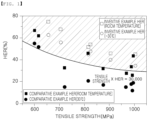
- FIG. 1 is a graph showing relationships between tensile strength and Hole Expanding Ratio (HER) of inventive and comparative examples.
- C may be the most economical and effective element for strengthening steel. As the content thereof increases, the tensile strength may increase by the precipitation strengthening effect or the bainite fraction increasing effect. In order to obtain such an effect in the present disclosure, C is contained in an amount of 0.05% or more. When the content thereof is excessive, a large amount of martensite may be formed, to excessively increase strength, deteriorate formability and impact resistance, and deteriorate weldability. In order to prevent this, an upper limit of the C content is limited to 0.14%, more preferably to 0.12%, and even more preferably to 0.10%.
- Si may play roles of deoxidizing molten steel, improving strength of steel by solid solution strengthening, delaying formation of coarse carbides, and improving formability.
- content thereof is 0.01% or more.
- a red color scale due to Si may be formed on the surface of the steel sheet during a hot-rolling operation, which not only deteriorates surface quality of the steel sheet, but also deteriorates ductility and weldability of the steel sheet.
- an upper limit of the Si is limited to 1.0%.
- Mn may be an effective element for solid solution strengthening the steel, and may enhance the hardenability of the steel to facilitate formation of bainite during a cooling operation, after a hot-rolling operation.
- the content thereof is 1.0% or more, preferably 1.2% or more.
- an upper limit of the Mn content is limited to 3.0%, preferably to 2.5%.
- Al may be a component mainly added for deoxidation, Al is contained in an amount of 0.01% or more to expect a sufficient deoxidizing effect.
- AlN When the content thereof is excessive, AlN may be formed in association with nitrogen, such that corner cracks may be likely to occur in a slab during a continuous casting operation, and defects due to formation of inclusions may be likely to occur.
- an upper limit of the content of Al is limited to 0.1%, preferably to 0.06%.
- Cr may play roles of solid solution strengthening the steel, delaying the phase transformation of ferrite during a cooling operation, and helping to form bainite.
- the content thereof is 0.005% or more, preferably 0.008% or more.
- the ferrite transformation may be excessively delayed to form martensite, thereby deteriorating the ductility of the steel.
- a segregation portion may be greatly developed in a central portion of the plate thickness, and a microstructure in the thickness direction may be made ununiformly, and the stretch flangeability may deteriorate.
- an upper limit of the Cr content is limited to 1.0%, preferably to 0.8%.
- Mo may increase the hardenability of the steel to facilitate bainite formation.
- the content thereof is 0.003% or more.
- martensite may be formed due to an increase in the quenchability, and the formability may rapidly deteriorate, which may be also disadvantageous in terms of economy and weldability.
- an upper limit of the Mo content is limited to 0.3%, preferably to 0.2%, more preferably to 0.1%.
- P like Si
- the content thereof is 0.001% or more.
- an upper limit of the P content is limited to 0.05%, preferably to 0.03%.
- S may be an impurity inevitably contained in the steel. When the content thereof is excessive, it may form a nonmetallic inclusion by bonding with Mn or the like, thereby causing fine cracks to occur during a cutting operation of the steel, and greatly reducing the stretch flangeability and impact resistance.
- an upper limit of the S content is limited to 0.01%, preferably to 0.005%.
- a lower limit of the S content is not particularly limited. In order to lower the S content to less than 0.001%, it may take too much time for steelmaking to lower productivity thereof. In consideration of the above, the limit may be set to 0.001%.
- N may be a representative solid solution strengthening element, in addition to C, and may form a coarse precipitate together with Ti, Al, and the like. In order to obtain such effects in the present disclosure, the content thereof is 0.001% or more.
- the solid solution strengthening effect of N may be better than that of carbon, but there may be a problem that the toughness may be largely lowered, when the N content in the steel is excessive. In order to prevent this, an upper limit of the N content is limited to 0.01%, preferably to 0.005%.
- Nb may be a representative precipitation strengthening element, in addition to Ti and V, may precipitate during a hot-rolling operation, and may refine the crystal grains through the delay of recrystallization, thereby improving the strength and impact toughness of the steel.
- the content thereof is 0.005% or more, preferably 0.01% or more.
- an upper limit of the Nb content is limited to 0.06%, preferably, to 0.04%.
- Ti may be a representative precipitation strengthening element, in addition to Nb and V, and may form a coarse TiN in the steel due to strong affinity with N. Such TiN may serve to inhibit growth of crystal grains during a heating operation for hot-rolling. Ti remaining after the reaction with N may form a TiC precipitate by solid solubilizing in the steel and bonding with C. This TiC may serve to improve the strength of the steel.
- the content thereof is preferably 0.005% or more, more preferably 0.05% or more. When the content thereof is excessive, the stretch flangeability may deteriorate by the formation of the coarse TiN and the coarsening of the precipitate during a forming operation. In order to prevent this, the upper limit of the Ti content is 0.13%.
- V may be a representative precipitation strengthening element, in addition to Nb and Ti, and may serve to form a precipitate after a coiling operation, to improve the strength of the steel.
- the content thereof is 0.003% or more.
- an upper limit of the V content is limited to 0.2%, preferably to 0.15%.
- the B may have an effect of stabilizing the grain boundaries and improving the brittleness of the steel at low temperature, when it is present in the solid solution state in the steel, and may play a role of forming BN together with solid solution N to inhibit formation of coarse nitride.
- the content thereof is 0.0003% or more.
- the recrystallization behavior during a hot-rolling operation may be delayed, and the ferrite transformation may be delayed to reduce the effect of precipitation strengthening.
- an upper limit of the B content is limited to 0.003%, preferably to 0.002%.
- the remainder of the present invention is iron (Fe) and other inevitable impurities.
- the impurities may not be excluded. All of these impurities are not specifically mentioned in this specification, as they are known to anyone skilled in the art of steelmaking. Meanwhile, addition of an effective component other than the above-mentioned composition is not excluded.
- [C]* defined by the following Equations 1 and 2 is controlled to be 0.022 or more and 0.10 or less, preferably to be 0.022 or more and 0.070 or less, more preferably to be 0.022 or more and 0.045 or less.
- the [C]* may be calculated by converting the amount of solid solution carbon and nitrogen in the steel. When a value thereof is too low, the bake hardenability may deteriorate.
- each of [C], [N], [Nb], [Ti], [V], and [Mo] refers to a weight percentage (wt%) of the element.
- the contents of C, N, Nb, Ti, V, and Mo are preferably controlled to be the value of 4.0 or less and more preferably controlled to be the value of 3.95 or less, in which the value calculated by the following Relationship 1.
- the following Relationship 1 may be a factorization of the combination of alloying elements capable of maintaining the proper formation of martensite and austenite (MA, martensite-austenite constituent) in the steel.
- the MA in the steel may form a high dislocation density around the steel to increase the bake hardenability of the steel, but, during punching and forming operations of the steel at low temperature, cracks may be generated and propagation of cracks may be promoted, such that the burring properties at low temperature may largely deteriorate.
- the high strength steel of the present disclosure includes ferrite and bainite as microstructures, and the sum of area ratios of ferrite and bainite is 97 to 99%.
- the sum of the area ratios of ferrite and bainite is controlled in the above-described range, strength, ductility, burring properties at low temperature, and bake hardenability of target steel may be easily secured.
- Each of the area ratio of ferrite and bainite is not particularly limited in the present disclosure.
- ferrite may be limited to not less than 20% of the area ratio of ferrite, in view of the fact that the ferrite may be useful for securing ductility of steel and forming fine precipitates, and bainite may be limited to 10% or more of the area ratio of bainite, in view of the fact that the bainite may be useful for securing strength and bake hardenability of steel.
- a remainder excluding ferrite and bainite is martensite and austenite (MA), and the area ratio thereof is 1 to 3%.
- MA martensite and austenite
- the area ratio of MA is less than 1%, bake hardenability may deteriorate.
- the area ratio of MA exceeds 3%, the burring properties at low temperature may deteriorate.
- the austenite may be effective in securing bake hardenability due to high dislocation density formed at the periphery.
- the austenite may have a higher C content and higher hardness than ferrite or bainite, which may be disadvantageous for the burring properties at low temperature.
- the coarse austenite having a diameter of 10 um or more may greatly deteriorate the burring properties at low temperature. Thus, it is preferable to suppress the formation of austenite having a diameter of 10 um or more, to the maximum.
- the number of austenite structures having a diameter of 10 um or more per a unit area is limited to 1 ⁇ 10 4 /cm 2 or less (including 0 /cm 2 ), and the number of austenite structures having a diameter of less than 10 ⁇ m per a unit area is limited to 1 ⁇ 10 8 /cm 2 or more.
- the diameter refers to the equivalent circular diameter of particles detected by observing a cross-section of the steel.
- the high strength steel of the present disclosure may have an advantage of high tensile strength, and according to an example, the tensile strength may be 590 MPa or more.
- the high strength steel of the present disclosure may have an advantage of excellent the burring properties at low temperature.
- a product of Hole Expanding Ratio (HER) and tensile strength at -30°C may be 30,000 MPa ⁇ % or more.
- the high strength steel of the present disclosure may have an advantage of excellent bake hardenability.
- the bake hardenability (BH) may be 40 MPa or more.
- the high strength steel of the present disclosure described above may be produced by various methods, and the production method thereof is not particularly limited. As a preferable example, it may be produced by the following method.
- the slab reheating temperature is 1200°C to 1350°C.
- the reheating temperature is lower than 1200°C, precipitates may be not sufficiently re-dissolved, such that, in other operations after hot-rolling operation, formation of the precipitates may be reduced, and coarse TiN may remain.
- the temperature exceeds 1350°C, the strength may be lowered due to abnormal grain growth of the austenite crystal grains.
- the reheated slab is hot-rolled.
- a hot-rolling operation may be carried out in a temperature range of 850°C to 1150°C.
- temperature of the hot-rolled steel sheet may become excessively high, size of the crystal grain may become large, and surface quality of the hot-rolled steel sheet may deteriorate.
- the hot-rolling operation is terminated at a temperature lower than 850°C, elongated crystal grains may be developed due to excessive recrystallization delay, such that anisotropy may become worse, and formability may also deteriorate.
- the hot-rolled steel sheet is firstly cooled.
- a first cooling end temperature is 500°C to 700°C, preferably 600°C to 670°C.
- an air-cooling operation is performed after completion of the first cooling operation.
- ferrite necessary for ensuring ductility of steel may be formed first, and fine precipitates may be formed in crystal grains of such ferrite. Therefore, the strength of the steel may be secured without affecting burring properties at low temperature.
- fine precipitates may not develop effectively in the subsequent air-cooling operation, to decrease the strength.
- a first cooling end temperature is excessively high, ferrite may be not sufficiently developed or MA may be excessively formed, to deteriorate ductility and burring properties at low temperature of the steel.
- the cooling rate in the first cooling operation is 10°C/sec to 70°C/sec, preferably 15°C/sec to 50°C/sec, and more preferably 20°C/sec to 45°C/sec.
- the cooling rate is too low, a fraction of the ferrite phase may be too low, while when the cooling rate is too high, the formation of fine precipitates may be insufficient.
- the firstly cooled steel sheet is air-cooled at the first cooling end temperature.
- air-cooling time is 3 to 10 seconds.
- the air-cooling time is too short, the ferrite may not be sufficiently formed to deteriorate ductility.
- air-cooling time is too long, bainite may be not sufficiently formed, to deteriorate the strength and the bake hardenability.
- the air-cooled steel sheet is secondly cooled.
- a second cooling end temperature is 400°C to 550°C, preferably 450°C to 550°C.
- bainite may not be sufficiently formed, and the strength of steel may be difficult to secure.
- bainite in the steel may be formed in excessively larger amounts than necessary, to greatly reduce the ductility, and MA may be also formed to deteriorate the burring properties at low temperature.
- a cooling rate in the second cooling operation is 10°C/sec to 70°C/sec, preferably 15°C/sec to 50°C/sec, and more preferably 20°C/sec to 25°C/sec.
- the cooling rate is too low, crystal grain of a matrix structure may become coarse, and a microstructure may become ununiform.
- the cooling rate is too high, MA may be likely to be formed, to deteriorate the burring properties at low temperature.
- the secondly cooled hot-rolled steel sheet is coiled at the second cooling end temperature, and then is subjected to a third cooling operation.
- a cooling rate is 25°C/hour or less (excluding 0°C/hour) and preferably 10°C/hour or less (excluding 0°C/hour).
- the cooling rate is excessively high, MA in the steel may be formed in a large amount, to deteriorate the burring properties at low temperature.
- the slower the cooling rate in the third cooling operation the more favorable the inhibition of MA formation in the steel.
- a lower limit thereof is not particularly limited. In order to control the cooling rate to less than 0.1°C/hour, a separate heating facility and the like may be needed, Which may be economically disadvantageous. Considering this, the lower limit may be limited to 0.1°C/hour.
- a third cooling end temperature is not particularly limited, and it may be enough when a third cooling operation is maintained until a temperature at which phase transformation of the steel is completed.
- the third cooling end temperature may be below 200°C.
- first and second cooling rates were in the range of 20°C/sec to 25°C/sec, a first cooling end temperature was 650°C, and air-cooling time was constantly 5 seconds.
- FDT refers to a hot-rolling end temperature
- CT refers to a second cooling end temperature (coiling temperature).
- YS, TS, and T-El refer to 0.2% off-set yield strength, tensile strength, and fracture elongation, respectively, and were test results of JIS No. 5 standard test specimens taken in a direction perpendicular to a rolling direction.
- the HER evaluation was based on the JFST 1001-1996 standard, and was averaged after three runs. In this case, the HER evaluation results at room temperature and -30°C were the results of punching and hole expansion tests of initial holes at 25°C and -30°C, respectively.
- BH was a test result of a tensile test specimen of JIS standard (JIS No.
- BH is a difference between measured lower yield strength value or 0.2% offset yield strength value in tension test and measured strength value in 2% tensile strain.
- Example Alloy Composition (wt%) C Si Mn Cr Al P S N *CE1 0.045 0.03 1.4 0.01 0.03 0.01 0.003 0.004 CE2 0.06 0.3 1.3 0.05 0.03 0.01 0.003 0.003 CE3 0.07 0.01 1.8 0.8 0.03 0.01 0.003 0.004 CE4 0.07 0.5 2.1 0.5 0.04 0.01 0.002 0.005 CE5 0.13 0.1 1.8 0.01 0.04 0.01 0.003 0.003 CE6 0.08 0.02 2.2 0.6 0.03 0.01 0.003 0.004 CE7 0.125 0.3 2.6 0.5 0.03 0.01 0.003 0.004 CE8 0.06 0.1 2.4 0.5 0.03 0.01 0.003 0.003 CE9 0.06 0.1 2.4 0.5 0.03 0.01 0.003 0.003 **IE1 0.06 0.05 1.3 0.5 0.03 0.01 0.003 0.004 IE2 0.06 0.01 1.5 0.01 0.03 0.01 0.003 0.0042 IE3 0.05 0.9 1.7
- Comparative Examples 1 and 2 the desired BH value in the present disclosure was not obtained, because [C]* values obtained therefrom failed to fall within the range of the present disclosure.
- Comparative Examples 3 and 4 not satisfying Relationship 1, it was confirmed that MA phase in steel was excessively formed, and burring properties at low temperature deteriorated.
- Comparative Example 5 a [C]* value obtained therefrom failed to fall within the range of the present disclosure, and a high BH value was obtained, but yield strength was decreased and burring properties at low temperature deteriorated. This was because the MA phase increased.
- Comparative Examples 6 and 7 [C]* values obtained therefrom and a value of Relationship 1 were not all satisfied.
- Comparative Example 6 due to lack of excess C and N, BH value was low, and alloying elements, capable of increasing hardenability, were in an excessive amount to also deteriorate HER at low temperature.
- Comparative Example 7 it was evaluated that the MA phase increased to have a high BH value, due to excess C in the steel, but to have low burring properties at low temperature.
- Comparative Examples 8 and 9 all of the component range proposed in the present disclosure, a [C]* value, and a value of Relationship 1 were satisfied, but coiling temperature or cooling rate after coiling failed to fall within the range proposed by the present disclosure.
- coiling temperature was as high as 580°C, to have a lower bainite phase fraction in the microstructure, and MA phase was hardly produced. In this case, coarse carbides were observed near the grain boundaries. As a result, BH value was very low, and burring properties at low temperature also deteriorated.
- Comparative Example 9 since a forced cooling operation was performed after coiling, third cooling rate was 63°C/hour.
- FIG. 1 is a graph showing relationships between tensile strength and Hole Expanding Ratio (HER) of Inventive Examples 1 to 6 and Comparative Examples 1 to 7.
- HER Hole Expanding Ratio
- a product of Hole Expanding Ratio (HER) and tensile strength at -30°C was 30,000 MPa ⁇ % or more.
Landscapes
- Chemical & Material Sciences (AREA)
- Engineering & Computer Science (AREA)
- Mechanical Engineering (AREA)
- Materials Engineering (AREA)
- Metallurgy (AREA)
- Organic Chemistry (AREA)
- Physics & Mathematics (AREA)
- Thermal Sciences (AREA)
- Crystallography & Structural Chemistry (AREA)
- Heat Treatment Of Sheet Steel (AREA)
- Heat Treatment Of Steel (AREA)
- Vehicle Body Suspensions (AREA)
Description
- The present disclosure high strength steel having excellent burring properties at low temperature, and a method for producing the same. More specifically, the present disclosure relates to high strength steel having excellent burring properties at low temperature, and a method for producing the same, wherein the steel may be appropriately used as a member, a lower arm, a reinforcement material, a connection material, or the like for a vehicle chassis component.
- In general, two-phase ferrite-bainite multi-phase steel may be mainly used as a hot-rolled steel sheet for an automobile chassis component, and examples of art related thereto are Patent Documents 1 to 3. The alloying elements such as silicon (Si), manganese (Mn), aluminum (Al), molybdenum (Mo), and chromium (Cr), mainly used to produce such multi-phase steel, may be effective in improving strength and stretch flangeability of hot-rolled steel sheets. However, when they are added in excessively amounts, segregation of alloy components and ununiformity of a microstructure may be caused, such that the stretch flangeability may deteriorate. Especially, steel having a relatively high hardenability may be susceptible to microstructural changes depending on cooling conditions. When a low temperature transformed structure phase is formed ununiformly, the stretch flangeability may deteriorate. In addition, when precipitate forming elements such as titanium (Ti), niobium (Nb), and vanadium (V) are excessively used to obtain high strength, a rolling load may increase due to delay of recrystallization of the steel during a hot-rolling operation. Therefore, it may be difficult to produce a relatively thin product, and formability may also deteriorate. In addition, since the content of C and N dissolved in the steel may decrease, it may be difficult to obtain a relatively high bake hardenability (BH) value, and it may be economically disadvantageous.
WO2015099222A1 describes a hot-rolled steel sheet, the product of its tensile strength and extension flange property is 48000 or more. - (Patent Document 1)
Japanese Patent Publication No. 06-293910 - (Patent Document 2)
Korean Patent No. 10-1114672 - (Patent Document 3)
Korean Patent Publication No. 10-2013-7009196 - (Patent Document 4)
WO2015099222A1 - An aspect of the present invention is to provide high strength steel having excellent burring properties at low temperature, and a method for producing the same.
- The present invention is as described in claims 1 to 7.
- According to an aspect of the present invention, high strength steel according to the present invention has an advantage of having excellent burring properties at low temperature.
- The various and advantageous advantages and effects of the present invention are not limited to the above description, and can be more easily understood in the course of describing specific embodiments of the present invention.
-
FIG. 1 is a graph showing relationships between tensile strength and Hole Expanding Ratio (HER) of inventive and comparative examples. - Hereinafter, high strength steel having excellent burring properties at low temperature, which may be one aspect of the present disclosure, will be described in detail.
- First, the alloy components and the preferable content range of the high strength steel of the present disclosure will be described in detail. It is noted that the content of each component described below is based on weight, unless otherwise specified.
- C may be the most economical and effective element for strengthening steel. As the content thereof increases, the tensile strength may increase by the precipitation strengthening effect or the bainite fraction increasing effect. In order to obtain such an effect in the present disclosure, C is contained in an amount of 0.05% or more. When the content thereof is excessive, a large amount of martensite may be formed, to excessively increase strength, deteriorate formability and impact resistance, and deteriorate weldability. In order to prevent this, an upper limit of the C content is limited to 0.14%, more preferably to 0.12%, and even more preferably to 0.10%.
- Si may play roles of deoxidizing molten steel, improving strength of steel by solid solution strengthening, delaying formation of coarse carbides, and improving formability. In order to obtain such effects in the present disclosure, content thereof is 0.01% or more. When the content thereof is excessive, a red color scale due to Si may be formed on the surface of the steel sheet during a hot-rolling operation, which not only deteriorates surface quality of the steel sheet, but also deteriorates ductility and weldability of the steel sheet. In order to prevent this, an upper limit of the Si is limited to 1.0%.
- Mn, like Si, may be an effective element for solid solution strengthening the steel, and may enhance the hardenability of the steel to facilitate formation of bainite during a cooling operation, after a hot-rolling operation. In order to obtain such effects in the present disclosure, the content thereof is 1.0% or more, preferably 1.2% or more. When the content thereof is excessive, there may be problems that the hardenability may greatly increase, martensite transformation may easily occur, the microstructure may be unevenly formed in the plate thickness direction, and the stretch flangeability may deteriorate. In order to prevent this, an upper limit of the Mn content is limited to 3.0%, preferably to 2.5%.
- Al may be a component mainly added for deoxidation, Al is contained in an amount of 0.01% or more to expect a sufficient deoxidizing effect. When the content thereof is excessive, AlN may be formed in association with nitrogen, such that corner cracks may be likely to occur in a slab during a continuous casting operation, and defects due to formation of inclusions may be likely to occur. In order to prevent this, an upper limit of the content of Al is limited to 0.1%, preferably to 0.06%.
- Cr may play roles of solid solution strengthening the steel, delaying the phase transformation of ferrite during a cooling operation, and helping to form bainite. In order to obtain such an effect in the present disclosure, the content thereof is 0.005% or more, preferably 0.008% or more. When the content thereof is excessive, the ferrite transformation may be excessively delayed to form martensite, thereby deteriorating the ductility of the steel. In addition, similar to Mn, a segregation portion may be greatly developed in a central portion of the plate thickness, and a microstructure in the thickness direction may be made ununiformly, and the stretch flangeability may deteriorate. In order to prevent this, an upper limit of the Cr content is limited to 1.0%, preferably to 0.8%.
- Mo may increase the hardenability of the steel to facilitate bainite formation. In order to obtain such effects in the present disclosure, the content thereof is 0.003% or more. When the content thereof is excessive, martensite may be formed due to an increase in the quenchability, and the formability may rapidly deteriorate, which may be also disadvantageous in terms of economy and weldability. In order to prevent this, an upper limit of the Mo content is limited to 0.3%, preferably to 0.2%, more preferably to 0.1%.
- P, like Si, has effects of solid solution strengthening and ferrite transformation promotion at the same time. In order to obtain such effects in the present disclosure, the content thereof is 0.001% or more. When the content thereof is excessive, brittleness due to grain boundary segregation may occur, fine cracks may be likely to occur during a forming operation, and the ductility, stretch flangeability, and impact resistance characteristics may greatly deteriorate. In order to prevent this, an upper limit of the P content is limited to 0.05%, preferably to 0.03%.
- S may be an impurity inevitably contained in the steel. When the content thereof is excessive, it may form a nonmetallic inclusion by bonding with Mn or the like, thereby causing fine cracks to occur during a cutting operation of the steel, and greatly reducing the stretch flangeability and impact resistance. In order to prevent this, an upper limit of the S content is limited to 0.01%, preferably to 0.005%. In the present disclosure, a lower limit of the S content is not particularly limited. In order to lower the S content to less than 0.001%, it may take too much time for steelmaking to lower productivity thereof. In consideration of the above, the limit may be set to 0.001%.
- N may be a representative solid solution strengthening element, in addition to C, and may form a coarse precipitate together with Ti, Al, and the like. In order to obtain such effects in the present disclosure, the content thereof is 0.001% or more. The solid solution strengthening effect of N may be better than that of carbon, but there may be a problem that the toughness may be largely lowered, when the N content in the steel is excessive. In order to prevent this, an upper limit of the N content is limited to 0.01%, preferably to 0.005%.
- Nb may be a representative precipitation strengthening element, in addition to Ti and V, may precipitate during a hot-rolling operation, and may refine the crystal grains through the delay of recrystallization, thereby improving the strength and impact toughness of the steel. In order to obtain such effects in the present disclosure, the content thereof is 0.005% or more, preferably 0.01% or more. When the content thereof is excessive, a elongated crystal grain may be formed due to an excessively slow recrystallization delay during hot-rolling, and a coarse complex precipitate may be formed, which may cause a problem of insufficient stretch flangeability. In order to prevent this, an upper limit of the Nb content is limited to 0.06%, preferably, to 0.04%.
- Ti may be a representative precipitation strengthening element, in addition to Nb and V, and may form a coarse TiN in the steel due to strong affinity with N. Such TiN may serve to inhibit growth of crystal grains during a heating operation for hot-rolling. Ti remaining after the reaction with N may form a TiC precipitate by solid solubilizing in the steel and bonding with C. This TiC may serve to improve the strength of the steel. In order to obtain such an effect in the present disclosure, the content thereof is preferably 0.005% or more, more preferably 0.05% or more. When the content thereof is excessive, the stretch flangeability may deteriorate by the formation of the coarse TiN and the coarsening of the precipitate during a forming operation. In order to prevent this, the upper limit of the Ti content is 0.13%.
- V may be a representative precipitation strengthening element, in addition to Nb and Ti, and may serve to form a precipitate after a coiling operation, to improve the strength of the steel. In order to obtain such effects in the present disclosure, the content thereof is 0.003% or more. When the content thereof is excessive, a coarse complex precipitate may be formed to deteriorate stretch flangeability, which may be economically disadvantageous. In order to prevent this, an upper limit of the V content is limited to 0.2%, preferably to 0.15%.
- B may have an effect of stabilizing the grain boundaries and improving the brittleness of the steel at low temperature, when it is present in the solid solution state in the steel, and may play a role of forming BN together with solid solution N to inhibit formation of coarse nitride. In order to obtain such an effect in the present disclosure, the content thereof is 0.0003% or more. When the content thereof is excessive, the recrystallization behavior during a hot-rolling operation may be delayed, and the ferrite transformation may be delayed to reduce the effect of precipitation strengthening. In order to prevent this, an upper limit of the B content is limited to 0.003%, preferably to 0.002%.
- The remainder of the present invention is iron (Fe) and other inevitable impurities. In the conventional steel manufacturing process, since impurities which are not intended from raw materials or the surrounding environment may be inevitably incorporated, the impurities may not be excluded. All of these impurities are not specifically mentioned in this specification, as they are known to anyone skilled in the art of steelmaking. Meanwhile, addition of an effective component other than the above-mentioned composition is not excluded.
- When designing an alloy of a steel material having the above-described composition range, [C]* defined by the following Equations 1 and 2 is controlled to be 0.022 or more and 0.10 or less, preferably to be 0.022 or more and 0.070 or less, more preferably to be 0.022 or more and 0.045 or less. The [C]* may be calculated by converting the amount of solid solution carbon and nitrogen in the steel. When a value thereof is too low, the bake hardenability may deteriorate. When a value thereof is too high, the burring properties at low temperature may deteriorate:


where each of [C], [N], [Nb], [Ti], [V], and [Mo] refers to a weight percentage (wt%) of the element. - In designing an alloy of a steel material having the above-mentioned composition range, the contents of C, N, Nb, Ti, V, and Mo are preferably controlled to be the value of 4.0 or less and more preferably controlled to be the value of 3.95 or less, in which the value calculated by the following Relationship 1. The following Relationship 1 may be a factorization of the combination of alloying elements capable of maintaining the proper formation of martensite and austenite (MA, martensite-austenite constituent) in the steel. The MA in the steel may form a high dislocation density around the steel to increase the bake hardenability of the steel, but, during punching and forming operations of the steel at low temperature, cracks may be generated and propagation of cracks may be promoted, such that the burring properties at low temperature may largely deteriorate. The lower the value of Relationship 1 is, the more favorable the improvement of the burring properties at low temperature. Therefore, the lower limit thereof is not particularly limited in the present disclosure.

where each of [Mn], [Mo], [Cr], and [B] refers to a weight percentage (wt%) of the element. - Hereinafter, the microstructure of the high strength steel of the present disclosure will be described in detail.
- The high strength steel of the present disclosure includes ferrite and bainite as microstructures, and the sum of area ratios of ferrite and bainite is 97 to 99%. When the sum of the area ratios of ferrite and bainite is controlled in the above-described range, strength, ductility, burring properties at low temperature, and bake hardenability of target steel may be easily secured. Each of the area ratio of ferrite and bainite is not particularly limited in the present disclosure.
- For example, ferrite may be limited to not less than 20% of the area ratio of ferrite, in view of the fact that the ferrite may be useful for securing ductility of steel and forming fine precipitates, and bainite may be limited to 10% or more of the area ratio of bainite, in view of the fact that the bainite may be useful for securing strength and bake hardenability of steel.
- A remainder excluding ferrite and bainite is martensite and austenite (MA), and the area ratio thereof is 1 to 3%. When the area ratio of MA is less than 1%, bake hardenability may deteriorate. When the area ratio of MA exceeds 3%, the burring properties at low temperature may deteriorate.
- In MA, the austenite may be effective in securing bake hardenability due to high dislocation density formed at the periphery. The austenite may have a higher C content and higher hardness than ferrite or bainite, which may be disadvantageous for the burring properties at low temperature. The coarse austenite having a diameter of 10 um or more may greatly deteriorate the burring properties at low temperature. Thus, it is preferable to suppress the formation of austenite having a diameter of 10 um or more, to the maximum. In the present disclosure, the number of austenite structures having a diameter of 10 um or more per a unit area is limited to 1 × 10⁴ /cm2 or less (including 0 /cm2), and the number of austenite structures having a diameter of less than 10 µm per a unit area is limited to 1 × 10⁸ /cm2 or more. In this case, the diameter refers to the equivalent circular diameter of particles detected by observing a cross-section of the steel.
- The high strength steel of the present disclosure may have an advantage of high tensile strength, and according to an example, the tensile strength may be 590 MPa or more.
- The high strength steel of the present disclosure may have an advantage of excellent the burring properties at low temperature. According to an example, a product of Hole Expanding Ratio (HER) and tensile strength at -30°C may be 30,000 MPa·% or more.
- The high strength steel of the present disclosure may have an advantage of excellent bake hardenability. According to an example, the bake hardenability (BH) may be 40 MPa or more.
- The high strength steel of the present disclosure described above may be produced by various methods, and the production method thereof is not particularly limited. As a preferable example, it may be produced by the following method.
- Hereinafter, a method for producing high strength steel excellent in burring properties at low temperature, according to the present invention, will be described in detail.
- First, a slab having the above-mentioned component system is reheated.
- According to the present invention, the slab reheating temperature is 1200°C to 1350°C. When the reheating temperature is lower than 1200°C, precipitates may be not sufficiently re-dissolved, such that, in other operations after hot-rolling operation, formation of the precipitates may be reduced, and coarse TiN may remain. When the temperature exceeds 1350°C, the strength may be lowered due to abnormal grain growth of the austenite crystal grains.
- Next, the reheated slab is hot-rolled.
- According to an example, a hot-rolling operation may be carried out in a temperature range of 850°C to 1150°C. When the hot-rolling operation is started at a temperature higher than 1150°C, temperature of the hot-rolled steel sheet may become excessively high, size of the crystal grain may become large, and surface quality of the hot-rolled steel sheet may deteriorate. When the hot-rolling operation is terminated at a temperature lower than 850°C, elongated crystal grains may be developed due to excessive recrystallization delay, such that anisotropy may become worse, and formability may also deteriorate.
- Next, the hot-rolled steel sheet is firstly cooled.
- In this case, a first cooling end temperature is 500°C to 700°C, preferably 600°C to 670°C. As will be described later, in the present disclosure, an air-cooling operation is performed after completion of the first cooling operation. In this case, ferrite necessary for ensuring ductility of steel may be formed first, and fine precipitates may be formed in crystal grains of such ferrite. Therefore, the strength of the steel may be secured without affecting burring properties at low temperature. When a first cooling end temperature is too low, fine precipitates may not develop effectively in the subsequent air-cooling operation, to decrease the strength. When a first cooling end temperature is excessively high, ferrite may be not sufficiently developed or MA may be excessively formed, to deteriorate ductility and burring properties at low temperature of the steel.
- The cooling rate in the first cooling operation is 10°C/sec to 70°C/sec, preferably 15°C/sec to 50°C/sec, and more preferably 20°C/sec to 45°C/sec. When the cooling rate is too low, a fraction of the ferrite phase may be too low, while when the cooling rate is too high, the formation of fine precipitates may be insufficient.
- Next, the firstly cooled steel sheet is air-cooled at the first cooling end temperature.
- In this case, air-cooling time is 3 to 10 seconds. When the air-cooling time is too short, the ferrite may not be sufficiently formed to deteriorate ductility. When air-cooling time is too long, bainite may be not sufficiently formed, to deteriorate the strength and the bake hardenability.
- Next, the air-cooled steel sheet is secondly cooled.
- In this case, a second cooling end temperature is 400°C to 550°C, preferably 450°C to 550°C. When the second cooling end temperature is too high, bainite may not be sufficiently formed, and the strength of steel may be difficult to secure. When the second cooling end temperature is excessively low, bainite in the steel may be formed in excessively larger amounts than necessary, to greatly reduce the ductility, and MA may be also formed to deteriorate the burring properties at low temperature.
- A cooling rate in the second cooling operation is 10°C/sec to 70°C/sec, preferably 15°C/sec to 50°C/sec, and more preferably 20°C/sec to 25°C/sec. When the cooling rate is too low, crystal grain of a matrix structure may become coarse, and a microstructure may become ununiform. When the cooling rate is too high, MA may be likely to be formed, to deteriorate the burring properties at low temperature.
- Next, the secondly cooled hot-rolled steel sheet is coiled at the second cooling end temperature, and then is subjected to a third cooling operation.
- In the third cooling operation, a cooling rate is 25°C/hour or less (excluding 0°C/hour) and preferably 10°C/hour or less (excluding 0°C/hour). When the cooling rate is excessively high, MA in the steel may be formed in a large amount, to deteriorate the burring properties at low temperature. The slower the cooling rate in the third cooling operation, the more favorable the inhibition of MA formation in the steel. In the present disclosure, a lower limit thereof is not particularly limited. In order to control the cooling rate to less than 0.1°C/hour, a separate heating facility and the like may be needed, Which may be economically disadvantageous. Considering this, the lower limit may be limited to 0.1°C/hour.
- In the present invention, a third cooling end temperature is not particularly limited, and it may be enough when a third cooling operation is maintained until a temperature at which phase transformation of the steel is completed. By way of non-limiting example, the third cooling end temperature may be below 200°C.
- In the description below, an example embodiment of the present invention will be described in greater detail. It should be noted that the example embodiments are provided to describe the present invention in greater detail, the scope of rights of the present invention is defined in the appended claims.
- Steel slabs having the compositions illustrated in the following Tables 1 and 2 were reheated to 1250°C, and were hot-rolled under the conditions illustrated in Table 2 to obtain hot-rolled steel sheets. Then, a first cooling operation, an air-cooling operation, a second cooling operation, a coiling operation, and a third cooling operation were carried out in sequence. In each example, first and second cooling rates were in the range of 20°C/sec to 25°C/sec, a first cooling end temperature was 650°C, and air-cooling time was constantly 5 seconds. In the following Table 3, FDT refers to a hot-rolling end temperature, and CT refers to a second cooling end temperature (coiling temperature).
- Then, a microstructure of the hot-rolled steel sheet was analyzed, and mechanical properties were evaluated. The results therefrom are illustrated in the following Table 4.
- In the following Table 4, an area fraction of MA in steel was measured using an optical microscope and an image analyzer after etched by Lepera etching method. The size and number of austenite structures were measured using an Electron Back Scatter Diffraction (EBSD) method, and analyzed at 3000 magnification.
- In the following Table 4, YS, TS, and T-El refer to 0.2% off-set yield strength, tensile strength, and fracture elongation, respectively, and were test results of JIS No. 5 standard test specimens taken in a direction perpendicular to a rolling direction. In addition, the HER evaluation was based on the JFST 1001-1996 standard, and was averaged after three runs. In this case, the HER evaluation results at room temperature and -30°C were the results of punching and hole expansion tests of initial holes at 25°C and -30°C, respectively. BH was a test result of a tensile test specimen of JIS standard (JIS No. 5) manufactured in a direction perpendicular to a rolling direction, and was subjected to 2% tensile strain, heat treated at 170°C for 20 minutes, and a tensile test was carried out, and BH is a difference between measured lower yield strength value or 0.2% offset yield strength value in tension test and measured strength value in 2% tensile strain.
[Table 1] Example Alloy Composition (wt%) C Si Mn Cr Al P S N *CE1 0.045 0.03 1.4 0.01 0.03 0.01 0.003 0.004 CE2 0.06 0.3 1.3 0.05 0.03 0.01 0.003 0.003 CE3 0.07 0.01 1.8 0.8 0.03 0.01 0.003 0.004 CE4 0.07 0.5 2.1 0.5 0.04 0.01 0.002 0.005 CE5 0.13 0.1 1.8 0.01 0.04 0.01 0.003 0.003 CE6 0.08 0.02 2.2 0.6 0.03 0.01 0.003 0.004 CE7 0.125 0.3 2.6 0.5 0.03 0.01 0.003 0.004 CE8 0.06 0.1 2.4 0.5 0.03 0.01 0.003 0.003 CE9 0.06 0.1 2.4 0.5 0.03 0.01 0.003 0.003 **IE1 0.06 0.05 1.3 0.5 0.03 0.01 0.003 0.004 IE2 0.06 0.01 1.5 0.01 0.03 0.01 0.003 0.0042 IE3 0.05 0.9 1.7 0.7 0.03 0.01 0.003 0.0035 IE4 0.07 0.3 1.6 0.7 0.03 0.01 0.003 0.004 IE5 0.075 0.7 1.7 0.7 0.03 0.01 0.003 0.004 IE6 0.06 0.1 2.4 0.5 0.03 0.01 0.003 0.003 *CE: Comparative Example, **IE: Inventive Example. [Table 2] Example Alloying Composition (wt%) [C]* Relationship 1 Mo Ti Nb V B *CE1 0.03 0.09 0.03 0.005 0.0002 0.017 1.60 CE2 0.1 0.004 0.05 0.1 0.0003 0.019 1.81 CE3 0.15 0.09 0.025 0.005 0.0015 0.028 4.17 CE4 0.1 0.1 0.03 0.006 0.0025 0.032 4.38 CE5 0.001 0.07 0.02 0.005 0.0004 0.051 2.02 CE6 0.2 0.04 0.06 0.1 0.001 0.017 4.16 CE7 0.05 0.06 0.007 0.008 0.0015 0.049 4.38 CE8 0.004 0.07 0.03 0.004 0.0015 0.040 3.91 CE9 0.004 0.07 0.03 0.004 0.0015 0.040 3.91 **IE1 0.005 0.085 0.02 0.005 0.0003 0.038 2.21 IE2 0.003 0.07 0.03 0.005 0.0004 0.041 1.72 IE3 0.05 0.06 0.03 0.005 0.0005 0.027 3.14 IE4 0.004 0.1 0.02 0.005 0.0004 0.045 2.86 IE5 0.004 0.11 0.02 0.1 0.0004 0.024 2.96 IE6 0.004 0.07 0.03 0.004 0.0015 0.040 3.91 *CE: Comparative Example, **IE: Inventive Example. [Table 3] Steel FDT (°C) CT (°C) 3rd Cooling Rate (°C/h) *CE1 904 520 5.5 CE2 887 495 3.8 CE3 899 485 11 CE4 884 455 4 CE5 885 490 15 CE6 902 470 5 CE7 895 504 1.5 CE8 905 580 12.5 CE9 899 465 63 **IE1 896 455 8.2 IE2 901 448 5.5 IE3 905 452 3.5 IE4 899 465 10.5 IE5 899 465 8 IE6 911 477 2.5 *CE: Comparative Example, **IE: Inventive Example. [Table 4] Steel Microstructure Mechanical Properties Area Ratio (%) Number of A YS (MPa) TS (MPa) T-El (%) BH (MPa) HER (%) F B MA Diameter less than 10µm Diameter 10µm or more Room Temp. -30° C CE1 88 11 1 8.6X10⁶ 1.2X10³ 534 616 19 23 62 52 CE2 80 18 2 3.8X10⁷ 3.7X10³ 521 599 19 26 67 55 CE3 62 34 4 5.1X10⁸ 6.5X10⁴ 720 815 18 45 46 21 CE4 59 37 4 7.6X10⁸ 8.4X10⁴ 766 875 11 52 32 17 CE5 42 46 12 8.2X10¹⁰ 9.2X10⁷ 723 967 11 53 28 15 CE6 60 36 4 2.1X10⁹ 3.2X10⁵ 869 988 10 35 34 18 CE7 54 38 8 6.2X10¹⁰ 9.7X10⁶ 805 992 10 48 26 12 CE8 92 5 0 3.8X10³ 0 655 720 18 5 33 15 CE9 72 25 3 2 6X10⁹ 8.5X10⁴ 859 995 10 58 44 19 IE1 82 17 1 7.3X10⁸ 4.8X10³ 622 705 18 52 68 56 IE2 79 20 1 6.1X10⁸ 6.6X10² 586 655 19 56 75 63 IE3 73 25 2 2.2X10⁸ 8.7X10³ 723 824 17 43 54 48 IE4 68 31 1 7.3X10⁸ 6.1X10³ 718 815 18 46 52 45 IE5 61 36 3 5.2X10⁸ 4.6X10³ 803 905 14 47 46 40 IE6 23 75 2 6.9X10⁸ 9.2X10³ 867 1003 10 52 45 35 * In the microstructure, F refers to ferrite, B refers to bainite, and A refers to austenite. *CE: Comparative Example, **IE: Inventive Example.@ - In Comparative Examples 1 and 2, the desired BH value in the present disclosure was not obtained, because [C]* values obtained therefrom failed to fall within the range of the present disclosure. In Comparative Examples 3 and 4, not satisfying Relationship 1, it was confirmed that MA phase in steel was excessively formed, and burring properties at low temperature deteriorated. In Comparative Example 5, a [C]* value obtained therefrom failed to fall within the range of the present disclosure, and a high BH value was obtained, but yield strength was decreased and burring properties at low temperature deteriorated. This was because the MA phase increased. In Comparative Examples 6 and 7, [C]* values obtained therefrom and a value of Relationship 1 were not all satisfied. In Comparative Example 6, due to lack of excess C and N, BH value was low, and alloying elements, capable of increasing hardenability, were in an excessive amount to also deteriorate HER at low temperature. In Comparative Example 7, it was evaluated that the MA phase increased to have a high BH value, due to excess C in the steel, but to have low burring properties at low temperature.
- In Comparative Examples 8 and 9, all of the component range proposed in the present disclosure, a [C]* value, and a value of Relationship 1 were satisfied, but coiling temperature or cooling rate after coiling failed to fall within the range proposed by the present disclosure. In Comparative Example 8, coiling temperature was as high as 580°C, to have a lower bainite phase fraction in the microstructure, and MA phase was hardly produced. In this case, coarse carbides were observed near the grain boundaries. As a result, BH value was very low, and burring properties at low temperature also deteriorated. In Comparative Example 9, since a forced cooling operation was performed after coiling, third cooling rate was 63°C/hour. In Comparative Example 9, it was confirmed that MA phase fraction in the microstructure was slightly high, and, in particular, a somewhat larger austenite phase having a diameter of 10 um or more was formed. It was judged that this was due to a high cooling rate after coiling, and a high BH value was obtained, but burring properties at low temperature deteriorated.
- All of the inventive examples satisfied all of composition ranges, manufacturing conditions, a [C]* value, and a value of Relationship 1 value proposed in the present disclosure, to secure all of the desired materials.
-
FIG. 1 is a graph showing relationships between tensile strength and Hole Expanding Ratio (HER) of Inventive Examples 1 to 6 and Comparative Examples 1 to 7. In all of the inventive examples satisfying the conditions proposed in the present disclosure, a product of Hole Expanding Ratio (HER) and tensile strength at -30°C was 30,000 MPa·% or more. - While example embodiments have been illustrated and described above, it will be apparent to those skilled in the art that modifications and variations could be made without departing from the scope of the present invention as defined by the appended claims.
Claims (7)
- High strength steel comprising, by weight, carbon: 0.05% to 0.14%, silicon: 0.01.% to 1.0%, manganese: 1.0% to 3.0%, aluminum. 0.01% to 0.1%, chromium: 0.005% to 1.0%, molybdenum: 0.003% to 0.3%, phosphorus: 0.001% to 0.05%, sulfur: 0.01% or less, nitrogen: 0.001% to 0.01%, niobium: 0.005% to 0.06%, titanium: 0.005% to 0.13%, vanadium: 0.003% to 0.2%, boron: 0.0003% to 0.003%, a remainder of iron, and other inevitable impurities,wherein [C]∗ defined by the following Equations 1 and 2 is 0.022 or more and 0.10 or less,in a microstructure of the high strength steel,the sum of area ratios of ferrite and bainite is 97% to 99%,a remainder of martensite and austenite with an area ratio of 1% to 3%,the number of the austenite structures having a diameter of 10 µm or more per a unit area is 1 × 10⁴ /cm2 or less, including 0 /cm2, andthe number of the austenite structures having a diameter of less than 10 µm per a unit area is 1 × 10⁸ /cm2 or more, wherein the size and number of austenite structures are measured using an Electron Back Scatter Diffraction method;

 where each of [C], [N], [Nb], [Ti], [V], and [Mo] refers to a weight percentage of the element.
 - The high strength steel according to claim 1, wherein the steel satisfies the following Relationship 1:

- The high strength steel according to claim 1, wherein an area ratio of the ferrite is 20% or more, and an area ratio of the bainite is 10% or more.
- The high strength steel according to claim 1, wherein a product of hole expanding ratio and tensile strength of the steel at -30°C is 30,000 MPa-% or more, wherein the hole expanding ratio is evaluated based on the JFST 1001 -1996 standard and the tensile strength is tested following JIS No.5 standard tests.
- The high strength steel according to claim 1, wherein bake hardenability of the steel is 40 MPa or more, wherein the back hardenability is tested following JIS No.5 standard tests.
- A method for producing the high strength steel of claim 1, comprising:reheating at a temperature range of 1200°C to 1350°C a slab comprising, by weight, carbon: 0.05% to 0.14%, silicon: 0.01% to 1.0%, manganese: 1.0% to 3.0%, aluminum: 0.01% to 0.1%, chromium: 0.005% to 1.0%, molybdenum: 0.003% to 0.3%, phosphorus: 0.001% to 0.05%, sulfur: 0.01% or less, nitrogen: 0.001% to 0.01%, niobium: 0.005% to 0.06%, titanium: 0.005% to 0.13%, vanadium: 0.003% to 0.2%, boron: 0.0003% to 0.003%, a remainder of iron, and other inevitable impurities, and satisfying the following Relationship 1,wherein [C]∗ defined by the following Equations 1 and 2 is 0.022 or more and 0.10 or less;hot-rolling the reheated slab to obtain a hot-rolled steel sheet;firstly cooling the hot-rolled steel sheet to a first cooling end temperature of 500°C to 700°C at a rate of 10°C/sec to 70°C/sec;air-cooling the firstly cooled hot-rolled steel sheet at the first cooling end temperature for 3 to 10 seconds;secondly cooling the air-cooled hot-rolled steel sheet to a second cooling end temperature of 400°C to 550°C at a rate of 10°C/sec to 70°C/sec;coiling the secondly cooled hot-rolled steel sheet at the second cooling end temperature; andthirdly cooling the coiled hot-rolled steel sheet to 200°C or less at a rate of 25°C/hour or less, excluding 0°C/hour:


 where each of [C], [N], [Nb], [Ti], [V], [Mo], [Mn], [Cr], and [Mo] refers to a weight percentage of the element.
 - The method according to claim 6, wherein the hot-rolling is performed in a temperature range of 850°C to 1150°C.
Applications Claiming Priority (2)
| Application Number | Priority Date | Filing Date | Title |
|---|---|---|---|
| KR1020160169718A KR101899670B1 (en) | 2016-12-13 | 2016-12-13 | High strength multi-phase steel having excellent burring property at low temperature and method for manufacturing same |
| PCT/KR2017/013408 WO2018110853A1 (en) | 2016-12-13 | 2017-11-23 | High strength dual phase steel having excellent low temperature range burring properties, and method for producing same |
Publications (3)
| Publication Number | Publication Date |
|---|---|
| EP3556889A1 EP3556889A1 (en) | 2019-10-23 |
| EP3556889A4 EP3556889A4 (en) | 2019-10-23 |
| EP3556889B1 true EP3556889B1 (en) | 2023-05-24 |
Family
ID=62559131
Family Applications (1)
| Application Number | Title | Priority Date | Filing Date |
|---|---|---|---|
| EP17880227.8A Active EP3556889B1 (en) | 2016-12-13 | 2017-11-23 | High strength multi-phase steel having excellent burring properties at low temperature, and method for producing same |
Country Status (6)
| Country | Link |
|---|---|
| US (2) | US12435383B2 (en) |
| EP (1) | EP3556889B1 (en) |
| JP (1) | JP6945628B2 (en) |
| KR (1) | KR101899670B1 (en) |
| CN (1) | CN110088337B (en) |
| WO (1) | WO2018110853A1 (en) |
Families Citing this family (14)
| Publication number | Priority date | Publication date | Assignee | Title |
|---|---|---|---|---|
| KR102098478B1 (en) * | 2018-07-12 | 2020-04-07 | 주식회사 포스코 | Hot rolled coated steel sheet having high strength, high formability, excellent bake hardenability and method of manufacturing the same |
| KR102098482B1 (en) | 2018-07-25 | 2020-04-07 | 주식회사 포스코 | High-strength steel sheet having excellent impact resistant property and method for manufacturing thereof |
| KR102164078B1 (en) * | 2018-12-18 | 2020-10-13 | 주식회사 포스코 | High strength hot-rolled steel sheet having excellentworkability, and method for manufacturing the same |
| CN113122769B (en) * | 2019-12-31 | 2022-06-28 | 宝山钢铁股份有限公司 | Low-silicon and low-carbon equivalent gigapascal multiphase steel sheet/strip and its manufacturing method |
| KR20220149776A (en) * | 2020-03-13 | 2022-11-08 | 타타 스틸 네덜란드 테크날러지 베.뷔. | Steel article and method for manufacturing the same |
| DE102020206298A1 (en) * | 2020-05-19 | 2021-11-25 | Thyssenkrupp Steel Europe Ag | Flat steel product and process for its manufacture |
| KR102451005B1 (en) * | 2020-10-23 | 2022-10-07 | 주식회사 포스코 | High-strength steel sheet having excellent thermal stability and method for mnufacturing thereof |
| KR102403648B1 (en) * | 2020-11-17 | 2022-05-30 | 주식회사 포스코 | High strength hot-rolled steel sheet and hot-rolled plated steel sheet, and manufacturing method for thereof |
| WO2022239591A1 (en) * | 2021-05-14 | 2022-11-17 | Jfeスチール株式会社 | High-strength hot-rolled steel sheet and manufacturing method therefor, and high-strength electric resistance welded steel pipe and manufacturing method therefor |
| US20250277283A1 (en) * | 2022-05-13 | 2025-09-04 | Arcelormittal | Hot rolled and steel sheet and a method of manufacturing thereof |
| KR20240011284A (en) * | 2022-07-18 | 2024-01-26 | 주식회사 포스코 | Hot rolled high strength steel sheet having excellent shearing quality and stretch-flangeabilty, and method for the same |
| JP7723339B1 (en) * | 2023-11-28 | 2025-08-14 | 日本製鉄株式会社 | hot-rolled steel sheets |
| TWI897360B (en) * | 2024-04-19 | 2025-09-11 | 中國鋼鐵股份有限公司 | High-strength and multi-phase steel and manufacturing method thereof |
| WO2025248287A1 (en) * | 2024-05-30 | 2025-12-04 | Arcelormittal | Hot rolled and steel sheet and a method of manufacturing thereof |
Citations (1)
| Publication number | Priority date | Publication date | Assignee | Title |
|---|---|---|---|---|
| EP1577412B2 (en) * | 2002-12-24 | 2014-11-12 | Nippon Steel & Sumitomo Metal Corporation | High strength steel sheet exhibiting good burring workability and excellent resistance to softening in heat-affected zone and method for production thereof |
Family Cites Families (23)
| Publication number | Priority date | Publication date | Assignee | Title |
|---|---|---|---|---|
| JP3188787B2 (en) | 1993-04-07 | 2001-07-16 | 新日本製鐵株式会社 | Method for producing high-strength hot-rolled steel sheet with excellent hole expandability and ductility |
| KR100498214B1 (en) * | 1997-09-11 | 2005-07-01 | 제이에프이 스틸 가부시키가이샤 | Hot rolled steel plate to be processed having hyper fine particles, method of manufacturing the same, and method of manufacturing cold rolled steel plate |
| JP3551064B2 (en) * | 1999-02-24 | 2004-08-04 | Jfeスチール株式会社 | Ultra fine grain hot rolled steel sheet excellent in impact resistance and method for producing the same |
| JP4261765B2 (en) * | 2000-03-29 | 2009-04-30 | 新日本製鐵株式会社 | Low yield ratio high strength steel excellent in weldability and low temperature toughness and method for producing the same |
| US6709534B2 (en) | 2001-12-14 | 2004-03-23 | Mmfx Technologies Corporation | Nano-composite martensitic steels |
| JP4692018B2 (en) | 2004-03-22 | 2011-06-01 | Jfeスチール株式会社 | High-tensile hot-rolled steel sheet with excellent strength-ductility balance and method for producing the same |
| JP4661306B2 (en) | 2005-03-29 | 2011-03-30 | Jfeスチール株式会社 | Manufacturing method of ultra-high strength hot-rolled steel sheet |
| JP4088316B2 (en) | 2006-03-24 | 2008-05-21 | 株式会社神戸製鋼所 | High strength hot-rolled steel sheet with excellent composite formability |
| JP5338525B2 (en) | 2009-07-02 | 2013-11-13 | 新日鐵住金株式会社 | High yield ratio hot-rolled steel sheet excellent in burring and method for producing the same |
| JP5402847B2 (en) | 2010-06-17 | 2014-01-29 | 新日鐵住金株式会社 | High-strength hot-rolled steel sheet excellent in burring properties and method for producing the same |
| JP4949541B2 (en) * | 2010-07-13 | 2012-06-13 | 新日本製鐵株式会社 | Duplex oil well steel pipe and method for producing the same |
| JP5724267B2 (en) | 2010-09-17 | 2015-05-27 | Jfeスチール株式会社 | High-strength hot-rolled steel sheet excellent in punching workability and manufacturing method thereof |
| KR101256523B1 (en) * | 2010-12-28 | 2013-04-22 | 주식회사 포스코 | Method for manufacturing low yield ratio type high strength hot rolled steel sheet and the steel sheet manufactured thereby |
| JP5429429B2 (en) * | 2011-03-18 | 2014-02-26 | 新日鐵住金株式会社 | Hot-rolled steel sheet excellent in press formability and manufacturing method thereof |
| TWI468530B (en) * | 2012-02-13 | 2015-01-11 | 新日鐵住金股份有限公司 | Cold rolled steel sheet, plated steel sheet, and the like |
| JP5910219B2 (en) | 2012-03-23 | 2016-04-27 | Jfeスチール株式会社 | High strength steel plate for high heat input welding with excellent material uniformity in steel plate and method for producing the same |
| EP2690183B1 (en) | 2012-07-27 | 2017-06-28 | ThyssenKrupp Steel Europe AG | Hot-rolled steel flat product and method for its production |
| CN102747272B (en) * | 2012-08-01 | 2014-08-27 | 攀枝花贝氏体耐磨管道有限公司 | B-P-T steel tube and preparation method thereof |
| JP5610003B2 (en) | 2013-01-31 | 2014-10-22 | Jfeスチール株式会社 | High-strength hot-rolled steel sheet excellent in burring workability and manufacturing method thereof |
| JP6194951B2 (en) | 2013-04-15 | 2017-09-13 | 新日鐵住金株式会社 | Hot rolled steel sheet |
| CN103510008B (en) * | 2013-09-18 | 2016-04-06 | 济钢集团有限公司 | A kind of hot-rolled ferrite-bainite High Strength Steel Plate and manufacture method thereof |
| JP5858032B2 (en) | 2013-12-18 | 2016-02-10 | Jfeスチール株式会社 | High strength steel plate and manufacturing method thereof |
| JP6368785B2 (en) * | 2013-12-26 | 2018-08-01 | ポスコPosco | Hot-rolled steel sheet excellent in weldability and burring property and method for producing the same |
-
2016
- 2016-12-13 KR KR1020160169718A patent/KR101899670B1/en active Active
-
2017
- 2017-11-23 JP JP2019531320A patent/JP6945628B2/en active Active
- 2017-11-23 WO PCT/KR2017/013408 patent/WO2018110853A1/en not_active Ceased
- 2017-11-23 EP EP17880227.8A patent/EP3556889B1/en active Active
- 2017-11-23 US US16/467,226 patent/US12435383B2/en active Active
- 2017-11-23 CN CN201780077012.6A patent/CN110088337B/en active Active
-
2025
- 2025-09-24 US US19/339,298 patent/US20260022437A1/en active Pending
Patent Citations (1)
| Publication number | Priority date | Publication date | Assignee | Title |
|---|---|---|---|---|
| EP1577412B2 (en) * | 2002-12-24 | 2014-11-12 | Nippon Steel & Sumitomo Metal Corporation | High strength steel sheet exhibiting good burring workability and excellent resistance to softening in heat-affected zone and method for production thereof |
Also Published As
| Publication number | Publication date |
|---|---|
| JP2020509172A (en) | 2020-03-26 |
| EP3556889A1 (en) | 2019-10-23 |
| CN110088337B (en) | 2021-09-24 |
| US20200080167A1 (en) | 2020-03-12 |
| US20260022437A1 (en) | 2026-01-22 |
| WO2018110853A8 (en) | 2018-10-04 |
| KR20180068099A (en) | 2018-06-21 |
| EP3556889A4 (en) | 2019-10-23 |
| US12435383B2 (en) | 2025-10-07 |
| WO2018110853A1 (en) | 2018-06-21 |
| JP6945628B2 (en) | 2021-10-06 |
| KR101899670B1 (en) | 2018-09-17 |
| CN110088337A (en) | 2019-08-02 |
Similar Documents
| Publication | Publication Date | Title |
|---|---|---|
| EP3556889B1 (en) | High strength multi-phase steel having excellent burring properties at low temperature, and method for producing same | |
| JP6924284B2 (en) | Low-cost, high-formability 1180 MPa class cold-rolled annealed two-phase steel sheet and its manufacturing method | |
| KR102044693B1 (en) | High strength cold rolled steel sheet and method of producing such steel sheet | |
| EP3561111B1 (en) | Thick steel sheet having excellent cryogenic impact toughness and manufacturing method therefor | |
| KR20150110723A (en) | 780 mpa class cold rolled dual-phase strip steel and manufacturing method thereof | |
| EP3705596A1 (en) | Steel material for welding steel pipe having excellent low-temperature toughness, steel material that has undergone post weld heat treatment, and method for manufacturing same | |
| EP3395992B1 (en) | Super strength hot-rolled steel sheet excellent ductility and manufacturing therefor | |
| EP3730647A1 (en) | High-strength hot-rolled steel sheet having excellent bendability and low-temperature toughness and method for manufacturing same | |
| EP3964600A1 (en) | Ultra-high strength steel sheet having excellent shear workability and method for manufacturing same | |
| EP3889305A1 (en) | High-strength steel plate having excellent low-temperature fracture toughness and elongation ratio, and manufacturing method therefor | |
| EP4386103A1 (en) | High strength hot-rolled steel sheet having excellent formability, and manufacturing method therefor | |
| EP3556890B1 (en) | High-strength steel plate having excellent burring workability in low temperature range and manufacturing method therefor | |
| JP5302840B2 (en) | High-strength cold-rolled steel sheet with an excellent balance between elongation and stretch flangeability | |
| EP4265782A1 (en) | High-yield-ratio ultra-high-strength steel sheet having excellent thermal stability, and manufacturing method therefor | |
| EP4560044A1 (en) | Hot-rolled steel sheet and manufacturing method therefor | |
| EP3561101A1 (en) | High-strength hot-rolled steel plate having excellent weldability and ductility and method for manufacturing same | |
| KR101778385B1 (en) | High strength cold rolled steel sheet having excellent shear workability and method for manufacturing the same | |
| KR20190076788A (en) | High strength steel sheet having excellent impact resistance property and method for manufacturing the same | |
| KR101560948B1 (en) | High strength multi-matrix hot rolled steel sheet having excellent impact resistance and formability of edge part and method for manufacturing the same | |
| EP4636118A1 (en) | Steel sheet and method for manufacturing same | |
| EP4438761A1 (en) | Hot-rolled steel sheet and method for manufacturing same | |
| KR102451005B1 (en) | High-strength steel sheet having excellent thermal stability and method for mnufacturing thereof | |
| JPS63145745A (en) | Hot rolled high tensile steel plate and its production | |
| KR102560057B1 (en) | High yield ratio and high strength steel sheet having excellent bendability and the method for manufacturing the same | |
| KR101185269B1 (en) | High hardness cold-rolled steel with excellent burring workability and method of manufacturing the same |
Legal Events
| Date | Code | Title | Description |
|---|---|---|---|
| STAA | Information on the status of an ep patent application or granted ep patent |
Free format text: STATUS: THE INTERNATIONAL PUBLICATION HAS BEEN MADE |
|
| PUAI | Public reference made under article 153(3) epc to a published international application that has entered the european phase |
Free format text: ORIGINAL CODE: 0009012 |
|
| STAA | Information on the status of an ep patent application or granted ep patent |
Free format text: STATUS: REQUEST FOR EXAMINATION WAS MADE |
|
| 17P | Request for examination filed |
Effective date: 20190711 |
|
| A4 | Supplementary search report drawn up and despatched |
Effective date: 20190816 |
|
| AK | Designated contracting states |
Kind code of ref document: A1 Designated state(s): AL AT BE BG CH CY CZ DE DK EE ES FI FR GB GR HR HU IE IS IT LI LT LU LV MC MK MT NL NO PL PT RO RS SE SI SK SM TR |
|
| AX | Request for extension of the european patent |
Extension state: BA ME |
|
| DAV | Request for validation of the european patent (deleted) | ||
| DAX | Request for extension of the european patent (deleted) | ||
| STAA | Information on the status of an ep patent application or granted ep patent |
Free format text: STATUS: EXAMINATION IS IN PROGRESS |
|
| 17Q | First examination report despatched |
Effective date: 20200909 |
|
| RAP3 | Party data changed (applicant data changed or rights of an application transferred) |
Owner name: POSCO HOLDINGS INC. |
|
| GRAP | Despatch of communication of intention to grant a patent |
Free format text: ORIGINAL CODE: EPIDOSNIGR1 |
|
| STAA | Information on the status of an ep patent application or granted ep patent |
Free format text: STATUS: GRANT OF PATENT IS INTENDED |
|
| INTG | Intention to grant announced |
Effective date: 20221206 |
|
| RAP1 | Party data changed (applicant data changed or rights of an application transferred) |
Owner name: POSCO CO., LTD |
|
| GRAS | Grant fee paid |
Free format text: ORIGINAL CODE: EPIDOSNIGR3 |
|
| GRAA | (expected) grant |
Free format text: ORIGINAL CODE: 0009210 |
|
| STAA | Information on the status of an ep patent application or granted ep patent |
Free format text: STATUS: THE PATENT HAS BEEN GRANTED |
|
| AK | Designated contracting states |
Kind code of ref document: B1 Designated state(s): AL AT BE BG CH CY CZ DE DK EE ES FI FR GB GR HR HU IE IS IT LI LT LU LV MC MK MT NL NO PL PT RO RS SE SI SK SM TR |
|
| REG | Reference to a national code |
Ref country code: GB Ref legal event code: FG4D |
|
| REG | Reference to a national code |
Ref country code: CH Ref legal event code: EP |
|
| REG | Reference to a national code |
Ref country code: DE Ref legal event code: R096 Ref document number: 602017069095 Country of ref document: DE |
|
| REG | Reference to a national code |
Ref country code: AT Ref legal event code: REF Ref document number: 1569524 Country of ref document: AT Kind code of ref document: T Effective date: 20230615 |
|
| REG | Reference to a national code |
Ref country code: IE Ref legal event code: FG4D |
|
| REG | Reference to a national code |
Ref country code: LT Ref legal event code: MG9D |
|
| REG | Reference to a national code |
Ref country code: NL Ref legal event code: MP Effective date: 20230524 |
|
| REG | Reference to a national code |
Ref country code: AT Ref legal event code: MK05 Ref document number: 1569524 Country of ref document: AT Kind code of ref document: T Effective date: 20230524 |
|
| PG25 | Lapsed in a contracting state [announced via postgrant information from national office to epo] |
Ref country code: SE Free format text: LAPSE BECAUSE OF FAILURE TO SUBMIT A TRANSLATION OF THE DESCRIPTION OR TO PAY THE FEE WITHIN THE PRESCRIBED TIME-LIMIT Effective date: 20230524 Ref country code: PT Free format text: LAPSE BECAUSE OF FAILURE TO SUBMIT A TRANSLATION OF THE DESCRIPTION OR TO PAY THE FEE WITHIN THE PRESCRIBED TIME-LIMIT Effective date: 20230925 Ref country code: NO Free format text: LAPSE BECAUSE OF FAILURE TO SUBMIT A TRANSLATION OF THE DESCRIPTION OR TO PAY THE FEE WITHIN THE PRESCRIBED TIME-LIMIT Effective date: 20230824 Ref country code: NL Free format text: LAPSE BECAUSE OF FAILURE TO SUBMIT A TRANSLATION OF THE DESCRIPTION OR TO PAY THE FEE WITHIN THE PRESCRIBED TIME-LIMIT Effective date: 20230524 Ref country code: ES Free format text: LAPSE BECAUSE OF FAILURE TO SUBMIT A TRANSLATION OF THE DESCRIPTION OR TO PAY THE FEE WITHIN THE PRESCRIBED TIME-LIMIT Effective date: 20230524 Ref country code: AT Free format text: LAPSE BECAUSE OF FAILURE TO SUBMIT A TRANSLATION OF THE DESCRIPTION OR TO PAY THE FEE WITHIN THE PRESCRIBED TIME-LIMIT Effective date: 20230524 |
|
| PG25 | Lapsed in a contracting state [announced via postgrant information from national office to epo] |
Ref country code: RS Free format text: LAPSE BECAUSE OF FAILURE TO SUBMIT A TRANSLATION OF THE DESCRIPTION OR TO PAY THE FEE WITHIN THE PRESCRIBED TIME-LIMIT Effective date: 20230524 Ref country code: PL Free format text: LAPSE BECAUSE OF FAILURE TO SUBMIT A TRANSLATION OF THE DESCRIPTION OR TO PAY THE FEE WITHIN THE PRESCRIBED TIME-LIMIT Effective date: 20230524 Ref country code: LV Free format text: LAPSE BECAUSE OF FAILURE TO SUBMIT A TRANSLATION OF THE DESCRIPTION OR TO PAY THE FEE WITHIN THE PRESCRIBED TIME-LIMIT Effective date: 20230524 Ref country code: LT Free format text: LAPSE BECAUSE OF FAILURE TO SUBMIT A TRANSLATION OF THE DESCRIPTION OR TO PAY THE FEE WITHIN THE PRESCRIBED TIME-LIMIT Effective date: 20230524 Ref country code: IS Free format text: LAPSE BECAUSE OF FAILURE TO SUBMIT A TRANSLATION OF THE DESCRIPTION OR TO PAY THE FEE WITHIN THE PRESCRIBED TIME-LIMIT Effective date: 20230924 Ref country code: HR Free format text: LAPSE BECAUSE OF FAILURE TO SUBMIT A TRANSLATION OF THE DESCRIPTION OR TO PAY THE FEE WITHIN THE PRESCRIBED TIME-LIMIT Effective date: 20230524 Ref country code: GR Free format text: LAPSE BECAUSE OF FAILURE TO SUBMIT A TRANSLATION OF THE DESCRIPTION OR TO PAY THE FEE WITHIN THE PRESCRIBED TIME-LIMIT Effective date: 20230825 |
|
| PG25 | Lapsed in a contracting state [announced via postgrant information from national office to epo] |
Ref country code: FI Free format text: LAPSE BECAUSE OF FAILURE TO SUBMIT A TRANSLATION OF THE DESCRIPTION OR TO PAY THE FEE WITHIN THE PRESCRIBED TIME-LIMIT Effective date: 20230524 |
|
| PG25 | Lapsed in a contracting state [announced via postgrant information from national office to epo] |
Ref country code: SK Free format text: LAPSE BECAUSE OF FAILURE TO SUBMIT A TRANSLATION OF THE DESCRIPTION OR TO PAY THE FEE WITHIN THE PRESCRIBED TIME-LIMIT Effective date: 20230524 |
|
| PG25 | Lapsed in a contracting state [announced via postgrant information from national office to epo] |
Ref country code: SM Free format text: LAPSE BECAUSE OF FAILURE TO SUBMIT A TRANSLATION OF THE DESCRIPTION OR TO PAY THE FEE WITHIN THE PRESCRIBED TIME-LIMIT Effective date: 20230524 Ref country code: SK Free format text: LAPSE BECAUSE OF FAILURE TO SUBMIT A TRANSLATION OF THE DESCRIPTION OR TO PAY THE FEE WITHIN THE PRESCRIBED TIME-LIMIT Effective date: 20230524 Ref country code: RO Free format text: LAPSE BECAUSE OF FAILURE TO SUBMIT A TRANSLATION OF THE DESCRIPTION OR TO PAY THE FEE WITHIN THE PRESCRIBED TIME-LIMIT Effective date: 20230524 Ref country code: EE Free format text: LAPSE BECAUSE OF FAILURE TO SUBMIT A TRANSLATION OF THE DESCRIPTION OR TO PAY THE FEE WITHIN THE PRESCRIBED TIME-LIMIT Effective date: 20230524 Ref country code: DK Free format text: LAPSE BECAUSE OF FAILURE TO SUBMIT A TRANSLATION OF THE DESCRIPTION OR TO PAY THE FEE WITHIN THE PRESCRIBED TIME-LIMIT Effective date: 20230524 Ref country code: CZ Free format text: LAPSE BECAUSE OF FAILURE TO SUBMIT A TRANSLATION OF THE DESCRIPTION OR TO PAY THE FEE WITHIN THE PRESCRIBED TIME-LIMIT Effective date: 20230524 |
|
| REG | Reference to a national code |
Ref country code: DE Ref legal event code: R097 Ref document number: 602017069095 Country of ref document: DE |
|
| PLBE | No opposition filed within time limit |
Free format text: ORIGINAL CODE: 0009261 |
|
| STAA | Information on the status of an ep patent application or granted ep patent |
Free format text: STATUS: NO OPPOSITION FILED WITHIN TIME LIMIT |
|
| 26N | No opposition filed |
Effective date: 20240227 |
|
| PG25 | Lapsed in a contracting state [announced via postgrant information from national office to epo] |
Ref country code: SI Free format text: LAPSE BECAUSE OF FAILURE TO SUBMIT A TRANSLATION OF THE DESCRIPTION OR TO PAY THE FEE WITHIN THE PRESCRIBED TIME-LIMIT Effective date: 20230524 |
|
| PG25 | Lapsed in a contracting state [announced via postgrant information from national office to epo] |
Ref country code: SI Free format text: LAPSE BECAUSE OF FAILURE TO SUBMIT A TRANSLATION OF THE DESCRIPTION OR TO PAY THE FEE WITHIN THE PRESCRIBED TIME-LIMIT Effective date: 20230524 |
|
| REG | Reference to a national code |
Ref country code: CH Ref legal event code: PL |
|
| PG25 | Lapsed in a contracting state [announced via postgrant information from national office to epo] |
Ref country code: MC Free format text: LAPSE BECAUSE OF FAILURE TO SUBMIT A TRANSLATION OF THE DESCRIPTION OR TO PAY THE FEE WITHIN THE PRESCRIBED TIME-LIMIT Effective date: 20230524 |
|
| PG25 | Lapsed in a contracting state [announced via postgrant information from national office to epo] |
Ref country code: LU Free format text: LAPSE BECAUSE OF NON-PAYMENT OF DUE FEES Effective date: 20231123 |
|
| PG25 | Lapsed in a contracting state [announced via postgrant information from national office to epo] |
Ref country code: CH Free format text: LAPSE BECAUSE OF NON-PAYMENT OF DUE FEES Effective date: 20231130 |
|
| GBPC | Gb: european patent ceased through non-payment of renewal fee |
Effective date: 20231123 |
|
| PG25 | Lapsed in a contracting state [announced via postgrant information from national office to epo] |
Ref country code: MC Free format text: LAPSE BECAUSE OF FAILURE TO SUBMIT A TRANSLATION OF THE DESCRIPTION OR TO PAY THE FEE WITHIN THE PRESCRIBED TIME-LIMIT Effective date: 20230524 Ref country code: LU Free format text: LAPSE BECAUSE OF NON-PAYMENT OF DUE FEES Effective date: 20231123 Ref country code: CH Free format text: LAPSE BECAUSE OF NON-PAYMENT OF DUE FEES Effective date: 20231130 |
|
| REG | Reference to a national code |
Ref country code: BE Ref legal event code: MM Effective date: 20231130 |
|
| REG | Reference to a national code |
Ref country code: IE Ref legal event code: MM4A |
|
| PG25 | Lapsed in a contracting state [announced via postgrant information from national office to epo] |
Ref country code: IE Free format text: LAPSE BECAUSE OF NON-PAYMENT OF DUE FEES Effective date: 20231123 |
|
| PG25 | Lapsed in a contracting state [announced via postgrant information from national office to epo] |
Ref country code: GB Free format text: LAPSE BECAUSE OF NON-PAYMENT OF DUE FEES Effective date: 20231123 |
|
| PG25 | Lapsed in a contracting state [announced via postgrant information from national office to epo] |
Ref country code: BE Free format text: LAPSE BECAUSE OF NON-PAYMENT OF DUE FEES Effective date: 20231130 |
|
| PG25 | Lapsed in a contracting state [announced via postgrant information from national office to epo] |
Ref country code: IE Free format text: LAPSE BECAUSE OF NON-PAYMENT OF DUE FEES Effective date: 20231123 Ref country code: GB Free format text: LAPSE BECAUSE OF NON-PAYMENT OF DUE FEES Effective date: 20231123 Ref country code: BE Free format text: LAPSE BECAUSE OF NON-PAYMENT OF DUE FEES Effective date: 20231130 |
|
| PG25 | Lapsed in a contracting state [announced via postgrant information from national office to epo] |
Ref country code: BG Free format text: LAPSE BECAUSE OF FAILURE TO SUBMIT A TRANSLATION OF THE DESCRIPTION OR TO PAY THE FEE WITHIN THE PRESCRIBED TIME-LIMIT Effective date: 20230524 |
|
| PG25 | Lapsed in a contracting state [announced via postgrant information from national office to epo] |
Ref country code: BG Free format text: LAPSE BECAUSE OF FAILURE TO SUBMIT A TRANSLATION OF THE DESCRIPTION OR TO PAY THE FEE WITHIN THE PRESCRIBED TIME-LIMIT Effective date: 20230524 |
|
| PG25 | Lapsed in a contracting state [announced via postgrant information from national office to epo] |
Ref country code: CY Free format text: LAPSE BECAUSE OF FAILURE TO SUBMIT A TRANSLATION OF THE DESCRIPTION OR TO PAY THE FEE WITHIN THE PRESCRIBED TIME-LIMIT; INVALID AB INITIO Effective date: 20171123 |
|
| PG25 | Lapsed in a contracting state [announced via postgrant information from national office to epo] |
Ref country code: HU Free format text: LAPSE BECAUSE OF FAILURE TO SUBMIT A TRANSLATION OF THE DESCRIPTION OR TO PAY THE FEE WITHIN THE PRESCRIBED TIME-LIMIT; INVALID AB INITIO Effective date: 20171123 |
|
| PG25 | Lapsed in a contracting state [announced via postgrant information from national office to epo] |
Ref country code: TR Free format text: LAPSE BECAUSE OF FAILURE TO SUBMIT A TRANSLATION OF THE DESCRIPTION OR TO PAY THE FEE WITHIN THE PRESCRIBED TIME-LIMIT Effective date: 20230524 |
|
| PGFP | Annual fee paid to national office [announced via postgrant information from national office to epo] |
Ref country code: DE Payment date: 20251120 Year of fee payment: 9 |
|
| PGFP | Annual fee paid to national office [announced via postgrant information from national office to epo] |
Ref country code: IT Payment date: 20251121 Year of fee payment: 9 |
|
| PGFP | Annual fee paid to national office [announced via postgrant information from national office to epo] |
Ref country code: FR Payment date: 20251125 Year of fee payment: 9 |