EP1029837A2 - Mixed ionic conductor and device using the same - Google Patents
Mixed ionic conductor and device using the same Download PDFInfo
- Publication number
- EP1029837A2 EP1029837A2 EP00301251A EP00301251A EP1029837A2 EP 1029837 A2 EP1029837 A2 EP 1029837A2 EP 00301251 A EP00301251 A EP 00301251A EP 00301251 A EP00301251 A EP 00301251A EP 1029837 A2 EP1029837 A2 EP 1029837A2
- Authority
- EP
- European Patent Office
- Prior art keywords
- mixed ionic
- ionic conductor
- group
- element selected
- mixed
- Prior art date
- Legal status (The legal status is an assumption and is not a legal conclusion. Google has not performed a legal analysis and makes no representation as to the accuracy of the status listed.)
- Granted
Links
Images


Classifications
-
- G—PHYSICS
- G01—MEASURING; TESTING
- G01N—INVESTIGATING OR ANALYSING MATERIALS BY DETERMINING THEIR CHEMICAL OR PHYSICAL PROPERTIES
- G01N27/00—Investigating or analysing materials by the use of electric, electrochemical, or magnetic means
- G01N27/26—Investigating or analysing materials by the use of electric, electrochemical, or magnetic means by investigating electrochemical variables; by using electrolysis or electrophoresis
- G01N27/403—Cells and electrode assemblies
- G01N27/406—Cells and probes with solid electrolytes
- G01N27/407—Cells and probes with solid electrolytes for investigating or analysing gases
- G01N27/4073—Composition or fabrication of the solid electrolyte
- G01N27/4074—Composition or fabrication of the solid electrolyte for detection of gases other than oxygen
-
- C—CHEMISTRY; METALLURGY
- C04—CEMENTS; CONCRETE; ARTIFICIAL STONE; CERAMICS; REFRACTORIES
- C04B—LIME, MAGNESIA; SLAG; CEMENTS; COMPOSITIONS THEREOF, e.g. MORTARS, CONCRETE OR LIKE BUILDING MATERIALS; ARTIFICIAL STONE; CERAMICS; REFRACTORIES; TREATMENT OF NATURAL STONE
- C04B35/00—Shaped ceramic products characterised by their composition; Ceramics compositions; Processing powders of inorganic compounds preparatory to the manufacturing of ceramic products
- C04B35/01—Shaped ceramic products characterised by their composition; Ceramics compositions; Processing powders of inorganic compounds preparatory to the manufacturing of ceramic products based on oxide ceramics
- C04B35/46—Shaped ceramic products characterised by their composition; Ceramics compositions; Processing powders of inorganic compounds preparatory to the manufacturing of ceramic products based on oxide ceramics based on titanium oxides or titanates
-
- C—CHEMISTRY; METALLURGY
- C04—CEMENTS; CONCRETE; ARTIFICIAL STONE; CERAMICS; REFRACTORIES
- C04B—LIME, MAGNESIA; SLAG; CEMENTS; COMPOSITIONS THEREOF, e.g. MORTARS, CONCRETE OR LIKE BUILDING MATERIALS; ARTIFICIAL STONE; CERAMICS; REFRACTORIES; TREATMENT OF NATURAL STONE
- C04B35/00—Shaped ceramic products characterised by their composition; Ceramics compositions; Processing powders of inorganic compounds preparatory to the manufacturing of ceramic products
- C04B35/01—Shaped ceramic products characterised by their composition; Ceramics compositions; Processing powders of inorganic compounds preparatory to the manufacturing of ceramic products based on oxide ceramics
- C04B35/48—Shaped ceramic products characterised by their composition; Ceramics compositions; Processing powders of inorganic compounds preparatory to the manufacturing of ceramic products based on oxide ceramics based on zirconium or hafnium oxides, zirconates, zircon or hafnates
-
- C—CHEMISTRY; METALLURGY
- C04—CEMENTS; CONCRETE; ARTIFICIAL STONE; CERAMICS; REFRACTORIES
- C04B—LIME, MAGNESIA; SLAG; CEMENTS; COMPOSITIONS THEREOF, e.g. MORTARS, CONCRETE OR LIKE BUILDING MATERIALS; ARTIFICIAL STONE; CERAMICS; REFRACTORIES; TREATMENT OF NATURAL STONE
- C04B35/00—Shaped ceramic products characterised by their composition; Ceramics compositions; Processing powders of inorganic compounds preparatory to the manufacturing of ceramic products
- C04B35/50—Shaped ceramic products characterised by their composition; Ceramics compositions; Processing powders of inorganic compounds preparatory to the manufacturing of ceramic products based on rare-earth compounds
-
- C—CHEMISTRY; METALLURGY
- C04—CEMENTS; CONCRETE; ARTIFICIAL STONE; CERAMICS; REFRACTORIES
- C04B—LIME, MAGNESIA; SLAG; CEMENTS; COMPOSITIONS THEREOF, e.g. MORTARS, CONCRETE OR LIKE BUILDING MATERIALS; ARTIFICIAL STONE; CERAMICS; REFRACTORIES; TREATMENT OF NATURAL STONE
- C04B35/00—Shaped ceramic products characterised by their composition; Ceramics compositions; Processing powders of inorganic compounds preparatory to the manufacturing of ceramic products
- C04B35/622—Forming processes; Processing powders of inorganic compounds preparatory to the manufacturing of ceramic products
- C04B35/626—Preparing or treating the powders individually or as batches ; preparing or treating macroscopic reinforcing agents for ceramic products, e.g. fibres; mechanical aspects section B
- C04B35/62605—Treating the starting powders individually or as mixtures
- C04B35/6261—Milling
- C04B35/62615—High energy or reactive ball milling
-
- C—CHEMISTRY; METALLURGY
- C04—CEMENTS; CONCRETE; ARTIFICIAL STONE; CERAMICS; REFRACTORIES
- C04B—LIME, MAGNESIA; SLAG; CEMENTS; COMPOSITIONS THEREOF, e.g. MORTARS, CONCRETE OR LIKE BUILDING MATERIALS; ARTIFICIAL STONE; CERAMICS; REFRACTORIES; TREATMENT OF NATURAL STONE
- C04B35/00—Shaped ceramic products characterised by their composition; Ceramics compositions; Processing powders of inorganic compounds preparatory to the manufacturing of ceramic products
- C04B35/622—Forming processes; Processing powders of inorganic compounds preparatory to the manufacturing of ceramic products
- C04B35/626—Preparing or treating the powders individually or as batches ; preparing or treating macroscopic reinforcing agents for ceramic products, e.g. fibres; mechanical aspects section B
- C04B35/62605—Treating the starting powders individually or as mixtures
- C04B35/6261—Milling
- C04B35/6262—Milling of calcined, sintered clinker or ceramics
-
- C—CHEMISTRY; METALLURGY
- C04—CEMENTS; CONCRETE; ARTIFICIAL STONE; CERAMICS; REFRACTORIES
- C04B—LIME, MAGNESIA; SLAG; CEMENTS; COMPOSITIONS THEREOF, e.g. MORTARS, CONCRETE OR LIKE BUILDING MATERIALS; ARTIFICIAL STONE; CERAMICS; REFRACTORIES; TREATMENT OF NATURAL STONE
- C04B35/00—Shaped ceramic products characterised by their composition; Ceramics compositions; Processing powders of inorganic compounds preparatory to the manufacturing of ceramic products
- C04B35/622—Forming processes; Processing powders of inorganic compounds preparatory to the manufacturing of ceramic products
- C04B35/626—Preparing or treating the powders individually or as batches ; preparing or treating macroscopic reinforcing agents for ceramic products, e.g. fibres; mechanical aspects section B
- C04B35/62605—Treating the starting powders individually or as mixtures
- C04B35/62625—Wet mixtures
- C04B35/6264—Mixing media, e.g. organic solvents
-
- C—CHEMISTRY; METALLURGY
- C04—CEMENTS; CONCRETE; ARTIFICIAL STONE; CERAMICS; REFRACTORIES
- C04B—LIME, MAGNESIA; SLAG; CEMENTS; COMPOSITIONS THEREOF, e.g. MORTARS, CONCRETE OR LIKE BUILDING MATERIALS; ARTIFICIAL STONE; CERAMICS; REFRACTORIES; TREATMENT OF NATURAL STONE
- C04B35/00—Shaped ceramic products characterised by their composition; Ceramics compositions; Processing powders of inorganic compounds preparatory to the manufacturing of ceramic products
- C04B35/622—Forming processes; Processing powders of inorganic compounds preparatory to the manufacturing of ceramic products
- C04B35/626—Preparing or treating the powders individually or as batches ; preparing or treating macroscopic reinforcing agents for ceramic products, e.g. fibres; mechanical aspects section B
- C04B35/62605—Treating the starting powders individually or as mixtures
- C04B35/62645—Thermal treatment of powders or mixtures thereof other than sintering
- C04B35/6268—Thermal treatment of powders or mixtures thereof other than sintering characterised by the applied pressure or type of atmosphere, e.g. in vacuum, hydrogen or a specific oxygen pressure
-
- H—ELECTRICITY
- H01—ELECTRIC ELEMENTS
- H01M—PROCESSES OR MEANS, e.g. BATTERIES, FOR THE DIRECT CONVERSION OF CHEMICAL ENERGY INTO ELECTRICAL ENERGY
- H01M8/00—Fuel cells; Manufacture thereof
- H01M8/10—Fuel cells with solid electrolytes
- H01M8/12—Fuel cells with solid electrolytes operating at high temperature, e.g. with stabilised ZrO2 electrolyte
-
- H—ELECTRICITY
- H01—ELECTRIC ELEMENTS
- H01M—PROCESSES OR MEANS, e.g. BATTERIES, FOR THE DIRECT CONVERSION OF CHEMICAL ENERGY INTO ELECTRICAL ENERGY
- H01M8/00—Fuel cells; Manufacture thereof
- H01M8/10—Fuel cells with solid electrolytes
- H01M8/12—Fuel cells with solid electrolytes operating at high temperature, e.g. with stabilised ZrO2 electrolyte
- H01M8/124—Fuel cells with solid electrolytes operating at high temperature, e.g. with stabilised ZrO2 electrolyte characterised by the process of manufacturing or by the material of the electrolyte
- H01M8/1246—Fuel cells with solid electrolytes operating at high temperature, e.g. with stabilised ZrO2 electrolyte characterised by the process of manufacturing or by the material of the electrolyte the electrolyte consisting of oxides
-
- H—ELECTRICITY
- H01—ELECTRIC ELEMENTS
- H01M—PROCESSES OR MEANS, e.g. BATTERIES, FOR THE DIRECT CONVERSION OF CHEMICAL ENERGY INTO ELECTRICAL ENERGY
- H01M8/00—Fuel cells; Manufacture thereof
- H01M8/10—Fuel cells with solid electrolytes
- H01M8/12—Fuel cells with solid electrolytes operating at high temperature, e.g. with stabilised ZrO2 electrolyte
- H01M8/124—Fuel cells with solid electrolytes operating at high temperature, e.g. with stabilised ZrO2 electrolyte characterised by the process of manufacturing or by the material of the electrolyte
- H01M8/1246—Fuel cells with solid electrolytes operating at high temperature, e.g. with stabilised ZrO2 electrolyte characterised by the process of manufacturing or by the material of the electrolyte the electrolyte consisting of oxides
- H01M8/1253—Fuel cells with solid electrolytes operating at high temperature, e.g. with stabilised ZrO2 electrolyte characterised by the process of manufacturing or by the material of the electrolyte the electrolyte consisting of oxides the electrolyte containing zirconium oxide
-
- H—ELECTRICITY
- H01—ELECTRIC ELEMENTS
- H01M—PROCESSES OR MEANS, e.g. BATTERIES, FOR THE DIRECT CONVERSION OF CHEMICAL ENERGY INTO ELECTRICAL ENERGY
- H01M8/00—Fuel cells; Manufacture thereof
- H01M8/10—Fuel cells with solid electrolytes
- H01M8/12—Fuel cells with solid electrolytes operating at high temperature, e.g. with stabilised ZrO2 electrolyte
- H01M8/124—Fuel cells with solid electrolytes operating at high temperature, e.g. with stabilised ZrO2 electrolyte characterised by the process of manufacturing or by the material of the electrolyte
- H01M8/1246—Fuel cells with solid electrolytes operating at high temperature, e.g. with stabilised ZrO2 electrolyte characterised by the process of manufacturing or by the material of the electrolyte the electrolyte consisting of oxides
- H01M8/126—Fuel cells with solid electrolytes operating at high temperature, e.g. with stabilised ZrO2 electrolyte characterised by the process of manufacturing or by the material of the electrolyte the electrolyte consisting of oxides the electrolyte containing cerium oxide
-
- C—CHEMISTRY; METALLURGY
- C04—CEMENTS; CONCRETE; ARTIFICIAL STONE; CERAMICS; REFRACTORIES
- C04B—LIME, MAGNESIA; SLAG; CEMENTS; COMPOSITIONS THEREOF, e.g. MORTARS, CONCRETE OR LIKE BUILDING MATERIALS; ARTIFICIAL STONE; CERAMICS; REFRACTORIES; TREATMENT OF NATURAL STONE
- C04B2235/00—Aspects relating to ceramic starting mixtures or sintered ceramic products
- C04B2235/02—Composition of constituents of the starting material or of secondary phases of the final product
- C04B2235/30—Constituents and secondary phases not being of a fibrous nature
- C04B2235/32—Metal oxides, mixed metal oxides, or oxide-forming salts thereof, e.g. carbonates, nitrates, (oxy)hydroxides, chlorides
-
- C—CHEMISTRY; METALLURGY
- C04—CEMENTS; CONCRETE; ARTIFICIAL STONE; CERAMICS; REFRACTORIES
- C04B—LIME, MAGNESIA; SLAG; CEMENTS; COMPOSITIONS THEREOF, e.g. MORTARS, CONCRETE OR LIKE BUILDING MATERIALS; ARTIFICIAL STONE; CERAMICS; REFRACTORIES; TREATMENT OF NATURAL STONE
- C04B2235/00—Aspects relating to ceramic starting mixtures or sintered ceramic products
- C04B2235/02—Composition of constituents of the starting material or of secondary phases of the final product
- C04B2235/30—Constituents and secondary phases not being of a fibrous nature
- C04B2235/32—Metal oxides, mixed metal oxides, or oxide-forming salts thereof, e.g. carbonates, nitrates, (oxy)hydroxides, chlorides
- C04B2235/3205—Alkaline earth oxides or oxide forming salts thereof, e.g. beryllium oxide
- C04B2235/3215—Barium oxides or oxide-forming salts thereof
-
- C—CHEMISTRY; METALLURGY
- C04—CEMENTS; CONCRETE; ARTIFICIAL STONE; CERAMICS; REFRACTORIES
- C04B—LIME, MAGNESIA; SLAG; CEMENTS; COMPOSITIONS THEREOF, e.g. MORTARS, CONCRETE OR LIKE BUILDING MATERIALS; ARTIFICIAL STONE; CERAMICS; REFRACTORIES; TREATMENT OF NATURAL STONE
- C04B2235/00—Aspects relating to ceramic starting mixtures or sintered ceramic products
- C04B2235/02—Composition of constituents of the starting material or of secondary phases of the final product
- C04B2235/30—Constituents and secondary phases not being of a fibrous nature
- C04B2235/32—Metal oxides, mixed metal oxides, or oxide-forming salts thereof, e.g. carbonates, nitrates, (oxy)hydroxides, chlorides
- C04B2235/3224—Rare earth oxide or oxide forming salts thereof, e.g. scandium oxide
-
- C—CHEMISTRY; METALLURGY
- C04—CEMENTS; CONCRETE; ARTIFICIAL STONE; CERAMICS; REFRACTORIES
- C04B—LIME, MAGNESIA; SLAG; CEMENTS; COMPOSITIONS THEREOF, e.g. MORTARS, CONCRETE OR LIKE BUILDING MATERIALS; ARTIFICIAL STONE; CERAMICS; REFRACTORIES; TREATMENT OF NATURAL STONE
- C04B2235/00—Aspects relating to ceramic starting mixtures or sintered ceramic products
- C04B2235/02—Composition of constituents of the starting material or of secondary phases of the final product
- C04B2235/30—Constituents and secondary phases not being of a fibrous nature
- C04B2235/32—Metal oxides, mixed metal oxides, or oxide-forming salts thereof, e.g. carbonates, nitrates, (oxy)hydroxides, chlorides
- C04B2235/3224—Rare earth oxide or oxide forming salts thereof, e.g. scandium oxide
- C04B2235/3225—Yttrium oxide or oxide-forming salts thereof
-
- C—CHEMISTRY; METALLURGY
- C04—CEMENTS; CONCRETE; ARTIFICIAL STONE; CERAMICS; REFRACTORIES
- C04B—LIME, MAGNESIA; SLAG; CEMENTS; COMPOSITIONS THEREOF, e.g. MORTARS, CONCRETE OR LIKE BUILDING MATERIALS; ARTIFICIAL STONE; CERAMICS; REFRACTORIES; TREATMENT OF NATURAL STONE
- C04B2235/00—Aspects relating to ceramic starting mixtures or sintered ceramic products
- C04B2235/02—Composition of constituents of the starting material or of secondary phases of the final product
- C04B2235/30—Constituents and secondary phases not being of a fibrous nature
- C04B2235/32—Metal oxides, mixed metal oxides, or oxide-forming salts thereof, e.g. carbonates, nitrates, (oxy)hydroxides, chlorides
- C04B2235/3224—Rare earth oxide or oxide forming salts thereof, e.g. scandium oxide
- C04B2235/3227—Lanthanum oxide or oxide-forming salts thereof
-
- C—CHEMISTRY; METALLURGY
- C04—CEMENTS; CONCRETE; ARTIFICIAL STONE; CERAMICS; REFRACTORIES
- C04B—LIME, MAGNESIA; SLAG; CEMENTS; COMPOSITIONS THEREOF, e.g. MORTARS, CONCRETE OR LIKE BUILDING MATERIALS; ARTIFICIAL STONE; CERAMICS; REFRACTORIES; TREATMENT OF NATURAL STONE
- C04B2235/00—Aspects relating to ceramic starting mixtures or sintered ceramic products
- C04B2235/02—Composition of constituents of the starting material or of secondary phases of the final product
- C04B2235/30—Constituents and secondary phases not being of a fibrous nature
- C04B2235/32—Metal oxides, mixed metal oxides, or oxide-forming salts thereof, e.g. carbonates, nitrates, (oxy)hydroxides, chlorides
- C04B2235/3224—Rare earth oxide or oxide forming salts thereof, e.g. scandium oxide
- C04B2235/3229—Cerium oxides or oxide-forming salts thereof
-
- C—CHEMISTRY; METALLURGY
- C04—CEMENTS; CONCRETE; ARTIFICIAL STONE; CERAMICS; REFRACTORIES
- C04B—LIME, MAGNESIA; SLAG; CEMENTS; COMPOSITIONS THEREOF, e.g. MORTARS, CONCRETE OR LIKE BUILDING MATERIALS; ARTIFICIAL STONE; CERAMICS; REFRACTORIES; TREATMENT OF NATURAL STONE
- C04B2235/00—Aspects relating to ceramic starting mixtures or sintered ceramic products
- C04B2235/02—Composition of constituents of the starting material or of secondary phases of the final product
- C04B2235/30—Constituents and secondary phases not being of a fibrous nature
- C04B2235/32—Metal oxides, mixed metal oxides, or oxide-forming salts thereof, e.g. carbonates, nitrates, (oxy)hydroxides, chlorides
- C04B2235/3231—Refractory metal oxides, their mixed metal oxides, or oxide-forming salts thereof
-
- C—CHEMISTRY; METALLURGY
- C04—CEMENTS; CONCRETE; ARTIFICIAL STONE; CERAMICS; REFRACTORIES
- C04B—LIME, MAGNESIA; SLAG; CEMENTS; COMPOSITIONS THEREOF, e.g. MORTARS, CONCRETE OR LIKE BUILDING MATERIALS; ARTIFICIAL STONE; CERAMICS; REFRACTORIES; TREATMENT OF NATURAL STONE
- C04B2235/00—Aspects relating to ceramic starting mixtures or sintered ceramic products
- C04B2235/02—Composition of constituents of the starting material or of secondary phases of the final product
- C04B2235/30—Constituents and secondary phases not being of a fibrous nature
- C04B2235/32—Metal oxides, mixed metal oxides, or oxide-forming salts thereof, e.g. carbonates, nitrates, (oxy)hydroxides, chlorides
- C04B2235/3231—Refractory metal oxides, their mixed metal oxides, or oxide-forming salts thereof
- C04B2235/3232—Titanium oxides or titanates, e.g. rutile or anatase
-
- C—CHEMISTRY; METALLURGY
- C04—CEMENTS; CONCRETE; ARTIFICIAL STONE; CERAMICS; REFRACTORIES
- C04B—LIME, MAGNESIA; SLAG; CEMENTS; COMPOSITIONS THEREOF, e.g. MORTARS, CONCRETE OR LIKE BUILDING MATERIALS; ARTIFICIAL STONE; CERAMICS; REFRACTORIES; TREATMENT OF NATURAL STONE
- C04B2235/00—Aspects relating to ceramic starting mixtures or sintered ceramic products
- C04B2235/02—Composition of constituents of the starting material or of secondary phases of the final product
- C04B2235/30—Constituents and secondary phases not being of a fibrous nature
- C04B2235/32—Metal oxides, mixed metal oxides, or oxide-forming salts thereof, e.g. carbonates, nitrates, (oxy)hydroxides, chlorides
- C04B2235/3231—Refractory metal oxides, their mixed metal oxides, or oxide-forming salts thereof
- C04B2235/3239—Vanadium oxides, vanadates or oxide forming salts thereof, e.g. magnesium vanadate
-
- C—CHEMISTRY; METALLURGY
- C04—CEMENTS; CONCRETE; ARTIFICIAL STONE; CERAMICS; REFRACTORIES
- C04B—LIME, MAGNESIA; SLAG; CEMENTS; COMPOSITIONS THEREOF, e.g. MORTARS, CONCRETE OR LIKE BUILDING MATERIALS; ARTIFICIAL STONE; CERAMICS; REFRACTORIES; TREATMENT OF NATURAL STONE
- C04B2235/00—Aspects relating to ceramic starting mixtures or sintered ceramic products
- C04B2235/02—Composition of constituents of the starting material or of secondary phases of the final product
- C04B2235/30—Constituents and secondary phases not being of a fibrous nature
- C04B2235/32—Metal oxides, mixed metal oxides, or oxide-forming salts thereof, e.g. carbonates, nitrates, (oxy)hydroxides, chlorides
- C04B2235/3231—Refractory metal oxides, their mixed metal oxides, or oxide-forming salts thereof
- C04B2235/3241—Chromium oxides, chromates, or oxide-forming salts thereof
-
- C—CHEMISTRY; METALLURGY
- C04—CEMENTS; CONCRETE; ARTIFICIAL STONE; CERAMICS; REFRACTORIES
- C04B—LIME, MAGNESIA; SLAG; CEMENTS; COMPOSITIONS THEREOF, e.g. MORTARS, CONCRETE OR LIKE BUILDING MATERIALS; ARTIFICIAL STONE; CERAMICS; REFRACTORIES; TREATMENT OF NATURAL STONE
- C04B2235/00—Aspects relating to ceramic starting mixtures or sintered ceramic products
- C04B2235/02—Composition of constituents of the starting material or of secondary phases of the final product
- C04B2235/30—Constituents and secondary phases not being of a fibrous nature
- C04B2235/32—Metal oxides, mixed metal oxides, or oxide-forming salts thereof, e.g. carbonates, nitrates, (oxy)hydroxides, chlorides
- C04B2235/3231—Refractory metal oxides, their mixed metal oxides, or oxide-forming salts thereof
- C04B2235/3244—Zirconium oxides, zirconates, hafnium oxides, hafnates, or oxide-forming salts thereof
-
- C—CHEMISTRY; METALLURGY
- C04—CEMENTS; CONCRETE; ARTIFICIAL STONE; CERAMICS; REFRACTORIES
- C04B—LIME, MAGNESIA; SLAG; CEMENTS; COMPOSITIONS THEREOF, e.g. MORTARS, CONCRETE OR LIKE BUILDING MATERIALS; ARTIFICIAL STONE; CERAMICS; REFRACTORIES; TREATMENT OF NATURAL STONE
- C04B2235/00—Aspects relating to ceramic starting mixtures or sintered ceramic products
- C04B2235/02—Composition of constituents of the starting material or of secondary phases of the final product
- C04B2235/30—Constituents and secondary phases not being of a fibrous nature
- C04B2235/32—Metal oxides, mixed metal oxides, or oxide-forming salts thereof, e.g. carbonates, nitrates, (oxy)hydroxides, chlorides
- C04B2235/3231—Refractory metal oxides, their mixed metal oxides, or oxide-forming salts thereof
- C04B2235/3251—Niobium oxides, niobates, tantalum oxides, tantalates, or oxide-forming salts thereof
-
- C—CHEMISTRY; METALLURGY
- C04—CEMENTS; CONCRETE; ARTIFICIAL STONE; CERAMICS; REFRACTORIES
- C04B—LIME, MAGNESIA; SLAG; CEMENTS; COMPOSITIONS THEREOF, e.g. MORTARS, CONCRETE OR LIKE BUILDING MATERIALS; ARTIFICIAL STONE; CERAMICS; REFRACTORIES; TREATMENT OF NATURAL STONE
- C04B2235/00—Aspects relating to ceramic starting mixtures or sintered ceramic products
- C04B2235/02—Composition of constituents of the starting material or of secondary phases of the final product
- C04B2235/30—Constituents and secondary phases not being of a fibrous nature
- C04B2235/32—Metal oxides, mixed metal oxides, or oxide-forming salts thereof, e.g. carbonates, nitrates, (oxy)hydroxides, chlorides
- C04B2235/3231—Refractory metal oxides, their mixed metal oxides, or oxide-forming salts thereof
- C04B2235/3256—Molybdenum oxides, molybdates or oxide forming salts thereof, e.g. cadmium molybdate
-
- C—CHEMISTRY; METALLURGY
- C04—CEMENTS; CONCRETE; ARTIFICIAL STONE; CERAMICS; REFRACTORIES
- C04B—LIME, MAGNESIA; SLAG; CEMENTS; COMPOSITIONS THEREOF, e.g. MORTARS, CONCRETE OR LIKE BUILDING MATERIALS; ARTIFICIAL STONE; CERAMICS; REFRACTORIES; TREATMENT OF NATURAL STONE
- C04B2235/00—Aspects relating to ceramic starting mixtures or sintered ceramic products
- C04B2235/02—Composition of constituents of the starting material or of secondary phases of the final product
- C04B2235/30—Constituents and secondary phases not being of a fibrous nature
- C04B2235/32—Metal oxides, mixed metal oxides, or oxide-forming salts thereof, e.g. carbonates, nitrates, (oxy)hydroxides, chlorides
- C04B2235/3231—Refractory metal oxides, their mixed metal oxides, or oxide-forming salts thereof
- C04B2235/3258—Tungsten oxides, tungstates, or oxide-forming salts thereof
-
- C—CHEMISTRY; METALLURGY
- C04—CEMENTS; CONCRETE; ARTIFICIAL STONE; CERAMICS; REFRACTORIES
- C04B—LIME, MAGNESIA; SLAG; CEMENTS; COMPOSITIONS THEREOF, e.g. MORTARS, CONCRETE OR LIKE BUILDING MATERIALS; ARTIFICIAL STONE; CERAMICS; REFRACTORIES; TREATMENT OF NATURAL STONE
- C04B2235/00—Aspects relating to ceramic starting mixtures or sintered ceramic products
- C04B2235/02—Composition of constituents of the starting material or of secondary phases of the final product
- C04B2235/30—Constituents and secondary phases not being of a fibrous nature
- C04B2235/32—Metal oxides, mixed metal oxides, or oxide-forming salts thereof, e.g. carbonates, nitrates, (oxy)hydroxides, chlorides
- C04B2235/327—Iron group oxides, their mixed metal oxides, or oxide-forming salts thereof
-
- C—CHEMISTRY; METALLURGY
- C04—CEMENTS; CONCRETE; ARTIFICIAL STONE; CERAMICS; REFRACTORIES
- C04B—LIME, MAGNESIA; SLAG; CEMENTS; COMPOSITIONS THEREOF, e.g. MORTARS, CONCRETE OR LIKE BUILDING MATERIALS; ARTIFICIAL STONE; CERAMICS; REFRACTORIES; TREATMENT OF NATURAL STONE
- C04B2235/00—Aspects relating to ceramic starting mixtures or sintered ceramic products
- C04B2235/02—Composition of constituents of the starting material or of secondary phases of the final product
- C04B2235/30—Constituents and secondary phases not being of a fibrous nature
- C04B2235/32—Metal oxides, mixed metal oxides, or oxide-forming salts thereof, e.g. carbonates, nitrates, (oxy)hydroxides, chlorides
- C04B2235/327—Iron group oxides, their mixed metal oxides, or oxide-forming salts thereof
- C04B2235/3272—Iron oxides or oxide forming salts thereof, e.g. hematite, magnetite
-
- C—CHEMISTRY; METALLURGY
- C04—CEMENTS; CONCRETE; ARTIFICIAL STONE; CERAMICS; REFRACTORIES
- C04B—LIME, MAGNESIA; SLAG; CEMENTS; COMPOSITIONS THEREOF, e.g. MORTARS, CONCRETE OR LIKE BUILDING MATERIALS; ARTIFICIAL STONE; CERAMICS; REFRACTORIES; TREATMENT OF NATURAL STONE
- C04B2235/00—Aspects relating to ceramic starting mixtures or sintered ceramic products
- C04B2235/02—Composition of constituents of the starting material or of secondary phases of the final product
- C04B2235/30—Constituents and secondary phases not being of a fibrous nature
- C04B2235/32—Metal oxides, mixed metal oxides, or oxide-forming salts thereof, e.g. carbonates, nitrates, (oxy)hydroxides, chlorides
- C04B2235/327—Iron group oxides, their mixed metal oxides, or oxide-forming salts thereof
- C04B2235/3275—Cobalt oxides, cobaltates or cobaltites or oxide forming salts thereof, e.g. bismuth cobaltate, zinc cobaltite
-
- C—CHEMISTRY; METALLURGY
- C04—CEMENTS; CONCRETE; ARTIFICIAL STONE; CERAMICS; REFRACTORIES
- C04B—LIME, MAGNESIA; SLAG; CEMENTS; COMPOSITIONS THEREOF, e.g. MORTARS, CONCRETE OR LIKE BUILDING MATERIALS; ARTIFICIAL STONE; CERAMICS; REFRACTORIES; TREATMENT OF NATURAL STONE
- C04B2235/00—Aspects relating to ceramic starting mixtures or sintered ceramic products
- C04B2235/02—Composition of constituents of the starting material or of secondary phases of the final product
- C04B2235/30—Constituents and secondary phases not being of a fibrous nature
- C04B2235/32—Metal oxides, mixed metal oxides, or oxide-forming salts thereof, e.g. carbonates, nitrates, (oxy)hydroxides, chlorides
- C04B2235/327—Iron group oxides, their mixed metal oxides, or oxide-forming salts thereof
- C04B2235/3279—Nickel oxides, nickalates, or oxide-forming salts thereof
-
- C—CHEMISTRY; METALLURGY
- C04—CEMENTS; CONCRETE; ARTIFICIAL STONE; CERAMICS; REFRACTORIES
- C04B—LIME, MAGNESIA; SLAG; CEMENTS; COMPOSITIONS THEREOF, e.g. MORTARS, CONCRETE OR LIKE BUILDING MATERIALS; ARTIFICIAL STONE; CERAMICS; REFRACTORIES; TREATMENT OF NATURAL STONE
- C04B2235/00—Aspects relating to ceramic starting mixtures or sintered ceramic products
- C04B2235/02—Composition of constituents of the starting material or of secondary phases of the final product
- C04B2235/30—Constituents and secondary phases not being of a fibrous nature
- C04B2235/32—Metal oxides, mixed metal oxides, or oxide-forming salts thereof, e.g. carbonates, nitrates, (oxy)hydroxides, chlorides
- C04B2235/3281—Copper oxides, cuprates or oxide-forming salts thereof, e.g. CuO or Cu2O
-
- C—CHEMISTRY; METALLURGY
- C04—CEMENTS; CONCRETE; ARTIFICIAL STONE; CERAMICS; REFRACTORIES
- C04B—LIME, MAGNESIA; SLAG; CEMENTS; COMPOSITIONS THEREOF, e.g. MORTARS, CONCRETE OR LIKE BUILDING MATERIALS; ARTIFICIAL STONE; CERAMICS; REFRACTORIES; TREATMENT OF NATURAL STONE
- C04B2235/00—Aspects relating to ceramic starting mixtures or sintered ceramic products
- C04B2235/02—Composition of constituents of the starting material or of secondary phases of the final product
- C04B2235/30—Constituents and secondary phases not being of a fibrous nature
- C04B2235/32—Metal oxides, mixed metal oxides, or oxide-forming salts thereof, e.g. carbonates, nitrates, (oxy)hydroxides, chlorides
- C04B2235/3286—Gallium oxides, gallates, indium oxides, indates, thallium oxides, thallates or oxide forming salts thereof, e.g. zinc gallate
-
- C—CHEMISTRY; METALLURGY
- C04—CEMENTS; CONCRETE; ARTIFICIAL STONE; CERAMICS; REFRACTORIES
- C04B—LIME, MAGNESIA; SLAG; CEMENTS; COMPOSITIONS THEREOF, e.g. MORTARS, CONCRETE OR LIKE BUILDING MATERIALS; ARTIFICIAL STONE; CERAMICS; REFRACTORIES; TREATMENT OF NATURAL STONE
- C04B2235/00—Aspects relating to ceramic starting mixtures or sintered ceramic products
- C04B2235/02—Composition of constituents of the starting material or of secondary phases of the final product
- C04B2235/30—Constituents and secondary phases not being of a fibrous nature
- C04B2235/32—Metal oxides, mixed metal oxides, or oxide-forming salts thereof, e.g. carbonates, nitrates, (oxy)hydroxides, chlorides
- C04B2235/3289—Noble metal oxides
-
- C—CHEMISTRY; METALLURGY
- C04—CEMENTS; CONCRETE; ARTIFICIAL STONE; CERAMICS; REFRACTORIES
- C04B—LIME, MAGNESIA; SLAG; CEMENTS; COMPOSITIONS THEREOF, e.g. MORTARS, CONCRETE OR LIKE BUILDING MATERIALS; ARTIFICIAL STONE; CERAMICS; REFRACTORIES; TREATMENT OF NATURAL STONE
- C04B2235/00—Aspects relating to ceramic starting mixtures or sintered ceramic products
- C04B2235/02—Composition of constituents of the starting material or of secondary phases of the final product
- C04B2235/30—Constituents and secondary phases not being of a fibrous nature
- C04B2235/32—Metal oxides, mixed metal oxides, or oxide-forming salts thereof, e.g. carbonates, nitrates, (oxy)hydroxides, chlorides
- C04B2235/3289—Noble metal oxides
- C04B2235/3291—Silver oxides
-
- C—CHEMISTRY; METALLURGY
- C04—CEMENTS; CONCRETE; ARTIFICIAL STONE; CERAMICS; REFRACTORIES
- C04B—LIME, MAGNESIA; SLAG; CEMENTS; COMPOSITIONS THEREOF, e.g. MORTARS, CONCRETE OR LIKE BUILDING MATERIALS; ARTIFICIAL STONE; CERAMICS; REFRACTORIES; TREATMENT OF NATURAL STONE
- C04B2235/00—Aspects relating to ceramic starting mixtures or sintered ceramic products
- C04B2235/02—Composition of constituents of the starting material or of secondary phases of the final product
- C04B2235/30—Constituents and secondary phases not being of a fibrous nature
- C04B2235/32—Metal oxides, mixed metal oxides, or oxide-forming salts thereof, e.g. carbonates, nitrates, (oxy)hydroxides, chlorides
- C04B2235/3293—Tin oxides, stannates or oxide forming salts thereof, e.g. indium tin oxide [ITO]
-
- C—CHEMISTRY; METALLURGY
- C04—CEMENTS; CONCRETE; ARTIFICIAL STONE; CERAMICS; REFRACTORIES
- C04B—LIME, MAGNESIA; SLAG; CEMENTS; COMPOSITIONS THEREOF, e.g. MORTARS, CONCRETE OR LIKE BUILDING MATERIALS; ARTIFICIAL STONE; CERAMICS; REFRACTORIES; TREATMENT OF NATURAL STONE
- C04B2235/00—Aspects relating to ceramic starting mixtures or sintered ceramic products
- C04B2235/02—Composition of constituents of the starting material or of secondary phases of the final product
- C04B2235/30—Constituents and secondary phases not being of a fibrous nature
- C04B2235/32—Metal oxides, mixed metal oxides, or oxide-forming salts thereof, e.g. carbonates, nitrates, (oxy)hydroxides, chlorides
- C04B2235/3294—Antimony oxides, antimonates, antimonites or oxide forming salts thereof, indium antimonate
-
- C—CHEMISTRY; METALLURGY
- C04—CEMENTS; CONCRETE; ARTIFICIAL STONE; CERAMICS; REFRACTORIES
- C04B—LIME, MAGNESIA; SLAG; CEMENTS; COMPOSITIONS THEREOF, e.g. MORTARS, CONCRETE OR LIKE BUILDING MATERIALS; ARTIFICIAL STONE; CERAMICS; REFRACTORIES; TREATMENT OF NATURAL STONE
- C04B2235/00—Aspects relating to ceramic starting mixtures or sintered ceramic products
- C04B2235/02—Composition of constituents of the starting material or of secondary phases of the final product
- C04B2235/30—Constituents and secondary phases not being of a fibrous nature
- C04B2235/32—Metal oxides, mixed metal oxides, or oxide-forming salts thereof, e.g. carbonates, nitrates, (oxy)hydroxides, chlorides
- C04B2235/3296—Lead oxides, plumbates or oxide forming salts thereof, e.g. silver plumbate
-
- C—CHEMISTRY; METALLURGY
- C04—CEMENTS; CONCRETE; ARTIFICIAL STONE; CERAMICS; REFRACTORIES
- C04B—LIME, MAGNESIA; SLAG; CEMENTS; COMPOSITIONS THEREOF, e.g. MORTARS, CONCRETE OR LIKE BUILDING MATERIALS; ARTIFICIAL STONE; CERAMICS; REFRACTORIES; TREATMENT OF NATURAL STONE
- C04B2235/00—Aspects relating to ceramic starting mixtures or sintered ceramic products
- C04B2235/02—Composition of constituents of the starting material or of secondary phases of the final product
- C04B2235/30—Constituents and secondary phases not being of a fibrous nature
- C04B2235/32—Metal oxides, mixed metal oxides, or oxide-forming salts thereof, e.g. carbonates, nitrates, (oxy)hydroxides, chlorides
- C04B2235/3298—Bismuth oxides, bismuthates or oxide forming salts thereof, e.g. zinc bismuthate
-
- C—CHEMISTRY; METALLURGY
- C04—CEMENTS; CONCRETE; ARTIFICIAL STONE; CERAMICS; REFRACTORIES
- C04B—LIME, MAGNESIA; SLAG; CEMENTS; COMPOSITIONS THEREOF, e.g. MORTARS, CONCRETE OR LIKE BUILDING MATERIALS; ARTIFICIAL STONE; CERAMICS; REFRACTORIES; TREATMENT OF NATURAL STONE
- C04B2235/00—Aspects relating to ceramic starting mixtures or sintered ceramic products
- C04B2235/65—Aspects relating to heat treatments of ceramic bodies such as green ceramics or pre-sintered ceramics, e.g. burning, sintering or melting processes
- C04B2235/656—Aspects relating to heat treatments of ceramic bodies such as green ceramics or pre-sintered ceramics, e.g. burning, sintering or melting processes characterised by specific heating conditions during heat treatment
- C04B2235/6567—Treatment time
-
- C—CHEMISTRY; METALLURGY
- C04—CEMENTS; CONCRETE; ARTIFICIAL STONE; CERAMICS; REFRACTORIES
- C04B—LIME, MAGNESIA; SLAG; CEMENTS; COMPOSITIONS THEREOF, e.g. MORTARS, CONCRETE OR LIKE BUILDING MATERIALS; ARTIFICIAL STONE; CERAMICS; REFRACTORIES; TREATMENT OF NATURAL STONE
- C04B2235/00—Aspects relating to ceramic starting mixtures or sintered ceramic products
- C04B2235/70—Aspects relating to sintered or melt-casted ceramic products
- C04B2235/74—Physical characteristics
- C04B2235/76—Crystal structural characteristics, e.g. symmetry
- C04B2235/768—Perovskite structure ABO3
-
- C—CHEMISTRY; METALLURGY
- C04—CEMENTS; CONCRETE; ARTIFICIAL STONE; CERAMICS; REFRACTORIES
- C04B—LIME, MAGNESIA; SLAG; CEMENTS; COMPOSITIONS THEREOF, e.g. MORTARS, CONCRETE OR LIKE BUILDING MATERIALS; ARTIFICIAL STONE; CERAMICS; REFRACTORIES; TREATMENT OF NATURAL STONE
- C04B2235/00—Aspects relating to ceramic starting mixtures or sintered ceramic products
- C04B2235/70—Aspects relating to sintered or melt-casted ceramic products
- C04B2235/96—Properties of ceramic products, e.g. mechanical properties such as strength, toughness, wear resistance
-
- H—ELECTRICITY
- H01—ELECTRIC ELEMENTS
- H01M—PROCESSES OR MEANS, e.g. BATTERIES, FOR THE DIRECT CONVERSION OF CHEMICAL ENERGY INTO ELECTRICAL ENERGY
- H01M8/00—Fuel cells; Manufacture thereof
- H01M8/10—Fuel cells with solid electrolytes
- H01M8/12—Fuel cells with solid electrolytes operating at high temperature, e.g. with stabilised ZrO2 electrolyte
- H01M2008/1293—Fuel cells with solid oxide electrolytes
-
- H—ELECTRICITY
- H01—ELECTRIC ELEMENTS
- H01M—PROCESSES OR MEANS, e.g. BATTERIES, FOR THE DIRECT CONVERSION OF CHEMICAL ENERGY INTO ELECTRICAL ENERGY
- H01M2300/00—Electrolytes
- H01M2300/0017—Non-aqueous electrolytes
- H01M2300/0065—Solid electrolytes
- H01M2300/0068—Solid electrolytes inorganic
- H01M2300/0071—Oxides
- H01M2300/0074—Ion conductive at high temperature
-
- Y—GENERAL TAGGING OF NEW TECHNOLOGICAL DEVELOPMENTS; GENERAL TAGGING OF CROSS-SECTIONAL TECHNOLOGIES SPANNING OVER SEVERAL SECTIONS OF THE IPC; TECHNICAL SUBJECTS COVERED BY FORMER USPC CROSS-REFERENCE ART COLLECTIONS [XRACs] AND DIGESTS
- Y02—TECHNOLOGIES OR APPLICATIONS FOR MITIGATION OR ADAPTATION AGAINST CLIMATE CHANGE
- Y02E—REDUCTION OF GREENHOUSE GAS [GHG] EMISSIONS, RELATED TO ENERGY GENERATION, TRANSMISSION OR DISTRIBUTION
- Y02E60/00—Enabling technologies; Technologies with a potential or indirect contribution to GHG emissions mitigation
- Y02E60/30—Hydrogen technology
- Y02E60/50—Fuel cells
-
- Y—GENERAL TAGGING OF NEW TECHNOLOGICAL DEVELOPMENTS; GENERAL TAGGING OF CROSS-SECTIONAL TECHNOLOGIES SPANNING OVER SEVERAL SECTIONS OF THE IPC; TECHNICAL SUBJECTS COVERED BY FORMER USPC CROSS-REFERENCE ART COLLECTIONS [XRACs] AND DIGESTS
- Y02—TECHNOLOGIES OR APPLICATIONS FOR MITIGATION OR ADAPTATION AGAINST CLIMATE CHANGE
- Y02P—CLIMATE CHANGE MITIGATION TECHNOLOGIES IN THE PRODUCTION OR PROCESSING OF GOODS
- Y02P70/00—Climate change mitigation technologies in the production process for final industrial or consumer products
- Y02P70/50—Manufacturing or production processes characterised by the final manufactured product
Definitions
- the present invention relates to a mixed ionic conductor and an electrochemical device, such as a fuel cell or a gas sensor, using the same.
- mixed conductors of protons and oxide ions see for example Publication of Unexamined Japanese Patent Application (Tokkai) No. H5-28820 or H6-236114.
- These mixed ionic conductors are basically perovskite oxides containing barium and cerium wherein a portion of the cerium has been substituted by the substitute element M, so as to achieve a high ionic conductivity (chemical formula: BaCe 1-p M p O 3- ⁇ ).
- the mixed ionic conductor has a high conductivity higher even than zirconia-based oxides (YSZ: yttrium-stabilized zirconia), which conventionally have been used as oxide ionic conductors.
- YSZ zirconia-based oxides
- the substitution element M rare earth elements are suitable, in particular heavy rare earth elements, because of their atomic radius and charge balance.
- New fuel cells, sensors and other electrochemical devices using such materials as a solid electrolyte have been developed.
- the sensor characteristics and the discharge characteristics of fuel cells using such materials have been shown to be superior to prior devices.
- Other patent applications related to these materials are Tokkai H5-234604, Tokkai H5-290860, Tokkai H6-223857, Tokkai H6-290802, Tokkai H7-65839, Tokkai H7-136455, Tokkai H8-29390, Tokkai H8-162121, and Tokkai H8-220060.
- the main cause for decomposition of the oxides due to humidity is believed to be the fact that the segregated barium turning into barium hydroxide reacts with the carbon dioxide, and forms stable barium carbonate.
- the present invention uses a mixed ionic conductor including the following perovskite structure oxide.
- a mixed ionic conductor of one embodiment of the present invention includes an ion conductive oxide having a perovskite structure of the formula Ba a (Ce 1-b M 1 b )L c O 3- ⁇ , wherein
- M 1 is at least one element selected from the group consisting of La, Pr, Nd, Pm, Sm, Eu, Gd, Tb, Dy, Ho, Er, Tm, Yb, Y and Sc. More preferably, M 1 is Gd and/or Y.
- L is at least one element selected from the group consisting of Zr, Ti, Fe, Co, Ni, Cu, Bi, Sn, Pb and Ga. More preferably, L is at least one element selected from the group consisting of Zr, Ti, Bi, Pb and Ga.
- a mixed ionic conductor of another embodiment of the present invention includes an ion conductive oxide having a perovskite structure of the formula Ba e Zr 1-z M 2 z O 3- ⁇ , wherein 0.9 ⁇ e ⁇ 1;
- M 2 is at least one element selected from the group consisting of trivalent rare earth elements and In, especially elements selected from the group consisting of Pr, Eu, Gd, Yb, Sc and In.
- a mixed ionic conductor of yet another embodiment of the present invention includes an ion conductive oxide having a perovskite structure of the formula Ba d Zr 1-x-y Ce x M 3 y O 3- ⁇ wherein
- M 3 is at least one element selected from the group consisting of Nd, Sm, Eu, Gd, Tb, Yb, Y, Sc and In. More preferably, M 3 is at least one element selected from the group consisting of Gd, In, Y and Yb.
- the mixed ionic conductors of the present invention have not only the necessary conductivity for electrochemical devices such as fuel cells, but also superior moisture resistance.
- rare earth element means Sc, Y, and the lanthanides (elements 57La though 71Lu).
- ⁇ , ⁇ and ⁇ are determined by the absent amount of disproportionate oxygen.
- the present invention also provides devices using such a mixed ionic conductor.
- a fuel cell in accordance with the present invention includes as a solid-state electrolyte a mixed ionic conductor as described above.
- a gas sensor in accordance with the present invention includes as a solid-state electrolyte a mixed ionic conductor as described above.
- Using the mixed ionic conductors of the present invention provides electric devices, such as fuel cells and gas sensors, with high moisture resistance, high performance, and long lifetimes.
- the high conductivity of mixed ionic conductors in accordance with the present invention stems from the mixed ion conductivity of oxygen ions and protons.
- a suitable substitute element is introduced into the above-mentioned first ionic conductor so as to reduce the amount of barium in the perovskite oxide to less than the stochiometric ratio.
- such a mixed ionic conductor also is referred to as "additive system" conductor.
- the second and the third ionic conductors in accordance with the present invention are also mixed ionic conductors with high moisture resistance.
- these mixed ionic conductors are referred to as "barium-zirconium system” conductors and “barium zirconium cerium system” conductors, respectively. While these systems are mixed ionic conductors exhibiting proton conductivity, they still provide high moisture resistance.
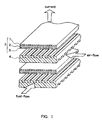
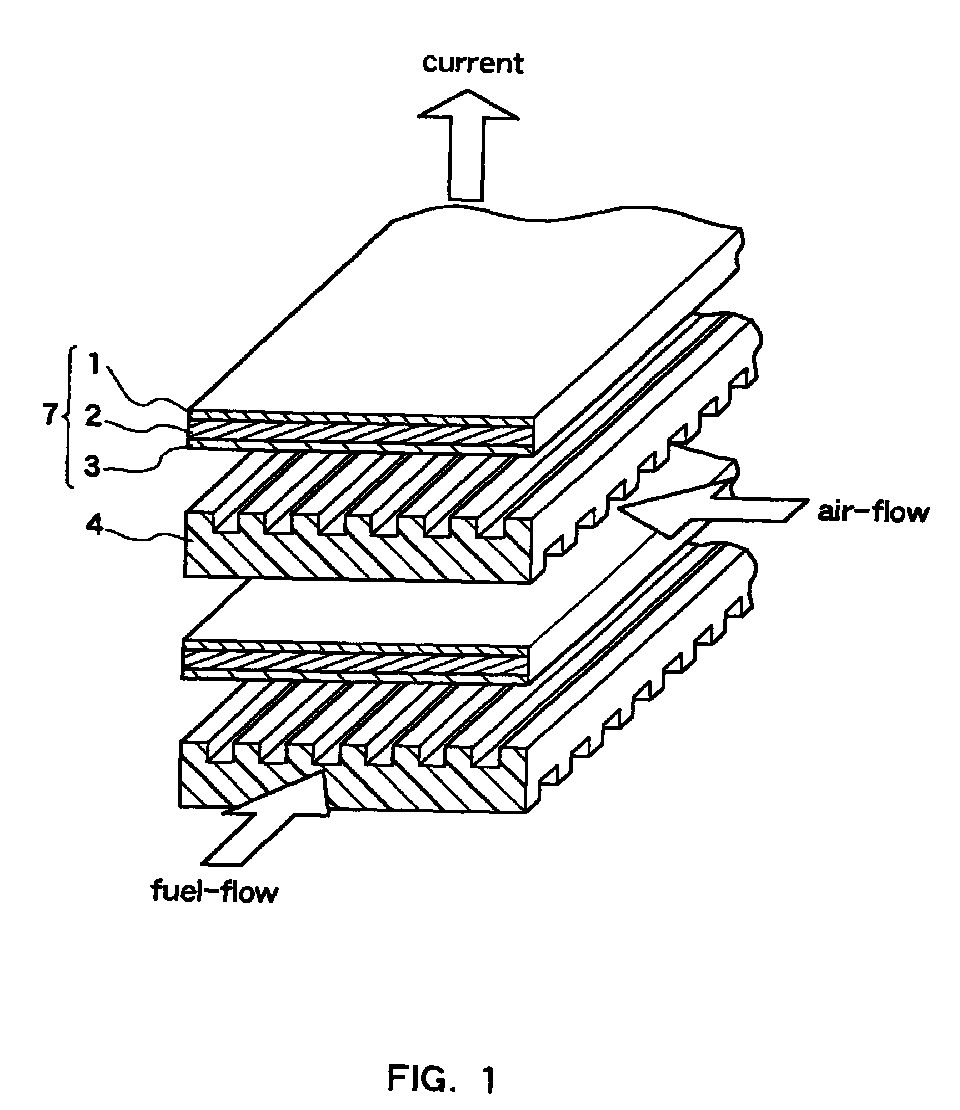
- Fig. 1 is a cross-sectional perspective view of an embodiment of a fuel cell in accordance with the present invention.
- This planar fuel cell has several layered units 7, which include a cathode (fuel electrode) 3, a solid electrolyte 2 layered on the cathode 3, and an anode (air electrode) 1 on the solid electrolyte 2.
- Separators 4 are arranged between the layered units 7.
- an oxidation gas 6 (such as air) is supplied to the anodes 1, and a fuel gas 5 (a reduction gas such as hydrogen or natural gas) is supplied to the cathodes 3.
- a fuel gas 5 a reduction gas such as hydrogen or natural gas
- the oxidation-reduction reaction at the electrodes generates electrons, so that the fuel cell serves as an electric power source.
- Fig. 2 is a cross-sectional view of an embodiment of a gas sensor in accordance with the present invention.
- This HC sensor hydrocarbon sensor
- This layered structure is attached with an inorganic adhesive 18 to a (ceramic) substrate 17, providing a space 20 between the substrate and the layered structure.
- This space 20 is in communication with the outside via a diffusion limiting hole 13.
- a certain voltage for example 1.2V
- a current that is proportional to the concentration of hydrocarbons in the space adjacent to the anode 15 is attained as output.
- the sensor is kept at a certain temperature with a heater 19 attached to the substrate.
- a heater 19 attached to the substrate.
- To provide the diffusion limiting hole 13 is advantageous to limit the inflow of the material to be measured (here, hydrocarbons) into the space 20.
- oxides as shown in Tables 1 to 6 have been synthesized. These oxides were synthesized by solid state sintering. An oxide powder of barium, cerium, zirconium, and rare earth elements was weighed to the composition ratio listed in the tables, and crushed and mixed with ethanol in an agate mortar. After sufficient mixing, the solvent was removed, defatted with a burner, and crushing and mixing were repeated in the agate mortar. Then, the samples were pressed into columnar shape and fired for 10 hours at 1300°C. After the firing, granules of about 3 ⁇ m were produced by coarse crushing, with further crushing in a benzene solution with a planetary ball mill.
- the resulting powder was vacuum-dried at 150°C, and columns were formed with a hydrostatic press at 2tons/cm 2 , which were immediately fired for 10 hours at 1650°C to synthesize a sintered product. For almost all samples, a very compact single-phase perovskite oxide was attained. The resulting samples were then evaluated as follows:
- the samples were introduced into boiling water of 100°C, and the level of Ba precipitation was evaluated after 10 hours by measuring the pH value.
- This evaluation utilizes the fact that the pH value in the aqueous solution rises proportionally with the precipitation of barium.
- the moisture resistance was taken to be excellent (A), for more than 2 and not more than 3.5, it was taken to be good (B), for more than 3.5 and not more than 4, it was taken to be adequate (C), and for more than 4, it was taken to be poor (D).
- Fig. 3 is an arrhenius plot showing the conductivity of materials in accordance with the present invention.
- mixed ionic conductors in accordance with the present invention have considerably better moisture resistance, while the ion conductivity can be held at a practical level.
- the oxide also can be synthesized by coprecipitation, nitration, spray granulation or any other suitable method. It is also possible to use film forming methods such as CVD or sputtering methods. It is also possible to use thermal spraying.
- shape of the oxide There is no limitation to the shape of the oxide, and it can be of any shape, including bulk shapes and films.
Landscapes
- Chemical & Material Sciences (AREA)
- Engineering & Computer Science (AREA)
- Manufacturing & Machinery (AREA)
- Ceramic Engineering (AREA)
- Materials Engineering (AREA)
- Structural Engineering (AREA)
- Organic Chemistry (AREA)
- Life Sciences & Earth Sciences (AREA)
- Electrochemistry (AREA)
- Chemical Kinetics & Catalysis (AREA)
- Inorganic Chemistry (AREA)
- Sustainable Development (AREA)
- General Chemical & Material Sciences (AREA)
- Sustainable Energy (AREA)
- Health & Medical Sciences (AREA)
- Physics & Mathematics (AREA)
- Molecular Biology (AREA)
- Biochemistry (AREA)
- General Health & Medical Sciences (AREA)
- General Physics & Mathematics (AREA)
- Immunology (AREA)
- Pathology (AREA)
- Composite Materials (AREA)
- Analytical Chemistry (AREA)
- Thermal Sciences (AREA)
- Conductive Materials (AREA)
- Compositions Of Oxide Ceramics (AREA)
- Fuel Cell (AREA)
Abstract
with
Description
- The present invention relates to a mixed ionic conductor and an electrochemical device, such as a fuel cell or a gas sensor, using the same.
- The applicant has long been actively developing mixed conductors of protons and oxide ions (see for example Publication of Unexamined Japanese Patent Application (Tokkai) No. H5-28820 or H6-236114). These mixed ionic conductors are basically perovskite oxides containing barium and cerium wherein a portion of the cerium has been substituted by the substitute element M, so as to achieve a high ionic conductivity (chemical formula: BaCe1-pMpO3-α). Especially, when the substitution amount p of the substitution element M is 0.16 to 0.23, the mixed ionic conductor has a high conductivity higher even than zirconia-based oxides (YSZ: yttrium-stabilized zirconia), which conventionally have been used as oxide ionic conductors. As the substitution element M, rare earth elements are suitable, in particular heavy rare earth elements, because of their atomic radius and charge balance.
- New fuel cells, sensors and other electrochemical devices using such materials as a solid electrolyte have been developed. The sensor characteristics and the discharge characteristics of fuel cells using such materials have been shown to be superior to prior devices. Other patent applications related to these materials are Tokkai H5-234604, Tokkai H5-290860, Tokkai H6-223857, Tokkai H6-290802, Tokkai H7-65839, Tokkai H7-136455, Tokkai H8-29390, Tokkai H8-162121, and Tokkai H8-220060.
- However, these materials show some problems with regard to their chemical stability. For example, barium tends to precipitate in CO2 gas. To solve these problems, the applicant has proposed a counter-strategy in Tokkai H8-107918. However, even this counter-strategy is not perfect, and for example at low temperatures of 85°C and 85% humidity precipitation can be observed in shelf tests and boiling tests in water. Moreover, under high water vapor pressures as during discharge of the fuel cells, barium can be seen to precipitate near the platinum electrodes. Furthermore, with gas sensors, there is the problem of maintaining high ion conductivity at lower temperatures over a long time and the problem of raising the acid resistance of the oxide itself.
- To solve these problems, it is an object of the present invention to improve the chemical stability of the mixed ionic conductors.
- The main cause for decomposition of the oxides due to humidity is believed to be the fact that the segregated barium turning into barium hydroxide reacts with the carbon dioxide, and forms stable barium carbonate. To increase the moisture resistance, the present invention uses a mixed ionic conductor including the following perovskite structure oxide.
- A mixed ionic conductor of one embodiment of the present invention (a first ionic conductor) includes an ion conductive oxide having a perovskite structure of the formula Baa(Ce1-bM1 b)LcO3-α, wherein
- M1 is at least one trivalent rare earth element other than Ce;
- L is at least one element selected from the group consisting of Zr, Ti,
V, Nb, Cr, Mo, W, Fe, Co, Ni, Cu, Ag, Au, Pd, Pt, Bi, Sb, Sn, Pb and Ga;
with -
- In this mixed ionic conductor it is preferable that M1 is at least one element selected from the group consisting of La, Pr, Nd, Pm, Sm, Eu, Gd, Tb, Dy, Ho, Er, Tm, Yb, Y and Sc. More preferably, M1 is Gd and/or Y.
- It is also preferable that L is at least one element selected from the group consisting of Zr, Ti, Fe, Co, Ni, Cu, Bi, Sn, Pb and Ga. More preferably, L is at least one element selected from the group consisting of Zr, Ti, Bi, Pb and Ga.
- A mixed ionic conductor of another embodiment of the present invention (a second ionic conductor) includes an ion conductive oxide having a perovskite structure of the formula BaeZr1-zM2 zO3-β , wherein
- M2 is at least one element selected from the group consisting of
trivalent rare earth elements, Bi, Ga, Sn, Sb and In;
with -
- In this mixed ionic conductor it is preferable that 0.16 ≤ z ≤ 0.3. It is also preferable that M2 is at least one element selected from the group consisting of trivalent rare earth elements and In, especially elements selected from the group consisting of Pr, Eu, Gd, Yb, Sc and In.
- A mixed ionic conductor of yet another embodiment of the present invention (a third ionic conductor) includes an ion conductive oxide having a perovskite structure of the formula BadZr1-x-yCexM3 yO3-γ wherein
- M3 is at least one element selected from the group consisting of
trivalent rare earth elements, Bi and In;
with -
- In this third mixed ionic conductor, it is preferable that M3 is at least one element selected from the group consisting of Nd, Sm, Eu, Gd, Tb, Yb, Y, Sc and In. More preferably, M3 is at least one element selected from the group consisting of Gd, In, Y and Yb.
- The mixed ionic conductors of the present invention have not only the necessary conductivity for electrochemical devices such as fuel cells, but also superior moisture resistance.
- Throughout this specification, "rare earth element" means Sc, Y, and the lanthanides (elements 57La though 71Lu). In the above formulas, α, β and γ are determined by the absent amount of disproportionate oxygen.
- The present invention also provides devices using such a mixed ionic conductor. A fuel cell in accordance with the present invention includes as a solid-state electrolyte a mixed ionic conductor as described above. A gas sensor in accordance with the present invention includes as a solid-state electrolyte a mixed ionic conductor as described above. Using the mixed ionic conductors of the present invention provides electric devices, such as fuel cells and gas sensors, with high moisture resistance, high performance, and long lifetimes.
- Fig. 1 is an exploded perspective cross-sectional view of an embodiment of a fuel cell using a mixed ionic conductor in accordance with the present invention.
- Fig. 2 is a cross-sectional view of an embodiment of a gas sensor using a mixed ionic conductor in accordance with the present invention.
- Fig. 3 is a graph showing the conductivity of mixed ionic conductors in accordance with the present invention.
-
- The following is an explanation of the preferred embodiments of the present invention.
- As the applicant has pointed out in the above-noted publications, the high conductivity of mixed ionic conductors in accordance with the present invention stems from the mixed ion conductivity of oxygen ions and protons. In order to improve the moisture resistance of such mixed ionic conductors, a suitable substitute element is introduced into the above-mentioned first ionic conductor so as to reduce the amount of barium in the perovskite oxide to less than the stochiometric ratio. In the following, such a mixed ionic conductor also is referred to as "additive system" conductor.
- The second and the third ionic conductors in accordance with the present invention are also mixed ionic conductors with high moisture resistance. In the following, these mixed ionic conductors are referred to as "barium-zirconium system" conductors and "barium zirconium cerium system" conductors, respectively. While these systems are mixed ionic conductors exhibiting proton conductivity, they still provide high moisture resistance.
- These systems of mixed ionic conductors can be obtained with conventional raw materials and manufacturing methods. Specific examples of manufacturing methods are explained along with the examples further below.
- The following is an explanation of a device using a mixed ionic conductor in accordance with the present invention.
- Fig. 1 is a cross-sectional perspective view of an embodiment of a fuel cell in accordance with the present invention. This planar fuel cell has several layered units 7, which include a cathode (fuel electrode) 3, a solid electrolyte 2 layered on the
cathode 3, and an anode (air electrode) 1 on the solid electrolyte 2.Separators 4 are arranged between the layered units 7. - When generating power, an oxidation gas 6 (such as air) is supplied to the
anodes 1, and a fuel gas 5 (a reduction gas such as hydrogen or natural gas) is supplied to thecathodes 3. The oxidation-reduction reaction at the electrodes generates electrons, so that the fuel cell serves as an electric power source. - Fig. 2 is a cross-sectional view of an embodiment of a gas sensor in accordance with the present invention. This HC sensor (hydrocarbon sensor) includes an
anode 15, asolid electrolyte 14 on theanode 15, and acathode 16 on thesolid electrolyte 14. This layered structure is attached with aninorganic adhesive 18 to a (ceramic)substrate 17, providing aspace 20 between the substrate and the layered structure. Thisspace 20 is in communication with the outside via adiffusion limiting hole 13. - When a certain voltage (for example 1.2V) is applied steadily between the two
electrodes anode 15 is attained as output. During the measurement, the sensor is kept at a certain temperature with aheater 19 attached to the substrate. To provide thediffusion limiting hole 13 is advantageous to limit the inflow of the material to be measured (here, hydrocarbons) into thespace 20. - This embodiment has been explained for a HC sensor, but an oxygen sensor is also possible by exchanging anode and cathode in the structure shown in Fig. 2. Furthermore, the mixed ionic conductor of the present invention is not limited the above, but also can be applied to all kinds of other electrochemical devices.
- The following is a more detailed description of specific examples of the present invention. It should be noted that the present invention is in no way limited to these examples.
- As examples of the present invention, oxides as shown in Tables 1 to 6 have been synthesized. These oxides were synthesized by solid state sintering. An oxide powder of barium, cerium, zirconium, and rare earth elements was weighed to the composition ratio listed in the tables, and crushed and mixed with ethanol in an agate mortar. After sufficient mixing, the solvent was removed, defatted with a burner, and crushing and mixing were repeated in the agate mortar. Then, the samples were pressed into columnar shape and fired for 10 hours at 1300°C. After the firing, granules of about 3 µ m were produced by coarse crushing, with further crushing in a benzene solution with a planetary ball mill. The resulting powder was vacuum-dried at 150°C, and columns were formed with a hydrostatic press at 2tons/cm2, which were immediately fired for 10 hours at 1650°C to synthesize a sintered product. For almost all samples, a very compact single-phase perovskite oxide was attained. The resulting samples were then evaluated as follows:
- As an accelerated test of moisture resistance, the samples were introduced into boiling water of 100°C, and the level of Ba precipitation was evaluated after 10 hours by measuring the pH value. This evaluation utilizes the fact that the pH value in the aqueous solution rises proportionally with the precipitation of barium. For a pH change of not more than 2, the moisture resistance was taken to be excellent (A), for more than 2 and not more than 3.5, it was taken to be good (B), for more than 3.5 and not more than 4, it was taken to be adequate (C), and for more than 4, it was taken to be poor (D).
- After the above-mentioned boiling test, disks of 0.5mm thickness and 13mm diameter were made of the columnar sintered product samples, both sides of the disks were coated with a platinum paste on an area of 0.5cm2 each, which was baked onto the samples, and the ion conductivity was measured. In this experiment, the conductivity was calculated from the resistance with the alternating current impedance method in air. The measurement temperature was 500°C. The resistance of the leads of the measurement device was subtracted. When the conductivity (in S/cm) was at least 0.007, it was taken as A, for at least 0.00 1 and less than 0.007 it was taken as B, and for less than 0.001 it was taken as C.
- Fig. 3 is an arrhenius plot showing the conductivity of materials in accordance with the present invention.
- When the sintered product was single-phase it was taken as A, when it was multi-phase, it was taken as B, and sintering failures were taken as C.
- The tables show the conductivity at 500°C and the result of the pH evaluation in the boiling test.
Material Boiling Test Crystallinity Conductivity BaCe0.8Gd0.2O3-α D A A Ba0.99Ce0.8Gd0.2O3-α D A A Ba0.98Ce0.8Gd0.2O3-α D A A Ba0.94Ce0.8Gd0.2O3-α D A B Ba0.90Ce0.8Gd0.2O3-α D A B Additive System Material Boiling Test Crystallinity Conductivity BaCe0.8Gd0.2Zr0.01O3-α B A A BaCe0.8Gd0.2Zr0.04O3-α B A A BaCe0.8Gd0.2Zr0.06O3-α B A A BaCe0.8Gd0.2Zr0.1O3-α B A A BaCe0.8Gd0.2Zr0.11O3-α D B not measured BaCe0.8Gd0.2Zr0.15O3-α D C not measured Ba0.99Ce0.8Gd0.2Zr0.01O3-α B A A Ba0.99Ce0.8Gd0.2Zr0.04O3-α B A A Ba0.99Ce0.8Gd0.2Zr0.06O3-α B A B Ba0.99Ce0.8Gd0.2Zr0.1O3-α B A B Ba0.99Ce0.8Gd0.2Zr0.11O3-α B B C Ba0.98Ce0.8Gd0.2Zr0.01O3-α B A A Ba0.98Ce0.8Gd0.2Zr0.04O3-α B A B Ba0.98Ce0.8Gd0.2Zr0.06O3-α B A B Ba0.98Ce0.8Gd0.2Zr0.1O3-α B A B Ba0.98Ce0.8Gd0.2Zr0.11O3-α B B C Ba0.98Ce0.8Gd0.16Zr0.04O3-α B A B Ba0.98Ce0.8Gd0.23Zr0.04O3-α B A B Ba0.98Ce0.8Gd0.26Zr0.04O3-α B A A Ba0.9Ce0.8Gd0.2Zr0.01O3-α B A B Ba0.9Ce0.8Gd0.2Zr0.04O3-α B A C Ba0.9Ce0.8Gd0.2Zr0.06O3-α B A C Ba0.9Ce0.8Gd0.2Zr0.1O3-α A A C Ba0.9Ce0.8Gd0.2Zr0.11O3-α A B D Ba0.89Ce0.8Gd0.2Zr0.01O3-α B A C Ba0.85Ce0.8Gd0.2Zr0.04O3-α B A D 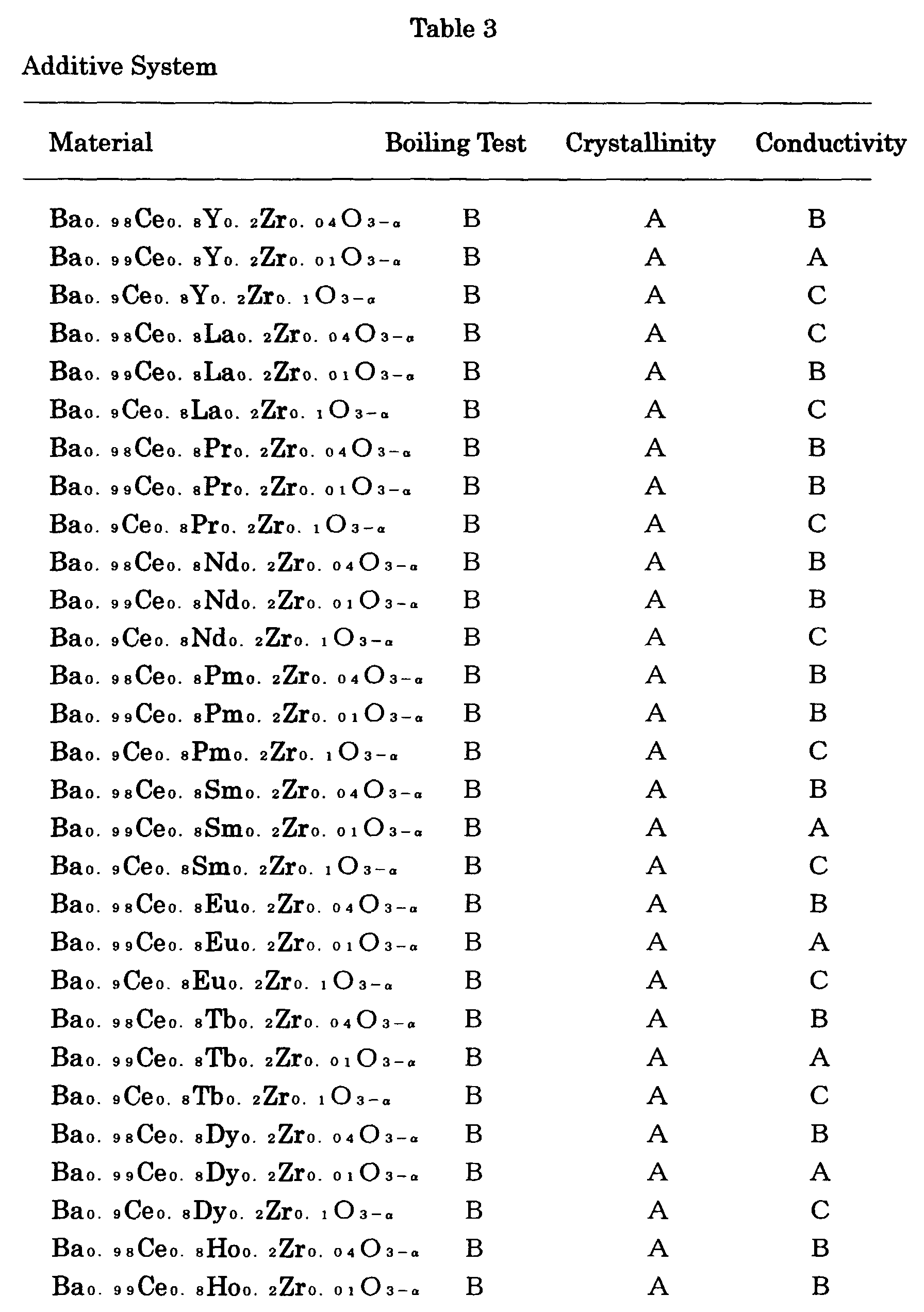

Additive System Material Boiling Test Crystallinity Conductivity Ba0.99Ce0.8Gd0.2Ti0.01O3-α B A C Ba0.99Ce0.8Gd0.2Ti0.1O3-α B A C Ba0.98Ce0.8Gd0.2Ti0.04O3-α B A C Ba0.9Ce0.8Gd0.2Ti0.1O3-α A A C Ba0.98Ce0.8Gd0.16Ti0.04O3-α B A C Ba0.99Ce0.8Gd0.2Bi0.01O3-α B A A Ba0.99Ce0.8Gd0.2Bi0.1O3-α B A B Ba0.98Ce0.8Gd0.2Bi0.04O3-α B A B Ba0.9Ce0.8Gd0.2Bi0.1O3-α A A C Ba0.98Ce0.8Gd0.16Bi0.04O3-α B A B Ba0.99Ce0.8Gd0.2Pb0.01O3-α B A B Ba0.99Ce0.8Gd0.2Pb0.1O3-α B A C Ba0.98Ce0.8Gd0.2Pb0.04O3-α B A C Ba0.9Ce0.8Gd0.2Pb0.1O3-α A A C Ba0.98Ce0.8Gd0.16Pb0.04O3-α B A C Ba0.99Ce0.8Gd0.2Ga0.01O3-α B A A Ba0.99Ce0.8Gd0.2Ga0.1O3-α B A C Ba0.98Ce0.8Gd0.2Ga0.04O3-α B A B Ba0.9Ce0.8Gd0.2Ga0.1O3-α A A C Ba0.98Ce0.8Gd0.16Ga0.04O3-α B A B Ba0.98Ce0.8Gd0.2V0.04O3-α C A C Ba0.98Ce0.8Gd0.2Nb0.04O3-α C A C Ba0.98Ce0.8Gd0.2Cr0.04O3-α C A C Ba0.98Ce0.8Gd0.2Mo0.04O3-α C A C Ba0.98Ce0.8Gd0.2W0.04O3-α C A C Ba0.98Ce0.8Gd0.2Fe0.04O3-α B A C Ba0.98Ce0.8Gd0.2Co0.04O3-α B A C Ba0.98Ce0.8Gd0.2Ni0.04O3-α B A C Ba0.98Ce0.8Gd0.2Cu0.04O3-α B A B Ba0.98Ce0.8Gd0.2Ag0.04O3-α C A B Ba0.98Ce0.8Gd0.2Au0.04O3-α C A B Ba0.98Ce0.8Gd0.2Pd0.04O3-α C A B Ba0.98Ce0.8Gd0.2Pt0.04O3-α C A B Ba0.98Ce0.8Gd0.2Sb0.04O3-α B A C Ba0.98Ce0.8Gd0.2Sn0.04O3-α B A C 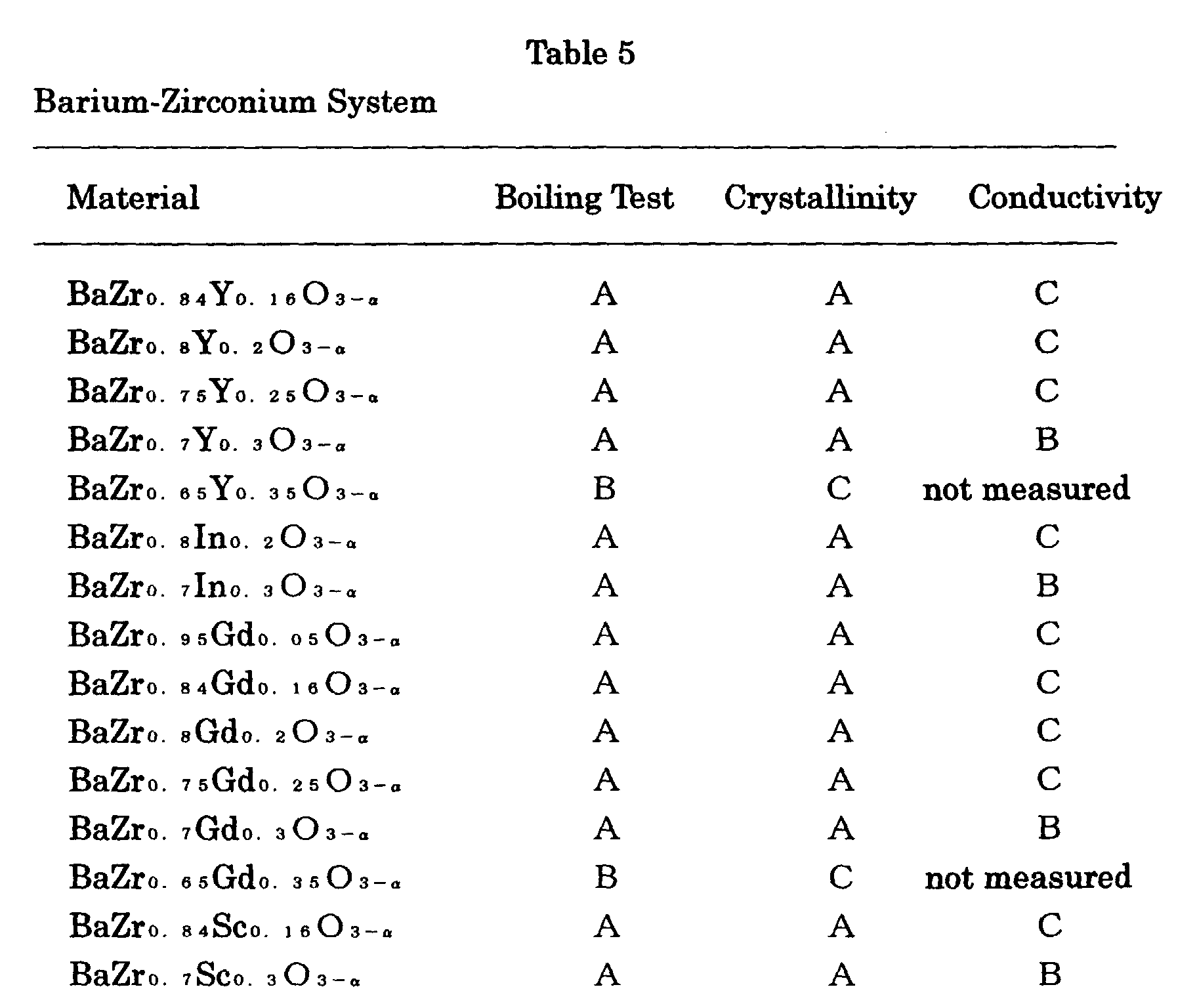


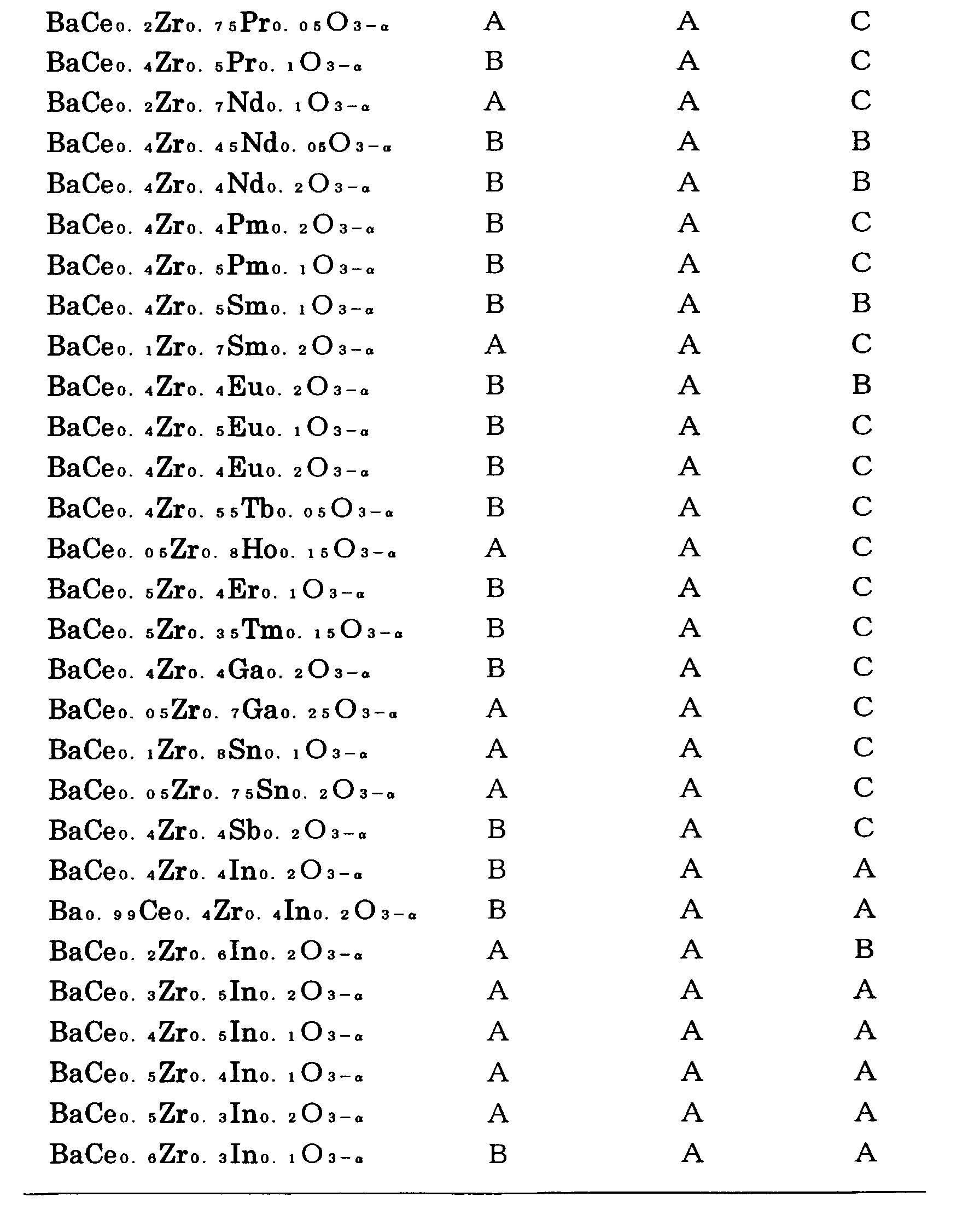
- As becomes clear from this evaluation, mixed ionic conductors in accordance with the present invention have considerably better moisture resistance, while the ion conductivity can be held at a practical level.
- The above examples have been synthesized by solid state sintering, but there is no limitation to this method, and the oxide also can be synthesized by coprecipitation, nitration, spray granulation or any other suitable method. It is also possible to use film forming methods such as CVD or sputtering methods. It is also possible to use thermal spraying. There is no limitation to the shape of the oxide, and it can be of any shape, including bulk shapes and films.
Claims (13)
- A mixed ionic conductor comprising an ion conductive oxide having a perovskite structure of the formula Baa(Ce1-bM1 b)LcO3-α , whereinM1 is at least one trivalent rare earth element other than Ce;L is at least one element selected from the group consisting of Zr, Ti, V, Nb, Cr, Mo, W, Fe, Co, Ni, Cu, Ag, Au, Pd, Pt, Bi, Sb, Sn, Pb and Ga;
with - The mixed ionic conductor of Claim 1, characterized in that M1 is at least one element selected from the group consisting of La, Pr, Nd, Pm, Sm, Eu, Gd, Tb, Dy, Ho, Er, Tm, Yb, Y and Sc.
- The mixed ionic conductor of Claim 2, characterized in that M1 is at least one element selected from the group consisting of Gd and Y.
- The mixed ionic conductor of Claim 1, characterized in that L is at least one element selected from the group consisting of Zr, Ti, Fe, Co, Ni, Cu, Bi, Sn, Pb and Ga.
- A mixed ionic conductor comprising an ion conductive oxide having a perovskite structure of the formula BaeZr1-zM2 zO3-β , whereinM2 is at least one element selected from the group consisting of trivalent rare earth elements, Bi, Ga, Sn, Sb and In;
with - The mixed ionic conductor of Claim 5, characterized in that 0.16 ≤ z ≤ 0.3.
- The mixed ionic conductor of Claim 5, characterized in that M2 is at least one element selected from the group consisting of trivalent rare earth elements and In.
- The mixed ionic conductor of Claim 7, characterized in that M2 is at least one element selected from the group consisting of Pr, Eu, Gd, Yb, Sc and In.
- A mixed ionic conductor comprising an ion conductive oxide having a perovakite structure of the formula BadZr1-x-yCexM3 yO3-γ whereinM3 is at least one element selected from the group consisting of trivalent rare earth elements, Bi and In;
with - The mixed ionic conductor of Claim 9, characterized in that M3 is at least one element selected from the group consisting of Nd, Sm, Eu, Gd, Tb, Yb, Y, Sc and In.
- The mixed ionic conductor of Claim 10, characterized in that M3 is selected from Gd, In, Y and Yb.
- A fuel cell comprising as a solid-state electrolyte a mixed ionic conductor of any of Claims 1 to 11.
- A gas sensor comprising as a solid-state electrolyte a mixed ionic conductor of any of Claims 1 to 11.
Priority Applications (2)
| Application Number | Priority Date | Filing Date | Title |
|---|---|---|---|
| EP02025062A EP1284249A1 (en) | 1999-02-17 | 2000-02-17 | Mixed ionic conductor and device using the same |
| EP02025061A EP1281694B1 (en) | 1999-02-17 | 2000-02-17 | Mixed ionic conductor and device using the same |
Applications Claiming Priority (2)
| Application Number | Priority Date | Filing Date | Title |
|---|---|---|---|
| JP3836999 | 1999-02-17 | ||
| JP3836999 | 1999-02-17 |
Related Child Applications (2)
| Application Number | Title | Priority Date | Filing Date |
|---|---|---|---|
| EP02025062A Division EP1284249A1 (en) | 1999-02-17 | 2000-02-17 | Mixed ionic conductor and device using the same |
| EP02025061A Division EP1281694B1 (en) | 1999-02-17 | 2000-02-17 | Mixed ionic conductor and device using the same |
Publications (3)
| Publication Number | Publication Date |
|---|---|
| EP1029837A2 true EP1029837A2 (en) | 2000-08-23 |
| EP1029837A3 EP1029837A3 (en) | 2000-09-20 |
| EP1029837B1 EP1029837B1 (en) | 2003-05-07 |
Family
ID=12523378
Family Applications (3)
| Application Number | Title | Priority Date | Filing Date |
|---|---|---|---|
| EP02025061A Expired - Lifetime EP1281694B1 (en) | 1999-02-17 | 2000-02-17 | Mixed ionic conductor and device using the same |
| EP02025062A Withdrawn EP1284249A1 (en) | 1999-02-17 | 2000-02-17 | Mixed ionic conductor and device using the same |
| EP00301251A Expired - Lifetime EP1029837B1 (en) | 1999-02-17 | 2000-02-17 | Mixed ionic conductor and device using the same |
Family Applications Before (2)
| Application Number | Title | Priority Date | Filing Date |
|---|---|---|---|
| EP02025061A Expired - Lifetime EP1281694B1 (en) | 1999-02-17 | 2000-02-17 | Mixed ionic conductor and device using the same |
| EP02025062A Withdrawn EP1284249A1 (en) | 1999-02-17 | 2000-02-17 | Mixed ionic conductor and device using the same |
Country Status (5)
| Country | Link |
|---|---|
| US (3) | US6528195B1 (en) |
| EP (3) | EP1281694B1 (en) |
| KR (3) | KR100352099B1 (en) |
| CA (1) | CA2298850A1 (en) |
| DE (2) | DE60040097D1 (en) |
Cited By (12)
| Publication number | Priority date | Publication date | Assignee | Title |
|---|---|---|---|---|
| EP1125893A1 (en) * | 2000-02-14 | 2001-08-22 | Matsushita Electric Industrial Co., Ltd. | Ion Conductor |
| WO2001072508A1 (en) * | 2000-03-28 | 2001-10-04 | Ceramic Fuel Cells Limited | Surface treated electrically conductive metal element and method of forming same |
| NL1015886C2 (en) * | 2000-08-07 | 2002-02-08 | Stichting Energie | Electrode for an electrochemical cell. |
| WO2002013302A1 (en) * | 2000-08-07 | 2002-02-14 | Energieonderzoek Centrum Nederland | Mixed oxide material, electrode and method of manufacturing the electrode and electrochemical cell comprising it |
| WO2003008095A3 (en) * | 2001-07-17 | 2003-10-16 | Uni Degli Studi Di L Aquila | Perovskites comprising noble metals, applicable as catalysts |
| WO2004074205A1 (en) | 2003-02-24 | 2004-09-02 | National University Corporation Nagoya University | Proton-conductive and electron-conductive ceramic |
| WO2004074175A1 (en) * | 2003-02-24 | 2004-09-02 | National University Corporation Nagoya University | Hydrogen gas separator |
| US7235171B2 (en) * | 2001-07-24 | 2007-06-26 | Matsushita Electric Industrial Co., Ltd. | Hydrogen sensor, hydrogen sensor device and method of detecting hydrogen concentration |
| WO2008123484A1 (en) * | 2007-03-27 | 2008-10-16 | Toyota Jidosha Kabushiki Kaisha | Proton conductor, electrochemical cell and method of manufacturing proton conductor |
| WO2011046594A3 (en) * | 2009-10-13 | 2011-10-06 | The Penn State Research Foundation | High energy density ionic dielectric materials and devices |
| CN104689817A (en) * | 2014-12-12 | 2015-06-10 | 湖北航特科技有限责任公司 | Composite oxide catalyst for purification of vehicle tail gas and method for preparing composite oxide catalyst for purification of vehicle tail gas |
| CN105393393A (en) * | 2013-07-18 | 2016-03-09 | 住友电气工业株式会社 | Composite material for fuel cell, manufacturing method of composite material for fuel cell, and fuel cell |
Families Citing this family (20)
| Publication number | Priority date | Publication date | Assignee | Title |
|---|---|---|---|---|
| US6770392B2 (en) * | 2001-04-27 | 2004-08-03 | Air Products And Chemicals, Inc. | Ceria based solid electrolytes |
| WO2003076336A1 (en) * | 2002-03-08 | 2003-09-18 | Anan Kasei Co., Ltd. | Cerium based composite oxide, sintered product thereof and method for preparation thereof |
| EP1369949B1 (en) * | 2002-06-06 | 2013-01-30 | Panasonic Corporation | Solid electrolyte fuel cell and manufacturing method thereof |
| CN100593825C (en) * | 2003-09-03 | 2010-03-10 | 松下电器产业株式会社 | mixed ionic conductor |
| US7625653B2 (en) * | 2005-03-15 | 2009-12-01 | Panasonic Corporation | Ionic conductor |
| JP2007317627A (en) * | 2006-05-29 | 2007-12-06 | Toyota Motor Corp | Fuel cell |
| EP2181476B1 (en) * | 2007-08-22 | 2015-03-25 | Hexis AG | Electrode for fixed oxide reactor and fixed oxide reactor |
| EP2425893B8 (en) * | 2009-04-28 | 2018-10-17 | Panasonic Intellectual Property Management Co., Ltd. | Device for catalytic hydrolysis comprising an optically pumped semiconductor |
| KR100985381B1 (en) * | 2009-12-22 | 2010-10-05 | 신일피엔에스 주식회사 | Adhesive method of synthetic resin woven bag |
| RU2495854C1 (en) * | 2012-04-03 | 2013-10-20 | Федеральное государственное бюджетное учреждение науки Институт высокотемпературной электрохимии Уральского отделения Российской Академии наук | Cerium oxide and barium cerate based solid electrolyte |
| CN104969302B (en) | 2013-07-16 | 2017-08-01 | 松下知识产权经营株式会社 | Proton conductor |
| JP6191090B2 (en) | 2013-08-27 | 2017-09-06 | 住友電気工業株式会社 | ELECTRODE MATERIAL FOR FUEL ELECTRODE, SOLID ELECTROLYTE ELECTRODE LAMINATE, SOLID ELECTROLYTE ELECTRODE LAMINATE MANUFACTURING METHOD, AND FUEL CELL |
| WO2015114684A1 (en) | 2014-01-31 | 2015-08-06 | パナソニックIpマネジメント株式会社 | Proton conductor |
| US9896771B2 (en) | 2014-02-07 | 2018-02-20 | Panasonic Intellectual Property Management Co., Ltd. | Dehydrogenation device |
| US9458544B2 (en) | 2014-02-07 | 2016-10-04 | Panasonic Intellectual Property Management Co., Ltd. | Organic hydride conversion device |
| RU2550816C1 (en) * | 2014-05-16 | 2015-05-20 | Открытое акционерное общество "ТВЭЛ" (ОАО "ТВЭЛ") | Cathode material for sofc based on copper-containing layered perovskite compounds |
| US9527033B2 (en) * | 2015-01-23 | 2016-12-27 | Toyota Motor Engineering & Manufacturing North America, Inc. | Mixed metal oxide catalyst |
| EP3279987B1 (en) * | 2015-03-30 | 2019-11-27 | Sumitomo Electric Industries, Ltd. | Proton conductor, fuel-cell solid-electrolyte layer, cell structure, and fuel cell provided with same |
| CN111189901B (en) * | 2020-01-13 | 2021-06-29 | 吉林大学 | Gd2Zr2O7 solid electrolyte formaldehyde sensor and preparation method thereof |
| WO2021256221A1 (en) | 2020-06-18 | 2021-12-23 | 住友電気工業株式会社 | Proton conducting cell structure, proton conductor, electrochemical device, and method for producing proton conductor |
Family Cites Families (18)
| Publication number | Priority date | Publication date | Assignee | Title |
|---|---|---|---|---|
| JP2882104B2 (en) | 1991-07-17 | 1999-04-12 | 松下電器産業株式会社 | Proton conductor and method for producing the same |
| JP3160993B2 (en) | 1992-02-20 | 2001-04-25 | 松下電器産業株式会社 | Solid oxide fuel cell |
| JPH05290860A (en) | 1992-04-09 | 1993-11-05 | Matsushita Electric Ind Co Ltd | Manufacture of solid electrolyte fuel cell |
| JPH06223857A (en) | 1993-01-25 | 1994-08-12 | Matsushita Electric Ind Co Ltd | Continuous Discharge Device for Flat Plate Solid Oxide Fuel Cell |
| JP2864928B2 (en) | 1993-02-04 | 1999-03-08 | 松下電器産業株式会社 | Mixed ionic conductor |
| JP3055350B2 (en) | 1993-04-01 | 2000-06-26 | 松下電器産業株式会社 | Operating method of barium-cerium type solid electrolyte fuel cell |
| JP3340526B2 (en) | 1993-08-23 | 2002-11-05 | 松下電器産業株式会社 | Reduction electrode for barium-cerium-based oxide solid electrolyte and method for producing the same |
| JP3253198B2 (en) | 1993-11-24 | 2002-02-04 | 松下電器産業株式会社 | Nitrogen oxide reduction equipment |
| US6033632A (en) * | 1993-12-08 | 2000-03-07 | Eltron Research, Inc. | Solid state oxygen anion and electron mediating membrane and catalytic membrane reactors containing them |
| EP0677741A3 (en) | 1994-04-12 | 1996-05-01 | Matsushita Electric Industrial Co Ltd | Oxygen sensor. |
| JP2948124B2 (en) | 1994-04-12 | 1999-09-13 | 松下電器産業株式会社 | Oxygen sensor |
| JP3449642B2 (en) | 1994-07-12 | 2003-09-22 | 松下電器産業株式会社 | Carbon monoxide sensor |
| JPH08162121A (en) | 1994-12-07 | 1996-06-21 | Matsushita Electric Ind Co Ltd | Barium cerium oxide solid electrolyte fuel cell fuel electrode and method for producing the same |
| JP3760475B2 (en) * | 1995-01-19 | 2006-03-29 | 東ソー株式会社 | Fluorite-type zirconia-based solid electrolyte |
| JP3498772B2 (en) | 1995-03-31 | 2004-02-16 | 株式会社豊田中央研究所 | Thin film gas sensor and method of manufacturing the same |
| JPH0927330A (en) * | 1995-07-11 | 1997-01-28 | Tokyo Gas Co Ltd | Fuel electrode of solid electrolyte fuel cell |
| JP2951887B2 (en) | 1996-04-26 | 1999-09-20 | 松下電器産業株式会社 | Mixed ionic conductor |
| US6235417B1 (en) * | 1999-04-30 | 2001-05-22 | Her Majesty The Queen In Right Of Canada, As Represented By The Minister Of Natural Resources | Two-phase hydrogen permeation membrane |
-
2000
- 2000-02-15 CA CA002298850A patent/CA2298850A1/en not_active Abandoned
- 2000-02-17 EP EP02025061A patent/EP1281694B1/en not_active Expired - Lifetime
- 2000-02-17 DE DE60040097T patent/DE60040097D1/en not_active Expired - Lifetime
- 2000-02-17 EP EP02025062A patent/EP1284249A1/en not_active Withdrawn
- 2000-02-17 US US09/506,122 patent/US6528195B1/en not_active Expired - Lifetime
- 2000-02-17 EP EP00301251A patent/EP1029837B1/en not_active Expired - Lifetime
- 2000-02-17 KR KR1020000007509A patent/KR100352099B1/en not_active Expired - Fee Related
- 2000-02-17 DE DE60002510T patent/DE60002510T2/en not_active Expired - Lifetime
-
2002
- 2002-04-24 KR KR1020020022462A patent/KR100352097B1/en not_active Expired - Fee Related
- 2002-04-24 KR KR1020020022461A patent/KR100352096B1/en not_active Expired - Fee Related
- 2002-12-19 US US10/324,301 patent/US7491461B2/en not_active Expired - Fee Related
-
2005
- 2005-07-27 US US11/190,772 patent/US20050260477A1/en not_active Abandoned
Non-Patent Citations (2)
| Title |
|---|
| DATABASE WPI Section Ch, Week 199641 Derwent Publications Ltd., London, GB; Class L03, AN 1996-408238 XP002143027 & JP 08 198670 A (TOSOH CORP), 6 August 1996 (1996-08-06) * |
| DATABASE WPI Section Ch, Week 199714 Derwent Publications Ltd., London, GB; Class L03, AN 1997-151595 XP002143026 & JP 09 027330 A (TOKYO GAS CO LTD), 28 January 1997 (1997-01-28) * |
Cited By (20)
| Publication number | Priority date | Publication date | Assignee | Title |
|---|---|---|---|---|
| US6517693B2 (en) | 2000-02-14 | 2003-02-11 | Matsushita Electric Industrial Co., Ltd. | Ion conductor |
| EP1362831A3 (en) * | 2000-02-14 | 2004-03-24 | Matsushita Electric Industrial Co., Ltd. | Ion conductor |
| EP1125893A1 (en) * | 2000-02-14 | 2001-08-22 | Matsushita Electric Industrial Co., Ltd. | Ion Conductor |
| US6828052B2 (en) | 2000-03-28 | 2004-12-07 | Ceramic Fuel Cells Limited | Surface treated electrically conductive metal element and method of forming same |
| WO2001072508A1 (en) * | 2000-03-28 | 2001-10-04 | Ceramic Fuel Cells Limited | Surface treated electrically conductive metal element and method of forming same |
| KR100709684B1 (en) | 2000-03-28 | 2007-04-19 | 세라믹 퓨얼 셀즈 리미티드 | Components of solid oxide fuel cell assemblies and methods for improving their conductivity |
| NL1015886C2 (en) * | 2000-08-07 | 2002-02-08 | Stichting Energie | Electrode for an electrochemical cell. |
| WO2002013302A1 (en) * | 2000-08-07 | 2002-02-14 | Energieonderzoek Centrum Nederland | Mixed oxide material, electrode and method of manufacturing the electrode and electrochemical cell comprising it |
| US7166267B2 (en) | 2001-07-17 | 2007-01-23 | Universita Degli Studi Di L'aquila | Solid solutions, applicable as catalysts, with perovskite structure comprising noble metals |
| WO2003008095A3 (en) * | 2001-07-17 | 2003-10-16 | Uni Degli Studi Di L Aquila | Perovskites comprising noble metals, applicable as catalysts |
| US7235171B2 (en) * | 2001-07-24 | 2007-06-26 | Matsushita Electric Industrial Co., Ltd. | Hydrogen sensor, hydrogen sensor device and method of detecting hydrogen concentration |
| WO2004074175A1 (en) * | 2003-02-24 | 2004-09-02 | National University Corporation Nagoya University | Hydrogen gas separator |
| WO2004074205A1 (en) | 2003-02-24 | 2004-09-02 | National University Corporation Nagoya University | Proton-conductive and electron-conductive ceramic |
| EP1598325A4 (en) * | 2003-02-24 | 2007-08-01 | Tyk Corp | CONDUCTIVE CERAMIC OF PROTONS AND CONDUCTOR OF ELECTRONS |
| WO2008123484A1 (en) * | 2007-03-27 | 2008-10-16 | Toyota Jidosha Kabushiki Kaisha | Proton conductor, electrochemical cell and method of manufacturing proton conductor |
| WO2011046594A3 (en) * | 2009-10-13 | 2011-10-06 | The Penn State Research Foundation | High energy density ionic dielectric materials and devices |
| US8906818B2 (en) | 2009-10-13 | 2014-12-09 | Recapping, Inc. | High energy density ionic dielectric materials and devices |
| CN105393393A (en) * | 2013-07-18 | 2016-03-09 | 住友电气工业株式会社 | Composite material for fuel cell, manufacturing method of composite material for fuel cell, and fuel cell |
| CN105393393B (en) * | 2013-07-18 | 2018-05-01 | 住友电气工业株式会社 | Fuel cell composite material, the manufacture method of fuel cell composite material and fuel cell |
| CN104689817A (en) * | 2014-12-12 | 2015-06-10 | 湖北航特科技有限责任公司 | Composite oxide catalyst for purification of vehicle tail gas and method for preparing composite oxide catalyst for purification of vehicle tail gas |
Also Published As
| Publication number | Publication date |
|---|---|
| EP1029837A3 (en) | 2000-09-20 |
| DE60040097D1 (en) | 2008-10-09 |
| US7491461B2 (en) | 2009-02-17 |
| CA2298850A1 (en) | 2000-08-17 |
| EP1029837B1 (en) | 2003-05-07 |
| DE60002510D1 (en) | 2003-06-12 |
| KR100352096B1 (en) | 2002-09-13 |
| KR20010014488A (en) | 2001-02-26 |
| US20030124403A1 (en) | 2003-07-03 |
| KR100352099B1 (en) | 2002-09-12 |
| DE60002510T2 (en) | 2004-04-08 |
| KR100352097B1 (en) | 2002-09-13 |
| US6528195B1 (en) | 2003-03-04 |
| EP1281694A1 (en) | 2003-02-05 |
| KR20020053786A (en) | 2002-07-05 |
| EP1284249A1 (en) | 2003-02-19 |
| KR20020053787A (en) | 2002-07-05 |
| US20050260477A1 (en) | 2005-11-24 |
| EP1281694B1 (en) | 2008-08-27 |
Similar Documents
| Publication | Publication Date | Title |
|---|---|---|
| EP1029837B1 (en) | Mixed ionic conductor and device using the same | |
| JP4608047B2 (en) | Mixed ionic conductor and device using the same | |
| JP4608506B2 (en) | Mixed ionic conductor and device using the same | |
| JP6195901B2 (en) | Sensor using internal reference electrode | |
| US5731097A (en) | Solid-electrolyte fuel cell | |
| EP3915936B1 (en) | SOLID ELECTROLYTE, ELECTROLYTE LAYER AND BATTERY | |
| JP2015514988A5 (en) | ||
| JP4158966B2 (en) | Composite oxide, oxide ion conductor, oxide ion conductive membrane and electrochemical cell | |
| KR101165124B1 (en) | Ion conductor | |
| JP2951887B2 (en) | Mixed ionic conductor | |
| US7625653B2 (en) | Ionic conductor | |
| JP2002097021A (en) | High-temperature conductive oxide, fuel cell electrode, and fuel cell using the electrode | |
| JP2001250563A (en) | Oxidation electrode for oxide solid electrolyte | |
| JP3446649B2 (en) | Method for producing oxide ion conductor | |
| Doshi et al. | Oxygen pumping characteristics of oxide ion electrolytes at low temperatures | |
| EP4131287B1 (en) | Proton conductor, electrolyte membrane, membrane electrode assembly, electrochemical cell and fuel cell stack | |
| WO1996009106A1 (en) | Solid-state oxygen ion conductors and oxygen separation device |
Legal Events
| Date | Code | Title | Description |
|---|---|---|---|
| PUAI | Public reference made under article 153(3) epc to a published international application that has entered the european phase |
Free format text: ORIGINAL CODE: 0009012 |
|
| PUAL | Search report despatched |
Free format text: ORIGINAL CODE: 0009013 |
|
| AK | Designated contracting states |
Kind code of ref document: A2 Designated state(s): DE FR GB |
|
| AX | Request for extension of the european patent |
Free format text: AL;LT;LV;MK;RO;SI |
|
| RIC1 | Information provided on ipc code assigned before grant |
Free format text: 7C 04B 35/486 A, 7G 01N 27/12 B, 7C 04B 35/50 B, 7H 01M 8/12 B, 7C 04B 35/46 B |
|
| AK | Designated contracting states |
Kind code of ref document: A3 Designated state(s): AT BE CH CY DE DK ES FI FR GB GR IE IT LI LU MC NL PT SE |
|
| AX | Request for extension of the european patent |
Free format text: AL;LT;LV;MK;RO;SI |
|
| 17P | Request for examination filed |
Effective date: 20000913 |
|
| AKX | Designation fees paid |
Free format text: DE FR GB |
|
| 17Q | First examination report despatched |
Effective date: 20020117 |
|
| GRAH | Despatch of communication of intention to grant a patent |
Free format text: ORIGINAL CODE: EPIDOS IGRA |
|
| GRAH | Despatch of communication of intention to grant a patent |
Free format text: ORIGINAL CODE: EPIDOS IGRA |
|
| GRAA | (expected) grant |
Free format text: ORIGINAL CODE: 0009210 |
|
| AK | Designated contracting states |
Designated state(s): DE FR GB |
|
| REG | Reference to a national code |
Ref country code: GB Ref legal event code: FG4D |
|
| REF | Corresponds to: |
Ref document number: 60002510 Country of ref document: DE Date of ref document: 20030612 Kind code of ref document: P |
|
| ET | Fr: translation filed | ||
| PLBE | No opposition filed within time limit |
Free format text: ORIGINAL CODE: 0009261 |
|
| STAA | Information on the status of an ep patent application or granted ep patent |
Free format text: STATUS: NO OPPOSITION FILED WITHIN TIME LIMIT |
|
| 26N | No opposition filed |
Effective date: 20040210 |
|
| PGFP | Annual fee paid to national office [announced via postgrant information from national office to epo] |
Ref country code: GB Payment date: 20070214 Year of fee payment: 8 |
|
| PGFP | Annual fee paid to national office [announced via postgrant information from national office to epo] |
Ref country code: FR Payment date: 20070208 Year of fee payment: 8 |
|
| GBPC | Gb: european patent ceased through non-payment of renewal fee |
Effective date: 20080217 |
|
| REG | Reference to a national code |
Ref country code: FR Ref legal event code: ST Effective date: 20081031 |
|
| PG25 | Lapsed in a contracting state [announced via postgrant information from national office to epo] |
Ref country code: FR Free format text: LAPSE BECAUSE OF NON-PAYMENT OF DUE FEES Effective date: 20080229 |
|
| PG25 | Lapsed in a contracting state [announced via postgrant information from national office to epo] |
Ref country code: GB Free format text: LAPSE BECAUSE OF NON-PAYMENT OF DUE FEES Effective date: 20080217 |
|
| PGFP | Annual fee paid to national office [announced via postgrant information from national office to epo] |
Ref country code: DE Payment date: 20190205 Year of fee payment: 20 |
|
| PGFP | Annual fee paid to national office [announced via postgrant information from national office to epo] |
Ref country code: DE Payment date: 20190205 Year of fee payment: 20 |
|
| REG | Reference to a national code |
Ref country code: DE Ref legal event code: R071 Ref document number: 60002510 Country of ref document: DE |