EP1027175B1 - Method for removing biofilm and debris from lines and tubing - Google Patents
Method for removing biofilm and debris from lines and tubing Download PDFInfo
- Publication number
- EP1027175B1 EP1027175B1 EP98930060A EP98930060A EP1027175B1 EP 1027175 B1 EP1027175 B1 EP 1027175B1 EP 98930060 A EP98930060 A EP 98930060A EP 98930060 A EP98930060 A EP 98930060A EP 1027175 B1 EP1027175 B1 EP 1027175B1
- Authority
- EP
- European Patent Office
- Prior art keywords
- tubing
- water
- biofilm
- cleaning
- debris
- Prior art date
- Legal status (The legal status is an assumption and is not a legal conclusion. Google has not performed a legal analysis and makes no representation as to the accuracy of the status listed.)
- Expired - Lifetime
Links
Images





Classifications
-
- C—CHEMISTRY; METALLURGY
- C11—ANIMAL OR VEGETABLE OILS, FATS, FATTY SUBSTANCES OR WAXES; FATTY ACIDS THEREFROM; DETERGENTS; CANDLES
- C11D—DETERGENT COMPOSITIONS; USE OF SINGLE SUBSTANCES AS DETERGENTS; SOAP OR SOAP-MAKING; RESIN SOAPS; RECOVERY OF GLYCEROL
- C11D3/00—Other compounding ingredients of detergent compositions covered in group C11D1/00
- C11D3/48—Medical, disinfecting agents, disinfecting, antibacterial, germicidal or antimicrobial compositions
-
- A—HUMAN NECESSITIES
- A61—MEDICAL OR VETERINARY SCIENCE; HYGIENE
- A61C—DENTISTRY; APPARATUS OR METHODS FOR ORAL OR DENTAL HYGIENE
- A61C1/00—Dental machines for boring or cutting ; General features of dental machines or apparatus, e.g. hand-piece design
- A61C1/0061—Air and water supply systems; Valves specially adapted therefor
- A61C1/0076—Sterilising operating fluids or fluid supply elements such as supply lines, filters
-
- A—HUMAN NECESSITIES
- A61—MEDICAL OR VETERINARY SCIENCE; HYGIENE
- A61L—METHODS OR APPARATUS FOR STERILISING MATERIALS OR OBJECTS IN GENERAL; DISINFECTION, STERILISATION OR DEODORISATION OF AIR; CHEMICAL ASPECTS OF BANDAGES, DRESSINGS, ABSORBENT PADS OR SURGICAL ARTICLES; MATERIALS FOR BANDAGES, DRESSINGS, ABSORBENT PADS OR SURGICAL ARTICLES
- A61L2/00—Disinfection or sterilisation of materials or objects, in general; Accessories therefor
- A61L2/16—Disinfection or sterilisation of materials or objects, in general; Accessories therefor using chemical substances
- A61L2/18—Liquid substances
- A61L2/186—Peroxide solutions
-
- A—HUMAN NECESSITIES
- A61—MEDICAL OR VETERINARY SCIENCE; HYGIENE
- A61L—METHODS OR APPARATUS FOR STERILISING MATERIALS OR OBJECTS IN GENERAL; DISINFECTION, STERILISATION OR DEODORISATION OF AIR; CHEMICAL ASPECTS OF BANDAGES, DRESSINGS, ABSORBENT PADS OR SURGICAL ARTICLES; MATERIALS FOR BANDAGES, DRESSINGS, ABSORBENT PADS OR SURGICAL ARTICLES
- A61L2/00—Disinfection or sterilisation of materials or objects, in general; Accessories therefor
- A61L2/16—Disinfection or sterilisation of materials or objects, in general; Accessories therefor using chemical substances
- A61L2/22—Phase substances, e.g. smokes or aerosols
-
- A—HUMAN NECESSITIES
- A61—MEDICAL OR VETERINARY SCIENCE; HYGIENE
- A61M—DEVICES FOR INTRODUCING MEDIA INTO, OR ONTO, THE BODY; DEVICES FOR TRANSDUCING BODY MEDIA OR FOR TAKING MEDIA FROM THE BODY; DEVICES FOR PRODUCING OR ENDING SLEEP OR STUPOR
- A61M1/00—Suction or pumping devices for medical purposes; Devices for carrying-off, for treatment of, or for carrying-over, body-liquids; Drainage systems
- A61M1/14—Dialysis systems; Artificial kidneys; Blood oxygenators ; Reciprocating systems for treatment of body fluids, e.g. single needle systems for hemofiltration or pheresis
- A61M1/16—Dialysis systems; Artificial kidneys; Blood oxygenators ; Reciprocating systems for treatment of body fluids, e.g. single needle systems for hemofiltration or pheresis with membranes
- A61M1/168—Sterilisation or cleaning before or after use
- A61M1/1682—Sterilisation or cleaning before or after use both machine and membrane module, i.e. also the module blood side
-
- A—HUMAN NECESSITIES
- A61—MEDICAL OR VETERINARY SCIENCE; HYGIENE
- A61M—DEVICES FOR INTRODUCING MEDIA INTO, OR ONTO, THE BODY; DEVICES FOR TRANSDUCING BODY MEDIA OR FOR TAKING MEDIA FROM THE BODY; DEVICES FOR PRODUCING OR ENDING SLEEP OR STUPOR
- A61M1/00—Suction or pumping devices for medical purposes; Devices for carrying-off, for treatment of, or for carrying-over, body-liquids; Drainage systems
- A61M1/14—Dialysis systems; Artificial kidneys; Blood oxygenators ; Reciprocating systems for treatment of body fluids, e.g. single needle systems for hemofiltration or pheresis
- A61M1/16—Dialysis systems; Artificial kidneys; Blood oxygenators ; Reciprocating systems for treatment of body fluids, e.g. single needle systems for hemofiltration or pheresis with membranes
- A61M1/168—Sterilisation or cleaning before or after use
- A61M1/169—Sterilisation or cleaning before or after use using chemical substances
-
- B—PERFORMING OPERATIONS; TRANSPORTING
- B01—PHYSICAL OR CHEMICAL PROCESSES OR APPARATUS IN GENERAL
- B01D—SEPARATION
- B01D65/00—Accessories or auxiliary operations, in general, for separation processes or apparatus using semi-permeable membranes
- B01D65/02—Membrane cleaning or sterilisation ; Membrane regeneration
-
- B—PERFORMING OPERATIONS; TRANSPORTING
- B01—PHYSICAL OR CHEMICAL PROCESSES OR APPARATUS IN GENERAL
- B01D—SEPARATION
- B01D65/00—Accessories or auxiliary operations, in general, for separation processes or apparatus using semi-permeable membranes
- B01D65/02—Membrane cleaning or sterilisation ; Membrane regeneration
- B01D65/022—Membrane sterilisation
-
- B—PERFORMING OPERATIONS; TRANSPORTING
- B08—CLEANING
- B08B—CLEANING IN GENERAL; PREVENTION OF FOULING IN GENERAL
- B08B9/00—Cleaning hollow articles by methods or apparatus specially adapted thereto
- B08B9/02—Cleaning pipes or tubes or systems of pipes or tubes
- B08B9/027—Cleaning the internal surfaces; Removal of blockages
- B08B9/032—Cleaning the internal surfaces; Removal of blockages by the mechanical action of a moving fluid, e.g. by flushing
- B08B9/0321—Cleaning the internal surfaces; Removal of blockages by the mechanical action of a moving fluid, e.g. by flushing using pressurised, pulsating or purging fluid
- B08B9/0326—Using pulsations
-
- B—PERFORMING OPERATIONS; TRANSPORTING
- B08—CLEANING
- B08B—CLEANING IN GENERAL; PREVENTION OF FOULING IN GENERAL
- B08B9/00—Cleaning hollow articles by methods or apparatus specially adapted thereto
- B08B9/02—Cleaning pipes or tubes or systems of pipes or tubes
- B08B9/027—Cleaning the internal surfaces; Removal of blockages
- B08B9/032—Cleaning the internal surfaces; Removal of blockages by the mechanical action of a moving fluid, e.g. by flushing
- B08B9/0321—Cleaning the internal surfaces; Removal of blockages by the mechanical action of a moving fluid, e.g. by flushing using pressurised, pulsating or purging fluid
- B08B9/0327—Cleaning the internal surfaces; Removal of blockages by the mechanical action of a moving fluid, e.g. by flushing using pressurised, pulsating or purging fluid the fluid being in the form of a mist
-
- C—CHEMISTRY; METALLURGY
- C11—ANIMAL OR VEGETABLE OILS, FATS, FATTY SUBSTANCES OR WAXES; FATTY ACIDS THEREFROM; DETERGENTS; CANDLES
- C11D—DETERGENT COMPOSITIONS; USE OF SINGLE SUBSTANCES AS DETERGENTS; SOAP OR SOAP-MAKING; RESIN SOAPS; RECOVERY OF GLYCEROL
- C11D3/00—Other compounding ingredients of detergent compositions covered in group C11D1/00
- C11D3/02—Inorganic compounds ; Elemental compounds
- C11D3/12—Water-insoluble compounds
- C11D3/14—Fillers; Abrasives ; Abrasive compositions; Suspending or absorbing agents not provided for in one single group of C11D3/12; Specific features concerning abrasives, e.g. granulometry or mixtures
-
- C—CHEMISTRY; METALLURGY
- C11—ANIMAL OR VEGETABLE OILS, FATS, FATTY SUBSTANCES OR WAXES; FATTY ACIDS THEREFROM; DETERGENTS; CANDLES
- C11D—DETERGENT COMPOSITIONS; USE OF SINGLE SUBSTANCES AS DETERGENTS; SOAP OR SOAP-MAKING; RESIN SOAPS; RECOVERY OF GLYCEROL
- C11D3/00—Other compounding ingredients of detergent compositions covered in group C11D1/00
- C11D3/39—Organic or inorganic per-compounds
- C11D3/3947—Liquid compositions
-
- C—CHEMISTRY; METALLURGY
- C11—ANIMAL OR VEGETABLE OILS, FATS, FATTY SUBSTANCES OR WAXES; FATTY ACIDS THEREFROM; DETERGENTS; CANDLES
- C11D—DETERGENT COMPOSITIONS; USE OF SINGLE SUBSTANCES AS DETERGENTS; SOAP OR SOAP-MAKING; RESIN SOAPS; RECOVERY OF GLYCEROL
- C11D3/00—Other compounding ingredients of detergent compositions covered in group C11D1/00
- C11D3/395—Bleaching agents
- C11D3/3956—Liquid compositions
-
- C—CHEMISTRY; METALLURGY
- C23—COATING METALLIC MATERIAL; COATING MATERIAL WITH METALLIC MATERIAL; CHEMICAL SURFACE TREATMENT; DIFFUSION TREATMENT OF METALLIC MATERIAL; COATING BY VACUUM EVAPORATION, BY SPUTTERING, BY ION IMPLANTATION OR BY CHEMICAL VAPOUR DEPOSITION, IN GENERAL; INHIBITING CORROSION OF METALLIC MATERIAL OR INCRUSTATION IN GENERAL
- C23G—CLEANING OR DE-GREASING OF METALLIC MATERIAL BY CHEMICAL METHODS OTHER THAN ELECTROLYSIS
- C23G5/00—Cleaning or de-greasing metallic material by other methods; Apparatus for cleaning or de-greasing metallic material with organic solvents
-
- A—HUMAN NECESSITIES
- A61—MEDICAL OR VETERINARY SCIENCE; HYGIENE
- A61L—METHODS OR APPARATUS FOR STERILISING MATERIALS OR OBJECTS IN GENERAL; DISINFECTION, STERILISATION OR DEODORISATION OF AIR; CHEMICAL ASPECTS OF BANDAGES, DRESSINGS, ABSORBENT PADS OR SURGICAL ARTICLES; MATERIALS FOR BANDAGES, DRESSINGS, ABSORBENT PADS OR SURGICAL ARTICLES
- A61L2103/00—Materials or objects being the target of disinfection or sterilisation
- A61L2103/15—Laboratory, medical or dentistry appliances, e.g. catheters or sharps
-
- B—PERFORMING OPERATIONS; TRANSPORTING
- B01—PHYSICAL OR CHEMICAL PROCESSES OR APPARATUS IN GENERAL
- B01D—SEPARATION
- B01D2321/00—Details relating to membrane cleaning, regeneration, sterilization or to the prevention of fouling
- B01D2321/16—Use of chemical agents
- B01D2321/168—Use of other chemical agents
-
- B—PERFORMING OPERATIONS; TRANSPORTING
- B01—PHYSICAL OR CHEMICAL PROCESSES OR APPARATUS IN GENERAL
- B01D—SEPARATION
- B01D2321/00—Details relating to membrane cleaning, regeneration, sterilization or to the prevention of fouling
- B01D2321/18—Use of gases
- B01D2321/185—Aeration
-
- B—PERFORMING OPERATIONS; TRANSPORTING
- B08—CLEANING
- B08B—CLEANING IN GENERAL; PREVENTION OF FOULING IN GENERAL
- B08B2209/00—Details of machines or methods for cleaning hollow articles
- B08B2209/02—Details of apparatuses or methods for cleaning pipes or tubes
- B08B2209/022—Details of apparatuses or methods for cleaning pipes or tubes making use of the reversal flow of the cleaning liquid
-
- C—CHEMISTRY; METALLURGY
- C11—ANIMAL OR VEGETABLE OILS, FATS, FATTY SUBSTANCES OR WAXES; FATTY ACIDS THEREFROM; DETERGENTS; CANDLES
- C11D—DETERGENT COMPOSITIONS; USE OF SINGLE SUBSTANCES AS DETERGENTS; SOAP OR SOAP-MAKING; RESIN SOAPS; RECOVERY OF GLYCEROL
- C11D2111/00—Cleaning compositions characterised by the objects to be cleaned; Cleaning compositions characterised by non-standard cleaning or washing processes
- C11D2111/10—Objects to be cleaned
- C11D2111/14—Hard surfaces
- C11D2111/20—Industrial or commercial equipment, e.g. reactors, tubes or engines
Definitions
- This invention relates to a method for removing bacteria with pathogenic potential and other microorganisms, debris, tissue, food particles from lines and tubing.
- Small bore tubing that delivers ordinary running water, purified or not, to fixtures such as dental units, develop bacterial and fungal growth from the water on their interior surfaces, as is well known. Bacteria present in the water strongly adhere to tubing surfaces and then grow laterally, forming what is known as biofilm. Biofilm is apparent to the touch as a slimy film which has been analyzed and found to be bacterial growth.
- bacteria included in these biofilms which include several bacteria having pathogenic potential, such as Flavobacterium, Moraxella, Achromobacter, Pseudomonas, Alcaligenes, Micrococcus and Legionella. All of these bacteria have the potential to cause infections in humans, and legionella, which is highly resistant to antibiotics, is of particular concern since infection can be fatal. Organisms such as legionella can also be inhaled from contaminated water spray during dental or other medical treatment.
- Dental unit tubing that carries rinse water to the mouth of patients has been determined to contain over one million (1x10 6 ) colony forming units of bacteria per milliliter of water (CFU/ml) after one week of use. Thus these water lines and tubing must be periodically cleaned to ensure the removal of this biofilm on the walls of the tubing to prevent infection.
- CFU/ml colony forming units of bacteria per milliliter of water
- Biofilms are very difficult to remove from tubing however.
- the biofilm is strongly adherent to smooth tubing surfaces, whether the tubing is made from natural or synthetic materials such as rubber-based materials, polyethylene, polytetrafluoroethylene.
- Treatment with disinfectant and biocidal agents may kill the bacteria and so remove the biofilm.
- these agents do not readily diffuse into the biofilm which strongly adheres to the tubing walls, and thus removal is generally only partial and the biofilm returns quite rapidly. Reduction of the level of bacteria present in water delivery systems to below 200 CFU/ml has been suggested by the American Dental Association.
- tubing used for sterile manufacturing, food processing.
- These types of tubing may contain, in addition to biofilm, food particles, tissue particles, mucous, blood, which is referred to hereinafter as "debris".
- Such tubing also must be thoroughly cleaned, these between each and every use, to prevent infection from one patient to another.
- US-A 3,625,231 discloses an apparatus for cleaning the interview of an air-driven dental hand piece which uses a combination of a cleaning fluid and pressurized gas.
- the pressurized gas is not pulsed.
- Guidelines for cleaning gastrointestinal endoscopy units promulgated by the American Society for Gastrointestinal Endoscopy include a multi-step method for cleaning tubing between patients to prevent infection. First, mechanical cleaning with a brush is performed, using a detergent solution, soon after use. The tubing is then rinsed with water and then a sterilization is carried out using a disinfecting solution such as a gluteraldehyde solution. The tubing is then rinsed with water again and then dried with forced air.
- respirators both neonatal and adult, which must be cleaned about every 8 hours or so. Such cleaning is expensive, but necessary.
- a combination of pressurized gas and a suitable aqueous cleaning solution is used to create a turbulent environment on or in a tubing having a biofilm or debris on interior or exterior surfaces, that completely removes the biofilm and debris.
- a suitable aqueous cleaning solution comprises water and a surfactant.
- An oxidizing agent and a biocidal agent can also be added.
- Inert particles that can provide a scrubbing action can also be added advantageously to the aqueous cleaning solution.
- This aqueous cleaning composition is delivered to the tubing to be cleaned by means of compressed gas, thus making a mixed-phase system, that provides a turbulent flow along the walls of the tubing that aids in loosening the biofilm and debris from the surfaces of the tubing, and aids in flushing the loosened materials from the tubing.
- the invention relates to methods of removing biofilm and debris from the surfaces of a tubing according to the appending claim 1-17.
- the disclosure also includes an apparatus for delivering the above mixed-phase cleaning solution to the interior of small bore tubing and lines and combining it with a gas under pressure.
- the compressed gas-aqueous cleaning solution combination develops turbulent flow inside the tubing that aids in loosening the biofilm from the interior surfaces of tubing so that it can be readily removed by flushing and rinsing with water.
- the disclosure also includes an apparatus for delivering the above cleaning solution to the exterior surfaces of small bore tubing and lines, by encapsulating the tubing in a pressure-resistant sleeve having an adaptor that provides a pressure-tight seal between the cleaning solution-pressurized gas mixture and the tubing.
- the apparatus includes a mixing chamber for mixing the aqueous solution, optional solid particles and a gas under pressure for delivery to the lines and tubing to be cleaned.
- the aqueous cleaning solution useful herein contains water and a surfactant that, when mixed under pressure with a gas such as air, acts to loosen organic residues from tubing surfaces so they can be rinsed away. Since the cleaning solution is water-based, environmental problems relating to waste disposal are reduced or non-existent.
- the aqueous cleaning solution can comprise water and a surfactant alone, but preferably includes an oxidizing agent, such as a hydrogen peroxide source.
- Suitable surfactants can be nonionic, anionic or cationic, or mixtures thereof. Any surfactant that is compatible with water or aqueous solutions can be used, generally in a concentration of up to about 5% by weight of the cleaning solution.
- Suitable anionic surfactants include for example alkyl sulfates and sulfonates such as sodium dodecyl sulfate.
- Nonionic surfactants can be added to increase the wetting of the organic material to be removed, and to improve the quality of the foam generated when the aqueous surfactant-containing solution is mixed with a gas under pressure.
- Cationic surfactants such as quaternary amines, have a strong interaction with glycoproteins and bacterial cell walls present in biofilms, and thus solubilize the bacterial and fungal matter in the biofilm. Cationic surfactants are also known that have disinfectant properties.
- surfactants provide a foaming action to the aqueous solution which helps to provide a turbulent flow in the tubing to be cleaned, and also aids in loosening the biofilm or debris from the tubing surface.
- quaternary amine surfactants produce small bubbles in solution that further aid in forming a turbulent flow in the gas-cleaning solution mixture during cleaning, adding a scrubbing action against the biofilm that aids in its effective and efficient removal.
- Suitable oxidizing agents include aqueous hydrogen peroxide solutions, or peroxy compounds such as perborates, periodates and peroxycarboxylic acids that produce hydrogen peroxide in situ in an aqueous solution.
- Solid oxidizing agents, such as peroxycarbonates may also provide a further scrubbing action.
- oxidizing agents have biocidal properties that not only aid in efficiently reducing bacterial material from tubing walls, but also reduce the re-occurrence of biofilm.
- Mixing a peroxide-surfactant solution with compressed air produces a thick froth, enhanced by the peroxide, in the tubing which removes biofilm more effectively than water and air alone.
- the oxidizing agents are suitably present in amounts of up to about 15% by weight of the aqueous solution, preferably about 3-15% by weight.
- Inert particles can also be added advantageously to the aqueous cleaning solution of the invention to provide a further scrubbing action to the tubing walls.
- Hard insoluble particles such as of silica, alumina and titania, will provide the most effective scrubbing action together with surfactant foams.
- Soft insoluble inert particles such as calcium carbonate, preferably having a small particle size such as 10-300 microns, can advantageously be used. These materials are normally used already as abrasives for cleaning teeth or removing plaque and for polishing teeth and gums.
- Water soluble particles, such as sodium bicarbonate can also be added. Since removal of biofilm takes place rapidly in accordance with the invention, some scrubbing action by the water soluble particles is obtained prior to their dissolution. The fact that the particles are water soluble means that they dissolve during the rinsing or flushing step, so that the particles are removed from the tubing surfaces in solution, thus reducing the number of solid particles that must be flushed out of the tubing after cleaning
- a sufficient amount of inert, insoluble particles can be added to the above cleaning solution to provide increased erosion of the biofilm by impact of the particles on the walls of the tubing to be cleaned in a turbulent environment.
- the particle size of the inert particles should be on the order of 10-300 microns, which may be somewhat larger than particles used in tooth pastes for example.
- the particle shape is not critical, but may be adjusted to maximize the effectiveness of the present process. For example, an irregularly shaped particle may be preferred to a smooth walled particle to increase the scrubbing action of the mixture.
- the particles preferably are hydrophobic so that they can be carried along in the cleaning solution by air bubbles. For example, generally up to about 20% by weight of inert particles are suitably added to the cleaning solution.
- the temperature of use of the cleaning mixture of the invention can vary from 0-50°C.
- the cleaning solution and the inert particles used herein are safe and non-toxic. Most of the ingredients are already used in present-day dental practices and thus present no danger to patients.
- the cleaning solution can be discharged into municipal sewage systems.
- the cleaning solution is also safe, i.e., non-toxic and non-carcinogenic, and is non-corrosive to commonly available plastics such as polyvinychloride, polyolefin and polytetrafluoroethylene tubing.
- the cleaning solution is used together with a pressurized gas that provides turbulence of the cleaning solution inside the tubing.
- a pressurized gas that provides turbulence of the cleaning solution inside the tubing.
- gases can be substituted such as oxygen, nitrogen, carbon dioxide, noble gases such as argon.
- gases may be stored under pressure in cylinders, or available from in-house gas sources.
- the mixture charged to the tubing to be cleaned preferably includes a surfactant that produces bubbles or froth in the aqueous solution, a surfactant that produces a foaming action to the aqueous solution, and air under pressure.
- This mixed-phase mixture is charged to the small bore tubing to be cleaned in a sufficient volume to loosen and remove biofilm in a short time, i.e., about 3-10 minutes. The volume of the mixed-phase cleaning solution can thus be maximized for various applications.
- the pressurized air can be pulsed.
- the air or other pressurized gas is delivered under a pressure of above 172 KPa (25 psi), preferably at a pressure of 207 to 414 KPa (30 to 60 psi) for dental tubing.
- the pressure range is not critical and can be adjusted to be higher according to the tubing diameter.
- the invention will be first described in the Examples in terms of cleaning dental tubing that supplies cleaning water under pressure.
- the pressure is supplied by an air compressor that can continuously supply up to 552 to 689 KPa (80-100 psi) of compressed air. This pressure is stepped down to 207-414 KPa (30-60 psi) prior to entry of the cleaning composition to the hand cleaning syringe used by the dental practitioner.
- water is generally delivered by municipal water systems at a pressure of about 172 KPa (25 psi).
- Fig. 1 is a schematic diagram of a modified coolant and irrigation apparatus for use by a dental practitioner.
- the conventional system includes an air compressor 12, an air line 13, a pressure regulator 14, a water line 16 for adding water or other aqueous solution to the compressed air in line 13, an air adaptor 18 and a water adaptor 19 to permit the dental practitioner to adjust the volumes of air in line 20 and water in line 21 delivered to a hand held fixture 22.
- the conventional apparatus is modified to deliver the present cleaning solution to water line 21 to clean it.
- a three way valve 24 is used to direct the pressurized air to air line 13A.
- a solenoid valve 26 is inserted into line 13A to impart a pulsing action to the pressurized air.
- a pressurized container 28 that is refillable stores the cleaning solution of the invention.
- An air tight cap (not shown) permits the cleaning solution to be replaced and line 13A permits pressurized air to enter the container 28.
- the outlet line 30 is connected to a mixing chamber 32.
- the mixing chamber 32 is connected to the pressurized air line 13A and to the cleaning solution outlet line 30.
- the cleaning solution and pressurized air are mixed in the mixing chamber 32 to create a turbulent mixture or froth depending on the ratio of air to cleaning solution, which can be adjusted.
- a container 34 is connected to water line 16 and can include a biocide for example.
- the outlet from the container 34 can be directly connected to water line 16 or can be connected to the mixing chamber 32 for addition to the cleaning solution mixture.
- a water source can be connected to the water line 16 or to the mixing chamber 32 to flush the dental water line 21 with water subsequent to cleaning with the cleaning solution of the invention.
- a conventional control panel (not shown) can be used to regulate the air pressure in the system, to turn the solenoid valve 26 to impart a pulsating action to the compressed air, to control the temperature of the solutions, to control the three-way valves during regular dental unit operation, during cleaning and during flushing operations, to add biocide solution from the chamber 34.
- An alert light can be included to alert attendants that it is time to clean the dental tubing.
- the above system can be enclosed in a suitable housing if desired.
- the top water line 16 is shut off via valve V1 and compressed air is directed to the container 28 via valve V2.
- the solenoid valve 26 is activated to create a pulsating action to the compressed air which is passed to the container 28, and to the additional container 34 if required.
- a froth is formed in the mixing chamber 32 and is forced into the dental unit adaptor 19 to the dental tubing water line 21.
- cleaning solution is shut off in line 30 via valve V3 and biocide or an alkaline peroxide solution and water can be directed to the mixing chamber 32 together with pulsating compressed air through line 13A.
- the pressurized water is passed through the dental tubing 21 to flush out cleaning solution, loosened biofilm and any solid particles or debris remaining in the tubing 21.
- the addition of a biocide and/or a peroxide may increase the time period that elapses before biofilm starts to re-form.
- the cleaning, flushing and normal operation cycles are each continued for a certain period of time, as predetermined by the manufacturer or the practitioner.
- the turbulent flow in the mixing chamber 32 provides bubbles or froth patterns by manipulating the ratio of air:liquid:particles and the flow speeds of the cleaning solution and compressed air.
- the compressed air creates liquid droplets, or suspends any solid particles in the cleaning solution, and thus produces an effective method of eroding the biofilm via a dynamic impact of the solution and froth or inert particles on the tubing walls.
- air forced through a 1.8 mm diameter tubing, using 207-414 KPa (30-60 psi)air pressure has a Reynolds number between about 9700 and 15,000, which is considered to be turbulent in a pipe-type geometry.
- the addition of inert particles or liquid droplets to the cleaning solution further increases the cleaning effectiveness of the solution.
- the relationship between the applied air pressure and the friction force can be estimated in accordance with known one dimensional energy equations.
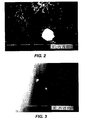
- FIG. 2 A portion of dental tubing having a biofilm about one year old on its interior surface is shown in Fig. 2.
- the biofilm completely covers the interior surface of the tubing and consists of about 200,000 colonies/cm of bacteria.
- a three foot section of the tubing was treated in accordance with the invention using a cleaning solution of 3% aqueous hydrogen peroxide containing 5% by weight of inert particles of calcium carbonate 50-100 microns in size, and surfactants including about 2% of an anionic surfactant, sodium dodecyl sulfate, and about 1% of a nonionic surfactant.
- the cleaning solution was added to the mixing chamber 28 of Fig. 1 and air was added to the mixing chamber from a 1 HP air compressor regulated at 30-60 psi, the air being continuously pulsed. The amount of air and the pulse rate were regulated to optimize mixing of the ingredients and the turbulence generated inside the tubing.
- the mixture was passed to the dental tubing to permit turbulent cleaning of the tubing.
- the tubing was then flushed with distilled water.
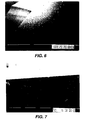
- the interior surface of the cleaned tubing is shown in Fig. 3. It is apparent that the biofilm has been completely removed.
- the cleaned tubing was tested for bacteria by scraping the interior surface of a section of the tubing 2.5 cm long and collecting water in that portion of the tube as follows.
- the tubing was.cut in half, about 1.25 cm in length, and three pieces were stored at 4°C.
- the lumen of each piece was scraped 15 times with the tip of a sterile scalpel blade to remove any bacteria and the scalpel and the tubing were agitated in water for one minute to suspend any bacteria present.
- the resultant suspension was diluted 10 fold and spread onto dilute peptone agar plates using distilled water.
- the water in the tubing was also diluted and plated.
- the plates were incubated for two weeks at 25°C and the bacteria colonies counted and identified according to conventional practice, including Gram strain calitose reaction, oxidase and glucose fermentation tests.
- the total number of bacteria and the total number of viable bacteria were counted according to the procedure of Hobbe et al, Applied & Environmental Microbiology, May, 1977 pp 1225-1228; and Kogure et al, Can. J. of Microbiology Vol. 25, pp 415-420 (1979).
- the cleaned tubing had only 280 colonies/cm of tubing, whereas untreated tubing had about 200,000 colonies/cm of tubing. Thus a reduction in bacterial count of one thousand times was obtained.
- the large white particles in Fig. 4 are believed to be deposits due to water hardness that accumulate over a long period of time.
- a cleaning solution was made by mixing 50 grams of calcium carbonate particles having a particle size of 10-100 microns into 450 ml of a solution containing 3% by weight of hydrogen peroxide solution, 2% by weight of a surfactant, sodium dodecyl sulfate and 1% of a nonionic surfactant.
- the above mixture was introduced into a used dental tubing 0.9m (3 feet) long and 1.8 mm in diameter having a biofilm thereon, as shown in Fig. 4, together with air supplied by a compressor set between 207 and 414 KPa (30 and 60 psi).
- the cleaning composition was flushed through the tubing for about 3 minutes.
- the tubing was then flushed with 200 ml of distilled water.
- the number of bacterial colonies in the tubing decreased from an initial value of 7.15 x 10 5 per linear cm of tubing down to zero after cleaning.
- the CFU/ml of water flowing in the tube was reduced from an initial value of 3.19 x 10 6 to zero after cleaning.
- Fig. 5 The SEM photograph of Fig. 5 is an overall view of the interior wall of the tubing after treatment. Fig. 5 shows a complete removal of biofilm in the lumen of the tubing. The bare surface of the tubing was free of any debris or biofilm.
- the number of bacterial colonies per cm of tubing after culture decreased from an initial value of 1 x 10 5 to zero.
- the CFU/ml of the water decreased from an initial value of 3.01 x 10 6 to zero.
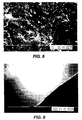
- Fig. 6 is a photograph of the interior wall of the tubing prior to treatment.
- Fig. 7 is a photograph of the interior wall of the tubing after treatment.
- Example 2 The procedure of Example 2 was followed except substituting distilled water for the hydrogen peroxide solution.
- the CFU/cm decreased from an initial value of 4 x 10 5 to zero.
- a mixture of water, surfactant, abrasive particles and air under a preselected pressure was sufficient to remove the biofilm from the tubing.
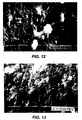
- Fig. 8 is a photograph of the interior surface of the tubing prior to treatment.
- Fig. 9 is a photograph of the interior surface of the tubing after treatment according to this example.
- a cleaning solution was made from 193 ml of 3% by weight of hydrogen peroxide, 3% by weight of sodium dodecyl sulfate surfactant and 50-100 grams of water soluble sodium bicarbonate particles. The solution was brought to 600 grams with distilled water.
- the cleaning solution was introduced into used dental tubing along with air from a compressor set at 207-414 KPa (30-60 psi) for three minutes. The tubing was then flushed with distilled water.
- a mixture of 5% of sodium dodecyl sulfate surfactant and peroxycarbonate and 1% of polyphosphate was mixed with water to a total of 600 ml.
- the mixture was introduced into used dental tubing with air under pressure supplied by a compressor set at 207 to 414 KPa (30 to 60 psi) for three minutes. The tubing was then flushed with 200 ml of water.
- the CFU/cm was reduced from an initial value of 1.25x10 5 to zero and the CFU/ml was reduced from an initial value of 3x10 6 to zero.
- the CFU/cm was reduced from an initial value of 7.5x10 4 to 3.5x10 4 . However, the CFU/ml of water was reduced only from 2.5x10 6 and was 2.38x10 6 after treatment.
- Fig. 12 shows the presence of biofilm prior to the Control treatment and Fig. 13 shows a reduction of only about 30% in the biofilm after treatment.
- the above treatment should be repeated at least about every 100 hours.
- the present cleaning solutions and method can also be used to remove other contaminants in addition to biofilm from tubing, such as organic films, mucous or solid debris, e.g., tissue, loose cells, food particles, that adhere to tubing walls.
- FIG. 14 is a schematic view of a cleaning apparatus that can be used to clean both the interior walls of an endoscopy tube and the exterior walls.
- An air compressor 100 carries air in line 102 through a compressed air pulsation control nozzle 104 to a mixing chamber 106.
- a pressure regulator 108 controls the air flow.
- a chamber 110 for the storage of cleaning solution passes the cleaning solution to the mixing chamber 106 through a line 112.
- the resultant turbulent mixture of pressurized air and cleaning solution is passed via line 114 to an adaptor 116 (see Fig. 14A) that provides a pressure-tight fitting to the port 118 of the endoscopy tube 120.
- Fig. 14A is a magnified view of the adaptor 116 and the endoscopy port 118.
- Fig. 14B is a magnified view of an external port 122 that fastens a pressure-tight sleeve 124 by means of an adaptor 126 to accommodate the line 115 carrying cleaning solution to the external surfaces of the endoscopy tube.
- the sleeve 124 can be made of any flexible plastic such as cellulose materials, polyolefins and polyesters.
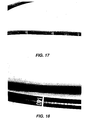
- a flexible tubing having a length of about 1.8m (6 feet) and an internal channel diameter of about 0.110 cm was partially filled with a debris mixture of food residue including carbohydrates (starch), proteins and sugars and allowed to dry overnight. This residue was designed to simulate debris remaining after an endoscopy procedure. The debris can be clearly seen in Fig. 15, which is a low magnification view.
- the internal channels were filled with water for 5-10 minutes to soften the debris residue.
- a mixture of cationic surfactants of 0.05% octyldecyldimethyl ammonium chloride, 0.025% dioctyldimethyl ammonium chloride and 0.025% didecyldimethyl ammonium chloride and about 1% of nonionic and anionic surfactants mixed with 4% of hydrogen peroxide were used as the cleaning solution.
- 500 Ml of this solution was mixed with air up to 552 KPa (80 psi) pressure and passed through the channel over a 5 minute period.
- the channels were then flushed with one liter of water.
- the channels were then disinfected using 200 ml of a solution of 3-7% hydrogen peroxide together with pressurized air. The channels were then dried in air for five minutes. The interior walls of the tubing were cleaned of all debris, as shown in Fig. 16.
- Example 7 The procedure of Example 7 was repeated except the cleaning solution contained a mixture of both anionic and nonionic surfactants at up to 2% concentration in a solution of 3% hydrogen peroxide. All debris was removed.
- Example 7 The procedure of Example 7 was repeated except the cleaning solution was made by first dissolving the surfactants in distilled water. All debris was removed.
- Example 7 The procedure of Example 7 was repeated except that 5% of calcium carbonate particles having a particle size of 50-200 microns was dispersed in the cleaning solution. All debris was removed.
- Example 8 The procedure of Example 8 was repeated except that 5% of calcium carbonate particles having a particle size of 50-200 microns was dispersed in the cleaning solution. All debris was removed.
- Water soluble particles such as sodium bicarbonate, can be substituted for the water insoluble calcium carbonate particles.
- the stem of the tube was inserted into a flexible cellulose polymer sleeve having a diameter of 1.4 cm.
- the sleeve and the tube were connected together by means of a pressure-tight adaptor.
- the cleaning solution (500 ml) of Example 7 was mixed with air at up to 689 KPa (100 psi) pressure and passed into the sleeve for five minutes.
- a water flushing cycle, disinfecting cycle and drying cycle were carried out as in Example 7. All debris was removed from the external surface of the tubing as can be seen in Fig. 18.
- the present cleaning solution can also be sprayed under pressure onto a surface to be cleaned, such as prosthesis implants and respirators for both adults and for neonatal care.
Landscapes
- Chemical & Material Sciences (AREA)
- Health & Medical Sciences (AREA)
- Chemical Kinetics & Catalysis (AREA)
- Engineering & Computer Science (AREA)
- Life Sciences & Earth Sciences (AREA)
- Organic Chemistry (AREA)
- Animal Behavior & Ethology (AREA)
- General Health & Medical Sciences (AREA)
- Public Health (AREA)
- Veterinary Medicine (AREA)
- Oil, Petroleum & Natural Gas (AREA)
- Wood Science & Technology (AREA)
- Urology & Nephrology (AREA)
- General Chemical & Material Sciences (AREA)
- Heart & Thoracic Surgery (AREA)
- Mechanical Engineering (AREA)
- Epidemiology (AREA)
- Vascular Medicine (AREA)
- Biomedical Technology (AREA)
- Hematology (AREA)
- Anesthesiology (AREA)
- Inorganic Chemistry (AREA)
- Emergency Medicine (AREA)
- Materials Engineering (AREA)
- Metallurgy (AREA)
- Dentistry (AREA)
- Water Supply & Treatment (AREA)
- Oral & Maxillofacial Surgery (AREA)
- Detergent Compositions (AREA)
- Apparatus For Disinfection Or Sterilisation (AREA)
- Cleaning By Liquid Or Steam (AREA)
- Cleaning In General (AREA)
- Dental Tools And Instruments Or Auxiliary Dental Instruments (AREA)
- Biological Treatment Of Waste Water (AREA)
Applications Claiming Priority (3)
| Application Number | Priority Date | Filing Date | Title |
|---|---|---|---|
| US880662 | 1992-05-11 | ||
| US08/880,662 US6027572A (en) | 1997-06-23 | 1997-06-23 | Cleaning method for removing biofilm and debris from lines and tubing |
| PCT/US1998/011401 WO1998058632A1 (en) | 1997-06-23 | 1998-06-11 | Cleaning composition and apparatus for removing biofilm and debris from lines and tubing and method therefor |
Publications (3)
| Publication Number | Publication Date |
|---|---|
| EP1027175A1 EP1027175A1 (en) | 2000-08-16 |
| EP1027175A4 EP1027175A4 (en) | 2002-08-14 |
| EP1027175B1 true EP1027175B1 (en) | 2007-05-16 |
Family
ID=25376793
Family Applications (1)
| Application Number | Title | Priority Date | Filing Date |
|---|---|---|---|
| EP98930060A Expired - Lifetime EP1027175B1 (en) | 1997-06-23 | 1998-06-11 | Method for removing biofilm and debris from lines and tubing |
Country Status (7)
| Country | Link |
|---|---|
| US (3) | US6027572A (enExample) |
| EP (1) | EP1027175B1 (enExample) |
| JP (2) | JP4198196B2 (enExample) |
| AT (1) | ATE362517T1 (enExample) |
| CA (1) | CA2290441C (enExample) |
| DE (1) | DE69837790T2 (enExample) |
| WO (1) | WO1998058632A1 (enExample) |
Cited By (2)
| Publication number | Priority date | Publication date | Assignee | Title |
|---|---|---|---|---|
| EP2674228A1 (de) | 2012-06-11 | 2013-12-18 | Hammann GmbH | Verfahren zur Entfernung von Ablagerungen und/oder Biofilmen in einer Rohrleitung über modulierende Druckimpulse |
| EP2815816A1 (de) | 2013-06-20 | 2014-12-24 | Hammann GmbH | Verfahren und Vorrichtung zur Optimierung der Reinigung von flüssigkeitsdurchströmten Leitungen oder Anlagen |
Families Citing this family (91)
| Publication number | Priority date | Publication date | Assignee | Title |
|---|---|---|---|---|
| DE19639666C1 (de) * | 1996-09-27 | 1998-06-10 | Alpro Dental Produkte Gmbh | Dosiervorrichtung zur Zugabe von Entkeimungsmittel in eine wassergespeiste Versorgungseinrichtung zur Bereitstellung von entkeimtem Wasser für Verbraucher sowie deren Verwendung |
| US6454871B1 (en) * | 1997-06-23 | 2002-09-24 | Princeton Trade & Technology, Inc. | Method of cleaning passageways using a mixed phase flow of gas and a liquid |
| US6945257B2 (en) * | 1997-06-23 | 2005-09-20 | Princeton Trade & Technology | Method for cleaning hollow tubing and fibers |
| US20040007255A1 (en) * | 1997-06-20 | 2004-01-15 | Labib Mohamed Emam | Apparatus and method for cleaning pipelines, tubing and membranes using two-phase flow |
| US6027572A (en) * | 1997-06-23 | 2000-02-22 | Princeton Trade And Technologt, Inc | Cleaning method for removing biofilm and debris from lines and tubing |
| FR2773725B1 (fr) | 1998-01-16 | 2000-02-25 | Commissariat Energie Atomique | Procede de generation et de mise en circulation d'une mousse dans une installation et dispositif pour la mise en oeuvre de ce procede |
| US6076536A (en) * | 1998-10-07 | 2000-06-20 | H.E.R.C. Products Incorporated | Cleaning and passivating water distribution systems |
| US6464868B1 (en) | 1999-09-14 | 2002-10-15 | Amos Korin | Method and system for controlling biofilm |
| US6585943B1 (en) | 2000-02-07 | 2003-07-01 | Steris Inc. | Liquid cleaning and sterilization system |
| US6558620B1 (en) | 2000-02-07 | 2003-05-06 | Steris Inc. | Liquid cleaning and sterilization method |
| DE60124906T2 (de) | 2000-06-05 | 2007-05-24 | S.C. Johnson & Son, Inc., Racine | Biozide reinigungsmittel |
| AT408987B (de) * | 2000-10-13 | 2002-04-25 | Thonhauser Gmbh Dipl Ing | Reinigungs- und desinfektionsmittel |
| FI113521B (fi) * | 2000-11-08 | 2004-05-14 | Planmeca Oy | Menetelmät hammashoitokoneen vesilinjojen desinfioimiseksi ja hammashoitokoneen vesilinjojen desinfiointijärjestelyt |
| WO2002081378A1 (en) * | 2001-04-09 | 2002-10-17 | Downs Bradley J | Structure and process for continuously treating dental unit water |
| US6793880B2 (en) * | 2001-07-13 | 2004-09-21 | Minntech Corporation | Apparatus and method for monitoring biofilm cleaning efficacy |
| SE523144C2 (sv) * | 2001-07-24 | 2004-03-30 | Mikael Nutsos | Tappställe och vattentillförselnät innefattande sådant tappställeint |
| US6598616B2 (en) | 2001-07-24 | 2003-07-29 | Mikael Nutsos | Tapping point and supply water network comprising such tapping point |
| US7017593B2 (en) * | 2001-08-30 | 2006-03-28 | Toshimi Honda | Pipe washing method and pipe washing apparatus |
| US20030121532A1 (en) * | 2001-10-11 | 2003-07-03 | Coughlin Robert W. | Removal of biofilm from surfaces |
| US6726778B2 (en) * | 2002-01-14 | 2004-04-27 | Je Cleanpress Ltd. Co. | Method for cleaning and renovating pipelines |
| US6919057B2 (en) * | 2002-04-04 | 2005-07-19 | Steris Inc. | Automated endoscope reprocessor |
| US7351386B2 (en) | 2002-04-04 | 2008-04-01 | Steris Inc | Cartridge holder for automated reprocessor |
| US20030190254A1 (en) * | 2002-04-07 | 2003-10-09 | Frank Falat | Method for ultra-violet disinfecting of compressed air |
| ITBO20020634A1 (it) * | 2002-10-08 | 2004-04-09 | Castellini Spa | Unita' ausiliaria per trattamenti igienici su apparecchiature dentistiche |
| US7055533B2 (en) * | 2002-12-17 | 2006-06-06 | Larkin Rodney B | Apparatus and method for cleaning HVE conduits |
| US6872303B2 (en) * | 2003-08-12 | 2005-03-29 | Ian M. Knapp | Water treatment cartridge |
| US6945261B2 (en) * | 2003-09-09 | 2005-09-20 | Nalco Company | Apparatuses, systems and processes for surface cleaning |
| GB0326653D0 (en) * | 2003-11-15 | 2003-12-17 | Whirlwind By Air Ltd | Cleaning wall deposits from ducts |
| US7407799B2 (en) * | 2004-01-16 | 2008-08-05 | California Institute Of Technology | Microfluidic chemostat |
| US7392811B2 (en) * | 2004-02-23 | 2008-07-01 | Ecolab Inc. | Delivery head for multiple phase treatment composition, vessel including a delivery head, and method for treating a vessel interior surface |
| US7247210B2 (en) * | 2004-02-23 | 2007-07-24 | Ecolab Inc. | Methods for treating CIP equipment and equipment for treating CIP equipment |
| US7220358B2 (en) * | 2004-02-23 | 2007-05-22 | Ecolab Inc. | Methods for treating membranes and separation facilities and membrane treatment composition |
| US8076117B2 (en) * | 2004-03-18 | 2011-12-13 | Mayo Foundation For Medical Education And Research | Microbial biofilm removal methods and systems |
| GB0408651D0 (en) * | 2004-04-16 | 2004-05-19 | Lauzon Normand | Cleaning method and system for use with piping systems |
| US20060078844A1 (en) * | 2004-10-07 | 2006-04-13 | Goldman Paul D | Oral care systems, oral care devices and methods of use |
| JP5363697B2 (ja) * | 2005-06-15 | 2013-12-11 | 花王株式会社 | バイオフィルム抑制・除去剤 |
| FR2900357B1 (fr) * | 2006-04-28 | 2009-03-20 | Barena Sarl | Procede de regeneration de futs ou analogues et dispositif pour sa mise en oeuvre |
| US20080099057A1 (en) * | 2006-10-27 | 2008-05-01 | Dade Behring Inc. | Method and Device for Cleaning a Liquid Aspiration and Dispense Probe |
| US7862660B2 (en) | 2007-01-12 | 2011-01-04 | Princeton Trade & Technology, Inc. | Device and method for fluid dynamics cleaning of constrained spaces |
| US7517413B2 (en) * | 2007-03-26 | 2009-04-14 | The Clorox Company | Remediation of microfloral and biofilm development from laundering devices |
| WO2008151093A1 (en) * | 2007-05-30 | 2008-12-11 | Alburtylab, Inc. | Liquid to liquid biological particle concentrator |
| US20090025760A1 (en) * | 2007-07-24 | 2009-01-29 | Oscar Ciampaglia | Medical and dental tool cleaning device |
| NL2000790C2 (nl) * | 2007-07-31 | 2009-02-03 | X Flow Bv | Werkwijze voor het reinigen van filtermembranen. |
| US8801867B2 (en) * | 2007-07-31 | 2014-08-12 | X-Flow B.V. | Method for cleaning filter membranes |
| RU2494821C2 (ru) * | 2007-07-31 | 2013-10-10 | Икс-Флоу Б.В. | Способ очистки технологической аппаратуры, в частности фильтров |
| US8262645B2 (en) * | 2007-11-21 | 2012-09-11 | Actuated Medical, Inc. | Devices for clearing blockages in in-situ artificial lumens |
| EP2065059A1 (de) * | 2007-11-29 | 2009-06-03 | HAMMANN Wasser Kommunal Ingenieurgesellschaft für kommunale Dienstleistungen mbH | Verfahren und Vorrichtung zur Reinigung von medizinischen Geräten, insbesondere von Endoskopen |
| JP2011528619A (ja) * | 2008-07-21 | 2011-11-24 | スリーエム イノベイティブ プロパティズ カンパニー | 流体の流れに添加剤を分散するための装置 |
| JP5127619B2 (ja) * | 2008-07-24 | 2013-01-23 | オリンパスメディカルシステムズ株式会社 | 内視鏡洗浄消毒装置、内視鏡洗浄消毒装置を用いた内視鏡の洗浄方法 |
| US8114221B2 (en) * | 2008-09-30 | 2012-02-14 | Princeton Trade & Technology, Inc. | Method and composition for cleaning tubular systems employing moving three-phase contact lines |
| US8226774B2 (en) | 2008-09-30 | 2012-07-24 | Princeton Trade & Technology, Inc. | Method for cleaning passageways such an endoscope channels using flow of liquid and gas |
| EP2358643A4 (en) * | 2008-11-20 | 2012-10-10 | Michael J Conrad | NEW CHEMICALS, SOLUTIONS AND DISPERSION SYSTEMS FOR THE DECONTAMINATION OF CHEMICAL AND BIOLOGICAL SYSTEMS |
| DE102009026039A1 (de) | 2009-06-25 | 2010-12-30 | Thomas Pfalz | Reinigungs- und Desinfektionssystem für Rohre, Schläuche und Behälter und dazugehörige Verfahren |
| US9157053B1 (en) | 2009-07-01 | 2015-10-13 | Thomas Tupaj | Laundry washing machine deodorizer |
| DE102010013167A1 (de) * | 2010-03-27 | 2011-09-29 | Hammann Gmbh | Verfahren und Vorrichtung zur Entfernung von Ablagerungen und/oder Biofilmen in Wasser- oder Produktleitungen oder Rohrleitungssystemen |
| WO2012027158A1 (en) * | 2010-08-26 | 2012-03-01 | Pickett Joseph S | Method and apparatus for cleaning and sterilizing product lines |
| CA2846259A1 (en) * | 2010-09-08 | 2012-03-15 | Medizone International Inc. | Food-handling facility disinfection treatment |
| JP5433591B2 (ja) | 2011-01-18 | 2014-03-05 | シャープ株式会社 | 洗浄処理装置および洗浄処理方法 |
| US20140060584A1 (en) * | 2012-09-06 | 2014-03-06 | United Technologies Corporation | Wash device |
| US10022189B2 (en) | 2013-12-16 | 2018-07-17 | Stryker Sustainability Solutions, Inc. | Apparatus and method for cleaning an instrument |
| US9850154B2 (en) | 2013-12-30 | 2017-12-26 | Ecolab Usa Inc. | Method of reducing industrial water use |
| AT515104B1 (de) * | 2014-03-04 | 2015-06-15 | Michael Leonhartsberger | Vorrichtung zur Aufbereitung von metallionenhältigen Lösungen |
| JP6465107B2 (ja) | 2014-04-10 | 2019-02-06 | 三菱瓦斯化学株式会社 | 成形体及びその製造方法 |
| US10118844B2 (en) | 2014-12-31 | 2018-11-06 | Ecolab Usa Inc. | Multifunctional method for membrane protection and biofouling control |
| JP7090271B2 (ja) * | 2015-09-29 | 2022-06-24 | ブルー ボックス エア、エルエルシー | 暖房換気及び空気調節システムをクリーニングするための方法及びシステム |
| EP3356759B1 (en) * | 2015-09-29 | 2021-04-21 | Blue Box Air, LLC | Method and system for cleaning heating, ventilation and air conditioning systems |
| US10859331B2 (en) | 2015-09-29 | 2020-12-08 | Blue Box Air, Llc | Method and system for cleaning a heat exchange system of a heating ventilation and air conditioning system |
| DE102015219659A1 (de) * | 2015-10-09 | 2017-04-13 | Blue Safety Gmbh | Aufbereitungsverfahren für eine Betriebswasserversorgungseinheit |
| DE102016206816A1 (de) * | 2016-04-21 | 2017-10-26 | Olympus Winter & Ibe Gmbh | Reinigungs-, Desinfizier- und/oder Trocknungseinrichtung sowie Verfahren zum Reinigen, Desinfizieren und/oder Trocknen für bzw. von medizinischen Geräten |
| US10512523B2 (en) | 2016-08-24 | 2019-12-24 | Novaflux, Inc. | Apparatus and methods for hygiene testing a medical device |
| EP3300684B1 (en) * | 2016-09-30 | 2020-01-15 | Ferton Holding S.A. | Fluid distributing device |
| US10266793B2 (en) | 2016-09-30 | 2019-04-23 | Novaflux, Inc. | Compositions for cleaning and decontamination |
| IT201600100869A1 (it) * | 2016-10-07 | 2018-04-07 | Ali Group Srl Carpigiani | Metodo e sistema di pulizia di una macchina per la realizzazione di prodotti alimentari liquidi e/o semiliquidi del settore gelateria, pasticceria o ristorazione |
| WO2019147856A1 (en) * | 2018-01-25 | 2019-08-01 | Johnson Jack E | Membrane and diffuser de-fouling treatment |
| JP7868974B2 (ja) | 2018-04-03 | 2026-06-02 | ノバフラックス インコーポレイテッド | 高吸収性ポリマーを備える洗浄組成物 |
| US20220249211A1 (en) * | 2019-03-08 | 2022-08-11 | Dentsply Sirona Inc. | Treatment apparatus for treating peri-implantitis |
| EP3714762B1 (en) | 2019-03-29 | 2023-08-23 | Picosun Oy | Method and apparatus for cleaning medical instruments and for detecting residue thereon |
| RU2723138C1 (ru) * | 2019-06-14 | 2020-06-09 | Федеральное государственное бюджетное учреждение науки Удмуртский федеральный исследовательский центр Уральского отделения Российской академии наук | Способ применения раствора для удаления зубного налета с помощью ирригатора |
| US11370001B2 (en) * | 2019-08-26 | 2022-06-28 | Jeffrey J. Seippel | Method and apparatus for cleaning a heat exchanger or water system |
| US11918677B2 (en) | 2019-10-03 | 2024-03-05 | Protegera, Inc. | Oral cavity cleaning composition method and apparatus |
| US12064495B2 (en) | 2019-10-03 | 2024-08-20 | Protegera, Inc. | Oral cavity cleaning composition, method, and apparatus |
| GB201914723D0 (en) | 2019-10-11 | 2019-11-27 | Rolls Royce Plc | Cleaning system and a method of cleaning |
| CN111117800A (zh) * | 2019-12-26 | 2020-05-08 | 南京巨鲨显示科技有限公司 | 生物膜去除清洗剂及其制备方法 |
| CN114632758B (zh) * | 2020-12-16 | 2024-04-09 | 深圳市帝迈生物技术有限公司 | 一种清洗装置、液路清洗方法及样本分析仪 |
| EP4351809A4 (en) * | 2021-06-09 | 2025-04-02 | Saban Ventures Pty Limited | SYSTEMS AND METHODS FOR CLEANING LUMENS WITH FLUID COMPOSITIONS |
| CN113522895B (zh) * | 2021-07-20 | 2022-11-15 | 西安交通大学 | 一种管道冲刷方法及装置 |
| US12516895B2 (en) | 2022-02-16 | 2026-01-06 | Blue Box Air, Llc | Apparatus and methods for self-cleaning and maintaining HVAC heat transfer coils |
| US12296293B2 (en) | 2022-09-27 | 2025-05-13 | Blue Box Air, Llc | Method and system for automated cleaning of filter wall for HVAC systems |
| EP4344609B1 (de) | 2022-09-30 | 2025-10-01 | Hammann GmbH | Verfahren und vorrichtung zur reinigung von medizinischen instrumenten mittels modulierender druckgasimpulse |
| CN118000829A (zh) | 2022-11-09 | 2024-05-10 | 巴德阿克塞斯系统股份有限公司 | 用于预防或治疗与血管通路装置相关的血栓形成的系统 |
| EP4753774A1 (en) | 2023-08-01 | 2026-06-10 | Fresenius Medical Care Holdings, Inc. | Reducing biofilm build-up in a dialysate pathway by using ultrasonication and ionization |
Family Cites Families (105)
| Publication number | Priority date | Publication date | Assignee | Title |
|---|---|---|---|---|
| US1948568A (en) * | 1930-04-28 | 1934-02-27 | Faber Engineering Company | Method of treating textile materials and the like |
| US2245195A (en) * | 1936-05-07 | 1941-06-10 | Nat Carbon Co Inc | Cooling system flushing gun |
| US2222516A (en) * | 1937-07-21 | 1940-11-19 | William T Powell | Method and apparatus for cleaning fluid circulating systems |
| DE893595C (de) | 1951-12-29 | 1953-10-19 | Adalbert Besta | Verfahren zum Loesen und Entfernen von Ablagerungen und Anlagerungen in Kanaelen und Rohren |
| US2699403A (en) * | 1952-05-24 | 1955-01-11 | Emmett J Courts | Means and methods for cleaning and polishing automobiles |
| US2875521A (en) * | 1954-09-16 | 1959-03-03 | Paul J Tascher | Abrasive flux and flush control system for dental apparatus |
| US2809429A (en) * | 1956-05-21 | 1957-10-15 | Albert R Cerveris | Dental instrument assembly |
| US3146952A (en) * | 1962-09-27 | 1964-09-01 | Edward L Brady | Radiator cleaning device |
| US3182670A (en) * | 1963-01-16 | 1965-05-11 | Martin Marietta Corp | Means for decontaminating fluid systems |
| US3431145A (en) * | 1964-11-12 | 1969-03-04 | Frank D Riley | Method for flushing and cleaning internal combustion engines |
| US3194438A (en) * | 1964-11-19 | 1965-07-13 | Maurice D Walker | Cleaning and sanitizing machine |
| US3467314A (en) * | 1966-12-29 | 1969-09-16 | Norman J Grubb | Apparatus for cleaning objects |
| US3625231A (en) * | 1970-07-31 | 1971-12-07 | William Getz Dental Products | Apparatus for cleaning and conditioning dental handpieces |
| US3811408A (en) * | 1972-11-06 | 1974-05-21 | A Thompson | Penumatic cleaning, disinfecting and oiling device for a tube-type dental handpiece |
| US4169123A (en) * | 1975-12-11 | 1979-09-25 | Moore-Perk Corporation | Hydrogen peroxide vapor sterilization method |
| US4109703A (en) * | 1976-11-11 | 1978-08-29 | Wynn Oil Company | Engine cooling system flushing apparatus and method |
| CH636121A5 (de) * | 1977-03-18 | 1983-05-13 | Schaefer Chemisches Inst Ag | Metall-ionen-, phosphat- und enzym-freies reiniger-konzentrat. |
| US4219333A (en) * | 1978-07-03 | 1980-08-26 | Harris Robert D | Carbonated cleaning solution |
| US4222346A (en) * | 1978-11-29 | 1980-09-16 | Reisgies Rolf W | Milk line back flushing method and apparatus |
| DE3040995A1 (de) * | 1979-11-09 | 1981-05-27 | National Research Development Corp., London | Vorrichtung zum erzeugen einer reinigungsspruehzerstaeubung |
| US4444597A (en) * | 1980-03-03 | 1984-04-24 | Norman Gortz | Automated cleaning method for dialyzers |
| SU1042826A1 (ru) | 1981-02-12 | 1983-09-23 | Предприятие П/Я А-7179 | Способ очистки внутренней поверхности трубопроводов |
| US4517081A (en) * | 1981-11-17 | 1985-05-14 | Renal Systems, Inc. | Dialyzer reuse machine |
| US4477438A (en) * | 1982-11-12 | 1984-10-16 | Surgikos, Inc. | Hydrogen peroxide composition |
| DE3417571C2 (de) * | 1983-05-16 | 1986-10-30 | Olympus Optical Co., Ltd., Tokio/Tokyo | Verfahren zum Reinigen von Endoskopen, sowie Endoskop hierfür |
| SE8405557D0 (sv) * | 1983-11-07 | 1984-11-06 | American Sterilizer Co | Sett att koncentrera veteperoxid |
| US4538545A (en) * | 1984-07-11 | 1985-09-03 | Rio Linda Chemical Co., Inc. | Foam generating and distributing manifold apparatus |
| DE3469145D1 (en) * | 1984-08-14 | 1988-03-10 | Johan Szucs | Stone and metal cleaning system |
| DE3430605A1 (de) * | 1984-08-20 | 1986-02-27 | Siemens AG, 1000 Berlin und 8000 München | Verfahren und vorrichtung zur reinigung, desinfektion und sterilisation von aerztlichen, insbesondere zahnaerztlichen, instrumenten |
| US4695385A (en) * | 1985-04-29 | 1987-09-22 | Colorado Medical, Inc. | Dialyzer reuse system |
| FI76935C (sv) * | 1985-07-22 | 1989-01-10 | Goeran Sundholm | Spolaggregat. |
| JPS62109000A (ja) * | 1985-11-07 | 1987-05-20 | Takao Sakamoto | 熱交換器における伝熱管の内面洗浄方法 |
| US4802630A (en) * | 1985-11-19 | 1989-02-07 | Ecolab Inc. | Aspirating foamer |
| US4752444A (en) * | 1985-12-09 | 1988-06-21 | Bowen Ltd. | Method for sterilizing a dental handpiece |
| US5077008A (en) * | 1986-02-06 | 1991-12-31 | Steris Corporation | Anti-microbial composition |
| US4776794A (en) * | 1986-06-03 | 1988-10-11 | Moshe Meller | Cleaning instrument using premixed abrasive liquid |
| JPS6312933A (ja) * | 1986-07-03 | 1988-01-20 | Nippon Sekiyu Seisei Kk | 連続式分析用液体試料採取装置 |
| US4902352A (en) * | 1986-09-05 | 1990-02-20 | General Motors Corporation | Paint color change system |
| US4881563A (en) * | 1986-09-05 | 1989-11-21 | General Motors Corporation | Paint color change system |
| US4863688A (en) * | 1986-12-31 | 1989-09-05 | American Sterilizer Company | Method of decontaminating surfaces on or near living cells with vapor hydrogen peroxide |
| US5137689A (en) * | 1987-07-01 | 1992-08-11 | Cantrell Stephen B | Method and apparatus for cleaning instruments |
| CA1311912C (en) * | 1987-07-09 | 1992-12-29 | Werner Naf | Method for the repair of the inside of installed conduits |
| AT387712B (de) * | 1987-08-07 | 1989-03-10 | Oegussa | Handgeraet zum reinigen und/oder desinfizieren und/oder schmieren von dentalen hand- oder winkelstuecken bzw. turbinenwinkelstuecken od.dgl. |
| DE3803410A1 (de) * | 1988-02-05 | 1989-08-17 | Karl Mueller | Verfahren zur reinigung und beschichtung von zur wasserfuehrung bestimmten rohrleitungen |
| JPH0539355Y2 (enExample) * | 1988-03-16 | 1993-10-05 | ||
| KR930003763B1 (ko) * | 1988-04-29 | 1993-05-10 | 선돌름 고란 | 수압파이프 시스템 등의 세척장치(Apparatus for flushing of hydraulic pipe systems or the like) |
| FR2641973B1 (fr) * | 1989-01-20 | 1991-04-19 | Bene Pierre Yves | Dispositif de nettoyage et de desinfection d'instruments medicaux et chirurgicaux |
| US5109562A (en) * | 1989-08-30 | 1992-05-05 | C.V.D. System Cleaners Corporation | Chemical vapor deposition system cleaner |
| DE69024503T2 (de) * | 1990-04-05 | 1996-05-15 | Minntech Corp | Antikorrosive mikrobizide |
| DE4024171C2 (de) * | 1990-07-30 | 1996-02-22 | Kaltenbach & Voigt | Verfahren und Pflegesatz zum Desinfizieren und Pflegen von ärztlichen, insbesondere zahnärztlichen Instrumenten |
| GB9020559D0 (en) * | 1990-09-20 | 1990-10-31 | Keymed Medicals & Ind Equip | Cleaning and disinfecting medical instruments |
| EP0490117A1 (de) | 1990-12-13 | 1992-06-17 | Bühler Ag | Verfahren zum Reinigen einer Rohrleitung |
| US5160548A (en) * | 1991-09-09 | 1992-11-03 | Ohmstede Mechanical Services, Inc. | Method for cleaning tube bundles using a slurry |
| FI95821B (fi) * | 1991-10-18 | 1995-12-15 | Ahlstroem Oy | Menetelmä ja laite kaasun sekoittamiseksi väliaineeseen sekä menetelmää soveltava valkaisuprosessi |
| US5287867A (en) * | 1992-06-08 | 1994-02-22 | Plummer Design & Technologies, Inc. | Apparatus and method for insuring and controlling turbulent flow for cleaning ducts |
| US5244468A (en) * | 1992-07-27 | 1993-09-14 | Harris Research, Inc. | Urea containing internally-carbonated non-detergent cleaning composition and method of use |
| US5408991A (en) * | 1992-07-31 | 1995-04-25 | Olympus Optical Co., Ltd. | Endoscope system wherein cleaning solution flows at same speed in cleaning solution supply section and in all flow paths of internal conduits |
| JPH06121769A (ja) * | 1992-08-24 | 1994-05-06 | Olympus Optical Co Ltd | 内視鏡用洗浄装置 |
| DE4225590C2 (de) * | 1992-08-03 | 1995-04-27 | Johann Szuecs | Vorrichtung für die Behandlung von empfindlichen Oberflächen, insbesondere von Skulpturen |
| US5314644A (en) * | 1992-10-19 | 1994-05-24 | Virginia Polytechnic Institute And State University | Microbubble generator |
| US5380369A (en) * | 1992-10-22 | 1995-01-10 | Kaltenbach & Voigt Gmbh & Co. | Process for cleaning and/or disinfecting and/or maintaining medical or dental instruments |
| US5419347A (en) * | 1992-11-16 | 1995-05-30 | Ssi Medical Services, Inc. | Automated flushing module |
| EP0603563A1 (de) * | 1992-12-04 | 1994-06-29 | F. Gehrig + Co. Ag | Verfahren zur Prüfung und Reinigung von Endoskopen sowie Reinigungsgerät zur Durchführung des Verfahrens |
| US5316587A (en) * | 1993-01-21 | 1994-05-31 | Church & Dwight Co., Inc. | Water soluble blast media containing surfactant |
| US5423917A (en) * | 1993-02-12 | 1995-06-13 | Garcia, Jr.; Ralph | Method for cleaning heat exchanger tubes by creating shock wave and mixing the liquid with injected air |
| US5674323A (en) * | 1993-02-12 | 1997-10-07 | American International, Inc. | Method and apparatus for cleaning columns by inducing vibrations in fouling material and the column |
| US5395456A (en) * | 1993-05-06 | 1995-03-07 | Ferro Corporation | Abrasive and purge compositions and methods of using the same |
| US6207201B1 (en) * | 1993-06-03 | 2001-03-27 | Amuchina International, Inc. | Sodium hypochlorite based disinfectant and sterilizer for medical-surgical instruments |
| ATE171886T1 (de) | 1993-07-12 | 1998-10-15 | Promotec Ag | Verfahren, zusammensetzung und vorrichtung zur innenreinigung und beschichtung von rohrleitungen |
| DE4323815C2 (de) * | 1993-07-15 | 1997-09-25 | Siemens Ag | Verfahren und Vorrichtung zur hygienischen Aufbereitung von medizinischen, insbesondere zahnmedizinischen Instrumenten |
| US5526841A (en) * | 1993-08-20 | 1996-06-18 | Detsch; Steven G. | Water line decontamination system |
| US5567444A (en) * | 1993-08-30 | 1996-10-22 | Ecolab Inc. | Potentiated aqueous ozone cleaning and sanitizing composition for removal of a contaminating soil from a surface |
| US5730806A (en) * | 1993-08-30 | 1998-03-24 | The United States Of America As Represented By The Administrator Of The National Aeronautics & Space Administration | Gas-liquid supersonic cleaning and cleaning verification spray system |
| US5445761A (en) * | 1993-09-24 | 1995-08-29 | E.R. Squibb And Sons, Inc. | Percarbonate based cleaner for cosmetic and pharmaceutical manufacturing facilities |
| US5480565A (en) * | 1993-10-08 | 1996-01-02 | Levin; Nathan | Methods for disinfecting dialyzers |
| EP0756577A4 (en) * | 1993-10-29 | 1998-02-11 | Alan Edwin Board | METHOD AND APPARATUS FOR CLEANING LIQUID DELIVERY SYSTEMS |
| US5403479A (en) * | 1993-12-20 | 1995-04-04 | Zenon Environmental Inc. | In situ cleaning system for fouled membranes |
| DE69502272D1 (de) * | 1994-01-31 | 1998-06-04 | Andre Prevost | System zum desinfektieren der wasserleitungen einer zahnärztlichen einheit |
| US5826282A (en) * | 1994-03-09 | 1998-10-27 | Matsushita Electric Industrial Co., Ltd. | Sanitary cleaning apparatus |
| US5731275A (en) * | 1994-04-05 | 1998-03-24 | Universite De Montreal | Synergistic detergent and disinfectant combinations for decontaminating biofilm-coated surfaces |
| GB9409785D0 (en) * | 1994-05-16 | 1994-07-06 | Medisafe Uk Limited | Cleaning tubular elements |
| US5616616A (en) * | 1994-06-01 | 1997-04-01 | Minntech Corporation | Room Temperature sterilant |
| JP2568986B2 (ja) * | 1994-07-07 | 1997-01-08 | 貞晋 大工 | 歯科排唾用バキュウムホースの清掃方法 |
| US5529788A (en) * | 1994-10-07 | 1996-06-25 | Southland, Ltd. | Enzyme containing effervescent cleaning tablet |
| US5611868A (en) * | 1994-12-13 | 1997-03-18 | U. S. Products, Inc. | Fabric cleaner with ozone injection |
| US5591344A (en) * | 1995-02-13 | 1997-01-07 | Aksys, Ltd. | Hot water disinfection of dialysis machines, including the extracorporeal circuit thereof |
| US5595344A (en) * | 1995-03-02 | 1997-01-21 | Starnes; Gary D. | Surgical instrument cleaning device |
| US5706842A (en) * | 1995-03-29 | 1998-01-13 | The United States Of America As Represented By The Administrator Of The National Aeronautics And Space Administration | Balanced rotating spray tank and pipe cleaning and cleanliness verification system |
| US5628959A (en) * | 1995-04-03 | 1997-05-13 | Alcide Corporation | Composition and methods for sterilizing dialyzers |
| US5699817A (en) * | 1995-05-11 | 1997-12-23 | Graco Inc | Turbulent flow conduit cleaning apparatus |
| ATE187367T1 (de) * | 1995-06-13 | 1999-12-15 | Bitiess Microtecnica S A | Universalgerät zur gründlichen reinigung, desinfektion und sterilisation von zahnärtzlichen, chirurugischen und tierärtzlichen instrumentn sowie zu anderen anwendungen |
| US5795404A (en) * | 1995-10-13 | 1998-08-18 | Welch Allyn, Inc. | Method and apparatus for cleaning channels of an endoscope |
| US5589507A (en) * | 1995-11-17 | 1996-12-31 | Minntech Corporation | Method for sterilizing medical devices utilizing a room temperature sterilant |
| ATE287645T1 (de) * | 1995-12-01 | 2005-02-15 | Minntech Corp | Raumtemperatur-sterilisierungsmittel fur medizinische instrumente |
| US5615695A (en) * | 1995-12-15 | 1997-04-01 | Chambers; Harvey E. | Pulsater fluid system flusher |
| US5868999A (en) * | 1996-03-19 | 1999-02-09 | Ozone Sterilization Products, Inc. | Ozone sterilizer and method for ozone sterilization |
| US5868523A (en) * | 1996-09-05 | 1999-02-09 | Nickell; Jerry D. | In-situ deep remediation injection system and method |
| US5925257A (en) * | 1996-09-27 | 1999-07-20 | Albelda; David | Method and apparatus for removing biofilm from an aqueous liquid |
| US6454871B1 (en) * | 1997-06-23 | 2002-09-24 | Princeton Trade & Technology, Inc. | Method of cleaning passageways using a mixed phase flow of gas and a liquid |
| US6945257B2 (en) * | 1997-06-23 | 2005-09-20 | Princeton Trade & Technology | Method for cleaning hollow tubing and fibers |
| US6027572A (en) * | 1997-06-23 | 2000-02-22 | Princeton Trade And Technologt, Inc | Cleaning method for removing biofilm and debris from lines and tubing |
| US6142170A (en) * | 1998-03-25 | 2000-11-07 | Belfer; William A. | Apparatus and method for dispensing disinfectant compositions for disinfecting water systems and lines |
| NO307453B1 (no) | 1998-06-29 | 2000-04-10 | Intel Sampling As | Fremgangsmõte og anordning for behandling i form av fjerning eller põføring av belegg põ innvendige flater i et lukket fluidsystem |
| US6326340B1 (en) * | 1998-09-29 | 2001-12-04 | Mohamed Emam Labib | Cleaning composition and apparatus for removing biofilm and debris from lines and tubing and method therefor |
| US6261457B1 (en) * | 1999-11-12 | 2001-07-17 | Minntech Corporation | Method and product for cleaning hollow fiber material and filter |
-
1997
- 1997-06-23 US US08/880,662 patent/US6027572A/en not_active Expired - Lifetime
-
1998
- 1998-06-11 WO PCT/US1998/011401 patent/WO1998058632A1/en not_active Ceased
- 1998-06-11 AT AT98930060T patent/ATE362517T1/de not_active IP Right Cessation
- 1998-06-11 DE DE69837790T patent/DE69837790T2/de not_active Expired - Lifetime
- 1998-06-11 EP EP98930060A patent/EP1027175B1/en not_active Expired - Lifetime
- 1998-06-11 JP JP50447899A patent/JP4198196B2/ja not_active Expired - Fee Related
- 1998-06-11 CA CA002290441A patent/CA2290441C/en not_active Expired - Fee Related
- 1998-09-29 US US09/162,698 patent/US6619302B2/en not_active Expired - Lifetime
-
2003
- 2003-08-18 US US10/643,486 patent/US20050028845A1/en not_active Abandoned
-
2008
- 2008-06-11 JP JP2008152801A patent/JP2008302231A/ja active Pending
Cited By (2)
| Publication number | Priority date | Publication date | Assignee | Title |
|---|---|---|---|---|
| EP2674228A1 (de) | 2012-06-11 | 2013-12-18 | Hammann GmbH | Verfahren zur Entfernung von Ablagerungen und/oder Biofilmen in einer Rohrleitung über modulierende Druckimpulse |
| EP2815816A1 (de) | 2013-06-20 | 2014-12-24 | Hammann GmbH | Verfahren und Vorrichtung zur Optimierung der Reinigung von flüssigkeitsdurchströmten Leitungen oder Anlagen |
Also Published As
| Publication number | Publication date |
|---|---|
| EP1027175A4 (en) | 2002-08-14 |
| JP4198196B2 (ja) | 2008-12-17 |
| WO1998058632A1 (en) | 1998-12-30 |
| US20010047813A1 (en) | 2001-12-06 |
| US20050028845A1 (en) | 2005-02-10 |
| JP2002505603A (ja) | 2002-02-19 |
| DE69837790D1 (de) | 2007-06-28 |
| EP1027175A1 (en) | 2000-08-16 |
| JP2008302231A (ja) | 2008-12-18 |
| DE69837790T2 (de) | 2008-01-31 |
| ATE362517T1 (de) | 2007-06-15 |
| CA2290441C (en) | 2008-12-02 |
| CA2290441A1 (en) | 1998-12-30 |
| US6619302B2 (en) | 2003-09-16 |
| US6027572A (en) | 2000-02-22 |
Similar Documents
| Publication | Publication Date | Title |
|---|---|---|
| US6027572A (en) | Cleaning method for removing biofilm and debris from lines and tubing | |
| US6326340B1 (en) | Cleaning composition and apparatus for removing biofilm and debris from lines and tubing and method therefor | |
| US6857436B2 (en) | Method of cleaning passageways using a mixed phase flow of a gas and a liquid | |
| US20240010949A1 (en) | Compositions for cleaning and decontamination | |
| CA2478060C (en) | Method for cleaning hollow tubing and fibers | |
| US20030121532A1 (en) | Removal of biofilm from surfaces | |
| JP2010005130A (ja) | 医療用洗浄水供給装置 | |
| US6217327B1 (en) | Soft scrub and spray method | |
| JP4647030B2 (ja) | 歯科ユニットのための洗浄水供給装置 | |
| US6599432B2 (en) | Methods for disinfecting small diameter water lines | |
| JP3935198B2 (ja) | 循環式浴槽の配管洗浄方法 | |
| CN113952068B (zh) | 一种种植体表面菌斑消毒杀菌装置及使用方法 | |
| JP3128520B2 (ja) | 医療機器用消毒洗浄液 | |
| JPH04135559A (ja) | 人工透析の医療機器の消毒洗浄剤 | |
| US20230372564A1 (en) | Unit dose pack for cleaning surgical instruments | |
| Burlibasa et al. | PREPARATION (CLEANING) OF ELEMENTS MADE OF TITANIUM AND TITANIUM-BASED ALLOYS IN ORAL IMPLANTOLOGY (PHYSICAL, CHEMICAL, BIOLOGICAL, PHYSIOLOGICAL IMPLICATIONS) | |
| JP2004329707A (ja) | オゾン水による義歯の殺菌・洗浄法 |
Legal Events
| Date | Code | Title | Description |
|---|---|---|---|
| PUAI | Public reference made under article 153(3) epc to a published international application that has entered the european phase |
Free format text: ORIGINAL CODE: 0009012 |
|
| 17P | Request for examination filed |
Effective date: 19991217 |
|
| AK | Designated contracting states |
Kind code of ref document: A1 Designated state(s): AT BE CH CY DE DK ES FI FR GB GR IE IT LI LU MC NL PT SE |
|
| A4 | Supplementary search report drawn up and despatched |
Effective date: 20020702 |
|
| AK | Designated contracting states |
Kind code of ref document: A4 Designated state(s): AT BE CH CY DE DK ES FI FR GB GR IE IT LI LU MC NL PT SE |
|
| RIC1 | Information provided on ipc code assigned before grant |
Free format text: 7C 11D 11/00 A, 7A 61L 2/18 B, 7B 08B 9/02 B |
|
| 17Q | First examination report despatched |
Effective date: 20031216 |
|
| RTI1 | Title (correction) |
Free format text: METHOD FOR REMOVING BIOFILM AND DEBRIS FROM LINES AND TUBING |
|
| GRAP | Despatch of communication of intention to grant a patent |
Free format text: ORIGINAL CODE: EPIDOSNIGR1 |
|
| GRAS | Grant fee paid |
Free format text: ORIGINAL CODE: EPIDOSNIGR3 |
|
| GRAA | (expected) grant |
Free format text: ORIGINAL CODE: 0009210 |
|
| AK | Designated contracting states |
Kind code of ref document: B1 Designated state(s): AT BE CH CY DE DK ES FI FR GB GR IE IT LI LU MC NL PT SE |
|
| PG25 | Lapsed in a contracting state [announced via postgrant information from national office to epo] |
Ref country code: FI Free format text: LAPSE BECAUSE OF FAILURE TO SUBMIT A TRANSLATION OF THE DESCRIPTION OR TO PAY THE FEE WITHIN THE PRESCRIBED TIME-LIMIT Effective date: 20070516 |
|
| REG | Reference to a national code |
Ref country code: GB Ref legal event code: FG4D |
|
| REG | Reference to a national code |
Ref country code: CH Ref legal event code: EP |
|
| REG | Reference to a national code |
Ref country code: IE Ref legal event code: FG4D |
|
| REF | Corresponds to: |
Ref document number: 69837790 Country of ref document: DE Date of ref document: 20070628 Kind code of ref document: P |
|
| PG25 | Lapsed in a contracting state [announced via postgrant information from national office to epo] |
Ref country code: ES Free format text: LAPSE BECAUSE OF FAILURE TO SUBMIT A TRANSLATION OF THE DESCRIPTION OR TO PAY THE FEE WITHIN THE PRESCRIBED TIME-LIMIT Effective date: 20070827 |
|
| PGFP | Annual fee paid to national office [announced via postgrant information from national office to epo] |
Ref country code: IE Payment date: 20070907 Year of fee payment: 10 |
|
| REG | Reference to a national code |
Ref country code: SE Ref legal event code: TRGR |
|
| ET | Fr: translation filed | ||
| PG25 | Lapsed in a contracting state [announced via postgrant information from national office to epo] |
Ref country code: AT Free format text: LAPSE BECAUSE OF FAILURE TO SUBMIT A TRANSLATION OF THE DESCRIPTION OR TO PAY THE FEE WITHIN THE PRESCRIBED TIME-LIMIT Effective date: 20070516 |
|
| REG | Reference to a national code |
Ref country code: CH Ref legal event code: NV Representative=s name: E. BLUM & CO. AG PATENT- UND MARKENANWAELTE VSP |
|
| PG25 | Lapsed in a contracting state [announced via postgrant information from national office to epo] |
Ref country code: BE Free format text: LAPSE BECAUSE OF FAILURE TO SUBMIT A TRANSLATION OF THE DESCRIPTION OR TO PAY THE FEE WITHIN THE PRESCRIBED TIME-LIMIT Effective date: 20070516 |
|
| PG25 | Lapsed in a contracting state [announced via postgrant information from national office to epo] |
Ref country code: PT Free format text: LAPSE BECAUSE OF FAILURE TO SUBMIT A TRANSLATION OF THE DESCRIPTION OR TO PAY THE FEE WITHIN THE PRESCRIBED TIME-LIMIT Effective date: 20071016 Ref country code: MC Free format text: LAPSE BECAUSE OF NON-PAYMENT OF DUE FEES Effective date: 20070630 Ref country code: DK Free format text: LAPSE BECAUSE OF FAILURE TO SUBMIT A TRANSLATION OF THE DESCRIPTION OR TO PAY THE FEE WITHIN THE PRESCRIBED TIME-LIMIT Effective date: 20070516 |
|
| PLBE | No opposition filed within time limit |
Free format text: ORIGINAL CODE: 0009261 |
|
| STAA | Information on the status of an ep patent application or granted ep patent |
Free format text: STATUS: NO OPPOSITION FILED WITHIN TIME LIMIT |
|
| 26N | No opposition filed |
Effective date: 20080219 |
|
| PG25 | Lapsed in a contracting state [announced via postgrant information from national office to epo] |
Ref country code: GR Free format text: LAPSE BECAUSE OF FAILURE TO SUBMIT A TRANSLATION OF THE DESCRIPTION OR TO PAY THE FEE WITHIN THE PRESCRIBED TIME-LIMIT Effective date: 20070817 |
|
| PG25 | Lapsed in a contracting state [announced via postgrant information from national office to epo] |
Ref country code: IE Free format text: LAPSE BECAUSE OF NON-PAYMENT OF DUE FEES Effective date: 20080611 |
|
| PG25 | Lapsed in a contracting state [announced via postgrant information from national office to epo] |
Ref country code: CY Free format text: LAPSE BECAUSE OF FAILURE TO SUBMIT A TRANSLATION OF THE DESCRIPTION OR TO PAY THE FEE WITHIN THE PRESCRIBED TIME-LIMIT Effective date: 20070516 |
|
| PG25 | Lapsed in a contracting state [announced via postgrant information from national office to epo] |
Ref country code: LU Free format text: LAPSE BECAUSE OF NON-PAYMENT OF DUE FEES Effective date: 20070611 |
|
| PGFP | Annual fee paid to national office [announced via postgrant information from national office to epo] |
Ref country code: CH Payment date: 20110427 Year of fee payment: 14 |
|
| PGFP | Annual fee paid to national office [announced via postgrant information from national office to epo] |
Ref country code: NL Payment date: 20110615 Year of fee payment: 14 |
|
| PGFP | Annual fee paid to national office [announced via postgrant information from national office to epo] |
Ref country code: FR Payment date: 20120614 Year of fee payment: 15 Ref country code: GB Payment date: 20120525 Year of fee payment: 15 |
|
| PGFP | Annual fee paid to national office [announced via postgrant information from national office to epo] |
Ref country code: IT Payment date: 20120619 Year of fee payment: 15 |
|
| REG | Reference to a national code |
Ref country code: NL Ref legal event code: V1 Effective date: 20130101 |
|
| REG | Reference to a national code |
Ref country code: SE Ref legal event code: EUG |
|
| REG | Reference to a national code |
Ref country code: CH Ref legal event code: PL |
|
| REG | Reference to a national code |
Ref country code: CH Ref legal event code: PL |
|
| PG25 | Lapsed in a contracting state [announced via postgrant information from national office to epo] |
Ref country code: SE Free format text: LAPSE BECAUSE OF NON-PAYMENT OF DUE FEES Effective date: 20120612 |
|
| PG25 | Lapsed in a contracting state [announced via postgrant information from national office to epo] |
Ref country code: NL Free format text: LAPSE BECAUSE OF NON-PAYMENT OF DUE FEES Effective date: 20130101 Ref country code: LI Free format text: LAPSE BECAUSE OF NON-PAYMENT OF DUE FEES Effective date: 20120630 Ref country code: CH Free format text: LAPSE BECAUSE OF NON-PAYMENT OF DUE FEES Effective date: 20120630 |
|
| GBPC | Gb: european patent ceased through non-payment of renewal fee |
Effective date: 20130611 |
|
| REG | Reference to a national code |
Ref country code: FR Ref legal event code: ST Effective date: 20140228 |
|
| PG25 | Lapsed in a contracting state [announced via postgrant information from national office to epo] |
Ref country code: GB Free format text: LAPSE BECAUSE OF NON-PAYMENT OF DUE FEES Effective date: 20130611 |
|
| PG25 | Lapsed in a contracting state [announced via postgrant information from national office to epo] |
Ref country code: IT Free format text: LAPSE BECAUSE OF NON-PAYMENT OF DUE FEES Effective date: 20130611 Ref country code: FR Free format text: LAPSE BECAUSE OF NON-PAYMENT OF DUE FEES Effective date: 20130701 |
|
| REG | Reference to a national code |
Ref country code: DE Ref legal event code: R082 Ref document number: 69837790 Country of ref document: DE Representative=s name: V. BEZOLD & PARTNER PATENTANWAELTE - PARTG MBB, DE Ref country code: DE Ref legal event code: R081 Ref document number: 69837790 Country of ref document: DE Owner name: OLYMPUS CORPORATION, HACHIOJI-SHI, JP Free format text: FORMER OWNER: PRINCETON TRADE AND TECHNOLOGY, INC., PRINCETON, N.J., US |
|
| PGFP | Annual fee paid to national office [announced via postgrant information from national office to epo] |
Ref country code: SE Payment date: 20160607 Year of fee payment: 19 |
|
| PGFP | Annual fee paid to national office [announced via postgrant information from national office to epo] |
Ref country code: DE Payment date: 20170606 Year of fee payment: 20 |
|
| REG | Reference to a national code |
Ref country code: DE Ref legal event code: R071 Ref document number: 69837790 Country of ref document: DE |