EP1012139B1 - Azetidinonderivate als beta-lactamase-inhibitoren - Google Patents
Azetidinonderivate als beta-lactamase-inhibitoren Download PDFInfo
- Publication number
- EP1012139B1 EP1012139B1 EP98941015A EP98941015A EP1012139B1 EP 1012139 B1 EP1012139 B1 EP 1012139B1 EP 98941015 A EP98941015 A EP 98941015A EP 98941015 A EP98941015 A EP 98941015A EP 1012139 B1 EP1012139 B1 EP 1012139B1
- Authority
- EP
- European Patent Office
- Prior art keywords
- group
- pharmaceutically acceptable
- compound according
- compound
- acid
- Prior art date
- Legal status (The legal status is an assumption and is not a legal conclusion. Google has not performed a legal analysis and makes no representation as to the accuracy of the status listed.)
- Expired - Lifetime
Links
- 0 C[C@@]([C@@]1NC(C(*)=NO*)=O)N(*)C1=O Chemical compound C[C@@]([C@@]1NC(C(*)=NO*)=O)N(*)C1=O 0.000 description 10
- HZNNTMZJLXLCAB-WHFBIAKZSA-N C=C[C@@H]([C@@H](C1=O)N=C)N1S(O)(=O)=O Chemical compound C=C[C@@H]([C@@H](C1=O)N=C)N1S(O)(=O)=O HZNNTMZJLXLCAB-WHFBIAKZSA-N 0.000 description 1
- BSRMPVKSLRCVGG-UHFFFAOYSA-N CC(CCCNC)CNCN Chemical compound CC(CCCNC)CNCN BSRMPVKSLRCVGG-UHFFFAOYSA-N 0.000 description 1
- FWUIDEGBHDHNIC-UHFFFAOYSA-N CC(CN)CNC(N)=N Chemical compound CC(CN)CNC(N)=N FWUIDEGBHDHNIC-UHFFFAOYSA-N 0.000 description 1
- VGRANAIVDLTZTP-UHFFFAOYSA-N CCC(CN)NC(N)=N Chemical compound CCC(CN)NC(N)=N VGRANAIVDLTZTP-UHFFFAOYSA-N 0.000 description 1
- OUQDBKLTZPHQEY-UCORVYFPSA-N C[C@@H]([C@@H](C1=O)NC(C(C)=O)=O)N1S(O)(=O)=O Chemical compound C[C@@H]([C@@H](C1=O)NC(C(C)=O)=O)N1S(O)(=O)=O OUQDBKLTZPHQEY-UCORVYFPSA-N 0.000 description 1
- LGMFDZRQVDRIFN-WDTYERQASA-N C[C@@](CC1=O)(NC(/C(/C)=N/O)=O)N1S(O)(=O)=O Chemical compound C[C@@](CC1=O)(NC(/C(/C)=N/O)=O)N1S(O)(=O)=O LGMFDZRQVDRIFN-WDTYERQASA-N 0.000 description 1
Classifications
-
- C—CHEMISTRY; METALLURGY
- C07—ORGANIC CHEMISTRY
- C07D—HETEROCYCLIC COMPOUNDS
- C07D409/00—Heterocyclic compounds containing two or more hetero rings, at least one ring having sulfur atoms as the only ring hetero atoms
- C07D409/02—Heterocyclic compounds containing two or more hetero rings, at least one ring having sulfur atoms as the only ring hetero atoms containing two hetero rings
- C07D409/12—Heterocyclic compounds containing two or more hetero rings, at least one ring having sulfur atoms as the only ring hetero atoms containing two hetero rings linked by a chain containing hetero atoms as chain links
-
- A—HUMAN NECESSITIES
- A61—MEDICAL OR VETERINARY SCIENCE; HYGIENE
- A61P—SPECIFIC THERAPEUTIC ACTIVITY OF CHEMICAL COMPOUNDS OR MEDICINAL PREPARATIONS
- A61P31/00—Antiinfectives, i.e. antibiotics, antiseptics, chemotherapeutics
- A61P31/04—Antibacterial agents
-
- A—HUMAN NECESSITIES
- A61—MEDICAL OR VETERINARY SCIENCE; HYGIENE
- A61P—SPECIFIC THERAPEUTIC ACTIVITY OF CHEMICAL COMPOUNDS OR MEDICINAL PREPARATIONS
- A61P43/00—Drugs for specific purposes, not provided for in groups A61P1/00-A61P41/00
Definitions
- This invention relates to new 2-oxo-1-azetidine sulfonic acid derivatives which are of value for use in combination with ⁇ -lactam antibiotics to increase their effectiveness in infection caused by ⁇ -lactamase producing bacteria.
- the present invention provides certain novel 2-oxo-1-azetidine sulfonic acid derivatives which are potent inhibitors of bacterial ⁇ -lactamases, particularly against class C ⁇ -lactamases (cephalosporinase).
- U.S. pat. no. 4,775,670 issued October 4, 1988 to Sykes et al. discloses the discovery of 2-oxo-1-azetidine sulfonic acid salts as antibacterial agents.
- One member from this series, called aztreonam is a known antibiotic.
- Aztreonam is a monocyclic ⁇ -lactam having a sulfonic acid substituent in the 1-position and a (substituted oxyimino) acylamino group in the 3-position.
- the orientation of the "substituted oxyimino" group in aztreonam is in the "Syn” form (Z-isomer).
- the present inventors found that by introducing an aminoalkyl substituted "anti" (E-isomer) oxyimino group in the acylamino substituent at 3-position of the monobactam ring, it is possible to obtain a monobactam compound having remarkable ⁇ -lactamase inhibitory activity, particularly against class C ⁇ -lactamases (cephalosporinase).
- compositions comprising a ⁇ -lactamase inhibitor of this invention in combination with a ⁇ -lactam antibiotic and a pharmaceutically acceptable carrier or diluent.
- class C ⁇ -lactamase cephalosporinase
- this invention provides novel 2-oxo-1-azetidine sulfonic acid derivatives having the formula (I) and the pharmaceutically acceptable salts thereof, wherein R 1 is selected from a 5-membered heterocyclic ring containing from 1 to 4 of any one or more of the heteroatoms selected from O, S and N and the heterocyclic ring is optionally substituted with amino group or C 1-6 alkyl group.
- R 2 is selected from any one of the following groups: X is O, S or NH M is hydrogen or a pharmaceutically acceptable salt forming cation.
- the present inventors also found that the inhibitory activity against isolated ⁇ -lacamase and the synergy with a ⁇ -lactam antibiotic is greatly influenced by the nature of the heterocyclic ring represented by R 1 and the nature of the substituent in the oxime fragment represented by R 2 .
- 2-thienyl is the preferred 5-membered heterocyclic ring as R 1 and amino(C 1-6 ) alkyl is the preferred group for R 2 .
- amino(C 1- 6 ) alkyl may optionally be substituted by (C 1-6 ) alkyl, hydroxy (C 1-6 ) alkyl, amino (C 1-6 ) alkyl, amino, hydroxy, guanidino, amidino, guanidino (C 1-6 ) alkyl, amidino (C 1-6 ) alkyl.
- ⁇ -lactamase inhibitors of this invention are the compounds having the formula (I)
- the present ⁇ -lacamase inhibitors of the invention are effective in enhancing the antimicrobial activity of ⁇ -lactam antibiotics, when used in combination to treat a mammalian subject suffering from a bacterial infection caused by a ⁇ -lactamase producing microorganism.
- antibiotics which can be used cojointly with the compounds of the present invention are commonly used penicillins such as amoxicillin, aspoxicillin, ampicillin, azlocillin, mezlocillin, apalcillin, hetacillin, bacampicillin, carbenicillin, sulbenicillin, ticarcillin, piperacillin, mecillinam, pivmecillinam, methicillin, ciclacillin, talampicillin, oxacillin, cloxacillin, dicloxacillin, flucloxacillin, nafcillin, pivampicillin; commonly used cephalosporins such as cephalothin, cephaloridine, cefaclor, cefadroxil, cefamandole, cefazolin, cephalexin, cephradine, cefuroxime, cefoxitin, cephacetrile, cefotiam, cefotaxime, cefsulodin, cef
- the ⁇ -lactamase inhibitors of the present invention can be used in combination with another ⁇ -lactamase inhibitor to enhance the antimicrobial activity of any of the above mentioned ⁇ -lactam antibiotics.
- the inhibitors of this invention can be combined with piperacillin/tazobactam combination; ampicillin/sulbactam combination; amoxicillin/clavulanic acid combination; ticarcillin/clavulanic acid combination, cefoperazone/sulbactam combination, and the like.
- R 1 in the formula (I) is a 5-membered heterocyclic ring containing from 1 to 4 heteroatoms independently selected from the group consisting of O, S and N, and the heterocyclic ring is optionally substituted with amino group or C 1-6 alkyl group such as methyl, ethyl, n-propyl, i-propyl, n-butyl, i-butyl, sec-butyl, t-butyl, pentyl and hexyl group.
- R 1 in the formula (I) is 2-thienyl, 2-furyl, 2-pyrrolyl, 1-methyl-2-pyrrolyl and 2-amino-4-thiazolyl.
- R 1 is 2-thienyl
- R 2 in the formula (I) is amino(C 1-6 ) alkyl which may optionally be substituted by any one of the following groups, such as (C 1-6 ) alkyl, hydroxy (C 1-6 ) alkyl, amino (C 1-6 ) alkyl, amino, amidino, hydroxy, guanidino, amidino (C 1-6 ) alkyl, guanidino (C 1-6 ) alkyl and the like.
- the substitution could be at the carbon atom or at the nitrogen atom of the amino group.
- Illustrative of (C 1-6 )alkyl are linear or branched alkyl groups including methyl, ethyl, n-propyl, i-propyl, n-butyl, i-butyl, sec-butyl, t-butyl, pentyl and hexyl groups.
- amino groups mentioned above may remain as free amino group or it may form salts with inorganic acids or organic acids or it may form a zwitterion (inner salt) by interaction with the hydrogen atom of the sulfonic acid group [i.e., when M is hydrogen in the formula (I)].
- Examples of the group for forming a pharmaceutically acceptable salt represented by M in the formula (I) include the inorganic base salts, ammonium salts, organic base salts, basic amino acid salts.
- Inorganic bases that can form the inorganic base salts include alkali metals (e.g., sodium, potassium) and alkaline earth metals (e.g., calcium, magnesium); organic bases that can form the organic base salts include cyclohexylamine, benzylamine, octylamine, ethanolamine, diethanolamine, diethylamine, triethylamine, procaine, morpholine, pyrrolidine, piperidine, N-ethylpiperidine, N-methylmorpholine; basic amino acids that can form the basic acid salts include lysine, arginine, ornithine, histidine and the like.
- M when M is hydrogen in the formula (I) it can form a zwitterion (inner salt) by interacting with the amino group present in the molecule of formula (I) or with a basic nitrogen atom other than amino group present in the molecule.
- the present invention encompasses all the possible stereoisomers as well as their racemic or optically active mixtures.
- Azetidines of the formula (III) are well known in the literature; see, for example, the United Kingdom patent application no. 2,071,650 published September 23, 1981; J. Org. Chem., Vol. 47, pp. 5160-5167, 1982.
- the compounds of the formula (I) can be prepared by reacting azetidines of the formula (III) with compounds of the formula in the presence of a coupling agent. It is preferable to first treat the compound of formula (III) with one equivalent of a base, e.g. tributylamine or trioctylamine or sodium bicarbonate. Preferably the reaction is run in the presence of a substance capable of forming a reactive intermediate in situ, such as N-hydroxybenzotriazole and a catalyst such as dimethylaminopyridine, using a coupling agent such as dicyclohexylcarbodiimide.
- a coupling agent such as dicyclohexylcarbodiimide.
- Exemplary solvents which can be used for the reaction are dimethylformamide, tetrahydrofuran, dichloromethane or mixtures thereof.
- Suitable reaction temperature may range from -20°C to 50°C, preferably from 0°C to room temperature, even more preferably at room temperature.
- Reaction time may range from 1 hour to 24 hours, preferably from 4 hours to 12 hours.
- the acid anhydrides include, among others, mixed anhydride with a hydrohaloic acid, e.g. hydrochloric acid, hydrobromic acid; mixed anhydrides with a monoalkyl carbonic acid; mixed anhydrides with an aliphatic carboxylic acid, e.g. acetic acid, pivalic acid, valeric acid, isopentanoic acid, trichloroacetic acid; mixed anhydrides with an aromatic carboxylic acid, e.g., benzoic acid; mixed anhydride with a substituted phosphoric acid e.g., dialkoxyphosphoric acid, dibenzyloxyphosphoric acid, diphenoxyphosphoric acid, mixed anhydride with a substituted phosphinic acid e.g. diphenylphosphinic acid, dialkylphosphinic acid; mixed anhydride with sulfurous acid, thiosulfuric acid, sulfuric acid, and the symmetric acid anhydride.
- a hydrohaloic acid e.g
- the activated amides include amides with pyrazole, imidazole, 4-substituted imidazoles, dimethylpyrazole, triazole, benzotriazole, tetrazole, etc.
- the activated esters include, among others, such esters as methyl, ethyl, methoxymethyl, propargyl, 4-nitrophenyl, 2,4-dinitrophenyl, trichlorophenyl, pentachlorophenyl, mesylphenyl, pyranyl, pyridyl, piperidyl and 8-quinolylthio esters.
- activated esters are esters with a N-hydroxy compound e.g., N,N-dimethylhydroxylamine, 1-hydroxy-2(1 H )pyridone, N-hydroxy succinimide, N-hydroxy-phthalimide, 1-hydroxy-1H-benzotriazole, 1-hydroxy-6-chloro-1H-benzotriazole, 1,1'-bis [(6-trifluoro methyl)benzotriazolyl]oxalate (BTBO), N-ethoxycarbonyl-2-ethoxy-1,2-dihydroquinoline and the like.
- N-hydroxy compound e.g., N,N-dimethylhydroxylamine, 1-hydroxy-2(1 H )pyridone, N-hydroxy succinimide, N-hydroxy-phthalimide, 1-hydroxy-1H-benzotriazole, 1-hydroxy-6-chloro-1H-benzotriazole, 1,1'-bis [(6-trifluoro methyl)benzotriazolyl]oxalate (BTBO),
- Appropriate reactive derivatives of organic carboxylic acids are selected from among such ones as mentioned above depending on the type of the acid used.
- the reaction is preferably carried out in the presence of a condensing agent.
- the condensing agent are N,N-dicyclohexylcarbodiimide, N-cyclohexyl-N'-morpholinoethylcarbodiimide, N'-cyclohexyl-N'-(4-diethylaminocyclohexyl) carbodiimide and N-ethyl-N'-(3-dimethylaminopropyl)carbodiimide.
- the acylation reaction is usually carried out in a solvent.
- the solvent includes water, acetone, dioxane, acetonitrile, methylene chloride, chloroform, dichloroethane, tetrahydrofuran, ethyl acetate, dimethylformamide, pyridine and other common organic solvents inert to the reaction.
- the acylation reaction can be carried out in the presence of an inorganic base such as sodium hydroxide, sodium carbonate, potassium carbonate or sodium hydrogen carbonate or an organic base such as trimethylamine, triethylamine, tributylamine, N-methylmorpholine, N-methylpiperidine, N,N-dialkylaniline, N,N-dialkylbenzylamine, pyridine, picoline, lutidine, 1,5-diazabicyclo[4.3.0] non-5-ene, 1,4-diazabicyclo [2.2.2] octane, 1,8-diazabicyclo [5.4.4] undecene-7, tetra-n-butylammonium hydroxide.
- the reaction is usually conducted under cooling or at room temperature.
- the amides of formula V which result from the coupling of acid IV (or a salt thereof) and a (3S)-3-amino-2-oxo-1-azetidinesulfonic acid salt of formula (III) can be oxidized to the corresponding ketoamide of formula VI (process B).
- oxidation procedures may be used e.g., potassium nitrosodisulfonate in water (or a mixed aqueous solvent), selenium dioxide in dioxane; use of metal catalysts in the presence of a suitable co-oxidant.
- ketoamide (VI) can be prepared (process C) by coupling the keto acid (VII) with (3S)-3-amino-2-oxo-1-azetidinesulfonic acid of formula (III) (or a salt thereof).
- the compounds of this invention of formula (I) can also be prepared by reacting a ketoamide (VI) (process B or process C) having the formula with a hydroxylamine derivative (or a salt thereof) of formula R 2 - O - NH 2
- ketoamide (VI) can be reacted with hydroxylamine hydrochloride to provide the hydroxyimino derivative (VIII) (process D).
- Coupling of the hydroxyimino derivative of formula (VIII). with the alcohol (R 2 -OH, X) under Mitsunobu conditions (PPh 3 /DEAD/THF) will provide the compounds of formula (I).
- the compounds of formula (I) can be prepared by reacting the hydroxyimino derivative (VIII) (process E) with a compound of the formula (XI).
- the compounds of formula (I) which has a sulfo group (SO 3 H) at N-1 position can generally react with a base to form a salt thereof. Therefore, the compound (I) may be recovered in the form of a salt and such salt may be converted into the free form or to another salt. And, the compound (I) obtained in the free form may be converted into a salt.
- the present invention also covers the compound (I) in a pharmaceutically acceptable salt form.
- the method using an acid can be used.
- Usable acids depend on the kind of protective group and other factors.
- Acid ion exchange resins can also be used.
- Solvents may be used include hydrophilic organic solvents such as acetone, tetrahydrofuran, methanol, ethanol, acetonitrile, dioxane, dimethylformamide, dimethyl sulfoxide, water and mixed solvents thereof.
- the compounds of formula (II) are novel compounds and as such form an integral part of this invention.
- the compounds of formula (II) can be prepared by reacting an intermediate of formula (XII) with the alcohol R 2 -OH (X) under standard Mitsunobu conditions (PPh 3 /DEAD/THF; D.L. Hughes, The Mitsunobu Reaction in Organic Reactions; P. Beak et al., Eds; John Wiley & Sons, Inc: New York, Vol. 42, pp. 335-656, 1992).
- R 1 has the same definition as defined before.
- R 3 is a protective group for the carboxyl group.
- the protective groups for said carboxyl group include all groups generally usable as carboxyl-protecting groups in the field of ⁇ -lactam compound and organic chemistry, for example, methyl, ethyl, propyl, isopropyl, allyl, t-butyl, benzyl, p-methoxybenzyl, p-nitrobenzyl, benzhydryl, methoxymethyl, ethoxymethyl, acetoxymethyl, pivaloyloxymethyl, trityl, 2,2,2-trichloroethyl, -iodoethyl, t-butyldimethylsilyl, dimethylsilyl, acetylmethyl among others.
- the selection of the said protective group should be in such a way which at the end of the above described reaction sequence can be cleaved from the carboxyl group under conditions that do not alter the rest of the molecule.
- Preferred protective groups are methyl, ethyl, allyl.
- the removal of protective groups R 3 can be effected by selective application of a per se known method such as the method involving a base, the method involving the use of palladium tetrakis.
- the method involving the use of a base employs, according to the type of protective group and other conditions, inorganic bases such as the hydroxides or carbonates of alkali metals (e.g., sodium, potassium, etc.) or of alkaline earth metals (e.g., calcium, magnesium, etc.) or organic bases such as metal alkoxides, organic amines, quarternary ammonium salts or basic ion exchange resins, etc.
- inorganic bases such as the hydroxides or carbonates of alkali metals (e.g., sodium, potassium, etc.) or of alkaline earth metals (e.g., calcium, magnesium, etc.) or organic bases such as metal alkoxides, organic amines, quarternary ammonium salts or basic ion exchange resins, etc
- the reaction temperature is about 0° to 80° C more preferably about 10° to 40° C.
- the reaction is usually carried out in a solvent.
- organic solvents such as ethers (e.g., dioxane, tetrahydrofuran, diethyl ether), esters (e.g., ethyl acetate, ethyl formate), halogenated hydrocarbons (e.g., chloroform, methylene chloride), hydrocarbons (e.g., benzene, toluene) and amides (e.g., dimethylformamide, dimethylacetamide) and a mixture thereof are used.
- ethers e.g., dioxane, tetrahydrofuran, diethyl ether
- esters e.g., ethyl acetate, ethyl formate
- halogenated hydrocarbons e.g., chloroform, methylene chloride
- the intermediate of formula (II) can be prepared by reacting the compound of formula (XII) with a compound of formula R 2 - X (XI) wherein X is a leaving group such as halogen, trifluoroacetate, alkylsulfonate, arylsulfonate or other activated esters of alcohols.
- X is a leaving group such as halogen, trifluoroacetate, alkylsulfonate, arylsulfonate or other activated esters of alcohols.
- the intermediate (II) can be prepared by reacting a keto acid compound of formula (VII) with a hydroxylamine derivative (or it's salt) of formula R 2 -O-NH 2 (IX) using conventional procedures; see for example, EP 0251,299 (Kaken).
- the acids useful for removing the amino-protecting group in the final step of the preparation of compound of the formula (I) are formic acid, trichloroacetic acid, trifluoroacetic acid, hydrochloric acid, hydrobromic acid, hydroiodic acid, hydrofluoric acid, trifluoromethanesulfonic acid, or the like.
- the acid When the acid is used in a liquid state, it can act also as a solvent or an organic solvent can be used as a co-solvent.
- Useful solvents are not particularly limited as far as they do not adversely affect the reaction. Examples of useful solvents are anisole, trifluoroethanol, dichloromethane and like solvents.
- the 2-oxo-1-azetidinesulfonic acid derivatives of the present invention having the formula (I) can be purified by standard procedures well-known in the art such as crystallization and chromatography over silica gel or HP-20 column.
- Typical solvates of the compounds of formula (I) may include water as water of crystallization and water miscible solvents like methanol, ethanol, acetone, dioxane or acetonitrile.
- Favourable pharmaceutically acceptable salts of the compounds of formula (I) are sodium, potassium and calcium.
- the inhibitory activity against the isolated ⁇ -lactamase (cephalosporinase) and the synergy with a ⁇ -lactam antibiotic against cephalosporinase producing gram-negative bacteria are greatly influenced by the nature of the heterocyclic ring represented by R 1 and the nature of the substituent in the oxime fragment represented by R 2 .
- 2- Thiophene is the choice of heterocycle as R 1 .
- R 2 is amino(C 1-6 ) alkyl.
- the amino(C 1-6 ) alkyl may optionally be substituted by (C 1-6 ) alkyl, hydroxy (C 1-6 ) alkyl, amino (C 1-6 ) alkyl, hydroxy, amino, amidino, guanidino, amidino (C 1-6 ) alkyl, guanidino (C 1-6 ) alkyl.
- R 2 is selected from the following groups: X is O, S or NH.
- the compounds of the present invention including the pharmaceutically acceptable salts thereof are inhibitors of bacterial ⁇ -lactamases particularly of cephalosporinases and they increase the antibacterial effectiveness of ⁇ -lactamase susceptible ⁇ -lactam antibiotics - that is, they increase the effectiveness of the antibiotic against infections caused by ⁇ -lactamase (cephalosporinase) producing gram-negative bacteria including Pseudomonas aeruginosa.
- said compound of the formula (I) or salt can be mixed with the ⁇ -lactam antibiotic, and the two agents thereby administered simultaneously.
- the said compound of formula (I) or salt can be administered as a separate agent during a course of treatment with the antibiotic.
- the compounds of the invention can be administered by the usual routes, for example, parenterally e.g., by intravenous injection or infusion, intramuscularly, subcutaneously, orally, intraperitoneally; intravenous injection or infusion being the preferred.
- the dosage depends on the age, weight and condition of the patient and on the administration route.
- compositions of the invention may contain a compound of formula (I) or a pharmaceutically acceptable salt thereof, as the active substance mixed with a ⁇ -lactam antibiotic in association with one or more pharmaceutically acceptable excipients and/or carriers.
- compositions of the invention are usually prepared following conventional methods and are administered in a pharmaceutically suitable form.
- solutions for intravenous injection or infusion may contain as carrier, for example, sterile water or preferably, they may be in the form of sterile aqueous isotonic saline solutions.
- Suspensions or solutions for intramuscular injections may contain together with the active compound of formula (I) and the ⁇ -lactam antibiotic, a pharmaceutically acceptable carrier, e.g., sterile water, olive oil, ethyl oleate, glycols, e.g., propylene glycol.
- a pharmaceutically acceptable carrier e.g., sterile water, olive oil, ethyl oleate, glycols, e.g., propylene glycol.
- a compound of this invention of formula (I) in association with a ⁇ -lactam antibiotic can be used in the form of tablets, capsules, granules, powders, lozenges, troches, syrups, elixirs, suspensions and the like in accordance with the standard pharmaceutical practice.
- the oral forms may contain together with the active compound of this present invention and a ⁇ -lactam antibiotic, diluents, e.g., lactose, dextrose, saccharose, cellulose, corn starch and potato starch; lubricants e.g., silica, talc, stearic acid, magnesium or calcium stearate, and/or polyethylene glycols; binding agents e.g., starches, arabic gums, gelatin, methylcellulose, carboxymethyl cellulose, disaggregating agents, e.g., a starch, alginic acid, alginates, sodium starch glycolate, effervescing mixtures; dyestuffs; sweetners; wetting agents e.g., lecithin, polysorbates, laurylsulphates and pharmacologically inactive substances used in pharmaceutical formulations.
- diluents e.g., lactose, dextrose, saccharose, cellulose,
- an effective ⁇ -lactamase inhibiting dose of a compound of formula (I) or a pharmaceutically acceptable salt thereof will be a daily dose in the range from about 1 to about 500 mg/kg of body weight orally, and from about 1 to about 500 mg/kg of body weight parenterally. However, in some cases it may be necessary to use dosages outside these ranges.
- the weight ratio of the ⁇ -lactamase inhibitor of the present invention and the ⁇ -lactam antibiotic with which it is being administered will normally be in the range of 1:20 to 20:1, preferably in the range of 1:8 to 8:1, even more preferably in the range of 1:4 to 4:1.
- the compounds of the present invention in combination with ceftazidime and ceftazidime alone were tested for minimal inhibitory concentration (MIC) against the bacteria listed in Table 3, according to the microbroth dilution method described below.
- MICs of the antibiotics e.g., ceftazidime
- the MICs of ceftazidime in combination with reference compounds particularly aztreonam Repf. compd. I
- the MICs of the ⁇ -lactamase inhibitors (10 g/ml) of the present invention in combination with ceftazidime were determined with the same ⁇ -lactamase producing bacteria.
- the organic layer was separated out and dried (Na 2 SO 4 ) and concentrated.
- the crude product was purified over silica gel column using hexane-ethyl acetate mixture as eluant.
- the target compound was obtained as a yellow oil, 6.03 gm (28% yield).
- the mixture was treated with water and the aqueous layer was separated out, cooled to 0° C and the pH was adjusted to 2.0 with 1(N) HCI.
- the acidified aqueous layer was extracted with methylene chloride, dried and concentrated to give the desired title compound as a gummy foam (4.74 gm, 97.5%).
Landscapes
- Chemical & Material Sciences (AREA)
- Organic Chemistry (AREA)
- Health & Medical Sciences (AREA)
- Chemical Kinetics & Catalysis (AREA)
- Life Sciences & Earth Sciences (AREA)
- General Chemical & Material Sciences (AREA)
- Medicinal Chemistry (AREA)
- Nuclear Medicine, Radiotherapy & Molecular Imaging (AREA)
- Veterinary Medicine (AREA)
- Pharmacology & Pharmacy (AREA)
- Public Health (AREA)
- Animal Behavior & Ethology (AREA)
- General Health & Medical Sciences (AREA)
- Engineering & Computer Science (AREA)
- Bioinformatics & Cheminformatics (AREA)
- Communicable Diseases (AREA)
- Oncology (AREA)
- Pharmaceuticals Containing Other Organic And Inorganic Compounds (AREA)
- Plural Heterocyclic Compounds (AREA)
Claims (25)
- Verbindung der Formel (I)wobei R1 ein heterocyclischer 5-Ring ist, welcher 1 bis 4 eines oder mehrere der aus O, S und N ausgewählten Heteroatome enthält, und der heterocylische Ring wahlweise mit einer Aminogruppe oder einer C1-6-Alkylgruppe substituiert ist,
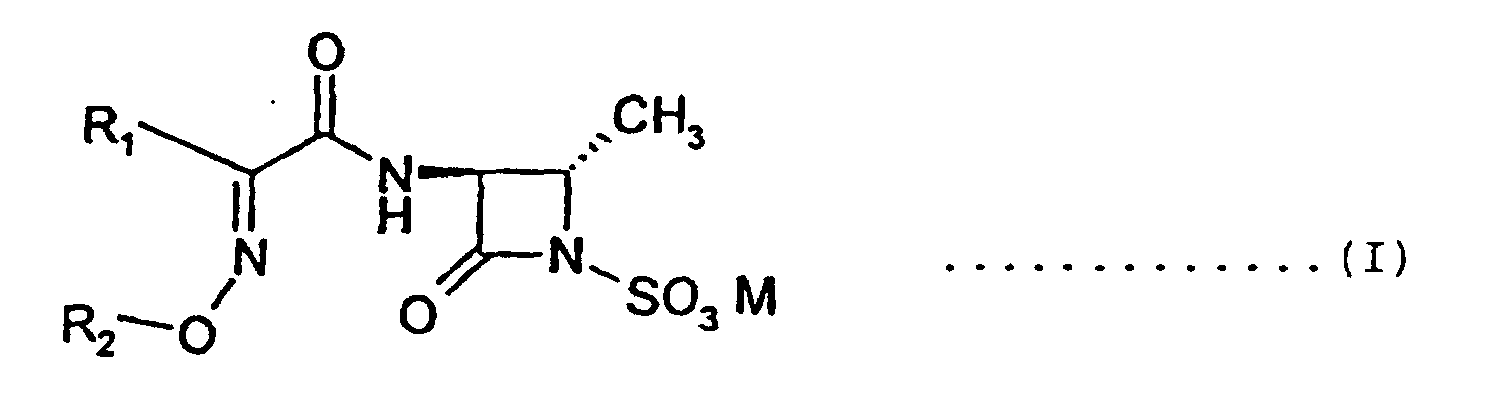
R2 ein Amino(C1-6)alkyl ist, welches ferner durch eine oder mehrere der folgenden Gruppen substituiert ist, (C1-6)Alkyl-, Hydroxy(C1-6)alkyl-, Amino(C1-6)alkyl-, Hydroxy-, Amino-, Amidino-, Guanidino-, Amidino(C1- 6)alkyl- und Guanidino(C1-6)alkylgruppen; oder R2 aus einer Gruppe ausgewählt ist, bestehend ausM Wasserstoff oder ein pharmazeutisch akzeptables, salzbildendes, nicht-toxisches Kation ist,
wobei die Oxyiminogruppe(=N-OR2) in der Formel (I) spezifisch die Anti-Orientierung hat (E-Isomer); und Hydrate oder pharmazeutisch akzeptable Salze davon. - Verbindung nach Anspruch 1, wobei die R1-Gruppe in der Formel (I) 2-Thienyl ist.
- Verbindung nach Anspruch 1, wobei die R1-Gruppe aus einer der folgenden Gruppen ausgewählt ist:


- Hydrat der Verbindung nach Anspruch 1, wobei das Hydrat veränderliche Mengen Wasser enthält.
- Hydrat nach Anspruch 4, wobei die veränderlichen Mengen Wasser aus der Lyophilisation, Kristallisation oder Säulenreinigung resultieren.
- Verbindung nach Anspruch 1, wobei M Wasserstoff ist.
- Pharmazeutisch akzeptables Salz der Verbindung nach Anspruch 1, wobei das pharmazeutisch akzeptable Salz ein Säureadditions-Salz ist, gebildet durch die Reaktion mit anorganischen Säuren oder organischen Säuren.
- Pharmazeutische Zusammensetzung, geeignet zur Behandlung bakterieller Infektionen bei Säugetieren, welche die in Anspruch 1 beschriebene Verbindung oder ein pharmazeutisch akzeptables Salz davon und einen pharmazeutisch akzeptablen Träger umfasst.
- Pharmazeutische Zusammensetzung, geeignet zur Behandlung bakterieller Infektionen, welche die in Anspruch 1 beschriebene Verbindung oder ein pharmazeutisch akzeptables Salz davon, ein β-Lactam-Antibiotikum und einen pharmazeutisch akzeptablen Träger umfasst.
- Antibiotikum, welches die in Anspruch 6 beschriebene Verbindung und ein β-Lactam-Antibiotikum umfasst.
- Pharmazeutische Zusammensetzung nach Anspruch 9, wobei das β-Lactam-Antibiotikum aus der aus Penicillinen, Cephalosporinen, Carbapenemen und Monobactamen bestehenden Gruppe ausgewählt ist.
- Pharmazeutische Zusammensetzung nach Anspruch 11, wobei die Penicilline aus der aus Amoxicillin, Ampicillin, Azlocillin, Mezlocillin, Apalcillin, Hetacillin, Bacampicillin, Carbenicillin, Sulbenicillin, Ticarcillin, Piperacillin, Mecillinam, Pivmecillinam, Methicillin, Ciclacillin, Talampicillin, Aspoxicillin, Oxacillin, Cloxacillin, Dicloxacillin, Flucoxacillin, Nafcillin, Pivampicillin, Piperacillin in Kombination mit Tazobactam, Ampicillin in Kombination mit Sulbactam, Amoxicillin in Kombination mit Clavulansäure, Ticarcillin in Kombination mit Clavulansäure, bestehenden Gruppe ausgewählt sind.
- Pharmazeutische Zusammensetzung nach Anspruch 11, wobei die Cephalosporine aus der aus Cephalothin, Cephaloridin, Cefaclor, Cefadroxil, Cefamandol, Cefazolin, Cephalexin, Cephradin, Cefuroxim, Cefoxitin, Cephacetril, Cefotiam, Cefotaxim, Cefsulodin, Cefoperazon, Ceftizoxim, Cefmenoxim, Cefmetazol, Cephaloglycin, Cefonicid, Cefodizim, Cefpirom, Ceftazidim, Ceftriaxon, Cefpiramid, Cefbuperazon, Cefuzonam, Cefpimizol, Cefozopran, Cefepim, Cefoselis, Cefluprenam, Cefclidin, Cefixim, Ceftibuten, Cefdinir, Cefpodoximproxetil, Cefterampivoxil, Cefetametpivoxil, Cefcapenpivoxil, Cefditorenpivoxil, Cefoperazon in Kombination mit Sulbactam, bestehenden Gruppe ausgewählt sind.
- Pharmazeutische Zusammensetzung nach Anspruch 11, wobei die Carbapeneme aus der aus Imipenem, Meropenem, Biapenem und Panipenem bestehenden Gruppe ausgewählt sind, und die Monobactame aus der aus Aztreonam und Carumonam, bestehenden Gruppe ausgewählt sind.
- Pharmazeutische Zusammensetzung nach Anspruch 11, wobei die Verbindung und ein β-Lactam-Antibiotikum in dem Masseverhältnisbereich von 1 : 20 bis 20 : 1 enthalten sind.
- Verbindung nach einem der Ansprüche 1-5, 7-9 oder 11-15 oder ein pharmazeutisch akzeptables Salz davon, zur Verwendung als ein aktives Arzneimittel.
- Verbindung, beschrieben in Anspruch 6 oder 10, zur Verwendung als ein aktives Arzneimittel.
- Verwendung einer Verbindung nach einem der Ansprüche 1-5, 7-9 oder 11-15 oder eines pharmazeutisch akzeptablen Salzes davon zur Herstellung eines Medikaments zur Inhibition der β-Lactamase-Inaktivierung eines Antibiotikums, welches ein β-Lactam-Antibiotikum enthält.
- Verwendung einer Verbindung nach einem der Ansprüche 6 oder 10 zur Herstellung eines Medikaments zur Inhibition der β-Lactamase-Inaktivierung eines Antibiotikums, welches ein β-Lactam-Antibiotikum enthält.
- Verwendung einer Verbindung nach einem der Ansprüche 1-5, 7-9 oder 11-15 oder eines pharmazeutisch akzeptablen Salzes davon zur Herstellung eines Medikaments zur Behandlung bakterieller Infektionen.
- Verwendung einer Verbindung nach einem der Ansprüchen 6 oder 10 zur Herstellung eines Medikaments zur Behandlung bakterieller Infektionen.
- Verwendung einer Verbindung nach Anspruch 20, wobei das Medikament das β-Lactam-Antibiotikum einschließt.
- Verwendung einer Verbindung nach Anspruch 21, wobei das Medikament das β-Lactam-Antibiotikum einschließt.
- Verwendung einer Verbindung nach Anspruch 20, wobei das β-Lactam-Antibiotikum nicht im Medikament eingeschlossen ist.
- Verwendung einer Verbindung nach Anspruch 21, wobei das β-Lactam-Antibiotikum nicht im Medikament eingeschlossen ist.
Applications Claiming Priority (3)
| Application Number | Priority Date | Filing Date | Title |
|---|---|---|---|
| US08/920,886 US5994340A (en) | 1997-08-29 | 1997-08-29 | Azetidinone derivatives as β-lactamase inhibitors |
| US920886 | 1997-08-29 | ||
| PCT/US1998/017343 WO1999010324A1 (en) | 1997-08-29 | 1998-08-28 | AZETIDINONE DERIVATIVES AS β-LACTAMASE INHIBITORS |
Publications (3)
| Publication Number | Publication Date |
|---|---|
| EP1012139A1 EP1012139A1 (de) | 2000-06-28 |
| EP1012139A4 EP1012139A4 (de) | 2001-08-16 |
| EP1012139B1 true EP1012139B1 (de) | 2002-11-13 |
Family
ID=25444568
Family Applications (1)
| Application Number | Title | Priority Date | Filing Date |
|---|---|---|---|
| EP98941015A Expired - Lifetime EP1012139B1 (de) | 1997-08-29 | 1998-08-28 | Azetidinonderivate als beta-lactamase-inhibitoren |
Country Status (7)
| Country | Link |
|---|---|
| US (1) | US5994340A (de) |
| EP (1) | EP1012139B1 (de) |
| JP (1) | JP2001514170A (de) |
| AU (1) | AU8917098A (de) |
| CA (1) | CA2301523A1 (de) |
| DE (1) | DE69809446T2 (de) |
| WO (1) | WO1999010324A1 (de) |
Cited By (1)
| Publication number | Priority date | Publication date | Assignee | Title |
|---|---|---|---|---|
| CN102286002A (zh) * | 2011-08-31 | 2011-12-21 | 山东罗欣药业股份有限公司 | 头孢匹胺钠粉针组合物及其制备方法 |
Families Citing this family (27)
| Publication number | Priority date | Publication date | Assignee | Title |
|---|---|---|---|---|
| US7527807B2 (en) * | 2000-06-21 | 2009-05-05 | Cubist Pharmaceuticals, Inc. | Compositions and methods for increasing the oral absorption of antimicrobials |
| JP2004509122A (ja) * | 2000-09-14 | 2004-03-25 | パンセリックス・リミテッド | 抗菌剤としての、3−(ヘテロアリールアセトアミド)−2−オキソ−アゼチジン−1−スルホン酸誘導体 |
| DK2301524T3 (da) | 2000-12-27 | 2013-07-15 | Gilead Sciences Inc | Inhalerbar aztreonam uden arginin til behandling og forebyggelse af bakterielle lungeinfektioner |
| US7214364B2 (en) * | 2000-12-27 | 2007-05-08 | Corus Pharma, Inc. | Inhalable aztreonam lysinate formulation for treatment and prevention of pulmonary bacterial infections |
| US7138419B2 (en) * | 2000-12-27 | 2006-11-21 | Corus Pharma, Inc. | Process for manufacturing bulk solutions and a lyophilized pure α-aztreonam lysinate |
| AU2002326375B2 (en) * | 2001-03-08 | 2006-12-21 | The Trustees Of The University Of Pennsylvania | Facially amphiphilic polymers as anti-infective agents |
| CA2442311C (en) * | 2001-04-26 | 2009-12-01 | Meiji Seika Kaisha Ltd. | Amorphous cefditoren pivoxil composition and process for producing the same |
| US20030060451A1 (en) * | 2001-05-29 | 2003-03-27 | Rajneesh Taneja | Enhancement of oral bioavailability of non-emulsified formulations of prodrug esters with lecithin |
| FR2835186B1 (fr) * | 2002-01-28 | 2006-10-20 | Aventis Pharma Sa | Nouveaux composes heterocycliques, actifs comme inhibiteurs de beta-lactamases |
| US20050245498A1 (en) * | 2002-05-14 | 2005-11-03 | Shoichet Brian K | Sterically-awkward beta-lactamase inhibitors |
| KR100472048B1 (ko) * | 2002-07-11 | 2005-03-08 | 종근당바이오 주식회사 | 아즈트레오남의 신규제조방법 |
| KR100463920B1 (ko) * | 2002-10-18 | 2004-12-30 | 제일약품주식회사 | 신규 세프디토렌 피복실 메지틸렌 설폰산염 및 그 제조방법 |
| US9241917B2 (en) * | 2003-03-17 | 2016-01-26 | The Trustees Of The University Of Pennsylvania | Facially amphiphilic polymers and oligomers and uses thereof |
| US20050005101A1 (en) * | 2003-07-03 | 2005-01-06 | Yenduri Bhargava K. | Kernel cryptographic module signature verification system and method |
| WO2005072246A2 (en) * | 2004-01-23 | 2005-08-11 | The Trustees Of The University Of Pennsylvania | Facially amphiphilic polyaryl and polyarylalkynyl polymers and oligomers and uses thereof |
| KR20080004475A (ko) * | 2005-02-25 | 2008-01-09 | 유니버시티 오브 매사추세츠 | 표면적으로 양친매성인 중합체 및 올리고머, 그 조성물 및암치료방법으로서의 그 용도 |
| NZ580951A (en) * | 2005-04-29 | 2011-06-30 | Cubist Pharm Inc | Therapeutic compositions |
| KR101403164B1 (ko) | 2005-12-07 | 2014-06-03 | 바실리어 파마슈티카 아게 | 베타-락타마아제 저해제 및 모노박탐 항생물질의 유용한조합 |
| WO2007129176A2 (en) * | 2006-04-28 | 2007-11-15 | Wockhardt Ltd | Improvements in therapy for treating resistant bacterial infections |
| BRPI0809147A2 (pt) | 2007-03-23 | 2014-08-26 | Basilea Pharmaceutica Ag | Medicamentos combinados para tratamento de infecções bacterianas |
| CN101747342B (zh) * | 2008-12-08 | 2013-03-06 | 南京海纳医药科技有限公司 | 一种阿扑西林的合成工艺 |
| CN103044456A (zh) * | 2011-10-17 | 2013-04-17 | 苏州中联化学制药有限公司 | 硫酸头孢匹罗的返工方法 |
| WO2013085152A1 (en) * | 2011-12-07 | 2013-06-13 | Union Korea Pharm Co., Ltd. | Combined antibiotics comprising cephalosporins and beta-lactamase inhibitors |
| UY34585A (es) | 2012-01-24 | 2013-09-02 | Aicuris Gmbh & Co Kg | Compuestos b-lactámicos sustituidos con amidina, su preparación y uso |
| NZ706734A (en) * | 2012-09-03 | 2016-05-27 | Wockhardt Ltd | Pharmaceutical compositions useful for the treatment or control of bacterial infections |
| AU2014206087A1 (en) * | 2013-01-14 | 2015-05-28 | Wockhardt Limited | Compositions and methods for treating bacterial infections |
| CN105147698A (zh) * | 2015-10-09 | 2015-12-16 | 杨献美 | 一种治疗感染性疾病的药物盐酸头孢他美酯组合物片剂 |
Family Cites Families (7)
| Publication number | Priority date | Publication date | Assignee | Title |
|---|---|---|---|---|
| US4775670A (en) * | 1980-09-29 | 1988-10-04 | E. R. Squibb & Sons, Inc. | 2-oxo-1-azetidinesulfonic acid salts |
| FR2558467B2 (fr) * | 1981-10-23 | 1987-03-20 | Roussel Uclaf | Nouveau produit derive de l'acide 3-amino 2-oxo azetidine 1-sulfamique, son procede de preparation, son application comme medicament et un produit intermediaire necessaire a sa preparation |
| EP0096296B1 (de) * | 1982-06-03 | 1987-07-29 | F. HOFFMANN-LA ROCHE & CO. Aktiengesellschaft | 1-Sulfo-2-oxoazetidinderivate |
| US4632985A (en) * | 1985-06-03 | 1986-12-30 | E. R. Squibb & Sons, Inc. | 3-acylamino-2-oxo-1-azetidinesulfonic acids |
| US5112968A (en) * | 1989-07-28 | 1992-05-12 | E. R. Squibb & Sons, Inc. | Monobactam hydrazide derivatives |
| CA2024282A1 (en) * | 1989-09-21 | 1991-03-22 | Peter H. Ermann | Heterocyclic hydrazide derivatives of monocyclic beta-lactam antibiotics |
| ZA918014B (en) * | 1990-11-05 | 1992-07-29 | Squibb & Sons Inc | Heteroaroyl derivatives of monocyclic beta-lactam antibiotics |
-
1997
- 1997-08-29 US US08/920,886 patent/US5994340A/en not_active Expired - Fee Related
-
1998
- 1998-08-28 JP JP2000507653A patent/JP2001514170A/ja active Pending
- 1998-08-28 AU AU89170/98A patent/AU8917098A/en not_active Abandoned
- 1998-08-28 DE DE69809446T patent/DE69809446T2/de not_active Expired - Fee Related
- 1998-08-28 WO PCT/US1998/017343 patent/WO1999010324A1/en not_active Ceased
- 1998-08-28 CA CA002301523A patent/CA2301523A1/en not_active Abandoned
- 1998-08-28 EP EP98941015A patent/EP1012139B1/de not_active Expired - Lifetime
Cited By (2)
| Publication number | Priority date | Publication date | Assignee | Title |
|---|---|---|---|---|
| CN102286002A (zh) * | 2011-08-31 | 2011-12-21 | 山东罗欣药业股份有限公司 | 头孢匹胺钠粉针组合物及其制备方法 |
| CN102286002B (zh) * | 2011-08-31 | 2013-07-03 | 山东罗欣药业股份有限公司 | 头孢匹胺钠粉针组合物及其制备方法 |
Also Published As
| Publication number | Publication date |
|---|---|
| US5994340A (en) | 1999-11-30 |
| DE69809446D1 (de) | 2002-12-19 |
| WO1999010324A1 (en) | 1999-03-04 |
| EP1012139A1 (de) | 2000-06-28 |
| EP1012139A4 (de) | 2001-08-16 |
| DE69809446T2 (de) | 2003-07-10 |
| JP2001514170A (ja) | 2001-09-11 |
| AU8917098A (en) | 1999-03-16 |
| CA2301523A1 (en) | 1999-03-04 |
Similar Documents
| Publication | Publication Date | Title |
|---|---|---|
| US5994340A (en) | Azetidinone derivatives as β-lactamase inhibitors | |
| EP0979229B1 (de) | 2-oxo-1-azetidinsulfonicsaure- derivative als potent ss-lactamase hemmer | |
| KR102537340B1 (ko) | 베타-락타마제 억제제 화합물 | |
| US20110288063A1 (en) | Novel fused bridged bicyclic heteroaryl substituted 6-alkylidene penems as potent beta-lactamase inhibitors | |
| ZA200405607B (en) | Heterocyclic compounds which are active as inhibitors of beta-lactamases | |
| KR20150015523A (ko) | 신규 β-락타마아제 저해제 및 그의 제조법 | |
| EP2748165A1 (de) | 1,6-diazabicyclo-[3,2,1-]octan-7-on-derivate und ihre verwendung zur behandlung bakterieller infektionen | |
| AU2008231854A1 (en) | Combination medicaments for treating bacterial infections | |
| KR20160065871A (ko) | 디아자비시클로옥탄 유도체의 결정과 그의 제조법 | |
| US20070191312A1 (en) | Novel heterocyclic compounds, preparation process and intermediates, and use as medicaments, in particular as beta-lactamase inhibitors and antibacterials | |
| JP7598594B2 (ja) | オキソ置換化合物 | |
| AU2011224710A1 (en) | Bridged lipoglycopeptides that potentiate the activity of beta-lactam antibacterials | |
| US6566355B1 (en) | Bicyclic and tricyclic β-lactams | |
| JPH0820597A (ja) | トロンビン阻害作用を有する複素環カルボニル化合物 | |
| EP3097104A2 (de) | Stickstoffhaltige verbindungen und deren verwendung | |
| WO2016128867A1 (en) | Azetidinone containing compounds and their use in treatment of bacterial infections | |
| WO2017002089A1 (en) | Nitrogen containing bicyclic compounds and their use in treatment of bacterial infections | |
| CN108137567A (zh) | 用于抑制β-内酰胺酶的组合物和方法 | |
| EP0842180B1 (de) | Penamsulfone als beta-laktamase inhibitoren | |
| JPH0613529B2 (ja) | 新規セフアロスポリン誘導体及び抗菌剤 | |
| JP2020105148A (ja) | 非アリールヘテロ環置換芳香族化合物 | |
| JPH064644B2 (ja) | 新規セフアロスポリン誘導体及び抗菌剤 | |
| HK1235399A1 (en) | Novel beta-lactamase inhibitor and process for preparing the same | |
| HK1235399A (en) | Novel beta-lactamase inhibitor and process for preparing the same | |
| JPH10182656A (ja) | セフェム化合物 |
Legal Events
| Date | Code | Title | Description |
|---|---|---|---|
| PUAI | Public reference made under article 153(3) epc to a published international application that has entered the european phase |
Free format text: ORIGINAL CODE: 0009012 |
|
| 17P | Request for examination filed |
Effective date: 20000323 |
|
| AK | Designated contracting states |
Kind code of ref document: A1 Designated state(s): BE DE FR GB IT |
|
| RIN1 | Information on inventor provided before grant (corrected) |
Inventor name: NISHIDA, KOICHI Inventor name: KUNUGITA, CHIEKO Inventor name: HIGASHITANI, FUSAHIRO Inventor name: MICETICH, RONALD, G. Inventor name: REDDY, ANDHE, V., NARENDER Inventor name: PHILLIPS, OLUDOTUN, A., DEPT. OF PHARMACEUTICAL Inventor name: MAITI, SAMARENDRA, N. Inventor name: SETTI, EDUARDO, L. |
|
| A4 | Supplementary search report drawn up and despatched |
Effective date: 20010629 |
|
| AK | Designated contracting states |
Kind code of ref document: A4 Designated state(s): BE DE FR GB IT |
|
| GRAG | Despatch of communication of intention to grant |
Free format text: ORIGINAL CODE: EPIDOS AGRA |
|
| RTI1 | Title (correction) |
Free format text: AZETIDINONE DERIVATIVES AS BETA-LACTAMASE INHIBITORS |
|
| 17Q | First examination report despatched |
Effective date: 20011123 |
|
| GRAG | Despatch of communication of intention to grant |
Free format text: ORIGINAL CODE: EPIDOS AGRA |
|
| GRAH | Despatch of communication of intention to grant a patent |
Free format text: ORIGINAL CODE: EPIDOS IGRA |
|
| GRAH | Despatch of communication of intention to grant a patent |
Free format text: ORIGINAL CODE: EPIDOS IGRA |
|
| GRAA | (expected) grant |
Free format text: ORIGINAL CODE: 0009210 |
|
| AK | Designated contracting states |
Kind code of ref document: B1 Designated state(s): BE DE FR GB IT |
|
| PG25 | Lapsed in a contracting state [announced via postgrant information from national office to epo] |
Ref country code: BE Free format text: LAPSE BECAUSE OF FAILURE TO SUBMIT A TRANSLATION OF THE DESCRIPTION OR TO PAY THE FEE WITHIN THE PRESCRIBED TIME-LIMIT Effective date: 20021113 |
|
| REG | Reference to a national code |
Ref country code: GB Ref legal event code: FG4D |
|
| REF | Corresponds to: |
Ref document number: 69809446 Country of ref document: DE Date of ref document: 20021219 |
|
| ET | Fr: translation filed | ||
| PLBE | No opposition filed within time limit |
Free format text: ORIGINAL CODE: 0009261 |
|
| STAA | Information on the status of an ep patent application or granted ep patent |
Free format text: STATUS: NO OPPOSITION FILED WITHIN TIME LIMIT |
|
| 26N | No opposition filed |
Effective date: 20030814 |
|
| PGFP | Annual fee paid to national office [announced via postgrant information from national office to epo] |
Ref country code: GB Payment date: 20040630 Year of fee payment: 7 |
|
| PGFP | Annual fee paid to national office [announced via postgrant information from national office to epo] |
Ref country code: FR Payment date: 20040712 Year of fee payment: 7 |
|
| PGFP | Annual fee paid to national office [announced via postgrant information from national office to epo] |
Ref country code: DE Payment date: 20040929 Year of fee payment: 7 |
|
| PG25 | Lapsed in a contracting state [announced via postgrant information from national office to epo] |
Ref country code: IT Free format text: LAPSE BECAUSE OF NON-PAYMENT OF DUE FEES Effective date: 20050828 Ref country code: GB Free format text: LAPSE BECAUSE OF NON-PAYMENT OF DUE FEES Effective date: 20050828 |
|
| PG25 | Lapsed in a contracting state [announced via postgrant information from national office to epo] |
Ref country code: DE Free format text: LAPSE BECAUSE OF NON-PAYMENT OF DUE FEES Effective date: 20060301 |
|
| GBPC | Gb: european patent ceased through non-payment of renewal fee |
Effective date: 20050828 |
|
| PG25 | Lapsed in a contracting state [announced via postgrant information from national office to epo] |
Ref country code: FR Free format text: LAPSE BECAUSE OF NON-PAYMENT OF DUE FEES Effective date: 20060428 |
|
| REG | Reference to a national code |
Ref country code: FR Ref legal event code: ST Effective date: 20060428 |