EP1007904B1 - Verfahren und vorrichtung zum messen einer aussenoberfläche - Google Patents
Verfahren und vorrichtung zum messen einer aussenoberfläche Download PDFInfo
- Publication number
- EP1007904B1 EP1007904B1 EP98939039A EP98939039A EP1007904B1 EP 1007904 B1 EP1007904 B1 EP 1007904B1 EP 98939039 A EP98939039 A EP 98939039A EP 98939039 A EP98939039 A EP 98939039A EP 1007904 B1 EP1007904 B1 EP 1007904B1
- Authority
- EP
- European Patent Office
- Prior art keywords
- measuring
- support member
- carriage
- measuring device
- envelope surface
- Prior art date
- Legal status (The legal status is an assumption and is not a legal conclusion. Google has not performed a legal analysis and makes no representation as to the accuracy of the status listed.)
- Expired - Lifetime
Links
- 238000000034 method Methods 0.000 title claims abstract description 21
- 238000005259 measurement Methods 0.000 claims abstract description 44
- 230000001681 protective effect Effects 0.000 claims abstract description 21
- 239000000463 material Substances 0.000 claims description 10
- 230000008878 coupling Effects 0.000 claims description 9
- 238000010168 coupling process Methods 0.000 claims description 9
- 238000005859 coupling reaction Methods 0.000 claims description 9
- 230000005540 biological transmission Effects 0.000 claims description 8
- 230000001939 inductive effect Effects 0.000 claims description 7
- 239000004033 plastic Substances 0.000 claims description 6
- 229910052751 metal Inorganic materials 0.000 claims description 5
- 239000002184 metal Substances 0.000 claims description 5
- 230000007797 corrosion Effects 0.000 claims description 4
- 238000005260 corrosion Methods 0.000 claims description 4
- 125000006850 spacer group Chemical group 0.000 claims description 4
- 230000001360 synchronised effect Effects 0.000 claims description 4
- 239000002131 composite material Substances 0.000 claims description 3
- 239000000919 ceramic Substances 0.000 claims description 2
- 230000001427 coherent effect Effects 0.000 claims description 2
- 238000004519 manufacturing process Methods 0.000 claims description 2
- 230000001105 regulatory effect Effects 0.000 claims 1
- 238000001035 drying Methods 0.000 description 10
- 239000000428 dust Substances 0.000 description 3
- 239000007788 liquid Substances 0.000 description 3
- 238000004140 cleaning Methods 0.000 description 2
- 238000010276 construction Methods 0.000 description 2
- 238000006073 displacement reaction Methods 0.000 description 2
- 230000035484 reaction time Effects 0.000 description 2
- 230000008439 repair process Effects 0.000 description 2
- 238000012546 transfer Methods 0.000 description 2
- 229910000831 Steel Inorganic materials 0.000 description 1
- 239000004809 Teflon Substances 0.000 description 1
- 229920006362 Teflon® Polymers 0.000 description 1
- 239000004411 aluminium Substances 0.000 description 1
- 229910052782 aluminium Inorganic materials 0.000 description 1
- XAGFODPZIPBFFR-UHFFFAOYSA-N aluminium Chemical compound [Al] XAGFODPZIPBFFR-UHFFFAOYSA-N 0.000 description 1
- 230000008901 benefit Effects 0.000 description 1
- 230000008859 change Effects 0.000 description 1
- 239000000109 continuous material Substances 0.000 description 1
- 238000012937 correction Methods 0.000 description 1
- 230000007812 deficiency Effects 0.000 description 1
- 230000000694 effects Effects 0.000 description 1
- 231100001261 hazardous Toxicity 0.000 description 1
- 238000010438 heat treatment Methods 0.000 description 1
- 238000007689 inspection Methods 0.000 description 1
- 239000000203 mixture Substances 0.000 description 1
- 230000003287 optical effect Effects 0.000 description 1
- 230000000704 physical effect Effects 0.000 description 1
- 238000003825 pressing Methods 0.000 description 1
- 230000008569 process Effects 0.000 description 1
- 238000012545 processing Methods 0.000 description 1
- 239000007921 spray Substances 0.000 description 1
- 239000010959 steel Substances 0.000 description 1
- 239000000725 suspension Substances 0.000 description 1
- YSGSDAIMSCVPHG-UHFFFAOYSA-N valyl-methionine Chemical compound CSCCC(C(O)=O)NC(=O)C(N)C(C)C YSGSDAIMSCVPHG-UHFFFAOYSA-N 0.000 description 1
- 230000004304 visual acuity Effects 0.000 description 1
- XLYOFNOQVPJJNP-UHFFFAOYSA-N water Substances O XLYOFNOQVPJJNP-UHFFFAOYSA-N 0.000 description 1
Images


Classifications
-
- G—PHYSICS
- G01—MEASURING; TESTING
- G01B—MEASURING LENGTH, THICKNESS OR SIMILAR LINEAR DIMENSIONS; MEASURING ANGLES; MEASURING AREAS; MEASURING IRREGULARITIES OF SURFACES OR CONTOURS
- G01B11/00—Measuring arrangements characterised by the use of optical techniques
- G01B11/24—Measuring arrangements characterised by the use of optical techniques for measuring contours or curvatures
- G01B11/2408—Measuring arrangements characterised by the use of optical techniques for measuring contours or curvatures for measuring roundness
Definitions
- the present invention relates to a method for, without contact and with the aid of a measuring device, measuring in a predetermined measuring area in connection to an envelope surface of at least one measuring object journalled rotatably in a machine stand of a paper machine, with respect to its cylindricity and/or its straightness relative to a straightness reference arranged substantially parallel with the axis of rotation of the measuring object, which measuring device comprises said straightness reference, a measuring stand and a linearly movably journalled measuring carriage on which at least one measuring means is arranged, said measuring carriage during said measurement is traversed along an elongate form-stable support member forming a part of the measuring stand, and running substantially parallel to the axis of rotation of the measuring object, whereby said measuring means is moved to one or more desired positions for the measurement, and the measuring means is caused to perform a measurement of the present measurement values at each such position selected in said measuring area.
- the measurement commences with a starting position for the measuring means relative the straightness reference and the measuring object being determined, which starting position comprises an initial position for the rotating measuring object, a current position along the support member and a position in radial direction from the envelope surface of the measuring object.
- a first measurement is performed for this starting position.
- the measuring means is thereafter moved to at least one more position along the support member while this or these new positions are continuously determined in relation to each other or said starting position, whereupon a measurement occurs in said measuring area at each position.
- a laser beam is used as straightness reference, said laser beam being generated by a laser unit.
- the invention also relates to a measuring device for, without contact, measuring in a predetermined measuring area in connection to an envelope surface of at least one measuring object journalled rotatably in a machine stand of a paper machine, with respect to its cylindricity and/or its straightness relative to a straightness reference, said straightness reference being arranged substantially parallel with the axis of rotation of the measuring object, which measuring device comprises said straightness reference, a measuring stand and a linearly movably journalled measuring carriage on which at least one measuring means is arranged, said measuring carriage during said measurement is traversed along an elongate form-stable support member forming a part of the measuring stand, and running substantially parallel to the axis of rotation of the measuring object.
- Said straightness reference comprises a laser beam which is generated by a laser unit comprising a laser transmitter and a receiver detector.
- Substantially all machines include a larger or smaller number of machine elements which are in the shape of cylindrical bodies that rotate about an axis of rotation during operation.
- machine elements consist primarily of either rolls or drying cylinders such as Yankee cylinders, the rolls usually being used to influence a continuous material web in one or more roll nips through which the web runs, to transfer some form of liquid, mixture or the like to said material web and also to support, guide and propel the web, whereas the drying cylinders are used to dry the moving web before it is finally reeled to a finished reel of paper.
- the drying cylinder has a hollow, thin-walled drum, heated by steam, which has a polished envelope surface over and around which the moist material web is moved in contact with the surface so that considerable heat can be transferred to the web.
- the drum has relatively large diameter in order to facilitate the necessary drying.
- Measurement and inspection of the envelope surface of a measuring object are relatively simple to perform when it is not in operation and a great deal of information can therefore be obtained.
- the shape of the envelope surface can be compared, for instance, with the rotationally symmetrical cross section described above in order to determine the size and any variation in the cylindricity or the straightness profile of the measuring object.
- the word "straightness” is used instead of the expression "straightness profile”.
- deposits, corrosion, wear patterns and the magnitude of this wear can be observed or measured.
- the shape of the Yankee cylinder's envelope surface, and thus the properties of said cylinder are very different during operation from when it is stationary, because of the unavoidable deformations that occur during operation. Said deformations are caused primarily by three different loads, viz. linear pressure or loading from press rollers, an internal steam pressure and temperature forces.
- the temperature forces mentioned above are caused by heating from the water vapour used for the drying process, which affects the shape and dimensions of the drying cylinder.
- a distance transducer stated to be a “non contact eddy-current type displacement transducer” is used for measuring the envelope surface of a Yankee cylinder.
- This "displacement transducer” is supposed to enable measurement of the distance between the envelope surface and the transducer with an accuracy of ⁇ 1/100 mm when the cylinder is in full operation which, as established below, is not the case.
- the transducer Carried by a movable measuring carriage, the transducer is moved along a device travelling longitudinally along the Yankee cylinder and included in said measuring means which is suitably secured to the stand of the doctor blade, the doctor-blade beam, transverse to the paper machine. Situated at a specific first position along and close to the envelope surface of the Yankee cylinder, the transducer emits an extremely accurate signal which is thus proportional to the distance to said envelope surface. After one complete turn of the drying cylinder, therefore, the cylindricity of the envelope surface for this first position can be determined with relatively great precision.
- a piano wire is used as straightness reference, this reference wire being arranged as best possible between two attachment devices in a measuring stand arranged in said measuring device parallel to the envelope surface of the cylinder and extending from the drive side of the paper machine across the entire length of the cylinder close to its downstream side.
- the measuring means can thereafter be adjusted laterally to a fix position in relation to the reference wire for each selected measuring position along the envelope surface of the Yankee cylinder. Since the length of the reference wire must at least be equal to the length of the object being measured which in paper mills used nowadays may be more than 8 meter, as well as the measuring accuracy being ⁇ 1/100 mm, it will be understood that the unavoidable sag in the wire constitutes an extremely considerable problem which must be determined, despite maximum wire tension having been applied for the reference wire, and the measured values obtained by the transducer for each new measuring position along the measuring object must be corrected in accordance with the change in position that has thus occurred in the measuring direction of the transducer.
- the measured values may be reported in isometric form, for example, so that a topographic map of the envelope surface is drawn showing the irregularities thus ascertained in the longitudinal and transverse directions on said envelope surface.
- a straightness reference consisting of a reference wire, such as air turbulence caused by the rotating cylinder and by the moving material web, vibrations, collections of dust and paper fluff, liquid spray, etc.
- the straightness reference must be checked, and possibly cleaned, and re-adjusted prior to each measurement and even during each measurement if said measurement comprises extended measurement sequences.
- the measuring carriage on which the measuring means is fitted must be pushed manually along the measuring beam and it is therefore extremely complicated to obtain any exact measuring positions in the cramped and hazardous space for the operator in the area around the doctor blade.
- US-A-5 617 645 describes a non-contact precision measurement system and a method of measuring using the system.
- the surface contour of an object such as the envelope surface of a cylindrical roll of a paper machine, is measured utilising a laser distance measuring means on a carriage.
- the carriage is movable on a support member in a direction parallel to the axis of the cylindrical roll.
- a laser beam is used as straightness reference for the carriage travelling along the support member. Measurements are taken at different positions along the cylindrical roll.
- the main object of the present invention is to provide an improved method and an improved device for measuring at the envelope surface of at least one object to be measured with respect to its cylindricity and/or straightness so that the above problems are eliminated or at least greatly reduced.
- a second object of the present invention is to provide a method and a device for completely automatically and while simultaneously performing measurements, pass a transducer or measuring means, without contact, along a measuring stand substantially parallel with the cylindrical body or measuring object to be measured and at the same time automatically collect, process and visually present the result of said measurement.
- a third object of the invention is to provide a method and a device for, as far as possible, obtaining an improved straightness reference which lacks or at least minimizes the errors and deficiencies that were unavoidable in the straightness references used hitherto.
- a fourth object of the invention is to provide a method and a device for protecting said improved straightness reference from substantially all external influence.
- a further object of the invention is to provide a method and a device for performing said measurement of the envelope surface of a measuring object during full operation of the machine in which said measuring object is included.
- the method according to the invention is characterized in the laser beam is protected from external influence by being arranged along at least a part of its length in the shelter of an elongate protective device arranged substantially parallel with said support member.
- the device according to the invention is characterized in that said laser beam is protected from external influence by being arranged along at least a part of its length in the shelter of an elongate protective device arranged substantially parallel with said support member.
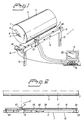
- Figures 1 and 2 show schematically in perspective parts of the measuring device 1 according to the invention for measuring without contact in a predetermined measuring area 2 at, on, around and along an envelope surface 3 of at least one measuring object 5 rotatably journalled in a machine stand 4, preferably the machine stand 4 of a paper machine, to determine the cylindricity and/or straightness of said object, as well as any other desired property or determination of or at said measuring object 5, such as corrosion, wear, temperature or velocity, and also suitable properties of a material web running over and around said measuring object 5 deemed advantageous to determine with the aid of said measuring device 1 comprising at least one measuring means 6 suitable for the purpose.
- the measuring object 5 comprises a substantially cylindrical body, e.g. a roll or a cylinder, rotating about an axis of rotation 8, such as a drive shaft.
- At least one suitable revolution pulse device 9 is arranged close to the measuring object 5, suitably at one end wall 7 or one drive shaft extension 8 so that it can be determined when the measuring object 5 is at its zero or starting position, when it has rotated part of a revolution, one complete revolution or several complete revolutions.
- said revolution pulse device 9 may comprise an inductive transducer, suitably placed a few millimetres from said end wall 7, which reacts to a metal object arranged on the end wall, the transducer then having the advantage of an extremely short reaction time, a photocell detector comprising a reflector arranged at the axis of rotation 8 of the measuring object 5 and a transmitter which may be placed at a relatively much greater distance, approximately 0.5-1.0 m, from the rotating body 5 than the inductive transducer.
- the transmitter is therefore comparatively better protected than said inductive transducer but the reaction time of the photocell detector is somewhat longer than that of said inductive transducer.
- the measuring device 1 also comprises a measuring stand 10 consisting of an elongate, rigid, i.e. form-stable, support member 11 arranged substantially parallel with the axis of rotation 8 of the measuring object 5, e.g. a linear unit or a measuring beam, at each end of which measuring beam 11 an attachment means 12 is arranged.
- the measuring stand 10 is also provided with a linearly movably journalled measuring carriage 13 on which the measuring means 6 is arranged and which is arranged to be moved substantially parallel with said measuring beam 11, as well as a traversing device 14 to move said measuring carriage 13 to preferably predetermined, optional positions along said measuring beam 11 where measurement is desired, and an electronic measuring and control unit 15.
- substantially parallel with the axis of rotation 8 of the measuring object 5" is meant that the support member 11 is arranged so that said measurements will always be performed within the measuring area of respective measuring means 6.
- each of said attachment means 12 may comprise at least one leg, a support or an attachment to the machine stand 4 mentioned above, in which the cylindrical body/bodies 5 to be measured are rotatably arranged, or else to some other permanent member able to give the requisite stability for the measuring device 1, e.g. the foundation of the machine.
- the measuring device 1 When using the measuring device 1 according to the invention with a Yankee cylinder 5 in a paper machine, a space is required for assembly and manipulation of the measuring carriage 13 of said measuring device 1 which is more or less accessible close to and between the Yankee cylinder 5 and the moving web.
- the normal placing of the measuring device in this specific case, not shown, is suitably between the creping doctor and the cleaning doctor.
- construction elements are used in or designed for the measuring device 1 that have or achieve considerable rigidity and/or a vibration suppressing effect.
- the measuring beam 11 comprises a member, or if necessary several substantially identical sections 18, form-stable in all directions and rigidly joined together coaxially and/or in parallel, which sections are suitably made of composite material or metal, preferably steel or aluminium sections, see Figure 9.
- sections are suitably made of composite material or metal, preferably steel or aluminium sections, see Figure 9.
- stop member is arranged at each end of said measuring beam 11, adjustable to optional positions along the beam, see Figures 1-2, suitably consisting of a part of one or more non-contact end-sensing devices comprising transducers such as photocells, inductive transducers or the like for recording the current position of said measuring carriage 13 relative a start or end position as described in more detail below.
- Said stop member 20 may consist of any other known type of position-recording means, e.g.
- Non-contact stop members 20 are preferable since they do not cause unfavourable influence in the form of impact jolts.
- One or more linear journalling means 21, such as linear bearings or guides, are arranged along the measuring beam 11, substantially parallel thereto and at one or more of its sides.
- two journalling members 21 are situated, one at the upper side 22 and the other at the lower side 23 of the measuring beam 11, which journalling members 21 comprise one or more parallel guides constituting a shaped bar, slide or rail along which some form of journalling member 24 arranged on the measuring carriage 13 runs in cooperation therewith.
- the journalling member may consist, for instance, of a number of bogie wheels, slide, ball or roller bearings.
- One or more sliding surfaces 25 of some type of self-lubricating material may be arranged between said measuring carriage 13 and measuring beam 11, suitably along the entire extension of said guides mentioned above, beside at least one or between several of these guides.
- said measuring carriage 13 comprises a positioning unit 26 on which the coupling 27 for the traversing means 14 is arranged, enabling positioning of the measuring carriage 13 in a to and fro linear movement to each desired and predetermined position along one or more of the linear journalling means 21 of the measuring beam 11, suitably along one or more of the journalling means 21 arranged at the sides of the measuring beam 11 facing the measuring object 5.
- the positioning unit 26 comprises a slide or carriage 28 in which one each of said couplings 27 for the traversing device 14 is arranged at its two opposite ends seen in the direction of travel, and also a sleeve or frame 29 surrounding the support beam 11 and connecting said carriage 28 with the other journalling means 21 described above.
- a tensioning device 30 is arranged on the measuring carriage 13, at the lower edge of the frame 29, the function of the tensioning device 30 being to suitably hold and clamp the measuring carriage 13 against the measuring beam 11 during its linear movements to and fro.
- the tensioning device 30, which in the device shown, comprises a link arm 31 arranged pivotably at one end of the frame 29, with a suitable journalling means 32 such as a bogie wheel at its free, opposite end, which tensioning device 30 is clamped against and cooperates with the support member 11, suitably one of the linear journalling means 21 described above, of the support member 11.
- Said link arm 31 can then either be fixed at a specific angle by means of a screw member 33 arranged at its pivot point, or a suitable tension force can be obtained by means of a spring member, not shown, arranged together with said link arm 31.
- the other, movable part of the above-mentioned non-contact end-sensing device(s) 20 is also fitted on the measuring carriage 13, which end-sensing devices 20 record the current position of the measuring carriage 13 in relation to its start or end position travelling along the measuring beam 11, so that the traversing movement can always commence and finish at a known position in relation to said end position.
- the measured values obtained can thus easily be compared within the same measuring sequence and also with equivalent measured values obtained during previous measurements performed on the same or other similar measuring objects 5.
- An adjustment member 35 is also arranged at the positioning unit 26 of the measuring carriage 13, see Figures 6, 8 and 9, and comprises a shaft 36 arranged in suitable manner in the longitudinal direction of the support beam 11, and at least one hinge member 37 pivotable about this shaft 36.
- Said hinge member 37 can be secured to the shaft 36, e.g. by a screw member 38, so that a retaining and adjustment member 39, e.g. consisting of a platform of bent sheet metal, arranged at this hinge member(s) 37, on which platform 39 the measuring means 6 is/are mounted, can be set at a desired angle to the envelope surface 3 of the measuring object 5.
- a manual or automatic adjustment member 40 is arranged, in the embodiment illustrated in Figure 9, at the lower side of said platform 39.
- the adjustment member 40 then comprises a spring member 41, which in the embodiment illustrated consists of a rod 42 attached to the hinge member 37 perpendicularly to the measuring object 5 and parallel with said platform 39 and a forward control element 43 and a rear control element 44, both displaceable along the rod 42, which control elements 43, 44 are permanently mounted on the platform 39, the latter thus being adjustable along said rod 42, and also a spring 45 coiled around said rod 42 so that a force is obtained on the platform 39 directed against the measuring object 5, and also a manual or automatic actuator 46, in the embodiment shown in Figure 6 extending between said hinge 37 and the rear control element 44 and acting parallel to this spring member 41, e.g. consisting of a micrometer screw or an electric motor, so that said distance from the envelope surface 3 of the measuring object 5 can be controlled,
- a manual or automatic actuator 46 in the embodiment shown in Figure 6 extending between said hinge 37 and the rear control
- One or more protective spacers 47 are fitted on the front of the platform 39, facing the measuring object 5, suitably shaped as blocks of plastic, ceramic, composite or some other suitable material that does not damage the envelope surface 3 of said measuring object 5 in the event of contact between them, during adjustment of said platform 39, for instance.
- Said traversing device 14 comprises a motor 48, see Figure 5, such as a stepping or servo motor, suitably arranged at one end of the measuring beam 11 for propelling said measuring carriage 13, a coupling 49 which may comprise a planetary gear, a drive shaft 50 from the motor 48 connected to one wheel, in this case constituting a driving wheel, of at least two journalling members such as wheels 51, 52, between and around which wheels 51, 52 at least one synchronous transmission belt 53 runs in a loop in a completely or partially sheltered position inside the support member 11, and each of the above-mentioned coupling 27 between the ends of the transmission belt 53 and the positioning unit 26 of said measuring carriage 13.
- Said coupling 27 is suitably designed with some form of means to regulate the tension in the transmission belt 53.
- the described motor 48 with all movable parts carefully enclosed to protect them from external influence of dust, fluff, etc., is controlled so that it automatically adjusts the measuring carriage 13 with the aid of the transmission belt 53 to any desired position along the measuring beam 11, instead of the previous complicated and in some cases dangerous method of pushing the measuring carriage 13 manually.
- the electronic measuring and control unit 15 used in the measuring device 1 for controlling said motor 48, collecting the measured values obtained by the measuring means 6 and presenting the calculated results comprises a computer 54 with a pre-programmed measurement collection card suitably in the form of an insert card for the computer.
- the computer 54 is specially designed for recording measurement data from different forms and types of transducers, including the requisite data processing of said measured values, and suitably presents the result either visually on a display screen 55 or in the form of a data print-out.
- the computer 54 may also include a calibrating unit for the straightness reference 16.
- the straightness reference 16 comprises a laser beam 58 generated by at least one laser unit comprising a laser transmitter 56 and a receiver detector 57, see Figure 2, said laser unit also including a correction and control device, not shown, enabling adjustment of the direction of the laser beam 58 to be performed with the aid of two differential micrometer screws. This fine adjustment allows an accuracy of adjustment of 0.001 mm per meter.
- the laser detector 57 comprises a 2-axis, position-sensitive receiver with a detector surface of 20x20 mm, said receiver having a display box with two display windows showing the x and y values, respectively, of the detector 57 in digital form with a resolution of 0.01 mm.
- an elongate protective device 17, mentioned above, is arranged below at least a part of the length of the laser beam 58 substantially parallel with the measuring beam 11.
- this protective device 17, which may be telescopic, comprises a laser path 59 constituting some form of an extended member 60 inside which, or sheltered by which, the laser beam 58 extends, such as a screen, hollow beam, pipe or boom at least partially surrounding or in some other way protecting the laser beam 58.
- the protective device may comprise a resilient bellows, suitably of plastic or rubber, which laser path 59 thus forms an undisturbed light channel for the laser beam 58 between its transmitter 56 and receiver 57, said extended member 60 having at least one gap, sector or groove, not shown, running horizontally along one side and extending at least along the part(s) of the member 60 located between the end positions applicable for traversing of the measuring carriage 13, said gap suitably being screened from the outer of two or more coaxial brush members arranged preferably parallel to each other on each side of said gap thereby forming a soft, flexible curtain which screens and closes the gap in a plastic and yielding manner.
- the purpose and function of said brush members is to protect the straightness reference 16 arranged in the shelter of, or inside the protective device 17, the elongate protective device 17 thus forming a space constituting said light channel in the centre of which the detector 57 or laser transmitter 56 are arranged or operate.
- Either the laser transmitter 56 or the receiver detector 57 is mounted on the measuring carriage 13 and the remaining either receiver detector 57 or laser transmitter 56 is mounted on the measuring beam 11, protected from external influence, after having been accurately adjusted with the aid of said correcting and control devices.
- the differences are thus measured in the distance between the envelope surface 3 of the measuring object 5 and the measuring means 6, the measuring means 6 being maintained in one and the same stationary position on the measuring beam 11 throughout a complete rotation of the measuring object 5.
- Measuring is suitably performed in such a way that a measured value is obtained both for each degree of rotation during a revolution so that the mentioned non-cylindricity can be obtained, and also for a number of positions along the measuring beam 11 where the location of the measuring means 6 in relation to the straightness reference 16 is determined, so that the straightness profile of the measuring object 5 can also be obtained.
- the number of measuring positions is determined by the length of the measuring object 5 and the required accuracy of the measuring result.
- the measuring results thus automatically collected, analyzed and suitably processed may be reported both in real time, in the embodiment shown on said display screen 55 included in the control and measuring unit 15, graphically in the isometric form described above for instance, or in tabular form, and also on a unit, e.g. a printer, connected thereto. If appropriate, said measurement and reporting may be performed for different operating conditions such as web speed, temperature or some other parameter of significance to operation.
- the measuring device 1 is dismountable and can therefore be packed up and simply moved when necessary between different measuring objects 5 or machines, and installed at the measuring object 5 selected, e.g. a Yankee cylinder, where said measurement can be performed during manufacture, in connection with service and repair or even during operation of the finished and installed cylindrical body 5.
- the measuring device 1 Since sufficient and relatively accessible space for mounting and handling the measuring device 1 and measuring carriage 13 is required close to and between the Yankee cylinder and the web draw, the measuring device 1 is normally placed between the creping and cleaning doctors. If necessary it is also possible to measure through the web and a position both before and after the pickup doctor may therefore be used.
- All transducers or similar measuring means used in the measuring device 1 are suitably non-contacting transducers, e.g. optical, photo-electric or inductive eddy-current transducers of known type, but may of course be entirely or partially replaced with electric, mechanical or pneumatic contact means if deemed sufficient.
- non-contacting transducers e.g. optical, photo-electric or inductive eddy-current transducers of known type, but may of course be entirely or partially replaced with electric, mechanical or pneumatic contact means if deemed sufficient.
- revolution pulse device 9 is placed on the axis of rotation 8 of the measuring object 5, in this case suitably said photocell detector, it can suitably be attached to said shaft 8 by means of a belt-like attachment member to facilitate mounting and dismantling of said revolution pulse device 9.
- the measurement of the cylindricity and/or straightness of a measuring object 5 can of course also include simultaneous recording of any other required parameter possible and desirable for measuring objects 5 of this type, using one of the measuring devices now commercially available.
- Such parameters are mentioned above and include deposits, corrosion, wear patterns, magnitude of wear, etc.
- the described invention is particularly suitable for measuring at a Yankee cylinder.
Landscapes
- Physics & Mathematics (AREA)
- General Physics & Mathematics (AREA)
- Length Measuring Devices By Optical Means (AREA)
- Length Measuring Devices With Unspecified Measuring Means (AREA)
Claims (24)
- Verfahren für ein kontaktfreies und mit Hilfe ein Messvorrichtung (1) erfolgendes Messen in einem vorbestimmten Messbereich (2) in Verbindung mit einer Mantelfläche (3) von zumindest einem Messobjekt (5), das drehbar in einem Maschinengestell einer Papiermaschine gelagert ist, in Bezug auf seine Zylindrizität und / oder seine Geradheit relativ zu einer Geradheitsreferenz (16), die im Wesentlichen parallel zu der Drehachse (8) des Messobjektes (5) angeordnet ist, wobei die Messvorrichtung (1) die Geradheitsreferenz (16), ein Messgestell (10) und einen linear beweglich gelagerten Messschlitten (13), an dem zumindest eine Messeinrichtung (6) angeordnet ist, aufweist, wobei der Messschlitten (13) während der Messung entlang eines länglichen formstabilen Stützelements (11) läuft, der ein Teil des Messgestells (10) ausbildet, und im Wesentlichen parallel zu der Drehachse (8) des Messobjektes (5) läuft, wodurch die Messeinrichtung (6) zu einer oder zu mehreren erwünschten Positionen für die Messung bewegt wird und die Messeinrichtung (6) dazu gebracht wird, dass sie eine Messung der gegenwärtigen Messwerte bei jeder derartigen Position ausführt, die in dem Messbereich (2) gewählt wird, wobei das Messen bei einer Startposition für die Messeinrichtung (6) relativ zu der Geradheitsreferenz (16) beginnt und das Messobjekt (5) bestimmt wird, wobei die Startposition eine Anfangsposition für das sich drehende Messobjekt (5), eine gegenwärtige Position entlang des Stützelementes (11) und einer Position in radialer Richtung von der Mantelfläche (3) des Messobjektes (5) aufweist, wobei eine erste Messung für diese Startposition ausgeführt wird, wobei die Messeinrichtung (6) danach zu zumindest einer weiteren Position entlang des Stützelementes (11) bewegt wird, während diese neue Position oder diese neuen Positionen kontinuierlich in Bezug auf einander oder auf die Startposition bestimmt wird oder werden, woraufhin eine Messung in dem Messbereich (2) bei jeder Position geschieht, wobei ein Laserstrahl (58) als Geradheitsreferenz (16) verwendet wird, wobei der Laserstrahl durch eine Lasereinheit erzeugt wird,
dadurch gekennzeichnet, dass
der Laserstrahl (58) vor einem externen Einfluss geschützt wird, indem er entlang von zumindest einem Teil seiner Länge in dem Schutz einer länglichen Schutzvorrichtung (17) angeordnet wird, die im Wesentlichen parallel zu dem Stützelement (11) angeordnet ist. - Verfahren gemäß Anspruch 1,
dadurch gekennzeichnet, dass
zumindest eine Umlaufimpulsvorrichtung (9) an dem Messobjekt (5) angeordnet ist,
die Anfangsposition mit Hilfe der Umlaufimpulsvorrichtung (9) bestimmt wird und
die gegenwärtige Position entlang des Stützelementes (11) mit Hilfe von Anschlagelementen (20) bestimmt wird, die an jedem Ende des Stützelementes (11) angeordnet sind. - Verfahren gemäß Anspruch 1 oder 2,
dadurch gekennzeichnet, dass
der Laserstrahl (58) vor einem externen Einfluss durch die Lasereinheit geschützt wird und der Laserstrahl (58), der dadurch erzeugt wird, innerhalb der länglichen Schutzvorrichtung (17) angeordnet ist, die parallel zu dem Stützelement (11) angeordnet ist. - Verfahren gemäß einem der vorherigen Ansprüche,
dadurch gekennzeichnet, dass
die erhaltenen Messwerte mittels einer elektronischen Mess- und Steuereinheit (15) verarbeitet und berichtet werden. - Verfahren gemäß Anspruch 4,
dadurch gekennzeichnet, dass
das Durchlaufen des Messschlittens (13) entlang des Stützelementes (11) automatisch mit Hilfe einer Durchlaufvorrichtung (14) geschieht, die einen Motor (48), eine Kupplung (49), eine Antriebswelle (50), zumindest zwei Räder (51, 52) aufweist, wobei eines von ihnen ein angetriebenes Rad (51) ist, wobei zwischen den Rädern und um diese Räder (51, 52) herum zumindest ein Synchrontransmissionsriemen (53) in einer an dem Messschlitten (13) gesicherten Schleife läuft, wobei der Synchrontransmissionsriemen (53) bei einer vollständig oder teilweise abgeschirmten Position innerhalb des Stützelementes (11) angeordnet ist und
die Durchlaufvorrichtung (14) durch die elektronische Mess- und Steuereinheit (15), die vorprogrammiert worden ist, gesteuert wird, um den Messschlitten (13) bei wahlweisen vorbestimmten Positionen entlang des Stützelementes (11) anzuordnen. - Verfahren gemäß einem der vorherigen Ansprüche,
dadurch gekennzeichnet, dass
ein Halte- und Einstellelement (39), das an dem Messschlitten (13) angeordnet ist, bei einem erwünschten Winkel relativ zu der Mantelfläche (3) des Messobjektes (5) mit Hilfe eines Einstellelementes (35) eingestellt wird, das an einer Positioniereinheit (26) angeordnet ist, die an dem Messschlitten (13) angeordnet ist, und eine Welle (36) aufweist, die in der Längsrichtung des Stützelementes (11) angeordnet ist,
zumindest ein Scharnierelement (37) um diese Welle (36) gedreht wird, und
das Scharnierelement (37) danach an der Welle (36) so gesichert wird, dass das Halte- und Einstellelement (39), das an diesen Scharnierelementen (37) angeordnet ist, den erwünschten Winkel zu der Mantelfläche (3) des Messobjektes (5) erlangt. - Verfahren gemäß Anspruch 6,
dadurch gekennzeichnet, dass
das Halte- und Einstellelement (39) außerdem in radialer Richtung bei einem Abstand von der Mantelfläche (3) des Messobjektes (5) in geeigneter Weise für die Messeinrichtung (6) mit Hilfe einer manuellen oder automatischen Einstellvorrichtung (40) eingestellt wird, wodurch ermöglicht wird, dass der Abstand bei der automatischen Einstellvorrichtung (40) mit Hilfe der Mess- und Steuereinheit (15) reguliert wird. - Verfahren gemäß einem der vorherigen Ansprüche,
dadurch gekennzeichnet, dass
eine Messung, die in dem vorbestimmten Messbereich (2) von jeder anderen erwünschten Eigenschaft oder jedem anderen erwünschten Parameter von dem oder bei dem Messobjekt (5) und außerdem von einer Materialbahn, die über das oder um das Messobjekt (5) herum läuft, geschieht, wobei sie als vorteilhaft erachtet wird, um mit Hilfe der Messvorrichtung (1) beispielsweise eine Korrosion, einen Verschleiß, eine Temperatur oder eine Geschwindigkeit zu bestimmen und zumindest eine zusätzliche geeignete Messeinrichtung (6) daher an der Messvorrichtung (1) angeordnet wird. - Messvorrichtung (1) für ein kontaktfreies Messen in einem vorbestimmten Messbereich (2) in Verbindung mit einer Mantelfläche (3) von zumindest einem Messobjekt (5), das drehbar in einem Maschinengestell einer Papiermaschine gelagert ist, in Bezug auf seine Zylindrizität und / oder seine Geradheit relativ zu einer Geradheitsreferenz (16), wobei die Geradheitsreferenz (16) im Wesentlichen parallel zu der Drehachse (8) des Messobjektes (5) angeordnet ist, wobei die Messvorrichtung (1) die Geradheitsreferenz (16), ein Messgestell (10) und einen linear beweglich gelagerten Messschlitten (13) aufweist, an dem zumindest eine Messeinrichtung (6) angeordnet ist, wobei der Messschlitten (13) während der Messung entlang einem formstabilen Stützelement (11) durchläuft, das einen Teil des Messgestells (10) ausbildet und im Wesentlichen parallel zu der Drehachse (8) des Messobjektes (5) verläuft, wobei die Geradheitsreferenz (16) einen Laserstrahl (58) aufweist, der durch eine Lasereinheit erzeugt wird, die einen Lasertransmitter (56) und eine Empfangserfassungseinrichtung (57) aufweist,
dadurch gekennzeichnet, dass
der Laserstrahl (58) vor einem externen Einfluss geschützt ist, indem er entlang von zumindest einem Teil seiner Länge im Schutz einer länglichen Schutzvorrichtung (17) angeordnet ist, die im Wesentlichen parallel zu dem Stützelement (11) angeordnet ist. - Messvorrichtung gemäß Anspruch 9,
dadurch gekennzeichnet, dass
die Lasereinheit und somit sein Lasertransmitter (56) und seine Empfangserfassungseinrichtung (57) innerhalb der länglichen Schutzvorrichtung (17) angeordnet sind, die im Wesentlichen parallel zu dem Stützelement (11) angeordnet ist. - Messvorrichtung gemäß Anspruch 9 oder 10,
dadurch gekennzeichnet, dass
die Messvorrichtung (1) außerdem eine elektronische Messund Steuereinheit (15) hat. - Messvorrichtung gemäß einem der Ansprüche 9 bis 11,
dadurch gekennzeichnet, dass
die Messvorrichtung (1) außerdem eine automatische Durchlaufvorrichtung (14) hat, um den Messschlitten (13) bei den erwünschten Messpositionen entlang des Stützelementes (11) einzustellen, wobei die Durchlaufvorrichtung (14) einen Motor (48) aufweist, der in geeigneter Weise an einem Ende des Stützelementes (11) angeordnet ist, und eine Kupplung (49) und eine Antriebswelle (50) aufweist, die mit einem von zumindest zwei Rädern (51, 52) verbunden ist, die als Lagerelemente vorgesehen sind, wobei eines von ihnen ein angetriebenes Rad (51) aufweist, wobei zwischen den Rädern und um die Räder (51, 52) herum zumindest ein Synchrontransmissionsriemen (53) in einer Schleife bei einer vollständig oder teilweise geschützten Position innerhalb des Stützelementes (11) läuft, und jeweils eine Kupplung (27) zwischen den Enden von jedem Transmissionsriemen (53) und eine Positioniereinheit (26), die an dem Messschlitten (13) angeordnet ist, aufweist. - Messvorrichtung gemäß einem der Ansprüche 9 bis 12,
dadurch gekennzeichnet, dass
das Stützelement (11) einen oder mehrere formstabile im Wesentlichen identische Abschnitte (18) aufweist, die miteinander mittels geeigneter Verbindungen (19) verbunden sind, um eine kohärente Länge auszubilden, die zumindest der Länge des erwünschten Messbereichs (2) entspricht, wobei die Verbindungen (19) an den Seiten der Abschnitte (18) eine Vertiefung, ein Anschlagelement (20), das an jedem Ende des Stützelementes (11) angeordnet ist und das in geeigneter Weise aus einem Teil von einer oder mehreren kontaktfreien Endabtastvorrichtungen, induktiven Wandlern oder dergleichen für ein Aufzeichnen der gegenwärtigen Position des Messschlittens (13) relativ zu einer Startposition oder einer Endposition entlang des Stützelementes (11) besteht, eine oder mehrere Linearlagereinrichtungen (21), die im Wesentlichen parallel zu und nahe zu einer oder mehreren Seiten des Stützelementes (11) angeordnet ist oder sind, wobei die Linearlagereinrichtungen (21) eine oder mehrere parallele Führungen aufweisen, die einen Formstab, eine Gleiteinrichtung oder eine Schiene ausbilden, entlang dem oder der eine Art an Lagerelement (24), das an dem Messschlitten (13) angeordnet ist, in Zusammenwirkung läuft, aufweisen. - Messvorrichtung gemäß Anspruch 13 in Kombination mit Anspruch 12,
dadurch gekennzeichnet, dass
die Positioniereinheit (26) eine Gleiteinrichtung oder einen Schlitten (28) aufweist, bei der oder bei dem jeweils eine der Kupplungen (27) für die Durchlaufeinrichtungen (14) an ihren zwei entgegengesetzten Enden unter Betrachtung ihrer Laufrichtung angeordnet ist, und außerdem eine Hülle oder einen Rahmen (29) aufweist, der das Stützelement (11) umgibt und den Schlitten (28) mit der Linearlagereinrichtung (21) verbindet. - Messvorrichtung gemäß Anspruch 13 oder 14,
dadurch gekennzeichnet, dass
eine Spannvorrichtung (30) an dem Messschlitten (13) angeordnet ist, wobei die Spannvorrichtung einen Verbindungsarm (31) aufweist, der drehbar an einem Ende des Messschlittens (13) angeordnet ist, wobei eine Lagereinrichtung (32) an seinem freien entgegengesetzten Ende ist, wobei die Spannvorrichtung (30) an dem Stützelement (11), in geeigneter Weise eine der Linearlagereinrichtungen (21) des Stützelementes (11), geklemmt ist und mit diesem bzw. dieser zusammenwirkt. - Messvorrichtung gemäß Anspruch 12 oder gemäß Anspruch 13 in Kombination mit Anspruch 12 oder gemäß Anspruch 14,
dadurch gekennzeichnet, dass
ein Einstellelement (35) außerdem bei der Positioniereinheit (26) des Messschlittens (13) angeordnet ist, wobei das Einstellelement eine Welle (36), die in der Längsrichtung des Stützelementes (11) angeordnet ist, und zumindest ein Scharnierelement (37) aufweist, das um diese Welle (36) herum drehbar ist und das an der Welle (36) so gesichert werden kann, dass ein Halte- und Einstellelement (39), das an diesem oder an diesen Scharnierelement(en) (37) angeordnet ist, wobei an diesem Element (39) die Messeinrichtung(en) (6) montiert ist / sind, bei einem erwünschten Winkel gegenüber der Mantelfläche (3) des Messobjektes (5) eingestellt werden kann. - Messvorrichtung gemäß Anspruch 16,
dadurch gekennzeichnet, dass
ein manuelles oder automatisches Einstellelement (40) an dem Halte- und Einstellelement (39) angeordnet ist, um dieses auch in der radialen Richtung auf einen geeigneten Abstand für die Messeinrichtung (6) von der Mantelfläche (3) einzustellen, wobei das Einstellelement (40) ein Federelement (41), so dass eine Kraft erhalten wird, die an dem Halte- und Einstellelement (39) und gegen das Messobjekt (5) gerichtet ist, und außerdem einen manuellen oder automatischen Aktuator (46) aufweist, der parallel zu diesem Federelement (41) wirkt, so dass der Abstand von der Mantelfläche (3) des Messobjektes (5) in dem letztgenannten Fall automatisch durch die Mess- und Steuereinheit (15) im Zusammenwirken mit dem Federelement (41) gesteuert werden kann. - Messvorrichtung gemäß Anspruch 16 oder 17,
dadurch gekennzeichnet, dass
ein oder mehrere Schutzabstandshalter (47) an der Vorderseite des Halte- und Einstellelementes (39) sitzen, wobei sie dem Messobjekt (5) zugewandt sind, wobei sie in geeigneter Weise als Blöcke aus Kunststoff, Keramik, einem Verbundmaterial oder einem anderen geeigneten Material geformt sind, das die Mantelfläche (3) von dem Messobjekt (5) in dem Fall eines Kontaktes zwischen ihnen nicht beschädigt. - Messvorrichtung gemäß einem der Ansprüche 16 bis 18,
dadurch gekennzeichnet, dass
das Halte- und Einstellelement (39) eine Plattform aus einem gebogenen Blech aufweist. - Messvorrichtung gemäß einem der Ansprüche 9 bis 19,
dadurch gekennzeichnet, dass
eine längliche Schutzvorrichtung (17) unterhalb von zumindest einem Teil der Länge des Laserstrahls (58) im Wesentlichen parallel zu dem Stützelement (11) angeordnet ist, wobei die Schutzvorrichtung (17) eine Laserbahn (59) aufweist, die eine Art längliches Element (60) aufweist, innerhalb dem oder in dessen Schutz der Laserstrahl (58) sich erstreckt, wobei die Laserbahn (59) somit einen Lichtkanal für den Laserstrahl (58) zwischen ihrem Transmitter (56) und ihrem Empfänger (57) ausbildet, wobei das längliche Element (60) zumindest einen Zwischenraum, einen Sektor oder eine Bahn aufweist, der oder die horizontal läuft und sich zumindest entlang des Teils (der Teile) des länglichen Elementes (60) erstreckt, das zwischen den Endpositionen angeordnet ist, die bei dem Durchlaufen des Messschlittens (13) anwendbar sind, wobei in dem Lichtkanal die Erfassungseinrichtung (57) und der Lasertransmitter (56) angeordnet sind oder arbeiten, wobei von ihnen entweder der Lasertransmitter (56) oder die Empfangserfassungseinrichtung (57) an dem Messschlitten (13) montiert ist, und das andere Element, d.h. entweder die Empfangserfassungseinrichtung (57) oder der Lasertransmitter (56) an dem Stützelement (11) montiert ist. - Messvorrichtung gemäß Anspruch 20,
dadurch gekennzeichnet, dass
die Schutzvorrichtung (17) teleskopisch ist. - Messvorrichtung gemäß Anspruch 20 oder 21,
dadurch gekennzeichnet, dass
das längliche Element (60) einen Schirm, einen hohlen Balken oder ein Rohr oder sogar einen elastischen Balg beispielsweise aufweist, wobei der Balg dann in geeigneter Weise aus Kunststoff oder Gummi ist, wobei das Element zumindest teilweise den Laserstrahl (58) umgibt oder anderweitig schützt. - Messvorrichtung gemäß einem der Ansprüche 20 bis 22,
dadurch gekennzeichnet, dass der Zwischenraum von dem äußeren der zwei oder mehr koaxialen Bürstenelementen abgeschirmt ist. - Messvorrichtung gemäß einem der Ansprüche 9 bis 23,
dadurch gekennzeichnet, dass
die Messvorrichtung (1) zwischen verschiedenen Messobjekten (5) oder Maschinen entfernt oder transportiert werden kann und somit bei einem Messobjekt (5) eingebaut werden kann, das bei einem speziellen Fall so gewählt wird, dass ein Messen während der Herstellung des Messobjektes (5) und außerdem während des Betriebs des fertigen und eingebauten Objektes ausgeführt werden kann.
Applications Claiming Priority (3)
| Application Number | Priority Date | Filing Date | Title |
|---|---|---|---|
| SE9702945A SE510988C2 (sv) | 1997-08-22 | 1997-08-22 | Sätt och mätanordning att beröringsfritt mäta rakhet vid en mantelyta |
| SE9702945 | 1997-08-22 | ||
| PCT/SE1998/001465 WO1999010708A1 (en) | 1997-08-22 | 1998-08-13 | Method and measuring device for measuring at an envelope surface |
Publications (2)
| Publication Number | Publication Date |
|---|---|
| EP1007904A1 EP1007904A1 (de) | 2000-06-14 |
| EP1007904B1 true EP1007904B1 (de) | 2005-03-09 |
Family
ID=20407937
Family Applications (1)
| Application Number | Title | Priority Date | Filing Date |
|---|---|---|---|
| EP98939039A Expired - Lifetime EP1007904B1 (de) | 1997-08-22 | 1998-08-13 | Verfahren und vorrichtung zum messen einer aussenoberfläche |
Country Status (5)
| Country | Link |
|---|---|
| EP (1) | EP1007904B1 (de) |
| AT (1) | ATE290684T1 (de) |
| DE (1) | DE69829295T2 (de) |
| SE (1) | SE510988C2 (de) |
| WO (1) | WO1999010708A1 (de) |
Cited By (3)
| Publication number | Priority date | Publication date | Assignee | Title |
|---|---|---|---|---|
| CN102628674A (zh) * | 2012-03-30 | 2012-08-08 | 苏州筑邦测控科技有限公司 | 非接触式试件表面测试系统 |
| CN104330060A (zh) * | 2014-10-29 | 2015-02-04 | 中铁建电气化局集团康远新材料有限公司 | 一种便携式平直度检测装置 |
| US12055379B2 (en) | 2020-10-22 | 2024-08-06 | Heidelberger Druckmaschinen Ag | Device for measuring elevations on the surface of a rotary body |
Families Citing this family (10)
| Publication number | Priority date | Publication date | Assignee | Title |
|---|---|---|---|---|
| AT502875B1 (de) * | 2002-12-11 | 2007-10-15 | Andritz Ag Maschf | Verfahren und vorrichtung zur bestimmung von oberflächenparametern an rotierenden zylindern |
| FI20105205A0 (fi) * | 2010-03-03 | 2010-03-03 | Pyynikki Engineering Oy | Menetelmä ja järjestelmä telan pinnan profiilin määrittämiseksi ja/tai hionnan ohjaamiseksi |
| FR3001032B1 (fr) * | 2013-01-17 | 2015-03-13 | Snecma | Dispositif de mesure de profil interne d'un arbre creux |
| CN106352813A (zh) * | 2016-10-10 | 2017-01-25 | 江苏理工学院 | 一种基于传感技术的轴类工件测量装置及其测量方法 |
| CN108534679B (zh) * | 2018-05-14 | 2019-08-13 | 西安电子科技大学 | 一种筒形件轴线位姿的无靶标自动测量装置及方法 |
| CN108844445B (zh) * | 2018-09-06 | 2020-03-20 | 丹阳市亚邦精密机械有限公司 | 一种传动轴用同轴度检测工装 |
| DK4000931T3 (da) * | 2019-05-09 | 2023-07-31 | Heidelberger Druckmasch Ag | Apparat til udmåling af forhøjninger på overfladen af et omdrejningslegeme |
| CN111397533A (zh) * | 2020-04-08 | 2020-07-10 | 河北新兴铸管有限公司 | 管件椭圆度检测装置及检测方法 |
| CN113405454B (zh) * | 2021-05-14 | 2023-05-16 | 上海交大智邦科技有限公司 | 适用于舱段类产品姿态测量的装置、方法及软件系统 |
| DE102023136188A1 (de) * | 2023-12-21 | 2025-06-26 | Heidelberger Druckmaschinen Aktiengesellschaft | Verfahren zum Ermitteln der ortsabhängigen Strukturtiefe einer Flexodruckform |
Citations (1)
| Publication number | Priority date | Publication date | Assignee | Title |
|---|---|---|---|---|
| US5617645A (en) * | 1995-05-02 | 1997-04-08 | William R. W. Wick | Non-contact precision measurement system |
Family Cites Families (4)
| Publication number | Priority date | Publication date | Assignee | Title |
|---|---|---|---|---|
| US3923402A (en) * | 1973-01-10 | 1975-12-02 | Beloit Corp | Method and apparatus for aligning paper machinery |
| DE3419059A1 (de) * | 1984-05-22 | 1985-11-28 | Prüftechnik KG Dieter Busch + Partner GmbH & Co, 8045 Ismaning | Vorrichtung zum feststellen von aenderungen der gegenseitigen position gesondert montierter maschinen |
| ES2102094T3 (es) * | 1994-04-26 | 1997-07-16 | Schablonentechnik Kufstein Ag | Procedimiento y dispositivo para la fabricacion de una plantilla de serigrafia. |
| US5587051A (en) * | 1994-07-29 | 1996-12-24 | Ostermayer; Volker | Simplified laser apparatus and method for measuring stock thickness on papermaking machines |
-
1997
- 1997-08-22 SE SE9702945A patent/SE510988C2/sv not_active IP Right Cessation
-
1998
- 1998-08-13 EP EP98939039A patent/EP1007904B1/de not_active Expired - Lifetime
- 1998-08-13 WO PCT/SE1998/001465 patent/WO1999010708A1/en not_active Ceased
- 1998-08-13 DE DE69829295T patent/DE69829295T2/de not_active Expired - Lifetime
- 1998-08-13 AT AT98939039T patent/ATE290684T1/de active
Patent Citations (1)
| Publication number | Priority date | Publication date | Assignee | Title |
|---|---|---|---|---|
| US5617645A (en) * | 1995-05-02 | 1997-04-08 | William R. W. Wick | Non-contact precision measurement system |
Cited By (3)
| Publication number | Priority date | Publication date | Assignee | Title |
|---|---|---|---|---|
| CN102628674A (zh) * | 2012-03-30 | 2012-08-08 | 苏州筑邦测控科技有限公司 | 非接触式试件表面测试系统 |
| CN104330060A (zh) * | 2014-10-29 | 2015-02-04 | 中铁建电气化局集团康远新材料有限公司 | 一种便携式平直度检测装置 |
| US12055379B2 (en) | 2020-10-22 | 2024-08-06 | Heidelberger Druckmaschinen Ag | Device for measuring elevations on the surface of a rotary body |
Also Published As
| Publication number | Publication date |
|---|---|
| SE9702945L (sv) | 1999-02-23 |
| SE510988C2 (sv) | 1999-07-19 |
| SE9702945D0 (sv) | 1997-08-15 |
| DE69829295T2 (de) | 2006-04-13 |
| ATE290684T1 (de) | 2005-03-15 |
| WO1999010708A1 (en) | 1999-03-04 |
| EP1007904A1 (de) | 2000-06-14 |
| DE69829295D1 (de) | 2005-04-14 |
Similar Documents
| Publication | Publication Date | Title |
|---|---|---|
| US6169290B1 (en) | Method and measuring device for measuring at an envelope surface | |
| EP1007904B1 (de) | Verfahren und vorrichtung zum messen einer aussenoberfläche | |
| US6327788B1 (en) | Surface form measurement | |
| CN102650516B (zh) | 大口径钢管管端外径和椭圆度在线测量方法及装置 | |
| FI100708B (fi) | Kone ilmajohtimen ajolangan tarkastamiseksi | |
| US4548105A (en) | Method and arrangement for observing a position | |
| CA1116843A (en) | Precision measuring device for cylindrical objects | |
| PT2247396E (pt) | Método para verificação e controlo de uma máquina de dobragem de rolos para dobragem contínua de uma peça de trabalho alongada em raios de curvatura variáveis, e máquina assim controlada | |
| CA1326552C (en) | Sheet tension sensor | |
| US5050089A (en) | Closed-loop control system | |
| US5226577A (en) | Web guide for elongated flexible web | |
| GB2039673A (en) | Precision length measuring arrangement | |
| JP3028058B2 (ja) | 管の真円度測定装置 | |
| CN101137887B (zh) | 用于磨床的形测组件 | |
| JP2837219B2 (ja) | ロールプロファイルの測定方法および装置 | |
| US5317913A (en) | Apparatus for determining the sag of a running web of material transversely to its longitudinal direction | |
| CN101096248A (zh) | 用于运输和扩幅带材的轧辊 | |
| JPH0365841B2 (de) | ||
| GB2259052A (en) | Compensating for lack of roundness in printing cylinders. | |
| US5379497A (en) | Apparatus for inspecting settings on a textile fabric shearing machine | |
| FI57708C (fi) | Precisionsmaetanordning foer cylindriska foeremaol | |
| KR100628350B1 (ko) | 스캔형 차륜 측정장치 및 이를 이용한 측정시스템 | |
| FI100094B (fi) | Menetelmä ja laitteisto työstökoneen ohjaamiseksi | |
| CN211179642U (zh) | 手持涡流探伤仪辅助检测装置 | |
| US2844876A (en) | Measuring machine |
Legal Events
| Date | Code | Title | Description |
|---|---|---|---|
| PUAI | Public reference made under article 153(3) epc to a published international application that has entered the european phase |
Free format text: ORIGINAL CODE: 0009012 |
|
| 17P | Request for examination filed |
Effective date: 20000204 |
|
| AK | Designated contracting states |
Kind code of ref document: A1 Designated state(s): AT DE GB |
|
| RIN1 | Information on inventor provided before grant (corrected) |
Inventor name: STARK, MATS, OLA Inventor name: ROSBERG, LARS, TOMAS, RAGNAR |
|
| RAP1 | Party data changed (applicant data changed or rights of an application transferred) |
Owner name: METSO PAPER KARLSTAD AKTIEBOLAG |
|
| RTI1 | Title (correction) |
Free format text: METHOD AND DEVICE FOR MEASURING AN ENVELOPE SURFACE |
|
| GRAP | Despatch of communication of intention to grant a patent |
Free format text: ORIGINAL CODE: EPIDOSNIGR1 |
|
| RAP1 | Party data changed (applicant data changed or rights of an application transferred) |
Owner name: METSO PAPER, INC. |
|
| GRAS | Grant fee paid |
Free format text: ORIGINAL CODE: EPIDOSNIGR3 |
|
| GRAA | (expected) grant |
Free format text: ORIGINAL CODE: 0009210 |
|
| AK | Designated contracting states |
Kind code of ref document: B1 Designated state(s): AT DE GB |
|
| REG | Reference to a national code |
Ref country code: GB Ref legal event code: FG4D |
|
| REF | Corresponds to: |
Ref document number: 69829295 Country of ref document: DE Date of ref document: 20050414 Kind code of ref document: P |
|
| PLBE | No opposition filed within time limit |
Free format text: ORIGINAL CODE: 0009261 |
|
| STAA | Information on the status of an ep patent application or granted ep patent |
Free format text: STATUS: NO OPPOSITION FILED WITHIN TIME LIMIT |
|
| 26N | No opposition filed |
Effective date: 20051212 |
|
| PGFP | Annual fee paid to national office [announced via postgrant information from national office to epo] |
Ref country code: GB Payment date: 20090827 Year of fee payment: 12 |
|
| PGFP | Annual fee paid to national office [announced via postgrant information from national office to epo] |
Ref country code: DE Payment date: 20100823 Year of fee payment: 13 Ref country code: AT Payment date: 20100812 Year of fee payment: 13 |
|
| GBPC | Gb: european patent ceased through non-payment of renewal fee |
Effective date: 20100813 |
|
| PG25 | Lapsed in a contracting state [announced via postgrant information from national office to epo] |
Ref country code: GB Free format text: LAPSE BECAUSE OF NON-PAYMENT OF DUE FEES Effective date: 20100813 |
|
| REG | Reference to a national code |
Ref country code: DE Ref legal event code: R119 Ref document number: 69829295 Country of ref document: DE Effective date: 20120301 |
|
| REG | Reference to a national code |
Ref country code: AT Ref legal event code: MM01 Ref document number: 290684 Country of ref document: AT Kind code of ref document: T Effective date: 20110813 |
|
| PG25 | Lapsed in a contracting state [announced via postgrant information from national office to epo] |
Ref country code: AT Free format text: LAPSE BECAUSE OF NON-PAYMENT OF DUE FEES Effective date: 20110813 |
|
| PG25 | Lapsed in a contracting state [announced via postgrant information from national office to epo] |
Ref country code: DE Free format text: LAPSE BECAUSE OF NON-PAYMENT OF DUE FEES Effective date: 20120301 |