EP0992180B1 - Verfahren zur automatischen intensitätseinstellung einer beleuchtung für einrichtungen zur lageerkennung und/oder qualitätskontrolle - Google Patents
Verfahren zur automatischen intensitätseinstellung einer beleuchtung für einrichtungen zur lageerkennung und/oder qualitätskontrolle Download PDFInfo
- Publication number
- EP0992180B1 EP0992180B1 EP98936128A EP98936128A EP0992180B1 EP 0992180 B1 EP0992180 B1 EP 0992180B1 EP 98936128 A EP98936128 A EP 98936128A EP 98936128 A EP98936128 A EP 98936128A EP 0992180 B1 EP0992180 B1 EP 0992180B1
- Authority
- EP
- European Patent Office
- Prior art keywords
- grey
- scale
- intensity
- structures
- values
- Prior art date
- Legal status (The legal status is an assumption and is not a legal conclusion. Google has not performed a legal analysis and makes no representation as to the accuracy of the status listed.)
- Expired - Lifetime
Links
Images

Classifications
-
- G—PHYSICS
- G06—COMPUTING OR CALCULATING; COUNTING
- G06T—IMAGE DATA PROCESSING OR GENERATION, IN GENERAL
- G06T7/00—Image analysis
- G06T7/0002—Inspection of images, e.g. flaw detection
- G06T7/0004—Industrial image inspection
-
- G—PHYSICS
- G01—MEASURING; TESTING
- G01J—MEASUREMENT OF INTENSITY, VELOCITY, SPECTRAL CONTENT, POLARISATION, PHASE OR PULSE CHARACTERISTICS OF INFRARED, VISIBLE OR ULTRAVIOLET LIGHT; COLORIMETRY; RADIATION PYROMETRY
- G01J1/00—Photometry, e.g. photographic exposure meter
- G01J1/10—Photometry, e.g. photographic exposure meter by comparison with reference light or electric value provisionally void
- G01J1/20—Photometry, e.g. photographic exposure meter by comparison with reference light or electric value provisionally void intensity of the measured or reference value being varied to equalise their effects at the detectors, e.g. by varying incidence angle
-
- G—PHYSICS
- G01—MEASURING; TESTING
- G01N—INVESTIGATING OR ANALYSING MATERIALS BY DETERMINING THEIR CHEMICAL OR PHYSICAL PROPERTIES
- G01N21/00—Investigating or analysing materials by the use of optical means, i.e. using sub-millimetre waves, infrared, visible or ultraviolet light
- G01N21/84—Systems specially adapted for particular applications
- G01N21/88—Investigating the presence of flaws or contamination
- G01N21/8806—Specially adapted optical and illumination features
-
- H—ELECTRICITY
- H05—ELECTRIC TECHNIQUES NOT OTHERWISE PROVIDED FOR
- H05K—PRINTED CIRCUITS; CASINGS OR CONSTRUCTIONAL DETAILS OF ELECTRIC APPARATUS; MANUFACTURE OF ASSEMBLAGES OF ELECTRICAL COMPONENTS
- H05K13/00—Apparatus or processes specially adapted for manufacturing or adjusting assemblages of electric components
- H05K13/08—Monitoring manufacture of assemblages
- H05K13/081—Integration of optical monitoring devices in assembly lines; Processes using optical monitoring devices specially adapted for controlling devices or machines in assembly lines
- H05K13/0812—Integration of optical monitoring devices in assembly lines; Processes using optical monitoring devices specially adapted for controlling devices or machines in assembly lines the monitoring devices being integrated in the mounting machine, e.g. for monitoring components, leads, component placement
-
- G—PHYSICS
- G06—COMPUTING OR CALCULATING; COUNTING
- G06T—IMAGE DATA PROCESSING OR GENERATION, IN GENERAL
- G06T2207/00—Indexing scheme for image analysis or image enhancement
- G06T2207/10—Image acquisition modality
- G06T2207/10141—Special mode during image acquisition
- G06T2207/10152—Varying illumination
-
- G—PHYSICS
- G06—COMPUTING OR CALCULATING; COUNTING
- G06T—IMAGE DATA PROCESSING OR GENERATION, IN GENERAL
- G06T2207/00—Indexing scheme for image analysis or image enhancement
- G06T2207/30—Subject of image; Context of image processing
- G06T2207/30108—Industrial image inspection
- G06T2207/30148—Semiconductor; IC; Wafer
Definitions
- the invention relates to a method for automatic Intensity setting of lighting in institutions for position detection and / or quality control for automatic Assembly of components according to the generic term of claim 1.
- the position of the components becomes relative before assembly to the mounting position on the circuit board by means of devices intended for position detection.
- components all items that can be fitted are recorded, for example, shielding plates.
- position detection devices vision systems are generally used, the one camera, for example a CCD camera, and a lighting device include.
- a visual inspection of the Components are made in analog structures Quality control. The lighting should be chosen so that useful structures (generally the connections of the components) are shown very high contrast, while Disruptive structures (e.g. the body of the components) be suppressed.
- JP 8-152311 (A) the lighting of Known solder connections from different directions to examine the quality of the solder connections.
- the two Individual gray values determined in a lighting Image evaluation unit added up. However, it is not a clue removable, such as lighting automatically adjustable is to be realized.
- a method is known from WO 96/21343, for the components with the help of segmented ring lighting are not illuminated equally from all angles, but from certain angles no light on the structure falls. So that images are determined from among these Angles particularly conspicuous protruding structures suppressed.
- a disadvantage of the known methods with multiple light sources is the fact that for each new component first by an operator optimal lighting for this component must be set manually. To do this the intensity of the individual light sources by the operator to settle until it is visually inspected one for location detection or quality control adequate lighting has achieved. The intensity setting will be user-specific and not reproducible as it is for assembly with large quantities would be required.
- From US 54 54 049 is a method for automatic lighting adjustment known for a light source where recorded in a camera and in an image evaluation unit stored gray values in this regard by an intensity control device be changed so that the existing gray value range the image evaluation unit is used as well as possible becomes. This is for lighting with multiple light sources Method not suitable because of the influence of the intensities of the individual light sources is not taken into account.
- the object of the invention is a reproducible, automatic To develop procedures with which to adjust the intensity lighting with at least two light sources comprehensive lighting device for position detection and quality control guaranteed when assembling components is.
- the method according to the invention Process the advantage of automatic lighting adjustment to achieve the operator-independent and automated, that is, it runs without time-consuming, time-consuming tests and thus perfect lighting of a component in the facilities for location detection and / or quality control of an automatic placement machine.
- the figure shows a schematic cross section through the facility for position detection and / or quality control in an automatic placement machine.
- an automatic placement machine for assembling a printed circuit board are the of a suction pipette attached to a placement head 1 2 components received from storage containers 3 in a position detection device on its relative position on the Suction pipette 2 examined by the components 3 by a Illumination device illuminated from a plurality of light sources 4 become.
- the intensity of each light source 4 can be separated by an assigned intensity control device 5 regulate.
- the resulting image of the component is shown by a Camera 6 and an image evaluation unit connected downstream of the camera 6 7 recorded and saved.
- a gray value is assigned to each pixel, whereby a higher gray value corresponds to a higher brightness.
- values are saved, that correspond to the detected color.
- the Image evaluation unit 7 is able to determine the current position of the To recognize component 3 on the suction pipette 2, a correction calculate and the correction to a central control unit of the pick and place machine, so that afterwards the position of the pipette 2 or the circuit board is varied that the component 3 is positioned correctly the circuit board is put on.
- the method according to the invention achieves an optimal, automatic lighting setting in the device for position detection and / or quality control by first assigning the pixels of the camera 6 to useful and interference structures 9, 8 of the component 3 on the basis of an example of the components 3 to be equipped.
- the assignment takes place, for example, through a theoretical description of the geometric structure of the component 3, which is stored in the image evaluation unit 7.
- Another possibility is to display the recorded image of the component 3 on a screen (not shown) connected to the image evaluation unit 7, on which an operator can visually identify useful and interference structures 9, 8.
- the assignment is then made manually by the operator by identifying the respectively assigned areas on the screen, which are then stored in the image evaluation unit 7.
- This possibility offers the advantage that a manual adjustment of the component 3 associated with the method can take place in the position detection device in the course of the visual identification of interference and useful structures 8, 9.
- the process can be accelerated in which the resolution by combining several pixels so-called moxels is reduced.
- the moxels will be there by averaging the gray values assigned to the pixels Gray value assigned.
- the intensities x i of all light sources 4 are first regulated to a predetermined value, for example zero, and then the intensities x i of the individual light sources are successively varied and regulated again to the predetermined value.
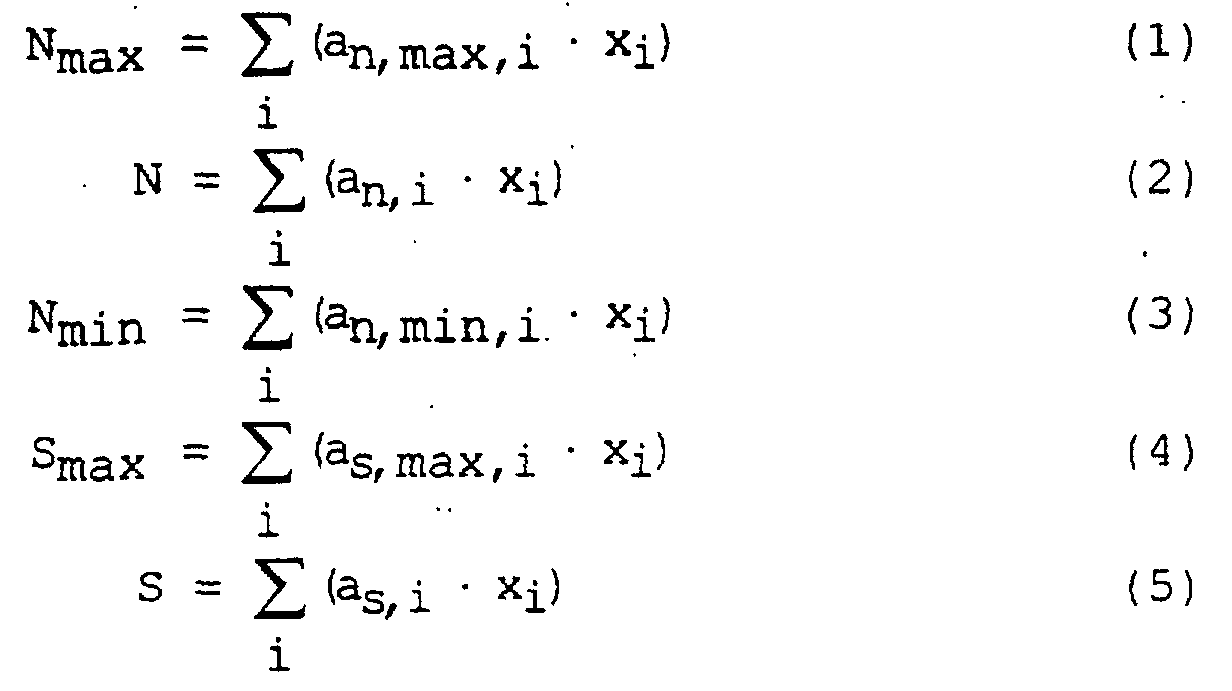
- the camera 6 records the image of the component 3 and the previous assignment of pixels (or moxels) to interference and useful structures 9, 8 determines the gray value components for the set intensities x i of the respective light source.
- the coefficients, which are stored in the image evaluation unit 7, are obtained by dividing the gray value components by the set intensities x i .
- limit values for the gray values or differences therefrom are first defined for this.
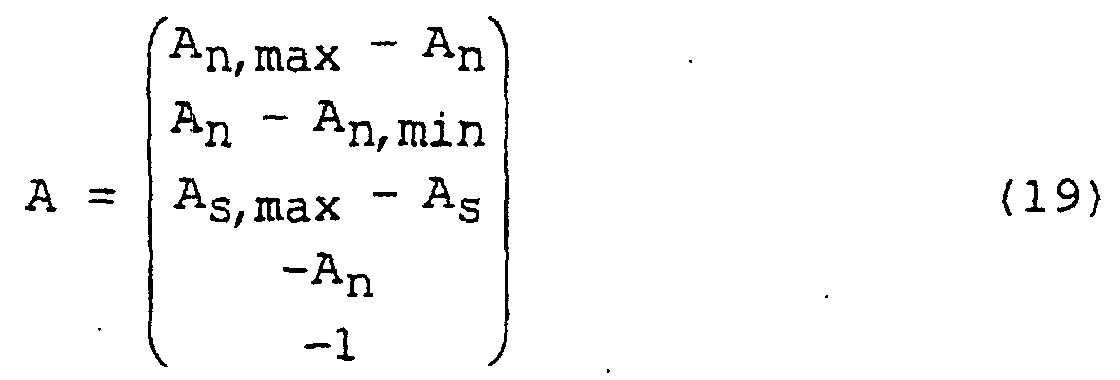
- the difference between the maximum gray scale value N max of the useful structures 9 and the mean value N of the gray scale values of the useful structures 9 should be smaller than a predetermined first limit value GW1.
- N Max - N (A n, max - A n ) • X ⁇ GW1
- N - N min (A n - A n, min ) • X ⁇ GW2
- the difference between the maximum gray scale value S max and the average value S of the gray scale values of the interference structures 8 should be smaller than a predetermined third limit value GW3.
- S Max - S (A s.max - A s ) • X ⁇ GW3
- N A N • X ⁇ GW4 or -A N • X ⁇ -GW4
- the intensity should be greater than zero, which can be written vectorially after the introduction of an auxiliary vector 1 with elements that have the unit of an intensity and the value 1: 1 • X ⁇ 0 or -1 • X ⁇ 0
- the useful structures 9 can be distinguished from the interference structures 8, which is the case if, for at least one light source i, there is a large difference in the coefficients a n, i and a s, i of the mean values of the gray values of useful and interference structures 9.8 occurs: positive contrast: a n, i >> a s, i negative contrast: a n, i ⁇ a s, i
- the distance between the gray value areas of interfering and useful structures (8,9) is thus chosen to be as large as possible.
- the optimal illumination will then provide approximately the same gray values for useful and interference structures 9, 8, so that the position of the component 3 is recognized on the basis of the external shape of the component 3 against a background.
- the condition for the specified fourth limit value GW 4 (equations 14 and 15) relates to the mean value S of the gray values of the interference structures 8.
- S A S • X ⁇ GW4 or -A S • X ⁇ -GW4
- the Eq. (20) is adjusted accordingly in this case.
- Eqs. (20) and (26), or Eqs. (20) and (28) are calculated using a linear optimization method, for example the revised simplex algorithm (see for example Bronstein, Semendjajew: Taschenbuch der Mathematik, 24th ed., Verlag Harri Deutsch, Thun and Frankfurt / Main p. 711 ff.) With a program in the image evaluation unit 7 and the result is the desired intensities x i of the individual light sources i, which are set for optimal illumination.
- the revised simplex algorithm see for example Bronstein, Semendjajew: Taschenbuch der Mathematik, 24th ed., Verlag Harri Deutsch, Thun and Frankfurt / Main p. 711 ff.
- the image of the connections recorded by the camera 6 is divided into regions R1, R2 as a useful structure 9, which are examined separately become.
- a single light source 4a or 4b does not produce a uniform illumination of the useful structure 9, but rather regionally bright spots arise, while the rest of the useful structure 9 remains dark.
- the pixel or moxel with the maximum gray value of the structure is not stationary, but changes with changing direction of illumination due to different light sources 4a, 4b. For this reason, the difference between the maximum gray value N max and the mean value N cannot be represented as a linear combination of the intensity values x i of the light sources 4a, 4b.
- regional coefficients a n, R1, i a n, R2, i for the respective mean value N R1 , N R2 of the gray values of the useful structures 9 in the respective regions R1, R2 determined.
- a total of 4 regional coefficients a n, R1, i a n, R2, i are determined.
- the number of light sources 4 and the regions R1, R2 can be varied depending on the problem. vary.
- the mean values N R1 , N R2 of the gray values in the regions R1, R2 result analogously as a linear combination of the regional coefficients a n, R1, i a n, R2, i and the intensities x i of the light sources 4a, 4b.
- the mean values N R1 , N R2 of the gray values of the regions R1, R2 are not greater than a fifth limit value GW5, so that the signal limitation of the camera 6 is not exceeded.
- the coefficient a n, i for the mean values N R1 , N R2 of the gray values of the useful structure 9 it is assumed that all light sources 4a, 4b are used for illumination.
- the coefficient a n, i for the mean values N R1 , N R2 of the gray values of the useful structure is the arithmetic mean of the regional coefficients a n, R1, i a n, R2, i .
- the optimal lighting is then determined analogously to the first embodiment described.
Landscapes
- Engineering & Computer Science (AREA)
- General Physics & Mathematics (AREA)
- Physics & Mathematics (AREA)
- Analytical Chemistry (AREA)
- General Health & Medical Sciences (AREA)
- Computer Vision & Pattern Recognition (AREA)
- Theoretical Computer Science (AREA)
- Health & Medical Sciences (AREA)
- Life Sciences & Earth Sciences (AREA)
- Chemical & Material Sciences (AREA)
- Spectroscopy & Molecular Physics (AREA)
- Biochemistry (AREA)
- Quality & Reliability (AREA)
- Immunology (AREA)
- Pathology (AREA)
- Operations Research (AREA)
- Manufacturing & Machinery (AREA)
- Microelectronics & Electronic Packaging (AREA)
- Circuit Arrangement For Electric Light Sources In General (AREA)
- Image Processing (AREA)
- Length Measuring Devices By Optical Means (AREA)
Description
Diese Möglichkeit bietet den Vorteil, daß eine zum Verfahren zugehörige manuelle Justage des Bauelementes 3 in der Lageerkennungseinrichtung im Verlauf der visuellen Identifikation von Stör- und Nutzstrukturen 8,9 erfolgen kann.

Claims (16)
- Verfahren zur automatischen Intensitätseinstellung einer Beleuchtung einer Einrichtung zur Lageerkennung und/oder Qualitätskontrolle in Bestückautomaten für Bauelemente (3), wobei die Einrichtung eine Beleuchtungseinrichtung aus mindestens zwei Lichtquellen (4) mit zugeordneten, regelbaren Intensitätssteuereinrichtungen (5) sowie eine zugeordnete Kamera (6) mit nachgeschalteter Bildauswerteeinheit (7) umfaßt, welche zumindest bereichsweise eine in Bildpunkte (Pixel) gerasterte Abbildung des Bauelementes (3) in Form von Grauwerten aufnimmt,
dadurch gekennzeichnet, daß die Abbildung des Bauelementes (3) in für die Lageerkennung und/oder.Qualitätskontrolle störende Strukturen (Störstrukturen) (8) und nützliche Strukturen (Nutzstrukturen) (9) des Bauelementes (3) aufgeteilt wird und die Zuordnung der Bildpunkte zu Stör- und Nutzstrukturen (8,9) in der Bildauswerteeinheit (7) abgespeichert wird,
daß das Bauelement (3) in der Einrichtung zur Lageerkennung und/oder Qualitätskontrolle nacheinander durch jeweils eine der mindestens zwei Lichtquellen (4) mit variierender Intensität beleuchtet wird,
daß die Grauwerte der mit der Kamera (6) aufgenommenen Abbildung als Grauwertanteile in der Bildauswerteeinheit (7) gespeichert und den Stör- und Nutzstrukturen (8,9) zugeordnet werden und damit die Abhängigkeit von Grauwertbereichen der Stör- und Nutzstrukturen (8,9) von der Intensität (xi) der einzelnen Lichtquellen (4) ermittelt wird,
daß in der Bildauswerteeinheit (7) die gespeicherten Grauwertanteile aller Lichtquellen (4) geordnet nach Nutz- und
Störstrukturen (9,8) aufsummiert werden und die ermittelten Grauwertsummen der Stör- und Nutzstrukturen (8,9) untereinander verglichen werden,
daß mit Hilfe einer linearen Optimierung die optimale Beleuchtung automatisch so bestimmt wird,daß für den Fall der Existenz mindestens einer Lichtquelle (4), deren Beleuchtung zu einer Differenz zwischen den Mittelwerten der Grauwerte von Stör- und Nutzstrukturen (8,9) führt, wobei der Betrag der Differenz einen vorbestimmten Wert überschreitet, unter Berücksichtigung der Beleuchtung von allen Lichtquellen (4) eine maximale Differenz zwischen den Mittelwerten der Grauwerte von Störund Nutzstrukturen (8,9) angestrebt wirdund falls keine Lichtquelle (4) existiert, deren Beleuchtung zu einer Differenz zwischen den Mittelwerten der Graüwerte von Stör- und Nutzstrukturen (8,9) führt, wobei der Betrag der Differenz einen vorbestimmten Wert überschreitet, unter Berücksichtigung der Beleuchtung von allen Lichtquellen (4) eine minimale Differenz zwischen den Mittelwerten der Grauwerte von Stör- und Nutzstrukturen (8, 9) angestrebt wird. - Verfahren zur automatischen Intensitätseinstellung einer Beleuchtung nach Anspruch 1,
dadurch gekennzeichnet, daß die gemessenen Grauwertanteile pixelweise oder über mehrere Pixel gemittelt der Lichtquelle (4) und der Intensität der Lichtquelle (xi) zugeordnet und in der Bildauswerteeinheit (7) gespeichert werden. - Verfahren zur automatischen Intensitätseinstellung einer Beleuchtung nach einem der Ansprüche 1 oder 2,
dadurch gekennzeichnet, daß in der Bildauswerteeinheit (7) zu jeder Lichtquelle (4) und jeder eingestellten Intensität (xi) der minimale Grauwertanteil der Nutzstrukturen (9) ermittelt und durch Division durch die eingestellte Intensität (xi) ein Koeffizient (an,min,i) des minimalen Grauwertanteils der Nutzstrukturen (9) ermittelt und abgespeichert wird, so daß ein minimaler Grauwert (Nmin) der Nutzstrukturen (9) durch eine Linearkombination dieser Koeffizienten (an,min,i) und der eingestellten Intensität (xi) aller Lichtquellen (4) ermittelbar ist. - Verfahren zur automatischen Intensitätseinstellung einer Beleuchtung nach einem der Ansprüche 1 bis 3,
dadurch gekennzeichnet, daß in der Bildauswerteeinheit (7) zu jeder Lichtquelle (4) und jeder eingestellten Intensität (xi) der Mittelwert der Grauwertanteile der Nutzstrukturen (9) ermittelt und durch Division durch die eingestellte Intensität (xi) ein Koeffizient (an,i) des Mittelwertes der Grauwertanteile der Nutzstrukturen (9) ermittelt und abgespeichert wird, so daß ein Mittelwert der Grauwerte (N) der Nutzstrukturen (9) durch eine Linearkombination dieser Koeffizienten (an,i) und der eingestellten Intensität (xi) aller Lichtquellen (4) ermittelbar ist. - Verfahren zur automatischen Intensitätseinstellung einer Beleuchtung nach einem der Ansprüche 1 bis 3,
dadurch gekennzeichnet, daß die Nutzstrukturen (9) in mindestens zwei Regionen (R1,R2) unterteilt werden,
daß in der Bildauswerteeinheit (7) zu jeder Lichtquelle (4) und jeder eingestellten Intensität (xi) der Mittelwert der Grauwertanteile der jeweiligen Region (R1, R2) der Nutzstruktur (9) ermittelt und durch Division durch die eingestellte Intensität (xi) ein regionaler Koeffizient (an,R1,i an,R2,i) des Mittelwertes der Grauwertanteile der Region (R1,R2) der Nutzstrukturen (9) ermittelt und abgespeichert wird, so daß ein Mittelwert (NR1, NR2) der Grauwerte der Region (R1,R2) der Nutzstrukturen (9) durch eine Linearkombination dieser regionalen Koeffizienten (an,R1,i an,R2,i) und der eingestellten Intensität (xi) aller Lichtquellen (4) ermittelbar ist. - Verfahren zur automatischen Intensitätseinstellung einer Beleuchtung nach Anspruch 4,
dadurch gekennzeichnet, daß ein Mittelwert (N) der Grauwerte der Nutzstrukturen (9) durch eine Linearkombination aus aus den regionalen Koeffizienten (an,R1,i an,R2,i) ermittelten Koeffizienten (an,i) des Mittelwerts der Grauwerte der Nutzstrukturen (9) und der eingestellten Intensität (xi) aller Lichtquellen (4) ermittelt wird. - Verfahren zur automatischen Intensitätseinstellung einer Beleuchtung nach Anspruch 6,
dadurch gekennzeichnet, daß der Koeffizient (an,i) des Mittelwerts der Grauwerte der Nutzstrukturen (9) durch Mittelwertbildung aus den regionalen Koeffizienten (an,R1,i an,R2,i) ermittelt wird. - Verfahren zur automatischen Intensitätseinstellung einer Beleuchtung nach einem der Ansprüche 1 bis 7,
dadurch gekennzeichnet, daß in der Bildauswerteeinheit (7) zu jeder Lichtquelle (4) und jeder eingestellten Intensität (xi) der maximale Grauwertanteil der Nutzstrukturen (9) ermittelt und durch Division durch die eingestellte Intensität (xi) ein Koeffizient (an,max,i) des maximalen Grauwertanteils der Nutzstrukturen (9) ermittelt und abgespeichert wird, so daß ein maximaler Grauwert (Nmax) der Nutzstrukturen (9) durch eine Linearkombination dieser Koeffizienten (an,max,i) und der eingestellten Intensität (xi) aller Lichtquellen (4) ermittelbar ist. - Verfahren zur automatischen Intensitätseinstellung einer Beleuchtung nach einem der Ansprüche 1 bis 8,
dadurch gekennzeichnet, daß in der Bildauswerteeinheit (7) zu jeder Lichtquelle (4) und jeder eingestellten Intensität (xi) der maximale Grauwertanteil der Störstrukturen (8) ermittelt und durch Division durch die eingestellte Intensität (xi) ein Koeffizient (as,max,i) des maximalen Grauwertanteils der Störstrukturen (8) ermittelt und abgespeichert wird, so daß ein maximaler Grauwert (Smax) der Störstrukturen (8) durch eine Linearkombination dieser Koeffizienten (as,max,i) und der eingestellten Intensität (xi) aller Lichtquellen (4) ermittelbar ist. - Verfahren zur automatischen Intensitätseinstellung einer Beleuchtung nach einem der Ansprüche 1 bis 9,
dadurch gekennzeichnet, daß in der Bildauswerteeinheit (7) zu jeder Lichtquelle (4) und jeder eingestellten Intensität (xi) der Mittelwert der Grauwertanteile der Störstrukturen (8) ermittelt und durch Division durch die eingestellte Intensität (xi) ein Koeffizient (as,i) des Mittelwertes der maximalen Grauwertanteile der Störstrukturen (9) ermittelt und abgespeichert wird, so daß ein Mittelwert der Grauwerte (S) der Störstrukturen (8) durch eine Linearkombination dieser Koeffizienten (as,i) und der eingestellten Intensität (xi) aller Lichtquellen (4) ermittelbar ist. - Verfahren zur automatischen Intensitätseinstellung einer Beleuchtung nach Anspruch 10,
dadurch gekennzeichnet, daß die Koeffizienten (an,i , as,i) der Mittelwerte der Grauwertanteile der Nutz- und der Störstrukturen (8,9)bezüglich einzelner Lichtquellen (4) miteinander verglichen werden,
daß, falls eine Lichtquelle (4) existiert, deren zugeordnete Koeffizienten (an,i , as,i) der Mittelwerte der Grauwerte von Nutz- und Störstrukturen (8,9) sich stark unterscheiden, als Optimierungsbedingung eine möglichst große Differenz der Mittelwerte (N-S) der Grauwerte von Nutz- und Störstrukturen (8,9) gewählt wird,
und ansonsten als Optimierungsbedingung eine möglichst kleine die Differenz der Mittelwerte (N-S) der Grauwerte von Nutzund Störstrukturen (8,9) gewählt wird. - Verfahren zur automatischen Intensitätseinstellung einer Beleuchtung nach einem der Ansprüche 1 bis 11,
dadurch gekennzeichnet, daß Grenzwerte (GW1, GW2, GW3, GW4, GW5) für die Grauwerte oder für Differenzen oder Quotienten von Grauwerten vorgegeben werden. - Verfahren zur automatischen Intensitätseinstellung einer Beleuchtung nach Anspruch 12,
dadurch gekennzeichnet, daß mit den Grenzwerten (GW1, GW2, GW3, GW4, GW5) mindestens eine der Grenzbedingungen
für die Differenz aus dem maximalen Grauwert und dem Mittelwert der Grauwerte der Nutzstrukturen (Nmax-N ≤ GW1),
für die Differenz aus dem Mittelwert der Grauwerte und dem minimalen Grauwert der Nutzstrukturen (N-Nmin ≤ GW2),
für die Differenz aus dem maximalen Grauwert und dem Mittelwert der Grauwerte der Störstrukturen (Smax-S ≤ GW3),
für den Mittelwert der Grauwerte der Nutzstrukturen (N ≥ GW4) und für die Intensitäten (xi)
vorgegeben wird. - Verfahren zur automatischen Intensitätseinstellung einer Beleuchtung nach Anspruch 12,
dadurch gekennzeichnet, daß mit den Grenzwerten (GW1, GW2, GW3, GW4, GW5) mindestens eine der Grenzbedingungen
für die Mittelwerte (NR1, NR2) der Grauwerte der Regionen der Nutzstrukturen (NR1,NR2 ≤ GW5),
für den Mittelwert der Grauwerte der Störstrukturen und für die Intensitäten (xi)
vorgegeben wird. - Verfahren zur automatischen Intensitätseinstellung einer Beleuchtung nach einem der Ansprüche 13 oder 14,
dadurch gekennzeichnet, daß aus den Grenzbedingungen und der Optimierungsbedingung ein lineares Ungleichungssystem gebildet wird,
und daß das lineare Ungleichungssystem mit Hilfe einer Linearen Optimierung in der Bildauswerteeinheit (7) gelöst wird. - Verfahren zur automatischen Intensitätseinstellung einer Beleuchtung nach Anspruch 15,
dadurch gekennzeichnet, daß als Verfahren für die Lineare Optimierung der revidierte Simplex Algorithmus verwendet wird.
Applications Claiming Priority (3)
| Application Number | Priority Date | Filing Date | Title |
|---|---|---|---|
| DE19727471 | 1997-06-27 | ||
| DE19727471A DE19727471C1 (de) | 1997-06-27 | 1997-06-27 | Verfahren zur automatischen Intensitätseinstellung einer Beleuchtung für Einrichtungen zur Lageerkennung und/oder Qualitätskontrolle bei der automatischen Bestückung von Bauelementen |
| PCT/DE1998/001581 WO1999001014A1 (de) | 1997-06-27 | 1998-06-10 | Verfahren zur automatischen intensitätseinstellung einer beleuchtung für einrichtungen zur lageerkennung und/oder qualitätskontrolle |
Publications (2)
| Publication Number | Publication Date |
|---|---|
| EP0992180A1 EP0992180A1 (de) | 2000-04-12 |
| EP0992180B1 true EP0992180B1 (de) | 2002-05-22 |
Family
ID=7833896
Family Applications (1)
| Application Number | Title | Priority Date | Filing Date |
|---|---|---|---|
| EP98936128A Expired - Lifetime EP0992180B1 (de) | 1997-06-27 | 1998-06-10 | Verfahren zur automatischen intensitätseinstellung einer beleuchtung für einrichtungen zur lageerkennung und/oder qualitätskontrolle |
Country Status (4)
| Country | Link |
|---|---|
| US (1) | US6546126B1 (de) |
| EP (1) | EP0992180B1 (de) |
| DE (2) | DE19727471C1 (de) |
| WO (1) | WO1999001014A1 (de) |
Families Citing this family (11)
| Publication number | Priority date | Publication date | Assignee | Title |
|---|---|---|---|---|
| DE10012043A1 (de) * | 2000-03-14 | 2001-10-04 | Bosch Gmbh Robert | Vorrichtung zur Ausrichtung von Referenzmarken tragenden Objekten zueinander |
| US20050207655A1 (en) * | 2004-03-22 | 2005-09-22 | Nasreen Chopra | Inspection system and method for providing feedback |
| US7454053B2 (en) * | 2004-10-29 | 2008-11-18 | Mitutoyo Corporation | System and method for automatically recovering video tools in a vision system |
| WO2008081796A1 (ja) | 2006-12-28 | 2008-07-10 | Yamaha Motor Co., Ltd. | 部品認識装置、表面実装機、および部品試験装置 |
| GB0809037D0 (en) | 2008-05-19 | 2008-06-25 | Renishaw Plc | Video Probe |
| JP5562906B2 (ja) | 2011-06-09 | 2014-07-30 | ヤマハ発動機株式会社 | 部品撮像方法、部品撮像装置および同装置を備えた部品実装装置 |
| WO2014065058A1 (ja) * | 2012-10-26 | 2014-05-01 | シャープ株式会社 | 光学部材搬送装置 |
| CN106546598B (zh) * | 2016-10-28 | 2019-09-24 | 鞍钢未来钢铁研究院有限公司 | 带钢表面检测系统光源自适应控制方法 |
| EP3653030B1 (de) * | 2017-07-12 | 2024-09-18 | Mycronic Ab | Verfahren und system zur bestimmung von komponentenbeleuchtungseinstellungen |
| CN110867392B (zh) * | 2019-11-19 | 2023-02-10 | 上海华力微电子有限公司 | 晶圆缺陷扫描方法 |
| JP2022117091A (ja) * | 2021-01-29 | 2022-08-10 | キヤノン株式会社 | 計測装置、リソグラフィ装置及び物品の製造方法 |
Family Cites Families (8)
| Publication number | Priority date | Publication date | Assignee | Title |
|---|---|---|---|---|
| JPS62299948A (ja) * | 1986-06-20 | 1987-12-26 | Fujitsu Ltd | 照明光量の自動設定方法 |
| US5185811A (en) | 1990-12-27 | 1993-02-09 | International Business Machines Corporation | Automated visual inspection of electronic component leads prior to placement |
| JP3000761B2 (ja) * | 1991-11-22 | 2000-01-17 | 松下電器産業株式会社 | 電子部品実装工程における光学系のランプ値調節方法 |
| US5454049A (en) * | 1993-06-21 | 1995-09-26 | Sony Electronics, Inc. | Automatic threshold function for machine vision |
| JP3243385B2 (ja) * | 1994-11-28 | 2002-01-07 | 株式会社豊田中央研究所 | 物体の形状検査装置 |
| EP0800756B1 (de) * | 1994-12-30 | 1998-09-02 | Siemens Aktiengesellschaft | Vorrichtung zur lageerkennung der anschlüsse von bauelementen |
| JPH08189901A (ja) * | 1995-01-11 | 1996-07-23 | Fuji Electric Co Ltd | 画像信号を用いる検査装置 |
| JP3725207B2 (ja) * | 1995-07-20 | 2005-12-07 | 日本電信電話株式会社 | 画像位置合わせ方法及びそれを用いる製品検査装置 |
-
1997
- 1997-06-27 DE DE19727471A patent/DE19727471C1/de not_active Expired - Fee Related
-
1998
- 1998-06-10 EP EP98936128A patent/EP0992180B1/de not_active Expired - Lifetime
- 1998-06-10 WO PCT/DE1998/001581 patent/WO1999001014A1/de not_active Ceased
- 1998-06-10 US US09/446,485 patent/US6546126B1/en not_active Expired - Fee Related
- 1998-06-10 DE DE59804201T patent/DE59804201D1/de not_active Expired - Fee Related
Also Published As
| Publication number | Publication date |
|---|---|
| DE59804201D1 (de) | 2002-06-27 |
| WO1999001014A1 (de) | 1999-01-07 |
| DE19727471C1 (de) | 1998-12-17 |
| EP0992180A1 (de) | 2000-04-12 |
| US6546126B1 (en) | 2003-04-08 |
Similar Documents
| Publication | Publication Date | Title |
|---|---|---|
| EP1020105B1 (de) | Verfahren zur beleuchtungseinstellung in einer einrichtung zur lageerkennung und/oder qualitätskontrolle von bauelementen und/oder substraten | |
| DE3600330C2 (de) | Dreifarben-Kathodenstrahlröhrenanordnung | |
| EP0992180B1 (de) | Verfahren zur automatischen intensitätseinstellung einer beleuchtung für einrichtungen zur lageerkennung und/oder qualitätskontrolle | |
| DE3750285T2 (de) | Gerät zur Untersuchung einer elektronischen Vorrichtung in fester Baugruppe. | |
| EP0309758B1 (de) | Verfahren und Vorrichtung zum Feststellen und Auswerten von Oberflächenrissen bei Werkstücken | |
| DE68909505T2 (de) | Farbbildschirm-Kontrollsystem. | |
| DE102020126491B4 (de) | Scheinwerfersystem für Fahrzeuge | |
| EP3456151A1 (de) | Beleuchtungsvorrichtung mit konsistenten lichteigenschaften | |
| DE69912579T2 (de) | Vorrichtung und verfahren zur aufzeichnung eines objektbildes | |
| DE69705880T2 (de) | Verfahren zur Druckqualitätskontrolle eines Mehrfarbenbildes | |
| DE19637234C2 (de) | Verfahren zur Überprüfung der Farbreinheit von Oberflächen | |
| DE3586975T2 (de) | Verfahren und vorrichtung zur messung des eine offsetdruckplatte anfeuchtenden wassers. | |
| EP0087652B1 (de) | Messkopf zur Erfassung der Farbeneinheit und der Konvergenz bei einer Farbbildröhre | |
| DE69923120T2 (de) | Vorrichtung und Verfahren zum Feststellen von hellen oder dunklen Flecken | |
| DE602004001909T2 (de) | Verfahren und Instrument zur Kontrolle der Verbindung von Wänden einer wabenförmigen Struktur mit einem Substrat | |
| EP3958036A1 (de) | Verfahren und vorrichtung zum erzeugen eines übersichtskontrastbildes eines probenträgers in einem mikroskop | |
| EP0336114A2 (de) | Vorrichtung zur Lageerfassung der Anschlusskontakte elektrischer oder elektronischer Bauelemente | |
| DE3006379A1 (de) | Defektpruefsystem | |
| DE3925012A1 (de) | Verfahren und anordnung zur bestimmung der flaechenbedeckung der primaerfarben in messsegmenten mehrfarbiger druckvorlagen einer offsetdruckmaschine | |
| DE19906375C1 (de) | Verfahren zur Farbbestimmung von Objekten | |
| DE68912900T2 (de) | Verfahren und Gerät zur Inspektion von Schichten. | |
| WO2024068468A1 (de) | Verfahren und vorrichtung zur aufnahme mehrerer abbildungen eines objekts mit unterschiedlichen beleuchtungskonfigurationen | |
| EP4102492A1 (de) | Verfahren und vorrichtung zur lichttechnischen vermessung eines elektronischen displays sowie verfahren zur ansteuerung eines elektronischen displays | |
| DE102005037894B3 (de) | Verfahren zur Ermittlung und Korrektur nichtlinearer Detektorpixel | |
| EP0231004B1 (de) | Verfahren zur Selbstkontrolle einer optoelektronischen Risserkennungseinrichtung, insbesondere nach dem Magnetpulververfahren |
Legal Events
| Date | Code | Title | Description |
|---|---|---|---|
| PUAI | Public reference made under article 153(3) epc to a published international application that has entered the european phase |
Free format text: ORIGINAL CODE: 0009012 |
|
| 17P | Request for examination filed |
Effective date: 19991217 |
|
| AK | Designated contracting states |
Kind code of ref document: A1 Designated state(s): CH DE FR GB IT LI NL |
|
| 17Q | First examination report despatched |
Effective date: 20010222 |
|
| GRAG | Despatch of communication of intention to grant |
Free format text: ORIGINAL CODE: EPIDOS AGRA |
|
| GRAG | Despatch of communication of intention to grant |
Free format text: ORIGINAL CODE: EPIDOS AGRA |
|
| GRAH | Despatch of communication of intention to grant a patent |
Free format text: ORIGINAL CODE: EPIDOS IGRA |
|
| GRAH | Despatch of communication of intention to grant a patent |
Free format text: ORIGINAL CODE: EPIDOS IGRA |
|
| GRAA | (expected) grant |
Free format text: ORIGINAL CODE: 0009210 |
|
| REG | Reference to a national code |
Ref country code: GB Ref legal event code: FG4D Free format text: NOT ENGLISH |
|
| REG | Reference to a national code |
Ref country code: CH Ref legal event code: NV Representative=s name: SIEMENS SCHWEIZ AG Ref country code: CH Ref legal event code: EP |
|
| REF | Corresponds to: |
Ref document number: 59804201 Country of ref document: DE Date of ref document: 20020627 |
|
| GBT | Gb: translation of ep patent filed (gb section 77(6)(a)/1977) |
Effective date: 20020801 |
|
| ET | Fr: translation filed | ||
| PLBE | No opposition filed within time limit |
Free format text: ORIGINAL CODE: 0009261 |
|
| STAA | Information on the status of an ep patent application or granted ep patent |
Free format text: STATUS: NO OPPOSITION FILED WITHIN TIME LIMIT |
|
| 26N | No opposition filed |
Effective date: 20030225 |
|
| PGFP | Annual fee paid to national office [announced via postgrant information from national office to epo] |
Ref country code: IT Payment date: 20080626 Year of fee payment: 11 |
|
| PGFP | Annual fee paid to national office [announced via postgrant information from national office to epo] |
Ref country code: NL Payment date: 20080618 Year of fee payment: 11 Ref country code: DE Payment date: 20080818 Year of fee payment: 11 Ref country code: CH Payment date: 20080909 Year of fee payment: 11 |
|
| PGFP | Annual fee paid to national office [announced via postgrant information from national office to epo] |
Ref country code: FR Payment date: 20080616 Year of fee payment: 11 |
|
| PGFP | Annual fee paid to national office [announced via postgrant information from national office to epo] |
Ref country code: GB Payment date: 20080616 Year of fee payment: 11 |
|
| REG | Reference to a national code |
Ref country code: CH Ref legal event code: PCAR Free format text: SIEMENS SCHWEIZ AG;INTELLECTUAL PROPERTY FREILAGERSTRASSE 40;8047 ZUERICH (CH) |
|
| REG | Reference to a national code |
Ref country code: CH Ref legal event code: PL |
|
| GBPC | Gb: european patent ceased through non-payment of renewal fee |
Effective date: 20090610 |
|
| NLV4 | Nl: lapsed or anulled due to non-payment of the annual fee |
Effective date: 20100101 |
|
| REG | Reference to a national code |
Ref country code: FR Ref legal event code: ST Effective date: 20100226 |
|
| PG25 | Lapsed in a contracting state [announced via postgrant information from national office to epo] |
Ref country code: LI Free format text: LAPSE BECAUSE OF NON-PAYMENT OF DUE FEES Effective date: 20090630 Ref country code: FR Free format text: LAPSE BECAUSE OF NON-PAYMENT OF DUE FEES Effective date: 20090630 Ref country code: CH Free format text: LAPSE BECAUSE OF NON-PAYMENT OF DUE FEES Effective date: 20090630 |
|
| PG25 | Lapsed in a contracting state [announced via postgrant information from national office to epo] |
Ref country code: GB Free format text: LAPSE BECAUSE OF NON-PAYMENT OF DUE FEES Effective date: 20090610 |
|
| PG25 | Lapsed in a contracting state [announced via postgrant information from national office to epo] |
Ref country code: DE Free format text: LAPSE BECAUSE OF NON-PAYMENT OF DUE FEES Effective date: 20100101 |
|
| PG25 | Lapsed in a contracting state [announced via postgrant information from national office to epo] |
Ref country code: NL Free format text: LAPSE BECAUSE OF NON-PAYMENT OF DUE FEES Effective date: 20100101 |
|
| PG25 | Lapsed in a contracting state [announced via postgrant information from national office to epo] |
Ref country code: IT Free format text: LAPSE BECAUSE OF NON-PAYMENT OF DUE FEES Effective date: 20090610 |