EP0984656B1 - Weiterreichsteuerung für eine Punkt zur Mehrpunkt Verbindung in einem Mobilen ATM-Netzwerk - Google Patents
Weiterreichsteuerung für eine Punkt zur Mehrpunkt Verbindung in einem Mobilen ATM-Netzwerk Download PDFInfo
- Publication number
- EP0984656B1 EP0984656B1 EP99103788A EP99103788A EP0984656B1 EP 0984656 B1 EP0984656 B1 EP 0984656B1 EP 99103788 A EP99103788 A EP 99103788A EP 99103788 A EP99103788 A EP 99103788A EP 0984656 B1 EP0984656 B1 EP 0984656B1
- Authority
- EP
- European Patent Office
- Prior art keywords
- base station
- newbs
- mobile terminal
- handoff
- pmp
- Prior art date
- Legal status (The legal status is an assumption and is not a legal conclusion. Google has not performed a legal analysis and makes no representation as to the accuracy of the status listed.)
- Expired - Lifetime
Links
- 230000011664 signaling Effects 0.000 claims description 36
- 238000000034 method Methods 0.000 claims description 27
- 238000011144 upstream manufacturing Methods 0.000 claims description 24
- 238000004891 communication Methods 0.000 claims description 16
- 239000003550 marker Substances 0.000 claims description 14
- 230000004044 response Effects 0.000 claims description 9
- 238000004590 computer program Methods 0.000 claims description 5
- 238000012545 processing Methods 0.000 claims description 4
- 238000012546 transfer Methods 0.000 claims description 3
- 230000008569 process Effects 0.000 description 10
- 230000009471 action Effects 0.000 description 5
- 230000005540 biological transmission Effects 0.000 description 3
- 230000003139 buffering effect Effects 0.000 description 3
- 230000006870 function Effects 0.000 description 3
- 230000000977 initiatory effect Effects 0.000 description 3
- 238000013459 approach Methods 0.000 description 2
- 241001659321 ANME-2 cluster Species 0.000 description 1
- 230000008901 benefit Effects 0.000 description 1
- 230000006727 cell loss Effects 0.000 description 1
- 230000003247 decreasing effect Effects 0.000 description 1
- 238000013507 mapping Methods 0.000 description 1
- 238000010295 mobile communication Methods 0.000 description 1
- 230000007727 signaling mechanism Effects 0.000 description 1
Images







Classifications
-
- H—ELECTRICITY
- H04—ELECTRIC COMMUNICATION TECHNIQUE
- H04Q—SELECTING
- H04Q11/00—Selecting arrangements for multiplex systems
- H04Q11/04—Selecting arrangements for multiplex systems for time-division multiplexing
- H04Q11/0428—Integrated services digital network, i.e. systems for transmission of different types of digitised signals, e.g. speech, data, telecentral, television signals
- H04Q11/0478—Provisions for broadband connections
-
- H—ELECTRICITY
- H04—ELECTRIC COMMUNICATION TECHNIQUE
- H04W—WIRELESS COMMUNICATION NETWORKS
- H04W36/00—Hand-off or reselection arrangements
- H04W36/0005—Control or signalling for completing the hand-off
- H04W36/0007—Control or signalling for completing the hand-off for multicast or broadcast services, e.g. MBMS
-
- H—ELECTRICITY
- H04—ELECTRIC COMMUNICATION TECHNIQUE
- H04W—WIRELESS COMMUNICATION NETWORKS
- H04W72/00—Local resource management
- H04W72/30—Resource management for broadcast services
-
- H—ELECTRICITY
- H04—ELECTRIC COMMUNICATION TECHNIQUE
- H04L—TRANSMISSION OF DIGITAL INFORMATION, e.g. TELEGRAPHIC COMMUNICATION
- H04L12/00—Data switching networks
- H04L12/54—Store-and-forward switching systems
- H04L12/56—Packet switching systems
- H04L12/5601—Transfer mode dependent, e.g. ATM
- H04L2012/5603—Access techniques
- H04L2012/5604—Medium of transmission, e.g. fibre, cable, radio
- H04L2012/5607—Radio
-
- H—ELECTRICITY
- H04—ELECTRIC COMMUNICATION TECHNIQUE
- H04L—TRANSMISSION OF DIGITAL INFORMATION, e.g. TELEGRAPHIC COMMUNICATION
- H04L12/00—Data switching networks
- H04L12/54—Store-and-forward switching systems
- H04L12/56—Packet switching systems
- H04L12/5601—Transfer mode dependent, e.g. ATM
- H04L2012/5638—Services, e.g. multimedia, GOS, QOS
- H04L2012/564—Connection-oriented
- H04L2012/5642—Multicast/broadcast/point-multipoint, e.g. VOD
-
- H—ELECTRICITY
- H04—ELECTRIC COMMUNICATION TECHNIQUE
- H04W—WIRELESS COMMUNICATION NETWORKS
- H04W36/00—Hand-off or reselection arrangements
- H04W36/08—Reselecting an access point
-
- H—ELECTRICITY
- H04—ELECTRIC COMMUNICATION TECHNIQUE
- H04W—WIRELESS COMMUNICATION NETWORKS
- H04W8/00—Network data management
- H04W8/005—Discovery of network devices, e.g. terminals
-
- H—ELECTRICITY
- H04—ELECTRIC COMMUNICATION TECHNIQUE
- H04W—WIRELESS COMMUNICATION NETWORKS
- H04W88/00—Devices specially adapted for wireless communication networks, e.g. terminals, base stations or access point devices
- H04W88/08—Access point devices
Definitions
- This invention relates to handoff control for point to multipoint connections in mobile ATM networks, and for the first time provides for handoff control for a mobile participating in a point to multipoint connection.
- This invention relates to a system for handoff control in a point to multipoint mobile ATM network.
- the invention is embodied in a system, a method, and a program product for handoff control in a point to multipoint mobile ATM network
- ATM Asynchronous transfer mode (ATM) networks provide for point to point (PTP) and also for point to multipoint (PMP) connections.
- PTP point to point
- PMP point to multipoint
- PTP connections one station communicates with only one other station.
- PMP connections In PMP connections, one station broadcasts to a plurality of other stations.
- the station so broadcasting may be referred to as a broadcasting station or a root station.
- the stations so receiving the broadcast of the root station may be referred to as receiving stations or as leaf stations.
- PMP connections are useful when it is desired to send a broadcast to several stations, for example, in an educational lecture setting. Using a PMP connection over an ATM network, a root station at a university could broadcast a lecture to students participating at leaf stations.
- Stations in an ATM network connect to the network at switching nodes of the network.
- ATM switching nodes may be interconnected by links.
- the node to which the root station connects may be referred to as the root node of the PMP connection.
- the nodes to which leaf stations connect may be referred to as leaf nodes.
- a leaf node may provide service to more than one leaf station. Communication that moves in the direction away from the root station toward the leaf stations may be referred to as downstream communication; communication that moves in the direction toward the root station may be referred to as upstream communication.
- Fig. 1 shows a plurality of ATM switching nodes. Some of the nodes are interconnected by links. The nodes are represented by circles, and the links are represented by straight lines between the nodes.
- ATM networks may include support for mobile terminals.
- a mobile terminal (or, simply, a mobile; also referred to as a MT) communicates with the ATM network via a base station (BS).
- the BS for the purposes of this discussion, may conceptually be considered as part of a switching node. It is not necessary for all switching nodes to be BS's.
- a BS may be considered to be a special kind of switching node having communication facilities for directly communicating with MT's.
- Mobile ATM networks provide for handoff for PTP connections when an MT in a PTP connection moves from an area served by one BS into an area served by another BS. That is, a MT may have its PTP ATM connection handed off between different BS's.
- the BS that the MT leaves may be referred to as the old base station, or OldBS.
- the BS that the MT goes to may be referred to as the new base station, or NewBS.
- cell when discussing mobile ATM networks. This confusion arises because mobile networks have historically used "cell” to indicate the service area of a BS. In other words, a MT moving from one cell to another will have its call handed off between an OldBS and a NewBS. In ATM networks, however, "cell” has been used to refer to the ATM cell which serves as the basic unit for protocol processing and switching. To avoid confusion, herein the term “cell” refers to the ATM cell unless otherwise indicated, and the service area of a BS will be referred to as a service area.
- An ATM network may operate according to a Private Network to Network Interface (PNNI) hierarchy.
- PNNI Private Network to Network Interface
- the PNNI hierarchy provides for scalability of networks and is highly advantageous.
- the PNNI hierarchy provides that peer entities may be grouped together. A conceptual overview of the PNNI hierarchy will now be given.
- Fig. 2 shows one way in which the nodes of Fig. 1 might be grouped at a high level. Fig. 2 does not show the links between the nodes for the sake of clarity.
- the nodes above the dashed line may be thought of as belonging to an overall group referred to as group B.
- the nodes below the dashed line may be thought of as belonging to a group A.
- Group A and group B are defined at the same high level, and may be referred to as peers of each other. That is, group A is a peer of group B.
- Fig. 3 shows a lower level grouping of nodes. Again, the links between the nodes have been omitted for clarity.
- the nodes of peer group B have been grouped into groups B.1 and B.2; the nodes of peer group A have been grouped into groups A.1, A.2, A.3, and A.4.
- these lower level groups are peers of each other. That is, groups B.1 and B.2 are peers of each other and may also be referred to as peer groups. Groups A.1, A.2, A.3, and A.4 are peers of each other.
- a network may be understood to include a plurality of nodes, each which has a switching station or the like. Since these nodes are all at the same level, they are peers.
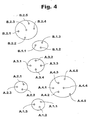
- a switching node may be named based on the names of the groups of which it is a part.
- A.2.1 may be in highest level group A, in the next level group A.2, and may be switching node number 1 within group A.2.
- This naming convention may be referred to as a hierarchical naming convention.
- Fig. 4 shows how the switching nodes in the exemplary network might be named under the foregoing convention.
- the PNNI hierarchy thus provides for peer groups of an arbitrary number of levels of abstraction.
- the scalable PNNI hierarchy helps hide from upper levels the impact of changing the network at lower levels, and also helps hide from other peer groups any changes made inside one peer group.
- a PNNI ATM network requires that a PMP connection must have a consistent tree topology at every level. More particularly, the root of the tree in a PMP connection is the root station. The leaves of the tree in a PMP connection are the leaf stations. The leaves must connect to the root via branches which do not overlap or cross. The prohibition of branch overlap/crossing allows a PMP connection to exist in harmony with the scalability of the PNNI network over all of the different levels of abstraction.
- the foregoing tree topology requirement imposed by the PNNI hierarchy does not substantially affect handoff for PTP ATM connections during handoff between BS's. PTP handoff may be accomplished in a straightforward manner.
- the foregoing tree topology requirement does, however, pose serious implications for PMP ATM connections during handoff.
- the proper handoff control it is possible that, when a MT participating as a leaf station in a PMP connection moves from the service area of the OldBS to the NewBS, the handing off of the connection to the NewBS might cause two branches impermissibly to cross or overlap.
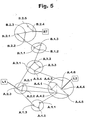
- Fig. 5 shows the exemplary network with the switching node addresses labeled, and the links between switching nodes as straight lines.
- a root station RT which is connected to switching node B.2.4.
- a first leaf station, L1 is connected to switching node A.2.3.
- a second leaf station, L2 is connected to switching node A.4.4.
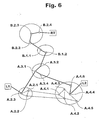
- Fig. 6 shows a PMP connection established through the ATM network by which L1 and L2 receive communications from RT.
- peer group A.1 in its entirety, several other switching nodes, and several links have been omitted for clarity.
- the PMP connection is shown as a heavy, dark line. Links not part of the PMP connection are shown as faint lines.
- the PMP connection includes switching nodes B.2.4, B.2.3, and B.2.2 of peer group B.2; switching nodes B.1.1 and B.1.2 of peer group B.1; switching nodes A.3.2, A.3.1, and A.3.4 of peer group A.3; switching node A.2.3 of peer group A.2; and switching nodes A.4.6 and A.4.4 of peer group A.4.
- Fig. 7 shows only a part of the exemplary ATM network with the PMP connection now including a third leaf which is a mobile terminal MT.
- the MT is in communication with switching node A.4.2, and the PMP connection includes switching nodes A.4.3 and A.4.2 in addition to the switching nodes already mentioned. Since the connection between MT and A.4.2 is a mobile communication link, it is shown as a heavy dashed line.
- Fig. 8 shows the MT in a highly schematic fashion.
- a transmit and receive unit 10 may have an antenna ANT through which radio communications are received and sent.
- Connected to transmit and receive unit 10 may be a processing unit 20 which enables the MT to participate in wireless radio communications.
- Fig. 9 shows an exemplary switching node which is a base station in a mobile ATM network in highly schematic fashion.
- the terms "base station” and “switching node” may be considered to be the same for many purposes of this discussion.
- a base station 60 includes a base station transmit and receive unit 30 having at least one antenna ANT.
- the base station 60 may also have a base station processing unit 40 which controls unit 30 to receive and send radio communications through antenna ANT.
- the base station 60 may also include a switching unit 50 which interfaces with the links of an ATM network.
- Switching unit 50 may include a processor and an associated memory.
- the memory may include instructions adapted to enable the processor to cause the switching unit to participate in predefined ways in the ATM network.
- a switching node that is not a base station might not have units 30, 40, or ANT.
- Fig. 10 shows a base station BS 60 and its service area 70.
- a MT in the service area 70 of a BS may communicate with the switching unit 50 of the ATM network via the BS 60.
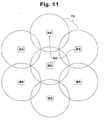
- Fig. 11 shows how the service areas 70 of different BS's 60 may be provided in close proximity one to another so as to provide substantially continuous communications capability.
- Fig. 12 shows how the PMP connection would appear if such a handoff is performed in a straightforward manner.
- the PMP connection is shown as being extended from A.4.2 to A.2.2 so that MT can continue to participate in the PMP connection, and MT is shown as communicating with the ATM network via A.2.2.
- connection handoff can violate the tree topology presents a serious problem with respect to the support of PMP connections in mobile ATM networks. Therefore, mobility is not presently supported for PMP connections in ATM networks. Moreover, there are multiple types of PMP connections, and this further complicates handoff control. The multiple types of PMP connections will now be briefly discussed.
- PMP connections there are three types of PMP connections.
- the three types of PMP connections are the Root Initiated PMP connection, the Root LIJ connection, and the Network LIJ connection.
- Root Initiated PMP connection the Root Initiated PMP connection
- Root LIJ connection the Root LIJ connection
- Network LIJ connection the Network LIJ connection
- Root Initiated PMP connections are created by the root and only the root can initiate signaling procedure by sending an ADD PARTY message toward a new leaf.
- Root LIJ PMP connection is characterized in that it is a root prompted, L eaf Initiated J oin (LIJ). Root LIJ connections allow a leaf to request to join the PMP connection by sending a LEAF SETUP REQUEST message to the root. Upon receiving the message, the root starts the signaling procedure to add this leaf by sending an ADD PARTY message toward the new leaf.
- LIJ L eaf Initiated J oin
- a Network LIJ PMP connection is characterized in that it is a leaf prompted L eaf Initiated J oin (LIJ).
- Network LIJ connections allow a leaf to request to join the PMP connection by sending a LEAF SETUP REQUEST message toward the root. This request message might not reach the root.
- the network determines whether there exists a node that qualifies as a proxy root for the leaf. If there is a proxy root for the leaf, then the proxy root (and not the "real" root) starts the signaling procedure to add the leaf by sending the ADD PARTY message toward the new leaf.
- the nodes upstream of the proxy root might not notice the leaf's join because the join is handled by the proxy root.
- Network LIJ is the only type of ATM PMP connection in which a proxy root is used.
- This invention is realized in a method of handoff for all three types of PMP connections in a mobile PNNI ATM network in such a manner as to avoid branch crossing /overlapping.
- the invention also is realized in a computer system and a computer program product for implementing the foregoing method.
- the handoff control method provides for the discovery of a proper cross over switch which is an entry border node that covers both the old base station and the new base station.
- the inventive control method includes new protocol messages, a new type of cell for providing handoff without any data loss, and a new PNNI route view to support setting up of new paths for any of the three types of PMP connections.
- a PNNI ATM network may conceptually be viewed as shown in Fig. 13.
- a PMP connection in a PNNI ATM network is shown in Fig. 14.
- a PMP connection may not have any overlapping of branches between nodes. This means that only the first leaf in a peer group can be added with a branch crossing the border of the peer group to the PMP tree; the rest of leaves in the peer group must be added with the branches within the peer group. This requirement is imposed because, at any level of PNNI hierarchy, a PMP connection must have a tree topology.
- connection view is established for each node on the PMP tree (see background documents 12, 13 for more detailed information on a connection view).
- the connection view of a node is a tree graph rooted at the node. The view is specific to each node, and may be different depending on which of the three types of PMP connections is being used.
- the PNNI routing algorithm can use a node's connection view to determine the Designate Transit Lists (DTLs) along with the existing path on the tree toward the new leaf to be added. Without the connection view, a parallel path to the existing path might unnecessarily be created for adding a new leaf to the PMP connection.
- DTLs Designate Transit Lists
- EBN Entry Border Node
- the EBN of a peer group is defined as, from the upstream of the connection, the first node in the peer group which is on the PMP tree.
- B.1.1 is the EBN for peer group B.1
- A.3.2 is the EBN for peer group A.3 and higher level peer group A. Since root nodes and EBN's are responsible for PNNI source routing, they must maintain a connection view.
- the inventive handoff control for PMP connections performs incremental path re-routing for MT's which is similar to that performed for PTP connection handoff. However, the tree topology requirement also has to be met. This path re-routing in the invention is maintained with the available topology information already provided in a node's connection view, as will be seen below.
- a MT as a leaf of a PMP connection, can seamlessly become a new leaf of the PMP connection through a handoff control process when the MT moves from one wireless access point to another wireless access point (i.e., from one service area to another).
- the network entities which may be involved in the handoff process for a PMP connection are shown in Fig. 15.
- MT a MT
- the root (RT) or the proxy root of the MT the RT is not necessarily aware the handoff control procedure
- the Original Base Station or old base station: OldBS
- OldBS Old base station
- NewBS New Base Station
- COS Cross Over Switch
- the MT at the OldBS may be referred to as an old leaf (OldLeaf) and at the NewBS as a new leaf (NewLeaf).
- the connection path between the OldBS and the COS is referred to as an old path (OldPath) and that between the NewBS and the COS may be referred to as a new path (NewPath).
- S1 is marked as the proxy root for the MT.
- a COS may be upstream, downstream, or at an equal position with respect to the MT's root or proxy root.
- the handoff control includes the following primary functions so as to maintain the connectivity of a mobile user to a PMP connection in the network: (1) COS discovery, (2) adding the MT as the NewLeaf from the COS, (3) dropping the MT as the OldLeaf from the COS.
- COS discovery When adding the NewLeaf, it is possible that a part of the NewPath is already on the PMP tree (such as from S3 to S5).
- dropping the OldLeaf the OldPath is released at the point at which no more leaves exist downstream (between the OldBS and S4 if no more mobile at the OldBS).
- COS discovery for a PMP connection handoff is different from the "discovery" of a proxy root in a Network LIJ PMP connection. It also is different from the COS discovery for a PTP connection handoff.
- the handoff for a PTP connection may use as a COS any node on the original path from the OldBS to the last switch attached by the fixed host (see background document 14).
- the selection of COS in a PMP connection is very restrictive due to the non-overlapping requirement of the PMP connection.
- a PMP COS has to be an EBN whose peer group covers the OldBS and the NewBS. With this requirement, handoff control process is consistent for all three types of PMP connections.
- connection view of a node may be different in the three different types of connections.
- a leaf added in a Network LIJ connection through a proxy root might not be in the view of some upstream nodes, while in other two types, every downstream leaf is in the view of an upstream node.
- PNNI Route View of a node
- PNNI route view is used to accomplish PNNI source routing while avoiding branch overlap.
- a PNNI route view is at least maintained at (1) the root and (2) every EBN of the connection.
- the PNNI route view is advantageous because it provides the same useful routing view in all three types of connections by taking into account topology information available already (i.e., by using a subset of the existing connection view). Therefore, handoff control can be accomplished in a uniform manner.
- each EBN know that it is an EBN. That is, when one node (an upstream node, closer to the root) arranges with another node (a downstream node, further from the root) for a PMP connection, the downstream node must examine the address of the upstream node. If the address of the upstream node indicates that the upstream node is from a different peer group than the downstream node, then the downstream node is an EBN for that peer group. Depending on the difference of address, the downstream node may be an EBN for a higher level peer group.
- node A.3.2 receives a request for setting up a PMP connection from node B.1.2.
- Node A.3.2 can readily determine that the request is coming from a node in peer group B.
- node A.3.2 knows at least from the difference in address from the upstream station that it (node A.3.2) is the EBN for peer group A. This necessarily means that node A.3.2 is also the EBN for peer group A.3.
- node A.3.2 When node A.3.2 sends a message to node A.3.1 to set up a part of the PMP connection, node A.3.2 is the upstream node and node A.3.1 is the downstream node. Node A.3.1 can tell, from the address of the upstream node A.3.2, that the PMP connection already has reached peer group A, as well as peer group A.3. From the similarity of the address of node A.3.2 to its own address, node A.3.1 can tell that it (node A.3.1) is not an EBN.
- each node may store a value in a memory location associated with the connection which indicates whether the node is an EBN or not. It would be possible also to not store any value relating to whether a node is an EBN, and to derive this information whenever such information becomes necessary. That is, whenever a node needed to know whether the node was an EBN or not, the node could compare the address of the upstream node in the PMP connection with its own address, and then make a determination as to the node's own EBN status.
- EBN status of the node For convenience, whether a node is an EBN or not may be referred to as the EBN status of the node. For this discussion, it will be assumed that each node memorizes its own EBN status when a PMP connection is being set up. Thus, as the PMP connection expands or contracts with respect to different nodes, the RT and the EBN's all also memorize and update the PNNI Route View.
- the COS initiates the adding procedure for the NewLeaf.
- a COS discovery message (see PMP_HANDOFF_REQUEST message, below) with a Leaf Locator IE containing the NewLeaf's ATM address is sent upstream following the PMP tree until it reaches an EBN which covers the NewBS (i.e., until it reaches the COS).
- the message goes from the OldBS (A.4.2) to A.3.2, the EBN of A, which covers the NewBS (A.2.2).
- the discovered COS is an EBN whose peer group covers both the OldBS and the NewBS.
- the signaling message for COS discovery is initiated from the NewBS.
- the signaling message for COS discovery initiated from the NewBS may need to traverse upstream and/or downstream to locate the COS - an EBN of the peer group which covers both the OldBS and the NewBS.
- the signaling message from the NewBS (A.2.2) hits the PMP tree at the A.2.3. It should be noted that, although A.2.3 satisfies the conditions for a proxy root of the NewLeaf under Network LIJ, the COS actually is A.3.2 which covers both A.4.2 and A.2.2.
- each leaf is uniquely identified in the PMP tree with an Endpoint Reference for connection trace purposes.
- an endpoint reference is stored in the nodes from the root (or proxy root) to the node that the leaf attached to.
- the endpoint reference is not necessarily an end-to-end identifier.
- An upstream root may assign a number for a leaf as the endpoint reference but the number may be in use for another leaf on a downstream link (in Network LIJ).
- the endpoint reference can be mapped to an unused number at a node.
- the endpoint reference can be a hop-by-hop identifier.
- the root can quickly trace a leaf along the tree without invoking PNNI routing, which can be used for any control signaling, such as dropping a leaf.
- the endpoint reference for a leaf forms a path from the root (or proxy root) to the leaf. This path is referred to as a Leaf's Path on the PMP tree.
- a Leaf's Path on the PMP tree.
- the MT's OldPath may not be available because its endpoint reference cannot be identified locally on the COS. This is because (1) the endpoint reference is not end-to-end between the MT and its proxy root, and (2) the MT'S proxy root is upstream of the COS, which is beyond the scope of the MT's OldPath.
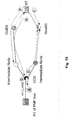
- Fig. 16 The control process of a PMP connection handoff using the OldBS COS discovery is illustrated in Fig. 16. It includes following steps.
- Lossless control using in-band signaling to synchronize stream.
- a marker OAM cell can be inserted at the COS.
- the MT receives the marker OAM cell from the OldBS, it requests dropping the OldLeaf and moves to the NewBS.
- the NewBS when the marker OAM cell is received, cell buffering starts until it makes sure that the MT is ready to receive data from the NewBS.
- the marker cells sent to the MT and the NewBS may be different in format or the same. Using an identical cell for both is preferred.
- a signaling mechanism is defined by extending ATM signaling at the UNI and NNI interfaces. It includes new and modified ILMI (Interim Local Management Interface) and Q2931 signaling messages.
- ILMI Interim Local Management Interface
- Q2931 Signaling messages
- the extension sets are represented as ILMI+ and Q2931+, respectively. New messages and modified messages are shown in time sequence. The signaling sequence can be explained from the following aspects.
- a mobile ATM terminal registers on the NewBS to obtain resources, such as ATM addresses, signaling permanent virtual circuits (PVCs), and radio frequencies.
- the MT may not need a full registration to the NewBS as it boots up, but the resources availability must at least be checked before the handoff of the data connections.
- the ILMI+ messages MT_HANDOFF_REQUEST /RESPONSE are used for resource acquisition from the NewBS. These messages may be referred to as initial handoff request and initial handoff response messages.
- the message MT_LEAVE_CELL releases the resources on the OldBS.
- the message MT_ENTER_CELL activates the using of the resources on NewBS.
- the PMP handoff control process may proceed.
- a new message called the PMP_HANDOFF_REQUEST message is defined for initiating the PMP handoff control process and for discovering a PMP COS.
- a Leaf Locator ID information element for the NewBS is included.
- the COS is selected when the massage traverses an EBN whose peer group covers the NewBS.
- the MT puts into a PMP_HANDOFF_REQUEST message at least the Leaf Locator ID of the NewBS. This message goes from the MT to the OldBS. The message is evaluated at the switching node that serves the OldBS.
- Any switching node detecting a PMP_HANDOFF_REQUEST message may evaluate the message. If the switching node is not an EBN, then there is no need to evaluate the message in detail; a non-EBN switching node may simply pass the message upstream. If a switching node receives a PMP_HANDOFF_REQUEST message, and the switching node happens to be an EBN, then the switching node must evaluate the message in detail. In particular, the switching node must determine whether it is in a peer group that covers the NewBS indicated in the PMP_HANDOFF_REQUEST message.
- An EBN may determine whether it is in a peer group that covers the NewBS indicated in the PMP_HANDOFF_REQUEST message by performing an address / name comparison, taking advantage of the hierarchical naming convention already described above and the PNNI Route View.
- the EBN passes the message upstream.
- an ADD PARTY / SETUP message is sent toward the NewBS.
- a Handoff Control Information Element (HCIE) is included in the message to indicate the message is for handoff control.
- a regular ADD PARTY / SETUP message ends at the user side UNI interface, but the ADD PARTY / SETUP message with HCIE can end instead at the network side UNI interface on the NewBS. In other words, there is no need to pass this message on to the user side UNI.
- the ADD PARTY/SETUP message with HCIE is necessary only to establish the path from the COS to the NewBS. Although the ADD PARTY / SETUP with HCIE does not reach the MT, which is not yet at the NewBS, the MT is added through the NewBS virtually.
- the NewBS In response to the ADD PARTY / SETUP message with HCIE, the NewBS virtually adds the MT and then replies with a CONNECT / ADD PARTY ACK to the COS.
- the NewLeaf is thus set up when the CONNECT / ADD PARTY ACK is sent to the COS.
- HOSYN H and o ff Cell Syn chronization
- the HOSYN OAM cell is inserted to the input virtual circuit (VC) at the COS.
- the HOSYN OAM cell may be sent to both the OldBS and the NewBS.
- the NewBS receives the HOSYN OAM cell, it knows that a specific MT is in the handoff process. It will begin to buffer the cell stream upon receipt of the HOSYN until such time as a control message from the MT is received.
- the HOSYN may be sent to both the OldBS and the NewBS.
- the MT at the OldBS may send a DROP PARTY request to the root.
- This message has a HCIE indicating it is a handoff control message. The message goes upstream until it reaches the COS (or MT's proxy root, in a Network LIJ PMP connection, whichever is reached first).
- the COS itself sends the DROP PARTY message to the OldLeaf after the HOSYN is sent out.
- the endpoint reference for the MT must be available at the COS, and which may be accomplished via the PMP_HANDOFF_REQUEST sent earlier from downstream.
- the NewLeaf is virtually added at the NewBS through the SETUP message.
- a new message, HANDOFF_JOIN is used to release the cell stream buffering on the NewBS.
- the HANDOFF_JOIN message is sent by the MT to the NewBS.
- One HANDOFF_JOIN can be used for all VC's of the MT.
- the NewBS Upon receiving the HANDOFF_JOIN message, the NewBS releases all the buffering for the MT, including both point-to-point and point-to-multipoint connections.
- the above-identified invention in all of its embodiments may be embodied in a computer system for a node or terminal in an ATM network that contains hardware and software enabling it to perform the foregoing handoff operations.
- the above-identified invention may be embodied also in a computer program product, as will now be explained.
- the software that enables the computer system to perform the above-identified approach and operations of the invention is supplied on any one of a variety of media.
- the actual implementation of the approach and operations of the invention are actually statements written in a programming language. Such programming language statements, when executed by a computer, cause the computer to act in accordance with the particular content of the statements.
- the software that enables a computer system to act in accordance with the invention may be provided in any number of forms including, but not limited to, original source code, assembly code, object code, machine language, compressed or encrypted versions of the foregoing, and any and all equivalents.
- media may include a diskette, a tape, a compact disc, an integrated circuit, a cartridge, a remote transmission via a communications circuit, or any other similar medium useable by computers.
- the supplier might provide a diskette or might transmit the software in some form via satellite transmission, via a direct telephone link, or via the Internet.
- program product is thus used to refer to a computer useable medium, as defined above, which bears in any form of software to enable a computer system to operate in any of the described roles (i.e., MT, node, RT, EBN, COS, BTS) according to the above-identified invention.
- the invention is also embodied in a program product bearing software which enables a computer to operate or participate in the foregoing handoff control method for PMP connections in a mobile ATM network according to the invention.
Landscapes
- Engineering & Computer Science (AREA)
- Computer Networks & Wireless Communication (AREA)
- Signal Processing (AREA)
- Mobile Radio Communication Systems (AREA)
- Data Exchanges In Wide-Area Networks (AREA)
- Small-Scale Networks (AREA)
Claims (8)
- Verfahren zur Steuerung einer Gesprächsweiterreichung bei einem mobilen Endgerät (MT) für eine Punkt-zu-Mehrpunktverbindung, welche nachfolgend als PMP-Verbindung bezeichnet wird, in einem mobilen ATM-Netz, wobei das Verfahren die folgenden Schritte aufweist:- Bestimmen einer Kennung einer neuen Basisstation (NewBS), welche einen entsprechenden Versorgungsbereich (70) aufweist; dann- Senden einer anfänglichen Gesprächsweiterreichungs-Anforderungsnachricht von dem mobilen Endgerät (MT) an die neue Basisstation (NewBS) über die derzeit gültige oder aktive Basisstation; dann- Senden einer anfänglichen Gesprächsweiterreichungs-Antwortnachricht von der neuen Basisstation (NewBS) an das mobile Endgerät (MT) über die derzeit gültige Basisstation, wobei ein Zustand der Betriebsmittel- oder Ressourcenverfügbarkeit an der neuen Basisstation (NewBS) angezeigt wird; dann- wenn die anfängliche Gesprächsweiterreichungsantwortnachricht anzeigt, dass ausreichend Betriebsmittel an der neuen Basisstation (NewBS) zur Verfügung stehen, Stellen einer PMP-Gesprächsweiterreichungs-Anforderung an eine derzeit gültige Ba-sisstation über einen alten virtuellen Schaltkreis, welcher die neue Basisstation (NewBS) anzeigt; dann- Liefern der PMP-Gesprächsweiterreichungs-Anforderung an einen Dateneingabe-Randknoten (EBN), welcher die derzeit gültige Basisstation und die neue Basisstation (NewBS) versorgt, wobei der Dateneingabe-Randknoten (EBN) einen Kreuzschienenschalter (COS) für den Transfer definiert; dann- Senden einer Add-Party-Nachricht von dem Kreuzschienenschalter (COS) an die neue Basisstation (NewBS); dann- Einrichten eines neuen virtuellen Schaltkreises für das mobile Endgerät (MT) an der neuen Basisstation (NewBS) ansprechend auf die Add-Party-Nachricht; dann- Bewirken, dass die neue Basisstation (NewBS) Zellen für den neuen virtuellen Schaltkreis zwischenspeichert, indem eine Markierungszelle vom Kreuzschienenschalter (COS) an die neue Basisstation (NewBS) gesendet wird, und Signalisieren an das mobile Endgerät (MT), in dem neuen virtuellen Schaltkreis teilzunehmen oder mitzu- wirken, indem eine jeweilige Markierzelle an das mobile Endgerät (MT) gesendet wird; und dann- Signalisieren an die neue Basisstation (NewBS), die zwischengespeicherten Zellen für das mobile Endgerät (MT) freizugeben.
- Verfahren zur Steuerung einer Gesprächsweiterreichung bei einem mobilen Endgerät für eine Punkt-zu-Mehrpunkt(PMP)-Verbindung in einem mobilen ATM-Netz nach Anspruch 1, dadurch gekennzeichnet, dass die Bestimmung, ob der Vermittlungsknoten ein die neue Basisstation (NewBS) versorgender Dateneingabe-Randknoten (EBN) ist, an einem Vermittlungsknoten bewertet wird, und dass:- wenn die Bestimmung positiv ist, der Vermittlungsknoten als Kreuzschienenschalter (COS) ausgewählt wird; und- wenn die Bestimmung negativ ist, die Gesprächsweiterreichungs-Anforderung netzaufwärts geleitet wird.
- Vermittlungsknoten, welcher zur Steuerung einer Gesprächsweiterreichung bei einem mobilen Endgerät für eine Punkt-zu-Mehrpunkt(PMP)-Verbindung in einem mobilen ATM-Netz ausgelegt ist, wobei der Vermittlungsknoten Folgendes aufweist:- einen Prozessor, und- einen Speicher, welcher Software-Befehle enthält, die derart ausgelegt sind, dass sie es dem Prozessor ermöglichen, zu bewirken, dass der Vermittlungsknoten die folgenden Schritte ausführt:- Empfangen einer Gesprächsweiterreichungs-Anforderung über einen alten virtuellen Schaltkreis, welcher eine neue Basisstation (NewBS) für das mobile Endgerät (MT) anzeigt;- Auswerten der Gesprächsweiterreichungs-Anforderung, um zu bestimmen, ob der Vermittlungsknoten ein Dateneingabe-Randknoten (EBN) ist, welcher die neue Basisstation (NewBS) versorgt;- bei positiver Bestimmung, Bewirken der Gesprächsweiterreichung als Kreuzschienenschalter (COS); und- bei negativer Bestimmung, Weiterleiten der Gesprächsweiterreichungs-Anforderung netzaufwärts,dadurch gekennzeichnet, dass der Speicher des Weiteren Software-Befehle einschließt, welche derart ausgelegt sind, dass sie es dem Vermittlungsknoten ermöglichen, die Ausführung der Gesprächsweiterreichung so zu bewirken, dass sie die folgenden Schritte aufweist:- Bewirken, dass die neue Basisstation (NewBS) einen neuen virtuellen Schaltkreis für das mobile Endgerät (MT) einrichtet;- Bewirken, dass die neue Basisstation (NewBS) Zellen für den neuen virtuellen Schaltkreis zwischenspeichert, wobei dies durch Senden einer Markierungszelle an die neue Basisstation (NewBS) bewirkt wird;- Signalisieren an das mobile Endgerät (MT), in dem virtuellen Schaltkreis mitzuwirken, wobei die Signalisierung durch Senden einer Zelle, welche identisch mit der Markierungszelle ist, an ein mobiles Endgerät (MT) erfolgt; und- Signalisieren an die neue Basisstation (NewBS), die zwischengespeicherten Zellen für das mobile Endgerät (MT) freizugeben.
- Vermittlungsknoten, welcher zur Steuerung der Gesprächsweiterreichung bei einem mobilen Endgerät (MT) für eine Punkt-zu-Mehrpunkt(PMP)-Verbindung in einem mobilen ATM-Netz nach Anspruch 3 ausgelegt ist, wobei der Vermittlungsknoten des Weiteren Folgendes aufweist:- eine Basisstations-Sende- und Empfangseinheit (30); und- eine Basisstations-Verarbeitungseinheit (40), welche die Basisstations-Sende- und Empfangseinheit (30) steuert, damit diese Funkkommunikationen mit dem mobilen Endgerät (MT) empfängt und sendet.
- Computerprogrammprodukt, um es einem Prozessor eines Vermittlungsknotens zu ermöglichen, eine Gesprächsweiterreichung bei einem mobilen Endgerät (MT) für eine Punkt-zu-Mehrpunkt(PMP)-Verbindung in einem mobilen ATM-Netz zu steuern, wobei das Computerprogrammprodukt Folgendes aufweist:- Software-Befehle, welche es dem Prozessor ermöglichen, vorher festgelegte Operationen oder Vorgänge auszuführen; sowie- einen computerlesbaren Datenträger, auf welchem die Software-Befehle gespeichert sind;- wobei die vorher festgelegten Operationen oder Vorgänge die folgenden Schritte aufweisen:- Empfangen einer Gesprächsweiterreichungs-Anforderung über einen alten virtuellen Schaltkreis, welcher eine neue Basisstation (NewBS) für das mobile Endgerät (MT) anzeigt;- Bewerten der Gesprächsweiterreichungs-Anforderung, um zu bestimmen, ob der Vermittlungsknoten ein Dateneingabe-Randknoten (EBN) ist, welcher die neue Basisstation (NewBS) versorgt;- bei positiver Bestimmung, Bewirken der Gesprächsweiterreichung als Kreuzschienenschalter (COS); und- bei negativer Bestimmung, Weiterleiten der Gesprächsweiterreichungs-Anforderung netzaufwärts,wobei:- das Bewirken der Gesprächsweiterreichung so erfolgt, dass sie die folgenden Schritte einschließt:- Bewirken, dass die neue Basisstation (NewBS) einen neuen virtuellen Schaltkreis für das mobile Endgerät (MT) einrichtet;- Bewirken, dass die neue Basisstation (NewBS) Zellen für den neuen virtuellen Schaltkreis zwischenspeichert, wobei dies durch Senden einer Markierungszelle an die neue Basisstation (NewBS) erfolgt;- Signalisieren an das mobile Endgerät (MT), in dem neuen virtuellen Schaltkreis mitzuwirken, wobei die Signalisierung dadurch erfolgt, dass eine mit der Markierungszelle identische Zelle an das mobile Endgerät (MT) gesendet wird; und- Signalisieren an die neue Basisstation (NewBS), die zwischengespeicherten Zellen für das mobile Endgerät (MT) freizugeben.
- Mobiles Funkendgerät, welches für den Betrieb in einem mobilen ATM-Netz ausgelegt ist, wobei das mobile Funkendgerät Folgendes aufweist:- einen Prozessor, und- einen Speicher, welcher Software-Befehle enthält, die so ausgelegt sind, dass sie es dem Prozessor ermöglichen, zu bewirken, dass das mobile Endgerät (MT), wenn es in einer Punkt-zu-Mehrpunkt(PMP)-Verbindung teilnimmt, die folgenden Schritte ausführt:- Bestimmen einer Kennung einer neuen Basisstation (NewBS), welche einen entsprechenden Versorgungsbereich (70) aufweist;- Senden einer Gesprächsweiterreichungs-Anforderung über einen alten virtuellen Schaltkreis, welcher die neue Basisstation (NewBS) anzeigt;- Empfangen einer Signalisierungsnachricht über den alten virtuellen Schaltkreis;- Teilnehmen oder Mitwirken in einem neuen virtuellen Schaltkreis ansprechend auf die Signalisierungsnachricht;- wobei der Speicher weiter Software-Befehle aufweist, welche derart ausgelegt sind, dass sie es dem Prozessor ermöglichen, des Weiteren den Empfangsschritt auszuführen, indem eine Markierungszelle als die Signalisierungsnachricht empfangen wird.
- Computerprogrammprodukt, um es einem Prozessor eines mobilen Endgeräts (MT) zu ermöglichen, in einem Gesprächsweiterreichungsvorgang mitzuwirken, welcher eine Punkt-zu-Mehrpunkt(PMP)-Verbindung in einem mobilen ATM-Netz beinhaltet, wobei das Computerprogrammprodukt Folgendes aufweist:- Software-Befehle, um es einem Prozessor zu ermöglichen, vorher festgelegte Operationen oder Vorgänge durchzuführen; und- einen computerlesbaren Datenträger, welcher die Software-Befehle speichert oder trägt;- wobei die vorher festgelegten Operationen oder Vorgänge die folgenden Schritte aufweisen:- Bestimmen einer Kennung einer neuen Basisstation (NewBS), welche einen entsprechenden Versorgungsbereich (70) aufweist;- Senden einer Gesprächsweiterreichungs-Anforderung über einen alten virtuellen Schaltkreis, welcher die neue Basisstation (NewBS) anzeigt;- Empfangen einer Signalisierungsnachricht über den alten virtuellen Schaltkreis, wobei der Empfang den Empfang einer Markierungszelle einschließt; und- Mitwirken in einem neuen virtuellen Schaltkreis ansprechend auf die Signalisierungsnachricht.
- Computerprogrammprodukt, welches einem Prozessor eines mobilen Endgeräts (MT) ermöglicht, in einem Gesprächsweiterreichungsvorgang, welcher an einer Punkt-zu-Mehrpunkt(PMP)-Verbindung in einem mobilen ATM-Netz nach Anspruch 6 beteiligt ist, mitzuwirken, dadurch gekennzeichnet, dass:- der Schritt des Bewirkens, dass die neue Basisstation (NewBS) die Zellen zwischenspeichert, dadurch erfolgt, dass die Markierungszelle an die neue Basisstation (NewBS) gesendet wird; und- der Schritt der Signalisierung an das mobile Endgerät (MT), in dem neuen virtuellen Schaltkreis mitzuwirken, dadurch erfolgt, dass eine mit der Markierungszelle identische Zelle an das mobile Endgerät (MT) gesendet wird.
Applications Claiming Priority (2)
| Application Number | Priority Date | Filing Date | Title |
|---|---|---|---|
| US09/145,225 US6643279B1 (en) | 1998-09-01 | 1998-09-01 | Handoff control for point to multipoint connections in mobile ATM networks |
| US145225 | 1998-09-01 |
Publications (3)
| Publication Number | Publication Date |
|---|---|
| EP0984656A2 EP0984656A2 (de) | 2000-03-08 |
| EP0984656A3 EP0984656A3 (de) | 2003-02-12 |
| EP0984656B1 true EP0984656B1 (de) | 2007-01-24 |
Family
ID=22512145
Family Applications (1)
| Application Number | Title | Priority Date | Filing Date |
|---|---|---|---|
| EP99103788A Expired - Lifetime EP0984656B1 (de) | 1998-09-01 | 1999-02-26 | Weiterreichsteuerung für eine Punkt zur Mehrpunkt Verbindung in einem Mobilen ATM-Netzwerk |
Country Status (4)
| Country | Link |
|---|---|
| US (1) | US6643279B1 (de) |
| EP (1) | EP0984656B1 (de) |
| JP (1) | JP3444220B2 (de) |
| DE (1) | DE69934944T2 (de) |
Families Citing this family (18)
| Publication number | Priority date | Publication date | Assignee | Title |
|---|---|---|---|---|
| GB2359220A (en) * | 2000-02-03 | 2001-08-15 | Orange Personal Comm Serv Ltd | Handover in accordance with a network policy |
| US6990088B2 (en) | 2000-08-18 | 2006-01-24 | Telefonaktiebolaget L M Ericsson (Publ) | Handoff in radio telecommunications networks |
| US20020083151A1 (en) * | 2000-12-22 | 2002-06-27 | Robert Adams | System and method for database access and management |
| US6826154B2 (en) * | 2001-05-24 | 2004-11-30 | 3Com Corporation | Method and apparatus for seamless mobility between different access technologies |
| US7009952B1 (en) | 2001-05-24 | 2006-03-07 | 3Com Corporation | Method and apparatus for seamless mobility with layer two assistance |
| JP2003069617A (ja) | 2001-08-27 | 2003-03-07 | Ntt Docomo Inc | ハンドオーバ制御装置、基地局、エッジルータ、中継ルータ、無線端末機、移動通信システム及びハンドオーバ制御方法 |
| JP4108950B2 (ja) * | 2001-09-12 | 2008-06-25 | 株式会社エヌ・ティ・ティ・ドコモ | ハンドオーバ制御装置、無線端末機、エッジルータ、ルータ、移動通信システム及びハンドオーバ制御方法 |
| KR100421893B1 (ko) * | 2001-12-29 | 2004-03-11 | 엘지전자 주식회사 | Watm 망에서 핸드오프 수행 방법 |
| JP2004222070A (ja) | 2003-01-16 | 2004-08-05 | Ntt Docomo Inc | 経路制御装置及び経路制御方法 |
| BRPI0507448A (pt) * | 2004-02-06 | 2007-07-10 | Matsushita Electric Industrial Co Ltd | método de transferência de passagem de comunicação para um terminal móvel, programa de transferência de passagem de comunicação, método de processamento de mensagem de comunicação para um nó ou um roteador, e, programa de processamento de mensagem de comunicação |
| CN1943187A (zh) * | 2004-02-13 | 2007-04-04 | 松下电器产业株式会社 | 数据通信网络中的信令管理 |
| KR20070046899A (ko) * | 2004-07-30 | 2007-05-03 | 마츠시타 덴끼 산교 가부시키가이샤 | 신규 경로 설정 방법 및 이동 단말 및 경로 관리 장치 |
| CN101194478A (zh) * | 2005-06-09 | 2008-06-04 | 松下电器产业株式会社 | 路径设置方法和路径管理设备 |
| DE602005002259T2 (de) * | 2005-06-30 | 2008-05-21 | Ntt Docomo Inc. | Vorrichtung und Verfahren für verbesserte Weiterreichung in Maschennetzwerken |
| BRPI0612659A2 (pt) * | 2005-07-08 | 2016-11-29 | Matsushita Electric Industrial Co Ltd | método e programa de detecção de nó de cruzamento, nó móvel, e, aparelho de retransmissão |
| DE602005020803D1 (de) * | 2005-10-13 | 2010-06-02 | Mitsubishi Electric Corp | Verfahren zur Bestimmung ob ein Weiterreichungsverfahren eines mobilen Terminals ausgeführt werden muss |
| CN101043436B (zh) * | 2006-03-20 | 2012-06-20 | 华为技术有限公司 | 基于标签分配协议提高通信质量的方法 |
| KR101569031B1 (ko) | 2009-03-23 | 2015-11-13 | 엘지전자 주식회사 | Home (e)NodeB에 대한 단말의 접속을 제어하는 방법 |
Family Cites Families (7)
| Publication number | Priority date | Publication date | Assignee | Title |
|---|---|---|---|---|
| US5528583A (en) * | 1993-05-26 | 1996-06-18 | The Trustees Of Columbia University In The City Of New York | Method and apparatus for supporting mobile communications in mobile communications networks |
| US5875185A (en) * | 1995-10-10 | 1999-02-23 | Industrial Technology Research Inst. | Seamless handoff for a wireless lan/wired lan internetworking |
| FI102654B (fi) * | 1996-02-22 | 1999-01-15 | Nokia Mobile Phones Ltd | Menetelmä tukiaseman vaihtamiseksi ATM-verkon radiolaajennuksessa |
| US5940381A (en) * | 1996-03-14 | 1999-08-17 | Motorola, Inc. | Asynchronous transfer mode radio communications system with handoff and method of operation |
| US5974036A (en) * | 1996-12-24 | 1999-10-26 | Nec Usa, Inc. | Handoff-control technique for wireless ATM |
| US6023461A (en) * | 1997-10-10 | 2000-02-08 | Nec Usa, Inc. | Handoff method for an ATM wireless network wherein both the switch and the mobile buffer cells and the mobile controls when the handoff will occur |
| JPH10200536A (ja) | 1997-01-09 | 1998-07-31 | Toshiba Corp | ネットワークシステム |
-
1998
- 1998-09-01 US US09/145,225 patent/US6643279B1/en not_active Expired - Fee Related
-
1999
- 1999-02-26 DE DE69934944T patent/DE69934944T2/de not_active Expired - Lifetime
- 1999-02-26 EP EP99103788A patent/EP0984656B1/de not_active Expired - Lifetime
- 1999-03-09 JP JP06187699A patent/JP3444220B2/ja not_active Expired - Fee Related
Also Published As
| Publication number | Publication date |
|---|---|
| JP3444220B2 (ja) | 2003-09-08 |
| JP2000078165A (ja) | 2000-03-14 |
| DE69934944T2 (de) | 2007-10-31 |
| US6643279B1 (en) | 2003-11-04 |
| EP0984656A3 (de) | 2003-02-12 |
| EP0984656A2 (de) | 2000-03-08 |
| DE69934944D1 (de) | 2007-03-15 |
Similar Documents
| Publication | Publication Date | Title |
|---|---|---|
| EP0984656B1 (de) | Weiterreichsteuerung für eine Punkt zur Mehrpunkt Verbindung in einem Mobilen ATM-Netzwerk | |
| US5974036A (en) | Handoff-control technique for wireless ATM | |
| US6529489B1 (en) | Plural communication connection setting method | |
| JP3202928B2 (ja) | 通信ネットワークにおいて呼びを確立するシステム | |
| US5659544A (en) | Method and system for distributed control in wireless cellular and personal communication systems | |
| Yuan et al. | Mobility support in a wireless ATM network | |
| JPH10224381A (ja) | 無線atmシステムの部分を実現するネットワーク構造及び該ネットワーク構造においてスイッチ間ハンドオーバを実行する方法 | |
| Naylon et al. | Low-latency handover in a wireless ATM LAN | |
| EP0851701A2 (de) | Kontrollverfahren zum Weiterreichen in schnurlosem ATM Netz | |
| Yu et al. | Connection architecture and protocols to support efficient handoffs over an ATM/B-ISDN personal communications network | |
| US20010053138A1 (en) | ATM handoff process | |
| EP1008267A2 (de) | Lokalisierungsverwaltung in einem verbindungsorientierten paketnetzwerk | |
| Salah et al. | A two-phase inter-switch handoff scheme for wireless ATM networks | |
| KR100306159B1 (ko) | 이동통신시스템의 기지국 제어기에서 비동기전송모드 전송구간의영구가상접속 설정 장치 및 방법 | |
| Li et al. | Handoff control for point to multipoint connections in mobile ATM networks | |
| US6888827B1 (en) | Communications system with special channel | |
| KR100344875B1 (ko) | 인터넷 프로토콜 패킷 데이터 전송 장비들간의 상호 연동방법 | |
| Jiang et al. | Wireless ATM: handover issues | |
| Martínez et al. | A FIXED NETWORK MECHANISM FOR THE SUPPORT OF MULTIMEDIA COMMUNICATIONS IN AN EXPERIMENTAL WATM NETWORK | |
| Li et al. | Handoff control in the PNNI hierarchy of mobile ATM networks | |
| KR100297596B1 (ko) | 무선비동기전송방식(watm) 네트워크에서의 핸드오버 시그널링 방법 | |
| JP3437058B2 (ja) | マルチポイント接続における迂回接続処理方法 | |
| Takahashi et al. | A center‐controlled dynamic rerouting scheme for fast and reliable handover in mobile ATM networks | |
| US20020143919A1 (en) | Network comprising a localization management | |
| Biswas et al. | An agent‐based signaling architecture for supporting mobility in radio ATM networks |
Legal Events
| Date | Code | Title | Description |
|---|---|---|---|
| PUAI | Public reference made under article 153(3) epc to a published international application that has entered the european phase |
Free format text: ORIGINAL CODE: 0009012 |
|
| AK | Designated contracting states |
Kind code of ref document: A2 Designated state(s): AT BE CH CY DE DK ES FI FR GB GR IE IT LI LU MC NL PT SE |
|
| AX | Request for extension of the european patent |
Free format text: AL;LT;LV;MK;RO;SI |
|
| PUAL | Search report despatched |
Free format text: ORIGINAL CODE: 0009013 |
|
| AK | Designated contracting states |
Designated state(s): AT BE CH CY DE DK ES FI FR GB GR IE IT LI LU MC NL PT SE |
|
| AX | Request for extension of the european patent |
Extension state: AL LT LV MK RO SI |
|
| 17P | Request for examination filed |
Effective date: 20021230 |
|
| AKX | Designation fees paid |
Designated state(s): DE FI GB SE |
|
| GRAP | Despatch of communication of intention to grant a patent |
Free format text: ORIGINAL CODE: EPIDOSNIGR1 |
|
| RIC1 | Information provided on ipc code assigned before grant |
Ipc: H04L 12/56 20060101ALI20060719BHEP Ipc: H04Q 7/24 20060101ALI20060719BHEP Ipc: H04Q 11/04 20060101AFI20060719BHEP |
|
| GRAS | Grant fee paid |
Free format text: ORIGINAL CODE: EPIDOSNIGR3 |
|
| GRAA | (expected) grant |
Free format text: ORIGINAL CODE: 0009210 |
|
| AK | Designated contracting states |
Kind code of ref document: B1 Designated state(s): DE FI GB SE |
|
| REG | Reference to a national code |
Ref country code: GB Ref legal event code: FG4D |
|
| REF | Corresponds to: |
Ref document number: 69934944 Country of ref document: DE Date of ref document: 20070315 Kind code of ref document: P |
|
| REG | Reference to a national code |
Ref country code: SE Ref legal event code: TRGR |
|
| PLBE | No opposition filed within time limit |
Free format text: ORIGINAL CODE: 0009261 |
|
| STAA | Information on the status of an ep patent application or granted ep patent |
Free format text: STATUS: NO OPPOSITION FILED WITHIN TIME LIMIT |
|
| 26N | No opposition filed |
Effective date: 20071025 |
|
| PGFP | Annual fee paid to national office [announced via postgrant information from national office to epo] |
Ref country code: SE Payment date: 20130212 Year of fee payment: 15 Ref country code: GB Payment date: 20130220 Year of fee payment: 15 Ref country code: DE Payment date: 20130220 Year of fee payment: 15 Ref country code: FI Payment date: 20130212 Year of fee payment: 15 |
|
| REG | Reference to a national code |
Ref country code: DE Ref legal event code: R119 Ref document number: 69934944 Country of ref document: DE |
|
| REG | Reference to a national code |
Ref country code: SE Ref legal event code: EUG |
|
| GBPC | Gb: european patent ceased through non-payment of renewal fee |
Effective date: 20140226 |
|
| PG25 | Lapsed in a contracting state [announced via postgrant information from national office to epo] |
Ref country code: FI Free format text: LAPSE BECAUSE OF NON-PAYMENT OF DUE FEES Effective date: 20140226 |
|
| PG25 | Lapsed in a contracting state [announced via postgrant information from national office to epo] |
Ref country code: SE Free format text: LAPSE BECAUSE OF NON-PAYMENT OF DUE FEES Effective date: 20140227 |
|
| REG | Reference to a national code |
Ref country code: DE Ref legal event code: R119 Ref document number: 69934944 Country of ref document: DE Effective date: 20140902 |
|
| PG25 | Lapsed in a contracting state [announced via postgrant information from national office to epo] |
Ref country code: DE Free format text: LAPSE BECAUSE OF NON-PAYMENT OF DUE FEES Effective date: 20140902 Ref country code: GB Free format text: LAPSE BECAUSE OF NON-PAYMENT OF DUE FEES Effective date: 20140226 |