EP0979322B1 - Abschirmsystem mit wechselnder lichtabschirmung, beinhaltend ein netz mit einstellbarem offnungsfaktor - Google Patents
Abschirmsystem mit wechselnder lichtabschirmung, beinhaltend ein netz mit einstellbarem offnungsfaktor Download PDFInfo
- Publication number
- EP0979322B1 EP0979322B1 EP99907652A EP99907652A EP0979322B1 EP 0979322 B1 EP0979322 B1 EP 0979322B1 EP 99907652 A EP99907652 A EP 99907652A EP 99907652 A EP99907652 A EP 99907652A EP 0979322 B1 EP0979322 B1 EP 0979322B1
- Authority
- EP
- European Patent Office
- Prior art keywords
- zone
- blind
- threads
- web
- void factor
- Prior art date
- Legal status (The legal status is an assumption and is not a legal conclusion. Google has not performed a legal analysis and makes no representation as to the accuracy of the status listed.)
- Expired - Lifetime
Links
- 239000004744 fabric Substances 0.000 claims description 3
- 239000011368 organic material Substances 0.000 claims description 2
- 239000011800 void material Substances 0.000 claims 14
- 239000011147 inorganic material Substances 0.000 claims 1
- 229910010272 inorganic material Inorganic materials 0.000 claims 1
- 239000011248 coating agent Substances 0.000 description 5
- 238000000576 coating method Methods 0.000 description 5
- 230000037431 insertion Effects 0.000 description 5
- 238000004519 manufacturing process Methods 0.000 description 5
- 238000003780 insertion Methods 0.000 description 4
- 238000009941 weaving Methods 0.000 description 4
- 238000004804 winding Methods 0.000 description 4
- 239000000470 constituent Substances 0.000 description 3
- 238000009413 insulation Methods 0.000 description 3
- 238000000034 method Methods 0.000 description 2
- 206010052128 Glare Diseases 0.000 description 1
- 230000032683 aging Effects 0.000 description 1
- 230000015572 biosynthetic process Effects 0.000 description 1
- 238000007598 dipping method Methods 0.000 description 1
- 230000004313 glare Effects 0.000 description 1
- 229910052500 inorganic mineral Inorganic materials 0.000 description 1
- 239000012212 insulator Substances 0.000 description 1
- 238000009940 knitting Methods 0.000 description 1
- 230000031700 light absorption Effects 0.000 description 1
- 239000000463 material Substances 0.000 description 1
- 239000011707 mineral Substances 0.000 description 1
- 238000012986 modification Methods 0.000 description 1
- 230000004048 modification Effects 0.000 description 1
- 230000000750 progressive effect Effects 0.000 description 1
- 230000000717 retained effect Effects 0.000 description 1
- 230000002441 reversible effect Effects 0.000 description 1
- 230000035882 stress Effects 0.000 description 1
- 229920001169 thermoplastic Polymers 0.000 description 1
- 239000004416 thermosoftening plastic Substances 0.000 description 1
- 238000011282 treatment Methods 0.000 description 1
Images

Classifications
-
- D—TEXTILES; PAPER
- D03—WEAVING
- D03D—WOVEN FABRICS; METHODS OF WEAVING; LOOMS
- D03D9/00—Open-work fabrics
-
- B—PERFORMING OPERATIONS; TRANSPORTING
- B60—VEHICLES IN GENERAL
- B60J—WINDOWS, WINDSCREENS, NON-FIXED ROOFS, DOORS, OR SIMILAR DEVICES FOR VEHICLES; REMOVABLE EXTERNAL PROTECTIVE COVERINGS SPECIALLY ADAPTED FOR VEHICLES
- B60J1/00—Windows; Windscreens; Accessories therefor
- B60J1/20—Accessories, e.g. wind deflectors, blinds
- B60J1/2011—Blinds; curtains or screens reducing heat or light intensity
- B60J1/2013—Roller blinds
- B60J1/2036—Roller blinds characterised by structural elements
- B60J1/2041—Blind sheets, e.g. shape of sheets, reinforcements in sheets, materials therefor
-
- D—TEXTILES; PAPER
- D03—WEAVING
- D03D—WOVEN FABRICS; METHODS OF WEAVING; LOOMS
- D03D13/00—Woven fabrics characterised by the special disposition of the warp or weft threads, e.g. with curved weft threads, with discontinuous warp threads, with diagonal warp or weft
- D03D13/008—Woven fabrics characterised by the special disposition of the warp or weft threads, e.g. with curved weft threads, with discontinuous warp threads, with diagonal warp or weft characterised by weave density or surface weight
Definitions
- the present invention relates to the field of blinds or curtains of networks which can be made by weaving threads to have a determined opening factor.
- networks delimit by their interlaced wires, selected opening meshes without this term of mesh being able to let suppose that the subject of the invention is essentially oriented towards networks, the constitution of which is obtained, not by weaving, but by knitting giving rise to the formation of stitches by the intertwined thread (s)
- the invention relates to mesh networks which are intended to constitute panel curtains and / or slats or blinds that can be used in arrangement internal or external with respect to one or more bay windows or the like.
- Such curtains or blinds generally have the function of attenuating the passage of light in the case of high light and / or to constitute a kind of screen introducing a thermal insulation factor, more particularly when such screens are placed in external arrangement relative to bays.
- Networks of the above type are generally coated with material thermo-plastic, either by prior coating of the wires, or by coating by dipping, such a coating being intended to impart suitable resistance to aging, more particularly in the case of external placement.
- the coating should also generally be considered as having a specific vocation of tying allowing a bond to be established between the interleaved wires which are woven in a weave which can be arbitrary insofar as it allows to remain a significant factor of openness, of the type of that of articles sold as that attenuation screen for the passage of light.
- the determined area in question may be that located at the base of a curtain or blind or at the top, or even in some cases, in the middle part of said curtain or blind considered in its deployed or unwound state.
- the object of the invention is precisely to fill such a gap and to make it possible to provide a network to meshes that can be produced to locally present a part with an opening factor different according to a very clearly delimited area or, on the contrary, showing a progressive variation.
- Document NL 95 00 121 A describes a network with variable density, but not a satisfactory blind or curtain the need identified by the applicant.
- the blind or curtain comprising a network according to the invention, for the constitution of a screen with light attenuation and / or thermal insulation function, is characterized in that the network consists of two layers of organic material son or mineral, intertwined to delimit meshes locally defining an area having a mesh opening factor different from that of the rest of the network (see claim 1).
- Fig. 1 shows, in partial plan view, a network 1 which is formed by weaving a first layer of wires 2 interleaved with a second layer of wires 3 .
- the interlacing involves a weave of the taffeta or preferably canvas type, without this weave being to be considered as being an essential determining element within the meaning of the invention.
- any suitable weave can be retained, as soon as the mode of interlacing chosen results in leaving, between the layers of interlaced wires 2 and 3 , open meshes 4 determining the opening factor of the network 1 .
- the layers 2 and 3 are made from organic or inorganic yarns.
- the son of the web 3 have a constant spacing which is for example equal to that presented by the constituent son of the area 5a.
- the network designated as a whole by the reference 1 has a zone 5a whose opening factor can be qualified as low compared to the strong opening factor presented by zone 5b.
- the invention also relates to the choice of a texture so that the spacing of the threads, for example of the ply 2 , is gradually varying, for example from zone 5a 1 to zone 5b 2 , so that the latter has a greater opening factor than zone 5a 1 .
- the variation in spacing can be non-constant and for example involve a certain recurrence in the succession.
- the opening factor of area 5a can be of the order of 2%, or even preferably 5%, while the opening factor of area 5b can reach 20% and be preferably located at 15%.
- Fig. 2 shows an example of constitution of a screen or a curtain intended to constitute a light attenuator or an insulator by being then disposed externally to a bay which it is responsible for obscuring.
- a coupon or a network panel 1 is cut to the appropriate measures so as to be able to be linked, for example by the edge of the zone 5a, such as 5a 1 to a winding mandrel 10 mounted on axes 11 and capable of be driven in reversible rotation by a mechanism 12 manually or electrically controlled.
- the mandrel 10 makes it possible to wind or unwind, as illustrated in FIG. 2, the network coupon 1, so that in the unrolled state, the zone 5a is located immediately following the mandrel 10 while the zone 5b is always arranged in the direction of the lower part of the bay to be obscured.
- a light attenuation factor intervenes through the zone 5a while the zone 5b lets in a suitable luminosity to ensure sufficient lighting and comfort without the result for the occupants of the premises equipped with such a curtain, any risk of glare.
- zone 5a occupies a height of the order of two thirds of the height H of the curtain unrolled while zone 5b occupies the remaining third.
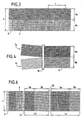
- One of the best techniques consists in warping the ply 2 as a ply of warp threads over a width L corresponding substantially to a maximum height of future use such as the height H according to FIG. 2 when it is a question of constituting a blind or curtain capable of obscuring windows or bays with standardized dimensional characteristics.
- the establishment of the chain son ply 2 involves a variable concentration of these son, for example according to the two zones 5a and 5b respectively qualified as low opening factor and high opening factor.
- zones 5a and 5b are substantially equivalent in transverse extent, but it must obviously be considered within the meaning of the invention that different and variable extents from one product to another can be conferred on zones 5a and 5b.
- the concentration of chain son is constant, for each of the areas 5a and 5b. It could be quite different by providing for a gradual or degressive variation from one to the other of the zones, or even successively from one to another when the width L is occupied by a number of zones greater than two.
- the son ply 2 can be established from a single beam, as shown in FIG. 3, or even from two or more, as illustrated in FIG. 4. It may, in such a case, be advantageous to ensure the specific guidance of the wires of the parts of plies corresponding to zones 5a and 5b by means of a comb or the like 15 .
- the weaving of the network from the establishment of the ply of warp threads then involves the insertion of the constituent threads of the ply 3 and then forming, in the example, weft threads. This insertion occurs with an opening of the chain son depending on the weave chosen, all these provisions falling within the knowledge of the skilled person.
- the network is woven in a known manner on such bases and can, after coating, winding and constitution of coils, be used in the unwinding by being cut parallel to the weft threads 3 so that an elementary width 1 corresponds to the width a blind or curtain definitively constituted.
- the network is woven in such a way that the cut cross allows to have coupons or panels meeting the dimensional characteristics to be required for the constitution of a blind or curtain, each corresponding coupon or panel and meeting the requirements of presence of at least one zone with an opening factor different from the opening factor of the rest of coupon.
- the width obtained during the manufacture of the network offers a mechanical behavior which is not likely to allow proper winding due to mechanical response locally different to a tensile stress.
- the network so as to have at the edge of the zone 5b with a high opening factor, a border 20 in which the constituent chain wires have a close concentration, otherwise identical to that presented by zone 5a of low opening factor.
- the width produced has two selvedges with behavior neighboring mechanics, if not identical, allowing manipulations, windings or subsequent treatments without risk of deformation.
- this embodiment is also advantageously used to give the part 5b 2 occupied by the selvedge 20 a mechanical resistance making it possible to easily carry out, ie fixing the coupon on a winding-unwinding mandrel such as 10 , or the connection with a load bar 21 as illustrated in FIG. 2.
- the network width or fabric obtained can be easily cut crosswise over a width which corresponds to the length of the width considered with respect to the direction of production, in order to provide an elementary part, the dimension of which, according to measure l, is chosen during cutting to correspond to the width of the curtain or blind which must ultimately be produced in the intended application.
- Such an elementary piece or coupon can then be easily adapted on the mandrel 10 in one direction or the other to reveal in the unrolled state, the area of low or high opening factor, either at the top or in the lower part depending on the intended application.
- Fig. 6 schematically shows another method of manufacturing the network from the establishment, as a web of warp threads, the threads 3 which in the previous example constituted the weft threads.
- the wires 3 are set up to have a constant spacing over the entire width l which can, for example, but not necessarily, correspond to a width of future use of a blackout curtain of a bay meeting standardized dimensional characteristics and as shown in fig. 2.
- the network is obtained by then proceeding with the insertion of the wires 2 which constitute the weft wires and by adopting for this insertion a pitch such that they make it possible to obtain successive zones such as 5b-5a with variable opening factor. .
- Fig. 6 shows an exemplary embodiment in which, by insertion program, it is possible to obtain a segment of width L1 including two zones 5a and 5b and a segment L2 of shorter length also having two zones 5a and 5b which are however established to cover areas different from those of the L1 segment .
- the initial network can be cut to produce slats used as is known for building of a screen.
- a blind or curtain comprising a network according to the invention can be used for different screen applications, one of the most preferred is that concerning the creation of screen curtains light attenuators.
Landscapes
- Engineering & Computer Science (AREA)
- Textile Engineering (AREA)
- Mechanical Engineering (AREA)
- Curtains And Furnishings For Windows Or Doors (AREA)
- Woven Fabrics (AREA)
Claims (9)
- Rollo oder Vorhang, das einen Aufrolldorn mit einem Netz kombiniert, das dazu bestimmt ist, einen lichtdämpfenden Schirm zu bilden, wobei das Netz aus zwei Floren Fäden aus organischem oder mineralischem Werkstoff besteht, die verwebt sind, um Maschen abzugrenzen, dadurch gekennzeichnet, dass die Fäden eines der Flore des Netzes einen konstanten Abstand aufweisen, während die Fäden des anderen Flors einen veränderlichen Abstand aufweisen, um lokal mindestens eine Zone (5a oder 5b) zu bilden, die einen Maschenöffnungsfaktor besitzt, der vom Rest des Netzes unterschieden ist, und dadurch, dass das Netz mit dem Aufrolldorn durch einen Verbindungsrand verbunden ist, der sich parallel zu den Fäden des Flors erstreckt, das einen variablen Abstand aufweist.
- Rollo oder Vorhang nach Anspruch 1, dadurch gekennzeichnet, dass der Verbindungsrand am Aufrolldorn einen Öffnungsfaktor aufweist, der kleiner ist als der des Rests des Netzes.
- Rollo oder Vorhang nach Anspruch 1 oder 2, dadurch gekennzeichnet, dass die Zone des Netzes, die einen unterschiedlichen Öffnungsfaktor aufweist, fester Bestandteil einer Textur ist, die so ausgewählt ist, dass der Abstand der Fäden mindestens eines der verwebten Flore allmählich variiert.
- Rollo oder Vorhang nach Anspruch 1 oder 2, dadurch gekennzeichnet, dass die Zone des Netzes, die einen unterschiedlichen Öffnungsfaktor aufweist, fester Bestandteil einer Textur ist, die so ausgewählt ist, dass der Abstand der Fäden mindestens eines der verwebten Flore über die ganze Weite der Zone konstant ist.
- Rollo oder Vorhang nach Anspruch 1, 2 oder 4, dadurch gekennzeichnet, dass es/er mindestens eine Zone (5a) mit kleinem Öffnungsfaktor und mindestens eine Zone (5b) mit großem Öffnungsfaktor umfasst.
- Rollo oder Vorhang nach Anspruch 5, dadurch gekennzeichnet, dass die Zone mit kleinem Öffnungsfaktor eine höhere Konzentration an Kettfäden aufweist als die Zone mit großem Öffnungsfaktor.
- Rollo oder Vorhang nach Anspruch 5 und/oder 6, dadurch gekennzeichnet, dass die Zone mit kleinem Öffnungsfaktor eine Konzentration an Schussfäden umfasst, die größer ist als die der Zone mit großem Öffnungsfaktor.
- Rollo oder Vorhang nach Anspruch 1, 2, 4, 5, 6 oder 7, dadurch gekennzeichnet, dass es/er eine Zone mit kleinem Öffnungsfaktor und eine Zone mit großem Öffnungsfaktor umfasst, die von einem Rand (20) umrandet ist, der einen kleinen Öffnungsfaktor aufweist.
- Rollo oder Vorhang nach einem der Ansprüche 1 bis 8, dadurch gekennzeichnet, dass die Öffnungsfaktoren zwischen 2 und 20 %, vorzugsweise zwischen 5 und 15 % liegen.
Applications Claiming Priority (3)
| Application Number | Priority Date | Filing Date | Title |
|---|---|---|---|
| FR9802650A FR2775487B1 (fr) | 1998-02-27 | 1998-02-27 | Reseau a facteur d'ouverture variable |
| FR9802650 | 1998-02-27 | ||
| PCT/FR1999/000447 WO1999043879A1 (fr) | 1998-02-27 | 1999-02-26 | Reseau a facteur d'ouverture variable pour la constitution d'ecrans attenuateurs de lumiere |
Publications (2)
| Publication Number | Publication Date |
|---|---|
| EP0979322A1 EP0979322A1 (de) | 2000-02-16 |
| EP0979322B1 true EP0979322B1 (de) | 2004-09-15 |
Family
ID=9523655
Family Applications (1)
| Application Number | Title | Priority Date | Filing Date |
|---|---|---|---|
| EP99907652A Expired - Lifetime EP0979322B1 (de) | 1998-02-27 | 1999-02-26 | Abschirmsystem mit wechselnder lichtabschirmung, beinhaltend ein netz mit einstellbarem offnungsfaktor |
Country Status (7)
| Country | Link |
|---|---|
| US (1) | US6397920B1 (de) |
| EP (1) | EP0979322B1 (de) |
| AU (1) | AU2731299A (de) |
| DE (1) | DE69920119D1 (de) |
| ES (1) | ES2229682T3 (de) |
| FR (1) | FR2775487B1 (de) |
| WO (1) | WO1999043879A1 (de) |
Families Citing this family (19)
| Publication number | Priority date | Publication date | Assignee | Title |
|---|---|---|---|---|
| DE59907872D1 (de) * | 1999-09-17 | 2004-01-08 | Sattler Ag Graz | Markisenstoff |
| DE20105483U1 (de) | 2001-03-29 | 2001-06-28 | Sattler Ag, Graz | Lichtschutztextil |
| US7165594B2 (en) * | 2002-03-22 | 2007-01-23 | Oxford House, Incorporated | Removable decorative vane cover |
| AU2003227350B2 (en) * | 2002-08-09 | 2005-12-22 | Huesker Synthetic Gmbh | Grid of synthetic material |
| US6772815B1 (en) * | 2003-02-11 | 2004-08-10 | Ren Judkins | Window covering having faces of parallel threads |
| FR2864138A1 (fr) | 2003-12-23 | 2005-06-24 | Hexcel Fabrics | Reseau destine a la constitution d'ecran attenuateur de lumiere et leur procede de fabrication |
| US7150305B2 (en) * | 2004-07-28 | 2006-12-19 | Union Looper Co., Ltd. | Curtain |
| FR2909703B1 (fr) | 2006-12-12 | 2009-03-06 | Hexcel Reinforcements Soc Par | Reseau, destine a la constitution d'un ecran attenuateur de lumiere, assurant une auto-regulation de la lumiere transmise |
| US20120103540A1 (en) * | 2010-10-27 | 2012-05-03 | Kris Shaffer | Window Treatment With Spatially Varied Transparency |
| EP2830465A4 (de) * | 2012-03-30 | 2016-03-16 | Saint Gobain Adfors Canada Ltd | Leicht zusammenrollbarer fester bildschirm |
| CA2900078C (en) | 2013-02-28 | 2021-07-06 | Odl, Incorporated | Retractable flexible-panel door |
| US9175509B2 (en) | 2013-03-15 | 2015-11-03 | Aedes Technologies | Screen with visible marker |
| US20140338222A1 (en) * | 2013-05-16 | 2014-11-20 | Soo Bok Song | Upper of footwear and manufacturing method thereof |
| CA2952352A1 (en) * | 2014-06-16 | 2015-12-23 | Nine Ip Limited | Netting material |
| US9528201B1 (en) * | 2015-07-13 | 2016-12-27 | Smart Textile Products, LLC | Insulating sheer fabric |
| USD841340S1 (en) * | 2016-06-13 | 2019-02-26 | Herman Miller, Inc. | Suspension textile sheet |
| USD832017S1 (en) | 2016-06-13 | 2018-10-30 | Herman Miller, Inc. | Chair component |
| BR112019008544B1 (pt) | 2016-10-28 | 2022-11-22 | Hunter Douglas Inc | Painel multicamadas flexível para uma cobertura de janela |
| TWD194984S (zh) | 2017-08-03 | 2018-12-21 | 希臘商卡拉提斯公司 | 護網 |
Family Cites Families (18)
| Publication number | Priority date | Publication date | Assignee | Title |
|---|---|---|---|---|
| US926200A (en) * | 1908-04-08 | 1909-06-29 | Fitz R Longstreet | Window-shade. |
| US1828678A (en) * | 1931-02-14 | 1931-10-20 | Ralph B Peterman | Weighted pin for draperies, curtains, and the like |
| US2037629A (en) * | 1934-07-19 | 1936-04-14 | Boott Mills | Duplex curtain |
| US2079831A (en) * | 1935-11-20 | 1937-05-11 | United Merchants & Mfg | Curtain |
| US2125422A (en) * | 1937-11-23 | 1938-08-02 | Guyan Mills Inc | Fabric for curtains or the like |
| GB624668A (en) | 1947-02-04 | 1949-06-14 | Joseph Folkard Eden | Improvements relating to hoists |
| US2817371A (en) * | 1953-11-02 | 1957-12-24 | Bates Mfg Co | Open mesh fabric woven with synthetic yarn |
| DE6903060U (de) * | 1969-01-28 | 1969-07-03 | Jakob Acker & Soehne | Gardine |
| US3822727A (en) * | 1972-08-07 | 1974-07-09 | K Small | Fabric weave |
| JPS51133574A (en) * | 1975-04-11 | 1976-11-19 | Permes Einlagestoff | Zonal core fabric |
| US4002188A (en) * | 1975-12-15 | 1977-01-11 | Phifer Wire Products, Inc. | Woven shade screen |
| DE3128487A1 (de) * | 1981-07-18 | 1983-01-27 | Robert Bosch Gmbh, 7000 Stuttgart | Waermedaemmanordnung fuer fenster, tueren und dergleichen |
| US4582109A (en) * | 1984-07-23 | 1986-04-15 | Custom Shade And Awning Corporation | Accordian fold type decorative fabric drapery system |
| DE3609845A1 (de) * | 1986-03-22 | 1987-09-24 | Stromag Maschf | Verfahren und vorrichtung zur musterbildung bei einer webmaschine |
| US5007125A (en) * | 1989-12-26 | 1991-04-16 | Beacon Manufacturing Company | Blanket having improved thermal characteristics in the portion covering the feet |
| JP3222158B2 (ja) * | 1990-09-08 | 2001-10-22 | アクゾ ノーベル ナムローゼ フェンノートシャップ | エアーバッグのフィルタ部分用の織布を製造する方法 |
| JP2787527B2 (ja) * | 1992-11-09 | 1998-08-20 | 株式会社キクチウエブテック | 織物/プラスチックシートの結合構造体 |
| NL9500121A (nl) * | 1995-01-23 | 1995-11-01 | Bruynzeel Plastics Bv | Gaasweefsel. |
-
1998
- 1998-02-27 FR FR9802650A patent/FR2775487B1/fr not_active Expired - Fee Related
-
1999
- 1999-02-26 AU AU27312/99A patent/AU2731299A/en not_active Abandoned
- 1999-02-26 ES ES99907652T patent/ES2229682T3/es not_active Expired - Lifetime
- 1999-02-26 EP EP99907652A patent/EP0979322B1/de not_active Expired - Lifetime
- 1999-02-26 US US09/403,046 patent/US6397920B1/en not_active Expired - Fee Related
- 1999-02-26 WO PCT/FR1999/000447 patent/WO1999043879A1/fr not_active Ceased
- 1999-02-26 DE DE69920119T patent/DE69920119D1/de not_active Expired - Lifetime
Also Published As
| Publication number | Publication date |
|---|---|
| ES2229682T3 (es) | 2005-04-16 |
| US6397920B1 (en) | 2002-06-04 |
| WO1999043879A1 (fr) | 1999-09-02 |
| FR2775487A1 (fr) | 1999-09-03 |
| FR2775487B1 (fr) | 2000-05-19 |
| DE69920119D1 (de) | 2004-10-21 |
| AU2731299A (en) | 1999-09-15 |
| WO1999043879A9 (fr) | 1999-11-11 |
| EP0979322A1 (de) | 2000-02-16 |
Similar Documents
| Publication | Publication Date | Title |
|---|---|---|
| EP0979322B1 (de) | Abschirmsystem mit wechselnder lichtabschirmung, beinhaltend ein netz mit einstellbarem offnungsfaktor | |
| KR100912862B1 (ko) | 일체 제직으로 이루어지는 횡 방향 각도조절형 블라인드지 및 그 제조방법 | |
| EP0456651A1 (de) | Schatten- und isolationsschirm mit hydrofilen textilfäden. | |
| FR2580003A1 (de) | ||
| US20110120661A1 (en) | Integrated weaving type three-dimensional curtain sheet fabric having bands and manufacturing method thereof | |
| EP2847411B1 (de) | Verfahren zur Steuerung der Licht- oder Luftdurchlässigkeit eines elastischen, erweiterbaren Vorhangs und dafür geeignete Steuerungsvorrichtung | |
| EP0931638A1 (de) | Verfahren und Vorrichtung zur simultanen Aufwicklung von mehreren vorimprägnierten Fasersträngen auf einen Kern und so hergestellte Verbundwerkstoffstrukturen | |
| KR101052194B1 (ko) | 연결 띠를 갖는 입체커튼지 | |
| FR2765616A1 (fr) | Perfectionnements a des volets roulants | |
| EP2088018B1 (de) | Elastische Plane für Verdeckrollo, entsprechendes Verdeckrollo und Kraftfahrzeug | |
| EP1199160B1 (de) | Rolloanordnung für Fahrzeuge | |
| KR102464728B1 (ko) | 휨억제 구조를 갖는 베네시안 블라인드용 차양날개의 제조방법과, 이를 이용하여 제조된 베네시안 블라인드용 차양날개 | |
| FR3160710A1 (fr) | Tissu elastique, et dispositif d’occultation incluant un tel tissu | |
| KR101696141B1 (ko) | 커튼 일체형 버티컬 블라인드의 블라인드지 제조방법 | |
| FR2782528A1 (fr) | Element multicouches d'isolation et son procede de fabrication | |
| EP3898225B1 (de) | Flexibles transparentes material mit verstärkungsfäden | |
| KR101404445B1 (ko) | 다층 직물 구조의 블라인드 및 그 제조방법 | |
| FR2892435A1 (fr) | Element de nappe ouverte a effet masquant, procede de fabrication et plafond temporaire realise a l'aide de tels elements | |
| FR2540525A1 (fr) | Tissu dote de plots solides saillants et son procede de fabrication | |
| DE102009056820A1 (de) | Rollostoffbahn | |
| EP1528131B1 (de) | Wärmeisolierender Stoff | |
| EP3540153B1 (de) | Sichtschutzelement für zäune | |
| FR2856336A1 (fr) | Feuille de matiere thermoplastique renforcee par des elements unidirectionnels de renforcement, et procede de fabrication | |
| FR2615214A1 (fr) | Etoffe enduite double face comportant des fourreaux et procede de fabrication | |
| FR2871407A1 (fr) | Toile d'isolation, notamment thermique |
Legal Events
| Date | Code | Title | Description |
|---|---|---|---|
| PUAI | Public reference made under article 153(3) epc to a published international application that has entered the european phase |
Free format text: ORIGINAL CODE: 0009012 |
|
| 17P | Request for examination filed |
Effective date: 19991108 |
|
| AK | Designated contracting states |
Kind code of ref document: A1 Designated state(s): CH DE ES FR GB IT LI NL |
|
| RBV | Designated contracting states (corrected) |
Designated state(s): CH DE ES FR GB IT LI NL |
|
| 17Q | First examination report despatched |
Effective date: 20020724 |
|
| RTI1 | Title (correction) |
Free format text: LIGHT ALTERNATING SCREEN-SYSTEM COMPRISING A NETWORK WITH VARIABLE OPENING FACTOR |
|
| GRAP | Despatch of communication of intention to grant a patent |
Free format text: ORIGINAL CODE: EPIDOSNIGR1 |
|
| RTI1 | Title (correction) |
Free format text: LIGHT ALTERNATING SCREEN-SYSTEM COMPRISING A NETWORK WITH VARIABLE OPENING FACTOR |
|
| GRAS | Grant fee paid |
Free format text: ORIGINAL CODE: EPIDOSNIGR3 |
|
| GRAA | (expected) grant |
Free format text: ORIGINAL CODE: 0009210 |
|
| AK | Designated contracting states |
Kind code of ref document: B1 Designated state(s): CH DE ES FR GB IT LI NL |
|
| PG25 | Lapsed in a contracting state [announced via postgrant information from national office to epo] |
Ref country code: NL Free format text: LAPSE BECAUSE OF FAILURE TO SUBMIT A TRANSLATION OF THE DESCRIPTION OR TO PAY THE FEE WITHIN THE PRESCRIBED TIME-LIMIT Effective date: 20040915 Ref country code: IT Free format text: LAPSE BECAUSE OF FAILURE TO SUBMIT A TRANSLATION OF THE DESCRIPTION OR TO PAY THE FEE WITHIN THE PRESCRIBED TIME-LIMIT;WARNING: LAPSES OF ITALIAN PATENTS WITH EFFECTIVE DATE BEFORE 2007 MAY HAVE OCCURRED AT ANY TIME BEFORE 2007. THE CORRECT EFFECTIVE DATE MAY BE DIFFERENT FROM THE ONE RECORDED. Effective date: 20040915 Ref country code: GB Free format text: LAPSE BECAUSE OF FAILURE TO SUBMIT A TRANSLATION OF THE DESCRIPTION OR TO PAY THE FEE WITHIN THE PRESCRIBED TIME-LIMIT Effective date: 20040915 |
|
| REG | Reference to a national code |
Ref country code: GB Ref legal event code: FG4D Free format text: NOT ENGLISH Ref country code: CH Ref legal event code: EP |
|
| REF | Corresponds to: |
Ref document number: 69920119 Country of ref document: DE Date of ref document: 20041021 Kind code of ref document: P |
|
| PG25 | Lapsed in a contracting state [announced via postgrant information from national office to epo] |
Ref country code: DE Free format text: LAPSE BECAUSE OF FAILURE TO SUBMIT A TRANSLATION OF THE DESCRIPTION OR TO PAY THE FEE WITHIN THE PRESCRIBED TIME-LIMIT Effective date: 20041216 |
|
| PG25 | Lapsed in a contracting state [announced via postgrant information from national office to epo] |
Ref country code: LI Free format text: LAPSE BECAUSE OF NON-PAYMENT OF DUE FEES Effective date: 20050228 Ref country code: CH Free format text: LAPSE BECAUSE OF NON-PAYMENT OF DUE FEES Effective date: 20050228 |
|
| NLV1 | Nl: lapsed or annulled due to failure to fulfill the requirements of art. 29p and 29m of the patents act | ||
| GBV | Gb: ep patent (uk) treated as always having been void in accordance with gb section 77(7)/1977 [no translation filed] |
Effective date: 20040915 |
|
| REG | Reference to a national code |
Ref country code: ES Ref legal event code: FG2A Ref document number: 2229682 Country of ref document: ES Kind code of ref document: T3 |
|
| PLBE | No opposition filed within time limit |
Free format text: ORIGINAL CODE: 0009261 |
|
| STAA | Information on the status of an ep patent application or granted ep patent |
Free format text: STATUS: NO OPPOSITION FILED WITHIN TIME LIMIT |
|
| 26N | No opposition filed |
Effective date: 20050616 |
|
| REG | Reference to a national code |
Ref country code: CH Ref legal event code: PL |
|
| REG | Reference to a national code |
Ref country code: FR Ref legal event code: TP |
|
| REG | Reference to a national code |
Ref country code: ES Ref legal event code: PC2A |
|
| PGFP | Annual fee paid to national office [announced via postgrant information from national office to epo] |
Ref country code: FR Payment date: 20110218 Year of fee payment: 13 |
|
| PGFP | Annual fee paid to national office [announced via postgrant information from national office to epo] |
Ref country code: ES Payment date: 20110315 Year of fee payment: 13 |
|
| REG | Reference to a national code |
Ref country code: FR Ref legal event code: ST Effective date: 20121031 |
|
| PG25 | Lapsed in a contracting state [announced via postgrant information from national office to epo] |
Ref country code: FR Free format text: LAPSE BECAUSE OF NON-PAYMENT OF DUE FEES Effective date: 20120229 |
|
| REG | Reference to a national code |
Ref country code: ES Ref legal event code: FD2A Effective date: 20130709 |
|
| PG25 | Lapsed in a contracting state [announced via postgrant information from national office to epo] |
Ref country code: ES Free format text: LAPSE BECAUSE OF NON-PAYMENT OF DUE FEES Effective date: 20120227 |