EP0976834B1 - Flüssiges Reagens zur Bestimmung von Kalzium - Google Patents
Flüssiges Reagens zur Bestimmung von Kalzium Download PDFInfo
- Publication number
- EP0976834B1 EP0976834B1 EP99114742A EP99114742A EP0976834B1 EP 0976834 B1 EP0976834 B1 EP 0976834B1 EP 99114742 A EP99114742 A EP 99114742A EP 99114742 A EP99114742 A EP 99114742A EP 0976834 B1 EP0976834 B1 EP 0976834B1
- Authority
- EP
- European Patent Office
- Prior art keywords
- calcium
- acid
- gldh
- reagent
- liquid reagent
- Prior art date
- Legal status (The legal status is an assumption and is not a legal conclusion. Google has not performed a legal analysis and makes no representation as to the accuracy of the status listed.)
- Expired - Lifetime
Links
Images

Classifications
-
- G—PHYSICS
- G01—MEASURING; TESTING
- G01N—INVESTIGATING OR ANALYSING MATERIALS BY DETERMINING THEIR CHEMICAL OR PHYSICAL PROPERTIES
- G01N33/00—Investigating or analysing materials by specific methods not covered by groups G01N1/00 - G01N31/00
- G01N33/48—Biological material, e.g. blood, urine; Haemocytometers
- G01N33/50—Chemical analysis of biological material, e.g. blood, urine; Testing involving biospecific ligand binding methods; Immunological testing
- G01N33/84—Chemical analysis of biological material, e.g. blood, urine; Testing involving biospecific ligand binding methods; Immunological testing involving inorganic compounds or pH
-
- C—CHEMISTRY; METALLURGY
- C12—BIOCHEMISTRY; BEER; SPIRITS; WINE; VINEGAR; MICROBIOLOGY; ENZYMOLOGY; MUTATION OR GENETIC ENGINEERING
- C12N—MICROORGANISMS OR ENZYMES; COMPOSITIONS THEREOF; PROPAGATING, PRESERVING, OR MAINTAINING MICROORGANISMS; MUTATION OR GENETIC ENGINEERING; CULTURE MEDIA
- C12N9/00—Enzymes; Proenzymes; Compositions thereof; Processes for preparing, activating, inhibiting, separating or purifying enzymes
- C12N9/0004—Oxidoreductases (1.)
- C12N9/0012—Oxidoreductases (1.) acting on nitrogen containing compounds as donors (1.4, 1.5, 1.6, 1.7)
- C12N9/0014—Oxidoreductases (1.) acting on nitrogen containing compounds as donors (1.4, 1.5, 1.6, 1.7) acting on the CH-NH2 group of donors (1.4)
- C12N9/0016—Oxidoreductases (1.) acting on nitrogen containing compounds as donors (1.4, 1.5, 1.6, 1.7) acting on the CH-NH2 group of donors (1.4) with NAD or NADP as acceptor (1.4.1)
-
- C—CHEMISTRY; METALLURGY
- C12—BIOCHEMISTRY; BEER; SPIRITS; WINE; VINEGAR; MICROBIOLOGY; ENZYMOLOGY; MUTATION OR GENETIC ENGINEERING
- C12Y—ENZYMES
- C12Y104/00—Oxidoreductases acting on the CH-NH2 group of donors (1.4)
- C12Y104/01—Oxidoreductases acting on the CH-NH2 group of donors (1.4) with NAD+ or NADP+ as acceptor (1.4.1)
- C12Y104/01002—Glutamate dehydrogenase (1.4.1.2)
-
- G—PHYSICS
- G01—MEASURING; TESTING
- G01N—INVESTIGATING OR ANALYSING MATERIALS BY DETERMINING THEIR CHEMICAL OR PHYSICAL PROPERTIES
- G01N2800/00—Detection or diagnosis of diseases
- G01N2800/04—Endocrine or metabolic disorders
Definitions
- the present invention relates to a liquid reagent for assaying calcium in body fluid samples.
- the inventive reagent contains a specific calcium-dependent glutamate dehydrogenase and a chelating agent and is in a liquid form, and consists of a kit containing two separate containers.
- the invention relates to a method for assaying calcium in body fluid samples by using the assay reagent.
- Calcium ion plays a significant role in biological organisms. In biological organisms, 99 % of calcium is locally present in bone and teeth, but calcium is continuously absorbed in bone or excreted therefrom at 700 mg/day. Thus, calcium is also present in body fluids and cells at a lesser amount than the amount in bone. The calcium in body fluids and cells is responsible for significant functions as second messenger in biological actions, including nerve transmission function, muscle contraction function, and hormonal actions, in addition to blood coagulation. Thus, the calcium level in body fluids, particularly in blood, should be retained constantly in a strict manner.
- blood calcium level is retained constantly by vitamin D, parathyroid hormone and calcitonin; in normal individuals, for example, calcium is present at 9 to 11 mg/dl in blood and the intra-day variation of the calcium level should be strictly retained within ⁇ 3 % at most.
- the calcium level varies in response to diseased conditions. Hypercalcemia occurs in diseases such as myxedema, malignant tumor sarcoidosis, hyperproteinemia, and hyperthyroidism; hypocalcemia emerges in diseases such as hypoparathyroidism, osteomalacia, renal rickets, uremia, hypoproteinemia, and bone metastasis of malignant tumor. Even a slight change of the blood calcium level in normal individuals simply indicates that the change is due to a disease. Thus, the blood calcium assay is a very important test item for laboratory tests.
- EP-A-0 555 046 discloses a method of determining Ca by using a transglutaminase capable of being activated with calcium.
- the invention has been achieved so as to satisfy such demands in the industry. It is an object of the invention to develop a novel calcium assay liquid reagent storable for a long term despite the liquid form.
- GLDH glutamate dehydrogenase
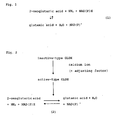
- GLDH is an enzyme catalyzing the reaction represented by the formula 1 in Fig. 1, including for example enzymes represented by Enzyme Nos. EC 1.4.1.2., EC 1.4.1.3. and EC 1.4.1.4.
- the enzyme of the Enzyme No. EC 1.4.1.2. specific to NAD + (nicotinamide adenine dinucleotide; at oxidized state) is distributed in animal tissues, plants and bacteria.
- the enzyme of the Enzyme No. EC 1.4.1.3. is reactive with both of NAD + and NADP + (nicotinamide adenine dinucleotide phosphate; at oxidized state) and is locally present in animal liver and renal mitochondria.
- the enzyme of the Enzyme No. EC 1.4.1.4. present in yeast and bacteria is specific to NADP + .
- the inventors have further promoted investigations about GLDH.
- the inventors have focused attention particularly to a GLDH species with no activity exertion unless calcium ion is present (namely, calcium-dependent GLDH) among these GLDH species.
- the inventors have attempted to contact the calcium-dependent enzyme (GLDH) to the calcium ion in a sample.
- GLDH calcium-dependent enzyme
- the inventors have first found that the GLDH enzyme activity varies in the presence of a substrate, depending on the calcium ion concentration in a sample and that the assay of the activity enables the assay of calcium ion.' After further investigations, consequently, the inventors have newly found that the calcium-dependent GLDH is stable in a liquid phase against temperature change under storage and can therefore retain a high enzyme activity in a solution for a long term.
- the invention has been achieved when the inventors have selected the calcium-dependent GLDH for a calcium assay system (in a liquid phase) for biological materials. Based on these new and useful findings, the invention has been achieved.
- the calcium-dependent GLDH is used for a liquid reagent for assaying calcium derived from a biological material in a sample.
- the activity of the GLDH is utilized.
- inactive-type GLDH is converted to active-type GLDH by utilizing calcium ion present in samples such as blood, serum, plasma and pancreatic juice. Then, ammonia, 2-oxoglutaric acid, NAD(P)H and the active-type GLDH are allowed to react together. By subsequently assaying for example the rate of NAD(P)H decrease on the basis of the absorbance around 340 nm, the amount of calcium derived from the biological material is assayed. Through the reaction represented by the formula 2 in Fig. 2, for example, the amount of calcium can be determined.
- calcium-dependent GLDH is utilized as shown in the aforementioned reaction.
- the calcium-dependent GLDH defined in claim 1 is utilized which never exerts the activity in the absence of calcium ion. It is a Calcium-dependent GLDH derived from maize.
- the specific maize-derived GLDH can retain the enzyme activity even after thermal treatment under conditions of 70 °C and pH 7.0 for 20 minutes.
- a liquid reagent for calcium assay can be provided, by using therein an enzyme stable in a solution state under storage.
- amino acid sequence is shown as SEQ ID No. 1
- the inventive calcium-dependent GLDH can be extracted and purified from maize by known methods including for example the method for the maize-derived enzyme as described in Plant Cell Physiol. 36, 5: 789-797, 1995.
- the calcium-dependent GLDH used according to the invention is satisfactorily a synthetic GLDH or a recombinant GLDH recovered by genetic engineering. A person skilled in the art can readily recover the calcium-dependent GLDH, according to the disclosure of the present Specification.
- the amino acid sequence of the calcium-dependent GLDH and the nucleotide sequence of the gene encoding the calcium-dependent GLDH have been elucidated by the inventors; and therefore, such GLDH can be not only extracted from natural products such as maize but also synthetically prepared or industrially prepared in a genetic engineering manner by inserting a DNA fragment of the GLDH gene in a known expression vector such as commercially available expression vectors to prepare a plasmid, transforming a host such as Escherichia coli by using the resulting plasmid, and culturing the transformant to recover the objective GLDH.
- the inventive liquid reagent characteristically contains the calcium-dependent GLDH in an aqueous medium as a first reagent.
- the calcium-dependent GLDH is contained at a concentration of 0.1 U/ml to 50 U/ml, preferably 0.5 U/ml to 10 U/ml.
- one unit of the enzyme is defined as the amount thereof to generate 1 ⁇ mol NAD + under standard GLDH assay conditions, for example at 37 °C and pH 8.0, per one minute.
- the inventive liquid reagent contains 0.2 mM to 0.5 mM NADH as a second reagent preferably 0.3 mM to 0.4 mM NADH, and 0.1 mM to 20 mM 2-oxoglutaric acid, preferably 0.5 mM to 10 mM 2-oxoglutaric acid also in the first reagent. These 2 reagents are charged in separated containers so that these are added at the time of reaction.
- chelating agents are satisfactorily be contained in the first or second liquid reagent.
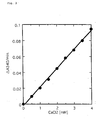
- calcium can be assayed satisfactorily by using the calcium-dependent GLDH. It is firstly confirmed that the enzymological examination of the apparent Km of the glutamate dehydrogenase for calcium is 10 ⁇ M and that a linear standard curve within a range of 0 to 4 mM Ca, which is significant for serum calcium assay, can be prepared by adjusting the activity of the glutamate dehydrogenase to enable the determination of serum calcium at a lower level in a linear manner.
- Usable chelating agents include EDTA (ethylenediaminetetraacetic acid), CyDTA (trans-1,2-cyclohexanediamine-N, N, N', N'-tetraacetic acid), DTPA (diethylenetriaminepentaacetic acid), GEDTA (glycol ether diaminetetraacetic acid), TTHA (triethylenetetraminehexaacetic acid), and methyl EDTA (diaminopropane tetraacetic acid) and additionally including NTA (nitrilotriacetic acid), EDTA-OH .(hydroxyethylenediaminetriacetic acid), IDA (iminodiacetic acid), and HIDA (hydroxyethyliminodiacetic acid).
- NTA is preferably illustrated as one example of the chelating agents.
- the inventive assay reagent satisfactorily contains the adjusting factor described above in the first or second reagent.
- the content of the adjusting factor is 0.1 to 100 mM; the content of NTA is preferably 1 to 50 mM.
- the content varies.
- the inventive reagent uses a single enzyme, namely a specific inactive-type GLDH, which is converted to active-type GLDH, depending on the calcium ion level in the biological material, to assay the enzyme activity of the active-type GLDH to determine the calcium ion level.
- a single enzyme namely a specific inactive-type GLDH, which is converted to active-type GLDH, depending on the calcium ion level in the biological material
- the inventive method uses a single enzyme, namely a specific inactive-type GLDH, which is converted to active-type GLDH, depending on the calcium ion level in the biological material, to assay the enzyme activity of the active-type GLDH to determine the calcium ion level.
- any sample possibly containing such body fluids can be assayed, with no specific limitation, and includes blood, serum, plasma and pancreatic juice.
- the sample is satisfactorily collected from living organisms.
- a specific inactive-type calcium-dependent GLDH is converted to active-type GLDH by using calcium present in a biological material.
- a reaction solution containing 2-oxoglutaric acid and NADH reacts with the resulting GLDH.
- the reaction is progressed at pH 6 to 9, preferably at 25 °C to 40 °C for 5 minutes to one hour.
- the enzyme activity of the active-type GLDH as converted by the presence of calcium ion can be assayed by known methods. Because NADPH exerts a specific absorption profile at 340 nm, the change of the absorbance at the wave length, as measured prior to and after GLDH reaction, is compared with the data of calcium conversion of GLDH , to determine the calcium level derived from a biological material.
- NADPH exerts a specific absorption profile at 340 nm
- a more linear standard curve can be yielded by adding a chelating agent as an adjusting factor to exert its action according to the inventive method (formula 2).
- the chelating agent composing the inventive liquid reagent for calcium assay can be allowed to exert its action prior to or during calcium conversion of inactive-type GLDH to active-type GLDH.
- Calcium-dependent GLDH derived from maize was expressed, extracted and purified as follows.
- a 1.5-kb DNA fragment containing the calcium-dependent GLDH gene and ranging from the restriction BspH I site to the restriction EcoR I site in the full-length region was inserted in the multicloning Nco I/ EcoR I site of a commercially available expression vector pTrc99A (Pharmacia Co.), to construct a plasmid pTrcZmGLDH expressing maize glutamate dehydrogenase.
- a transformant was recovered in a host Escherichia coli (abbreviated sometimes as E. coli ) strain JM105. The transformant E.
- coli JM105/pTrcZmGLDH was cultured in an LB culture medium (0.5 % yeast extract, 1 % tryptone, and 1 % sodium chloride, pH 7.5) containing 50 ⁇ g/ml sodium ampicillin, and when the transformant reached its logarithmic growth phase, an expression inducer of recombinant glutamate dehydrogenase, namely 1 mM IPTG (isopropylthio- ⁇ -galactoside), was added to the culture. The transformant was recovered at a wet weight yield of 6 g, by shaking culture in a flask containing the culture broth of 2 liters. Glutamate dehydrogenase was expressed and accumulated at the total activity of 2, 348 units in the bacteria.
- the enzyme activity of the glutamate dehydrogenase was assayed under the following conditions according to the aforementioned formula 2.
- GLDH can efficiently be produced by using the transformant Escherichia coli strain prepared by inserting a recombinant plasmid containing at least a part of the gene encoding GLDH in the host strain.
- the transformant is designated Escherichia coli JM105/pTrcZmGLDH and is deposited as Accession No. FERM BP-6705 under the Budapest Treaty in National Institute of Bioscience and Human-Technology, Agency of Industrial Science and Technology, of 1-3, Higashi 1 chome, Tsukuba-shi, Ibarakiken, Japan (the deposit date: April 19, 1999).
- One unit of the'activity can generate 1 ⁇ mol NAD + per one minute.
- the starting material transformant of 6 g (in wet weight) recovered through the flask culture was subjected to disruption and extraction of the bacteria and thermal treatment thereof and a combination of various chromatographic means, to elevate the purification ratio of the extracted solution of the disrupted bacteria to 165 fold.
- the specific activity of the purified enzyme sample was 660 U/mg.
- the purification process is schematically shown in the following Table 1.
- the enzyme activity of the maize-derived calcium-dependent GLDH recovered by the extraction and purification process was assayed under the conditions described in Example 1a. Consequently, purified maize-derived GLDH was recovered at a yield of 40, 000 units from 40 liters of the bacterial culture. The resulting calcium-dependent GLDH exerted the following properties.
- Example 2 Using the calcium-dependent GLDH recovered in Example 1, assessment was made about the adjustment of the enzyme activity for calcium concentration for assaying serum calcium level. So as to examine the activation in response to the concentration within a range of serum calcium concentration, the activation of maize-derived GLDH by calcium concentration in the presence of various chelating agents added as adjusting factors, each at 0.2 mM, was analyzed in a pattern. On the axis of abscissa is shown the sample calcium concentration; on the axis of ordinate is shown the relative ratio (%) of enzyme activation. The results are shown in Fig. 3. It is indicated that the addition of various chelating agents can adjust the calcium activation. At a 0-4 mM calcium concentration in a sample, NTA is particularly effective as an adjusting factor to permit almost linear activation response.
- Second reagent containing NADH is added to a mixture of a calcium sample solution and the first reagent, to determine the calcium activation pattern based on the initial velocity of enzyme reaction (triangle A340/min).
- Example 2 Based on the results of Example 2, furthermore, the relation between the NTA concentration and the calcium standard curve was examined. It was found that a linear standard curve could be prepared by using an assay reagent prepared as described below. The results are shown in Fig. 4. Additionally, the calcium level in a commercially available serum (Consera as Sample 1; manufactured by Nissui Pharmaceuticals, Co.) was assayed by using a standard curve prepared by using an aqueous calcium chloride solution as the standard solution; the recovery rate of calcium was calculated by using Sample 2 prepared by adding 1 mM calcium chloride to Sample 1. Consequently, as shown in the following Table 2, the recovery rate of calcium added to the Sample 1 from the Sample 2 was calculated to be 100.2 %.
- a commercially available serum Consera as Sample 1; manufactured by Nissui Pharmaceuticals, Co.
- the inventive liquid reagent can retain its high enzyme activity in solution for a long term because of the use of a specific calcium-dependent GLDH therein.
- the reagent is very stable in a solution state under storage, so the reagent can be incorporated in a liquid reagent kit with ready handling, to enable simple and accurate calcium assay in body fluid samples.
Landscapes
- Chemical & Material Sciences (AREA)
- Health & Medical Sciences (AREA)
- Life Sciences & Earth Sciences (AREA)
- Engineering & Computer Science (AREA)
- Organic Chemistry (AREA)
- Zoology (AREA)
- Biomedical Technology (AREA)
- Wood Science & Technology (AREA)
- Genetics & Genomics (AREA)
- Bioinformatics & Cheminformatics (AREA)
- General Health & Medical Sciences (AREA)
- Molecular Biology (AREA)
- Biochemistry (AREA)
- Medicinal Chemistry (AREA)
- Hematology (AREA)
- General Engineering & Computer Science (AREA)
- Biotechnology (AREA)
- Urology & Nephrology (AREA)
- Microbiology (AREA)
- Immunology (AREA)
- Pathology (AREA)
- General Physics & Mathematics (AREA)
- Food Science & Technology (AREA)
- Cell Biology (AREA)
- Analytical Chemistry (AREA)
- Physics & Mathematics (AREA)
- Inorganic Chemistry (AREA)
- Measuring Or Testing Involving Enzymes Or Micro-Organisms (AREA)
- Enzymes And Modification Thereof (AREA)
- Micro-Organisms Or Cultivation Processes Thereof (AREA)
Claims (5)
- Flüssiges Reagenz zur Verwendung zur Bestimmung von Calcium in Körperflüssigkeitsproben, welches aus einem Kit besteht, das zwei separate Behälter enthält, enthaltend ein erstes Reagenz, welches 2-Oxoglutarsäure und Calcium-abhängige Glutamat-Dehydrogenase enthält, und ein zweites Reagenz, enthaltend NADH; wobei das erste Reagenz oder das zweite Reagenz darüber hinaus ein oder mehr Chelatisierungsmittel für Calcium enthält, und wobei die Calcium-abhängige Glutamat-Dehydrogenase eine ist, die aus Mais erhalten wird, oder eine, die durch Verwendung einer mikrobiellen Transformante hergestellt wird, welche ein Expressionsplasmid enthält, das dieselbe Calcium-abhängige Glutamat-Dehydrogenase wie die aus Mais erhaltene exprimieren kann, wobei die Calcium-abhängige Glutamat-Dehydrogenase eine Aminosäuresequenz mit SEQ ID No. 1 aufweist.
- Flüssiges Reagenz nach Anspruch 1 zur Verwendung zur Bestimmung von Calcium in Blutserum.
- Flüssiges Reagenz nach einem der Ansprüche 1 und 2, wobei das eine oder mehr Chelatisierungsmittel ausgewählt wird/werden aus der Gruppe, die aus Ethylendiamintetraessigsäure, Trans-1,2-cyclohexandiamin-N,N,N',N'-tetraessigsäure, Diethylentriaminopentaessigsäure, Glykoletherdiamintetraessigsäure, Triethylentetraminhexaessigsäure, Diaminopropantetraessigsäure, Nitrilotriessigsäure, Hydroxyethylendiamintriessigsäure, Iminodiessigsäure und Hydroxyethyliminodiessigsäure besteht.
- Flüssiges Reagenz nach einem der Ansprüche 1 bis 3, wobei die mikrobielle Transformante Escherichia coli FERM BP-6705 ist.
- Verfahren zur Bestimmung von Calcium in Körperflüssigkeitsproben, welches Verwendung des flüssigen Reagenz nach einem der Ansprüche 1 bis 5 umfasst.
Applications Claiming Priority (4)
| Application Number | Priority Date | Filing Date | Title |
|---|---|---|---|
| JP22856598 | 1998-07-30 | ||
| JP22856598 | 1998-07-30 | ||
| JP14517399A JP4416866B2 (ja) | 1998-07-30 | 1999-05-25 | カルシウム測定用液状試薬 |
| JP14517399 | 1999-05-25 |
Publications (3)
| Publication Number | Publication Date |
|---|---|
| EP0976834A2 EP0976834A2 (de) | 2000-02-02 |
| EP0976834A3 EP0976834A3 (de) | 2000-06-14 |
| EP0976834B1 true EP0976834B1 (de) | 2004-03-10 |
Family
ID=26476373
Family Applications (1)
| Application Number | Title | Priority Date | Filing Date |
|---|---|---|---|
| EP99114742A Expired - Lifetime EP0976834B1 (de) | 1998-07-30 | 1999-07-28 | Flüssiges Reagens zur Bestimmung von Kalzium |
Country Status (4)
| Country | Link |
|---|---|
| US (2) | US20020120952A1 (de) |
| EP (1) | EP0976834B1 (de) |
| JP (1) | JP4416866B2 (de) |
| DE (1) | DE69915416T2 (de) |
Families Citing this family (1)
| Publication number | Priority date | Publication date | Assignee | Title |
|---|---|---|---|---|
| CN104951898B (zh) * | 2015-07-02 | 2017-02-22 | 北京理工大学 | 一种面向任务的协同多智能体联盟形成方法 |
Family Cites Families (4)
| Publication number | Priority date | Publication date | Assignee | Title |
|---|---|---|---|---|
| EP0035831B1 (de) * | 1980-03-07 | 1986-01-08 | Imperial Chemical Industries Plc | Verfahren zur Herstellung genetisch modifizierter Mikroorganismen |
| US4931390A (en) * | 1986-04-16 | 1990-06-05 | Public Health Research Institute Of The City Of New York, Inc. | Expression of the cloned lysostaphin gene |
| EP0309525A1 (de) * | 1987-04-10 | 1989-04-05 | The Flinders University Of South Australia | Bestimmung von ionen in flüssigkeiten |
| JP3164165B2 (ja) * | 1992-02-07 | 2001-05-08 | オリエンタル酵母工業株式会社 | カルシウムの定量方法 |
-
1999
- 1999-05-25 JP JP14517399A patent/JP4416866B2/ja not_active Expired - Fee Related
- 1999-07-28 DE DE1999615416 patent/DE69915416T2/de not_active Expired - Fee Related
- 1999-07-28 EP EP99114742A patent/EP0976834B1/de not_active Expired - Lifetime
-
2000
- 2000-12-13 US US09/734,731 patent/US20020120952A1/en not_active Abandoned
-
2003
- 2003-06-17 US US10/378,821 patent/US20040014163A1/en not_active Abandoned
Non-Patent Citations (2)
| Title |
|---|
| Loulakakis CA. AND Roubelakis-Angelakis KA.: "Intracellular Localization and Properties of NADH-Glutamate Dehydrogenase from Vits vinifer L.....", J. Exp. Bot. (1990), Vol. 41, No. 231, pages 1223-1230 * |
| SAKAKIBARA H. ET AL: "Isolation and Characterization of a cDNA that Encodes Maize Glutamate Dehydrogenase", PLANT CELL PHYSIOLOGY, vol. 36, no. 5, 1995, pages 789 - 797 * |
Also Published As
| Publication number | Publication date |
|---|---|
| US20040014163A1 (en) | 2004-01-22 |
| EP0976834A2 (de) | 2000-02-02 |
| DE69915416D1 (de) | 2004-04-15 |
| JP4416866B2 (ja) | 2010-02-17 |
| DE69915416T2 (de) | 2005-01-13 |
| US20020120952A1 (en) | 2002-08-29 |
| JP2000102392A (ja) | 2000-04-11 |
| EP0976834A3 (de) | 2000-06-14 |
Similar Documents
| Publication | Publication Date | Title |
|---|---|---|
| US8785147B2 (en) | L-threonine analysis method and L-threonine dehydrogenase | |
| KR20140020273A (ko) | 생체 시료 중의 l-트립토판 분석 방법 및 그것에 이용하는 키트 | |
| CN110044881B (zh) | 一种酶法测定肌酐的检测试剂盒及其使用方法 | |
| EP1176191B1 (de) | Alpha-glikolisierte aminosäure freisetzendes enzym | |
| CN116064427B (zh) | 一种酰基辅酶a合成酶突变体、其编码基因、表达菌株及其应用 | |
| McDonald et al. | Overproduction, purification, and subunit structure of Escherichia coli glycyl transfer ribonucleic acid synthetase | |
| EP1666586B1 (de) | Pyrrolochinolin-chinon (pqq)-abhängige glucosedehydrogenase-modifikation mit ausgezeichneter substratspezifität | |
| EP0976834A2 (de) | Flüssiges Reagens zur Bestimmung von Kalzium | |
| EP2039765A1 (de) | Verfahren zur bestimmung von 1,5-anhydroglucitol und reagentienzusammensetzung zur bestimmung von 1,5-anhydroglucitol | |
| Ferri et al. | Biomolecular engineering of biosensing molecules—The challenges in creating sensing molecules for glycated protein biosensing— | |
| JP2004275168A (ja) | フルクトシルアミン酸化酵素 | |
| KR890004091B1 (ko) | 과산화 수소를 형성하는 살코신 산화효소 및 그 제법 | |
| WO2021210614A1 (ja) | ケトン体測定用酵素剤、ケトン体測定用センサ及び試料中のケトン体を測定する方法 | |
| CN116601286A (zh) | 突变葡萄糖脱氢酶 | |
| Ferri et al. | Cloning and Expression of Fructosyl-amine Oxidase from Marine Yeast Pichia Species N1-1: Stefano Ferri et al. | |
| Delaney et al. | Relationship of lipoamide dehydrogenases from Pseudomonas putida to other FAD‐linked dehydrogenases | |
| CN119432779B (zh) | 一种酰基辅酶A合成酶突变体ACS01-Des4、其编码基因、表达菌株及其应用 | |
| CN110777188B (zh) | 一种酶法检测谷氨酸含量的方法及其应用 | |
| EP1561812B1 (de) | Modifizierte sarcosinoxidase, verfahrenzur herstellung davon und reagenzzusammenstellung unter verwendung davon | |
| CN121914998A (zh) | 一种胆固醇氧化酶突变体及其表达菌株和应用 | |
| CN121931067A (zh) | 一种酰基辅酶a氧化酶突变体及其表达菌株和应用 | |
| JP2008125368A (ja) | 新規なジペプチド分解酵素及びその製造方法並びにジペプチド分解酵素を用いる糖化蛋白質等の測定方法及びそれに用いる試薬組成物 | |
| US20120244520A1 (en) | D-serine dehydratase and use thereof | |
| JP2009072195A (ja) | 安定化されたザルコシンオキシダーゼ | |
| JP2009050274A (ja) | 安定化されたザルコシンオキシダーゼ |
Legal Events
| Date | Code | Title | Description |
|---|---|---|---|
| PUAI | Public reference made under article 153(3) epc to a published international application that has entered the european phase |
Free format text: ORIGINAL CODE: 0009012 |
|
| AK | Designated contracting states |
Kind code of ref document: A2 Designated state(s): DE FR GB IT |
|
| AX | Request for extension of the european patent |
Free format text: AL;LT;LV;MK;RO;SI |
|
| PUAL | Search report despatched |
Free format text: ORIGINAL CODE: 0009013 |
|
| AK | Designated contracting states |
Kind code of ref document: A3 Designated state(s): AT BE CH CY DE DK ES FI FR GB GR IE IT LI LU MC NL PT SE |
|
| AX | Request for extension of the european patent |
Free format text: AL;LT;LV;MK;RO;SI |
|
| 17P | Request for examination filed |
Effective date: 20000721 |
|
| AKX | Designation fees paid |
Free format text: DE FR GB IT |
|
| 17Q | First examination report despatched |
Effective date: 20010612 |
|
| REG | Reference to a national code |
Ref country code: GB Ref legal event code: FG4D |
|
| GRAP | Despatch of communication of intention to grant a patent |
Free format text: ORIGINAL CODE: EPIDOSNIGR1 |
|
| GRAS | Grant fee paid |
Free format text: ORIGINAL CODE: EPIDOSNIGR3 |
|
| GRAA | (expected) grant |
Free format text: ORIGINAL CODE: 0009210 |
|
| AK | Designated contracting states |
Kind code of ref document: B1 Designated state(s): DE FR GB IT |
|
| PG25 | Lapsed in a contracting state [announced via postgrant information from national office to epo] |
Ref country code: IT Free format text: LAPSE BECAUSE OF FAILURE TO SUBMIT A TRANSLATION OF THE DESCRIPTION OR TO PAY THE FEE WITHIN THE PRESCRIBED TIME-LIMIT;WARNING: LAPSES OF ITALIAN PATENTS WITH EFFECTIVE DATE BEFORE 2007 MAY HAVE OCCURRED AT ANY TIME BEFORE 2007. THE CORRECT EFFECTIVE DATE MAY BE DIFFERENT FROM THE ONE RECORDED. Effective date: 20040310 |
|
| REF | Corresponds to: |
Ref document number: 69915416 Country of ref document: DE Date of ref document: 20040415 Kind code of ref document: P |
|
| ET | Fr: translation filed | ||
| PLBE | No opposition filed within time limit |
Free format text: ORIGINAL CODE: 0009261 |
|
| STAA | Information on the status of an ep patent application or granted ep patent |
Free format text: STATUS: NO OPPOSITION FILED WITHIN TIME LIMIT |
|
| 26N | No opposition filed |
Effective date: 20041213 |
|
| PGFP | Annual fee paid to national office [announced via postgrant information from national office to epo] |
Ref country code: DE Payment date: 20070726 Year of fee payment: 9 |
|
| PGFP | Annual fee paid to national office [announced via postgrant information from national office to epo] |
Ref country code: GB Payment date: 20070725 Year of fee payment: 9 |
|
| PGFP | Annual fee paid to national office [announced via postgrant information from national office to epo] |
Ref country code: FR Payment date: 20070710 Year of fee payment: 9 |
|
| GBPC | Gb: european patent ceased through non-payment of renewal fee |
Effective date: 20080728 |
|
| PG25 | Lapsed in a contracting state [announced via postgrant information from national office to epo] |
Ref country code: DE Free format text: LAPSE BECAUSE OF NON-PAYMENT OF DUE FEES Effective date: 20090203 |
|
| REG | Reference to a national code |
Ref country code: FR Ref legal event code: ST Effective date: 20090331 |
|
| PG25 | Lapsed in a contracting state [announced via postgrant information from national office to epo] |
Ref country code: GB Free format text: LAPSE BECAUSE OF NON-PAYMENT OF DUE FEES Effective date: 20080728 |
|
| PG25 | Lapsed in a contracting state [announced via postgrant information from national office to epo] |
Ref country code: FR Free format text: LAPSE BECAUSE OF NON-PAYMENT OF DUE FEES Effective date: 20080731 |